
Zechariah 7:12

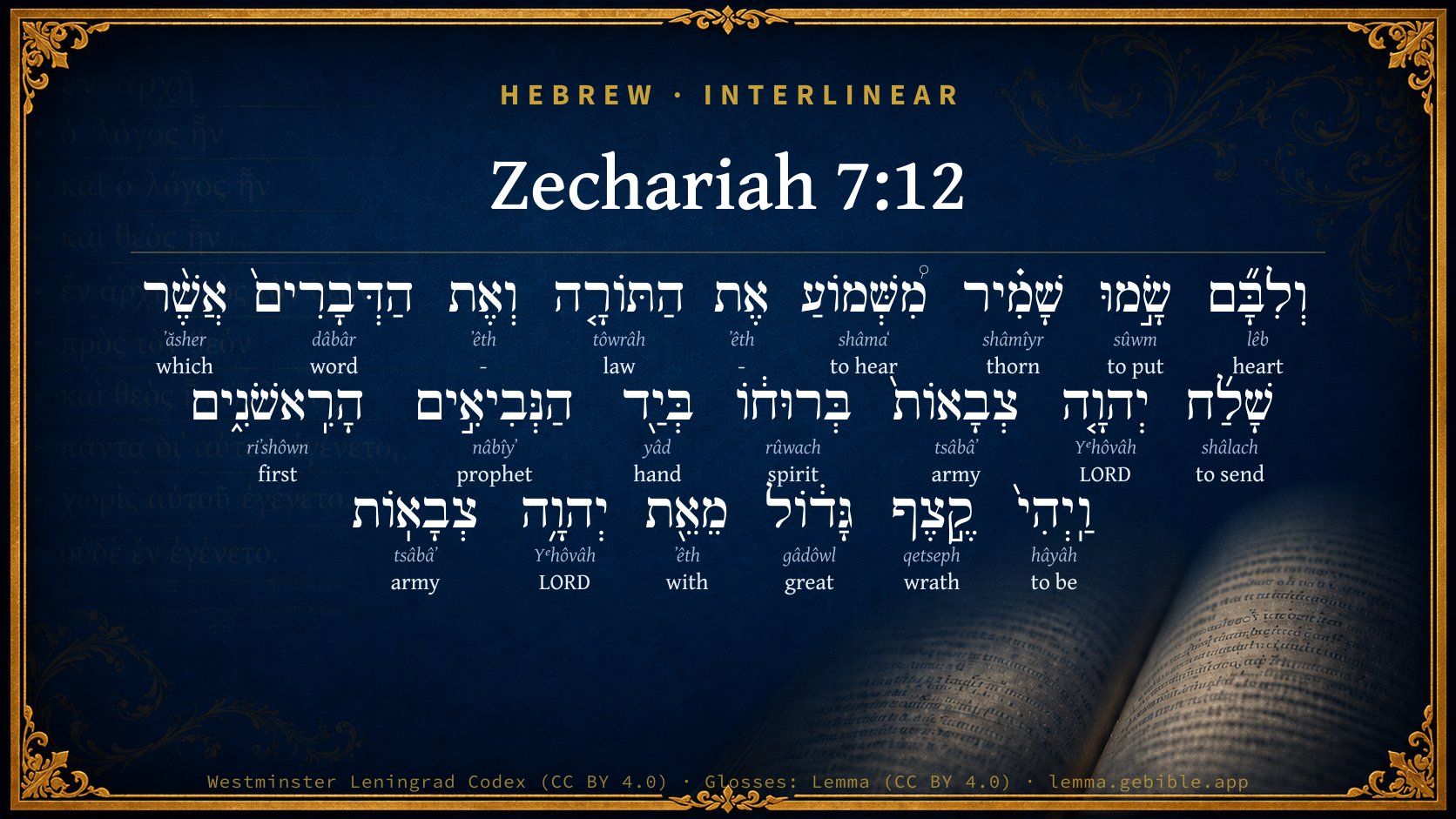
Hebrew (Westminster Leningrad Codex) Zechariah 7:12 appears in the Hebrew Old Testament. The text above is from the Westminster Leningrad Codex. Each word links to its Strong’s number, a concise gloss, and parsing drawn from the Open Scriptures Hebrew Bible morphology. Click any word for its full Brown-Driver-Briggs (BDB) entry.
Download image
Cite this verse

Zechariah 7:12 (World English Bible). Public Domain. Lemma interlinear Bible study tool, https://lemma.gebible.app/v/zechariah/7/12.

Show BibTeX & RIS
BibTeX
RIS
English Translation
Yes, they made their hearts as hard as flint, lest they might hear the law, and the words which Yahweh of Hosts had sent by his Spirit by the former prophets. Therefore great wrath came from Yahweh of Hosts.
World English Bible · Public Domain
Download a study sheet

One document with this verse’s original text, its word-by-word gloss line, the meaning frame, cross-references with their text, attributed commentary, and full source and license credits — printable, and it pastes into notes with its structure intact.

This verse Autodidact and up

Study sheet (.html) Plain text (.txt)

A passage Seminary Student

Up to 50 verses in one chapter. A passage sheet keeps up to 6 commentary sources and 12 cross-references per verse, in the order this page ranks them, and says so on the sheet whenever that leaves anything out. Ask for a single verse and you get the Autodidact verse sheet above.

Everything on this page stays free to read, with no account — the sheet is a download of what is already on screen, not access to it.

Want to remove ads? Support Godless Engineer
Compare translations 3

The same verse in 3 English versions, stacked beneath the original-language interlinear above. Click any original word for its lexicon entry.

Each is an independent rendering of the whole verse — the interlinear is not word-aligned to these translations.

Highlighted words mark where these versions differ — a whole-verse word diff, not a word-by-word alignment.

  • World English Bible Public Domain
    Yes, they made their hearts as hard as flint, lest they might hear the law, and the words which Yahweh of Hosts had sent by his Spirit by the former prophets. Therefore great wrath came from Yahweh of Hosts.
  • King James Version Public Domain
    Yea, they made their hearts as an adamant stone, lest they should hear the law, and the words which the LORD of hosts hath sent in his spirit by the former prophets: therefore came a great wrath from the LORD of hosts.
  • unfoldingWord Literal Text CC BY-SA 4.0
    And their hearts they set as flint from hearing the law and the words that Yahweh of Armies had sent by his Spirit by the hand of the former prophets. And there was great fury from Yahweh of Armies.

unfoldingWord Literal Text — © unfoldingWord, licensed CC BY-SA 4.0. Word-aligned USFM3 via Door43 (git.door43.org/unfoldingWord/en_ult).

Versions to compare (up to 4)

3 of 4 selected

Show all 18 translations

Every available English version of this verse, each an independent rendering of the whole verse.

  • World English Bible Public Domain
    Yes, they made their hearts as hard as flint, lest they might hear the law, and the words which Yahweh of Hosts had sent by his Spirit by the former prophets. Therefore great wrath came from Yahweh of Hosts.
  • Berean Standard Bible Public Domain
    They made their hearts like flint and would not listen to the law or to the words that the LORD of Hosts had sent by His Spirit through the earlier prophets. Therefore great anger came from the LORD of Hosts.
  • Majority Standard Bible Public Domain
    They made their hearts like flint and would not listen to the law or to the words that the LORD of Hosts had sent by His Spirit through the earlier prophets. Therefore great anger came from the LORD of Hosts.
  • King James Version Public Domain
    Yea, they made their hearts as an adamant stone, lest they should hear the law, and the words which the LORD of hosts hath sent in his spirit by the former prophets: therefore came a great wrath from the LORD of hosts.
  • American Standard Version (1901) Public Domain
    Yea, they made their hearts as an adamant stone, lest they should hear the law, and the words which Jehovah of hosts had sent by his Spirit by the former prophets: therefore there came great wrath from Jehovah of hosts.
  • Revised Version (1885) Public Domain
    Yea, they made their hearts as an adamant stone, lest they should hear the law, and the words which the LORD of hosts had sent by his spirit by the hand of the former prophets: therefore came there great wrath from the LORD of hosts.
  • Geneva Bible (1599) Public Domain
    Yea, they made their hearts as an adamant stone, least they should heare the Lawe and the wordes which the Lord of hostes sent in his spirit by the ministerie of ye former Prophets: therefore came a great wrath from the Lord of hostes.
  • Douay-Rheims (1899) Public Domain
    And they made their heart as the adamant stone, lest they should hear the law, and the words which the Lord of hosts sent in his spirit by the hand of the former prophets: so a great indignation came from the Lord of hosts.
  • Young's Literal Translation Public Domain
    And their heart they have made adamant, Against hearing the law, and the words, That Jehovah of Hosts sent by His Spirit, By the hand of the former prophets, And their is great wrath from Jehovah of Hosts.
  • Literal Standard Version CC BY-SA 4.0
    And their heart they have made adamant, || Against hearing the Law, and the words, || That YHWH of Hosts sent by His Spirit, || By the hand of the former prophets, || And there is great wrath from YHWH of Hosts.
  • Unlocked Literal Bible CC BY-SA 4.0
    They made their hearts as hard as rock so they would not hear the law or the words of Yahweh of hosts. He had sent these messages to the people by his Spirit in earlier times, by the mouth of the prophets. But the people refused to listen, so Yahweh of hosts was very angry with them.
  • unfoldingWord Literal Text CC BY-SA 4.0
    And their hearts they set as flint from hearing the law and the words that Yahweh of Armies had sent by his Spirit by the hand of the former prophets. And there was great fury from Yahweh of Armies.
  • Darby Bible Public Domain
    And they made their heart [as] an adamant, that they should not hear the law, and the words that Jehovah of hosts sent by his Spirit by the hand of the former prophets: therefore was there great wrath from Jehovah of hosts.
  • World Messianic Bible Public Domain
    Yes, they made their hearts as hard as flint, lest they might hear the law and the words which the LORD of Hosts had sent by his Spirit by the former prophets. Therefore great wrath came from the LORD of Hosts.
  • Webster's Bible Public Domain
    Yes, they made their hearts as an adamant stone, lest they should hear the law, and the words which the LORD of hosts hath sent in his spirit by the former prophets: therefore came a great wrath from the LORD of hosts.
  • Free Bible Version CC BY-SA 4.0
    They made their minds unreceptive, as hard as stone. They refused to listen to the law or to what the Lord Almighty told them by his Spirit through the former prophets. That's why the Lord Almighty became very angry with them.
  • Bible in Basic English Public Domain
    And they made their hearts like the hardest stone, so that they might not give ear to the law and the words which the Lord of armies had said by the earlier prophets: and there came great wrath from the Lord of armies.
  • JPS Tanakh (1917) Public Domain
    Yea, they made their hearts as an adamant stone, lest they should hear the law, and the words which the LORD of hosts had sent by His spirit by the hand of the former prophets; therefore came there great wrath from the LORD of hosts.

Literal Standard Version (2020), Covenant Press — licensed CC BY-SA 4.0. Text via the HelloAO Bible API (eBible.org). Unlocked Literal Bible (unfoldingWord) — licensed CC BY-SA 4.0. Text via the HelloAO Bible API (eBible.org). unfoldingWord Literal Text — © unfoldingWord, licensed CC BY-SA 4.0. Word-aligned USFM3 via Door43 (git.door43.org/unfoldingWord/en_ult). Free Bible Version, Dr. Jonathan Gallagher — licensed CC BY-SA 4.0. Text via the HelloAO Bible API (eBible.org).

Word by word

More ways to search: Search by grammar → Find every occurrence → Compare this word →

Practice this passage: Drill this verse → Learn its vocabulary →

שָׁמִ֗יר
shâmîyr
H8068
“thorn”
Noun, Common, Masculine, Singular, Absolute
Part of Speech
Noun
Type
Common
Gender
Masculine
Number
Singular
State
Absolute
Full BDB Definition

Origin: from H8104 in the original sense of pricking

TWOT: 2416a

thorn(s), adamant, flint - thorns, thorn-bushes - adamant (as sharp) - a sharp stone, flint - perhaps a diamond
  1. וְלִבָּ֞ם lêb H3820 “and · heart · their” Conjunction + Noun, Common, Masculine, Singular, Construct + Suffix, Personal, 3rd Person, Masculine, Plural
  2. שָׂ֣מוּ sûwm H7760 “to put” Verb, Qal, Perfect, 3rd Person, Common, Plural
  3. מִ֠שְּׁמוֹעַ shâmaʻ H8085 “from · to hear” Preposition + Verb, Qal, Infinitive Construct
  4. אֶת ʼêth H853 “-” Particle, Direct Object
  5. הַתּוֹרָ֤ה tôwrâh H8451 “the · law” Particle, Definite Article + Noun, Common, Feminine, Singular, Absolute
  6. וְאֶת ʼêth H853 “and · -” Conjunction + Particle, Direct Object
  7. הַדְּבָרִים֙ dâbâr H1697 “the · words” Particle, Definite Article + Noun, Common, Masculine, Plural, Absolute
  8. אֲשֶׁ֨ר ʼăsher H834 “which” Particle, Relative
  9. שָׁלַ֜ח shâlach H7971 “to send” Verb, Qal, Perfect, 3rd Person, Masculine, Singular
  10. יְהוָ֤ה Yᵉhôvâh H3068 “LORD” Noun, Proper
  11. צְבָאוֹת֙ tsâbâʼ H6635 “armies” Noun, Common, Both, Plural, Absolute
  12. בְּרוּח֔וֹ rûwach H7307 “in/at · spirit · his” Preposition + Noun, Common, Both, Singular, Construct + Suffix, Personal, 3rd Person, Masculine, Singular
  13. בְּיַ֖ד yâd H3027 “in/at · hand of” Preposition + Noun, Common, Both, Singular, Construct
  14. הַנְּבִיאִ֣ים nâbîyʼ H5030 “the · prophets” Particle, Definite Article + Noun, Common, Masculine, Plural, Absolute
  15. הָרִֽאשֹׁנִ֑ים riʼshôwn H7223 “the · first” Particle, Definite Article + Adjective, Adjective, Masculine, Plural, Absolute
  16. וַֽיְהִי֙ hâyâh H1961 “and · to be” Conjunction + Verb, Qal, Sequential Imperfect, 3rd Person, Masculine, Singular
  17. קֶ֣צֶף qetseph H7110 “wrath” Noun, Common, Masculine, Singular, Absolute
  18. גָּד֔וֹל gâdôwl H1419 “great” Adjective, Adjective, Masculine, Singular, Absolute
  19. מֵאֵ֖ת ʼêth H854 “from · with” Preposition + Preposition
  20. יְהוָ֥ה Yᵉhôvâh H3068 “LORD” Noun, Proper
  21. צְבָאֽוֹת tsâbâʼ H6635 “armies” Noun, Common, Both, Plural, Absolute

About this verse

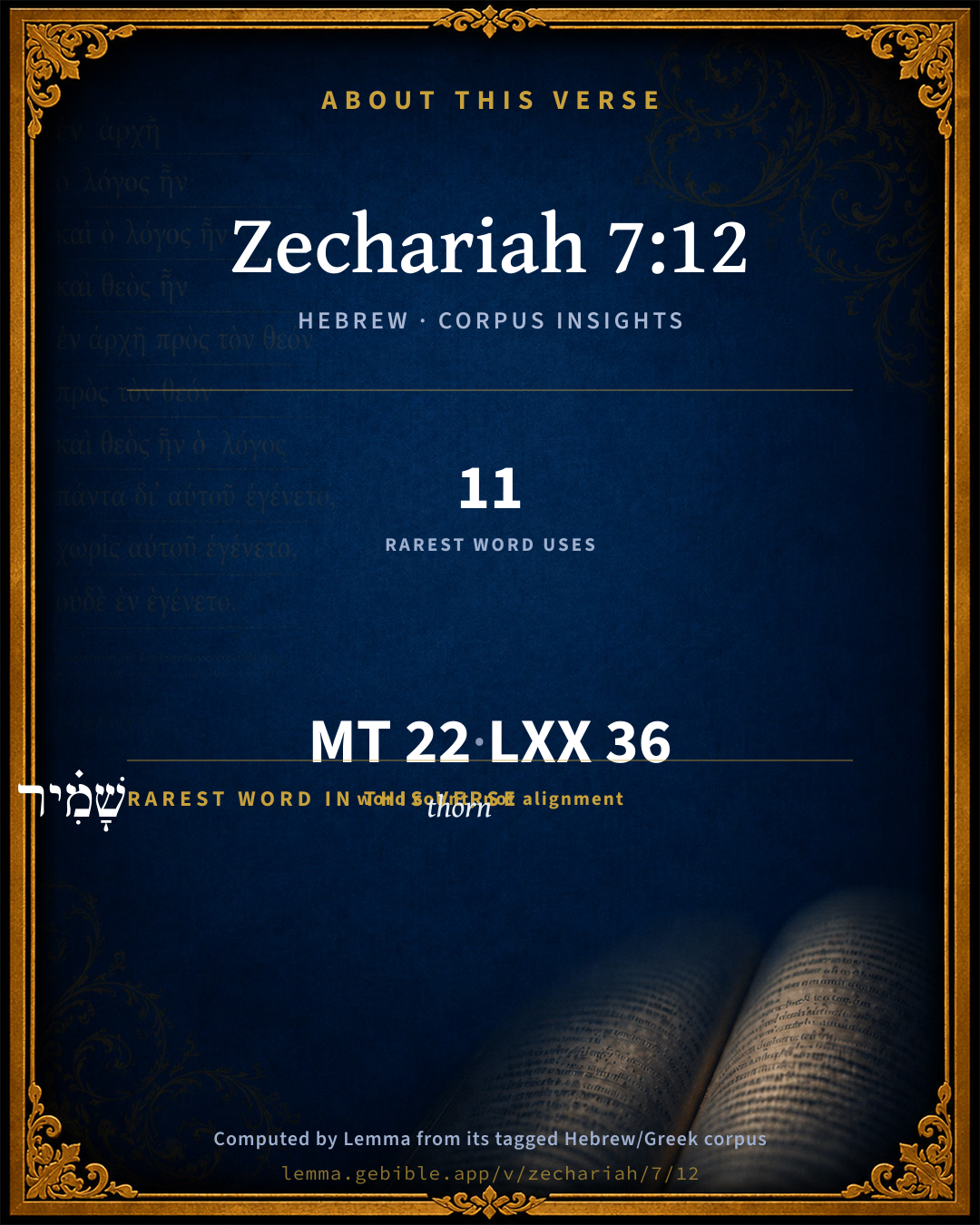
These counts appear in no published source. They are computed here, from the morphology-tagged text and Lemma’s own curated glosses. What Lemma adds →

22
words
19
distinct lemmas
Prophets
section

Notable vocabulary

The rarest word here is שָׁמִ֗יר thorn H8068 — appearing just 11 times in the whole Hebrew Bible.

Shared distinctive vocabulary

שָׁמִ֗יר thorn H8068 occurs in 11 verses of the Hebrew Bible. Also found in:

Grammatical profile

  • 4 verbs
  • 12 nouns
  • 2 adjectives
  • 1 preposition
  • 3 particles

Verb forms

  • שָׂ֣מוּ Qal · Perfect
  • מִ֠שְּׁמוֹעַ Qal · Infinitive Construct
  • שָׁלַ֜ח Qal · Perfect
  • וַֽיְהִי֙ Qal · Sequential Imperfect

Repetition

Words recur within this verse — often emphatic in Hebrew:

  • יְהוָ֤ה LORD H3068 ×2
  • צְבָאוֹת֙ army H6635 ×2

Hebrew & Septuagint length

In English translation the verse runs 39 words from the Hebrew and 39 from the Septuagint (LXX English) — the same length.

A rough comparison of the two English renderings, which tokenize alike — not a word-level alignment.

Word counts can differ between the Hebrew and the Greek without any difference in meaning — e.g. the Hebrew direct-object marker אֵת has no separate Greek word, and Greek often adds the article ὁ.

In the original languages it is 22 Hebrew tokens and 36 Greek tokens — but the two are counted differently (Hebrew bundles its prefixes and suffixes into one token; the Greek is in lemma form), so that isn’t a like-for-like length.

Cross-references

25

Topical passages linked to Zechariah 7:12 in the Treasury of Scripture Knowledge — connected by theme and wording, ordered by reader-vote popularity; previews shown in the World English Bible.

  • 2 Chronicles 36:16 but they mocked the messengers of God, and despised his words, and scoffed at his prophets, until the wrath of Yahweh arose against his people, until there was no remedy.
  • Nehemiah 9:29–30 and testified against them, that you might bring them again to your law. Yet they dealt proudly, and didn't listen to your commandments, but sinned against your ordinances, (which if a man do, he shall live in them), and withdrew the shoulder, and hardened their neck, and would not hear.
  • Ezekiel 11:19 I will give them one heart, and I will put a new spirit within you; and I will take the stony heart out of their flesh, and will give them a heart of flesh;
  • Ezekiel 36:26 A new heart also will I give you, and a new spirit will I put within you; and I will take away the stony heart out of your flesh, and I will give you a heart of flesh.
  • Acts 28:27 For this people's heart has grown callous. Their ears are dull of hearing. Their eyes they have closed. Lest they should see with their eyes, Hear with their ears, Understand with their heart, And would turn again, And I would heal them.'
  • Psalms 50:17 Seeing you hate instruction, And throw my words behind you?
  • Isaiah 6:10 Make the heart of this people fat; Make their ears heavy, and shut their eyes; Lest they see with their eyes, And hear with their ears, And understand with their heart, And turn again, and be healed."
  • Ezekiel 2:4 The children are impudent and stiff-hearted: I do sent you to them; and you shall tell them, Thus says the Lord Yahweh.
  • Ezekiel 3:7–9 But the house of Israel will not listen to you; for they will not listen to me: for all the house of Israel are of hard forehead and of a stiff heart.
  • Daniel 9:11–12 Yes, all Israel have transgressed your law, even turning aside, that they should not obey your voice: therefore has the curse been poured out on us, and the oath that is written in the law of Moses the servant of God; for we have sinned against him.
  • Matthew 13:15 For this people's heart has grown callous, Their ears are dull of hearing, They have closed their eyes; Or else perhaps they might perceive with their eyes, Hear with their ears, Understand with their heart, And should turn again; And I would heal them.'
  • Mark 4:12 that 'seeing they may see, and not perceive; and hearing they may hear, and not understand; lest perhaps they should turn again, and their sins should be forgiven them.'"
  • 2 Thessalonians 2:10–12 and with all deception of wickedness for those who are being lost, because they didn't receive the love of the truth, that they might be saved.
  • Job 9:4 God who is wise in heart, and mighty in strength: Who has hardened himself against him, and prospered?
  • Isaiah 48:4 Because I knew that you are obstinate, and your neck is an iron sinew, and your brow brass;
  • Jeremiah 5:3 O Yahweh, don't your eyes look on truth? you have stricken them, but they were not grieved; you have consumed them, but they have refused to receive correction: they have made their faces harder than a rock; they have refused to return.
  • Jeremiah 17:1 The sin of Judah is written with a pen of iron, [and] with the point of a diamond: it is engraved on the tablet of their heart, and on the horns of your altars;
  • Jeremiah 26:19 Did Hezekiah king of Judah and all Judah put him to death? Didn't he fear Yahweh, and entreat the favor of Yahweh, and Yahweh repented him of the evil which he had pronounced against them? Thus should we commit great evil against our own souls.
  • Zechariah 7:7 Aren't these the words which Yahweh proclaimed by the former prophets, when Jerusalem was inhabited and in prosperity, and its cities around her, and the South and the lowland were inhabited?'"
  • Luke 8:12 Those along the road are those who hear, then the devil comes, and takes away the word from their heart, that they may not believe and be saved.
  • John 3:19–20 This is the judgment, that the light has come into the world, and men loved the darkness rather than the light; for their works were evil.
  • Acts 7:51–52 "You stiff-necked and uncircumcised in heart and ears, you always resist the Holy Spirit! As your fathers did, so you do.
  • 1 Thessalonians 2:15–16 who killed both the Lord Jesus and their own prophets, and drove us out, and didn't please God, and are contrary to all men;
  • 1 Peter 1:11–12 searching for who or what kind of time the Spirit of Christ, which was in them, pointed to, when he predicted the sufferings of Christ, and the glories that would follow them.
  • 2 Peter 1:21 For no prophecy ever came by the will of man: but holy men of God spoke, being moved by the Holy Spirit.

Cross-references courtesy of OpenBible.info (CC BY 4.0).

Hebrew and Greek witnesses Masoretic Hebrew ↔ Greek Septuagint

The same verse in the two great witnesses to the Old Testament, shown verse-for-verse.

These are two independent witnesses, not word-aligned to each other, and the Septuagint is shown in lemma (dictionary) form.

Hebrew Zechariah 7:12 Masoretic · Westminster Leningrad Codex

וְלִבָּ֞ם שָׂ֣מוּ שָׁמִ֗יר מִ֠שְּׁמוֹעַ אֶת הַתּוֹרָ֤ה וְאֶת הַדְּבָרִים֙ אֲשֶׁ֨ר שָׁלַ֜ח יְהוָ֤ה צְבָאוֹת֙ בְּרוּח֔וֹ בְּיַ֖ד הַנְּבִיאִ֣ים הָרִֽאשֹׁנִ֑ים וַֽיְהִי֙ קֶ֣צֶף גָּד֔וֹל מֵאֵ֖ת יְהוָ֥ה צְבָאֽוֹת

Yes, they made their hearts as hard as flint, lest they might hear the law, and the words which Yahweh of Hosts had sent by his Spirit by the former prophets. Therefore great wrath came from Yahweh of Hosts.

World English Bible · Public Domain

Greek LXX Zechariah 7:12 Septuagint · lemma form

καί ὁ καρδία αὐτός τάσσω ἀπειθής ὁ μή εἰςἀκούω ὁ νόμος ἐγώ καί ὁ λόγος ὅς ἐκ ἀποστέλλω κύριος παντοκράτωρ ἐν πνεῦμα αὐτός ἐν χείρ ὁ προφήτης ὁ ἔμπροσθεν καί γίγνομαι ὀργή μέγας παρά κύριος παντοκράτωρ

And they made their heart disobedient, so as not to listen to my law, and the words which the Lord Almighty sent forth by his Spirit by the former prophets: so there was great wrath from the Lord Almighty.

LXX2012 (modern English Septuagint) · Public Domain

On this verse, Ellicott's Commentary for English Readers discusses the Septuagint’s reading. Read the note in Commentary ↓

Hebrew: Westminster Leningrad Codex (CC BY 4.0). Greek: Septuagint (public domain); English from LXX2012 (modern English Septuagint) (Public Domain). How the Septuagint differs from the Hebrew →

Targum (Aramaic paraphrase)

1

The Targum is the ancient Jewish Aramaic paraphrase of the Hebrew Scriptures — an interpretive translation, not the Hebrew text itself. Onkelos (literal) and Pseudo-Jonathan (expansive) render the Torah, and Jonathan the Prophets. Coverage is partial: where no permissively-licensed English translation exists for a verse, only the Aramaic is shown. This is verse-level text, not a word-by-word alignment to the Hebrew.

  1. Targum Jonathan Prophets (Joshua–Malachi)
    וְלִבְּהוֹן שַׁוִיאוּ תַקִיף כִּשְׁמִירָא מִלְקַבָּלָא אוֹרַיְתָא וְיַת פִּתְגָמַיָא דִי שְׁלַח יְיָ צְבָאוֹת בְּמֵימְרֵיהּ בְּיַד נְבִיַיָא קַדְמָאֵי וַהֲוָה רְגַז רַב מִן קֳדָם יְיָ צְבָאוֹת:

    (no public-domain English translation for this verse)

    Targum Jonathan — Aramaic: “Mikraot Gedolot” (public domain). English: “Sefaria Community Translation” (CC0 1.0 (public-domain dedication)); “London "Chaldee Paraphrase," 1871” (public domain). Text via Sefaria.

Commentary

Notes on Zechariah 7:12 from classic Christian and Jewish commentators (each source and its license shown beneath its notes). The classic Christian expositions comment on the surrounding passage and are grouped to its opening verse, so a note may address several verses; the Jewish commentaries on the Tanakh (Rashi and others) are per-verse, so they appear only where the commentator wrote on this verse.

Lemma curates 59 commentaries, every one of them public domain or Creative Commons licensed, each selected and text-cleaned for this edition rather than reprinted as found. About our sources →

Trapp's Complete Commentary

John Trapp

Zec 7:12 Yea, they made their hearts [as] an adamant stone, lest they should hear the law, and the words which the LORD of hosts hath sent in his spirit by the former prophets: therefore came a great wrath from the LORD of hosts.

Ver. 12. Yea, they made their hearts as an adamant] That hardest of stones, harder than the flint, Eze 3:9, than the nether millstone, Job 41:24. Pliny saith of it, Durities eius est inenarrabilis, et simul ignium victrix natura et nunquam incalescens. The hardness of this stone is unspeakable: the fire cannot burn it, nor so much as heat it through; the hammer cannot break it; and therefore the Greeks call it an adamant, from its untameableness. Hircino tamen rumpitur sanguine, saith the same author. Howbeit this hardest stone, soaked for a while in goat’s blood, may be dissolved and broken in pieces. So may the hardest heart by the blood of Christ (the true scape goat) applied by faith. "They shall look upon him whom they have pierced, and shall mourn" (οψονται κοψονται, Rev 1:7). He shall look again upon them, and they shall melt much more. A stroke from guilt broke Judas’s heart into despair; but a look from Christ broke Peter’s heart into tears. Now till the heart be thus graciously mollified instructions glide off it, as rain falling upon a rock: afflictions, God’s hammers, do not but beat upon an adamant, qui respuit scalptra et malleos, quin at ipsos disrampit, which will sooner break them than be broken by them. "Ye stiffnecked and uncircumcised in heart and ears, ye do always resist the Holy Ghost: as your fathers did, so do ye," Act 7:51. How their fathers did appears by this text and Neh 9:29. They had not only sinews of iron, a natural hereditary hardness (whereby all men are born averse from, yea, adverse to, the motions of the Spirit: "That which is born of the flesh is flesh"), but also brows of brass, Isa 48:4, a habitual, voluntary, adventitious, wilful hardness; refusing to be reformed, hating to be healed: such a desperate hardness, as neither ministry, nor misery, nor miracle, nor mercy could possibly mollify.

By the former prophets] Heb. the hand of the former prophets, that is, by their mouth and ministry ( Manus enim, est οργανον οργανων. Arist.), but to as little purpose, through their singular obstinace, as when Bede preached to a heap of stones.

Therefore came a great wrath from the Lord of hosts] Which argues that they were great sinners before the Lord, as Gen 13:13; for he doth not use to kill flies upon men’s brows with beetles.

John Trapp, A Commentary or Exposition upon All the Books of the Old and New Testament (1647–1656) — public domain. Text from a community e-Sword module.

The Biblical Illustrator

Joseph S. Exell

Zec_7:12

Yea, they made their hearts as an adamant stone

The disease and cure of the hard heart

A man does not become profligate or altogether wicked at once.

One vice makes way for another. The people in Zechariahs time had arrived at such a prodigious height of vice, that it is said, Yea, they made their hearts as an adamant stone. Adamant is the hardest of all stones: it is found by the best chemists to be indissolvable. The similitude is proper to exhibit the real state of the human heart; which cannot be melted, or reduced to the genuine image of Jesus, by human art or power.

I. The disuse of the hard heart.

1. Of the symptoms or nature of it. It discovers itself in a wayward temper, a pride and stoutness of heart against God, particularly the calls of His providence, and the admonitions of His holy Word. This is the genuine character of wicked men. God is not in all their thoughts. They extinguish the remains of natural conscience. In an inflexibility against the word of truth, and the ordinances of religion. The inflexible adamantine heart defeateth the gracious designs of the Gospel. It is inflexible to the motions of Gods Holy Spirit. And this is the crowning sin. He knocks by the motions of His Holy Spirit, yet the hard heart refuseth to give Him admittance.

2. The different kinds of this disease.

(1) There is a natural hardness: a part of that natural corruption, that original guilt and inbred poison of our nature.

(2) There is an acquired hardness of heart. There are those who voluntarily strengthen themselves in their natural disobedience, and reject the counsel of God against themselves. How careful we should be to form our hearts for the Redeemer; to open those gates that the truths of the Gospel may be admitted.

(3) There is a penal hardness of heart. There is a degree above voluntary hardness, as voluntary hardness implieth something above natural. In Scripture God is said to harden mens hearts in two ways--by leaving them in their natural state; and by giving up to a reprobate mind.

(4) This hardness is either in part or in whole. Some complain of hardness and insensibility, as the present frame and temper of the soul. What contributes so much to hardness of heart in believers is, their giving too great scope to carnal delights. These may be tasted, but a large draught intoxicates.

(5) This hardness of heart is severely felt by the genuine disciples of Jesus. It is neither felt nor complained of by carnal and wicked men. But to be past feeling is a sure symptom of death, as well spiritual as natural. There is no life without feeling.

Learn--

(1) From this view of the human heart, the character of the real Christian.

(2) That nothing short of the teachings of the Holy Spirit have ever proved sufficient to affect the heart with a practical sense of the vileness of sin and its own hardness.

(3) Learn what that sacrifice is which is most acceptable and pleasing to God.

3. The causes of this spiritual malady.

(1) Ignorance. The blind mind, the obstinate will, and hard heart, inseparably accompany each other.

(2) Unbelief. The most powerful arguments and most engaging motives of our holy religion are brought from things unseen. Unless we feel the powers of the world to come, neither the joys of heaven nor the terrors of utter darkness will properly work on our fears or encourage our hopes.

(3) Custom in sinning hardens the heart.

(4) Hypocrisy. This dangerous character appears to consist of two branches: dissimulation, by which we deceive others; and formality, by which we deceive ourselves.

(5) Pride. As in the case of Pharaoh. Pride is at the bottom of every vice.

(6) The deceitfulness of sin. Sin deceiveth by general invectives. By delays. By coming plumed in the feathers of profit, or pleasure, or honours, or preferments. By presenting herself in a coat of many colours, especially in making her address in all the charms of sensual pleasures. She attacks the soul in Jacobs voice, and in an angels form. Sin, by continuance, increases upon the soul. In hardened sinners, vice prompts men to presume upon impunity.

II. The cure of this spiritual malady.

1. Serious and frequent mediations on the perfections of the Divine nature, especially His glory and power.

2. Faith in the great doctrines of the Gospel is a sovereign remedy for the most inveterate disorders of the soul.

3. Faith in Gospel ordinances is another sovereign remedy.

4. Faith in the great atonement made by our exalted High Priest is another absolutely necessary ingredient in the cure of the adamantine heart. The dignity and infinite excellence of this sacrifice will appear from its Divine appointment; from the nature of the sacrifice itself; from its noble and infinitely precious fruits; from those vast multitudes who have been saved by this sacrifice.

5. Another ingredient towards the cure of the hard heart is a proper knowledge of the guilt and demerit of transgression. The smallest deviation from the Divine law is entailed with the curse. (J. Johnston.)

The guilt of hardness of heart

There are periods in the life of every person who hears the Gospel in which his attention is called, in an especial manner, to the subject of religion; and one of the most common discoveries made at these times is this--that the heart is insensible,--that there is in it no corresponding emotions to the magnitude, or to the admitted importance of the great truths which have now become the subject of special attention. Insensibility upon the subject of religion is inexcusable. Notice that you are not destitute of sensibility and susceptibility. You are not incapable of feeling. Religion does not indeed consist in emotion. It consists, first, in a right belief, then right feeling, then right purpose, then right action. You are not destitute of those susceptibilities to which the truths of the Gospel make their appeal. Nothing is so adapted to excite these constitutional susceptibilities as the great truths of religion. Consider the subjects of immortality, the being and character of God. God is love. Then why do you not love Him whom you should love supremely? We are capable of reverence, and God is the most venerable being in the universe. There is in Him independence, eternal existence, majesty, power, dominion, sovereignty, the terribleness of wrath, greatness of mercy, all of which qualities are capable of inspiring the soul of man with the profoundest feeling of reverence. Fearful, said Moses of God, fearful in praises. Consider the great work of redemption. God from His holy throne looking down upon a lost race. God meeting the demands of His own justice, and in order to sustain the principles of His moral government, condescending to be Himself the victim of the law, and a sacrifice to its penal demands. Will you tell me, you who confess to this charge of religious insensibility, will you tell me why you have never sympathised with the Divine compassion? You have looked upon that scene of the Father giving up His only begotten Son to save a lost race, and you never felt that, you never admired, never loved, never thanked, never praised Him for it! It is not that God has made you so, not that religion is not calculated to enlist your feelings on its behalf, there must be some other cause. Your hardness of heart is the result of apostasy. It is the issue, the fatal issue of a process, directly and completely adapted to the end, and incessantly practised up to the present moment. Who is it that is now complaining of moral insensibilities? Is it that person who has cherished the teachings of maternal kindness, and the sentiments inspired from time to time by the solemn admonitions of providence, and the more solemn warnings of life? Oh, no! I apprehend a fair review of your life will take away your surprise at any present hardness of heart. You have the power of commanding your thoughts, of fixing your attention on any subject. You can then command your thoughts, control the current of your thoughts, and the attention of your mind, keep your mental eye fixed upon all that is pure, lovely, noble, vast, glorious, upon God, the human soul, immortality, redemption, the great, the vast interests of the human race. Keep your thoughts up, and your soul will go up; keep your thoughts high, and your character will be elevated; keep your thoughts high, and your hopes will be pure, elevating, high. I am not speaking of this life only, I go beyond that. You will notice, in regard to your own mind, that some subjects approve themselves to you, by the operation of the passions. The passions have their own objects, and when they are at work in the soul, they bring into the imagination those thoughts and visions which are apt to feed themselves. Bodily appetites have their passions, and they control the trains of thought. What I wish to observe is, that the passions, the appetites, the senses, the general conversation of life, the character of the literature of the day, all tend to make you worldly and sinful and not religious. They do not suggest the great truths of religion, nor tend to keep them before the mind. Spiritual subjects must be kept before you by an effort of your will; your thoughts must be raised by meditating upon the Divine will. The hardness of heart which you may be feeling tonight, runs back through the history of your life, and could be traced to a period quite remote from the present. The text is true, You have made your heart as an adamant stone. What a comparison this is to make! Like an adamant stone all moral culture is lost upon it. (E. N. Kirk.)

Gospel hardened

I was on a visit lately at a country village. The first morning I was there, I was awakened very early by the sound of a horn blowing, which continued for about a quarter of an hour. It disturbed me every morning, at the same hour, and on speaking of it to my friends, they assured me that I would soon get accustomed to it, and it would then cease to disturb me. And so it proved. I could soon sleep on undisturbed, though the horn blew as usual. In a spiritual sense I think this is the most dangerous state into which a man can fall. When they hear the Gospel preached to them at first, they seem to waken out of a sleep, and get disturbed and uncomfortable; but if they do not take advantage of what they hear, they get accustomed to it, and by and by can listen to any Gospel sermon without being moved by it. Such a mans state is worse than at the first, for Gods Spirit has ceased to strive with him. (Christian Herald.)

The Biblical Illustrator, edited by Joseph S. Exell (c. 1880s–1900s) — public domain. Text from a community e-Sword module.

Tyndale Open Study Notes

Tyndale Open Resources

7:12 To make one’s heart as hard as stone is to steel one’s will against the will of God (see Jer 17:1; cp. Ezek 3:9). • Instructions (Hebrew torah) refers to God’s laws and commands as taught and interpreted by the prophets.

Tyndale Open Study Notes — © Tyndale Open Resources, licensed CC BY-SA 4.0. Text via the HelloAO Bible API.

Geneva Bible (1599)

Geneva Bible translators

Which declareth that they rebelled not only against the Prophets, but against the Spirit of God that spake in them.

Geneva Bible (1599) marginal notes — public domain. Text via Bolls.life.

Jamieson, Fausset & Brown

Robert Jamieson, A. R. Fausset & David Brown

hearts . . . adamant-- (Eze 3:9; Eze 11:19).

Lord . . . sent in Spirit by . . . prophets--that is, sent by the former prophets inspired with His Spirit.

therefore . . . great wrath-- (Ch2 36:16). As they pushed from them the yoke of obedience, God laid on them the yoke of oppression. As they made their heart hard as adamant, God brake their hard hearts with judgments. Hard hearts must expect hard treatment. The harder the stone, the harder the blow of the hammer to break it.

Jamieson, Fausset & Brown — Commentary Critical and Explanatory on the Whole Bible (1871) — public domain (CC PDM 1.0). Text via the HelloAO Bible API.

Adam Clarke's Commentary

Verse 12. Made their hearts as an adamant stone] שמיר shamir may mean the granite. This is the hardest stone with which the common people could be acquainted. Perhaps the corundum, of which emery is a species, may be intended. Bochart thinks it means a stone used in polishing others. The same name, in Hebrew, applies to different stones.

Adam Clarke's Commentary on the Bible (1810–1826) — public domain. Text from a community e-Sword/MySword module.

John Calvin's Commentaries

He then comes to the heart, They made, he says, their heart adamant, or the very hardest stone. Some render it steel, and others flint. It means sometimes a thorn; but in this place, as in Ezekiel 3:9, and in Jeremiah 17:1, it is to be taken for adamant, or the hardest stone. We now see that the Prophet’s object was to show that the Jews had no excuse, as if they had fallen away through error or ignorance, but had ever wilfully and perversely rejected sound doctrine. The Prophet then teaches us that hypocrisy had been the sole hindrance to prevent them from understanding and following what was right.

But it may be useful to notice the manner of speaking which the Prophet adopts in condemning the perverseness of the Jews, when he says, that they had refused attention to God. For we ought here to observe the connection between the fear of God and obedience, and on the other hand, between the contempt of the law and wilful rebellion. If then we would not be condemned for contumacy before God, attention must in the first place be given to his word, and afterwards the shoulders must be put under, so that we may bear submissively the yoke laid on us; and thirdly, we must listen with the ears, so that the word of God, preached to us, may not be lost, but strike in us deep roots; and lastly, our hearts must be turned to obedience, and all hardness corrected or softened. Then Zechariah adds, that the Jews had a stonily or an iron heart, so that they repudiated the law of God and all his Prophets. He gives the first place to the law, for they ought to have sought from it the whole doctrine of religion; and the Prophets, as it has been often stated, were only interpreters of the law.

He afterwards mentions the words which had been sent by Jehovah through his Spirit and through his Prophets By saying that God spoke by his Prophets, he meets an objection by which hypocrites are wont to cover themselves, when they reject the truth. For they object and say, that they would be willingly submissive to God, but that they cannot bear the authority of men, as though God’s word changed its nature by coming through the mouth of man. But as hypocrites and profane men are wont to lessen the authority of the word, the Prophet here shows, having this pretext in view, that God designed to be heard, though he employed ministers. Hence by this kind of concession it is implied, that Prophets are middle persons, and yet that God so speaks by their mouth, that contempt is offered to him when no due honor is shown to the truth. And further, lest the baseness of men should withhold regard from the word, he mentions also the Spirit, as though he had said, that God had spoken not only by his servants, even mortal men, but also by his Spirit. There is then no reason for hypocrites deceitfully to excuse themselves, by saying, that they rebel not against God, when they depreciate his Prophets; for the power and majesty of the Holy Spirit appear and shine forth in the doctrine itself, so that the condition of men takes nothing away from its authority. This part was also added in order to condemn the Jews, because they had from the very beginning been seasonably warned, and it was only their own fault that they did not repent. For if the Lord had allowed them for a long time to go astray, there would have been some pretense for their evasions: but since God had tried to recall them to the right way, and Prophets, one after another, had been continually sent to them, their unfaithfulness, yea their iron perverseness, in obstinately refusing to obey God, was more fully discovered. This is the reason why Zechariah mentions here the former Prophets.

He then adds, that there was great wrath from Jehovah of hosts; by which sentence he reminded them, that it was no matter of dispute, as in case of a doubtful thing, whether their fathers had been wicked and disobedient to God; for he had sufficiently proved be punishments that he abominated their conduct; for this principle is to be held true that God does not deal unjustly with men when he chastises them, but that the demerit of crimes is to be estimated by the punishment which he inflicts. As then God had so severely chastised the ancient people, the natural conclusion is, that their wickedness had become intolerable. We now then see why the Prophet said that there had been great wrath from God; the reason was, that the Jews might not think that he had been lightly offended, as he had not been satisfied with a moderate punishment; for since his wrath had been so great, and since he had in so dreadful a manner punished the sins of the people, it follows, that their wickedness had been more grievous than what men considered it to have been.

There is also here an implied comparison; for the unfaithfulness of those who then lived was the worse, for this reason — because they took no warning from the calamities of their fathers, so as to deal with more sincerity with God. They knew that their fathers had been carefully and in various ways admonished; they knew that exile followed, which was an evidence of the dreadful vengeance of God. As then they were like their fathers, and had not put off their perverse disposition, they proved themselves guilty of greater and more refractory baseness, for they ought to have been influenced at least by fear, when they saw that God’s judgment had been so dreadful against obstinate men. It afterwards follows —

John Calvin's Commentaries (1540-1563) — public domain. Text from the Calvin Translation Society English edition (1840s-50s) via the Christian Classics Ethereal Library (ccel.org). Calvin's coverage is partial (roughly two-thirds of the Bible); uncommented books and verses are honest gaps, never fabricated. The 19th-century editor's footnotes and remarks are omitted so the notes are faithfully Calvin's own voice.

Ellicott's Commentary for English Readers

(12) Adamant stone means a very hard stone; “diamond” is the modern form of the word. “Adamant,” adhámas, meaning in Greek unconquerable, was originally applied to “steel” (Hesiod). LXX. explain the metaphor, “made the heart disobedient.”

A Bible Commentary for English Readers, edited by Charles John Ellicott (1878–1897) — public domain. Text from a community e-Sword module.

The Cambridge Bible for Schools and Colleges

gen. ed. J. J. S. Perowne

12. an adamant] perhaps diamond, “so called from its cutting and perforating (the original meaning of the word being a sharp point, or thorn), as the point of a stylus was made of diamonds, Jer_17:1.” Gesen. “The stone, whatever it be, was hard enough to cut ineffaceable characters (Jer_17:1): it was harder than flint (Eze_3:9). It would cut rocks; it could not be graven itself, or receive the characters of God.” Pusey.

in his spirit] Rather, by His Spirit, as R. V. The preposition is the same as in the next clause, by the hand of His prophets. The Holy Ghost was the Divine Agent, the prophets were the human instruments. Comp. Neh_9:30.

The Cambridge Bible for Schools and Colleges (gen. ed. J. J. S. Perowne; Cambridge University Press, 1878–1918) — public domain. Text from a community e-Sword module.

John Gill's Exposition

But I scattered them with a whirlwind,.... Denoting the fierceness of his wrath, and the strength of his fury, seen in their dispersion:

among all the nations whom they knew not; such as the Babylonians, Medes, and Persians, people before unknown to the Jews:

thus the land was desolate after them; that is, the land of Judea was destitute of inhabitants, or had but few remaining in it, after the Jews were carried captive into Babylon; for the rest, after the death of Gedaliah, fled into Egypt:

that no man passed through, nor returned; neither from Egypt, nor from Babylon, until the seventy years of captivity were ended; nor indeed did any from other nations pass through and fro, or settle in it, during this time, that we have any account of:

for they laid the pleasant land desolate; either the Israelites by their iniquities, which were the cause of it; or the Babylonians, as the instruments of God's vengeance. This pleasant land is the land of Canaan, a land flowing with milk and honey; the glory of all lands, for its great fruitfulness, and delightful situation; and especially for being the seat of the divine Majesty, and where his people dwelt, and where his temple was, and he was worshipped; see Eze 20:6 Deu 8:7.

Next: Zechariah Chapter 8

John Gill's Exposition of the Whole Bible (1746–1763) — public domain (CC PDM 1.0). Text via the HelloAO Bible API.

Albert Barnes' Notes on the Bible

Harder than adamant - The stone, whatever it be, was hard enough to cut ineffaceable characters : it was harder than flint . It would cut rocks; it could not be graven itself, or receive the characters of God.

This is the last sin, obduracy, persevering impenitence, which “resisted the Holy Spirit” Act 7:51. and “did despite to the Spirit of grace” Heb 10:29. Not through infirmity, but of set purpose, they hardened themselves, lest “they should convert” Isa 6:10 and be healed. They feared to trust themselves to God’s word, lest He should convert them by it.

Lest they should hear the law and the words which the Lord God sent by His Spirit by the hand of the former prophets - The Holy Spirit was the chief agent; “by His Spirit;” the inspired prophets were His instruments; by the hand of. Nehemiah confesses the same to God: “Thou didst protest to them by Thy Spirit by the hand of Thy prophets” Neh 9:30. Moses was one of the greatest prophets. The law then may be included, either as delivered by Moses, or as being continually enforced by all the prophets. Observe the gradations:

(1) The words of God are not heard.

(2) The restive shoulder is shown; people turn away, when God, by the inner motions of His Spirit or by lesser chastisements, would bring them to the yoke of obedience. Osorius: “They would not bear the burden of the law, whereas they willingly bore that most heavy weight of their sins.”

(3) Obduracy. Osorius: “Their adamantine heart could be softened neither by promises nor threats.” Therefore nothing remained but the great wrath, which they had treasured to themselves against the day of wrath. And so Zechariah returns to that, wherewith his message and visions of future mercy began, the great wrath which fell upon their fathers Zec 1:7.

Osorius: “‘I sought not,’ He says, ‘for your tears; I enjoined not bitterness of sorrow; but what, had they been done, the calamity, for which those tears were meet, had never befallen you. What was it which I admonished you formerly by the former prophets to recall you from sin? What I bid you by Zechariah now. This I preach, admonish, testify, inculcate upon you. ‘“

Albert Barnes' Notes on the Bible (1834–1885) — public domain. Text from a community e-Sword/MySword module.

Haydock's Catholic Bible Commentary

As, &c. Hebrew, "of Samir;" a stone used to polish jewels. Septuagint, "disobedient."

George Leo Haydock (1774–1849), Haydock's Catholic Family Bible and Commentary, 1859 edition — public domain. Excludes Psalms (Douay-Rheims chapter numbering differs from Protestant) and Deuterocanonical books (Catholic canon only).

Matthew Poole's English Annotations

They made their hearts as an adamant: though the heart of itself is far from taking impressions, and receiving kindly the law of God, yet these desperate sinners think it is too pliable, they study how to harden it, and this was the fault of many of them. An adamant; the hardest of stones.

Lest they should hear the law; which was peremptorily required of them, and they as peremptorily resolved against it.

The law of God by Moses, of whom they boasted, whilst they despised his law.

The words, counsels and commands, which the Lord of hosts, their God, spake; nay, though they knew he spake they would not hear.

In his spirit; by his Holy Spirit, in clear evidences, piercing convictions, powerful operation, and dreadful threatenings; yet they opposed and resisted. and sinned against his Spirit.

By the former prophets: all of them acted by the same Spirit, pressing them to the same duties, and foretelling the same miseries, and promising the same blessings, but all would not prevail.

Therefore, for this great obstinacy, came a great wrath, which consumed the whole land, and burned against them seventy years together in Babylon.

From the Lord of hosts; in all which the hand of the Lord was most evidently seen, dealing to them according to their ways. Such were your fathers, such their ways, such their sufferings, all which is well known to you who start such queries, and meanwhile run away from the great commands of the law.

Matthew Poole's English Annotations on the Holy Bible (1683–1685) — public domain. Text from a community e-Sword/MySword module.

The Pulpit Commentary

They made their hearts as an adamant stone. They made their hearts as hard as a stone which could receive no cutting or engraving; no message from God could find entrance; and this from their wilful obstinacy. The word rendered "adamant," shamir, probably means "diamond," a stone so hard, says Jerome, as to break all metals to pieces, but to be itself broken by none; hence it is called adamas, "unconquerable." Ezekiel (Eze_3:9) notes that it is harder than flint. (comp. Jer_17:1) The LXX, paraphrasing, gives. Than autwn etaxan apeiyh , "They set their heart disobedient." The Law. The various enactments of the Mosaic system. In his Spirit; rather, by his Spirit. The leaching which the Spirit of God inspired the prophets to deliver. (comp. Neh_9:30 2Ki_17:13 Mic_3:8) And for the succession of prophets from Solomon to the Captivity, see note on Amo_2:11; and to those there enumerated, add Iddo, Shemaiah, Hanani, Micaiah, Huldah.

The Pulpit Commentary (1880–1919), ed. H.D.M. Spence-Jones & Joseph S. Exell — public domain. Text from a community e-Sword module.

John Wesley's Explanatory Notes

In his spirit - By his Holy Spirit.

John Wesley, Explanatory Notes Upon the Whole Bible (1754–1765) — public domain. Text via the GEBible commentary corpus.

Rashi

Rabbi Shlomo Yitzchaki (Rashi)

shamir A worm stronger than flint. They would show it to the stone, which would split.

Rashi on the Tanakh — English translations: “The Judaica Press complete Tanach with Rashi, translated by A. J. Rosenberg” (CC BY 4.0); “Pentateuch with Rashi's commentary by M. Rosenbaum and A.M. Silbermann, 1929-1934” (public domain); “The Metsudah Tanach series, Lakewood, N.J” (CC BY 4.0); and “The Book of Joshua, Metsudah Publications, 1997” (CC BY 4.0). Text via Sefaria.

Lesson kit

Teaching starters — assembled from the data on this page, not authored interpretation. Every prompt links to the verse data it draws on. Edit before teaching.

Zechariah, in the Prophets, opens this verse with 22 words (19 distinct Hebrew lemmas). Its most distinctive word is shâmîyr (“thorn”). A historical commentator’s framing appears above. Read the whole chapter for the surrounding context.

Discussion questions

  1. The word shâmîyr carries the sense “thorn.” How does it shape the verse?
  2. How does Isaiah 5:6, which shares the word «thorn», read alongside this verse?
  3. What does the repetition of “LORD” (2× in this one verse) do in this verse?
  4. These translations render this verse differently. What is at stake in choosing one wording over another?
  5. «שָׂ֣מוּ» is a Qal Perfect verb. How does that grammatical form shape the action described?
  6. Compare how Trapp's Complete Commentary and The Biblical Illustrator read this verse. Where do they agree or differ?

Things to notice

Reading settings

Reading text

Shown beneath each verse's original-language words.

Old Testament
Old Testament edition

Read the OT as the Masoretic Hebrew (MT) or the Greek Septuagint (LXX).

English shown for the Greek Septuagint (in the Hebrew ↔ Greek comparison).

Comparing translations? Open the Compare panel on any verse page to stack up to four side by side.