
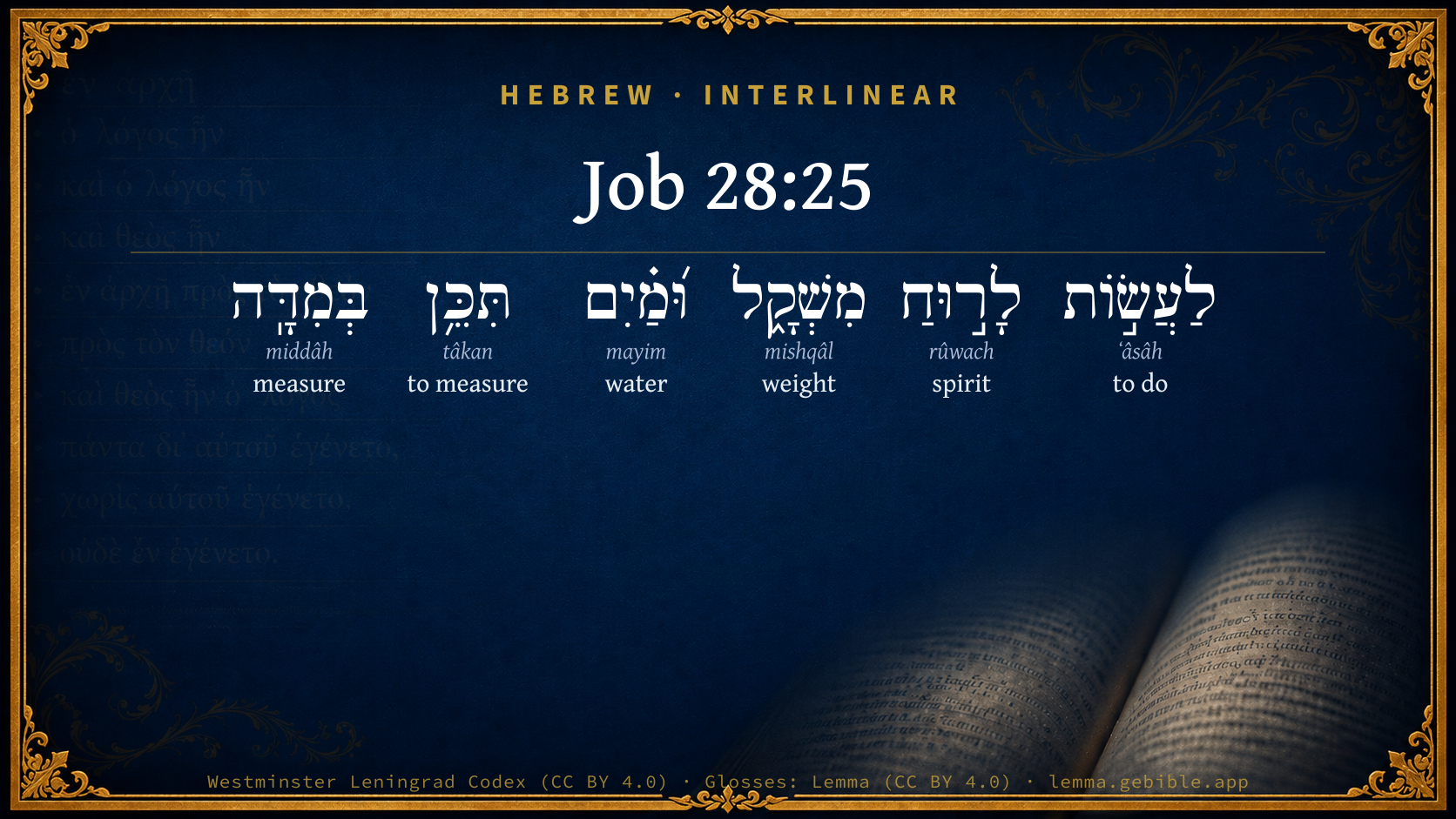
Job 28:25

Hebrew (Westminster Leningrad Codex) Job 28:25 appears in the Hebrew Old Testament. The text above is from the Westminster Leningrad Codex. Each word links to its Strong’s number, a concise gloss, and parsing drawn from the Open Scriptures Hebrew Bible morphology. Click any word for its full Brown-Driver-Briggs (BDB) entry.
Download image
Cite this verse

Job 28:25 (World English Bible). Public Domain. Lemma interlinear Bible study tool, https://lemma.gebible.app/v/job/28/25.

Show BibTeX & RIS
BibTeX
RIS
English Translation
He establishes the force of the wind; Yes, he measures out the waters by measure.
World English Bible · Public Domain
Download a study sheet

One document with this verse’s original text, its word-by-word gloss line, the meaning frame, cross-references with their text, attributed commentary, and full source and license credits — printable, and it pastes into notes with its structure intact.

This verse Autodidact and up

Study sheet (.html) Plain text (.txt)

A passage Seminary Student

Up to 50 verses in one chapter. A passage sheet keeps up to 6 commentary sources and 12 cross-references per verse, in the order this page ranks them, and says so on the sheet whenever that leaves anything out. Ask for a single verse and you get the Autodidact verse sheet above.

Everything on this page stays free to read, with no account — the sheet is a download of what is already on screen, not access to it.

Want to remove ads? Support Godless Engineer
Compare translations 3

The same verse in 3 English versions, stacked beneath the original-language interlinear above. Click any original word for its lexicon entry.

Each is an independent rendering of the whole verse — the interlinear is not word-aligned to these translations.

Highlighted words mark where these versions differ — a whole-verse word diff, not a word-by-word alignment.

  • World English Bible Public Domain
    He establishes the force of the wind; Yes, he measures out the waters by measure.
  • King James Version Public Domain
    To make the weight for the winds; and he weigheth the waters by measure.
  • unfoldingWord Literal Text CC BY-SA 4.0
    When he made the weight for the wind and apportioned the waters by measure,

unfoldingWord Literal Text — © unfoldingWord, licensed CC BY-SA 4.0. Word-aligned USFM3 via Door43 (git.door43.org/unfoldingWord/en_ult).

Versions to compare (up to 4)

3 of 4 selected

Show all 18 translations

Every available English version of this verse, each an independent rendering of the whole verse.

  • World English Bible Public Domain
    He establishes the force of the wind; Yes, he measures out the waters by measure.
  • Berean Standard Bible Public Domain
    When God fixed the weight of the wind and measured out the waters,
  • Majority Standard Bible Public Domain
    When God fixed the weight of the wind and measured out the waters,
  • King James Version Public Domain
    To make the weight for the winds; and he weigheth the waters by measure.
  • American Standard Version (1901) Public Domain
    To make a weight for the wind: Yea, he meteth out the waters by measure.
  • Revised Version (1885) Public Domain
    To make a weight for the wind; yea, he meteth out the waters by measure.
  • Geneva Bible (1599) Public Domain
    To make the weight of the windes, and to weigh the waters by measure.
  • Douay-Rheims (1899) Public Domain
    Who made a weight for the winds and weighed the waters by measure.
  • Young's Literal Translation Public Domain
    To make for the wind a weight, And the waters He meted out in measure.
  • Literal Standard Version CC BY-SA 4.0
    To make a weight for the wind, || And He meted out the waters in measure.
  • Unlocked Literal Bible CC BY-SA 4.0
    He made the force of the wind and parceled out the waters by measure.
  • unfoldingWord Literal Text CC BY-SA 4.0
    When he made the weight for the wind and apportioned the waters by measure,
  • Darby Bible Public Domain
    In making a weight for the wind, and meting out the waters by measure,
  • World Messianic Bible Public Domain
    He establishes the force of the wind. Yes, he measures out the waters by measure.
  • Webster's Bible Public Domain
    To make the weight for the winds; and he weigheth the waters by measure.
  • Free Bible Version CC BY-SA 4.0
    He decided how strong the wind should blow, and regulated the waters.
  • Bible in Basic English Public Domain
    When he made a weight for the wind, measuring out the waters;
  • JPS Tanakh (1917) Public Domain
    When He maketh a weight for the wind, and meteth out the waters by measure.

Literal Standard Version (2020), Covenant Press — licensed CC BY-SA 4.0. Text via the HelloAO Bible API (eBible.org). Unlocked Literal Bible (unfoldingWord) — licensed CC BY-SA 4.0. Text via the HelloAO Bible API (eBible.org). unfoldingWord Literal Text — © unfoldingWord, licensed CC BY-SA 4.0. Word-aligned USFM3 via Door43 (git.door43.org/unfoldingWord/en_ult). Free Bible Version, Dr. Jonathan Gallagher — licensed CC BY-SA 4.0. Text via the HelloAO Bible API (eBible.org).

Word by word

More ways to search: Search by grammar → Find every occurrence → Compare this word →

Practice this passage: Drill this verse → Learn its vocabulary →

תִּכֵּ֥ן
tâkan
H8505
“to measure”
Verb, Piel, Perfect, 3rd Person, Masculine, Singular
Part of Speech
Verb
Stem
Piel
Form
Perfect
Person
3rd Person
Gender
Masculine
Number
Singular
Full BDB Definition

Origin: a primitive root

TWOT: 2511

to regulate, measure, estimate, ponder, balance, make even, level, weigh, be equal, be weighed out, test, prove - (Qal) estimate (participle) - (Niphal) - to be estimated - to be made even or right, be adjusted to the standard - (Piel) to weigh out, mete out - (Pual) - to be weighed out, be measured out - measured out (participle)
  1. לַעֲשׂ֣וֹת ʻâsâh H6213 “to do” Preposition + Verb, Qal, Infinitive Construct
  2. לָר֣וּחַ rûwach H7307 “to/for the · spirit” Preposition, Determined + Noun, Common, Both, Singular, Absolute
  3. מִשְׁקָ֑ל mishqâl H4948 “weight” Noun, Common, Masculine, Singular, Absolute
  4. וּ֝מַ֗יִם mayim H4325 “and · water(s)” Conjunction + Noun, Common, Masculine, Plural, Absolute
  5. בְּמִדָּֽה middâh H4060 “in/at · measure” Preposition + Noun, Common, Feminine, Singular, Absolute

About this verse

These counts appear in no published source. They are computed here, from the morphology-tagged text and Lemma’s own curated glosses. What Lemma adds →

6
words
6
distinct lemmas
Wisdom
section

Notable vocabulary

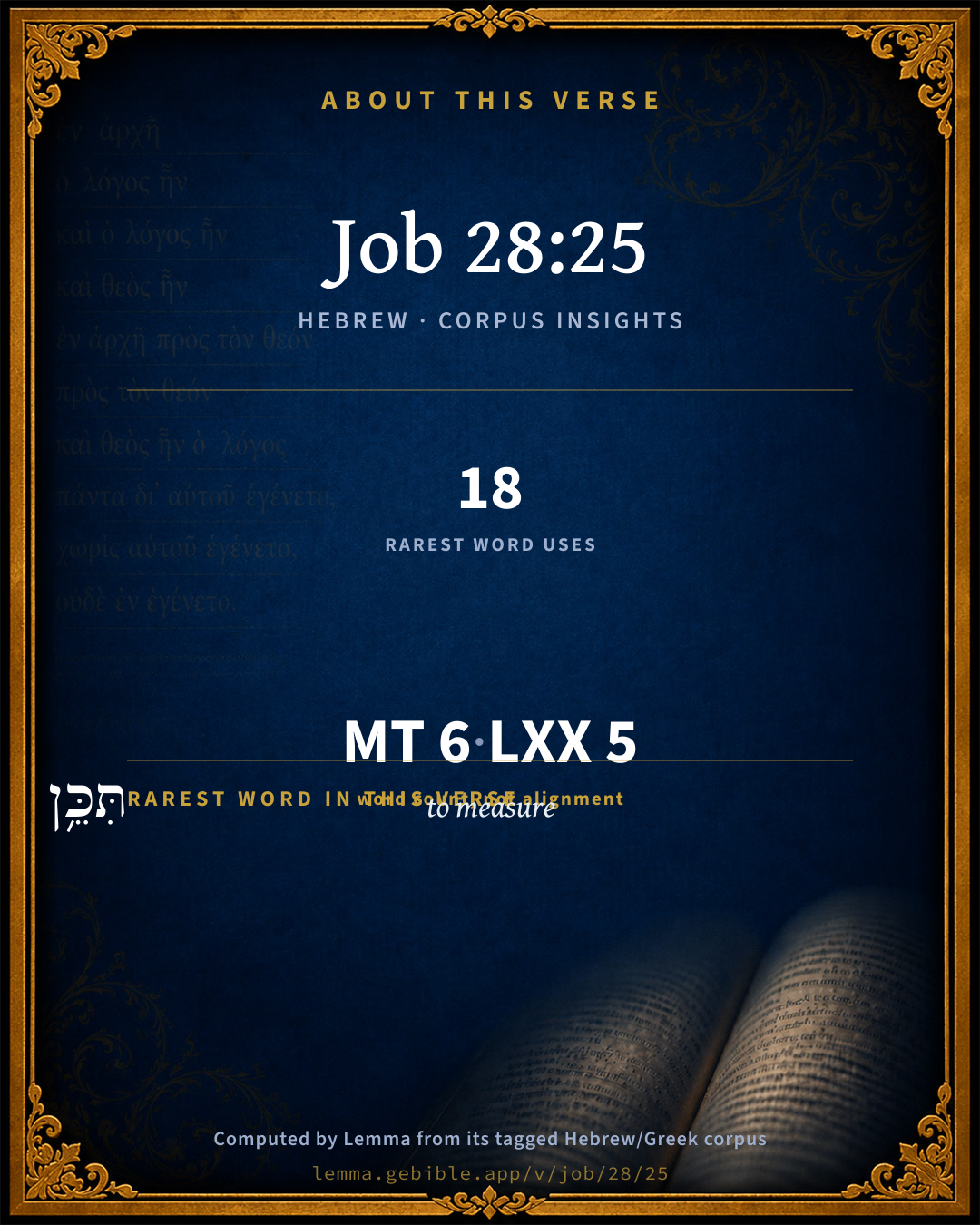
The rarest word here is תִּכֵּ֥ן to measure H8505 — appearing just 18 times in the whole Hebrew Bible.

Shared distinctive vocabulary

תִּכֵּ֥ן to measure H8505 occurs in 13 verses of the Hebrew Bible. Also found in:

Grammatical profile

  • 2 verbs
  • 4 nouns

Verb forms

  • לַעֲשׂ֣וֹת Qal · Infinitive Construct
  • תִּכֵּ֥ן Piel · Perfect

Hebrew & Septuagint length

In English translation the verse runs 15 words from the Hebrew and 15 from the Septuagint (LXX English) — the same length.

A rough comparison of the two English renderings, which tokenize alike — not a word-level alignment.

Word counts can differ between the Hebrew and the Greek without any difference in meaning — e.g. the Hebrew direct-object marker אֵת has no separate Greek word, and Greek often adds the article ὁ.

In the original languages it is 6 Hebrew tokens and 5 Greek tokens — but the two are counted differently (Hebrew bundles its prefixes and suffixes into one token; the Greek is in lemma form), so that isn’t a like-for-like length.

Cross-references

3

Topical passages linked to Job 28:25 in the Treasury of Scripture Knowledge — connected by theme and wording, ordered by reader-vote popularity; previews shown in the World English Bible.

  • Psalms 135:7 Who causes the clouds to rise from the ends of the earth; Who makes lightnings with the rain; Who brings forth the wind out of his treasuries;
  • Isaiah 40:12 Who has measured the waters in the hollow of his hand, and meted out the sky with the span, and comprehended the dust of the earth in a measure, and weighed the mountains in scales, and the hills in a balance?
  • Job 12:15 Behold, he withholds the waters, and they dry up; Again, he sends them out, and they overturn the earth.

Cross-references courtesy of OpenBible.info (CC BY 4.0).

Hebrew and Greek witnesses Masoretic Hebrew ↔ Greek Septuagint

The same verse in the two great witnesses to the Old Testament, shown verse-for-verse.

These are two independent witnesses, not word-aligned to each other, and the Septuagint is shown in lemma (dictionary) form.

Hebrew Job 28:25 Masoretic · Westminster Leningrad Codex

לַעֲשׂ֣וֹת לָר֣וּחַ מִשְׁקָ֑ל וּ֝מַ֗יִם תִּכֵּ֥ן בְּמִדָּֽה

He establishes the force of the wind; Yes, he measures out the waters by measure.

World English Bible · Public Domain

Greek LXX Job 28:25 Septuagint · lemma form

ἄνεμος σταθμός ὕδωρ τε μέτρον

all that he has made; the weight of the winds, the measures of the water.

LXX2012 (modern English Septuagint) · Public Domain

Hebrew: Westminster Leningrad Codex (CC BY 4.0). Greek: Septuagint (public domain); English from LXX2012 (modern English Septuagint) (Public Domain). How the Septuagint differs from the Hebrew →

Commentary

Notes on Job 28:25 from classic Christian and Jewish commentators (each source and its license shown beneath its notes). The classic Christian expositions comment on the surrounding passage and are grouped to its opening verse, so a note may address several verses; the Jewish commentaries on the Tanakh (Rashi and others) are per-verse, so they appear only where the commentator wrote on this verse.

Lemma curates 59 commentaries, every one of them public domain or Creative Commons licensed, each selected and text-cleaned for this edition rather than reprinted as found. About our sources →

Trapp's Complete Commentary

John Trapp

Job 28:25 To make the weight for the winds; and he weigheth the waters by measure.

Ver. 25. To make the weight for the winds] He ordereth wind and water, rain and thunder, Pondere, mensura, numero, tacit omnia, - therefore wisdom is with him. The winds he weigheth in a balance; then when they seem to blow where they list, piercing through the air with their violent blasts, God sets them their bounds, and appoints them their proportion. He sends them out as his posts, and makes them pace orderly.

And he weigheth the waters by measure] Both the rain (not a drop falls in vain in a wrong place, or at random, but by a divine decree, as a witness of his wisdom and goodness, Act 17:14) and the sea and rivers; neither do the winds blow nor the waters flow without the Lord, who is the great moderator, who measureth the waters in the hollow of his hand, &c., Isa 40:12.

John Trapp, A Commentary or Exposition upon All the Books of the Old and New Testament (1647–1656) — public domain. Text from a community e-Sword module.

Joseph Benson's Commentary

Job 28:25. To make the weight for the winds — His wisdom it is which sets things in such exact order, and gives them such just measures, that the wind cannot blow but in those proportions which he hath prescribed. He appoints to every wind that blows its season, its degree, its bounds, when, and where, and how much, and how long, each shall blow. He only knows why he doth these things. He instanceth in some few of God’s works, and those which seem to be most trivial and uncertain, that thereby he might more strongly imply that God doth the same in other things which are more considerable, and that he doth all things in the most exact order, and weight, and measure. And he weigheth the waters — Namely, the rain- waters, which God layeth up in his storehouses, the clouds, and thence draws them forth, and sends them down upon the earth, in such times and proportions as he thinks fit. By measure — For liquid things are examined by measure, as other things are by weight: and here are both weight and measure, to signify with what perfect wisdom God governs the world.

Joseph Benson's Commentary on the Old and New Testaments (1811–1818) — public domain. Text from a community e-Sword module.

Jamieson, Fausset & Brown

Robert Jamieson, A. R. Fausset & David Brown

God has adjusted the weight of the winds, so seemingly imponderable, lest, if too weighty, or too light, injury should be caused. He measureth out the waters, fixing their bounds, with wisdom as His counsellor (Pro 8:27-31; Isa 40:12).

Jamieson, Fausset & Brown — Commentary Critical and Explanatory on the Whole Bible (1871) — public domain (CC PDM 1.0). Text via the HelloAO Bible API.

Adam Clarke's Commentary

Verse 25. To make the weight for the winds] God has given an atmosphere to the earth, which, possessing a certain degree of gravity perfectly suited to the necessities of all animals, plants, vegetables, and fluids, is the cause in his hand of preserving animal and vegetative life through the creation; for by it the blood circulates in the veins of animals, and the juices in the tubes of vegetables. Without this pressure of the atmosphere, there could be no respiration; and the elasticity of the particles of air included in animal and vegetable bodies, without this superincumbent pressure, would rupture the vessels in which they are contained, and destroy both kinds of life. So exactly is this weight of the winds or atmospheric air proportioned to the necessities of the globe, that we find it in the mean neither too light to prevent the undue expansion of animal and vegetable tubes, nor too heavy to compress them so as to prevent due circulation. See at the end of the chapter. See Clarke on Job 28:28.

And he weigheth the waters by measure.] He has exactly proportioned the aqueous surface of the earth to the terrene parts, so that there shall be an adequate surface to produce, by evaporation, moisture sufficient to be treasured up in the atmosphere for the irrigation of the earth, so that it may produce grass for cattle, and corn for the service of man. It has been found, by a pretty exact calculation, that the aqueous surface of the globe is to the terrene parts as three to one; or, that three-fourths of the surface of the globe is water, and about one-fourth earth. And other experiments on evaporation, or the quantity of vapours which arise from a given space in a given time, show that it requires such a proportion of aqueous surface to afford moisture sufficient for the other proportion of dry land. Thus God has given the waters by measure, as he has given the due proportion of weight to the winds.

Adam Clarke's Commentary on the Bible (1810–1826) — public domain. Text from a community e-Sword/MySword module.

The Cambridge Bible for Schools and Colleges

gen. ed. J. J. S. Perowne

25. to make the weight for the winds] Or, making (when he made), appointing the winds their greater or less force. The idea is of course that God weighed the winds themselves, i. e. defined their bulk exactly, not that, in modern language, he gave to each its weight or pressure, though the sense is little different.

and he weigheth the waters by measure] Or, and he meted out the waters by measure. The “waters” are the rains, Job_28:26. The “winds” and “waters” are examples, taken to represent all, of the agencies and forces of creation. These were and continue all weighed and measured, adjusted and directed by God. The second half of the verse explains the first. In the first half it is not God’s abstract omniscience that is referred to, but His universal oversight as Creator; and the sense of the whole verse, which supports the assertion that God has Wisdom (Job_28:23), is not that God must be in possession of Wisdom in order to be Creator, which without Wisdom He could not be, but rather that His being Creator enables us to understand how Wisdom is or comes to be in His possession.

Wisdom in this passage, as in other parts of Scripture where it is spoken of, is properly the idea or conception lying behind or under the fixed order of the universe, the world-plan. This fixed order itself with all its phenomena and occurrences is nothing but God fulfilling Himself in many ways, but these ways may be reduced to one conception, and this is Wisdom, which is thus conceived as a thing having an objective existence of its own. Naturally such an objective thing is apt to be personified and may be “seen,” “established,” “searched out” and the like. In the same way the question may be put, Where is Wisdom to be found? and the answer given that it can be found nowhere. This question and answer merely mean that man cannot attain to intellectual apprehension of the idea of the universe, nor understand the principle underlying the phenomena and events of the world and human life.

The Cambridge Bible for Schools and Colleges (gen. ed. J. J. S. Perowne; Cambridge University Press, 1878–1918) — public domain. Text from a community e-Sword module.

John Gill's Exposition

When he made a decree for the rain, and a way for the lightning of the thunder. Decreed within himself that he would give it; for rain is his gift alone, and which none of the vanities of the Gentiles can give, and a wonderful blessing to the earth it is; and which God bestows on all sorts of men, both good and bad, and causes it to fall sometimes on one place and sometimes on another, sometimes in greater, sometimes in lesser showers; and according to his sovereign pleasure he gives or withholds it; the effects of which are quickly seen. Mr. Broughton renders the clause, "he made a bound for the rain, and a way for the lightning of thunder", or "the lightning and the thunder", as Ben Gersom, who thinks the copulative "and", is wanting. Thunder is from God, it is his voice, and the word here used is in the plural number, "voices" (m), signifying various claps of thunder; and lightning generally accompanies it, which, though first perceived, they are both at once the eye doing its office quicker than the ear; and a cloud also is usual; and so some render the word for lightning, as in Zac 10:1; it may signify the way of the lightning out of the thunder cloud, and attending claps of thunder; the thunder breaks the cloud and makes a path for the lightning: the Targum is,

"a path for the lightnings, which run with the voices or thunders;''

but, though the course or path the lightning steers is very quick and very extensive from east to west, and cannot be traced by us. God that made it knows it, and he knows the path and place of wisdom. Sephorno interprets this of the thunder and lightnings at the giving of the law, which he understands by wisdom, as do other Jewish writers: Pliny (n) speaks of thunder and lightning as chance matters; but Seneca (o) more truly ascribes them to divine power and Providence, as here.

(m) "vocum", Piscator, Mercerus, Drusius. (n) Nat. Hist. l. 2. c. 43. (o) Nat. Quaest. l. 2. c. 13. 31.

John Gill's Exposition of the Whole Bible (1746–1763) — public domain (CC PDM 1.0). Text via the HelloAO Bible API.

Albert Barnes' Notes on the Bible

To make the weight for the winds - That is, to weigh the winds and to measure the waters - things that it would seem most difficult to do. The idea here seems to be, that God had made all things by measure and by rule. Even the winds - so fleeting and imponderable - he had adjusted and balanced in the most exact manner, as if he had “weighed” them when he made them. The air has “weight,” but it is not probable that this fact was known in the time of Job, or that he adverted to it here. It is rather the idea suggested above, that the God who had formed everything by exact rule. and who had power to govern the winds in the most exact manner, must be qualified to impart wisdom.

And he weigheth the waters - Compare the notes at Isa 40:12. The word rendered “weigheth” in this place (תכן tâkan) means either to “weigh,” or to “measure,” Isa 40:12. As the “measure” here is mentioned, it rather means probably to adjust, to apportion, than to weigh. The waters are dealt out by measure; the winds are weighed. The sense is, that though the waters of the ocean are so vast, yet God has adjusted them all with infinite skill, as if he had dealt them out by measure; and having done this, he is qualified to explain to man the reason of his doings.

Albert Barnes' Notes on the Bible (1834–1885) — public domain. Text from a community e-Sword/MySword module.

Haydock's Catholic Bible Commentary

Measure. He regulates the winds, and know the drops of water, (Haydock) which to man is impossible, Proverbs xvi. 2.

George Leo Haydock (1774–1849), Haydock's Catholic Family Bible and Commentary, 1859 edition — public domain. Excludes Psalms (Douay-Rheims chapter numbering differs from Protestant) and Deuterocanonical books (Catholic canon only).

Matthew Poole's English Annotations

To make the weight for the winds; which of themselves are most light, and without any weight, and inconstant, and such as no creature can order or govern them: but God manageth them all by weight, appointing to every wind that blows its season, its proportion, its bounds and limits, when, and where, and how much, and how long each wind shall blow, and for what ends; whether for mercy, as to refresh men in hot seasons with its gentle gales, to cherish the fruits of the earth, to waft ships on the sea to their desired havens, &c.; or whether for judgment, as to corrupt the air, and thereby the bodies of men, and fruits of the earth, to blow down houses upon their inhabitants, as he was pleased to deal with my poor unhappy children. He only doth all these things, and he only knows why he doth them. He instanceth but in some few of God’s works, and those which seem to be most trivial, and casual, and uncertain, that thereby he might more strongly imply and prove that God doth the same in other things which are more considerable, and are managed by more constant causes and certain methods; that he doth all things in the most exact order, and weight, and measure.

He weigheth: but it seems a very improper speech, to weigh things by measure; and therefore this word may more fitly be otherwise rendered, he examineth, or disposeth, or fitteth, or directeth, for so this verb is elsewhere used, as 1Sa 2:3; Psa 75:3; Pro 16:2; 21:2.

The waters, to wit, the rain waters, as appears from the next verse, which God layeth up in his store-houses, or bottles, the clouds, and thence draws them forth, and sends them down upon the earth in such times and proportions as he thinks fit, and as may serve his several designs and ends.

By measure; for liquid things are examined by measure, as other things are by weight; and here is both weight and measure, to signify with what exact and perfect wisdom God doth govern the world.

Matthew Poole's English Annotations on the Holy Bible (1683–1685) — public domain. Text from a community e-Sword/MySword module.

Whedon's Commentary on the Bible

Daniel D. Whedon

25. The weight for the winds — In the four representative instances which Job adduces out of the great storehouse of like wonder-workings, wisdom is no more manifested in the adjustment of the weight of the wind, or in the distribution of immense masses of water by measure, or in the opening up of a path for the lightning of the thunders, than in the rounding of the small waterdrops that fall gently to the earth vivifying its widespread fields. It is thought wonderful that Aristotle (B.C. 384) should have known of the weight and elasticity of the air. The weight of a column of air is equal to a column of mercury thirty inches high — a fact illustrated by the barometer.

Weigheth the waters by measure — The magnitude of the ocean is one of the conditions to which the structure of all organized beings which are dependent upon climate must be adapted. (WHEWELL, Bridg. Treat., Bohn’s edit., p. 45.)

Daniel D. Whedon (gen. ed.), Commentary on the Old and New Testaments (1874–1909) — public domain. Text from a community e-Sword module.

The Pulpit Commentary

To make the weight for the winds. God by his wisdom gives to winds their exactly fitting degree of force and violence, so that they perform the work in the world which they were intended to perform, and which would not be performed, were they either of a less or of a greater intensity. And he weigheth the waters by measure. (comp. Isa_40:12, "Who hath measured the waters in the hollow of his hand, and meted out heaven with a span, and comprehended the dust of the earth in a measure, and weighed the mountains in scales, and the hills in a balance? Everything in creation is duly proportioned to every other thing. All is ordered "by weight and with care."

The Pulpit Commentary (1880–1919), ed. H.D.M. Spence-Jones & Joseph S. Exell — public domain. Text from a community e-Sword module.

John Wesley's Explanatory Notes

Winds - God manageth them all by weight, appointing to every wind that blows, its season, its proportion, its bounds, when, and where, and how much, and how long each shall blow. He only doth all these things, and he only knows why he doth them. He instanceth in some few of God's works, and those which seem to be most trivial, and uncertain, that thereby he might more strongly imply that God doth the same in other things which are more considerable, that he doth all things in the most exact order, and weight, and measure. The waters - Namely, the rain-waters, which God layeth up in his store-houses, the clouds, and thence draws them forth, and sends them down upon the earth in such times and proportions as he thinks fit. Measure - For liquid things are examined by measure, as other things are by weight: and here is both weight and measure to signify with what perfect wisdom God governs the world.

John Wesley, Explanatory Notes Upon the Whole Bible (1754–1765) — public domain. Text via the GEBible commentary corpus.

Keil & Delitzsch

C. F. Keil & F. Delitzsch

25 When He appointed to the wind its weight,

And weighed the water according to a measure,

26 When He appointed to the rain its law,

And the course to the lightning of the thunder:

27 Then He saw it and declared it,

Took it as a pattern and tested it also,

28 And said to man: Behold, the fear of the Lord is wisdom,

And to depart from evil is understanding.

It is impracticable to attach the inf. לעשׂות to Job 28:24 as the purpose, because it is contrary to the meaning; but it is impossible, according to the syntax, to refer it to Job 28:27 as the purpose placed in advance, or to take it in the sense of perfecturus, because in both instances it ought to have been יתכּן instead of תּכּן, or at least ותכּן with the verb placed first (vid., Job 37:15). But even the temporal use of ל in לפנות at the turn (of morning, of evening, e.g., Gen 24:63) cannot be compared, but לעשׂות signifies perficiendo = quum perficeret (as e.g., Sa2 18:29, mittendo = quum mitteret), it is a gerundival inf. Ngelsb. S. 197f., 2nd edition); and because it is the past that is spoken of, the modal inf. can be continued in the perf., Ges. 132, rem. 2. The thought that God, when He created the world, appointed fixed laws of equable and salutary duration, he particularizes by examples: He appointed to the wind its weight, i.e., the measure of its force or feebleness; distributed the masses of water by measure; appointed to the rain its law, i.e., the conditions of its development and of its beginning; appointed the way, i.e., origin and course, to the lightning (חזיז from חזז, Arab. ḥzz, secare). When He thus created the world, and regulated what was created by laws, then He perceived (ראהּ with He Mappic. according to the testimony of the Masora) it, wisdom, viz., as the ideal of all things; then He declared it, enarravit, viz., by creating the world, which is the development and realization of its substance; then He gave it a place הכינהּ (for which Dderl. and Ewald unnecessarily read הבינהּ), viz., to create the world after its pattern, and to commit the arrangement of the world as a whole to its supreme protection and guidance; then He also searched it out or tested it, viz., its demiurgic powers, by setting them in motion to realize itself.

If we compare Pro 8:22-31 with this passage, we may say: the חכמה is the divine ideal-world, the divine imagination of all things before their creation, the complex unity of all the ideas, which are the essence of created things and the end of their development. "Wisdom," says one of the old theologians,

(Note: Vid., Jul. Hamberger, Lehre Jak. Bhme's, S. 55.)

"is a divine imagination, in which the ideas of the angels and souls and all things were seen from eternity, not as already actual creatures, but as a man beholds himself in a mirror." It is not directly one with the Logos, but the Logos is the demiurg by which God has called the world into existence according to that ideal which was in the divine mind. Wisdom is the impersonal model, the Logos the personal master-builder according to that model. Nevertheless the notions, here or in the alter cognate portion of Scripture, Pro 8:22-31, are not as yet so distinct as the New Testament revelation of God has first of all rendered possible. In those days, when God realized the substance of the חכמה, this eternal mirror of the world, in the creation of the world, He also gave man the law, corresponding to which he corresponds to His idea and participates in wisdom. Fearing the supreme Lord (אדני) only here in the book of Job, one of the 134 ודאין, i.e., passages, where אדני is not merely to be read instead of יהוה, but is actually written),

(Note: Vid., Buxtorf's Tiberias, p. 245; comp. Br's Psalterium, p. 133.)

and renouncing evil (סוּר מרע, according to another less authorized mode of writing מרע), - this is man's share of wisdom, this is his relative wisdom, by which he remains in connection with the absolute. This is true human φιλοσοφία, in contrast to all high-flown and profound speculations; comp. Pro 3:7, where, in like manner, "fear Jehovah" is placed side by side with "depart from evil," and Pro 16:6, according to which it is rendered possible סור מרע, to escape the evil of sin and its punishment by fearing God. "The fear of God is the beginning of wisdom" (Pro 1:7; comp. Psa 111:10) is the symbolum, the motto and uppermost principle, of that Israelitish Chokma, whose greatest achievement is the book of Job. The whole of Job 28:1 is a minute panegyric of this principle, the materials of which are taken from the far-distant past; and it is very characteristic, that, in the structure of the book, this twenty-eighth chapter is the clasp which unites the half of the δέσις with the half of the λύσις, and that the poet has inscribed upon this clasp that sentence, "The fear of God is the beginning of wisdom." But, moreover, Job's closing speech, which ends in this celebration of the praise of the חכמה, also occupies an important position, which must not be determined, in the structure of the whole.

After Job has refuted Bildad, and, continuing his description, has celebrated in such lofty strains the majesty of God, it can hardly be expected that the poet will allow Zophar to speak fore the third time. Bildad is unable to advance anything new, and Zophar has already tried his utmost to terrify Job for the second time; besides, Job's speech furnishes no material for a reply (a motive which is generally overlooked), unless the controversy were designed to ramble on into mere personalities. Accordingly the poet allows Job to address the friends once more, but no longer in the extreme and excited tone of the previous dialogue, but, since the silence of the friends must produce a soothing impression on Job, tempering him to gentleness and forbearance, in a tone of confession conscious of victory, yet altogether devoid of haughty triumph, - a confession in which only one single word of reproach (Job 27:12) escapes him. Job 27:1 contain this confession - Job's final address to his friends.

Job once again most solemnly asserts his innocence before the friends; all attempts on the part of the friends to entice or to extort from him a confession which is against his conscience, have therefore been in vain: joyous and victorious he raises his head, invincible, even to death, in the conviction of that which is a fact of his consciousness that cannot be got rid of by denial. He is not an evil-doer; accordingly he must stand convicted as an evil-doer who treats him as such. For although he is not far from death, and is in sore vexation, he has not manifested the hopelessness and defection from God in which the evil-doer passes away. Job has indeed even expressed himself despondingly, and complained of God's wrath; but the true essence of his relation to God came to light in such words as Job 16:19-21; Job 17:9; Job 19:25-27. If the friends had not been blind to such brilliant aspirations of his life in God, how could they regard him as a godless man, and his affliction as the punishment of such an one! His affliction has, indeed, no connection with the terrible end of the evil-doer. Job here comes before the friends with the very doctrine they have so frequently advanced, but infatuated with the foolish notion that it is suited to his case. He here gives it back to them, to show them that it is not suited to him. He also does not deny, that in the rule the evil-doer meets a terrible end, although he has hitherto disputed the assertion of the friends, because of the exclusiveness with which it was maintained by them. His counter-assertion respecting the prosperity of the evil-doer, which from the beginning was not meant by him so exclusively as the friends meant theirs respecting the misfortune of the evil-doer, is here indirectly freed from the extreme appearance of exclusiveness by Job himself, and receives the necessary modification. Job does not deny, yea, he here brings it under the notice of the friends, that the sword, famine, and pestilence carry off the descendants of the evil-doer, and even himself; that his possessions at length fall into the hands of the righteous, and contain within themselves the germ of destruction from the very first; that God's curse pursues, and suddenly destroys, the godless rich man himself. Thus it comes to pass; for while silver and other precious things come from the depths of the earth, wisdom, whose worth far transcends all earthly treasures, is to be found with no created being, but is with God alone; and the fear of God, to avoid evil, is the share of wisdom to which man is directed according to God's primeval decree.

The object of the section, Job 28:1, is primarily to confirm the assertion concerning the judgment that befalls the evil-doer, Job 27:13-23; the confirmation is, however, at the same time, according to the delicately laid plan of the poet, a glorious general confession, in which Job's dialogue with the friends comes to a close. This panegyric of wisdom (similar to Paul's panegyric of charity, Co1 13:1-13) is the presentation of Job's predominant principle, and as such, is like a song of triumph, with which, without vain-glory, he closes the dialogue in the most appropriate manner. If God's life has such a basis, it is not possible that his affliction should be the punishment of an ungodly man. And if the fear of God is the wisdom appointed to man, he also teaches himself that, though unable to see through the mystery of his affliction, he must still hold on to the fear of God, and teaches the friends that they must do the same, and not lay themselves open to the charge of injustice and uncharitableness towards him, the suffering one, in order to solve the mystery. Job's conclusion, which is first intended to show that he who does not fear God is overtaken by the merited fate of a fool who rebels against God's moral government, shows at the same time that the afflictive lot of those who fear God must be judged of in an essentially different manner from that of the ungodly.

We may imagine what impression these last words of Job to the friends must have made upon them. Since they were obliged to be silent, they will not have admitted that they are vanquished, although the drying up of their thoughts, and their involuntary silence, is an actual proof of it. But does Job make them feel this oppressively? Now that they are become so insignificant, does he read them a severe lecture? does he in general act towards them as vanquished? No indeed, but solemnly, and without vaunting himself over his accusers, he affirms his innocence; earnestly, but in a winning manner, he admonishes them, by tempering and modifying what was vehement and extreme in his previous replies. He humbly submits himself to the divine wisdom, by setting the fear of God, as man's true wisdom, before himself and the friends as their common aim. Thus he utters "the loftiest words, which must surprise the opponents as they exhibit him as the not merely mighty, but also wonderfully calm and modest conqueror, who here for the first time wears the crown of true victory, when, in outward victory conquering himself, he struggles on towards a more exalted clearness of perception."

Keil & Delitzsch — Biblical Commentary on the Old Testament (1861–1891) — public domain (CC PDM 1.0). Text via the HelloAO Bible API. (Old Testament only.)

Rashi

Rabbi Shlomo Yitzchaki (Rashi)

To make with it a weight for the wind, for each land according to its strength, and so the water according to its measure, according to what each land required to water it. There is an arid land which requires much rain, and there is a land that does not require so much.

Rashi on the Tanakh — English translations: “The Judaica Press complete Tanach with Rashi, translated by A. J. Rosenberg” (CC BY 4.0); “Pentateuch with Rashi's commentary by M. Rosenbaum and A.M. Silbermann, 1929-1934” (public domain); “The Metsudah Tanach series, Lakewood, N.J” (CC BY 4.0); and “The Book of Joshua, Metsudah Publications, 1997” (CC BY 4.0). Text via Sefaria.

Lesson kit

Teaching starters — assembled from the data on this page, not authored interpretation. Every prompt links to the verse data it draws on. Edit before teaching.

Job, in the Wisdom, opens this verse with 6 words (6 distinct Hebrew lemmas). Its most distinctive word is tâkan (“to measure”). A historical commentator’s framing appears above. Read the whole chapter for the surrounding context.

Discussion questions

  1. The word tâkan carries the sense “to measure.” How does it shape the verse?
  2. 1 Samuel 2:3 shares the word «to measure» with this verse. How do the two illuminate each other?
  3. These translations render this verse differently. What is at stake in choosing one wording over another?
  4. The verb «לַעֲשׂ֣וֹת» is Qal Infinitive Construct. How does its form color the action?
  5. Reading how Trapp's Complete Commentary and Joseph Benson's Commentary read this verse, where do the two commentators agree and where do they part?

Things to notice

Reading settings

Reading text

Shown beneath each verse's original-language words.

Old Testament
Old Testament edition

Read the OT as the Masoretic Hebrew (MT) or the Greek Septuagint (LXX).

English shown for the Greek Septuagint (in the Hebrew ↔ Greek comparison).

Comparing translations? Open the Compare panel on any verse page to stack up to four side by side.