
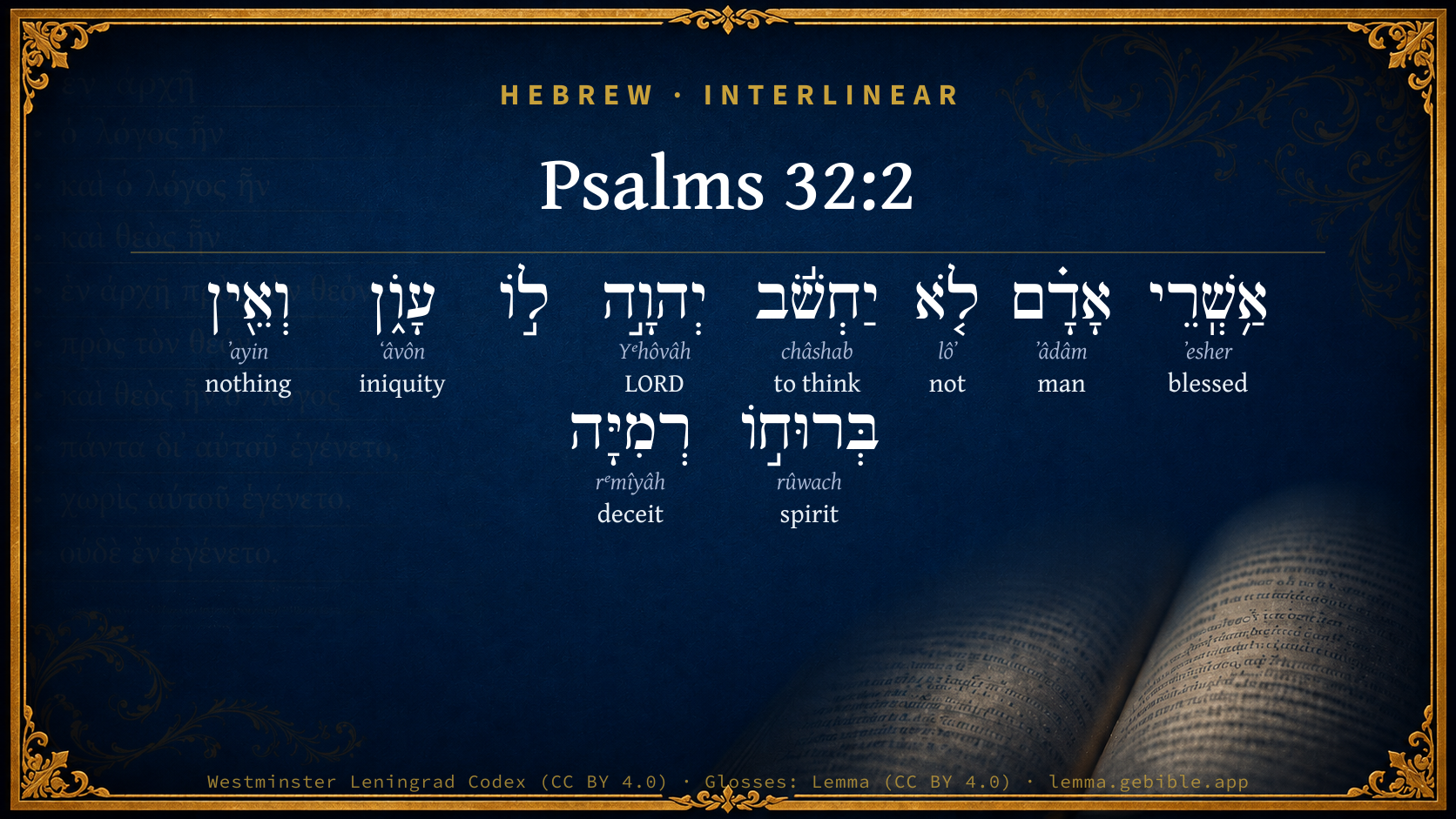
Psalms 32:2

Hebrew (Westminster Leningrad Codex) Psalms 32:2 appears in the Hebrew Old Testament. The text above is from the Westminster Leningrad Codex. Each word links to its Strong’s number, a concise gloss, and parsing drawn from the Open Scriptures Hebrew Bible morphology. Click any word for its full Brown-Driver-Briggs (BDB) entry.
Download image
Cite this verse

Psalms 32:2 (World English Bible). Public Domain. Lemma interlinear Bible study tool, https://lemma.gebible.app/v/psalms/32/2.

Show BibTeX & RIS
BibTeX
RIS
English Translation
Blessed is the man to whom Yahweh doesn't impute iniquity, In whose spirit there is no deceit.
World English Bible · Public Domain
Download a study sheet

One document with this verse’s original text, its word-by-word gloss line, the meaning frame, cross-references with their text, attributed commentary, and full source and license credits — printable, and it pastes into notes with its structure intact.

This verse Autodidact and up

Study sheet (.html) Plain text (.txt)

A passage Seminary Student

Up to 50 verses in one chapter. A passage sheet keeps up to 6 commentary sources and 12 cross-references per verse, in the order this page ranks them, and says so on the sheet whenever that leaves anything out. Ask for a single verse and you get the Autodidact verse sheet above.

Everything on this page stays free to read, with no account — the sheet is a download of what is already on screen, not access to it.

Want to remove ads? Support Godless Engineer
Compare translations 3

The same verse in 3 English versions, stacked beneath the original-language interlinear above. Click any original word for its lexicon entry.

Each is an independent rendering of the whole verse — the interlinear is not word-aligned to these translations.

Highlighted words mark where these versions differ — a whole-verse word diff, not a word-by-word alignment.

  • World English Bible Public Domain
    Blessed is the man to whom Yahweh doesn't impute iniquity, In whose spirit there is no deceit.
  • King James Version Public Domain
    Blessed is the man unto whom the LORD imputeth not iniquity, and in whose spirit there is no guile.
  • unfoldingWord Literal Text CC BY-SA 4.0
    The happinesses of the man to whom Yahweh reckons no guilt, and in whose spirit no deceit!

unfoldingWord Literal Text — © unfoldingWord, licensed CC BY-SA 4.0. Word-aligned USFM3 via Door43 (git.door43.org/unfoldingWord/en_ult).

Versions to compare (up to 4)

3 of 4 selected

Show all 18 translations

Every available English version of this verse, each an independent rendering of the whole verse.

  • World English Bible Public Domain
    Blessed is the man to whom Yahweh doesn't impute iniquity, In whose spirit there is no deceit.
  • Berean Standard Bible Public Domain
    Blessed is the man whose iniquity the LORD does not count against him, in whose spirit there is no deceit.
  • Majority Standard Bible Public Domain
    Blessed is the man whose iniquity the LORD does not count against him, in whose spirit there is no deceit.
  • King James Version Public Domain
    Blessed is the man unto whom the LORD imputeth not iniquity, and in whose spirit there is no guile.
  • American Standard Version (1901) Public Domain
    Blessed is the man unto whom Jehovah imputeth not iniquity, And in whose spirit there is no guile.
  • Revised Version (1885) Public Domain
    Blessed is the man unto whom the LORD imputeth not iniquity, and in whose spirit there is no guile.
  • Geneva Bible (1599) Public Domain
    Blessed is the man, vnto whom the Lord imputeth not iniquitie, and in whose spirite there is no guile.
  • Douay-Rheims (1899) Public Domain
    Blessed is the man to whom the Lord hath not imputed sin, and in whose spirit there is no guile.
  • Young's Literal Translation Public Domain
    O the happiness of a man, To whom Jehovah imputeth not iniquity, And in whose spirit there is no deceit.
  • Literal Standard Version CC BY-SA 4.0
    O the blessedness of a man, || To whom YHWH does not impute iniquity, || And in whose spirit there is no deceit.
  • Unlocked Literal Bible CC BY-SA 4.0
    Blessed is the man to whom Yahweh reckons no guilt and in whose spirit there is no deceit.
  • unfoldingWord Literal Text CC BY-SA 4.0
    The happinesses of the man to whom Yahweh reckons no guilt, and in whose spirit no deceit!
  • Darby Bible Public Domain
    Blessed is the man unto whom Jehovah reckoneth not iniquity, and in whose spirit there is no guile!
  • World Messianic Bible Public Domain
    Blessed is the man to whom the LORD doesn’t impute iniquity, in whose spirit there is no deceit.
  • Webster's Bible Public Domain
    Blessed is the man to whom the LORD imputeth not iniquity, and in whose spirit there is no guile.
  • Free Bible Version CC BY-SA 4.0
    How happy are those whose sins the Lord does not count against them, those who do not act deceptively.
  • Bible in Basic English Public Domain
    Happy is the man in whom the Lord sees no evil, and in whose spirit there is no deceit.
  • JPS Tanakh (1917) Public Domain
    Happy is the man unto whom the LORD counteth not iniquity, and in whose spirit there is no guile.

Literal Standard Version (2020), Covenant Press — licensed CC BY-SA 4.0. Text via the HelloAO Bible API (eBible.org). Unlocked Literal Bible (unfoldingWord) — licensed CC BY-SA 4.0. Text via the HelloAO Bible API (eBible.org). unfoldingWord Literal Text — © unfoldingWord, licensed CC BY-SA 4.0. Word-aligned USFM3 via Door43 (git.door43.org/unfoldingWord/en_ult). Free Bible Version, Dr. Jonathan Gallagher — licensed CC BY-SA 4.0. Text via the HelloAO Bible API (eBible.org).

Word by word

More ways to search: Search by grammar → Find every occurrence → Compare this word →

Practice this passage: Drill this verse → Learn its vocabulary →

About this verse

These counts appear in no published source. They are computed here, from the morphology-tagged text and Lemma’s own curated glosses. What Lemma adds →

10
words
9
distinct lemmas
Wisdom
section

Notable vocabulary

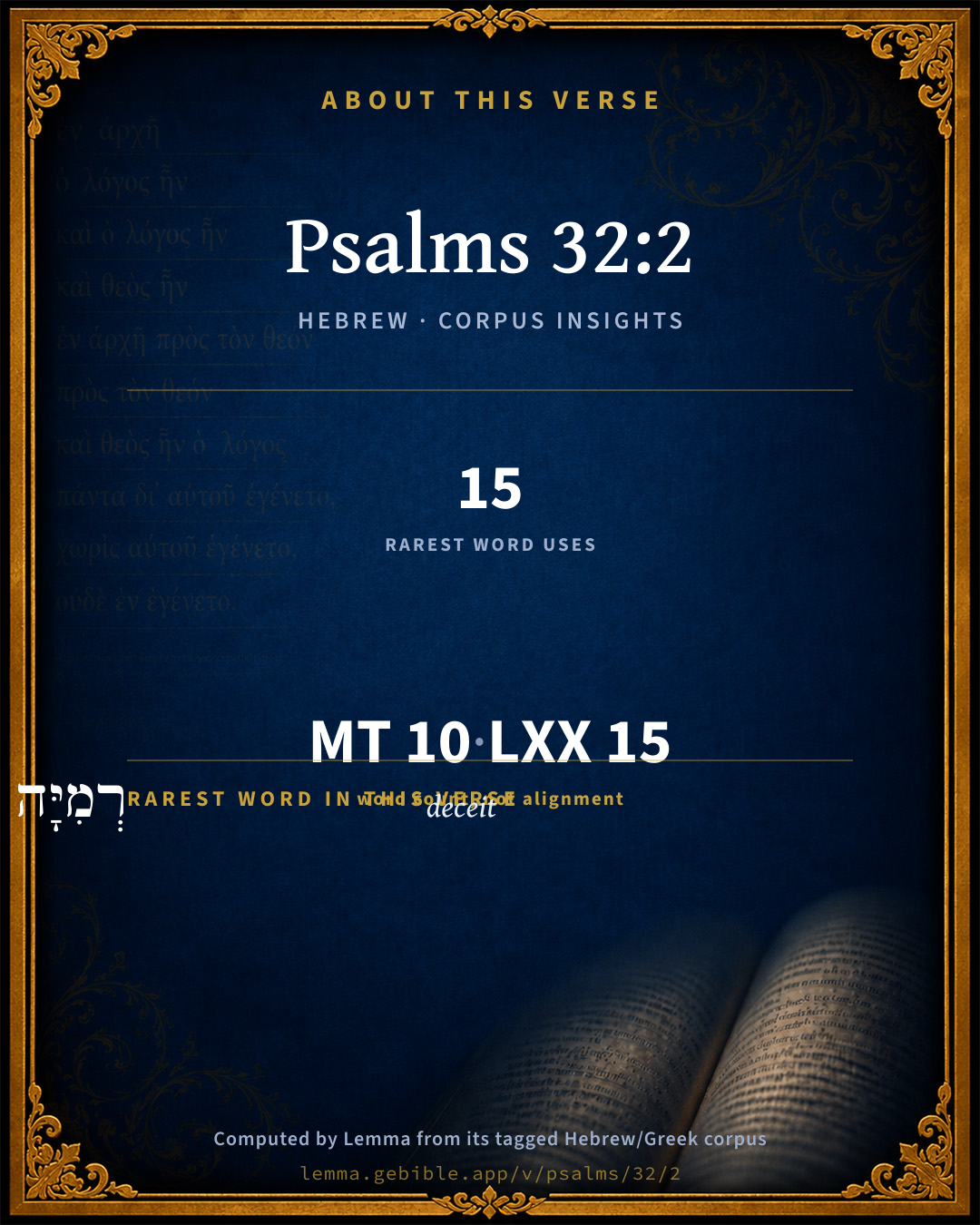
The rarest word here is רְמִיָּה deceit H7423 — appearing just 15 times in the whole Hebrew Bible.

Shared distinctive vocabulary

רְמִיָּה deceit H7423 occurs in 15 verses of the Hebrew Bible. Also found in:

Grammatical profile

  • 1 verb
  • 6 nouns
  • 1 preposition
  • 2 particles

Verb forms

  • יַחְשֹׁ֬ב Qal · Imperfect

Hebrew & Septuagint length

In English translation the verse runs 17 words from the Hebrew and 19 from the Septuagint (LXX English) — closely comparable.

A rough comparison of the two English renderings, which tokenize alike — not a word-level alignment.

Word counts can differ between the Hebrew and the Greek without any difference in meaning — e.g. the Hebrew direct-object marker אֵת has no separate Greek word, and Greek often adds the article ὁ.

In the original languages it is 10 Hebrew tokens and 15 Greek tokens — but the two are counted differently (Hebrew bundles its prefixes and suffixes into one token; the Greek is in lemma form), so that isn’t a like-for-like length.

Cross-references

7

Topical passages linked to Psalms 32:2 in the Treasury of Scripture Knowledge — connected by theme and wording, ordered by reader-vote popularity; previews shown in the World English Bible.

  • John 1:47 Jesus saw Nathanael coming to him, and said about him, "Behold, an Israelite indeed, in whom is no deceit!"
  • 2 Corinthians 5:19–21 namely, that God was in Christ reconciling the world to himself, not reckoning to them their trespasses, and having committed to us the word of reconciliation.
  • Revelation 14:5 In their mouth was found no lie, for they are blameless.
  • 1 Peter 2:1–2 Putting away therefore all wickedness, all deceit, hypocrisies, envies, and all evil speaking,
  • Leviticus 17:4 and hasn't brought it to the door of the Tent of Meeting, to offer it as an offering to Yahweh before the tabernacle of Yahweh: blood shall be imputed to that man. He has shed blood; and that man shall be cut off from among his people.
  • 2 Corinthians 1:12 For our boasting is this: the testimony of our conscience, that in holiness and sincerity of God, not in fleshly wisdom but in the grace of God we behaved ourselves in the world, and more abundantly toward you.
  • Romans 5:13 For until the law, sin was in the world; but sin is not charged when there is no law.

Cross-references courtesy of OpenBible.info (CC BY 4.0).

Hebrew and Greek witnesses Masoretic Hebrew ↔ Greek Septuagint

The same verse in the two great witnesses to the Old Testament, shown verse-for-verse.

You’re reading Greek Psalm 31 (Hebrew Psalm 32). The Septuagint counts the superscription, so verse numbers can differ from the Hebrew — chapter-level alignment, not verse-by-verse. Numbering follows Rahlfs.

These are two independent witnesses, not word-aligned to each other, and the Septuagint is shown in lemma (dictionary) form.

Hebrew Psalms 32:2 Masoretic · Westminster Leningrad Codex

אַ֥שְֽׁרֵי אָדָ֗ם לֹ֤א יַחְשֹׁ֬ב יְהוָ֣ה ל֣וֹ עָוֺ֑ן וְאֵ֖ין בְּרוּח֣וֹ רְמִיָּה

Blessed is the man to whom Yahweh doesn't impute iniquity, In whose spirit there is no deceit.

World English Bible · Public Domain

Greek LXX Greek Psalm 31:2 Septuagint · lemma form

μακάριος ἀνήρ ὅς οὐ μή λογίζομαι κύριος ἁμαρτία οὐδέ εἰμί ἐν ὁ στόμα αὐτός δόλος

Blessed is the man to whom the Lord will not impute sin, and whose mouth there is no guile.

LXX2012 (modern English Septuagint) · Public Domain

Hebrew: Westminster Leningrad Codex (CC BY 4.0). Greek: Septuagint (public domain); English from LXX2012 (modern English Septuagint) (Public Domain). How the Septuagint differs from the Hebrew →

Commentary

Notes on Psalms 32:2 from classic Christian and Jewish commentators (each source and its license shown beneath its notes). The classic Christian expositions comment on the surrounding passage and are grouped to its opening verse, so a note may address several verses; the Jewish commentaries on the Tanakh (Rashi and others) are per-verse, so they appear only where the commentator wrote on this verse.

Lemma curates 59 commentaries, every one of them public domain or Creative Commons licensed, each selected and text-cleaned for this edition rather than reprinted as found. About our sources →

Trapp's Complete Commentary

John Trapp

Psa 32:2 Blessed [is] the man unto whom the LORD imputeth not iniquity, and in whose spirit [there is] no guile.

Ver. 2. Blessed is the man unto whom the Lord imputeth not iniquity] Let no man think this triplication of the same thing needless or superfluous; since the poor soul, afflicted with sense of sin and fear of wrath, is not easily persuaded of pardon; but when faith would lay hold on the promise Satan rappeth her on the fingers, as it were, and seeks to beat her off. Besides, by such an emphatic repetition and heap of words to one purpose, the great grace of God in pardoning men’s sin, is plainly and plentifully declared and celebrated; it being a mercy that no words, how wide soever, can sufficiently set forth. By the word iniquity some understand original sin, that peccatum peccans, as the schools call it, that πανσπερμια, common cause and impure seminary of all actual disobediences. Neither this, nor any of the fruits of it, doth the Lord impute, reckon, count, or think to the pardoned sinner, 2Co 5:19. Cui non cogitat peccatum, so some render it, To whom he thinketh no sin, that is, he reputeth or imputeth it not for a sin, he putteth it not into the reckoning, Isa 43:25; Isa 48:9; Isa 48:11; the bill or bond is cancelled, Col 2:14, and there remaineth no action. Christ is our surety, Heb 7:22. Now the surety and debtor are in law reputed as one person. Christ is made sin for us, that is, in our stead or place, that we might be "made the righteousness of God in him," 2Co 5:21.

And in whose spirit there is no guile] Sed sincere et sine dolo a suis peccatis resipiscit, et ad Dei misericordiam se recipit. The justified are also sanctified, 1Co 6:11; they hide not their sins, as Adam; they neither excuse nor extenuate what evils they have done, but think and speak the worst of their sins; they lay load upon themselves; they hate hypocrisy, and detest dissimulation; it is a question whether they do more desire to be good or abhor to seem only to be so. Basil, as he commendeth that sentence of Plato, that seeming sanctity is double iniquity; so he justly condemneth that saying of Euripides, I had rather seem to be good than be so indeed. That maxim of Machiavel is the same for sense, that virtue itself should not be sought after, but only the appearance; because the credit is a help, the use an encumberance. The pardoned sinner is sanctified throughout, washed not only from his sin (the guilt and filth of it), but his swinish nature also (the love and liking of it); he hath no mind to return to his vomit or wallowing in the mire, saith R. Solomon here; he saith not, Resipiscam et denuo peccabo, vel peccabo et resipiscam, as R. David senseth it, I will repent, and then sin again; or sin again, and then repent. This he knoweth to be incompatible with faith unfeigned, and hope unfailable, 1Ti 1:5 1Jn 3:3.

John Trapp, A Commentary or Exposition upon All the Books of the Old and New Testament (1647–1656) — public domain. Text from a community e-Sword module.

The Biblical Illustrator

Joseph S. Exell

Psa_32:2

In whose spirit there is no guile.

Signs of a sincere and guileless heart

1. Observe thy actions.

(1) In their nature. If they be single and pure, so is thy heart. As is the fountain and the root, such are the streams and the fruit.

(2) In their end. An honest heart ever aims at Gods glory directly, whereas a guileful heart ever propounds bad ends of good actions.

2. Observe whether thou makest conscience secretly of all sins; yea, most seriously of those to which thou art most inclined.

3. Consider whether thou daily renewest thy purpose of not sinning against God, as thou renewest thy days, and whether thou watchest over thine own heart with an holy suspicion, and wilt for Gods will break thine own.

4. Mark whether thou lovest God in His image, ordinances, and children, even then when the world scorns and hates all these. (T. Taylor, D. D.)

Motives to guilelessness

1. Gods commandment (Gen_17:1; Psa_51:6). Conformity of manners must go with reformation of the heart.

2. It is a part of Gods image, who is most single and true; and the beauty of the Church is to be all glorious within: herein she is conformable to her Head, in whose mouth was found no guile. Every son of the Church must be a Nathaniel, in whom is no guile (Joh_1:47), and a true Israelite, even pure of heart (Psa_73:1).

3. Our text affords a sound reason, in that sincerity of heart is joined with forgiveness of sins, and is a forerunner to blessedness. Sincerity is a veil to cover all sin; because of this, God covers and cures all our iniquities (1Ki_15:14).

4. If we would be distinguished from hypocrites, we must labour for sincerity; wicked ones may outwardly strain beyond us, make fair shows, and have a kind of faith and joy, etc., but we must outstrip them all in sincerity of heart.

5. If we would have our duties comfortable to ourselves and profitable, when men object them unto us, and we meet with but small comfort in the world because of them, let us labour to become true Israelites (2Sa_6:20-22).

6. God hath appointed a day to try thy heart and the soundness thereof, to turn out all the windings of it; and He abhors the double heart, that turns itself upon deceitfulness as a door upon hinges; therefore look to the singleness of it beforehand.

7. Only they that walk uprightly are citizens of heaven (Psa_15:2). (T. Taylor, D. D. )

Guile forsaken when guilt is forgiven

I. many men play tricks with god and their consciences.

1. The guile of the human heart shows itself in a refusal to come to serious consideration. The most frivolous amusements, the most carking cares, and even the most weary ceremonials of fashions, are adopted as a happy release from the labour of reflection. Death, judgment, eternity, heaven, and hell--they dare not think of these: and why? Because they know that all is wrong with them, and so they practise a crafty carelessness and a cunning indifference.

2. Others who do think a little are partial in their judgments of themselves. They present accounts, but these are cooked and made to appear other than they should by a sort of spiritual financing.

3. Many are evidently tricking themselves wilfully because they rest on such frivolous grounds of confidence. Could any man depend on his own good works unless he had juggled with his judgment?

4. Others avoid all home truths, and keep clear of searching doctrines. The preacher is too censorious, and that is your excuse for remaining in spiritual apathy. Even books come in for like censures. The plain-speaking volume is not conceived in a gentle spirit, or is too narrow, bigoted, and one-sided.

5. Many are clever at parrying home thrusts by introducing other themes. You know how the lapwing pretends to have a broken wing, and flies as if it must be taken and all with the view of leading the passenger from her nest, so do our hearers try to lead us away from the main matter.

6. Another very cunning trick which is often practised by sinners who are full of guile is this, they pass on to other people anything which is uncomfortably applicable to themselves. It seemed as if the preacher had made a cap specially to fit that head, but the result was that the person who watched the making exclaimed, Dear me! How well he has taken my neighbours measure.

7. One sorry piece of craft which Satan teaches to many is to make them doubt, or pretend to doubt, anything in Scripture which frowns upon them.

8. While yet far from God, many calm and quiet themselves with outward religion.

9. There are others who conceal in the secret of their hearts a blasphemous notion which they hardly dare to put into words, but it amounts to this that the reason why they are not saved is not by any means due to themselves.

10. Perhaps the most numerous victims of this guile are those who flatter themselves that they will come right some day. If you resolve that you will repent in a years time, what is that but a daring defiance of God by declaring that you will continue in sin for twelve months at least? Have you ever looked at it in that light?

II. the pardoned man gives evidence of ceasing from this guile.

1. He makes an open confession of his sin to God.

2. He has done with all sorts of excuses and palliations.

3. Sincerity has entered into his belief in the terrible things of Gods Word. He now sees their certainty and their justice.

4. He now wishes to be dealt with personally and impartially whenever he reads a book or hears a sermon.

5. He desires in everything that he does to be true.

6. He also desires to be rid of all sin.

7. He seeks after perfect purity of life, and he has heartily ceased from guile, for now as an heir of heaven he lives in the presence of God, and delights to remember the all-seeing eye. (C. H. Spurgeon.)

The Biblical Illustrator, edited by Joseph S. Exell (c. 1880s–1900s) — public domain. Text from a community e-Sword module.

Joseph Benson's Commentary

Psa 32:2. Unto whom the Lord imputeth not iniquity — Whom God doth not charge with the guilt of his sins, as he justly might, but pardons and accepts him in Christ. And in whose spirit there is no guile — Who freely confesses all his sins, without dissembling, is truly sorry for, and sincerely hates them, and turns from sin to God with all his heart.

Joseph Benson's Commentary on the Old and New Testaments (1811–1818) — public domain. Text from a community e-Sword module.

J. A. Alexander on Psalms

Joseph Addison Alexander

2. (Psa 32:2) Happy man— Jehovah will not impute to him iniquity — and there is not in his spirit guile. The peculiar form of the construction may be thus resolved into our idiom: happy the man to whom the Lord, etc. The phrase at the beginning, Oh the happinesses of the man, is substantially the same as in Psa 1:1.—Impute, reckon or charge to his account, and deal with him accordingly. The whole phrase occurs in 2Sa 19:20 (19). The threefold designation, sin, transgression, and iniquity, seems to be borrowed from Exo 34:7, where the doctrine of forgiveness is first fully and explicitly propounded.—Guile, deceit, including self-deception as to one's own character and dissimulation in the sight of God, the attempt to palliate or conceal sin instead of freely confessing it, which is an indispensable condition of forgiveness, according to the doctrine of both testaments (Pro 28:13, 1Jn 1:8-10).

Joseph Addison Alexander, The Psalms Translated and Explained (1850) — public domain. Text from a community e-Sword module.

Jamieson, Fausset & Brown

Robert Jamieson, A. R. Fausset & David Brown

imputeth--charge to him, and treat him accordingly.

no guile--or, deceit, no false estimate of himself, nor insincerity before God (compare Rom 8:1).

Jamieson, Fausset & Brown — Commentary Critical and Explanatory on the Whole Bible (1871) — public domain (CC PDM 1.0). Text via the HelloAO Bible API.

John Calvin's Commentaries

2. In whose spirit there is no guile. In this clause the Psalmist distinguishes believers both from hypocrites and from senseless despisers of God, neither of whom care for this happiness, nor can they attain to the enjoyment of it. The wicked are, indeed, conscious to themselves of their guilt, but still they delight in their wickedness; harden themselves in their impudence, and laugh at threatenings; or, at least, they indulge themselves in deceitful flatteries, that they may not be constrained to come into the presence of God. Yea, though they are rendered unhappy by a sense of their misery, and harassed with secret torments, yet with perverse forgetfulness they stifle all fear of God. As for hypocrites, if their conscience as any time stings them, they soothe their pain with ineffectual remedies: so that if God at any time cite them to his tribunal, they place before them I know not what phantoms for their defense; and they are never without coverings whereby they may keep the light out of their hearts. Both these classes of men are hindered by inward guile from seeking their happiness in the fatherly love of God. Nay more, many of them rush frowardly into the presence of God, or puff themselves up with proud presumption, dreaming that they are happy, although God is against them. David, therefore, means that no man can taste what the forgiveness of sins is until his heart is first cleansed from guile. What he means, then, by this term, guile, may be understood from what I have said. Whoever examines not himself, as in the presence of God, but, on the contrary, shunning his judgment, either shrouds himself in darkness, or covers himself with leaves, deals deceitfully both with himself and with God. It is no wonder, therefore, that he who feels not his disease refuses the remedy. The two kinds of this guile which I have mentioned are to be particularly attended to. Few may be so hardened as not to be touched with the fear of God, and with some desire of his grace, and yet they are moved but coldly to seek forgiveness. Hence it comes to pass, that they do not yet perceive what an unspeakable happiness it is to possess God’s favor. Such was David’s case for a time, when a treacherous security stole upon him, darkened his mind, and prevented him from zealously applying himself to pursue after this happiness. Often do the saints labor under the same disease. If, therefore, we would enjoy the happiness which David here proposes to us, we must take the greatest heed lest Satan, filling our hearts with guile, deprive us of all sense of our wretchedness, in which every one who has recourse to subterfuges must necessarily pine away.

John Calvin's Commentaries (1540-1563) — public domain. Text from the Calvin Translation Society English edition (1840s-50s) via the Christian Classics Ethereal Library (ccel.org). Calvin's coverage is partial (roughly two-thirds of the Bible); uncommented books and verses are honest gaps, never fabricated. The 19th-century editor's footnotes and remarks are omitted so the notes are faithfully Calvin's own voice.

John Gill's Exposition

Blessed is the man to whom the Lord imputeth not iniquity,.... Or "does not think of it" (n); with respect unto men, at least to the harm of them; his thoughts are thoughts of peace, and not of evil; their sins and iniquities he remembers no more; he does not charge them with them, he does not reckon them, or place them to their account, having imputed them to his Son; see Co2 5:19. The Apostle Paul interprets this as inclusive of the imputation of righteousness without works; even of the righteousness of Christ, in which the blessedness of a man lies, Rom 4:6; for such an one is accepted with God, is justified in his sight, and is secure from condemnation and wrath; it is well with him at all times, in life, at death, and at judgment; he is an heir of eternal life, will enter into it, and be for ever glorified;

and in whose spirit there is no guile: for being thoroughly convinced of sin, he is sincere in his repentance for it, without deceit and hypocrisy in his confession of it; as David, the Apostle Paul, and the publican were, when they acknowledged themselves sinners; his faith, in looking to Christ for pardon and righteousness, is from the heart, and is unfeigned, and so is his profession of it before God, angels, and men; and whatever hypocrisy and guile are remaining in the old man, there is none in the new spirit put into him; in the new man, which is created in him, and which sinneth not: as the other phrases are expressive of pardon and justification, this points at internal sanctification, and which serves to complete the description of the happy man; such an one as David himself was; and this happiness he illustrates from his own experience in the following verses.

(n) "cogitat", Piscator; "cogitando reputavit", Gejerus; so Ainsworth.

John Gill's Exposition of the Whole Bible (1746–1763) — public domain (CC PDM 1.0). Text via the HelloAO Bible API.

Albert Barnes' Notes on the Bible

Blessed is the man unto whom the Lord imputeth not iniquity - Whose sin is not “reckoned” to him, or “charged” on him. The reference here is “to his own sin.” The idea is not, that he is happy on whom God does not charge the guilt of other men, but that he is happy who is not charged “with his own guilt,” or who is treated as if he had no guilt; that is, as if he were innocent. This is the true idea of justification. It is, that a man, although he is a sinner, and “is conscious” of having violated the law of God, is treated as if he had not committed sin, or as if he were innocent; that is, he is pardoned, and his sins are remembered against him no more; and it is the purpose of God to treat him henceforward as if he were innocent. The act of pardon does not change the facts in the case, or “make him innocent,” but it makes it proper for God to treat him as if he were innocent. The sin will not be re-charged upon him, or reckoned to his account; but he is admitted to the same kind of treatment to which he would be entitled if he had always been perfectly holy. See Rom 1:17, note; Rom 3:24, note; Rom 4:5, note; Rom 5:1, note.

And in whose spirit there is no guile - Who are sincere and true. That is, who are not hypocrites; who are conscious of no desire to cover up or to conceal their offences; who make a frank and full confession to God, imploring pardon. The “guile” here refers to the matter under consideration. The idea is not who are “innocent,” or “without guilt,” but who are sincere, frank, and honest in making “confession” of their sins; who keep nothing back when they go before God. We cannot go before him and plead our innocence, but we may go before him with the feeling of conscious sincerity and honesty in making confession of our guilt. Compare Psa 66:18.

Albert Barnes' Notes on the Bible (1834–1885) — public domain. Text from a community e-Sword/MySword module.

Matthew Poole's English Annotations

Whom God doth not charge with the guilt of his sins, as he might justly do, but graciously accepts and pardons him in Christ, and deals with him as if he had not sinned.

In whose spirit there is no guile; who freely confesseth all his sins without dissembling and concealing of them; which may seem to be the main thing here intended, by comparing this with the following verses; and who is sincere in his professions of repentance, turning from sin to God with all his heart, and not feignedly.

Matthew Poole's English Annotations on the Holy Bible (1683–1685) — public domain. Text from a community e-Sword/MySword module.

The Treasury of David

Charles H. Spurgeon

Ver. 2. Blessed is the man unto whom the Lord imputeth not iniquity. The word blessed is in the plural, oh, the blessednesses! the double joys, the bundles of happiness, the mountains of delight! Note the three words so often used to denote our disobedience: transgression, sin, and iniquity, are the three headed dog at the gates of hell, but our glorious Lord has silenced his barkings for ever against his own believing ones. The trinity of sin is overcome by the Trinity of heaven. Non imputation is of the very essence of pardon: the believer sins, but his sin is not reckoned, not accounted to him. Certain divines froth at the mouth with rage against imputed righteousness, be it ours to see our sin not imputed, and to us may there be as Paul words it, "Righteousness imputed without works." He is blessed indeed who has a substitute to stand for him to whose account all his debts may be set down. And in whose spirit there is no guile. He who is pardoned, has in every case been taught to deal honestly with himself, his sin, and his God. Forgiveness is no sham, and the peace which it brings is not caused by playing tricks with conscience. Self deception and hypocrisy bring no blessedness, they may drug the soul into hell with pleasant dreams, but into the heaven of true peace they cannot conduct their victim. Free from guilt, free from guile. Those who are justified from fault are sanctified from falsehood. A liar is not a forgiven soul. Treachery, double dealing, chicanery, dissimulation, are lineaments of the devil's children, but he who is washed from sin is truthful, honest, simple, and childlike. There can be no blessedness to tricksters with their plans, and tricks, and shuffling, and pretending: they are too much afraid of discovery to be at ease; their house is built on the volcano's brink, and eternal destruction must be their portion. Observe the three words to describe sin, and the three words to represent pardon, weigh them well, and note their meaning. (See note at the end.)

Ver. 2. Unto whom the Lord imputeth not iniquity. Aben Ezra paraphrases it, of whose sins God does not think, does not regard them, so as to bring them into judgment, reckoning them as if they were not; ou me logizetai does not count or calculate them; does not require for them the debt of punishment. To us the remission is entirely free, our Sponsor having taken upon him the whole business of paying the ransom. His suffering is our impunity, his bond our freedom, and his chastisement our peace; and therefore the prophet says, "The chastisement of our peace was upon him, and by his stripes we are healed." Robert Leighton.

Ver. 2. In whose spirit there is no guile. In the saint's trouble, conscience is full of Scripture sometimes, on which it grounds its verdict, but very ill interpreted. Oh, saith the poor soul, this place is against me! Blessed is the man unto whom the Lord imputeth not iniquity, and in whose spirit there is no guile. Here, saith he, is a description of a sincere soul, to be one in whose spirit there is no guile; but I find much guile in me, therefore I am not the sincere one. Now this is a very weak, yea, false inference. By a spirit without guile, is not meant a person that hath not the least deceitfulness and hypocrisy remaining in his heart. To be without sin, and to be without guile, in this strict sense are the samea prerogative here on earth peculiar to the Lord Christ 1Pe 2:22, "Who did no sin, neither was guile found in his mouth." And therefore when we meet with the same phrase attributed to the saints, as to Levi, Mal 2:6; "Iniquity was not found in his lips; "and to Nathanael, Joh 1:47: "Behold an Israelite indeed in whom is no guile!" we must sense it in an inferior way, that may suit with their imperfect state here below, and not put that which was only Christ's crown on earth, and is the glorified saint's robe in heaven, on the weak Christian while militant here on earth, not only with a devil without, but with a body of sin within him. Wipe thine eyes again, poor soul, and then if thou readest such places, wherein the Spirit of God speaks so highly and hyperbolically of his saint's grace, thou shalt find he doth not assert the perfection of their grace, free from all mixture of sin, but rather to comfort poor drooping souls, and cross their misgiving hearts, which, from the presence of hypocrisy, are ready to overlook their sincerity as none at all, he expresses his high esteem of their little grace, by speaking of it as if it were perfect, and their hypocrisy none at all. William Gurnall.

Ver. 2. In whose spirit there is no guile. When once pardon is realized, the believer has courage to be truthful before God: he can afford to have done with guile in the spirit. Who would not declare all his debts when they are certain to be discharged by another? Who would not declare his malady when he was sure of a cure? True faith knows not only that guile before God is impossible, but also that it is no longer necessary. The believer has nothing to conceal: he sees himself as before God, stripped, and laid open, and bare; and if he has learned to see himself as he is, so also has he learned to see God as he reveals himself. There is no guile in the spirit of one who is justified by faith; because in the act of justification truth has been established in his inward parts. There is no guile in the spirit of him who sees the truth of himself in the light of the truth of God. For the truth of God shows him at once that in Christ he is perfectly righteous before God, and in himself he is the chief of sinners. Such a one knows he is not his own, for he is bought with a price, and therefore he is to glorify God. There is no guile in the spirit of him whose real object is to glorify Christ and not himself. But when a man is not quite true to Christ, and has not quite ceased to magnify self, there may be guile, for he will be more occupied with thoughts about himself than with the honour of Christ. But if the truth, and honour, and glory of Christ be his supreme care, he may leave himself out of the question, and, like Christ, "O commit himself to him that judgeth righteously." J. W. Reeve, M.A., in "Lectures on the Thirty-second Psalm, " 1860.

Ver. 2. No guile. Sincerity is that property to which pardoning mercy is annexed. True, indeed, it is that Christ covers all our sins and failings; but it is only the sincere soul over which he will cast his skirt. Blessed is he whose sin is covered. Blessed is the man unto whom the Lord imputeth not iniquity. None will doubt this; but which is the man? The next words tell us his name; And in whose spirit there is no guile. Christ's righteousness is the garment which covers the nakedness and shame of our unrighteousness; faith the grace that puts this garment on; but what faith? None but the faith unfeigned, as Paul calls it. 2Ti 1:5. "Here is water, "said the eunuch, "what doth hinder me to be baptized?" Ac 8:36. Now mark Philip's answer, Ac 8:37, "If thou believest with all thine heart thou mayest; "as if he had said, Nothing but an hypocritical heart can hinder thee. It is the false heart only that finds the door of mercy shut. William Gurnall.

Ver. 2. Guile. The guile of the spirit is an inward corruption in the soul of man, whereby he dealeth deceitfully with himself before God in the matter of salvation. Thomas Taylor.

Ver. 2. Non imputation, a remarkable doctrine. Prove, explain, and improve it.

Ver. 2. No guile. The honesty of heart of the pardoned man.

Psalms 32:3*

Charles H. Spurgeon's The Treasury of David (1869–1885) — public domain. Psalms only. Text from a community e-Sword/MySword module.

Whedon's Commentary on the Bible

Daniel D. Whedon

2. Imputeth not iniquity—Quoted by Paul as identical with “imputeth righteousness.” Rom_4:6; Rom_4:8.

Guile—Deceit, falsehood. “Iniquity,” in previous line, is used in the sense of guiltiness, liability to punishment. Thus, the spirit—the seat of all moral good or evil—is expiated of guilt and purged from all deceit. No more evangelical view of atonement, pardon and regeneration are found in Holy Scripture.

Daniel D. Whedon (gen. ed.), Commentary on the Old and New Testaments (1874–1909) — public domain. Text from a community e-Sword module.

The Pulpit Commentary

Blessed is the man unto whom the Lord imputeth not iniquity. "Iniquity the defilement of the sinner"s own soul by sin is not at once removable; if removable at all, it is only so by long lapse of time, and God"s special mercy. But God can, at his own will and at any moment, "not impute" it not count it against the sinner to his detriment. Then in God"s sight the man is clean; it is as though the iniquity were not there. And in whose spirit there is no guile; i.e. no false seeming no hypocrisy where repentance has been sincere and real.

The Pulpit Commentary (1880–1919), ed. H.D.M. Spence-Jones & Joseph S. Exell — public domain. Text from a community e-Sword module.

John Wesley's Explanatory Notes

Imputeth - Whom God doth not charge with the guilt of his sins, but graciously pardons and accepts him in Christ. No guile - Who freely confesses all his sins, and turns from sin to God with all his heart.

John Wesley, Explanatory Notes Upon the Whole Bible (1754–1765) — public domain. Text via the GEBible commentary corpus.

Rashi

Rabbi Shlomo Yitzchaki (Rashi)

to whom the Lord ascribes no iniquity provided that in his spirit there is no guile, thinking to revert to his “vomit.”

Rashi on the Tanakh — English translations: “The Judaica Press complete Tanach with Rashi, translated by A. J. Rosenberg” (CC BY 4.0); “Pentateuch with Rashi's commentary by M. Rosenbaum and A.M. Silbermann, 1929-1934” (public domain); “The Metsudah Tanach series, Lakewood, N.J” (CC BY 4.0); and “The Book of Joshua, Metsudah Publications, 1997” (CC BY 4.0). Text via Sefaria.

Lesson kit

Teaching starters — assembled from the data on this page, not authored interpretation. Every prompt links to the verse data it draws on. Edit before teaching.

Psalms, in the Wisdom, opens this verse with 10 words (9 distinct Hebrew lemmas). Its most distinctive word is rᵉmîyâh (“deceit”). A historical commentator’s framing appears above. Read the whole chapter for the surrounding context.

Discussion questions

  1. What does “deceit” (rᵉmîyâh) contribute to the verse as a whole?
  2. How does Job 13:7, which shares the word «deceit», read alongside this verse?
  3. The translations on this page render this verse differently — a whole-verse word diff, not a word-by-word alignment. What might account for the different wordings?
  4. «יַחְשֹׁ֬ב» is a Qal Imperfect verb. How does that grammatical form shape the action described?
  5. Compare how Trapp's Complete Commentary and The Biblical Illustrator read this verse. Where do they agree or differ?

Things to notice

Reading settings

Reading text

Shown beneath each verse's original-language words.

Old Testament
Old Testament edition

Read the OT as the Masoretic Hebrew (MT) or the Greek Septuagint (LXX).

English shown for the Greek Septuagint (in the Hebrew ↔ Greek comparison).

Comparing translations? Open the Compare panel on any verse page to stack up to four side by side.