
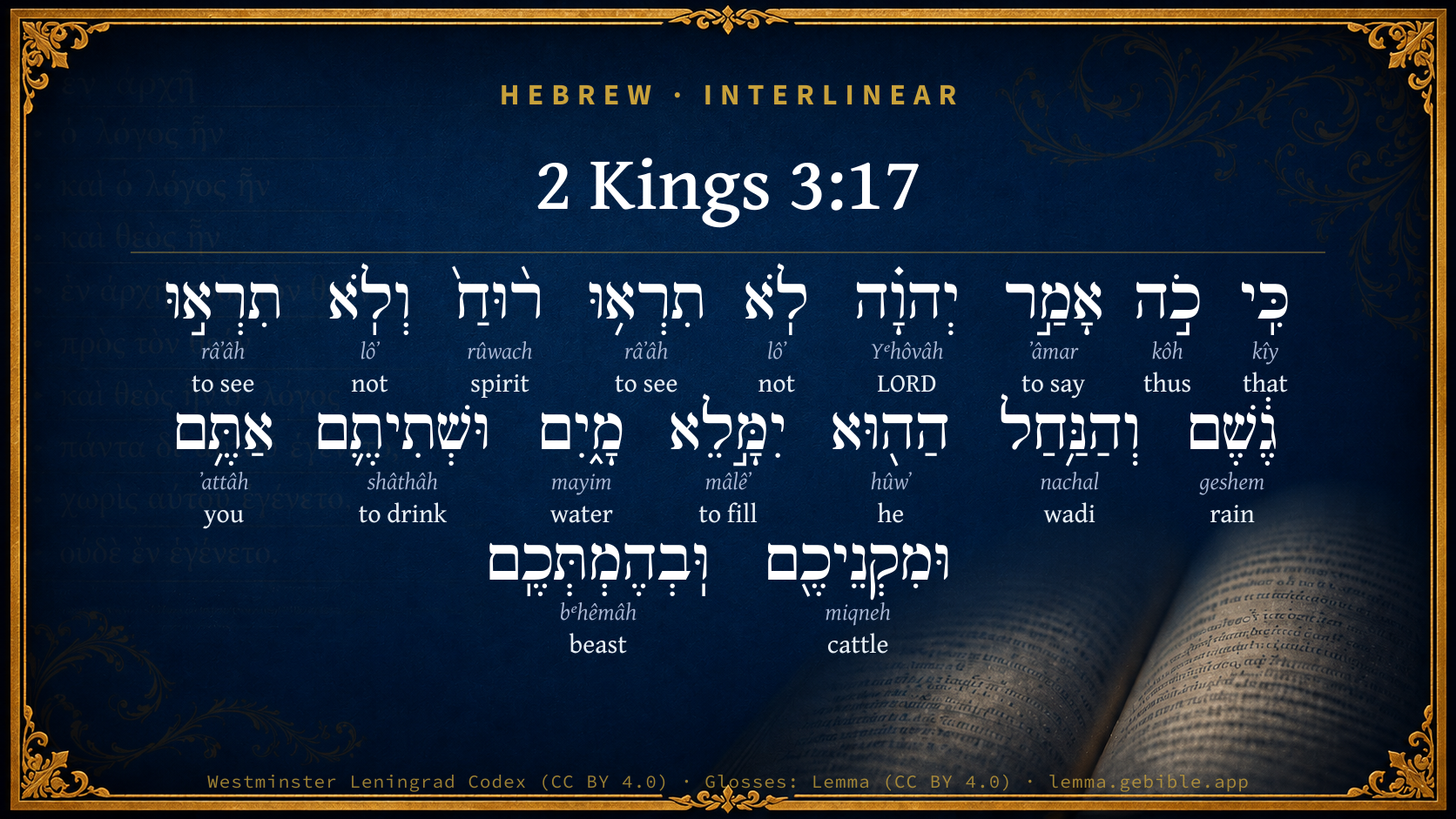
2 Kings 3:17

Hebrew (Westminster Leningrad Codex) 2 Kings 3:17 appears in the Hebrew Old Testament. The text above is from the Westminster Leningrad Codex. Each word links to its Strong’s number, a concise gloss, and parsing drawn from the Open Scriptures Hebrew Bible morphology. Click any word for its full Brown-Driver-Briggs (BDB) entry.
Download image
Cite this verse

2 Kings 3:17 (World English Bible). Public Domain. Lemma interlinear Bible study tool, https://lemma.gebible.app/v/2-kings/3/17.

Show BibTeX & RIS
BibTeX
RIS
English Translation
For thus says Yahweh, You shall not see wind, neither shall you see rain; yet that valley shall be filled with water, and you shall drink, both you and your cattle and your animals.
World English Bible · Public Domain
Download a study sheet

One document with this verse’s original text, its word-by-word gloss line, the meaning frame, cross-references with their text, attributed commentary, and full source and license credits — printable, and it pastes into notes with its structure intact.

This verse Autodidact and up

Study sheet (.html) Plain text (.txt)

A passage Seminary Student

Up to 50 verses in one chapter. A passage sheet keeps up to 6 commentary sources and 12 cross-references per verse, in the order this page ranks them, and says so on the sheet whenever that leaves anything out. Ask for a single verse and you get the Autodidact verse sheet above.

Everything on this page stays free to read, with no account — the sheet is a download of what is already on screen, not access to it.

Want to remove ads? Support Godless Engineer
Compare translations 3

The same verse in 3 English versions, stacked beneath the original-language interlinear above. Click any original word for its lexicon entry.

Each is an independent rendering of the whole verse — the interlinear is not word-aligned to these translations.

Highlighted words mark where these versions differ — a whole-verse word diff, not a word-by-word alignment.

  • World English Bible Public Domain
    For thus says Yahweh, You shall not see wind, neither shall you see rain; yet that valley shall be filled with water, and you shall drink, both you and your cattle and your animals.
  • King James Version Public Domain
    For thus saith the LORD, Ye shall not see wind, neither shall ye see rain; yet that valley shall be filled with water, that ye may drink, both ye, and your cattle, and your beasts.
  • unfoldingWord Literal Text CC BY-SA 4.0
    For thus says Yahweh, ‘You will not see wind, and you will not see rain, but this valley will be filled water. And you will drink, you and your cattle and your animals.’

unfoldingWord Literal Text — © unfoldingWord, licensed CC BY-SA 4.0. Word-aligned USFM3 via Door43 (git.door43.org/unfoldingWord/en_ult).

Versions to compare (up to 4)

3 of 4 selected

Show all 18 translations

Every available English version of this verse, each an independent rendering of the whole verse.

  • World English Bible Public Domain
    For thus says Yahweh, You shall not see wind, neither shall you see rain; yet that valley shall be filled with water, and you shall drink, both you and your cattle and your animals.
  • Berean Standard Bible Public Domain
    For the LORD says, ‘You will not see wind or rain, but the valley will be filled with water, and you will drink—you and your cattle and your animals.’
  • Majority Standard Bible Public Domain
    For the LORD says, ‘You will not see wind or rain, but the valley will be filled with water, and you will drink—you and your cattle and your animals.’
  • King James Version Public Domain
    For thus saith the LORD, Ye shall not see wind, neither shall ye see rain; yet that valley shall be filled with water, that ye may drink, both ye, and your cattle, and your beasts.
  • American Standard Version (1901) Public Domain
    For thus saith Jehovah, Ye shall not see wind, neither shall ye see rain; yet that valley shall be filled with water, and ye shall drink, both ye and your cattle and your beasts.
  • Revised Version (1885) Public Domain
    For thus saith the LORD, Ye shall not see wind, neither shall ye see rain, yet that valley shall be filled with water: and ye shall drink, both ye and your cattle and your beasts.
  • Geneva Bible (1599) Public Domain
    For thus saith the Lord, Ye shall neither see winde nor see raine, yet the valley shalbe filled with water, that ye may drinke, both ye and your cattel, and your beastes.
  • Douay-Rheims (1899) Public Domain
    For thus saith the Lord: You shall not see wind, nor rain: and yet this channel shall be filled with waters, and you shall drink, you and your families, and your beasts.
  • Young's Literal Translation Public Domain
    for thus said Jehovah, Ye do not see wind, nor do ye see rain, and that valley is full of water, and ye have drunk -- ye, and your cattle, and your beasts.
  • Literal Standard Version CC BY-SA 4.0
    for thus said YHWH: You do not see wind, nor do you see rain, and that valley is full of water, and you have drunk—you, and your livestock, and your beasts.
  • Unlocked Literal Bible CC BY-SA 4.0
    For Yahweh says this, 'You will not see wind, neither will you see rain, but this river valley will be filled with water, and you will drink, you and your livestock and all your animals.'
  • unfoldingWord Literal Text CC BY-SA 4.0
    For thus says Yahweh, ‘You will not see wind, and you will not see rain, but this valley will be filled water. And you will drink, you and your cattle and your animals.’
  • Darby Bible Public Domain
    For thus saith Jehovah: Ye shall not see wind, neither shall ye see rain; yet this valley shall be filled with water, and ye shall drink, both ye, and your cattle, and your beasts.
  • World Messianic Bible Public Domain
    For the LORD says, ‘You will not see wind, neither will you see rain, yet that valley will be filled with water, and you will drink, both you and your livestock and your other animals.
  • Webster's Bible Public Domain
    For thus saith the LORD, Ye shall not see wind, neither shall ye see rain; yet that valley shall be filled with water, that ye may drink, both ye, and your cattle, and your beasts.
  • Free Bible Version CC BY-SA 4.0
    You won't see any wind, you won't see any rain, but even so this valley will be filled with water. You will drink, and your cattle, and your animals.
  • Bible in Basic English Public Domain
    For the Lord says, Though you see no wind or rain, the valley will be full of water, and you and your armies and your beasts will have drink.
  • JPS Tanakh (1917) Public Domain
    For thus saith the LORD: Ye shall not see wind, neither shall ye see rain, yet that valley shall be filled with water; and ye shall drink, both ye and your cattle and your beasts.

Literal Standard Version (2020), Covenant Press — licensed CC BY-SA 4.0. Text via the HelloAO Bible API (eBible.org). Unlocked Literal Bible (unfoldingWord) — licensed CC BY-SA 4.0. Text via the HelloAO Bible API (eBible.org). unfoldingWord Literal Text — © unfoldingWord, licensed CC BY-SA 4.0. Word-aligned USFM3 via Door43 (git.door43.org/unfoldingWord/en_ult). Free Bible Version, Dr. Jonathan Gallagher — licensed CC BY-SA 4.0. Text via the HelloAO Bible API (eBible.org).

Word by word

More ways to search: Search by grammar → Find every occurrence → Compare this word →

Practice this passage: Drill this verse → Learn its vocabulary →

גֶ֔שֶׁם
geshem
H1653
“rain”
Noun, Common, Masculine, Singular, Absolute
Part of Speech
Noun
Type
Common
Gender
Masculine
Number
Singular
State
Absolute
Full BDB Definition

Origin: from H1652

TWOT: 389a

rain, shower
  1. כִּֽי kîy H3588 “that” Conjunction
  2. כֹ֣ה kôh H3541 “thus” Adverb
  3. אָמַ֣ר ʼâmar H559 “to say” Verb, Qal, Perfect, 3rd Person, Masculine, Singular
  4. יְהוָ֗ה Yᵉhôvâh H3068 “LORD” Noun, Proper
  5. לֹֽא lôʼ H3808 “not” Particle, Negative
  6. תִרְא֥וּ râʼâh H7200 “to see” Verb, Qal, Imperfect, 2nd Person, Masculine, Plural
  7. ר֨וּחַ֙ rûwach H7307 “spirit” Noun, Common, Both, Singular, Absolute
  8. וְלֹֽא lôʼ H3808 “and · not” Conjunction + Particle, Negative
  9. תִרְא֣וּ râʼâh H7200 “to see” Verb, Qal, Imperfect, 2nd Person, Masculine, Plural
  10. וְהַנַּ֥חַל nachal H5158 “and · the · wadi” Conjunction + Particle, Definite Article + Noun, Common, Masculine, Singular, Absolute
  11. הַה֖וּא hûwʼ H1931 “the · he” Particle, Definite Article + Pronoun, Personal, 3rd Person, Masculine, Singular
  12. יִמָּ֣לֵא mâlêʼ H4390 “to fill” Verb, Niphal, Imperfect, 3rd Person, Masculine, Singular
  13. מָ֑יִם mayim H4325 “water(s)” Noun, Common, Masculine, Plural, Absolute
  14. וּשְׁתִיתֶ֛ם shâthâh H8354 “and · to drink” Conjunction + Verb, Qal, Sequential Perfect, 2nd Person, Masculine, Plural
  15. אַתֶּ֥ם ʼattâh H859 “you” Pronoun, Personal, 2nd Person, Masculine, Plural
  16. וּמִקְנֵיכֶ֖ם miqneh H4735 “and · cattle · your” Conjunction + Noun, Common, Masculine, Plural, Construct + Suffix, Personal, 2nd Person, Masculine, Plural
  17. וּֽבְהֶמְתְּכֶֽם bᵉhêmâh H929 “and · beast · your” Conjunction + Noun, Common, Feminine, Singular, Construct + Suffix, Personal, 2nd Person, Masculine, Plural

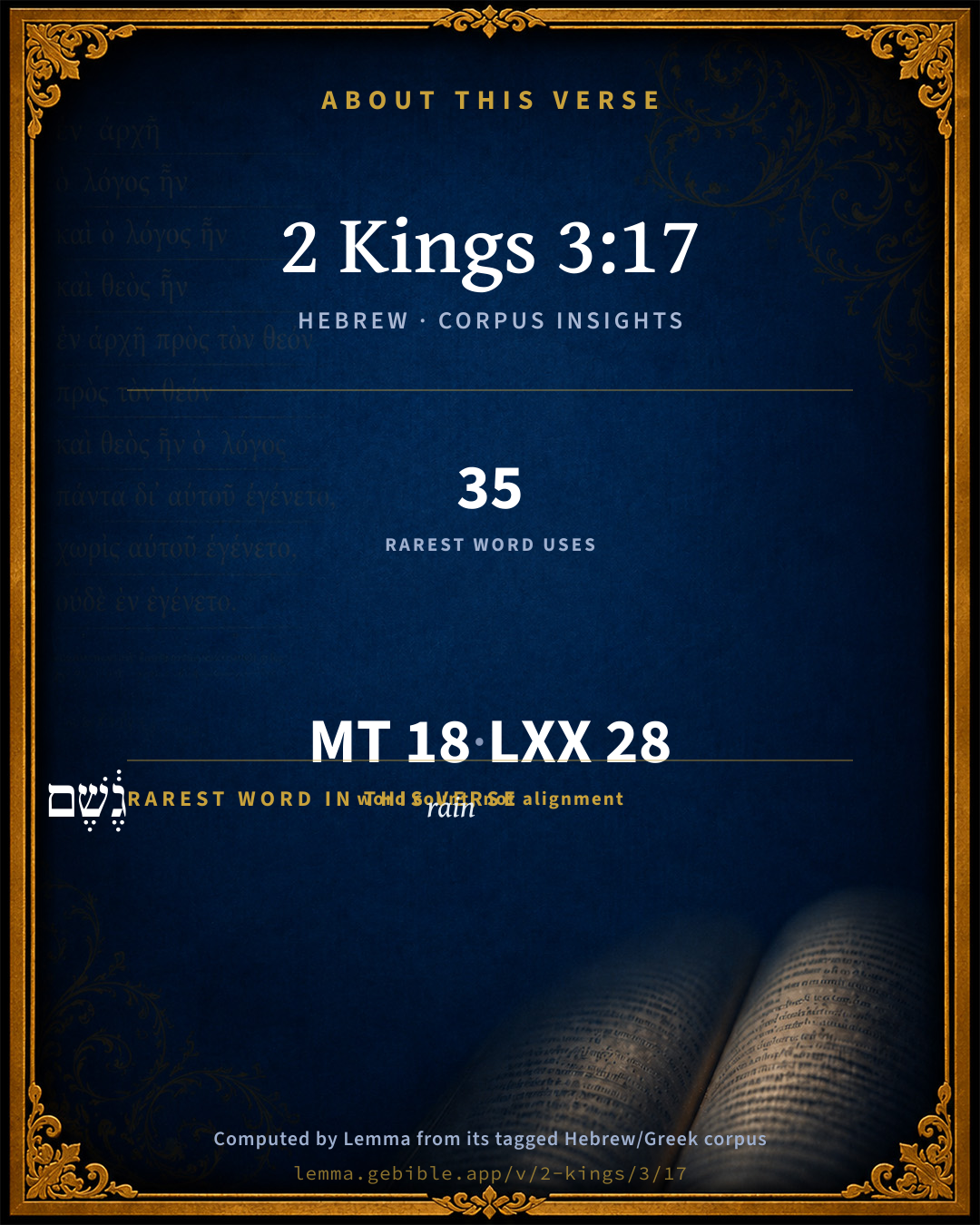
About this verse

These counts appear in no published source. They are computed here, from the morphology-tagged text and Lemma’s own curated glosses. What Lemma adds →

18
words
16
distinct lemmas
Historical
section

Shared distinctive vocabulary

גֶ֔שֶׁם rain H1653 occurs in 33 verses of the Hebrew Bible. Also found in:

Grammatical profile

  • 5 verbs
  • 7 nouns
  • 2 pronouns
  • 1 conjunction
  • 1 adverb
  • 2 particles

Verb forms

  • אָמַ֣ר Qal · Perfect
  • תִרְא֥וּ Qal · Imperfect
  • תִרְא֣וּ Qal · Imperfect
  • יִמָּ֣לֵא Niphal · Imperfect
  • וּשְׁתִיתֶ֛ם Qal · Sequential Perfect

Repetition

Words recur within this verse — often emphatic in Hebrew:

  • תִרְא֥וּ to see H7200 ×2
  • לֹֽא not H3808 ×2

Hebrew & Septuagint length

In English translation the verse runs 34 words from the Hebrew and 33 from the Septuagint (LXX English) — closely comparable.

A rough comparison of the two English renderings, which tokenize alike — not a word-level alignment.

Word counts can differ between the Hebrew and the Greek without any difference in meaning — e.g. the Hebrew direct-object marker אֵת has no separate Greek word, and Greek often adds the article ὁ.

In the original languages it is 18 Hebrew tokens and 28 Greek tokens — but the two are counted differently (Hebrew bundles its prefixes and suffixes into one token; the Greek is in lemma form), so that isn’t a like-for-like length.

Cross-references

8

Topical passages linked to 2 Kings 3:17 in the Treasury of Scripture Knowledge — connected by theme and wording, ordered by reader-vote popularity; previews shown in the World English Bible.

  • Psalms 107:35 He turns a desert into a pool of water, And a dry land into water springs.
  • Isaiah 41:17–18 The poor and needy seek water, and there is none, and their tongue fails for thirst; I, Yahweh, will answer them, I, the God of Israel, will not forsake them.
  • Isaiah 43:19–20 Behold, I will do a new thing; now shall it spring forth; shall you not know it? I will even make a way in the wilderness, and rivers in the desert.
  • Isaiah 48:21 They didn't thirst when he led them through the deserts; he caused the waters to flow out of the rock for them; he split the rock also, and the waters gushed out.
  • Psalms 84:6 Passing through the valley of Weeping, they make it a place of springs. Yes, the autumn rain covers it with blessings.
  • Exodus 17:6 Behold, I will stand before you there on the rock in Horeb. You shall strike the rock, and water will come out of it, that the people may drink." Moses did so in the sight of the elders of Israel.
  • Numbers 20:8–11 Take the rod, and assemble the congregation, you, and Aaron your brother, and speak you to the rock before their eyes, that it give forth its water; and you shall bring forth to them water out of the rock; so you shall give the congregation and their cattle drink.
  • 1 Kings 18:36–39 It happened at the time of the offering of the [evening] offering, that Elijah the prophet came near, and said, Yahweh, the God of Abraham, of Isaac, and of Israel, let it be known this day that you are God in Israel, and that I am your servant, and that I have done all these things at your word.

Cross-references courtesy of OpenBible.info (CC BY 4.0).

Hebrew and Greek witnesses Masoretic Hebrew ↔ Greek Septuagint

The same verse in the two great witnesses to the Old Testament, shown verse-for-verse.

These are two independent witnesses, not word-aligned to each other, and the Septuagint is shown in lemma (dictionary) form.

Hebrew 2 Kings 3:17 Masoretic · Westminster Leningrad Codex

כִּֽי כֹ֣ה אָמַ֣ר יְהוָ֗ה לֹֽא תִרְא֥וּ ר֨וּחַ֙ וְלֹֽא תִרְא֣וּ גֶ֔שֶׁם וְהַנַּ֥חַל הַה֖וּא יִמָּ֣לֵא מָ֑יִם וּשְׁתִיתֶ֛ם אַתֶּ֥ם וּמִקְנֵיכֶ֖ם וּֽבְהֶמְתְּכֶֽם

For thus says Yahweh, You shall not see wind, neither shall you see rain; yet that valley shall be filled with water, and you shall drink, both you and your cattle and your animals.

World English Bible · Public Domain

Greek LXX 2 Kings 3:17 Septuagint · lemma form

ὅτι ὅδε λέγω κύριος οὐ ὁράω πνεῦμα καί οὐ ὁράω ὑετός καί ὁ χειμάρρους οὗτος πίμπλημι ὕδωρ καί πίνω σύ καί ὁ κτῆσις σύ καί ὁ κτῆνος σύ

For thus says the Lord, You⌃ shall not see wind, neither shall you⌃ see rain, yet this valley shall be filled with water, and you⌃, and your flocks, and your cattle shall drink.

LXX2012 (modern English Septuagint) · Public Domain

Hebrew: Westminster Leningrad Codex (CC BY 4.0). Greek: Septuagint (public domain); English from LXX2012 (modern English Septuagint) (Public Domain). How the Septuagint differs from the Hebrew →

Targum (Aramaic paraphrase)

1

The Targum is the ancient Jewish Aramaic paraphrase of the Hebrew Scriptures — an interpretive translation, not the Hebrew text itself. Onkelos (literal) and Pseudo-Jonathan (expansive) render the Torah, and Jonathan the Prophets. Coverage is partial: where no permissively-licensed English translation exists for a verse, only the Aramaic is shown. This is verse-level text, not a word-by-word alignment to the Hebrew.

  1. Targum Jonathan Prophets (Joshua–Malachi)
    אֲרֵי כִּדְנַן אֲמַר יְיָ לָא תֶחֱזוּן רוּחָא וְלָא תֶחֱזוּן מִטְרָא וְנַחֲלָא הַהוּא יִתְמְלֵי מַיָא וְתִשְׁתּוּן אַתּוּן וְגֵיתֵיכוֹן וּבְעִירְכוֹן:

    (no public-domain English translation for this verse)

    Targum Jonathan — Aramaic: “Mikraot Gedolot” (public domain). English: “Sefaria Community Translation” (CC0 1.0 (public-domain dedication)); “London "Chaldee Paraphrase," 1871” (public domain). Text via Sefaria.

Commentary

Notes on 2 Kings 3:17 from classic Christian and Jewish commentators (each source and its license shown beneath its notes). The classic Christian expositions comment on the surrounding passage and are grouped to its opening verse, so a note may address several verses; the Jewish commentaries on the Tanakh (Rashi and others) are per-verse, so they appear only where the commentator wrote on this verse.

Lemma curates 59 commentaries, every one of them public domain or Creative Commons licensed, each selected and text-cleaned for this edition rather than reprinted as found. About our sources →

Trapp's Complete Commentary

John Trapp

2Ki 3:17 For thus saith the LORD, Ye shall not see wind, neither shall ye see rain; yet that valley shall be filled with water, that ye may drink, both ye, and your cattle, and your beasts.

Ver. 17. Ye shall not see wind nor rain.] God can relieve his people in the fail of means. {Hab 3:17}

John Trapp, A Commentary or Exposition upon All the Books of the Old and New Testament (1647–1656) — public domain. Text from a community e-Sword module.

Jamieson, Fausset & Brown

Robert Jamieson, A. R. Fausset & David Brown

Ye shall not see wind--It is common in the East to speak of seeing wind, from the clouds of straw, dust, or sand, that are often whirled into the air, after a long drought.

Jamieson, Fausset & Brown — Commentary Critical and Explanatory on the Whole Bible (1871) — public domain (CC PDM 1.0). Text via the HelloAO Bible API.

Adam Clarke's Commentary

Verse 17. Ye shall not see wind] There shall be no wind to collect vapours, and there shall be no showers, and yet the whole bed of this river, and all the new made canals, shall be filled with water.

Adam Clarke's Commentary on the Bible (1810–1826) — public domain. Text from a community e-Sword/MySword module.

Ellicott's Commentary for English Readers

(17) Ye shall not see wind.—Which in the east is the usual precursor of rain.

Yet that valley.—And that wady. He says “that (hû’) valley,” meaning “the one of which I spoke” (2Ki_3:16). Contrast “this (zeh) valley,” i.e., “the one in which we are” (2Ki_3:16).

Your cattle.—Miqneh: flocks and herds, as distinguished from “beasts” (bĕhçmâh), i.e., probably, beasts of burden.

A Bible Commentary for English Readers, edited by Charles John Ellicott (1878–1897) — public domain. Text from a community e-Sword module.

The Cambridge Bible for Schools and Colleges

gen. ed. J. J. S. Perowne

17. For thus saith the Lord] Both the order to dig trenches, and the promise of water are prefaced in this solemn manner. It is no order of his own which the prophet delivers.

Ye shall not see wind] The verb ‘see’ is used elsewhere of what is not visible but experienced by the other senses. So Exo_20:18, ‘All the people saw the thunderings … and the noise of the trumpet’. After a drought wind is in the East the general precursor of rain. Cf. 1Ki_18:41; 1Ki_18:45.

neither shall ye see rain] The prophet’s language here implies that the cause of the coming supply of water would be rain falling elsewhere. Natural powers will bring the rain, though it shall fall at a distance from the camp, so that neither Moab nor the invading armies shall be aware of its falling.

that ye may [R.V. and ye shall] drink] Thus giving a strictly literal rendering.

your cattle] These were the animals brought with them to be killed as occasion required for food. The beasts, next mentioned, are the beasts of burden.

The Cambridge Bible for Schools and Colleges (gen. ed. J. J. S. Perowne; Cambridge University Press, 1878–1918) — public domain. Text from a community e-Sword module.

John Gill's Exposition

And it came to pass in the morning, when the meat offering was offered,.... At Jerusalem; which always went along with the daily burnt offering of the lamb, which might not indeed be offered before break of day, yet quickly after; for no sacrifice could be offered before that; see Gill on Exo 29:39,

that, behold, there came water by the way of Edom; not from the heavens, but it may be out of some rock, rolling along on the earth from the hills and mountains, down into the valleys, where the armies were:

and the country was filled with water; all round about them. Who has not heard of the "thundering" legion, as it was called by the Emperor M. Aurelius, who, when the army under him was about to engage with the Germans and Sarmatians, and sadly distressed with thirst, fell down on their knees and prayed, upon which a large shower of rain came down to the refreshment of the army, and thunder bolts, which annoyed and put the enemy to flight (i)? at the battle of the Romans with Jugurtha, a sudden and unexpected shower of rain fell, to the refreshment of the Romans, in intolerable thirst (k).

(i) Euseb. Hist. Eccl. l. 5. c. 5. Orosii Hist. l. 7. c. 15. p. 120. (k) Orosii Hist. l. 5. c. 15. p. 77.

John Gill's Exposition of the Whole Bible (1746–1763) — public domain (CC PDM 1.0). Text via the HelloAO Bible API.

Albert Barnes' Notes on the Bible

No rain was to fall where the Israelites and their enemies were encamped; there was not even to be that all but universal accompaniment of rain in the East, a sudden rise of wind (compare 1Ki 18:45; Psa 147:18; Mat 7:25).

Cattle, and your beast - The former are the animals brought for food. The latter are the baggage animals.

Albert Barnes' Notes on the Bible (1834–1885) — public domain. Text from a community e-Sword/MySword module.

Matthew Poole's English Annotations

Ye shall not see wind; any of those winds which commonly produce rain. And seeing is here put for perceiving or feeling, one sense for another, or for all, as Gen 42:1; compare Act 7:12; Exo 20:18, and elsewhere.

Matthew Poole's English Annotations on the Holy Bible (1683–1685) — public domain. Text from a community e-Sword/MySword module.

Whedon's Commentary on the Bible

Daniel D. Whedon

17. Not see wind, neither… rain — A storm of wind usually precedes a heavy rain; but in this case the storm was to occur so far away from the Israelitish encampment that they would see nothing of it.

Daniel D. Whedon (gen. ed.), Commentary on the Old and New Testaments (1874–1909) — public domain. Text from a community e-Sword module.

The Pulpit Commentary

For thus saith the Lord, Ye shall not see i.e. , perceivewind, neither shall ye see rain. Wind and rain usually go together in the East, especially when there is sudden heavy rain after a time of drought. What Elisha promises is a heavy storm of wind accompanied by violent rain, which, however, will be at such a distance that the Israelites will see nothing of it, but whereof they will experience the effects when the torrent-course that separates them from the Moabite country suddenly becomes a rushing stream as the rain flows off down it. Their "pits," or trenches, will retain a portion of the water, and furnish them with a sufficient supply for their wants. It was necessary that the storm should be distant, that the Moabites might know nothing of it, and so fall under the delusion (ver. 23), which led to their complete defeat. Yet that valley shall be filled with water. Travelers tell us that, in certain circumstances, it takes but ten minutes or a quarter of an hour for a dry water-course in the East to become a raging torrent quite impassable. That ye may drink, both ye, and your cattlei.e. , the animals which you have brought with you for food and your boasts; i.e. your beasts of burden, or baggage-animals. Animals, except camels, suffer from drought even more than men, and die sooner. The Israelites do not appear to have ever employed camels.

The Pulpit Commentary (1880–1919), ed. H.D.M. Spence-Jones & Joseph S. Exell — public domain. Text from a community e-Sword module.

Lesson kit

Teaching starters — assembled from the data on this page, not authored interpretation. Every prompt links to the verse data it draws on. Edit before teaching.

2 Kings, in the Historical, opens this verse with 18 words (16 distinct Hebrew lemmas). Its most distinctive word is geshem (“rain”). A historical commentator’s framing appears above. Read the whole chapter for the surrounding context.

Discussion questions

  1. How does “rain” (geshem) shape what this verse is saying?
  2. How does Genesis 7:12, which shares the word «rain», read alongside this verse?
  3. What does the repetition of “to see” (2× in this one verse) do in this verse?
  4. The translations on this page render this verse differently — a whole-verse word diff, not a word-by-word alignment. What might account for the different wordings?
  5. «אָמַ֣ר» is a Qal Perfect verb. How does that grammatical form shape the action described?
  6. Compare how Trapp's Complete Commentary and Jamieson, Fausset & Brown read this verse. Where do they agree or differ?

Things to notice

Reading settings

Reading text

Shown beneath each verse's original-language words.

Old Testament
Old Testament edition

Read the OT as the Masoretic Hebrew (MT) or the Greek Septuagint (LXX).

English shown for the Greek Septuagint (in the Hebrew ↔ Greek comparison).

Comparing translations? Open the Compare panel on any verse page to stack up to four side by side.