
1 Samuel 1:15

Hebrew (Westminster Leningrad Codex) 1 Samuel 1:15 appears in the Hebrew Old Testament. The text above is from the Westminster Leningrad Codex. Each word links to its Strong’s number, a concise gloss, and parsing drawn from the Open Scriptures Hebrew Bible morphology. Click any word for its full Brown-Driver-Briggs (BDB) entry.
Download image
Cite this verse

1 Samuel 1:15 (World English Bible). Public Domain. Lemma interlinear Bible study tool, https://lemma.gebible.app/v/1-samuel/1/15.

Show BibTeX & RIS
BibTeX
RIS
English Translation
Hannah answered, No, my lord, I am a woman of a sorrowful spirit: I have drunk neither wine nor strong drink, but I poured out my soul before Yahweh.
World English Bible · Public Domain
Download a study sheet

One document with this verse’s original text, its word-by-word gloss line, the meaning frame, cross-references with their text, attributed commentary, and full source and license credits — printable, and it pastes into notes with its structure intact.

This verse Autodidact and up

Study sheet (.html) Plain text (.txt)

A passage Seminary Student

Up to 50 verses in one chapter. A passage sheet keeps up to 6 commentary sources and 12 cross-references per verse, in the order this page ranks them, and says so on the sheet whenever that leaves anything out. Ask for a single verse and you get the Autodidact verse sheet above.

Everything on this page stays free to read, with no account — the sheet is a download of what is already on screen, not access to it.

Want to remove ads? Support Godless Engineer
Compare translations 3

The same verse in 3 English versions, stacked beneath the original-language interlinear above. Click any original word for its lexicon entry.

Each is an independent rendering of the whole verse — the interlinear is not word-aligned to these translations.

Highlighted words mark where these versions differ — a whole-verse word diff, not a word-by-word alignment.

  • World English Bible Public Domain
    Hannah answered, No, my lord, I am a woman of a sorrowful spirit: I have drunk neither wine nor strong drink, but I poured out my soul before Yahweh.
  • King James Version Public Domain
    And Hannah answered and said, No, my lord, I am a woman of a sorrowful spirit: I have drunk neither wine nor strong drink, but have poured out my soul before the LORD.
  • unfoldingWord Literal Text CC BY-SA 4.0
    And Hannah answered and said, “No, my lord, a woman sorrowful of spirit I. And wine and beer I have not drunk, but I have been pouring out my soul to the face of Yahweh.

unfoldingWord Literal Text — © unfoldingWord, licensed CC BY-SA 4.0. Word-aligned USFM3 via Door43 (git.door43.org/unfoldingWord/en_ult).

Versions to compare (up to 4)

3 of 4 selected

Show all 18 translations

Every available English version of this verse, each an independent rendering of the whole verse.

  • World English Bible Public Domain
    Hannah answered, No, my lord, I am a woman of a sorrowful spirit: I have drunk neither wine nor strong drink, but I poured out my soul before Yahweh.
  • Berean Standard Bible Public Domain
    “No, my lord,” Hannah replied. “I am a woman oppressed in spirit. I have not had any wine or strong drink, but I have poured out my soul before the LORD.
  • Majority Standard Bible Public Domain
    “No, my lord,” Hannah replied. “I am a woman troubled in spirit. I have not had any wine or strong drink, but I have poured out my soul before the LORD.
  • King James Version Public Domain
    And Hannah answered and said, No, my lord, I am a woman of a sorrowful spirit: I have drunk neither wine nor strong drink, but have poured out my soul before the LORD.
  • American Standard Version (1901) Public Domain
    And Hannah answered and said, No, my lord, I am a woman of a sorrowful spirit: I have drunk neither wine nor strong drink, but I poured out my soul before Jehovah.
  • Revised Version (1885) Public Domain
    And Hannah answered and said, No, my lord, I am a woman of a sorrowful spirit: I have drunk neither wine nor strong drink, but I poured out my soul before the LORD.
  • Geneva Bible (1599) Public Domain
    Then Hannah answered and sayd, Nay my lord, but I am a woman troubled in spirit: I haue drunke neither wine nor strong drinke, but haue powred out my soule before the Lord.
  • Douay-Rheims (1899) Public Domain
    Anna answering, said: Not so, my lord: for I am an exceeding unhappy woman, and have drunk neither wine nor any strong drink, but I have poured out my soul before the Lord.
  • Young's Literal Translation Public Domain
    And Hannah answereth and saith, `No, my lord, A woman sharply pained in spirit I `am', and wine and strong drink I have not drunk, and I pour out my soul before Jehovah;
  • Literal Standard Version CC BY-SA 4.0
    And Hannah answers and says, “No, my lord, I [am] a woman sharply pained in spirit, and I have not drunk wine and strong drink, and I pour out my soul before YHWH;
  • Unlocked Literal Bible CC BY-SA 4.0
    Hannah answered, “No, my master, I am a woman of a sorrowful spirit. I have drunk neither wine nor strong drink, but I have been pouring out my soul before Yahweh.
  • unfoldingWord Literal Text CC BY-SA 4.0
    And Hannah answered and said, “No, my lord, a woman sorrowful of spirit I. And wine and beer I have not drunk, but I have been pouring out my soul to the face of Yahweh.
  • Darby Bible Public Domain
    And Hannah answered and said, No, my lord, I am a woman of a sorrowful spirit: I have drunk neither wine nor strong drink, but have poured out my soul before Jehovah.
  • World Messianic Bible Public Domain
    Hannah answered, “No, my lord, I am a woman of a sorrowful spirit. I have not been drinking wine or strong drink, but I poured out my soul before the LORD.
  • Webster's Bible Public Domain
    And Hannah answered and said, No, my lord, I am a woman of a sorrowful spirit: I have drank neither wine nor strong drink, but have poured out my soul before the LORD.
  • Free Bible Version CC BY-SA 4.0
    “It's not that, my lord,” Hannah replied. “I'm a very miserable woman. I haven't been drinking wine or beer; I'm just pouring my heart out to the Lord.
  • Bible in Basic English Public Domain
    And Hannah, answering him, said, No, my lord, I am a woman whose spirit is broken with sorrow: I have not taken wine or strong drink, but I have been opening my heart before the Lord.
  • JPS Tanakh (1917) Public Domain
    And Hannah answered and said: 'No, my lord, I am a woman of a sorrowful spirit; I have drunk neither wine nor strong drink, but I poured out my soul before the LORD.

Literal Standard Version (2020), Covenant Press — licensed CC BY-SA 4.0. Text via the HelloAO Bible API (eBible.org). Unlocked Literal Bible (unfoldingWord) — licensed CC BY-SA 4.0. Text via the HelloAO Bible API (eBible.org). unfoldingWord Literal Text — © unfoldingWord, licensed CC BY-SA 4.0. Word-aligned USFM3 via Door43 (git.door43.org/unfoldingWord/en_ult). Free Bible Version, Dr. Jonathan Gallagher — licensed CC BY-SA 4.0. Text via the HelloAO Bible API (eBible.org).

Word by word

More ways to search: Search by grammar → Find every occurrence → Compare this word →

Practice this passage: Drill this verse → Learn its vocabulary →

חַנָּ֤ה
Channâh
H2584
“Hannah”
Noun, Proper
Part of Speech
Noun
Type
Proper
Full BDB Definition

Origin: from H2603

TWOT: None

Hannah = "grace" - the mother of Samuel, one of the wives of Elkanah
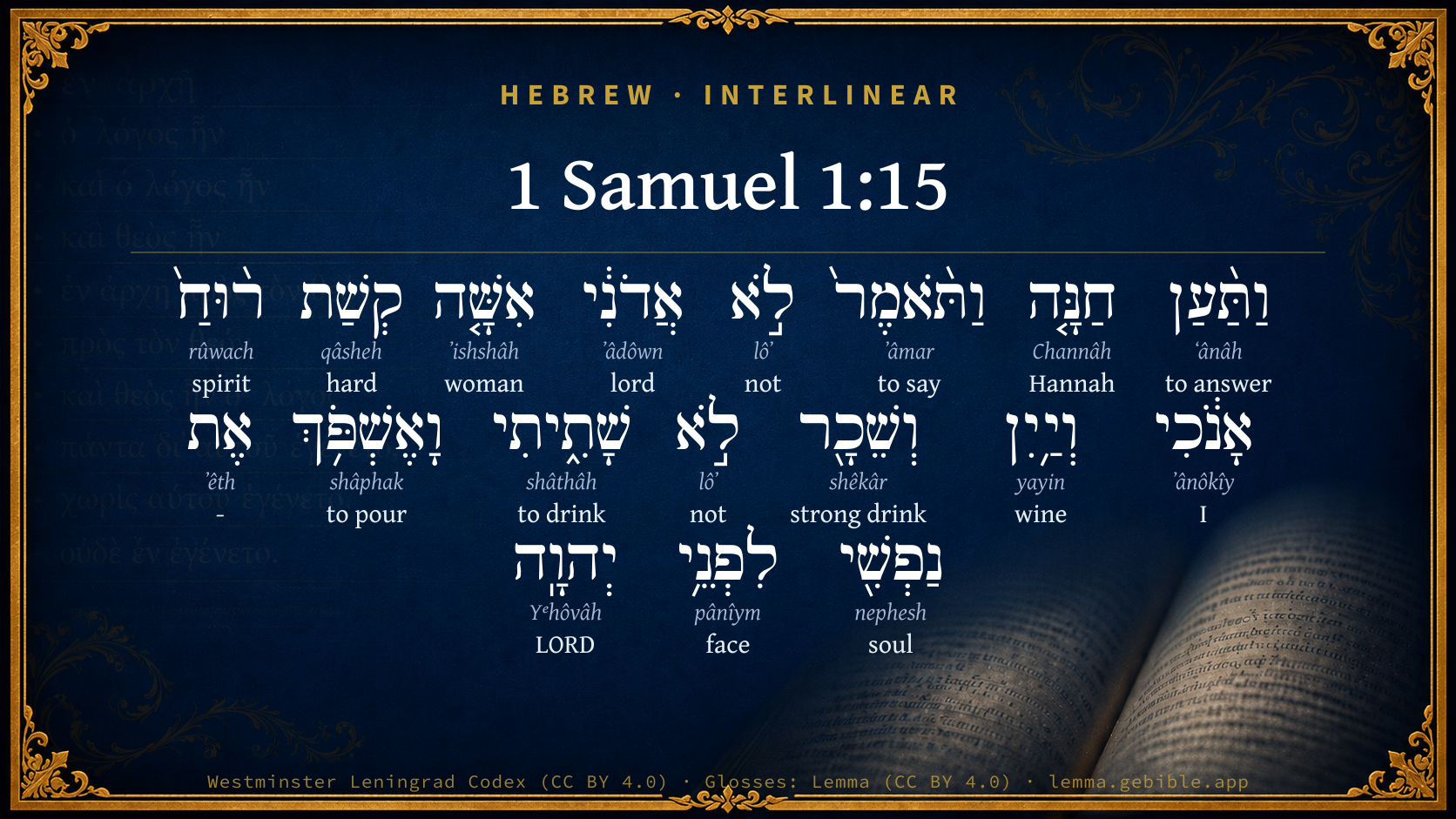
  1. וַתַּ֨עַן ʻânâh H6030 “and · to answer” Conjunction + Verb, Qal, Sequential Imperfect, 3rd Person, Feminine, Singular
  2. וַתֹּ֨אמֶר֙ ʼâmar H559 “and · to say” Conjunction + Verb, Qal, Sequential Imperfect, 3rd Person, Feminine, Singular
  3. לֹ֣א lôʼ H3808 “not” Particle, Negative
  4. אֲדֹנִ֔י ʼâdôwn H113 “lord · my” Noun, Common, Masculine, Singular, Construct + Suffix, Personal, 1st Person, Common, Singular
  5. אִשָּׁ֤ה ʼishshâh H802 “woman” Noun, Common, Feminine, Singular, Absolute
  6. קְשַׁת qâsheh H7186 “hard of” Adjective, Adjective, Feminine, Singular, Construct
  7. ר֨וּחַ֙ rûwach H7307 “spirit” Noun, Common, Both, Singular, Absolute
  8. אָנֹ֔כִי ʼânôkîy H595 “I” Pronoun, Personal, 1st Person, Common, Singular
  9. וְיַ֥יִן yayin H3196 “and · wine” Conjunction + Noun, Common, Masculine, Singular, Absolute
  10. וְשֵׁכָ֖ר shêkâr H7941 “and · strong drink” Conjunction + Noun, Common, Masculine, Singular, Absolute
  11. לֹ֣א lôʼ H3808 “not” Particle, Negative
  12. שָׁתִ֑יתִי shâthâh H8354 “to drink” Verb, Qal, Perfect, 1st Person, Common, Singular
  13. וָאֶשְׁפֹּ֥ךְ shâphak H8210 “and · to pour” Conjunction + Verb, Qal, Sequential Imperfect, 1st Person, Common, Singular
  14. אֶת ʼêth H853 “-” Particle, Direct Object
  15. נַפְשִׁ֖י nephesh H5315 “soul · my” Noun, Common, Both, Singular, Construct + Suffix, Personal, 1st Person, Common, Singular
  16. לִפְנֵ֥י pânîym H6440 “to/for · face(s) of” Preposition + Noun, Common, Both, Plural, Construct
  17. יְהוָֽה Yᵉhôvâh H3068 “LORD” Noun, Proper

About this verse

These counts appear in no published source. They are computed here, from the morphology-tagged text and Lemma’s own curated glosses. What Lemma adds →

18
words
17
distinct lemmas
Historical
section

Notable vocabulary

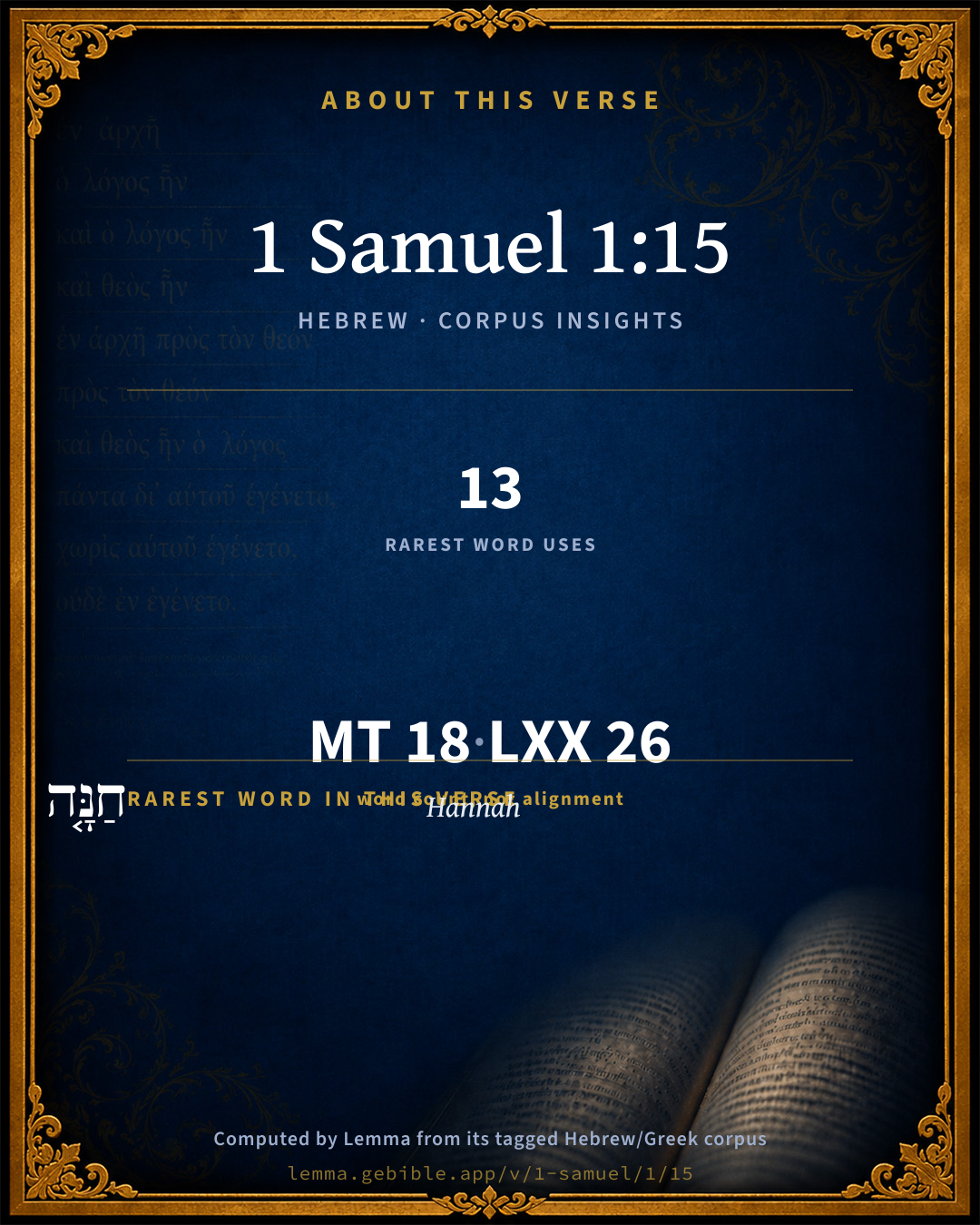
The rarest word here is חַנָּ֤ה Hannah H2584 — appearing just 13 times in the whole Hebrew Bible.

Shared distinctive vocabulary

חַנָּ֤ה Hannah H2584 occurs in 11 verses of the Hebrew Bible. Also found in:

Grammatical profile

  • 4 verbs
  • 9 nouns
  • 1 adjective
  • 1 pronoun
  • 3 particles

Verb forms

  • וַתַּ֨עַן Qal · Sequential Imperfect
  • וַתֹּ֨אמֶר֙ Qal · Sequential Imperfect
  • שָׁתִ֑יתִי Qal · Perfect
  • וָאֶשְׁפֹּ֥ךְ Qal · Sequential Imperfect

Repetition

A word recurs within this verse — often emphatic in Hebrew:

Hebrew & Septuagint length

In English translation the verse runs 29 words from the Hebrew and 32 from the Septuagint (LXX English) — closely comparable.

A rough comparison of the two English renderings, which tokenize alike — not a word-level alignment.

Word counts can differ between the Hebrew and the Greek without any difference in meaning — e.g. the Hebrew direct-object marker אֵת has no separate Greek word, and Greek often adds the article ὁ.

In the original languages it is 18 Hebrew tokens and 26 Greek tokens — but the two are counted differently (Hebrew bundles its prefixes and suffixes into one token; the Greek is in lemma form), so that isn’t a like-for-like length.

Cross-references

8

Topical passages linked to 1 Samuel 1:15 in the Treasury of Scripture Knowledge — connected by theme and wording, ordered by reader-vote popularity; previews shown in the World English Bible.

  • Psalms 62:8 Trust in him at all times, you people. Pour out your heart before him. God is a refuge for us. Selah.
  • Lamentations 2:19 Arise, cry out in the night, at the beginning of the watches; Pour out your heart like water before the face of the Lord: Lift up your hands toward him for the life of your young children, that faint for hunger at the head of every street.
  • Psalms 42:4 These things I remember, and pour out my soul within me, How I used to go with the crowd, and led them to the house of God, With the voice of joy and praise, a multitude keeping a holy day.
  • Psalms 142:2–3 I pour out my complaint before him. I tell him my troubles.
  • Psalms 143:6 I spread forth my hands to you. My soul thirsts for you, like a parched land. Selah.
  • Job 30:16 "Now my soul is poured out within me. Days of affliction have taken hold on me.
  • Proverbs 15:1 A gentle answer turns away wrath, But a harsh word stirs up anger.
  • Proverbs 25:15 By patience a ruler is persuaded. A soft tongue breaks the bone.

Cross-references courtesy of OpenBible.info (CC BY 4.0).

Hebrew and Greek witnesses Masoretic Hebrew ↔ Greek Septuagint

The same verse in the two great witnesses to the Old Testament, shown verse-for-verse.

These are two independent witnesses, not word-aligned to each other, and the Septuagint is shown in lemma (dictionary) form.

Hebrew 1 Samuel 1:15 Masoretic · Westminster Leningrad Codex

וַתַּ֨עַן חַנָּ֤ה וַתֹּ֨אמֶר֙ לֹ֣א אֲדֹנִ֔י אִשָּׁ֤ה קְשַׁת ר֨וּחַ֙ אָנֹ֔כִי וְיַ֥יִן וְשֵׁכָ֖ר לֹ֣א שָׁתִ֑יתִי וָאֶשְׁפֹּ֥ךְ אֶת נַפְשִׁ֖י לִפְנֵ֥י יְהוָֽה

Hannah answered, No, my lord, I am a woman of a sorrowful spirit: I have drunk neither wine nor strong drink, but I poured out my soul before Yahweh.

World English Bible · Public Domain

Greek LXX 1 Samuel 1:15 Septuagint · lemma form

καί ἀποκρίνω αννα καί εἶπον οὐ κύριος γυνή ὅς σκληρός ἡμέρα ἐγώ εἰμί καί οἶνος καί μέθυσμα οὐ πίνω καί ἐκχέω ὁ ψυχή ἐγώ ἐνώπιον κύριος

And Anna answered and said, Nay, my lord, I live in a hard day, and I have not drunk wine or strong drink, and I pour out my soul before the Lord.

LXX2012 (modern English Septuagint) · Public Domain

Hebrew: Westminster Leningrad Codex (CC BY 4.0). Greek: Septuagint (public domain); English from LXX2012 (modern English Septuagint) (Public Domain). How the Septuagint differs from the Hebrew →

Targum (Aramaic paraphrase)

1

The Targum is the ancient Jewish Aramaic paraphrase of the Hebrew Scriptures — an interpretive translation, not the Hebrew text itself. Onkelos (literal) and Pseudo-Jonathan (expansive) render the Torah, and Jonathan the Prophets. Coverage is partial: where no permissively-licensed English translation exists for a verse, only the Aramaic is shown. This is verse-level text, not a word-by-word alignment to the Hebrew.

  1. Targum Jonathan Prophets (Joshua–Malachi)
    וַאֲתִיבַת חַנָה וַאֲמַרַת לָא רִבּוֹנִי אִתְּתָא עָקַת רוּחַ אֲנָא וַחֲמַר חֲדַת וְעַתִּיק לָא אִשְׁתֵּיתִי וַאֲמָרִית עוּלְבַן נַפְשִׁי בִּצְלוֹ קֳדָם יְיָ:

    (no public-domain English translation for this verse)

    Targum Jonathan — Aramaic: “Mikraot Gedolot” (public domain). English: “Sefaria Community Translation” (CC0 1.0 (public-domain dedication)); “London "Chaldee Paraphrase," 1871” (public domain). Text via Sefaria.

Commentary

Notes on 1 Samuel 1:15 from classic Christian and Jewish commentators (each source and its license shown beneath its notes). The classic Christian expositions comment on the surrounding passage and are grouped to its opening verse, so a note may address several verses; the Jewish commentaries on the Tanakh (Rashi and others) are per-verse, so they appear only where the commentator wrote on this verse.

Lemma curates 59 commentaries, every one of them public domain or Creative Commons licensed, each selected and text-cleaned for this edition rather than reprinted as found. About our sources →

Trapp's Complete Commentary

John Trapp

1Sa 1:15 And Hannah answered and said, No, my lord, I [am] a woman of a sorrowful spirit: I have drunk neither wine nor strong drink, but have poured out my soul before the LORD.

Ver. 15. No, my lord, I am a woman of a sorrowful spirit.] She was also a woman of a meek and quiet spirit, as appeareth by this mild answer. She doth indeed roundly defend her own innocency, but setteth not up her note at him as a false accuser, neither biddeth him look better to those drunken whoremasters, his own sons - as many an impudent dame would have done, and as Augustus upon the bench was twitted with the disorders of his own family, - but giveth the high priest good words - which St Paul scarce did, - and {Act 23:5} seeketh to satisfy him by such good reasons as well showed that she was sober enough.

But have poured out my soul before the Lord.] This is a just description of effectual fervent prayer. {Jas 5:16} See Psa 62:8; Psa 142:2 Lam 2:19. Saints unbosom and unbowel themselves before the Lord with much freedom and affiance.

John Trapp, A Commentary or Exposition upon All the Books of the Old and New Testament (1647–1656) — public domain. Text from a community e-Sword module.

The Biblical Illustrator

Joseph S. Exell

1Sa_1:15-16

Hannah answered and said, No, my Lord, I am a woman of a sorrowful spirit.

A woman of a sorrowful spirit

The special cause of Hannahs sorrow arose from the institution of polygamy, which, although it was tolerated under the old law, is always exhibited to us in practical action as a most fruitful source of sorrow and sin. The worse the woman the better she could get on with the system of many wives, but the good woman, the true woman, was sure to smart under it. But enough sources of grief remain; and there is not in any household, however joyous, the utter absence of the cross. The worldling say, There is a skeleton in every house. I know little about such dead things, but I know that a cross of some sort or other must be borne by every child of God. The smoking furnace is part of the insignia of the heavenly family, without which a man may well question whether he stands in covenant relationship to God at all. Much that is precious may be connected with a sorrowful spirit. Note well the precious things which went in Hannahs case with a sorrowful spirit. She was a godly woman. As we read the chapter, we are thoroughly certified that her heart was right with God. Many of the sweetest flowers in the garden of grace grow in the shade, and flourish in the drip. True, there are children of the tropical sun, whose beauty and fragrance could only be produced by having bathed themselves in the golden flood, and these, in certain respects, must always stand in the forefront, yet are there choice flowerets to whom the unshaded sun would be death. They prefer a sheltered bank, or a ravine in the forest, under the shadow of the thick boughs, where a softened, mellowed light developes them to perfection. I am persuaded that he who feedeth among the lilies has rare plants in his flora, fair and fragrant, choice and comely, which are more at home in the damps of mourning than in the glaring sun of joy. I have known such, who have been a living lesson to us all, from their broken-hearted penitence, their solemn earnestness, their jealous watchfulness, their sweet humility, and their gentle love.

2. Hannah was a lovable woman.

3. In Hannahs case, too, the woman of a sorrowful spirit was a very gentle woman.

4. There was more, however, than I have shown you, for Hannah was a thoughtful woman, for her sorrow drove her first within herself, and next into much communion with her God. That she was a highly thoughtful woman appears in everything she says. The product of her mind is evidently that which only a cultivated soul could yield.

5. Remember, also, that though she was a woman of a sorrowful spirit, she was a blessed woman. It is now clear that much that is precious may go with a sorrowful spirit.

Much that is precious may come out of a sorrowful spirit: it is not only to be found with it, but may even grow out of it.

1. Observe, first, that through her sorrowful spirit Hannah had learned to pray. In too many cases ease and health bring a chill over supplication, and there is a needs be for a stirring of the fire with the rough iron of trial. Many a flower reserves its odour till the rough wind waves it to and fro, and shakes out its fragrance. As a rule the tried man is the praying man, the angel must wrestle with us in the night before we learn to hold him, and cry, I will not let thee go.

2. In the next place, Hannah had learned self-denial. This is clear, since the very prayer by which she hoped to escape out of her great grief was a self-denying one. She desired a son, that her reproach might be removed; but if her eyes might be blessed with such a sight she would cheerfully resign her darling to be the Lords as long as he lived.

3. Another precious thing had come to this woman, and that was, she had learned faith.

4. Still more of preciousness this woman of a sorrowful spirit found growing out of her sorrow: she had evidently learned much of God. Driven from common family joys she had been drawn near to God, and in that heavenly fellowship she had remained a humble waiter and watcher. In seasons of sacred nearness to the Lord she had made many heavenly discoveries of his name and nature, as her song makes us perceive.

(1) She now knew that the hearts truest joy is not in children, nor even in mercies given in answer to prayer, for she began to sing, My heart rejoiceth in the Lord--not in Samuel, but in Jehovah her chief delight was found. Mine horn is exalted in the Lord.

(2) Next, she had also discovered the Lords glorious holiness, for she sang, There is none holy as the Lord.

(3) She had perceived His all-sufficiency; There is none beside thee; neither is there any rock like our God.

(4) She had found out Gods method in providence, for how sweetly she sings, The bows of the mighty men are broken, and they that stumbled are girded with strength.

(5) She had also been taught the way and method of his grace as well as of his providence, for never did a woman show more acquaintance with the wonders of divine grace than she did when she sang, He raiseth up the poor out of the dust, and lifteth up the beggar from the dunghill, to set them among princes, and to make them inherit the throne of glory.

(6) She had also seen the Lords faithfulness to his people.

(7) She had foreseen, also, somewhat of His kingdom, and of the glory of it. Her prophetic eye, made brighter and clearer by her holy tears, enabled her to look into the future, and looking, her joyful heart made her sing, He shall give strength unto his King, and exalt the horn of his Anointed.

much that is precious will yet be given to those who are truly the Lords, even though they have a sorrowful spirit.

1. Hannah had her prayers answered.

2. Not only did there come to Hannah after her sorrow an answered prayer, but grace to use that answer.

3. Hannah had acquired another blessing, and that was the power to magnify the Lord.

4. Moreover, her sorrow prepared her to receive further blessings, for after the birth of Samuel she had three more sons and two daughters, God thus giving her five for the one that she had dedicated to him. This was grand interest for her loan: five hundred per cent. Last of all, it was by suffering in patience that she became so brave a witness for the Lord, and could so sweetly sing, There is none holy as the Lord, neither is there any rock like our God. (C. H. Spurgeon.)

Hannahs gracious disposition

Hannah still found prayer and patience the best anodynes and antidotes for assuaging her grief; cold patience must quench her corrivals fiery contumely, and hot fervent prayer must quicken and prevail with God to grant her desire; and to animate her devotion the more she adds warm tears thereunto, and, as if all this were not enough, she subjoins likewise her solemn vow to God, saying, If thou wilt give thine hand maid a man child, then will I give him to the Lord all the days of his life. The judge misjudged, and misconstrued her true devotion, as was that of those Primitive Christians (Act_2:13). Thus also both ancient and modern martyrs have been misjudged in all ages, and if we be so in our age, God is not leading us through any untrodden paths; many better than we have tons before us in that way, but our comfort is the day of judgment will judge over again all that are misjudged. (Psa_37:6). Hannah is silent, touching the taunts of Peninnah, that was so peevish to her; and though she could not be so to Elis taunts here, but answers them, yet she setteth not up a loud note at him, calling him a false accuser; nor doth she twit him in the teeth, with bidding him to look better to those drunken whoremasters, his own sons, saying vies corrects sin, as many pert dames would have done in her circumstances; but she gives him a milder answer to his reproaches than the blessed Apostle could scarcely give to the High Priest in his day (Act_23:5) calling him a whited wall, etc., but she here gives the high priest good words, patiently bearing his unjust censurings of her.

3. Here is her prudence, as well as patience, she seeketh to satisfy him against his false judgment. Saith she, I am a woman, in whom drunkenness is more abominable than in men; and thereupon the Romans punished it with death, as well as adultery, and that she was a woman of a troubled spirit, so more likely to be drunk with her own tears (whereof, good soul, she had drunk abundance) rather than with any intoxicating liquors.

4. Behold here, her humility and modesty together with her patience and prudence, none of which could have shined so forth in her, had she been really drunk according to Elis over-severe sentence; notwithstanding Elis rash severity in so misjudging her, yet she useth no railing accusation against him, as is said of Michael against the Devil (Jude verse 9) in calling him an unjust judge. (C. Ness.)

The Biblical Illustrator, edited by Joseph S. Exell (c. 1880s–1900s) — public domain. Text from a community e-Sword module.

unfoldingWord translationNotes

Door43 World Missions Community

I am a woman of a sorrowful spirit

"I am a woman who is deeply sad"

pouring out my soul before Yahweh

This is an idiom that means "telling Yahweh my deepest emotions." (See: Idiom)

Do not consider your servant to be

Hannah speaks of herself in the second person to show her humility. It can be stated in first person. AT: "Do not consider me, your servant, to be" or "Do not consider me" (See: First, Second, or Third Person)

I have been speaking out of the abundance of my great concern and provocation

This is another way of saying that she has a "sorrowful spirit," as in 1Sa 1:15. The abstract nouns "abundance," "concern," and "provocation" can be translated as adjectives and verbs. AT: "I have been speaking because I am very sad, and my rival has greatly provoked me" (See: Abstract Nouns)

concern and provocation

These words both mean that Hannah is sad and annoyed because her rival has been provoking her. (See: Doublet)

concern

Peninnah irritates and annoys her.

provocation

Hannah is referring to the grief and shame she feels because Peninnah is being cruel to her.

translationWords

lord

spirit

strong drink

soul

unfoldingWord translationNotes — © Distant Shores Media and the Door43 World Missions Community, licensed CC BY-SA 4.0. Source: git.door43.org/Door43/en_tn.

Geneva Bible (1599)

Geneva Bible translators

Hebrew, of an hard spirit.

Geneva Bible (1599) marginal notes — public domain. Text via Bolls.life.

Adam Clarke's Commentary

Verse 15. I have drunk neither wine nor strong drink] Neither wine nor inebriating drink has been poured out unto me; but I have poured out my soul unto the Lord. There is a great deal of delicacy and point in this vindication.

Adam Clarke's Commentary on the Bible (1810–1826) — public domain. Text from a community e-Sword/MySword module.

Ellicott's Commentary for English Readers

(15) NO, my lord, I am a woman of a sorrowful spirit . . .—Calvin, quoted by Erdmann, well remarks here:—“Consider the modesty of Hannah, who, though she had received injury from the high priest, yet answers with reverence and humility.”

On these words of Hannah the Talmud says:—“Some think that Hannah spake in the following sense. Thou art neither lord, nor does the Holy Spirit rest upon thee, because thou dost suspect me in this matter, and hast formed such an uncharitable opinion of me. Neither the Shekinah nor the Holy Spirit are with thee.”—Treatise Berachoth, fol. 31, Colossians 2.

A Bible Commentary for English Readers, edited by Charles John Ellicott (1878–1897) — public domain. Text from a community e-Sword module.

The Cambridge Bible for Schools and Colleges

gen. ed. J. J. S. Perowne

15. of a sorrowful spirit] Lit. “heavy of spirit.” “Consider the modesty of Hannah, who, though she suffered injury from the High Priest, nevertheless answers with reverence and humility.” Calvin.

The Cambridge Bible for Schools and Colleges (gen. ed. J. J. S. Perowne; Cambridge University Press, 1878–1918) — public domain. Text from a community e-Sword module.

John Gill's Exposition

And Hannah answered and said, no, my lord,.... That is not my case, you have greatly mistaken it; she answered with great mildness and meekness, without falling into a passion at such a scandalous imputation upon her, and with great respect and reverence to Eli, suitable to his office; so in later times the high priest used to be addressed after this manner, particularly on the day of atonement, "Lord high priest", do so and so (x); indeed these words of Hannah are interpreted as not so very respectful, as if the sense was, not a lord art thou in this matter; nor does the Holy Ghost dwell upon thee (y); which thou hast sufficiently shown, or thou wouldest never have suspected me of drunkenness:

I am a woman of a sorrowful spirit: depressed with trouble and grief on account of afflictions; if she was drunk, it was not with wine, but with sorrow: or "a woman of a hard spirit" (z); which is sometimes taken in an ill sense, and, according to Abarbinel, is here denied by her, who connects this clause with the preceding thus; not, my lord, am I a woman of a hard spirit, or such a hardened wretch, and such an impudent woman, as I must be, were it so, to come drunk into the house of God, and pretend to pray unto him:

I have drank neither wine nor strong drink; not any sort of intoxicating liquors that day, neither wine new or old, as the Targum:

but have poured out my soul before the Lord: the affliction of it, as the same paraphrase; the grievances and distresses, the complaints of her soul, which were many, and which she had poured out before the Lord freely and plentifully, and which had taken up some time to do it; see Psa 42:8 where phrases similar to this are used, and which seem to be taken from hence.

(x) Misn. Yoma, c. 1. sect. 3, 5, 7. (y) T. Bab. Beracot, fol. 31. 2. Jarchi in loc. (z) "dura spiritu", Pagninus, Montanus.

John Gill's Exposition of the Whole Bible (1746–1763) — public domain (CC PDM 1.0). Text via the HelloAO Bible API.

Albert Barnes' Notes on the Bible

See 1Sa 1:2 and note. She means that wine was not the cause of her present discomposure, but grief of heart.

Albert Barnes' Notes on the Bible (1834–1885) — public domain. Text from a community e-Sword/MySword module.

Haydock's Catholic Bible Commentary

My lord. She gives him this title, though he had called her a drunken woman. (Haydock) --- Unhappy. Hebrew, "of a hard (or afflicted) spirit." See Canticle of Canticles viii. 6. (Calmet)

George Leo Haydock (1774–1849), Haydock's Catholic Family Bible and Commentary, 1859 edition — public domain. Excludes Psalms (Douay-Rheims chapter numbering differs from Protestant) and Deuterocanonical books (Catholic canon only).

Matthew Poole's English Annotations

I am a women; in whom drunkenness is most abominable; so that the Romans punished it with death; therefore judge me not so severely.

Of a sorrowful spirit; and therefore not likely to give up myself to drink and jollity, and far from that merry temper which drunkards have: I am drunk with affliction, not with wine, as is said, Isa 51:21.

I have drunk neither wine nor strong drink, to wit, this day: see above, 1Sa 1:7,8.

Have poured out my soul; have been breathing forth the griefs, and perplexities, and desires of my soul. The like phrase is Job 30:16; Psa 62:8; 142:2.

Matthew Poole's English Annotations on the Holy Bible (1683–1685) — public domain. Text from a community e-Sword/MySword module.

Whedon's Commentary on the Bible

Daniel D. Whedon

15. Poured… soul — Expressed the very earnest desires of her soul.

Before the Lord — In the tabernacle, where the Divine Presence was wont to be manifested.

Daniel D. Whedon (gen. ed.), Commentary on the Old and New Testaments (1874–1909) — public domain. Text from a community e-Sword module.

Keil & Delitzsch

C. F. Keil & F. Delitzsch

Hannah answered: "No, my lord, I am a woman of an oppressed spirit. I have not drunk wine and strong drink, but have poured out my soul before the Lord (see Psa 42:5). Do not count thine handmaid for a worthless woman, for I have spoken hitherto out of great sighing and grief." לפני נתן, to set or lay before a person, i.e., generally to give a person up to another; here to place him in thought in the position of another, i.e., to take him for another. שׂיה, meditation, inward movement of the heart, sighing.

Keil & Delitzsch — Biblical Commentary on the Old Testament (1861–1891) — public domain (CC PDM 1.0). Text via the HelloAO Bible API. (Old Testament only.)

Rashi

Rabbi Shlomo Yitzchaki (Rashi)

No, my lord. You are not master in this matter. You have revealed that the Holy Spirit is not resting upon you, otherwise you would have known that I am not intoxicated from wine.

Rashi on the Tanakh — English translations: “The Judaica Press complete Tanach with Rashi, translated by A. J. Rosenberg” (CC BY 4.0); “Pentateuch with Rashi's commentary by M. Rosenbaum and A.M. Silbermann, 1929-1934” (public domain); “The Metsudah Tanach series, Lakewood, N.J” (CC BY 4.0); and “The Book of Joshua, Metsudah Publications, 1997” (CC BY 4.0). Text via Sefaria.

Radak

Rabbi David Kimhi (Radak)

No, my lord: I am not drunk, as you think. Rather, "I am a woman of a troubled spirit" - my spirit is troubled about me, from my great distress. And the construct form (smikhut) [of, "a troubled spirit"] is like, "of fallen leaves" (Isaiah 1:30); "of shaven beards" (Jeremiah 41:5); of torn clothes" (II Samuel 13:31).

Wine nor strong drink: It is like its translation [in Targum Yonatan], "new wine and old." And likewise is it said in the homiletical teachings - wine is new and strong drink (shekhar) is old [wine]. But it is likely to be explained, shekhar is that which is made from [other] fruits.

But I have been pouring out my soul with much prayer. It was as if she poured out her soul - like (Psalms 62:9), "they poured their hearts before Him." And Yonatan translated it as, "and she said, 'My soul is humbled in prayer before the Lord.'"

Radak on the Tanakh — English translations: “Sefaria Community Translation” (CC0 1.0 (public-domain dedication)); “Eliyahu Munk, HaChut Hameshulash” (CC BY 4.0); “Rabbi Mike Feuer, Jerusalem Anthology” (CC BY 4.0); and “R. David Kimhi on the first book of Psalms, Translated by R.G. Finch, London, 1919” (public domain). Text via Sefaria.

Lesson kit

Teaching starters — assembled from the data on this page, not authored interpretation. Every prompt links to the verse data it draws on. Edit before teaching.

1 Samuel, in the Historical, opens this verse with 18 words (17 distinct Hebrew lemmas). Its most distinctive word is Channâh (“Hannah”). A historical commentator’s framing appears above. Read the whole chapter for the surrounding context.

Discussion questions

  1. The word Channâh carries the sense “Hannah.” How does it shape the verse?
  2. How does 1 Samuel 1:2, which shares the word «Hannah», read alongside this verse?
  3. What does the repetition of “not” (2× in this one verse) do in this verse?
  4. The translations on this page render this verse differently — a whole-verse word diff, not a word-by-word alignment. What might account for the different wordings?
  5. «וַתַּ֨עַן» is a Qal Sequential Imperfect verb. How does that grammatical form shape the action described?
  6. Compare how Trapp's Complete Commentary and The Biblical Illustrator read this verse. Where do they agree or differ?

Things to notice

Reading settings

Reading text

Shown beneath each verse's original-language words.

Old Testament
Old Testament edition

Read the OT as the Masoretic Hebrew (MT) or the Greek Septuagint (LXX).

English shown for the Greek Septuagint (in the Hebrew ↔ Greek comparison).

Comparing translations? Open the Compare panel on any verse page to stack up to four side by side.