
Proverbs 17:27

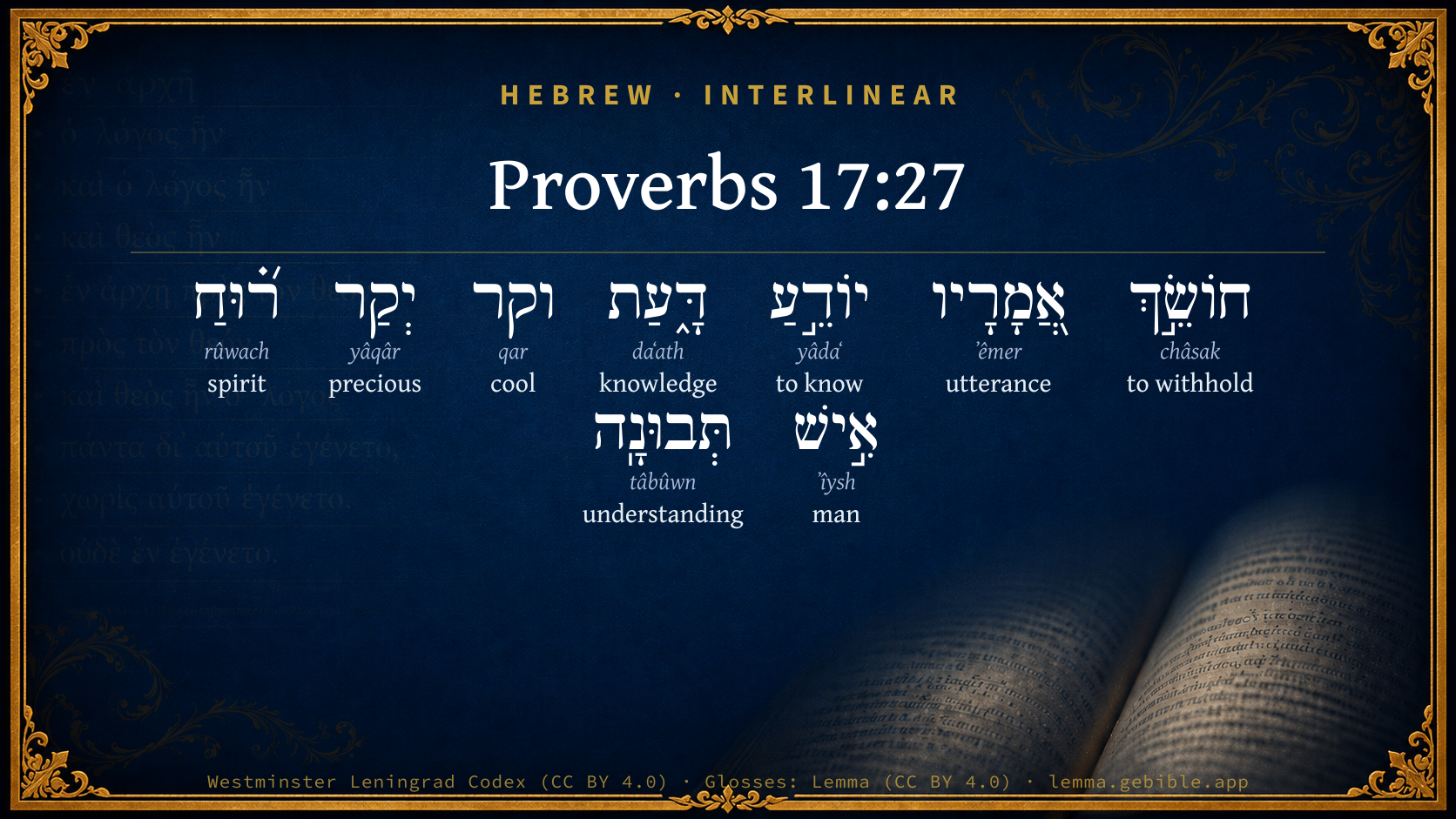
Hebrew (Westminster Leningrad Codex) Proverbs 17:27 appears in the Hebrew Old Testament. The text above is from the Westminster Leningrad Codex. Each word links to its Strong’s number, a concise gloss, and parsing drawn from the Open Scriptures Hebrew Bible morphology. Click any word for its full Brown-Driver-Briggs (BDB) entry.
Download image
Cite this verse

Proverbs 17:27 (World English Bible). Public Domain. Lemma interlinear Bible study tool, https://lemma.gebible.app/v/proverbs/17/27.

Show BibTeX & RIS
BibTeX
RIS
English Translation
He who spares his words has knowledge. He who is even tempered is a man of understanding.
World English Bible · Public Domain
Highlights
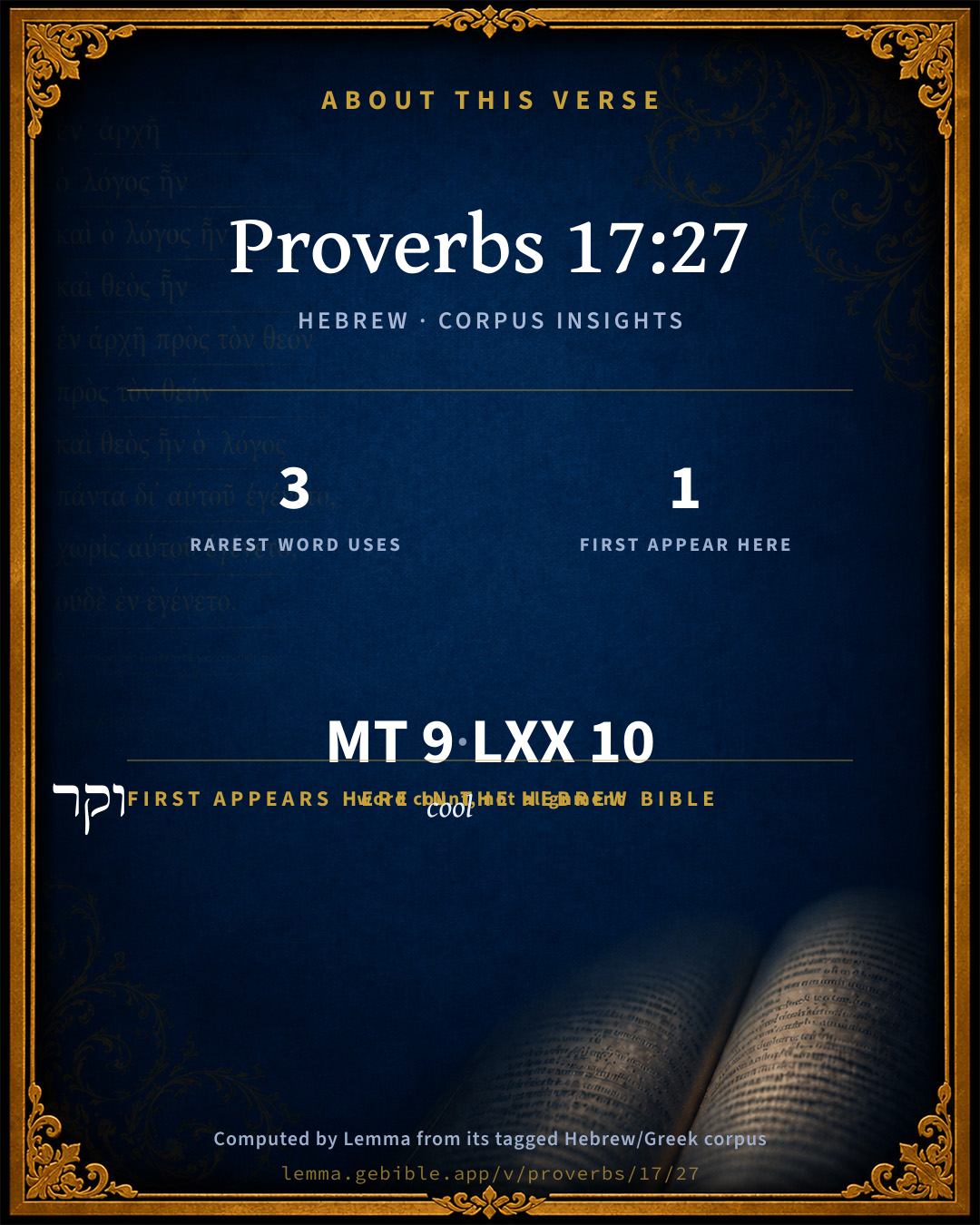
  • 1 first appearance in the Hebrew Bible
Full analysis ↓
Download a study sheet

One document with this verse’s original text, its word-by-word gloss line, the meaning frame, cross-references with their text, attributed commentary, and full source and license credits — printable, and it pastes into notes with its structure intact.

This verse Autodidact and up

Study sheet (.html) Plain text (.txt)

A passage Seminary Student

Up to 50 verses in one chapter. A passage sheet keeps up to 6 commentary sources and 12 cross-references per verse, in the order this page ranks them, and says so on the sheet whenever that leaves anything out. Ask for a single verse and you get the Autodidact verse sheet above.

Everything on this page stays free to read, with no account — the sheet is a download of what is already on screen, not access to it.

Want to remove ads? Support Godless Engineer
Compare translations 3

The same verse in 3 English versions, stacked beneath the original-language interlinear above. Click any original word for its lexicon entry.

Each is an independent rendering of the whole verse — the interlinear is not word-aligned to these translations.

Highlighted words mark where these versions differ — a whole-verse word diff, not a word-by-word alignment.

  • World English Bible Public Domain
    He who spares his words has knowledge. He who is even tempered is a man of understanding.
  • King James Version Public Domain
    He that hath knowledge spareth his words: and a man of understanding is of an excellent spirit.
  • unfoldingWord Literal Text CC BY-SA 4.0
    One restraining his words one knowing knowledge, and the cool of spirit a man of understanding.

unfoldingWord Literal Text — © unfoldingWord, licensed CC BY-SA 4.0. Word-aligned USFM3 via Door43 (git.door43.org/unfoldingWord/en_ult).

Versions to compare (up to 4)

3 of 4 selected

Show all 18 translations

Every available English version of this verse, each an independent rendering of the whole verse.

  • World English Bible Public Domain
    He who spares his words has knowledge. He who is even tempered is a man of understanding.
  • Berean Standard Bible Public Domain
    A man of knowledge restrains his words, and a man of understanding maintains a calm spirit.
  • Majority Standard Bible Public Domain
    A man of knowledge restrains his words, and a man of understanding maintains a calm spirit.
  • King James Version Public Domain
    He that hath knowledge spareth his words: and a man of understanding is of an excellent spirit.
  • American Standard Version (1901) Public Domain
    He that spareth his words hath knowledge; And he that is of a cool spirit is a man of understanding.
  • Revised Version (1885) Public Domain
    He that spareth his words hath knowledge: and he that is of a cool spirit is a man of understanding.
  • Geneva Bible (1599) Public Domain
    Hee that hath knowledge, spareth his wordes, and a man of vnderstanding is of an excellent spirit.
  • Douay-Rheims (1899) Public Domain
    He that setteth bounds to his words. is knowing and wise: and the man of understanding is of a precious spirit.
  • Young's Literal Translation Public Domain
    One acquainted with knowledge is sparing his words, And the cool of temper `is' a man of understanding.
  • Literal Standard Version CC BY-SA 4.0
    One acquainted with knowledge is sparing his words, || And the cool of temper [is] a man of understanding.
  • Unlocked Literal Bible CC BY-SA 4.0
    One who has knowledge uses few words and one with understanding is even-tempered.
  • unfoldingWord Literal Text CC BY-SA 4.0
    One restraining his words one knowing knowledge, and the cool of spirit a man of understanding.
  • Darby Bible Public Domain
    He that hath knowledge spareth his words; and a man of understanding is of a cool spirit.
  • World Messianic Bible Public Domain
    He who spares his words has knowledge. He who is even tempered is a man of understanding.
  • Webster's Bible Public Domain
    He that hath knowledge spareth his words: and a man of understanding is of an excellent spirit.
  • Free Bible Version CC BY-SA 4.0
    If you're wise, you'll be careful what you say; and if you're sensible, you'll keep your temper.
  • Bible in Basic English Public Domain
    He who has knowledge says little: and he who has a calm spirit is a man of good sense.
  • JPS Tanakh (1917) Public Domain
    He that spareth his words hath knowledge; and he that husbandeth his spirit is a man of discernment.

Literal Standard Version (2020), Covenant Press — licensed CC BY-SA 4.0. Text via the HelloAO Bible API (eBible.org). Unlocked Literal Bible (unfoldingWord) — licensed CC BY-SA 4.0. Text via the HelloAO Bible API (eBible.org). unfoldingWord Literal Text — © unfoldingWord, licensed CC BY-SA 4.0. Word-aligned USFM3 via Door43 (git.door43.org/unfoldingWord/en_ult). Free Bible Version, Dr. Jonathan Gallagher — licensed CC BY-SA 4.0. Text via the HelloAO Bible API (eBible.org).

Word by word

More ways to search: Search by grammar → Find every occurrence → Compare this word →

Practice this passage: Drill this verse → Learn its vocabulary →

וקר
qar
H7119
“and · cool of”
Conjunction + Adjective, Adjective, Masculine, Singular, Construct
Part of Speech
Conjunction + Adjective
Type
Adjective
Gender
Masculine
Number
Singular
State
Construct
Full BDB Definition

Origin: contracted from an unused root meaning to chill

TWOT: 2077a

cool - cool, calm, self-possessed (of spirit)
  1. חוֹשֵׂ֣ךְ châsak H2820 “withholding” Verb, Qal, Participle Active, Masculine, Singular, Absolute
  2. אֲ֭מָרָיו ʼêmer H561 “utterances · his” Noun, Common, Masculine, Plural, Construct + Suffix, Personal, 3rd Person, Masculine, Singular
  3. יוֹדֵ֣עַ yâdaʻ H3045 “knowing” Verb, Qal, Participle Active, Masculine, Singular, Absolute
  4. דָּ֑עַת daʻath H1847 “knowledge” Noun, Common, Feminine, Singular, Absolute
  5. יְקַר yâqâr H3368 “precious of” Adjective, Adjective, Masculine, Singular, Construct
  6. ר֝֗וּחַ rûwach H7307 “spirit” Noun, Common, Both, Singular, Absolute
  7. אִ֣ישׁ ʼîysh H376 “man of” Noun, Common, Masculine, Singular, Construct
  8. תְּבוּנָֽה tâbûwn H8394 “understanding” Noun, Common, Feminine, Singular, Absolute

About this verse

These counts appear in no published source. They are computed here, from the morphology-tagged text and Lemma’s own curated glosses. What Lemma adds →

9
words
9
distinct lemmas
Wisdom
section

Notable vocabulary

The rarest word here is וקר cool H7119 — appearing just 3 times in the whole Hebrew Bible.

First appearance in Scripture

This word makes its first canonical appearance in the Hebrew Bible here:

Shared distinctive vocabulary

וקר cool H7119 occurs in 3 verses of the Hebrew Bible. Also found in:

Grammatical profile

  • 2 verbs
  • 5 nouns
  • 2 adjectives

Verb forms

  • חוֹשֵׂ֣ךְ Qal · Participle Active
  • יוֹדֵ֣עַ Qal · Participle Active

Hebrew & Septuagint length

In English translation the verse runs 17 words from the Hebrew and 16 from the Septuagint (LXX English) — closely comparable.

A rough comparison of the two English renderings, which tokenize alike — not a word-level alignment.

Word counts can differ between the Hebrew and the Greek without any difference in meaning — e.g. the Hebrew direct-object marker אֵת has no separate Greek word, and Greek often adds the article ὁ.

In the original languages it is 9 Hebrew tokens and 10 Greek tokens — but the two are counted differently (Hebrew bundles its prefixes and suffixes into one token; the Greek is in lemma form), so that isn’t a like-for-like length.

Cross-references

8

Topical passages linked to Proverbs 17:27 in the Treasury of Scripture Knowledge — connected by theme and wording, ordered by reader-vote popularity; previews shown in the World English Bible.

  • James 3:18 Now the fruit of righteousness is sown in peace by those who make peace.
  • James 1:19 So, then, my beloved brothers, let every man be swift to hear, slow to speak, and slow to anger;
  • Proverbs 10:19 In the multitude of words there is no lack of disobedience, But he who restrains his lips does wisely.
  • Proverbs 14:29 He who is slow to anger has great understanding, But he who has a quick temper displays folly.
  • Proverbs 15:28 The heart of the righteous weighs answers, But the mouth of the wicked gushes out evil.
  • James 3:2 For in many things we all stumble. If anyone doesn't stumble in word, the same is a perfect man, able to bridle the whole body also.
  • Ecclesiastes 9:17 The words of the wise heard in quiet are better than the cry of him who rules among fools.
  • Proverbs 16:32 One who is slow to anger is better than the mighty; One who rules his spirit, than he who takes a city.

Cross-references courtesy of OpenBible.info (CC BY 4.0).

Hebrew and Greek witnesses Masoretic Hebrew ↔ Greek Septuagint

The same verse in the two great witnesses to the Old Testament, shown verse-for-verse.

These are two independent witnesses, not word-aligned to each other, and the Septuagint is shown in lemma (dictionary) form.

Hebrew Proverbs 17:27 Masoretic · Westminster Leningrad Codex

חוֹשֵׂ֣ךְ אֲ֭מָרָיו יוֹדֵ֣עַ דָּ֑עַת וקר יְקַר ר֝֗וּחַ אִ֣ישׁ תְּבוּנָֽה

He who spares his words has knowledge. He who is even tempered is a man of understanding.

World English Bible · Public Domain

Greek LXX Proverbs 17:27 Septuagint · lemma form

ὅς φείδομαι ῥῆμα προἵημι σκληρός ἐπιγνώμων μακρόθυμος δέ ἀνήρ φρόνιμος

He that forbears to utter a hard word is discreet, and a patient man is wise.

LXX2012 (modern English Septuagint) · Public Domain

On this verse, Joseph Benson's Commentary discusses the Septuagint’s reading. Read the note in Commentary ↓

Hebrew: Westminster Leningrad Codex (CC BY 4.0). Greek: Septuagint (public domain); English from LXX2012 (modern English Septuagint) (Public Domain). How the Septuagint differs from the Hebrew →

Commentary

Notes on Proverbs 17:27 from classic Christian and Jewish commentators (each source and its license shown beneath its notes). The classic Christian expositions comment on the surrounding passage and are grouped to its opening verse, so a note may address several verses; the Jewish commentaries on the Tanakh (Rashi and others) are per-verse, so they appear only where the commentator wrote on this verse.

Lemma curates 59 commentaries, every one of them public domain or Creative Commons licensed, each selected and text-cleaned for this edition rather than reprinted as found. About our sources →

Trapp's Complete Commentary

John Trapp

Pro 17:27 He that hath knowledge spareth his words: [and] a man of understanding is of an excellent spirit.

Ver. 27. He that hath knowledge spareth his words.] Taciturnity is a sign of solidity, and talkativeness of worthlesness. Epaminondas is worthily praised for this, saith Plutarch, that as no man knew more than he, so none spake less than he did.

And a man of understanding is of an excellent spirit.] Or, Of a cool spirit. The deepest seas are the most calm.

“Where river smoothest runs, deep is the ford,

The dial stirs, yet none perceives it move,” &c.

John Trapp, A Commentary or Exposition upon All the Books of the Old and New Testament (1647–1656) — public domain. Text from a community e-Sword module.

The Biblical Illustrator

Joseph S. Exell

Pro_17:27-28

He that hath knowledge spareth his words.

Signs of a wise man

Two ways a man may show himself to be a wise man.

1. By the good temper, the sweetness and the sedateness of his mind. A man of understanding is of an excellent spirit, i.e., a precious spirit. He is one that looks well to his spirit, that it be as it should be, and so keeps it in an even frame, easy to himself, and pleasant to others. A gracious spirit is a precious spirit, and renders a man amiable and more excellent than his neighbour. He is of a cool spirit (so some read it), not heated with passion nor put into any tumult or disorder by the impetus of any corrupt affection, but even and stayed. A cool head with a warm heart is an admirable composition.

2. By the good government of his tongue. A wise man will be of few words, as being afraid of speaking amiss; he that has knowledge, and aims to do good with it, is careful, when he does speak, to speak to the purpose, and says little, in order that he may take time to deliberate. He spares his words, because they are better spared than ill-spent. This is generally taken for such a sure indication of wisdom that a fool may gain the reputation of being a wise man if he have but wit enough to hold his tongue, to hear, and see, and say little. If a fool hold his peace, men of candour will think him wise, because nothing appears to the contrary, and because it will be thought that he is making observations on what others say and gaining experience, and is consulting with himself what he shall say that he may speak pertinently. See how easy it is to gain mens good opinion and to impose upon them. But when a fool holds his peace God knows his heart, and the folly that is bound up there; thoughts are words to Him, and therefore He cannot be deceived in His judgment of men. (Matthew Henry.)

The empire of silence

Looking round at the noisy inanity of the world, words with little meaning, actions with little worth, one loves to reflect on the great empire of silence. The noble silent men gathered here and there, each in his department, silently thinking, silently working, whom no morning newspaper makes mention of, they are the salt of the earth. A country that has none or few of these is in a bad way. Like a forest which has no roots, which has all turned into leaves and boughs, which must soon wither and be no forest. Woe to us if we had nothing but what we can show or speak. Silence, the great empire of silence, higher than the stars; deeper than the kingdoms of death! It alone is great; all else is small. (Thomas Carlyle.)

Silence and thought

Bees will not work except in darkness; thought will not work except in silence; neither will virtue work except in silence. Let not thy right hand know what thy left hand doeth. (Thomas Carlyle.)

The Biblical Illustrator, edited by Joseph S. Exell (c. 1880s–1900s) — public domain. Text from a community e-Sword module.

Joseph Benson's Commentary

Pro 17:27-28. He that hath knowledge spareth — Hebrew, חושׂךְ, restraineth, his words — As at other times, so especially when he is under a provocation to anger or any other passion, in which case fools utter all their minds. And a man of understanding is of an excellent spirit — Which he shows, as in various other things, so by commanding his passions, and bridling himself from hasty and unadvised speeches. But this is according to the marginal reading of the Masora; but the reading of the Hebrew text is, קר, cool, according to which, the sense of the clause is, a man of understanding is of a cool spirit, calm and moderate, not easily provoked, humble, as the Chaldee renders it, μακροθυμος, patient, or long- suffering, as the LXX. and Arabic interpreters render the words. Even a fool, when he holds his peace, is counted wise — Because he is sensible of his folly, and therefore forbears to speak lest he should discover it, which is one point of true wisdom. If a fool hold his peace, men of candour will think him wise, because nothing appears to the contrary, and because it will be thought he is making observations on what others say, and gaining experience, or consulting with himself what he should say, that he may speak pertinently. Thus, he that shutteth his lips is esteemed a man of understanding — He gains the reputation of being a wise man, on the easy condition of restraining his tongue, or, of hearing, and seeing, and saying little.

Joseph Benson's Commentary on the Old and New Testaments (1811–1818) — public domain. Text from a community e-Sword module.

The Preacher's Complete Homiletical Commentary

Joseph S. Exell (gen. ed.)

CRITICAL NOTES.—

Pro_17:27. Excellent, rather a cool spirit.

The homiletic teaching of Pro_17:1 is the same as that of chap. Pro_15:17. (See pages 421, 422.)

MAIN HOMILETICS OF Pro_17:27-28

TWO BADGES OF A WISE MAN

I. Reticence of speech. This subject has been dwelt on before. See on chap. Pro_10:19-21. The verses before us suggest further that a man who is sparing of words is not necessarily a man of abundant wisdom, for even a fool may hold his peace sometimes. Solomon elsewhere tells us that “a fool uttereth all his mind” (Pro_29:11); but the fool of this text is not so foolish as to do that. It has been remarked that “by silence a fool abates something of his senselessness, and since he gets the opportunity to collect himself and to reflect, a beginning of wisdom is developed in him” (Von Gerlach). It argues some amount of wisdom in a man if he is silent when he has nothing to say which is worth the saying. But the false conclusion must not be drawn, that every man who is not given to much speech is a man of great understanding and of vast mental resources. It is much better that the stone should remain upon the mouth of a well of impure water, but it must not be taken for granted, because the well is kept closed, that there is a supply of life-giving water within.

II. Calmness of temper. It is a mark of wisdom to strive after a “cool” (excellent) “spirit.”

1. It makes life more pleasant. A man who allows himself to be vexed and irritated by all the annoyances of every-day life has no enjoyment of his existence. A fretful and hasty temper makes every bitter draught more bitter, and takes the sweetness out of the cup that would otherwise be a pleasant one.

2. It makes a man more respected and more useful. A man who cannot curb his temper is a despicable object, and will certainly be despised. A passionate man may be pitied and excused, but he cannot be respected. Hence he cannot have much influence for good upon others. This subject also has been treated before. See Homiletics on chap. Pro_14:17; Pro_14:29, pages 363 and 386.

OUTLINES AND SUGGESTIVE COMMENTS

“He that restrains his words knows knowledge.” The words are precise. It is the fact that he “knows knowledge” that impels a man to restrain his words. If he did not “know knowledge,” if he had not light, and did not know it when he saw it; if he did not see light in God, and know it when he has seen it, and really see enough of it to convince him that “God is light,” he could not stand the darkness. The unfortunates in hell have no light to enable them to endure the dark. But the saint, knowing knowledge, and seeing that it exists in God, is balanced enough against the mysteries to enable him to restrain his words.… The wise man asserts that this silence is a chief mark of piety.… If a man do shut his lips he is wise.… The fool is a wise man when he is silent, and when, in meek submission, he bows to what he cannot understand.—Miller.

He cannot be known for a fool who says nothing. He is a fool, not who hath unwise thoughts, but who utters them. Even concealed folly is wisdom.—Bp. Hall.

He that hath knowledge hath not many words: the fulness of the one causeth in him a scarcity of the other. And there is nothing that he spendeth idly more unwillingly than his words. But yet, having knowledge, he knoweth both when to spare and when to spend.… The original words here are knowing knowledge, for many know much, but it is not knowledge that they know. Some labour hard and waste their time to know needless vanities, which, being better unknown, have not true knowledge in them.… Right knowledge is the knowledge of the Lord, and he that knoweth this spareth his words to spend them to God’s glory. And as it is in many the penury of their knowledge that causeth the superfluity of their words, so chiefly it is the lack of this knowledge. For by this knowledge we learn that an account must be given for every idle word.… Silence being so rare a virtue, where wisdom doth command it, it is accounted a virtue where folly doth impose it. He that fails of this first help, and is so far gone in folly as that his tongue outgoes his understanding, yet hath a second help, and that is to stop, and shut his lips before they go too far, which, though not the first, yet is a second praise; and he hath the repute of some understanding who either seeth, or is thought to see, his want of understanding.—Jermin.

It has been safely enough alleged that of two men equally successful in the business of life, the man who is silent will be generally deemed to have more in him than the man who talks: the latter “shows his hand;” everybody can tell the exact length of his tether; he has trotted himself out so often that all his points and paces are a matter of notoriety. But of the taciturn man, little or nothing is known. “The shallow murmur but the deep are dumb.” Friends and acquaintances shake their heads knowingly, and exclaim with an air of authority, that “So and so” has a great deal more in him than people imagine. They are as often wrong as right, but what need that signify to the silent man?… To follow out one of the Caxtonian essayist’s illustrations,—When we see a dumb strong-box, with its lid braced down by iron clasps and secured by a jealous padlock, involuntarily we suppose that its contents must be infinitely more precious than the gauds and nicknacks which are unguardedly scattered about a lady’s drawing-room. “Who could believe that a box so rigidly locked had nothing in it but odds and ends, which would be just as safe in a bandbox?”—Jacox.

The Preacher's Complete Homiletical Commentary (gen. ed. Joseph S. Exell; Funk & Wagnalls, c. 1892) — public domain (pre-1929). A full-Bible homiletical/sermon-outline anthology covering 65 of 66 books (2 John is absent from the source module). Text from a community e-Sword module.

Matthew Henry's Commentary

Two ways a man may show himself to be a wise man: - 1. By the good temper, the sweetness and the sedateness, of his mind: A man of understanding is of an excellent spirit, a precious spirit (so the word is); he is one that looks well to his spirit, that it be as it should be, and so keeps it in an even frame, easy to himself and pleasant to others. A gracious spirit is a precious spirit, and renders a man amiable and more excellent than his neighbour. He is of a cool spirit (so some read it), not heated with passion, nor put into any tumult or disorder by the impetus of any corrupt affection, but even and stayed. A cool head with a warm heart is an admirable composition. 2. By the good government of his tongue. (1.) A wise man will be of few words, as being afraid of speaking amiss: He that has knowledge, and aims to do good with it, is careful, when he does speak to speak to the purpose, and says little in order that he may take time to deliberate. He spares his words, because they are better spared than ill-spent. (2.) This is generally taken for such a sure indication of wisdom that a fool may gain the reputation of being a wise man if he have but wit enough to hold his tongue, to hear, and see, and say little. If a fool hold his peace, men of candour will think him wise, because nothing appears to the contrary, and because it will be thought that he is making observations on what others say, and gaining experience, and is consulting with himself what he shall say, that he may speak pertinently. See how easy it is to gain men's good opinion and to impose upon them. But when a fool holds his peace God knows his heart, and the folly that is bound up there; thoughts are words to him, and therefore he cannot be deceived in his judgment of men.

Matthew Henry's Commentary on the Whole Bible (1708–1710) — public domain (CC PDM 1.0). Text via the HelloAO Bible API.

Jamieson, Fausset & Brown

Robert Jamieson, A. R. Fausset & David Brown

Prudence of speech is commended as is an excellent or calm spirit, not excited to vain conversation.

Next: Proverbs Chapter 18

Jamieson, Fausset & Brown — Commentary Critical and Explanatory on the Whole Bible (1871) — public domain (CC PDM 1.0). Text via the HelloAO Bible API.

Ellicott's Commentary for English Readers

(27) He that hath knowledge . . .—This verse will better be rendered, He that restrains his words hath knowledge, and one who is cool of temper is a man of understanding. The avoidance of rash speech and hasty temper is here advised.

A Bible Commentary for English Readers, edited by Charles John Ellicott (1878–1897) — public domain. Text from a community e-Sword module.

The Cambridge Bible for Schools and Colleges

gen. ed. J. J. S. Perowne

27. excellent] Rather, cool, A.V. marg. and R.V.; μακρόθυμος ἀνὴρ, LXX.

It is better with LXX. and R.V. to invert the order of subject and predicate in this verse and render:

He that spareth his words hath knowledge:

And he that is of a cool spirit is a man of understanding.

The Cambridge Bible for Schools and Colleges (gen. ed. J. J. S. Perowne; Cambridge University Press, 1878–1918) — public domain. Text from a community e-Sword module.

John Gill's Exposition

He that hath knowledge spareth his words,.... Or, "he that knows knowledge" (c); one that is very knowing, has a fund of knowledge in him, "spareth his words"; is generally a man of few words, he thinks much and says little; and though he may be communicative of his knowledge to proper persons, and at proper times, yet never speaks of it in a boasting and ostentatious way: or, he "restrains his words" (d); he puts a bridle on them; and suffers not himself to speak hastily and angrily, and in a reproachful manner, when he is provoked to it;

and a man of understanding is of an excellent spirit; here is a various reading; the "Cetib" is "of a cool spirit" (e); in opposition to a warm fiery spirit; such as was that of the apostles, who were for calling for fire from heaven on those that slighted their master, and, as he told them, knew not what spirits they were of; but a cool spirit is one that is not soon angry, calm, sedate, and not easily provoked to wrath: the "Keri", or marginal reading, is "of an excellent" or "precious spirit" (f); and such an one is a right spirit; a spirit of faith and love, and of a sound mind; and of such a spirit is a man of understanding in things divine and spiritual; to have a spirit of prayer, and to be tenderhearted, and of a sympathizing and forgiving spirit, is to be of an excellent spirit. The Targum is,

"humble in spirit;''

and a meek and quiet spirit is in the sight of God of great price; the Lord has a great regard to such who are of an humble and contrite spirit: with these he dwells, to these he gives more grace; these are like to Christ, and have the fruits of his Spirit, and are very useful and ornamental. The Septuagint, Syriac, and Arabic versions render it, "patient" or "longsuffering"; and to be of a patient spirit is to be of an excellent spirit: such bear afflictions and reproaches quietly; wait God's own time for hearing and helping them, and live in the comfortable expectation of heaven and happiness; and such show themselves to be wise and understanding men.

(c) "qui scit scientiam", Pagninus, Vatablus, Mercerus. (d) "qui cohibet sermones suos", Junius & Tremellius, Piscator. (e) "frigidus spiritu", Junius & Tremellius, Piscator, Cocceius. (f) "pretiosus spiritu", Pagninus, Montanus, Mercerus, Gejerus, Baynus.

John Gill's Exposition of the Whole Bible (1746–1763) — public domain (CC PDM 1.0). Text via the HelloAO Bible API.

Albert Barnes' Notes on the Bible

Better, A man of calm (or noble) spirit is a man of understanding.

Albert Barnes' Notes on the Bible (1834–1885) — public domain. Text from a community e-Sword/MySword module.

Haydock's Catholic Bible Commentary

Precious and reserved spirit. This is a mark of wisdom. (Calmet)

George Leo Haydock (1774–1849), Haydock's Catholic Family Bible and Commentary, 1859 edition — public domain. Excludes Psalms (Douay-Rheims chapter numbering differs from Protestant) and Deuterocanonical books (Catholic canon only).

Matthew Poole's English Annotations

Spareth, Heb. restraineth, as at other times, so especially when he is provoked to passion, in which case fools utter all their mind. An excellent spirit; which he showeth by commanding his passions, and bridling himself from hasty and unadvised speeches. Or, as others render it, is of a cool spirit, calm and moderate, not easily provoked; humble, as the Chaldee renders it; patient or long-suffering, as the LXX. and Arabic interpreters render the words. Or, as others, sparing (Heb. precious, which is put for rare or scarce, 1Sa 3:1; Pro 25:17; Isa 13:12) of his breath, i.e. of his speech, as this very word is used, Pro 29:11; Isa 11:4, compared with 2Th 2:8.

Matthew Poole's English Annotations on the Holy Bible (1683–1685) — public domain. Text from a community e-Sword/MySword module.

Whedon's Commentary on the Bible

Daniel D. Whedon

27. Hath knowledge — Literally, knoweth knowledge.

Spareth… words — Is not voluble, but when he speaketh, uttereth words of weighty meaning.

Excellent spirit — קר רוח, (kar ruahh,) cool of spirit; so written, but the Masorites read יקר, (yekar,) precious or excellent of spirit. Many critics prefer the former, taking it in the sense of gentle, quiet.

Some would read, A man of calm spirit is a man of discernment. Compare Pro_10:19; Psa_39:3; Jas_1:19.

Daniel D. Whedon (gen. ed.), Commentary on the Old and New Testaments (1874–1909) — public domain. Text from a community e-Sword module.

The Pulpit Commentary

He that hath knowledge spareth his words; Revised Version, he that spareth his words hath knowledge; he shows his common sense, not by rash talk or saying all he knows, but by restraining his tongue. (comp. Pro_10:19 Jam_1:19) "Pirke Aboth" (1:18), "All my days I have grown up amongst the wise, and have not found aught good for a man but silence; not learning but doing is the groundwork, and whoso multiplies words occasions sin" Say the Greek gnomes Enioiv to sigan esti kreitton tou legein Kreitton siwpan h lalein a mh prepei. ~

And Theognis (5:815) writes Bouv moi epi glwsshv kraterw podi lanwn. Iscei kwtillein kaiper epistamenon. ~

"Speech for a shekel, silence for two; it is like a precious stone" ("Qoheleth Rabbah," 5:5). Septuagint, "He who spareth to utter a harsh speech is prudent" (epignwmwn ). A man of understanding is of an excellent spirit; Revised Version, he that is of a coot spirit is a man of understanding; i.e. he who considers before he speaks, and never answers in hot haste, proves that he is wise and intelligent. Septuagint, "The long suffering man is prudent." The above is the reading of the Khetib, followed by most interpreters. The Keri gives, "of a precious spirit" (pretiosi spiritus, Vulgate), that is, one whose words are weighty and valuable, not lavishly thrown about, but reserved as costly jewels.

The Pulpit Commentary (1880–1919), ed. H.D.M. Spence-Jones & Joseph S. Exell — public domain. Text from a community e-Sword module.

Keil & Delitzsch

C. F. Keil & F. Delitzsch

27 He that keepeth his words to himself hath knowledge,

And the cool of temper is a man of understanding.

The first line here is a variation of Pro 10:19. The phrase ידע דּעת (here and at Dan 1:4) means to possess knowledge (novisse); more frequently it is בּינה ידע, e.g., Pro 4:1, where ידע has the inchoative sense of noscere. In 27b the Kerı̂ is יקר־רוח. Jerome translates it pretiosi spiritus, the Venet. τίμιος τὸ πνεῦμα. Rashi glosses יקר here, as at Sa1 3:1, by מנוע (thus to be read after codd.), retentus spiritu; most interpreters remark that the spirit here comes into view as expressing itself in words. It is scarcely correct to say that יקר דּברים could designate one who is sparing in his words, but יקר־רוּח is, according to the fundamental conception of the verb יקר, gravis spiritu (Schultens), of a dignified, composed spirit; it is a quiet seriousness proceeding from high conscientiousness, and maintaining itself in self-control, which is designated by this word. But the Chethı̂b וקר־רוּח presents almost the same description of character. קר from קרר (of the same root as יקר) means to be firm, unmoveable, καρτερὸν εἶναι, hence to be congealed, frozen, cold (cf. frigus with rigere, rigor), figuratively to be cold-blooded, passionless, quiet, composed (Fl.); cf. post-bibl. קרת רוּח (Arab. ḳurrat‛ain), cooling = refreshing, ἀνάψυξις (Act 3:20).

(Note: "He has made my eye glowing" (askhn, cf. שׁחין) is in Arab. equivalent to "he has deeply troubled me." The eye of the benevolent is bârid, and in the Semitic manner of expression, with deep psychological significance, it is said that the tears of sorrow are hot, but those of joy cold.)

Whether we read יקר or קר, in any case we are not to translate rarus spiritu, which, apart from the impossibility of the expression, makes 27b almost a tautological repetition of the thought of 27a. The first line recommends bridling of the tongue, in contrast to inconsiderate and untimely talk; the second line recommends coldness, i.e., equanimity of spirit, in contrast to passionate heat.

Keil & Delitzsch — Biblical Commentary on the Old Testament (1861–1891) — public domain (CC PDM 1.0). Text via the HelloAO Bible API. (Old Testament only.)

Bridges on Proverbs

Charles Bridges

The wisdom of these proverbs will be acknowledged by those, who know the sins of the tongue, and the immense difficulty of restraining the unruly member. A man of knowledge will spare his words, when the probable prospect is harm rather than good. (Psa 39:1-2 . Mat 7:6 .) The good treasure is far too valuable to be unprofitably spent. Silence is often the best proof of wisdom.†1 Our Lord in his divine knowledge, careful as he was to improve every opportunity for instruction, sometimes spared his words. (Mat 16:4 .)

This restraint is most important under provocation.†2 Passion demands immediate judgment. A cool, well-tempered understanding asks further time for consideration. The fiery ebullition of the Apostles, their Master judged to be the want of an excellent understanding. (Luk 9:54-55 .) Nehemiah, by repressing the first vent of his righteous anger, gave a reasonable and convincing answer for the occasion.†3 The prophet wisely refrained even a message from God to a king in the moment of passion. (2Ch 25:16 .) ’A little spark blows up one of sulphureous temper; and many coals, greater injuries, and reproaches are quenched, and lose their force, being thrown at another of a cool spirit.’†4 Indeed a fool may purchase to himself the reputation of wisdom, if only he shut his mouth, instead of exposing his folly to common observation. (Contrast Pro 15:2 ; Pro 29:11 .) ’He cannot be known for a fool, that says nothing. He is a fool, not who hath unwise thoughts, but who utters them. Even concealed folly is wisdom.’†5

How infinitely momentous is the account, which God takes of the tongue! "Death and life are in the power of it." (Pro 18:21 .) Our eternal acceptance or condemnation will — in part at least — hang on it. (Mat 12:36-37 .) How could we endure the judgment for "every idle," no less than for every wicked "word," if there were not for the self-abased penitent a covering from this condemnation, a cleansing from this guilt, a seal of acceptance? (Isa 6:7 .)

Footnotes:

†1 Pro 10:19. Job 13:5 . Compare Sir 5:12-13 ; Sir 33:7-9 . Dr. Good in his note on Job 13:5, gives a translation of an Arabic poetical proverb.

Keep silence then; nor speak, but when besougt;

Who listens long, grows tired of what is told:

With tones of silver through thy tongue be fraught,

Know this — that silence of itself is gold.

†2 Num 12:1-2. Psa 38:12-14 . Isa 53:7 .

†3 Neh 5:6-11. Cicero advises his brother Quintus (a proconsul in Asia) most diligently to restrain his tongue under anger, which — he adds — is no less a virtue, than freedom from anger itself.. — Epist. ad. Q. Fratrem, lib. i. 1.

†4 Leighton on 1Pe 3:9 .

†5 Bishop Hall. Works, viii. 83.

Charles Bridges, An Exposition of the Book of Proverbs (1846) — public domain. Text from a community e-Sword module.

Kretzmann's Popular Commentary

Paul E. Kretzmann

v. 27. He that hath knowledge spareth his words, is chary of speech, refrains from garrulity; and a man of understanding is of an excellent spirit, rather, he that is of a quiet temper, a man who has himself in hand always, shows that lie is sensible.

Paul E. Kretzmann, Popular Commentary of the Bible (1921–1924) — public domain. Text from a community e-Sword module.

unfoldingWord translationNotes

Door43 World Missions Community

uses few words

This refers to the way he speaks. AT: "speaks with few words" (See: Assumed Knowledge and Implicit Information)

Even a fool is thought to be wise

This can be written in active form. AT: "People even think a fool is wise" (See: Active or Passive)

keeps his mouth shut

This means that he does not speak. AT: "does not speak" (See: Idiom)

he is considered to be intelligent

This can be written in active form. AT: "people consider him to be intelligent" (See: Active or Passive)

translationWords

know

word

fool

wise

unfoldingWord translationNotes — © Distant Shores Media and the Door43 World Missions Community, licensed CC BY-SA 4.0. Source: git.door43.org/Door43/en_tn.

Rashi

Rabbi Shlomo Yitzchaki (Rashi)

keeps back his words He who has knowledge does not talk excessively.

he whose breath is dear (Whose words are dear; Salonica ed.) He who keeps back his words is a man of understanding.

Rashi on the Tanakh — English translations: “The Judaica Press complete Tanach with Rashi, translated by A. J. Rosenberg” (CC BY 4.0); “Pentateuch with Rashi's commentary by M. Rosenbaum and A.M. Silbermann, 1929-1934” (public domain); “The Metsudah Tanach series, Lakewood, N.J” (CC BY 4.0); and “The Book of Joshua, Metsudah Publications, 1997” (CC BY 4.0). Text via Sefaria.

Lesson kit

Teaching starters — assembled from the data on this page, not authored interpretation. Every prompt links to the verse data it draws on. Edit before teaching.

Proverbs, in the Wisdom, opens this verse with 9 words (9 distinct Hebrew lemmas). Its most distinctive word is qar (“cool”). A historical commentator’s framing appears above. Read the whole chapter for the surrounding context.

Discussion questions

  1. The word qar carries the sense “cool.” How does it shape the verse?
  2. The word “cool” first appears here in Scripture. What is being introduced at this debut?
  3. Proverbs 25:25 shares the word «cool» with this verse. How do the two illuminate each other?
  4. These translations render this verse differently; the difference is in the English rendering, not the original. What questions does that raise?
  5. The verb «חוֹשֵׂ֣ךְ» is Qal Participle Active. How does its form color the action?
  6. Reading how Trapp's Complete Commentary and The Biblical Illustrator read this verse, where do the two commentators agree and where do they part?

Things to notice

Reading settings

Reading text

Shown beneath each verse's original-language words.

Old Testament
Old Testament edition

Read the OT as the Masoretic Hebrew (MT) or the Greek Septuagint (LXX).

English shown for the Greek Septuagint (in the Hebrew ↔ Greek comparison).

Comparing translations? Open the Compare panel on any verse page to stack up to four side by side.