
Psalms 35:5

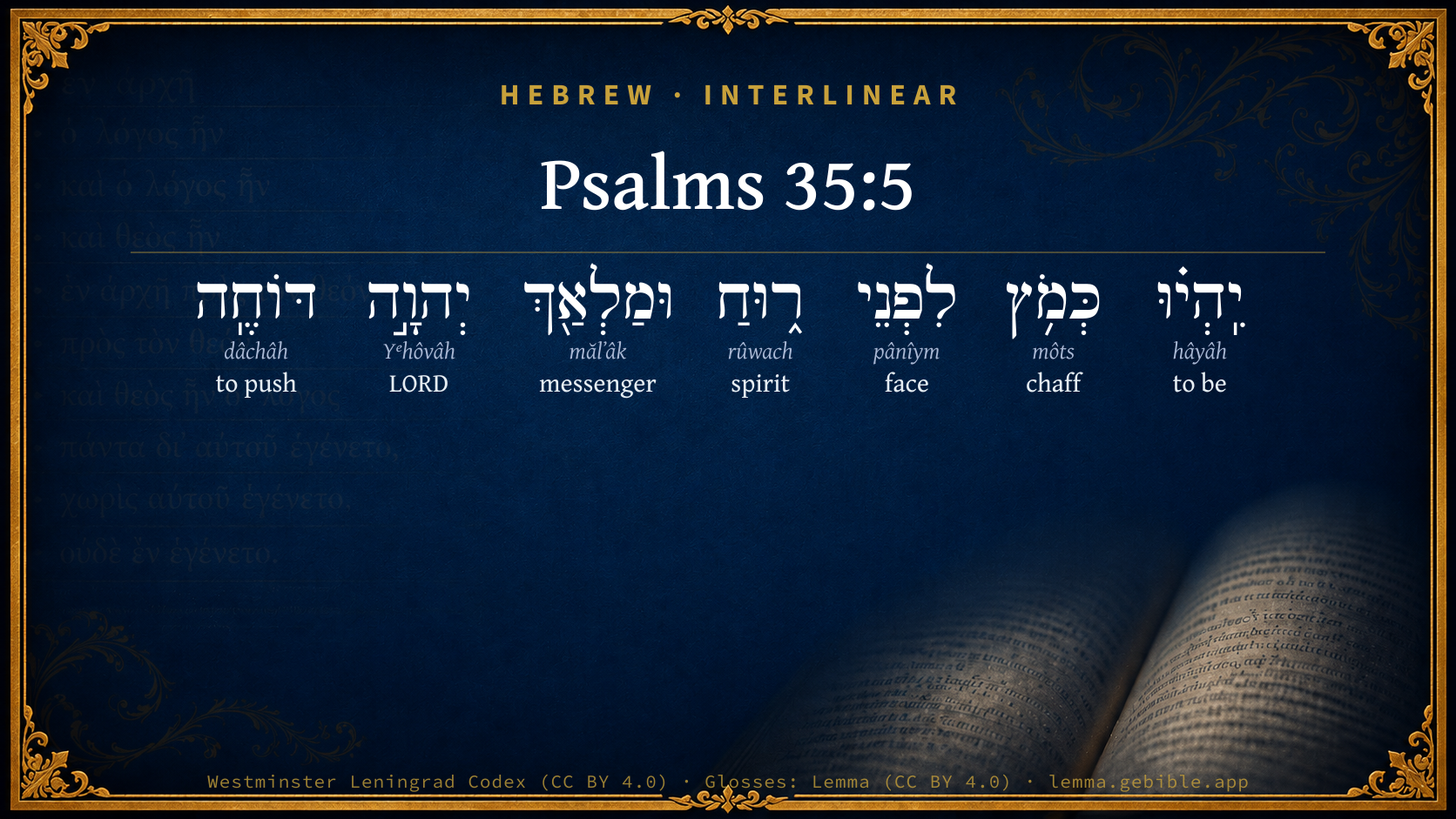
Hebrew (Westminster Leningrad Codex) Psalms 35:5 appears in the Hebrew Old Testament. The text above is from the Westminster Leningrad Codex. Each word links to its Strong’s number, a concise gloss, and parsing drawn from the Open Scriptures Hebrew Bible morphology. Click any word for its full Brown-Driver-Briggs (BDB) entry.
Download image
Cite this verse

Psalms 35:5 (World English Bible). Public Domain. Lemma interlinear Bible study tool, https://lemma.gebible.app/v/psalms/35/5.

Show BibTeX & RIS
BibTeX
RIS
English Translation
Let them be as chaff before the wind, Yahweh's angel driving them on.
World English Bible · Public Domain
Highlights
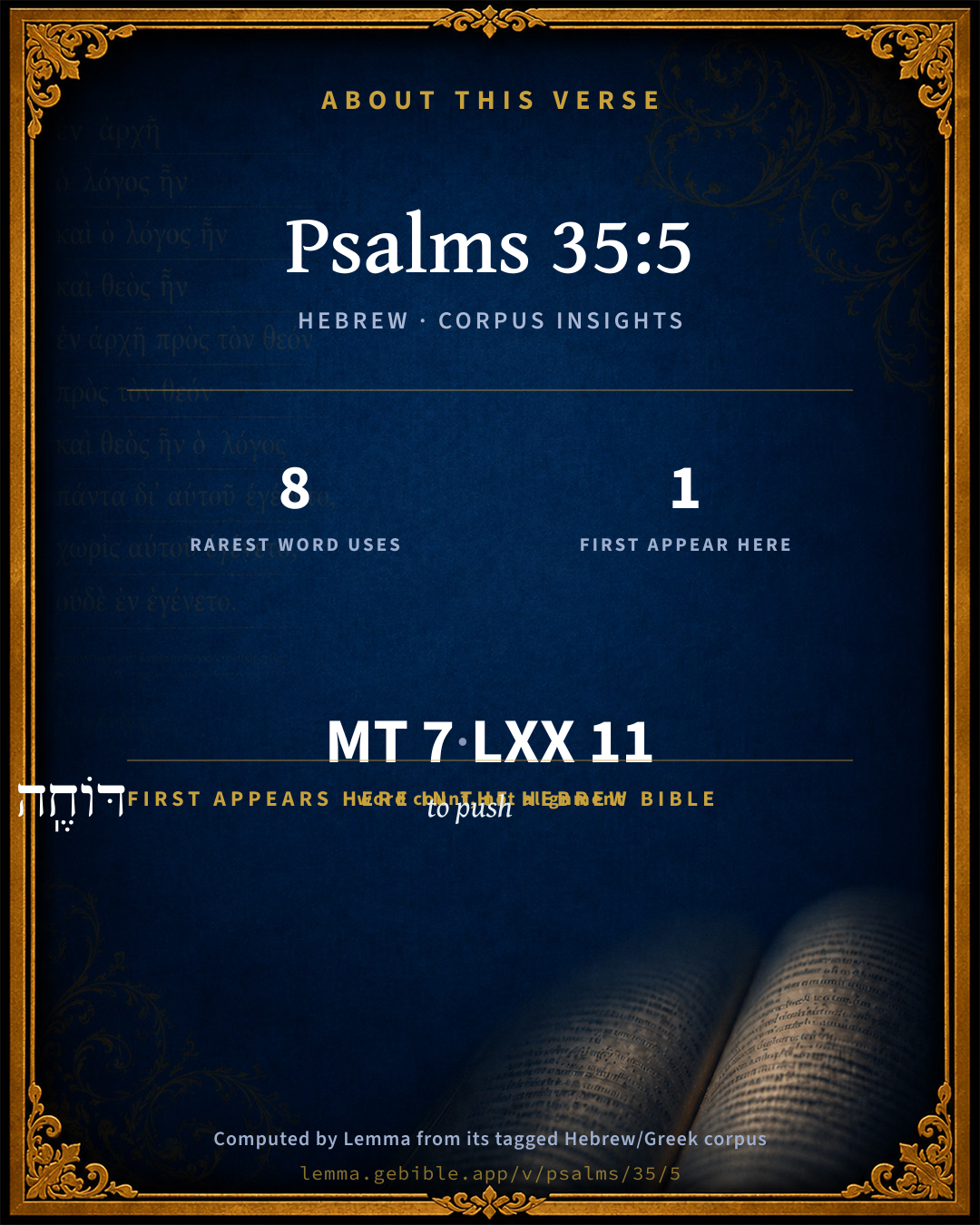
  • 1 first appearance in the Hebrew Bible
Full analysis ↓
Download a study sheet

One document with this verse’s original text, its word-by-word gloss line, the meaning frame, cross-references with their text, attributed commentary, and full source and license credits — printable, and it pastes into notes with its structure intact.

This verse Autodidact and up

Study sheet (.html) Plain text (.txt)

A passage Seminary Student

Up to 50 verses in one chapter. A passage sheet keeps up to 6 commentary sources and 12 cross-references per verse, in the order this page ranks them, and says so on the sheet whenever that leaves anything out. Ask for a single verse and you get the Autodidact verse sheet above.

Everything on this page stays free to read, with no account — the sheet is a download of what is already on screen, not access to it.

Want to remove ads? Support Godless Engineer
Compare translations 3

The same verse in 3 English versions, stacked beneath the original-language interlinear above. Click any original word for its lexicon entry.

Each is an independent rendering of the whole verse — the interlinear is not word-aligned to these translations.

Highlighted words mark where these versions differ — a whole-verse word diff, not a word-by-word alignment.

  • World English Bible Public Domain
    Let them be as chaff before the wind, Yahweh's angel driving them on.
  • King James Version Public Domain
    Let them be as chaff before the wind: and let the angel of the LORD chase them.
  • unfoldingWord Literal Text CC BY-SA 4.0
    May they be as chaff before the wind, and the angel of Yahweh driving away.

unfoldingWord Literal Text — © unfoldingWord, licensed CC BY-SA 4.0. Word-aligned USFM3 via Door43 (git.door43.org/unfoldingWord/en_ult).

Versions to compare (up to 4)

3 of 4 selected

Show all 18 translations

Every available English version of this verse, each an independent rendering of the whole verse.

  • World English Bible Public Domain
    Let them be as chaff before the wind, Yahweh's angel driving them on.
  • Berean Standard Bible Public Domain
    May they be like chaff in the wind, as the angel of the LORD drives them away.
  • Majority Standard Bible Public Domain
    May they be like chaff in the wind, as the angel of the LORD drives them away.
  • King James Version Public Domain
    Let them be as chaff before the wind: and let the angel of the LORD chase them.
  • American Standard Version (1901) Public Domain
    Let them be as chaff before the wind, And the angel of Jehovah driving `them' on.
  • Revised Version (1885) Public Domain
    Let them be as chaff before the wind, and the angel of the LORD driving them on.
  • Geneva Bible (1599) Public Domain
    Let them be as chaffe before the winde, and let the Angel of the Lord scatter them.
  • Douay-Rheims (1899) Public Domain
    Let them become as dust before the wind: and let the angel of the Lord straiten them.
  • Young's Literal Translation Public Domain
    They are as chaff before wind, And a messenger of Jehovah driving away.
  • Literal Standard Version CC BY-SA 4.0
    They are as chaff before wind, || And a messenger of YHWH driving away.
  • Unlocked Literal Bible CC BY-SA 4.0
    May they be as chaff before the wind, as the angel of Yahweh drives them away.
  • unfoldingWord Literal Text CC BY-SA 4.0
    May they be as chaff before the wind, and the angel of Yahweh driving away.
  • Darby Bible Public Domain
    Let them be as chaff before the wind, and let the angel of Jehovah drive [them] away;
  • World Messianic Bible Public Domain
    Let them be as chaff before the wind, the LORD’s angel driving them on.
  • Webster's Bible Public Domain
    Let them be as chaff before the wind: and let the angel of the LORD chase them.
  • Free Bible Version CC BY-SA 4.0
    Let them be like chaff blown by the wind; let the angel of the Lord drive them away.
  • Bible in Basic English Public Domain
    Let them be like dust from the grain before the wind; let the angel of the Lord send them in flight.
  • JPS Tanakh (1917) Public Domain
    Let them be as chaff before the wind, the angel of the LORD thrusting them.

Literal Standard Version (2020), Covenant Press — licensed CC BY-SA 4.0. Text via the HelloAO Bible API (eBible.org). Unlocked Literal Bible (unfoldingWord) — licensed CC BY-SA 4.0. Text via the HelloAO Bible API (eBible.org). unfoldingWord Literal Text — © unfoldingWord, licensed CC BY-SA 4.0. Word-aligned USFM3 via Door43 (git.door43.org/unfoldingWord/en_ult). Free Bible Version, Dr. Jonathan Gallagher — licensed CC BY-SA 4.0. Text via the HelloAO Bible API (eBible.org).

Word by word

More ways to search: Search by grammar → Find every occurrence → Compare this word →

Practice this passage: Drill this verse → Learn its vocabulary →

About this verse

These counts appear in no published source. They are computed here, from the morphology-tagged text and Lemma’s own curated glosses. What Lemma adds →

7
words
7
distinct lemmas
Wisdom
section

Notable vocabulary

The rarest word here is כְּמֹ֥ץ chaff H4671 — appearing just 8 times in the whole Hebrew Bible.

First appearance in Scripture

This word makes its first canonical appearance in the Hebrew Bible here:

  • דּוֹחֶֽה to push H1760

Shared distinctive vocabulary

כְּמֹ֥ץ chaff H4671 occurs in 8 verses of the Hebrew Bible. Also found in:

Grammatical profile

  • 2 verbs
  • 5 nouns

Verb forms

  • יִֽהְי֗וּ Qal · Imperfect
  • דּוֹחֶֽה Qal · Participle Active

Hebrew & Septuagint length

In English translation the verse runs 13 words from the Hebrew and 16 from the Septuagint (LXX English) — closely comparable.

A rough comparison of the two English renderings, which tokenize alike — not a word-level alignment.

Word counts can differ between the Hebrew and the Greek without any difference in meaning — e.g. the Hebrew direct-object marker אֵת has no separate Greek word, and Greek often adds the article ὁ.

In the original languages it is 7 Hebrew tokens and 11 Greek tokens — but the two are counted differently (Hebrew bundles its prefixes and suffixes into one token; the Greek is in lemma form), so that isn’t a like-for-like length.

Cross-references

10

Topical passages linked to Psalms 35:5 in the Treasury of Scripture Knowledge — connected by theme and wording, ordered by reader-vote popularity; previews shown in the World English Bible.

  • Job 21:18 That they are as stubble before the wind, As chaff that the storm carries away?
  • Isaiah 29:5 But the multitude of your foes shall be like small dust, and the multitude of the awesome ones as chaff that passes away: yes, it shall be in an instant suddenly.
  • Exodus 14:19 The angel of God, who went before the camp of Israel, moved and went behind them; and the pillar of cloud moved from before them, and stood behind them.
  • Psalms 1:4 The wicked are not so, But are like the chaff which the wind drives away.
  • Isaiah 17:13 The nations shall rush like the rushing of many waters: but he shall rebuke them, and they shall flee far off, and shall be chased as the chaff of the mountains before the wind, and like the whirling dust before the storm.
  • Isaiah 37:36 The angel of Yahweh went forth, and struck in the camp of the Assyrians one hundred and eighty-five thousand; and when men arose early in the morning, behold, these were all dead bodies.
  • Hosea 13:3 Therefore they will be like the morning cloud, And like the dew that passes away early, Like the chaff that is driven with the whirlwind out of the threshing floor, And like the smoke out of the chimney.
  • Acts 12:23 Immediately an angel of the Lord struck him, because he didn't give God the glory, and he was eaten by worms and died.
  • Hebrews 11:28 By faith, he kept the Passover, and the sprinkling of the blood, that the destroyer of the firstborn should not touch them.
  • Psalms 83:13–17 My God, make them like tumbleweed; Like chaff before the wind.

Cross-references courtesy of OpenBible.info (CC BY 4.0).

Hebrew and Greek witnesses Masoretic Hebrew ↔ Greek Septuagint

The same verse in the two great witnesses to the Old Testament, shown verse-for-verse.

You’re reading Greek Psalm 34 (Hebrew Psalm 35). The Septuagint counts the superscription, so verse numbers can differ from the Hebrew — chapter-level alignment, not verse-by-verse. Numbering follows Rahlfs.

These are two independent witnesses, not word-aligned to each other, and the Septuagint is shown in lemma (dictionary) form.

Hebrew Psalms 35:5 Masoretic · Westminster Leningrad Codex

יִֽהְי֗וּ כְּמֹ֥ץ לִפְנֵי ר֑וּחַ וּמַלְאַ֖ךְ יְהוָ֣ה דּוֹחֶֽה

Let them be as chaff before the wind, Yahweh's angel driving them on.

World English Bible · Public Domain

Greek LXX Greek Psalm 34:5 Septuagint · lemma form

γίγνομαι ὡσεί χνοῦς κατά πρόσωπον ἄνεμος καί ἄγγελος κύριος ἐκθλίβω αὐτός

Let them be as dust before the wind, and an angel of the Lord afflicting them.

LXX2012 (modern English Septuagint) · Public Domain

Hebrew: Westminster Leningrad Codex (CC BY 4.0). Greek: Septuagint (public domain); English from LXX2012 (modern English Septuagint) (Public Domain). How the Septuagint differs from the Hebrew →

Commentary

Notes on Psalms 35:5 from classic Christian and Jewish commentators (each source and its license shown beneath its notes). The classic Christian expositions comment on the surrounding passage and are grouped to its opening verse, so a note may address several verses; the Jewish commentaries on the Tanakh (Rashi and others) are per-verse, so they appear only where the commentator wrote on this verse.

Lemma curates 59 commentaries, every one of them public domain or Creative Commons licensed, each selected and text-cleaned for this edition rather than reprinted as found. About our sources →

Trapp's Complete Commentary

John Trapp

Psa 35:5 Let them be as chaff before the wind: and let the angel of the LORD chase [them].

Ver. 5. Let them be as chaff] Facti sint a corde suo fugitivi, let them fly before their own consciences, restless and uncertain whither to turn themselves.

And let the angel of the Lord chase them] It may be understood both of the evil angels and of the good, ready at God’s command to do execution upon his enemies. Chaff driven before the wind may rest against a wall; but where shall they rest who are chased by an angel? "Where shall the ungodly and the sinner appear?" 1Pe 4:18. Surely nowhere.

John Trapp, A Commentary or Exposition upon All the Books of the Old and New Testament (1647–1656) — public domain. Text from a community e-Sword module.

Joseph Benson's Commentary

Psa 35:5. Let them be — Or, They shall be; as chaff before the wind — That is, dispersed and chased from place to place, finding rest and safety nowhere. And let the angel of the Lord — Whom God employs to defend his people, and to destroy his enemies; chase them — Drive them forward to their destruction, as chaff is driven by a fierce wind.

Joseph Benson's Commentary on the Old and New Testaments (1811–1818) — public domain. Text from a community e-Sword module.

Whedon's Commentary on the Bible

Daniel D. Whedon

5, 6. Chaff—Emblem of worthlessness. See on Psa_83:13.

Angel of the Lord—The title occurs twice in this verse, and nowhere else in the psalms except Psa_34:7, where see note. Here it seems to mean any angel specially sent by Jehovah to execute the judgment; or, if Messiah is meant, he, too, executeth judgment. Psa_2:9-12; Joh_5:22-27.

Let their way be dark and slippery—Literally, darkness and slipperinesses, the abstract for the concrete, and the plural of the last word for intensity.

Persecute—Here, as in Psa_35:3, this word should be translated pursue. The figure is that of pursuing a retreating army in order to make victory complete, and answers to “chase”—drive forward—in Psa_35:5. A retreating army, covered with shame, confusion, and disappointment, pursued by the angel of Jehovah through dark and slippery passages, is an object too terrible for calm contemplation. Still it is only what they had meted out to David, and is according to the oldest laws of justice.

Daniel D. Whedon (gen. ed.), Commentary on the Old and New Testaments (1874–1909) — public domain. Text from a community e-Sword module.

J. A. Alexander on Psalms

Joseph Addison Alexander

5. (Psa 35:5) Let them be as chaff before a wind, and the angel of Jehovah smiting. Under the influence of inspiration, the Psalmist sees the natural and righteous consequences of their wickedness, and viewing the case merely in itself, apart from personal feeling, speaks of this effect as desirable. The wish expressed is, to all intents and purposes, equivalent to a prediction or the affirmation of a general truth. The Psalmist desires the destruction of these sinners precisely as God wills it; nor is it any harder to reconcile such wishes with the highest degree of human goodness than it is to reconcile the certain fact that God allows some men to perish with his infinite bene volence. The figure of chaff before the wind suggests the idea of intrinsic worthlessness with that of easy and complete destruction. Compare Psa 1:4. The participle at the close means striking (them) down, so that they cannot rise. Compare Psa 36:12. The angel of Jehovah, his appointed instrument of vengeance. See above, on Psa 34:8 (7).

Joseph Addison Alexander, The Psalms Translated and Explained (1850) — public domain. Text from a community e-Sword module.

Geneva Bible (1599)

Geneva Bible translators

Smite them with the spirit of giddiness that their enterprises may be foolish, and they received just reward.

Geneva Bible (1599) marginal notes — public domain. Text via Bolls.life.

Jamieson, Fausset & Brown

Robert Jamieson, A. R. Fausset & David Brown

(Compare Psa 1:4) --a terrible fate; driven by wind on a slippery path in darkness, and hotly pursued by supernatural violence (Sa2 24:16; Act 12:23).

Jamieson, Fausset & Brown — Commentary Critical and Explanatory on the Whole Bible (1871) — public domain (CC PDM 1.0). Text via the HelloAO Bible API.

Adam Clarke's Commentary

Verse 5. Let the angel of the Lord chase them.] By angel we may either understand one of those spirits, whether good or bad, commonly thus denominated, or any thing used by God himself as the instrument of their confusion.

Adam Clarke's Commentary on the Bible (1810–1826) — public domain. Text from a community e-Sword/MySword module.

John Calvin's Commentaries

The same thing he expresses more clearly in the following verse, praying that the angel of the Lord would drive them through dark and slippery places, so that reason and understanding might fail them, and that they might not know whither to go, nor what to become, nor have even time given them to draw their breath. We need not be surprised that this work should be assigned to the angels, by whose instrumentality God executes his judgments. At the same time, this passage may be expounded of the devils as well as of the holy angels, who are ever ready to execute the divine behests. We know that the devil is permitted to exercise his dominion over the reprobate; and hence it is often said that “an evil spirit from God came upon Saul,” (1 Samuel 18:10.) But as the devils never execute the will of God, unless compelled to do it when God wishes to serve himself of them; the Sacred Scriptures declare that the holy and elect angels are in a much higher sense the servants of God. God, then, executes his judgments by the wicked and reprobate angels; but he gives the elect angels the pre-eminence over them. On this account, also, good angels only are called rightfully “principalities,” as in Ephesians 3:10; Colossians 1:16, and other similar passages. If it is objected that it is not meet that the angels, who are the ministers of grace and salvation, and the appointed guardians of the faithful, should be employed in executing judgment upon the reprobate, the explanation is simply this, that they cannot watch for the preservation of the godly without being prepared for fighting — that they cannot succor them by their aid without also opposing their enemies, and declaring themselves to be against them. The style of imprecation which the Psalmist here employs can be explained only by bearing in mind what I have elsewhere said, namely, that David pleads not simply his own cause, nor utters rashly the dictates of passion, nor with unadvised zeal desires the destruction of his enemies; but under the guidance of the Holy Spirit he entertains and expresses against the reprobate such desires as were characterised by great moderation, and which were far removed from the spirit of those who are impelled either by desire of revenge or hatred, or some other inordinate emotion of the flesh.

John Calvin's Commentaries (1540-1563) — public domain. Text from the Calvin Translation Society English edition (1840s-50s) via the Christian Classics Ethereal Library (ccel.org). Calvin's coverage is partial (roughly two-thirds of the Bible); uncommented books and verses are honest gaps, never fabricated. The 19th-century editor's footnotes and remarks are omitted so the notes are faithfully Calvin's own voice.

Ellicott's Commentary for English Readers

(5) As chaff.—Comp. Psa_1:4, and see Note. There can be little doubt that the “angel of Jehovah” in this and the following verse is (comp. Psa_104:4) a personification of the “hurricane” itself, which drives before it all obstacles, and overwhelms even whole armies in dangerous places.

A Bible Commentary for English Readers, edited by Charles John Ellicott (1878–1897) — public domain. Text from a community e-Sword module.

The Cambridge Bible for Schools and Colleges

gen. ed. J. J. S. Perowne

5, 6. Let them be as chaff before the wind,

The angel of Jehovah thrusting them down.

Let their way be all dark and slippery,

The angel of Jehovah pursuing them.

A terrible picture of a pell-mell rout. Does it not read like a recollection of some incident in a warrior’s life, perhaps some defeat of the Philistines? Helpless as chaff before the wind (Psa_1:4, Psa_83:13) they are driven headlong down a dark and slippery track, where they can neither see nor keep their footing, with the dread Angel smiting them down as they vainly strive to escape. “The tracks down the limestone hills of Palestine are often worn as smooth as marble” (Kay).

Most probably the participles should be transposed. Pursuing suits the image of the storm-driven chaff (Isa_17:13); thrusting down (Psa_36:12; Psa_118:13; Psa_140:4) agrees better with the picture of the stumbling fugitives. For the angel of Jehovah see note on Psa_34:7. Cp. the reminiscence of this passage in Jer_23:12.

The Cambridge Bible for Schools and Colleges (gen. ed. J. J. S. Perowne; Cambridge University Press, 1878–1918) — public domain. Text from a community e-Sword module.

John Gill's Exposition

Let them be as chaff before the wind,.... As they are; see Psa 1:4;

and let the angel of the Lord chase them; either a good angel, who is the Lord's, his creature that ministers unto him, and is ready to obey his orders; and who, as he encamps about the saints and protects them, so he is able to destroy their enemies; as one angel in a night destroyed all the firstborn in Egypt, and another the whole army of the Assyrians, Exo 12:29; an angel of the Lord, who is swift to fly, and so to chase and overtake, and able to execute whatever is the will of the Lord; or else an evil angel, who is the Lord's, being made by him, though not made evil by him; and who is under his restraints, and can do nothing but by his permission; and who sometimes is employed by the Lord, as the executioner of his wrath upon wicked men; is suffered to distress and torture their consciences in this life, and hereafter drag them into everlasting burnings, prepared for the devil and his angels.

John Gill's Exposition of the Whole Bible (1746–1763) — public domain (CC PDM 1.0). Text via the HelloAO Bible API.

Albert Barnes' Notes on the Bible

Let them be as chaff before the wind - As chaff is driven away in winnowing grain. See the notes at Psa 1:4.

And let the angel of the Lord chase them - Drive them away, or scatter them. Angels are often represented in the Scriptures as agents employed by God in bringing punishment on wicked people. See 2Ki 19:35; Isa 37:36; 1Ch 21:12, 1Ch 21:30; 2Sa 24:16.

Albert Barnes' Notes on the Bible (1834–1885) — public domain. Text from a community e-Sword/MySword module.

Matthew Poole's English Annotations

As chaff before the wind, i.e. dispersed and chased from place to place, finding rest and safety no where.

The angel of the Lord; whom God useth to defend his people, and to destroy their enemies.

Matthew Poole's English Annotations on the Holy Bible (1683–1685) — public domain. Text from a community e-Sword/MySword module.

The Treasury of David

Charles H. Spurgeon

Ver. 5. Let them be as chaff before the wind. They were swift enough to attack, let them be as swift to flee. Let their own fears and the alarms of their consciences unman them so that the least breeze of trouble shall carry them hither and thither. Ungodly men are worthless in character, and light in their behaviour, being destitute of solidity and fixedness; it is but just that those that make themselves chaff should be treated as such. When this imprecation is fulfilled in graceless men, they will find it an awful thing to be for ever without rest, without peace of mind, or stay of soul, hurried from fear to fear, and from misery to misery. And let the angel of the Lord chase them. Fallen angels shall haunt them, good angels shall afflict them. To be pursued by avenging spirits will be the lot of those who delight in persecution. Observe the whole scene as the psalmist sketches it: the furious foe is first held at bay, then turned back, then driven to headlong flight, and chased by fiery messengers from whom there is no escape, while his pathway becomes dark and dangerous, and his destruction overwhelming.

Ver. 5. As chaff. Literally, "As the thistledown." John Morison.

None.

Psalms 35:6*

Charles H. Spurgeon's The Treasury of David (1869–1885) — public domain. Psalms only. Text from a community e-Sword/MySword module.

The Pulpit Commentary

Let them be as chaff before the wind. (comp. Psa_1:4 Isa_17:13 Isa_29:5 Hos_13:3) Chaff is the type of whatever is light, vain, futile, and worthless; chaff driven before the wind represents the confused rout of a beaten army flying without any resistance before an enemy. And let the angel of the Lord chase them; rather, smite them. The angel of the Lord, who protects the righteous, (Psa_34:7) is called on to complete the discomfiture of the wicked ones, who are David"s enemies.

The Pulpit Commentary (1880–1919), ed. H.D.M. Spence-Jones & Joseph S. Exell — public domain. Text from a community e-Sword module.

Scofield Reference Notes

C. I. Scofield

angel

(See Scofield "Heb 1:4").

The Scofield Reference Bible (1917 edition), notes by C. I. Scofield — public domain. Text from a community e-Sword module.

Lesson kit

Teaching starters — assembled from the data on this page, not authored interpretation. Every prompt links to the verse data it draws on. Edit before teaching.

Psalms, in the Wisdom, opens this verse with 7 words (7 distinct Hebrew lemmas). Its most distinctive word is môts (“chaff”). A historical commentator’s framing appears above. Read the whole chapter for the surrounding context.

Discussion questions

  1. What does “chaff” (môts) contribute to the verse as a whole?
  2. This is the first place “to push” appears in Scripture (first appears here). What does its debut here establish?
  3. How does Job 21:18, which shares the word «chaff», read alongside this verse?
  4. These translations render this verse differently. What is at stake in choosing one wording over another?
  5. «יִֽהְי֗וּ» is a Qal Imperfect verb. How does that grammatical form shape the action described?
  6. Compare how Trapp's Complete Commentary and Joseph Benson's Commentary read this verse. Where do they agree or differ?

Things to notice

Reading settings

Reading text

Shown beneath each verse's original-language words.

Old Testament
Old Testament edition

Read the OT as the Masoretic Hebrew (MT) or the Greek Septuagint (LXX).

English shown for the Greek Septuagint (in the Hebrew ↔ Greek comparison).

Comparing translations? Open the Compare panel on any verse page to stack up to four side by side.