
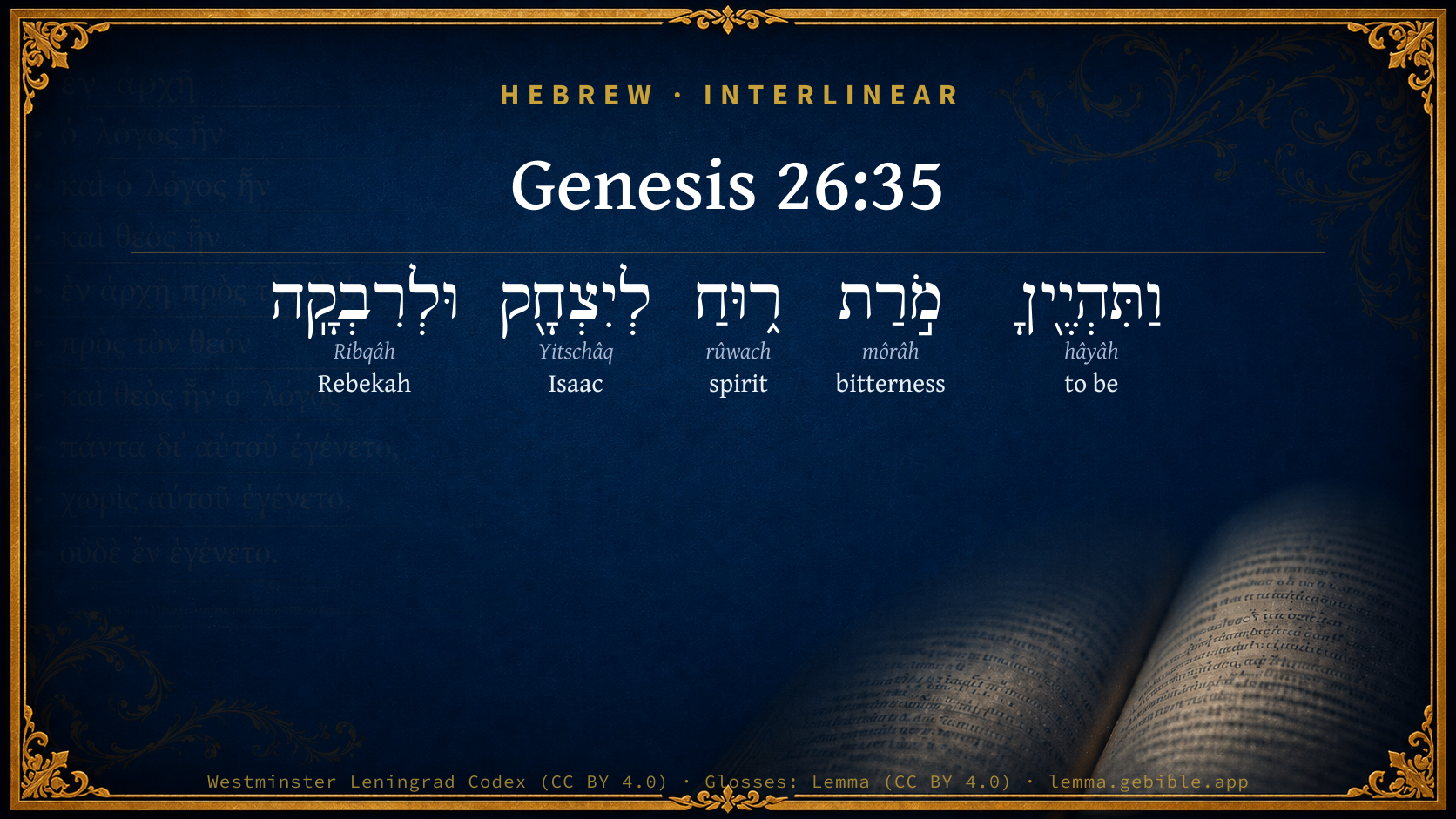
Genesis 26:35

Hebrew (Westminster Leningrad Codex) Genesis 26:35 appears in the Hebrew Old Testament. The text above is from the Westminster Leningrad Codex. Each word links to its Strong’s number, a concise gloss, and parsing drawn from the Open Scriptures Hebrew Bible morphology. Click any word for its full Brown-Driver-Briggs (BDB) entry.
Download image
Cite this verse

Genesis 26:35 (World English Bible). Public Domain. Lemma interlinear Bible study tool, https://lemma.gebible.app/v/genesis/26/35.

Show BibTeX & RIS
BibTeX
RIS
English Translation
They grieved Isaac and Rebekah's spirits.
World English Bible · Public Domain
Highlights
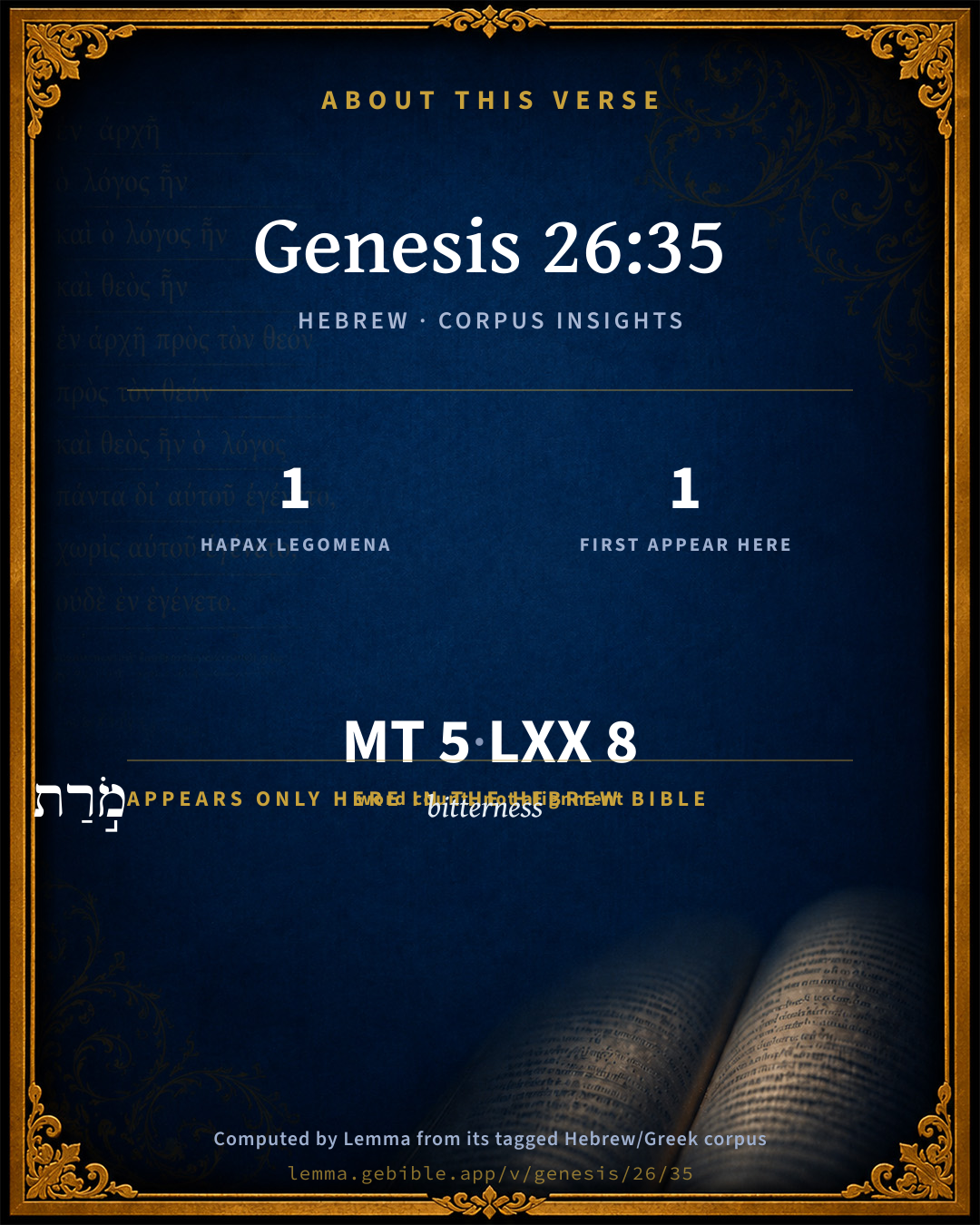
  • 1 hapax legomenon — only here in the Hebrew Bible
  • 1 first appearance in the Hebrew Bible
Full analysis ↓
Download a study sheet

One document with this verse’s original text, its word-by-word gloss line, the meaning frame, cross-references with their text, attributed commentary, and full source and license credits — printable, and it pastes into notes with its structure intact.

This verse Autodidact and up

Study sheet (.html) Plain text (.txt)

A passage Seminary Student

Up to 50 verses in one chapter. A passage sheet keeps up to 6 commentary sources and 12 cross-references per verse, in the order this page ranks them, and says so on the sheet whenever that leaves anything out. Ask for a single verse and you get the Autodidact verse sheet above.

Everything on this page stays free to read, with no account — the sheet is a download of what is already on screen, not access to it.

Want to remove ads? Support Godless Engineer
Compare translations 3

The same verse in 3 English versions, stacked beneath the original-language interlinear above. Click any original word for its lexicon entry.

Each is an independent rendering of the whole verse — the interlinear is not word-aligned to these translations.

Highlighted words mark where these versions differ — a whole-verse word diff, not a word-by-word alignment.

  • World English Bible Public Domain
    They grieved Isaac and Rebekah's spirits.
  • King James Version Public Domain
    Which were a grief of mind unto Isaac and to Rebekah.
  • unfoldingWord Literal Text CC BY-SA 4.0
    And they were a grief of mind to Isaac and Rebekah.

unfoldingWord Literal Text — © unfoldingWord, licensed CC BY-SA 4.0. Word-aligned USFM3 via Door43 (git.door43.org/unfoldingWord/en_ult).

Versions to compare (up to 4)

3 of 4 selected

Show all 18 translations

Every available English version of this verse, each an independent rendering of the whole verse.

  • World English Bible Public Domain
    They grieved Isaac and Rebekah's spirits.
  • Berean Standard Bible Public Domain
    And they brought grief to Isaac and Rebekah.
  • Majority Standard Bible Public Domain
    And they brought grief to Isaac and Rebekah.
  • King James Version Public Domain
    Which were a grief of mind unto Isaac and to Rebekah.
  • American Standard Version (1901) Public Domain
    And they were a grief of mind unto Isaac and to Rebekah.
  • Revised Version (1885) Public Domain
    and they were a grief of mind unto Isaac and to Rebekah.
  • Geneva Bible (1599) Public Domain
    And they were a griefe of minde to Izhak and to Rebekah.
  • Douay-Rheims (1899) Public Domain
    And they both offended the mind of Isaac and Rebecca.
  • Young's Literal Translation Public Domain
    and they are a bitterness of spirit to Isaac and to Rebekah.
  • Literal Standard Version CC BY-SA 4.0
    and they are a bitterness of spirit to Isaac and to Rebekah.
  • Unlocked Literal Bible CC BY-SA 4.0
    They brought sorrow to Isaac and Rebekah.
  • unfoldingWord Literal Text CC BY-SA 4.0
    And they were a grief of mind to Isaac and Rebekah.
  • Darby Bible Public Domain
    And they were a grief of mind to Isaac and to Rebecca.
  • World Messianic Bible Public Domain
    They grieved Isaac’s and Rebekah’s spirits.
  • Webster's Bible Public Domain
    Who were a grief of mind to Isaac and Rebekah.
  • Free Bible Version CC BY-SA 4.0
    They caused Isaac and Rebekah a great deal of grief.
  • Bible in Basic English Public Domain
    And Isaac and Rebekah had grief of mind because of them.
  • JPS Tanakh (1917) Public Domain
    And they were a bitterness of spirit unto Isaac and to Rebekah.

Literal Standard Version (2020), Covenant Press — licensed CC BY-SA 4.0. Text via the HelloAO Bible API (eBible.org). Unlocked Literal Bible (unfoldingWord) — licensed CC BY-SA 4.0. Text via the HelloAO Bible API (eBible.org). unfoldingWord Literal Text — © unfoldingWord, licensed CC BY-SA 4.0. Word-aligned USFM3 via Door43 (git.door43.org/unfoldingWord/en_ult). Free Bible Version, Dr. Jonathan Gallagher — licensed CC BY-SA 4.0. Text via the HelloAO Bible API (eBible.org).

Word by word

More ways to search: Search by grammar → Find every occurrence → Compare this word →

Practice this passage: Drill this verse → Learn its vocabulary →

About this verse

These counts appear in no published source. They are computed here, from the morphology-tagged text and Lemma’s own curated glosses. What Lemma adds →

5
words
5
distinct lemmas
Pentateuch
section

Notable vocabulary

1 hapax legomenon — a word that appears only here in the entire Hebrew Bible:

  • מֹ֣רַת bitterness H4786

First appearance in Scripture

This word makes its first canonical appearance in the Hebrew Bible here:

  • מֹ֣רַת bitterness H4786

Shared distinctive vocabulary

וּלְרִבְקָֽה Rebekah H7259 occurs in 29 verses of the Hebrew Bible. Also found in:

Grammatical profile

  • 1 verb
  • 4 nouns

Verb forms

  • וַתִּהְיֶ֖יןָ Qal · Sequential Imperfect

Hebrew & Septuagint length

In English translation the verse runs 6 words from the Hebrew and 8 from the Septuagint (LXX English) — closely comparable.

A rough comparison of the two English renderings, which tokenize alike — not a word-level alignment.

Word counts can differ between the Hebrew and the Greek without any difference in meaning — e.g. the Hebrew direct-object marker אֵת has no separate Greek word, and Greek often adds the article ὁ.

In the original languages it is 5 Hebrew tokens and 8 Greek tokens — but the two are counted differently (Hebrew bundles its prefixes and suffixes into one token; the Greek is in lemma form), so that isn’t a like-for-like length.

Cross-references

3

Topical passages linked to Genesis 26:35 in the Treasury of Scripture Knowledge — connected by theme and wording, ordered by reader-vote popularity; previews shown in the World English Bible.

  • Genesis 27:46–28:2 Rebekah said to Isaac, "I am weary of my life because of the daughters of Heth. If Jacob takes a wife of the daughters of Heth, such as these, of the daughters of the land, what good will my life do me?"
  • Genesis 6:2 that God's sons saw that men's daughters were beautiful, and they took for themselves wives of all that they chose.
  • Genesis 28:8 Esau saw that the daughters of Canaan didn't please Isaac, his father.

Cross-references courtesy of OpenBible.info (CC BY 4.0).

Hebrew and Greek witnesses Masoretic Hebrew ↔ Greek Septuagint

The same verse in the two great witnesses to the Old Testament, shown verse-for-verse.

These are two independent witnesses, not word-aligned to each other, and the Septuagint is shown in lemma (dictionary) form.

Hebrew Genesis 26:35 Masoretic · Westminster Leningrad Codex

וַתִּהְיֶ֖יןָ מֹ֣רַת ר֑וּחַ לְיִצְחָ֖ק וּלְרִבְקָֽה

They grieved Isaac and Rebekah's spirits.

World English Bible · Public Domain

Greek LXX Genesis 26:35 Septuagint · lemma form

καί εἰμί ἐρίζω ὁ ισαακ καί ὁ ρεβεκκα

And they were provoking to Isaac and Rebecca.

LXX2012 (modern English Septuagint) · Public Domain

On this verse, The Cambridge Bible for Schools and Colleges discusses the Septuagint’s reading. Read the note in Commentary ↓

Hebrew: Westminster Leningrad Codex (CC BY 4.0). Greek: Septuagint (public domain); English from LXX2012 (modern English Septuagint) (Public Domain). How the Septuagint differs from the Hebrew →

Targum (Aramaic paraphrase)

2

The Targum is the ancient Jewish Aramaic paraphrase of the Hebrew Scriptures — an interpretive translation, not the Hebrew text itself. Onkelos (literal) and Pseudo-Jonathan (expansive) render the Torah, and Jonathan the Prophets. Coverage is partial: where no permissively-licensed English translation exists for a verse, only the Aramaic is shown. This is verse-level text, not a word-by-word alignment to the Hebrew.

  1. Targum Onkelos Torah (Genesis–Deuteronomy)
    וַהֲוָאָה מְסָרְבָן וּמְרַגְּזָן עַל מֵימַר יִצְחָק וְרִבְקָה

    (no public-domain English translation for this verse)

    Targum Onkelos — Aramaic: “Onkelos Genesis” (public domain); “Onkelos Exodus” (public domain); “Onkelos Leviticus” (public domain); “Onkelos Numbers” (public domain); “Onkelos Deuteronomy” (public domain). English: “Sefaria Community Translation” (CC0 1.0 (public-domain dedication)); “J.W. Etheridge. The Targums of Onkelos and Jonathan Ben Uzziel on the Pentateuch. London: Longmans, Green, 1862” (public domain). Text via Sefaria.

  2. Targum Pseudo-Jonathan Torah (Genesis–Deuteronomy)
    וַהֲוָון מְגַחְנָן בְּפוּלְחָנָא נוּכְרָאָה וּמִתְכַּוֵינָן לְאַמְרָדָא בְּעוֹבָדֵיהוֹן בִּישַׁיָא לְיִצְחָק וּלְרִבְקָה

    And they bowed in strange worship, and set themselves to rebel in their evil conduct against Izhak and against Rivekah.

    Targum Pseudo-Jonathan — Aramaic: “Targum Jonathan on Genesis” (public domain); “Targum Jonathan on Exodus” (public domain); “Targum Jonathan on Leviticus” (public domain); “Targum Jonathan on Numbers” (public domain); “Targum Jonathan on Deuteronomy” (public domain). English: “The Targum of Jonathan ben Uzziel, trans. J. W. Etheridge, London, 1862” (public domain). Text via Sefaria.

Commentary

Notes on Genesis 26:35 from classic Christian and Jewish commentators (each source and its license shown beneath its notes). The classic Christian expositions comment on the surrounding passage and are grouped to its opening verse, so a note may address several verses; the Jewish commentaries on the Tanakh (Rashi and others) are per-verse, so they appear only where the commentator wrote on this verse.

Lemma curates 59 commentaries, every one of them public domain or Creative Commons licensed, each selected and text-cleaned for this edition rather than reprinted as found. About our sources →

Trapp's Complete Commentary

John Trapp

Gen 26:35 Which were a grief of mind unto Isaac and to Rebekah.

Ver. 35. Which were a grief.] Because idolatresses, {Rev 2:2} and untractable; because given up by God. {Hos 4:17 Rom 1:28}

John Trapp, A Commentary or Exposition upon All the Books of the Old and New Testament (1647–1656) — public domain. Text from a community e-Sword module.

Geneva Bible (1599)

Geneva Bible translators

Or, disobedient and rebellious.

Geneva Bible (1599) marginal notes — public domain. Text via Bolls.life.

Adam Clarke's Commentary

Verse 35. Which were a grief of mind] Not the marriage, though that was improper, but the persons; they, by their perverse and evil ways, brought bitterness into the hearts of Isaac and Rebekah. The Targum of Jonathan ben Uzziel, and that of Jerusalem, say they were addicted to idol worship, and rebelled against and would not hearken to the instructions either of Isaac or Rebekah. From Canaanites a different conduct could not be reasonably expected. Esau was far from being spiritual, and his wives were wholly carnal.

THE same reflections which were suggested by Abraham's conduct in denying his wife in Egypt and Gerar, will apply to that of Isaac; but the case of Isaac was much less excusable than that of Abraham. The latter told no falsity; he only through fear suppressed a part of the truth.

1. A good man has a right to expect God's blessing on his honest industry. Isaac sowed, and received a hundred-fold, and he had possession of flocks, c., for the Lord blessed him. Worldly men, if they pray at all, ask for temporal things: "What shall we eat? what shall we drink? and wherewithal shall we be clothed?" Most of the truly religious people go into another extreme they forget the body, and ask only for the soul! and yet there are "things requisite and necessary as well for the body as the soul," and things which are only at God's disposal. The body lives for the soul's sake; its life and comfort are in many respects essentially requisite to the salvation of the soul; and therefore the things necessary for its support should be earnestly asked from the God of all grace, the Father of bounty and providence. Ye have not because ye ask not, may be said to many poor, afflicted religious people; and they are afraid to ask lest it should appear mercenary, or that they sought their portion in this life. They should be better taught. Surely to none of these will God give a stone if they ask bread: he who is so liberal of his heavenly blessings will not withhold earthly ones, which are of infinitely less consequence. Reader, expect God's blessing on thy honest industry; pray for it, and believe that God does not love thee less, who hast taken refuge in the same hope, than he loved Isaac. Plead not only his promises, but plead on the precedents he has set before thee. "Lord, thou didst so and so to Abraham, to Isaac, to Jacob, and to others who trusted in thee; bless my field, bless my flocks, prosper my labour, that I may be able to provide things honest in the sight of all men, and have something to dispense to those who are in want." And will not God hear such prayers? Yea, and answer them too, for he does not willingly afflict the children of men. And we may rest assured that there is more affliction and poverty in the world than either the justice or providence of God requires. There are, however, many who owe their poverty to their want of diligence and economy; they sink down into indolence, and forget that word, Whatsoever thy hand findeth to do, do it with thy might; nor do they consider that by idleness a man is clothed with rags. Be diligent in business and fervent in spirit, and God will withhold from thee no manner of thing that is good.

2. From many examples we find that the wealth of the primitive inhabitants of the world did not consist in gold, silver, or precious stones, but principally in flocks of useful cattle, and the produce of the field. With precious metals and precious stones they were not unacquainted, and the former were sometimes used in purchases, as we have already seen in the case of Abraham buying a field from the children of Heth. But the blessings which God promises are such as spring from the soil. Isaac sowed in the land, and had possessions of flocks and herds, and great store of servants, Ge 26:12-14. Commerce, by which nations and individuals so suddenly rise and as suddenly fall, had not been then invented; every man was obliged to acquire property by honest and persevering labour, or be destitute. Lucky hits, fortunate speculations, and adventurous risks, could then have no place; the field must be tilled, the herds watched and fed, and the proper seasons for ploughing, sowing, reaping, and laying up, be carefully regarded and improved. No man, therefore, could grow rich by accident. Isaac waxed great and went forward, and grew until he became very great, Ge 26:13. Speculation was of no use, for it could have no object; and consequently many incitements to knavery and to idleness, that bane of the physical and moral health of the body and soul of man, could not show themselves. Happy times! when every man wrought with his hands, and God particularly blessed his honest industry. As he had no luxuries, he had no unnatural and factitious wants, few diseases, and a long life.

O fortunatos nimium, sua si bona norint, Agricolas!

O thrice happy husbandmen! did they but know their own mercies.

But has not what is termed commerce produced the reverse of all this? A few are speculators, and the many are comparatively slaves; and slaves, not to enrich themselves, (this is impossible,) but to enrich the speculators and adventurers by whom they are employed. Even the farmers become, at least partially, commercial men; and the soil, the fruitful parent of natural wealth, is comparatively disregarded: the consequence is, that the misery of the many, and the luxury of the few, increase; and from both these spring, on the one hand, pride, insolence, contempt of the poor, contempt of GOD'S holy word and commandments, with the long catalogue of crimes which proceed from pampered appetites and unsubdued passions: and on the other, murmuring, repining, discontent, and often insubordination and revolt, the most fell and most destructive of all the evils that can degrade and curse civil society. Hence wars, fightings, and revolutions of states, and public calamities of all kinds. Bad as the world and the times are, men have made them much worse by their unnatural methods of providing for the support of life. When shall men learn that even this is but a subordinate pursuit; and that the cultivator. of the soul in the knowledge, love, and obedience of God, is essentially necessary, not only to future glory, but to present happiness?

Adam Clarke's Commentary on the Bible (1810–1826) — public domain. Text from a community e-Sword/MySword module.

The Cambridge Bible for Schools and Colleges

gen. ed. J. J. S. Perowne

35. a grief of mind] Heb. bitterness of spirit. Cf. Gen_27:46, Gen_28:8. Isaac and Rebekah regarded a mixed marriage with the people of the land as a source of dishonour to the race; cf. Gen_24:3. By “a grief of mind” we should understand soreness and disappointment; cf. Pro_14:10. The LXX ἐρίζουσαι, Lat. offenderant animam, took the meaning to be that Judith and Basemath were quarrelsome, and had given offence to Esau’s parents.

The Cambridge Bible for Schools and Colleges (gen. ed. J. J. S. Perowne; Cambridge University Press, 1878–1918) — public domain. Text from a community e-Sword module.

Haydock's Catholic Bible Commentary

Offended. They were the daughters of princes of the Heathens, (Josephus) and being brought up in idolatry and pride, refused to give ear to the advice of Isaac, who never approved of the marriage of his son with them. Esau would not leave the choice of a wife to his father, as Isaac had done at the same age. (Haydock)

George Leo Haydock (1774–1849), Haydock's Catholic Family Bible and Commentary, 1859 edition — public domain. Excludes Psalms (Douay-Rheims chapter numbering differs from Protestant) and Deuterocanonical books (Catholic canon only).

Matthew Poole's English Annotations

Because to their idolatry and other wickedness they added obstinacy and incorrigibleness, despising their persons and godly counsels, whereby they invited them to repentance.

Matthew Poole's English Annotations on the Holy Bible (1683–1685) — public domain. Text from a community e-Sword/MySword module.

The Pulpit Commentary

Which were a grief of mind (literally, bitterness of spirit) unto Isaac and to Rebekah possibly because of their personal characters, but chiefly because of their Canaanitish descent, and because in marrying them Esau had not only violated the Divine law which forbade polygamy, but also evinced an utterly irreligious and unspiritual disposition.

The Pulpit Commentary (1880–1919), ed. H.D.M. Spence-Jones & Joseph S. Exell — public domain. Text from a community e-Sword module.

Rashi

Rabbi Shlomo Yitzchaki (Rashi)

מרת רוח [AND THEY WERE] A VEXATION OF SPIRIT — the expression means opposing the spirit of a person. The first word is of the same root as (Deuteronomy 9:24), “Ye have been rebellious (ממרים)”: all their actions tended to be a grief

ליצחק ולרבקה TO ISAAC AND REBEKAH, because they worshipped idols (Genesis Rabbah 65:4).

Rashi on the Tanakh — English translations: “The Judaica Press complete Tanach with Rashi, translated by A. J. Rosenberg” (CC BY 4.0); “Pentateuch with Rashi's commentary by M. Rosenbaum and A.M. Silbermann, 1929-1934” (public domain); “The Metsudah Tanach series, Lakewood, N.J” (CC BY 4.0); and “The Book of Joshua, Metsudah Publications, 1997” (CC BY 4.0). Text via Sefaria.

Radak

Rabbi David Kimhi (Radak)

ותהיין מורת רוח, they angered their in-laws and opposed them in every way. They even reversed the customs practiced by Rivkah in her household.

מרת, a noun, just as מרת נפש in Proverbs 14,10. The root of the word is מרר, embitter, the only difference between the word here and that in Proverbs being the vowel under the letter מ. Here we have the vowel cholem, whereas in Proverbs it is written with a kametz chataf, abbreviated vowel kametz. It is also possible that the root of the word here is מרה, in the sense of Isaiah 63,10 מרו ועצבו את רוח קדשו, “they rebelled, and grieved His Holy Spirit.” This too is a variation of the theme of bitterness. If we accept this word as the root of the word מרת in our verse, the meaning would be that these women actively engaged in causing anger, frustration to Yitzchok and Rivkah. The whole story would then have as its purpose to show how disdainful Esau was of the sensitivities of his parents. He did not even protest his wives’ behaviour or move them out of the patriarchal home.

Radak on the Tanakh — English translations: “Sefaria Community Translation” (CC0 1.0 (public-domain dedication)); “Eliyahu Munk, HaChut Hameshulash” (CC BY 4.0); “Rabbi Mike Feuer, Jerusalem Anthology” (CC BY 4.0); and “R. David Kimhi on the first book of Psalms, Translated by R.G. Finch, London, 1919” (public domain). Text via Sefaria.

Lesson kit

Teaching starters — assembled from the data on this page, not authored interpretation. Every prompt links to the verse data it draws on. Edit before teaching.

Genesis, in the Pentateuch, opens this verse with 5 words (5 distinct Hebrew lemmas). Its most distinctive word is môrâh (“bitterness”). A historical commentator’s framing appears above. Read the whole chapter for the surrounding context.

Discussion questions

  1. How does “bitterness” (môrâh) shape what this verse is saying?
  2. This verse holds 1 word here found nowhere else in the Hebrew Bible. What might the rare word draw attention to?
  3. The word “bitterness” first appears here in Scripture. What is being introduced at this debut?
  4. Genesis 22:23 shares the word «Rebekah» with this verse. How do the two illuminate each other?
  5. These translations render this verse differently. What is at stake in choosing one wording over another?
  6. The verb «וַתִּהְיֶ֖יןָ» is Qal Sequential Imperfect. How does its form color the action?
  7. Reading how Trapp's Complete Commentary and Geneva Bible (1599) read this verse, where do the two commentators agree and where do they part?

Things to notice

Reading settings

Reading text

Shown beneath each verse's original-language words.

Old Testament
Old Testament edition

Read the OT as the Masoretic Hebrew (MT) or the Greek Septuagint (LXX).

English shown for the Greek Septuagint (in the Hebrew ↔ Greek comparison).

Comparing translations? Open the Compare panel on any verse page to stack up to four side by side.