Ezekiel 39:29

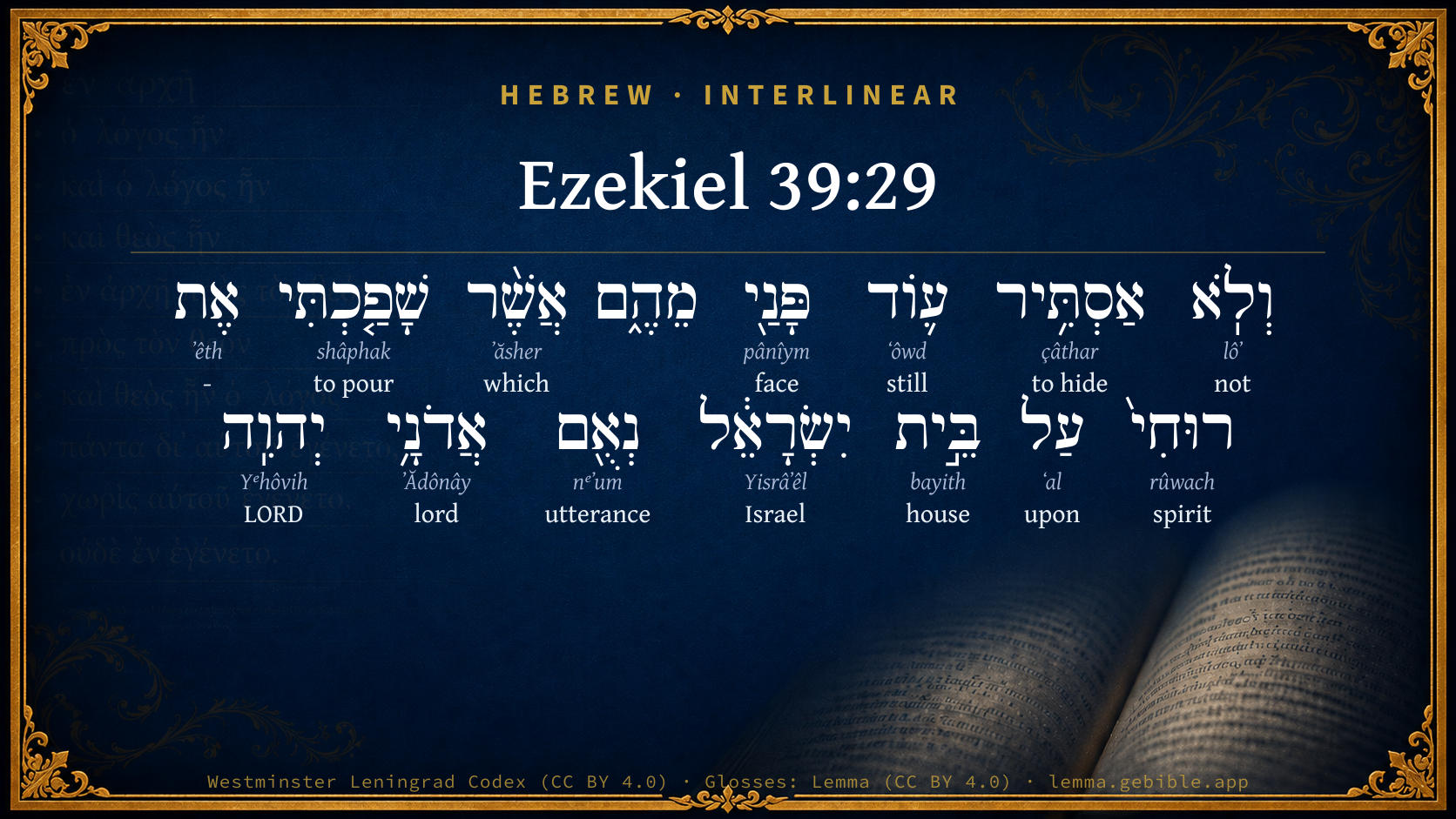
Hebrew (Westminster Leningrad Codex) Ezekiel 39:29 appears in the Hebrew Old Testament. The text above is from the Westminster Leningrad Codex. Each word links to its Strong’s number, a concise gloss, and parsing drawn from the Open Scriptures Hebrew Bible morphology. Click any word for its full Brown-Driver-Briggs (BDB) entry.
Download image
Cite this verse

Ezekiel 39:29 (World English Bible). Public Domain. Lemma interlinear Bible study tool, https://lemma.gebible.app/v/ezekiel/39/29.

Show BibTeX & RIS
BibTeX
RIS
English Translation
neither will I hide my face any more from them; for I have poured out my Spirit on the house of Israel, says the Lord Yahweh.
World English Bible · Public Domain
Download a study sheet

One document with this verse’s original text, its word-by-word gloss line, the meaning frame, cross-references with their text, attributed commentary, and full source and license credits — printable, and it pastes into notes with its structure intact.

This verse Autodidact and up

Study sheet (.html) Plain text (.txt)

A passage Seminary Student

Up to 50 verses in one chapter. A passage sheet keeps up to 6 commentary sources and 12 cross-references per verse, in the order this page ranks them, and says so on the sheet whenever that leaves anything out. Ask for a single verse and you get the Autodidact verse sheet above.

Everything on this page stays free to read, with no account — the sheet is a download of what is already on screen, not access to it.

Want to remove ads? Support Godless Engineer
Compare translations 3

The same verse in 3 English versions, stacked beneath the original-language interlinear above. Click any original word for its lexicon entry.

Each is an independent rendering of the whole verse — the interlinear is not word-aligned to these translations.

Highlighted words mark where these versions differ — a whole-verse word diff, not a word-by-word alignment.

  • World English Bible Public Domain
    neither will I hide my face any more from them; for I have poured out my Spirit on the house of Israel, says the Lord Yahweh.
  • King James Version Public Domain
    Neither will I hide my face any more from them: for I have poured out my spirit upon the house of Israel, saith the Lord GOD.
  • unfoldingWord Literal Text CC BY-SA 4.0
    I will no longer hide my face from them when I pour out my Spirit on the house of Israel—this is the Lord Yahweh’s declaration.”

unfoldingWord Literal Text — © unfoldingWord, licensed CC BY-SA 4.0. Word-aligned USFM3 via Door43 (git.door43.org/unfoldingWord/en_ult).

Versions to compare (up to 4)

3 of 4 selected

Show all 18 translations

Every available English version of this verse, each an independent rendering of the whole verse.

  • World English Bible Public Domain
    neither will I hide my face any more from them; for I have poured out my Spirit on the house of Israel, says the Lord Yahweh.
  • Berean Standard Bible Public Domain
    And I will no longer hide My face from them, for I will pour out My Spirit on the house of Israel, declares the Lord GOD.”
  • Majority Standard Bible Public Domain
    And I will no longer hide My face from them, for I will pour out My Spirit on the house of Israel, declares the Lord GOD.”
  • King James Version Public Domain
    Neither will I hide my face any more from them: for I have poured out my spirit upon the house of Israel, saith the Lord GOD.
  • American Standard Version (1901) Public Domain
    neither will I hide my face any more from them; for I have poured out my Spirit upon the house of Israel, saith the Lord Jehovah.
  • Revised Version (1885) Public Domain
    neither will I hide my face any more from them: for I have poured out my spirit upon the house of Israel, saith the Lord GOD.
  • Geneva Bible (1599) Public Domain
    Neither wil I hide my face any more from them: for I haue powred out my Spirit vpon the house of Israel, sayth the Lord God.
  • Douay-Rheims (1899) Public Domain
    And I will hide my face no more from them, for I have poured out my spirit upon all the house of Israel, saith the Lord God.
  • Young's Literal Translation Public Domain
    And I hide not any more My face from them, In that I have poured out My spirit on the house of Israel, An affirmation of the Lord Jehovah!'
  • Literal Standard Version CC BY-SA 4.0
    And I do not hide My face from them anymore, || In that I have poured out My Spirit on the house of Israel, || A declaration of Lord YHWH!”
  • Unlocked Literal Bible CC BY-SA 4.0
    I will no longer hide my face from them when I pour out my Spirit on the house of Israel—this is the Lord Yahweh's declaration.”
  • unfoldingWord Literal Text CC BY-SA 4.0
    I will no longer hide my face from them when I pour out my Spirit on the house of Israel—this is the Lord Yahweh’s declaration.”
  • Darby Bible Public Domain
    And I will not hide my face any more from them, for I shall have poured out my Spirit upon the house of Israel, saith the Lord Jehovah.
  • World Messianic Bible Public Domain
    I won’t hide my face from them any more, for I have poured out my Spirit on the house of Israel,’ says the Lord GOD.”
  • Webster's Bible Public Domain
    Neither will I hide my face any more from them: for I have poured out my spirit upon the house of Israel, saith the Lord GOD.
  • Free Bible Version CC BY-SA 4.0
    I won't give up on them anymore, for I will fill the people of Israel with my Spirit, declares the Lord God.”
  • Bible in Basic English Public Domain
    And my face will no longer be covered from them: for I have sent the out-flowing of my spirit on the children of Israel, says the Lord.
  • JPS Tanakh (1917) Public Domain
    neither will I hide My face any more from them; for I have poured out My spirit upon the house of Israel, saith the Lord GOD.'

Literal Standard Version (2020), Covenant Press — licensed CC BY-SA 4.0. Text via the HelloAO Bible API (eBible.org). Unlocked Literal Bible (unfoldingWord) — licensed CC BY-SA 4.0. Text via the HelloAO Bible API (eBible.org). unfoldingWord Literal Text — © unfoldingWord, licensed CC BY-SA 4.0. Word-aligned USFM3 via Door43 (git.door43.org/unfoldingWord/en_ult). Free Bible Version, Dr. Jonathan Gallagher — licensed CC BY-SA 4.0. Text via the HelloAO Bible API (eBible.org).

Word by word

More ways to search: Search by grammar → Find every occurrence → Compare this word →

Practice this passage: Drill this verse → Learn its vocabulary →

אַסְתִּ֥יר
çâthar
H5641
“to hide”
Verb, Hiphil, Imperfect, 1st Person, Common, Singular
Part of Speech
Verb
Stem
Hiphil
Form
Imperfect
Person
1st Person
Gender
Common
Number
Singular
Full BDB Definition

Origin: a primitive root

TWOT: 1551

to hide, conceal - (Niphal) - to hide oneself - to be hidden, be concealed - (Piel) to hide carefully - (Pual) to be hidden carefully, be concealed - (Hiphil) to conceal, hide - (Hithpael) to hide oneself carefully
  1. וְלֹֽא lôʼ H3808 “and · not” Conjunction + Particle, Negative
  2. ע֛וֹד ʻôwd H5750 “still” Adverb
  3. פָּנַ֖י pânîym H6440 “face(s) · my” Noun, Common, Both, Plural, Construct + Suffix, Personal, 1st Person, Common, Singular
  4. אֲשֶׁ֨ר ʼăsher H834 “which” Particle, Relative
  5. שָׁפַ֤כְתִּי shâphak H8210 “to pour” Verb, Qal, Perfect, 1st Person, Common, Singular
  6. אֶת ʼêth H853 “-” Particle, Direct Object
  7. רוּחִי֙ rûwach H7307 “spirit · my” Noun, Common, Both, Singular, Construct + Suffix, Personal, 1st Person, Common, Singular
  8. עַל ʻal H5921 “upon” Preposition
  9. בֵּ֣ית bayith H1004 “house of” Noun, Common, Masculine, Singular, Construct
  10. יִשְׂרָאֵ֔ל Yisrâʼêl H3478 “Israel” Noun, Proper
  11. נְאֻ֖ם nᵉʼum H5002 “utterance of” Noun, Common, Masculine, Singular, Construct
  12. אֲדֹנָ֥י ʼĂdônây H136 “Lord · my” Noun, Common, Masculine, Plural, Construct + Suffix, Personal, 1st Person, Common, Singular
  13. יְהוִֽה Yᵉhôvih H3069 “LORD” Noun, Proper

About this verse

These counts appear in no published source. They are computed here, from the morphology-tagged text and Lemma’s own curated glosses. What Lemma adds →

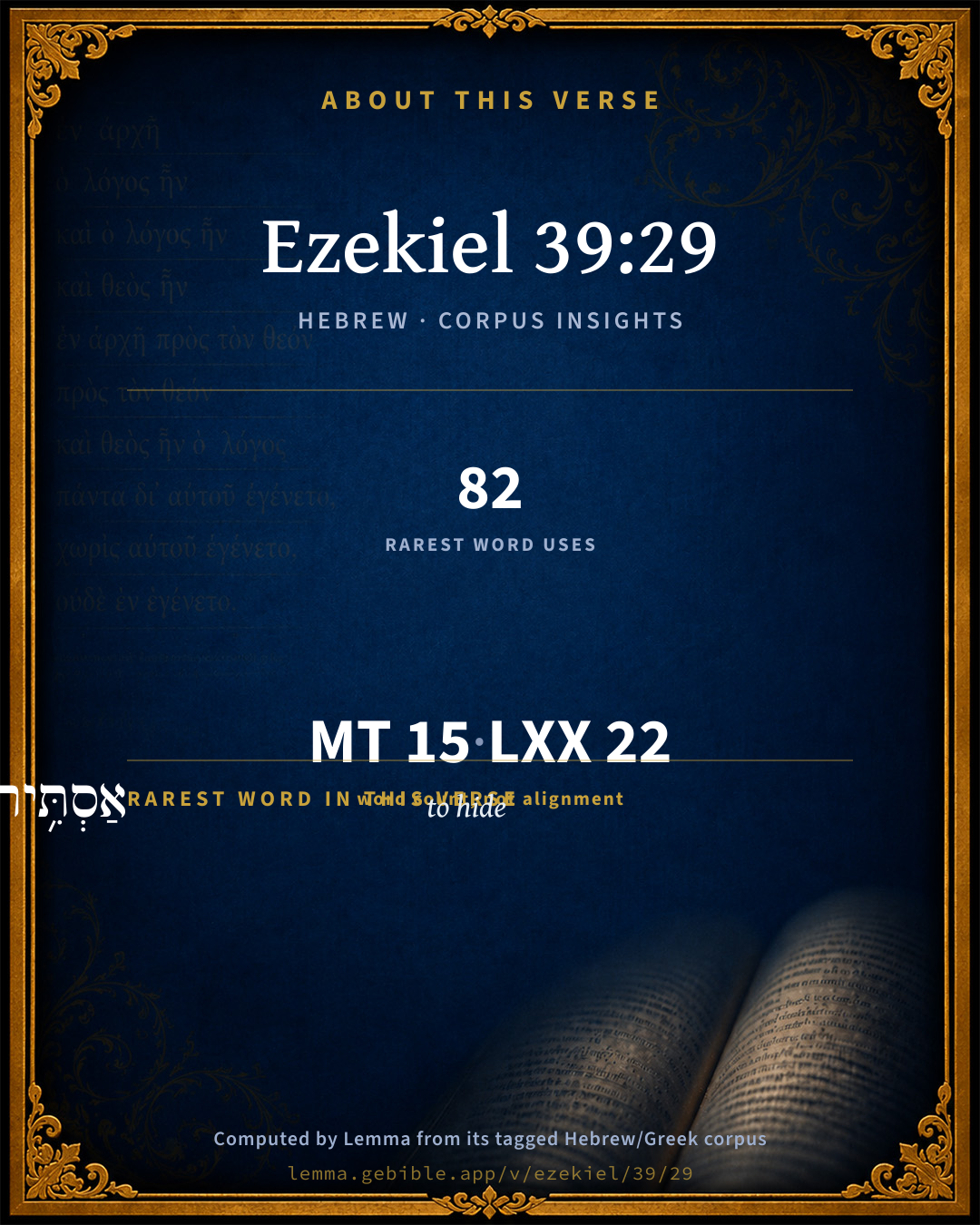
15
words
14
distinct lemmas
Prophets
section

Grammatical profile

  • 2 verbs
  • 7 nouns
  • 2 prepositions
  • 1 adverb
  • 3 particles

Verb forms

  • אַסְתִּ֥יר Hiphil · Imperfect
  • שָׁפַ֤כְתִּי Qal · Perfect

Hebrew & Septuagint length

In English translation the verse runs 26 words from the Hebrew and 27 from the Septuagint (LXX English) — closely comparable.

A rough comparison of the two English renderings, which tokenize alike — not a word-level alignment.

Word counts can differ between the Hebrew and the Greek without any difference in meaning — e.g. the Hebrew direct-object marker אֵת has no separate Greek word, and Greek often adds the article ὁ.

In the original languages it is 15 Hebrew tokens and 22 Greek tokens — but the two are counted differently (Hebrew bundles its prefixes and suffixes into one token; the Greek is in lemma form), so that isn’t a like-for-like length.

Cross-references

13

Topical passages linked to Ezekiel 39:29 in the Treasury of Scripture Knowledge — connected by theme and wording, ordered by reader-vote popularity; previews shown in the World English Bible.

  • Joel 2:28 "It will happen afterward, that I will pour out my Spirit on all flesh; And your sons and your daughters will prophesy. Your old men will dream dreams. Your young men will see visions.
  • 1 John 3:24 He who keeps his commandments remains in him, and he in him. By this we know that he remains in us, by the Spirit which he gave us.
  • Isaiah 32:15 until the Spirit be poured on us from on high, and the wilderness become a fruitful field, and the fruitful field be esteemed as a forest.
  • Ezekiel 36:25–27 I will sprinkle clean water on you, and you shall be clean: from all your filthiness, and from all your idols, will I cleanse you.
  • Zechariah 12:10 I will pour on the house of David, and on the inhabitants of Jerusalem, the spirit of grace and of supplication; and they will look to me whom they have pierced; and they shall mourn for him, as one mourns for his only son, and will grieve bitterly for him, as one grieves for his firstborn.
  • Isaiah 45:17 [But] Israel shall be saved by Yahweh with an everlasting salvation: you shall not be disappointed nor confounded world without end.
  • Isaiah 44:3–5 For I will pour water on him who is thirsty, and streams on the dry ground; I will pour my Spirit on your seed, and my blessing on your offspring:
  • Ezekiel 39:23–25 The nations shall know that the house of Israel went into captivity for their iniquity; because they trespassed against me, and I hid my face from them: so I gave them into the hand of their adversaries, and they fell all of them by the sword.
  • Acts 2:17–18 'It will be in the last days, says God, That I will pour out my Spirit on all flesh. Your sons and your daughters will prophesy. Your young men will see visions. Your old men will dream dreams.
  • Acts 2:33 Being therefore exalted by the right hand of God, and having received from the Father the promise of the Holy Spirit, he has poured out this, which you now see and hear.
  • Isaiah 54:8–10 In overflowing wrath I hid my face from you for a moment; but with everlasting loving kindness will I have mercy on you, says Yahweh your Redeemer.
  • Isaiah 59:20–21 A Redeemer will come to Zion, and to those who turn from disobedience in Jacob, says Yahweh.
  • Ezekiel 37:26–27 Moreover I will make a covenant of peace with them; it shall be an everlasting covenant with them; and I will place them, and multiply them, and will set my sanctuary in the midst of them forevermore.

Cross-references courtesy of OpenBible.info (CC BY 4.0).

Hebrew and Greek witnesses Masoretic Hebrew ↔ Greek Septuagint

The same verse in the two great witnesses to the Old Testament, shown verse-for-verse.

These are two independent witnesses, not word-aligned to each other, and the Septuagint is shown in lemma (dictionary) form.

Hebrew Ezekiel 39:29 Masoretic · Westminster Leningrad Codex

וְלֹֽא אַסְתִּ֥יר ע֛וֹד פָּנַ֖י מֵהֶ֑ם אֲשֶׁ֨ר שָׁפַ֤כְתִּי אֶת רוּחִי֙ עַל בֵּ֣ית יִשְׂרָאֵ֔ל נְאֻ֖ם אֲדֹנָ֥י יְהוִֽה

neither will I hide my face any more from them; for I have poured out my Spirit on the house of Israel, says the Lord Yahweh.

World English Bible · Public Domain

Greek LXX Ezekiel 39:29 Septuagint · lemma form

καί οὐ ἀποστρέφω οὐκέτι ὁ πρόσωπον ἐγώ ἀπό αὐτός ἀντί ὅς ἐκχέω ὁ θυμός ἐγώ ἐπί ὁ οἶκος ἰσραήλ λέγω κύριος κύριος

And I will no more turn away my face from them, because I have poured out my wrath upon the house of Israel, says the Lord God.

LXX2012 (modern English Septuagint) · Public Domain

Hebrew: Westminster Leningrad Codex (CC BY 4.0). Greek: Septuagint (public domain); English from LXX2012 (modern English Septuagint) (Public Domain). How the Septuagint differs from the Hebrew →

Targum (Aramaic paraphrase)

1

The Targum is the ancient Jewish Aramaic paraphrase of the Hebrew Scriptures — an interpretive translation, not the Hebrew text itself. Onkelos (literal) and Pseudo-Jonathan (expansive) render the Torah, and Jonathan the Prophets. Coverage is partial: where no permissively-licensed English translation exists for a verse, only the Aramaic is shown. This is verse-level text, not a word-by-word alignment to the Hebrew.

  1. Targum Jonathan Prophets (Joshua–Malachi)
    וְלָא אֲסַלֵק עוֹד שְׁכִנְתִּי מִנְהוֹן דִשְׁפִיכֵית יַת רוּחַ קוּדְשִׁי עַל בֵּית יִשְׂרָאֵל אֲמַר יְיָ אֱלֹהִים:

    (no public-domain English translation for this verse)

    Targum Jonathan — Aramaic: “Mikraot Gedolot” (public domain). English: “Sefaria Community Translation” (CC0 1.0 (public-domain dedication)); “London "Chaldee Paraphrase," 1871” (public domain). Text via Sefaria.

Commentary

Notes on Ezekiel 39:29 from classic Christian and Jewish commentators (each source and its license shown beneath its notes). The classic Christian expositions comment on the surrounding passage and are grouped to its opening verse, so a note may address several verses; the Jewish commentaries on the Tanakh (Rashi and others) are per-verse, so they appear only where the commentator wrote on this verse.

Lemma curates 59 commentaries, every one of them public domain or Creative Commons licensed, each selected and text-cleaned for this edition rather than reprinted as found. About our sources →

Trapp's Complete Commentary

John Trapp

Eze 39:29 Neither will I hide my face any more from them: for I have poured out my spirit upon the house of Israel, saith the Lord GOD.

Ver. 29. Neither Will I hide my face any more from them.] They shall have beatiful vision and fruition for ever. See on Eze 39:25.

For I have poured out my spirit.] Have already, and will do yet more liberally in the days of the gospel. {Act 2:2-7 Joh 7:38}

John Trapp, A Commentary or Exposition upon All the Books of the Old and New Testament (1647–1656) — public domain. Text from a community e-Sword module.

Joseph Benson's Commentary

Eze 39:29. Neither will I hide my face any more from them — I will never again withdraw my favour or protection from them, or turn from them in displeasure. For I have poured out — In abundant mercy; my Spirit upon the house of Israel — Which, as a Spirit of truth, shall enlighten their minds, and make them wise unto salvation; as a Spirit of grace, shall regenerate and create them anew; as a Spirit of power, shall strengthen them for every duty, and enable them to withstand and conquer every temptation; as a Spirit of holiness, shall cleanse them from sin, sanctify their souls, and stamp them with mine image; and, as a Spirit of adoption and consolation, shall inspire them with confidence and hope, and render every branch of obedience, and every exercise of piety and virtue, sweet and delightful to them. It appears by this promise, that there will be a new and plentiful effusion of God’s Spirit on the Jews and Israelites in the latter days, in order to their conversion, their establishment in grace, and their restoration to their own land: see Isa 59:20-21, a passage applied by St. Paul to this very purpose, Rom 11:26-27. Compare likewise Zec 12:10, and Eze 11:19; Eze 36:27, of this prophecy.

Joseph Benson's Commentary on the Old and New Testaments (1811–1818) — public domain. Text from a community e-Sword module.

Jamieson, Fausset & Brown

Robert Jamieson, A. R. Fausset & David Brown

poured out my Spirit upon . . . Israel--the sure forerunner of their conversion (Joe 2:28; Zac 12:10). The pouring out of His Spirit is a pledge that He will hide His face no more (Co2 1:22; Eph 1:14; Phi 1:6).

The arrangements as to the land and the temple are, in many particulars, different from those subsisting before the captivity. There are things in it so improbable physically as to preclude a purely literal interpretation. The general truth seems to hold good that, as Israel served the nations for his rejection of Messiah, so shall they serve him in the person of Messiah, when he shall acknowledge Messiah (Isa 60:12; Zac 14:17-19; compare Psa 72:11). The ideal temple exhibits, under Old Testament forms (used as being those then familiar to the men whom Ezekiel, a priest himself, and one who delighted in sacrificial images, addresses), not the precise literal outline, but the essential character of the worship of Messiah as it shall be when He shall exercise sway in Jerusalem among His own people, the Jews, and thence to the ends of the earth. The very fact that the whole is a vision (Eze 40:2), not an oral face-to-face communication such as that granted to Moses (Num 12:6-8), implies that the directions are not to be understood so precisely literally as those given to the Jewish lawgiver. The description involves things which, taken literally, almost involve natural impossibilities. The square of the temple, in Eze 42:20, is six times as large as the circuit of the wall enclosing the old temple, and larger than all the earthly Jerusalem. Ezekiel gives three and a half miles and one hundred forty yards to his temple square. The boundaries of the ancient city were about two and a half miles. Again, the city in Ezekiel has an area between three or four thousand square miles, including the holy ground set apart for the prince, priests, and Levites. This is nearly as large as the whole of Judea west of the Jordan. As Zion lay in the center of the ideal city, the one-half of the sacred portion extended to nearly thirty miles south of Jerusalem, that is, covered nearly the whole southern territory, which reached only to the Dead Sea (Eze 47:19), and yet five tribes were to have their inheritance on that side of Jerusalem, beyond the sacred portion (Eze 48:23-28). Where was land to be found for them there? A breadth of but four or five miles apiece would be left. As the boundaries of the land are given the same as under Moses, these incongruities cannot be explained away by supposing physical changes about to be effected in the land such as will meet the difficulties of the purely literal interpretation. The distribution of the land is in equal portions among the twelve tribes, without respect to their relative numbers, and the parallel sections running from east to west. There is a difficulty also in the supposed separate existence of the twelve tribes, such separate tribeships no longer existing, and it being hard to imagine how they could be restored as distinct tribes, mingled as they now are. So the stream that issued from the east threshold of the temple and flowed into the Dead Sea, in the rapidity of its increase and the quality of its waters, is unlike anything ever known in Judea or elsewhere in the world. Lastly, the catholicity of the Christian dispensation, and the spirituality of its worship, seem incompatible with a return to the local narrowness and "beggarly elements" of the Jewish ritual and carnal ordinances, disannulled "because of the unprofitableness thereof" [FAIRBAIRN], (Gal 4:3, Gal 4:9; Gal 5:1; Heb 9:10; Heb 10:18). "A temple with sacrifices now would be a denial of the all-sufficiency of the sacrifice of Christ. He who sacrificed before confessed the Messiah. He who should sacrifice now would solemnly deny Him" [DOUGLAS]. These difficulties, however, may be all seeming, not real. Faith accepts God's Word as it is, waits for the event, sure that it will clear up all such difficulties. Perhaps, as some think, the beau ideal of a sacred commonwealth is given according to the then existing pattern of temple services, which would be the imagery most familiar to the prophet and his hearers at the time. The minute particularizing of details is in accordance with Ezekiel's style, even in describing purely ideal scenes. The old temple embodied in visible forms and rites spiritual truths affecting the people even when absent from it. So this ideal temple is made in the absence of the outward temple to serve by description the same purpose of symbolical instruction as the old literal temple did by forms and acts. As in the beginning God promised to be a "sanctuary" (Eze 11:16) to the captives at the Chebar, so now at the close is promised a complete restoration and realization of the theocratic worship and polity under Messiah in its noblest ideal (compare Jer 31:38-40). In Rev 21:22 "no temple" is seen, as in the perfection of the new dispensation the accidents of place and form are no longer needed to realize to Christians what Ezekiel imparts to Jewish minds by the imagery familiar to them. In Ezekiel's temple holiness stretches over the entire temple, so that in this there is no longer a distinction between the different parts, as in the old temple: parts left undeterminate in the latter obtain now a divine sanction, so that all arbitrariness is excluded. So that it is be a perfect manifestation of the love of God to His covenant-people (Eze. 40:1-43:12); and from it, as from a new center of religious life, there gushes forth the fulness of blessings to them, and so to all people (Eze. 47:1-23) [FAIRBAIRN and HAVERNICK]. The temple built at the return from Babylon can only very partially have realized the model here given. The law is seemingly opposed to the gospel (Mat 5:21-22, Mat 5:27-28, Mat 5:33-34). It is not really so (compare Mat 5:17-18; Rom 3:31; Gal 3:21-22). It is true Christ's sacrifice superseded the law sacrifices (Heb 10:12-18). Israel's province may hereafter be to show the essential identity, even in the minute details of the temple sacrifices, between the law and gospel (Rom 10:8). The ideal of the theocratic temple will then first be realized.

Next: Ezekiel Chapter 40

Jamieson, Fausset & Brown — Commentary Critical and Explanatory on the Whole Bible (1871) — public domain (CC PDM 1.0). Text via the HelloAO Bible API.

Adam Clarke's Commentary

Verse 29. For I have poured out my Spirit] That is, I will pour out my Spirit; see the notes on Eze 36:25-29, where this subject is largely considered. This Spirit is to enlighten, quicken, purify, and cleanse their hearts; so that, being completely changed, they shall become God's people, and be a praise in the earth. Now, they are a proverb of reproach; then, they shall be eminently distinguished.

A NEW PLAN OF THE TEMPLE AT JERUSALEM

For an explanation of this plan, and of the accompanying

map of the division of the Land of Canaan,

see at the end of "Eze 48:35".

[Drawing of the Plan of the Temple]

[Drawing of Divison of the Land of Canaan]

Adam Clarke's Commentary on the Bible (1810–1826) — public domain. Text from a community e-Sword/MySword module.

Ellicott's Commentary for English Readers

(29) I have poured out.—Comp. Joe_2:28-29; Act_2:17. See Excursus G at the end of this book.

A Bible Commentary for English Readers, edited by Charles John Ellicott (1878–1897) — public domain. Text from a community e-Sword module.

The Cambridge Bible for Schools and Colleges

gen. ed. J. J. S. Perowne

29. poured out my spirit] This states in brief all the regenerating influences more fully dwelt upon in Eze_36:25-31. Cf. Joe_2:28; Zec_12:10. On first clause, Isa_54:8-10; Jer_31:3 seq.

The Cambridge Bible for Schools and Colleges (gen. ed. J. J. S. Perowne; Cambridge University Press, 1878–1918) — public domain. Text from a community e-Sword module.

John Gill's Exposition

Neither will I hide my face any more from them,.... The Jews, upon their future conversion, will always have the worship of God among them, and his presence with them; he will always take notice of them; they will ever be under his protection and care; he will never remove his Shechinah from them any more, as the Targum: a further proof that this refers to future times; for, after their return from Babylon, God did hide his face, and remove his presence from them, and left them to ruin and destruction by the Romans:

for I have poured out my Spirit upon the house of Israel, saith the Lord God; this refers not to the effusion of the Spirit on the day of Pentecost, but to one that is yet to come, when the Jews will be converted in the latter day; after which God will no more depart from them, nor shall they depart from him; see Zac 12:10.

Next: Ezekiel Chapter 40

John Gill's Exposition of the Whole Bible (1746–1763) — public domain (CC PDM 1.0). Text via the HelloAO Bible API.

Matthew Poole's English Annotations

Neither will I hide my face: see Eze 39:23. I will not turn from them in displeasure.

From them; from the whole house of Israel. This is no assurance to any pretender of great interest in God, who yet lives in sin.

Poured out, in abundant measures of wisdom and holiness, my Spirit; which is a Spirit of sanctification to make them holy, and a Spirit of strength to confirm them in holiness, and of adoption to sweeten obedience to them; they shall not, they will not depart from me, according to the promises, Eze 11:19,20; 36:25-27; 37:23-28; Jer 31:31, &c.; Jer 32:37-40. It was sin that caused God to hide his face, and now grace shall be given to keep them out of sin, and to engage them to constant obedience, that God may rejoice over them to do them good in this their latter end.

Matthew Poole's English Annotations on the Holy Bible (1683–1685) — public domain. Text from a community e-Sword/MySword module.

The Pulpit Commentary

I have poured out my Spirit upon the house of Israel. Already Jehovah had promised to put his Spirit in his people; (Eze_36:27 Eze_37:14) now the fact that he has implemented that promise by a copious effusion of the same he cites as a proof that Israel shall no more forfeit his favor because no more shall she forsake his ways (comp. Isa_59:21) The same promise had been previously given by Joel, (Joe_2:28) and was afterwards renewed by Zechariah. (Zec_12:10) The citation of Joel"s words by Peter on the Day of Pentecost (Act_2:17) shows that he regarded the remarkable effusion of the Holy Ghost on that memorable occasion as a fulfillment of the premise here recorded by Ezekiel. Yet the promise was not then exhausted. Rather it has often since been implemented, and will doubtless receive its consummation in the New Jerusalem. "No historical Church, Jewish or Gentile," writes Plumptre, "has ever yet realized the picture here sketched by Ezekiel. We ask, as before Will it ever be realized on earth? or must we look for it only in the heavenly city whose Builder and Maker is God?

NOTE. In addition to what has been stated at the beginning of this prophecy (Eze_38:1) with reference to the general significance of this invasion by and overthrow of Cog, that it points to some tremendous conflict in the latter days between the powers of the world and the Church of Christ, a few words may be offered in support of the preposition that nevertheless there is no reason to expect that this conflict will take the form of an actual invasion of the land of Israel or of a real fire-and-sword battle with the Church, or that Gog will step upon the field as a veritable flesh-and-blood personality, and his armies find a grave in the manner sketched by the prophet. That the whole delineation is symbolic, and embodies spiritual truths under material emblems, will hardly be doubted by one who impartially weighs the following considerations, which have been admirably brought together by Fairbairn.

1. The designation given to the great assailant of the latter times Gog, which discovers itself to be an ideal name, if by nothing else by the manner in which it has been formed.

2. The composition of his army, which is drawn from the four quarters of the globe, in fact, from the extremities of the earth, and consists of peoples not only remote from one another, but "the most unlike naturally to act in concert for any particular purpose.

3. The object of his attack the land of Israel, a territory so small that it is inconceivable a host so great should have been required to capture it, and so poor that had the invaders got all it contained it "could not have served to maintain them for a single day.

4. The fruits of Israel"s victory firewood for seven years out of the enemies" weapons, and seven months of labor in burying their corpses. "It would be but a very moderate allowance, on the literal supposition, to say that a million of men would thus be engaged, and that on an average each would consign two corpses to the tomb in one day; which for the hundred and eighty working days of the seven months would make an aggregate of three hundred and sixty millions of corpses! Then the putrefaction, the pestilential vapors arising from such masses of slain victims, before they were all buried. Who could live at such a time?

5. The impossibility of harmonizing prophecy on the hypothesis that Ezekiel"s picture must receive a literal interpretation, since Isaiah (34.), Joel (3:12, 14), and Zechariah (14), who all appear to depict the same conflict as Ezekiel portrays, each pitches its scene in a different locality.

6. The gross carnality of the whole picture on the assumption that it must be literally interpreted, which is wholly inconsistent with that spirituality one associates with the Messianic times. "Persons," writes Fairbairn, "who in the face of all these considerations can still cling to the literal view of this prophecy, must be left to themselves; they are incapable of being convinced in the way of argument.

The restored vision of God.

This is a great; we may say the supreme and final, result of the restoration of Israel. While the people are eagerly craving a return to their farms and villages, with temporal prosperity, the prophet teaches them that, though these advantages are to be received in the good time coming, a better blessing wilt be the restored vision of God enjoyed by means of the pouring out of his Spirit upon the house of Israel. This is the best, the highest, the most spiritual, result of Christ"s redemption of the world.

I THE BEATIFIC VISION OF GOD. God will no more hide his face.

1. The restoration of God"s favor. The averted countenance signifies disapproval. God hides his countenance when he refuses to hold communion with those of his creatures with whom he is angry. Therefore we are here reminded that sin leads to an action on God"s part to his veiling his bright countenance. There m then a need, not only for man to be reconciled to God, but for God to change his grieved and wrathful attitude towards man. This is an essential element in the atonement, which is suggested by the word "propitiation". (Rom_3:25; 1Jn_2:2) When God ceases to hide his countenance he looks favorably on his people.

2. The enjoyment of Gods presence. The favor of a king secures many privileges, and the favor of God the best privileges; but no gift of God can equal in value the enjoyment of his own presence To behold his countenance is to have the greatest of blessings.

(1) God is our Father; to see him is to be at home.

(2) He is the center of all light and truth; the vision of God is the highest knowledge.

(3) He is supreme brightness and beauty; to behold God is to gaze on the "beatific vision." Heaven consists in the undimmed vision of God.

3. An eternal blessedness. God will not hide his face any more. The hiding was an abnormal thing. The words before us suggest the idea that it is natural for God to reveal himself, and that the hiding was something temporally superinduced by man"s sin. Not to know God is a monstrously defective experience. When the black cloud has been dispelled the sun will shine out in unwaning splendor. There is no fading of the glory of heaven. The blessedness of God"s restored people is eternal.

II THE INSPIRATION THAT RESTORES THE VISION OF GOD. This vision has been lost, and God now promises a restoration of it, indicating the means by which the happy result will be brought to pass. It is because God has poured out his Spirit upon the house of Israel. Revelation is a result of inspiration. This is the process in prophecy. God reveals his will through prophets, i.e. by means of inspired men. Here we see that the spiritual revelation of the saint, who may learn no new truth, but who is brought into the enjoyment of the favor of God and into communion with him, is also a result of inspiration.

1. Christ"s redemption leads to a bestowal of the Spirit of God. John the Baptist promised that he who came after him would baptize with the Holy. (Mat_3:11) Christ promised the Spirit as "the Comforter". (Joh_14:16, Joh_14:17) Pentecost followed the crucifixion and resurrection of Christ. Christ has ascended up on high to give gifts unto men; and the best of his gifts, the gift that includes all others, is that of the Holy Spirit.

2. The bestowal of the Spirit of God unveils the countenance of God.

(1) It purges men"s hearts of the thick film of doubt and earthly-mindedness that hides the vision of God.

(2) It puts men into right relations with God, so that he can manifest his grace to them.

(3) It directly opens the eyes of the soul to see the truth of God.

(4) It is itself a communing Spirit communicating God to us.

The Pulpit Commentary (1880–1919), ed. H.D.M. Spence-Jones & Joseph S. Exell — public domain. Text from a community e-Sword module.

Lesson kit

Teaching starters — assembled from the data on this page, not authored interpretation. Every prompt links to the verse data it draws on. Edit before teaching.

Ezekiel, in the Prophets, opens this verse with 15 words (14 distinct Hebrew lemmas). Its most distinctive word is çâthar (“to hide”). A historical commentator’s framing appears above. Read the whole chapter for the surrounding context.

Discussion questions

  1. The word çâthar carries the sense “to hide.” How does it shape the verse?
  2. Joel 2:28 shares this passage’s theme. How do the two illuminate each other?
  3. These translations render this verse differently. What is at stake in choosing one wording over another?
  4. The verb «אַסְתִּ֥יר» is Hiphil Imperfect. How does its form color the action?
  5. Reading how Trapp's Complete Commentary and Joseph Benson's Commentary read this verse, where do the two commentators agree and where do they part?

Things to notice

Reading settings

Reading text

Shown beneath each verse's original-language words.

Old Testament
Old Testament edition

Read the OT as the Masoretic Hebrew (MT) or the Greek Septuagint (LXX).

English shown for the Greek Septuagint (in the Hebrew ↔ Greek comparison).

Comparing translations? Open the Compare panel on any verse page to stack up to four side by side.