
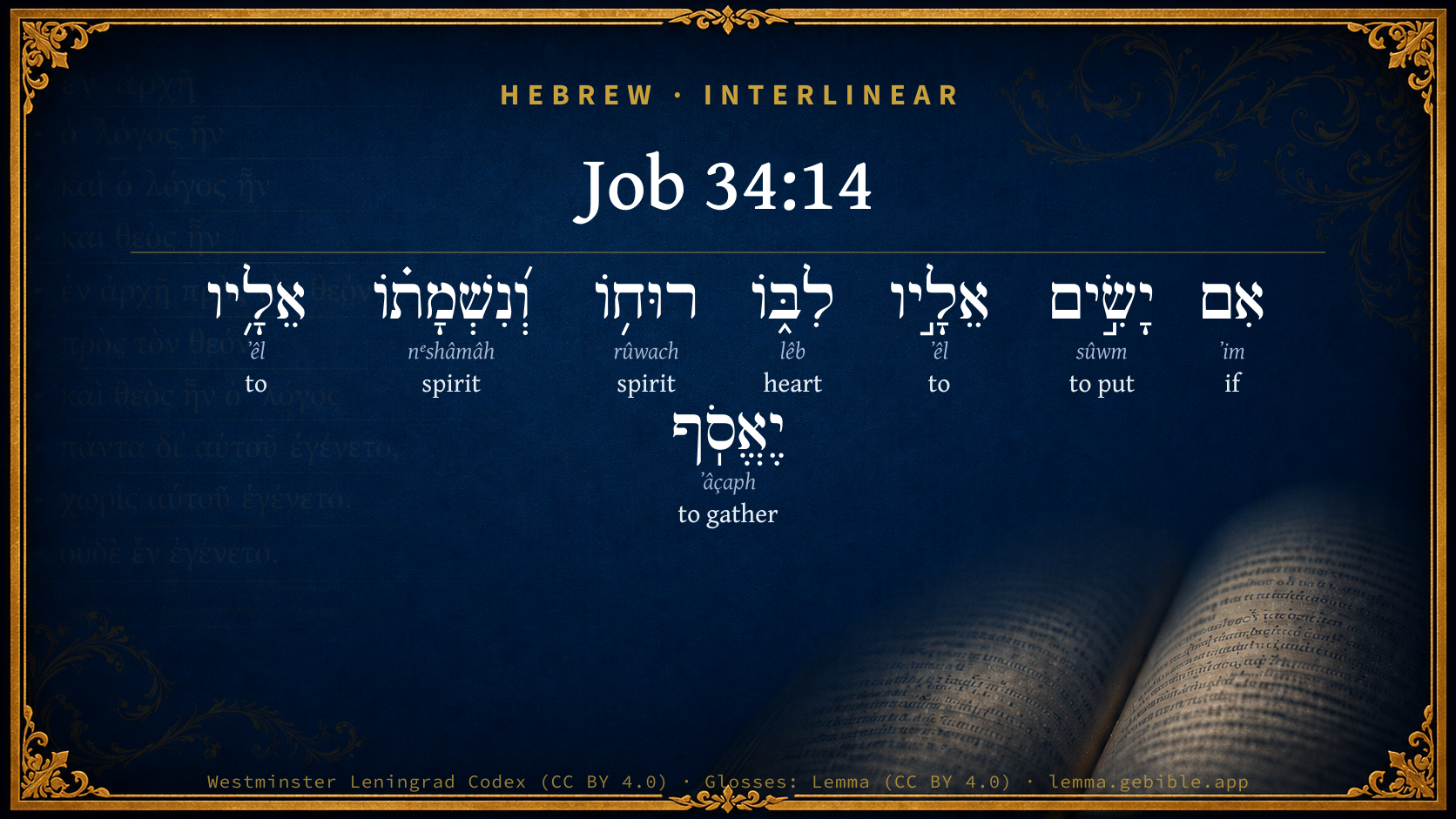
Job 34:14

Hebrew (Westminster Leningrad Codex) Job 34:14 appears in the Hebrew Old Testament. The text above is from the Westminster Leningrad Codex. Each word links to its Strong’s number, a concise gloss, and parsing drawn from the Open Scriptures Hebrew Bible morphology. Click any word for its full Brown-Driver-Briggs (BDB) entry.
Download image
Cite this verse

Job 34:14 (World English Bible). Public Domain. Lemma interlinear Bible study tool, https://lemma.gebible.app/v/job/34/14.

Show BibTeX & RIS
BibTeX
RIS
English Translation
If he set his heart on himself, If he gathered to himself his spirit and his breath;
World English Bible · Public Domain
Download a study sheet

One document with this verse’s original text, its word-by-word gloss line, the meaning frame, cross-references with their text, attributed commentary, and full source and license credits — printable, and it pastes into notes with its structure intact.

This verse Autodidact and up

Study sheet (.html) Plain text (.txt)

A passage Seminary Student

Up to 50 verses in one chapter. A passage sheet keeps up to 6 commentary sources and 12 cross-references per verse, in the order this page ranks them, and says so on the sheet whenever that leaves anything out. Ask for a single verse and you get the Autodidact verse sheet above.

Everything on this page stays free to read, with no account — the sheet is a download of what is already on screen, not access to it.

Want to remove ads? Support Godless Engineer
Compare translations 3

The same verse in 3 English versions, stacked beneath the original-language interlinear above. Click any original word for its lexicon entry.

Each is an independent rendering of the whole verse — the interlinear is not word-aligned to these translations.

Highlighted words mark where these versions differ — a whole-verse word diff, not a word-by-word alignment.

  • World English Bible Public Domain
    If he set his heart on himself, If he gathered to himself his spirit and his breath;
  • King James Version Public Domain
    If he set his heart upon man, if he gather unto himself his spirit and his breath;
  • unfoldingWord Literal Text CC BY-SA 4.0
    If he set his heart upon himself, he gathered his Spirit and his breath to himself,

unfoldingWord Literal Text — © unfoldingWord, licensed CC BY-SA 4.0. Word-aligned USFM3 via Door43 (git.door43.org/unfoldingWord/en_ult).

Versions to compare (up to 4)

3 of 4 selected

Show all 18 translations

Every available English version of this verse, each an independent rendering of the whole verse.

  • World English Bible Public Domain
    If he set his heart on himself, If he gathered to himself his spirit and his breath;
  • Berean Standard Bible Public Domain
    If He were to set His heart to it and withdraw His Spirit and breath,
  • Majority Standard Bible Public Domain
    If He were to set His heart to it and withdraw His Spirit and breath,
  • King James Version Public Domain
    If he set his heart upon man, if he gather unto himself his spirit and his breath;
  • American Standard Version (1901) Public Domain
    If he set his heart upon himself, `If' he gather unto himself his spirit and his breath;
  • Revised Version (1885) Public Domain
    If he set his heart upon man, if he gather unto himself his spirit and his breath;
  • Geneva Bible (1599) Public Domain
    If he set his heart vpon man, and gather vnto him selfe his spirit and his breath,
  • Douay-Rheims (1899) Public Domain
    If he turn his heart to him, he shall draw his spirit and breath unto himself.
  • Young's Literal Translation Public Domain
    If He doth set on him His heart, His spirit and his breath unto Him He gathereth.
  • Literal Standard Version CC BY-SA 4.0
    If He sets His heart on him, || [If] He gathers His Spirit and His breath to Himself,
  • Unlocked Literal Bible CC BY-SA 4.0
    If he ever set his intentions only on himself, and if he ever gathered back to himself his spirit and his breath,
  • unfoldingWord Literal Text CC BY-SA 4.0
    If he set his heart upon himself, he gathered his Spirit and his breath to himself,
  • Darby Bible Public Domain
    If he only thought of himself, [and] gathered unto him his spirit and his breath,
  • World Messianic Bible Public Domain
    If he set his heart on himself, if he gathered to himself his spirit and his breath,
  • Webster's Bible Public Domain
    If he should set his heart upon man, if he should gather to himself his spirit and his breath;
  • Free Bible Version CC BY-SA 4.0
    If he were to withdraw his spirit, if he were to take back his breath,
  • Bible in Basic English Public Domain
    If he made his spirit come back to him, taking his breath into himself again,
  • JPS Tanakh (1917) Public Domain
    If He set His heart upon man, if He gather unto Himself his spirit and his breath;

Literal Standard Version (2020), Covenant Press — licensed CC BY-SA 4.0. Text via the HelloAO Bible API (eBible.org). Unlocked Literal Bible (unfoldingWord) — licensed CC BY-SA 4.0. Text via the HelloAO Bible API (eBible.org). unfoldingWord Literal Text — © unfoldingWord, licensed CC BY-SA 4.0. Word-aligned USFM3 via Door43 (git.door43.org/unfoldingWord/en_ult). Free Bible Version, Dr. Jonathan Gallagher — licensed CC BY-SA 4.0. Text via the HelloAO Bible API (eBible.org).

Word by word

More ways to search: Search by grammar → Find every occurrence → Compare this word →

Practice this passage: Drill this verse → Learn its vocabulary →

וְ֝נִשְׁמָת֗וֹ
nᵉshâmâh
H5397
“and · spirit · his”
Conjunction + Noun, Common, Feminine, Singular, Construct + Suffix, Personal, 3rd Person, Masculine, Singular
Part of Speech
Conjunction + Noun
Type
Common
Gender
Feminine
Number
Singular
State
Construct
Full BDB Definition

Origin: from H5395

TWOT: 1433a

breath, spirit - breath (of God) - breath (of man) - every breathing thing - spirit (of man)
  1. אִם ʼim H518 “if” Conjunction
  2. יָשִׂ֣ים sûwm H7760 “to put” Verb, Qal, Imperfect, 3rd Person, Masculine, Singular
  3. אֵלָ֣יו ʼêl H413 “to · him” Preposition + Suffix, Personal, 3rd Person, Masculine, Singular
  4. לִבּ֑וֹ lêb H3820 “heart · his” Noun, Common, Masculine, Singular, Construct + Suffix, Personal, 3rd Person, Masculine, Singular
  5. רוּח֥וֹ rûwach H7307 “spirit · his” Noun, Common, Both, Singular, Construct + Suffix, Personal, 3rd Person, Masculine, Singular
  6. אֵלָ֥יו ʼêl H413 “to · him” Preposition + Suffix, Personal, 3rd Person, Masculine, Singular
  7. יֶאֱסֹֽף ʼâçaph H622 “to gather” Verb, Qal, Imperfect, 3rd Person, Masculine, Singular

About this verse

These counts appear in no published source. They are computed here, from the morphology-tagged text and Lemma’s own curated glosses. What Lemma adds →

8
words
7
distinct lemmas
Wisdom
section

Notable vocabulary

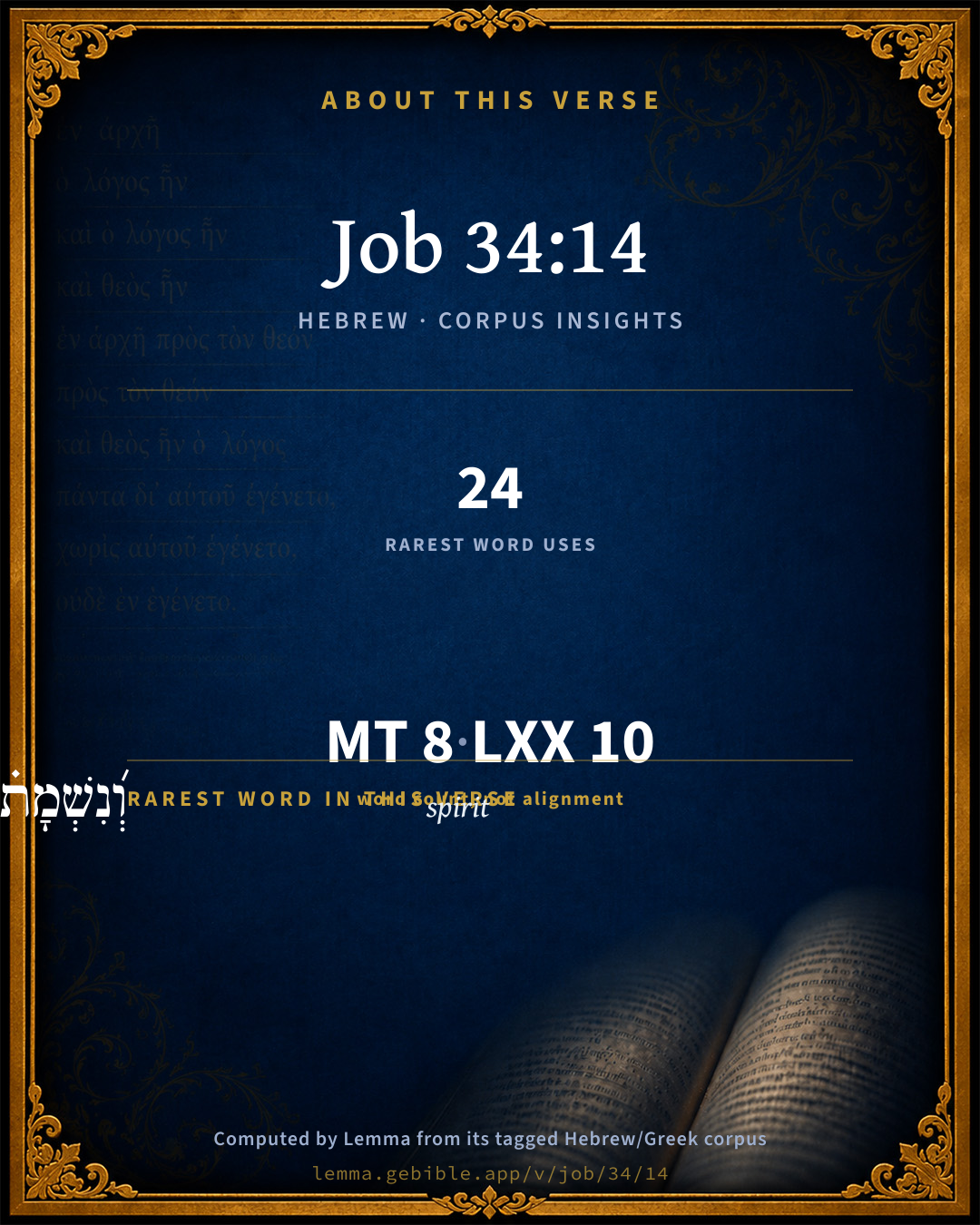
The rarest word here is וְ֝נִשְׁמָת֗וֹ spirit H5397 — appearing just 24 times in the whole Hebrew Bible.

Shared distinctive vocabulary

וְ֝נִשְׁמָת֗וֹ spirit H5397 occurs in 24 verses of the Hebrew Bible. Also found in:

Grammatical profile

  • 2 verbs
  • 3 nouns
  • 2 prepositions
  • 1 conjunction

Verb forms

  • יָשִׂ֣ים Qal · Imperfect
  • יֶאֱסֹֽף Qal · Imperfect

Repetition

A word recurs within this verse — often emphatic in Hebrew:

  • אֵלָ֣יו to H413 ×2

Hebrew & Septuagint length

In English translation the verse runs 17 words from the Hebrew and 11 from the Septuagint (LXX English) — the Septuagint runs noticeably shorter here. See the side-by-side →

A rough comparison of the two English renderings, which tokenize alike — not a word-level alignment.

Word counts can differ between the Hebrew and the Greek without any difference in meaning — e.g. the Hebrew direct-object marker אֵת has no separate Greek word, and Greek often adds the article ὁ.

In the original languages it is 8 Hebrew tokens and 10 Greek tokens — but the two are counted differently (Hebrew bundles its prefixes and suffixes into one token; the Greek is in lemma form), so that isn’t a like-for-like length.

Cross-references

4

Topical passages linked to Job 34:14 in the Treasury of Scripture Knowledge — connected by theme and wording, ordered by reader-vote popularity; previews shown in the World English Bible.

  • Psalms 104:29 You hide your face: they are troubled; You take away their breath: they die, and return to the dust.
  • Job 7:17 What is man, that you should magnify him, That you should set your mind on him,
  • Job 9:4 God who is wise in heart, and mighty in strength: Who has hardened himself against him, and prospered?
  • Isaiah 24:22 They shall be gathered together, as prisoners are gathered in the pit, and shall be shut up in the prison; and after many days shall they be visited.

Cross-references courtesy of OpenBible.info (CC BY 4.0).

Hebrew and Greek witnesses Masoretic Hebrew ↔ Greek Septuagint

The same verse in the two great witnesses to the Old Testament, shown verse-for-verse.

Here the Septuagint runs noticeably shorter than the Hebrew — LXX2012 (modern English Septuagint) 11 words vs World English Bible 17. A rough length comparison of the two English translations, not a word-level alignment — read both below.

These are two independent witnesses, not word-aligned to each other, and the Septuagint is shown in lemma (dictionary) form.

Hebrew Job 34:14 Masoretic · Westminster Leningrad Codex

אִם יָשִׂ֣ים אֵלָ֣יו לִבּ֑וֹ רוּח֥וֹ וְ֝נִשְׁמָת֗וֹ אֵלָ֥יו יֶאֱסֹֽף

If he set his heart on himself, If he gathered to himself his spirit and his breath;

World English Bible · Public Domain

Greek LXX Job 34:14 Septuagint · lemma form

εἰ γάρ βούλομαι συνἔχω καί ὁ πνεῦμα παρά αὐτός καταἔχω

For if he would confine, and restrain his spirit with himself;

LXX2012 (modern English Septuagint) · Public Domain

Hebrew: Westminster Leningrad Codex (CC BY 4.0). Greek: Septuagint (public domain); English from LXX2012 (modern English Septuagint) (Public Domain). How the Septuagint differs from the Hebrew →

Commentary

Notes on Job 34:14 from classic Christian and Jewish commentators (each source and its license shown beneath its notes). The classic Christian expositions comment on the surrounding passage and are grouped to its opening verse, so a note may address several verses; the Jewish commentaries on the Tanakh (Rashi and others) are per-verse, so they appear only where the commentator wrote on this verse.

Lemma curates 59 commentaries, every one of them public domain or Creative Commons licensed, each selected and text-cleaned for this edition rather than reprinted as found. About our sources →

Trapp's Complete Commentary

John Trapp

Job 34:14 If he set his heart upon man, [if] he gather unto himself his spirit and his breath;

Ver. 14. If he set his heart upon man] viz. For evil, and not for good, and have a purpose to unmake him again, which he can as easily do as will it to be done.

If he gather unto himself his spirit and his breath] If he take away his life, which what is it else but a puff of wind, a vapour, &c., who can say he is unjust? May not the potter do with his pot as he pleaseth? We subsist merely by his manutension; and if he but pull back his hand only we are gone immediately. This is to be seen in those that swoon suddenly away. See Psa 104:29, and consider how little this is considered by the most. Elihu thought that Job was wanting herein; for he had heard him, Job 12:13-25, disputing concerning the sovereign and absolute power of God almost in the very same words which himself here useth, from Job 34:13-31.

John Trapp, A Commentary or Exposition upon All the Books of the Old and New Testament (1647–1656) — public domain. Text from a community e-Sword module.

Joseph Benson's Commentary

Job 34:14-15. If he set his heart upon man — Hebrew, אליו, eelaiv, upon him, meaning man, doubtless. If his eye and heart be upon man, and he diligently observe him and all his ways, and whatsoever is amiss in him, and therefore resolve to punish him: or, if he set his heart against him, (as the word may properly be, and often is rendered,) and therefore resolve to cut him off: if he gather — Or, without if, which is not in the Hebrew, he will gather unto himself his spirit and his breath — Namely, by death, by which God is said to take away men’s breath, Psa 104:29, and to gather their souls, Psa 26:9. All flesh — All mankind, who are called flesh, Gen 6:3; Gen 6:17; Isa 40:6; shall perish together — Or, alike, without any exception, be they high or low, wise or foolish, good or bad; if God design to destroy them, they cannot withstand his power, but must needs perish by his stroke. The design of this and the foregoing verse is the same with that of Job 34:13, namely, to declare God’s absolute and uncontrollable sovereignty over all men, to dispose of them either for life or death as it pleases him; and consequently to show that Job had cause to be thankful unto God, who had continued his life so long to him, and had no cause to complain, or tax God with any injustice for afflicting him.

Joseph Benson's Commentary on the Old and New Testaments (1811–1818) — public domain. Text from a community e-Sword module.

Geneva Bible (1599)

Geneva Bible translators

The breath of life which he gave man.

To destroy him.

Geneva Bible (1599) marginal notes — public domain. Text via Bolls.life.

Jamieson, Fausset & Brown

Robert Jamieson, A. R. Fausset & David Brown

"If He were to set His heart on man," either to injure him, or to take strict account of his sins. The connection supports rather [UMBREIT], "If He had regard to himself (only), and were to gather unto Himself (Psa 104:29) man's spirit, &c. (which he sends forth, Psa 104:30; Ecc 12:7), all flesh must perish together," &c. (Gen 3:19). God's loving preservation of His creatures proves He cannot be selfish, and therefore cannot be unjust.

Jamieson, Fausset & Brown — Commentary Critical and Explanatory on the Whole Bible (1871) — public domain (CC PDM 1.0). Text via the HelloAO Bible API.

Adam Clarke's Commentary

Verse 14. If he set his heart upon man] I think this and the following verse should be read thus: - "If he set his heart upon man, he will gather his soul and breath to himself; for all flesh shall perish together, and man shall turn again unto dust." On whomsoever God sets his heart, that is, his love, though his body shall perish and turn to dust, like the rest of men, yet his soul will God gather to himself.

Adam Clarke's Commentary on the Bible (1810–1826) — public domain. Text from a community e-Sword/MySword module.

Ellicott's Commentary for English Readers

(14) If he set his heart upon man.—Or, upon himself. It is ambiguous: and so, likewise, the next clause is. We must either regard it as the consequence of the former one—“If He set His heart upon Himself, had regard to His own interest, then He would gather unto Himself His own spirit and His own breath”—or we must do as some do: supply the “if” at the beginning of it, and read it as in the Authorised Version. In this sense, the setting His heart upon man would mean in a bad sense—to do him injury. In doing him injury He would, in fact, injure His own. The effect of His setting His heart on man would be that all flesh would perish together, and man would turn again to his dust; but then God would have injured His own, and not another’s, in so doing. It is hardly possible that the writer of this last clause should have been ignorant of Gen_3:19. The speech of Elihu is marked with entire self-confidence.

A Bible Commentary for English Readers, edited by Charles John Ellicott (1878–1897) — public domain. Text from a community e-Sword module.

The Cambridge Bible for Schools and Colleges

gen. ed. J. J. S. Perowne

14. if he set his heart upon man] lit. as marg. upon him. The interpretation of the A. V. is possible, the meaning being, if God should set His mind strictly on man, to mark iniquity and the like (ch. Job_7:17). More probably the meaning is: set His mind upon Himself;—if He were the object of His own exclusive regard and consideration. If God thought alone of Himself and ceased to think of all creatures with a benevolent consideration, giving them life and upholding by His spirit, all flesh would perish.

The Cambridge Bible for Schools and Colleges (gen. ed. J. J. S. Perowne; Cambridge University Press, 1878–1918) — public domain. Text from a community e-Sword module.

John Gill's Exposition

All flesh shall perish together,.... Not one by one, or one after another, as they generally do, but all together; as when the flood swept away the world of the ungodly. "All flesh" signifies all men, and their bodies of flesh particularly, which are weak, frail, and mortal; and if God gathers or takes out the spirit from them, they die immediately, which is meant by perishing, as in Ecc 7:15;

and man shall turn again unto dust; from whence he came, as the body does at death; when those earthly tabernacles of the bodies of men, which have their foundation in the dust, are dissolved and sink into it. Now though this is the case of particular persons, one after another, yet it is not a general case, as it would be if God was to exert his power, as he might without any charge of injustice: and this shows the merciful kindness of God to man, so far is he from doing any thing injurious or unjust.

John Gill's Exposition of the Whole Bible (1746–1763) — public domain (CC PDM 1.0). Text via the HelloAO Bible API.

Albert Barnes' Notes on the Bible

If he set his heart upon man - Margin, as in Hebrew “upon him” - meaning “man.” That is, if he fixes his attention particularly on him, or should form a purpose in regard him. The argument seems to be tbis. “If God wished such a thing, and should set his heart upon it, he could easily cut off the whole race. He has power to do it, and no one can deny him the right. Man has no claim to life, but he who gave it has a right to withdraw it, and the race is absolutely dependent on this infinite Sovereign. Being such a Sovereign, therefore, and having such a right, man cannot complain of his Maker as unjust, if he is called to pass through trials.” Rosenmuller, however, supposes this is to be taken in the sense of severe scrutiny, and that it means, “If God should examine with strictness the life of man, and mark all his faults, no flesh would be allowed to live. All would be found to be guilty, and would be cut off.” Grotius supposes it to mean, “If God should regard only himself; if he wished only to be good to himself - that is, to consult his own welfare, he would take away life from all, and live and reign alone.” This is also the interpretation of Umbreit, Schnurrer, and Eichhorn. Noyes regards it as an argument drawn from the benevolence of God, meaning if God were severe, unjust, and revengeful, the earth would be a scene of universal desolation. It seems to me, however, that it is rather an argument from the absolute sovereignty or power of the Almighty, implying that man had no right to complain of the divine dealings in the loss of health, property, or friends; for if he chose he might sweep away the whole race, and leave the earth desolate.

If he gather unto himself his spirit and his breath - The spirit of man is represented as having been originally given by God, and as returning to him when man dies; Ecc 12:7, “Then shall the dust return to the earth as it was; and the spirit shall return unto God who gave it.”

Albert Barnes' Notes on the Bible (1834–1885) — public domain. Text from a community e-Sword/MySword module.

Haydock's Catholic Bible Commentary

To him, and examine his conduct with rigour: there is scarcely a moment of our lives in which he would not discover a just reason for withdrawing his hand, and suffering us to die, Psalm ciii. 29. (Calmet)

George Leo Haydock (1774–1849), Haydock's Catholic Family Bible and Commentary, 1859 edition — public domain. Excludes Psalms (Douay-Rheims chapter numbering differs from Protestant) and Deuterocanonical books (Catholic canon only).

Matthew Poole's English Annotations

Upon man, Heb. upon him, i.e. man, as may seem probable from Job 34:11,15, where man is expressed; and from the next clause of this verse, where he speaks of that

spirit and

breath which is in man. If his eye and heart be upon man, if he diligently and exactly observe him, and all his ways, and whatsoever is amiss in him, and, which follows upon it of course, resolve to punish him. Or, if he set his heart against (as this particle el is used, Amo 7:15, and elsewhere, as hath been noted before) him, to wit, to cut him off. If he gather unto himself; if it please him to gather to himself, to wit, by death, , whereby God is said to take away men’s breath, Psa 104:29, and to gather men’s souls, Psa 26:9, and the spirit is said to return unto God, Ecc 12:7.

His spirit and his breath, i.e. that spirit and breath, or that living soul, that God breathed into man, Gen 2:7, and gives to every man that cometh into the world.

Matthew Poole's English Annotations on the Holy Bible (1683–1685) — public domain. Text from a community e-Sword/MySword module.

Whedon's Commentary on the Bible

Daniel D. Whedon

14. Upon man — The marginal reading is now quite generally accepted — upon him, meaning God himself. That God is not self-seeking — does not set his heart upon himself, but is a being of benevolence — is evinced by the continued preservation of all living beings. He needs but withdraw to himself his spirit and breath, and all flesh would suddenly perish together. Life is not a spontaneous product of matter, but an element imparted to it by God, and entirely dependent upon him. The argument in brief is: God is not selfish, and therefore is not unjust. Compare Wisdom of Solomon, Wis_11:24-26.

Daniel D. Whedon (gen. ed.), Commentary on the Old and New Testaments (1874–1909) — public domain. Text from a community e-Sword module.

The Pulpit Commentary

If he set his heart upon man, if he gather unto himself his spirit and his breath. Two renderings are proposed, both supported By about equal authority:

(1) "If he (i.e. God) set his heart upon himself, if he should gather to himself his own spirit, and breath," then all flesh would perish, etc.

(2) "If he (i.e. God) set his heart upon or, "against man, if he were to gather to himself man"s spirit and man"s breath," then, etc. The difference is not great. God could, either by withdrawing from man the breath and spirit which he has given him, or simply by withholding from man the quickening and sustaining influences which he is perpetually putting forth, reduce all humankind to nothingness. Being so completely master of man, he would surely not condescend to treat him with injustice. Injustice implies something of opposition, struggle, rivalry.

The Pulpit Commentary (1880–1919), ed. H.D.M. Spence-Jones & Joseph S. Exell — public domain. Text from a community e-Sword module.

Rashi

Rabbi Shlomo Yitzchaki (Rashi)

If He puts His heart on man to destroy him, why should He come upon him with a pretext? He can immediately gather in to Himself... His spirit and His soul His spirit and His soul that He blew into him, and no one will stop Him. Thus, all flesh will perish together.

Rashi on the Tanakh — English translations: “The Judaica Press complete Tanach with Rashi, translated by A. J. Rosenberg” (CC BY 4.0); “Pentateuch with Rashi's commentary by M. Rosenbaum and A.M. Silbermann, 1929-1934” (public domain); “The Metsudah Tanach series, Lakewood, N.J” (CC BY 4.0); and “The Book of Joshua, Metsudah Publications, 1997” (CC BY 4.0). Text via Sefaria.

Lesson kit

Teaching starters — assembled from the data on this page, not authored interpretation. Every prompt links to the verse data it draws on. Edit before teaching.

Job, in the Wisdom, opens this verse with 8 words (7 distinct Hebrew lemmas). Its most distinctive word is nᵉshâmâh (“spirit”). The Greek Septuagint runs shorter here. A historical commentator’s framing appears above. Read the whole chapter for the surrounding context.

Discussion questions

  1. What does “spirit” (nᵉshâmâh) contribute to the verse as a whole?
  2. How does Genesis 2:7, which shares the word «spirit», read alongside this verse?
  3. What does the repetition of “to” (2× in this one verse) do in this verse?
  4. The Septuagint runs shorter here than the Hebrew. What might account for the difference?
  5. These translations render this verse differently; the difference is in the English rendering, not the original. What questions does that raise?
  6. «יָשִׂ֣ים» is a Qal Imperfect verb. How does that grammatical form shape the action described?
  7. Compare how Trapp's Complete Commentary and Joseph Benson's Commentary read this verse. Where do they agree or differ?

Things to notice

Reading settings

Reading text

Shown beneath each verse's original-language words.

Old Testament
Old Testament edition

Read the OT as the Masoretic Hebrew (MT) or the Greek Septuagint (LXX).

English shown for the Greek Septuagint (in the Hebrew ↔ Greek comparison).

Comparing translations? Open the Compare panel on any verse page to stack up to four side by side.