Psalms 78:8

Hebrew (Westminster Leningrad Codex) Psalms 78:8 appears in the Hebrew Old Testament. The text above is from the Westminster Leningrad Codex. Each word links to its Strong’s number, a concise gloss, and parsing drawn from the Open Scriptures Hebrew Bible morphology. Click any word for its full Brown-Driver-Briggs (BDB) entry.
Download image
Cite this verse

Psalms 78:8 (World English Bible). Public Domain. Lemma interlinear Bible study tool, https://lemma.gebible.app/v/psalms/78/8.

Show BibTeX & RIS
BibTeX
RIS
English Translation
And might not be as their fathers, A stubborn and rebellious generation, A generation that didn't make their hearts loyal, Whose spirit was not steadfast with God.
World English Bible · Public Domain
Download a study sheet

One document with this verse’s original text, its word-by-word gloss line, the meaning frame, cross-references with their text, attributed commentary, and full source and license credits — printable, and it pastes into notes with its structure intact.

This verse Autodidact and up

Study sheet (.html) Plain text (.txt)

A passage Seminary Student

Up to 50 verses in one chapter. A passage sheet keeps up to 6 commentary sources and 12 cross-references per verse, in the order this page ranks them, and says so on the sheet whenever that leaves anything out. Ask for a single verse and you get the Autodidact verse sheet above.

Everything on this page stays free to read, with no account — the sheet is a download of what is already on screen, not access to it.

Want to remove ads? Support Godless Engineer
Compare translations 3

The same verse in 3 English versions, stacked beneath the original-language interlinear above. Click any original word for its lexicon entry.

Each is an independent rendering of the whole verse — the interlinear is not word-aligned to these translations.

Highlighted words mark where these versions differ — a whole-verse word diff, not a word-by-word alignment.

  • World English Bible Public Domain
    And might not be as their fathers, A stubborn and rebellious generation, A generation that didn't make their hearts loyal, Whose spirit was not steadfast with God.
  • King James Version Public Domain
    And might not be as their fathers, a stubborn and rebellious generation; a generation that set not their heart aright, and whose spirit was not stedfast with God.
  • unfoldingWord Literal Text CC BY-SA 4.0
    And they would not be like their fathers, a stubborn generation and a rebellious generation, did not cause its heart to be steadfast, and its spirit was not faithful with God. ts\*

unfoldingWord Literal Text — © unfoldingWord, licensed CC BY-SA 4.0. Word-aligned USFM3 via Door43 (git.door43.org/unfoldingWord/en_ult).

Versions to compare (up to 4)

3 of 4 selected

Show all 18 translations

Every available English version of this verse, each an independent rendering of the whole verse.

  • World English Bible Public Domain
    And might not be as their fathers, A stubborn and rebellious generation, A generation that didn't make their hearts loyal, Whose spirit was not steadfast with God.
  • Berean Standard Bible Public Domain
    Then they will not be like their fathers, a stubborn and rebellious generation, whose heart was not loyal, whose spirit was not faithful to God.
  • Majority Standard Bible Public Domain
    Then they will not be like their fathers, a stubborn and rebellious generation, whose heart was not loyal, whose spirit was not faithful to God.
  • King James Version Public Domain
    And might not be as their fathers, a stubborn and rebellious generation; a generation that set not their heart aright, and whose spirit was not stedfast with God.
  • American Standard Version (1901) Public Domain
    And might not be as their fathers, A stubborn and rebellious generation, A generation that set not their heart aright, And whose spirit was not stedfast with God.
  • Revised Version (1885) Public Domain
    And might not be as their fathers, a stubborn and rebellious generation; a generation that set not their heart aright, and whose spirit was not stedfast with God.
  • Geneva Bible (1599) Public Domain
    And not to bee as their fathers, a disobedient and rebellious generation: a generation that set not their heart aright, and whose spirite was not faithfull vnto God.
  • Douay-Rheims (1899) Public Domain
    That they may not become like their fathers, a perverse end exasperating generation. A generation that set not their heart aright: and whose spirit was not faithful to God.
  • Young's Literal Translation Public Domain
    And they are not like their fathers, A generation apostate and rebellious, A generation! it hath not prepared its heart, Nor stedfast with God `is' its spirit.
  • Literal Standard Version CC BY-SA 4.0
    And they are not like their fathers, || A generation apostatizing and being rebellious, || A generation—it has not prepared its heart, || Nor [is] its spirit steadfast with God.
  • Unlocked Literal Bible CC BY-SA 4.0
    Then they would not be like their ancestors, who were a stubborn and rebellious generation, a generation whose hearts were not right, and whose spirits were not committed and faithful to God.
  • unfoldingWord Literal Text CC BY-SA 4.0
    And they would not be like their fathers, a stubborn generation and a rebellious generation, did not cause its heart to be steadfast, and its spirit was not faithful with God. ts\*
  • Darby Bible Public Domain
    And might not be as their fathers, a stubborn and rebellious generation, a generation that prepared not their heart, and whose spirit was not stedfast with ùGod.
  • World Messianic Bible Public Domain
    and might not be as their fathers— a stubborn and rebellious generation, a generation that didn’t make their hearts loyal, whose spirit was not steadfast with God.
  • Webster's Bible Public Domain
    And might not be as their fathers, a stubborn and rebellious generation; a generation that set not their heart aright, and whose spirit was not steadfast with God.
  • Free Bible Version CC BY-SA 4.0
    Then they would not be like their forefathers, a stubborn and rebellious generation that was untrustworthy and unfaithful.
  • Bible in Basic English Public Domain
    And not be like their fathers, a stiff-necked and uncontrolled generation; a generation whose heart was hard, whose spirit was not true to God.
  • JPS Tanakh (1917) Public Domain
    And might not be as their fathers, a stubborn and rebellious generation; a generation that set not their heart aright, and whose spirit was not stedfast with God.

Literal Standard Version (2020), Covenant Press — licensed CC BY-SA 4.0. Text via the HelloAO Bible API (eBible.org). Unlocked Literal Bible (unfoldingWord) — licensed CC BY-SA 4.0. Text via the HelloAO Bible API (eBible.org). unfoldingWord Literal Text — © unfoldingWord, licensed CC BY-SA 4.0. Word-aligned USFM3 via Door43 (git.door43.org/unfoldingWord/en_ult). Free Bible Version, Dr. Jonathan Gallagher — licensed CC BY-SA 4.0. Text via the HelloAO Bible API (eBible.org).

Word by word

More ways to search: Search by grammar → Find every occurrence → Compare this word →

Practice this passage: Drill this verse → Learn its vocabulary →

סוֹרֵ֪ר
çârar
H5637
“rebelling”
Verb, Qal, Participle Active, Masculine, Singular, Absolute
Part of Speech
Verb
Stem
Qal
Form
Participle Active
Gender
Masculine
Number
Singular
State
Absolute
Full BDB Definition

Origin: a primitive root

TWOT: 1549

to rebel, be stubborn, be rebellious, be refractory - (Qal) - to be stubborn - stubborn, rebel (substantive)
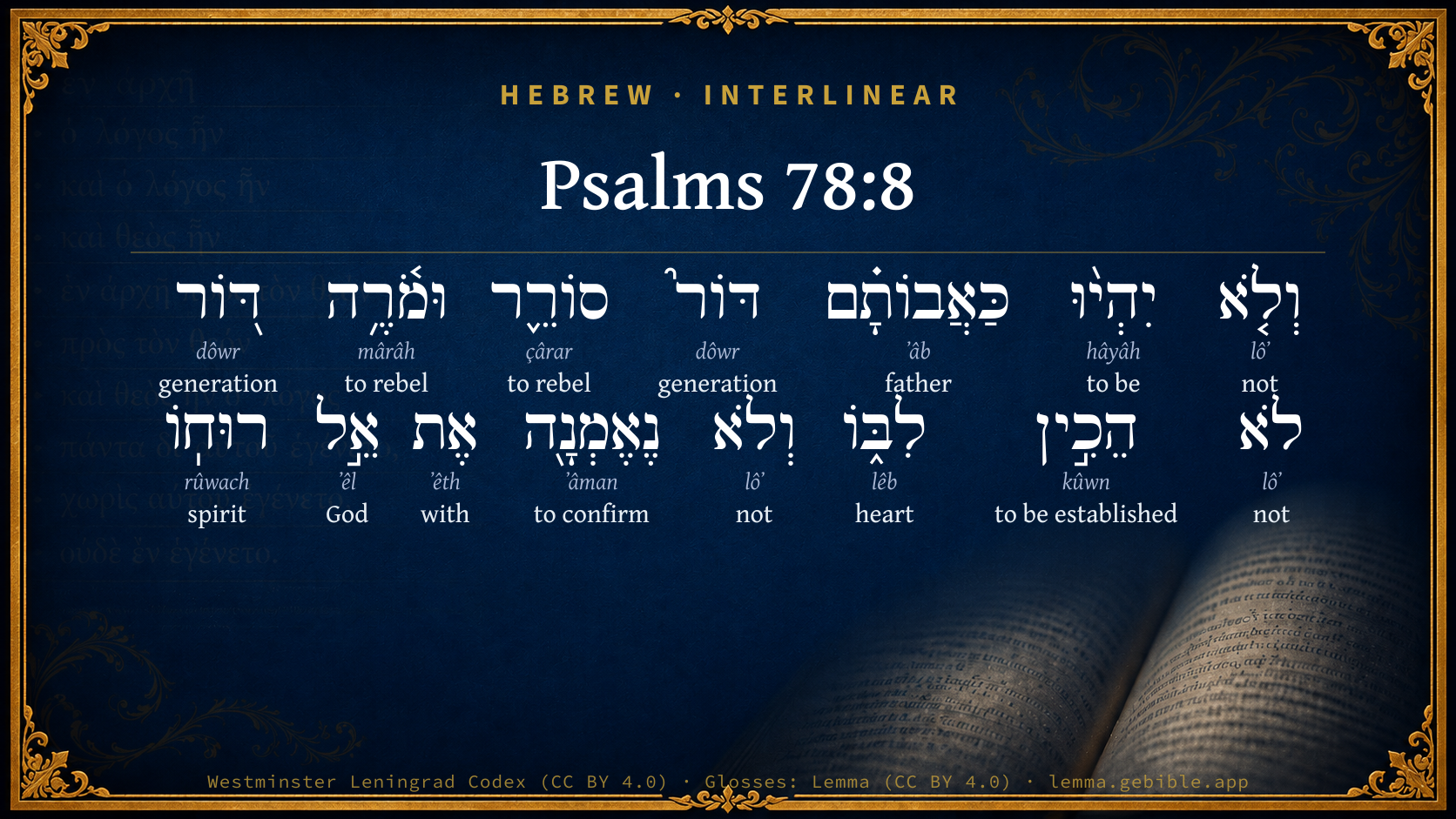
  1. וְלֹ֤א lôʼ H3808 “and · not” Conjunction + Particle, Negative
  2. יִהְי֨וּ hâyâh H1961 “to be” Verb, Qal, Imperfect, 3rd Person, Masculine, Plural
  3. כַּאֲבוֹתָ֗ם ʼâb H1 “like/as · fathers · their” Preposition + Noun, Common, Masculine, Plural, Construct + Suffix, Personal, 3rd Person, Masculine, Plural
  4. דּוֹר֮ dôwr H1755 “generation” Noun, Common, Masculine, Singular, Absolute
  5. וּמֹ֫רֶ֥ה mârâh H4784 “and · rebelling” Conjunction + Verb, Qal, Participle Active, Masculine, Singular, Absolute
  6. דּ֭וֹר dôwr H1755 “generation” Noun, Common, Masculine, Singular, Absolute
  7. לֹא lôʼ H3808 “not” Particle, Negative
  8. הֵכִ֣ין kûwn H3559 “to be established” Verb, Hiphil, Perfect, 3rd Person, Masculine, Singular
  9. לִבּ֑וֹ lêb H3820 “heart · his” Noun, Common, Masculine, Singular, Construct + Suffix, Personal, 3rd Person, Masculine, Singular
  10. וְלֹא lôʼ H3808 “and · not” Conjunction + Particle, Negative
  11. נֶאֶמְנָ֖ה ʼâman H539 “to confirm” Verb, Niphal, Perfect, 3rd Person, Feminine, Singular
  12. אֶת ʼêth H854 “with” Preposition
  13. אֵ֣ל ʼêl H410 “God” Noun, Common, Masculine, Singular, Absolute
  14. רוּחֽוֹ rûwach H7307 “spirit · his” Noun, Common, Both, Singular, Construct + Suffix, Personal, 3rd Person, Masculine, Singular

About this verse

These counts appear in no published source. They are computed here, from the morphology-tagged text and Lemma’s own curated glosses. What Lemma adds →

15
words
12
distinct lemmas
Wisdom
section

Notable vocabulary

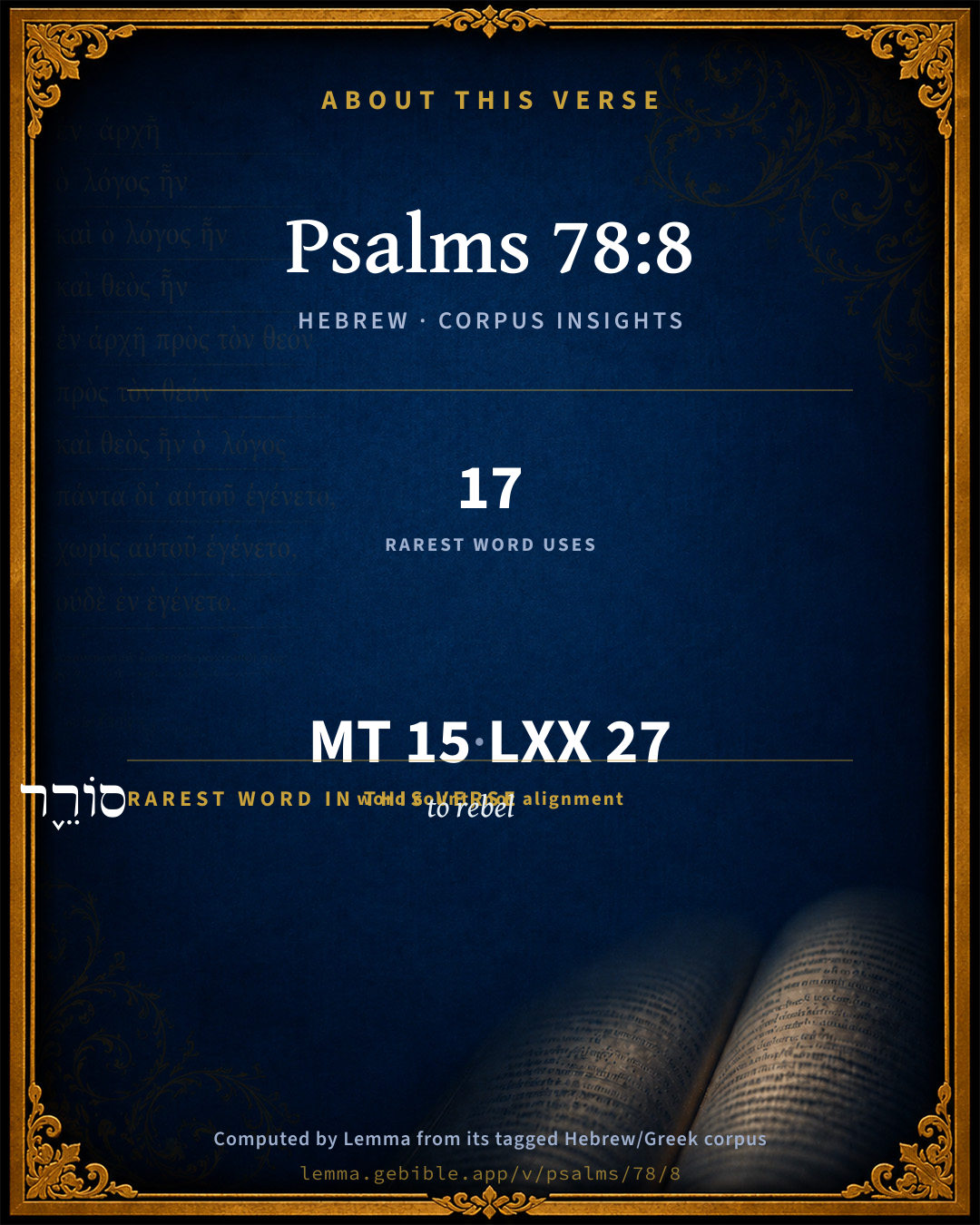
The rarest word here is סוֹרֵ֪ר to rebel H5637 — appearing just 17 times in the whole Hebrew Bible.

Shared distinctive vocabulary

סוֹרֵ֪ר to rebel H5637 occurs in 16 verses of the Hebrew Bible. Also found in:

Grammatical profile

  • 5 verbs
  • 6 nouns
  • 1 preposition
  • 3 particles

Verb forms

  • יִהְי֨וּ Qal · Imperfect
  • סוֹרֵ֪ר Qal · Participle Active
  • וּמֹ֫רֶ֥ה Qal · Participle Active
  • הֵכִ֣ין Hiphil · Perfect
  • נֶאֶמְנָ֖ה Niphal · Perfect

Repetition

Words recur within this verse — often emphatic in Hebrew:

  • דּוֹר֮ generation H1755 ×2
  • וְלֹ֤א not H3808 ×3

Hebrew & Septuagint length

In English translation the verse runs 27 words from the Hebrew and 29 from the Septuagint (LXX English) — closely comparable.

A rough comparison of the two English renderings, which tokenize alike — not a word-level alignment.

Word counts can differ between the Hebrew and the Greek without any difference in meaning — e.g. the Hebrew direct-object marker אֵת has no separate Greek word, and Greek often adds the article ὁ.

In the original languages it is 15 Hebrew tokens and 27 Greek tokens — but the two are counted differently (Hebrew bundles its prefixes and suffixes into one token; the Greek is in lemma form), so that isn’t a like-for-like length.

Cross-references

27

Topical passages linked to Psalms 78:8 in the Treasury of Scripture Knowledge — connected by theme and wording, ordered by reader-vote popularity; previews shown in the World English Bible.

  • Psalms 78:37 For their heart was not right with him, Neither were they faithful in his covenant.
  • Exodus 32:9 Yahweh said to Moses, "I have seen these people, and, behold, they are a stiff-necked people.
  • 2 Kings 17:14 Notwithstanding, they would not hear, but hardened their neck, like the neck of their fathers, who didn't believe in Yahweh their God.
  • Ezekiel 20:18 I said to their children in the wilderness, Don't you walk in the statutes of your fathers, neither observe their ordinances, nor defile yourselves with their idols.
  • Deuteronomy 31:27 For I know your rebellion, and your stiff neck: behold, while I am yet alive with you this day, you have been rebellious against Yahweh; and how much more after my death?
  • Exodus 33:3 to a land flowing with milk and honey: for I will not go up in the midst of you, for you are a stiff-necked people, lest I consume you in the way."
  • Exodus 33:5 Yahweh said to Moses, "Tell the children of Israel, 'You are a stiff-necked people. If I were to go up into your midst for one moment, I would consume you. Therefore now take off your jewelry from you, that I may know what to do to you."
  • Deuteronomy 9:13 Furthermore Yahweh spoke to me, saying, I have seen this people, and, behold, it is a stiff-necked people:
  • Deuteronomy 9:24 You have been rebellious against Yahweh from the day that I knew you.
  • 2 Chronicles 30:7 Don't be you like your fathers, and like your brothers, who trespassed against Yahweh, the God of their fathers, so that he gave them up to desolation, as you see.
  • Ezekiel 2:3–8 He said to me, Son of man, I send you to the children of Israel, to nations that are rebellious, which have rebelled against me: they and their fathers have transgressed against me even to this very day.
  • Ezekiel 20:8 But they rebelled against me, and would not listen to me; they did not every man cast away the abominations of their eyes, neither did they forsake the idols of Egypt. Then I said I would pour out my wrath on them, to accomplish my anger against them in the midst of the land of Egypt.
  • Matthew 23:31–33 Therefore you testify to yourselves that you are children of those who killed the prophets.
  • Acts 7:51 "You stiff-necked and uncircumcised in heart and ears, you always resist the Holy Spirit! As your fathers did, so you do.
  • Exodus 34:9 He said, "If now I have found favor in your sight, Lord, please let the Lord go in the midst of us; although this is a stiff-necked people; pardon our iniquity and our sin, and take us for your inheritance."
  • Deuteronomy 4:4 But you who did cleave to Yahweh your God are alive everyone of you this day.
  • Deuteronomy 9:6–7 Know therefore, that Yahweh your God doesn't give you this good land to possess it for your righteousness; for you are a stiff-necked people.
  • Joshua 14:8–9 Nevertheless my brothers who went up with me made the heart of the people melt; but I wholly followed Yahweh my God.
  • 2 Chronicles 12:14 He did that which was evil, because he didn't set his heart to seek Yahweh.
  • 2 Chronicles 19:3 Nevertheless there are good things found in you, in that you have put away the Asheroth out of the land, and have set your heart to seek God.
  • 2 Chronicles 20:33 However the high places were not taken away; neither as yet had the people set their hearts to the God of their fathers.
  • 2 Chronicles 30:19 who sets his heart to seek God, Yahweh, the God of his fathers, though not [cleansed] according to the purification of the sanctuary.
  • Job 11:13 "If you set your heart aright, Stretch out your hands toward him.
  • Psalms 68:6 God sets the lonely in families. He brings out the prisoners with singing, But the rebellious dwell in a sun-scorched land.
  • Psalms 106:7 Our fathers didn't understand your wonders in Egypt. They didn't remember the multitude of your loving kindnesses, But were rebellious at the sea, even at the Red Sea.
  • Acts 11:23 who, when he had come, and had seen the grace of God, was glad. He exhorted them all, that with purpose of heart they should remain near to the Lord.
  • Isaiah 30:9 For it is a rebellious people, lying children, children who will not hear the law of Yahweh;

Cross-references courtesy of OpenBible.info (CC BY 4.0).

Hebrew and Greek witnesses Masoretic Hebrew ↔ Greek Septuagint

The same verse in the two great witnesses to the Old Testament, shown verse-for-verse.

You’re reading Greek Psalm 77 (Hebrew Psalm 78). The Septuagint counts the superscription, so verse numbers can differ from the Hebrew — chapter-level alignment, not verse-by-verse. Numbering follows Rahlfs.

These are two independent witnesses, not word-aligned to each other, and the Septuagint is shown in lemma (dictionary) form.

Hebrew Psalms 78:8 Masoretic · Westminster Leningrad Codex

וְלֹ֤א יִהְי֨וּ כַּאֲבוֹתָ֗ם דּוֹר֮ סוֹרֵ֪ר וּמֹ֫רֶ֥ה דּ֭וֹר לֹא הֵכִ֣ין לִבּ֑וֹ וְלֹא נֶאֶמְנָ֖ה אֶת אֵ֣ל רוּחֽוֹ

And might not be as their fathers, A stubborn and rebellious generation, A generation that didn't make their hearts loyal, Whose spirit was not steadfast with God.

World English Bible · Public Domain

Greek LXX Greek Psalm 77:8 Septuagint · lemma form

ἵνα μή γίγνομαι ὡς ὁ πατήρ αὐτός γενεά σκολιός καί παραπικραίνω γενεά ὅστις οὐ καταεὐθύνω ὁ καρδία αὐτός καί οὐ πιστόω μετά ὁ θεός ὁ πνεῦμα αὐτός

That they should not be as their fathers, a perverse and provoking generation; a generation which set not its heart aright, and its spirit was not steadfast with God.

LXX2012 (modern English Septuagint) · Public Domain

Hebrew: Westminster Leningrad Codex (CC BY 4.0). Greek: Septuagint (public domain); English from LXX2012 (modern English Septuagint) (Public Domain). How the Septuagint differs from the Hebrew →

Commentary

Notes on Psalms 78:8 from classic Christian and Jewish commentators (each source and its license shown beneath its notes). The classic Christian expositions comment on the surrounding passage and are grouped to its opening verse, so a note may address several verses; the Jewish commentaries on the Tanakh (Rashi and others) are per-verse, so they appear only where the commentator wrote on this verse.

Lemma curates 59 commentaries, every one of them public domain or Creative Commons licensed, each selected and text-cleaned for this edition rather than reprinted as found. About our sources →

Trapp's Complete Commentary

John Trapp

Psa 78:8 And might not be as their fathers, a stubborn and rebellious generation; a generation [that] set not their heart aright, and whose spirit was not stedfast with God.

Ver. 8. And might not be as their fathers] Fathers are not always to be followed, Eze 20:18-19. He zealously affected his fathers, but not well, who said, I will follow them sicut bos armentum, etiamsi ruant, though I fall with them (Cicero Epist.).

A stubborn and rebellious generation] Aver satrix et irritatrix.

A generation that set not, &c.] Double-minded men, unstable in all their ways, Jas 1:8, having religionem ephemeram, as Beza said of Baldwin, that Ecebolius II.

And whose spirit was not stedfast with God] As was that martyr’s who said, Though you may pluck the heart out of nay body, yet you shall never pluck the truth out of my heart. The heavens shall sooner fall, said another, than I will forsake the truth I have once received.

John Trapp, A Commentary or Exposition upon All the Books of the Old and New Testament (1647–1656) — public domain. Text from a community e-Sword module.

The Treasury of David

Charles H. Spurgeon

Ver. 8. And might not be as their fathers, a stubborn and rebellious generation. There was room for improvement. Fathers stubborn in their own way, and rebellious against God's way, are sorry examples for their children; and it is earnestly desired that better instruction may bring forth a better race. It is common in some regions for men to count their family custom as the very best rule; but disobedience is not to be excused because it is hereditary. The leprosy was none the less loathsome because it had been long in the family. If our fathers were rebellious we must be better than they were, or else we shall perish as they did.

A generation that set not their heart aright. They had no decision for righteousness and truth. In them there was no preparedness, or willingness of heart, to entertain the Saviour; neither judgments, nor mercies could bind their affections to their God; they were fickle as the winds, and changeful as the waves.

And whose spirit was not steadfast with God. The tribes in the wilderness were constant only in their inconstancy; there was no depending upon them. It was, indeed, needful that their descendants should be warned, so that they might not blindly imitate them. How blessed it would be if each age improved upon its predecessor; but, alas! it is to be feared that decline is more general than progress, and too often the heirs of true saints are far more rebellious than even their fathers were in their unregeneracy. May the reading of this patriotic and divine song move many to labour after the elevation of themselves and their posterity.

Ver. 8. And might not be as their fathers. The warning is taken from an example at home. He does not say, That they might not be as the nations, which know not God: but, That they might not be as their fathers. Domestic examples of vice are much more pernicious than foreign ones. Hence one says: Sic natura jubet, velocius et citius nos corrumpunt vitiorum exempla domestica. Let us learn from this place, that it is not safe in all things to cleave to the footsteps of our fathers. He speaks of those fathers who perished in the wilderness: of whom, see Numbers 14; Deuteronomy 1, and Ps 68:6. Musculus.

Ver. 8. As their fathers, a stubborn and rebellious generation. Forasmuch as this bad emulation of their ancestors is with difficulty plucked from the minds of men, because of our innate reverence for our fathers, the prophet heaps up words in the description of the crimes of their fathers. He says they were hrm rwd, that is, a generation detracting from the authority of God, and continually breaking the bonds of the law, and in their petulance shaking off the yoke, as a violent and refractory horse, or an untamed bullock, enduring not the rein, or refusing to yield its neck to the yoke, but constantly drawing back and rejecting the bridle. Mollerus.

Ver. 8-9. Look carefully to the ground of thy active obedience, that it be sound and sincere. The same right principles whereby the sincere soul acts for Christ, will carry him to suffer for Christ, when a call from God comes with such an errand. "The children of Ephraim, being armed, and carrying bows, turned back in the day of battle." Why? what is the matter? so well armed, and yet so cowardly? This seems strange: read the preceding verse and you will cease wondering; they are called there, A generation that set not their heart aright, and whose spirit was not steadfast with God. Let the armour be what it will, yea, if soldiers were in a castle, whose foundations were rock, and walls brass; yet if their hearts be not right to their prince, an easy storm will drive them from the walls, and a little scare open their gate, which hath not this bolt of sincerity on it to hold it fast. In our late wars we have seen that the honest hearts within thin and weak works have held the town, when no walls could defend treachery from betraying trust. William Gurnall.

Ver. 8. Stubbornness not steadfastness, or the difference between a natural vice and a gracious quality.

Ver. 8. The false heart (middle clause), with its left hand, "Stubbornness in the wrong" (first clause), and its right hand, "Fickleness in the right" (last clause). C. D.

Psalms 78:9*

Ver. 8-9. See Psalms on "Ps 78:8" for further information.

Charles H. Spurgeon's The Treasury of David (1869–1885) — public domain. Psalms only. Text from a community e-Sword/MySword module.

J. A. Alexander on Psalms

Joseph Addison Alexander

8. (Psa 78:8) And might not be as their fathers, a generation stubborn and rebellious, a generation that did not prepare its heart, and whose spirit was not true to God. A still more specific purpose is here mentioned, to wit, that of warning by means of bad examples. The fathers here meant are the elder race that came out of Egypt. The description stubborn and rebellious is borrowed from Deut. xxi. 18. To prepare the heart is to dispose or devote it to God's service. Compare 1Sa 7:3, 2Ch 20:33.

Joseph Addison Alexander, The Psalms Translated and Explained (1850) — public domain. Text from a community e-Sword module.

Geneva Bible (1599)

Geneva Bible translators

Though these fathers were the seed of Abraham and the chosen people, yet he showeth by their rebellion, provocation, falsehood, and hypocrisy, that the children ought not to follow their examples.

Geneva Bible (1599) marginal notes — public domain. Text via Bolls.life.

John Calvin's Commentaries

8. And that they might not be as their fathers, a rebellious and provoking generation. The Psalmist here shows still more distinctly how necessary this sermon was, from the circumstance that the Jews were exceedingly prone to revolt from God, if they were not kept in subjection by powerful restraints. He takes it as a fact, which could not be questioned, that their hearts were in no respect better than the hearts of their fathers, whom he affirms to have been a treacherous, rebellious, crooked and disobedient race. They would, therefore, immediately backslide from the way of God, unless their hearts were continually sustained by stable supports. The experience of all ages shows that what Horace writes concerning his own nation is true every where: —

“Ætas parenturn, pejor avis, tulit Nos nequiores, mox daturos Progeniem vitiosiroem.” Odes, Book III. Ode vi.

“The age that gave our fathers birth, Saw them their noble sires disgrace: We, baser still, shall leave on earth The still increasing guilt of our degenerate race.” Boscawen’Translation.

What then would be the consequence, did not God succor the world which thus proceeds from evil to worse? As the prophet teaches the Jews from the wickedness and perverseness of their fathers, that they stood in need of a severe discipline to recall them from the imitation of bad examples, we learn from this, how great the folly of the world is, in persuading itself that the example of the fathers is to be regarded as equivalent to a law, which ought, in every case, to be followed. He does not here speak of all people without distinction, but of the holy and chosen race of Abraham; nor does he rebuke a small number of persons, but almost the whole nation, among whom there prevailed excessive obstinacy, as well as perverse forgetfulness of the grace of God, and perfidious dissimulation. He does not mention merely the fathers of one age, but he comprehends a period stretching back into a remote antiquity, that persons may not take occasion to excuse themselves in committing sin, from the length of time during which it has prevailed. We must therefore make a wise selection from amongst the fathers of those whom it becomes us to imitate. It being a work of great difficulty to remove the disposition to this perverse imitation of the fathers, towards whom the feeling of reverence is naturally impressed on the minds of their successors, the prophet employs a multiplicity of terms to set forth the aggravated wickedness of the fathers, stigmatising them as chargeable with apostasy, provocation, treachery, and hypocrisy. These are very weighty charges; but it will be evident from the sequel that they are not exaggerated. The word הכין, hechin, which I have rendered directed, is by some translated established, but in my opinion, the meaning rather is, that God’s ancient people always turned aside from God into crooked by-paths. Also, in what follows, instead of reading whose spirit was not faithful towards God, some read whose spirit leaned not upon God. But it is better to follow the former interpretation, That they were not faithfully and steadfastly devoted to God, although they had solemnly sworn allegiance to him. The Papists make use of this passage as an argument to prove that man has the power of bending his own heart, and directing it either to good or evil as he pleases; but this is an inference from it which cannot stand examination for a single moment. Although the prophet justly blames those who have not directed their heart aright, his object is not expressly to speak of what men can do of themselves. It is the special work of God to turn to himself the hearts of men by the secret influence of his Holy Spirit. It does not however follow from this, that they will be exempted from blame, when their own lust and depravity draw them away from God. Moreover, from the sins which are here reproved, we should learn in what way he would have us to obey and serve him. In the first place, we must lay aside all obstinacy and take his yoke upon us; and, secondly, we must clothe ourselves with the spirit of meekness, bring the affections of the heart to the obedience of God, and follow after uprightness, and that not with the fervor of a mere transient impulse, but with unfeigned and unwavering steadfastness.

John Calvin's Commentaries (1540-1563) — public domain. Text from the Calvin Translation Society English edition (1840s-50s) via the Christian Classics Ethereal Library (ccel.org). Calvin's coverage is partial (roughly two-thirds of the Bible); uncommented books and verses are honest gaps, never fabricated. The 19th-century editor's footnotes and remarks are omitted so the notes are faithfully Calvin's own voice.

Ellicott's Commentary for English Readers

(8) Stubborn.—Refractory.

That set not their heart aright.—Literally, did not establish their heart, which preserves the parallelism better.

A Bible Commentary for English Readers, edited by Charles John Ellicott (1878–1897) — public domain. Text from a community e-Sword module.

The Cambridge Bible for Schools and Colleges

gen. ed. J. J. S. Perowne

8. as their fathers] Primarily, the generation of the wandering in the wilderness; but the warning was true for almost every age.

stubborn and rebellious] Epithets applied in Deu_21:18 to the son, whom no admonition or chastisement would reform, and for whom accordingly nothing remained but the penalty of death. Cp. Jer_5:23; Deu_9:7 ff; Deu_31:27; Deu_32:5; Deu_32:20.

that set not their heart aright] Failed to direct and prepare it with stedfast purpose to serve God. Cp. Psa_78:37.

whose spirit was not stedfast] Better, as in Psa_78:37, was not faithful. Fickleness, instability, untrustworthiness, were the characteristics of Israel’s conduct.

The Cambridge Bible for Schools and Colleges (gen. ed. J. J. S. Perowne; Cambridge University Press, 1878–1918) — public domain. Text from a community e-Sword module.

John Gill's Exposition

And might not be as their fathers,.... This chiefly respects the Jews in Christ's time: though it also is an admonition to them in succeeding ages, and especially in the latter day, when they shall be instructed, called, and converted; and even to us, to whom the Gospel is preached, on whom the ends of the world are come, not to be disobedient, as the Jewish fathers were, and to take care we do not fall after the same example of unbelief; this opens the whole scope and general design of the psalm; see Co1 10:6,

a stubborn and rebellions generation; as the generation in the wilderness was, Deu 9:6 and so were their posterity in Christ's time, Mat 12:34,

a generation that set not their heart aright; to seek the Lord, serve and obey him; their hearts were removed far from him, and they were hypocritical in their prayers to him, and service of him:

and whose spirit was not steadfast with God; did not continue in the faith of God, in the true religion, but departed and apostatized from him; see Psa 78:37. Apostasy is generally the fruit and effect of hypocrisy; all the following facts support the character which is here given of them.

John Gill's Exposition of the Whole Bible (1746–1763) — public domain (CC PDM 1.0). Text via the HelloAO Bible API.

Albert Barnes' Notes on the Bible

And might not be as their fathers - Their ancestors, particularly in the wilderness, as they passed through it to the promised land. See Exo 32:7-9; Exo 33:3; Exo 34:9; Act 7:51-53.

A stubborn and rebellious generation - Stiff-necked, ungovernable; inclined to revolt. Nothing was more remarkable in their early history than this.

A generation that set not their heart aright - Margin, as in Hebrew, “prepared not their heart.” That is, they took no pains to keep their heart aright, or to cherish right feelings toward God. They yielded to any sudden impulse of passion, even when it led them to revolt against God. This is as true of sinners now as it was of them, that they “take no pains” to have their hearts right with God. If they did, there would be no difficulty in doing it. It is not with them “an object of desire” to have their hearts right with God, and hence, nothing is more easy or natural than that they should rebel and go astray.

And whose spirit was not stedfast with God - That is, they themselves did not maintain a firm trust in God. They yielded readily to every impulse, and every passion, even when it tended to draw them away wholly from him. There was no such “strength” of attachment to him as would lead them to resist temptation, and they easily fell into the sin of idolatry.

Albert Barnes' Notes on the Bible (1834–1885) — public domain. Text from a community e-Sword/MySword module.

Matthew Poole's English Annotations

That set not their heart aright; who though they outwardly and seemingly complied with the forms of worship which God had prescribed, yet

did not direct or prepare their hearts to the obedience and service of God.

Whose spirit was not stedfast with God; who quickly discovered their hypocrisy by their apostacy from God, and from the religion which they had professed.

Matthew Poole's English Annotations on the Holy Bible (1683–1685) — public domain. Text from a community e-Sword/MySword module.

The Pulpit Commentary

And might not be as their fathers, a stubborn and rebellious generation. (comp. Deu_21:18, Deu_21:20, for the combination of the two words) The "stubbornness" of Israel is noted in; (Deu_9:27 Jud_1:2:19; and frequently by Jeremiah Jer_3:17 Jer_7:24 Jer_9:14 Jer_11:8, etc.) their "rebelliousness" in Deu_9:7, 24 Isa_30:1, 9 65:2 Jer_5:23 Eze_2:3-8 Eze_3:9, Eze_3:26, 27 12:2, 3, etc. (compare also for the idea 2Ki_17:14-17 2Ch_36:14-16 Ezr_9:6, 7 Neh_1:6, 7 Dan_9:5-11; and Act_7:51, "Ye stiff-necked and uncircumcised in heart and ears, ye do always resist the Holy Ghost; as your fathers did, so do ye"). A generation that set not their heart aright; literally, that prepared not their heart did not make it ready to receive Divine influences. (see 1Sa 7:3Jo 1Sa_11:13 2Ch_20:33) And whose spirit was not steadfast with God. It was not that Israel was wholly without religious feeling, but the feeling was fickle, unsteadfast, never to be depended on. (comp. Exo_32:1-6 Num_16:41, 42 Jud_1:2:17, etc.)

The Pulpit Commentary (1880–1919), ed. H.D.M. Spence-Jones & Joseph S. Exell — public domain. Text from a community e-Sword module.

Rashi

Rabbi Shlomo Yitzchaki (Rashi)

as their forefathers who were in Egypt and in the desert.

Rashi on the Tanakh — English translations: “The Judaica Press complete Tanach with Rashi, translated by A. J. Rosenberg” (CC BY 4.0); “Pentateuch with Rashi's commentary by M. Rosenbaum and A.M. Silbermann, 1929-1934” (public domain); “The Metsudah Tanach series, Lakewood, N.J” (CC BY 4.0); and “The Book of Joshua, Metsudah Publications, 1997” (CC BY 4.0). Text via Sefaria.

Lesson kit

Teaching starters — assembled from the data on this page, not authored interpretation. Every prompt links to the verse data it draws on. Edit before teaching.

Psalms, in the Wisdom, opens this verse with 15 words (12 distinct Hebrew lemmas). Its most distinctive word is çârar (“to rebel”). A historical commentator’s framing appears above. Read the whole chapter for the surrounding context.

Discussion questions

  1. How does “to rebel” (çârar) shape what this verse is saying?
  2. How does Deuteronomy 21:18, which shares the word «to rebel», read alongside this verse?
  3. What does the repetition of “generation” (2× in this one verse) do in this verse?
  4. These translations render this verse differently; the difference is in the English rendering, not the original. What questions does that raise?
  5. «יִהְי֨וּ» is a Qal Imperfect verb. How does that grammatical form shape the action described?
  6. Compare how Trapp's Complete Commentary and The Treasury of David read this verse. Where do they agree or differ?

Things to notice

Reading settings

Reading text

Shown beneath each verse's original-language words.

Old Testament
Old Testament edition

Read the OT as the Masoretic Hebrew (MT) or the Greek Septuagint (LXX).

English shown for the Greek Septuagint (in the Hebrew ↔ Greek comparison).

Comparing translations? Open the Compare panel on any verse page to stack up to four side by side.