Nehemiah 9:20

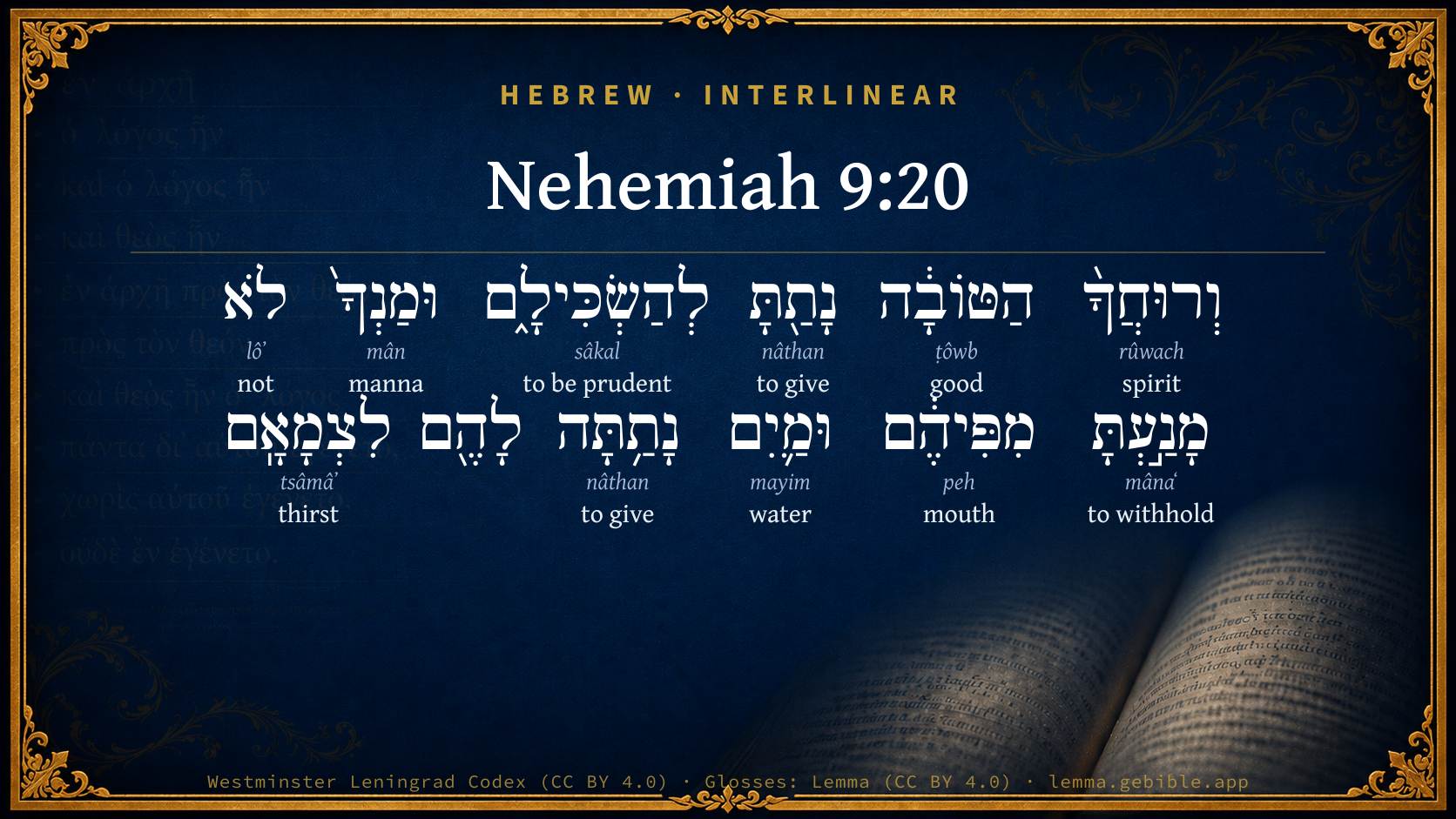
Hebrew (Westminster Leningrad Codex) Nehemiah 9:20 appears in the Hebrew Old Testament. The text above is from the Westminster Leningrad Codex. Each word links to its Strong’s number, a concise gloss, and parsing drawn from the Open Scriptures Hebrew Bible morphology. Click any word for its full Brown-Driver-Briggs (BDB) entry.
Download image
Cite this verse

Nehemiah 9:20 (World English Bible). Public Domain. Lemma interlinear Bible study tool, https://lemma.gebible.app/v/nehemiah/9/20.

Show BibTeX & RIS
BibTeX
RIS
English Translation
You gave also your good Spirit to instruct them, and didn't withhold your manna from their mouth, and gave them water for their thirst.
World English Bible · Public Domain
Download a study sheet

One document with this verse’s original text, its word-by-word gloss line, the meaning frame, cross-references with their text, attributed commentary, and full source and license credits — printable, and it pastes into notes with its structure intact.

This verse Autodidact and up

Study sheet (.html) Plain text (.txt)

A passage Seminary Student

Up to 50 verses in one chapter. A passage sheet keeps up to 6 commentary sources and 12 cross-references per verse, in the order this page ranks them, and says so on the sheet whenever that leaves anything out. Ask for a single verse and you get the Autodidact verse sheet above.

Everything on this page stays free to read, with no account — the sheet is a download of what is already on screen, not access to it.

Want to remove ads? Support Godless Engineer
Compare translations 3

The same verse in 3 English versions, stacked beneath the original-language interlinear above. Click any original word for its lexicon entry.

Each is an independent rendering of the whole verse — the interlinear is not word-aligned to these translations.

Highlighted words mark where these versions differ — a whole-verse word diff, not a word-by-word alignment.

  • World English Bible Public Domain
    You gave also your good Spirit to instruct them, and didn't withhold your manna from their mouth, and gave them water for their thirst.
  • King James Version Public Domain
    Thou gavest also thy good spirit to instruct them, and withheldest not thy manna from their mouth, and gavest them water for their thirst.
  • unfoldingWord Literal Text CC BY-SA 4.0
    And you gave your good spirit to give them insight. And you did not withhold your manna from their mouth, and you gave them water for their thirst.

unfoldingWord Literal Text — © unfoldingWord, licensed CC BY-SA 4.0. Word-aligned USFM3 via Door43 (git.door43.org/unfoldingWord/en_ult).

Versions to compare (up to 4)

3 of 4 selected

Show all 18 translations

Every available English version of this verse, each an independent rendering of the whole verse.

  • World English Bible Public Domain
    You gave also your good Spirit to instruct them, and didn't withhold your manna from their mouth, and gave them water for their thirst.
  • Berean Standard Bible Public Domain
    You gave Your good Spirit to instruct them. You did not withhold Your manna from their mouths, and You gave them water for their thirst.
  • Majority Standard Bible Public Domain
    You gave Your good Spirit to instruct them. You did not withhold Your manna from their mouths, and You gave them water for their thirst.
  • King James Version Public Domain
    Thou gavest also thy good spirit to instruct them, and withheldest not thy manna from their mouth, and gavest them water for their thirst.
  • American Standard Version (1901) Public Domain
    Thou gavest also thy good Spirit to instruct them, and withheldest not thy manna from their mouth, and gavest them water for their thirst.
  • Revised Version (1885) Public Domain
    Thou gavest also thy good spirit to instruct them, and withheldest not thy manna from their mouth, and gavest them water for their thirst.
  • Geneva Bible (1599) Public Domain
    Thou gauest also thy good Spirite to instruct them, and withheldest not thy MAN from their mouth, and gauest them water for their thirst.
  • Douay-Rheims (1899) Public Domain
    And thou gavest them thy good Spirit to teach them, and thy manna thou didst not withhold from their mouth, and thou gavest them water for their thirst.
  • Young's Literal Translation Public Domain
    `And Thy good Spirit Thou hast given, to cause them to act wisely; and Thy manna Thou hast not withheld from their mouth, and water Thou hast given to them for their thirst,
  • Literal Standard Version CC BY-SA 4.0
    And Your good Spirit You have given, || To cause them to act wisely; And Your manna You have not withheld from their mouth, || And water You have given to them for their thirst,
  • Unlocked Literal Bible CC BY-SA 4.0
    Your good Spirit you gave them to instruct them, and your manna you did not withhold from their mouths, and water you gave them for their thirst.
  • unfoldingWord Literal Text CC BY-SA 4.0
    And you gave your good spirit to give them insight. And you did not withhold your manna from their mouth, and you gave them water for their thirst.
  • Darby Bible Public Domain
    Thou gavest also thy good Spirit to instruct them, and withheldest not thy manna from their mouth, and gavest them water for their thirst.
  • World Messianic Bible Public Domain
    You gave also your good Spirit to instruct them, and didn’t withhold your manna from their mouth, and gave them water for their thirst.
  • Webster's Bible Public Domain
    Thou gavest also thy good spirit to instruct them, and withheldest not thy manna from their mouth, and gavest them water for their thirst.
  • Free Bible Version CC BY-SA 4.0
    You gave your good Spirit to teach them. You did not stop feeding them with your manna, and you gave them water when they were thirsty.
  • Bible in Basic English Public Domain
    And you gave your good spirit to be their teacher, and did not keep back your manna from their mouths, and gave them water when they had need of it.
  • JPS Tanakh (1917) Public Domain
    Thou gavest also Thy good spirit to instruct them, and withheldest not Thy manna from their mouth, and gavest them water for their thirst.

Literal Standard Version (2020), Covenant Press — licensed CC BY-SA 4.0. Text via the HelloAO Bible API (eBible.org). Unlocked Literal Bible (unfoldingWord) — licensed CC BY-SA 4.0. Text via the HelloAO Bible API (eBible.org). unfoldingWord Literal Text — © unfoldingWord, licensed CC BY-SA 4.0. Word-aligned USFM3 via Door43 (git.door43.org/unfoldingWord/en_ult). Free Bible Version, Dr. Jonathan Gallagher — licensed CC BY-SA 4.0. Text via the HelloAO Bible API (eBible.org).

Word by word

More ways to search: Search by grammar → Find every occurrence → Compare this word →

Practice this passage: Drill this verse → Learn its vocabulary →

וּמַנְךָ֙
mân
H4478
“and · manna · your”
Conjunction + Noun, Common, Masculine, Singular, Construct + Suffix, Personal, 2nd Person, Masculine, Singular
Part of Speech
Conjunction + Noun
Type
Common
Gender
Masculine
Number
Singular
State
Construct
Full BDB Definition

Origin: from H4100

TWOT: 1208 , 1209

manna - the bread from Heaven that fed the Israelites for 40 years of wilderness wanderings - means 'What is it?'
  1. וְרוּחֲךָ֨ rûwach H7307 “and · spirit · your” Conjunction + Noun, Common, Both, Singular, Construct + Suffix, Personal, 2nd Person, Masculine, Singular
  2. הַטּוֹבָ֔ה ṭôwb H2896 “the · good” Particle, Definite Article + Adjective, Adjective, Feminine, Singular, Absolute
  3. נָתַ֖תָּ nâthan H5414 “to give” Verb, Qal, Perfect, 2nd Person, Masculine, Singular
  4. לְהַשְׂכִּילָ֑ם sâkal H7919 “to be prudent · them” Preposition + Verb, Hiphil, Infinitive Construct + Suffix, Personal, 3rd Person, Masculine, Plural
  5. לֹא lôʼ H3808 “not” Particle, Negative
  6. מָנַ֣עְתָּ mânaʻ H4513 “to withhold” Verb, Qal, Perfect, 2nd Person, Masculine, Singular
  7. מִפִּיהֶ֔ם peh H6310 “from · mouth · their” Preposition + Noun, Common, Masculine, Singular, Construct + Suffix, Personal, 3rd Person, Masculine, Plural
  8. וּמַ֛יִם mayim H4325 “and · water(s)” Conjunction + Noun, Common, Masculine, Plural, Absolute
  9. נָתַ֥תָּה nâthan H5414 “to give” Verb, Qal, Perfect, 2nd Person, Masculine, Singular
  10. לִצְמָאָֽם tsâmâʼ H6772 “to/for · thirst · their” Preposition + Noun, Common, Masculine, Singular, Construct + Suffix, Personal, 3rd Person, Masculine, Plural

About this verse

These counts appear in no published source. They are computed here, from the morphology-tagged text and Lemma’s own curated glosses. What Lemma adds →

12
words
10
distinct lemmas
Historical
section

Notable vocabulary

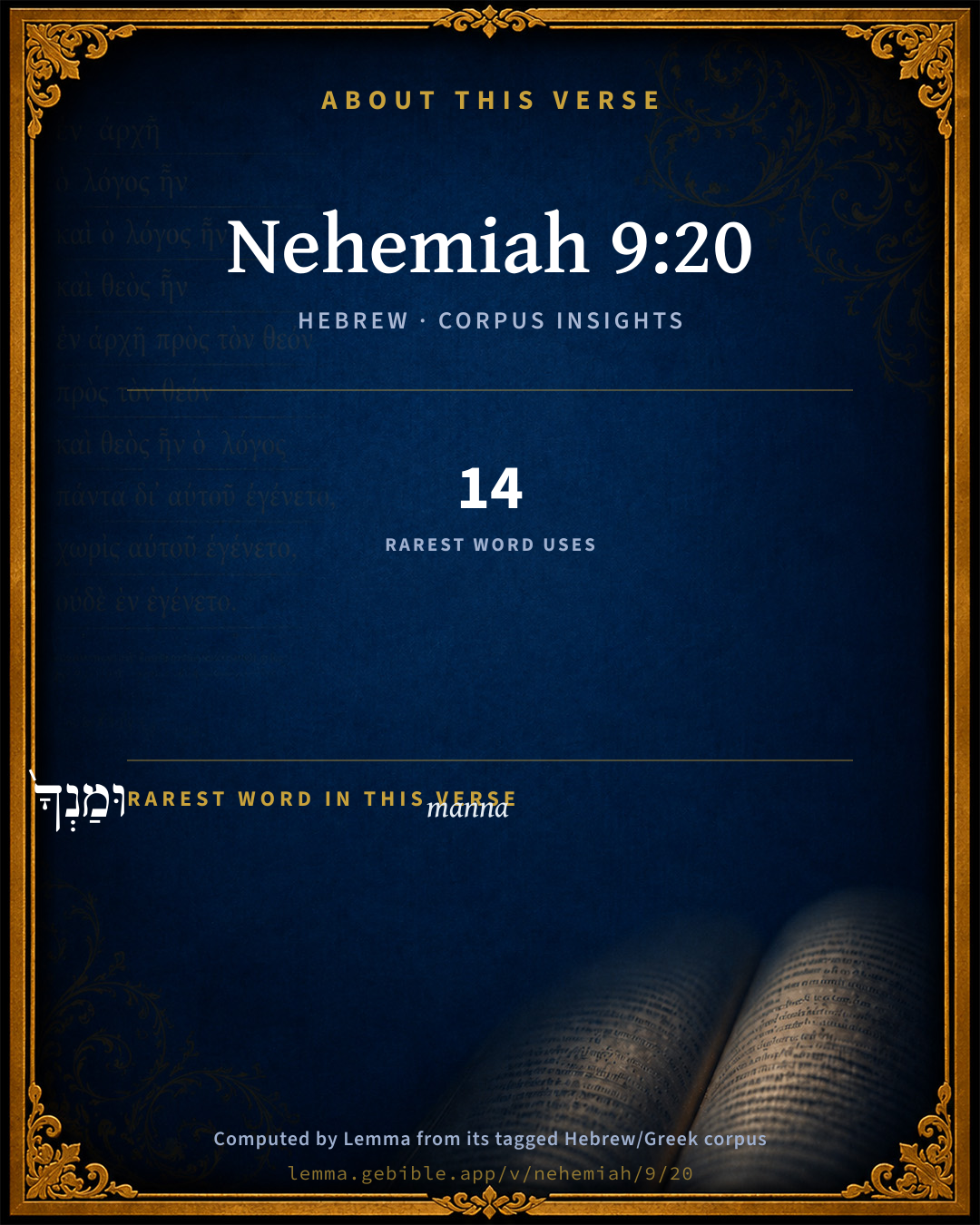
The rarest word here is וּמַנְךָ֙ manna H4478 — appearing just 14 times in the whole Hebrew Bible.

Shared distinctive vocabulary

וּמַנְךָ֙ manna H4478 occurs in 12 verses of the Hebrew Bible. Also found in:

Grammatical profile

  • 4 verbs
  • 5 nouns
  • 1 adjective
  • 1 preposition
  • 1 particle

Verb forms

  • נָתַ֖תָּ Qal · Perfect
  • לְהַשְׂכִּילָ֑ם Hiphil · Infinitive Construct
  • מָנַ֣עְתָּ Qal · Perfect
  • נָתַ֥תָּה Qal · Perfect

Repetition

A word recurs within this verse — often emphatic in Hebrew:

  • נָתַ֖תָּ to give H5414 ×2

Cross-references

20

Topical passages linked to Nehemiah 9:20 in the Treasury of Scripture Knowledge — connected by theme and wording, ordered by reader-vote popularity; previews shown in the World English Bible.

  • Psalms 143:10 Teach me to do your will, For you are my God. Your Spirit is good. Lead me in the land of uprightness.
  • Numbers 11:17 I will come down and talk with you there: and I will take of the Spirit which is on you, and will put it on them; and they shall bear the burden of the people with you, that you not bear it yourself alone.
  • Isaiah 63:11–14 Then he remembered the days of old, Moses [and] his people, [saying], Where is he who brought them up out of the sea with the shepherds of his flock? where is he who put his holy Spirit in the midst of them?
  • John 4:10 Jesus answered her, "If you knew the gift of God, and who it is who says to you, 'Give me a drink,' you would have asked him, and he would have given you living water."
  • 2 Peter 1:21 For no prophecy ever came by the will of man: but holy men of God spoke, being moved by the Holy Spirit.
  • Isaiah 41:17–18 The poor and needy seek water, and there is none, and their tongue fails for thirst; I, Yahweh, will answer them, I, the God of Israel, will not forsake them.
  • Isaiah 48:21 They didn't thirst when he led them through the deserts; he caused the waters to flow out of the rock for them; he split the rock also, and the waters gushed out.
  • Exodus 16:15 When the children of Israel saw it, they said one to another, "What is it?" For they didn't know what it was. Moses said to them, "It is the bread which Yahweh has given you to eat."
  • Exodus 17:6 Behold, I will stand before you there on the rock in Horeb. You shall strike the rock, and water will come out of it, that the people may drink." Moses did so in the sight of the elders of Israel.
  • Joshua 5:12 The manna ceased on the next day, after they had eaten of the produce of the land; neither had the children of Israel manna any more; but they ate of the fruit of the land of Canaan that year.
  • Psalms 105:41 He opened the rock, and waters gushed out. They ran as a river in the dry places.
  • John 4:14 but whoever drinks of the water that I will give him will never thirst again; but the water that I will give him will become in him a well of water springing up to eternal life."
  • John 7:37–39 Now on the last and greatest day of the feast, Jesus stood and cried out, "If anyone is thirsty, let him come to me and drink!
  • Ephesians 5:9 for the fruit of the Spirit is in all goodness and righteousness and truth,
  • Nehemiah 9:30 Yet many years did you bear with them, and testified against them by your Spirit through your prophets: yet would they not give ear: therefore gave you them into the hand of the peoples of the lands.
  • Exodus 16:35 The children of Israel ate the manna forty years, until they came to an inhabited land. They ate the manna until they came to the borders of the land of Canaan.
  • Numbers 11:25–29 Yahweh came down in the cloud, and spoke to him, and took of the Spirit that was on him, and put it on the seventy elders: and it happened that when the Spirit rested on them, they prophesied, but they did so no more.
  • Isaiah 49:10 They shall not hunger nor thirst; neither shall the heat nor sun strike them: for he who has mercy on them will lead them, even by springs of water will he guide them.
  • Romans 15:30 Now I beg you, brothers, by our Lord Jesus Christ, and by the love of the Spirit, that you strive together with me in your prayers to God for me,
  • Galatians 5:22–23 But the fruit of the Spirit is love, joy, peace, patience, kindness, goodness, faithfulness,

Cross-references courtesy of OpenBible.info (CC BY 4.0).

Hebrew and Greek witnesses Masoretic Hebrew ↔ Greek Septuagint

The same verse in the two great witnesses to the Old Testament, shown verse-for-verse.

These are two independent witnesses, not word-aligned to each other, and the Septuagint is shown in lemma (dictionary) form.

Hebrew Nehemiah 9:20 Masoretic · Westminster Leningrad Codex

וְרוּחֲךָ֨ הַטּוֹבָ֔ה נָתַ֖תָּ לְהַשְׂכִּילָ֑ם וּמַנְךָ֙ לֹא מָנַ֣עְתָּ מִפִּיהֶ֔ם וּמַ֛יִם נָתַ֥תָּה לָהֶ֖ם לִצְמָאָֽם

You gave also your good Spirit to instruct them, and didn't withhold your manna from their mouth, and gave them water for their thirst.

World English Bible · Public Domain

Greek LXX Structure differs

The Septuagint has no separate book of Nehemiah. Its Greek text is the second half of Esdras B (2 Esdras), chapters 11–23; Ezra is the first half (1–10).

A verse-for-verse comparison isn’t shown here because the chapters and verses don’t line up. Switch to the LXX edition with the MT / LXX toggle above to read the Greek directly.

Hebrew: Westminster Leningrad Codex (CC BY 4.0). Greek: Septuagint (public domain); English from a public-domain English Septuagint. How the Septuagint differs from the Hebrew →

Commentary

Notes on Nehemiah 9:20 from classic Christian and Jewish commentators (each source and its license shown beneath its notes). The classic Christian expositions comment on the surrounding passage and are grouped to its opening verse, so a note may address several verses; the Jewish commentaries on the Tanakh (Rashi and others) are per-verse, so they appear only where the commentator wrote on this verse.

Lemma curates 59 commentaries, every one of them public domain or Creative Commons licensed, each selected and text-cleaned for this edition rather than reprinted as found. About our sources →

Trapp's Complete Commentary

John Trapp

Neh 9:20 Thou gavest also thy good spirit to instruct them, and withheldest not thy manna from their mouth, and gavest them water for their thirst.

Ver. 20. Thou gavest also thy good spirit] viz. To their governors and teachers, Num 11:16-17; Num 11:25-26. Yea, to every good soul, that they might be all taught of God, led into all truth and holiness, Eph 5:9. For which end God hath promised to pour his Spirit upon all flesh, that is, the best thing upon the basest, Joe 2:28. Next to the sending of his Son in the flesh (which is called the gift, Joh 4:10, and the benefit, 1Ti 6:2), what can God do more for his people than to give them his good spirit? this is to give them all good things in one, Mat 7:11 Luk 11:13.

And withheldest not thy manna] See Neh 9:15. It is twice mentioned, as a singular and signal mercy. And it is well observed by a reverend writer, that this manna and water from the rock (which was Christ in the gospel) were given this people before the law, the sacraments of grace before the legal covenant. The grace of God preventeth our obedience; therefore shall we keep the law of God, because we have a Saviour.

John Trapp, A Commentary or Exposition upon All the Books of the Old and New Testament (1647–1656) — public domain. Text from a community e-Sword module.

Joseph Benson's Commentary

Neh 9:20. Thou gavest also thy good Spirit to instruct them — Which thou didst graciously and plentifully impart, first unto Moses, and then unto the seventy elders, (Num 11:17-26,) to the end that they might be able to direct and govern thy people wisely, and in thy fear.

Joseph Benson's Commentary on the Old and New Testaments (1811–1818) — public domain. Text from a community e-Sword module.

Ellicott's Commentary for English Readers

(20) Thy good spirit.—Probably a reference to Num_11:17; Num_11:25. The epithet given to the Spirit is in Psa_143:10. But His teaching function occurs here only, and is a remarkable anticipation of the New Testament.

A Bible Commentary for English Readers, edited by Charles John Ellicott (1878–1897) — public domain. Text from a community e-Sword module.

The Cambridge Bible for Schools and Colleges

gen. ed. J. J. S. Perowne

20. thy good spirit] Referring possibly to Num_11:17 ‘And I will take of the spirit which is upon thee and will put it upon them,’ 23–29, but mainly to the general Divine teaching of the people, cf. Isa_63:11, ‘Where is he that brought them out of the sea with the shepherds of his flock? Where is he that put his holy spirit in the midst of them?’ For the expression ‘thy good spirit’ cf. Psa_143:10, Marg. ‘Let thy good spirit lead me.’

to instruct] i.e. to make them understand. For the use of the verb ‘sakal,’ see note on Neh_8:12; cf. Psa_32:8, ‘I will instruct thee and lead thee in the way which thou shalt go.’

thy manna] The reference here seems to be to Num_11:6-9; that in Neh_9:15 had been to Exo_16:14-36.

Similarly ‘water for their thirst’ refers to the second miraculous gift of water described in Num_20:2-8 (not to Exo_17:3-6).

The Cambridge Bible for Schools and Colleges (gen. ed. J. J. S. Perowne; Cambridge University Press, 1878–1918) — public domain. Text from a community e-Sword module.

John Gill's Exposition

Thou gavest also thy good spirit to instruct them,.... In the knowledge of the laws delivered to them; the spirit of prophecy, according to Ben Melech, and which Aben Ezra interprets of the spirit put upon the seventy elders, Num 11:17,

and withheldest not thy manna from their mouth; all the while they were in the wilderness, until they came to Canaan's land; called the Lord's manna, because prepared by him, and given by him to them; a part or portion and gift from the Lord, as Ben Melech, from whence it had its name, see Exo 16:15

and gavest them water for their thirst; which seems to have respect to the last rock stricken for them, after their many provocations in the wilderness, Num 20:11.

John Gill's Exposition of the Whole Bible (1746–1763) — public domain (CC PDM 1.0). Text via the HelloAO Bible API.

Haydock's Catholic Bible Commentary

Spirit. The conducting angel. (Menochius) --- God enlightened and moved the hearts of the people, by his grace; which he gave in abundance to Moses. (Calmet)

George Leo Haydock (1774–1849), Haydock's Catholic Family Bible and Commentary, 1859 edition — public domain. Excludes Psalms (Douay-Rheims chapter numbering differs from Protestant) and Deuterocanonical books (Catholic canon only).

Matthew Poole's English Annotations

Thou gavest also thy good spirit; which thou didst graciously and plentifully impart unto Moses, and then unto the seventy eiders, Num 11:17,25,26, to the end that they might be able to direct and govern thy people wisely, and in thy fear.

Matthew Poole's English Annotations on the Holy Bible (1683–1685) — public domain. Text from a community e-Sword/MySword module.

The Pulpit Commentary

Thou gavest them also thy good Spirit to instruct them. The "good Spirit" of God is mentioned in Psa_143:10; and the fact of God"s "instructing and teaching" men in Psa_32:8. But instruction by God"s Spirit is nowhere else distinctly mentioned in the Old Testament.

The Holy Spirit as a Teacher.

"Thou gavest also thy good Spirit to instruct them." This assertion is more emphatically true of Christians than of Israel. We live under "the dispensation of the Spirit," when the "promise of the Spirit" is more abundantly fulfilled. We have here

I A WONDERFUL DISPLAY OF DIVINE MERCY. It is in the midst of the narration of Israel"s pride and stubbornness that this statement is made. So it is to a rebellious world that God"s Spirit comes to instruct, restore, and save.

II AN INVALUABLE GIFT.

1. Its nature. Special Divine influence and operation the Holy Spirit acting on and in the minds and hearts of men.

(1) In and through inspired men and their utterances by speech or writing. "Holy men of God spake as they were moved by the Holy Ghost." By such inspiration what might have been otherwise learned is taught more clearly and authoritatively, and the truths which especially relate to salvation, which could not have been otherwise known, are revealed.

(2) In the hearts of men generally. Those especially to whom the gospel comes enjoy this great blessing, for their enlightenment, conviction, conversion, regeneration, and sanctification.

(3) Through the Church. That is, through the speech and life of Christians, and in connection with Christian fellowship, worship, and ordinances. Not, however, as a magical influence to be dispensed at the will of men.

2. Its goodness. "Thy good Spirit." Intended not to describe the personal goodness of the Holy Spirit, but the value of his influence to men. Amongst the gifts of God to Israel named in the context, this was incalculably the best. The gifts of God which we call providential are invaluable; those of his grace are of far higher value, and of these this is the greatest. Without the Spirit no other Divine gift would avail for our highest and everlasting well-being. This renders all other blessings truly blessed. The good Spirit makes all things good to us, even those which we call evil, yea, those which in themselves are evil.

III A GRAND OPPORTUNITY. "To instruct them." Each one of us may have the inestimable advantage of a Divine Teacher who not only speaks to the ear, or the eye, but enters the heart, and whose instructions are the most essential to our welfare. He makes "wise unto salvation." The only conditions are faith in him and his teaching, willingness to learn and practise his lessons, and prayer for his influences.

IV A HEAVY RESPONSIBILITY. In proportion to the value of God"s gifts are the responsibilities they impose. No responsibility can, therefore, be so heavy as that which arises from the gift of the Holy Ghost; the presence amongst us, the influence upon us, of a Divine Person proffering and pressing his aid to lead us to God, goodness, and heaven. Happy those who receive him into. their hearts as a permanent guest and guide the life of their life, the soul of their soul. But let us take heed lest we "grieve the Holy Spirit of God," or "do despite unto the Spirit of grace," and he depart from us utterly and for ever, leaving us to the "sorer punishment" which falls on those to whom God comes most nearly and graciously, and is rejected by them.

The Pulpit Commentary (1880–1919), ed. H.D.M. Spence-Jones & Joseph S. Exell — public domain. Text from a community e-Sword module.

unfoldingWord translationNotes

Door43 World Missions Community

Connecting Statement:

In these verses, the Levites continue to praise Yahweh in the presence of the people of Israel.

Your good Spirit ... your manna ... water

The writer changes the usual word order to emphasize the good things Yahweh gave his people. Your language may have another way of emphasizing these items.

instruct

teach

your manna you did not withhold from their mouths

This litotes can be expressed positively. AT: "you generously gave them manna" (See: Litotes)

from their mouths

The mouth is a synecdoche for the whole person. AT: "from them" (See: Synecdoche)

translationWords

good

Holy Spirit

manna

water

desert

unfoldingWord translationNotes — © Distant Shores Media and the Door43 World Missions Community, licensed CC BY-SA 4.0. Source: git.door43.org/Door43/en_tn.

Lesson kit

Teaching starters — assembled from the data on this page, not authored interpretation. Every prompt links to the verse data it draws on. Edit before teaching.

Nehemiah, in the Historical, opens this verse with 12 words (10 distinct Hebrew lemmas). Its most distinctive word is mân (“manna”). A historical commentator’s framing appears above. Read the whole chapter for the surrounding context.

Discussion questions

  1. What does “manna” (mân) contribute to the verse as a whole?
  2. Exodus 16:15 shares the word «manna» with this verse. How do the two illuminate each other?
  3. “to give” occurs 2× in this one verse. What is the effect of the repetition?
  4. These translations render this verse differently; the difference is in the English rendering, not the original. What questions does that raise?
  5. The verb «נָתַ֖תָּ» is Qal Perfect. How does its form color the action?
  6. Reading how Trapp's Complete Commentary and Joseph Benson's Commentary read this verse, where do the two commentators agree and where do they part?

Things to notice

Reading settings

Reading text

Shown beneath each verse's original-language words.

Old Testament
Old Testament edition

Read the OT as the Masoretic Hebrew (MT) or the Greek Septuagint (LXX).

English shown for the Greek Septuagint (in the Hebrew ↔ Greek comparison).

Comparing translations? Open the Compare panel on any verse page to stack up to four side by side.