
2 Samuel 22:11

Hebrew (Westminster Leningrad Codex) 2 Samuel 22:11 appears in the Hebrew Old Testament. The text above is from the Westminster Leningrad Codex. Each word links to its Strong’s number, a concise gloss, and parsing drawn from the Open Scriptures Hebrew Bible morphology. Click any word for its full Brown-Driver-Briggs (BDB) entry.
Download image
Cite this verse

2 Samuel 22:11 (World English Bible). Public Domain. Lemma interlinear Bible study tool, https://lemma.gebible.app/v/2-samuel/22/11.

Show BibTeX & RIS
BibTeX
RIS
English Translation
He rode on a cherub, and did fly; Yes, he was seen on the wings of the wind.
World English Bible · Public Domain
Download a study sheet

One document with this verse’s original text, its word-by-word gloss line, the meaning frame, cross-references with their text, attributed commentary, and full source and license credits — printable, and it pastes into notes with its structure intact.

This verse Autodidact and up

Study sheet (.html) Plain text (.txt)

A passage Seminary Student

Up to 50 verses in one chapter. A passage sheet keeps up to 6 commentary sources and 12 cross-references per verse, in the order this page ranks them, and says so on the sheet whenever that leaves anything out. Ask for a single verse and you get the Autodidact verse sheet above.

Everything on this page stays free to read, with no account — the sheet is a download of what is already on screen, not access to it.

Want to remove ads? Support Godless Engineer
Compare translations 3

The same verse in 3 English versions, stacked beneath the original-language interlinear above. Click any original word for its lexicon entry.

Each is an independent rendering of the whole verse — the interlinear is not word-aligned to these translations.

Highlighted words mark where these versions differ — a whole-verse word diff, not a word-by-word alignment.

  • World English Bible Public Domain
    He rode on a cherub, and did fly; Yes, he was seen on the wings of the wind.
  • King James Version Public Domain
    And he rode upon a cherub, and did fly: and he was seen upon the wings of the wind.
  • unfoldingWord Literal Text CC BY-SA 4.0
    And he rode on a cherub, and he flew. He was seen on the wings of the wind.

unfoldingWord Literal Text — © unfoldingWord, licensed CC BY-SA 4.0. Word-aligned USFM3 via Door43 (git.door43.org/unfoldingWord/en_ult).

Versions to compare (up to 4)

3 of 4 selected

Show all 18 translations

Every available English version of this verse, each an independent rendering of the whole verse.

  • World English Bible Public Domain
    He rode on a cherub, and did fly; Yes, he was seen on the wings of the wind.
  • Berean Standard Bible Public Domain
    He mounted a cherub and flew; He soared on the wings of the wind.
  • Majority Standard Bible Public Domain
    He mounted a cherub and flew; He soared on the wings of the wind.
  • King James Version Public Domain
    And he rode upon a cherub, and did fly: and he was seen upon the wings of the wind.
  • American Standard Version (1901) Public Domain
    And he rode upon a cherub, and did fly; Yea, he was seen upon the wings of the wind.
  • Revised Version (1885) Public Domain
    And he rode upon a cherub, and did fly: yea, he was seen upon the wings of the wind.
  • Geneva Bible (1599) Public Domain
    And he rode vpon Cherub and did flie, and hee was seene vpon the winges of the winde.
  • Douay-Rheims (1899) Public Domain
    And he rode upon the cherubims, and flew: and slid upon the wings of the wind.
  • Young's Literal Translation Public Domain
    And He rideth on a cherub, and doth fly, And is seen on the wings of the wind.
  • Literal Standard Version CC BY-SA 4.0
    And He rides on a cherub and flies, || And is seen on the wings of the wind.
  • Unlocked Literal Bible CC BY-SA 4.0
    He rode on a cherub and flew. He was seen on the wings of the wind.
  • unfoldingWord Literal Text CC BY-SA 4.0
    And he rode on a cherub, and he flew. He was seen on the wings of the wind.
  • Darby Bible Public Domain
    And he rode upon a cherub, and did fly; And he was seen upon the wings of the wind.
  • World Messianic Bible Public Domain
    He rode on a cherub, and flew. Yes, he was seen on the wings of the wind.
  • Webster's Bible Public Domain
    And he rode upon a cherub, and flew: and he was seen upon the wings of the wind.
  • Free Bible Version CC BY-SA 4.0
    Riding on a heavenly being he flew, swooping on the wings of the wind.
  • Bible in Basic English Public Domain
    And he went through the air, seated on a storm-cloud: going quickly on the wings of the wind.
  • JPS Tanakh (1917) Public Domain
    And He rode upon a cherub, and did fly; yea, He was seen upon the wings of the wind.

Literal Standard Version (2020), Covenant Press — licensed CC BY-SA 4.0. Text via the HelloAO Bible API (eBible.org). Unlocked Literal Bible (unfoldingWord) — licensed CC BY-SA 4.0. Text via the HelloAO Bible API (eBible.org). unfoldingWord Literal Text — © unfoldingWord, licensed CC BY-SA 4.0. Word-aligned USFM3 via Door43 (git.door43.org/unfoldingWord/en_ult). Free Bible Version, Dr. Jonathan Gallagher — licensed CC BY-SA 4.0. Text via the HelloAO Bible API (eBible.org).

Word by word

More ways to search: Search by grammar → Find every occurrence → Compare this word →

Practice this passage: Drill this verse → Learn its vocabulary →

וַיָּעֹ֑ף
ʻûwph
H5774
“and · to fly”
Conjunction + Verb, Qal, Sequential Imperfect, 3rd Person, Masculine, Singular
Part of Speech
Conjunction + Verb
Stem
Qal
Form
Sequential Imperfect
Person
3rd Person
Gender
Masculine
Number
Singular
Full BDB Definition

Origin: a primitive root

TWOT: 1582 , 1583 , 1583c

to fly, fly about, fly away (verb) - (Qal) - to fly, hover - to fly away - (Hiphil) to cause to fly, light upon - (Polel) - to fly about or to and fro - to cause to fly to and fro, brandish - (Hithpolel) to fly away - (Qal) to cover, be dark (verb) - gloom (noun feminine)
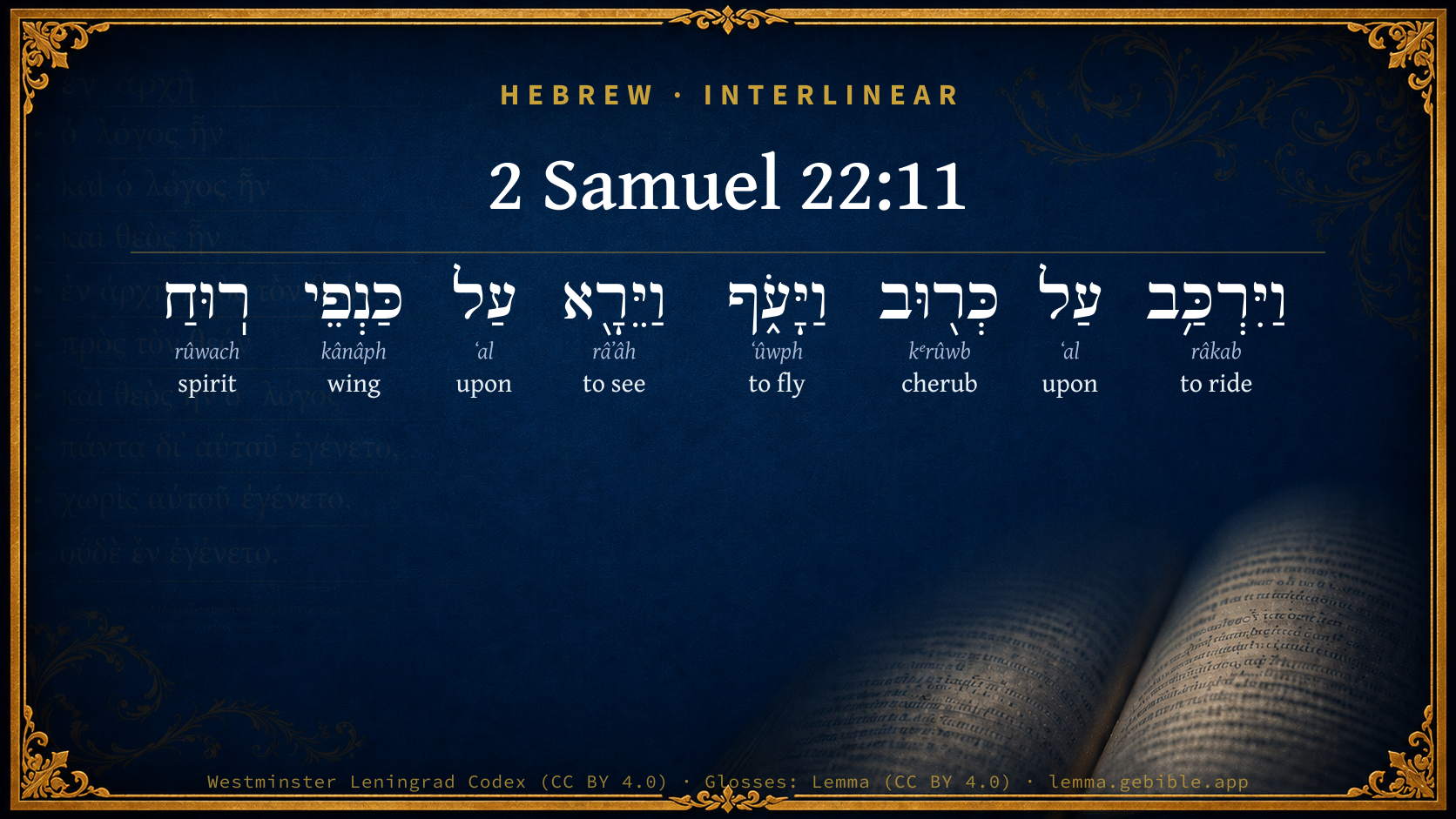
  1. וַיִּרְכַּ֥ב râkab H7392 “and · to ride” Conjunction + Verb, Qal, Sequential Imperfect, 3rd Person, Masculine, Singular
  2. עַל ʻal H5921 “upon” Preposition
  3. כְּר֖וּב kᵉrûwb H3742 “cherub” Noun, Common, Masculine, Singular, Absolute
  4. וַיֵּרָ֖א râʼâh H7200 “and · to see” Conjunction + Verb, Niphal, Sequential Imperfect, 3rd Person, Masculine, Singular
  5. עַל ʻal H5921 “upon” Preposition
  6. כַּנְפֵי kânâph H3671 “wings of” Noun, Common, Feminine, Dual, Construct
  7. רֽוּחַ rûwach H7307 “spirit” Noun, Common, Both, Singular, Absolute

About this verse

These counts appear in no published source. They are computed here, from the morphology-tagged text and Lemma’s own curated glosses. What Lemma adds →

8
words
7
distinct lemmas
Historical
section

Shared distinctive vocabulary

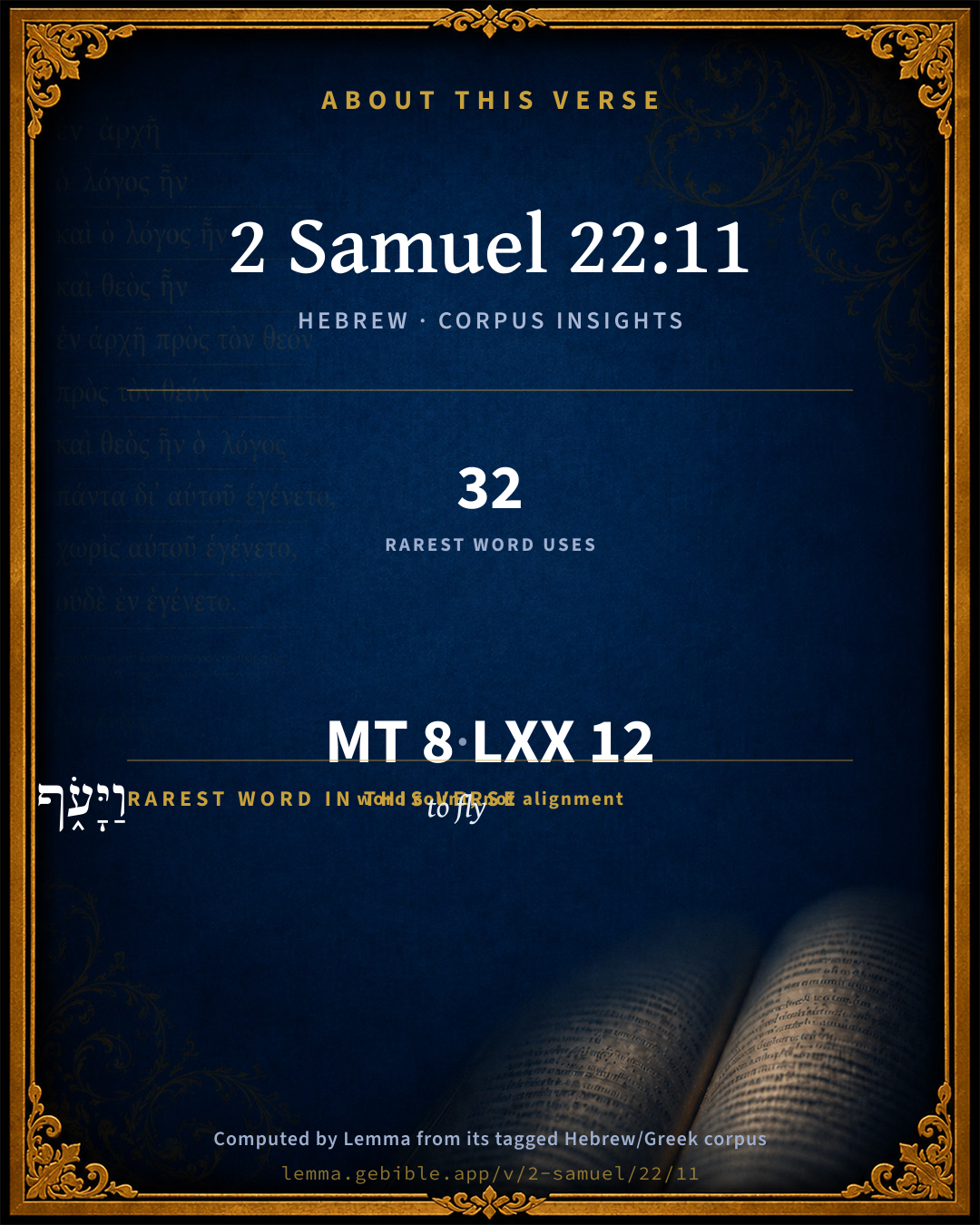
וַיָּעֹ֑ף to fly H5774 occurs in 29 verses of the Hebrew Bible. Also found in:

Grammatical profile

  • 3 verbs
  • 3 nouns
  • 2 prepositions

Verb forms

  • וַיִּרְכַּ֥ב Qal · Sequential Imperfect
  • וַיָּעֹ֑ף Qal · Sequential Imperfect
  • וַיֵּרָ֖א Niphal · Sequential Imperfect

Repetition

A word recurs within this verse — often emphatic in Hebrew:

Hebrew & Septuagint length

In English translation the verse runs 18 words from the Hebrew and 18 from the Septuagint (LXX English) — the same length.

A rough comparison of the two English renderings, which tokenize alike — not a word-level alignment.

Word counts can differ between the Hebrew and the Greek without any difference in meaning — e.g. the Hebrew direct-object marker אֵת has no separate Greek word, and Greek often adds the article ὁ.

In the original languages it is 8 Hebrew tokens and 12 Greek tokens — but the two are counted differently (Hebrew bundles its prefixes and suffixes into one token; the Greek is in lemma form), so that isn’t a like-for-like length.

Cross-references

12

Topical passages linked to 2 Samuel 22:11 in the Treasury of Scripture Knowledge — connected by theme and wording, ordered by reader-vote popularity; previews shown in the World English Bible.

  • Psalms 104:3 He lays the beams of his chambers in the waters. He makes the clouds his chariot. He walks on the wings of the wind.
  • Psalms 18:10 He rode on a cherub, and flew. Yes, he soared on the wings of the wind.
  • Genesis 3:24 So he drove out the man; and he placed Cherubs at the east of the garden of Eden, and the flame of a sword which turned every way, to guard the way to the tree of life.
  • Exodus 25:19 Make one cherub at the one end, and one cherub at the other end. You shall make the cherubim on its two ends of one piece with the mercy seat.
  • 1 Samuel 4:4 So the people sent to Shiloh; and they brought from there the ark of the covenant of Yahweh of Hosts, who sits [above] the cherubim: and the two sons of Eli, Hophni and Phinehas, were there with the ark of the covenant of God.
  • Psalms 68:17 The chariots of God are tens of thousands and thousands of thousands. The Lord is among them, from Sinai, into the sanctuary.
  • Psalms 80:1 Hear us, Shepherd of Israel, You who lead Joseph like a flock, You who sit above the cherubim, shine forth.
  • Psalms 99:1 Yahweh reigns! Let the peoples tremble. He sits enthroned among the cherubim. Let the earth be moved.
  • Psalms 139:9 If I take the wings of the dawn, And settle in the uttermost parts of the sea;
  • Ezekiel 9:3 The glory of the God of Israel was gone up from the cherub, whereupon it was, to the threshold of the house: and he called to the man clothed in linen, who had the writer's inkhorn by his side.
  • Ezekiel 10:2–14 He spoke to the man clothed in linen, and said, Go in between the whirling [wheels], even under the cherub, and fill both your hands with coals of fire from between the cherubim, and scatter them over the city. He went in as I watched.
  • Hebrews 1:14 Aren't they all ministering spirits, sent out to do service for the sake of those who will inherit salvation?

Cross-references courtesy of OpenBible.info (CC BY 4.0).

Hebrew and Greek witnesses Masoretic Hebrew ↔ Greek Septuagint

The same verse in the two great witnesses to the Old Testament, shown verse-for-verse.

These are two independent witnesses, not word-aligned to each other, and the Septuagint is shown in lemma (dictionary) form.

Hebrew 2 Samuel 22:11 Masoretic · Westminster Leningrad Codex

וַיִּרְכַּ֥ב עַל כְּר֖וּב וַיָּעֹ֑ף וַיֵּרָ֖א עַל כַּנְפֵי רֽוּחַ

He rode on a cherub, and did fly; Yes, he was seen on the wings of the wind.

World English Bible · Public Domain

Greek LXX 2 Samuel 22:11 Septuagint · lemma form

καί ἐπι καταἵζω ἐπί χερουβ καί πετάννυμι καί ὁράω ἐπί πτέρυξ ἄνεμος

And he rode upon the cherubs and did fly, and was seen upon the wings of the wind.

LXX2012 (modern English Septuagint) · Public Domain

Hebrew: Westminster Leningrad Codex (CC BY 4.0). Greek: Septuagint (public domain); English from LXX2012 (modern English Septuagint) (Public Domain). How the Septuagint differs from the Hebrew →

Targum (Aramaic paraphrase)

1

The Targum is the ancient Jewish Aramaic paraphrase of the Hebrew Scriptures — an interpretive translation, not the Hebrew text itself. Onkelos (literal) and Pseudo-Jonathan (expansive) render the Torah, and Jonathan the Prophets. Coverage is partial: where no permissively-licensed English translation exists for a verse, only the Aramaic is shown. This is verse-level text, not a word-by-word alignment to the Hebrew.

  1. Targum Jonathan Prophets (Joshua–Malachi)
    וְאִתְגְלֵי בִּגְבוּרְתֵיהּ עַל כְּרוּבִין קַלִילִין וְדַבַּר בִּתְקֵיף עַל כַּנְפֵי רוּחָא:

    (no public-domain English translation for this verse)

    Targum Jonathan — Aramaic: “Mikraot Gedolot” (public domain). English: “Sefaria Community Translation” (CC0 1.0 (public-domain dedication)); “London "Chaldee Paraphrase," 1871” (public domain). Text via Sefaria.

Commentary

Notes on 2 Samuel 22:11 from classic Christian and Jewish commentators (each source and its license shown beneath its notes). The classic Christian expositions comment on the surrounding passage and are grouped to its opening verse, so a note may address several verses; the Jewish commentaries on the Tanakh (Rashi and others) are per-verse, so they appear only where the commentator wrote on this verse.

Lemma curates 59 commentaries, every one of them public domain or Creative Commons licensed, each selected and text-cleaned for this edition rather than reprinted as found. About our sources →

Keil & Delitzsch

C. F. Keil & F. Delitzsch

11 He rode upon a cherub and flew hither,

And appeared upon the wings of the wind.

12 He made darkness round about Him as pavilions,

Water-gathering, thick clouds.

13 Out of the splendour before Him

Burned red-hot coals of fire.

These three verses are a further expansion of Sa2 22:19, and Sa2 22:11 of Sa2 22:10. The cherub is not a personified earthly creature, for cherubim are angels around the throne of God (see at Gen 3:22). The poetical figure "riding upon the cherub" is borrowed from the fact that God was enthroned between the two cherubim upon the lid of the ark of the covenant, and above their outspread wings (Exo 25:20-21). As the idea of His "dwelling between the cherubim" (Sa2 6:2; Sa1 4:4; Psa 80:2) was founded upon this typical manifestation of the gracious presence of God in the Most Holy place, so here David depicts the descent of Jehovah from heaven as "riding upon a cherub," picturing the cherub as a throne upon which God appears in the clouds of heaven, though without therefore imagining Him as riding upon a sphinx or driving in a chariot-throne. Such notions as these are precluded by the addition of the term ויּעף, "did fly." The "flying" is also suggested by the wings of the cherubim. As the divine "shechinah" was enthroned above the ark of the covenant upon the wings of the cherubim, David in his poetical description represents the cherub and his wings as carrying the throne of God, to express the thought that Jehovah came down from heaven as the judge and saviour of His servants in the splendour of His divine glory, surrounded by cherubim who stand as His highest servants around His throne, just as Moses in his blessing (Deu 33:2) speaks of Jehovah as coming out of myriads of His holy angels. The elementary substratum of this was the wings of the wind, upon which He appeared. In the psalm we have ויּדא, from דּאה, to soar (Deu 28:39; Jer 48:40), which suggests the idea of flying better than ויּרא (He was seen), though the latter gives the real explanation. In Sa2 22:12 and Sa2 22:13, the "cloudy darkness under His feet" (Sa2 22:10) is still further expanded, so as to prepare the way for the description of thunder and lightning in Sa2 22:14. God in His wrath withdraws His face from man. He envelopes himself in clouds. The darkness round about him is the black thunder-cloud which forms His hut or tent. The plural succoth is occasioned by the plural סביבתיו, "His surroundings:" it is used with indefinite generality, and is more probably the original term than סכּתו in the psalm. The "darkness" is still further explained in the second clause, מים חשׁרת, water-gatherings. חשׁרה (ἁπ. λεγ.) signifies, according to the Arabic, a gathering or collection. The expression used in the psalm is מים חשׁכת, water-darkness, which, if not less appropriate, is at any rate not the original term. שׁחקים עבי, clouds of clouds, i.e., the thickest clouds; a kind of superlative, in which a synonym is used instead of the same noun.

Keil & Delitzsch — Biblical Commentary on the Old Testament (1861–1891) — public domain (CC PDM 1.0). Text via the HelloAO Bible API. (Old Testament only.)

Geneva Bible (1599)

Geneva Bible translators

To fly in a moment through the world.

Geneva Bible (1599) marginal notes — public domain. Text via Bolls.life.

Adam Clarke's Commentary

Verse 11. He rode upon a cherub, and did fly - he was seen upon the things of the wind.] In the original of this sublime passage, sense and sound are astonishingly well connected. I shall insert the Hebrew, represent it in English letters for the sake of the unlearned reader, and have only to observe, he must read from the right to the left.

רוח כנפי על וירא ויעף כרוב על וירכב

ruach canphey al vaiyera :vaiyaoph kerub al vayirkab

wind the of wings the upon seen was he and :fly did and cherub a upon rode he

The clap of the wing, the agitation and rush through the air are expressed here in a very extraordinary manner.

Other beauties of this kind will be noted in the exposition of the Psalm alluded to above.

I now subjoin Dr. Kennicott's remarks on this chapter: -

"The very sublime poetry contained in this chapter is universally admired, and yet it cannot be perfectly understood, till it is known WHO is the speaker, who the person thus triumphant over mighty enemies, whose sufferings occasioned such a dreadful convulsion of nature, and, who, upon his deliverance, inflicted such vengeance on his own people, and also became thus a king over the heathen. Should we be told that this person was David, it will be very difficult to show how this description can possibly agree with that character: but if it did in fact agree, yet would it contradict St. Paul, who quotes part of it as predicting the conversion of the Gentiles under Christ the Messiah. Ro 15:9; Heb 2:13; and see Peirce's Commentary, p. 50. Now if the person represented as speaking through this Divine ode be David only, the Messiah is excluded. In consequence of the difficulties resulting from each of these suppositions, the general idea has been that it relates both to David and to the Messiah as a prophecy of a double sense; first, as spoken by David of himself, and yet to be understood in a secondary sense, of the Messiah. But it must be remarked here, that if spoken only of David, it is not a prediction of any thing future, but a thanksgiving for favours past, and therefore is no prophecy at all. And farther, it could not be a prophecy descriptive of David unless the particulars agreed to David, which they evidently do not. If then David be here necessarily excluded from the single sense, he must be excluded also from the double sense, because nothing can be intended by any sacred writer, to relate to two persons, unless it be TRUE of both; but it not being the case here as to David, we must conclude that this song relates only to the Messiah; and on this subject an excellent Dissertation, by the late Mr. Peirce, is subjoined to his comment on the Epistle to the Hebrews. It may be necessary to add here two remarks: the twenty-fourth verse now ends with, I have kept myself from mine iniquity, which words, it is objected, are not proper, if applied to the Messiah. But this difficulty is removed, in part, by the context, which represents the speaker as perfectly innocent and righteous; and this exactly agrees with the proof arising from the Syriac and Arabic versions, and also the Chaldee paraphrase, that this word was anciently מעונים ab iniquitatibus; consequently, this is one of the many instances where the ם final mem is improperly omitted by the Jewish transcribers. See my General Dissertation, p. 12. Lastly, the difficulty arising from the title, which ascribes the Psalm to David, and which seems to make him the speaker in it, may be removed, either by supposing that the title here, like those now prefixed to several Psalms, is of no sufficient authority; or rather, by considering this title as only meant to describe the time when David composed this prophetic hymn, that when delivered from all his other enemies as well as from the hand of Saul, he then consecrated his leisure by composing this sublime prophecy concerning MESSIAH, his son, whom he represents here as speaking, (just as in Psa. 22, 40, and other places,) and as describing,

1. His triumph over death and hell;

2. The manifestations of Omnipotence in his favour, earth and heaven, trembling at God's awful presence;

3. The speaker's innocence thus divinely attested;

4. The vengeance he was to take on his own people the Jews, in the destruction of Jerusalem; and,

5. The adoption of the heathen, over whom he was to be the head and ruler.

"Another instance of a title denoting only the time of a prophecy, occurs in the very next chapter; where a prophecy concerning the Messiah is entitled, The LAST words of David; i.e., a hymn which he composed a little before his death, after all his other prophecies. And perhaps this ode in 2 Sam. 22, which immediately precedes that in 2 Sam. 23, was composed but a little while before; namely, when all his wars were over. Let it be added, that Josephus, immediately before he speaks of David's mighty men, which follow in this same chapter of Samuel, considers the two hymns in 2 Sam. 22 and 23, as both written after his wars were over - Jam Davides, bellis et periculis perfunctus, pacemque deinceps profundam agitans, odas in Deum hymnosque composuit. Tom. i., page 401."

Adam Clarke's Commentary on the Bible (1810–1826) — public domain. Text from a community e-Sword/MySword module.

Ellicott's Commentary for English Readers

(11) He was seen.—Psalms 18, “he did fly.” The two words are exceedingly alike in the Hebrew, and either could easily be mistaken for the other. The form in the psalm is far more poetical.

A Bible Commentary for English Readers, edited by Charles John Ellicott (1878–1897) — public domain. Text from a community e-Sword module.

The Cambridge Bible for Schools and Colleges

gen. ed. J. J. S. Perowne

11. he rode upon a cherub] As the Shechinah, or mystic Presence of God in the cloud of glory, rested over the Cherubim which were upon the “Mercy-seat” or covering of the Ark (ch. 2Sa_6:2), so in this Theophany God is represented “riding upon a Cherub,” as the living throne on which He traverses space.

The Cherubim appear in Scripture (a) as the guardians of Paradise (Gen_3:24): (b) as sculptured or wrought figures in the Tabernacle and Temple (Exo_25:17-20; Exo_26:1, &c.): (c) in prophetic visions as the attendants of God (Eze_10:1 ff; cp. Ezekiel 1; Isaiah 6; Revelation 4). The Cherubim of the Tabernacle and Temple seem to have been winged human figures, representing the angelic attendants who minister in God’s Presence: those of Ezekiel’s vision appear as composite figures (Eze_10:20-21), symbolical perhaps of all the powers of nature, which wait upon God and fulfil His Will.

was seen] The true reading is that preserved in Psa_18:10, did fly, a peculiar word used of the swooping of an eagle (Deu_28:49; Jer_48:40; Jer_49:22). The consonants of the two words are so nearly alike (וידא–וירא), that the rarer word would be easily altered into the more common one. For “the wings of the wind” cp. Psa_104:3.

The Cambridge Bible for Schools and Colleges (gen. ed. J. J. S. Perowne; Cambridge University Press, 1878–1918) — public domain. Text from a community e-Sword module.

John Gill's Exposition

They prevented me in the day of my calamity: but the Lord was my stay. See Gill on Psa 18:18.

.

2 Samuel 22:20

sa2 22:20

sa2 22:20

sa2 22:20He brought me forth also into a large place: he delivered me,

because he delighted in me. See Gill on Psa 18:19.

John Gill's Exposition of the Whole Bible (1746–1763) — public domain (CC PDM 1.0). Text via the HelloAO Bible API.

Haydock's Catholic Bible Commentary

Upon. Cardell (Menochius) would translate the Hebrew, "as in contest."

George Leo Haydock (1774–1849), Haydock's Catholic Family Bible and Commentary, 1859 edition — public domain. Excludes Psalms (Douay-Rheims chapter numbering differs from Protestant) and Deuterocanonical books (Catholic canon only).

Whedon's Commentary on the Bible

Daniel D. Whedon

11. Rides upon a cherub — Jehovah communed with Moses from between the two cherubim that spread their wings over the mercy-seat.

Exo_25:22. So here he is represented as moving forth upborne on a cherub’s wing. Compare Ezekiel’s vision, where the outspread wings of the cherubim support the firmament on which rests the throne of the Divine Glory. Eze_1:23; Eze_1:26.

Wings of the wind — An allusion to some sweeping tempest, an element often used as the Lord’s minister of judgment. Comp. Jdg_5:4, note.

Daniel D. Whedon (gen. ed.), Commentary on the Old and New Testaments (1874–1909) — public domain. Text from a community e-Sword module.

The Pulpit Commentary

Vers. 11-13.

And he rode upon a cherub, and did fly; And he was seen upon the wings of the wind. And he made darkness booths round about him; Gathering of waters, thickenings of clouds. Out of the brightness before him Coals of fire burned. 2Sa_6:2 Jehovah is described as sitting upon the cherubim; his presence there, called by the rabbins his Shechinah, that is, dwelling, being indicated by a cloud of light. In this psalm the cherub is his chariot, on which he rides forth to judgment. He was seen. There can be little doubt that the right reading is preserved in Psa_18:10, where we find a verb signifying the swooping down of a bird of prey upon its quarry (Deu_28:49; Jer_48:40) The two words differ only in the substitution of r for d, and these letters are so similar in Hebrew that they are constantly interchanged. Booths; made of branches of trees, and forming a temporary abode. So the dark storm clouds are gathered round the Almighty to veil his awful form from sight as he goes forth for judgment. Gathering of waters; probably the right reading, instead of which in the psalm we find "dark waters." The gathering of waters would describe the massing of the rain clouds. The difference here also consists only in one letter. Out of the brightness, which closely surrounds the Deity in the midst of the black mass of the tempest, the lightning flashes forth. This brightness is the Shechinah (see above), to which St. Paul also refers where he says that God"s dwelling is in "the unapproachable light". (1Ti_6:16)

The Pulpit Commentary (1880–1919), ed. H.D.M. Spence-Jones & Joseph S. Exell — public domain. Text from a community e-Sword module.

Lesson kit

Teaching starters — assembled from the data on this page, not authored interpretation. Every prompt links to the verse data it draws on. Edit before teaching.

2 Samuel, in the Historical, opens this verse with 8 words (7 distinct Hebrew lemmas). Its most distinctive word is ʻûwph (“to fly”). A historical commentator’s framing appears above. Read the whole chapter for the surrounding context.

Discussion questions

  1. What does “to fly” (ʻûwph) contribute to the verse as a whole?
  2. How does Genesis 1:20, which shares the word «to fly», read alongside this verse?
  3. What does the repetition of “upon” (2× in this one verse) do in this verse?
  4. The translations on this page render this verse differently — a whole-verse word diff, not a word-by-word alignment. What might account for the different wordings?
  5. «וַיִּרְכַּ֥ב» is a Qal Sequential Imperfect verb. How does that grammatical form shape the action described?
  6. Compare how Keil & Delitzsch and Geneva Bible (1599) read this verse. Where do they agree or differ?

Things to notice

Reading settings

Reading text

Shown beneath each verse's original-language words.

Old Testament
Old Testament edition

Read the OT as the Masoretic Hebrew (MT) or the Greek Septuagint (LXX).

English shown for the Greek Septuagint (in the Hebrew ↔ Greek comparison).

Comparing translations? Open the Compare panel on any verse page to stack up to four side by side.