
Isaiah 63:10

Hebrew (Westminster Leningrad Codex) Isaiah 63:10 appears in the Hebrew Old Testament. The text above is from the Westminster Leningrad Codex. Each word links to its Strong’s number, a concise gloss, and parsing drawn from the Open Scriptures Hebrew Bible morphology. Click any word for its full Brown-Driver-Briggs (BDB) entry.
Download image
Cite this verse

Isaiah 63:10 (World English Bible). Public Domain. Lemma interlinear Bible study tool, https://lemma.gebible.app/v/isaiah/63/10.

Show BibTeX & RIS
BibTeX
RIS
English Translation
But they rebelled, and grieved his holy Spirit: therefore he was turned to be their enemy, [and] himself fought against them.
World English Bible · Public Domain
Download a study sheet

One document with this verse’s original text, its word-by-word gloss line, the meaning frame, cross-references with their text, attributed commentary, and full source and license credits — printable, and it pastes into notes with its structure intact.

This verse Autodidact and up

Study sheet (.html) Plain text (.txt)

A passage Seminary Student

Up to 50 verses in one chapter. A passage sheet keeps up to 6 commentary sources and 12 cross-references per verse, in the order this page ranks them, and says so on the sheet whenever that leaves anything out. Ask for a single verse and you get the Autodidact verse sheet above.

Everything on this page stays free to read, with no account — the sheet is a download of what is already on screen, not access to it.

Want to remove ads? Support Godless Engineer
Compare translations 3

The same verse in 3 English versions, stacked beneath the original-language interlinear above. Click any original word for its lexicon entry.

Each is an independent rendering of the whole verse — the interlinear is not word-aligned to these translations.

Highlighted words mark where these versions differ — a whole-verse word diff, not a word-by-word alignment.

  • World English Bible Public Domain
    But they rebelled, and grieved his holy Spirit: therefore he was turned to be their enemy, [and] himself fought against them.
  • King James Version Public Domain
    But they rebelled, and vexed his holy Spirit: therefore he was turned to be their enemy, and he fought against them.
  • unfoldingWord Literal Text CC BY-SA 4.0
    But they, they rebelled, and they grieved the Spirit of his holiness. And he turned himself into an enemy of them; he, he fought with them.

unfoldingWord Literal Text — © unfoldingWord, licensed CC BY-SA 4.0. Word-aligned USFM3 via Door43 (git.door43.org/unfoldingWord/en_ult).

Versions to compare (up to 4)

3 of 4 selected

Show all 18 translations

Every available English version of this verse, each an independent rendering of the whole verse.

  • World English Bible Public Domain
    But they rebelled, and grieved his holy Spirit: therefore he was turned to be their enemy, [and] himself fought against them.
  • Berean Standard Bible Public Domain
    But they rebelled and grieved His Holy Spirit. So He turned and became their enemy, and He Himself fought against them.
  • Majority Standard Bible Public Domain
    But they rebelled and grieved His Holy Spirit. So He turned and became their enemy, and He Himself fought against them.
  • King James Version Public Domain
    But they rebelled, and vexed his holy Spirit: therefore he was turned to be their enemy, and he fought against them.
  • American Standard Version (1901) Public Domain
    But they rebelled, and grieved his holy Spirit: therefore he was turned to be their enemy, `and' himself fought against them.
  • Revised Version (1885) Public Domain
    But they rebelled, and grieved his holy spirit: therefore he was turned to be their enemy, and himself fought against them.
  • Geneva Bible (1599) Public Domain
    But they rebelled and vexed his holy Spirit: therefore was hee turned to be their enemie and he fought against them.
  • Douay-Rheims (1899) Public Domain
    But they provoked to wrath, and afflicted the spirit of his Holy One: and he was turned to be their enemy, and he fought against them.
  • Young's Literal Translation Public Domain
    And they have rebelled and grieved His Holy Spirit, And He turneth to them for an enemy, He Himself hath fought against them.
  • Literal Standard Version CC BY-SA 4.0
    And they have been rebellious and have grieved His Holy Spirit, || And He turns to them for an enemy, || He Himself has fought against them.
  • Unlocked Literal Bible CC BY-SA 4.0
    But they rebelled and grieved his Holy Spirit. So he became their enemy and fought against them.
  • unfoldingWord Literal Text CC BY-SA 4.0
    But they, they rebelled, and they grieved the Spirit of his holiness. And he turned himself into an enemy of them; he, he fought with them.
  • Darby Bible Public Domain
    But they rebelled and grieved his holy Spirit: and he turned to be their enemy; himself, he fought against them.
  • World Messianic Bible Public Domain
    But they rebelled and grieved his Holy Spirit. Therefore he turned and became their enemy, and he himself fought against them.
  • Webster's Bible Public Domain
    But they rebelled, and vexed his holy Spirit: therefore he was turned to be their enemy, and he fought against them.
  • Free Bible Version CC BY-SA 4.0
    But they rebelled against him, and caused his Holy Spirit grief, so to them he became like an enemy and he fought against them.
  • Bible in Basic English Public Domain
    But they went against him, causing grief to his holy spirit: so he was turned against them, and made war on them.
  • JPS Tanakh (1917) Public Domain
    But they rebelled, and grieved His holy spirit; therefore He was turned to be their enemy, Himself fought against them.

Literal Standard Version (2020), Covenant Press — licensed CC BY-SA 4.0. Text via the HelloAO Bible API (eBible.org). Unlocked Literal Bible (unfoldingWord) — licensed CC BY-SA 4.0. Text via the HelloAO Bible API (eBible.org). unfoldingWord Literal Text — © unfoldingWord, licensed CC BY-SA 4.0. Word-aligned USFM3 via Door43 (git.door43.org/unfoldingWord/en_ult). Free Bible Version, Dr. Jonathan Gallagher — licensed CC BY-SA 4.0. Text via the HelloAO Bible API (eBible.org).

Word by word

More ways to search: Search by grammar → Find every occurrence → Compare this word →

Practice this passage: Drill this verse → Learn its vocabulary →

וְעִצְּב֖וּ
ʻâtsab
H6087
“and · to pain”
Conjunction + Verb, Piel, Sequential Perfect, 3rd Person, Common, Plural
Part of Speech
Conjunction + Verb
Stem
Piel
Form
Sequential Perfect
Person
3rd Person
Gender
Common
Number
Plural
Full BDB Definition

Origin: a primitive root

TWOT: 1666 , 1667

to hurt, pain, grieve, displease, vex, wrest - (Qal) to hurt, pain - (Niphal) to be in pain, be pained, be grieved - (Piel) to vex, torture - (Hiphil) to cause pain - (Hithpael) to feel grieved, be vexed - to shape, fashion, make, form, stretch into shape, (TWOT) worship - (Piel) to shape, form - (Hiphil) to form, copy, fashion
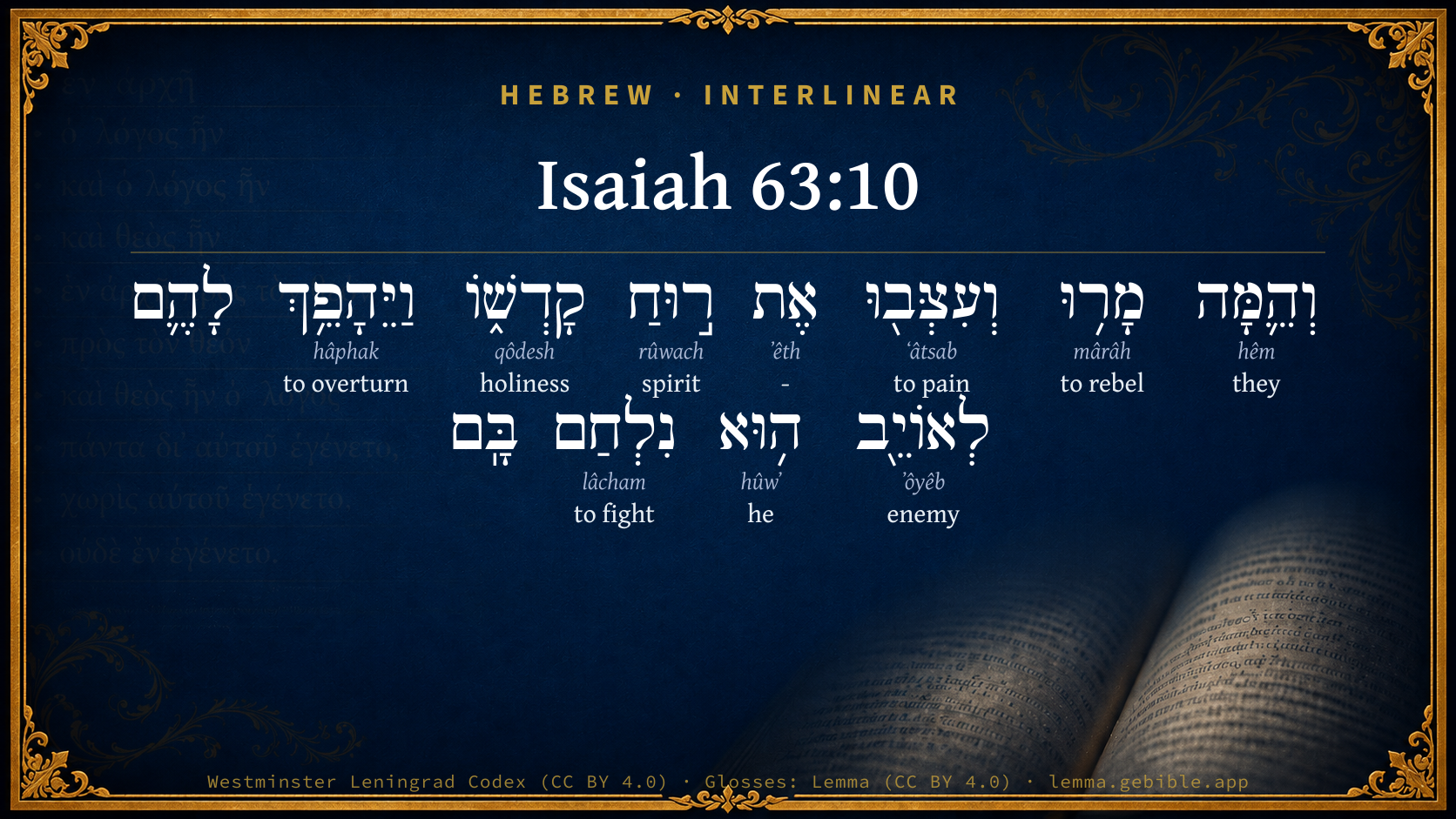
  1. וְהֵ֛מָּה hêm H1992 “and · they” Conjunction + Pronoun, Personal, 3rd Person, Masculine, Plural
  2. מָר֥וּ mârâh H4784 “to rebel” Verb, Qal, Perfect, 3rd Person, Common, Plural
  3. אֶת ʼêth H853 “-” Particle, Direct Object
  4. ר֣וּחַ rûwach H7307 “spirit of” Noun, Common, Both, Singular, Construct
  5. קָדְשׁ֑וֹ qôdesh H6944 “holiness · his” Noun, Common, Masculine, Singular, Construct + Suffix, Personal, 3rd Person, Masculine, Singular
  6. וַיֵּהָפֵ֥ךְ hâphak H2015 “and · to overturn” Conjunction + Verb, Niphal, Sequential Imperfect, 3rd Person, Masculine, Singular
  7. לְאוֹיֵ֖ב ʼôyêb H341 “to/for · enemy” Preposition + Verb, Qal, Participle Active, Masculine, Singular, Absolute
  8. ה֥וּא hûwʼ H1931 “he” Pronoun, Personal, 3rd Person, Masculine, Singular
  9. נִלְחַם lâcham H3898 “to fight” Verb, Niphal, Perfect, 3rd Person, Masculine, Singular

About this verse

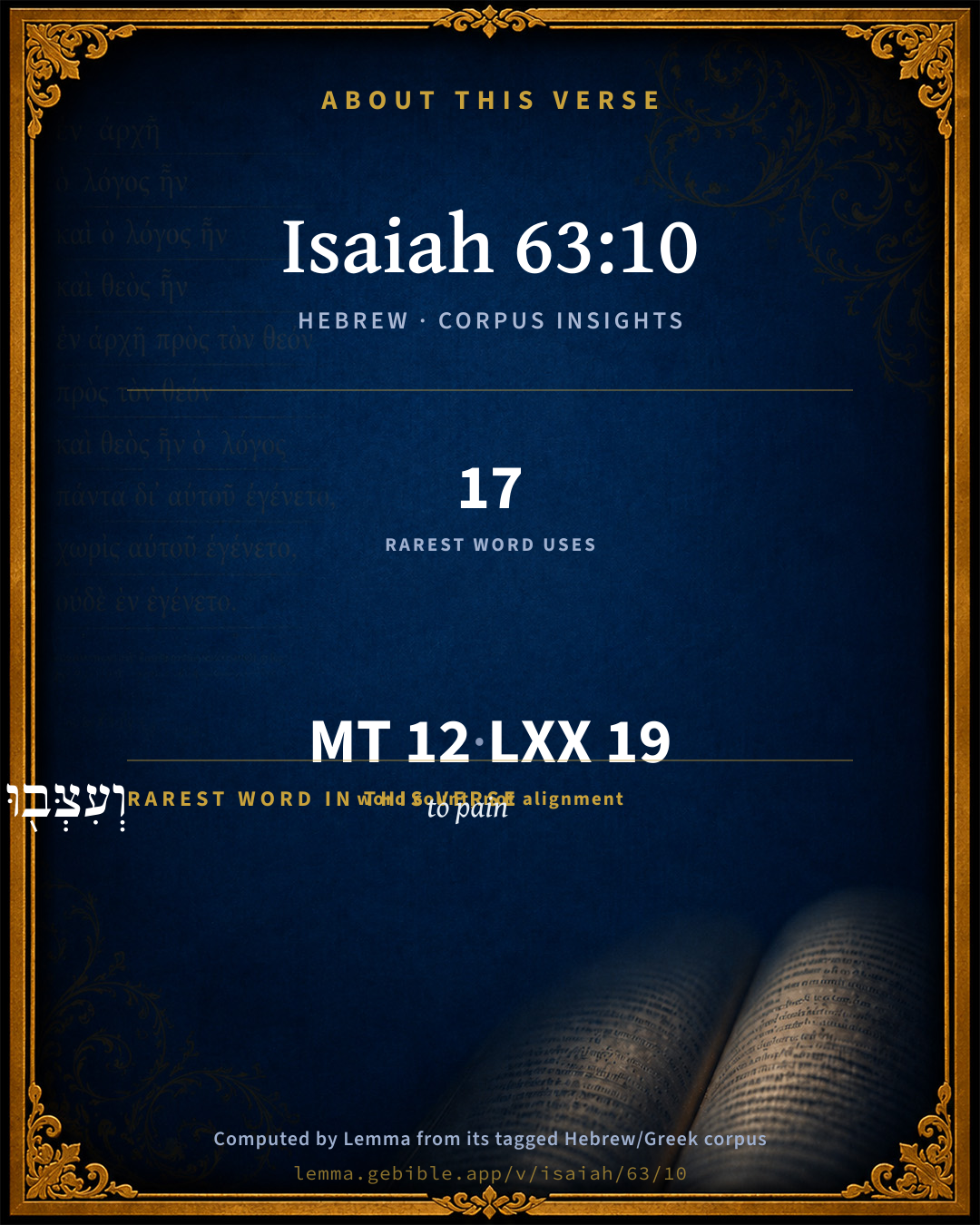
These counts appear in no published source. They are computed here, from the morphology-tagged text and Lemma’s own curated glosses. What Lemma adds →

12
words
10
distinct lemmas
Prophets
section

Notable vocabulary

The rarest word here is וְעִצְּב֖וּ to pain H6087 — appearing just 17 times in the whole Hebrew Bible.

Shared distinctive vocabulary

וְעִצְּב֖וּ to pain H6087 occurs in 17 verses of the Hebrew Bible. Also found in:

Grammatical profile

  • 5 verbs
  • 2 nouns
  • 2 pronouns
  • 2 prepositions
  • 1 particle

Verb forms

  • מָר֥וּ Qal · Perfect
  • וְעִצְּב֖וּ Piel · Sequential Perfect
  • וַיֵּהָפֵ֥ךְ Niphal · Sequential Imperfect
  • לְאוֹיֵ֖ב Qal · Participle Active
  • נִלְחַם Niphal · Perfect

Hebrew & Septuagint length

In English translation the verse runs 21 words from the Hebrew and 20 from the Septuagint (LXX English) — closely comparable.

A rough comparison of the two English renderings, which tokenize alike — not a word-level alignment.

Word counts can differ between the Hebrew and the Greek without any difference in meaning — e.g. the Hebrew direct-object marker אֵת has no separate Greek word, and Greek often adds the article ὁ.

In the original languages it is 12 Hebrew tokens and 19 Greek tokens — but the two are counted differently (Hebrew bundles its prefixes and suffixes into one token; the Greek is in lemma form), so that isn’t a like-for-like length.

Cross-references

36

Topical passages linked to Isaiah 63:10 in the Treasury of Scripture Knowledge — connected by theme and wording, ordered by reader-vote popularity; previews shown in the World English Bible.

  • Acts 7:51 "You stiff-necked and uncircumcised in heart and ears, you always resist the Holy Spirit! As your fathers did, so you do.
  • Ephesians 4:30 Don't grieve the Holy Spirit of God, in whom you were sealed for the day of redemption.
  • Psalms 78:56 Yet they tempted and rebelled against the Most High God, And didn't keep his testimonies;
  • Psalms 78:40 How often they rebelled against him in the wilderness, And grieved him in the desert!
  • Jeremiah 21:5 I myself will fight against you with an outstretched hand and with a strong arm, even in anger, and in wrath, and in great indignation.
  • Nehemiah 9:16–17 But they and our fathers dealt proudly and hardened their neck, and didn't listen to your commandments,
  • Ezekiel 20:8 But they rebelled against me, and would not listen to me; they did not every man cast away the abominations of their eyes, neither did they forsake the idols of Egypt. Then I said I would pour out my wrath on them, to accomplish my anger against them in the midst of the land of Egypt.
  • Psalms 51:11 Don't throw me from your presence, And don't take your holy Spirit from me.
  • Exodus 15:24 The people murmured against Moses, saying, "What shall we drink?"
  • Exodus 16:8 Moses said, "Now Yahweh shall give you meat to eat in the evening, and in the morning bread to satisfy you; because Yahweh hears your murmurings which you murmur against him. And who are we? Your murmurings are not against us, but against Yahweh."
  • Exodus 23:21 Pay attention to him, and listen to his voice. Don't provoke him, for he will not pardon your disobedience, for my name is in him.
  • Deuteronomy 9:7 Remember, don't forget, how you provoked Yahweh your God to wrath in the wilderness: from the day that you went forth out of the land of Egypt, until you came to this place, you have been rebellious against Yahweh.
  • Deuteronomy 32:19–25 Yahweh saw [it], and abhorred [them], Because of the provocation of his sons and his daughters.
  • Nehemiah 9:29 and testified against them, that you might bring them again to your law. Yet they dealt proudly, and didn't listen to your commandments, but sinned against your ordinances, (which if a man do, he shall live in them), and withdrew the shoulder, and hardened their neck, and would not hear.
  • Psalms 78:8 And might not be as their fathers, A stubborn and rebellious generation, A generation that didn't make their hearts loyal, Whose spirit was not steadfast with God.
  • Psalms 95:9–11 When your fathers tempted me, Tested me, and saw my work.
  • Ezekiel 2:7 You shall speak my words to them, whether they will hear, or whether they will forbear; for they are most rebellious.
  • Ezekiel 6:9 Those of you that escape shall remember me among the nations where they shall be carried captive, how that I have been broken with their lewd heart, which has departed from me, and with they eyes, which play the prostitute after their idols: and they shall loathe themselves in their own sight for the evils which they have committed in all their abominations.
  • Ezekiel 20:21 But the children rebelled against me; they didn't walk in my statutes, neither kept my ordinances to do them, which if a man do, he shall live in them; they profaned my Sabbaths. Then I said I would pour out my wrath on them, to accomplish my anger against them in the wilderness.
  • Exodus 32:8 They have turned aside quickly out of the way which I commanded them. They have made themselves a molten calf, and have worshiped it, and have sacrificed to it, and said, 'These are your gods, Israel, which brought you up out of the land of Egypt.'"
  • Leviticus 26:17–46 I will set my face against you, and you will be struck before your enemies. Those who hate you will rule over you; and you will flee when no one pursues you.
  • Numbers 14:9–11 Only don't rebel against Yahweh, neither fear the people of the land; for they are bread for us: their defense is removed from over them, and Yahweh is with us: don't fear them.
  • Numbers 16:1–35 Now Korah, the son of Izhar, the son of Kohath, the son of Levi, with Dathan and Abiram, the sons of Eliab, and On, the son of Peleth, sons of Reuben, took [men]:
  • Deuteronomy 28:15–68 But it shall come to pass, if you will not listen to the voice of Yahweh your God, to observe to do all his commandments and his statutes which I command you this day, that all these curses shall come on you, and overtake you.
  • Nehemiah 9:26 Nevertheless they were disobedient, and rebelled against you, and cast your law behind their back, and killed your prophets that testified against them to turn them again to you, and they committed awful blasphemies.
  • Psalms 78:49 He threw on them the fierceness of his anger, Wrath, indignation, and trouble, And a band of angels of evil.
  • Isaiah 1:2 Hear, heavens, And listen, earth; for Yahweh has spoken: I have nourished and brought up children, And they have rebelled against me.
  • Isaiah 65:2 I have spread out my hands all the day to a rebellious people, who walk in a way that is not good, after their own thoughts;
  • Lamentations 1:18 Yahweh is righteous; for I have rebelled against his commandment: Please hear all you peoples, and see my sorrow: My virgins and my young men are gone into captivity.
  • Lamentations 2:4–5 He has bent his bow like an enemy, he has stood with his right hand as an adversary, Has killed all that were pleasant to the eye: In the tent of the daughter of Zion he has poured out his wrath like fire.
  • Ezekiel 2:3 He said to me, Son of man, I send you to the children of Israel, to nations that are rebellious, which have rebelled against me: they and their fathers have transgressed against me even to this very day.
  • Ezekiel 20:13 But the house of Israel rebelled against me in the wilderness: they didn't walk in my statutes, and they rejected my ordinances, which if a man keep, he shall live in them; and my Sabbaths they greatly profaned. Then I said I would pour out my wrath on them in the wilderness, to consume them.
  • Matthew 22:7 When the king heard that, he was angry, and he sent his armies, destroyed those murderers, and burned their city.
  • Deuteronomy 9:22–24 At Taberah, and at Massah, and at Kibroth-hattaavah, you provoked Yahweh to wrath.
  • Jeremiah 30:14 All your lovers have forgotten you; they don't seek you: for I have wounded you with the wound of an enemy, with the chastisement of a cruel one, for the greatness of your iniquity, because your sins were increased.
  • Lamentations 1:20 See, Yahweh; for I am in distress; my heart is troubled; My heart is turned within me; for I have grievously rebelled: Abroad the sword bereaves, at home there is as death.

Cross-references courtesy of OpenBible.info (CC BY 4.0).

Hebrew and Greek witnesses Masoretic Hebrew ↔ Greek Septuagint

The same verse in the two great witnesses to the Old Testament, shown verse-for-verse.

These are two independent witnesses, not word-aligned to each other, and the Septuagint is shown in lemma (dictionary) form.

Hebrew Isaiah 63:10 Masoretic · Westminster Leningrad Codex

וְהֵ֛מָּה מָר֥וּ וְעִצְּב֖וּ אֶת ר֣וּחַ קָדְשׁ֑וֹ וַיֵּהָפֵ֥ךְ לָהֶ֛ם לְאוֹיֵ֖ב ה֥וּא נִלְחַם בָּֽם

But they rebelled, and grieved his holy Spirit: therefore he was turned to be their enemy, [and] himself fought against them.

World English Bible · Public Domain

Greek LXX Isaiah 63:10 Septuagint · lemma form

αὐτός δέ ἀπειθέω καί παραὀξύνω ὁ πνεῦμα ὁ ἅγιος αὐτός καί στρέφω αὐτός εἰς ἔχθρα καί αὐτός πολεμέω αὐτός

But they disobeyed, and provoked his Holy Spirit: so he turned to be an enemy, he himself contended against them.

LXX2012 (modern English Septuagint) · Public Domain

On this verse, Albert Barnes' Notes on the Bible discusses the Septuagint’s reading. Read the note in Commentary ↓

Hebrew: Westminster Leningrad Codex (CC BY 4.0). Greek: Septuagint (public domain); English from LXX2012 (modern English Septuagint) (Public Domain). How the Septuagint differs from the Hebrew →

Targum (Aramaic paraphrase)

1

The Targum is the ancient Jewish Aramaic paraphrase of the Hebrew Scriptures — an interpretive translation, not the Hebrew text itself. Onkelos (literal) and Pseudo-Jonathan (expansive) render the Torah, and Jonathan the Prophets. Coverage is partial: where no permissively-licensed English translation exists for a verse, only the Aramaic is shown. This is verse-level text, not a word-by-word alignment to the Hebrew.

  1. Targum Jonathan Prophets (Joshua–Malachi)
    וְאִינוּן סָרִיבוּ וְאַרְגִיזוּ עַל מֵימַר נְבִיֵי קוּדְשֵׁהּ וְאִתְהַפֵּךְ מֵימְרֵהּ לְהוֹן לִבְעֵיל דְבַב הוּא אַגִיחַ קְרָבָא בְּהוֹן:

    But they rebelled against the word of His holy prophets, and blasphemed, and His WORD became their enemy, and He waged war against them.

    Targum Jonathan — Aramaic: “Mikraot Gedolot” (public domain). English: “Sefaria Community Translation” (CC0 1.0 (public-domain dedication)); “London "Chaldee Paraphrase," 1871” (public domain). Text via Sefaria.

Commentary

Notes on Isaiah 63:10 from classic Christian and Jewish commentators (each source and its license shown beneath its notes). The classic Christian expositions comment on the surrounding passage and are grouped to its opening verse, so a note may address several verses; the Jewish commentaries on the Tanakh (Rashi and others) are per-verse, so they appear only where the commentator wrote on this verse.

Lemma curates 59 commentaries, every one of them public domain or Creative Commons licensed, each selected and text-cleaned for this edition rather than reprinted as found. About our sources →

Trapp's Complete Commentary

John Trapp

Isa 63:10 But they rebelled, and vexed his holy Spirit: therefore he was turned to be their enemy, [and] he fought against them.

Ver. 10. But they rebelled, and vexed his Holy Spirit.] By sinning against light, checks of conscience, motions of the Spirit, mercies without measure, &c. Junius thinketh this a clear place for proof of the Trinity in unity.

So he was turned to be their enemy.] This was an ill turn for them; abused mercy turneth into fury; with the froward God will wrestle. {Psa 18:26}

John Trapp, A Commentary or Exposition upon All the Books of the Old and New Testament (1647–1656) — public domain. Text from a community e-Sword module.

The Biblical Illustrator

Joseph S. Exell

Isa_63:10

But they rebelled, and vexed His holy Spirit

The Holy Spirit in the Old Testament

Except here and in Isa_63:11 and Psa_2:11 the predicate holy is never in the Old Testament used of the Spirit of Jehovah.

It is, perhaps, impossible to determine the exact connotation of the word in this connection. It cannot be accidental that in all three cases the holy Spirit is a principle of religious life; hence the phrase hardly signifies so little as merely His Divine Spirit; as Jehovahs holy arm may mean no more than His Divine arm. Nor is it likely that it describes the Spirit as the influence that imparts to Israel the quality of holiness, i.e separateness from other nations, and consecration to Jehovah. The idea rather is that the Spirit is holy in the same sense as Jehovah Himself is holy--a principle which is both pure and inviolable, which resents and draws back from the contact of human impurity and especially of wilful opposition. This Spirit is a national endowment, residing in the community (verse 11); it is the Spirit of prophecy, resting on Moses, but manifesting its presence also through other organs of revelation Deu_34:9; Num_11:25 ft.). Hence it is said to have led the people (verse 14), and to vex the Spirit is to resist His guidance by disobeying the Divine word which He inspires. The use of this verb marks the highest degree of personification of the Spirit attained in the Old Testament, preparing the way for the New Testament doctrine concerning Him. (Prof. J. Skinner, D. D.)

The Holy Spirit

The Spirit of [Jehovahs] holiness, as an existence capable of feeling, and therefore not a mere force, is distinguished from Him. For as the Angel, who is His countenance, i.e the representation of His nature, is described as a person, both by His name and the mediatorial work of redemption ascribed to Him, so the Spirit of Holiness, i.e holy in Himself and producing holiness (Psa_143:10) is similarly described by the circumstance that He is grieved, and He can therefore feel grief Eph_4:30). Thus Jehovah and the Angel of His countenance and the Spirit of His holiness are distinguished as three existences, in such a way, indeed, that the latter two have their existence from the first; who is the primal ground of the Godhead and of everything Divine. (F. Delitzsch, D. D.)

Rebellion against God

The pronoun at the beginning is emphatic: they on their part, as opposed to Gods forbearance and long-suffering. (J. A. Alexander.)

The sin and consequence of vexing the Holy Spirit

I. INQUIRE CONCERNING THE EVIL DONE.

1. The nature of it. We are not to understand it as if the blessed Spirit of God was capable of real perturbation or passion. That, common reason will tell us, the Divine nature is not capable of. But yet there is some great thing lies under this expression, which we may conceive of in these two particulars.

(1) His will is really crossed.

(2) He doth apprehend and resent this matter; though without any commotion, or perturbation. He resents it so as not to look upon it as a matter of indifference. This He keeps by Him as the just matter era controversy, which He will manage; and will animadvert upon it in His own time, and when a fit and proper season shall come.

2. The cause of this vexation. We may well understand in the general that sin does so; being in its own nature a direct contrariety to His good, and holy, and acceptable will. But especially rebellion against the Spirit of God is vexatious, which is a higher pitch of sin, and implies a continued course of disobedience. We may understand what sin is more especially vexing to the Spirit of God, if we allow ourselves to consider what the titles and attributes of this Spirit in Scripture are.

(1) The Spirit of God is styled the Spirit of truth (Joh_14:17). It is therefore very grievous and vexing to this Spirit, to have a light esteem of Divine truth; to be indifferently affected towards it; to have a loose adherence to it; an easiness to part with it; and much more a proneness to oppose it, and run away from it.

(2) The Spirit of grace (Heb_10:29). It is therefore very vexing to this blessed Spirit when that grace, of which it is the Author, and which it is its office and business to convey and apply, or effectually to reveal, is rejected.

(3) The Spirit of faith (2Co_4:13). When persons continue under the Gospel in obstinate unbelief; and the great things there revealed and discovered to us are but as a tale that is told, or regarded no more than we would regard the word of a child; a most vexing thing to the Spirit of God this must be understood to be.

(4) A Spirit of contrition and repentance (Zec_12:10). We cannot conceive a greater vexation to Him than to find hearts hard as rocks and stones, under the dispensation of the everlasting Gospel.

(5) The Spirit of love (2Ti_1:7); which is the great principle that disposes and inclines the soul towards God. A cold heart, then, towards God; a heart that is disaffected to Him, that keeps at a distance from Him, that will not be engaged in sweet communion with Him through love, is a most vexing thing to His Spirit.

(6) A Spirit of power and of life (Joh_6:63; 2Ti_1:7). It is a very vexatious thing to this Spirit when any indulge themselves in deadness of heart; when they allow themselves to be formal, lukewarm, and indifferent.

(7) The Spirit of holiness (Rom_1:4). Here it is said, They rebelled and vexed His holy Spirit. Thin is a most vexing thing, when persons professing the Christian name indulge themselves in a liberty to walk at random.

(8) A heavenly Spirit, and the design of all its gracious operations upon souls is to fit them for heaven (2Co_5:5). A worldly heart, therefore, is a vexation to this Spirit.

(9) A Spirit of prayer (Zec_12:10). It is the great business of this Spirit to actuate souls, and to raise them to God, in the way of prayer. It is a very great vexation, therefore, to the Holy Spirit, when persons grow to a prayerless disposition.

(10) A Spirit of sincerity and uprightness; and wherever it obtains, it makes men upright and sincere. Thus it is called the Spirit of a sound mind (2Ti_1:7). Hypocrisy, therefore, or a deceitful dealing with the blessed God in matters of religion, is a most vexatious thing to his Spirit.

(11) A Spirit of union, peace and meekness, among them that belong to God. Animosities among the people of God are the most vexing things imaginable to the Spirit of God

(12) A Spirit of sobriety and temperance, in opposition to grossly sensual lusts. It is a very vexatious thing to the Spirit of God, when among a people that profess His name, there is a general profusion, and running into vile sensual lusts (Jud_1:19).

II. INQUIRE CONCERNING THE EVIL SUFFERED HEREUPON. Namely, His turning against them so as to become their enemy.

1. The nature of this evil. It is implied that He shall cease doing for such a people as He hath done. Have we vexed[ the Spirit of God? then it is natural to expect that the Spirit of God will retire. Then these words express some positive evils against such persons.

2. Consider how justly this penal evil does ensue in this case.

(1) This is very despiteful dealing, to do that which will vex His very Spirit.

(2) This is a wickedness wherein the most immediate kind of affront is offered unto God.

(3) Sinning so as more directly to vex the Spirit of God, does carry with it a withstanding of the Spirit in that which is its proper office; which is a great aggravation of the wickedness. It is one thing when I withstand a person in a thing which he does casually and by the bye; and another when I withstand him in that which is his stated business.

Inferences:

1. Among a people professing the name of God, the Spirit of God is wont to be at work; and where it is not doing any work, we cannot but suppose it to be thus vexatiously resisted and contended against.

2. Consider whether this may not be much our case and the case of the generality at this time, even thus like the Jews to have vexed the holy Spirit of God, which hath been for a long season dealing with us.

3. Let us be persuaded to hasten the taking up this controversy by humbling and abasing ourselves in the dust before the Lord; for ourselves on our own account, and on the behalf of the generality of those among whom we dwell.

4. Let us apply ourselves particularly and with great earnestness to supplicate the continuance of the Spirit, where it remains breathing in us; and the restoring it, where it had been in any measure restrained. (John Howe, M. A.)

Vexing the Holy Spirit

I. SOME OF THE WAYS IN WHICH MEN MAY BE SAID TO VEX THE HOLY SPIRIT. This sin is committed--

1. When the all-important office executed by the Spirit in the Church, as sent by Christ to quicken, convert and sanctify the soul, is not duly recognized and honoured.

2. When the means and instruments by which He carries on His work are despised or abused.

3. By the unwarrantable doubts and fears which sometimes depress the minds of the people of God.

4. When any good motions or purposes which He excites in the heart are suppressed, or not followed out.

5. When the grace and energy which He imparts are not actively and faithfully exercised.

II. THE DANGEROUS CONSEQUENCES OF VEXING THE HOLY SPIRIT.

1. One result of the Spirits turning against any one would be His withdrawing altogether the instruments and means and opportunities of grace which men have despised or abused; and as they sought not to arrive at the knowledge of the truth, leaving them to perish in the darkness which they have loved.

2. Another thing obviously implied is, HIS ceasing to work and make the means of grace effectual for conviction and conversion. (A. B.Davidson, D. D.)

The Biblical Illustrator, edited by Joseph S. Exell (c. 1880s–1900s) — public domain. Text from a community e-Sword module.

Joseph Benson's Commentary

Isa 63:10. But they rebelled — Revolted from him and, as it were, took up arms against him, many instances of which we find in their history; and vexed, or grieved, his Holy Spirit — With their unbelief and murmuring, and continual proneness to idolatry, as well as by their repeated acts of obstinacy and disobedience. Therefore he was turned to be their enemy — Withdrew the tokens and evidences of his love and favour; and fought against them — By one judgment after another, both in the wilderness, and after their settlement in Canaan.

Joseph Benson's Commentary on the Old and New Testaments (1811–1818) — public domain. Text from a community e-Sword module.

The Preacher's Complete Homiletical Commentary

Joseph S. Exell (gen. ed.)

THE FRIEND TURNED INTO AN ENEMY

Isa_63:10. But they rebelled, and grieved His Holy Spirit, &c.

How sad is the change described in these words. If it were the heathen, unprivileged and unenlightened, of whom this was spoken, it would not be so surprising, but that it should be said of Israel with all their advantages that “they rebelled,” &c., does seem surprising (Isa_63:8-9). Are we indignant at such ingratitude? May we not have cause to turn our indignation against ourselves? The history of Israel, the mercies of which are here recounted, is a mirror in which we may see ourselves. Our privileges are even greater than theirs, and correspondingly greater is the guilt of our rebellion.

I. The surprising change in God’s people in their bearing toward Him. Even they rebelled against Him, and grieved His Spirit. The Old Testament Church had a real though limited dispensation of the Spirit. Christ is now glorified, and He is given in more abundant measure (Joh_7:39). He is said to be grieved (Eph_4:30), resisted (Act_7:51), quenched (1Th_5:19). But how can a Divine person suffer grief? As the revealer of truth He is grieved by unbelief and ignorance; as the Spirit of holiness, by all impurity; as the Spirit of love, by selfishness and ingratitude. Look at some of the features of this rebellion. How are we to account for this surprising change, and what is involved in this shameful backsliding?

1. Distrust and alienation of heart. Open rebellion arises from secret disloyalty. In the case of Israel, we find them turning back in heart to Egypt, and murmuring against God, &c. How prone we are to revert to former sources of carnal gratification! Another fruitful source of defection in Israel was the idolatrous practices of surrounding nations. Prevailing customs have a power to drag us down, to unhinge our reliance on God, and to instigate the spirit of rebellion. Against both these influences let us be on our guard. Beware of every insidious influence that would tamper with your loyalty and trust.

2. The influences of the Spirit are resisted. All who live under the Gospel are subjects in some measure of these influences. He awakens, &c. But these alarms do not always issue in conversion. Souls thus roused begin to resist the Spirit, &c. But even God’s people may sadly wound and grieve the Spirit by opposing His gracious work, and by the coldness and deadness of their hearts.

3. As Israel murmured against Moses, so in our rebellion we despise Christ our deliverer. It is the Spirit’s work to reveal Christ (Joh_16:13-14). He is glorified in the homage paid to Christ. Whatever, then, obscures the glory and sufficiency of Christ’s sacrifice, or is proposed as a substitute for it, must grieve the Spirit.

4. Neglect of the means of grace. The Word of God is from the Holy Spirit, and is used by Him as an instrument in all His gracious operations on the hearts of men. To trifle with the word of revelation, to neglect or despise it is to dishonour its Author. We cannot respect the physician whose medicines we refuse to take.

II. The consequent change in God’s bearing toward His people. This does not imply any real change in God. The change is in His people who have revolted against Him. He is as much their loving Father now when He shows himself their enemy, as before when He showed himself their friend. If we take part with His enemies, and hold traitorous intercourse with them, how can He deal with us otherwise? Oh, the folly and ingratitude of those who having found God a Friend turn Him into an enemy. In mentioning the loving-kindnesses of the Lord (Isa_63:7), this is not the least of them, that in our foolish rebellions He is turned to be our enemy. How unwearied and patient is His love (Neh_9:17). Be faithful to your vows. It is not for you to hold traitorous intercourse with the enemies of your Leader.

—William Guthrie, M.A.

Isa_63:10. I. The claims which arise from the work of the Holy Spirit. II. The sins which are possible against the Holy Spirit.—J Rawlinson.

Isa_63:11. I. A grateful retrospect. II. An affectionate inquiry. III. A delightful assurance.

Isa_63:12. I. God leads His people by instruments which He chooses and qualifies. II. Defends them with the arm of His power. III. Removes every difficulty that intercepts their course. IV. Glorifies His own name in their deliverance.

Isa_63:14. I. God’s people need rest. II. Rest is provided for them. III. God guides them to it by His own Spirit. IV. Thereby reveals and glorifies His name.

Isa_63:15-16. I. Our Father’s house. Heavenly. Holy. Glorious. II. Our Father’s character. Strong. Tender. Compassionate. III. Our Father’s faithfulness. Survives our ingratitude—vicissitude—time. IV. Our Father’s name. Father. Redeemer—from everlasting. V. Our Father’s claims. Honour. Obedience. Love.

Isa_63:15. I. God’s people in trouble. II. Their resource. III. Their plea. Past interpositions. Past mercies.—J. Lyth, D.D.

The Preacher's Complete Homiletical Commentary (gen. ed. Joseph S. Exell; Funk & Wagnalls, c. 1892) — public domain (pre-1929). A full-Bible homiletical/sermon-outline anthology covering 65 of 66 books (2 John is absent from the source module). Text from a community e-Sword module.

Keil & Delitzsch

C. F. Keil & F. Delitzsch

Israel's ingratitude. "But they resisted and vexed His Holy Spirit: then He turned to be their enemy; He made war upon them." Not only has ועצּבוּ (to cause cutting pain) קדשׁו את־רוּח as its object, but מרוּ has the same (on the primary meaning, see at Isa 3:8). In other cases, the object of merōth (hamrōth) is Jehovah, or His word, His promise, His providence, hence Jehovah himself in the revelations of His nature in word and deed; here it is the spirit of holiness, which is distinguished from Him as a personal existence. For just as the angel who is His face, i.e., the representation of His nature, is designated as a person both by His name and also by the redeeming activity ascribed to Him; so also is the Spirit of holiness, by the fact that He can be grieved, and therefore can feel grief (compare Eph 4:30, "Grieve not the Holy Spirit of God"). Hence Jehovah, and the angel of His face, and the Spirit of His holiness, are distinguished as three persons, but so that the two latter derive their existence from the first, which is the absolute ground of the Deity, and of everything that is divine. Now, if we consider that the angel of Jehovah was indeed an angel, but that he was the angelic anticipation of the appearance of God the Mediator "in the flesh," and served to foreshadow Him "who, as the image of the invisible God" (Col 1:15), as "the reflection of His glory and the stamp of His nature" (Heb 1:3), is not merely a temporary medium of self-manifestation, but the perfect personal self-manifestation of the divine pânı̄m, we have here an unmistakeable indication of the mystery of the triune nature of God the One, which was revealed in history in the New Testament work of redemption. The subject to ויּהפך is Jehovah, whose Holy Spirit they troubled. He who proved Himself to be their Father (cf., Deu 32:6), became, through the reaction of His holiness, the very reverse of what He wished to be. He turned to be their enemy; הוּא, He, the most fearful of all foes, made war against them. This is the way in which we explain Isa 63:10, although with this explanation it would have to be accentuated differently, viz., ויהפך mahpach, להם pashta, לאויב zakeph, הוא tiphchah, נלחם־בם silluk. The accentuation as we find it takes נלחם־בם הוא as an attributive clause: "to an enemy, who made war against them."

Keil & Delitzsch — Biblical Commentary on the Old Testament (1861–1891) — public domain (CC PDM 1.0). Text via the HelloAO Bible API. (Old Testament only.)

Tyndale Open Study Notes

Tyndale Open Resources

63:10 But they rebelled: See also 1:2, 4; 59:1-15; Pss 78, 106. • Persistent disobedience and unbelief grieved his Holy Spirit (Ps 106:33; Matt 12:32; Mark 3:29). • he became their enemy: Examples include Israel’s period of wandering in the wilderness (see the book of Numbers), the period of the judges (see the book of Judges), and the period leading up to the Exile (see the book of Jeremiah).

Tyndale Open Study Notes — © Tyndale Open Resources, licensed CC BY-SA 4.0. Text via the HelloAO Bible API.

Jamieson, Fausset & Brown

Robert Jamieson, A. R. Fausset & David Brown

vexed--grieved (Psa 78:40; Psa 95:10; Act 7:51; Eph 4:30; Heb 3:10, Heb 3:17).

he fought--rather, "He it was that fought," namely, the angel of His presence [HORSLEY], (Lam 2:5).

Jamieson, Fausset & Brown — Commentary Critical and Explanatory on the Whole Bible (1871) — public domain (CC PDM 1.0). Text via the HelloAO Bible API.

Adam Clarke's Commentary

Verse 10. And he fought against them] Twenty-six MSS. (ten ancient) and the first edition, with another, add the conjunction ו vau, והוא vehu, and he.

Adam Clarke's Commentary on the Bible (1810–1826) — public domain. Text from a community e-Sword/MySword module.

Ellicott's Commentary for English Readers

(10) Vexed his holy Spirit . . .—Literally, his Spirit of holiness. So St. Paul speaks of Christians as “grieving the Holy Spirit.” Here, and in Psa_51:11, as in the “Angel of the Presence,” we may note a foreshadowing of the truth of the trinal personality of the unity of the Godhead, which was afterwards to be revealed. That which “vexed” the Holy Spirit was, in the nature of the case, the unholiness of the people, and this involved a change in the manifestation of the Divine Love, which was now compelled to show itself as wrath.

A Bible Commentary for English Readers, edited by Charles John Ellicott (1878–1897) — public domain. Text from a community e-Sword module.

The Cambridge Bible for Schools and Colleges

gen. ed. J. J. S. Perowne

10. and vexed his holy Spirit] Comp. Act_7:51; Eph_4:30. Except here and in Isa_63:11 and Psa_51:11 the predicate “holy” is never in the O.T. used of the spirit of Jehovah. It is perhaps impossible to determine the exact connotation of the word in this connexion. It cannot be accidental that in all three cases the holy spirit is a principle of religious life; hence the phrase hardly signifies so little as merely “His divine spirit”; as Jehovah’s “holy arm” may mean no more than His divine arm. Nor is it likely that it describes the spirit as the influence that imparts to Israel the quality of holiness, i.e. separateness from other nations, and consecration to Jehovah. The idea rather is that the spirit is holy in the same sense as Jehovah Himself is holy,—a principle which is both pure and inviolable, which resents and draws back from the contact of human impurity and especially of wilful opposition. This spirit is a national endowment, residing in the community (see Isa_63:11); it is the spirit of prophecy, resting on Moses, but manifesting its presence also through other organs of revelation (see Deu_34:9; Num_11:25 ff.). Hence it is said to have led the people (Isa_63:14), and to “vex” the spirit is to resist his guidance, by disobeying the divine word which he inspires. The use of this verb marks the highest degree of personification of the Spirit attained in the O.T., preparing the way for the N.T. doctrine concerning Him.

10–14. The rebellion of the people, by which Jehovah is made to be their enemy, and their vain regrets. Comp. Deu_32:15 ff.

The Cambridge Bible for Schools and Colleges (gen. ed. J. J. S. Perowne; Cambridge University Press, 1878–1918) — public domain. Text from a community e-Sword module.

John Gill's Exposition

But they rebelled,.... Against the Lord, not withstanding he thought so well of them; did so many good things for them; sympathized with them, and showed them so many favours; wretched ingratitude! they rebelled against the Lord in the times of Moses, at the Red sea, and in the wilderness, by their murmurings, unbelief, and idolatry; wherefore he calls them a rebellious people, and says they were such from the day he had been with them; and so in later times, in the times of the judges, and of the prophets Isaiah and Ezekiel, they rebelled against God their Parent, Protector, and King; see Deu 9:7 and so they did in the times of Christ, whom they rejected as the Messiah, and disowned as their King, and still continue in their rebellion, Luk 19:14,

and vexed his Holy Spirit; the Spirit of God the Father, who pitied them in all their afflictions; or the Spirit of the Angel of his presence, that redeemed and saved them; for the Spirit is both the Spirit of the Father and of the Son; and he is holy in his nature and operations, and the author of sanctification in the hearts of his people; him they vexed and provoked to anger against them, speaking after the manner of men, by their sins and transgressions; rejecting his counsels and instructions by Moses, and by the prophets in later times, in and by whom he spake unto them, and by the apostles in Gospel times; for the Jews, as their fathers before them ever did, resisted the Holy Spirit of God in the evidence he gave of the Messiah, which must be very provoking, Act 7:51. The Targum paraphrases it, the word of his holy prophets; and so Kimchi and Ben Melech interpret it; and according to some, in Aben Ezra, the Angel of glory is meant, who went before the people of Israel, whom they were charged not to provoke, Exo 23:20,

therefore he was turned to be their enemy; not that there is any change in God, or any turn in him from love to hatred; but he may, and sometimes does, so appear in his providential dispensations towards his people, as to seem to be their enemy, and to be thought to be so by them, Job 13:24. The Targum is, and his Word became their enemy; compare with this Luk 19:27,

and he fought against them; as he threatened he would when they behaved ill towards him; and as he actually did when he brought the sword upon them, gave them up into the hands of their enemies, as often in the times of the judges, and particularly when the king of Babylon came against them; see Lev 26:25 and as the Messiah did when he brought the Roman armies against them, and destroyed their city, to which times this prophecy is thought by some to have respect, and not without reason.

John Gill's Exposition of the Whole Bible (1746–1763) — public domain (CC PDM 1.0). Text via the HelloAO Bible API.

Albert Barnes' Notes on the Bible

But they rebelled - Against God. This charge is often made against the Jews; and indeed their history is little more than a record of a series of rebellions against God.

And vexed - Or rather ‘grieved.’ The Hebrew word עצב ‛âtsab, in Piel, means to pain, to afflict, to grieve. This is the idea here. Their conduct was such as was suited to produce the deepest pain - for there is nothing which we more deeply feel than the ingratitude of those who have been benefited by us. Our translators have supposed that the word conveyed the idea of provoking to wrath by their conduct (thus the Septuagint renders it παρώξυναν τὸ πνεύμα, κ.τ.λ. parōxunan to pneuma, etc.; but the more appropriate sense is, that their conduct was such as to produce pain or grief. Compare Eph 4:30 : ‘Grieve not (μὴ λυπεῖτε mē lupeite) the Holy Spirit.’ Psa 78:40; Psa 95:10. Heb 3:10-17.

His Holy Spirit - The Chaldee renders this, ‘But they were unwilling to obey, and they irritated (provoked, blasphemed רגז râgaz) against the words of the prophets.’ But the reference seems rather to be to the Spirit of God that renewed, comforted, enlightened, and sanctified them. Grotius, Rosenmuller, and Gesenius, suppose that this means God himself - a Spirit of holiness. But, with the revelation of the New Testament before us, we cannot well doubt that the real reference here is to the third person of the Trinity - the renewer and sanctifier of the people of God. It may be admitted, perhaps, that the ancient Hebrews would refer this to God himself, and that their views of the offices of the different persons in the divine nature were not very clearly marked, or very distinct. But this does not prove that the real reference may not have been to ‘the Holy Spirit.’ The renewer and sanctifier of the human heart at all times has been the same.

And when any operations of the mind and heart pertaining to salvation are referred to in the Old Testament, nothing should forbid us to apply to the explanation of the expressions and the facts, the clear light which we have in the New Testament - in the same way as when the ancients speak of phenomena in the physical world, we deem it not improper to apply to the explanation of them the established doctrines which we now have in the physical sciences. By this we by no means design to say that the ancients had the same knowledge which we have, or that the language which they used conveyed the same idea to them which it now does to us, but that the events occurred in accordance with the laws which we now understand, and that the language may be explained by the light of modern science. Thus the word eclipse conveyed to them a somewhat different idea from what it does to us. They supposed it was produced by different causes. Still they described accurately the facts in the case; and to the explanation of those facts we are permitted now to apply the principles of modern science. So the Old Testament describes facts occurring under the influence of truth. The facts were clearly understood. What shall hinder us, in explaining them, from applying the clearer light of the New Testament? Admitting this obvious principle, I suppose that the reference here was really to the third person of the Trinity; and that the sense is, that their conduct was such as was suited to cause grief to their Sanctifier and Comforter, in the same way as it is said in the New Testament that this is done now.

He was turned - He abandoned them for their sins, and left them to reap the consequences.

And he fought against them - He favored their enemies and gave them the victory. He gave them up to a series of disasters which finally terminated in their long and painful captivity, and in the destruction of their temple, city, and nation. The sentiment is, that when we grieve the Spirit of God, he abandons us to our chosen course, and leaves us to a series of spiritual and temporal disasters.

Albert Barnes' Notes on the Bible (1834–1885) — public domain. Text from a community e-Sword/MySword module.

Haydock's Catholic Bible Commentary

One; Moses, Numbers xiv. 29., and xx. 3, 12.

George Leo Haydock (1774–1849), Haydock's Catholic Family Bible and Commentary, 1859 edition — public domain. Excludes Psalms (Douay-Rheims chapter numbering differs from Protestant) and Deuterocanonical books (Catholic canon only).

Matthew Poole's English Annotations

They rebelled: many of their rebellions we read of in Exodus and Numbers in their travels. The Lord tells Moses that they had tempted him ten times, and therefore severely threatens them, Num 14:22,23. There were three principal times of their rebellion:

1. In the wilderness, where they murmured for want of bread and water.

2. In Canaan, in not destroying, but only making tributary, such nations as God commanded them to destroy.

3. Before the Babylonian captivity, when they set themselves against the prophets, which Stephen chargeth upon them, Act 7:51,52. Among which also we may reckon all their behaviours under their judges and their kings. Or we may understand it of their not answering God’s end and expectation.

Vexed his holy Spirit; Spirit of his holiness; they vexed him by their obstinacy against his will and mind, and walking contrary unto him: not that there are such passions in God, but it is spoken after the manner of men, as they are vexed when their will is crossed.

He was turned to be their enemy; overthrew them not only in the wilderness, Psa 78:33,59,60, &c., sending among them fiery serpents, Num 21:6; but even in Canaan, stirring up against them adversaries sometimes the Philistines, and the Midianites, and then the Moabites, &c.

Matthew Poole's English Annotations on the Holy Bible (1683–1685) — public domain. Text from a community e-Sword/MySword module.

Whedon's Commentary on the Bible

Daniel D. Whedon

10. But they rebelled — A charge often made against Judah and Israel.

And vexed his Holy Spirit — “His Holy Spirit” is God himself, the Holy Ghost of the New Testament; though the Old Testament development does but indistinctly define the third person of the Godhead.

He was turned — He left them to the consequences of their chosen course.

Daniel D. Whedon (gen. ed.), Commentary on the Old and New Testaments (1874–1909) — public domain. Text from a community e-Sword module.

The Pulpit Commentary

But they rebelled. The rebellions of Israel against God commenced in the wilderness. They rebelled at Sinai, when they set up the golden calf; at Meribah; (Num_20:24) at Shittim, when they consorted with the daughters of Moab. (Num_25:6) Under the Judges, their conduct was one long rebellion. (Jud_1:2:11 3:7, 12 4:1 6:1 8:33 10:6 13:1) They rebelled in Samuel"s time by asking for a king. (1Sa_8:5, 1Sa_8:19, 1Sa_8:20) The ten tribes rebelled under Jeroboam, and set up the idolatry of the calves at Dan and Bethel. Worse idolatries followed, and in two centuries and a half had reached such a height, that God was provoked to "remove Israel out of his sight". (2Ki_17:23) Judah remained, but "rebelled" under Manasseh, Jehoiakim, Jehoiachin, and Zedekiah, "transgressing very much after all the abominations of the heathen, and polluting the very house of the Lord at Jerusalem". (2Ch_36:14) These rebellions against God vexed his Holy Spirit him," "grieved him," "moved the Holy One in Israel". (Psa_78:40, 41 106:43) Therefore he was turned to be their enemy. (comp. Jer_30:14 Lam_2:4, Lam_2:5) Judah had "filled up the measure of her iniquities," had gone on "until there was no remedy". (2Ch_36:16) God"s indignation was therefore poured out upon her without let or stint. "He cut oft" in his fierce anger all the horn of Israel: he drew back his right hand from before the enemy; he burned against Jacob like a flaming fire, which devoureth round about. He bent his bow like an enemy; he stood with his right hand as an adversary, and slew all that were pleasant in the tabernacle of the daughter of Zion; he poured out his fury like fire. The Lord was as an enemy". (Lam_2:3-5) He fought against them; rather, he himself fought against them. God himself, though they were "his people," yet fought against them and for the Chaldeans in that final struggle. He "gave the city into the hand of the King of Babylon". (Jer_34:2)

Vers. 10-14. The remembrance of the past.

I THE MEMORY OF GOD. If God is thought of, as he must be thought of, after the analogy of human experiences, he must be thought of as remembering, calling the past to mind, and as undergoing changes of mind in consequence. These are ways of representing first to thought, then in language, an infinite love, which must be capable of all the scale and gamut of feeling anger, wrath, jealousy, and the revulsion almost to the tenderness of tears. So in the wilderness, he, being full of compassion, forgave the iniquity of the rebels in the wilderness, turning his anger away, because he remembered that they were flesh, or but as the passing wind; he called to mind his covenant; he repented according to the multitude of his mercies. (Lev_26:45 Psa_78:39 Psa_106:45) In the history of Israel there was nothing more memorable than the coming up out of Egypt, and the leadership of Moses and Aaron.

II THE HISTORY OF ISRAEL EXPLAINED FROM THE GOVERNMENT OF GOD. The outward wonders, the deeds of might, were but the manifestation of an inward waking of his Spirit in the breast el the people. A Spirit of instruction, of "providential guidance and sagacious government good Spirit to instruct them". (Neh_9:20) A holy light seemed in the retrospect to rest upon that period. It was said that the people "served the Lord all the days of Joshua, and all the days of the elders that over-lived Joshua," for "they had known all the works of the Lord, that he had done for Israel." The next generation knew not the works of the Lord, nor the works he bad done for Israel. (Jos_24:31 Jud 2:6-10) The Spirit of Jehovah appears to mean much the same as the face of Jehovah above. (cf. Exo_33:14 Hag_2:4, Hag_2:5; cf. Num_11:10-30) The term "holiness" reminds of the covenant, and the covenant of the obligations of fidelity on the part of the people, in response to the oath-keeping of God. Another image, almost carrying the same meaning, is that of the "arm of Jehovah"s splendour", (Isa_40:10 Isa_45:1) ready to support Moses, to hold him up from falling. (Isa_41:10-13) Then the sublime picture of the crossing of the RedSea rises up in imagination, (Exo_14:21; cf. Psa_106:9 Psa_77:16) and the wide and dreary steppe. Finally, as a herd goes down from the mountain-side into the pasture-land of the plain, so, under the same guidance, the people came to their rest a beloved word. (Deu_3:20 Deu_12:9 Jos_1:13 Jos_22:4 Jer_31:2 Heb_4:1, Heb_4:9) The spiritual sum and substance of all is, "Thus thou didst guide thy people to make unto thyself a monument of glory." By his work he became for ever known among the heathen. It was a work not to be executed by any false god, nor by any human arm. "Egypt was at this time the centre of all science, art, and culture; arid what occurred there would be known in other lands. God designed to make a signal demonstration of his existence and power, that should be known in all lands and should never be forgotten." God"s glory is the grand end of all he does, and consequently ought to be likewise of all that we either do or suffer. And whatever, therefore, befalls any man makes for God"s glory and for his own good, if he be a child of God. We should learn, then, to estimate things by their use and tendency. Poison may enter into the composition of an antidote; and things essentially good may, under certain circumstances, become pernicious. Prosperity may harden and adversity may humble us; the one may prepare us for judgment, the other for mercy. J.

Vers. 10-14. How God feels and why he acts.

The revolt or disobedience of Israel is said to have "vexed grieved his Holy Spirit." We learn from this and from a similar expression in Eph_4:30

I THE GRIEF TO WHICH GOD IS SUBJECT. Men have argued thus. God is a blessed or happy Being; he is infinite in all his attributes; therefore he is infinitely, perfectly happy; therefore there is no possibility of sorrow in his Divine nature. But such reasoning is very precarious and unreliable. We can argue little from infinity of which we know nothing, and we must not think of weighing any inference thus obtained against plain statements of Scripture. We are there assured that God is capable of grief, and we must believe that he is, our logical conclusions notwithstanding. And, looking from another point of view, we might well conclude that he is and must be so. For is he not a Divine Father? And has he not undutiful, rebellious children? How, then, could he fail to be grieved at heart? The fact of God"s fatherhood is the most certain of all truths established by Divine revelation; no ground is more solid than that. Our human fatherhood is indicative of the Divine; it is the reflection of it; it is immeasurably less than it; its best, its tenderest, its most holy and generous feelings, are hints and shadows of corresponding feelings in the heart of the heavenly Father. If, then, in our thought, we purify, magnify, multiply that parental grief which father feels when his children go astray, we understand something of the grief of God.

1. Our Divine Father has expended on us boundless thought, affection, treasure, training, patience a "multitude of loving-kindnesses." He has "given himself for us" in one supreme act of self-sacrificing love.

2. He looks for filial response from us, for eager attention to his voice when he speaks; for the acceptance of his pardoning love, for daily remembrance of him and communion with him; for cheerful obedience to his holy will.

3. He too often finds stubborn and protracted inattention, persistent refusal of his overtures of mercy, forgetfulness and neglect, a painful disregard of his will in our relations with one another disobedience.

4. Then his heart is grieved. He who should be satisfied with us (Isa_53:11) is disappointed in us; looking for fruit, he finds none; his Holy Spirit is vexed, is grieved, in a way and in a degree beyond our human understanding, with a grief which is Divine.

II THE ACTION WHICH HE TAKES. "Therefore he was turned to be their enemy, and he fought against them." God"s attitude towards his people, consequent on their guilt, seemed that of an enemy. He was as one who strove with them; he sent them discomfiture, calamity, exile. God may seem to be our enemy, to contend with us. He may send us:

1. Unhappiness of heart, a sense of the insufficiency and uselessness of our life, dreariness and despondency of spirit.

2. Failure of our temporal plans and schemes, and sense of miserable defeat.

3. Bereavement.

4. A wounded heart through the inconstancy or the unfaithfulness of a friend; or some other blow which bends and threatens to break our spirit. God is against us, we feel.

III THE END HE HAS IN VIEW. However we read ver. 11, it is clear that the purpose of God in thus striving with his people was restorative. He meant to give them rest, thus filling their hearts with joy and "making to himself a glorious Name." This is the meaning of all his adverse action toward us. He seeks our restoration to himself and to his service. There are with us, as with Israel, two strong securities.

1. His past loving-kindnesses. He who had bound his people to his heart as the God of Israel had done (vers. 11-14) could not and would not desert them in their distress.

2. The honour of his holy Name. God is establishing a kingdom of peace and righteousness, and he wants us as his loyal citizens. This is the meaning of all we are enduring. It is a summons from God to return to ourselves, to enter on our true heritage, to have fellowship with him. C.

Grieving the Spirit.

"But they rebelled, and grieved his Holy Spirit." Dean Plumptre says, "Here we may note a foreshadowing of the truth of the trinal personality of the unity of the Godhead, which was afterwards to be revealed. That which "vexed" the Holy Spirit was, in the nature of the case, the unholiness of the people, and this involved a change in the manifestation of the Divine love, which was now compelled to show itself as wrath.

I THE SPIRIT IS HOLY; EVERYTHING IMPURE WILL GRIEVE HIM. The Bible refers to him as the Holy Ghost, the Holy Spirit, as though to suggest to us that it is this attribute of his character which bears special relation to us, and his work in us. His aim is our sanctification. All the overcomings of sin, all the removals of hindrances and evils, all the bestowments of peace, are intended to help us toward that great end. When we first go forth into life from a pure home, how grieved we feel at the association of the scoffer, the swearer, the vicious! To a chaste mind how grievous indelicacy is! So our impurities must grieve the pure Spirit. Our besetting sins must, be they pride, or selfishness, or conceit, or unchartiableness, or the cherishing of foul thoughts, be a grief and a vexation to him.

II THE SPIRIT URGES TO ACTIVE WORK FOR GOD; WHERE THERE IS APATHY, INDOLENCE, OR REBELLIOUSNESS, HE IS GRIEVED. Among the weapons of the spiritual warfare we read of the "sword of the Spirit," as though the activity of the Christian depended on the Spirit. The highest attainments of Christian life have been made, not by quiet folk, who set themselves only on personal culture, but by active folk, who have gone forth to witness for God, taking their lives in their hands. Wherever there is shrinking back from active service which is virtual rebellion the Spirit is grieved. We are grieved when we see a man with great powers abusing or neglecting to use them. The Spirit would act through our energies, and is checked if we hold our powers hack from him. And we suffer ourselves. The spiritual sluggard"s garden will surely be like the natural sluggard"s. Thorns and thistles will spring up and riot there. If he would but toil, and sow, and weed, and train, the dews and rains and sunshine would help on his work. This is the reason of our barrenness, not that we have had no dews from heaven, no Spirit of God with us, but that we have neglected our part of the work, and, withholding our loving obedience and active service, have grieved his Holy Spirit. R.T.

The Pulpit Commentary (1880–1919), ed. H.D.M. Spence-Jones & Joseph S. Exell — public domain. Text from a community e-Sword module.

J. A. Alexander on Isaiah

Joseph Addison Alexander

“And they rebelled and grieved His holy spirit (or spirit of holiness), and He was turned for them into an enemy, He Himself fought against them.” The pronoun at the beginning is emphatic: they on their part, as opposed to God’s forbearance and long-suffering. There seems to be an allusion in this clause to the injunction given to the people at the exodus, in reference to the Angel who was to conduct them: Beware of him and obey his voice, provoke him not, for he will not pardon your transgressions, for my name is in him (Exo 23:21). That the Spirit of this verse, like the Angel of the ninth, is represented as divine, is evident not only from a comparison of Psa 78:17; Psa 78:40, where the same thing is said of God Himself, but also from the fact that those interpreters who will not recognize a personal spirit in this passage, unanimously understand the spirit either as denoting an attribute of God or God Himself. This passage is in some sort historical, and shows the progress of the alienation between God and Israel. Having shown in the preceding verse that it began upon the part of Israel, and was long resisted and deferred by Jehovah, He now shows how at length His patience was exhausted, and He really became what He was not before. The disputes among interpreters whether this verse has reference to the conduct of the people in the wilderness, or under the Judges, or before the Babylonish exile, or before the final destruction of Jerusalem, are only useful as a demonstration that the passage is a general description, which was often verified. From this verse Paul has borrowed a remarkable expression in Eph 4:30. (Compare Mat 12:31; Act 7:51; Heb 10:29).

Joseph Addison Alexander, The Prophecies of Isaiah (1846–1847; New York: Scribner, 1870–1878) — public domain. Text from a community e-Sword module.

Scofield Reference Notes

C. I. Scofield

holy Spirit Holy Spirit. Eze 2:2; Gen 1:2; Mal 2:15

The Scofield Reference Bible (1917 edition), notes by C. I. Scofield — public domain. Text from a community e-Sword module.

unfoldingWord translationNotes

Door43 World Missions Community

But they rebelled

"but we rebelled." Here "they" refers to the people of Israel. Isaiah included himself as a member of the people.

his Holy Spirit

"Yahweh's Holy Spirit"

translationWords

rebel

Holy Spirit

unfoldingWord translationNotes — © Distant Shores Media and the Door43 World Missions Community, licensed CC BY-SA 4.0. Source: git.door43.org/Door43/en_tn.

Rashi

Rabbi Shlomo Yitzchaki (Rashi)

But they rebelled Heb. מָרוּ. They angered. Comp. (Deut. 9:7) “You were rebellious (מַמְרִים).”

Rashi on the Tanakh — English translations: “The Judaica Press complete Tanach with Rashi, translated by A. J. Rosenberg” (CC BY 4.0); “Pentateuch with Rashi's commentary by M. Rosenbaum and A.M. Silbermann, 1929-1934” (public domain); “The Metsudah Tanach series, Lakewood, N.J” (CC BY 4.0); and “The Book of Joshua, Metsudah Publications, 1997” (CC BY 4.0). Text via Sefaria.

Ibn Ezra

Rabbi Abraham ibn Ezra

ועצבו And vexed. Comp. אל תעצבו be not grieved (Gen. 45:5). And vexed His holy spirit. This is a figurative expression. Some understand by the holy spirit the angel of the Lord. He fought against them till they left His land.

Ibn Ezra on the Tanakh — English translations: “Sefaria Community Translation” (CC0 1.0 (public-domain dedication)); “Yalkut, Sifsei Chachomim Chumash, Metsudah Publications, 2009” (CC BY 4.0); and “Commentary of Ibn Ezra on Isaiah - trans. by M. Friedlander, 1873” (public domain). Text via Sefaria.

Lesson kit

Teaching starters — assembled from the data on this page, not authored interpretation. Every prompt links to the verse data it draws on. Edit before teaching.

Isaiah, in the Prophets, opens this verse with 12 words (10 distinct Hebrew lemmas). Its most distinctive word is ʻâtsab (“to pain”). A historical commentator’s framing appears above. Read the whole chapter for the surrounding context.

Discussion questions

  1. The word ʻâtsab carries the sense “to pain.” How does it shape the verse?
  2. How does Genesis 6:6, which shares the word «to pain», read alongside this verse?
  3. The translations on this page render this verse differently — a whole-verse word diff, not a word-by-word alignment. What might account for the different wordings?
  4. «מָר֥וּ» is a Qal Perfect verb. How does that grammatical form shape the action described?
  5. Compare how Trapp's Complete Commentary and The Biblical Illustrator read this verse. Where do they agree or differ?

Things to notice

Reading settings

Reading text

Shown beneath each verse's original-language words.

Old Testament
Old Testament edition

Read the OT as the Masoretic Hebrew (MT) or the Greek Septuagint (LXX).

English shown for the Greek Septuagint (in the Hebrew ↔ Greek comparison).

Comparing translations? Open the Compare panel on any verse page to stack up to four side by side.