Numbers 24:2

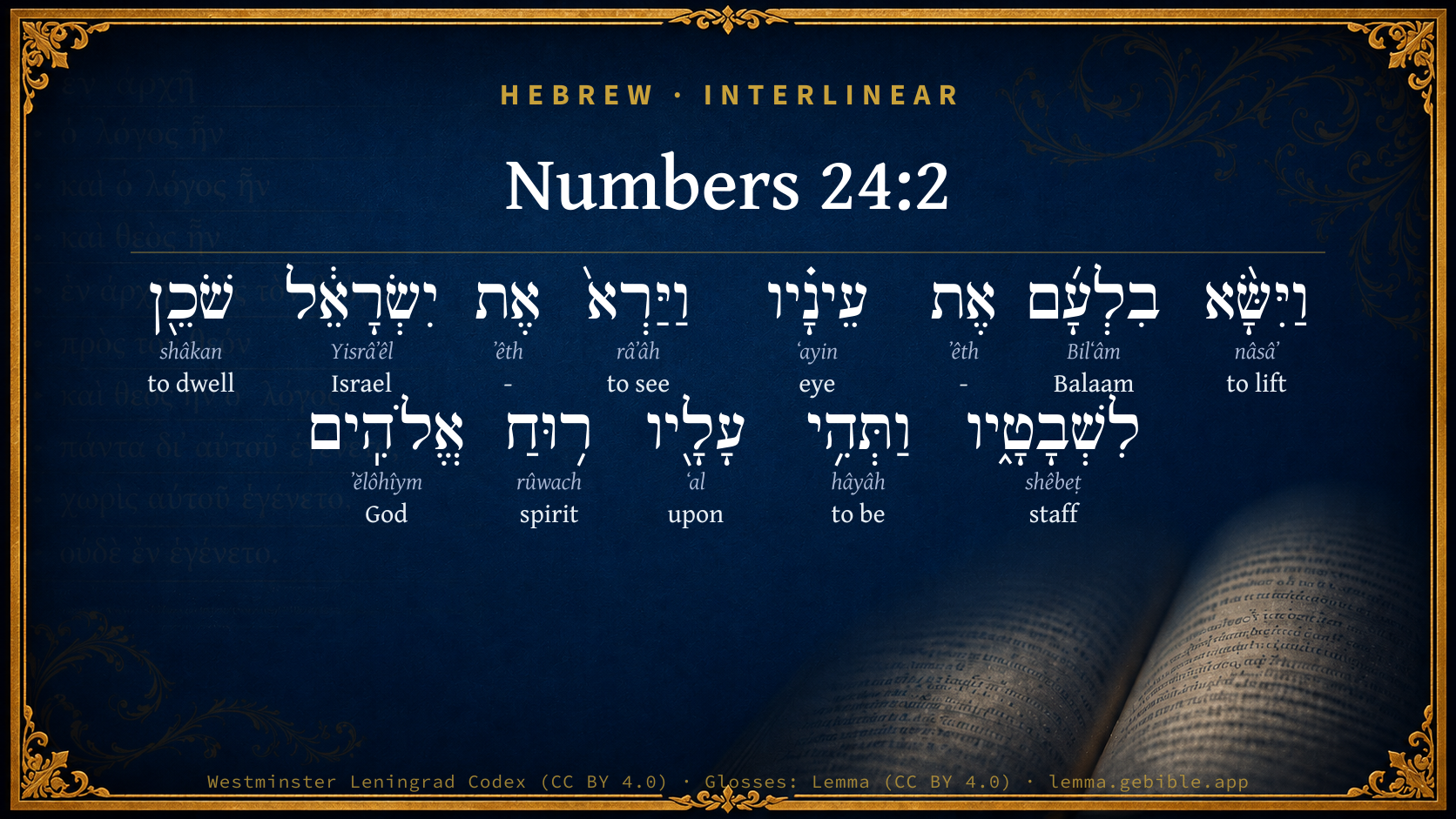
Hebrew (Westminster Leningrad Codex) Numbers 24:2 appears in the Hebrew Old Testament. The text above is from the Westminster Leningrad Codex. Each word links to its Strong’s number, a concise gloss, and parsing drawn from the Open Scriptures Hebrew Bible morphology. Click any word for its full Brown-Driver-Briggs (BDB) entry.
Download image
Cite this verse

Numbers 24:2 (World English Bible). Public Domain. Lemma interlinear Bible study tool, https://lemma.gebible.app/v/numbers/24/2.

Show BibTeX & RIS
BibTeX
RIS
English Translation
Balaam lifted up his eyes, and he saw Israel dwelling according to their tribes; and the Spirit of God came on him.
World English Bible · Public Domain
Download a study sheet

One document with this verse’s original text, its word-by-word gloss line, the meaning frame, cross-references with their text, attributed commentary, and full source and license credits — printable, and it pastes into notes with its structure intact.

This verse Autodidact and up

Study sheet (.html) Plain text (.txt)

A passage Seminary Student

Up to 50 verses in one chapter. A passage sheet keeps up to 6 commentary sources and 12 cross-references per verse, in the order this page ranks them, and says so on the sheet whenever that leaves anything out. Ask for a single verse and you get the Autodidact verse sheet above.

Everything on this page stays free to read, with no account — the sheet is a download of what is already on screen, not access to it.

Want to remove ads? Support Godless Engineer
Compare translations 3

The same verse in 3 English versions, stacked beneath the original-language interlinear above. Click any original word for its lexicon entry.

Each is an independent rendering of the whole verse — the interlinear is not word-aligned to these translations.

Highlighted words mark where these versions differ — a whole-verse word diff, not a word-by-word alignment.

  • World English Bible Public Domain
    Balaam lifted up his eyes, and he saw Israel dwelling according to their tribes; and the Spirit of God came on him.
  • King James Version Public Domain
    And Balaam lifted up his eyes, and he saw Israel abiding in his tents according to their tribes; and the spirit of God came upon him.
  • unfoldingWord Literal Text CC BY-SA 4.0
    And Balaam lifted up his eyes, and he saw Israel dwelling according to its tribes, and the Spirit of God was on him.

unfoldingWord Literal Text — © unfoldingWord, licensed CC BY-SA 4.0. Word-aligned USFM3 via Door43 (git.door43.org/unfoldingWord/en_ult).

Versions to compare (up to 4)

3 of 4 selected

Show all 18 translations

Every available English version of this verse, each an independent rendering of the whole verse.

  • World English Bible Public Domain
    Balaam lifted up his eyes, and he saw Israel dwelling according to their tribes; and the Spirit of God came on him.
  • Berean Standard Bible Public Domain
    When Balaam looked up and saw Israel encamped tribe by tribe, the Spirit of God came upon him,
  • Majority Standard Bible Public Domain
    When Balaam looked up and saw Israel encamped tribe by tribe, the Spirit of God came upon him,
  • King James Version Public Domain
    And Balaam lifted up his eyes, and he saw Israel abiding in his tents according to their tribes; and the spirit of God came upon him.
  • American Standard Version (1901) Public Domain
    And Balaam lifted up his eyes, and he saw Israel dwelling according to their tribes; and the Spirit of God came upon him.
  • Revised Version (1885) Public Domain
    And Balaam lifted up his eyes, and he saw Israel dwelling according to their tribes; and the spirit of God came upon him.
  • Geneva Bible (1599) Public Domain
    And Balaam lift vp his eyes, and looked vpon Israel, which dwelt according to their tribes, and the Spirit of God came vpon him.
  • Douay-Rheims (1899) Public Domain
    And lifting up his eyes, he saw Israel abiding in their tents by their tribes: and the spirit of God rushing upon him,
  • Young's Literal Translation Public Domain
    and Balaam lifteth up his eyes, and seeth Israel tabernacling, by its tribes, and the Spirit of God is upon him,
  • Literal Standard Version CC BY-SA 4.0
    and Balaam lifts up his eyes, and sees Israel dwelling by its tribes, and the Spirit of God is on him,
  • Unlocked Literal Bible CC BY-SA 4.0
    He raised his eyes and saw that Israel was camped, each in their own tribe, and the Spirit of God came on him.
  • unfoldingWord Literal Text CC BY-SA 4.0
    And Balaam lifted up his eyes, and he saw Israel dwelling according to its tribes, and the Spirit of God was on him.
  • Darby Bible Public Domain
    And Balaam lifted up his eyes and saw Israel dwelling [in tents] according to his tribes; and the Spirit of God came upon him.
  • World Messianic Bible Public Domain
    Balaam lifted up his eyes, and he saw Israel dwelling according to their tribes; and the Spirit of God came on him.
  • Webster's Bible Public Domain
    And Balaam lifted up his eyes, and he saw Israel abiding in his tents according to their tribes, and the spirit of God came upon him.
  • Free Bible Version CC BY-SA 4.0
    and as he looked at Israel camped there according to their respective tribes, the Spirit of God came on him.
  • Bible in Basic English Public Domain
    And lifting up his eyes, he saw Israel there, with their tents in the order of their tribes: and the spirit of God came on him.
  • JPS Tanakh (1917) Public Domain
    And Balaam lifted up his eyes, and he saw Israel dwelling tribe by tribe; and the spirit of God came upon him.

Literal Standard Version (2020), Covenant Press — licensed CC BY-SA 4.0. Text via the HelloAO Bible API (eBible.org). Unlocked Literal Bible (unfoldingWord) — licensed CC BY-SA 4.0. Text via the HelloAO Bible API (eBible.org). unfoldingWord Literal Text — © unfoldingWord, licensed CC BY-SA 4.0. Word-aligned USFM3 via Door43 (git.door43.org/unfoldingWord/en_ult). Free Bible Version, Dr. Jonathan Gallagher — licensed CC BY-SA 4.0. Text via the HelloAO Bible API (eBible.org).

Word by word

More ways to search: Search by grammar → Find every occurrence → Compare this word →

Practice this passage: Drill this verse → Learn its vocabulary →

בִלְעָ֜ם
Bilʻâm
H1109
“Balaam”
Noun, Proper
Part of Speech
Noun
Type
Proper
Full BDB Definition

Origin: probably from H1077 and H5971

TWOT: 251b

Balaam = "not of the people" - the son of Beor, a man endowed with the gift of prophecy (noun proper masculine) - a town in Manasseh (noun proper locative)
  1. וַיִּשָּׂ֨א nâsâʼ H5375 “and · to lift” Conjunction + Verb, Qal, Sequential Imperfect, 3rd Person, Masculine, Singular
  2. אֶת ʼêth H853 “-” Particle, Direct Object
  3. עֵינָ֗יו ʻayin H5869 “eyes · his” Noun, Common, Both, Dual, Construct + Suffix, Personal, 3rd Person, Masculine, Singular
  4. וַיַּרְא֙ râʼâh H7200 “and · to see” Conjunction + Verb, Qal, Sequential Imperfect, 3rd Person, Masculine, Singular
  5. אֶת ʼêth H853 “-” Particle, Direct Object
  6. יִשְׂרָאֵ֔ל Yisrâʼêl H3478 “Israel” Noun, Proper
  7. שֹׁכֵ֖ן shâkan H7931 “dwelling” Verb, Qal, Participle Active, Masculine, Singular, Absolute
  8. לִשְׁבָטָ֑יו shêbeṭ H7626 “to/for · staffs · his” Preposition + Noun, Common, Masculine, Plural, Construct + Suffix, Personal, 3rd Person, Masculine, Singular
  9. וַתְּהִ֥י hâyâh H1961 “and · to be” Conjunction + Verb, Qal, Sequential Imperfect, 3rd Person, Feminine, Singular
  10. עָלָ֖יו ʻal H5921 “upon · him” Preposition + Suffix, Personal, 3rd Person, Masculine, Singular
  11. ר֥וּחַ rûwach H7307 “spirit of” Noun, Common, Both, Singular, Construct
  12. אֱלֹהִֽים ʼĕlôhîym H430 “God(s)” Noun, Common, Masculine, Plural, Absolute

About this verse

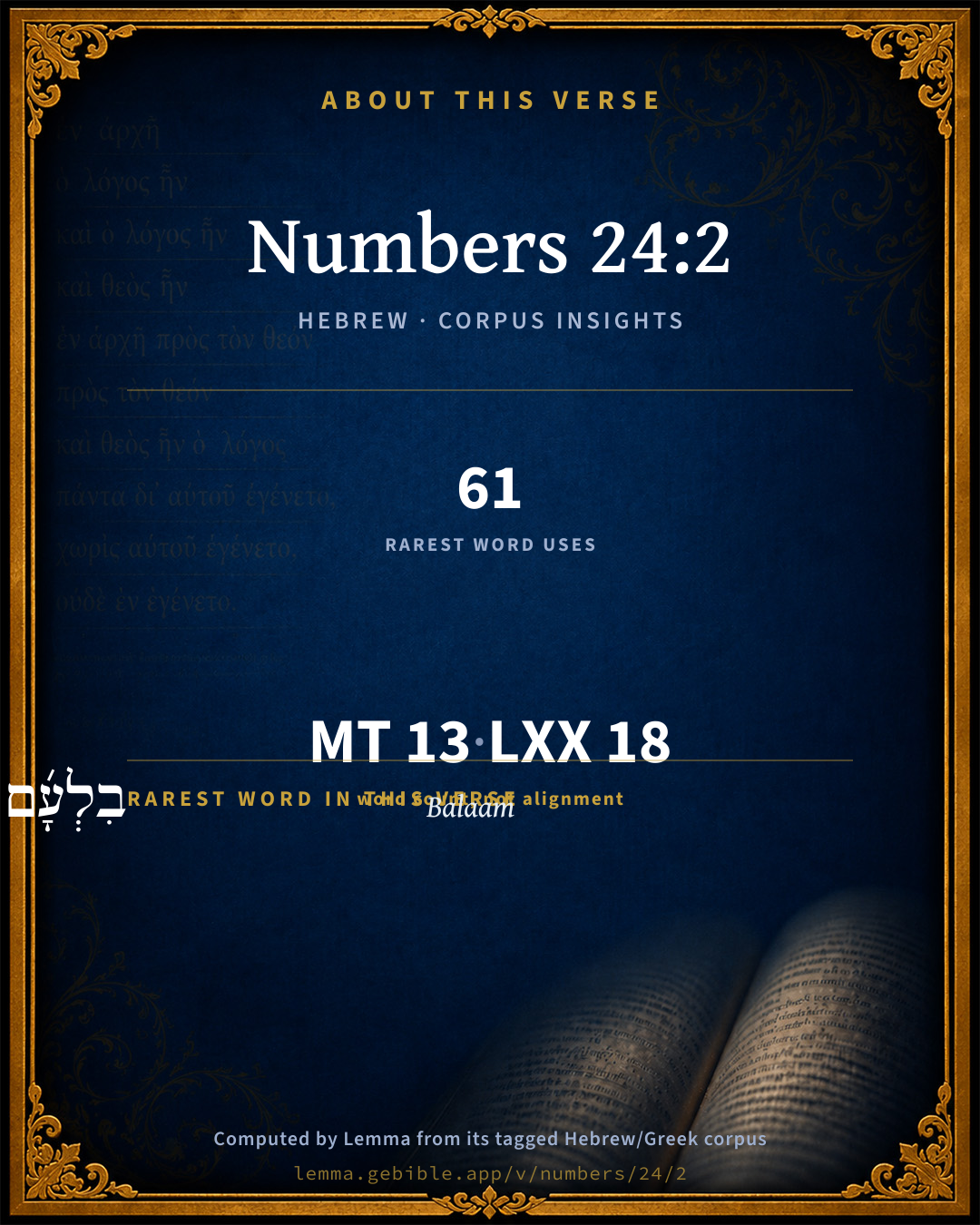
These counts appear in no published source. They are computed here, from the morphology-tagged text and Lemma’s own curated glosses. What Lemma adds →

13
words
12
distinct lemmas
Pentateuch
section

Grammatical profile

  • 4 verbs
  • 6 nouns
  • 1 preposition
  • 2 particles

Verb forms

  • וַיִּשָּׂ֨א Qal · Sequential Imperfect
  • וַיַּרְא֙ Qal · Sequential Imperfect
  • שֹׁכֵ֖ן Qal · Participle Active
  • וַתְּהִ֥י Qal · Sequential Imperfect

Hebrew & Septuagint length

In English translation the verse runs 22 words from the Hebrew and 21 from the Septuagint (LXX English) — closely comparable.

A rough comparison of the two English renderings, which tokenize alike — not a word-level alignment.

Word counts can differ between the Hebrew and the Greek without any difference in meaning — e.g. the Hebrew direct-object marker אֵת has no separate Greek word, and Greek often adds the article ὁ.

In the original languages it is 13 Hebrew tokens and 18 Greek tokens — but the two are counted differently (Hebrew bundles its prefixes and suffixes into one token; the Greek is in lemma form), so that isn’t a like-for-like length.

Cross-references

15

Topical passages linked to Numbers 24:2 in the Treasury of Scripture Knowledge — connected by theme and wording, ordered by reader-vote popularity; previews shown in the World English Bible.

  • 1 Samuel 19:20 Saul sent messengers to take David: and when they saw the company of the prophets prophesying, and Samuel standing as head over them, the Spirit of God came on the messengers of Saul, and they also prophesied.
  • 2 Chronicles 15:1 The Spirit of God came on Azariah the son of Oded:
  • 1 Samuel 10:10 When they came there to the hill, behold, a band of prophets met him; and the Spirit of God came mightily on him, and he prophesied among them.
  • 1 Samuel 19:23 He went there to Naioth in Ramah: and the Spirit of God came on him also, and he went on, and prophesied, until he came to Naioth in Ramah.
  • Numbers 2:2–34 "The children of Israel shall encamp every man by his own standard, with the ensigns of their fathers' houses: at a distance from the tent of meeting shall they encamp around it."
  • Numbers 11:25–29 Yahweh came down in the cloud, and spoke to him, and took of the Spirit that was on him, and put it on the seventy elders: and it happened that when the Spirit rested on them, they prophesied, but they did so no more.
  • Numbers 23:9–10 For from the top of the rocks I see him, From the hills I see him: behold, it is a people that dwells alone, And shall not be reckoned among the nations.
  • Numbers 24:5 How goodly are your tents, Jacob, Your tents, Israel!
  • Song of Solomon 6:4 You are beautiful, my love, as Tirzah, Lovely as Jerusalem, Awesome as an army with banners.
  • Song of Solomon 6:10 Who is she who looks forth as the morning, Beautiful as the moon, Clear as the sun, Awesome as an army with banners?
  • Matthew 7:22 Many will tell me in that day, 'Lord, Lord, didn't we prophesy in your name, in your name cast out demons, and in your name do many mighty works?'
  • Matthew 10:4 Simon the Canaanite; and Judas Iscariot, who also betrayed him.
  • Matthew 10:8 Heal the sick, cleanse the lepers, and cast out demons. Freely you received, so freely give.
  • Luke 10:20 Nevertheless, don't rejoice in this, that the spirits are subject to you, but rejoice that your names are written in heaven."
  • John 11:49–51 But a certain one of them, Caiaphas, being high priest that year, said to them, "You know nothing at all,

Cross-references courtesy of OpenBible.info (CC BY 4.0).

Hebrew and Greek witnesses Masoretic Hebrew ↔ Greek Septuagint

The same verse in the two great witnesses to the Old Testament, shown verse-for-verse.

These are two independent witnesses, not word-aligned to each other, and the Septuagint is shown in lemma (dictionary) form.

Hebrew Numbers 24:2 Masoretic · Westminster Leningrad Codex

וַיִּשָּׂ֨א בִלְעָ֜ם אֶת עֵינָ֗יו וַיַּרְא֙ אֶת יִשְׂרָאֵ֔ל שֹׁכֵ֖ן לִשְׁבָטָ֑יו וַתְּהִ֥י עָלָ֖יו ר֥וּחַ אֱלֹהִֽים

Balaam lifted up his eyes, and he saw Israel dwelling according to their tribes; and the Spirit of God came on him.

World English Bible · Public Domain

Greek LXX Numbers 24:2 Septuagint · lemma form

καί ἐκαἴρω βαλααμ ὁ ὀφθαλμός αὐτός καταὁράω ὁ ἰσραήλ στρατοπεδεύω κατά φυλή καί γίγνομαι πνεῦμα θεός ἐν αὐτός

And Balaam lifted up his eyes, and sees Israel encamped by their tribes; and the Spirit of God came upon him.

LXX2012 (modern English Septuagint) · Public Domain

Hebrew: Westminster Leningrad Codex (CC BY 4.0). Greek: Septuagint (public domain); English from LXX2012 (modern English Septuagint) (Public Domain). How the Septuagint differs from the Hebrew →

Targum (Aramaic paraphrase)

2

The Targum is the ancient Jewish Aramaic paraphrase of the Hebrew Scriptures — an interpretive translation, not the Hebrew text itself. Onkelos (literal) and Pseudo-Jonathan (expansive) render the Torah, and Jonathan the Prophets. Coverage is partial: where no permissively-licensed English translation exists for a verse, only the Aramaic is shown. This is verse-level text, not a word-by-word alignment to the Hebrew.

  1. Targum Onkelos Torah (Genesis–Deuteronomy)
    וּזְקֵף בִּלְעָם יָת עֵינוֹהִי וַחֲזָא יָת יִשְׂרָאֵל שָׁרָן לְשִׁבְטוֹהִי וּשְׁרַת עֲלוֹהִי רוּחַ נְבוּאָה מִן קֳדָם יְיָ

    (no public-domain English translation for this verse)

    Targum Onkelos — Aramaic: “Onkelos Genesis” (public domain); “Onkelos Exodus” (public domain); “Onkelos Leviticus” (public domain); “Onkelos Numbers” (public domain); “Onkelos Deuteronomy” (public domain). English: “Sefaria Community Translation” (CC0 1.0 (public-domain dedication)); “J.W. Etheridge. The Targums of Onkelos and Jonathan Ben Uzziel on the Pentateuch. London: Longmans, Green, 1862” (public domain). Text via Sefaria.

  2. Targum Pseudo-Jonathan Torah (Genesis–Deuteronomy)
    וּזְקַף בִּלְעָם יַת עֵינוֹי וַחֲמָא יַת יִשְרָאֵל שַׁרְיַין לְשִׁבְטֵיהוֹן בְּבָתֵּי מֶדְרָשֵׁיהוֹן וְלָא הֲווֹן תַּרְעֵיהוֹן מְכַוְונִין כֻּלוֹ קֳבֵיל תַּרְעֵי חַבְרֵיהוֹן וּשְׁרַת עֲלוֹי רוּחַ נְבוּאָה מִן קֳדָם יְיָ

    And Bileam lifted up his eyes, but beheld Israel dwelling together by their tribes in their schools, and (saw) that their doors were arranged so as not to overlook the doors of their companions: and the Spirit of prophecy from before the Lord rested upon him.

    Targum Pseudo-Jonathan — Aramaic: “Targum Jonathan on Genesis” (public domain); “Targum Jonathan on Exodus” (public domain); “Targum Jonathan on Leviticus” (public domain); “Targum Jonathan on Numbers” (public domain); “Targum Jonathan on Deuteronomy” (public domain). English: “The Targum of Jonathan ben Uzziel, trans. J. W. Etheridge, London, 1862” (public domain). Text via Sefaria.

Commentary

Notes on Numbers 24:2 from classic Christian and Jewish commentators (each source and its license shown beneath its notes). The classic Christian expositions comment on the surrounding passage and are grouped to its opening verse, so a note may address several verses; the Jewish commentaries on the Tanakh (Rashi and others) are per-verse, so they appear only where the commentator wrote on this verse.

Lemma curates 59 commentaries, every one of them public domain or Creative Commons licensed, each selected and text-cleaned for this edition rather than reprinted as found. About our sources →

Trapp's Complete Commentary

John Trapp

Num 24:2 And Balaam lifted up his eyes, and he saw Israel abiding [in his tents] according to their tribes; and the spirit of God came upon him.

Ver. 2. And the spirit of God came upon him.] A common spirit, a spirit of prophecy: "Have not we prophesied in thy name?," {Mat 7:22} said those castaways. In impiis quandoque sunt dona Dei, sine Deo. God gives gifts to men, "yea to the rebellious," {Psa 68:18} for the use of his Church. A blind man may bear a torch in his hand, whereby others may receive benefit, though himself receive none; so here.

John Trapp, A Commentary or Exposition upon All the Books of the Old and New Testament (1647–1656) — public domain. Text from a community e-Sword module.

Joseph Benson's Commentary

Num 24:2-3. The Spirit of God came upon him — And is it likely that the Spirit of God would have come upon a sorcerer or enchanter? A prophetic influence from God came upon him, whereby he was enabled to foresee future events, and inspired to utter the following words: The man whose eyes are open — Some, confounding שׁתםshetum, with סתם, or שׂתםsetum, would translate the words, Whose eyes are or were shut, for which there does not seem to be sufficient authority. The Seventy render them, ο αληθινως ορων, seeing truly. His eyes indeed had been shut, and he had been blind and stupid, having eyes but not seeing, nor understanding; but God had opened them in a peculiar and prophetical manner. Hence the prophets were called seers, from God’s having opened their eyes.

Joseph Benson's Commentary on the Old and New Testaments (1811–1818) — public domain. Text from a community e-Sword module.

Jamieson, Fausset & Brown

Robert Jamieson, A. R. Fausset & David Brown

he saw Israel abiding in his tents according to their tribes--that is, in the orderly distribution of the camp (Num. 2:1-34).

the spirit of God came upon him--Before the regular ministry of the prophets was instituted, God made use of various persons as the instruments through whom He revealed His will, and Balaam was one of these (Deu 23:5).

Jamieson, Fausset & Brown — Commentary Critical and Explanatory on the Whole Bible (1871) — public domain (CC PDM 1.0). Text via the HelloAO Bible API.

Adam Clarke's Commentary

Verse 2. The Spirit of God came upon him.] This Divine afflatus he had not expected on the present occasion, but God had not yet declared the whole of his will.

Adam Clarke's Commentary on the Bible (1810–1826) — public domain. Text from a community e-Sword/MySword module.

Ellicott's Commentary for English Readers

(2) Abiding in his tents . . . —i.e., encamped according to the order prescribed for the respective tribes. The cognate noun is rendered tabernacles in Num_24:5.

And the spirit of God came upon him.—In regard to the two former utterances, it is said that Jehovah put a word in the mouth of Balaam (Num_23:5; Num_23:15). In the present case the Spirit of God came upon (or, over) him. The same expression is used of the messengers of Saul (1Sa_19:20), and of Saul himself (Ibid, Num_24:23). The prophecy of Caiaphas (Joh_11:15) affords another instance of the sovereign power of the Spirit as displayed through the medium of wicked men.

A Bible Commentary for English Readers, edited by Charles John Ellicott (1878–1897) — public domain. Text from a community e-Sword module.

John Gill's Exposition

And Balaam lifted up his eyes,.... Being on Mount Peor:

and he saw Israel abiding in his tents according to their tribes; in that exact order in which they were directed to encamp under four standards, and so many tribes under each standard, Num 2:1.

and the Spirit of God came upon him; not in his grace but in his gifts; not as a spirit of sanctification, but as a spirit of prophecy, as the Targums of Onkelos and Jonathan paraphrase it; and so sometimes the Spirit of God in this sense has come upon wicked men, as on Caiaphas and others, Joh 11:51.

John Gill's Exposition of the Whole Bible (1746–1763) — public domain (CC PDM 1.0). Text via the HelloAO Bible API.

Albert Barnes' Notes on the Bible

Balaam gazed over the camp of Israel that stretched before him, and allowed the spectacle to work its own influence upon him.

Albert Barnes' Notes on the Bible (1834–1885) — public domain. Text from a community e-Sword/MySword module.

Matthew Poole's English Annotations

According to their tribes; in the order appointed, Num 2.

Came upon him, i.e. inspired him to speak the following words, and so constrained him again to bless those whom he desired to curse.

Matthew Poole's English Annotations on the Holy Bible (1683–1685) — public domain. Text from a community e-Sword/MySword module.

Whedon's Commentary on the Bible

Daniel D. Whedon

2. The Spirit of God came upon him — The inlet of God into the soul is through the truth as a medium. The orderly aspect of the Hebrew camp encircling the tabernacle — the abode of Jehovah — signalized by the cloudy pillar, awakened faith in the mind of Balaam; not, indeed, a personal and saving trust in Jehovah, but a realization of the truth of his claims and of Israel’s election. This faith prepared Balaam for the incoming of the inspiring Spirit. This is not said of his two former speeches, which were put into his mouth without his being thrown into a state of ecstasy; but this utterance resembles the predictions of true prophets: the inner ear is opened to hear the voice of God, and the spiritual eye, purged by the Spirit of God, sees the substance of the revelation.

Daniel D. Whedon (gen. ed.), Commentary on the Old and New Testaments (1874–1909) — public domain. Text from a community e-Sword module.

The Pulpit Commentary

The spirit of God came upon him. This seems to intimate a higher state of inspiration than the expression, "God put a word into his mouth". (Num_23:5, Num_23:16)

The Pulpit Commentary (1880–1919), ed. H.D.M. Spence-Jones & Joseph S. Exell — public domain. Text from a community e-Sword module.

John Wesley's Explanatory Notes

Came upon him - Inspired him to speak the following words.

John Wesley, Explanatory Notes Upon the Whole Bible (1754–1765) — public domain. Text via the GEBible commentary corpus.

unfoldingWord translationNotes

Door43 World Missions Community

He raised his eyes

Here "raised his eyes" is an idiom that means to look up. AT: "He looked up" (See: Idiom)

Spirit of God came on him

This mean's God's Spirit took control of him to prophesy.

He received this prophecy

This can be stated in active form. AT: "God gave him this prophecy" (See: Active or Passive)

Balaam son of Beor

Beor was Balaam's father. See how you translated this in Numbers 22:5.

whose eyes are wide open

This idiom means he sees and understands clearly. (See: Idiom)

translationWords

tribe

Holy Spirit

receive

prophet

unfoldingWord translationNotes — © Distant Shores Media and the Door43 World Missions Community, licensed CC BY-SA 4.0. Source: git.door43.org/Door43/en_tn.

Rashi

Rabbi Shlomo Yitzchaki (Rashi)

וישא בלעם את עיניו AND BALAAM LIFTED UP HIS EYES — he wished to cast the evil eye upon them. Thus you have his three characteristics — an evil eye mentioned here, and pride and greed which have been mentioned above (see Rashi on Numbers 22:13 and 18).

שכן לשבטיו DWELLING ACCORDING TO HIS TRIBES — He saw each tribe dwelling by itself not intermingled one with another; he saw that the entrances of their tents were not exactly facing each other so that one could not peer into the other's tent (Bava Batra 60a).

ותהי עליו רוח אלהים AND THE SPIRIT OF GOD WAS UPON HIM — Then he made up his mind not to curse them (i.e. he decided to comply with the will of God, רוח אלהים).

Rashi on the Tanakh — English translations: “The Judaica Press complete Tanach with Rashi, translated by A. J. Rosenberg” (CC BY 4.0); “Pentateuch with Rashi's commentary by M. Rosenbaum and A.M. Silbermann, 1929-1934” (public domain); “The Metsudah Tanach series, Lakewood, N.J” (CC BY 4.0); and “The Book of Joshua, Metsudah Publications, 1997” (CC BY 4.0). Text via Sefaria.

Lesson kit

Teaching starters — assembled from the data on this page, not authored interpretation. Every prompt links to the verse data it draws on. Edit before teaching.

Numbers, in the Pentateuch, opens this verse with 13 words (12 distinct Hebrew lemmas). Its most distinctive word is Bilʻâm (“Balaam”). A historical commentator’s framing appears above. Read the whole chapter for the surrounding context.

Discussion questions

  1. The word Bilʻâm carries the sense “Balaam.” How does it shape the verse?
  2. 1 Samuel 19:20 shares this passage’s theme. How do the two illuminate each other?
  3. These translations render this verse differently. What is at stake in choosing one wording over another?
  4. The verb «וַיִּשָּׂ֨א» is Qal Sequential Imperfect. How does its form color the action?
  5. Reading how Trapp's Complete Commentary and Joseph Benson's Commentary read this verse, where do the two commentators agree and where do they part?

Things to notice

Reading settings

Reading text

Shown beneath each verse's original-language words.

Old Testament
Old Testament edition

Read the OT as the Masoretic Hebrew (MT) or the Greek Septuagint (LXX).

English shown for the Greek Septuagint (in the Hebrew ↔ Greek comparison).

Comparing translations? Open the Compare panel on any verse page to stack up to four side by side.