
Job 32:8

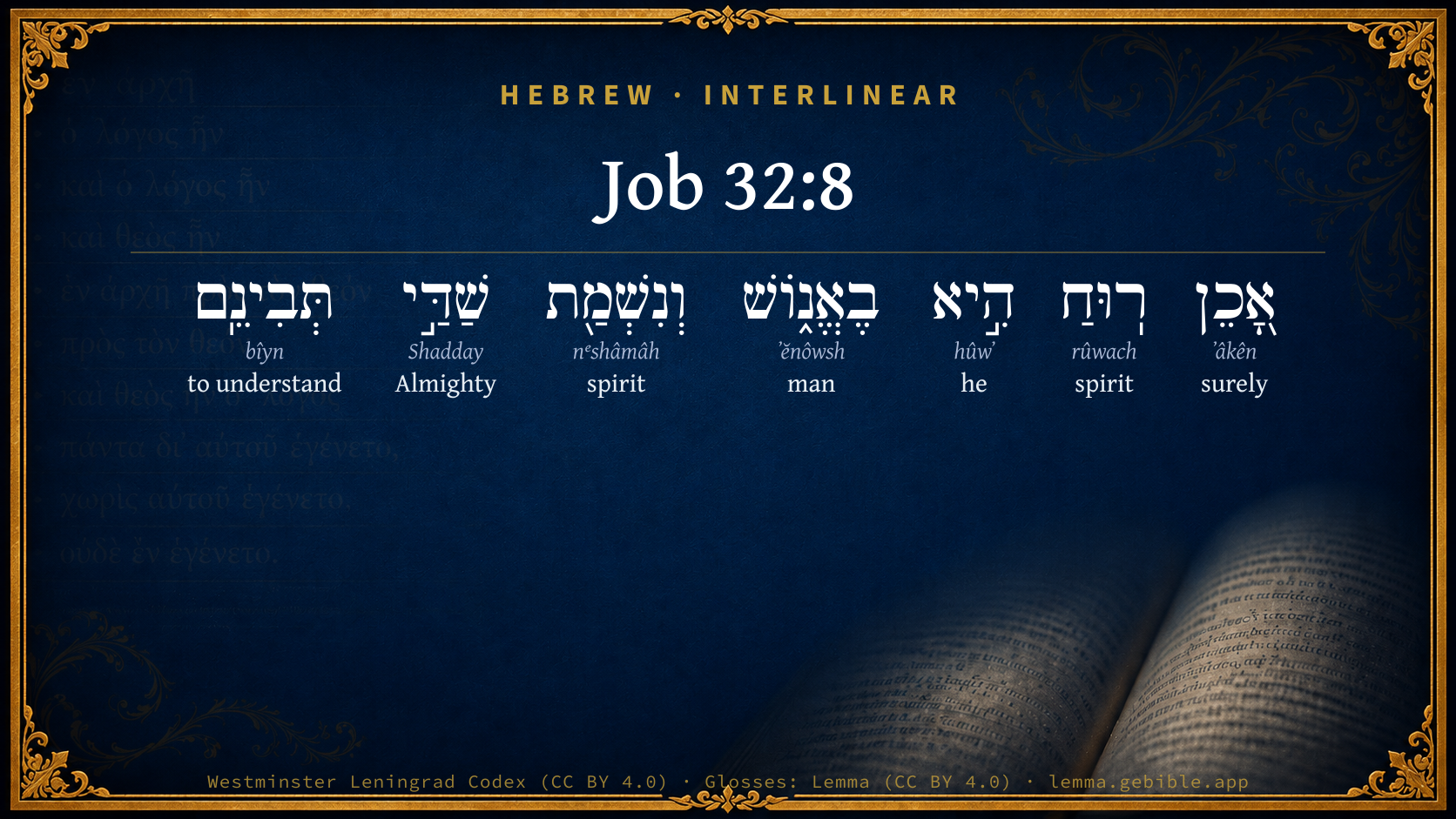
Hebrew (Westminster Leningrad Codex) Job 32:8 appears in the Hebrew Old Testament. The text above is from the Westminster Leningrad Codex. Each word links to its Strong’s number, a concise gloss, and parsing drawn from the Open Scriptures Hebrew Bible morphology. Click any word for its full Brown-Driver-Briggs (BDB) entry.
Download image
Cite this verse

Job 32:8 (World English Bible). Public Domain. Lemma interlinear Bible study tool, https://lemma.gebible.app/v/job/32/8.

Show BibTeX & RIS
BibTeX
RIS
English Translation
But there is a spirit in man, And the breath of the Almighty gives them understanding.
World English Bible · Public Domain
Download a study sheet

One document with this verse’s original text, its word-by-word gloss line, the meaning frame, cross-references with their text, attributed commentary, and full source and license credits — printable, and it pastes into notes with its structure intact.

This verse Autodidact and up

Study sheet (.html) Plain text (.txt)

A passage Seminary Student

Up to 50 verses in one chapter. A passage sheet keeps up to 6 commentary sources and 12 cross-references per verse, in the order this page ranks them, and says so on the sheet whenever that leaves anything out. Ask for a single verse and you get the Autodidact verse sheet above.

Everything on this page stays free to read, with no account — the sheet is a download of what is already on screen, not access to it.

Want to remove ads? Support Godless Engineer
Compare translations 3

The same verse in 3 English versions, stacked beneath the original-language interlinear above. Click any original word for its lexicon entry.

Each is an independent rendering of the whole verse — the interlinear is not word-aligned to these translations.

Highlighted words mark where these versions differ — a whole-verse word diff, not a word-by-word alignment.

  • World English Bible Public Domain
    But there is a spirit in man, And the breath of the Almighty gives them understanding.
  • King James Version Public Domain
    But there is a spirit in man: and the inspiration of the Almighty giveth them understanding.
  • unfoldingWord Literal Text CC BY-SA 4.0
    Nevertheless, a spirit, it in man, and the breath of the Almighty gives them understanding.

unfoldingWord Literal Text — © unfoldingWord, licensed CC BY-SA 4.0. Word-aligned USFM3 via Door43 (git.door43.org/unfoldingWord/en_ult).

Versions to compare (up to 4)

3 of 4 selected

Show all 18 translations

Every available English version of this verse, each an independent rendering of the whole verse.

  • World English Bible Public Domain
    But there is a spirit in man, And the breath of the Almighty gives them understanding.
  • Berean Standard Bible Public Domain
    But there is a spirit in a man, the breath of the Almighty, that gives him understanding.
  • Majority Standard Bible Public Domain
    But there is a spirit in a man, the breath of the Almighty, that gives him understanding.
  • King James Version Public Domain
    But there is a spirit in man: and the inspiration of the Almighty giveth them understanding.
  • American Standard Version (1901) Public Domain
    But there is a spirit in man, And the breath of the Almighty giveth them understanding.
  • Revised Version (1885) Public Domain
    But there is a spirit in man, and the breath of the Almighty giveth them understanding.
  • Geneva Bible (1599) Public Domain
    Surely there is a spirite in man, but the inspiration of the Almightie giueth vnderstanding.
  • Douay-Rheims (1899) Public Domain
    But, as I see, there is a spirit in men, and the inspiration of the Almighty giveth understanding.
  • Young's Literal Translation Public Domain
    Surely a spirit is in man, And the breath of the Mighty One Doth cause them to understand.
  • Literal Standard Version CC BY-SA 4.0
    Surely a spirit is in man, || And the breath of the Mighty One || Causes them to understand.
  • Unlocked Literal Bible CC BY-SA 4.0
    But there is a spirit in a man; the breath of the Almighty gives him understanding.
  • unfoldingWord Literal Text CC BY-SA 4.0
    Nevertheless, a spirit, it in man, and the breath of the Almighty gives them understanding.
  • Darby Bible Public Domain
    But there is a spirit which is in man; and the breath of the Almighty giveth them understanding.
  • World Messianic Bible Public Domain
    But there is a spirit in man, and the Spirit of the Almighty gives them understanding.
  • Webster's Bible Public Domain
    But there is a spirit in man: and the inspiration of the Almighty giveth them understanding.
  • Free Bible Version CC BY-SA 4.0
    However, there is a spirit in human beings, the breath of the Almighty, that gives them understanding.
  • Bible in Basic English Public Domain
    But truly it is the spirit in man, even the breath of the Ruler of all, which gives them knowledge.
  • JPS Tanakh (1917) Public Domain
    But it is a spirit in man, and the breath of the Almighty, that giveth them understanding.

Literal Standard Version (2020), Covenant Press — licensed CC BY-SA 4.0. Text via the HelloAO Bible API (eBible.org). Unlocked Literal Bible (unfoldingWord) — licensed CC BY-SA 4.0. Text via the HelloAO Bible API (eBible.org). unfoldingWord Literal Text — © unfoldingWord, licensed CC BY-SA 4.0. Word-aligned USFM3 via Door43 (git.door43.org/unfoldingWord/en_ult). Free Bible Version, Dr. Jonathan Gallagher — licensed CC BY-SA 4.0. Text via the HelloAO Bible API (eBible.org).

Word by word

More ways to search: Search by grammar → Find every occurrence → Compare this word →

Practice this passage: Drill this verse → Learn its vocabulary →

About this verse

These counts appear in no published source. They are computed here, from the morphology-tagged text and Lemma’s own curated glosses. What Lemma adds →

7
words
7
distinct lemmas
Wisdom
section

Notable vocabulary

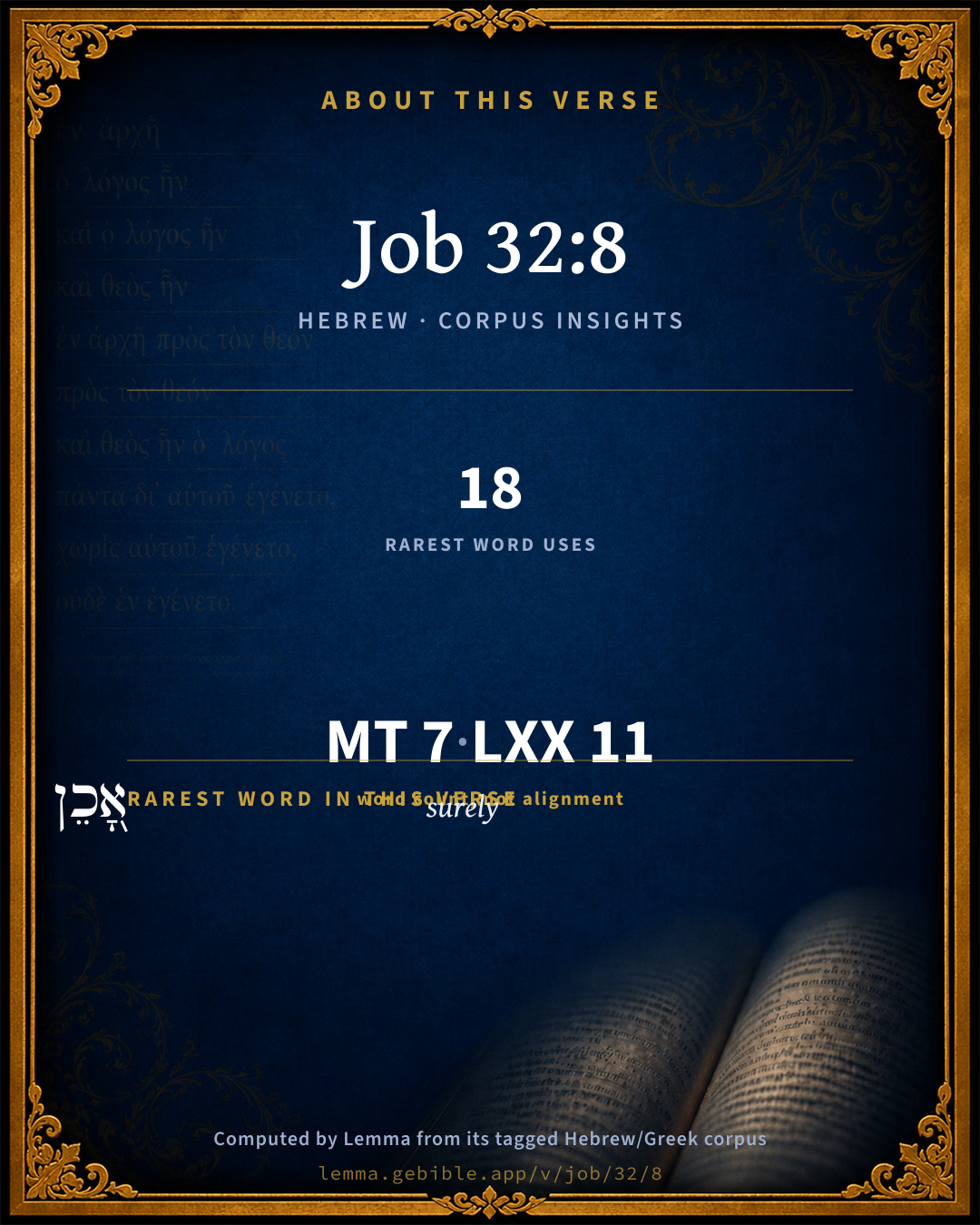
The rarest word here is אָ֭כֵן surely H403 — appearing just 18 times in the whole Hebrew Bible.

Shared distinctive vocabulary

אָ֭כֵן surely H403 occurs in 17 verses of the Hebrew Bible. Also found in:

Grammatical profile

  • 1 verb
  • 4 nouns
  • 1 pronoun
  • 1 adverb

Verb forms

  • תְּבִינֵֽם Hiphil · Imperfect

Hebrew & Septuagint length

In English translation the verse runs 16 words from the Hebrew and 17 from the Septuagint (LXX English) — closely comparable.

A rough comparison of the two English renderings, which tokenize alike — not a word-level alignment.

Word counts can differ between the Hebrew and the Greek without any difference in meaning — e.g. the Hebrew direct-object marker אֵת has no separate Greek word, and Greek often adds the article ὁ.

In the original languages it is 7 Hebrew tokens and 11 Greek tokens — but the two are counted differently (Hebrew bundles its prefixes and suffixes into one token; the Greek is in lemma form), so that isn’t a like-for-like length.

Cross-references

17

Topical passages linked to Job 32:8 in the Treasury of Scripture Knowledge — connected by theme and wording, ordered by reader-vote popularity; previews shown in the World English Bible.

  • Job 33:4 The Spirit of God has made me, And the breath of the Almighty gives me life.
  • Job 38:36 Who has put wisdom in the inward parts? Or who has given understanding to the mind?
  • 2 Timothy 3:16 Every writing inspired by God is profitable for teaching, for reproof, for correction, and for instruction which is in righteousness,
  • Proverbs 2:6 For Yahweh gives wisdom. Out of his mouth comes knowledge and understanding.
  • James 1:5 But if any of you lacks wisdom, let him ask of God, who gives to all liberally and without reproach; and it will be given to him.
  • Ecclesiastes 2:26 For to the man who pleases him, God gives wisdom, knowledge, and joy; but to the sinner he gives travail, to gather and to heap up, that he may give to him who pleases God. This also is vanity and a chasing after wind.
  • 1 Corinthians 2:10–12 But to us, God revealed them through the Spirit. For the Spirit searches all things, yes, the deep things of God.
  • 1 Kings 3:12 behold, I have done according to your word: behold, I have given you a wise and an understanding heart; so that there has been none like you before you, neither after you shall any arise like you.
  • Daniel 2:21 He changes the times and the seasons; he removes kings, and sets up kings; he gives wisdom to the wise, and knowledge to those who have understanding;
  • 1 Kings 3:28 All Israel heard of the judgment which the king had judged; and they feared the king: for they saw that the wisdom of God was in him, to do justice.
  • Job 33:16 Then he opens the ears of men, And seals their instruction,
  • Job 35:11 Who teaches us more than the animals of the earth, And makes us wiser than the birds of the sky?'
  • Daniel 1:17 Now as for these four youths, God gave them knowledge and skill in all learning and wisdom: and Daniel had understanding in all visions and dreams.
  • 1 Kings 4:29 God gave Solomon wisdom and understanding exceeding much, and very great understanding, even as the sand that is on the sea-shore.
  • Genesis 41:39 Pharaoh said to Joseph, "Because God has shown you all of this, there is none so discreet and wise as you.
  • Job 4:12–21 "Now a thing was secretly brought to me, My ear received a whisper of it.
  • 1 Corinthians 12:8 For to one is given through the Spirit the word of wisdom, and to another the word of knowledge, according to the same Spirit;

Cross-references courtesy of OpenBible.info (CC BY 4.0).

Hebrew and Greek witnesses Masoretic Hebrew ↔ Greek Septuagint

The same verse in the two great witnesses to the Old Testament, shown verse-for-verse.

These are two independent witnesses, not word-aligned to each other, and the Septuagint is shown in lemma (dictionary) form.

Hebrew Job 32:8 Masoretic · Westminster Leningrad Codex

אָ֭כֵן רֽוּחַ הִ֣יא בֶאֱנ֑וֹשׁ וְנִשְׁמַ֖ת שַׁדַּ֣י תְּבִינֵֽם

But there is a spirit in man, And the breath of the Almighty gives them understanding.

World English Bible · Public Domain

Greek LXX Job 32:8 Septuagint · lemma form

ἀλλά πνεῦμα εἰμί ἐν βροτός πνοή δέ παντοκράτωρ εἰμί ὁ διδάσκω

but there is a spirit in mortals; and the inspiration of the Almighty is that which teaches.

LXX2012 (modern English Septuagint) · Public Domain

On this verse, Keil & Delitzsch discusses the Septuagint’s reading. Read the note in Commentary ↓

Hebrew: Westminster Leningrad Codex (CC BY 4.0). Greek: Septuagint (public domain); English from LXX2012 (modern English Septuagint) (Public Domain). How the Septuagint differs from the Hebrew →

Commentary

Notes on Job 32:8 from classic Christian and Jewish commentators (each source and its license shown beneath its notes). The classic Christian expositions comment on the surrounding passage and are grouped to its opening verse, so a note may address several verses; the Jewish commentaries on the Tanakh (Rashi and others) are per-verse, so they appear only where the commentator wrote on this verse.

Lemma curates 59 commentaries, every one of them public domain or Creative Commons licensed, each selected and text-cleaned for this edition rather than reprinted as found. About our sources →

Trapp's Complete Commentary

John Trapp

Job 32:8 But [there is] a spirit in man: and the inspiration of the Almighty giveth them understanding.

Ver. 8. But there is a spirit in man: and the inspiration of the Almighty] Or, Surely there is a spirit in man, but the inspiration, &c. Man hath a reasonable soul and a natural judgment, whereby he differeth from brute beasts; and not only so, but some there are that do animam excolere, as Cicero and Aristotle; they improve their natural abilities by art, and so go far beyond others in worth; differing from the unlearned as much almost as a man doth from a beast. Lo, such a spirit there is in some men; which yet amounteth not to wisdom without the concurrence of God’s good Spirit to sanctify all, as the altar sanctifieth the gold of the altar. If this be not attained unto, the wiser any man is the vainer he proveth, Rom 1:22. The Lord knoweth the thoughts of those wise (even of the choicest and most picked men among them) that they are vain, 1Co 3:20. And to such we may say, as Austin once wrote to a man of great parts, Ornari abs te diabotus quaerit, the devil desireth to be tricked up by thee.

And the inspiration of the Almighty giveth them understanding] He is the wise man, when all is done, whom, whether old or young, the Spirit of God, who acteth most freely, is pleased to imbreathe. And although arts and age be good helps to knowledge, yet they must be all taught of God that shall be wise unto salvation; and such as these, the older they grow the wiser they are, for the most part; and if young saints, they become old angels. True it is, that God is debtor to none; neither doth a longer life of itself deserve anything at God’s hands; because the longer they live the more sins they commit. But yet the promise is, that to him that hath shall be given, and he shall abound. "The righteous also shall hold on his way, and he that hath clean bands shall be stronger and stronger," Job 17:9. Howbeit, some good men’s first days have been their best days; and they have suffered no small decays in their spiritual intellect; as did Solomon, Asa, Joash, and perhaps these three friends of Job, to whom this speech is directed. Certain it is that he is a rare and a happy man of whom it may be said, in a spiritual sense (as it was said of Moses), that, after long profession of religion, his sight is not waxed dim, nor his holy heat abated. The heathen sages have cause to admonish us to take heed of old age; as that which cometh not alone, but is itself a disease, and ever accompanied with many maladies, both of body and mind. Elihu seemeth to take this here for granted (experience sealing to it), that true wisdom dependeth not upon any man’s authority, power, learning, experience, or old age; but upon the inspiration of the Almighty, 2Pe 1:21 2Ti 3:16. And, therefore, the Holy Scriptures must needs be the storehouse of wisdom, the statute book of heaven, as being θεοπνευστος, imbreathed by God, as Paul speaketh, the very heart and soul of God, as Gregory.

John Trapp, A Commentary or Exposition upon All the Books of the Old and New Testament (1647–1656) — public domain. Text from a community e-Sword module.

The Biblical Illustrator

Joseph S. Exell

Job_32:8

But there is a spirit in man.

The spirit in man

We can define spirit only by negations, but the negations are positive, inasmuch as it is the limitations and imperfections of matter that they deny. Spirit, though it uses material organs and implements, is distinct from them, their owner and master. Modern science derives mans parentage from what we have been accustomed to call the lower order of beings. I confess a strong preference for the genealogy whose two connecting links are, which was the Son of Adam, which was the Son of God. Man has the same material conditions, surroundings, and necessities with his humbler fellow beings. But is there in man an immaterial, supra-material consciousness, in which he differs from the brutes, not in degree alone, but in kind, something into which: instinct could never grow, occupying a range of thought, knowledge, and aspiration which to the brute is and ever will be an unexplored region? This question we attempt to answer.

1. Note mans power of progress, as manifested both individually and collectively. The swallow builds as good a nest the first spring of his life as he will ever build. But mans antecedents and surroundings do not furnish the first elements for calculating his orbit, which may intersect the outermost circle of the material system to which he belongs, and stretch on unto the unmapped region beyond, as the comet wings its flight into depths of space remoter than the planets round. Man, also, alone of all animals, grows collectively, and from generation to generation. Each generation of men mounts on the shoulders of that which preceded it. Facts are epitomised into principles! knowledge is condensed into general truths, and the acquisitions of a thousand years are carried by the child from the primary school. There is no physical peculiarity in man that can account for this power of progress. Is it ascribed to speech? The human hand cannot account for mans progress. Mans power of progress is due to causes wholly unconnected with his physical development, and with the possibility of material consciousness. We have no proof that other animals have any knowledge, except that which comes to them immediately through the senses. They evince no apprehension of principles, of multitudinous, comprehensive facts, of general truths. Mans superiority consists in his capacity for super-sensual ideas, and these cannot be elaborated by any conceivable material apparatus. Man with his mental vision sees a class or a law as distinctly as the eye discerns an individual object; and still further, by higher stages of abstraction and generalisation, he resolves clusters of classes into more comprehensive classes, fascicles of laws into single laws of a broader scope, till in every department he seizes upon some one unifying principle under which all the classes may be grouped, or to which all the laws may be referred. He then, from these principles, deduces inferences which the senses never could have discovered. And mans entire imaginative apparatus is super-sensual.

2. The phenomena of mans moral nature cannot be derived from his material organisation. Of all beings on the earth, man alone cognises the distinction between right and wrong. The first question in ethics, whether theoretical or practical, concerns the nature of moral distinctions--the essential difference between right and wrong. Material philosophers see the origin of this distinction in the differing sensations of pleasure and pain; and that conscience results solely from the observation of what is approved and what disapproved. But materialism cannot account for either a mans moral or a mans religious nature. We conclude that natural science cannot detach mans hold upon the ancestral tree which traces his parentage from God. In Jesus Christ Himself we find the strongest of all arguments against the theory of material evolution as applicable to the higher portion of mans nature. (A. P. Peabody, D. D.)

Human spirit and Divine inspiration

Read text thus, There is a spirit in man, and the in-spirit-ing of the Almighty giveth them understanding. The spirit in man is that special apartment of his nature which has been contrived and fitted for personal intercourse between him and God. The spirit in man is to the great inbreathing of God what the lungs are to the circumambient air. It is the element of our being that establishes in us religious possibilities. There is a spirit in man, and like every other instinct of our being, it stands to us authoritatively, and lays its mandate upon us imperiously. We are religious by nature. It is just this faculty divinely wrought upon, and this string divinely played upon, that really composes the strength and tenacity of our religious convictions. The inspiration here has to do, in a purely general way, with Gods own personal communication of Himself to us, and, at the spirit point of our being, imparting unto us the energies of His own wisdom, holiness, and power. It is not our concern to understand how this is done. The first office work of inspiration is to create in us fresh personal vigour and new spiritual animation. Character cannot be constructed. It cannot be put together. It needs first of all a principle that is animated, and one, therefore, that is animating. It was an impulse more glowing, determined, and passionate than anything we are possessed of naturally. We need nothing so much as a determining life force at the core of character, an impulse from out the very soul of God, that shall hold us in its warm, steady, and irresistible grip, and impel us with a momentum that has the very pressure of Jehovah in it. And all of this is a draft upon the Divine inspiration. This may seem to be what theologians call regeneration. The new man, the new life, is only another name for character wrought out at the determining impulse of a Divine inspiration. What we need first of all is not to act like Christ, but to have exactly the same Divine Spirit working at the core of our lives that worked at the core of His, and then acts will take care of themselves. All true manliness grows around a core of divineness. Virtue is safe only when it is inspired. Another office work of inspiration is to create in us fresh and vivid perceptions of the Divine truth. We need as much inspiration to read the Bible as its authors needed to fit them to write it. No Christian creed is ever constructed. It is the form in which a man shapes his own experiences of the things of God, and of his own soul. As we go on to know the Lord, our creeds will change. Christian thinking will continue growing better, deeper, truer, so long as Christians, along the luminous path of Gods self-revelation to them, continue getting into the deeper things of God and the closer intimacies of God. And further, the inspirations of the Almighty are suited to become to us qualification for all kinds of holy doing. We make toilsome work of being good, because we do not let the inspirations of God work in us: and we make irksome work of doing good because we do not let the inspirations of God work through us . . . Our common and comprehensive need is of the inspiration of the Almighty, the direct breathing into us of the breath of God, with all the wisdom, holiness, and power which such a Divine afflatus involves, that whether we speak, be it by word or act, we may speak as the oracles of God; and whether we minister, we may do it as of the ability which God giveth: that God in all things may be glorified through Christ Jesus. (Charles H. Parkhurst, D. D.)

God the source of all wisdom

Professor Morse, the renowned electric telegraph inventor, was once asked, Professor, when you were making your experiments yonder in your rooms in the university, did you ever come to a stand, not knowing what to do next? Oh yes; mere than once. And at such times, what did you do next? I may answer you in confidence, sir, said the professor, but it is a matter of which the public knows nothing. Whenever I could not see my way clearly, I prayed for more light. And the light generally came? Yes. And I may tell you that when flattering honours came to me from America and Europe on account of the invention which bears my name, I never felt that I deserved them. I had made a valuable application of electricity, not because I was superior to other men, but solely because God, who meant it for mankind, must reveal it to someone, and was pleased to reveal it to me. The inventors first message--What hath God wrought--intimated in no uncertain way the inspiration which gave his work longevity, and made it a light to the world.

On man as a rational and moral being

The inherent excellence of our nature. Consider man--

1. As a rational being. How are we otherwise to account for that superiority which man has acquired over all the other inhabitants of this world? In the lowest conditions of human society there is always a marked preeminence in man over the other animals. In man there are at all times signs of a mind possessing in some degree a creative and inventive energy. The effects of this power in man are by no means small and insignificant. While he is yet remote from what we call civilisation, the native grandeur of the human mind shows itself in bold exertions of genius; and as he proceeds in his career, man constantly discovers new resources. What is this power? Is it not what the text declares it to be, a spirit in man, the inspiration of the Almighty? Going on the principles of natural reason,--what, indeed, is it that produces in our minds a belief of the existence of the supreme God, but the perception that the world which we inhabit bears strong indications of design and intelligence having been employed in its formation? Our connection with God is impressed on our minds by the very proofs which bring us a knowledge of His existence, and we could not know that there was such a Being unless we tried His works by the scale of our own reason.

2. The same great truth will appear if we consider man as a moral being. Other animals follow blindly the impulse of appetite. There is impressed on the mind of man a rule by which he judges himself,--a sense of right and wrong in conduct, by which he becomes conscious that he is the object either of love and esteem, or of contempt and hatred. Reflect on the very high dignity and importance of this part of our constitution; how much it elevates us above the other creatures; how close a connection it forms between us and the Almighty. How can we derive, except from God Himself, except from the spirit which He has breathed into man, any feeling of those excellencies, any love for, or any aspiration after that goodness which indisputably constitutes His own greatest attribute? Is not our relationship to the Divine nature apparent in this, that we alone, of all the creatures breathing upon earth, are capable of having any relish of those perfections which alone render God Himself the object of worship and love? (J. Morehead, M. A.)

On man as a religious being

Man has not only received understanding from the inspiration of the Almighty, but he knows that it is so; and he is prompted by nature to lift up his thoughts to the contemplation of that great Being who conferred upon him so high a preeminence. This principle it is which distinguishes us from the lower animals, even more than our reason or our moral perceptions. He alone of all creatures thinks it not presumption to address himself to the unknown God. Wherever man exists, therefore, you will find religion. By collecting together all the follies of superstition, it has been attempted to show that the religion of man is rather a proof of the weakness than of the loftiness of his nature. It must be owned that the vices and follies of man have shown themselves as frequently in the midst of his religious sentiments as in any other part of his character. Yet the perversions of religion ought never to be treated in a light and careless strain; they are rather objects of pity. But even these superstitions prove that man is by nature a religious being. Man is a spirit, clouded and obscured, struggling with darkness, and fettered by sin, yet aiming at lofty things, and striving to regain some glimpses of the Divine form, which was accustomed to walk with man while yet in the garden of primeval innocence.

1. Let students pursue their inquiries with a becoming reverence for the nature to which they belong.

2. Value Christianity which has brought immortality to light. (J. Morehead, M. A.)

The world within

There is a spirit in man--a rational, accountable, undying personality. This spirit has been called the world within, and truly of all worlds it is the greatest and most wonderful, Like the outward world of nature, it has its own orbit, and its own revolutions, and its own centre. Souls create their own centres. The Bible everywhere teaches the distinction between the soul and matter. This world is the greatest world.

1. It is a world whose existence is complete in itself.

2. It is a world that has a self-multiplying power.

3. It is a world conscious of its own existence.

4. It is a world that can make use of the outward.

5. It is a world that can devoutly recognise its Maker.

6. It is a world which its Maker has made extraordinary efforts to restore.

7. It is a world that can shut out its Maker.

Conclusion--

(1) Consider the sad moral state of this world within.

(2) Profoundly study this world within.

(3) Earnestly cultivate this world within. (Homilist.)

The Biblical Illustrator, edited by Joseph S. Exell (c. 1880s–1900s) — public domain. Text from a community e-Sword module.

Keil & Delitzsch

C. F. Keil & F. Delitzsch

8 Still the spirit, it is in mortal man,

And the breath of the Almighty, that giveth them understanding.

9 Not the great in years are wise,

And the aged do not understand what is right.

10 Therefore I say: O hearken to me,

I will declare my knowledge, even I.

The originally affirmative and then (like אוּלם) adversative אכן also does not occur elsewhere in the book of Job. In contradiction to biblical psychology, Rosenm. and others take Job 32:8 as antithetical: Certainly there is spirit in man, but ... . The two halves of the verse are, on the contrary, a synonymous ("the spirit, it is in man, viz., that is and acts") or progressive parallelism) thus according to the accents: "the spirit, even that which is in man, and ... "). It is the Spirit of God to which man owes his life as a living being, according to Job 33:4; the spirit of man is the principle of life creatively wrought, and indeed breathed into him, by the Spirit of God; so that with regard to the author it can be just as much God's רוּח or נשׁמה, Job 34:14, as in respect of the possessor: man's רוח or נשׁמה. All man's life, his thinking as well as his bodily life, is effected by this inwrought principle of life which he bears within him, and all true understanding, without being confined to any special age of life, comes solely from this divinely originated and divinely living spirit, so far as he acts according to his divine origin and basis of life. רבּים are here (as the opposite of צעירים, Gen 25:23) grandes = grandaevi (lxx πολυχρόνιοι). לא governs both members of the verse, as Job 3:10; Job 28:17; Job 30:24. Understanding or ability to form a judgment is not limited to old age, but only by our allowing the πνεῦμα to rule in us in its connection with the divine. Elihu begs a favourable hearing for that of which he is conscious. דּע, and the Hebr.-Aramaic הוּה, which likewise belong to his favourite words, recur here.

Keil & Delitzsch — Biblical Commentary on the Old Testament (1861–1891) — public domain (CC PDM 1.0). Text via the HelloAO Bible API. (Old Testament only.)

Tyndale Open Study Notes

Tyndale Open Resources

32:8-9 The spirit within people might not be the prophetic Spirit that Elihu later appeals to (33:14-15), as Eliphaz had done (4:12-17; cp. 32:18-20). This spirit might simply exist by virtue of creation (33:4; Gen 2:7; Acts 17:25).

Tyndale Open Study Notes — © Tyndale Open Resources, licensed CC BY-SA 4.0. Text via the HelloAO Bible API.

Geneva Bible (1599)

Geneva Bible translators

It is a special gift of God that man hath understanding, and cometh neither of nature nor by age.

Geneva Bible (1599) marginal notes — public domain. Text via Bolls.life.

Jamieson, Fausset & Brown

Robert Jamieson, A. R. Fausset & David Brown

Elihu claims inspiration, as a divinely commissioned messenger to Job (Job 33:6, Job 33:23); and that claim is not contradicted in Job 42:4-5. Translate: "But the spirit (which God puts) in man, and the inspiration . . . is that which giveth," &c.; it is not mere "years" which give understanding (Pro 2:6; Joh 20:22).

Jamieson, Fausset & Brown — Commentary Critical and Explanatory on the Whole Bible (1871) — public domain (CC PDM 1.0). Text via the HelloAO Bible API.

Adam Clarke's Commentary

Verse 8. But there is a spirit in man] Mr. Good translates: -

"But surely there is an afflation in mankind,

And the inspiration of the Almighty actuateth them."

Coverdale, thus: -

Every man (no doute) hath a mynde; but it is the inspyracion of the Almightie that geveth understondinge.

I will now offer my own opinion, but first give the original text: רוח היא באנוש ונשמת שדי תבינם ruach hi beenosh venishmath shaddai tebinem. "The spirit itself is in miserable man, and the breath of the Almighty causeth them to understand," How true is it that in God we live, move, and have our being! The spirit itself is in man as the spring or fountain of his animal existence, and by the afflatus of this spirit he becomes capable of understanding and reason, and consequently of discerning Divine truth. The animal and intellectual lives are here stated to be from God; and this appears to be an allusion to man's creation, Ge 2:7: "And God breathed into man's nostrils the breath of lives," נשמת חיים nishmath chaiyim, i.e., animal and intellectual, and thus he became a living soul, nephesh chaiyah, a rational animal.

When man fell from God, the Spirit of God was grieved, and departed from him; but was restored, as the enlightener and corrector, in virtue of the purposed incarnation and atonement of our Lord Jesus; hence, he is "the true Light that lighteth every man that cometh into the world," Joh 1:9. That afflatus is therefore still continued to אנוש enosh, man, in his wretched, fallen state; and it is by that Spirit, the רוח אלהים Ruach Elohim, "the Spirit of the merciful or covenant God," that we have any conscience, knowledge of good and evil, judgment in Divine things, and, in a word, capability of being saved. And when, through the light of that Spirit, convincing of sin, righteousness, and judgment, the sinner turns to God through Christ, and finds redemption in his blood, the remission of sins; then it is the office of that same Spirit to give him understanding of the great work that has been done in and for him; "for the Spirit itself (αυτο το πνευμα, Ro 8:16, the same words in Greek as the Hebrew רוח היא ruach hi of Elihu) beareth witness with his spirit that he is a child of God." It is the same Spirit which sanctifies, the same Spirit that seals, and the same Spirit that lives and works in the believer, guiding him by his counsel till it leads him into glory. In this one saying, independently of the above paraphrase, Elihu spoke more sense and sound doctrine than all Job's friends did in the whole of the controversy.

Adam Clarke's Commentary on the Bible (1810–1826) — public domain. Text from a community e-Sword/MySword module.

Ellicott's Commentary for English Readers

(8) But there is a spirit in man.—Rather, But it is the spirit in man.

And the inspiration of the Almighty.—Rather, And the breath of the Almighty that giveth them understanding. It is the expression used in the Mosaic narrative of the origin of man, and may perhaps show acquaintance on the part of the writer with that narrative (Gen_2:7). Elihu means to say that it is not years so much as the spirit and illumination of the Almighty that maketh a man pre-eminent in wisdom.

A Bible Commentary for English Readers, edited by Charles John Ellicott (1878–1897) — public domain. Text from a community e-Sword module.

The Cambridge Bible for Schools and Colleges

gen. ed. J. J. S. Perowne

8. the inspiration of the Almighty] lit. the breath of the Almighty, as ch. Job_33:4. Both “spirit” and “breath” refer to God’s spirit of life breathed into man when he is brought into existence (Gen_2:7), there is no allusion to any extraordinary illumination given to Elihu at the moment when he speaks. This spirit of God is a spirit of intelligence as well as of life (ch. Job_33:4), and under the impulse of the crowding thoughts which rush into his mind at this instant Elihu feels that this spirit has been given to himself in great fulness.

The Cambridge Bible for Schools and Colleges (gen. ed. J. J. S. Perowne; Cambridge University Press, 1878–1918) — public domain. Text from a community e-Sword module.

John Gill's Exposition

But there is a spirit in man,.... This seems to be a correction of his former sentiment; the consideration of which gave him encouragement, though young, to declare his opinion, since there is a spirit in men, both young and old; and wherever that be, there is an ability to speak and a capacity of teaching wisdom; which is not tied to age; but may he found in young men as well as in old men: some by this understand the rational soul, or spirit, which is immaterial, immortal, is of God, and is in man; and the rather it is thought this is meant, because it is in every man, whereby he has knowledge of many things, natural and divine, and particularly is capable of trying and judging things, of discerning the difference between one thing and another, and of reasoning and discoursing upon them; and this being observed by Elihu, and he being conscious to himself of having such a spirit in him, was emboldened to engage in the debate, though a young man; but if such a spirit is meant, the words may be rendered to such a sense, verily, truly, indeed "there is such a rational spirit in man", which makes him capable of knowing many things, "but the inspiration of the Almighty", &c. (p); it is not owing to the rational powers and faculties of the soul of man, and the use of them, that a man becomes capable of teaching others wisdom; but to his soul or spirit being inspired by the Almighty; and such an one, be he young or old, that God breathes into, and he is under his inspiration, he is the man fit to engage in such work: though I rather think, that in this first clause the spirit of God is meant, and so Jarchi; who is an uncreated, infinite, and eternal Spirit; is of God, and is put into men; for he is not in men naturally, nor in everyone; and where he is, he is given, and there he abides; and it is from him men have their wisdom and knowledge; it is he that makes men know themselves, that searches the deep things of God, and reveals them to men, and that is the spirit of wisdom and revelation in the knowledge of Christ, and leads into all truth, as it is in him; though rather the spirit in his gifts, than in his spiritual saving grace, is here meant; and so does not point to every good man in common, but to such who are favoured with the gifts of the spirit superior to others; and so the Targum interprets it of the spirit of prophecy; and on whomsoever this rests, whether on young or old, he is fit to teach men wisdom:

and the inspiration of the Almighty giveth them understanding; not the soul of man, or breath of God inspired by him, which is the candle of the Lord, searching the inward parts of men; for that leaves him without understanding of things of the greatest importance: rather, as the Targum, the Word of God, the essential Word, the Son of God, who gives an understanding of the best things, Jo1 5:20; but, better, the Spirit of God, by whom the Scriptures were inspired, and who is breathed into men, Joh 20:22; and is a spirit of understanding to them; for though a man has an understanding of natural things, yet not of things spiritual; to have an understanding of them is the special gift of God, and is in particular the work of the Spirit of God: Elihu now having some reason to believe that he had the Spirit of God, and was under his inspiration, and was favoured with knowledge and understanding by him, is encouraged, though young, to interpose in this dispute between Job and his friends, and declare his opinion on the matter in debate; and which leads him to make an observation somewhat different from his former sentiment, as follows.

(p) So Vatablus, Beza.

John Gill's Exposition of the Whole Bible (1746–1763) — public domain (CC PDM 1.0). Text via the HelloAO Bible API.

Albert Barnes' Notes on the Bible

But there is a spirit in man - This evidently refers to a spirit imparted from above; a spirit from the Almighty. The parallelism seems to require this, for it responds to the phrase “the inspiration of the Almighty” in the other hemistich. The Hebrew expression here also seems to require this interpretation. It is, הוא רוח rûach hû', the Spirit itself; meaning the very Spirit that gives wisdom, or the Spirit of inspiration. He had said, in the previous verse, that it was reasonable to expect to find wisdom among the aged and the experienced. But in this he had been disappointed. He now finds that wisdom is not the attribute of rank or station, but that it is the gift of God, and therefore it may be found in a youth. All true wisdom, is the sentiment, is from above; and where the inspiration of the Almighty is, no matter whether with the aged or the young, there is understanding. Elihu undoubtedly means to say, that though he was much younger than they were, and though, according to the common estimate in which the aged and the young were held, he might be supposed to have much less acquaintance with the subjects under consideration, yet, as all true wisdom came from above, he might be qualified to speak. The word “spirit” here, therefore, refers to the spirit which God gives; and the passage is a proof that it was an early opinion that certain men were under the teachings of divine inspiration. The Chaldee renders it נבואתא רוח, a spirit of prophecy.

And the inspiration of the Almighty - The breathing” of the Almighty - שׁדי נשׁמה neshâmâh Shadday. The idea was, that God breathed this into man, and that this wisdom was the breath of God; compare Gen 2:7; Joh 20:22. Septuagint, πνοή pnoē, breath, breathing.

Albert Barnes' Notes on the Bible (1834–1885) — public domain. Text from a community e-Sword/MySword module.

Haydock's Catholic Bible Commentary

Spirit, which is communicated to the young, as well as to the old. (Menochius)

George Leo Haydock (1774–1849), Haydock's Catholic Family Bible and Commentary, 1859 edition — public domain. Excludes Psalms (Douay-Rheims chapter numbering differs from Protestant) and Deuterocanonical books (Catholic canon only).

Matthew Poole's English Annotations

But; or, surely; it must be confessed.

A spirit, to wit, which gives him understanding, as is easily and fitly gathered out of the last words of the verse. And this is to be understood either,

1. Of the human spirit, or reasonable soul, which is in every man. So the sense of the place is, Every man, as a man, whether old or young, hath a reasonable soul, by which he is able in some measure to discern between good and evil, and to judge of men’s opinions and discourses; and therefore I also may venture to deliver my opinion. Or,

2. Of the Spirit of God; the latter clause being explicatory of the former, according to the manner. So the sense is, I expected a true and full discovery of the truth in this controversy from persons of your years, wisdom, and experience. But upon second thoughts I consider that the knowledge of these deep and Divine mysteries is not to be had or expected from any man as such, though never so aged or wise; but only from God’s Spirit, which alone knoweth the deep things of God. And this

Spirit he saith is

in man; not in every man, for the words are not universal, but indefinite, and man in this branch is no larger than them who receive Divine inspiration in the next branch. And so the sense is, God is pleased to give his Spirit unto mankind, unto men of all ages and qualities, as tie pleaseth; and having given it in some measure to me, I may take the boldness to utter my thoughts.

The inspiration of the Almighty, i.e. God’s Spirit, or the gracious gifts thereof breathed or infused into man’s soul by God.

Understanding, to wit, in divine and spiritual matters, which are the matter of this debate and book.

Matthew Poole's English Annotations on the Holy Bible (1683–1685) — public domain. Text from a community e-Sword/MySword module.

Whedon's Commentary on the Bible

Daniel D. Whedon

8. But there is a spirit in man — Literally, But the Spirit, it is in mortal man; or, רוח היא, the Spirit itself is, etc. The parallel, “inspiration of the Almighty,” requires us to understand by the “spirit in man,” the divine Spirit. The Hebrew regarded all physical and spiritual power as a divine inspiration. The word rendered man is enosh, mortal or decaying man. See note Job_4:17. Frail and perishable man has a capacity for God: the vessel may be fragile, (earthen, 2Co_4:7,) yet it may be not only the residence of the divine Spirit, but the medium through which it may act. Through faith in God Elihu is emboldened to speak upon a subject that has overtasked his superiors. The divine Spirit honoured his confidence by making him (St. Augustine says) “as superior in wisdom as he was in modesty.”

The inspiration of the Almighty — נשׁמת שׁדי, same as in Job_33:4, where it is rendered “the breath of the Almighty,” which in both cases agrees with the Vulgate; while the Septuagint, in like manner, gives for each, πνοη, breath. The same Hebrew is used in Gen_2:7 for breath of life, which leads Mercerus unhesitatingly to say that Elihu alludes to the first creation of man, when God breathed into man the breath of life. See note Job_33:4; also a sermon by Dr. Bushnell, in loc., on “The Spirit in Man,” and Eaton’s Bampton Lecture, (1872.)

Daniel D. Whedon (gen. ed.), Commentary on the Old and New Testaments (1874–1909) — public domain. Text from a community e-Sword module.

The Pulpit Commentary

But there is a spirit in man. But, after all, it is not mere age and experience that make men wise and able to teach others. "There is a spirit in man"; (see Gen_2:7) and it is according as this spirit is or is not enlightened from on high that men speak words of wisdom or the contrary. The inspiration of the Almighty this it is, whichgiveth them understanding. And such inspiration it is in the power of God to bestow, as he pleases, on the old or on the young, on the great of the earth, or on those of small reputation. Hence Elihu"s conclusion

The common inspiration of man.

Elihu here utters a great and daring thought. He turns from the dogmas of the ancients to the present Divine inspiration; from the teaching of authority to the voice of truth in the heart of man.

I THERE IS A DIVINE INSPIRATION OF MAN. Elihu affirms its existence. The old men had grown stiff in thought, worldly, and dim-sighted. If ever they had quivered beneath the touch of inspiration this was in bygone days, and they had forgotten the experience. But the young, enthusiastic Elihu is alive to spiritual influence. Here we are at the root of religion, which does not spring from man"s worship of God, but from God"s touching man.

II THIS INSPIRATION IS FOR ALL MEN. Elihu is not thinking of the special and rare vision of the seer which Eliphaz had described as so awe-inspiring. (Job_4:12-16) He is thinking of something more simple, more natural, and more common. God does not only teach us indirectly by means of prophets and intermediate messengers. He has not left himself without witness in the heart of man. Conscience is the voice of God in the soul. Reason in man is a spark from the Logos, the great Word and Reason of God. Whenever men read truth they are in contact with the ever-present Spirit of truth. We do not live in a God-deserted world, nor in one that is only visited at rare intervals by Divine influences. God is nearer to us than we suspect. Job has been crying out for God; Elihu shows that God is not far off

III THE COMMON INSPIRATION OF MAN IS SEEN IN VARIOUS FORMS. It does not make every man a prophet, much less does it always confer the gift of infallibility. In Bezaleel it was a faculty for artistic workmanship. (Exo_35:30-35) Samson found it a source of physical strength. (Jud_1:13:25) God gives his Spirit in science, leading men to truth; in art, teaching what is beautiful, and helping men to discriminate between meretricious, hurtful art and true, fruitful art; in daily life, affording guidance in perplexity and strength in difficulty; in religion, not only under the Jewish and Christian dispensations, where indeed it is most gloriously developed, but in every truly religious life. God has not abandoned India, nor did he abandon Greece or Egypt. Even amidst the monstrous delusions and the gross corruptions of heathenism the still small voice of God may be detected. Whatever is good and true in the world is an inspiration of God.

IV CHRISTIANITY DEEPENS AND QUICKENS THE INSPIRATION OF MAN. Joel predicted the time when God"s Spirit should be poured out on all flesh, (Joe_2:28) and St. Peter claimed that that time had come on the Day of Pentecost. (Act_2:16-18) St. Paul tells us that all Christians together constitute a temple of the Holy Ghost. (1Co_6:19) If the Spirit of God is felt in the world, much more must the gracious Divine presence be enjoyed in the Church. Every Christian is, indeed, an inspired man. He is not infallible. But he has a Guide to truth, a Comforter in distress, a Strength for service, and a Grace for holiness. W.F.A.

The Pulpit Commentary (1880–1919), ed. H.D.M. Spence-Jones & Joseph S. Exell — public domain. Text from a community e-Sword module.

John Wesley's Explanatory Notes

Spirit - The spirit of God. Giveth - To whom he pleaseth.

John Wesley, Explanatory Notes Upon the Whole Bible (1754–1765) — public domain. Text via the GEBible commentary corpus.

unfoldingWord translationNotes

Door43 World Missions Community

General Information:

Elihu continues speaking to Job and his friends.

there is a spirit in a man; the breath of the Almighty

Both phrases mean the same thing. Elihu is emphasizing that a man's wisdom comes from God. AT: "there is a spirit in a man, that is, the breath of the Almighty that" (See: Parallelism)

the breath of the Almighty

Here the spirit is represented by "breath." AT: "the spirit of the Almighty" (See: Metonymy)

translationWords

Holy Spirit

Almighty

understand

wise

just

know

unfoldingWord translationNotes — © Distant Shores Media and the Door43 World Missions Community, licensed CC BY-SA 4.0. Source: git.door43.org/Door43/en_tn.

Rashi

Rabbi Shlomo Yitzchaki (Rashi)

Indeed, it is a spirit in man Wisdom [is a spirit in man] and [comes] not through days or old age, but it is the spirit of the Omnipresent.

Rashi on the Tanakh — English translations: “The Judaica Press complete Tanach with Rashi, translated by A. J. Rosenberg” (CC BY 4.0); “Pentateuch with Rashi's commentary by M. Rosenbaum and A.M. Silbermann, 1929-1934” (public domain); “The Metsudah Tanach series, Lakewood, N.J” (CC BY 4.0); and “The Book of Joshua, Metsudah Publications, 1997” (CC BY 4.0). Text via Sefaria.

Lesson kit

Teaching starters — assembled from the data on this page, not authored interpretation. Every prompt links to the verse data it draws on. Edit before teaching.

Job, in the Wisdom, opens this verse with 7 words (7 distinct Hebrew lemmas). Its most distinctive word is ʼâkên (“surely”). A historical commentator’s framing appears above. Read the whole chapter for the surrounding context.

Discussion questions

  1. What does “surely” (ʼâkên) contribute to the verse as a whole?
  2. Genesis 28:16 shares the word «surely» with this verse. How do the two illuminate each other?
  3. The translations on this page render this verse differently — a whole-verse word diff, not a word-by-word alignment. What might account for the different wordings?
  4. The verb «תְּבִינֵֽם» is Hiphil Imperfect. How does its form color the action?
  5. Reading how Trapp's Complete Commentary and The Biblical Illustrator read this verse, where do the two commentators agree and where do they part?

Things to notice

Reading settings

Reading text

Shown beneath each verse's original-language words.

Old Testament
Old Testament edition

Read the OT as the Masoretic Hebrew (MT) or the Greek Septuagint (LXX).

English shown for the Greek Septuagint (in the Hebrew ↔ Greek comparison).

Comparing translations? Open the Compare panel on any verse page to stack up to four side by side.