Psalms 18:15

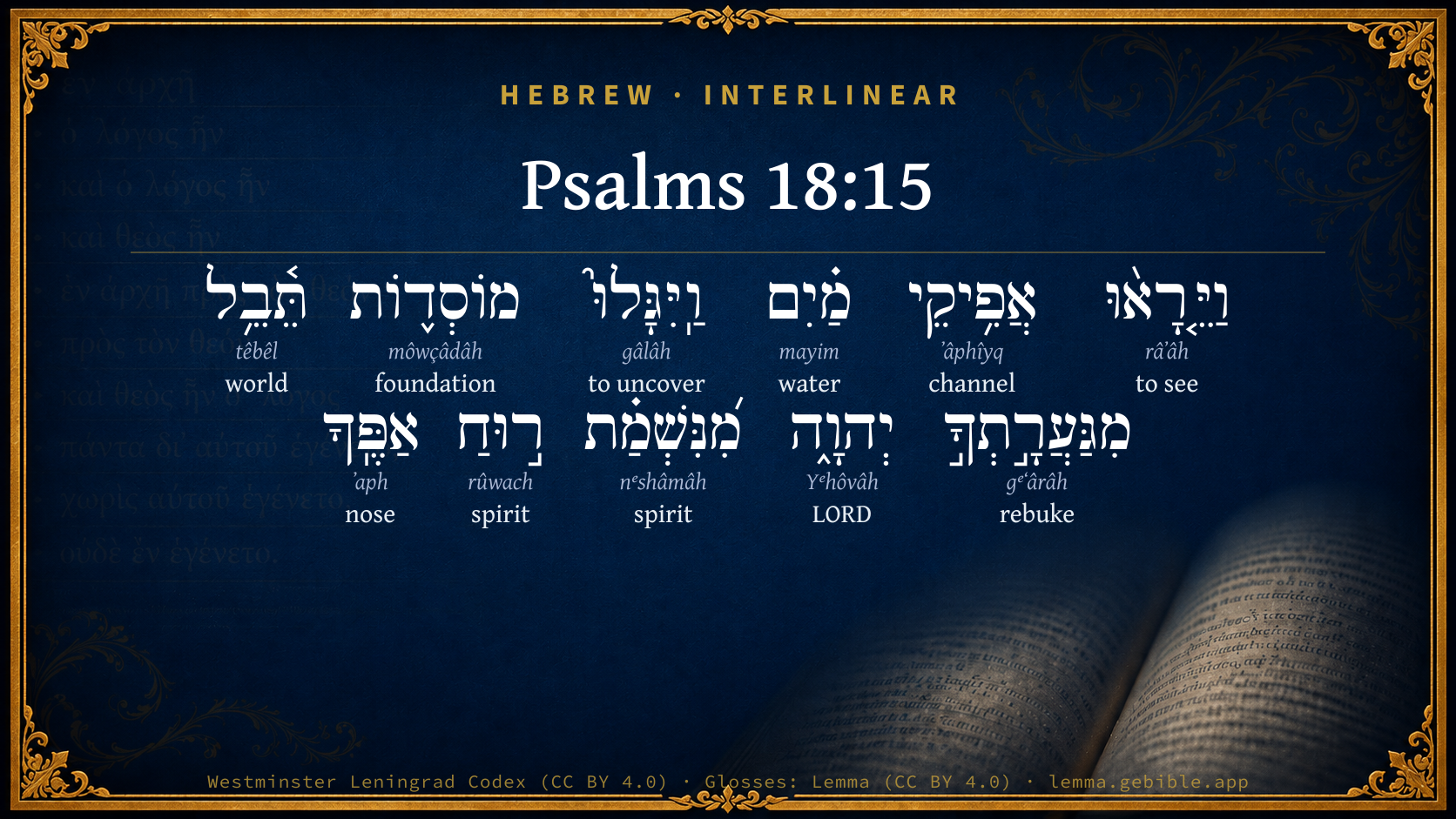
Hebrew (Westminster Leningrad Codex) Psalms 18:15 appears in the Hebrew Old Testament. The text above is from the Westminster Leningrad Codex. Each word links to its Strong’s number, a concise gloss, and parsing drawn from the Open Scriptures Hebrew Bible morphology. Click any word for its full Brown-Driver-Briggs (BDB) entry.
Download image
Cite this verse

Psalms 18:15 (World English Bible). Public Domain. Lemma interlinear Bible study tool, https://lemma.gebible.app/v/psalms/18/15.

Show BibTeX & RIS
BibTeX
RIS
English Translation
Then the channels of waters appeared, The foundations of the world were laid bare at your rebuke, Yahweh, At the blast of the breath of your nostrils.
World English Bible · Public Domain
Download a study sheet

One document with this verse’s original text, its word-by-word gloss line, the meaning frame, cross-references with their text, attributed commentary, and full source and license credits — printable, and it pastes into notes with its structure intact.

This verse Autodidact and up

Study sheet (.html) Plain text (.txt)

A passage Seminary Student

Up to 50 verses in one chapter. A passage sheet keeps up to 6 commentary sources and 12 cross-references per verse, in the order this page ranks them, and says so on the sheet whenever that leaves anything out. Ask for a single verse and you get the Autodidact verse sheet above.

Everything on this page stays free to read, with no account — the sheet is a download of what is already on screen, not access to it.

Want to remove ads? Support Godless Engineer
Compare translations 3

The same verse in 3 English versions, stacked beneath the original-language interlinear above. Click any original word for its lexicon entry.

Each is an independent rendering of the whole verse — the interlinear is not word-aligned to these translations.

Highlighted words mark where these versions differ — a whole-verse word diff, not a word-by-word alignment.

  • World English Bible Public Domain
    Then the channels of waters appeared, The foundations of the world were laid bare at your rebuke, Yahweh, At the blast of the breath of your nostrils.
  • King James Version Public Domain
    Then the channels of waters were seen, and the foundations of the world were discovered at thy rebuke, O LORD, at the blast of the breath of thy nostrils.
  • unfoldingWord Literal Text CC BY-SA 4.0
    And the channels of the sea were seen, and the foundations of the world were uncovered, from your rebuke, Yahweh, from the blast of the breath of your nose.

unfoldingWord Literal Text — © unfoldingWord, licensed CC BY-SA 4.0. Word-aligned USFM3 via Door43 (git.door43.org/unfoldingWord/en_ult).

Versions to compare (up to 4)

3 of 4 selected

Show all 18 translations

Every available English version of this verse, each an independent rendering of the whole verse.

  • World English Bible Public Domain
    Then the channels of waters appeared, The foundations of the world were laid bare at your rebuke, Yahweh, At the blast of the breath of your nostrils.
  • Berean Standard Bible Public Domain
    The channels of the sea appeared, and the foundations of the world were exposed, at Your rebuke, O LORD, at the blast of the breath of Your nostrils.
  • Majority Standard Bible Public Domain
    The channels of the sea appeared, and the foundations of the world were exposed, at Your rebuke, O LORD, at the blast of the breath of Your nostrils.
  • King James Version Public Domain
    Then the channels of waters were seen, and the foundations of the world were discovered at thy rebuke, O LORD, at the blast of the breath of thy nostrils.
  • American Standard Version (1901) Public Domain
    Then the channels of waters appeared, And the foundations of the world were laid bare, At thy rebuke, O Jehovah, At the blast of the breath of thy nostrils.
  • Revised Version (1885) Public Domain
    Then the channels of waters appeared, and the foundations of the world were laid bare, at thy rebuke, O LORD, at the blast of the breath of thy nostrils.
  • Geneva Bible (1599) Public Domain
    And the chanels of waters were seene, and the foundations of the worlde were discouered at thy rebuking, O Lord, at the blasting of the breath of thy nostrels.
  • Douay-Rheims (1899) Public Domain
    And he sent forth his arrows, and he scattered them: he multiplied lightnings, and troubled them.
  • Young's Literal Translation Public Domain
    And seen are the streams of waters, And revealed are foundations of the earth. From Thy rebuke, O Jehovah, From the breath of the spirit of Thine anger.
  • Literal Standard Version CC BY-SA 4.0
    And the streams of waters are seen, || And foundations of the earth are revealed, || From Your rebuke, O YHWH, || From the breath of the wind of Your anger.
  • Unlocked Literal Bible CC BY-SA 4.0
    Then the water channels appeared; the foundations of the world were laid bare at your rebuke, Yahweh, at the blast of the breath of your nostrils.
  • unfoldingWord Literal Text CC BY-SA 4.0
    And the channels of the sea were seen, and the foundations of the world were uncovered, from your rebuke, Yahweh, from the blast of the breath of your nose.
  • Darby Bible Public Domain
    And the beds of the waters were seen, and the foundations of the world were uncovered at thy rebuke, Jehovah, at the blast of the breath of thy nostrils.
  • World Messianic Bible Public Domain
    Then the channels of waters appeared. The foundations of the world were laid bare at your rebuke, LORD, at the blast of the breath of your nostrils.
  • Webster's Bible Public Domain
    \\18:14\\Yes, he sent out his arrows, and scattered them; and he shot out lightnings, and discomfited them.
  • Free Bible Version CC BY-SA 4.0
    You roared, Lord, and by the wind from the breath of your nostrils the valleys of the sea were exposed and the foundations of the earth were uncovered.
  • Bible in Basic English Public Domain
    Then the deep beds of the waters were seen, and the bases of the world were uncovered, because of your words of wrath, O Lord, because of the breath from your mouth.
  • JPS Tanakh (1917) Public Domain
    (18-16) And the channels of waters appeared, and the foundations of the world were laid bare, at Thy rebuke, O LORD, at the blast of the breath of Thy nostrils.

Literal Standard Version (2020), Covenant Press — licensed CC BY-SA 4.0. Text via the HelloAO Bible API (eBible.org). Unlocked Literal Bible (unfoldingWord) — licensed CC BY-SA 4.0. Text via the HelloAO Bible API (eBible.org). unfoldingWord Literal Text — © unfoldingWord, licensed CC BY-SA 4.0. Word-aligned USFM3 via Door43 (git.door43.org/unfoldingWord/en_ult). Free Bible Version, Dr. Jonathan Gallagher — licensed CC BY-SA 4.0. Text via the HelloAO Bible API (eBible.org).

Word by word

More ways to search: Search by grammar → Find every occurrence → Compare this word →

Practice this passage: Drill this verse → Learn its vocabulary →

מוֹסְד֪וֹת
môwçâdâh
H4146
“foundations of”
Noun, Common, Both, Plural, Construct
Part of Speech
Noun
Type
Common
Gender
Both
Number
Plural
State
Construct
Full BDB Definition

Origin: from H4144

TWOT: 875f

foundation
  1. וַיֵּ֤רָא֨וּ râʼâh H7200 “and · to see” Conjunction + Verb, Niphal, Sequential Imperfect, 3rd Person, Masculine, Plural
  2. אֲפִ֥יקֵי ʼâphîyq H650 “channels of” Noun, Common, Masculine, Plural, Construct
  3. מַ֗יִם mayim H4325 “water(s)” Noun, Common, Masculine, Plural, Absolute
  4. וַֽיִּגָּלוּ֮ gâlâh H1540 “and · to uncover” Conjunction + Verb, Niphal, Sequential Imperfect, 3rd Person, Masculine, Plural
  5. תֵּ֫בֵ֥ל têbêl H8398 “world” Noun, Common, Feminine, Singular, Absolute
  6. מִגַּעֲרָ֣תְךָ֣ gᵉʻârâh H1606 “from · rebuke · your” Preposition + Noun, Common, Feminine, Singular, Construct + Suffix, Personal, 2nd Person, Masculine, Singular
  7. יְהוָ֑ה Yᵉhôvâh H3068 “LORD” Noun, Proper
  8. מִ֝נִּשְׁמַ֗ת nᵉshâmâh H5397 “from · spirit of” Preposition + Noun, Common, Feminine, Singular, Construct
  9. ר֣וּחַ rûwach H7307 “spirit of” Noun, Common, Both, Singular, Construct
  10. אַפֶּֽךָ ʼaph H639 “nose · your” Noun, Common, Masculine, Singular, Construct + Suffix, Personal, 2nd Person, Masculine, Singular

About this verse

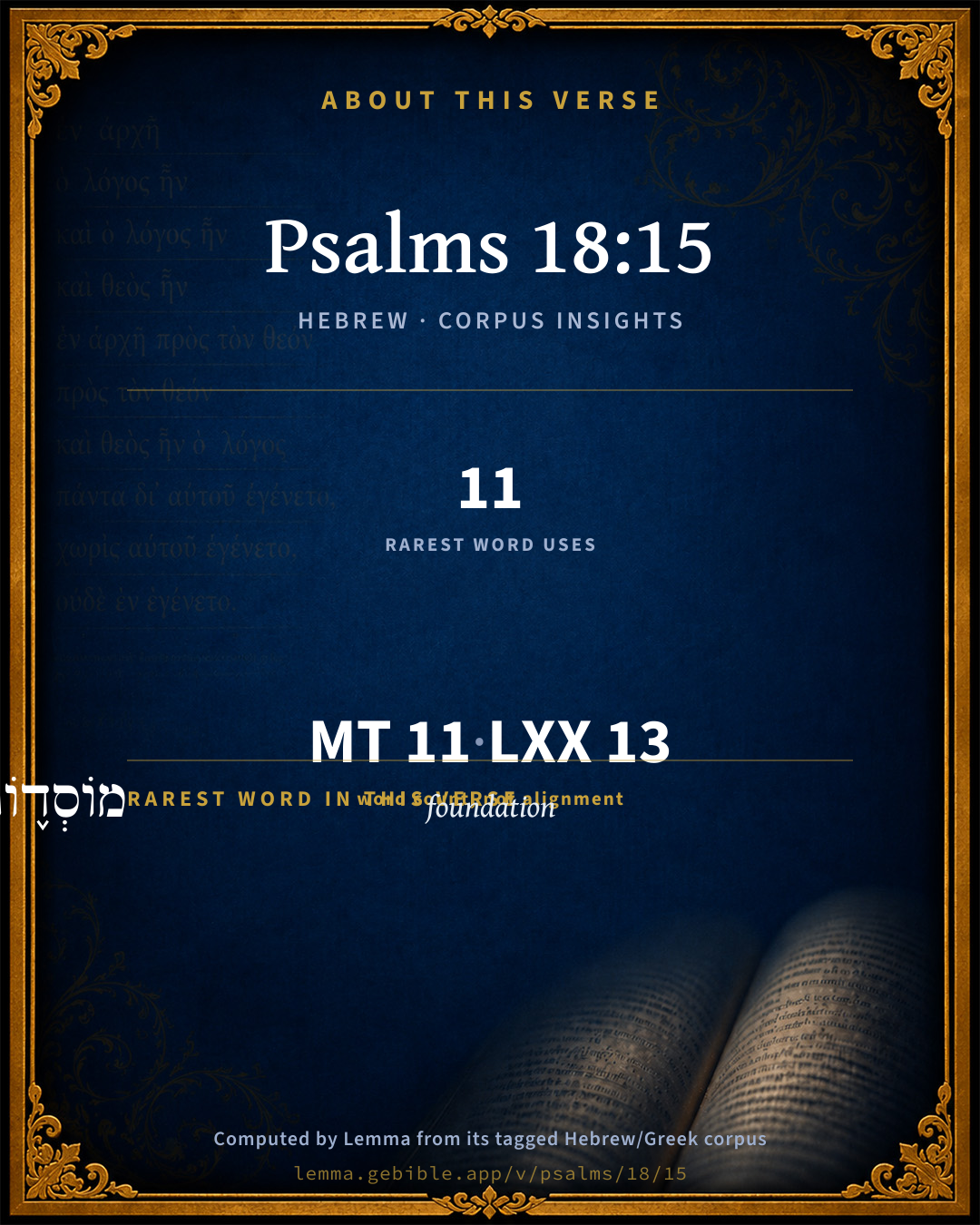
These counts appear in no published source. They are computed here, from the morphology-tagged text and Lemma’s own curated glosses. What Lemma adds →

11
words
11
distinct lemmas
Wisdom
section

Notable vocabulary

The rarest word here is מוֹסְד֪וֹת foundation H4146 — appearing just 11 times in the whole Hebrew Bible.

Shared distinctive vocabulary

מוֹסְד֪וֹת foundation H4146 occurs in 11 verses of the Hebrew Bible. Also found in:

Grammatical profile

  • 2 verbs
  • 9 nouns

Verb forms

  • וַיֵּ֤רָא֨וּ Niphal · Sequential Imperfect
  • וַֽיִּגָּלוּ֮ Niphal · Sequential Imperfect

Hebrew & Septuagint length

In English translation the verse runs 27 words from the Hebrew and 28 from the Septuagint (LXX English) — closely comparable.

A rough comparison of the two English renderings, which tokenize alike — not a word-level alignment.

Word counts can differ between the Hebrew and the Greek without any difference in meaning — e.g. the Hebrew direct-object marker אֵת has no separate Greek word, and Greek often adds the article ὁ.

In the original languages it is 11 Hebrew tokens and 13 Greek tokens — but the two are counted differently (Hebrew bundles its prefixes and suffixes into one token; the Greek is in lemma form), so that isn’t a like-for-like length.

Cross-references

16

Topical passages linked to Psalms 18:15 in the Treasury of Scripture Knowledge — connected by theme and wording, ordered by reader-vote popularity; previews shown in the World English Bible.

  • Psalms 106:9 He rebuked the Red Sea also, and it was dried up; So he led them through the depths, as through a desert.
  • Exodus 15:8 With the blast of your nostrils the waters were piled up. The floods stood upright as a heap. The deeps were congealed in the heart of the sea.
  • Micah 6:2 Hear, you mountains, Yahweh's controversy, And you enduring foundations of the earth; For Yahweh has a controversy with his people, And he will contend with Israel.
  • Joshua 3:13–16 It shall come to pass, when the soles of the feet of the priests who bear the ark of Yahweh, the Lord of all the earth, shall rest in the waters of the Jordan, that the waters of the Jordan shall be cut off, even the waters that come down from above; and they shall stand in one heap.
  • 2 Samuel 22:16 Then the channels of the sea appeared, The foundations of the world were laid bare, By the rebuke of Yahweh, At the blast of the breath of his nostrils.
  • Job 4:9 By the breath of God they perish, By the blast of his anger are they consumed.
  • Psalms 76:6 At your rebuke, God of Jacob, Both chariot and horse are cast into a deep sleep.
  • Psalms 104:5 He laid the foundations of the earth, That it should not be moved forever.
  • Jeremiah 31:37 Thus says Yahweh: If heaven above can be measured, and the foundations of the earth searched out beneath, then will I also cast off all the seed of Israel for all that they have done, says Yahweh.
  • 2 Kings 19:7 Behold, I will put a spirit in him, and he shall hear news, and shall return to his own land; and I will cause him to fall by the sword in his own land.
  • Job 38:4–6 "Where were you when I laid the foundations of the earth? Declare, if you have understanding.
  • Psalms 74:15 You opened up spring and stream. You dried up mighty rivers.
  • Isaiah 30:27–28 Behold, the name of Yahweh comes from far, burning with his anger, and in thick rising smoke: his lips are full of indignation, and his tongue is as a devouring fire;
  • Isaiah 11:4 but with righteousness shall he judge the poor, and decide with equity for the humble of the earth; and he shall strike the earth with the rod of his mouth; and with the breath of his lips shall he kill the wicked.
  • Jonah 2:6 I went down to the bottoms of the mountains. The earth barred me in forever: Yet have you brought up my life from the pit, Yahweh my God.
  • Isaiah 30:33 For a Topheth is prepared of old; yes, for the king it is made ready; he has made it deep and large; the pile of it is fire and much wood; the breath of Yahweh, like a stream of sulfur, does kindle it.

Cross-references courtesy of OpenBible.info (CC BY 4.0).

Hebrew and Greek witnesses Masoretic Hebrew ↔ Greek Septuagint

The same verse in the two great witnesses to the Old Testament, shown verse-for-verse.

You’re reading Greek Psalm 17 (Hebrew Psalm 18). The Septuagint counts the superscription, so verse numbers can differ from the Hebrew — chapter-level alignment, not verse-by-verse. Numbering follows Rahlfs.

These are two independent witnesses, not word-aligned to each other, and the Septuagint is shown in lemma (dictionary) form.

Hebrew Psalms 18:15 Masoretic · Westminster Leningrad Codex

וַיֵּ֤רָא֨וּ אֲפִ֥יקֵי מַ֗יִם וַֽיִּגָּלוּ֮ מוֹסְד֪וֹת תֵּ֫בֵ֥ל מִגַּעֲרָ֣תְךָ֣ יְהוָ֑ה מִ֝נִּשְׁמַ֗ת ר֣וּחַ אַפֶּֽךָ

Then the channels of waters appeared, The foundations of the world were laid bare at your rebuke, Yahweh, At the blast of the breath of your nostrils.

World English Bible · Public Domain

Greek LXX Greek Psalm 17:15 Septuagint · lemma form

καί ἐκ ἀποστέλλω βέλος καί σκορπίζω αὐτός καί ἀστραπή πληθύνω καί συνταράσσω αὐτός

And the springs of waters appeared, and the foundations of the world were exposed, at your rebuke, O Lord, at the blasting of the breath of your wrath.

LXX2012 (modern English Septuagint) · Public Domain

Hebrew: Westminster Leningrad Codex (CC BY 4.0). Greek: Septuagint (public domain); English from LXX2012 (modern English Septuagint) (Public Domain). How the Septuagint differs from the Hebrew →

Commentary

Notes on Psalms 18:15 from classic Christian and Jewish commentators (each source and its license shown beneath its notes). The classic Christian expositions comment on the surrounding passage and are grouped to its opening verse, so a note may address several verses; the Jewish commentaries on the Tanakh (Rashi and others) are per-verse, so they appear only where the commentator wrote on this verse.

Lemma curates 59 commentaries, every one of them public domain or Creative Commons licensed, each selected and text-cleaned for this edition rather than reprinted as found. About our sources →

Trapp's Complete Commentary

John Trapp

Psa 18:15 Then the channels of waters were seen, and the foundations of the world were discovered at thy rebuke, O LORD, at the blast of the breath of thy nostrils.

Ver. 15. Then the channels of waters were seen] The force of this terrible tempest is further set forth by the effect of it, a dreadful concussion of the universe; not without an allusion to the drying up of the Red Sea and of Jordan before Israel: which deliverances stood for archetypes, or chief patterns, to all posterity.

John Trapp, A Commentary or Exposition upon All the Books of the Old and New Testament (1647–1656) — public domain. Text from a community e-Sword module.

Joseph Benson's Commentary

Psa 18:15. Then the channels of waters were seen — This is a description of the effects of the earthquake, by which the earth was rent in sunder, and such clefts made in it that the subterraneous passages of the waters were discovered, as has frequently been the case in violent earthquakes, whole rivers of waters sometimes issuing from the clefts, and spouting up a great height into the air. The foundations of the world were discovered — That is, Such large and deep chasms, or apertures, were made by the violence of the shock that the lower parts of the earth were laid open to view, and made perfectly visible.

Joseph Benson's Commentary on the Old and New Testaments (1811–1818) — public domain. Text from a community e-Sword module.

J. A. Alexander on Psalms

Joseph Addison Alexander

16. (Psa 18:15). Then were seen the channels of water and uncovered the foundations of the world, at thy rebuke, Jehovah, at the blast of the breath of thy wrath. The idea meant to be conveyed by this poetical description is that of sudden and complete subversion, the turning of the whole earth upside down. The language is not designed to be exactly expressive of any real physical change whatever. From, or at thy rebuke, i.e. after it and in consequence of it. The breath of thy wrath, thy angry breath, might also be rendered, the wind of thy wrath, thy angry or tempestuous wind. That the Hebrew words do not mean thy nose or nostrils, see above, on Psa 18:9 (8). Some suppose an allusion, in the figures of this verse, to the floods of worthlessness in Psa 18:5 (4), and the bands of hell in Psa 18:6 (5).

Joseph Addison Alexander, The Psalms Translated and Explained (1850) — public domain. Text from a community e-Sword module.

Geneva Bible (1599)

Geneva Bible translators

That is, the deep bottoms were seen when the red sea was divided.

Geneva Bible (1599) marginal notes — public domain. Text via Bolls.life.

Jamieson, Fausset & Brown

Robert Jamieson, A. R. Fausset & David Brown

The tempest of the air is attended by appropriate results on earth. The language, though not expressive of any special physical changes, represents the utter subversion of the order of nature. Before such a God none can stand.

Jamieson, Fausset & Brown — Commentary Critical and Explanatory on the Whole Bible (1871) — public domain (CC PDM 1.0). Text via the HelloAO Bible API.

Adam Clarke's Commentary

Verse 15. The channels of water were seen] This must refer to an earthquake; for in such cases, the ground being rent, water frequently gushes out at the fissures, and often rises to a tremendous height. Whole rivers were poured out of the chasms made by the earthquake in Jamaica, A. D. 1694; and new lakes of water were formed, covering a thousand acres of land!

Adam Clarke's Commentary on the Bible (1810–1826) — public domain. Text from a community e-Sword/MySword module.

John Calvin's Commentaries

15. And the sources of the waters were seen. In this verse, David doubtless alludes to the miracle which was wrought when the chosen tribes passed through the Red Sea. I have before declared the purpose for which he does this. As all the special benefits which God in old time conferred upon any of the children of Abraham as individuals, were so many testimonies by which he recalled to their remembrance the covenant which he had once entered into with the whole people, to assure them that he would always continue his grace towards them, and that one deliverance might be to them a token or pledge of their perpetual safety, and of the protection of God, David fitly conjoins with that ancient deliverance of the Church the assistance which God had sent from heaven to him in particular. As the grace which he declares God had shown towards him was not to be separated from that first deliverance, since it was, so to speak, a part and an appendage of it, he beholds, as it were at a glance, or in an instant, both the ancient miracle of the drying up of the Red Sea, and the assistance which God granted to himself. In short, God, who once opened up for his people a way through the Red Sea, and then showed himself to be their protector upon this condition, that they should assure themselves of being always maintained and preserved under his keeping, now again displayed his wonderful power in the defense and preservation of one man, to renew the remembrance of that ancient history. From this it appears the more evidently, that David, in using these apparently strange and exaggerated hyperboles, does not recite to us the mere creations of romance to please the fancy, after the manner of the heathen poets, “En usant de ces hyperboles et similitudes qui semblent estranges et excessives ne nous recite pas des fables et contes faits a plaisir a la fakon des Poietes profanes.” — Fr.

John Calvin's Commentaries (1540-1563) — public domain. Text from the Calvin Translation Society English edition (1840s-50s) via the Christian Classics Ethereal Library (ccel.org). Calvin's coverage is partial (roughly two-thirds of the Bible); uncommented books and verses are honest gaps, never fabricated. The 19th-century editor's footnotes and remarks are omitted so the notes are faithfully Calvin's own voice.

Ellicott's Commentary for English Readers

(15) The channels.—The description of the storm ends with the fury of the wind and the effects of the tempest on the earth’s surface. Comp. Psalms 29, and Milton:—

“Either tropic now

‘Gan thunder and both ends of heaven the clouds,

From many a horrid rift abortive pour’d

Fierce rain with lightning mix’d, water with fire,

In ruin reconciled; nor slept the winds

Within their stony caves, but rush’d abroad

From the four hinges of the world and fell

On the vex’d wilderness.”

—Par. Reg. iv. 409416.

Here, to suit the poet’s purpose (see next verse), the rage of the tempest is made to spend itself on the water-floods. The “channels” are either torrent beds (Isa_8:7; Psa_42:1; Job_6:15), or as in Samuel (where for “waters” the text has “sea”) the depths of ocean. (Comp. Jon_2:5.)

A Bible Commentary for English Readers, edited by Charles John Ellicott (1878–1897) — public domain. Text from a community e-Sword module.

The Cambridge Bible for Schools and Colleges

gen. ed. J. J. S. Perowne

15. The waters of the sea retreat, its bed is seen, and the hidden bases of the world are laid bare, owning their Lord and Master, as of old at the Exodus when “He rebuked the Red Sea, and it was dried up.” See Exo_15:8; Psa_106:9; Nah_1:4. Cp. too Mat_8:26. Channels of the sea (2 Sam.) is the preferable reading.

were discovered] i.e. as R.V., were laid bare, the original meaning of the word discover, which it generally retains in the A.V. Cp. Psa_29:9.

at the blast &c.] Cp. Psa_18:8.

The Cambridge Bible for Schools and Colleges (gen. ed. J. J. S. Perowne; Cambridge University Press, 1878–1918) — public domain. Text from a community e-Sword module.

John Gill's Exposition

He sent from above,.... Either his hand, as in Psa 144:7; he exerted and displayed his mighty power in raising Christ from the dead; or he sent help from his sanctuary; as in Psa 20:2; and helped and strengthened him in a day of salvation; or when he wrought out the salvation of his people; or "he sent his word", as in Psa 107:20; his word of command, to take up his life again, as he had given it to lay it down, Joh 10:18. The Targum is, he sent his prophets; but it may be much better supplied, he sent his angels, or an angel; as he did at his resurrection, who rolled away the stone from the sepulchre, as a token of his justification and discharge: so Jarchi interprets it, he sent his angels; and Aben Ezra supplies it thus,

"he sent his word or his angel:''

unless the sense should be, as Cocceius suggests, he sent a cloud from above, which was done at Christ's ascension, and which received him out of the sight of the apostles, Act 1:9. Since it follows,

he took me; that is, up to heaven; thither Christ was carried in a cloud, one of God's chariots, he sent for him; and where he is received, and will be retained until his second coming; though rather the sense is, he took me by the hand:

he drew me out of many waters. This is said either in allusion to Moses, who had his name from his being drawn out of the water, Exo 2:10; and who was an eminent type of Christ; and this is the only place where the Hebrew word is made use of from whence he had his name; or else to a man plunged in water ready to be drowned; see Psa 69:1. By these "many waters" may be meant the many afflictions, sorrows, and sufferings from which Christ was freed, when raised from the dead, and highly exalted and crowned with glory and honour; and the torrent of sins which flowed in upon him at the time he was made sin for his people, from which he was justified when risen; and so will appear a second time without sin unto salvation; and the wrath of God, the waves and billows of which went over him, and compassed him about as water, at the time of his sufferings; from which he was delivered when he was shown the path of life, and entered into the presence of God, and sat at his right hand, where are joys and pleasures for evermore; and also his grand enemy Satan, with his principalities and powers, who came in like a flood upon him; but he destroyed him and spoiled them; and particularly the floods of ungodly men, spoken of in Psa 18:4; seem to be here designed; compare with this Psa 144:7; "so many waters" signify many people and nations, Rev 17:15; and accordingly the Targum is,

"he delivered me from many people.''

This was true of Christ when risen and ascended; he was then separate from sinners, and made higher than the heavens; and this sense is confirmed by the following words, where what is expressed figuratively here is there literally explained.

John Gill's Exposition of the Whole Bible (1746–1763) — public domain (CC PDM 1.0). Text via the HelloAO Bible API.

Albert Barnes' Notes on the Bible

Then the channels of waters were seen - In 2Sa 22:16 this is, “And the channels of the sea appeared.” The idea is that, by the driving of the storm and tempest, the waters were driven on heaps, leaving the bottom bare. In the place before us the word used, “waters” - מים mayim - would denote waters of any kind - seas, lakes, rivers; in the corresponding place in 2 Samuel, the word used - ים yâm - denotes, properly, the sea or the ocean. The word rendered channels means a pipe or tube; then a channel, or bed of a brook or stream, Isa 8:7; Eze 32:6; and then the bottom of the sea or of a river. The allusion is to the effect of a violent wind, driving the waters on heaps, and seeming to leave the bed or channel bare.

The foundations of the world were discovered - Were laid open; were manifested or revealed. People seemed to be able to look down into the depths, and to see the very foundations on which the earth rests. The world is often represented as resting on a foundation, Psa 102:25; Isa 48:13; Zec 12:1; Pro 8:29; see the note at Job 38:4.

At thy rebuke - At the expression of his anger or displeasure; as if God, in the fury of the tempest, was expressing his indignation and wrath.

At the blast of the breath of thy nostrils - At the breathing forth of anger, as it were, from his nostrils. See the note at Psa 18:8.

Albert Barnes' Notes on the Bible (1834–1885) — public domain. Text from a community e-Sword/MySword module.

Matthew Poole's English Annotations

By mighty and terrible earthquakes, which overturned the earth, and made its lower parts uppermost and visible.

Matthew Poole's English Annotations on the Holy Bible (1683–1685) — public domain. Text from a community e-Sword/MySword module.

The Treasury of David

Charles H. Spurgeon

Ver. 15. So tremendous was the shock of God's assault in arms that the order of nature was changed, and the bottoms of rivers and seas were laid bare.

The channels of waters was seen; and the deep cavernous bowels of the earth were upheaved till

the foundations of the world were discovered. What will not Jehovah's rebuke do? If the blast of the breath of thy nostrils, O Lord, be so terrible, what must thine arm be? Vain are the attempts of men to conceal anything from him whose word unbars the deep, and lifts the doors of earth from their hinges! Vain are all hopes of resistance, for a whisper of his voice makes the whole earth quail in abject terror.

Ver. 15. The foundations of the world were discovered; i.e., such large and deep chasms, or apertures, were made by the violence of the earthquake, as one might almost see the very foundations, or as Jonah calls them, the bottoms, or rather, the extremities of the mountains, in the bottom of the sea. Jon 2:6. Samuel Chandler.

Ver. 15. The Lord interposed with the same notoriety of his presence, as when the waters of the sea were driven back by a strong east wind, and the deep turned into dry ground (Ex 14:21-22), to give the Israelites a safe passage out of their thraldom, and to drown the Egyptians. Henry Hammond.

None.

Psalms 18:16*

Charles H. Spurgeon's The Treasury of David (1869–1885) — public domain. Psalms only. Text from a community e-Sword/MySword module.

Whedon's Commentary on the Bible

Daniel D. Whedon

15. Then—Emphatic: when the divine judgments had been fully executed. The psalmist describes (to Psa_18:19) the wonderful effects of the divine interference.

Channels of waters—In the parallel place (2Sa_22:16) it reads, “channels of the sea.” The plural denotes the Red Sea and Jordan. Exo_14:21-22; Jos_3:15-17.

Foundations of the world—The Hebrews had no knowledge of the interior of the earth below the bottom of the sea and the rocky foundations of the mountains.

Jon_2:6. The figure is in harmony with ancient geogony, and poetically admissible in any age. See notes on Psa_24:2; Psa_104:5; Psa_104:9

Daniel D. Whedon (gen. ed.), Commentary on the Old and New Testaments (1874–1909) — public domain. Text from a community e-Sword module.

The Pulpit Commentary

Then the channels of waters were seen. By "the channels of waters" seem to be meant the torrent-courses, so common in Palestine, especially on either side of Jordan, which convey into it the winter rains. These "were seen," lit up by the "lightnings manifold," having previously been in darkness (see vers. 9-11). At the same time, the foundations of the world were discovered. The earthquake (ver. 7) still continuing, the earth gaped in places, and the glare of the lightning enabled the eye to penetrate deep into the solid globe so deep that it seemed to reach the "foundations." At thy rebuke, O Lord, at the blast of the breath of thy nostrils (comp. ver. 7, "because he was wroth").

The Pulpit Commentary (1880–1919), ed. H.D.M. Spence-Jones & Joseph S. Exell — public domain. Text from a community e-Sword module.

John Wesley's Explanatory Notes

Discovered - By mighty earthquakes, which overturned the earth, and made its lower parts visible.

John Wesley, Explanatory Notes Upon the Whole Bible (1754–1765) — public domain. Text via the GEBible commentary corpus.

unfoldingWord translationNotes

Door43 World Missions Community

General Information:

The writer continues to speak of Yaweh's great power.

Then the water channels appeared; the foundations of the world were laid bare

These two clauses have similar meanings. This can be stated in active form. AT: "Then the water channels appeared and the bottom of the ocean became visible; you exposed the foundations of the world" (See: Parallelism and Active or Passive)

at the blast of the breath of your nostrils

Though God does not have human physical characteristics as described here, this pictures his mighty strength. The wind is spoken of here as if it came as a mighty blast from God's nostrils. (See: Personification and Metaphor)

translationWords

water

found

unfoldingWord translationNotes — © Distant Shores Media and the Door43 World Missions Community, licensed CC BY-SA 4.0. Source: git.door43.org/Door43/en_tn.

Lesson kit

Teaching starters — assembled from the data on this page, not authored interpretation. Every prompt links to the verse data it draws on. Edit before teaching.

Psalms, in the Wisdom, opens this verse with 11 words (11 distinct Hebrew lemmas). Its most distinctive word is môwçâdâh (“foundation”). A historical commentator’s framing appears above. Read the whole chapter for the surrounding context.

Discussion questions

  1. How does “foundation” (môwçâdâh) shape what this verse is saying?
  2. How does Deuteronomy 32:22, which shares the word «foundation», read alongside this verse?
  3. These translations render this verse differently. What is at stake in choosing one wording over another?
  4. «וַיֵּ֤רָא֨וּ» is a Niphal Sequential Imperfect verb. How does that grammatical form shape the action described?
  5. Compare how Trapp's Complete Commentary and Joseph Benson's Commentary read this verse. Where do they agree or differ?

Things to notice

Reading settings

Reading text

Shown beneath each verse's original-language words.

Old Testament
Old Testament edition

Read the OT as the Masoretic Hebrew (MT) or the Greek Septuagint (LXX).

English shown for the Greek Septuagint (in the Hebrew ↔ Greek comparison).

Comparing translations? Open the Compare panel on any verse page to stack up to four side by side.