
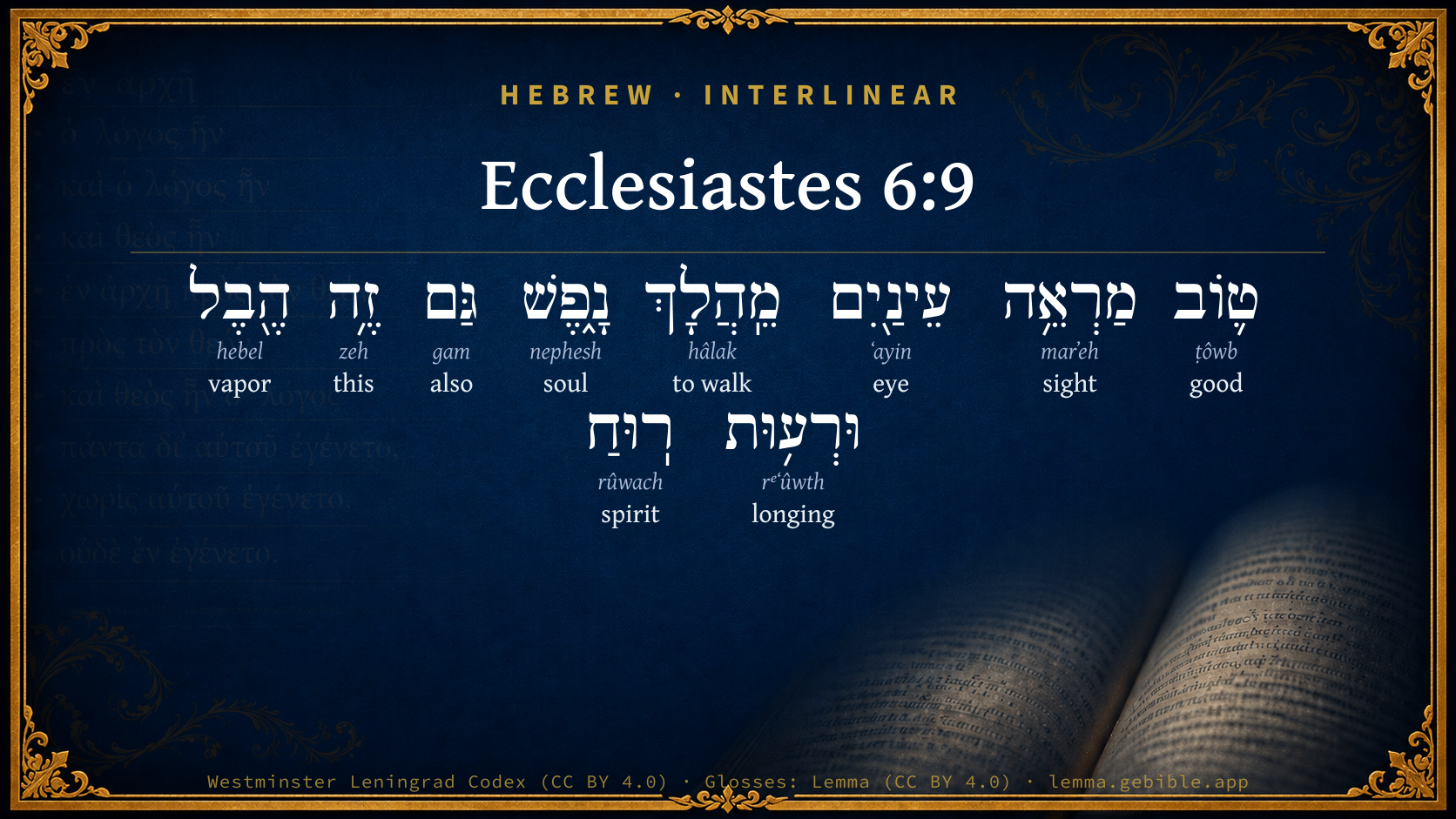
Ecclesiastes 6:9

Hebrew (Westminster Leningrad Codex) Ecclesiastes 6:9 appears in the Hebrew Old Testament. The text above is from the Westminster Leningrad Codex. Each word links to its Strong’s number, a concise gloss, and parsing drawn from the Open Scriptures Hebrew Bible morphology. Click any word for its full Brown-Driver-Briggs (BDB) entry.
Download image
Cite this verse

Ecclesiastes 6:9 (World English Bible). Public Domain. Lemma interlinear Bible study tool, https://lemma.gebible.app/v/ecclesiastes/6/9.

Show BibTeX & RIS
BibTeX
RIS
English Translation
Better is the sight of the eyes than the wandering of the desire. This also is vanity and a chasing after wind.
World English Bible · Public Domain
Download a study sheet

One document with this verse’s original text, its word-by-word gloss line, the meaning frame, cross-references with their text, attributed commentary, and full source and license credits — printable, and it pastes into notes with its structure intact.

This verse Autodidact and up

Study sheet (.html) Plain text (.txt)

A passage Seminary Student

Up to 50 verses in one chapter. A passage sheet keeps up to 6 commentary sources and 12 cross-references per verse, in the order this page ranks them, and says so on the sheet whenever that leaves anything out. Ask for a single verse and you get the Autodidact verse sheet above.

Everything on this page stays free to read, with no account — the sheet is a download of what is already on screen, not access to it.

Want to remove ads? Support Godless Engineer
Compare translations 3

The same verse in 3 English versions, stacked beneath the original-language interlinear above. Click any original word for its lexicon entry.

Each is an independent rendering of the whole verse — the interlinear is not word-aligned to these translations.

Highlighted words mark where these versions differ — a whole-verse word diff, not a word-by-word alignment.

  • World English Bible Public Domain
    Better is the sight of the eyes than the wandering of the desire. This also is vanity and a chasing after wind.
  • King James Version Public Domain
    Better is the sight of the eyes than the wandering of the desire: this is also vanity and vexation of spirit.
  • unfoldingWord Literal Text CC BY-SA 4.0
    Better a sight of eyes than the walking of soul. Also this vapor and pursuit of wind.

unfoldingWord Literal Text — © unfoldingWord, licensed CC BY-SA 4.0. Word-aligned USFM3 via Door43 (git.door43.org/unfoldingWord/en_ult).

Versions to compare (up to 4)

3 of 4 selected

Show all 18 translations

Every available English version of this verse, each an independent rendering of the whole verse.

  • World English Bible Public Domain
    Better is the sight of the eyes than the wandering of the desire. This also is vanity and a chasing after wind.
  • Berean Standard Bible Public Domain
    Better what the eye can see than the wandering of desire. This too is futile and a pursuit of the wind.
  • Majority Standard Bible Public Domain
    Better what the eye can see than the wandering of desire. This too is futile and a pursuit of the wind.
  • King James Version Public Domain
    Better is the sight of the eyes than the wandering of the desire: this is also vanity and vexation of spirit.
  • American Standard Version (1901) Public Domain
    Better is the sight of the eyes than the wandering of the desire: this also is vanity and a striving after wind.
  • Revised Version (1885) Public Domain
    Better is the sight of the eyes than the wandering of the desire: this also is vanity and a striving after wind.
  • Geneva Bible (1599) Public Domain
    The sight of ye eye is better then to walke in ye lustes: this also is vanitie, and vexation of spirit.
  • Douay-Rheims (1899) Public Domain
    Better it is to see what thou mayst desire, than to desire that which thou canst not know. But this also is vanity, and presumption of spirit.
  • Young's Literal Translation Public Domain
    Better `is' the sight of the eyes than the going of the soul. This also `is' vanity and vexation of spirit.
  • Literal Standard Version CC BY-SA 4.0
    Better [is] the sight of the eyes than the going of the soul. This [is] also vanity and distress of spirit.
  • Unlocked Literal Bible CC BY-SA 4.0
    It is better to be satisfied with what the eyes see than to desire what a wandering appetite craves, which is also vapor and an attempt to shepherd the wind.
  • unfoldingWord Literal Text CC BY-SA 4.0
    Better a sight of eyes than the walking of soul. Also this vapor and pursuit of wind.
  • Darby Bible Public Domain
    Better is the seeing of the eyes than the wandering of the desire: this also is vanity and pursuit of the wind.
  • World Messianic Bible Public Domain
    Better is the sight of the eyes than the wandering of the desire. This also is vanity and a chasing after wind.
  • Webster's Bible Public Domain
    Better is the sight of the eyes than the wandering of the desire: this is also vanity and vexation of spirit.
  • Free Bible Version CC BY-SA 4.0
    Be happy with what you have instead of running after what you don't! But this is also hard to do, like running after the wind.
  • Bible in Basic English Public Domain
    What the eyes see is better than the wandering of desire. This is to no purpose and a desire for wind.
  • JPS Tanakh (1917) Public Domain
    Better is the seeing of the eyes than the wandering of the desire; this also is vanity and a striving after wind.

Literal Standard Version (2020), Covenant Press — licensed CC BY-SA 4.0. Text via the HelloAO Bible API (eBible.org). Unlocked Literal Bible (unfoldingWord) — licensed CC BY-SA 4.0. Text via the HelloAO Bible API (eBible.org). unfoldingWord Literal Text — © unfoldingWord, licensed CC BY-SA 4.0. Word-aligned USFM3 via Door43 (git.door43.org/unfoldingWord/en_ult). Free Bible Version, Dr. Jonathan Gallagher — licensed CC BY-SA 4.0. Text via the HelloAO Bible API (eBible.org).

Word by word

More ways to search: Search by grammar → Find every occurrence → Compare this word →

Practice this passage: Drill this verse → Learn its vocabulary →

About this verse

These counts appear in no published source. They are computed here, from the morphology-tagged text and Lemma’s own curated glosses. What Lemma adds →

10
words
10
distinct lemmas
Wisdom
section

Notable vocabulary

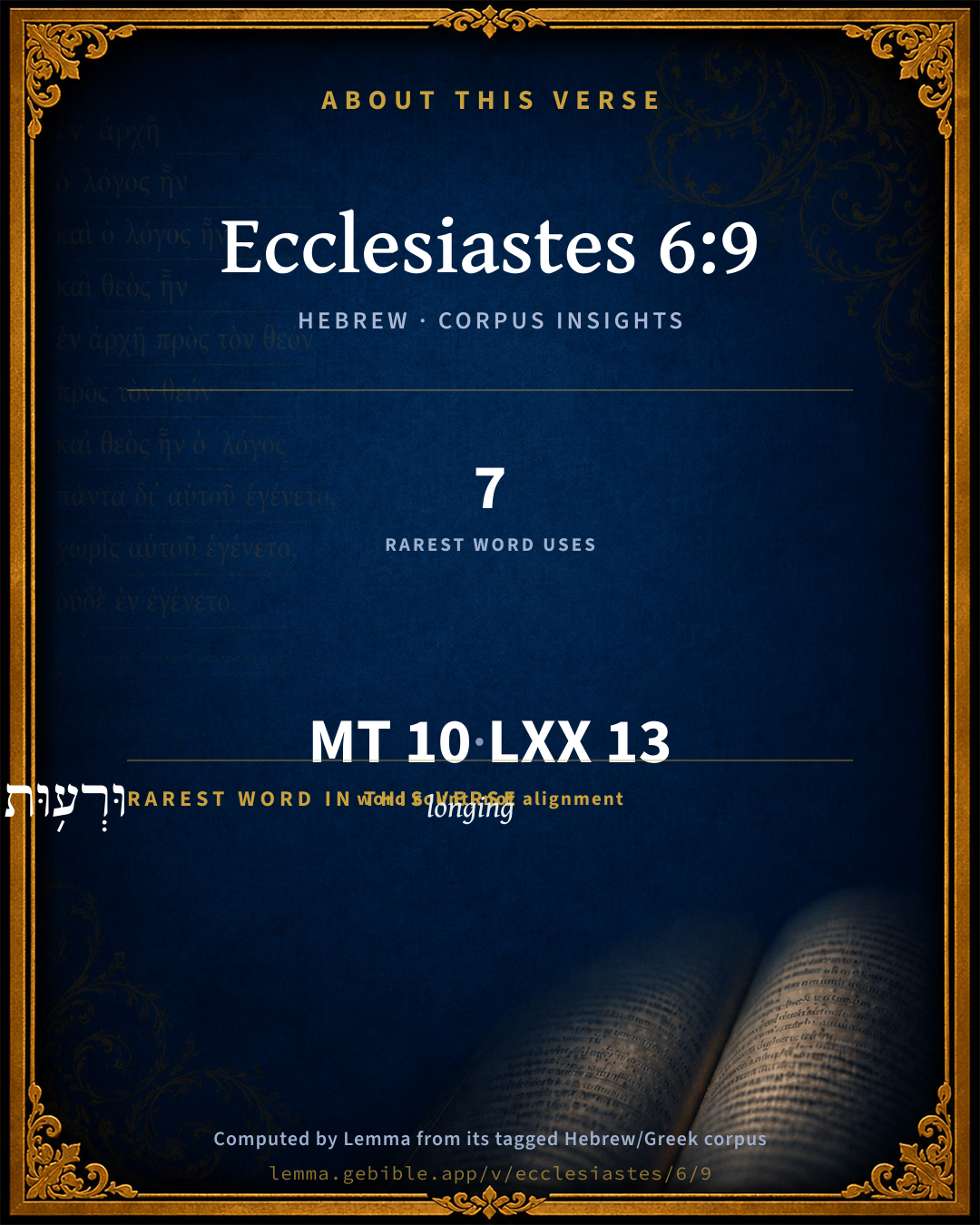
The rarest word here is וּרְע֥וּת longing H7469 — appearing just 7 times in the whole Hebrew Bible.

Shared distinctive vocabulary

וּרְע֥וּת longing H7469 occurs in 7 verses of the Hebrew Bible. Also found in:

Grammatical profile

  • 1 verb
  • 6 nouns
  • 1 adjective
  • 1 pronoun
  • 1 particle

Verb forms

  • מֵֽהֲלָךְ Qal · Infinitive Construct

Hebrew & Septuagint length

In English translation the verse runs 22 words from the Hebrew and 21 from the Septuagint (LXX English) — closely comparable.

A rough comparison of the two English renderings, which tokenize alike — not a word-level alignment.

Word counts can differ between the Hebrew and the Greek without any difference in meaning — e.g. the Hebrew direct-object marker אֵת has no separate Greek word, and Greek often adds the article ὁ.

In the original languages it is 10 Hebrew tokens and 13 Greek tokens — but the two are counted differently (Hebrew bundles its prefixes and suffixes into one token; the Greek is in lemma form), so that isn’t a like-for-like length.

Cross-references

10

Topical passages linked to Ecclesiastes 6:9 in the Treasury of Scripture Knowledge — connected by theme and wording, ordered by reader-vote popularity; previews shown in the World English Bible.

  • Ecclesiastes 1:14 I have seen all the works that are done under the sun; and, behold, all is vanity and a chasing after wind.
  • Job 31:7 If my step has turned out of the way, If my heart walked after my eyes, If any defilement has stuck to my hands,
  • Ecclesiastes 1:2 "Vanity of vanities," says the Preacher; "Vanity of vanities, all is vanity."
  • Ecclesiastes 2:11 Then I looked at all the works that my hands had worked, and at the labor that I had labored to do; and, behold, all was vanity and a chasing after wind, and there was no profit under the sun.
  • Ecclesiastes 3:12–13 I know that there is nothing better for them than to rejoice, and to do good as long as they live.
  • Ecclesiastes 4:4 Then I saw all the labor and achievement that is the envy of a man's neighbor. This also is vanity and a striving after wind.
  • Ecclesiastes 5:18 Behold, that which I have seen to be good and proper is for one to eat and to drink, and to enjoy good in all his labor, in which he labors under the sun, all the days of his life which God has given him; for this is his portion.
  • Ecclesiastes 11:9 Rejoice, young man, in your youth, And let your heart cheer you in the days of your youth, And walk in the ways of your heart, And in the sight of your eyes; But know that for all these things God will bring you into judgment.
  • Ecclesiastes 2:22–24 For what has a man of all his labor, and of the striving of his heart, in which he labors under the sun?
  • Ecclesiastes 6:2 a man to whom God gives riches, wealth, and honor, so that he lacks nothing for his soul of all that he desires, yet God gives him no power to eat of it, but an alien eats it. This is vanity, and it is an evil disease.

Cross-references courtesy of OpenBible.info (CC BY 4.0).

Hebrew and Greek witnesses Masoretic Hebrew ↔ Greek Septuagint

The same verse in the two great witnesses to the Old Testament, shown verse-for-verse.

These are two independent witnesses, not word-aligned to each other, and the Septuagint is shown in lemma (dictionary) form.

Hebrew Ecclesiastes 6:9 Masoretic · Westminster Leningrad Codex

ט֛וֹב מַרְאֵ֥ה עֵינַ֖יִם מֵֽהֲלָךְ נָ֑פֶשׁ גַּם זֶ֥ה הֶ֖בֶל וּרְע֥וּת רֽוּחַ

Better is the sight of the eyes than the wandering of the desire. This also is vanity and a chasing after wind.

World English Bible · Public Domain

Greek LXX Ecclesiastes 6:9 Septuagint · lemma form

ἀγαθός ὅραμα ὀφθαλμός ὑπέρ πορεύομαι ψυχή καί γέ οὗτος ματαιότης καί προαίρεσις πνεῦμα

The sight of the eyes is better than that which wanders in soul: this is also vanity, and waywardness of spirit.

LXX2012 (modern English Septuagint) · Public Domain

On this verse, Trapp's Complete Commentary discusses the Septuagint’s reading. Read the note in Commentary ↓

Hebrew: Westminster Leningrad Codex (CC BY 4.0). Greek: Septuagint (public domain); English from LXX2012 (modern English Septuagint) (Public Domain). How the Septuagint differs from the Hebrew →

Commentary

Notes on Ecclesiastes 6:9 from classic Christian and Jewish commentators (each source and its license shown beneath its notes). The classic Christian expositions comment on the surrounding passage and are grouped to its opening verse, so a note may address several verses; the Jewish commentaries on the Tanakh (Rashi and others) are per-verse, so they appear only where the commentator wrote on this verse.

Lemma curates 59 commentaries, every one of them public domain or Creative Commons licensed, each selected and text-cleaned for this edition rather than reprinted as found. About our sources →

The Cambridge Bible for Schools and Colleges

gen. ed. J. J. S. Perowne

9. Better is the sight of the eyes than the wandering of the desire] Literally, than the wandering of the soul. The truth is substantially that embodied in the fable of “the dog and his shadow” and in proverbs like “a bird in the hand is worth two in the bush.” To enjoy what we actually see, i.e. present opportunities, however limited, is better than the cravings of a limitless desire, “wandering” at will through all the region of possibilities. In that wandering, there is once more the feeding upon wind. Perhaps, however, that sentence is passed with an intentional ambiguity, characteristic of the writer (see note on Ecc_6:9), upon the actual present enjoyment, as well as on the unsatisfied desire, or upon the bare fact that the former with its lower aims is better than the latter with its higher ones.

The Cambridge Bible for Schools and Colleges (gen. ed. J. J. S. Perowne; Cambridge University Press, 1878–1918) — public domain. Text from a community e-Sword module.

Trapp's Complete Commentary

John Trapp

Ecc 6:9 Better [is] the sight of the eyes than the wandering of the desire: this [is] also vanity and vexation of spirit.

Ver. 9. Better is the sight of the eyes, &c., ] i.e., As some sense it, Better it is to overlook dainty dishes than to overcharge the stomach with them; to fill the eyes than the belly; to gratify that than to pamper this: though that is a vanity too in the issue, and may prove a vexation of spirit - may breed inward inquietation; the best that can come of it is repentance and self-revenge, {2Co 7:11} as in Epaminondas. Symmachus reads the words thus, Melius est providere, quam ambulare ut libet: Better it is to provide than to walk at random. The Septuagint thus, Melius est videre quod cupias, quam desiderare quod nescias: Better is it to see what thou desirest, than to desire what thou knowest not. The best expositors make it an answer to an objection: for, whereas the rich man might reply, Better see wealth than be always seeking it, better have it than hawk after it: the Preacher answers that misery may be somewhat mitigated by this means but never fully cured or cashiered.

John Trapp, A Commentary or Exposition upon All the Books of the Old and New Testament (1647–1656) — public domain. Text from a community e-Sword module.

Joseph Benson's Commentary

Ecc 6:9. Better is the sight of the eyes — That is, The comfortable enjoyment of what a man hath, seeing being often put for enjoying; than the wandering of the desire — Than restless and insatiable desires of what a man hath not. This is also vanity — This wandering of the desire, wherein many indulge themselves; and vexation of spirit — It is not the way to satisfaction, as they imagine, but to vexation.

Joseph Benson's Commentary on the Old and New Testaments (1811–1818) — public domain. Text from a community e-Sword module.

Geneva Bible (1599)

Geneva Bible translators

To be content with that which God hath given, is better than to follow the desires that never can be satisfied.

Geneva Bible (1599) marginal notes — public domain. Text via Bolls.life.

Jamieson, Fausset & Brown

Robert Jamieson, A. R. Fausset & David Brown

Answer to the question in Ecc 6:8. This is the advantage:

Better is the sight of the eyes--the wise man's godly enjoyment of present seen blessings

than the (fool's) wandering--literally, walking (Psa 73:9), of the desire, that is, vague, insatiable desires for what he has not (Ecc 6:7; Heb 13:5).

this--restless wandering of desire, and not enjoying contentedly the present (Ti1 6:6, Ti1 6:8).

Jamieson, Fausset & Brown — Commentary Critical and Explanatory on the Whole Bible (1871) — public domain (CC PDM 1.0). Text via the HelloAO Bible API.

Adam Clarke's Commentary

Verse 9. Better is the sight of the eyes than the wandering of the desire] This is translated by the Vulgate, as a sort of adage: Melius est videre quod cupias, quam desiderare quod nescias, "It is better to see what one desires than to covet what one knows not." It is better to enjoy the present than to feed one's self with vain desires of the future. What we translate the wandering of desire, מהלך נפש mehaloch nephesh, is the travelling of the soul. What is this? Does it simply mean desire? Or is there any reference here to the state of separate spirits! It however shows the soul to be in a restless state, and consequently to be unhappy. If Christ dwell in the heart by faith, the soul is then at rest, and this is properly the rest of the people of God.

Adam Clarke's Commentary on the Bible (1810–1826) — public domain. Text from a community e-Sword/MySword module.

John Gill's Exposition

Better is the sight of the eyes than the wandering of the desire,.... By "the sight of the eyes" is not meant the bare beholding outward riches, as in Ecc 5:11; but the enjoyment of present mercies; such things as a man is in the possession of, and with which he should be content, Heb 13:5; and by "the wandering of the desire", the craving appetite and insatiable lust of the covetous mind, which enlarges its desire as hell, after a thousand things, and everything it can think of; such a mind roves through the whole creation, and covets everything under the sun: now it is better to enjoy contentedly things in sight and in possession, than to let the mind loose in vague desires, after things that may never be come at, and, if attained to, would give no satisfaction;

this is also vanity and vexation of spirit: a most vain thing, to give the mind such a loose and liberty in its unbounded desires after worldly things; and a vexation of spirit it is to such a craving mind, that it cannot obtain what it is so desirous of.

John Gill's Exposition of the Whole Bible (1746–1763) — public domain (CC PDM 1.0). Text via the HelloAO Bible API.

Haydock's Catholic Bible Commentary

Know. Enjoyment has the advantage over hope. Hebrew, "better is the sight of the eyes than the going of the soul," which denotes her desires. (Calmet) --- Presumption. Hebrew, "vexation." (Haydock)

George Leo Haydock (1774–1849), Haydock's Catholic Family Bible and Commentary, 1859 edition — public domain. Excludes Psalms (Douay-Rheims chapter numbering differs from Protestant) and Deuterocanonical books (Catholic canon only).

Matthew Poole's English Annotations

The sight of the eyes, i.e. the comfortable enjoyment of what a man hath; for seeing is oft put for enjoying, as Psa 34:12; Ecc 2:1; 3:13, &c.

The wandering of the desire; restless and insatiable desires of what a man hath not, wherewith covetous rich men are perpetually haunted and tormented.

This, this wandering of the desire wherein most men indulge themselves,

is also vanity and vexation of spirit; is not the way to satisfaction, as they imagine, but to vexation.

Matthew Poole's English Annotations on the Holy Bible (1683–1685) — public domain. Text from a community e-Sword/MySword module.

Whedon's Commentary on the Bible

Daniel D. Whedon

9. This verse is preliminary to the discussion of the value of common sense in human affairs.

The sight of the eyes — That is, that which is seen by the eyes, and therefore near at hand. “Our best things are nearest us.” and “Take short views,” are proverbs expressing the wisdom of many. “Let what is out of sight be out of mind.” These sayings would be true enough if only man could be satisfied with the present and visible. But he is not, so the proverbs break down into vanity.

Daniel D. Whedon (gen. ed.), Commentary on the Old and New Testaments (1874–1909) — public domain. Text from a community e-Sword module.

The Pulpit Commentary

Better is the sight of the eyes than the wandering of the desire (nephesh, "the soul," ver. 7). This is a further confirmation of the misery and unrest that accompany immoderate desires. "The sight of the eyes" means the enjoyment of the present, that which lies before one, in contrast to the restless craving for what is distant, uncertain, and out of reach. The lesson taught is to make the best of existing circumstances, to enjoy the present, to control the roaming of fancy, and to narrow the vast field of appetency. We have a striking expression in RAPC Wis 4:12, rJembasmoav by which is denoted the giddiness, the reeling intoxication, caused by unrestrained passion. The Roman satirist lashed the sin of unscrupulous greed

Seal quae reverentia legum, Quis rectus aut pudor eat unquam properantis avari? (Juven., "Sat.," 14:177. )

Nor law, nor checks of conscience will he hear, When in hot scent of gain and full career. (Dryden. )

Zockler quotes Horace, "Epist.," 1:18. 96, sqq

Inter cuncta leges et percontabere doctos, Qua ratione queas traducere leniter aevum; Num te semper inops agitet vexetque cupido, Num paver et return mediocriter utilium spes.

To sum up all Consult and con the wise In what the art of true contentment lies: How fear and hope, that rack the human will, Are but vain dreams of things nor good nor ill. (Howes. )

Marc. Aurel., "Meditat.," 4:26,

any advantage happened to you? It is the bounty of fate. It was all preordained you by the universal cause. Upon the whole, life is but short, therefore be just and prudent, and make your most of it; and when you divert yourself, be always on your guard" (J. Collier). Well is it added that this insatiability of the soul, which never leads to contentment, is vanity and vexation of spirit, a feeding on wind, empty, unsatisfying. Commentators refer in illustration to the fable of the dog and the shadow, and the proverb, "A bird in the hand is worth two in the bush."

The Pulpit Commentary (1880–1919), ed. H.D.M. Spence-Jones & Joseph S. Exell — public domain. Text from a community e-Sword module.

John Wesley's Explanatory Notes

The fight - The comfortable enjoyment of what a man hath. Than - Restless desires of what a man hath not. This - Wandering of the desire.

John Wesley, Explanatory Notes Upon the Whole Bible (1754–1765) — public domain. Text via the GEBible commentary corpus.

Keil & Delitzsch

C. F. Keil & F. Delitzsch

"Better is the sight of the eyes than the wandering of the soul: also this is vain and windy effort." We see from the fin. הל־ן interchanging with מר that the latter is not meant of the object (Ecc 11:9), but of the action, viz., the "rejoicing in that which one has" (Targ.); but this does not signify grassatio,-i.e., impetus animae appetentis, ὁρμὴ τῆς ψυχῆς (cf. Marcus Aurelius, iii. 16), which Knobel, Heiligst., and Ginsburg compare (for הלך means grassari only with certain subjects, as fire, contagion, and the life; and in certain forms, as יהלך for ילך, to which הלך = לכת does not belong), - but erratio, a going out in extent, roving to a distance (cf. הלך, wanderer), ῥεμβασμὸς ἐπιθυμίας, Wisd. 4:12. - Going is the contrast of rest; the soul which does not become full or satisfied goes out, and seeks and reaches not its aim. This insatiableness, characteristic of the soul, this endless unrest, belongs also to the miseries of this present life; for to have and to enjoy is better than this constant Hungern und Lungern hungering and longing. More must not be put into 9a than already lies in it, as Elster does: "the only enduring enjoyment of life consists in the quiet contemplation of that which, as pleasant and beautiful, it affords, without this mental joy mingling with the desire for the possession of sensual enjoyment." The conception of "the sight of the eyes" is certainly very beautifully idealized, but in opposition to the text. If 9a must be a moral proverb, then Luther's rendering is the best: "It is better to enjoy the present good, than to think about other good."

Keil & Delitzsch — Biblical Commentary on the Old Testament (1861–1891) — public domain (CC PDM 1.0). Text via the HelloAO Bible API. (Old Testament only.)

unfoldingWord translationNotes

Door43 World Missions Community

what the eyes see

A person can see these things because he already has them. AT: "what a person has" (See: Metonymy)

to desire what a wandering appetite craves

This refers to things that a person wants but does not have. AT: "to want what he does not have" (See: Metonymy)

vapor ... an attempt to shepherd the wind

These two phrases are both metaphors that emphasize the idea of things being useless and futile. (See: Parallelism)

vapor

"mist." The author speaks of things as being useless and meaningless as if they were vapor. See how you translated this in Ecclesiastes 1:14. AT: "as useless as vapor" or "meaningless" (See: Metaphor)

an attempt to shepherd the wind

The author speaks of everything that people do as being useless as if they were trying to control the wind. See how you translated this in Ecclesiastes 1:14. AT: "are as useless as trying to control the wind" (See: Metaphor)

Whatever has existed has already been given its name

This can be stated in active form. AT: "People have already named everything that exists" (See: Active or Passive)

what mankind is like has already been known

This can be stated in active form. AT: "people already know what mankind is like" (See: Active or Passive)

the one who is the mighty judge

"God, who is the mighty judge"

translationWords

shepherd

might

judge, judges

unfoldingWord translationNotes — © Distant Shores Media and the Door43 World Missions Community, licensed CC BY-SA 4.0. Source: git.door43.org/Door43/en_tn.

Rashi

Rabbi Shlomo Yitzchaki (Rashi)

Better is what he sees with his eyes than that which goes to sate his appetite It would have been better and more proper for this person to see his riches with the vision of his eyes, than food and drink, which go into his body.

Another explanation: טוֹב מַרְאֵה עֵינַיִם מֵהֲלָךְ נָפֶשׁ This person prefers and it seems better and more proper for him to follow his eyes, to rob and to oppress, rather than the course of his soul, that he did not put his mind [to realize] where his soul will go when he dies.

this too is vanity It is what is given to the wicked.

Rashi on the Tanakh — English translations: “The Judaica Press complete Tanach with Rashi, translated by A. J. Rosenberg” (CC BY 4.0); “Pentateuch with Rashi's commentary by M. Rosenbaum and A.M. Silbermann, 1929-1934” (public domain); “The Metsudah Tanach series, Lakewood, N.J” (CC BY 4.0); and “The Book of Joshua, Metsudah Publications, 1997” (CC BY 4.0). Text via Sefaria.

Lesson kit

Teaching starters — assembled from the data on this page, not authored interpretation. Every prompt links to the verse data it draws on. Edit before teaching.

Ecclesiastes, in the Wisdom, opens this verse with 10 words (10 distinct Hebrew lemmas). Its most distinctive word is rᵉʻûwth (“longing”). A historical commentator’s framing appears above. Read the whole chapter for the surrounding context.

Discussion questions

  1. The word rᵉʻûwth carries the sense “longing.” How does it shape the verse?
  2. How does Ecclesiastes 1:14, which shares the word «longing», read alongside this verse?
  3. These translations render this verse differently. What is at stake in choosing one wording over another?
  4. «מֵֽהֲלָךְ» is a Qal Infinitive Construct verb. How does that grammatical form shape the action described?
  5. Compare how The Cambridge Bible for Schools and Colleges and Trapp's Complete Commentary read this verse. Where do they agree or differ?

Things to notice

Reading settings

Reading text

Shown beneath each verse's original-language words.

Old Testament
Old Testament edition

Read the OT as the Masoretic Hebrew (MT) or the Greek Septuagint (LXX).

English shown for the Greek Septuagint (in the Hebrew ↔ Greek comparison).

Comparing translations? Open the Compare panel on any verse page to stack up to four side by side.