Psalms 142:3

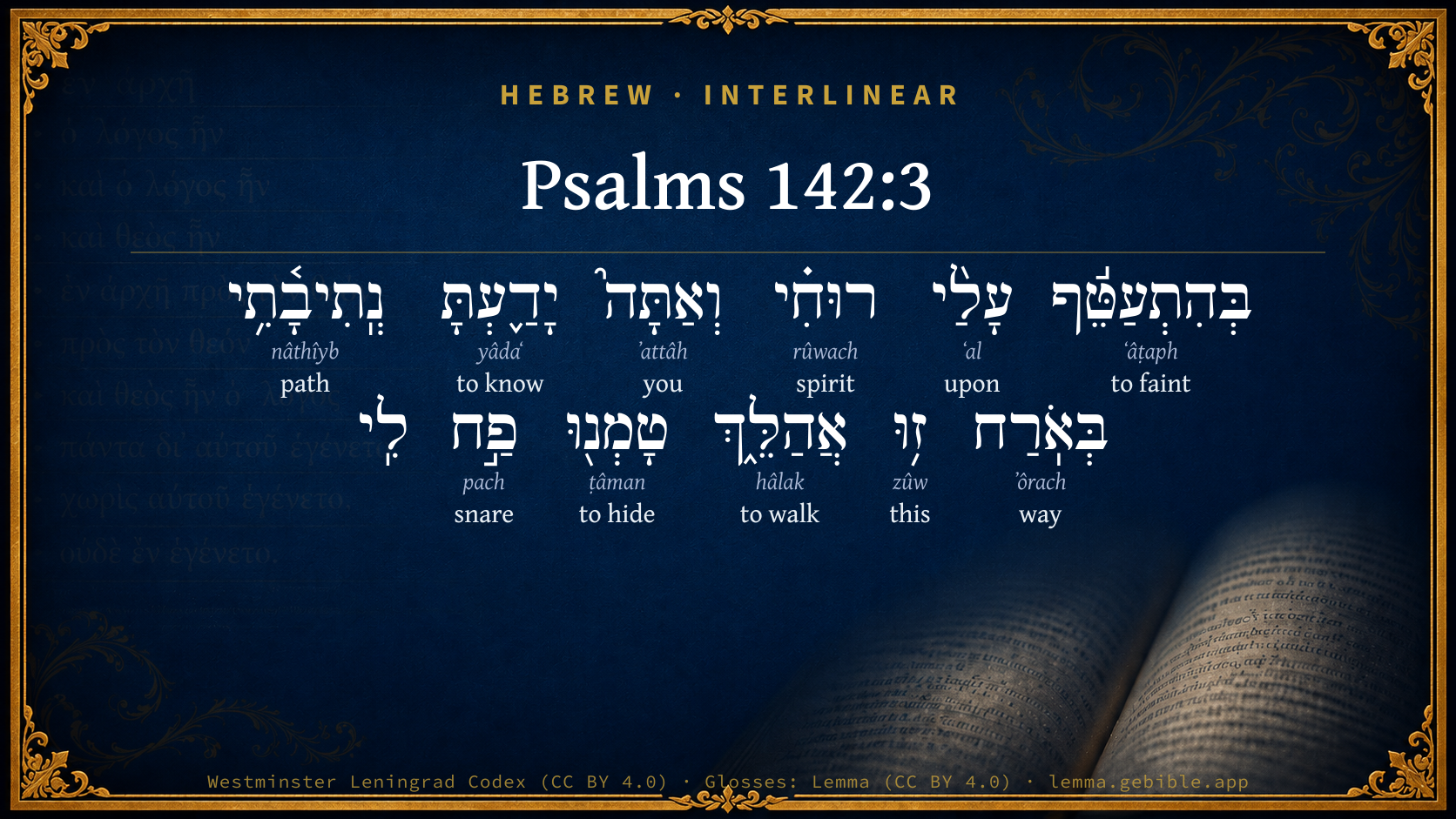
Hebrew (Westminster Leningrad Codex) Psalms 142:3 appears in the Hebrew Old Testament. The text above is from the Westminster Leningrad Codex. Each word links to its Strong’s number, a concise gloss, and parsing drawn from the Open Scriptures Hebrew Bible morphology. Click any word for its full Brown-Driver-Briggs (BDB) entry.
Download image
Cite this verse

Psalms 142:3 (World English Bible). Public Domain. Lemma interlinear Bible study tool, https://lemma.gebible.app/v/psalms/142/3.

Show BibTeX & RIS
BibTeX
RIS
English Translation
When my spirit was overwhelmed within me, You knew my path. In the way in which I walk, They have hidden a snare for me.
World English Bible · Public Domain
Download a study sheet

One document with this verse’s original text, its word-by-word gloss line, the meaning frame, cross-references with their text, attributed commentary, and full source and license credits — printable, and it pastes into notes with its structure intact.

This verse Autodidact and up

Study sheet (.html) Plain text (.txt)

A passage Seminary Student

Up to 50 verses in one chapter. A passage sheet keeps up to 6 commentary sources and 12 cross-references per verse, in the order this page ranks them, and says so on the sheet whenever that leaves anything out. Ask for a single verse and you get the Autodidact verse sheet above.

Everything on this page stays free to read, with no account — the sheet is a download of what is already on screen, not access to it.

Want to remove ads? Support Godless Engineer
Compare translations 3

The same verse in 3 English versions, stacked beneath the original-language interlinear above. Click any original word for its lexicon entry.

Each is an independent rendering of the whole verse — the interlinear is not word-aligned to these translations.

Highlighted words mark where these versions differ — a whole-verse word diff, not a word-by-word alignment.

  • World English Bible Public Domain
    When my spirit was overwhelmed within me, You knew my path. In the way in which I walk, They have hidden a snare for me.
  • King James Version Public Domain
    When my spirit was overwhelmed within me, then thou knewest my path. In the way wherein I walked have they privily laid a snare for me.
  • unfoldingWord Literal Text CC BY-SA 4.0
    When my spirit faints within me, then you, you know my path. Along this path I walk they have hidden a trap for me.

unfoldingWord Literal Text — © unfoldingWord, licensed CC BY-SA 4.0. Word-aligned USFM3 via Door43 (git.door43.org/unfoldingWord/en_ult).

Versions to compare (up to 4)

3 of 4 selected

Show all 18 translations

Every available English version of this verse, each an independent rendering of the whole verse.

  • World English Bible Public Domain
    When my spirit was overwhelmed within me, You knew my path. In the way in which I walk, They have hidden a snare for me.
  • Berean Standard Bible Public Domain
    Although my spirit grows faint within me, You know my way. Along the path I travel they have hidden a snare for me.
  • Majority Standard Bible Public Domain
    Although my spirit grows faint within me, You know my way. Along the path I travel they have hidden a snare for me.
  • King James Version Public Domain
    When my spirit was overwhelmed within me, then thou knewest my path. In the way wherein I walked have they privily laid a snare for me.
  • American Standard Version (1901) Public Domain
    When my spirit was overwhelmed within me, Thou knewest my path. In the way wherein I walk Have they hidden a snare for me.
  • Revised Version (1885) Public Domain
    When my spirit was overwhelmed within me, thou knewest my path. In the way wherein I walk have they hidden a snare for me.
  • Geneva Bible (1599) Public Domain
    Though my spirit was in perplexitie in me, yet thou knewest my path: in the way wherein I walked, haue they priuily layde a snare for me.
  • Douay-Rheims (1899) Public Domain
    Set a watch, O Lord, before my mouth: and a door round about my lips.
  • Young's Literal Translation Public Domain
    When my spirit hath been feeble in me, Then Thou hast known my path; In the way `in' which I walk, They have hid a snare for me.
  • Literal Standard Version CC BY-SA 4.0
    When my spirit has been feeble in me, || Then You have known my path; In the way [in] which I walk, || They have hid a snare for me.
  • Unlocked Literal Bible CC BY-SA 4.0
    When my spirit is weak within me, you know my path. In the way that I walk they have hidden a trap for me.
  • unfoldingWord Literal Text CC BY-SA 4.0
    When my spirit faints within me, then you, you know my path. Along this path I walk they have hidden a trap for me.
  • Darby Bible Public Domain
    When my spirit was overwhelmed within me, then *thou* knewest my path. In the way wherein I walked have they hidden a snare for me.
  • World Messianic Bible Public Domain
    When my spirit was overwhelmed within me, you knew my route. On the path in which I walk, they have hidden a snare for me.
  • Webster's Bible Public Domain
    \\142:2\\I poured out my complaint before him; I showed before him my trouble.
  • Free Bible Version CC BY-SA 4.0
    When I'm totally discouraged, you know the direction I should take. But whichever way I go, people set traps for me.
  • Bible in Basic English Public Domain
    When my spirit is overcome, your eyes are on my goings; nets have been secretly placed in the way in which I go.
  • JPS Tanakh (1917) Public Domain
    (142-4) When my spirit fainteth within me — Thou knowest my path — in the way wherein I walk have they hidden a snare for me.

Literal Standard Version (2020), Covenant Press — licensed CC BY-SA 4.0. Text via the HelloAO Bible API (eBible.org). Unlocked Literal Bible (unfoldingWord) — licensed CC BY-SA 4.0. Text via the HelloAO Bible API (eBible.org). unfoldingWord Literal Text — © unfoldingWord, licensed CC BY-SA 4.0. Word-aligned USFM3 via Door43 (git.door43.org/unfoldingWord/en_ult). Free Bible Version, Dr. Jonathan Gallagher — licensed CC BY-SA 4.0. Text via the HelloAO Bible API (eBible.org).

Word by word

More ways to search: Search by grammar → Find every occurrence → Compare this word →

Practice this passage: Drill this verse → Learn its vocabulary →

ז֥וּ
zûw
H2098
“this”
Particle, Relative
Part of Speech
Particle
Type
Relative
Full BDB Definition

Origin: for H2088

TWOT: 528

this, such (demonstrative pronoun) - (of) which, (of) whom (relative pronoun)
  1. בְּהִתְעַטֵּ֬ף ʻâṭaph H5848 “in/at · to faint” Preposition + Verb, Hithpael, Infinitive Construct
  2. עָלַ֨י ʻal H5921 “upon · me” Preposition + Suffix, Personal, 1st Person, Common, Singular
  3. רוּחִ֗י rûwach H7307 “spirit · my” Noun, Common, Both, Singular, Construct + Suffix, Personal, 1st Person, Common, Singular
  4. וְאַתָּה֮ ʼattâh H859 “and · you” Conjunction + Pronoun, Personal, 2nd Person, Masculine, Singular
  5. יָדַ֪עְתָּ yâdaʻ H3045 “to know” Verb, Qal, Perfect, 2nd Person, Masculine, Singular
  6. נְֽתִיבָ֫תִ֥י nâthîyb H5410 “path · my” Noun, Common, Both, Singular, Construct + Suffix, Personal, 1st Person, Common, Singular
  7. בְּאֹֽרַח ʼôrach H734 “in/at · way” Preposition + Noun, Common, Both, Singular, Absolute
  8. אֲהַלֵּ֑ךְ hâlak H1980 “to walk” Verb, Piel, Imperfect, 1st Person, Common, Singular
  9. טָמְנ֖וּ ṭâman H2934 “to hide” Verb, Qal, Perfect, 3rd Person, Common, Plural
  10. פַ֣ח pach H6341 “snare” Noun, Common, Masculine, Singular, Absolute

About this verse

These counts appear in no published source. They are computed here, from the morphology-tagged text and Lemma’s own curated glosses. What Lemma adds →

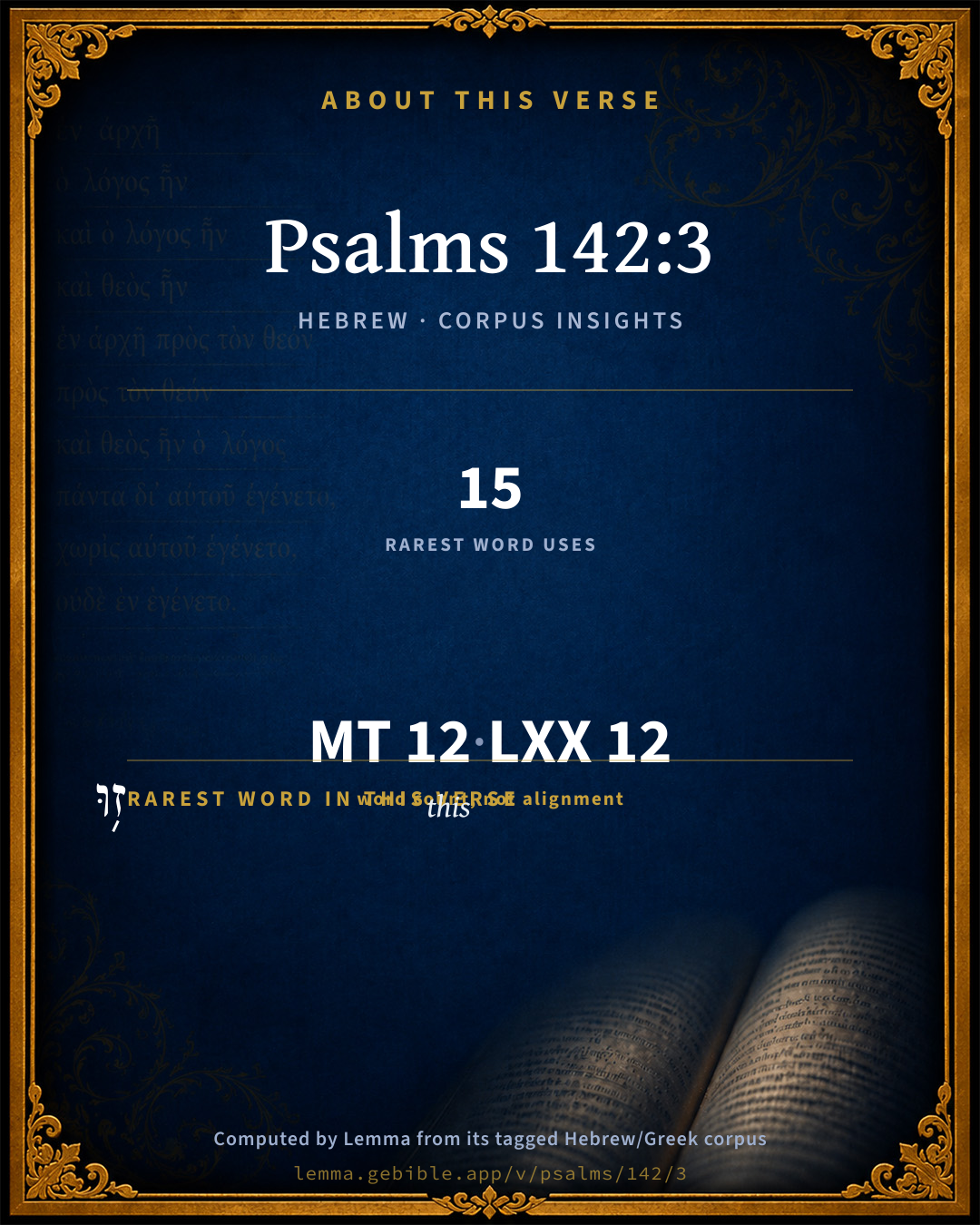
12
words
11
distinct lemmas
Wisdom
section

Notable vocabulary

The rarest word here is ז֥וּ this H2098 — appearing just 15 times in the whole Hebrew Bible.

Shared distinctive vocabulary

ז֥וּ this H2098 occurs in 15 verses of the Hebrew Bible. Also found in:

Grammatical profile

  • 4 verbs
  • 4 nouns
  • 1 pronoun
  • 2 prepositions
  • 1 particle

Verb forms

  • בְּהִתְעַטֵּ֬ף Hithpael · Infinitive Construct
  • יָדַ֪עְתָּ Qal · Perfect
  • אֲהַלֵּ֑ךְ Piel · Imperfect
  • טָמְנ֖וּ Qal · Perfect

Hebrew & Septuagint length

In English translation the verse runs 25 words from the Hebrew and 26 from the Septuagint (LXX English) — closely comparable.

A rough comparison of the two English renderings, which tokenize alike — not a word-level alignment.

Word counts can differ between the Hebrew and the Greek without any difference in meaning — e.g. the Hebrew direct-object marker אֵת has no separate Greek word, and Greek often adds the article ὁ.

In the original languages it is 12 Hebrew tokens and 12 Greek tokens — but the two are counted differently (Hebrew bundles its prefixes and suffixes into one token; the Greek is in lemma form), so that isn’t a like-for-like length.

Cross-references

17

Topical passages linked to Psalms 142:3 in the Treasury of Scripture Knowledge — connected by theme and wording, ordered by reader-vote popularity; previews shown in the World English Bible.

  • Psalms 140:5 The proud have hidden a snare for me, They have spread the cords of a net by the path. They have set traps for me. Selah.
  • Psalms 141:9 Keep me from the snare which they have laid for me, From the traps of the workers of iniquity.
  • Psalms 61:2 From the end of the earth, I will call to you, when my heart is overwhelmed. Lead me to the rock that is higher than I.
  • Psalms 143:4 Therefore my spirit is overwhelmed within me. My heart within me is desolate.
  • Jeremiah 18:22 Let a cry be heard from their houses, when you shall bring a troop suddenly on them; for they have dug a pit to take me, and hid snares for my feet.
  • Mark 14:33–36 He took with him Peter, James, and John, and began to be greatly troubled and distressed.
  • Job 23:10 But he knows the way that I take. When he has tried me, I shall come forth like gold.
  • Psalms 1:6 For Yahweh knows the way of the righteous, But the way of the wicked shall perish.
  • Psalms 22:14 I am poured out like water. All my bones are out of joint. My heart is like wax; It is melted within me.
  • Psalms 31:4 Pluck me out of the net that they have laid secretly for me, For you are my stronghold.
  • Psalms 35:7–8 For without cause they have hidden their net in a pit for me. Without cause they have dug a pit for my soul.
  • Psalms 56:6 They conspire and lurk, Watching my steps, they are eager to take my life.
  • Psalms 77:3 I remember God, and I groan. I complain, and my spirit is overwhelmed. Selah.
  • Psalms 102:4 My heart is blighted like grass, and withered, For I forget to eat my bread.
  • Psalms 139:2–4 You know my sitting down and my rising up. You perceive my thoughts from afar.
  • Psalms 17:3 You have proved my heart; you have visited me in the night; You have tried me, and found nothing; I have resolved that my mouth shall not disobey.
  • Matthew 22:15 Then the Pharisees went and took counsel how they might entrap him in his talk.

Cross-references courtesy of OpenBible.info (CC BY 4.0).

Hebrew and Greek witnesses Masoretic Hebrew ↔ Greek Septuagint

The same verse in the two great witnesses to the Old Testament, shown verse-for-verse.

You’re reading Greek Psalm 141 (Hebrew Psalm 142). The Septuagint counts the superscription, so verse numbers can differ from the Hebrew — chapter-level alignment, not verse-by-verse. Numbering follows Rahlfs.

These are two independent witnesses, not word-aligned to each other, and the Septuagint is shown in lemma (dictionary) form.

Hebrew Psalms 142:3 Masoretic · Westminster Leningrad Codex

בְּהִתְעַטֵּ֬ף עָלַ֨י רוּחִ֗י וְאַתָּה֮ יָדַ֪עְתָּ נְֽתִיבָ֫תִ֥י בְּאֹֽרַח ז֥וּ אֲהַלֵּ֑ךְ טָמְנ֖וּ פַ֣ח לִֽי

When my spirit was overwhelmed within me, You knew my path. In the way in which I walk, They have hidden a snare for me.

World English Bible · Public Domain

Greek LXX Greek Psalm 141:3 Septuagint · lemma form

ἐκχέω ἐναντίον αὐτός ὁ δέησις ἐγώ ὁ θλῖψις ἐγώ ἐνώπιον αὐτός ἀποἀγγέλλω

When my spirit was fainting within me, then you knew my paths; in the very way wherein I was walking, they hid a snare for me.

LXX2012 (modern English Septuagint) · Public Domain

Hebrew: Westminster Leningrad Codex (CC BY 4.0). Greek: Septuagint (public domain); English from LXX2012 (modern English Septuagint) (Public Domain). How the Septuagint differs from the Hebrew →

Commentary

Notes on Psalms 142:3 from classic Christian and Jewish commentators (each source and its license shown beneath its notes). The classic Christian expositions comment on the surrounding passage and are grouped to its opening verse, so a note may address several verses; the Jewish commentaries on the Tanakh (Rashi and others) are per-verse, so they appear only where the commentator wrote on this verse.

Lemma curates 59 commentaries, every one of them public domain or Creative Commons licensed, each selected and text-cleaned for this edition rather than reprinted as found. About our sources →

Trapp's Complete Commentary

John Trapp

Psa 142:3 When my spirit was overwhelmed within me, then thou knewest my path. In the way wherein I walked have they privily laid a snare for me.

Ver. 3. When my spirit was overwhelmed within me] Or, covered over, with grief, as the Greek expoundeth it.

Then thou knewest my path] sc. That I neither fretted nor fainted; or, thou knewest how to make a way to escape, 1Co 10:13. The Lord knoweth how to deliver his, 2Pe 2:9.

John Trapp, A Commentary or Exposition upon All the Books of the Old and New Testament (1647–1656) — public domain. Text from a community e-Sword module.

The Biblical Illustrator

Joseph S. Exell

Psa_142:3

When my spirit was overwhelmed within me, then Thou knewest my path.

Affliction and consolation

I. The dejection which he felt.

1. A painful consciousness of past guilt.

2. An oppressive endurance of present trouble.

3. A keen anticipation of future ills.

II. The refuge that he sought. Then Thou knewest my path. It supposes that God was consulted about his path, that the case was distinctly brought before God in prayer, and that the case was one which would bear to be submitted to the Divine inspection.

III. The mercy that he found. God did bring his soul out of prison. Every wish was accomplished (Psa_18:1-50.).

1. By the kindness of friends (1Sa_23:16).

2. By promises of His Word.

3. By events in Providence.

4. By consolations of His Spirit.

5. By translating from earth to heaven. (S. Thodey.)

A memorial of past troubles

I. A humble appeal. Thou knewest my path,--Thou knewest that my cause was just, and the steps which I took for obtaining redress were holy.

1. The path of prayer (verse 1).

2. The way of faith,--choosing God for his portion, trusting Him as his refuge, expecting bountiful treatment at His hands (verses 5, 7). Without this choice of God as our portion, and confidence in Him, prayer is mere selfishness, and has nothing to distinguish it from the cries of the lost.

II. A contrite confession. Thou knewest how impatient I was even when professing meek submission. I could bear the great trial of Sauls persecution, but not the lighter one of Nabals churlish insolence. Thou knewest the crookedness of my path, when by false pretences I evaded an enemy and deceived a friend; using sinful artifice where I should have relied in truth upon the God of truth.

III. A thankful acknowledgment of the Lords gracious conduct towards David when his spirit was overwhelmed. Then Thou knewest my path: Thou didst approve my course; and therefore didst support and comfort me under my trials. But how much greater occasion has the believer in Christ to make this thankful acknowledgment! Conclusion--

1. Let the children of God lay their account for sufferings and sorrows here below: heavy sorrows and dreadful sufferings, it may be. Such things are appointed for us, because needful, as is the furnace to separate the dross from the pure ore.

2. All trouble should lead us to God--not from Him. There is in the blessed God health and cure for all diseases of the mind; balm in Gilead, and a never-failing Physician there.

3. Let us all cherish the thought that God knows our path; in the fullest sense of the words knows our every step. To the sincere Christian, to the upright soul this truth is full of comfort. (C. Hodgson, M. A.)

In the way where I walked have they privily laid a snare for me.--

The dangers of youth

I see before me a class of young men about to go forth into the world. I know their way will be strewed with dangers. By all the love I bear them I am constrained to point out to them some of their perils.

I. The dangers of youth.

1. A- general exposedness to temptation. Full of passions easily excited, and warm as the current of their youthful blood; led on by an imagination as active as their youthful limbs and mostly unchecked by experience,--forming images which are constantly mistaken for realities,--which inflame and mislead the passions and bewilder the judgment; set down as strangers in the midst of a world whose objects and inhabitants present destructive blandishments to their inexperience,-whose beauties and amusements, in the absence of the love of God, are fat, ally adapted to their youthful tastes; how can they escape? at least, how dreadfully exposed are they.

2. Under all these exposures they are constantly forming habits, as uncontrollable and despotic as an Eastern sultan, and harder to be dethroned. Through inexperience and incaution, and the impetuosity of their youthful passions, they are liable to become petrified in evil habits, as fixed as the coral reefs of the ocean.

3. Young men, as they enter into business, are in danger of settling down into the love of the world, into views and aims confined to themselves and their own circle, separating them from the great republic of man, and keeping them from employing their powers and their property in promoting the happiness of the human family.

4. Another danger to which young men are exposed is indolence in action; betaking themselves to no profession, or pursuing it saunteringly, unsteadily, and to little effect; wasting life in idleness or in pleasure; in either case enervating the man in both body and soul, and making him a burden to himself and a disgraceful cumberer of the ground.

5. Young men are exposed to theological errors of every form and every degree of criminality and danger, from the slightest obliquity respecting a positive institution, up to blaspheming infidelity.

II. The defences to be set up against them.

1. In regard to the last-mentioned danger my advice to you is, first of all, settle your minds on the question whether the Bible is a revelation from God, and such a revelation as will guide believers into all truth unmixed with error; in order that your faith may rest on the testimony of God and not on the authority of men, you ought to find the fullest evidence that God has spoken, and spoken in a way to furnish a safe and sure rule of faith and practice. All this being settled in the affirmative, you ought to lose no time in grounding yourselves on a system of doctrines drawn from the obvious meaning of that book, supported by the general analogy of faith. Subject your reason to the Divine teachings. Put it to school to Christ as a humble pupil.

2. Avoid all kinds of professional business arid all occasions which are specifically fraught with temptation.

3. Avoid all connections with bad men, and, as far as possible, with men whose influence would tend to warp you from the truth, or from a correct course of judging or of acting.

4. Vigilantly guard against the beginning of every evil habit, in heart, intellect, or conduct. By watchfulness it is easy to prevent the first irregularity; but who can vanquish an evil habit?

5. Let your reading be safe. Not many novels, not u perpetual round of angry politics, not a constant poring upon theological errors.

6. Let it be a settled rule to make some advance in knowledge every day, and every day to bring to pass something for the good of mankind.

7. Establish the settled habit of prayer. Without prayer you have no security against one of these dangers. Without Christ you can do nothing. These rules you will find it hard to keep with a fallen nature, and impossible unless you observe another; which leads me to say--

8. That in the outset you must devote your hearts and souls and lives to the service of God. Without doing this you will not pray effectually, and of course will have no security against one of these dangers. Without this you will be the enemies of God: and what security against any evil can an enemy of God Have in a world which He governs? (E. D. Griffin, D. D.)

Hidden snares

Recently it was announced, as one of the latest discoveries, that a kind of telescope had been constructed which would enable any one looking through it to see far away down into quiet seas, and gaze on the wrecked and sunken ships that lie there. If only we had such an instrument in the spirit realm which we could put into the hands of men and women infatuated with sin, and so show them the moral wrecks of even last year! What a gift for a young man or woman as a permanent warning against the perils of life--the opening of their eyes to the devices of the destroyer! (H. O. Mackey.)

The Biblical Illustrator, edited by Joseph S. Exell (c. 1880s–1900s) — public domain. Text from a community e-Sword module.

Joseph Benson's Commentary

Psa 142:3. When my spirit was overwhelmed within me — And ready to sink under the burden of grief and fear: when I was quite at a loss what steps to take, and almost ready to despair; then thou knewest my path — That is, practically, so as to direct me what way I should take, in order that I might escape Saul and his men: or, thou knowest my sincerity and innocence, the straight path in which I have walked, and that I am not such a one as my persecutors represent me. And it was, and is, a comfort to me, that thou knewest this, and also, that thou knewest the danger that I was, and am, in, and how; in the way wherein I walked — Suspecting no danger; they have privily laid a snare for me — To entrap me. Saul gave Michal his daughter to David, on purpose that she might be a snare to him, 1Sa 18:21. And as he complains, every thing that was done to, or respecting him, was done with a design to insnare and destroy him. Yet, in the midst of all, he knew he was under the eye and guardian care of his all-wise and almighty Friend: in him he trusted, and this was his support and comfort. And “such should be, at all times, the confidence of believers in the wisdom, the power, and the goodness of God, even when human prudence has done its utmost and is at its wit’s end.”

Joseph Benson's Commentary on the Old and New Testaments (1811–1818) — public domain. Text from a community e-Sword module.

J. A. Alexander on Psalms

Joseph Addison Alexander

4. (Psa 142:3) Because my spirit is overwhelmed within me—and thou knowest my path—in the way that I go, they have hid a snare for me. The literal translation of the first words is, in my spirit's being overwhelmed, which may indicate either the time or the cause of his distress. See above, on Psa 142:1. Some adopt this construction: when my spirit is overwhelmed (then) thou knowest my path. Others suppose two reasons to be given for his calling upon God, his distress and his trust in the divine omniscience. Because my spirit is overwhelmed, and (because) thou knowest my path. But as the form of the two phrases is entirely different in Hebrew, the simplest and safest construction is to treat the second clause as parenthetical. Within me, literally upon me; see above, on Psa 42:4-6. In the way that I go, i.e. along my path. See above, on Psa 140:4. The words may mean, however, as in Psa 143:8, in the way that I should go, i.e. in the path of duty. Without my fault they hid a snare for me. With the first clause of this verse compare Psa 42:4; Psa 61:2; Psa 77:3, and with the last, Psa 140:5; Psa 141:9; Psa 143:8.

Joseph Addison Alexander, The Psalms Translated and Explained (1850) — public domain. Text from a community e-Sword module.

Tyndale Open Study Notes

Tyndale Open Resources

142:3-4 The psalmist reaches a point of despair (see 77:3), and the Lord cares for him in his distress. The psalmist commits himself to the Lord’s wisdom (see Ps 139) but laments his entrapment by the wicked (5:9-10; 140:5; 141:9; 142:3).

Tyndale Open Study Notes — © Tyndale Open Resources, licensed CC BY-SA 4.0. Text via the HelloAO Bible API.

Geneva Bible (1599)

Geneva Bible translators

Hebrew, was folden or wrapped in me: meaning, as a thing that could have no issue.

Geneva Bible (1599) marginal notes — public domain. Text via Bolls.life.

Adam Clarke's Commentary

Verse 3. Then thou knewest my path.] When Saul and his army were about the cave in which I was hidden, thou knewest my path - that I had then no way of escape but by miracle: but thou didst not permit them to know that I was wholly in their power.

Adam Clarke's Commentary on the Bible (1810–1826) — public domain. Text from a community e-Sword/MySword module.

John Calvin's Commentaries

3. When, my spirit, etc. Though he owns here that he felt anxiety, yet he confirms what he had said as to the constancy of his faith. The figure which he uses of his spirit being perplexed, “Or c’est une belle similitude quand il dit que son esprit a este en tortille et enveloppe,” etc. — Fr.

“The Lord will provide.” (Genesis 22:8.)

John Calvin's Commentaries (1540-1563) — public domain. Text from the Calvin Translation Society English edition (1840s-50s) via the Christian Classics Ethereal Library (ccel.org). Calvin's coverage is partial (roughly two-thirds of the Bible); uncommented books and verses are honest gaps, never fabricated. The 19th-century editor's footnotes and remarks are omitted so the notes are faithfully Calvin's own voice.

Ellicott's Commentary for English Readers

(3) When my spirit.—Literally, in the muffling upon me of my spirit. When my spirit was so wrapped in trouble and gloom, so “muffled round with woe” that I could not see the path before me, was distracted and unable to chose a. line of conduct, Thou (emphatic) knewest my path. (Comp. for the same verb Psa_61:2; Psa_77:3.)

A Bible Commentary for English Readers, edited by Charles John Ellicott (1878–1897) — public domain. Text from a community e-Sword module.

The Cambridge Bible for Schools and Colleges

gen. ed. J. J. S. Perowne

3. When my spirit fainteth upon me, THOU knowest my path,

In the way wherein I must walk have men hidden a snare for me.

3, 4. Jehovah knows his peril, and his loneliness.

The Cambridge Bible for Schools and Colleges (gen. ed. J. J. S. Perowne; Cambridge University Press, 1878–1918) — public domain. Text from a community e-Sword module.

John Gill's Exposition

When my spirit was overwhelmed within me,.... Ready to sink and faint under the present affliction, being attended with the hidings of God's face, and with unbelieving frames; which is sometimes the case of God's people, and with which they are as it were covered and overwhelmed, as well as with a sense of sin, and with shame and sorrow for it; see Psa 61:2;

then thou knewest my path: the eyes of the Lord are upon all men, and he knows their goings, none of them are hid from him; and he sees and approves of the way, of the life and conversation of his people in general; and particularly observes what way they take under affliction, which is to apply to him for help and deliverance, Psa 1:6. R. Moses in Aben Ezra and Kimchi interpret it of the path he walked in, which was right and not evil, for which he could appeal to God, that knows all things; it may literally intend the path David took to escape the fury of Saul, that pursued him from place to place;

in the way wherein I walked have they privily laid a snare for me; let him take which way he would, there were spies upon him, or men that were in ambush to take him; and snares were everywhere laid for him to entrap him; see Psa 140:5.

John Gill's Exposition of the Whole Bible (1746–1763) — public domain (CC PDM 1.0). Text via the HelloAO Bible API.

Albert Barnes' Notes on the Bible

When my spirit was overwhelmed within me - Luther renders this, “When my spirit was in distress.” The Hebrew word rendered “overwhelmed” means, in Kal, to cover as with a garment; then, to be covered as with darkness, trouble, sorrow; and then, to languish, to faint, to be feeble: Psa 77:3; Psa 107:5. The idea here is, that, in his troubles, he had no vigor, no life, no spirit. He did not see how he could escape from his troubles, and he had no heart to make an effort.

Then thou knewest my path - Thou didst see all. Thou didst see the way that I was treading, and all its darkness and dangers, implying here that God had made it an object to mark his course; to see what egress there might be - what way to escape from the danger. It was in no sense concealed from God, and no danger of the way was hidden from him. It is much for us to feel when we are in danger or difficulty that God knows it all, and that nothing can be hidden from him.

In the way wherein I walked - In my path; the path that I was treading.

Have they privily laid a snare for me - They treated me as a man would treat his neighbor, who should spread a snare, or set a trap, for him in the path which he knew he must take. The word rendered “have privily laid” means to hide, to conceal. It was so concealed that I could not perceive it. They did it unknown to me. I neither knew that it was laid, nor where it was laid. They meant to spring it upon me at a moment when I was not aware, and when I should be taken by surprise. It was not open and manly warfare; it was stealth, cunning, trick, art.

Albert Barnes' Notes on the Bible (1834–1885) — public domain. Text from a community e-Sword/MySword module.

Matthew Poole's English Annotations

Thou knewest, to wit, practically, so as to direct me to it.

My path; what paths I should choose whereby I might escape Saul, when I fled hither and thither in deserts, and mountains, and woods; and which way I should get out of his hands when he and all his men were at the cave’s mouth, which passed my skill.

Wherein I walked; wherein I used to walk, or they supposed that I would walk.

Matthew Poole's English Annotations on the Holy Bible (1683–1685) — public domain. Text from a community e-Sword/MySword module.

The Treasury of David

Charles H. Spurgeon

Ver. 3. When my spirit was overwhelmed within me, then thou knewest my path. The bravest spirit is sometimes sorely put to it. A heavy fog settles down upon the mind, and the man seems drowned and smothered in it; covered with a cloud, crushed with a load, confused with difficulties, conquered by impossibilities. David was a hero, and yet his spirit sank: he could smite a giant down, but he could not keep himself up. He did not know his own path, nor feel able to bear his own burden. Observe his comfort: he looked away from his own condition to the ever observant, all knowing God: and solaced himself with the fact that all was known to his heavenly Friend. Truly it is well for us to know that God knows what we do not know. We lose our heads, but God never closes his eyes: our judgments lose their balance, but the eternal mind is always clear.

In the way wherein I walked have they privily laid a snare for me. This the Lord knew at the time, and gave his servant warning of it. Looking back, the sweet singer is rejoiced that he had so gracious a Guardian, who kept him from unseen dangers. Nothing is hidden from God; no secret snare can hurt the man who dwells in the secret place of the Most High, for he shall abide under the shadow of the Almighty. The use of concealed traps is disgraceful to our enemies, but they care little to what tricks they resort for their evil purposes. Wicked men must find some exercise for their malice, and therefore when they dare not openly assail they will privately ensnare. They watch the gracious man to see where his haunt is, and there they set their trap; but they do it with great caution, avoiding all observation, lest their victim being forewarned should escape their toils. This is a great trial, but the Lord is greater still, and makes us to walk safely in the midst of danger, for he knows us and our enemies, our way and the snare which is laid in it. Blessed be his name.

Ver. 3. When my spirit was overwhelmed within me. "When even my spirit (the higher faculty) is wrapped in darkness upon me" that is, when even my spirit (ruach), which ought to elevate my soul (nephesh) falls heavily upon me, as in a swoon.

"When heavy, like a veil of woe,

My spirit on me lay."

What is here said of the spirit, is oftener predicted of the soul, the seat of the passions. See Ps 42:6 43:5 131:2. The dejection of the spirit represents a still more sorrowful and downcast condition, than the fainting of the soul. See Ps 143:3-4, and compare our Lord's words, "My soul is troubled" (Joh 12:27) with the Evangelist's statement, "Jesus was troubled in spirit" (Joh 13:21 11:33). Christopher Wordsworth.

Ver. 3. When my spirit was overwhelmed within me. Literally, in the muffling upon me of my spirit. When my spirit was so wrapped in trouble and gloom, so "muffled round with woe", that I could not see the path before me, was distracted and unable to choose a line of conduct, Thou (emphatic) knewest my path. A.S. Aglen, in "An Old Testament Commentary for English" Readers, 1884.

Ver. 3. I wish you much comfort from David's thought: When my spirit was overwhelmed within me, then thou knewest my path. The Lord is not withdrawn to a great distance, but his eye is upon you. He sees you not with the indifference of a mere spectator; but he observes with attention, he knows, he consider's your path: yea, he appoints it, and every circumstance about it is under his direction. Your trouble began at the hour he saw best, it could not come before; and he has marked the degree of it to a hair's breadth, and its duration to a minute. He knows likewise how your spirit is affected; and such supplies of grace and strength, and in such seasons as he sees needful, he will afford in due season. So that when things appear darkest, you shall still be able to say, Though chastened, not killed. Therefore hope in God, for you shall yet praise him. John Newton (1725-1807), in "Cardiphonia."

Ver. 3. Thou knewest.

From human eyes 'tis better to conceal

Much that I suffer, much I hourly feel;

But, oh, this thought can tranquillize and heal,

All, all is known to thee.

Nay, all by thee is ordered, chosen, planned,

Each drop that fills my daily cup, thy hand

Prescribes for ills, none else can understand,

All, all is known to thee. Charlotte Elliott.

Ver. 3. Although we as Christians possess the full solution of the problem of suffering, yet we frequently find ourselves in the position of Job, in regard to this or that particular affliction. There are sorrows so far reaching, so universal; there are losses so absolute, and blows so terrible and inexplicable, that it seems for a time as if we were wrapped in thickest gloom, and as if the secret of the Lord had not been revealed. Why was this man stricken, and that man spared? Why was such and such a being, in whom so many hopes centred, or who had already realised so many pleasant expectations, why was he withdrawn? Why was that other person left, a useless encumbrance to earth? Why was that voice, which found echo in so many hearts, suddenly silenced? Why have I been smitten? Why have I lost that which rendered my moral life beautiful and useful? Oftentimes the soul seems lost for awhile in thoughts which overwhelm it, it loses its foothold, it tumbles about helplessly amid the deep waters of affliction. It seems as if all were over. Do not believe it. Remember Job; you cannot go to greater lengths of despair than he, and yet God had pity on him. There is much comfort for you in this example of indescribable suffering, exasperated to the highest degree, and yet pardoned and consoled. Cling to the memory of this blessed fact as to a cable of deliverance, a board or a plank amidst the shipwreck. And then remember that affliction forms part of God's plan, and that he also asks you to manifest ready and absolute confidence in him. E. De Pressense, D.D., in "The Mystery of Suffering", 1869.

Ver. 3. They have privily laid a snare for me. Snares on the right hand, and snares on the left: snares on the right hand, worldly prosperity; snares on the left hand, worldly adversity; snares on the right hand, flattery; snares on the left hand, alarm. Do thou walk in the midst of the snares: depart not from the way: let neither flattery ensnare thee, nor alarm drive thee off it. Augustine.

Ver. 3. (first clause).

1. When.

2. Then.

Ver. 3. (latter clause). Temptations.

1. What form they take? "snares."

2. Who lay them? "they."

3. How do they lay them? Secretly, craftily "in the way", frequently.

4. What becomes of the tempted believer? He lives to tell the tale, to warn others, to glorify God.

Psalms 142:4*

Charles H. Spurgeon's The Treasury of David (1869–1885) — public domain. Psalms only. Text from a community e-Sword/MySword module.

Whedon's Commentary on the Bible

Daniel D. Whedon

3. Overwhelmed—Or, fainted. He was completely enveloped in doubt, anxiety, apprehension, so that he was unable to judge and decide what to do, as Psa_107:5; Jon_2:7.

Then thou knewest my path— God knew and comprehended his situation, and kindly chose his path, and made a way for his escape. Job_23:10; Psa_31:7-8.

In the way wherein I walked—In my daily, or ordinary, manner of life. Every movement was watched and criticised for evil.

Privily laid a snare— Treacherously placed in his path inducements to wrong, in the hope that he might fall into their “snare.”

Daniel D. Whedon (gen. ed.), Commentary on the Old and New Testaments (1874–1909) — public domain. Text from a community e-Sword module.

The Pulpit Commentary

When my spirit was overwhelmed within me; or, "fainted within me." Then thou knewest my path. I had not to tell thee because thou didst not know, but to relieve my own feelings. In the way wherein I walked have they privily laid a snare for me. (comp. Psa_140:5 Psa_141:9, Psa_141:10)

The confidence of the crushed heart.

Literally, "In the muffling of my spirit upon me." When my spirit was so wrapped in trouble and gloom, so muffled round with woe, that I could not see the path before me, was distracted and unable to choose a line of conduct, thou (emphatic) knewest my path. We are often placed in circumstances in life which baffle intellect and power of judgment. We are overwhelmed because we cannot understand, and cannot steer our way through conflicting conditions, so as to form a safe judgment as to the course we should take. But the condition of the psalmist, as indicated in this sentence, was altogether more serious. Intellect and judgment remained to him, but they were silenced, crushed, overwhelmed, with a weight of feeling; his "spirit was overwhelmed within him.

I THE MASTERY OF OUR SOUL-MOODS IS OUR DEEPEST DISTRESS. We cannot watch for it to guard against it. We cannot account for it so as to excuse it to ourselves. We cannot deal with it so as to gain security out of our experience. Every man knows that, any day, he may be beaten by the mastery of his soul-moods. And the strange thing is that the peril is greater the more spiritually sensitive a man becomes. The more worldly a man is, the fewer soul-moods he has. The more spiritual a man is, the more soul-moods he has. Often in life we are placed in circumstances that are not really very anxious, but which we make overwhelming by the response of our souls to them. And this explains how little we understand one another in the perplexities of life, because we cannot know how differently souls answer to things.

II CONFIDENCE IN GOD"S OVERRULING RELIEVES OUR DEEPEST DISTRESS, "Then thou knewest my path." At such times there is always something to do. And the psalmist is close near to the very heart of truth when he shows that God relieves feeling by leading into duty. Keep feeling, and the hands will hang down. Take feeling to God, and he will lead into active service, and so bring relief to feeling. We may be so blinded by feeling that we cannot see the way we should take. We may be sure that our feeling does not represent God"s. He never is so blinded. He always sees our way, and will lead us if we put our hand in his. R.T.

The Pulpit Commentary (1880–1919), ed. H.D.M. Spence-Jones & Joseph S. Exell — public domain. Text from a community e-Sword module.

John Wesley's Explanatory Notes

Knowest - So as to direct me to it. My path - What paths I should chuse whereby I might escape.

John Wesley, Explanatory Notes Upon the Whole Bible (1754–1765) — public domain. Text via the GEBible commentary corpus.

Keil & Delitzsch

C. F. Keil & F. Delitzsch

The prayer of the poet now becomes deep-breathed and excited, inasmuch as he goes more minutely into the details of his straitened situation. Everywhere, whithersoever he has to go (cf. on Psa 143:8), the snares of craftily calculating foes threaten him. Even God's all-seeing eye will not discover any one who would right faithfully and carefully interest himself in him. הבּיט, look! is a graphic hybrid form of הבּט and הבּיט, the usual and the rare imperative form; cf. הביא Sa1 20:40 (cf. Jer 17:18), and the same modes of writing the inf. absol. in Jdg 1:28; Amo 9:8, and the fut. conv. in Eze 40:3. מכּיר is, as in Rut 2:19, cf. Ps 10, one who looks kindly upon any one, a considerate (cf. the phrase הכּיר פּנים) well-wisher and friend. Such an one, if he had one, would be עמד על־ימינו or מימינו (Psa 16:8), for an open attack is directed to the arms-bearing right side (Psa 109:6), and there too the helper in battle (Psa 110:5) and the defender or advocate (Psa 109:31) takes his place in order to cover him who is imperilled (Psa 121:5). But then if God looks in that direction, He will find him, who is praying to Him, unprotected. Instead of ואין one would certainly have sooner expected אשׁר or כי as the form of introducing the condition in which he is found; but Hitzig's conjecture, הבּיט ימין וראה, "looking for days and seeing," gives us in the place of this difficulty a confusing half-Aramaism in ימין = יומין in the sense of ימים in Dan 8:27; Neh 1:4. Ewald's rendering is better: "though I look to the right hand and see (וראה), yet no friend appears for me;" but this use of the inf. absol. with an adversative apodosis is without example. Thus therefore the pointing appears to have lighted upon the correct idea, inasmuch as it recognises here the current formula הבּט וּראה, e.g., Job 35:5; Lam 5:1. The fact that David, although surrounded by a band of loyal subjects, confesses to having no true fiend, is to be understood similarly to the language of Paul when he says in Phi 2:20 : "I have no man like-minded." All human love, since sin has taken possession of humanity, is more or less selfish, and all fellowship of faith and of love imperfect; and there are circumstances in life in which these dark sides make themselves felt overpoweringly, so that a man seems to himself to be perfectly isolated and turns all the more urgently to God, who alone is able to supply the soul's want of some object to love, whose love is absolutely unselfish, and unchangeable, and unbeclouded, to whom the soul can confide without reserve whatever burdens it, and who not only honestly desires its good, but is able also to compass it in spite of every obstacle. Surrounded by bloodthirsty enemies, and misunderstood, or at least not thoroughly understood, by his friends, David feels himself broken off from all created beings. On this earth every kind of refuge is for him lost (the expression is like Job 11:20). There is no one there who should ask after or care for his soul, and should right earnestly exert himself for its deliverance. Thus, then, despairing of all visible things, he cries to the Invisible One. He is his "refuge" (Psa 91:9) and his "portion" (Psa 16:5; Psa 73:26), i.e., the share in a possession that satisfies him. To be allowed to call Him his God - this it is which suffices him and outweighs everything. For Jahve is the Living One, and he who possesses Him as his own finds himself thereby "in the land of the living" (Psa 27:13; Psa 52:7). He cannot die, he cannot perish.

Keil & Delitzsch — Biblical Commentary on the Old Testament (1861–1891) — public domain (CC PDM 1.0). Text via the HelloAO Bible API. (Old Testament only.)

unfoldingWord translationNotes

Door43 World Missions Community

my spirit is weak within me

"I am weak" or "I am extremely discouraged"

you know my path

"you know the path I should take." The psalmist speaks as if what a person does were a path that that person walked along. AT: "you know the way I should live" (See: Assumed Knowledge and Implicit Information)

In the way that I walk they have hidden a trap for me

The psalmist speaks of people wanting to harm him as if they were trying to trap an animal. AT: "They are making plans so that whatever I do they can harm me" (See: Metaphor)

my life

This is a metonym for "me." (See: Metonymy)

called out to you

This is a call for help. AT: "called to you now for help" (See: Metonymy)

my portion

Possible meanings are 1) "all I want" or 2) "all I need" or 3) "all I have."

in the land of the living

This idiom refers to a person being alive, as opposed to a person who is dead and in the place of the dead. AT: "while I am living" (See: Idiom)

translationWords

spirit

walk

life

refuge

unfoldingWord translationNotes — © Distant Shores Media and the Door43 World Missions Community, licensed CC BY-SA 4.0. Source: git.door43.org/Door43/en_tn.

Lesson kit

Teaching starters — assembled from the data on this page, not authored interpretation. Every prompt links to the verse data it draws on. Edit before teaching.

Psalms, in the Wisdom, opens this verse with 12 words (11 distinct Hebrew lemmas). Its most distinctive word is zûw (“this”). A historical commentator’s framing appears above. Read the whole chapter for the surrounding context.

Discussion questions

  1. The word zûw carries the sense “this.” How does it shape the verse?
  2. Exodus 15:13 shares the word «this» with this verse. How do the two illuminate each other?
  3. These translations render this verse differently. What is at stake in choosing one wording over another?
  4. The verb «בְּהִתְעַטֵּ֬ף» is Hithpael Infinitive Construct. How does its form color the action?
  5. Reading how Trapp's Complete Commentary and The Biblical Illustrator read this verse, where do the two commentators agree and where do they part?

Things to notice

Reading settings

Reading text

Shown beneath each verse's original-language words.

Old Testament
Old Testament edition

Read the OT as the Masoretic Hebrew (MT) or the Greek Septuagint (LXX).

English shown for the Greek Septuagint (in the Hebrew ↔ Greek comparison).

Comparing translations? Open the Compare panel on any verse page to stack up to four side by side.