
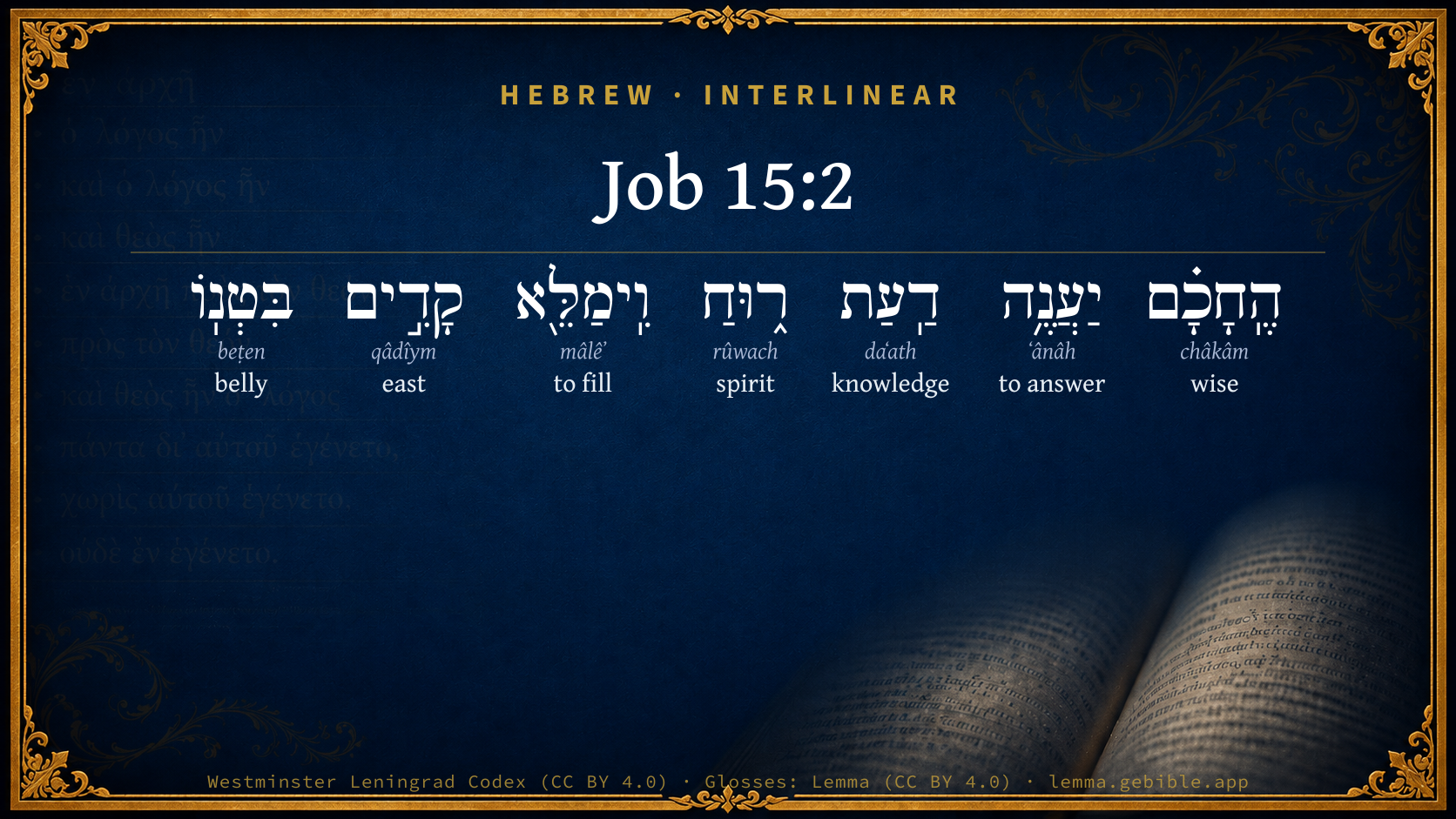
Job 15:2

Hebrew (Westminster Leningrad Codex) Job 15:2 appears in the Hebrew Old Testament. The text above is from the Westminster Leningrad Codex. Each word links to its Strong’s number, a concise gloss, and parsing drawn from the Open Scriptures Hebrew Bible morphology. Click any word for its full Brown-Driver-Briggs (BDB) entry.
Download image
Cite this verse

Job 15:2 (World English Bible). Public Domain. Lemma interlinear Bible study tool, https://lemma.gebible.app/v/job/15/2.

Show BibTeX & RIS
BibTeX
RIS
English Translation
"Should a wise man answer with vain knowledge, And fill himself with the east wind?
World English Bible · Public Domain
Download a study sheet

One document with this verse’s original text, its word-by-word gloss line, the meaning frame, cross-references with their text, attributed commentary, and full source and license credits — printable, and it pastes into notes with its structure intact.

This verse Autodidact and up

Study sheet (.html) Plain text (.txt)

A passage Seminary Student

Up to 50 verses in one chapter. A passage sheet keeps up to 6 commentary sources and 12 cross-references per verse, in the order this page ranks them, and says so on the sheet whenever that leaves anything out. Ask for a single verse and you get the Autodidact verse sheet above.

Everything on this page stays free to read, with no account — the sheet is a download of what is already on screen, not access to it.

Want to remove ads? Support Godless Engineer
Compare translations 3

The same verse in 3 English versions, stacked beneath the original-language interlinear above. Click any original word for its lexicon entry.

Each is an independent rendering of the whole verse — the interlinear is not word-aligned to these translations.

Highlighted words mark where these versions differ — a whole-verse word diff, not a word-by-word alignment.

  • World English Bible Public Domain
    "Should a wise man answer with vain knowledge, And fill himself with the east wind?
  • King James Version Public Domain
    Should a wise man utter vain knowledge, and fill his belly with the east wind?
  • unfoldingWord Literal Text CC BY-SA 4.0
    “Will the wise answer knowledge of wind and fill his belly the east wind,

unfoldingWord Literal Text — © unfoldingWord, licensed CC BY-SA 4.0. Word-aligned USFM3 via Door43 (git.door43.org/unfoldingWord/en_ult).

Versions to compare (up to 4)

3 of 4 selected

Show all 18 translations

Every available English version of this verse, each an independent rendering of the whole verse.

  • World English Bible Public Domain
    "Should a wise man answer with vain knowledge, And fill himself with the east wind?
  • Berean Standard Bible Public Domain
    “Does a wise man answer with empty counsel or fill his belly with the hot east wind?
  • Majority Standard Bible Public Domain
    “Does a wise man answer with empty counsel or fill his belly with the hot east wind?
  • King James Version Public Domain
    Should a wise man utter vain knowledge, and fill his belly with the east wind?
  • American Standard Version (1901) Public Domain
    Should a wise man make answer with vain knowledge, And fill himself with the east wind?
  • Revised Version (1885) Public Domain
    Should a wise man make answer with vain knowledge, and fill his belly with the east wind?
  • Geneva Bible (1599) Public Domain
    Shal a wise man speake words of ye winde, and fill his bellie with the East winde?
  • Douay-Rheims (1899) Public Domain
    Will a wise man answer as if he were speaking in the wind, and fill his stomach with burning heat?
  • Young's Literal Translation Public Domain
    Doth a wise man answer `with' vain knowledge? And fill `with' an east wind his belly?
  • Literal Standard Version CC BY-SA 4.0
    “Does a wise man answer [with] vain knowledge? And fill his belly [with] an east wind?
  • Unlocked Literal Bible CC BY-SA 4.0
    “Should a wise man answer with useless knowledge and fill himself with the east wind?
  • unfoldingWord Literal Text CC BY-SA 4.0
    “Will the wise answer knowledge of wind and fill his belly the east wind,
  • Darby Bible Public Domain
    Should a wise man answer with windy knowledge, and fill his belly with the east wind,
  • World Messianic Bible Public Domain
    “Should a wise man answer with vain knowledge, and fill himself with the east wind?
  • Webster's Bible Public Domain
    Should a wise men utter vain knowledge, and fill his belly with the east wind?
  • Free Bible Version CC BY-SA 4.0
    “Would a wise man answer with such empty ‘knowledge’ that is just a lot of hot air?
  • Bible in Basic English Public Domain
    Will a wise man make answer with knowledge of no value, or will he give birth to the east wind?
  • JPS Tanakh (1917) Public Domain
    Should a wise man make answer with windy knowledge, and fill his belly with the east wind?

Literal Standard Version (2020), Covenant Press — licensed CC BY-SA 4.0. Text via the HelloAO Bible API (eBible.org). Unlocked Literal Bible (unfoldingWord) — licensed CC BY-SA 4.0. Text via the HelloAO Bible API (eBible.org). unfoldingWord Literal Text — © unfoldingWord, licensed CC BY-SA 4.0. Word-aligned USFM3 via Door43 (git.door43.org/unfoldingWord/en_ult). Free Bible Version, Dr. Jonathan Gallagher — licensed CC BY-SA 4.0. Text via the HelloAO Bible API (eBible.org).

Word by word

More ways to search: Search by grammar → Find every occurrence → Compare this word →

Practice this passage: Drill this verse → Learn its vocabulary →

About this verse

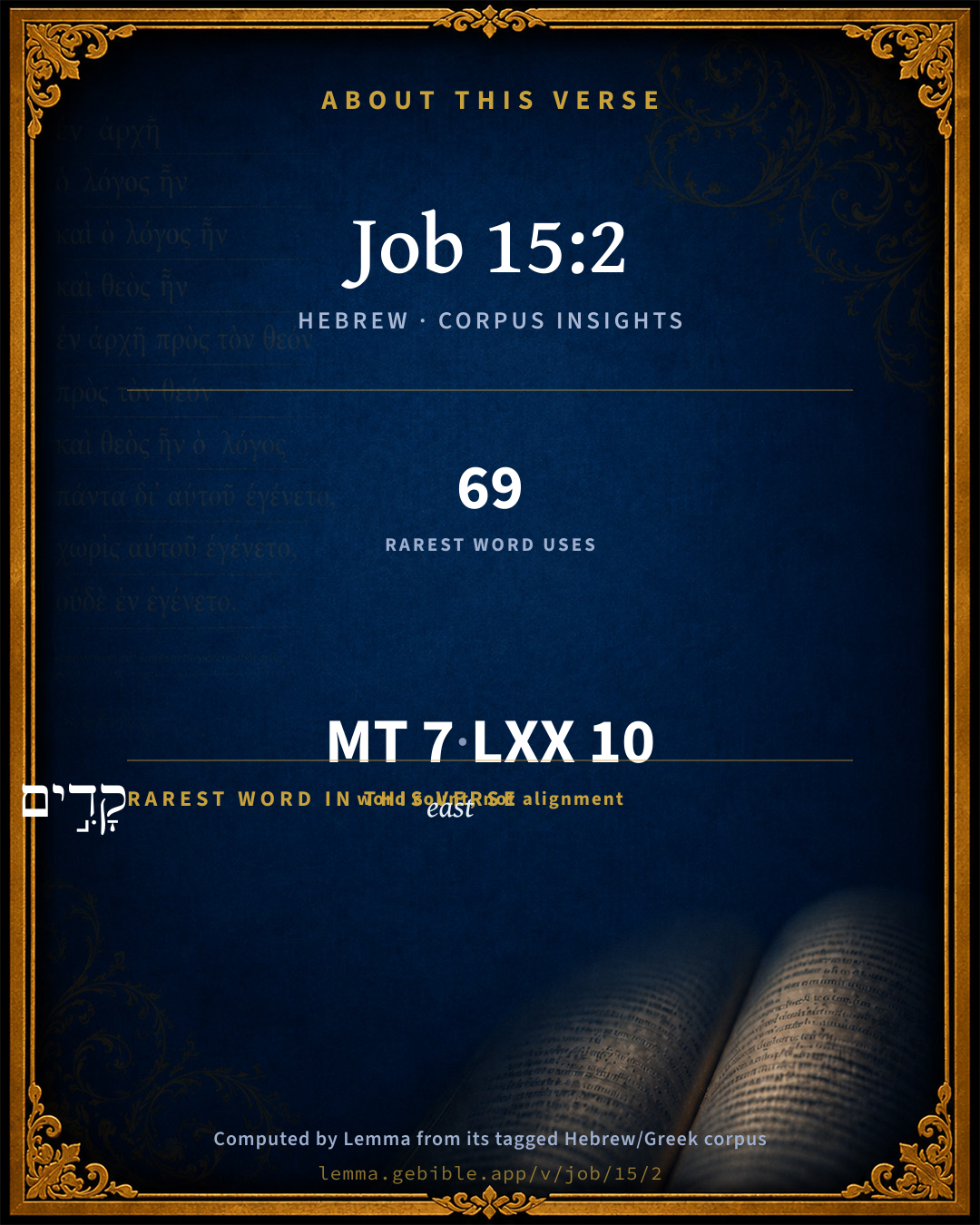
These counts appear in no published source. They are computed here, from the morphology-tagged text and Lemma’s own curated glosses. What Lemma adds →

7
words
7
distinct lemmas
Wisdom
section

Grammatical profile

  • 2 verbs
  • 4 nouns
  • 1 adjective

Verb forms

  • יַעֲנֶ֥ה Qal · Imperfect
  • וִֽימַלֵּ֖א Piel · Imperfect

Hebrew & Septuagint length

In English translation the verse runs 15 words from the Hebrew and 22 from the Septuagint (LXX English) — the Septuagint runs noticeably longer here. See the side-by-side →

A rough comparison of the two English renderings, which tokenize alike — not a word-level alignment.

Word counts can differ between the Hebrew and the Greek without any difference in meaning — e.g. the Hebrew direct-object marker אֵת has no separate Greek word, and Greek often adds the article ὁ.

In the original languages it is 7 Hebrew tokens and 10 Greek tokens — but the two are counted differently (Hebrew bundles its prefixes and suffixes into one token; the Greek is in lemma form), so that isn’t a like-for-like length.

Cross-references

6

Topical passages linked to Job 15:2 in the Treasury of Scripture Knowledge — connected by theme and wording, ordered by reader-vote popularity; previews shown in the World English Bible.

  • Job 6:26 Do you intend to reprove words, Seeing that the speeches of one who is desperate are as wind?
  • Job 8:2 "How long will you speak these things? Shall the words of your mouth be a mighty wind?
  • Job 11:2–3 "Shouldn't the multitude of words be answered? Should a man full of talk be justified?
  • Job 13:2 What you know, I know also. I am not inferior to you.
  • Hosea 12:1 Ephraim feeds on wind, And chases the east wind. He continually multiplies lies and desolation. They make a covenant with Assyria, And oil is carried into Egypt.
  • James 3:13 Who is wise and understanding among you? Let him show by his good conduct that his deeds are done in gentleness of wisdom.

Cross-references courtesy of OpenBible.info (CC BY 4.0).

Hebrew and Greek witnesses Masoretic Hebrew ↔ Greek Septuagint

The same verse in the two great witnesses to the Old Testament, shown verse-for-verse.

Here the Septuagint runs noticeably longer than the Hebrew — LXX2012 (modern English Septuagint) 22 words vs World English Bible 15. A rough length comparison of the two English translations, not a word-level alignment — read both below.

These are two independent witnesses, not word-aligned to each other, and the Septuagint is shown in lemma (dictionary) form.

Hebrew Job 15:2 Masoretic · Westminster Leningrad Codex

הֶֽחָכָ֗ם יַעֲנֶ֥ה דַֽעַת ר֑וּחַ וִֽימַלֵּ֖א קָדִ֣ים בִּטְנֽוֹ

"Should a wise man answer with vain knowledge, And fill himself with the east wind?

World English Bible · Public Domain

Greek LXX Job 15:2 Septuagint · lemma form

πότερον σοφός ἀπόκρισις δίδωμι σύνεσις πνεῦμα καί ἐνπίμπλημι πόνος γαστήρ

Will a wise man give for answer a mere breath of wisdom? and does he fill up the pain of his belly,

LXX2012 (modern English Septuagint) · Public Domain

Hebrew: Westminster Leningrad Codex (CC BY 4.0). Greek: Septuagint (public domain); English from LXX2012 (modern English Septuagint) (Public Domain). How the Septuagint differs from the Hebrew →

Commentary

Notes on Job 15:2 from classic Christian and Jewish commentators (each source and its license shown beneath its notes). The classic Christian expositions comment on the surrounding passage and are grouped to its opening verse, so a note may address several verses; the Jewish commentaries on the Tanakh (Rashi and others) are per-verse, so they appear only where the commentator wrote on this verse.

Lemma curates 59 commentaries, every one of them public domain or Creative Commons licensed, each selected and text-cleaned for this edition rather than reprinted as found. About our sources →

Trapp's Complete Commentary

John Trapp

Job 15:2 Should a wise man utter vain knowledge, and fill his belly with the east wind?

Ver. 2. Should a wise man utter vain knowledge] Heb. Knowledge of the wind; light, frothy, empty discourses, that have no tack or substance in them, but only words that are no better than wind, a mere flash or airy nothing. Solomon thinks a wise man should beware of falling into this fault, lest he forfeit his reputation: Ecc 10:1, "Dead flies cause the ointment of the apothecary to send forth a stinking savour: so doth a little folly him that is in reputation for wisdom and honour"; as spots are soonest observed in the whitest and finest garments; and envy, like worms and moths, doth usually feed on the purest cloth. A great many dead flies may be found in a tar box, and no harm done, but one of them fallen into a pot of sweet odours, or precious perfumes, may soon taint and corrupt them.

And fill his belly with the east wind?] Per ventrem, mentem intellige, et per ventum Orientalem, vanam opinionem, saith Vatablus. By belly understand the mind, and by the east wind a vain conceit, or frothy knowledge, blown forth out of a swelling breast, to the hurt of others; for the east wind is destructive to herbs and fruits, Hos 12:1 Gen 41:6. But doth not Eliphaz here by these bubble of words and blustering questions, betraying much choler and confidence, fall into the very same fault which he findeth with Job; doth not he also fill his belly with heat (so the Vulgate rendereth this text), which, kindling in his bosom, blazeth out at his lips? Doth not this angry man exalt folly, and show himself none of the wisest, though he were the oldest in all the company.

John Trapp, A Commentary or Exposition upon All the Books of the Old and New Testament (1647–1656) — public domain. Text from a community e-Sword module.

Joseph Benson's Commentary

Job 15:2. Should a wise man — Such as thou pretendest to be, utter vain knowledge — Hebrews דעת רוח, dagnath, ruach, knowledge of wind; that is, empty words, without any sense or solidity in them; and fill his belly — Satisfy his mind and conscience; with the east wind — With notions and speeches, which are not only unsubstantial and unprofitable, but also hasty, impetuous, and pernicious; and full as hurtful to the peace of his own mind, and the quiet and comfort of others, as the boisterous, scorching east wind is to fruits and herbs of every kind. The Hebrew is literally, And should the east wind fill his belly — his vain and useless knowledge puff him up with pride and self-conceit?

Joseph Benson's Commentary on the Old and New Testaments (1811–1818) — public domain. Text from a community e-Sword module.

Whedon's Commentary on the Bible

Daniel D. Whedon

First division — JOB’S SPEECHES SUBSTANTIATE HIS GUILT, Job_15:2-19.

First strophe — His discourses are distinguished for inane vehemence, destructive godlessness, and low cunning, Job_15:2-6.

2. Vain knowledge — Literally, windy knowledge. See note Job_16:3.

His belly — The sense of the Hebrew beten is best expressed by the Arabic, el battin, which signifies that which is within. In a mystical sense, it means the inmost being, in which were united, as Orientals believe, all the powers of mind, body, and spirit.

East wind — See Job_1:19. This wind was exceedingly violent and destructive, and is frequently used in the prophets as an image of desolation and emptiness.

Daniel D. Whedon (gen. ed.), Commentary on the Old and New Testaments (1874–1909) — public domain. Text from a community e-Sword module.

Tyndale Open Study Notes

Tyndale Open Resources

15:2-3 You are nothing but a windbag (literally You fill your belly with the east wind): Since the east wind was hot, it might represent heated (Exod 14:21; Hos 13:15; Jon 4:8) or violent (Job 27:21; Jer 18:17) speech.

Tyndale Open Study Notes — © Tyndale Open Resources, licensed CC BY-SA 4.0. Text via the HelloAO Bible API.

Geneva Bible (1599)

Geneva Bible translators

Meaning, with matters that are of none importance, which are forgotten as soon as they are uttered, as the East wind drieth up the moisture as soon as it falleth.

That is, vain words, and without consolation?

Geneva Bible (1599) marginal notes — public domain. Text via Bolls.life.

Adam Clarke's Commentary

Verse 2. Should a wise man utter vain knowledge] Or rather, Should a wise man utter the science of wind? A science without solidity or certainty.

And fill his belly with the east wind?] בטן beten, which we translate belly, is used to signify any part of the cavity of the body, whether the region of the thorax or abdomen; here it evidently refers to the lungs, and may include the cheeks and fauces. The east wind, קדים kadim, is a very stormy wind in the Levant, or the eastern part of the Mediterranean Sea, supposed to be the same with that called by the Greeks ευροκλυδων, euroclydon, the east storm, mentioned Ac 27:14. Eliphaz, by these words, seems to intimate that Job's speech was a perfect storm or tempest of words.

Adam Clarke's Commentary on the Bible (1810–1826) — public domain. Text from a community e-Sword/MySword module.

Ellicott's Commentary for English Readers

(2) Should a wise man utter vain knowledge . . .—Job therefore is not wise, and his words have been vain and windy.

A Bible Commentary for English Readers, edited by Charles John Ellicott (1878–1897) — public domain. Text from a community e-Sword module.

The Cambridge Bible for Schools and Colleges

gen. ed. J. J. S. Perowne

2. Should a wise man utter vain knowledge] Or, will a wise man answer with vain, &c., lit., knowledge of wind, i. e. empty and loud, cf. ch. Job_8:2, Job_16:2. The word wise refers back to Job’s claims to superior wisdom, ch. Job_12:3, Job_13:2. Eliphaz asks, Is this the manner of one possessed of wisdom?

fill his belly with the east wind] i. e. puff himself up and then bring out of his mouth violent blasts of mere barren words; cf. Hos_12:1.

The Cambridge Bible for Schools and Colleges (gen. ed. J. J. S. Perowne; Cambridge University Press, 1878–1918) — public domain. Text from a community e-Sword module.

John Gill's Exposition

Should a wise man utter vain knowledge,.... As Job had been thought to be, or as he himself thought he was, which he might say sarcastically; or as he really was, not worldly wise, nor merely wise in things natural, but in things divine; being one that had the fear of God, which is the beginning of wisdom, and wisdom itself; believed in Christ, and walked wisely and circumspectly before men; now it is not becoming such a man to utter vain knowledge, or such knowledge as is like the wind, or, as the Targum, windy knowledge; empty, not solid, nor satisfying, but swells and puffs up, and is knowledge falsely so called; but it does not appear that Job did utter such vain and fruitless things as deserved to be compared to the wind:

and fill his belly with the east wind; which is noisy and blusterous, rapid and forcible, bearing all before it, and very infectious in hot countries; and such notions Job, according to Eliphaz, satisfied himself with, and endeavoured to insinuate them into others; which were nothing but great swelling words of vanity, and tended to subvert the faith of men, and overthrow all religion, and were very unwholesome, infectious, and ruinous to the minds of men, as suggested.

John Gill's Exposition of the Whole Bible (1746–1763) — public domain (CC PDM 1.0). Text via the HelloAO Bible API.

Albert Barnes' Notes on the Bible

Should a wise man - Referring to Job, and to his claims to be esteemed wise; see Job 12:3; Job 13:2, Job 13:6. The argument of Eliphaz here is, that the sentiments which Job had advanced were a sufficient refutation of his pretensions to wisdom. A wise man would not be guilty of “mere talk,” or of using language that conveyed no ideas.

Utter - literally, answer. It refers to the replies which Job had made to the arguments of his friends.

Vain knowledge - Margin, “Knowledge of wind.” So the Hebrew; see Job 6:26; Job 7:7. The “wind” is used to denote what is unsubstantial, vain, changing. Here it is used as an emblem of remarks which were vain, empty, and irrelevant.

And fill his belly - Fill his mind with unsubstantial arguments or sentiments - as little fitted for utility as the east wind is for food. The image is, “he fills himself with mere wind, and then blows it out under pretence of delivering the maxims of wisdom.”

With the east wind - The east wind was not only tempestuous and vehement, but sultry, and destructive to vegetation. It passed over vast deserts, and was characterized by great dryness and heat. It is used here to denote a manner of discourse that had in it nothing profitable.

Albert Barnes' Notes on the Bible (1834–1885) — public domain. Text from a community e-Sword/MySword module.

Haydock's Catholic Bible Commentary

Heat. Hebrew, "east wind," (Haydock) or give vent to passion. (Haydock) --- Eliphaz now rebukes Job without any reserve. (Calmet) --- He was perhaps displeased at the comparison used by the latter, chap. xiii. 4. Baldad had also hinted that Job’s discourse was nothing but wind, chap. viii. 2. (Haydock) --- Being unable to answer his arguments, he reviles him as an enemy of God. (Worthington)

George Leo Haydock (1774–1849), Haydock's Catholic Family Bible and Commentary, 1859 edition — public domain. Excludes Psalms (Douay-Rheims chapter numbering differs from Protestant) and Deuterocanonical books (Catholic canon only).

Matthew Poole's English Annotations

A wise man; such as thou seemest and pretendest to be.

Vain knowledge, i.e. empty words, without any sense or solidity in them.

Fill his belly, i.e. satisfy his own mind and conscience, which being secret is compared to the inwards of the belly; as Job 32:19; Pro 20:27; 22:18.

With the east wind, i.e. with discourses which are not only flashy and unprofitable, and without any weight, but also boisterous and pernicious, both to himself and others; as the east wind was in those parts, Gen 41:6; Exo 10:13; Hos 12:1.

Matthew Poole's English Annotations on the Holy Bible (1683–1685) — public domain. Text from a community e-Sword/MySword module.

John Wesley's Explanatory Notes

Fill - Satisfy his mind and conscience. East wind - With discourses not only unprofitable, but also pernicious both to himself and others; as the east-wind was in those parts.

John Wesley, Explanatory Notes Upon the Whole Bible (1754–1765) — public domain. Text via the GEBible commentary corpus.

Rashi

Rabbi Shlomo Yitzchaki (Rashi)

Eliphaz’s AnswerShall a wise man raise his voice with opinions of wind It is puzzling. Should one who is wise answer and raise his voice with an opinion of wind and futility?

Rashi on the Tanakh — English translations: “The Judaica Press complete Tanach with Rashi, translated by A. J. Rosenberg” (CC BY 4.0); “Pentateuch with Rashi's commentary by M. Rosenbaum and A.M. Silbermann, 1929-1934” (public domain); “The Metsudah Tanach series, Lakewood, N.J” (CC BY 4.0); and “The Book of Joshua, Metsudah Publications, 1997” (CC BY 4.0). Text via Sefaria.

Lesson kit

Teaching starters — assembled from the data on this page, not authored interpretation. Every prompt links to the verse data it draws on. Edit before teaching.

Job, in the Wisdom, opens this verse with 7 words (7 distinct Hebrew lemmas). Its most distinctive word is qâdîym (“east”). The Greek Septuagint runs longer here. A historical commentator’s framing appears above. Read the whole chapter for the surrounding context.

Discussion questions

  1. The word qâdîym carries the sense “east.” How does it shape the verse?
  2. How does Job 6:26, which shares this passage’s theme, read alongside this verse?
  3. The Septuagint runs longer here than the Hebrew. What might account for the difference?
  4. These translations render this verse differently. What is at stake in choosing one wording over another?
  5. «יַעֲנֶ֥ה» is a Qal Imperfect verb. How does that grammatical form shape the action described?
  6. Compare how Trapp's Complete Commentary and Joseph Benson's Commentary read this verse. Where do they agree or differ?

Things to notice

Reading settings

Reading text

Shown beneath each verse's original-language words.

Old Testament
Old Testament edition

Read the OT as the Masoretic Hebrew (MT) or the Greek Septuagint (LXX).

English shown for the Greek Septuagint (in the Hebrew ↔ Greek comparison).

Comparing translations? Open the Compare panel on any verse page to stack up to four side by side.