1 Samuel 11:6

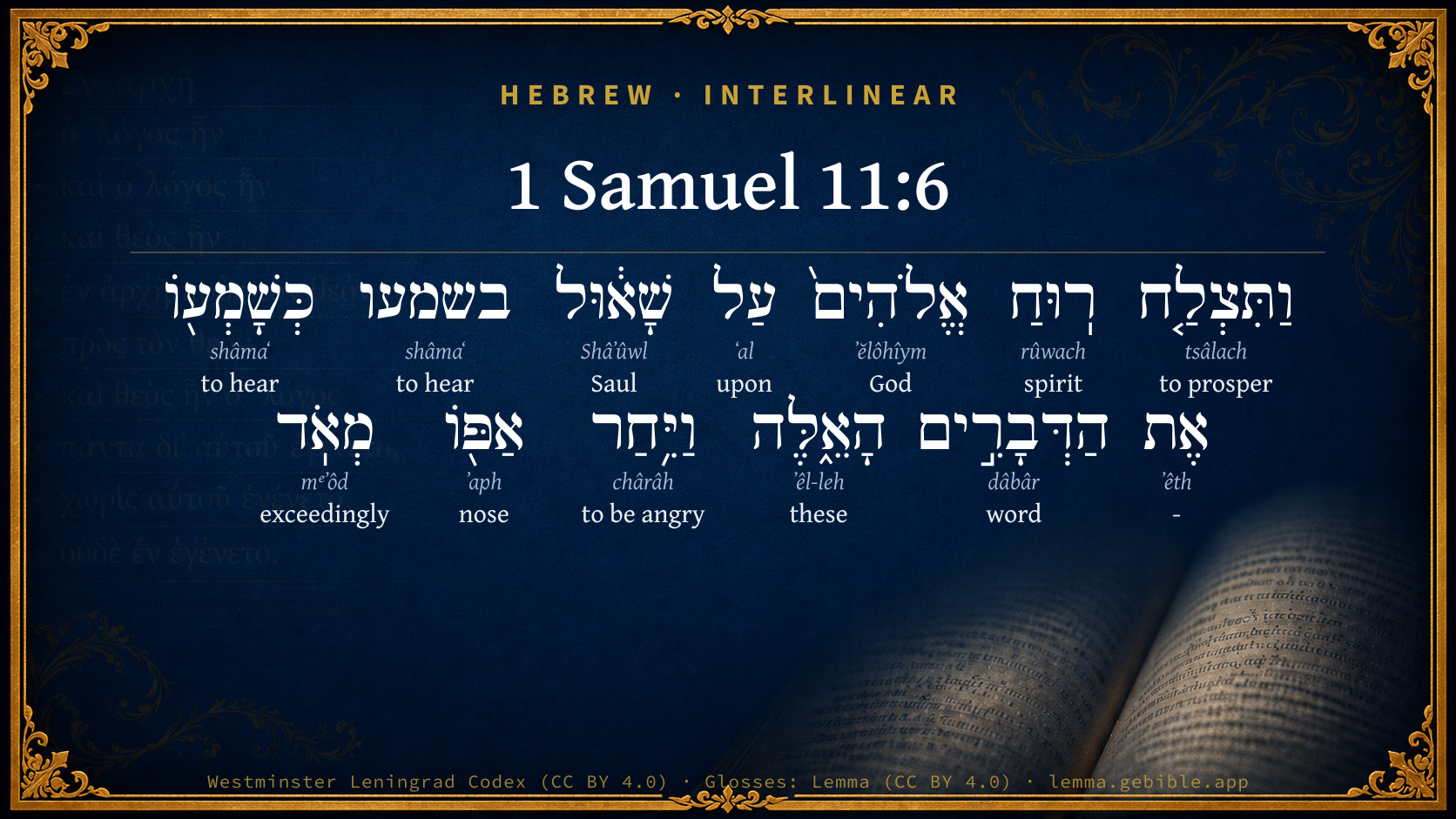
Hebrew (Westminster Leningrad Codex) 1 Samuel 11:6 appears in the Hebrew Old Testament. The text above is from the Westminster Leningrad Codex. Each word links to its Strong’s number, a concise gloss, and parsing drawn from the Open Scriptures Hebrew Bible morphology. Click any word for its full Brown-Driver-Briggs (BDB) entry.
Download image
Cite this verse

1 Samuel 11:6 (World English Bible). Public Domain. Lemma interlinear Bible study tool, https://lemma.gebible.app/v/1-samuel/11/6.

Show BibTeX & RIS
BibTeX
RIS
English Translation
The Spirit of God came mightily on Saul when he heard those words, and his anger was kindled greatly.
World English Bible · Public Domain
Download a study sheet

One document with this verse’s original text, its word-by-word gloss line, the meaning frame, cross-references with their text, attributed commentary, and full source and license credits — printable, and it pastes into notes with its structure intact.

This verse Autodidact and up

Study sheet (.html) Plain text (.txt)

A passage Seminary Student

Up to 50 verses in one chapter. A passage sheet keeps up to 6 commentary sources and 12 cross-references per verse, in the order this page ranks them, and says so on the sheet whenever that leaves anything out. Ask for a single verse and you get the Autodidact verse sheet above.

Everything on this page stays free to read, with no account — the sheet is a download of what is already on screen, not access to it.

Want to remove ads? Support Godless Engineer
Compare translations 3

The same verse in 3 English versions, stacked beneath the original-language interlinear above. Click any original word for its lexicon entry.

Each is an independent rendering of the whole verse — the interlinear is not word-aligned to these translations.

Highlighted words mark where these versions differ — a whole-verse word diff, not a word-by-word alignment.

  • World English Bible Public Domain
    The Spirit of God came mightily on Saul when he heard those words, and his anger was kindled greatly.
  • King James Version Public Domain
    And the Spirit of God came upon Saul when he heard those tidings, and his anger was kindled greatly.
  • unfoldingWord Literal Text CC BY-SA 4.0
    And the Spirit of God rushed upon Saul in his hearing these words. And his nose burned greatly.

unfoldingWord Literal Text — © unfoldingWord, licensed CC BY-SA 4.0. Word-aligned USFM3 via Door43 (git.door43.org/unfoldingWord/en_ult).

Versions to compare (up to 4)

3 of 4 selected

Show all 18 translations

Every available English version of this verse, each an independent rendering of the whole verse.

  • World English Bible Public Domain
    The Spirit of God came mightily on Saul when he heard those words, and his anger was kindled greatly.
  • Berean Standard Bible Public Domain
    When Saul heard their words, the Spirit of God rushed upon him, and he burned with great anger.
  • Majority Standard Bible Public Domain
    When Saul heard their words, the Spirit of God rushed upon him, and he burned with great anger.
  • King James Version Public Domain
    And the Spirit of God came upon Saul when he heard those tidings, and his anger was kindled greatly.
  • American Standard Version (1901) Public Domain
    And the Spirit of God came mightily upon Saul when he heard those words, and his anger was kindled greatly.
  • Revised Version (1885) Public Domain
    And the spirit of God came mightily upon Saul when he heard those words, and his anger was kindled greatly.
  • Geneva Bible (1599) Public Domain
    Then the Spirit of God came vpon Saul, when he heard those tidings, and he was exceeding angrie,
  • Douay-Rheims (1899) Public Domain
    And the spirit of the Lord came upon Saul, when he had heard these words, and his anger was exceedingly kindled.
  • Young's Literal Translation Public Domain
    And the Spirit of God doth prosper over Saul, in his hearing these words, and his anger burneth greatly,
  • Literal Standard Version CC BY-SA 4.0
    And the Spirit of God prospers over Saul, in his hearing these words, and his anger burns greatly,
  • Unlocked Literal Bible CC BY-SA 4.0
    When Saul heard what they said, the Spirit of God rushed upon him, and he was very angry.
  • unfoldingWord Literal Text CC BY-SA 4.0
    And the Spirit of God rushed upon Saul in his hearing these words. And his nose burned greatly.
  • Darby Bible Public Domain
    And the Spirit of God came upon Saul when he heard those words, and his anger was kindled greatly.
  • World Messianic Bible Public Domain
    God’s Spirit came mightily on Saul when he heard those words, and his anger burned hot.
  • Webster's Bible Public Domain
    And the Spirit of God came upon Saul when he heard those tidings, and his anger was kindled greatly.
  • Free Bible Version CC BY-SA 4.0
    The Spirit of God came on Saul in power when he heard about this, and he grew very angry.
  • Bible in Basic English Public Domain
    And at their words, the spirit of God came on Saul with power, and he became very angry.
  • JPS Tanakh (1917) Public Domain
    And the spirit of God came mightily upon Saul when he heard those words, and his anger was kindled greatly.

Literal Standard Version (2020), Covenant Press — licensed CC BY-SA 4.0. Text via the HelloAO Bible API (eBible.org). Unlocked Literal Bible (unfoldingWord) — licensed CC BY-SA 4.0. Text via the HelloAO Bible API (eBible.org). unfoldingWord Literal Text — © unfoldingWord, licensed CC BY-SA 4.0. Word-aligned USFM3 via Door43 (git.door43.org/unfoldingWord/en_ult). Free Bible Version, Dr. Jonathan Gallagher — licensed CC BY-SA 4.0. Text via the HelloAO Bible API (eBible.org).

Word by word

More ways to search: Search by grammar → Find every occurrence → Compare this word →

Practice this passage: Drill this verse → Learn its vocabulary →

וַתִּצְלַ֤ח
tsâlach
H6743
“and · to prosper”
Conjunction + Verb, Qal, Sequential Imperfect, 3rd Person, Feminine, Singular
Part of Speech
Conjunction + Verb
Stem
Qal
Form
Sequential Imperfect
Person
3rd Person
Gender
Feminine
Number
Singular
Full BDB Definition

Origin: a primitive root

TWOT: 1916 , 1917

(Qal) to rush - to advance, prosper, make progress, succeed, be profitable - (Qal) to prosper - (Hiphil) - to make prosperous, bring to successful issue, cause to prosper - to show or experience prosperity, prosper
  1. רֽוּחַ rûwach H7307 “spirit of” Noun, Common, Both, Singular, Construct
  2. אֱלֹהִים֙ ʼĕlôhîym H430 “God(s)” Noun, Common, Masculine, Plural, Absolute
  3. עַל ʻal H5921 “upon” Preposition
  4. שָׁא֔וּל Shâʼûwl H7586 “Saul” Noun, Proper
  5. בשמעו shâmaʻ H8085 “in/at · to hear · him” Preposition + Verb, Qal, Infinitive Construct + Suffix, Personal, 3rd Person, Masculine, Singular
  6. כְּשָׁמְע֖וֹ shâmaʻ H8085 “like/as · to hear · him” Preposition + Verb, Qal, Infinitive Construct + Suffix, Personal, 3rd Person, Masculine, Singular
  7. אֶת ʼêth H853 “-” Particle, Direct Object
  8. הַדְּבָרִ֣ים dâbâr H1697 “the · words” Particle, Definite Article + Noun, Common, Masculine, Plural, Absolute
  9. הָאֵ֑לֶּה ʼêl-leh H428 “the · these” Particle, Definite Article + Pronoun, Demonstrative, Common, Plural
  10. וַיִּ֥חַר chârâh H2734 “and · to be angry” Conjunction + Verb, Qal, Sequential Imperfect, 3rd Person, Masculine, Singular
  11. אַפּ֖וֹ ʼaph H639 “nose · his” Noun, Common, Masculine, Singular, Construct + Suffix, Personal, 3rd Person, Masculine, Singular
  12. מְאֹֽד mᵉʼôd H3966 “exceedingly” Adverb

About this verse

These counts appear in no published source. They are computed here, from the morphology-tagged text and Lemma’s own curated glosses. What Lemma adds →

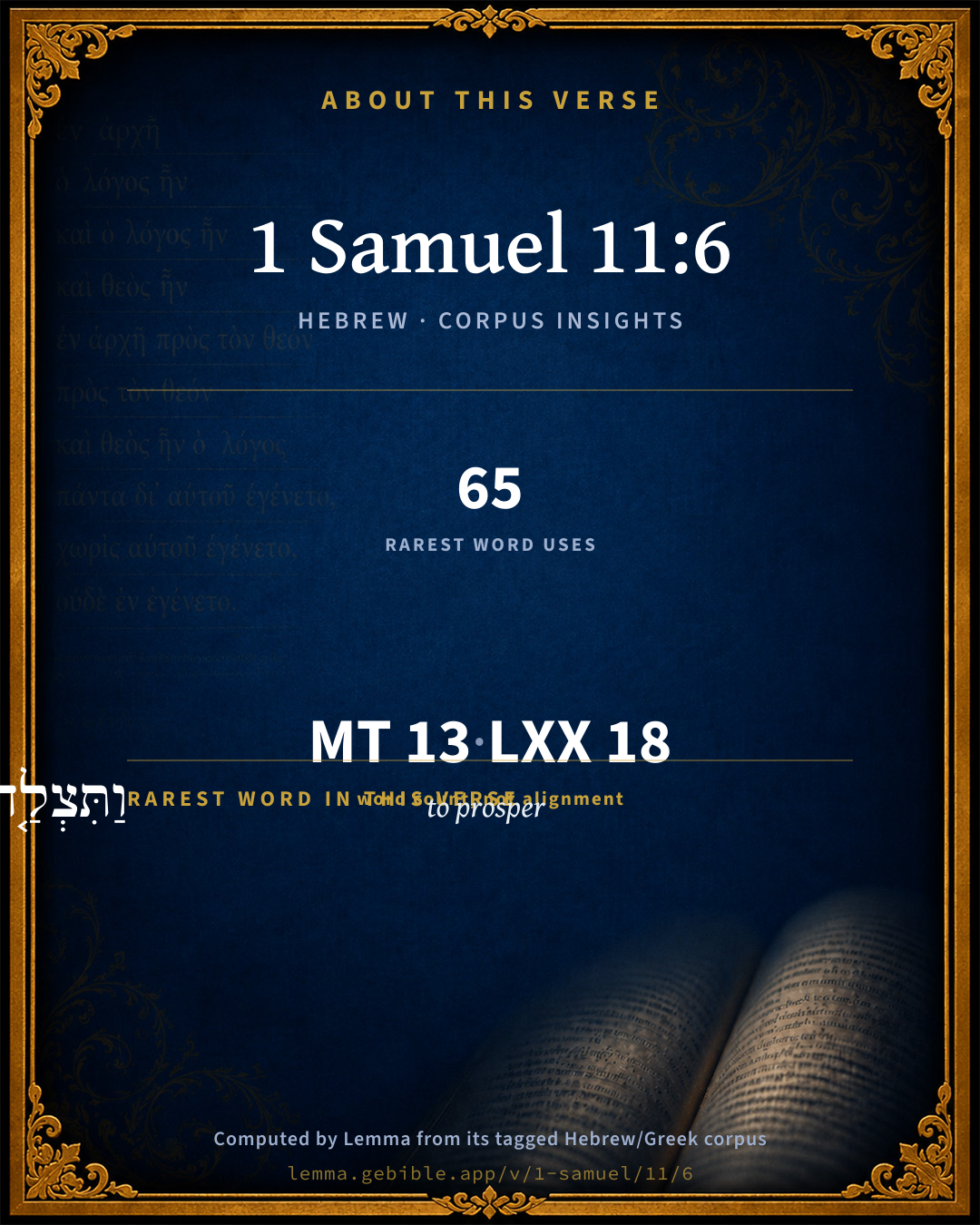
13
words
12
distinct lemmas
Historical
section

Grammatical profile

  • 4 verbs
  • 5 nouns
  • 1 pronoun
  • 1 preposition
  • 1 adverb
  • 1 particle

Verb forms

  • וַתִּצְלַ֤ח Qal · Sequential Imperfect
  • בשמעו Qal · Infinitive Construct
  • כְּשָׁמְע֖וֹ Qal · Infinitive Construct
  • וַיִּ֥חַר Qal · Sequential Imperfect

Repetition

A word recurs within this verse — often emphatic in Hebrew:

  • בשמעו to hear H8085 ×2

Hebrew & Septuagint length

In English translation the verse runs 19 words from the Hebrew and 22 from the Septuagint (LXX English) — closely comparable.

A rough comparison of the two English renderings, which tokenize alike — not a word-level alignment.

Word counts can differ between the Hebrew and the Greek without any difference in meaning — e.g. the Hebrew direct-object marker אֵת has no separate Greek word, and Greek often adds the article ὁ.

In the original languages it is 13 Hebrew tokens and 18 Greek tokens — but the two are counted differently (Hebrew bundles its prefixes and suffixes into one token; the Greek is in lemma form), so that isn’t a like-for-like length.

Cross-references

11

Topical passages linked to 1 Samuel 11:6 in the Treasury of Scripture Knowledge — connected by theme and wording, ordered by reader-vote popularity; previews shown in the World English Bible.

  • 1 Samuel 10:10 When they came there to the hill, behold, a band of prophets met him; and the Spirit of God came mightily on him, and he prophesied among them.
  • Judges 6:34 But the Spirit of Yahweh came on Gideon; and he blew a trumpet; and Abiezer was gathered together after him.
  • 1 Samuel 16:13 Then Samuel took the horn of oil, and anointed him in the midst of his brothers: and the Spirit of Yahweh came mightily on David from that day forward. So Samuel rose up, and went to Ramah.
  • Judges 3:10 The Spirit of Yahweh came on him, and he judged Israel; and he went out to war, and Yahweh delivered Cushan Rishathaim king of Mesopotamia into his hand: and his hand prevailed against Cushan Rishathaim.
  • Judges 13:25 The Spirit of Yahweh began to move him in Mahaneh-dan, between Zorah and Eshtaol.
  • Judges 14:6 The Spirit of Yahweh came mightily on him, and he tore him as he would have torn a kid; and he had nothing in his hand: but he didn't tell his father or his mother what he had done.
  • Judges 11:29 Then the Spirit of Yahweh came on Jephthah, and he passed over Gilead and Manasseh, and passed over Mizpeh of Gilead, and from Mizpeh of Gilead he passed over to the children of Ammon.
  • Exodus 32:19 It happened, as soon as he came near to the camp, that he saw the calf and the dancing: and Moses' anger grew hot, and he threw the tablets out of his hands, and broke them beneath the mountain.
  • Numbers 12:3 Now the man Moses was very humble, above all the men who were on the surface of the earth.
  • Mark 3:5 When he had looked around at them with anger, being grieved at the hardening of their hearts, he said to the man, "Stretch out your hand." He stretched it out, and his hand was restored as healthy as the other.
  • Ephesians 4:26 "Be angry, and don't sin." Don't let the sun go down on your wrath,

Cross-references courtesy of OpenBible.info (CC BY 4.0).

Hebrew and Greek witnesses Masoretic Hebrew ↔ Greek Septuagint

The same verse in the two great witnesses to the Old Testament, shown verse-for-verse.

These are two independent witnesses, not word-aligned to each other, and the Septuagint is shown in lemma (dictionary) form.

Hebrew 1 Samuel 11:6 Masoretic · Westminster Leningrad Codex

וַתִּצְלַ֤ח רֽוּחַ אֱלֹהִים֙ עַל שָׁא֔וּל בשמעו כְּשָׁמְע֖וֹ אֶת הַדְּבָרִ֣ים הָאֵ֑לֶּה וַיִּ֥חַר אַפּ֖וֹ מְאֹֽד

The Spirit of God came mightily on Saul when he heard those words, and his anger was kindled greatly.

World English Bible · Public Domain

Greek LXX 1 Samuel 11:6 Septuagint · lemma form

καί ἐπιἁλλομαι πνεῦμα κύριος ἐπί σαούλ ὡς ἀκούω ὁ ῥῆμα οὗτος καί θυμόω ἐπί αὐτός ὀργή αὐτός σφόδρα

And the Spirit of the Lord came upon Saul when he heard these words, and his anger was greatly kindled against them.

LXX2012 (modern English Septuagint) · Public Domain

On this verse, The Biblical Illustrator discusses the Septuagint’s reading. Read the note in Commentary ↓

Hebrew: Westminster Leningrad Codex (CC BY 4.0). Greek: Septuagint (public domain); English from LXX2012 (modern English Septuagint) (Public Domain). How the Septuagint differs from the Hebrew →

Targum (Aramaic paraphrase)

1

The Targum is the ancient Jewish Aramaic paraphrase of the Hebrew Scriptures — an interpretive translation, not the Hebrew text itself. Onkelos (literal) and Pseudo-Jonathan (expansive) render the Torah, and Jonathan the Prophets. Coverage is partial: where no permissively-licensed English translation exists for a verse, only the Aramaic is shown. This is verse-level text, not a word-by-word alignment to the Hebrew.

  1. Targum Jonathan Prophets (Joshua–Malachi)
    וּשְׁרַת רוּחַ גְבוּרָא מִן קֳדָם יְיָ עַל שָׁאוּל כַּד שְׁמַע יַת פִּתְגָמַיָא הָאִלֵין וּתְקֵיף רוּגְזֵיהּ לַחֲדָא:

    (no public-domain English translation for this verse)

    Targum Jonathan — Aramaic: “Mikraot Gedolot” (public domain). English: “Sefaria Community Translation” (CC0 1.0 (public-domain dedication)); “London "Chaldee Paraphrase," 1871” (public domain). Text via Sefaria.

Commentary

Notes on 1 Samuel 11:6 from classic Christian and Jewish commentators (each source and its license shown beneath its notes). The classic Christian expositions comment on the surrounding passage and are grouped to its opening verse, so a note may address several verses; the Jewish commentaries on the Tanakh (Rashi and others) are per-verse, so they appear only where the commentator wrote on this verse.

Lemma curates 59 commentaries, every one of them public domain or Creative Commons licensed, each selected and text-cleaned for this edition rather than reprinted as found. About our sources →

Trapp's Complete Commentary

John Trapp

1Sa 11:6 And the Spirit of God came upon Saul when he heard those tidings, and his anger was kindled greatly.

Ver. 6. And the Spirit of God came upon Saul.] That is, The spirit of fortitude, saith the Chaldee Paraphrast; not that "spirit of love, of power, and of a sound mind." {2Ti 1:7}

And his anger was kindled greatly.] Anger is cos fortitudinis, saith Aristotle, the whetstone of courage {a} And Saul, though cold in his own cause when slighted and rejected, {1Sa 10:27} is all alight, on fire, exarsit nasus eius, when God is dishonoured, and his people so reproached.

{a} Nervus est animae indignatio.

John Trapp, A Commentary or Exposition upon All the Books of the Old and New Testament (1647–1656) — public domain. Text from a community e-Sword module.

The Biblical Illustrator

Joseph S. Exell

1Sa_11:6

His anger was greatly kindled.

Divine indignation

My subject is Divine indignation--its advantage, its characteristics, and its limitation.

I. Mark the advantage of a good, wholesome indignation. The situation was a critical one. Only a month before, as the LXX give the date, Saul had been anointed king. But it is a weak, disjointed realm of which he is made the head--weak because attacked from without, doubly weak because disunited within. Give Saul a few years of peace, and he will have a chance to produce a different state of affairs, instead of that God sends the young king and young kingdom through a very baptism of fire and blood. And Israel heard, and the people lifted up their voice and wept--wept in impotent helplessness, wept in pity for their brothers, wept in pity for themselves, because in their own opinion they can do nothing. You may have seen, in an occasional fit of repentance, a man who has sold himself body and soul to drunkenness. You may have heard the maudlin sobs in which he humbles himself because he has been such a ten-times fool as to suffer this enemy to encamp within the frontier lines of his life. And you may have seen him slip back to his vice with the tears of shame not quite dry on his cheeks. The man is not the stronger for those tears; he is the weaker. That was like the state of Israel. There never will be help in such tears while the world lasts. Jabesh-Gilead could weep for itself; even the empty eye sockets which Nahash meant to leave them would still be of use for that. Jabesh-Gilead wants something harder than tears; Gods cause wants more than melancholy shakings of the head. God and Israel want a man with a mans heart within him and a mans hand on a sword hilt; and so the Spirit of the Lord came upon Saul when he heard those tidings and his anger was kindled greatly. We want something more of that indignation--eager, hot, fiery--which will burn out evil in the hearts and lives of men. Both in the Church and in the market the world needs men who have the courage of their convictions, and who dare act on them. Of such as will shake their heads sagely over the rottenness of this old world we have enough and to spare. Of an idle and ignorant tolerance we have over much. There are some things in human life which should never receive quarter--selfishness, cowardice, and all lying. Give up lamenting for one half hour, and do something to rid the earth of these, something to cleanse your own life of these, and you will not go back to the weeping, having found the better way. The Saga of our pagan ancestors imagined human life as a great tree whose roots were set deep in the earth while the branches towered up to heaven. But a great snake gnawed at the trunk continually, and would, so ran the tale, bring it to the ground one day. There is that great three-headed snake, which is gnawing still at the trunk of our social and national life, and its three heads are faithlessness, lust, and drunkenness. It is time that vain regrets were done with, that weak and mean excuses for these things were put away, and that the Church, believing in her Divine Head, awoke to her part as a company of those who are banded together to do battle to the death against those things which rot the heart out of life. Who will go forth unto the war with us against these? The effort is useless without a spark of Gods own righteous indignation in the hearts of men.

II. Mark the characteristics of this indignation. Human anger resents the hurt, Divine anger resents the wrong. Can you make the distinction, for it is a weighty one? It was the foul wrong meditated against Israel and through Israel against Jehovah, which passed like fire into Sauls blood Divine anger hates sin because it is sin. There is many a man who repents of his sin after it has been found out. Here one who regrets his drunken habits after they have cost him his situation. So long as they only threatened to cost him his soul he heeded not. There one who sorrows over her shattered reputation after it is published to the world. So long as only God knew it did not greatly matter. It is a cruel and bitter mistake, that of hating sins results instead of loathing sin itself. It came to pass that Jesus was led up to Pilate to be tried for His life, and there He was scourged and condemned. And when all this was so fully under way that no human power could stop it, Judas went up to the temple, and, scattering his blood money before the priests, went out into the darkness and hanged himself. All earth and hell might have laughed to scorn the mans folly. Was his sin made any greater because the crucifixion resulted from it? Was that traitor kiss made any blacker because it led to the darkness of Josephs tomb? No. We need to see sin as God in heaven sees it, and that was one reason why the Cross was set up on Calvary, that we might know how sin appears in the eyes of Him who made us.

2. Another characteristic of this Divine indignation I would have you notice: It is not selfish; it is for Gods glory. Mark this in Sauls action. A month or so before, when he was crowned king, certain men would not have him as their ruler. And now, when he comes back victor, his supporters urge him to bring out these men and to slay them without ruth. But with kingly self-command Saul refuses. His sword is to be drawn against the enemies of God, not against the foes of his own fame. His indignation is hot against Ammon, for Ammon is Jehovahs foe. His indignation is nil against these men, for they are only his private enemies. Human indignation is often selfish; Divine anger is fired at any indignity done to Gods glory. Cannot one see the distinction in our Lords own life? When His enemies railed at Him as a man gluttonous and a wine bibber, He held His peace, or only uttered words of solemn warning Against their wilful closing of their eyes to the light. But when He saw the temple courts choked with the tables of the money changers, and the pavements defiled by the sellers of pigeons and lambs, He took a lash of knotted cords and bound it round His hand and drove them out. And when He saw the Pharisee taking the very kitchen spices of the widow, but hold himself free, He spoke words which fell like molten metal on these men. It is easy to see when we are hurt, easier to resent it. That is very human. It is Divine when a man sees his brother made in the image of God outraged, and keep all his indignation tot the cause of God. Suspect your auger when there is self-interest in it; trust it when it burns hot for justice to your brother.

III. Mark the limitation of this indignation. I mean that it will not, that it cannot make up the whole of religion. It needs more than hate of wrong to do that; it needs the love of right. Religion is to love God even more than to hate the devil; and the latter is most valuable when it is a means of leading to the former. I have spoken already of how woefully Saul fell away from this position in which he here stands. He fought for God against Ammon when fighting against Ammon did him no hurt. He fought against God in hunting down David, when Davids life seemed to threaten his throne. His indignation burned hot where his self-interest was not involved; but it went out with a hiss when that can came into play. It is only the fine flame of love--love to right and truth and fair play, love to Jesus Christ--which will bear a man through life scathless, and at last present him faultless at Christs appearing. Do not be content till you have gained that. For indignation melts in the fierce flame of passion, and hatred of wrong vanishes when wrong ministers to ones own wishes. (A. C. Welch, B. D.)

Chivalry

It is pleasant to record of Lord Byron (amidst so much of an opposite character), that in his boyhood at Harrow, finding a new scholar, suffering, like himself, from lameness, he said, Let me know if any fellow bullies you, and Ill thrash him if I can! The boy, who became a clergyman in afterlife, never forgot this piece of chivalry.

The Biblical Illustrator, edited by Joseph S. Exell (c. 1880s–1900s) — public domain. Text from a community e-Sword module.

Geneva Bible (1599)

Geneva Bible translators

God gave him the spirit of strength and courage to go against this tyrant.

Geneva Bible (1599) marginal notes — public domain. Text via Bolls.life.

Adam Clarke's Commentary

Verse 6. The Spirit of God came upon Saul] He felt himself strongly excited to attempt the relief of his brethren.

And his anger was kindled greatly.] I believe this means no more than that his courage was greatly excited - he felt himself strong for fight, and confident of success.

Adam Clarke's Commentary on the Bible (1810–1826) — public domain. Text from a community e-Sword/MySword module.

Ellicott's Commentary for English Readers

(6) And the Spirit of God came upon Saul.—Nothing, perhaps, could have moved Saul so deeply as this news respecting the distress of Jabesh-gilead; he was affected not merely by the disgrace to Israel over which the Eternal had so lately directed him to be anointed king, but by the sore peril which menaced the ancient friend and ally of his tribe. On Saul’s heart, thus prepared for action, the Holy Spirit fell, and endued him with extraordinary wisdom, valour, and power for the great and difficult work which lay before him.

We read of the Spirit of the Lord coming upon men like Othniel (Jdg_3:10) and the other great Israelitic judges, who were raised up to be in their day the deliverers of the people; and the immediate result of the Spirit of the Lord coming upon them was to impart new and unusual power to their spirit, power which enabled them successfully to surmount every danger and difficulty which barred the progress of the great work they were specially called upon to do.

A Bible Commentary for English Readers, edited by Charles John Ellicott (1878–1897) — public domain. Text from a community e-Sword module.

The Cambridge Bible for Schools and Colleges

gen. ed. J. J. S. Perowne

6. the spirit of God came upon Saul] The Heb. for “came upon” describes a sudden and pervading impulse. (Sept. ἐφήλατο: Vulg. insilivit.) A supernatural accession of physical and mental vigour roused his dormant energies into action, and enabled him to meet the crisis promptly.

The Cambridge Bible for Schools and Colleges (gen. ed. J. J. S. Perowne; Cambridge University Press, 1878–1918) — public domain. Text from a community e-Sword module.

John Gill's Exposition

And the Spirit of God came upon Saul when he heard those tidings,.... And filled him with pity and compassion to the inhabitants of Jabesh, and with wisdom and prudence, and set his thoughts at work to contrive ways and means for their relief, and with fortitude, courage, and resolution, to attempt their deliverance; so the Targum,"the spirit of fortitude from the Lord dwelt on Saul:''and his anger was kindled greatly; against Nahash the Ammonite for insulting Israel, and threatening to use the inhabitants of Jabesh in such a cruel manner.

And the Spirit of God came upon Saul when he heard those tidings,.... And filled him with pity and compassion to the inhabitants of Jabesh, and with wisdom and prudence, and set his thoughts at work to contrive ways and means for their relief, and with fortitude, courage, and resolution, to attempt their deliverance; so the Targum,"the spirit of fortitude from the Lord dwelt on Saul:''and his anger was kindled greatly; against Nahash the Ammonite for insulting Israel, and threatening to use the inhabitants of Jabesh in such a cruel manner.

1 Samuel 11:7

sa1 11:7

sa1 11:7

sa1 11:7And he took a yoke of oxen,.... Of his own or his father's, which he had just followed out of the field, and for which chiefly that circumstance is mentioned:

and hewed them in pieces; as the Levite did his concubine, Jdg 19:29

and sent them throughout all the coasts of Israel by the hands of messengers; some carrying a piece one way, and some another, throughout all the tribes; for to them all the government of Saul extended, and which by this he let them know it did:

saying, whosoever cometh not after Saul and after Samuel; he names both, because he himself, though chosen king, was not inaugurated into his office, nor was Samuel put out of his; and because he knew he was despised by some, who would not object to and refuse the authority of Samuel, and therefore if they would not follow him, they would follow Samuel; and he mentions himself first, because of his superior dignity:

so shall it be done unto his oxen; be cut to pieces as these were; he does not threaten to cut them in pieces, but their oxen, lest he should seem to exercise too much severity at his first coming to the throne:

and the fear of the Lord fell on the people; they feared, should they be disobedient, the Lord would cut them to pieces, or in some way destroy them, as well as Saul would cut their oxen to pieces; for their minds were impressed with a sense of this affair being of the Lord:

and they came out with one consent; or "as one man" (t), as if they had consulted together; being under a divine impulse, they set out from different parts about much the same time, and met at a place of rendezvous next mentioned.

(t) "tanquam vir unus", Pagninus, Montanus, &c.

John Gill's Exposition of the Whole Bible (1746–1763) — public domain (CC PDM 1.0). Text via the HelloAO Bible API.

Albert Barnes' Notes on the Bible

This time the Spirit of God came upon him, as upon the Judges before him, as a Spirit of supernatural energy and power.

Albert Barnes' Notes on the Bible (1834–1885) — public domain. Text from a community e-Sword/MySword module.

Haydock's Catholic Bible Commentary

Spirit of fortitude, prudence, and zeal. (Haydock)

George Leo Haydock (1774–1849), Haydock's Catholic Family Bible and Commentary, 1859 edition — public domain. Excludes Psalms (Douay-Rheims chapter numbering differs from Protestant) and Deuterocanonical books (Catholic canon only).

Matthew Poole's English Annotations

The Spirit of God came upon Saul, inspiring him suddenly with more than ordinary courage, and zeal, and resolution, to engage himself and the people for their rescue. Compare Jdg 3:10; 6:34; 11:29.

His anger was kindled greatly against Nahash, for so insolent and barbarous a proposition.

Matthew Poole's English Annotations on the Holy Bible (1683–1685) — public domain. Text from a community e-Sword/MySword module.

Whedon's Commentary on the Bible

Daniel D. Whedon

6. The Spirit of God came upon Saul — As it came on the ancient judges. See the marginal references. As the judges of former times had undertaken their great exploits by special inspiration from the Almighty, so also Saul. When he departed from Samuel, that prophet told him after certain signs came to pass to follow the openings of Providence, (see note on 1Sa_10:7,) and here was presented a manifest occasion for him to rise in the dignity of his power and his royal office, and call the nation to arms.

His anger was kindled greatly — At the thought that the children of Ammon would dare threaten Israel with such barbarity.

Daniel D. Whedon (gen. ed.), Commentary on the Old and New Testaments (1874–1909) — public domain. Text from a community e-Sword module.

The Pulpit Commentary

And the Spirit of God came upon Saul. Rather, descended mightily upon Saul. (see 1Sa_10:6) No miraculous influence is here meant; far more full of meaning and piety is the lesson so constantly taught in the Book of Judges, that all mighty and noble acts are from God. (Jud_1:3:10 6:34 11:29 13:25 14:6 15:14, etc.) Even the heathen saw in enthusiasm something Divine, for it means the having God within. The energy with which Saul acted was strictly natural, but yet as truly Divine; and it is a sign of the irreligion of modern days that it can see and hear of great and heroic achievements and assign no part in them to God. In the days of Samuel and the judges the whole glory of such acts was ascribed to God. But equally now, whenever men are moved to noble acts, it is "the breath of God" that descends upon them and inspires them.

The Pulpit Commentary (1880–1919), ed. H.D.M. Spence-Jones & Joseph S. Exell — public domain. Text from a community e-Sword module.

Keil & Delitzsch

C. F. Keil & F. Delitzsch

When the report of the messengers had been communicated to him, "the Spirit of Jehovah came upon him, and his anger was kindled greatly," sc., at the shame which the Ammonites had resolved to bring upon all Israel.

Sa1 11:7

He took a yoke of oxen, cut them in pieces, and sent (the pieces) into every possession of Israel by messengers, and said, "Whoever cometh not forth after Saul and Samuel, so shall it be done unto his oxen." The introduction of Samuel's name after that of Saul, is a proof that Saul even as king still recognised the authority which Samuel possessed in Israel as the prophet of Jehovah. This symbolical act, like the cutting up of the woman in Jdg 19:29, made a deep impression. "The fear of Jehovah fell upon the people, so that they went out as one man." By "the fear of Jehovah" we are not to understand δεῖμα πανικόν (Thenius and Bttcher), for Jehovah is not equivalent to Elohim, nor the fear of Jehovah in the sense of fear of His punishment, but a fear inspired by Jehovah. In Saul's energetic appeal the people discerned the power of Jehovah, which inspired them with fear, and impelled them to immediate obedience.

Sa1 11:8

Saul held a muster of the people of war, who had gathered together at (or near) Bezek, a place which was situated, according to the Onom. (s. v. Bezek), about seven hours to the north of Nabulus towards Beisan (see at Jdg 1:4). The number assembled were 300,000 men of Israel, and 30,000 of Judah. These numbers will not appear too large, if we bear in mind that the allusion is not to a regular army, but that Saul had summoned all the people to a general levy. In the distinction drawn between the children of Judah and the children of Israel we may already discern a trace of that separation of Judah from the rest of the tribes, which eventually led to a formal secession on the part of the latter.

Sa1 11:9

The messengers from Jabesh, who had been waiting to see the result of Saul's appeal, were now despatched with this message to their fellow-citizens: "To-morrow you will have help, when the sun shines hot," i.e., about noon.

Sa1 11:10

After receiving these joyful news, the Jabeshites announced to the Ammonites: "To-morrow we will come out to you, and ye may do to us what seemeth good to you," - an untruth by which they hoped to assure the besiegers, so that they might be fallen upon unexpectedly by the advancing army of Saul, and thoroughly beaten.

Sa1 11:11

The next day Saul arranged the people in three divisions (ראשׁים, as in Jdg 7:16), who forced their way into the camp of the foe from three different sides, in the morning watch (between three and six o'clock in the morning), smote the Ammonites "till the heat of the day," and routed them so completely, that those who remained were all scattered, and there were not two men left together.

Keil & Delitzsch — Biblical Commentary on the Old Testament (1861–1891) — public domain (CC PDM 1.0). Text via the HelloAO Bible API. (Old Testament only.)

unfoldingWord translationNotes

Door43 World Missions Community

the Spirit of God rushed upon him

The phrase "rushed upon" means Yahweh's Spirit influenced Saul. In this case he enabled Saul to cause the people to fearfully respect him as their king and to join his army. See how you translated a similar phrase in 1 Samuel 10:6.

does not come out after

Saul was calling all the men of Israel to come fight against Nahash and the Ammonites.

Then the terror of Yahweh fell on the people

Yahweh enabled people to fearfully respect Saul as their king. The result was that the men rallied together with Saul at Bezek.

Bezek

This is the name of a town near Jabesh Gilead. (See: How to Translate Names)

the people of Israel were three hundred thousand, and the men of Judah thirty thousand

"the people of Israel were 300,000, and the men of Judah were 30,000" ( See: Numbers)

translationWords

Holy Spirit

anger

yoke

cow

send

Israel

Samuel

Yahweh

Judah

unfoldingWord translationNotes — © Distant Shores Media and the Door43 World Missions Community, licensed CC BY-SA 4.0. Source: git.door43.org/Door43/en_tn.

Lesson kit

Teaching starters — assembled from the data on this page, not authored interpretation. Every prompt links to the verse data it draws on. Edit before teaching.

1 Samuel, in the Historical, opens this verse with 13 words (12 distinct Hebrew lemmas). Its most distinctive word is tsâlach (“to prosper”). A historical commentator’s framing appears above. Read the whole chapter for the surrounding context.

Discussion questions

  1. What does “to prosper” (tsâlach) contribute to the verse as a whole?
  2. 1 Samuel 10:10 shares this passage’s theme. How do the two illuminate each other?
  3. “to hear” occurs 2× in this one verse. What is the effect of the repetition?
  4. The translations on this page render this verse differently — a whole-verse word diff, not a word-by-word alignment. What might account for the different wordings?
  5. The verb «וַתִּצְלַ֤ח» is Qal Sequential Imperfect. How does its form color the action?
  6. Reading how Trapp's Complete Commentary and The Biblical Illustrator read this verse, where do the two commentators agree and where do they part?

Things to notice

Reading settings

Reading text

Shown beneath each verse's original-language words.

Old Testament
Old Testament edition

Read the OT as the Masoretic Hebrew (MT) or the Greek Septuagint (LXX).

English shown for the Greek Septuagint (in the Hebrew ↔ Greek comparison).

Comparing translations? Open the Compare panel on any verse page to stack up to four side by side.