
1 Kings 22:24

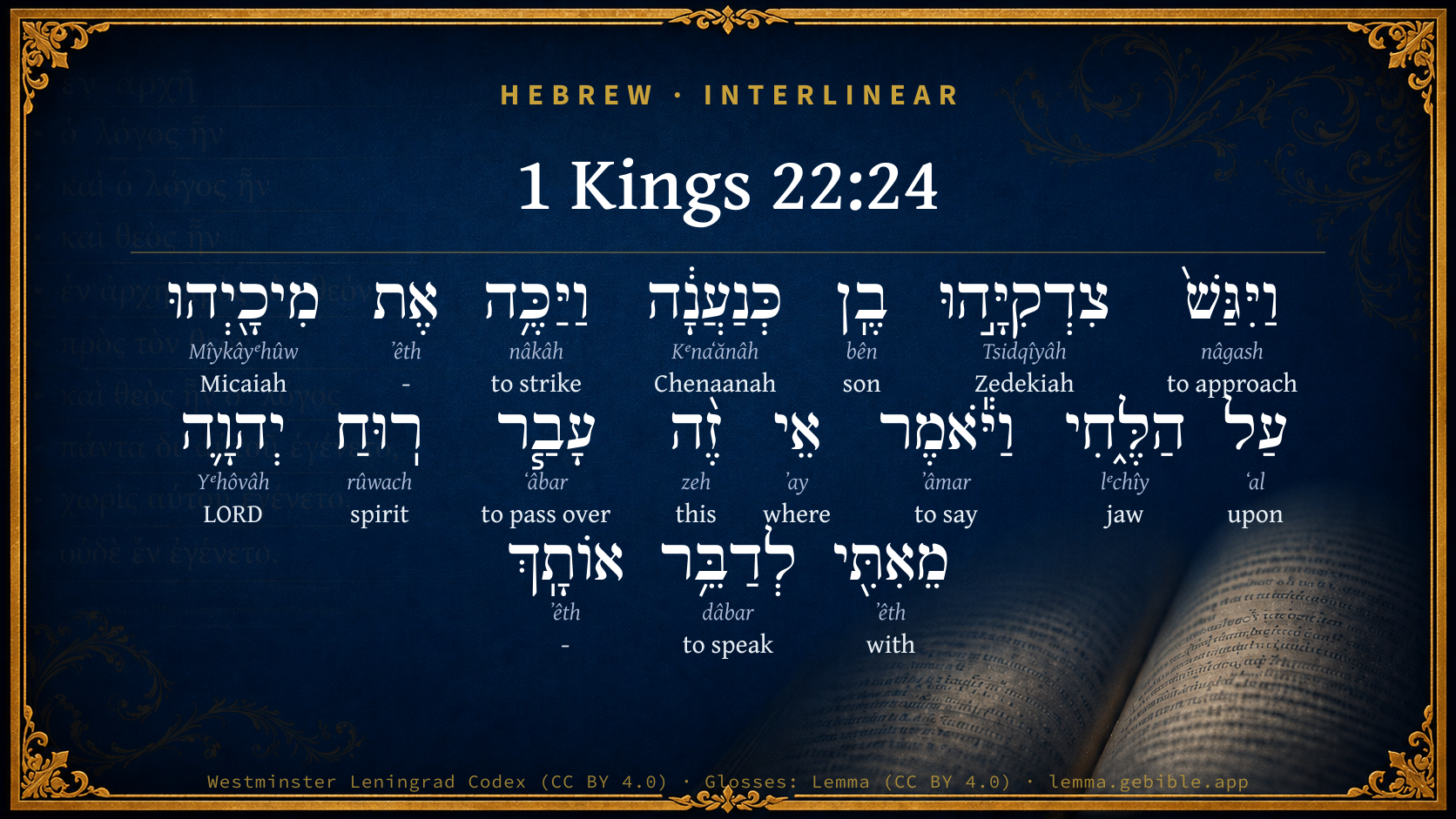
Hebrew (Westminster Leningrad Codex) 1 Kings 22:24 appears in the Hebrew Old Testament. The text above is from the Westminster Leningrad Codex. Each word links to its Strong’s number, a concise gloss, and parsing drawn from the Open Scriptures Hebrew Bible morphology. Click any word for its full Brown-Driver-Briggs (BDB) entry.
Download image
Cite this verse

1 Kings 22:24 (World English Bible). Public Domain. Lemma interlinear Bible study tool, https://lemma.gebible.app/v/1-kings/22/24.

Show BibTeX & RIS
BibTeX
RIS
English Translation
Then Zedekiah the son of Chenaanah came near, and struck Micaiah on the cheek, and said, Which way went the Spirit of Yahweh from me to speak to you?
World English Bible · Public Domain
Download a study sheet

One document with this verse’s original text, its word-by-word gloss line, the meaning frame, cross-references with their text, attributed commentary, and full source and license credits — printable, and it pastes into notes with its structure intact.

This verse Autodidact and up

Study sheet (.html) Plain text (.txt)

A passage Seminary Student

Up to 50 verses in one chapter. A passage sheet keeps up to 6 commentary sources and 12 cross-references per verse, in the order this page ranks them, and says so on the sheet whenever that leaves anything out. Ask for a single verse and you get the Autodidact verse sheet above.

Everything on this page stays free to read, with no account — the sheet is a download of what is already on screen, not access to it.

Want to remove ads? Support Godless Engineer
Compare translations 3

The same verse in 3 English versions, stacked beneath the original-language interlinear above. Click any original word for its lexicon entry.

Each is an independent rendering of the whole verse — the interlinear is not word-aligned to these translations.

Highlighted words mark where these versions differ — a whole-verse word diff, not a word-by-word alignment.

  • World English Bible Public Domain
    Then Zedekiah the son of Chenaanah came near, and struck Micaiah on the cheek, and said, Which way went the Spirit of Yahweh from me to speak to you?
  • King James Version Public Domain
    But Zedekiah the son of Chenaanah went near, and smote Micaiah on the cheek, and said, Which way went the Spirit of the LORD from me to speak unto thee?
  • unfoldingWord Literal Text CC BY-SA 4.0
    And Zedekiah, the son of Kenaanah, approached and struck Micaiah on the cheek. And he said, “What this, the Spirit of Yahweh has passed over from with me to speak to you?”

unfoldingWord Literal Text — © unfoldingWord, licensed CC BY-SA 4.0. Word-aligned USFM3 via Door43 (git.door43.org/unfoldingWord/en_ult).

Versions to compare (up to 4)

3 of 4 selected

Show all 18 translations

Every available English version of this verse, each an independent rendering of the whole verse.

  • World English Bible Public Domain
    Then Zedekiah the son of Chenaanah came near, and struck Micaiah on the cheek, and said, Which way went the Spirit of Yahweh from me to speak to you?
  • Berean Standard Bible Public Domain
    Then Zedekiah son of Chenaanah went up, struck Micaiah in the face, and demanded, “Which way did the Spirit of the LORD go when He departed from me to speak with you?”
  • Majority Standard Bible Public Domain
    Then Zedekiah son of Chenaanah went up, struck Micaiah in the face, and demanded, “Which way did the Spirit of the LORD go when He departed from me to speak with you?”
  • King James Version Public Domain
    But Zedekiah the son of Chenaanah went near, and smote Micaiah on the cheek, and said, Which way went the Spirit of the LORD from me to speak unto thee?
  • American Standard Version (1901) Public Domain
    Then Zedekiah the son of Chenaanah came near, and smote Micaiah on the cheek, and said, Which way went the Spirit of Jehovah from me to speak unto thee?
  • Revised Version (1885) Public Domain
    Then Zedekiah the son of Chenaanah came near, and smote Micaiah on the cheek, and said, Which way went the spirit of the LORD from me to speak unto thee?
  • Geneva Bible (1599) Public Domain
    Then Zidkiiah the sonne of Chenaanah came neere, and smote Michaiah on the cheeke and sayd, When went the Spirite of the Lord from me, to speake vnto thee?
  • Douay-Rheims (1899) Public Domain
    And Sedecias the son of Chanaana came, and struck Micheas on the cheek, and said: Hath then the spirit of the Lord left me, and spoken to thee?
  • Young's Literal Translation Public Domain
    And Zedekiah son of Chenaanah draweth nigh, and smiteth Micaiah on the cheek, and saith, `Where `is' this -- he hath passed over -- the Spirit of Jehovah -- from me to speak with thee?'
  • Literal Standard Version CC BY-SA 4.0
    And Zedekiah son of Chenaanah draws near and strikes Micaiah on the cheek, and says, “Where [is] this [that] the spirit [from] YHWH has passed over from me to speak with you?”
  • Unlocked Literal Bible CC BY-SA 4.0
    Then Zedekiah son of Kenaanah, came up, slapped Micaiah on the cheek, and said, “Which way did the Spirit of Yahweh take to go from me to speak to you?”
  • unfoldingWord Literal Text CC BY-SA 4.0
    And Zedekiah, the son of Kenaanah, approached and struck Micaiah on the cheek. And he said, “What this, the Spirit of Yahweh has passed over from with me to speak to you?”
  • Darby Bible Public Domain
    Then Zedekiah the son of Chenaanah went near, and smote Micah upon the cheek, and said, Where now went the Spirit of Jehovah from me to speak to thee?
  • World Messianic Bible Public Domain
    Then Zedekiah the son of Chenaanah came near and struck Micaiah on the cheek, and said, “Which way did the LORD’s Spirit go from me to speak to you?”
  • Webster's Bible Public Domain
    But Zedekiah the son of Chenaanah went near, and smote Micaiah on the cheek, and said, Which way went the Spirit of the LORD from me to speak to thee?
  • Free Bible Version CC BY-SA 4.0
    Then Zedekiah, son of Chenaanah, went and slapped Micaiah in the face, and demanded, “Which way did the Spirit of the Lord go when he left me to speak to you?”
  • Bible in Basic English Public Domain
    Then Zedekiah, the son of Chenaanah, came near and gave Micaiah a blow on the side of the face, saying, Where is the spirit of the Lord whose word is in you?
  • JPS Tanakh (1917) Public Domain
    Then Zedekiah the son of Chenaanah came near, and smote Micaiah on the check, and said: 'Which way went the spirit of the LORD from me to speak unto thee?'

Literal Standard Version (2020), Covenant Press — licensed CC BY-SA 4.0. Text via the HelloAO Bible API (eBible.org). Unlocked Literal Bible (unfoldingWord) — licensed CC BY-SA 4.0. Text via the HelloAO Bible API (eBible.org). unfoldingWord Literal Text — © unfoldingWord, licensed CC BY-SA 4.0. Word-aligned USFM3 via Door43 (git.door43.org/unfoldingWord/en_ult). Free Bible Version, Dr. Jonathan Gallagher — licensed CC BY-SA 4.0. Text via the HelloAO Bible API (eBible.org).

Word by word

More ways to search: Search by grammar → Find every occurrence → Compare this word →

Practice this passage: Drill this verse → Learn its vocabulary →

כְּנַעֲנָ֔ה
Kᵉnaʻănâh
H3668
“Chenaanah”
Noun, Proper
Part of Speech
Noun
Type
Proper
Full BDB Definition

Origin: from H3667

TWOT: None

Chenaanah = "trader" - father of Zedekiah the false prophet of Ahab - son of Bilhan, grandson of Jediael, and great grandson of Benjamin and the founder of a house of Benjamin
  1. וַיִּגַּשׁ֙ nâgash H5066 “and · to approach” Conjunction + Verb, Qal, Sequential Imperfect, 3rd Person, Masculine, Singular
  2. צִדְקִיָּ֣הוּ Tsidqîyâh H6667 “Zedekiah” Noun, Proper
  3. בֶֽן bên H1121 “son of” Noun, Common, Masculine, Singular, Construct
  4. וַיַּכֶּ֥ה nâkâh H5221 “and · to strike” Conjunction + Verb, Hiphil, Sequential Imperfect, 3rd Person, Masculine, Singular
  5. אֶת ʼêth H853 “-” Particle, Direct Object
  6. מִיכָ֖יְהוּ Mîykâyᵉhûw H4321 “Micaiah” Noun, Proper
  7. עַל ʻal H5921 “upon” Preposition
  8. הַלֶּ֑חִי lᵉchîy H3895 “the · jaw” Particle, Definite Article + Noun, Common, Both, Singular, Absolute
  9. וַיֹּ֕אמֶר ʼâmar H559 “and · to say” Conjunction + Verb, Qal, Sequential Imperfect, 3rd Person, Masculine, Singular
  10. אֵי ʼay H335 “where” Particle, Interrogative
  11. זֶ֨ה zeh H2088 “this” Pronoun, Demonstrative, Masculine, Singular
  12. עָבַ֧ר ʻâbar H5674 “to pass over” Verb, Qal, Perfect, 3rd Person, Masculine, Singular
  13. רֽוּחַ rûwach H7307 “spirit of” Noun, Common, Both, Singular, Construct
  14. יְהוָ֛ה Yᵉhôvâh H3068 “LORD” Noun, Proper
  15. מֵאִתִּ֖י ʼêth H854 “from · with · me” Preposition + Preposition + Suffix, Personal, 1st Person, Common, Singular
  16. לְדַבֵּ֥ר dâbar H1696 “to speak” Preposition + Verb, Piel, Infinitive Construct
  17. אוֹתָֽךְ ʼêth H853 “- · you” Particle, Direct Object + Suffix, Personal, 2nd Person, Feminine, Singular

About this verse

These counts appear in no published source. They are computed here, from the morphology-tagged text and Lemma’s own curated glosses. What Lemma adds →

18
words
17
distinct lemmas
Historical
section

Notable vocabulary

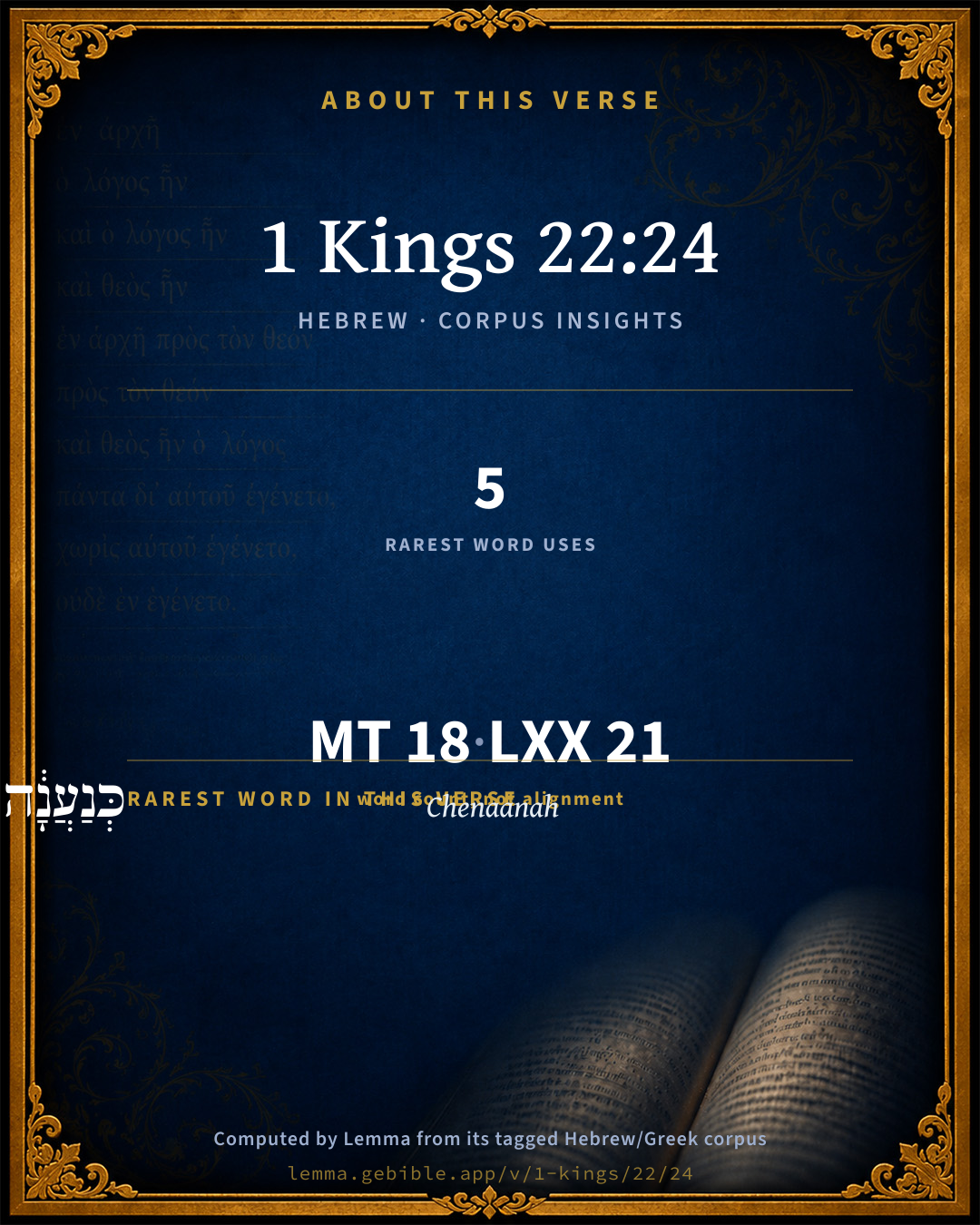
The rarest word here is כְּנַעֲנָ֔ה Chenaanah H3668 — appearing just 5 times in the whole Hebrew Bible.

Shared distinctive vocabulary

כְּנַעֲנָ֔ה Chenaanah H3668 occurs in 5 verses of the Hebrew Bible. Also found in:

Grammatical profile

  • 5 verbs
  • 7 nouns
  • 1 pronoun
  • 2 prepositions
  • 3 particles

Verb forms

  • וַיִּגַּשׁ֙ Qal · Sequential Imperfect
  • וַיַּכֶּ֥ה Hiphil · Sequential Imperfect
  • וַיֹּ֕אמֶר Qal · Sequential Imperfect
  • עָבַ֧ר Qal · Perfect
  • לְדַבֵּ֥ר Piel · Infinitive Construct

Hebrew & Septuagint length

In English translation the verse runs 29 words from the Hebrew and 28 from the Septuagint (LXX English) — closely comparable.

A rough comparison of the two English renderings, which tokenize alike — not a word-level alignment.

Word counts can differ between the Hebrew and the Greek without any difference in meaning — e.g. the Hebrew direct-object marker אֵת has no separate Greek word, and Greek often adds the article ὁ.

In the original languages it is 18 Hebrew tokens and 21 Greek tokens — but the two are counted differently (Hebrew bundles its prefixes and suffixes into one token; the Greek is in lemma form), so that isn’t a like-for-like length.

Cross-references

15

Topical passages linked to 1 Kings 22:24 in the Treasury of Scripture Knowledge — connected by theme and wording, ordered by reader-vote popularity; previews shown in the World English Bible.

  • Acts 23:2 The high priest, Ananias, commanded those who stood by him to strike him on the mouth.
  • Lamentations 3:30 Let him give his cheek to him who strikes him; let him be filled full with reproach.
  • Micah 5:1 Now you shall gather yourself in troops, Daughter of troops. He has laid siege against us; They will strike the judge of Israel with a rod on the cheek.
  • 1 Kings 22:11 Zedekiah the son of Chenaanah made him horns of iron, and said, Thus says Yahweh, With these shall you push the Syrians, until they be consumed.
  • 2 Chronicles 18:23–24 Then Zedekiah the son of Chenaanah came near, and struck Micaiah on the cheek, and said, Which way went the Spirit of Yahweh from me to speak to you?
  • Isaiah 50:5–6 The Lord Yahweh has opened my ear, and I was not rebellious, neither turned away backward.
  • Jeremiah 28:10–11 Then Hananiah the prophet took the bar from off the prophet Jeremiah's neck, and broke it.
  • Jeremiah 29:26–27 Yahweh has made you priest in the place of Jehoiada the priest, that there may be officers in the house of Yahweh, for every man who is mad, and makes himself a prophet, that you should put him in the stocks and in shackles.
  • Matthew 5:39 But I tell you, don't resist him who is evil; but whoever strikes you on your right cheek, turn to him the other also.
  • Matthew 26:68 saying, "Prophesy to us, you Christ! Who hit you?"
  • Matthew 27:42–43 "He saved others, but he can't save himself. If he is the King of Israel, let him come down from the cross now, and we will believe in him.
  • Mark 14:65 Some began to spit on him, and to cover his face, and to beat him with fists, and to tell him, "Prophesy!" The officers struck him with the palms of their hands.
  • Mark 15:19–20 They struck his head with a reed, and spat on him, and bowing their knees, did homage to him.
  • John 15:18 If the world hates you, you know that it has hated me before it hated you.
  • John 15:20 Remember the word that I said to you: 'A servant is not greater than his lord.' If they persecuted me, they will also persecute you. If they kept my word, they will keep yours also.

Cross-references courtesy of OpenBible.info (CC BY 4.0).

Hebrew and Greek witnesses Masoretic Hebrew ↔ Greek Septuagint

The same verse in the two great witnesses to the Old Testament, shown verse-for-verse.

These are two independent witnesses, not word-aligned to each other, and the Septuagint is shown in lemma (dictionary) form.

Hebrew 1 Kings 22:24 Masoretic · Westminster Leningrad Codex

וַיִּגַּשׁ֙ צִדְקִיָּ֣הוּ בֶֽן כְּנַעֲנָ֔ה וַיַּכֶּ֥ה אֶת מִיכָ֖יְהוּ עַל הַלֶּ֑חִי וַיֹּ֕אמֶר אֵי זֶ֨ה עָבַ֧ר רֽוּחַ יְהוָ֛ה מֵאִתִּ֖י לְדַבֵּ֥ר אוֹתָֽךְ

Then Zedekiah the son of Chenaanah came near, and struck Micaiah on the cheek, and said, Which way went the Spirit of Yahweh from me to speak to you?

World English Bible · Public Domain

Greek LXX 1 Kings 22:24 Septuagint · lemma form

καί προςἔρχομαι σεδεκιου υἱός χανανα καί πατάσσω ὁ μιχαιας ἐπί ὁ σιαγών καί εἶπον ποῖος πνεῦμα κύριος ὁ λαλέω ἐν σύ

And Sedekias the son of Chanaan came near and struck Michaias on the cheek, and said, What sort of a spirit of the Lord has spoken in you?

LXX2012 (modern English Septuagint) · Public Domain

On this verse, The Cambridge Bible for Schools and Colleges discusses the Septuagint’s reading. Read the note in Commentary ↓

Hebrew: Westminster Leningrad Codex (CC BY 4.0). Greek: Septuagint (public domain); English from LXX2012 (modern English Septuagint) (Public Domain). How the Septuagint differs from the Hebrew →

Targum (Aramaic paraphrase)

1

The Targum is the ancient Jewish Aramaic paraphrase of the Hebrew Scriptures — an interpretive translation, not the Hebrew text itself. Onkelos (literal) and Pseudo-Jonathan (expansive) render the Torah, and Jonathan the Prophets. Coverage is partial: where no permissively-licensed English translation exists for a verse, only the Aramaic is shown. This is verse-level text, not a word-by-word alignment to the Hebrew.

  1. Targum Jonathan Prophets (Joshua–Malachi)
    וּקְרֵיב צִדְקִיָהוּ בַּר כְּנַעֲנָה וּמְחָא יָת מִיכָיְהוּ עַל לְסָתֵיהּ וַאֲמַר אֵי דָא שָׁעָה אִסְתַּלֵק רוּחַ נְבוּאָה מִן קֳדָם יְיָ מִינִי לְמַלְלָא עִמָךְ:

    (no public-domain English translation for this verse)

    Targum Jonathan — Aramaic: “Mikraot Gedolot” (public domain). English: “Sefaria Community Translation” (CC0 1.0 (public-domain dedication)); “London "Chaldee Paraphrase," 1871” (public domain). Text via Sefaria.

Commentary

Notes on 1 Kings 22:24 from classic Christian and Jewish commentators (each source and its license shown beneath its notes). The classic Christian expositions comment on the surrounding passage and are grouped to its opening verse, so a note may address several verses; the Jewish commentaries on the Tanakh (Rashi and others) are per-verse, so they appear only where the commentator wrote on this verse.

Lemma curates 59 commentaries, every one of them public domain or Creative Commons licensed, each selected and text-cleaned for this edition rather than reprinted as found. About our sources →

Trapp's Complete Commentary

John Trapp

1Ki 22:24 But Zedekiah the son of Chenaanah went near, and smote Micaiah on the cheek, and said, Which way went the Spirit of the LORD from me to speak unto thee?

Ver. 24. And smote Micaiah on the cheek.] In a most disgraceful manner, and in such a presence.

“ Nihil est audaeius illis

Deprensis, iram atque animos a crimine sumunt. ” - Juvenal.

Here "the prophet was a fool, the spiritual man mad." {Hos 9:7}

Which way went the Spirit of the Lord?] Or, At what hour went, &c. Zedekiah would be thought to have the monopoly or sole enjoyment of the Spirit, as now the Jesuits would of learning and divinity. Aurelius the Sorbonist, a doctor of their own religion, saith of them, that they are a kind of men which have nothing more than theological arrogancy, but possess nothing less than theological science. {a}

{a} Vindiciar., p. 629.

John Trapp, A Commentary or Exposition upon All the Books of the Old and New Testament (1647–1656) — public domain. Text from a community e-Sword module.

Joseph Benson's Commentary

1Ki 22:24-25. But Zedekiah went near — The chief of the false prophets, who was much in the king’s favour. Which way went the Spirit of the Lord, &c. — In what manner went it? Contemptuous language as well as behaviour: as much as to say, How dare you prophesy directly contrary to what I have done, who have the Spirit of the Lord! Behold, thou shalt go into an inner chamber — Into a secret place; to hide thyself — For fear of being seized and punished as a false prophet, and as the great author and abetter of this pernicious war, and of Ahab’s destruction. Probably he went with Ahab to the battle, after which he was glad to shelter himself where he could.

Joseph Benson's Commentary on the Old and New Testaments (1811–1818) — public domain. Text from a community e-Sword module.

Tyndale Open Study Notes

Tyndale Open Resources

22:24-25 An indignant Zedekiah, one of the false prophets, insisted that he and the others were telling the truth. Like Ahab, they would one day find out the real truth when the prophecy against them was fulfilled in Jehu’s purge of Baal worship (2 Kgs 10:18-28).

Tyndale Open Study Notes — © Tyndale Open Resources, licensed CC BY-SA 4.0. Text via the HelloAO Bible API.

Geneva Bible (1599)

Geneva Bible translators

Thus the wicked would seem that none were in the favor of God, but they, and that God hath given his graces to none so much as to them.

Geneva Bible (1599) marginal notes — public domain. Text via Bolls.life.

Jamieson, Fausset & Brown

Robert Jamieson, A. R. Fausset & David Brown

Zedekiah the son of Chenaanah went near, and smote Micaiah on the cheek--The insolence of this man, the leader of the false prophets, seems to have been provoked by jealousy at Micaiah's assumed monopoly of the spirit of inspiration. This mode of smiting, usually with a shoe, is both severe and ignominious. The calm reply of the Lord's prophet consisted in announcing the fate of the false prophets who suffered as the advisers of the disastrous expedition.

Jamieson, Fausset & Brown — Commentary Critical and Explanatory on the Whole Bible (1871) — public domain (CC PDM 1.0). Text via the HelloAO Bible API.

Adam Clarke's Commentary

Verse 24. Which way went the Spirit of the Lord from me] This is an expression of as great insolence as the act was of brutal aggression. "Did the Spirit of the Lord, who rests solely upon me, condescend to inspire thee? Was it at this ear [where he smote him] that it entered, in order to hold communion with thee?" Josephus tells an idle rabbinical tale about this business, which is as unworthy of repetition as it is of credit. See his Antiq. of the Jews, book viii., c. 10.

Adam Clarke's Commentary on the Bible (1810–1826) — public domain. Text from a community e-Sword/MySword module.

Ellicott's Commentary for English Readers

(24) Smote Micaiah on the cheek.—The act is not only the expression of contempt (see Isa_1:6; Mic_5:1; Mat_5:39), but of professed indignation at words of blasphemy against God, or of contempt for His vicegerents; as is seen clearly, when it is recorded as directed against Our Lord or against St. Paul (Joh_18:22-23; Act_23:2). The words which accompany it evidently convey a sarcastic reference to the knowledge of the secret dealings of God, implied in Micaiah’s vision, with a view to turn it into ridicule. Micaiah’s answer accordingly passes them by, and merely declares the shame and terror, with which Zedekiah shall find out hereafter the truth of the prophecy of evil. Josephus has a curious addition, that Zedekiah challenged Micaiah to wither up his hand, like the hand of Jeroboam at Bethel, and scouted his prophecy as inconsistent with that of Elijah (Antt. viii. 15, § 4).

A Bible Commentary for English Readers, edited by Charles John Ellicott (1878–1897) — public domain. Text from a community e-Sword module.

The Cambridge Bible for Schools and Colleges

gen. ed. J. J. S. Perowne

24. But Zedekiah … went [R.V. came] near] The verb is the same as in 1Ki_20:13. See note there.

Josephus has a great expansion of the narrative at this point, which leads up to the blow given to Micaiah. He says ‘the king began to ponder on what had been said, but Zedekiah, one of the false prophets, came near and advised him to pay no regard to Micaiah, for he spake no truth. And he brought forward, as a proof of this, what Elijah, who knew the future far better than this man, had prophesied. He prophesied in the city of Jezreel and said that dogs should lick the king’s blood in the field of Naboth, as they had licked that of Naboth who through him had been stoned by the people. It is clear then that this man lies, in contradicting the better prophet and declaring that the king shall die within three days. But ye shall know if he is true and has the power of the divine spirit. For let him, after I have struck him, blast my hand at once, as Jadon (see above on 1Ki_13:1) withered the right hand of king Jeroboam, when he desired to arrest him. For, said he, you have heard what happened then. Whereupon he struck Micaiah, and when no harm befel him, Ahab took heart and was encouraged to lead his army against the Syrian.’

Which way went the spirit of the Lord] The whole account intimates that Zedekiah conceived himself prompted by the divine spirit and thought that he was telling the truth to Ahab. He was moved by the spirit of prophecy but knew not that God had willed it to be to him a spirit of lies.

The LXX. has rendered ‘what spirit of the Lord was it that has spoken in thee?’

The Cambridge Bible for Schools and Colleges (gen. ed. J. J. S. Perowne; Cambridge University Press, 1878–1918) — public domain. Text from a community e-Sword module.

John Gill's Exposition

And Micaiah said, if thou return at all in peace, the Lord hath not spoken by me,.... I am content to be reckoned a false prophet, and to be punished as such:

and, he said, hearken, O people, everyone of you; he called aloud unto them to observe what he had predicted, and mark the issue of it, and to bear testimony for him, or against him, as things should be.

John Gill's Exposition of the Whole Bible (1746–1763) — public domain (CC PDM 1.0). Text via the HelloAO Bible API.

Albert Barnes' Notes on the Bible

Smote Micaiah on the cheek - As Micaiah had been brought from prison 1Ki 22:26, it is probable that his hands were bound.

The prophet, thus standing before the great ones of the earth, bound and helpless, bearing testimony to the truth, and for his testimony smitten on the face by an underling, whose blow he receives without either shame or anger, is a notable type of our Lord before Caiaphas suffering the same indignity.

Which way ... - Zedekiah’s meaning may perhaps be expounded as follows:

“The Spirit of Yahweh certainly came to me, and inspired me with the answer which I gave. If He afterward went to thee, as thou sayest that He did, perhaps thou canst tell us - as all the secrets of the invisible world are, thou pretendest, open to thee - which way He took.”

Albert Barnes' Notes on the Bible (1834–1885) — public domain. Text from a community e-Sword/MySword module.

Haydock's Catholic Bible Commentary

Cheek. Josephus says he had told the king, that if his hand did not wither, like that of Jeroboam, he might conclude that Micheas was a false prophet; particularly as his prediction was at variance with that of Elias; who had asserted that Achab should die at Jezrahel, while Micheas seemed to condemn him to death at Ramoth. But these circumstances are by no means certain, though they be adopted by the author of the Scholastic History, by Lyranus, &c. (Calmet) --- If Sedecias had the assurance to make such a declaration, God was not obliged to work a miracle to prevent the king’s mistake; and Micheas had never said that Achab should die at Ramoth. (Haydock) --- Hath. In 2 Paralipomenon xviii. 23, it is expressed, Which way went the spirit of the Lord from me to speak to thee? If he could have proved that he had ever possessed the spirit, he might have spoken with some confidence; though sin may easily banish him. Thus Catholics may ask the pretended reformers, who boast of the spirit, how He came to abandon the Church with which all agree He once resided, to establish a contrary one? The spirit of God cannot be at variance with himself, nor reveal contradictory things. (Haydock)

George Leo Haydock (1774–1849), Haydock's Catholic Family Bible and Commentary, 1859 edition — public domain. Excludes Psalms (Douay-Rheims chapter numbering differs from Protestant) and Deuterocanonical books (Catholic canon only).

Matthew Poole's English Annotations

Zedekiah the son of Chenaanah; the chief of the false prophets, who was much in the king’s favour, upon which he now presumed.

Smote Micaiah on the cheek, in way of contempt and scorn, Job 16:10; Jer 20:2; Lam 3:30; Mar 14:65.

Which way went the Spirit of the Lord, i.e. in what manner went it? Forasmuch as I and my brethren have consulted the Lord, and answered in his name, and have the same Spirit which thou pretendest to have, and not a lying spirit, as thou dost falsely and maliciously affirm, how is it possible that the same Spirit should tell us one thing, and thee the quite contrary?

Matthew Poole's English Annotations on the Holy Bible (1683–1685) — public domain. Text from a community e-Sword/MySword module.

Whedon's Commentary on the Bible

Daniel D. Whedon

24. Smote Micaiah — This act of insolence was an outburst of rage and malice, prompted by a momentary consciousness that Micaiah’s words were but too true.

Which way went the Spirit — This was an attempt to turn the biting point of Micaiah’s vision against himself. As if he had said: The lying spirit has suddenly gone out from me to speak through thee; how has he effected it so quickly! Which route did he take?

Daniel D. Whedon (gen. ed.), Commentary on the Old and New Testaments (1874–1909) — public domain. Text from a community e-Sword module.

The Pulpit Commentary

But Zedekiah the son of Chenaanah Rawlinson holds that he was a sort of coryphaeus of the false prophets. It is more probable that, having put himself forward on a former occasion (ver. 11), he now feels specially aggrieved at Micaiah"s blunt assertion, that he and the rest have been possessed by a spirit of lies went near, and smote Micaiah A thoroughly natural touch. But the whole narrative has every mark of naturalness and veracity. It is easy to see how enraged Zedekiah would be at the slight cast upon his prophetic powers. Apparently this gross indignity elicited no protest or word of displeasure from either of the kings. Micaiah, like Elijah, was left alone, on the cheek cf. Job_16:10; Lam_3:30; Luk_6:29; and above all Mat_26:67; Luk_22:64; Act_23:2. Herein Micaiah had "the fellowship of sufferings" (Php_3:10) with our blessed Lord. Rawlinson thinks that his hands would be bound, but this is extremely improbable. In that case Ahab could hardly have asked him to prophesy (ver. 15), or if he did, Jehoshaphat would know beforehand what to expect, and said, Which way Heb. What, or where. The chronicler supplies "way," thereby bringing the expression into unison with 1Ki_13:12; (2 Kings Job_38:24) went Heb. passed, crossed, rb the Spirit of the Lord These words are important, as showing that the speaker had not identified "the spirit" of ver. 21 with the evil spirit: Job_1:6 sqq. from me to speak unto thee? It is pretty clear from these words, in connexion with ver. 23, that Zedekiah had been conscious of an inspiration, of a spirit not his own, which impelled him to speak and act as he did. We must not attach too much import-ante to a taunting and passionate speech, but its meaning appears to be: I have spoken in the name and by the spirit of Jehovah. Thou claimest to have done the same. How is it that the Spirit of God speaks one thing by me, another by thee? Thou hast seen (ver. 19) the secret counsels of Heaven. Tell us, then, which way, etc.

Vers. 24-29.

The Argument of Wickedness.

The Bible is a book of texts because it is a book of types. It does not profess to give full histories, but refers to public records for these (see Jos_10:13; 2Sa_1:18; 1Ki_11:41; 1Ch_9:1) Inspiration selects from histories typical or representative incidents to bring out the principles of the grace and truth of God. In the scene before us we have types of wickedness in Zedekiah and Ahab, the one ecclesiastical, the other civil, which may be profitably studied in the arguments they use contending with Micaiah, the representative of the truth of God. These arguments are

I RAGE AGAINST THE TRUTH. The reason is obvious, viz., because the truth is the worst that can be said of the wicked.

1. It is the worst that can be said of their character.

(1) It shows up their selfishness. The one object of Ahab was that "good" might be prophesied for him. To gain this he sold himself to his four hundred liars. These liars, to gain the patronage of Ahab, sold their consciences. Because Ahab could not gain flattery from Micaiah, he hated him.

(2) It shows up their folly. For what was the selfishness of Ahab but self-deception? The patronage of liars could not convert falsehood into truth, neither could the persecution of a true man convert truth into falsehood. Zedekiah, in deceiving Ahab, deceived his own soul. All sin is folly.

(3) It evinces their degradation, for it proves them to be the dupes and serfs of infernal spirits. Can degradation go lower?

2. It is the worst that can be said of their doom.

(1) The wicked are to be destroyed in time. Ahab in particular was to fall at Ramoth-Gilead. From that battle he was "not to return in peace." Zedekiah was to "go into an inner chamber to hide himself," as Ben-hadad had done, (1Ki_20:30) and there to meet his fate. While to the righteous death is an entrance to glory, it is the "king of terrors" to the wicked. (see 1Co_15:55-57) The sting is here:

(2) The wicked are to be destroyed in eternity. The alarm with which the ancients received predictions of maltreatment to their corpses arose from their apprehension that it presaged a posthumous retribution upon the soul. The dogs licking the blood of Ahab would suggest that devils would not only be the instigators but also the instruments of his ruin.

(3) Who can estimate the horrors of damnation? The truth will prove to be the worst that can be said of the lost. Is it wonderful, then, that the wicked should abhor the truth?

3. They are therefore constrained to hypocrisy.

(1) For their own sakes they have to play the hypocrite. They conceal their selfishness and affect generosity, conscious that were their base soul hunger to come honestly to the day, they would become odious. They hide their folly and affect wisdom lest they should suffer contempt.

(2) For the sake of society wicked men are hypocrites. Were they to be honestly known to each other, respect and confidence would be at an end; in fact, society would be impossible. There are no friendships in hell.

II THE RESENTMENT OF VIOLENCE.

1. The logic of the wicked is weak.

(1) Zedekiah"s speech was pertinacious: "Which way went the Spirit of the Lord from me to speak unto thee?" He assumed what Micaiah had not conceded, that he ever had the Spirit of the Lord. Micaiah had declared him, on the contrary, to have been influenced by a "spirit" of a very different description. Zedekiah also denied what he should have disproved, viz., that Micaiah had the Spirit of the Lord.

(2) Ahab wanted a prophet of the God of truth to tell lies to please him. He found four hundred to tell him lies, professedly in the name of the Lord. But the one honest man who told him the truth he imprisoned, because the truth did not please him. Yet the truth was what he adjured him to tell. What reason is there in all this?

(3) What sinner is there in our day who can clear himself of folly? (See Pro_13:19; 1Co_3:19)

2. The strength of the wicked is tyranny.

(1) The reason of Zedekiah was in his fist (ver. 24). "Which way?" From the fist to the cheek? The coward us d this argument with a council of four hundred ecclesiastics about him, and the civil power in reserve. So was Jesus insulted. (see Mat_26:57-68) So were the Protestant confessors. False prophets have ever been the worst enemies of the true. Micaiah did not return the blow, but referred the decision to God. True prophets wield other than carnal weapons.

(2) The reason of Ahab was in his bribes and prisons. Micaiah could not be cajoled as the four hundred were, therefore "the king of Israel said, Take Micaiah, carry him back unto Amen the governor of the city, and to Joash the king"s son, and say, Thus saith the king, put this fellow in prison, and feed him with bread of affliction, and with water of affliction, until I come in peace.

(3) But truth is not vanquished thus. How confident was Ahab that he should "come in peace"! And this is that Ahab who three or four years before so sagaciously said to Ben-hadad, "Let not him that girdeth on his harness boast himself as he that putteth it off." Persistency in sin does not sharpen men"s wits. Time vindicates truth. To this vindicator Micaiah called the attention of the people (ver. 29).

(4) But where was Jehoshaphat? He was silent when he should have spoken for the prophet of God. See the influence of bad company. "So the king of Israel, and Jehoshaphat the king of Judah went up to Ramoth-Gilead." Alas, Jehoshaphat! J.A.M.

The Pulpit Commentary (1880–1919), ed. H.D.M. Spence-Jones & Joseph S. Exell — public domain. Text from a community e-Sword module.

John Wesley's Explanatory Notes

Zedekiah - The chief of the false prophets, who was much in the king's favour. Which way - In what manner went it? Forasmuch as I and my brethren have consulted the Lord, and have the same spirit which thou pretendest to have.

John Wesley, Explanatory Notes Upon the Whole Bible (1754–1765) — public domain. Text via the GEBible commentary corpus.

unfoldingWord translationNotes

Door43 World Missions Community

Which way did the Spirit of Yahweh take to go from me to speak to you?

Zedekiah asks this sarcastic question to insult and rebuke Micaiah. AT: "Do not think that Yahweh's Spirit left me to speak to you!" (See: Rhetorical Question)

Look

"Listen" or "Pay attention to what I am about to tell you"

you will see

"you will know the answer to your question." If Zedekiah's rhetorical question is translated as a statement, this phrase may be translated to supply implicit information. AT: "you will know that the Spirit of Yahweh has spoken to me" (See: Assumed Knowledge and Implicit Information)

translationWords

Holy Spirit

know

unfoldingWord translationNotes — © Distant Shores Media and the Door43 World Missions Community, licensed CC BY-SA 4.0. Source: git.door43.org/Door43/en_tn.

Rashi

Rabbi Shlomo Yitzchaki (Rashi)

When did the spirit of Adonoy pass? [I.e.,] which way did it pass? This is an abbreviated verse. In Divrei Hayomim it is written, “In what way did [Adonoy’s spirit] pass.”

Rashi on the Tanakh — English translations: “The Judaica Press complete Tanach with Rashi, translated by A. J. Rosenberg” (CC BY 4.0); “Pentateuch with Rashi's commentary by M. Rosenbaum and A.M. Silbermann, 1929-1934” (public domain); “The Metsudah Tanach series, Lakewood, N.J” (CC BY 4.0); and “The Book of Joshua, Metsudah Publications, 1997” (CC BY 4.0). Text via Sefaria.

Lesson kit

Teaching starters — assembled from the data on this page, not authored interpretation. Every prompt links to the verse data it draws on. Edit before teaching.

1 Kings, in the Historical, opens this verse with 18 words (17 distinct Hebrew lemmas). Its most distinctive word is Kᵉnaʻănâh (“Chenaanah”). A historical commentator’s framing appears above. Read the whole chapter for the surrounding context.

Discussion questions

  1. What does “Chenaanah” (Kᵉnaʻănâh) contribute to the verse as a whole?
  2. How does 1 Kings 22:11, which shares the word «Chenaanah», read alongside this verse?
  3. These translations render this verse differently; the difference is in the English rendering, not the original. What questions does that raise?
  4. «וַיִּגַּשׁ֙» is a Qal Sequential Imperfect verb. How does that grammatical form shape the action described?
  5. Compare how Trapp's Complete Commentary and Joseph Benson's Commentary read this verse. Where do they agree or differ?

Things to notice

Reading settings

Reading text

Shown beneath each verse's original-language words.

Old Testament
Old Testament edition

Read the OT as the Masoretic Hebrew (MT) or the Greek Septuagint (LXX).

English shown for the Greek Septuagint (in the Hebrew ↔ Greek comparison).

Comparing translations? Open the Compare panel on any verse page to stack up to four side by side.