
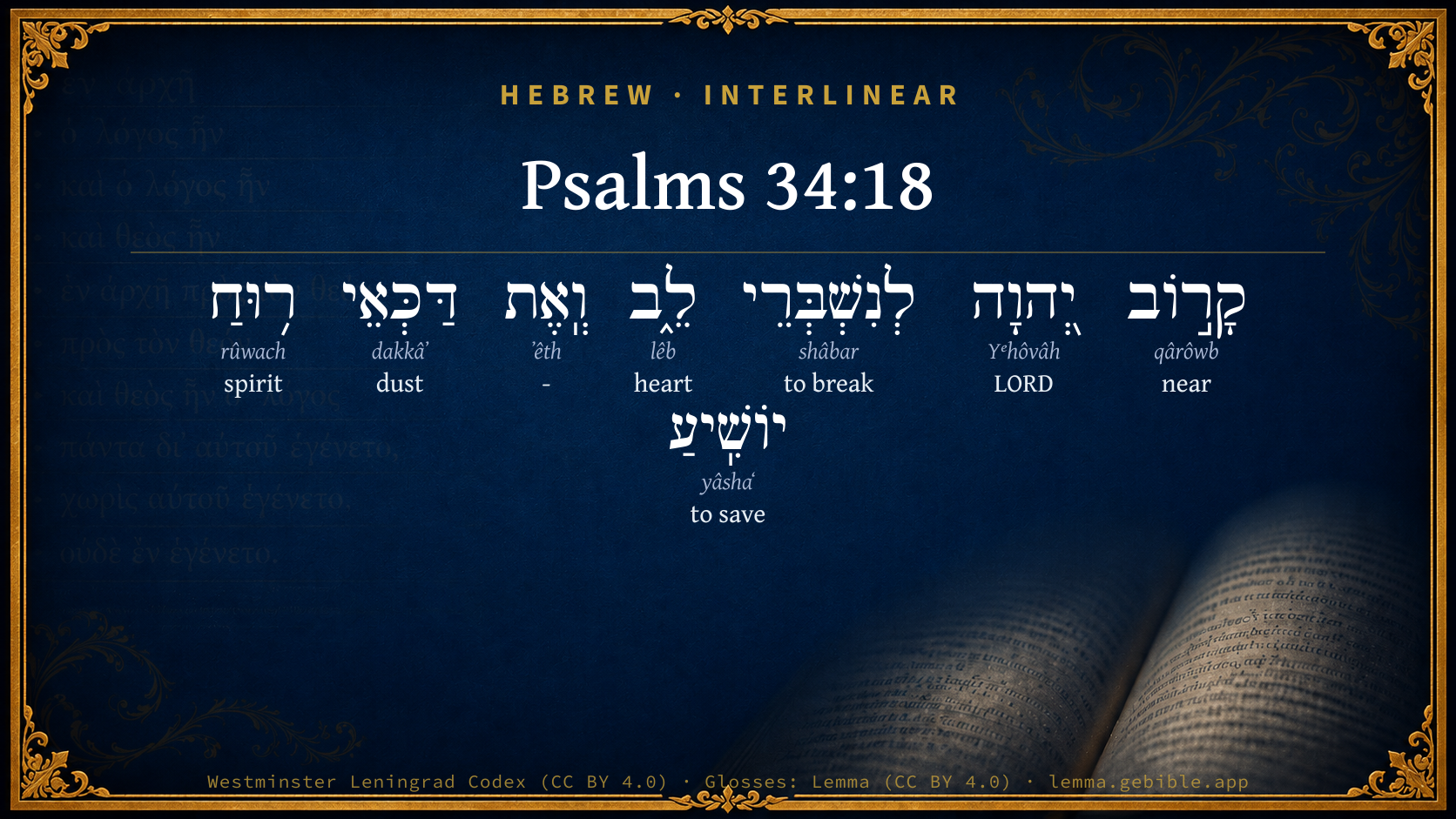
Psalms 34:18

Hebrew (Westminster Leningrad Codex) Psalms 34:18 appears in the Hebrew Old Testament. The text above is from the Westminster Leningrad Codex. Each word links to its Strong’s number, a concise gloss, and parsing drawn from the Open Scriptures Hebrew Bible morphology. Click any word for its full Brown-Driver-Briggs (BDB) entry.
Download image
Cite this verse

Psalms 34:18 (World English Bible). Public Domain. Lemma interlinear Bible study tool, https://lemma.gebible.app/v/psalms/34/18.

Show BibTeX & RIS
BibTeX
RIS
English Translation
Yahweh is near to those who have a broken heart, And saves those who have a crushed spirit.
World English Bible · Public Domain
Highlights
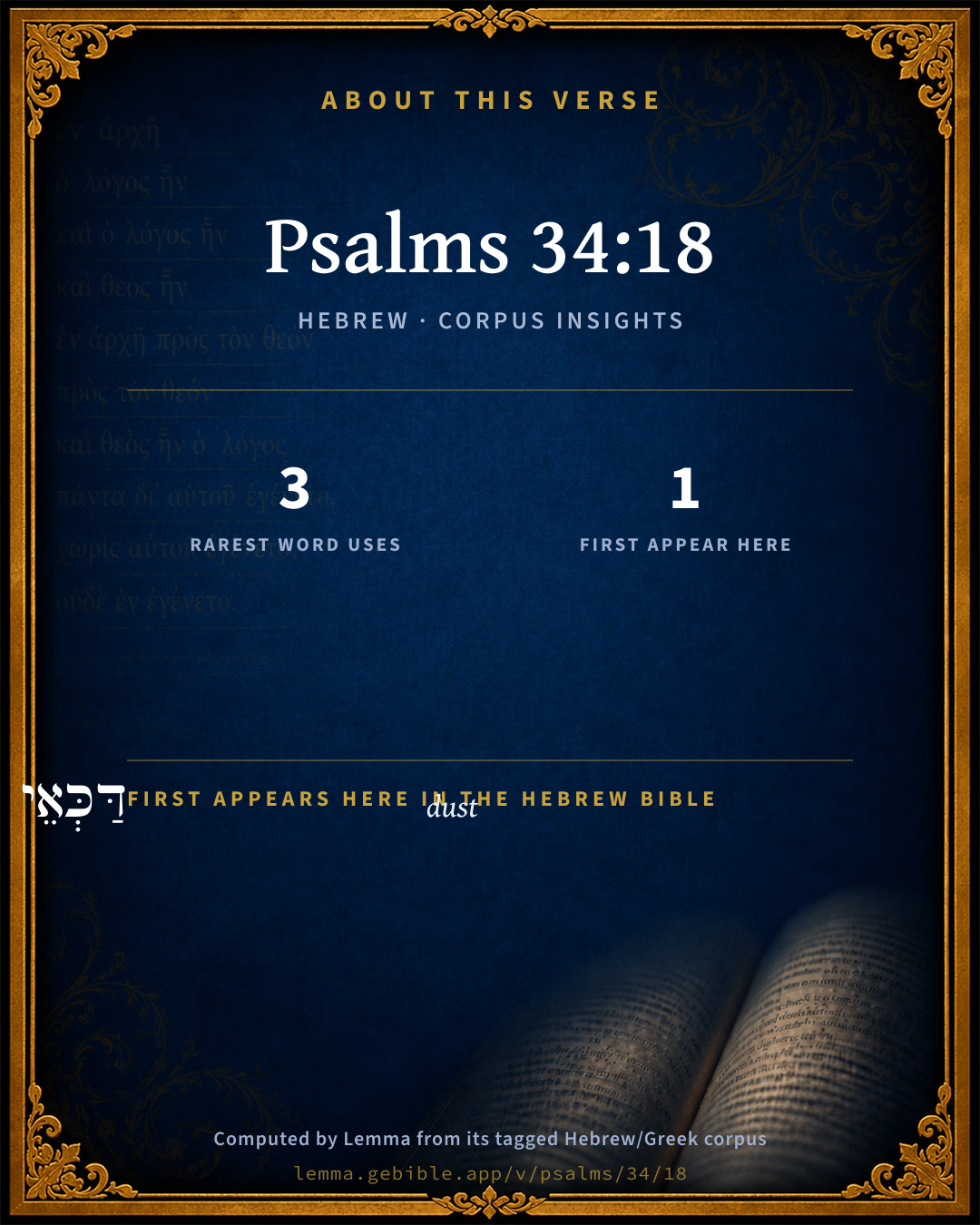
  • 1 first appearance in the Hebrew Bible
Full analysis ↓
Download a study sheet

One document with this verse’s original text, its word-by-word gloss line, the meaning frame, cross-references with their text, attributed commentary, and full source and license credits — printable, and it pastes into notes with its structure intact.

This verse Autodidact and up

Study sheet (.html) Plain text (.txt)

A passage Seminary Student

Up to 50 verses in one chapter. A passage sheet keeps up to 6 commentary sources and 12 cross-references per verse, in the order this page ranks them, and says so on the sheet whenever that leaves anything out. Ask for a single verse and you get the Autodidact verse sheet above.

Everything on this page stays free to read, with no account — the sheet is a download of what is already on screen, not access to it.

Want to remove ads? Support Godless Engineer
Compare translations 3

The same verse in 3 English versions, stacked beneath the original-language interlinear above. Click any original word for its lexicon entry.

Each is an independent rendering of the whole verse — the interlinear is not word-aligned to these translations.

Highlighted words mark where these versions differ — a whole-verse word diff, not a word-by-word alignment.

  • World English Bible Public Domain
    Yahweh is near to those who have a broken heart, And saves those who have a crushed spirit.
  • King James Version Public Domain
    The LORD is nigh unto them that are of a broken heart; and saveth such as be of a contrite spirit.
  • unfoldingWord Literal Text CC BY-SA 4.0
    Yahweh near to the broken of heart, and the crushed of spirit he saves.

unfoldingWord Literal Text — © unfoldingWord, licensed CC BY-SA 4.0. Word-aligned USFM3 via Door43 (git.door43.org/unfoldingWord/en_ult).

Versions to compare (up to 4)

3 of 4 selected

Show all 18 translations

Every available English version of this verse, each an independent rendering of the whole verse.

  • World English Bible Public Domain
    Yahweh is near to those who have a broken heart, And saves those who have a crushed spirit.
  • Berean Standard Bible Public Domain
    The LORD is near to the brokenhearted; He saves the contrite in spirit.
  • Majority Standard Bible Public Domain
    The LORD is near to the brokenhearted; He saves the contrite in spirit.
  • King James Version Public Domain
    The LORD is nigh unto them that are of a broken heart; and saveth such as be of a contrite spirit.
  • American Standard Version (1901) Public Domain
    Jehovah is nigh unto them that are of a broken heart, And saveth such as are of a contrite spirit.
  • Revised Version (1885) Public Domain
    The LORD is nigh unto them that are of a broken heart, and saveth such as be of a contrite spirit.
  • Geneva Bible (1599) Public Domain
    The Lord is neere vnto them that are of a contrite heart, and will saue such as be afflicted in Spirite.
  • Douay-Rheims (1899) Public Domain
    The just cried, and the Lord heard them: and delivered them out of all their troubles.
  • Young's Literal Translation Public Domain
    Near `is' Jehovah to the broken of heart, And the bruised of spirit He saveth.
  • Literal Standard Version CC BY-SA 4.0
    YHWH [is] near to the broken of heart, || And He saves the bruised of spirit.
  • Unlocked Literal Bible CC BY-SA 4.0
    Yahweh is close to the brokenhearted, and he saves those who are crushed in spirit.
  • unfoldingWord Literal Text CC BY-SA 4.0
    Yahweh near to the broken of heart, and the crushed of spirit he saves.
  • Darby Bible Public Domain
    Jehovah is nigh to those that are of a broken heart, and saveth them that are of a contrite spirit.
  • World Messianic Bible Public Domain
    The LORD is near to those who have a broken heart, and saves those who have a crushed spirit.
  • Webster's Bible Public Domain
    \\34:17\\The righteous cry, and the LORD heareth, and delivereth them out of all their troubles.
  • Free Bible Version CC BY-SA 4.0
    The Lord is close beside those who are broken-hearted; he saves those whose spirits are crushed.
  • Bible in Basic English Public Domain
    The Lord is near the broken-hearted; he is the saviour of those whose spirits are crushed down.
  • JPS Tanakh (1917) Public Domain
    (34-19) The LORD is nigh unto them that are of a broken heart, and saveth such as are of a contrite spirit.

Literal Standard Version (2020), Covenant Press — licensed CC BY-SA 4.0. Text via the HelloAO Bible API (eBible.org). Unlocked Literal Bible (unfoldingWord) — licensed CC BY-SA 4.0. Text via the HelloAO Bible API (eBible.org). unfoldingWord Literal Text — © unfoldingWord, licensed CC BY-SA 4.0. Word-aligned USFM3 via Door43 (git.door43.org/unfoldingWord/en_ult). Free Bible Version, Dr. Jonathan Gallagher — licensed CC BY-SA 4.0. Text via the HelloAO Bible API (eBible.org).

Word by word

More ways to search: Search by grammar → Find every occurrence → Compare this word →

Practice this passage: Drill this verse → Learn its vocabulary →

About this verse

These counts appear in no published source. They are computed here, from the morphology-tagged text and Lemma’s own curated glosses. What Lemma adds →

8
words
8
distinct lemmas
Wisdom
section

Notable vocabulary

The rarest word here is דַּכְּאֵי dust H1793 — appearing just 3 times in the whole Hebrew Bible.

First appearance in Scripture

This word makes its first canonical appearance in the Hebrew Bible here:

  • דַּכְּאֵי dust H1793

Shared distinctive vocabulary

דַּכְּאֵי dust H1793 occurs in 3 verses of the Hebrew Bible. Also found in:

Grammatical profile

  • 2 verbs
  • 3 nouns
  • 2 adjectives
  • 1 particle

Verb forms

  • לְנִשְׁבְּרֵי Niphal · Participle Active
  • יוֹשִֽׁיעַ Hiphil · Imperfect

Hebrew & Septuagint length

In English translation the verse runs 18 words from the Hebrew and 19 from the Septuagint (LXX English) — closely comparable.

A rough comparison of the two English renderings, which tokenize alike — not a word-level alignment.

Word counts can differ between the Hebrew and the Greek without any difference in meaning — e.g. the Hebrew direct-object marker אֵת has no separate Greek word, and Greek often adds the article ὁ.

Cross-references

14

Topical passages linked to Psalms 34:18 in the Treasury of Scripture Knowledge — connected by theme and wording, ordered by reader-vote popularity; previews shown in the World English Bible.

  • Psalms 147:3 He heals the broken in heart, And binds up their wounds.
  • Psalms 145:18 Yahweh is near to all those who call on him, To all who call on him in truth.
  • Isaiah 57:15 For thus says the high and lofty One who inhabits eternity, whose name is Holy: I dwell in the high and holy place, with him also who is of a contrite and humble spirit, to revive the spirit of the humble, and to revive the heart of the contrite.
  • Isaiah 61:1 The Spirit of the Lord Yahweh is on me; because Yahweh has anointed me to preach good news to the humble; he has sent me to bind up the broken-hearted, to proclaim liberty to the captives, and the opening [of the prison] to those who are bound;
  • Psalms 51:17 The sacrifices of God are a broken spirit. A broken and contrite heart, O God, you will not despise.
  • Ezekiel 36:26 A new heart also will I give you, and a new spirit will I put within you; and I will take away the stony heart out of your flesh, and I will give you a heart of flesh.
  • Isaiah 66:2 For all these things has my hand made, and [so] all these things came to be, says Yahweh: but to this man will I look, even to him who is poor and of a contrite spirit, and who trembles at my word.
  • Psalms 85:9 Surely his salvation is near those who fear him, That glory may dwell in our land.
  • Luke 4:18 "The Spirit of the Lord is on me, Because he has anointed me to preach good news to the poor. He has sent me to heal the brokenhearted, To proclaim release to the captives, Recovering of sight to the blind, To deliver those who are crushed,
  • Isaiah 55:6 Seek you Yahweh while he may be found; call you on him while he is near:
  • Psalms 119:151 You are near, Yahweh. All your commandments are truth.
  • 2 Kings 22:19 because your heart was tender, and you did humble yourself before Yahweh, when you heard what I spoke against this place, and against the inhabitants of it, that they should become a desolation and a curse, and have torn your clothes, and wept before me; I also have heard you, says Yahweh.
  • Ezekiel 36:31 Then shall you remember your evil ways, and your doings that were not good; and you shall loathe yourselves in your own sight for your iniquities and for your abominations.
  • Psalms 75:1 We give thanks to you, God, We give thanks, for your Name is near. Men tell about your wondrous works.

Cross-references courtesy of OpenBible.info (CC BY 4.0).

Hebrew and Greek witnesses Masoretic Hebrew ↔ Greek Septuagint

The same verse in the two great witnesses to the Old Testament, shown verse-for-verse.

You’re reading Greek Psalm 33 (Hebrew Psalm 34). The Septuagint counts the superscription, so verse numbers can differ from the Hebrew — chapter-level alignment, not verse-by-verse. Numbering follows Rahlfs.

These are two independent witnesses, not word-aligned to each other, and the Septuagint is shown in lemma (dictionary) form.

Hebrew Psalms 34:18 Masoretic · Westminster Leningrad Codex

קָר֣וֹב יְ֭הוָה לְנִשְׁבְּרֵי לֵ֑ב וְֽאֶת דַּכְּאֵי ר֥וּחַ יוֹשִֽׁיעַ

Yahweh is near to those who have a broken heart, And saves those who have a crushed spirit.

World English Bible · Public Domain

Greek LXX Greek Psalm 33:18 Septuagint · lemma form

κράζω ὁ δίκαιος καί ὁ κύριος εἰςἀκούω αὐτός καί ἐκ πᾶς ὁ θλῖψις αὐτός ῥύομαι αὐτός

The Lord is near to them that are of a contrite heart; and will save the lowly in spirit.

LXX2012 (modern English Septuagint) · Public Domain

Hebrew: Westminster Leningrad Codex (CC BY 4.0). Greek: Septuagint (public domain); English from LXX2012 (modern English Septuagint) (Public Domain). How the Septuagint differs from the Hebrew →

Commentary

Notes on Psalms 34:18 from classic Christian and Jewish commentators (each source and its license shown beneath its notes). The classic Christian expositions comment on the surrounding passage and are grouped to its opening verse, so a note may address several verses; the Jewish commentaries on the Tanakh (Rashi and others) are per-verse, so they appear only where the commentator wrote on this verse.

Lemma curates 59 commentaries, every one of them public domain or Creative Commons licensed, each selected and text-cleaned for this edition rather than reprinted as found. About our sources →

Trapp's Complete Commentary

John Trapp

Psa 34:18 The LORD [is] nigh unto them that are of a broken heart; and saveth such as be of a contrite spirit.

Ver. 18. The Lord is nigh unto them, &c.] More nigh than the bark is to the tree, for he is with them and in them continually; pouring the oil of his grace into these broken vessels, quorum corda peccata eorum non amplius retinent, sed, ut vas fracture, effundunt, saith Aben Ezra here, whose hearts retain not their sins any longer, but pour them out as water before the Lord.

And saveth such as be of a contrite spirit] Such as are ground to powder, as it were, with sense of sin and fear of wrath; yet not without good hope of mercy. These God delivereth out of their dangers; and in fine bringeth them to eternal blessedness.

John Trapp, A Commentary or Exposition upon All the Books of the Old and New Testament (1647–1656) — public domain. Text from a community e-Sword module.

The Biblical Illustrator

Joseph S. Exell

Psa_34:18

The Lord is nigh unto them that are of a broken ,heart: and sayeth such as be of a contrite spirit.

The broken heart and its Divine Restorer

The Lord is nigh. Now to be nigh to one object is to be more or less distant from others. So is it with men, and human language is employed to represent what is here told us of God. He cannot really be far from any heart. But, in a very deep sense, He is nigh the broken heart--to help, to comfort, to save.

I. Look at the broken heart and contrite spirit. A broken heart, a crushed spirit, what is it? The heart before us may be Considered to be like a piece of fine mechanism disordered, or some work of art fractured--some work of art made of exquisitely delicate material, and of very fine workmanship; or like flesh when worn and bruised. We selfish men like to look on things that are pleasant, and we frequently turn our faces away from that which is unpleasant. You always find Gods face turned towards objects like unto these broken hearts and crushed spirits.

II. now to such a heart God is nigh, and such a spirit God seeks to save.

1. He is nigh in knowledge, He knows all its history.

2. In ministration. He saveth such, etc. When God heals the broken heart, it is none the worse for having been broken. An angel could not do this; God can, and does.

III. learn the lessons of this truth.

1. DO not morbidly crave for creature help and fellowship. You can do without them, for God Himself is nigh.

2. Do not think, feel, or act as if He were far off. He has all along known how you would be placed, and He is nigh.

3. Remember that the resources of God are available in the hour of greatest need.

4. Do not despond or despair. You may be broken in heart, or crushed in spirit, without despondency, or despair, being elements of your sorrow; you may either cherish these feelings or fight against them. Now the feeblest fighting against them is victorious, if this struggle be carried on in the name of the Redeemer of men. If you find yourself sinking into some horrible pit of despondency and despair, it is your most sacred duty to cry importunately unto Him.

5. Look a little further by the light of this text, and observe that a broken heart and a crushed Spirit are named not as uncommon things. These are not uncommon things in human life; and you who are accustomed to look beyond surface, and beyond curtains, and draperies, and shams, and masks, know this as well as I.

6. But look once more at the text, and mark, that God being nigh is mentioned as something ordinary. A broken heart is common--Gods saving is a common thing. Some of you need this text. You need it as a word of warning. You seem to have set yourselves in a kind of morbid obstinacy to cherish a broken heart and a crushed spirit. You seem to have determined to perpetuate your misery. Now this text tells you where to turn for help. You cannot find it apart from God. No man ever yet healed his own crushed spirit, never will. He healeth the broken in heart, and bindeth up their wounds. Your fellow-Christians, religious books, consolatory hymns--all these are good so long as they lead you to God, but if they come between you and the Great Helper, you are better without them. These books cannot do the work you require to be done for you. (Samuel Martin.)

A broken heart

I. This heart feels that it deserves to be broken, deeply humbled, yea, crushed with anguish. The source of its sorrow is conscious delinquency, undeniable guilt, the abuse of many a mercy, and a heedless indulgence in many an evil passion. The sorrow thus produced is oftentimes unspeakably severe. Poverty may depress, persecution may harass, disease may prostrate, and bereavement produce painful blanks in the domestic circle; but a sorrow, more intense than is felt in all these has a place in the broken heart.

II. A broken heart is thankful that it has been broken. It feels that a power has been put forth upon it altogether foreign to itself, and apart from any means for this purpose that it could employ; and hence its adoring gratitude for the change effected.

III. A broken heart desires to be more and more broken. Washington Irving is represented to have said that sorrow for the dead is the only sorrow from which we refuse to be divorced. Every other wound we seek to heal, every other affliction to forget; but this wound we consider it a duty to keep open; this affliction we cherish, and brood over in solitude. Such language is, no doubt, very beautiful, and touchingly expressed. But how did this amiable student of the common sympathies of humanity forget that broken heart, of deepest interest, which refuses to be divorced from its sorrow on account of sin?

IV. A broken heart surveys with amazement the innumerable mercies with which it is encompassed. These mercies are like the stars of heaven for multitude; and there stands in the midst of them the gift of Gods Son, like the king of day amid the lesser luminaries of the sky. What a mercy is the Word of God! It testifies of Christ, and brings life and immortality to light. What a mercy is a throne of grace! I have sins, and I can go there for pardon; I have a polluted nature, and can go there for purity; I have enemies, and can go there for help; for weakness I can go there for strength; and for sickness, I can go there for health.

V. A broken heart is a tender heart--affectionate, forgiving, forbearing.

VI. A broken heart is an acquiescing heart.

VII. A broken heart triumphs in the assurance that all its sorrows shall issue in rivers of pleasure and a fulness of joy. Upon what does this assurance rest? It rests upon the fact of its own existence. Why has God broken this heart? That it may never be healed? No, no. Let us not, then, invest it with gloom, and sullenness, and sorrow. Let us invest it with joy. (Thomas Adam.)

A broken heart

A gentleman, having broken his watch glass, entered a jewellers to have a new one fixed. When the watch was returned, he inquired how much they would allow for the broken pieces. On being told that broken things were of no value, he said, I have a book at home that says something is no good till it is broken. That must be a strange kind of book, said the jeweller. Yes, said the other, A broken and a contrite heart, O God, Thou wilt not despise. I see you are talking religion, was the reply. (Newton Jones.)

The obdurate heart softened

Go into a cast-iron foundry and witness the extraordinary process by which fire conquers the solid metal, until it consents to be cast or stamped or rolled into the form which the artificer requires. This is a type of Gods moral foundry, when an obdurate heart is first so softened as to feel the truth, then to weep over sin, then to be ductile, then so flexible as to be formed into a shape that pleases the Lord Jesus Christ.

The Biblical Illustrator, edited by Joseph S. Exell (c. 1880s–1900s) — public domain. Text from a community e-Sword module.

The Treasury of David

Charles H. Spurgeon

Ver. 18. The Lord is nigh unto them that are of a broken heart. Near in friendship to accept and console. Broken hearts think God far away, when he is really most near them; their eyes are holden so that they see not their best friend. Indeed, he is with them, and in them, but they know it not. They run hither and thither, seeking peace in their own works, or in experiences, or in proposals and resolutions, whereas the Lord is nigh them, and the simple act of faith will reveal him. And saveth such as be of a contrite spirit. What a blessed token for good is a repentant, mourning heart! Just when the sinner condemns himself, the Lord graciously absolves him. If we chasten our own spirits the Lord will spare us. He never breaks with the rod of judgment those who are already sore with the rod of conviction. Salvation is linked with contrition.

Ver. 18. The Lord is nigh unto them that are of a broken heart. God is nigh unto them (with reverence be it spoken), God takes so much complacency in the company of such, that he cannot endure to have them far from him; he must have them always under his eyes; as for these broken ones, he will be sure not to leave them long, nor go far from them, but will be ready at hand to set their bones, to bind up their wounds to keep them from festering. It may be he may put them to much pain before he brings the cure to perfection, but it is to prevent future aches. He is a foolish cruel chirurgeon, who, for fear of putting his patient to some pain, never searcheth the wound, but skins it over presently; and a wise man will not think him unmerciful that puts him to exquisite pain, so he may make a thorough cure of it. Thus God doth by his patients sometimes, when the nature of their distemper calls for it. But, however, he will be sure not to be out of the way when they want him most. It is possible that they may look upon themselves as forgotten by God, they may not know their Physician when he is by them, and they may take their Friend for an enemy; they may think God far off when he is near; but when their eyes are opened and their distemper is pretty well worn off, they will, with shame and thankfulness, acknowledge their error; nay, they do from their souls confess, that they do not deserve the least look of kindness from God, but to be counted strangers and enemies; but God will let them know that he loves to act like himself, that is, like a God of love, mercy, and goodness; and that they are the persons that he hath set his heart upon; he will have them in his bosom, never leave them nor forsake them; and though these contrite ones many times look upon themselves as lost, yet God will save them, and they shall sing a song of thankfulness amongst his delivered ones. James Janeway.

Ver. 18. The Lord is nigh unto them, etc. Consider the ADVANTAGES of this broken heart; as I. A broken heart is acceptable and wellpleasing to God, "A broken and a contrite heart, O God thou wilt not despise." Ps 51:17. II. It makes up many defects in your service and duties, "The sacrifices of God are a broken spirit." Ps 51:17. III. It makes the soul a fit receptacle for God to dwell in, "For thus saith the high and lofty One that inhabiteth eternity, whose name is holy; I dwell in the high and holy place, with him also that is of a contrite and humble spirit, to revive the spirit of the humble, and to revive the heart of the contrite ones." Isa 57:15. IV. It brings God near to men, "The Lord is nigh unto them that are of a broken heart, and saveth such as be of a contrite spirit." Ps 34:18. And V. It lays you open to Christ's sweet healing, "I will bind up that which was broken, and will strengthen that which was sick." Eze 34:16. And, oh, who would not be broken that they might find Christ's soft hand healing them, and find the proof of that sweet word, "For I will restore health unto thee, and I will heal thee of thy wounds, saith the Lord." Jer 30:17. Yea, VI. It puts you in the right road to heaven, where all your wounds and bruises will be cured; for there is a tree Re 22:2 the leaves whereof are for the healing of the nations; there is no complaining there of wounds or bruises, but all are perfectly healed. John Spalding, in "Synaxis Sacra, or a Collection of Sermons, " etc., 1703.

Ver. 18. "The Lord is nigh unto them, "etc. We are apt to overlook men, in proportion as they are humbled beneath us; God regards them in that proportion. Vessels of honour are made of that clay which is "broken" into the smallest parts. George Horne.

Ver. 18. Broken heart...contrite spirit. Oh, this is the misery of all miseries which ministers have most cause to complain of, that men are not fitted enough for Jesus Christ, they are not lost enough in themselves for a Saviour. "In thee the fatherless findeth mercy." Ho 14:3. Were we more hopeless, helpless, and fatherless, we should find more mercy from the hand of Jesus Christ. O that God would awaken and shake some sin sleeping soul this day! O that this doctrine thus opened might be as a thunderbolt to let some of you see the inside of yourselves! O poor sinner, thou hast an unsupportable burden of sin and guilt lying on thy soul, ready to press thee down to hell, and yet you feel it not; thou hast the wrath of God hanging over thy head by the twined thread of a short life, which it may be thou mayest not be free from one year, nay, perhaps not one month, but thou seest it not; if thou didst but see it, then thou wouldest cry out as he did in Bosworth field, "A horse! a horse! a kingdom for a horse!" So thou wouldest cry out, None but Christ! nothing but Christ! ten thousand worlds for Christ! James Nalton, 1664.

Ver. 18. A contrite spirit. (xwr-yakd), dakkeey ruach, "the beaten out spirit." In both words the hammer is necessarily implied; in breaking to pieces the ore first, and then plating out the metal when it has been separated from the ore. This will call to the reader's remembrance Jer 23:29, "Is not my word like as a fire?" saith the Lord: and like a hammer that breaketh the rock in pieces? The breaking to shivers, and the beating out are metaphorical expressions: so are the hammer and the rock. What the large hammer struck on a rock by a powerful hand would do, so does the word of the Lord when struck on the sinner's heart by the power of the Holy Spirit. The broken heart, and the contrite spirit, are two essential characteristics of true repentance. Adam Clarke.

Ver. 18. The nearness of God to broken hearts, and the certainty of their salvation.

Psalms 34:19*

Charles H. Spurgeon's The Treasury of David (1869–1885) — public domain. Psalms only. Text from a community e-Sword/MySword module.

Joseph Benson's Commentary

Psa 34:18. The Lord is nigh unto them that are of a broken heart — Ready to hear and succour them; though, by the course of his providence toward them, he may sometimes seem to themselves and others to stand afar off. “God is near to all men; for in him they live: but he is near to the broken in heart, in a peculiar sense, as he is ever ready and able to help them; as men are much more capable of assisting those they value, when present with them than when absent from them; from which this form of speech, as applied to God, is taken.” — Chandler. And saveth such as be of a contrite spirit — Those whose spirits are truly humbled under the hand of God, and the sense of their sins, whose hearts are subdued, and made obedient to God’s will, and submissive to his providence.

Joseph Benson's Commentary on the Old and New Testaments (1811–1818) — public domain. Text from a community e-Sword module.

J. A. Alexander on Psalms

Joseph Addison Alexander

19. (Psa 34:18). Near (is) Jehovah to the broken in heart, and the crushed in spirit he will save. These figurative terms are always used in a good sense and applied to humble penitents. See Psa 51:19 (17), Isa 57:15; Isa 61:1; Isa 66:2. They are descriptive of the contrition wrought by divine grace in the hearts of sinners. To such the Lord is always near, i.e. ready to deliver and protect. See above, on Psa 22:12 (11).

Joseph Addison Alexander, The Psalms Translated and Explained (1850) — public domain. Text from a community e-Sword module.

Tyndale Open Study Notes

Tyndale Open Resources

34:18 Those who are brokenhearted possess a spirit of deep contrition and dependence on the Lord. God accepts this spirit as a proper sacrifice (51:17). The wicked hate the brokenhearted (109:16), but the Lord heals them (147:3; see Isa 57:15; 61:1).

Tyndale Open Study Notes — © Tyndale Open Resources, licensed CC BY-SA 4.0. Text via the HelloAO Bible API.

Geneva Bible (1599)

Geneva Bible translators

When they seem to be swallowed up with afflictions, then God is at hand to deliver them.

Geneva Bible (1599) marginal notes — public domain. Text via Bolls.life.

Adam Clarke's Commentary

Verse 18. A broken heart] נשברי לב nishberey leb, the heart broken to shivers.

A contrite spirit.] דכאי רוח dakkeey ruach, "the beaten-out spirit." In both words the hammer is necessarily implied; in breaking to pieces the ore first, and then plating out the metal when it has been separated from the ore. This will call to the reader's remembrance Jer 23:29: "Is not my word like as a fire, saith the Lord? And like a hammer that breaketh the rock in pieces?" The breaking to shivers, and beating out, are metaphorical expressions: so are the hammer and the rock. What the large hammer struck on a rock by a powerful hand would do, so does the word of the Lord when struck on the sinner's heart by the power of the Holy Spirit. The broken heart, and the contrite spirit, are two essential characteristics of true repentance.

Adam Clarke's Commentary on the Bible (1810–1826) — public domain. Text from a community e-Sword/MySword module.

John Calvin's Commentaries

18. Jehovah is nigh to those who are broken of heart. David here exemplifies and extends still more the preceding doctrine, that God is the deliverer of his people, even when they are brought very low, and when they are, as it were, half-dead. It is a very severe trial, when the grace of God is delayed, and all experience of it so far withdrawn, as that our spirits begin to fail; nay more, to say that God is nigh to the faithful, even when their hearts faint and fall them, and they are ready to die, is altogether incredible to human sense and reason. But by this means his power shines forth more clearly, when he raises us up again from the grave. Moreover, it is meet that the faithful should be thus utterly cast down and afflicted, that they may breathe again in God alone. From this we also learn, that nothing is more opposed to true patience than the loftiness of heart of which the Stoics boast; for we are not accounted truly humbled until true affliction of heart has abased us before God, so that, having prostrated ourselves in the dust before him, he may raise us up. It is a doctrine full of the sweetest consolation, that God departs not from us, even when we are overwhelmed by a succession of miseries, and, as it were, almost deprived of life.

John Calvin's Commentaries (1540-1563) — public domain. Text from the Calvin Translation Society English edition (1840s-50s) via the Christian Classics Ethereal Library (ccel.org). Calvin's coverage is partial (roughly two-thirds of the Bible); uncommented books and verses are honest gaps, never fabricated. The 19th-century editor's footnotes and remarks are omitted so the notes are faithfully Calvin's own voice.

The Cambridge Bible for Schools and Colleges

gen. ed. J. J. S. Perowne

18. nigh &c.] Cp. Psa_119:151; Isa_50:8; and the contrast, Psa_10:1. The broken in heart and crushed in spirit are those who have been broken down and crushed by sorrow and suffering (Psa_147:3; Isa_61:1; Jer_23:9); in whom, it is implied, affliction has borne fruit, and all self-asserting pride has been subdued and replaced by true contrition and humility.

The Cambridge Bible for Schools and Colleges (gen. ed. J. J. S. Perowne; Cambridge University Press, 1878–1918) — public domain. Text from a community e-Sword module.

John Gill's Exposition

The Lord is nigh unto them that are of a broken heart,.... Who are pressed and bore down with afflictions, by the sorrow of heart under which their spirits are broken, Pro 15:13; or with a sense of sin, and sorrow for it, for which their hearts smite them, and they are wounded by it, and broken with it: to these the Lord is "nigh"; not in a general way only, as he is to all men, being God omnipresent, but in a special manner; he comes and manifests himself to them in a gracious way, pours in the oil and wine of his love, and binds up their broken hearts; yea, comes and dwells with them: he does not pass by them and neglect them, much less make the breach worse; he does not break the bruised reeds, but he heals their breaches;

and saveth such as be of a contrite spirit; not in a legal, but in an evangelical way; who are humbled under a sense of sin, and melted down in true repentance, under a view of the love and grace of God; and are poor and mean in their own eyes: to these the Lord has respect; the sacrifices of a broken and contrite spirit are not despised by him, but accepted through faith in Christ; and such he saves with an everlasting salvation in him.

John Gill's Exposition of the Whole Bible (1746–1763) — public domain (CC PDM 1.0). Text via the HelloAO Bible API.

Albert Barnes' Notes on the Bible

The Lord is nigh unto them that are of a broken heart - Margin, as in Hebrew: “to the broken of heart.” The phrase, “the Lord is nigh,” means that he is ready to hear and to help. The language is, of course, figurative. As an Omnipresent Being, God is equally near to all persons at all times; but the language is adapted to our conceptions, as we feel that one who is near us can help us, or that one who is distant from us cannot give us aid. Compare the notes at Psa 22:11. The phrase, “them that are of a broken heart,” occurs often in the Bible. It refers to a condition when a burden “seems” to be on the heart, and when the heart “seems” to be crushed by sin or sorrow; and it is designed to describe a consciousness of deep guilt, or the heaviest kind of affliction and trouble. Compare Psa 51:17; Isa 57:15; Isa 61:1; Isa 66:2.

And sayeth such as be of a contrite spirit - Margin, as in Hebrew: “contrite of spirit.” The phrase here means the spirit as “crushed” or “broken down;” that is, as in the other phrase, a spirit that is oppressed by sin or trouble. The world abounds with instances of those who can fully understand this language.

Albert Barnes' Notes on the Bible (1834–1885) — public domain. Text from a community e-Sword/MySword module.

Matthew Poole's English Annotations

Nigh; ready to hear and succour them; though by the severe course of his providence towards them he seems to themselves and others to stand afar off, as David complains, Psa 10:1.

Such as be of a contrite spirit; by which he understands either,

1. Those whose spirits are oppressed, and even broken, with the greatness of their calamities. But this may be, and frequently is, the lot of wicked men. And therefore in this sense, and to such persons, this proposition and promise is not true. Or rather,

2. Those whose hearts or spirits are truly and deeply humbled under the hand of God, and the sense of their sins, and God’s displeasure for them, which was David’s case, Psa 6:1, &c.: Psa 32:3,4, whose proud and self-willed hearts are subdued and made obedient to God’s will, and submissive to his providence; for to all such, and to such only, this promise is verified.

Matthew Poole's English Annotations on the Holy Bible (1683–1685) — public domain. Text from a community e-Sword/MySword module.

The Pulpit Commentary

The Lord is nigh unto them that are of a broken heart; and sayeth such as be of a contrite spirit. On the value in God"s sight of a broken and contrite heart, see Psa_2:1-7; and on his mercy towards the truly contrite, see Psa_147:3 Isa_57:15. He "is nigh" to such persons, he "dwells with" them, "looks to them,... revives their heart,... heals" them, "saves" them.

The Pulpit Commentary (1880–1919), ed. H.D.M. Spence-Jones & Joseph S. Exell — public domain. Text from a community e-Sword module.

John Wesley's Explanatory Notes

Nigh - Ready to hear and succor them. To - Those whose spirits are truly humbled under the hand of God, and the sense of their sins, whose hearts are subdued, and made obedient to God's will and submissive to his providence.

John Wesley, Explanatory Notes Upon the Whole Bible (1754–1765) — public domain. Text via the GEBible commentary corpus.

unfoldingWord translationNotes

Door43 World Missions Community

Yahweh is close

Here "is close" means "ready to help." AT: "Yahweh is always ready to help" (See: Idiom)

the brokenhearted

This is a nominal adjective that refers to people who are brokenhearted. Deep sadness is spoken of as if the person's heart is broken. AT: "people who are very sad" (See: Metaphor and Nominal Adjectives)

those who are crushed in spirit

People who are deeply discouraged are spoken of as if their spirits are crushed. AT: "people who are deeply discouraged" (See: Metaphor)

the righteous

This refers to people who are righteous. AT: "the righteous people" (See: Nominal Adjectives)

He keeps all his bones, not one of them will be broken

Here "all his bones" is literal, but it also implies that Yahweh takes care of the entire person. AT: "He provides complete protection for him, he will not be harmed in any way" (See: Synecdoche)

translationWords

heart

save

spirit

unfoldingWord translationNotes — © Distant Shores Media and the Door43 World Missions Community, licensed CC BY-SA 4.0. Source: git.door43.org/Door43/en_tn.

Rashi

Rabbi Shlomo Yitzchaki (Rashi)

They cry out i.e., the righteous, and the Lord hearkens.

Rashi on the Tanakh — English translations: “The Judaica Press complete Tanach with Rashi, translated by A. J. Rosenberg” (CC BY 4.0); “Pentateuch with Rashi's commentary by M. Rosenbaum and A.M. Silbermann, 1929-1934” (public domain); “The Metsudah Tanach series, Lakewood, N.J” (CC BY 4.0); and “The Book of Joshua, Metsudah Publications, 1997” (CC BY 4.0). Text via Sefaria.

Lesson kit

Teaching starters — assembled from the data on this page, not authored interpretation. Every prompt links to the verse data it draws on. Edit before teaching.

Psalms, in the Wisdom, opens this verse with 8 words (8 distinct Hebrew lemmas). Its most distinctive word is dakkâʼ (“dust”). A historical commentator’s framing appears above. Read the whole chapter for the surrounding context.

Discussion questions

  1. How does “dust” (dakkâʼ) shape what this verse is saying?
  2. The word “dust” first appears here in Scripture. What is being introduced at this debut?
  3. Psalms 90:3 shares the word «dust» with this verse. How do the two illuminate each other?
  4. The translations on this page render this verse differently — a whole-verse word diff, not a word-by-word alignment. What might account for the different wordings?
  5. The verb «לְנִשְׁבְּרֵי» is Niphal Participle Active. How does its form color the action?
  6. Reading how Trapp's Complete Commentary and The Biblical Illustrator read this verse, where do the two commentators agree and where do they part?

Things to notice

Reading settings

Reading text

Shown beneath each verse's original-language words.

Old Testament
Old Testament edition

Read the OT as the Masoretic Hebrew (MT) or the Greek Septuagint (LXX).

English shown for the Greek Septuagint (in the Hebrew ↔ Greek comparison).

Comparing translations? Open the Compare panel on any verse page to stack up to four side by side.