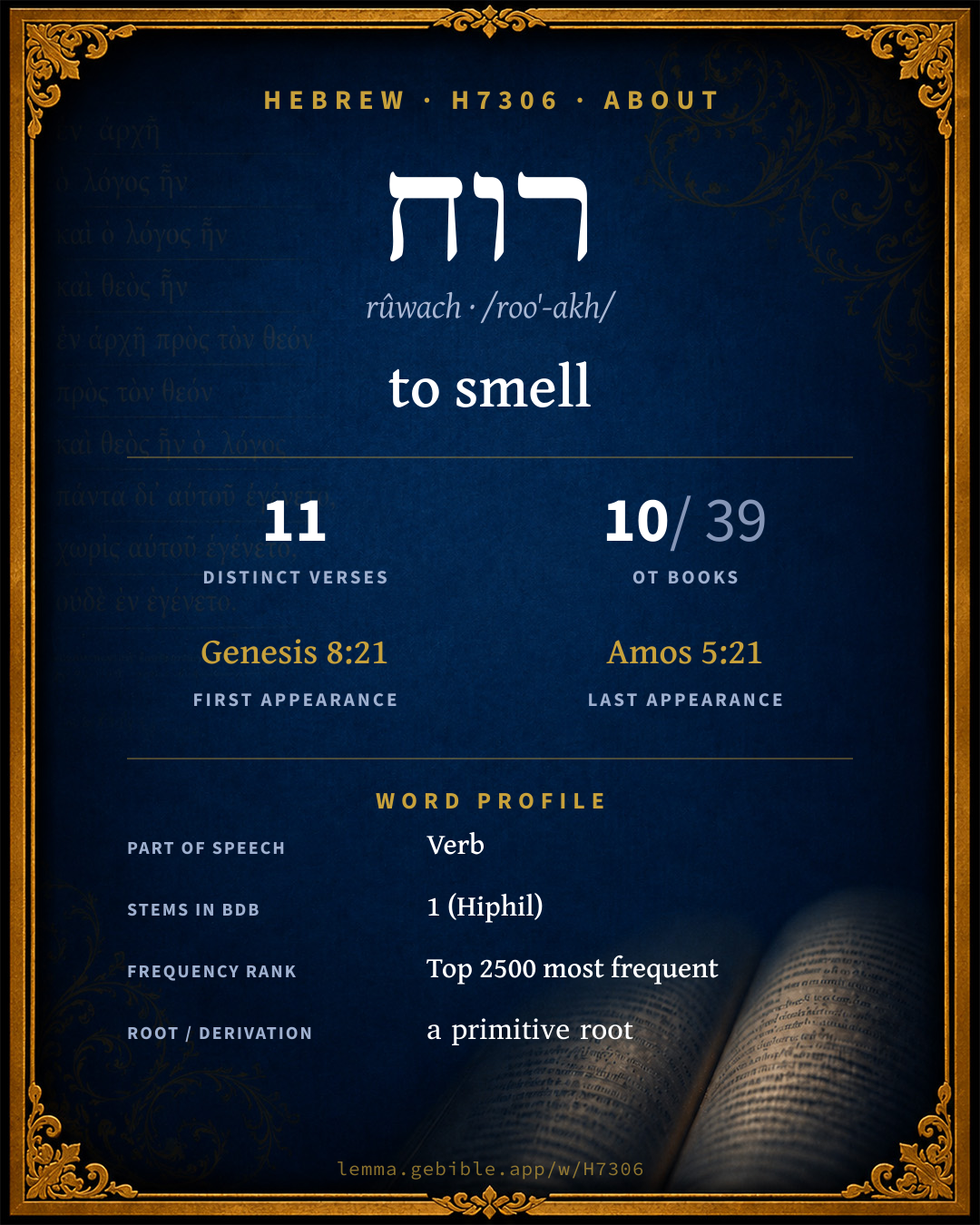
רִיחַ
to smell
also: scent, perceive odour, accept fuller range ↓
Full lexicon entry — Brown-Driver-Briggs (BDB)
From Brown-Driver-Briggs (BDB)
Where this word appears
Grammar key — what these labels mean
Part of speech
- Verb
- An action or state-of-being word.
Stem
- Hiphil
- The causative active stem (“he caused / brought about”).
Form
- Sequential Imperfect
- An imperfect with prefixed waw — the standard past-narrative form (waw-consecutive imperfect).
- Imperfect
- An incomplete, ongoing, or future action (“he will / would write”).
- Infinitive Construct
- A bound verbal noun, frequently with prepositions (“to write / in writing”).
Person
- 3rd Person
- The one spoken about (“he / she / it / they”).
- 1st Person
- The speaker (“I / we”).
Gender
- Masculine
- Grammatically masculine.
- Common
- Either gender — not distinguished for this form.
Number
- Singular
- One.
- Plural
- More than one (in Hebrew, generally three or more).
Grammatical forms
- Verb, Hiphil, Infinitive Construct 3 times (27%)
- Verb, Hiphil, Sequential Imperfect, 3rd Person, Masculine, Singular 2 times (18%)
- Verb, Hiphil, Imperfect, 1st Person, Common, Singular 2 times (18%)
- Verb, Hiphil, Imperfect, 3rd Person, Masculine, Plural 2 times (18%)
- Verb, Hiphil, Imperfect, 3rd Person, Masculine, Singular 2 times (18%)
Parsed forms decoded from the imported morphology (morphhb / Westminster Leningrad Codex — WLC text public domain, morphhb tagging CC BY 4.0), counted across 11 parsed occurrences — not distinct verses.
Every verse where H7306 appears — 11 distinct verses across 10 books. Click any verse to open its interlinear word-by-word view. Verse text shown in the World English Bible for context — . Each verse’s Hebrew form is shown with its reference; the English is not keyword-highlighted, since the data carries no word-level English alignment. Use “Compare translations” on any verse to read it across multiple English versions. This concordance covers the Hebrew Bible; Septuagint (Greek Old Testament) occurrences are not indexed here.
Genesis 2 verses
- Genesis 8:21 וַ/יָּ֣רַח conj + Hiphil wimpf 3ms Yahweh smelled the sweet savor. Yahweh said in his heart, "I will not again curse the ground any more for man's sake, because the imagination of man's heart is evil from his youth; neither will I ever again strike everything living, as I have done.
- Genesis 27:27 וַ/יָּ֛רַח conj + Hiphil wimpf 3ms He came near, and kissed him. He smelled the smell of his clothing, and blessed him, and said, "Behold, the smell of my son Is as the smell of a field which Yahweh has blessed.
Exodus 1 verse
Leviticus 1 verse
Deuteronomy 1 verse
Judges 1 verse
1 Samuel 1 verse
Job 1 verse
Psalms 1 verse
Isaiah 1 verse
Amos 1 verse
About this entry
At a glance — auto-summarized from this page’s data, not written by a person. Every figure links to its source below. This summary describes the numbers; it doesn’t interpret them.
The Hebrew verb רוח centers on the idea of “to smell.” First canonically at Genesis 8:21, it enters the text early. The Hebrew Bible uses it across 11 verses — uncommon. Beyond “to smell” it also covers “scent”, “perceive odour”, and “accept” — see its full sense range. Related forms include רוח, רוח and רחת. For the data behind this summary, explore the sense tree and the renderings breakdown below.
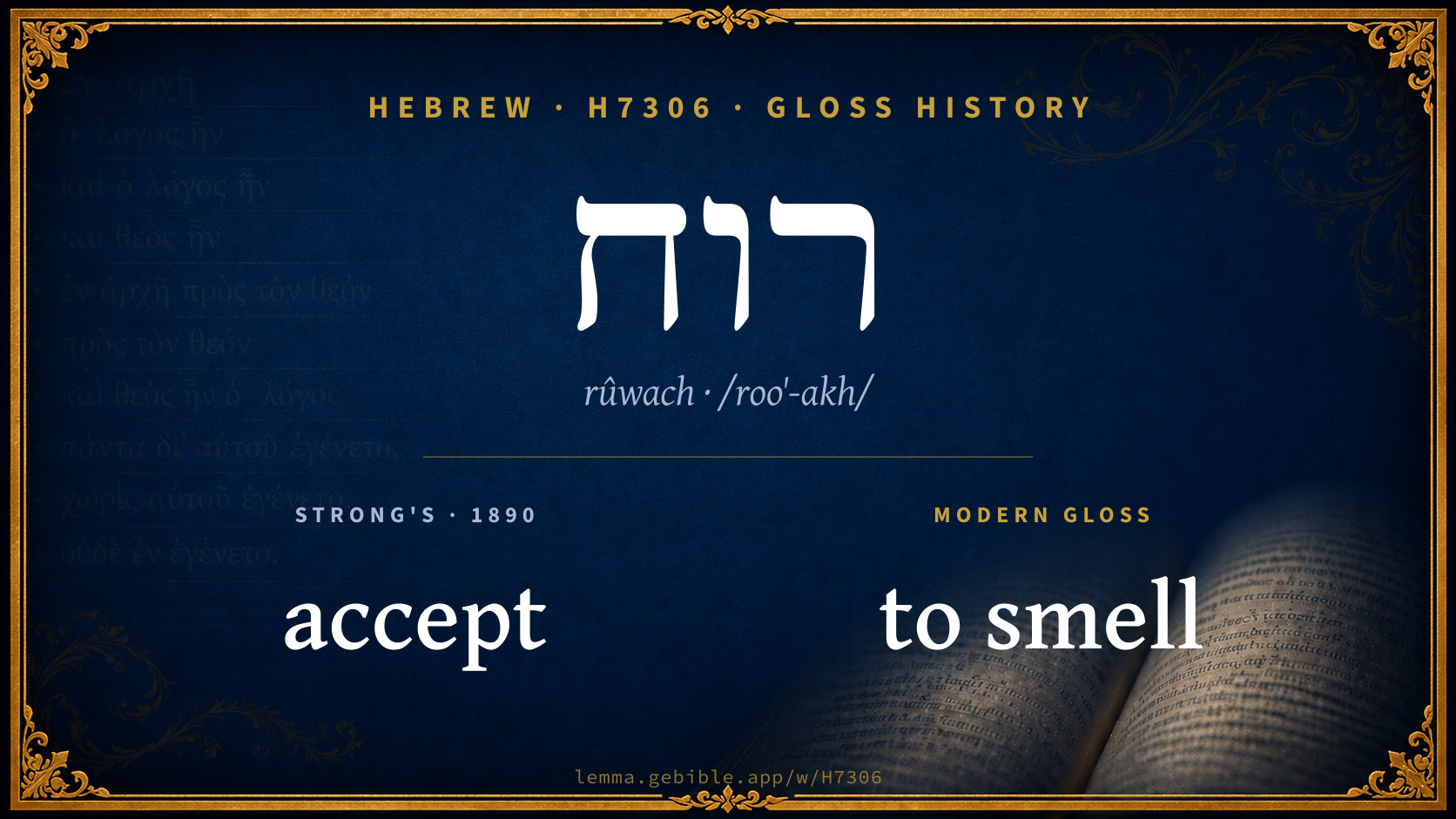
Gloss history
Strong's 1890 vs modern scholarship
About this word
Strong's H7306 catalogs a Hebrew word from the Hebrew Old Testament.
These counts are not copied from any lexicon or concordance. They are computed here, from the morphology-tagged Hebrew Old Testament. What Lemma adds →
- 11
- distinct verses
- The word appears in 11 distinct verses.
- 10 / 39
- OT books
- The word appears in 10 of 39 Old Testament books.
- #2,210
- by frequency
- Top 2500 most frequent Hebrew words (rank 2,210 of 8,640 Hebrew words by occurrence).
View all 11 occurrences in the concordance →
By section of the Old Testament
By traditional corpus
Conventional, traditional groupings — biblical authorship is debated, so this is a traditional corpus grouping, not an authorship claim. Each share is this word’s portion of its verses in that division of the Hebrew canon. Each figure is a share of the word’s 11 distinct verses.
- Torah (Pentateuch) 5 verses · 45%
- Prophets (Nevi'im) 4 verses · 36%
- Writings (Ketuvim) 2 verses · 18%
How translations render this word
Counts come from each version’s own published word-to-Strong’s tagging or interlinear alignment — an approximate guide to how each version renders this word, not a word-level alignment the data otherwise carries. Because each total is that version’s own tagged count, the per-version totals vary from one another and need not match the appearance or distinct-verse counts above. These counts may also differ from a printed concordance because Lemma counts each distinctly tagged rendering and does not collapse phrase taggings into a single head-word total. This is a fixed set of word-tagged versions (KJV, ASV, BSB, ULT) and does not change with the reading translation you choose elsewhere. Each version’s license is shown beside its name below (and on Sources).
- King James Version: I will not smell 2×
- American Standard Version: Against me 1×, Delight 1×, He smelleth 1×
- Berean Standard Bible: Smell 3×
- unfoldingWord Literal Text: Smell 4×
King James Version Public Domain
Renders H7306 across 11 tagged occurrences — most commonly:
Plus 9 renderings that appear only once — usually multi-word phrases or single function words the recovered tagging swept in, not distinct renderings.
American Standard Version Public Domain
Renders H7306 across 11 tagged occurrences — most commonly:
Berean Standard Bible Public Domain
Renders H7306 across 10 tagged occurrences — most commonly:
Plus 7 renderings that appear only once — usually multi-word phrases or single function words the recovered tagging swept in, not distinct renderings. Not rendered by a distinct English word in 1 further occurrence.
unfoldingWord Literal Text CC BY-SA 4.0
Renders H7306 across 16 tagged occurrences — most commonly:
Plus 12 renderings that appear only once — usually multi-word phrases or single function words the recovered tagging swept in, not distinct renderings.
Senses in the full BDB
What do BDB’s symbols mean?
BDB uses these scholarly abbreviations:
| Symbol | Meaning |
|---|---|
| 𝔊 | the Septuagint (the ancient Greek translation, LXX) |
| 𝔙 | the Vulgate (the Latin translation) |
| 𝔖 | the Syriac version (the Peshitta) |
| 𝔗 | the Targum (the Aramaic translation) |
| ψ | the Psalms |
| √ | root (the underlying root or stem) |
| ‖ | parallel passage (a synonymous or contrasted parallel) |
| † | the dagger: every passage where the word occurs is cited |
The 1 sense the full Brown-Driver-Briggs lexicon distinguishes for this word, in lexicon order (not ranked by frequency), with BDB’s own verbatim wording and sub-sense lettering. Shown in Hebrew script with BDB’s own scholarly abbreviations. The condensed entry is in the Lexicon Entry tab. See also the Forms in the corpus table below.
Hiphil
- (?), smell, perceive odour;—Impf. 3 ms. יָרִיחַ Jb 39:25, יָרַח 1 S 26:19 + 2 times; וַיָּ֫רַח Gn 8:21; 3 mpl. יְרִיח֑וּן ψ 115:6, יְרִיחֻ֑ן Dt 4:28, etc.; Inf. cstr. הָרִיחַ Ex 30:38, etc.;—smell, c. acc. Gn 8:21; 27:27 (JE), 1 S 26:19; abs. Dt 4:28 ψ 115:6; metaph. בַּהֲרִיחוֹ אֵשׁ Ju 16:9, יָרִיחַ מִלְחָמָה Jb 39:25 the horse scenteth battle; c. ב Ex 30:38; Lv 26:31 (both P); metaph. = delight in Am 5:21; Is 11:3 (prob. dittogr. BrMP 202). e.g. Job 39:25
Senses from the full Brown-Driver-Briggs lexicon (Brown, Driver, Briggs; Oxford 1906 — public domain), digitized via Sefaria, supplemented by the OpenScriptures HebrewLexicon (CC BY 4.0). Full attribution on Sources.
Word origin
Origin: a primitive root
Jastrow Dictionary
A second Hebrew/Aramaic lexicon for comparison, covering Aramaic and post-biblical (Talmudic, Targumic, Midrashic) usage that the biblical-Hebrew BDB does not. Matched by lemma rather than by Strong’s number, so a lemma may carry more than one Jastrow headword (shown separately below), and the entries cover usage well beyond the Bible.
רְוַוח
- 1. to be wide, extend; to be easy; ר׳ ל־ to feel relieved. Targ. Job XXXII, 20.—[Targ. Ps. XXIII, 5 רויחא Ms., ed. Lag. רווחא, v. רְוִיתָא.]—Snh. 7ᵃ כיון דר׳ ר׳, v. בִּדְקָא. Ḥull. 8ᵃ בית … מִירְוַוח ר׳ the cut widens, i.e. the parts cut through go apart, and are not affected by the heat of the knife. B. Bath. 90ᵇ תרעא דר׳ ר׳ when the market becomes easy (prices fall), it remains so (for the rest of the year). Taan. 23ᵇ אמינא … ר׳ עלמא וכ׳ (Ms. M. דוו, corr. acc.) I thought, as it has been raining, the world is at ease (prices will come down). Keth. 80ᵇ, v. רַוְוחָא. B. Bath. 167ᵃ (suspecting an erasure in a document) מ"ט רְוִיחַ ליה עלמא להאי וי"ו why has this Vav so much space?, opp. דחוק; a. fr.—Y. Sabb. XX, end, 17ᵈ נפל ביתיה על מאן דרויח עליה his house fell in over him who felt at ease (?), v. צְנִינִים.—[
- 2. to make room. Targ. Is. XLIX, 20 רְוַח לי (prob. to be read: רַוַּח Pa.; h. text גְּשָׁה.]
- 1. to widen, make room; give comfort. Targ. Prov. XVIII, 16 (h. text ירחיב).—Part. pass. מְרַוַּוח; f. מְרַוְּוחָא; pl. מרַוְּוחִין; מְרַוְּוחָן, מְרַוְּח׳. Targ. Jer. XXII, 14.—
- 2. (denom. of רוּחַ) to inspire.—Part. pass. as ab. Targ. Y. Deut. XXXII, 24 [read:] מְרַוְּוחֵי רוּחִין בישין possessed by evil spirits.
- 1. to make room, widen; to relieve. Targ. Y. Gen. XXVI, 22. Targ. Lam. III, 56 לאַרְוָוחוּתְנִי (verbal noun); a. e.—Sabb. 151ᵇ האי כוחלא … מַרְוַוח (or מְרַוַּוח Pa.) stibium widens (improves the eye-sight) up to forty years of age, מכאן … אַרְוָחֵי לא מרווח after that … it preserves the eye-sight, but does not improve it; a. e.—Part. pass. מַרְוַוח open; vacant. Targ. II Chr. XXIII, 15. Targ. I Sam. XX, 25; 27 (h. text ויִפָּקֵד).
- 2. to make profit, gain. Y. Ned. V, end, 39ᵇ חד בר נש נדר דלא מַרְוַוח (not מרווחא) a man made a vow that he would make no profit (in business). Ib. [read:] א"ל מאי אשבעת א"ל דלא מַרְוַוחְנָא he asked him, what didst thou swear (not to do)? Said he, that I will make no profit (v. Asheri to Gitt. 35ᵇ).
- 3. to cause to profit. B. Mets. 73ᵃ bot. אנא נטרנא … ומרווחנא להו בכמה I wait for them (give them time to move) until Iyar, and thus I benefit them greatly; a. e.—Part. pass. מַרְוַוח. Ber. 56ᵃ מ׳ עסקך thy business will be profitable, opp. פסיד.
- a) אתר׳ ל־ to be relieved; to be better. Targ. I Sam. VI, 3. Ib. XVI, 23; a. e.—b) to be blessed (with issue, with increase of wealth). Targ. Gen. XX, 17. Targ. Y. ib. XXII, 20. Ib. XXV, 21. Ib. XXVI, 31.
רָוַח
- , v. sub רווח.
רוּחַ I
- to smell, v. רִיחַ.
רוּחַ II
- 1. wind, air; direction, side. Ex. R. s. 1522 שלשה בריות … המים והר׳ וכ׳ three creations preceded the formation of the world: water, air, and fire; הר׳ הרה וכ׳ the air (spirit) conceived and gave birth to wisdom. B. Mets. 107ᵇ הכל בר׳ all (diseases) are caused by the air. Ḥag. 12ᵃ עשרה … ר׳ ומים וכ׳ ten things were created on the first day: heaven …, air and water &c. Ib. 12ᵇ הרים בר׳ the mountains are sustained by the air, ר׳ בסערה the air by the wind-storm.—Ber. 31ᵃ יכול … לכל ר׳ שירצה you may think a man may pray facing any direction he may desire. B. Bath. 22ᵇ מר׳ אחת from one side. Ib. II, 9 לכל ר׳ עושה וכ׳ one may erect a tannery on any side of the town except the western. Ib. 25ᵇ ר׳ דרומית the southern wind. Kil. V, 5; a. v. fr.—Pl. רוּחוֹת. Ab. III, 17 שאפי׳ כל הר׳ וכ׳ even if all the winds were to come and blow at them &c. Kil. III, 1 בארבע ר׳ הערוגה on the four sides of the bed. Y. ib. VI, end, 30ᶜ מגופף מארבע רוּחוֹתָיו enclosed on its four sides. Pes. 94ᵃ לארבע ר׳ העולם he may turn towards any of the four directions of the world; a. v. fr.
- 2. mind, disposition, spirit. Ab. III, 10, v. נוּחַ h. Y. Peah I, 15ᶜ bot., a. e., v. הֲנָחָה. Ab. IV, 7, v. גַּס III. Ib. V, 19 ר׳ נמוכה a lowly spirit; a. v. fr.
- 3. spirit, soul. Gen. R. s. 7, end נפש חיה זה רוּחוֹ של וכ׳ ‘a living soul’ (Gen. II, 19), this means the soul of Adam. Gen. R. s. 2 ורוח אלהים זו רוחו וכ׳ ‘and the spirit of God’ (Gen. I, 2), this means the soul of the king Messiah; a. v. fr.—Esp. ר׳ הקדש (abbr. רוה"ק) the holy spirit, prophetic inspiration, intuition. Ab. Zar. 20ᵇ קדושה … רוה"ק sanctity (of life) leads to prophetic inspiration. Meg. 7ᵃ אסתר ברוה"ק וכ׳ the Book of Esther was composed in a spirit of prophecy. Yoma 9ᵇ משמתו … נסתלקה רוה"ק וכ׳ with the death of the last prophets, Haggai …, the prophetic spirit was withdrawn from Israel. Ber. 10ᵃ חזאי לי ברוה"ק וכ׳ I saw in a prophetic vision that unworthy children would go forth &c.; a. v. fr.—Snḥ. 65ᵇ, a. fr. ר׳ טומאה unholy inspiration (augury &c.). e.g. Genesis 2:19
- 4. (evil) spirit, demon. Pes. 112ᵃ ר׳ רעה (סכנת) the danger threatening from an evil spirit; a. fr.—ר׳ צרדה, ר׳ צרעת, ר׳ תזזית &c., v. respective determinants.—Pl. רוּחוֹת, רוּחִין. Gen. R. s. 20 ר׳ הזכרים male demons; ר׳ נקבות female demons. Erub. 18ᵇ הוליד ר׳ ושדין וכ׳ begot spirits and demons &c.; a. fr.
רִיחַ
- (b. h.) to breathe, waft, blow.—Denom. רוּחַ.
- to scent, smell. Gen. R. s. 34 הלך וַהֲרִיחָהּ (not וריחה) he went and smelled of it. Ib. (ref. to Gen. VIII, 21) ה׳ ריחו של אברהם וכ׳ he smelled the savor of Abraham, our father, rising from the fiery furnace (foresaw the self-sacrifice of Abraham); ה׳ דורו של שמד he smelled the savor of the generation of persecution (foresaw their martyrdom). Snh. 11ᵃ ה׳ ריח שום he perceived the smell of garlic. Zeb. 62ᵃ הֵרִיחוּ ריח קטרת they smelled the savor of frankincense (at the place where the Temple had stood). Nidd. 58ᵇ כל המוללו מֵרִיחַ בו whoever crushes it, smells its odor. Snh. 109ᵃ לערב באין ומְרִיחִין אותו וכ׳ in the evening they came and scented it (the balsam) like a dog. Yoma VIII, 4 עוברה שהֵרִיחָה וכ׳ a woman with child that smelled (a dish on the Day of Atonement, and has a morbid desire for it) must be given to eat, until she feels restored. B. Bath. 146ᵃ bot. ריח צנון אני מריח בגליל I smell a radish in Galilee (have a strong appetite for a Galilean radish); a. fr. e.g. Genesis 8:21
A Dictionary of the Targumim, the Talmud Babli and Yerushalmi, and the Midrashic Literature (Marcus Jastrow; London, Luzac, 1903) — Public Domain. Digitized via Sefaria. Digitized via Sefaria. Full attribution on Sources.
Forms in the corpus
The 11 distinct written forms H7306 takes in the Hebrew Bible, most frequent first — each parse links to that stem’s occurrences in the concordance. Hebrew forms include their vowel points and cantillation, so a single lemma takes many written forms.
| Form | Parsing | Example | Uses |
|---|---|---|---|
| אָרִ֔יחַ | Verb, Hiphil, Imperfect, 1st Person, Common, Singular | Leviticus 26:31 | 1 |
| אָרִ֖יחַ | Verb, Hiphil, Imperfect, 1st Person, Common, Singular | Amos 5:21 | 1 |
| בַּ/הֲרִיח֣/וֹ | Verb, Hiphil, Infinitive Construct | Judges 16:9 | 1 |
| וַ/הֲרִיח֖/וֹ | Verb, Hiphil, Infinitive Construct | Isaiah 11:3 | 1 |
| וַ/יָּ֛רַח | Verb, Hiphil, Sequential Imperfect, 3rd Person, Masculine, Singular | Genesis 27:27 | 1 |
| וַ/יָּ֣רַח | Verb, Hiphil, Sequential Imperfect, 3rd Person, Masculine, Singular | Genesis 8:21 | 1 |
| יְרִיחֻֽ/ן | Verb, Hiphil, Imperfect, 3rd Person, Masculine, Plural | Deuteronomy 4:28 | 1 |
| יְרִיחֽוּ/ן | Verb, Hiphil, Imperfect, 3rd Person, Masculine, Plural | Psalms 115:6 | 1 |
| יָרִ֣יחַ | Verb, Hiphil, Imperfect, 3rd Person, Masculine, Singular | Job 39:25 | 1 |
| יָרַ֣ח | Verb, Hiphil, Imperfect, 3rd Person, Masculine, Singular | 1 Samuel 26:19 | 1 |
| לְ/הָרִ֣יחַ | Verb, Hiphil, Infinitive Construct | Exodus 30:38 | 1 |
Same root — word family
Other BDB entries built from the same root as H7306, grouped by Strong’s listed origin. These share a root / origin per the lexicon — not necessarily a shared meaning. Each links to that word’s own entry.
Derived from this word
- רוח râvach H7304 to be wide
- רוח rûwach H7307 spirit
- רחת rachath H7371 winnowing shovel
- ריח rêyach H7381 fragrance
Compare all same-root words → Showing 4 of 5 — not the complete family. They share a root, not necessarily a meaning.
Septuagint verse parallels
This word appears in 11 verses that also exist in the Greek Old Testament (Septuagint), out of the 11 Hebrew verses it occurs in. You can read those verses in Greek by switching the Old Testament edition to the Septuagint.
Read these verses in the Septuagint
- Genesis 8:21
- Exodus 30:38
- Leviticus 26:31
- Deuteronomy 4:28
- Judges 16:9
- 1 Samuel 26:19
- Job 39:25
- Psalms 115:6
- Isaiah 11:3
- Amos 5:21
This is a verse-level parallel only — the same verses exist in both the Hebrew and Greek Old Testaments. No word-level Hebrew↔Greek correspondence is claimed: the data carries no such alignment, so no Greek word is shown as this Hebrew word’s translation. Coverage is not total — the Septuagint omits the deuterocanon and renumbers the Psalms, so some Hebrew verses have no direct Greek parallel.