
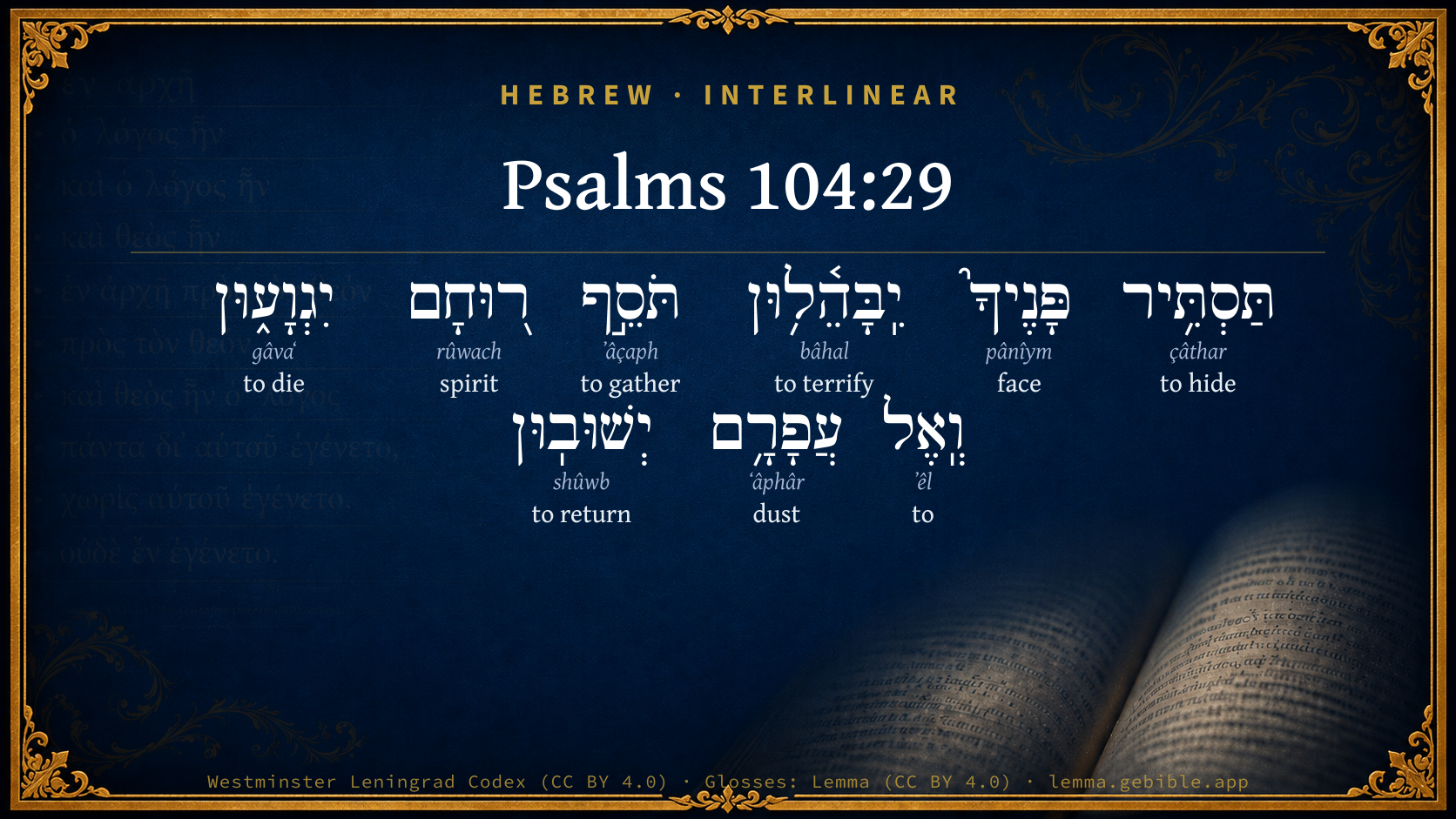
Psalms 104:29

Hebrew (Westminster Leningrad Codex) Psalms 104:29 appears in the Hebrew Old Testament. The text above is from the Westminster Leningrad Codex. Each word links to its Strong’s number, a concise gloss, and parsing drawn from the Open Scriptures Hebrew Bible morphology. Click any word for its full Brown-Driver-Briggs (BDB) entry.
Download image
Cite this verse

Psalms 104:29 (World English Bible). Public Domain. Lemma interlinear Bible study tool, https://lemma.gebible.app/v/psalms/104/29.

Show BibTeX & RIS
BibTeX
RIS
English Translation
You hide your face: they are troubled; You take away their breath: they die, and return to the dust.
World English Bible · Public Domain
Download a study sheet

One document with this verse’s original text, its word-by-word gloss line, the meaning frame, cross-references with their text, attributed commentary, and full source and license credits — printable, and it pastes into notes with its structure intact.

This verse Autodidact and up

Study sheet (.html) Plain text (.txt)

A passage Seminary Student

Up to 50 verses in one chapter. A passage sheet keeps up to 6 commentary sources and 12 cross-references per verse, in the order this page ranks them, and says so on the sheet whenever that leaves anything out. Ask for a single verse and you get the Autodidact verse sheet above.

Everything on this page stays free to read, with no account — the sheet is a download of what is already on screen, not access to it.

Want to remove ads? Support Godless Engineer
Compare translations 3

The same verse in 3 English versions, stacked beneath the original-language interlinear above. Click any original word for its lexicon entry.

Each is an independent rendering of the whole verse — the interlinear is not word-aligned to these translations.

Highlighted words mark where these versions differ — a whole-verse word diff, not a word-by-word alignment.

  • World English Bible Public Domain
    You hide your face: they are troubled; You take away their breath: they die, and return to the dust.
  • King James Version Public Domain
    Thou hidest thy face, they are troubled: thou takest away their breath, they die, and return to their dust.
  • unfoldingWord Literal Text CC BY-SA 4.0
    You hide your face; they are terrified; you take away their breath; they expire and return to their dust.

unfoldingWord Literal Text — © unfoldingWord, licensed CC BY-SA 4.0. Word-aligned USFM3 via Door43 (git.door43.org/unfoldingWord/en_ult).

Versions to compare (up to 4)

3 of 4 selected

Show all 18 translations

Every available English version of this verse, each an independent rendering of the whole verse.

  • World English Bible Public Domain
    You hide your face: they are troubled; You take away their breath: they die, and return to the dust.
  • Berean Standard Bible Public Domain
    When You hide Your face, they are terrified; when You take away their breath, they die and return to dust.
  • Majority Standard Bible Public Domain
    When You hide Your face, they are terrified; when You take away their breath, they die and return to dust.
  • King James Version Public Domain
    Thou hidest thy face, they are troubled: thou takest away their breath, they die, and return to their dust.
  • American Standard Version (1901) Public Domain
    Thou hidest thy face, they are troubled; Thou takest away their breath, they die, And return to their dust.
  • Revised Version (1885) Public Domain
    Thou hidest thy face, they are troubled; thou takest away their breath they die, and return to their dust.
  • Geneva Bible (1599) Public Domain
    But if thou hide thy face, they are troubled: if thou take away their breath, they dye and returne to their dust.
  • Douay-Rheims (1899) Public Domain
    But if thou turnest away thy face, they shall be troubled: thou shalt take away their breath, and they shall fail, and shall return to their dust.
  • Young's Literal Translation Public Domain
    Thou hidest Thy face -- they are troubled, Thou gatherest their spirit -- they expire, And unto their dust they turn back.
  • Literal Standard Version CC BY-SA 4.0
    You hide Your face—they are troubled, || You gather their spirit—they expire, || And they return to their dust.
  • Unlocked Literal Bible CC BY-SA 4.0
    When you hide your face, they are troubled; if you take away their breath, they die and return to dust.
  • unfoldingWord Literal Text CC BY-SA 4.0
    You hide your face; they are terrified; you take away their breath; they expire and return to their dust.
  • Darby Bible Public Domain
    Thou hidest thy face, they are troubled; thou takest away their breath, they expire and return to their dust.
  • World Messianic Bible Public Domain
    You hide your face; they are troubled. You take away their breath; they die and return to the dust.
  • Webster's Bible Public Domain
    Thou hidest thy face, they are troubled: thou takest away their breath, they die, and return to their dust.
  • Free Bible Version CC BY-SA 4.0
    When you turn away from them, they're terrified; when you take away their breath, they die and return to dust.
  • Bible in Basic English Public Domain
    If your face is veiled, they are troubled; when you take away their breath, they come to an end, and go back to the dust.
  • JPS Tanakh (1917) Public Domain
    Thou hidest Thy face, they vanish; Thou withdrawest their breath, they perish, and return to their dust.

Literal Standard Version (2020), Covenant Press — licensed CC BY-SA 4.0. Text via the HelloAO Bible API (eBible.org). Unlocked Literal Bible (unfoldingWord) — licensed CC BY-SA 4.0. Text via the HelloAO Bible API (eBible.org). unfoldingWord Literal Text — © unfoldingWord, licensed CC BY-SA 4.0. Word-aligned USFM3 via Door43 (git.door43.org/unfoldingWord/en_ult). Free Bible Version, Dr. Jonathan Gallagher — licensed CC BY-SA 4.0. Text via the HelloAO Bible API (eBible.org).

Word by word

More ways to search: Search by grammar → Find every occurrence → Compare this word →

Practice this passage: Drill this verse → Learn its vocabulary →

יִגְוָע֑וּן
gâvaʻ
H1478
“to die”
Verb, Qal, Imperfect, 3rd Person, Masculine, Plural + Suffix, n
Part of Speech
Verb
Stem
Qal
Form
Imperfect
Person
3rd Person
Gender
Masculine
Number
Plural
Full BDB Definition

Origin: a primitive root

TWOT: 328

to expire, die, perish, give up the ghost, yield up the ghost, be dead, be ready to die - (Qal) to expire, die, be about to die
  1. תַּסְתִּ֥יר çâthar H5641 “to hide” Verb, Hiphil, Imperfect, 2nd Person, Masculine, Singular
  2. פָּנֶיךָ֮ pânîym H6440 “face(s) · your” Noun, Common, Both, Plural, Construct + Suffix, Personal, 2nd Person, Masculine, Singular
  3. יִֽבָּהֵ֫ל֥וּן bâhal H926 “to terrify” Verb, Niphal, Imperfect, 3rd Person, Masculine, Plural + Suffix, n
  4. תֹּסֵ֣ף ʼâçaph H622 “to gather” Verb, Qal, Imperfect, 2nd Person, Masculine, Singular
  5. ר֭וּחָם rûwach H7307 “spirit · their” Noun, Common, Both, Singular, Construct + Suffix, Personal, 3rd Person, Masculine, Plural
  6. וְֽאֶל ʼêl H413 “and · to” Conjunction + Preposition
  7. עֲפָרָ֥ם ʻâphâr H6083 “dust · their” Noun, Common, Masculine, Singular, Construct + Suffix, Personal, 3rd Person, Masculine, Plural
  8. יְשׁוּבֽוּן shûwb H7725 “to return” Verb, Qal, Imperfect, 3rd Person, Masculine, Plural + Suffix, n

About this verse

These counts appear in no published source. They are computed here, from the morphology-tagged text and Lemma’s own curated glosses. What Lemma adds →

9
words
9
distinct lemmas
Wisdom
section

Notable vocabulary

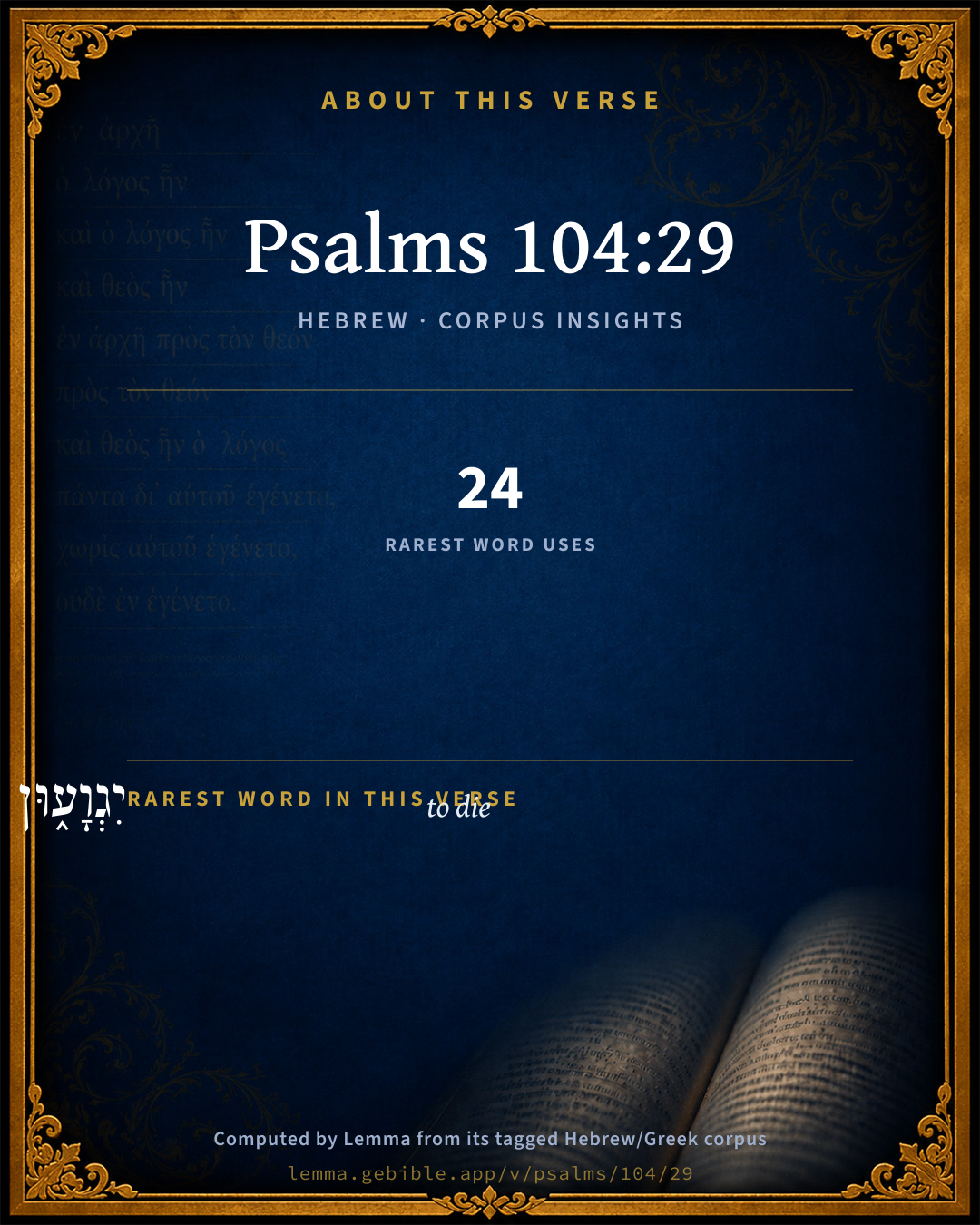
The rarest word here is יִגְוָע֑וּן to die H1478 — appearing just 24 times in the whole Hebrew Bible.

Shared distinctive vocabulary

יִגְוָע֑וּן to die H1478 occurs in 23 verses of the Hebrew Bible. Also found in:

Grammatical profile

  • 5 verbs
  • 3 nouns
  • 1 preposition

Verb forms

  • תַּסְתִּ֥יר Hiphil · Imperfect
  • יִֽבָּהֵ֫ל֥וּן Niphal · Imperfect
  • תֹּסֵ֣ף Qal · Imperfect
  • יִגְוָע֑וּן Qal · Imperfect
  • יְשׁוּבֽוּן Qal · Imperfect

Hebrew & Septuagint length

In English translation the verse runs 19 words from the Hebrew and 27 from the Septuagint (LXX English) — closely comparable.

A rough comparison of the two English renderings, which tokenize alike — not a word-level alignment.

Word counts can differ between the Hebrew and the Greek without any difference in meaning — e.g. the Hebrew direct-object marker אֵת has no separate Greek word, and Greek often adds the article ὁ.

Cross-references

12

Topical passages linked to Psalms 104:29 in the Treasury of Scripture Knowledge — connected by theme and wording, ordered by reader-vote popularity; previews shown in the World English Bible.

  • Job 34:14–15 If he set his heart on himself, If he gathered to himself his spirit and his breath;
  • Ecclesiastes 12:7 And the dust returns to the earth as it was, And the spirit returns to God who gave it.
  • Psalms 146:4 His spirit departs, and he returns to the earth. In that very day, his thoughts perish.
  • Genesis 3:19 By the sweat of your face will you eat bread until you return to the ground, for out of it you were taken. For you are dust, and to dust you shall return."
  • Psalms 30:7 You, Yahweh, when you favored me, made my mountain to stand strong. But when you hid your face, I was troubled.
  • Psalms 90:3 You turn man to destruction, saying, "Return, you children of men."
  • Acts 17:25 neither is he served by men's hands, as though he needed anything, seeing he himself gives to all life and breath, and all things.
  • Job 10:9 Remember, I beg you, that you have fashioned me as clay. Will you bring me into dust again?
  • Deuteronomy 31:17 Then my anger shall be kindled against them in that day, and I will forsake them, and I will hide my face from them, and they shall be devoured, and many evils and troubles shall come on them; so that they will say in that day, Haven't these evils come on us because our God is not among us?
  • Job 13:24 Why hide you your face, And hold me for your enemy?
  • Job 34:29 When he gives quietness, who then can condemn? When he hides his face, who then can see him? Alike whether to a nation, or to a man:
  • Romans 8:20–22 For the creation was subjected to vanity, not of its own will, but because of him who subjected it, in hope

Cross-references courtesy of OpenBible.info (CC BY 4.0).

Hebrew and Greek witnesses Masoretic Hebrew ↔ Greek Septuagint

The same verse in the two great witnesses to the Old Testament, shown verse-for-verse.

You’re reading Greek Psalm 103 (Hebrew Psalm 104). The Septuagint counts the superscription, so verse numbers can differ from the Hebrew — chapter-level alignment, not verse-by-verse. Numbering follows Rahlfs.

These are two independent witnesses, not word-aligned to each other, and the Septuagint is shown in lemma (dictionary) form.

Hebrew Psalms 104:29 Masoretic · Westminster Leningrad Codex

תַּסְתִּ֥יר פָּנֶיךָ֮ יִֽבָּהֵ֫ל֥וּן תֹּסֵ֣ף ר֭וּחָם יִגְוָע֑וּן וְֽאֶל עֲפָרָ֥ם יְשׁוּבֽוּן

You hide your face: they are troubled; You take away their breath: they die, and return to the dust.

World English Bible · Public Domain

Greek LXX Greek Psalm 103:29 Septuagint · lemma form

ἀποστρέφω δέ σύ ὁ πρόσωπον ταράσσω ἀντι ἀνααἱρέω ὁ πνεῦμα αὐτός καί ἐκλείπω καί εἰς ὁ χοῦς αὐτός ἐπιστρέφω

But when you have turned away your face, they shall be troubled: you will take away their breath, and they shall fail, and return to their dust.

LXX2012 (modern English Septuagint) · Public Domain

Hebrew: Westminster Leningrad Codex (CC BY 4.0). Greek: Septuagint (public domain); English from LXX2012 (modern English Septuagint) (Public Domain). How the Septuagint differs from the Hebrew →

Commentary

Notes on Psalms 104:29 from classic Christian and Jewish commentators (each source and its license shown beneath its notes). The classic Christian expositions comment on the surrounding passage and are grouped to its opening verse, so a note may address several verses; the Jewish commentaries on the Tanakh (Rashi and others) are per-verse, so they appear only where the commentator wrote on this verse.

Lemma curates 59 commentaries, every one of them public domain or Creative Commons licensed, each selected and text-cleaned for this edition rather than reprinted as found. About our sources →

Trapp's Complete Commentary

John Trapp

Psa 104:29 Thou hidest thy face, they are troubled: thou takest away their breath, they die, and return to their dust.

Ver. 29. Thou hidest thy face] i.e. Thou withdrawest thy favour, thy concurrence, thine influence, they are troubled, or terrified, a cold sweat sitteth upon their limbs, animam agunt, they shortly expire; for in God we live, move, and have our being, Act 17:28 A frown of Augustus Caesar proved to be the death of Cornelius Gallus. Sir Christopher Hatton, Lord Chancellor of England, died Sept. 20, 1591, of a flux of his urine and grief of mind conceived upon some angry words given him by Queen Elizabeth (Camden).

Thou takest away their breath] Heb. Thou gatherest it, callest for it again, viz. their vital vigour.

John Trapp, A Commentary or Exposition upon All the Books of the Old and New Testament (1647–1656) — public domain. Text from a community e-Sword module.

The Biblical Illustrator

Joseph S. Exell

Psa_104:29-30

Thou hidest Thy face, they are troubled: Thou takest away their breath, they die.

Views of death

I. Death disorganizes and destroys our corporeal frame. The words of the text merely announce the execution of the original sentence, Dust thou art, and unto dust shalt thou return.

II. Death puts an end to all worldly distinctions. Sometimes, indeed, they may appear to remain. One man is honoured with a splendid and imposing burial. Another has a blazoned monument erected over him. A third may have historians to record his name, and poets to sing his praise. And in contrast to all these, a fourth may be laid in the base earth, and have not even a stone to tell where he lies, and fade from the remembrance, almost as soon as he passes from the sight of that world, in which he did little more than toil, and weep, and suffer. But let your eye penetrate through those showy forms which custom, or affection, or vanity has thrown over the graves of departed mortals, and behold how the mightiest and the meanest lie side by side in one common undistinguished ruin. Receive, then, and practise the lesson which all this inculcates. It speaks to you who occupy distinguished situations in the world; and it says, Behold the nothingness of earthly grandeur, and power, and riches. Though elevated in station, be humble in spirit. The same fact speaks to you who are moving in the humble walks of life; to you it says, Why repine that you are not invested with the insignia of worldly greatness?

III. Death terminates all labour and all pleasure under the sun. There is no work, nor wisdom, nor device, in the grave; and as the tree falleth, so must it lie. Let no good action be unnecessarily delayed, or carelessly performed.

IV. Death dissolves the dearest and tenderest ties.

V. Death blasts the fairest prospects of individuals, of families, and of nations. He teaches us to put no confidence in our own life, or in that of any of the sons or daughters of men. He teaches us to recollect how feeble are all our efforts, and how short-sighted are all our best-laid schemes, and how perishable are all our most sanguine hopes.

VI. Death introduces us to judgment and to eternity. This is the most important view which we can take of it. (A. Thomson, D.D.)

The death of animals

Pain, suffering, and death, we know, may be of use to human beings. It may make them happier and better in this life, or in the life to come; if they are the Christians which they ought to be. But it seems, in the case of animals, to be only so much superfluous misery thrown away. Of the millions on millions of living creatures in the earth, the air, the sea, full one-half live by eating each other. In the sea, indeed, almost every kind of creature feeds on some other creature: and what an amount of pain, of terror, of violent death that means, or seems to mean! The Book of Genesis does not say that the animals began to devour each other at Adams fall. It does not even say that the ground is cursed for mans sake now, much less the animals. For we read (Gen_9:21). Neither do the psalmists and prophets give the least hint of any such doctrine. Surely, if we found it anywhere, we should find it in this psalm. But so far from saying that God has cursed His own works, or looks on them as cursed it says, The Lord shall rejoice in His works. Consider, with respect and admiration, the manful, cheerful view of pain and death, and indeed of the whole creation, which the psalmist has, because he has faith. There is in him no sentimentalism, no complaining of God, no impious, or at least weak and peevish, cry of Why hast Thou made things thus? He sees the mystery of pain and death. He does not attempt to explain it: but he faces it; faces it cheerfully and manfully, in the strength of his faith, saying--This too, mysterious, painful, terrible as it may seem, is as it should be; for it is of the law and will of God, from whom come all good things; of the God in whom is light, and in Him is no darkness at all. Therefore to the psalmist the earth is a noble sight; filled, to his eyes, with the fruit of Gods works. And so is the great and wide sea likewise. He looks upon it; full of things creeping innumerable, both small and great beasts, for ever dying, for ever devouring each other. And yet it does not seem to him a dreadful and a shocking place. What impresses his mind is just what would impress the mind of a modern poet, a modern man of science; namely, the wonderful variety, richness, and strangeness of its living things. Their natures and their names he knows not. It was not given to his race to know. It is enough for him that known unto God are all His works from the foundation of the world. But one thing more important than their natures and their names he does know; for he perceives it with the instinct of a true poet and a true philosopher--These all wait upon Thee, etc. (C. Kingsley, M.A.)

Life by respiration

It has always been supposed that mans power to breathe lay primarily in the united action of heart, lungs and blood. But a recent scientist of recognized authority declares that this is not altogether the case. He asserts, and apparently proves it to the satisfaction of many scientific minds, that although heart, lungs and blood assist the act of breathing, and constitutes mans physical safeguard against suffocation, the actual breathing--i.e., the taking in of the oxygen and hydrogen of the atmosphere, is done by the living substance of the human body. Practically we breathe, so to speak, at every pore, and not simply by the elaborate parts hitherto looked upon as the only human agents of respiration. Plants and animals as well as men thus breathe through the living substances which severally compose them. And what is equally wonderful, perhaps, is that, as this authority declares, the mutual action of plants, animals and men upon the atmosphere in respiration is one of the most beautiful harmonies in nature. What one gives off as waste product is taken up and utilized by the other. Truly we are fearfully and wonderfully made! (Homiletic Review.)

The Biblical Illustrator, edited by Joseph S. Exell (c. 1880s–1900s) — public domain. Text from a community e-Sword module.

J. A. Alexander on Psalms

Joseph Addison Alexander

29. (Psa 104:29) Thou hidest thy face, they are confounded; thou withdrawest their breath, they expire, and to their dust return. The hiding of God's face is the opposite of looking with a favourable aspect. See above, on Psa 13:1. It here means the suspension or withdrawing of the various benefits before described. They are troubled is, in every case, a feeble version of one of the strongest words in the language, which has been already more than once explained. Even confounded, though much stronger, does not perfectly convey the idea, which is that of being agitated, terror-stricken, or convulsed. See above, on Psa 2:5; Psa 78:7. heir breath, the vital principle imparted by the Spirit of God (Gen 2:7), who is the God of the spirits of all flesh, i.e. the author of all life whatever. See Num 16:22; Num 27:16, and compare Heb 12:9. The verb expire is used in the account of the destruction of all living creatures by the flood, Gen 7:21-22, to which there is no doubt allusion, as there is in the next clause to Gen 3:19. Compare Psa 90:3; Psa 103:14, Ecc 12:7. Their dust, their own, their native dust, to which they belong, and from which they sprang.

Joseph Addison Alexander, The Psalms Translated and Explained (1850) — public domain. Text from a community e-Sword module.

Tyndale Open Study Notes

Tyndale Open Resources

104:29-30 When you give them your breath: Life on earth is only possible as the Lord’s gift, symbolized by his breath (Hebrew ruakh, “breath, wind, spirit”). The Lord’s Spirit is the agent of renewal (Isa 32:15-20).

Tyndale Open Study Notes — © Tyndale Open Resources, licensed CC BY-SA 4.0. Text via the HelloAO Bible API.

Geneva Bible (1599)

Geneva Bible translators

As by thy presence all things have life: so if thou withdraw thy blessings, they all perish.

Geneva Bible (1599) marginal notes — public domain. Text via Bolls.life.

Adam Clarke's Commentary

Verse 29. Thou hidest thy face] If thou bring dearth or famine on the land, contagion in the air, or any destruction on the provision made by the waters, then beasts, fowl, and fish die, and are dissolved.

Adam Clarke's Commentary on the Bible (1810–1826) — public domain. Text from a community e-Sword/MySword module.

John Calvin's Commentaries

29 Thou shalt hide thy face, and they shall be afraid In these words, the Psalmist declares, that we stand or fall according to the will of God. We continue to live, so long as he sustains us by his power; but no sooner does he withdraw his life-giving spirit than we die. Even Plato knew this, who so often teaches that, properly speaking, there is but one God, and that all things subsist, or have their being only in him. Nor do I doubt, that it was the will of God, by means of that heathen writer, to awaken all men to the knowledge, that they derive their life from another source than from themselves. In the first place, the Psalmist asserts, that if God hide his face they are afraid; and, secondly, that if he take away their spirit they die, and return to their dust; by which words he points out, that when God vouchsafes to look upon us, that look gives us life, and that as long as his serene countenance shines, it inspires all the creatures with life. Our blindness then is doubly inexcusable, if we do not on our part cast our eyes upon that goodness which gives life to the whole world. The prophet describes step by step the destruction of living creatures, upon God’s withdrawing from them his secret energy, that from the contrast he may the better commend that continued inspiration, by which all things are maintained in life and rigor. He could have gone farther, and have asserted, that all things, unless upheld in being by God, would return to nothing; but he was content with affirming in general and popular language, that whatever is not cherished by Him falls into corruption. He again declares, that the world is daily renewed, because God sends forth his spirit In the propagation of living creatures, we doubtless see continually a new creation of the world. In now calling that God’s spirit, which he before represented as the spirit of living creatures, there is no contradiction. God sendeth forth that spirit which remains with him whither he pleases; and as soon as he has sent it forth, all things are created. In this way, what was his own he makes to be ours. But this gives no countenance to the old dream of the Manicheeans, which that filthy dog Servetus has made still worse in our own day. The Manicheeans said that the soul of man is a particle of the Divine Spirit, and is propagated from it as the shoot of a tree; but this base man has had the audacity to assert, that oxen, asses, and dogs, are parts of the divine essence. The Manichees at least had this pretext for their error, that the soul was created after the image of God; but to maintain this with respect to swine and cattle, is in the highest degree monstrous and detestable. Nothing was farther from the prophet’s intention, than to divide the spirit of God into parts, so that a portion of it should dwell essentially in every living creature. But he termed that the spirit of God which proceeds from him. By the way, he instructs us, that it is ours, because it is given us, that it may quicken us. The amount of what is stated is, that when we see the world daily decaying, and daily renewed, the life-giving power of God is reflected to us herein as in a mirror. All the deaths which take place among living creatures, are just so many examples of our nothingness, so to speak; and when others are produced and grow up in their room, we have in that presented to us a renewal of the world. Since then the world daily dies, and is daily renewed in its various parts, the manifest conclusion is, that it subsists only by a secret virtue derived from God.

John Calvin's Commentaries (1540-1563) — public domain. Text from the Calvin Translation Society English edition (1840s-50s) via the Christian Classics Ethereal Library (ccel.org). Calvin's coverage is partial (roughly two-thirds of the Bible); uncommented books and verses are honest gaps, never fabricated. The 19th-century editor's footnotes and remarks are omitted so the notes are faithfully Calvin's own voice.

Ellicott's Commentary for English Readers

(29) Thou hidest Thy face.—Elsewhere an image of displeasure, here only of withdrawal of providential care. (See Psa_30:7, where the expression “troubled” also occurs.)

Thou takest away their breath.—Not only is the food which sustains animal life dependent on the ceaseless providence of God, but even the very breath of life is His, to be sent forth or withdrawn at His will. But to this thought, derived of course from Genesis (comp. Psa_90:3, Note), the poet adds another. The existence of death is not a sorrow to him any more than it is a mystery. To the psalmist it is only the individual that dies; the race lives. One generation fades as God’s breath is withdrawn, but another succeeds as it is sent forth.

A Bible Commentary for English Readers, edited by Charles John Ellicott (1878–1897) — public domain. Text from a community e-Sword module.

The Cambridge Bible for Schools and Colleges

gen. ed. J. J. S. Perowne

29. All creatures depend upon God for life as well as food. The breath or spirit of God is the source of the life-breath of His creatures. The Psalmist probably had Job_34:14-15 in his mind. Cp. Act_17:25; Col_1:17. The ‘hiding’ of God’s face is usually the symbol of His wrath; but here it denotes rather the withdrawal of His sustaining power. Cp. Psa_30:7.

thou takest away their breath] Or, thou gatherest in, withdrawing the spirit lent for a time (Ecc_12:7), so that they expire, and their bodies return to the dust whence they were taken (Gen_3:19).

The Cambridge Bible for Schools and Colleges (gen. ed. J. J. S. Perowne; Cambridge University Press, 1878–1918) — public domain. Text from a community e-Sword module.

John Gill's Exposition

Thou hidest thy face, they are troubled,.... God may be said to hide his face from the creatures when he withholds their food from them, when there is a scarcity of provisions, a famine in the land; when there is no pasture for them to feed on, nor brooks of water to drink of; then are they troubled or perplexed, as in Joe 1:18 and know not what to do, nor where to go for help, but faint, and sink, and die. So in a spiritual sense when God hides his face from his people, removes his Shechinah, or divine Majesty and Presence, as the Targum here; and withdraws the influences of his grace and Spirit; or when they have no food for their souls, or what they have is not blessed, then are they troubled, Psa 30:7.

Thou takest away their breath, they die, and return to their dust; their original dust, from whence they sprung, as man himself does; the breath of all is from the Lord; he gives it to his creatures, and when he pleases he takes it away; and when he does, they die and become dust again.

John Gill's Exposition of the Whole Bible (1746–1763) — public domain (CC PDM 1.0). Text via the HelloAO Bible API.

Albert Barnes' Notes on the Bible

Thou hidest thy face - As if God turned away from them; as if he was displeased with them; as if he withdrew from them the tokens of his friendship and favor.

They are troubled - They are confounded; they are overwhelmed with terror and amazement. The word “troubled” by no means conveys the sense of the original word - בהל bâhal - which means properly to tremble; to be in trepidation; to be filled with terror; to be amazed; to be confounded. It is that kind of consternation which one has when all support and protection are withdrawn, and when inevitable ruin stares one in the face. So when God turns away, all their support is gone; all their resources “fail, and they must die.” They are represented as conscious of this; or, this is what would occur if they were conscious.

Thou takest away their breath - Withdrawing that which thou gavest to them.

They die, and return to their dust - Life ends when thou dost leave them, and they return again to earth. So it is also with man. When God withdraws from him, nothing remains for him “but to die.”

Albert Barnes' Notes on the Bible (1834–1885) — public domain. Text from a community e-Sword/MySword module.

Matthew Poole's English Annotations

Thou hidest thy face, when thou withdrawest or suspendest the favour and care of thy providence.

Troubled; dejected and distressed.

Takest away; so this word is used, Hos 4:3; Zep 1:2, and elsewhere.

To their dust; to the earth, from whence they had their first original.

Matthew Poole's English Annotations on the Holy Bible (1683–1685) — public domain. Text from a community e-Sword/MySword module.

The Treasury of David

Charles H. Spurgeon

Ver. 29. Thou hidest thy face, they are troubled. So dependent are all living things upon God's smile, that a frown fills them with terror, as though convulsed with anguish. This is so in the natural world, and certainly not less so in the spiritual: saints when the Lord hides his face are in terrible perplexity.

Thou takest away their breath, they die, and return to their dust. The breath appears to be a trifling matter, and the air an impalpable substance of but small importance, yet, once withdrawn, the body loses all vitality, and crumbles back to the earth from which it was originally taken. All animals come under this law, and even the dwellers in the sea are not exempt from it. Thus dependent is all nature upon the will of the Eternal. Note here that death is caused by the act of God, "thou takest away their breath"; we are immortal till he bids us die, and so are even the little sparrows, who fall not to the ground without our Father.

Ver. 29. They are troubled. They are confounded; they are overwhelmed with terror and amazement. The word "troubled" by no means conveys the sense of the original wordNab, bahalwhich means properly to tremble; to be in trepidation; to be filled with terror; to be amazed; to be confounded. It is that kind of consternation which one has when all support and protection are withdrawn, and when inevitable ruin stares one in the face. So when God turns away, all their support is gone, all their resources fail, and they must die. They are represented as conscious of this; or this is what would occur if they were conscious. Albert Barnes.

Ver. 29

1. The commencement of life is from God: "Thou sendest forth thy Spirit, "etc.

2. The continuance of life is from God: "Thou renewest, " etc.

3. The decline of life is from God: "Thou hidest thy face, " etc.

4. The cessation of life is from God: "Thou takest away their breath, "etc.

5. The resurrection of life is from God: "Thou renewest, " etc. G.R.

Psalms 104:30*

Charles H. Spurgeon's The Treasury of David (1869–1885) — public domain. Psalms only. Text from a community e-Sword/MySword module.

Whedon's Commentary on the Bible

Daniel D. Whedon

29. Thou takest away their breath—Compare Job_34:14; Psa_146:4. Death is by a natural law of the Creator, by which he taketh back, or gathers to himself, as the word means, the “breath” which he gave.

Daniel D. Whedon (gen. ed.), Commentary on the Old and New Testaments (1874–1909) — public domain. Text from a community e-Sword module.

The Pulpit Commentary

Thou hidest thy face, they are troubled. If God withdraws the light of his countenance from any living thing, instantly it feels the loss. It is "troubled," cast down, confounded. (comp. Psa_30:7) Thou takest away their breath, they die. As the living things have life from God, so they have death from him. Not one of them perishes but he knows it, and causes it or allows it. (see Mat_10:29) And return to their dust. Return, i.e., to the dead matter out of which they were created.

The Pulpit Commentary (1880–1919), ed. H.D.M. Spence-Jones & Joseph S. Exell — public domain. Text from a community e-Sword module.

John Wesley's Explanatory Notes

Hidest - Withdrawest the care of thy providence.

John Wesley, Explanatory Notes Upon the Whole Bible (1754–1765) — public domain. Text via the GEBible commentary corpus.

unfoldingWord translationNotes

Door43 World Missions Community

hide your face

This means that Yahweh does not look at them or pay attention to them. AT: "when you do not look upon them" or "when you ignore them" (See: Assumed Knowledge and Implicit Information)

return to dust

This means that their bodies decay and are and become soil again. AT: "their bodies decay and return to the ground" (See: Assumed Knowledge and Implicit Information)

When you send out your Spirit

This refers to his Spirit being sent to give life to creatures. (See: Idiom)

they are created

It is Yahweh's spirit that created them. (See: Active or Passive)

you renew the countryside

"you cause the land to be full of new life"

translationWords

face

trouble

breath

die

send

Holy Spirit

create

unfoldingWord translationNotes — © Distant Shores Media and the Door43 World Missions Community, licensed CC BY-SA 4.0. Source: git.door43.org/Door43/en_tn.

Rashi

Rabbi Shlomo Yitzchaki (Rashi)

You gather in their spirit Heb. תסף, an expression of destruction, as (above 73:19): “They were completely consumed (ספו).”

Rashi on the Tanakh — English translations: “The Judaica Press complete Tanach with Rashi, translated by A. J. Rosenberg” (CC BY 4.0); “Pentateuch with Rashi's commentary by M. Rosenbaum and A.M. Silbermann, 1929-1934” (public domain); “The Metsudah Tanach series, Lakewood, N.J” (CC BY 4.0); and “The Book of Joshua, Metsudah Publications, 1997” (CC BY 4.0). Text via Sefaria.

Lesson kit

Teaching starters — assembled from the data on this page, not authored interpretation. Every prompt links to the verse data it draws on. Edit before teaching.

Psalms, in the Wisdom, opens this verse with 9 words (9 distinct Hebrew lemmas). Its most distinctive word is gâvaʻ (“to die”). A historical commentator’s framing appears above. Read the whole chapter for the surrounding context.

Discussion questions

  1. How does “to die” (gâvaʻ) shape what this verse is saying?
  2. Genesis 6:17 shares the word «to die» with this verse. How do the two illuminate each other?
  3. These translations render this verse differently; the difference is in the English rendering, not the original. What questions does that raise?
  4. The verb «תַּסְתִּ֥יר» is Hiphil Imperfect. How does its form color the action?
  5. Reading how Trapp's Complete Commentary and The Biblical Illustrator read this verse, where do the two commentators agree and where do they part?

Things to notice

Reading settings

Reading text

Shown beneath each verse's original-language words.

Old Testament
Old Testament edition

Read the OT as the Masoretic Hebrew (MT) or the Greek Septuagint (LXX).

English shown for the Greek Septuagint (in the Hebrew ↔ Greek comparison).

Comparing translations? Open the Compare panel on any verse page to stack up to four side by side.