
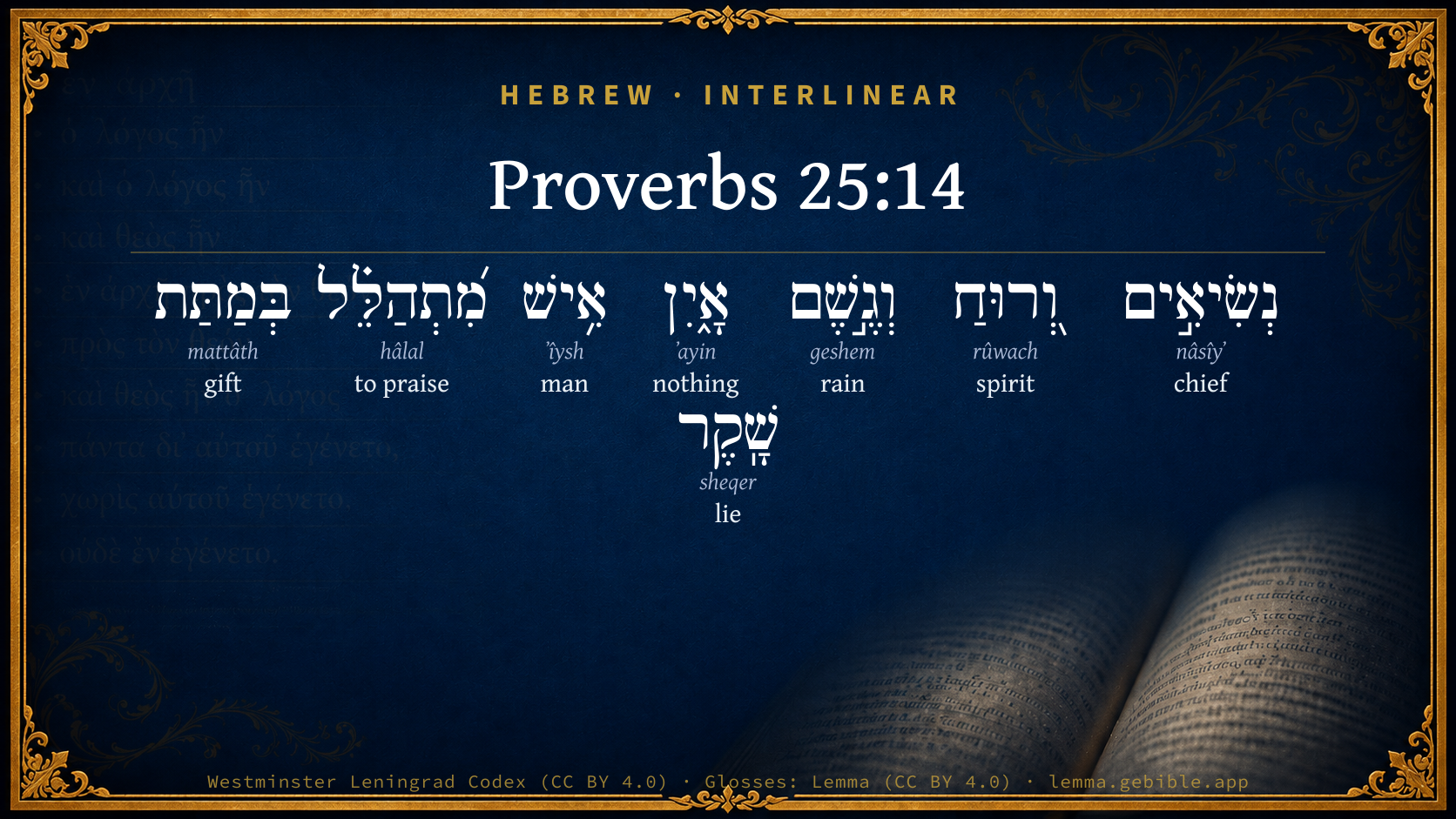
Proverbs 25:14

Hebrew (Westminster Leningrad Codex) Proverbs 25:14 appears in the Hebrew Old Testament. The text above is from the Westminster Leningrad Codex. Each word links to its Strong’s number, a concise gloss, and parsing drawn from the Open Scriptures Hebrew Bible morphology. Click any word for its full Brown-Driver-Briggs (BDB) entry.
Download image
Cite this verse

Proverbs 25:14 (World English Bible). Public Domain. Lemma interlinear Bible study tool, https://lemma.gebible.app/v/proverbs/25/14.

Show BibTeX & RIS
BibTeX
RIS
English Translation
As clouds and wind without rain, So is he who boasts of gifts deceptively.
World English Bible · Public Domain
Download a study sheet

One document with this verse’s original text, its word-by-word gloss line, the meaning frame, cross-references with their text, attributed commentary, and full source and license credits — printable, and it pastes into notes with its structure intact.

This verse Autodidact and up

Study sheet (.html) Plain text (.txt)

A passage Seminary Student

Up to 50 verses in one chapter. A passage sheet keeps up to 6 commentary sources and 12 cross-references per verse, in the order this page ranks them, and says so on the sheet whenever that leaves anything out. Ask for a single verse and you get the Autodidact verse sheet above.

Everything on this page stays free to read, with no account — the sheet is a download of what is already on screen, not access to it.

Want to remove ads? Support Godless Engineer
Compare translations 3

The same verse in 3 English versions, stacked beneath the original-language interlinear above. Click any original word for its lexicon entry.

Each is an independent rendering of the whole verse — the interlinear is not word-aligned to these translations.

Highlighted words mark where these versions differ — a whole-verse word diff, not a word-by-word alignment.

  • World English Bible Public Domain
    As clouds and wind without rain, So is he who boasts of gifts deceptively.
  • King James Version Public Domain
    Whoso boasteth himself of a false gift is like clouds and wind without rain.
  • unfoldingWord Literal Text CC BY-SA 4.0
    Clouds and wind but without rain the man who boasts in a gift of falsehood.

unfoldingWord Literal Text — © unfoldingWord, licensed CC BY-SA 4.0. Word-aligned USFM3 via Door43 (git.door43.org/unfoldingWord/en_ult).

Versions to compare (up to 4)

3 of 4 selected

Show all 18 translations

Every available English version of this verse, each an independent rendering of the whole verse.

  • World English Bible Public Domain
    As clouds and wind without rain, So is he who boasts of gifts deceptively.
  • Berean Standard Bible Public Domain
    Like clouds and wind without rain is the man who boasts of gifts never given.
  • Majority Standard Bible Public Domain
    Like clouds and wind without rain is the man who boasts of gifts never given.
  • King James Version Public Domain
    Whoso boasteth himself of a false gift is like clouds and wind without rain.
  • American Standard Version (1901) Public Domain
    `As' clouds and wind without rain, `So is' he that boasteth himself of his gifts falsely.
  • Revised Version (1885) Public Domain
    As clouds and wind without rain, so is he that boasteth himself of his gifts falsely.
  • Geneva Bible (1599) Public Domain
    A man that boasteth of false liberalitie, is like cloudes and winde without raine.
  • Douay-Rheims (1899) Public Domain
    As clouds, and wind, when no rain followeth, so is the man that boasteth, and doth not fulfil his promises.
  • Young's Literal Translation Public Domain
    Clouds and wind, and rain there is none, `Is' a man boasting himself in a false gift.
  • Literal Standard Version CC BY-SA 4.0
    Clouds and wind without rain, || [Is] a man boasting himself in a false gift.
  • Unlocked Literal Bible CC BY-SA 4.0
    Clouds and wind without rain is the one who boasts about a gift he does not give.
  • unfoldingWord Literal Text CC BY-SA 4.0
    Clouds and wind but without rain the man who boasts in a gift of falsehood.
  • Darby Bible Public Domain
    Clouds and wind without rain, [so] is a man that boasteth himself of a false gift.
  • World Messianic Bible Public Domain
    As clouds and wind without rain, so is he who boasts of gifts deceptively.
  • Webster's Bible Public Domain
    Whoever boasteth himself of a false gift is like clouds and wind without rain.
  • Free Bible Version CC BY-SA 4.0
    Someone who boasts about a gift they never give is like cloud and wind without rain.
  • Bible in Basic English Public Domain
    As clouds and wind without rain, so is one who takes credit for an offering he has not given.
  • JPS Tanakh (1917) Public Domain
    As vapours and wind without rain, so is he that boasteth himself of a false gift.

Literal Standard Version (2020), Covenant Press — licensed CC BY-SA 4.0. Text via the HelloAO Bible API (eBible.org). Unlocked Literal Bible (unfoldingWord) — licensed CC BY-SA 4.0. Text via the HelloAO Bible API (eBible.org). unfoldingWord Literal Text — © unfoldingWord, licensed CC BY-SA 4.0. Word-aligned USFM3 via Door43 (git.door43.org/unfoldingWord/en_ult). Free Bible Version, Dr. Jonathan Gallagher — licensed CC BY-SA 4.0. Text via the HelloAO Bible API (eBible.org).

Word by word

More ways to search: Search by grammar → Find every occurrence → Compare this word →

Practice this passage: Drill this verse → Learn its vocabulary →

About this verse

These counts appear in no published source. They are computed here, from the morphology-tagged text and Lemma’s own curated glosses. What Lemma adds →

8
words
8
distinct lemmas
Wisdom
section

Notable vocabulary

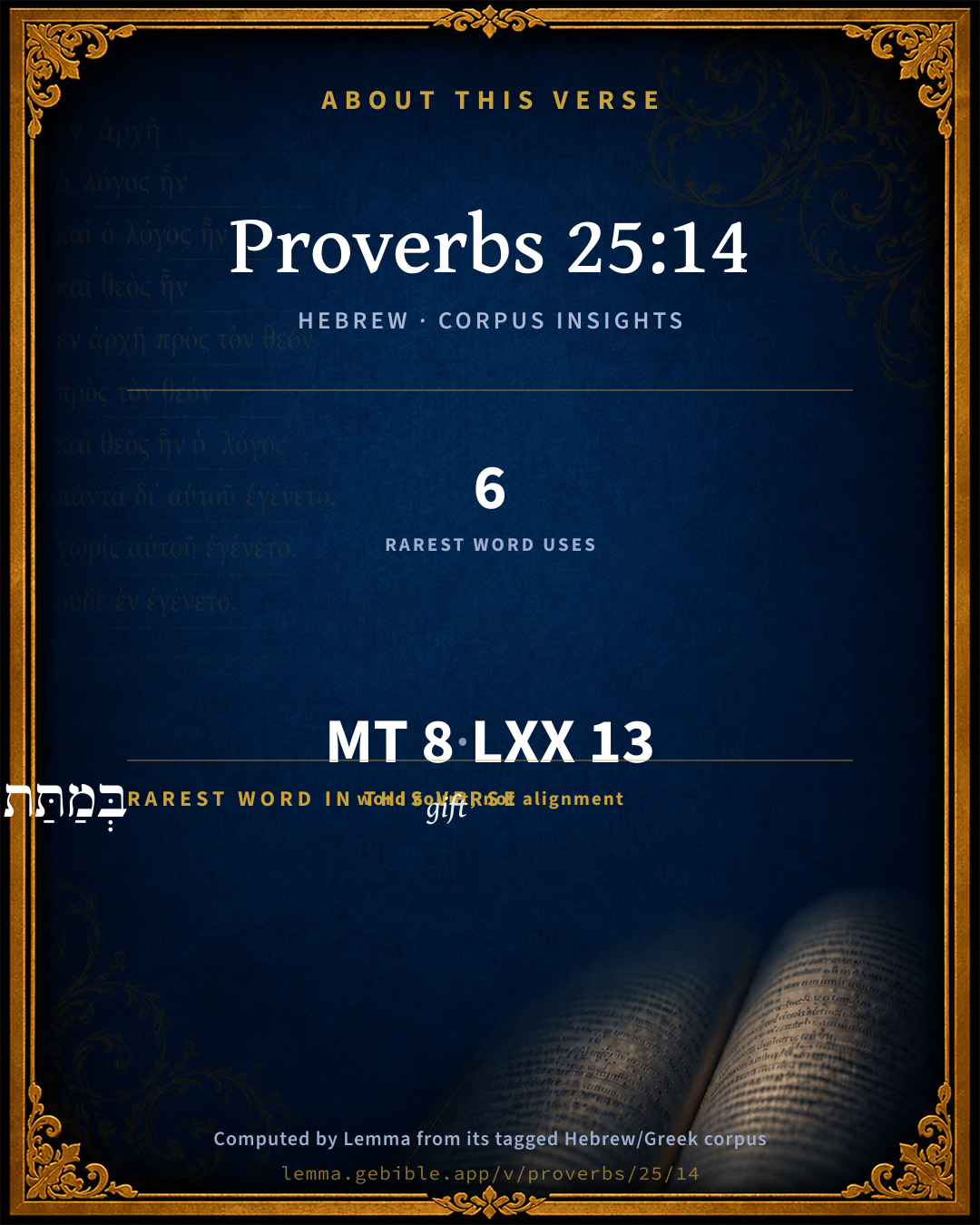
The rarest word here is בְּמַתַּת gift H4991 — appearing just 6 times in the whole Hebrew Bible.

Shared distinctive vocabulary

בְּמַתַּת gift H4991 occurs in 6 verses of the Hebrew Bible. Also found in:

Grammatical profile

  • 1 verb
  • 6 nouns
  • 1 particle

Verb forms

  • מִ֝תְהַלֵּ֗ל Hithpael · Participle Active

Hebrew & Septuagint length

In English translation the verse runs 14 words from the Hebrew and 19 from the Septuagint (LXX English) — closely comparable.

A rough comparison of the two English renderings, which tokenize alike — not a word-level alignment.

Word counts can differ between the Hebrew and the Greek without any difference in meaning — e.g. the Hebrew direct-object marker אֵת has no separate Greek word, and Greek often adds the article ὁ.

In the original languages it is 8 Hebrew tokens and 13 Greek tokens — but the two are counted differently (Hebrew bundles its prefixes and suffixes into one token; the Greek is in lemma form), so that isn’t a like-for-like length.

Cross-references

9

Topical passages linked to Proverbs 25:14 in the Treasury of Scripture Knowledge — connected by theme and wording, ordered by reader-vote popularity; previews shown in the World English Bible.

  • Proverbs 20:6 Many men claim to be men of unfailing love, But who can find a faithful man?
  • Luke 14:11 For everyone who exalts himself will be humbled, and whoever humbles himself will be exalted."
  • 2 Peter 2:15–19 forsaking the right way, they went astray, having followed the way of Balaam the son of Beor, who loved the wages of wrong-doing;
  • Jude 1:16 These are murmurers and complainers, walking after their lusts (and their mouth speaks proud things), showing respect of persons to gain advantage.
  • 1 Kings 22:11 Zedekiah the son of Chenaanah made him horns of iron, and said, Thus says Yahweh, With these shall you push the Syrians, until they be consumed.
  • Luke 18:10–14 "Two men went up into the temple to pray; one was a Pharisee, and the other was a tax collector.
  • 2 Corinthians 11:13–18 For such men are false apostles, deceitful workers, masquerading as Christ's apostles.
  • 2 Corinthians 11:31 The God and Father of the Lord Jesus Christ, he who is blessed forevermore, knows that I don't lie.
  • Jude 1:12–13 These are hidden rocky reefs in your love feasts when they feast with you, shepherds who without fear feed themselves; clouds without water, carried along by winds; autumn leaves without fruit, twice dead, plucked up by the roots;

Cross-references courtesy of OpenBible.info (CC BY 4.0).

Hebrew and Greek witnesses Masoretic Hebrew ↔ Greek Septuagint

The same verse in the two great witnesses to the Old Testament, shown verse-for-verse.

These are two independent witnesses, not word-aligned to each other, and the Septuagint is shown in lemma (dictionary) form.

Hebrew Proverbs 25:14 Masoretic · Westminster Leningrad Codex

נְשִׂיאִ֣ים וְ֭רוּחַ וְגֶ֣שֶׁם אָ֑יִן אִ֥ישׁ מִ֝תְהַלֵּ֗ל בְּמַתַּת שָֽׁקֶר

As clouds and wind without rain, So is he who boasts of gifts deceptively.

World English Bible · Public Domain

Greek LXX Proverbs 25:14 Septuagint · lemma form

ὥσπερ ἄνεμος καί νέφος καί ὑετός ἐπιφανής οὕτως ὁ καυχάομαι ἐπί δόσις ψευδής

As winds and clouds and rains are most evident objects, so is he that boasts of a false gift.

LXX2012 (modern English Septuagint) · Public Domain

On this verse, The Pulpit Commentary discusses the Septuagint’s reading. Read the note in Commentary ↓

Hebrew: Westminster Leningrad Codex (CC BY 4.0). Greek: Septuagint (public domain); English from LXX2012 (modern English Septuagint) (Public Domain). How the Septuagint differs from the Hebrew →

Commentary

Notes on Proverbs 25:14 from classic Christian and Jewish commentators (each source and its license shown beneath its notes). The classic Christian expositions comment on the surrounding passage and are grouped to its opening verse, so a note may address several verses; the Jewish commentaries on the Tanakh (Rashi and others) are per-verse, so they appear only where the commentator wrote on this verse.

Lemma curates 59 commentaries, every one of them public domain or Creative Commons licensed, each selected and text-cleaned for this edition rather than reprinted as found. About our sources →

Trapp's Complete Commentary

John Trapp

Pro 25:14 Whoso boasteth himself of a false gift [is like] clouds and wind without rain.

Ver. 14. Whoso boasteth himself of a false gift] As Ptolemy, surnamed Dωσων, from his fair promises, slack performances; as Sertorius, the Roman, that fed his creditors and clients wlth fair words, but did nothing for them, Pollicitis dives quilibet esse potest; as that pope and his nephew, of whom it is recorded that the one never spoke as he thought, the other never performed what he spoke; lastly, as the devil who promised Christ excelsa in excelsis, mountains on a mountain, and said, "All this will I give thee," {Mat 4:9} whenas that all was just nothing more than a show, a representation, a semblance, or if it had been something, yet it was not his to give; for "the earth is the Lord’s, and the fulness thereof." Physicians call their drugs Dοσεις, gifts, and yet we pay dear for them. Apothecaries set fair titles upon their boxes and gaily pots, but there is oftentimes aliud in titulo, aliud in pyxide, nothing but a bare title. Such are vain boasters, pompous preachers, painted hypocrites, Popish priests, such as was Tecelius [Tetzel], that sold iudulgences in Germany, and those other mass mongers in Gerson’s time that preached publicly to the people, that if any man would hear a mass he should not on that day be smitten with blindness, nor die a sudden death, nor want sufficient sustenance, &c. These were clouds without rain, that answer not expectation. {Jdg 1:12}

John Trapp, A Commentary or Exposition upon All the Books of the Old and New Testament (1647–1656) — public domain. Text from a community e-Sword module.

Joseph Benson's Commentary

Pro 25:14. Whoso boasteth himself of a false gift — Falsely pretends that he hath given, or will give, a valuable gift; or who raises high expectations by promising much, and then deceives them by performing little or nothing; is like clouds and wind without rain — Is like empty clouds carried about with wind, and not affording that rain which by their appearance they promise.

Joseph Benson's Commentary on the Old and New Testaments (1811–1818) — public domain. Text from a community e-Sword module.

The Preacher's Complete Homiletical Commentary

Joseph S. Exell (gen. ed.)

CRITICAL NOTES.—

Pro_25:14. A false gift. This gift is generally understood to be one bestowed by the boaster, but which is worth nothing, or the mere promise of a gift which is never fulfilled.

MAIN HOMILETICS OF Pro_25:14

CLOUDS WITHOUT RAIN

I. Those who promise and do not perform are wantonly cruel. To raise expectations without fulfilling them is one of the greatest unkindnesses of which men can be guilty. For however sorely the gift or the service desired may be needed, if the needy brother has never had any hope of possessing it, his sense of loss is not nearly so keen as it is if, depending on the word of another, he has felt as if the coveted good was almost in his grasp. The thirsty traveller in the desert feels his thirst more terribly after the deceitful mirage has led him to believe that a refreshing lake is just within his reach. He thinks he sees the sparkling water but a few paces distant, and is already in fancy drinking his fill when all his hopes are destroyed by the vanishing of the deception, and he is in a far worse condition than he was before its appearance. There are many men who are as deceitful and as disappointing as the mirage of the desert. Their large promises awaken bright hopes in the breast of some wayfarer on the journey of life, and he looks forward with confident joy to the time when he shall possess the promised gift. But his heart is gradually made sick by the deferred hope (chap. Pro_13:12) until at last he becomes aware that he has been cruelly deceived, and finds himself a far more wretched man than he was before the promise was made to him.

II. As a rule he who promises most will perform the least. Those who bestow most upon others are those who do not spend much time in talking about what they will do. Sometimes a heavy cloud is seen in the heavens, which seems as if it would every moment fall in refreshing showers. But a few drops only fall on the parched earth, and while the husbandman is looking with confident expectancy it vanishes from his sight. On another day a cloud which seems to promise far less falls in abundance upon the thirsty land. This is not the rule in nature, but it is in relation to the promises and performances of men. The loud boaster is well-nigh certain to be a cloud without rain, and should therefore never be relied upon, and the greatest givers are generally those who promise least.

OUTLINES AND SUGGESTIVE COMMENTS

This verse may be understood, either of God’s gift to man, or man’s gift to God, or else of man to any other man. For many there are who boast of those gifts which God never bestowed on them; and though God be infinite in His bounty, yet by their lying do make Him more bountiful than He is. Many there are who boast of their gifts to God, either in regard of the church or the poor, whereas His church or His poor have them as little as God Himself needs them. Many boast of their kind gifts to others, whereas their not performing them makes them more unkind than if they never had promised.… Their false gifts are as the clouds, and their boasting as the winds. Their false gifts do lift them up, as the clouds are; their great boasting maketh a great noise as the wind doth. The winds drive the clouds and scatter them; so doth their boasting spread abroad the fame of their false gifts; and as the clouds without rain darken the heavens without watering the earth; as the dry wind troubleth the air without refreshing the ground; so these boasters even darken the heaven with their naughtiness, and trouble the earth with their brags, but satisfy none with their deeds.—Jermin.

The Preacher's Complete Homiletical Commentary (gen. ed. Joseph S. Exell; Funk & Wagnalls, c. 1892) — public domain (pre-1929). A full-Bible homiletical/sermon-outline anthology covering 65 of 66 books (2 John is absent from the source module). Text from a community e-Sword module.

Tyndale Open Study Notes

Tyndale Open Resources

25:14 In Israel, rain is rare. When rain does not follow the appearance of storm clouds, it is like the disappointment caused by someone who gives empty promises. Cp. Jude’s description of false teachers (Jude 1:12).

Tyndale Open Study Notes — © Tyndale Open Resources, licensed CC BY-SA 4.0. Text via the HelloAO Bible API.

Geneva Bible (1599)

Geneva Bible translators

Which have an outward appearance, and are nothing within.

Geneva Bible (1599) marginal notes — public domain. Text via Bolls.life.

Matthew Henry's Commentary

He may be said to boast of a false gift, 1. Who pretends to have received or given that which he never had, which he never gave, makes a noise of his great accomplishments and his good services, but it is all false; he is not what he pretends to be. Or, 2. Who promises what he will give and what he will do, but performs nothing, who raises people's expectations of the mighty things he will do for his country, for his friends, what noble legacies he will leave, but either he has not wherewithal to do what he says or he never designs it. Such a one is like the morning-cloud, that passes away, and disappoints those who looked for rain from it to water the parched ground (Jde 1:12), clouds without water.

Matthew Henry's Commentary on the Whole Bible (1708–1710) — public domain (CC PDM 1.0). Text via the HelloAO Bible API.

Jamieson, Fausset & Brown

Robert Jamieson, A. R. Fausset & David Brown

clouds--literally, "vapors" (Jer 10:13), clouds only in appearance.

a false gift--promised, but not given.

Jamieson, Fausset & Brown — Commentary Critical and Explanatory on the Whole Bible (1871) — public domain (CC PDM 1.0). Text via the HelloAO Bible API.

Adam Clarke's Commentary

Verse 14. A false gift] מתת שקר mattath shaker, a lying gift, one promised, but never bestowed. "Whoso maketh greate boastes, and giveth nothing;" COVERDALE. SO the VULGATE: "Vir gloriosus, et promissa non complens;" "A bragging man, who does not fulfil his promises," is like clouds which appear to be laden with vapour, and like the wind which, though it blow from a rainy quarter, brings no moistness with it. So the vain boaster; he is big with promise, but performs nothing.

Adam Clarke's Commentary on the Bible (1810–1826) — public domain. Text from a community e-Sword/MySword module.

Ellicott's Commentary for English Readers

(14) Whoso boasteth himself of a false gift—i.e., talks loudly of what he is going to do for another, and then does nothing.

Clouds and wind.—Generally followed by heavy rain, (Comp. 1Ki_18:45.)

A Bible Commentary for English Readers, edited by Charles John Ellicott (1878–1897) — public domain. Text from a community e-Sword module.

The Cambridge Bible for Schools and Colleges

gen. ed. J. J. S. Perowne

14. Lit.,

Clouds and wind and no rain;

A man who boasts himself of a gift of falsehood.

The rising wind and gathering clouds (1Ki_18:45) which, un-accompanied by rain, disappoint the expectation of the thirsty earth are an apt emblem of a man who promises much and performs nothing.

The Vulg. is true to the original, and forcible:

Nubes et ventus et pluviae non sequentes,

Vir gloriosus et promissa non complens.

The Cambridge Bible for Schools and Colleges (gen. ed. J. J. S. Perowne; Cambridge University Press, 1878–1918) — public domain. Text from a community e-Sword module.

John Gill's Exposition

Whoso boasteth himself of a false gift,.... Of his charity and alms deeds; bragging of great things he does this way, when he does nothing; or who is very vain in making large promises of what he will give, when he does not perform; either not having it in his heart, or in the power of his hands, to give what he promises; Satan like, who offered to give all the kingdoms of this world to Christ, if he would worship him, when nothing of it belonged unto him, or was in his power to give: and so the Vulgate Latin version renders it, "a glorious man"; that is, a vainglorious man, and "not fulfilling promises". It may very well be applied to false teachers, who boast of their gifts and spiritual knowledge, when they have none; speaking great swelling words of vanity, when they are empty of all that is good, and are as follow:

is like like clouds and wind without rain; which make a show and appearance of rain, promise much, but produce none; see Pe2 2:17, Jde 1:12.

John Gill's Exposition of the Whole Bible (1746–1763) — public domain (CC PDM 1.0). Text via the HelloAO Bible API.

Albert Barnes' Notes on the Bible

The disappointment caused by him who promises much and performs little or nothing, is likened to the phenomena of an eastern climate; the drought of summer, the eager expectation of men who watch the rising clouds and the freshening breeze, the bitter disappointment when the breeze dies off, and the clouds pass away, and the wished for rain does not come.

Albert Barnes' Notes on the Bible (1834–1885) — public domain. Text from a community e-Sword/MySword module.

Matthew Poole's English Annotations

Whoso boasteth himself of a false gift, pretending that he hath given, or promising that he will give, a man those gifts, which he neither hath given, nor intendeth to give him,

is like clouds and wind without rain; like empty clouds carried about with wind, and not affording that rain which by their appearance they promise.

Matthew Poole's English Annotations on the Holy Bible (1683–1685) — public domain. Text from a community e-Sword/MySword module.

Whedon's Commentary on the Bible

Daniel D. Whedon

14. A false gift — This is understood of one that boasts of an intended gift which he never bestows.

Like clouds… without rain — Clouds and wind sometimes give promise of rain that comes not. Coverdale translates according to the sense: “Whose maketh great boasts and giveth nothing.” Compare 2Pe_2:17; Jud_1:12. For false gift here, the Geneva has “false liberalitie.”

Daniel D. Whedon (gen. ed.), Commentary on the Old and New Testaments (1874–1909) — public domain. Text from a community e-Sword module.

The Pulpit Commentary

The Hebrew is, Clouds and wind without rain he that boasteth himself in a gift of falsehood (see on Ver. 11). The proverb is concerned with promises disappointed. Clouds and wind are generally in the East the precursors of heavy rain, as we read in 1Ki_18:45, "In a little while the heaven was black with clouds and wind, and there was a great rain." After such phenomena, which, according to current meteorological observation, gave every hope of a refreshing shower in the time of summer drought, to see the clouds pass away without affording a single drop of rain is a grievous disappointment. The metaphor is found in the New Testament. St. Jude (Ver. 12) calls false teachers "clouds without water, carried along by winds." "A gift of falsehood," equivalent to "a false gift," one that deceives, because it is only promised and never given. A man makes a great parade of going to bestow a handsome present, and then sneaks out of it, and gives nothing. Such a one is, as St. Jerome renders, Vir gloriosus, et promissa non complens. The old commentators quote Ovid, "Heroid.," 6:509"Mobilis Aesonide, vernaque incertior aura, Cur tua pollicito pondere verba carent?

"Deeds are fruits," says the proverb, "words are but leaves;" and "Vainglory blossoms, but never bears fruit." Concerning the folly of making stupid beasts, the Bengalee proverb speaks of a peddler in ginger getting tidings of his ship. The Septuagint is incorrect, "As winds, and clouds, and rains are most evident (epifanestata ), so is he who boasts of a false gift."

The Pulpit Commentary (1880–1919), ed. H.D.M. Spence-Jones & Joseph S. Exell — public domain. Text from a community e-Sword module.

John Wesley's Explanatory Notes

Boasteth - Promising what he never intends to give. Is like - Like empty clouds carried about with wind, and not affording that rain which they promise.

John Wesley, Explanatory Notes Upon the Whole Bible (1754–1765) — public domain. Text via the GEBible commentary corpus.

Keil & Delitzsch

C. F. Keil & F. Delitzsch

This proverb relates to the word which promises much, but remains unaccomplished:

Clouds and wind, and yet no rain -

A man who boasteth with a false gift.

Incorrectly the lxx and Targ. refer the predicate contained in the concluding word of the first line to all the three subjects; and equally incorrectly Hitzig, with Heidenheim, interprets מתּת שׁקר, of a gift that has been received of which one boasts, although it is in reality of no value, because by a lying promise a gift is not at all obtained. But as לחם כזבים, Pro 23:3, is bread which, as it were, deceives him who eats it, so מתת שׁקר is a gift which amounts to a lie, i.e., a deceitful pretence. Rightly Jerome: vir gloriosus et promissa non complens. In the Arab. ṣaliḍ, which Fleischer compares, the figure 14a and its counterpart 14b are amalgamated, for this word signifies both a boaster and a cloud, which is, as it were, boastful, which thunders much, but rains only sparsely or not at all. Similar is the Arab. khullab, clouds which send forth lightning, and which thunder, but yet give no rain; we say to one, magno promissor hiatu: thou art (Arab.) kabaraḳn khullabin, i.e., as Lane translates it: "Thou art only like lightning with which is no rain." Schultens refers to this proverbial Arabic, fulmen nubis infecundae. Liberality is called (Arab.) nadnay, as a watering, cf. Pro 11:25. The proverb belongs to this circle of figures. It is a saying of the German peasants, "Wenn es sich wolket, so will es regnen" [when it is cloudy, then there will be rain]; but according to another saying, "nicht alle Wolken regnen" [it is not every cloud that yields rain]. "There are clouds and wind without rain."

Keil & Delitzsch — Biblical Commentary on the Old Testament (1861–1891) — public domain (CC PDM 1.0). Text via the HelloAO Bible API. (Old Testament only.)

Bridges on Proverbs

Charles Bridges

14 Whoso boasteth himself of a false gift,†a is like clouds and wind without rain. {of a...: Heb. in a gift of falsehood}

The last proverb described an invaluable blessing. This marks a destructive curse. Suppose a drought, as in the days of Elijah, threatening desolation to the land (1Ki 18:5 ), and a thick cloud, seemingly big with the fruitful blessing, yet passing over — the wind without rain. This is a true picture of the boaster; rich in promises, but performing nothing; exciting large expectations, then sinking them in disappointment. Whether it be a vain conceit of his own understanding, or an hypocritical desire to maintain a profession, it is a boasting over a gift of falsehood. If it be bad to promise and deceive, it is far worse to promise with an intention to deceive. This was the very character of the Great Deceiver. Did he not put before our unhappy parent a false gift — a promise, which could never be realized — "Ye shall be as gods, knowing good and evil"? (Gen 3:3-5 .) Nay — did he not with a presumption, that hell itself might almost be ashamed of, boast himself of his false gift; when he offered the world to his own Maker, as a temptation to the vilest blasphemy? (Mat 4:8-10 .)

How sad to find this character in those, who stand in the place of God! The Church has ever been chastened with false teachers; ministering delusion, instead of instruction.†1 And are there none among ourselves, feeding the flock with false gifts, seeking to maintain their hollow profession even in the sight of Him, whose frown at the great day will banish them for ever from his presence?†2 Oh! let those that bear the Lord’s message, take heed, that, if they be counted "as deceivers," they may be "yet true;"†3 not as those, which corrupt the word of God; but as of sincerity, as of God, in the "sight of God," let them "speak in Christ."†4

Footnotes:

†a ’Whoso maketh greate boastes, and giveth nothing.’ — Bishop Coverdale.

†1 1Ki 22:11 . Jer 5:31 . 2Co 11:13-15 . Gal 1:7 . 2Pe 2:17-19 . Jud 1:12-16 .

†2 Mat 7:22-23.

†3 2Co 6:8 .

†4 2Co 2:17 ; 2Co 4:2 .

Charles Bridges, An Exposition of the Book of Proverbs (1846) — public domain. Text from a community e-Sword module.

Rashi

Rabbi Shlomo Yitzchaki (Rashi)

Clouds and wind, etc. When there is a false hope—when the heavens thicken with clouds and the wind blows—people hope that it will rain. Now if it does not rain, they are troubled and their eyes languish. So is a man who boasts, saying, “So much and so much charity I will give to the collector,” but he lies, and the eyes of the poor languish for his gift, but it does not come.

Rashi on the Tanakh — English translations: “The Judaica Press complete Tanach with Rashi, translated by A. J. Rosenberg” (CC BY 4.0); “Pentateuch with Rashi's commentary by M. Rosenbaum and A.M. Silbermann, 1929-1934” (public domain); “The Metsudah Tanach series, Lakewood, N.J” (CC BY 4.0); and “The Book of Joshua, Metsudah Publications, 1997” (CC BY 4.0). Text via Sefaria.

Lesson kit

Teaching starters — assembled from the data on this page, not authored interpretation. Every prompt links to the verse data it draws on. Edit before teaching.

Proverbs, in the Wisdom, opens this verse with 8 words (8 distinct Hebrew lemmas). Its most distinctive word is mattâth (“gift”). A historical commentator’s framing appears above. Read the whole chapter for the surrounding context.

Discussion questions

  1. What does “gift” (mattâth) contribute to the verse as a whole?
  2. How does 1 Kings 13:7, which shares the word «gift», read alongside this verse?
  3. These translations render this verse differently; the difference is in the English rendering, not the original. What questions does that raise?
  4. «מִ֝תְהַלֵּ֗ל» is a Hithpael Participle Active verb. How does that grammatical form shape the action described?
  5. Compare how Trapp's Complete Commentary and Joseph Benson's Commentary read this verse. Where do they agree or differ?

Things to notice

Reading settings

Reading text

Shown beneath each verse's original-language words.

Old Testament
Old Testament edition

Read the OT as the Masoretic Hebrew (MT) or the Greek Septuagint (LXX).

English shown for the Greek Septuagint (in the Hebrew ↔ Greek comparison).

Comparing translations? Open the Compare panel on any verse page to stack up to four side by side.