
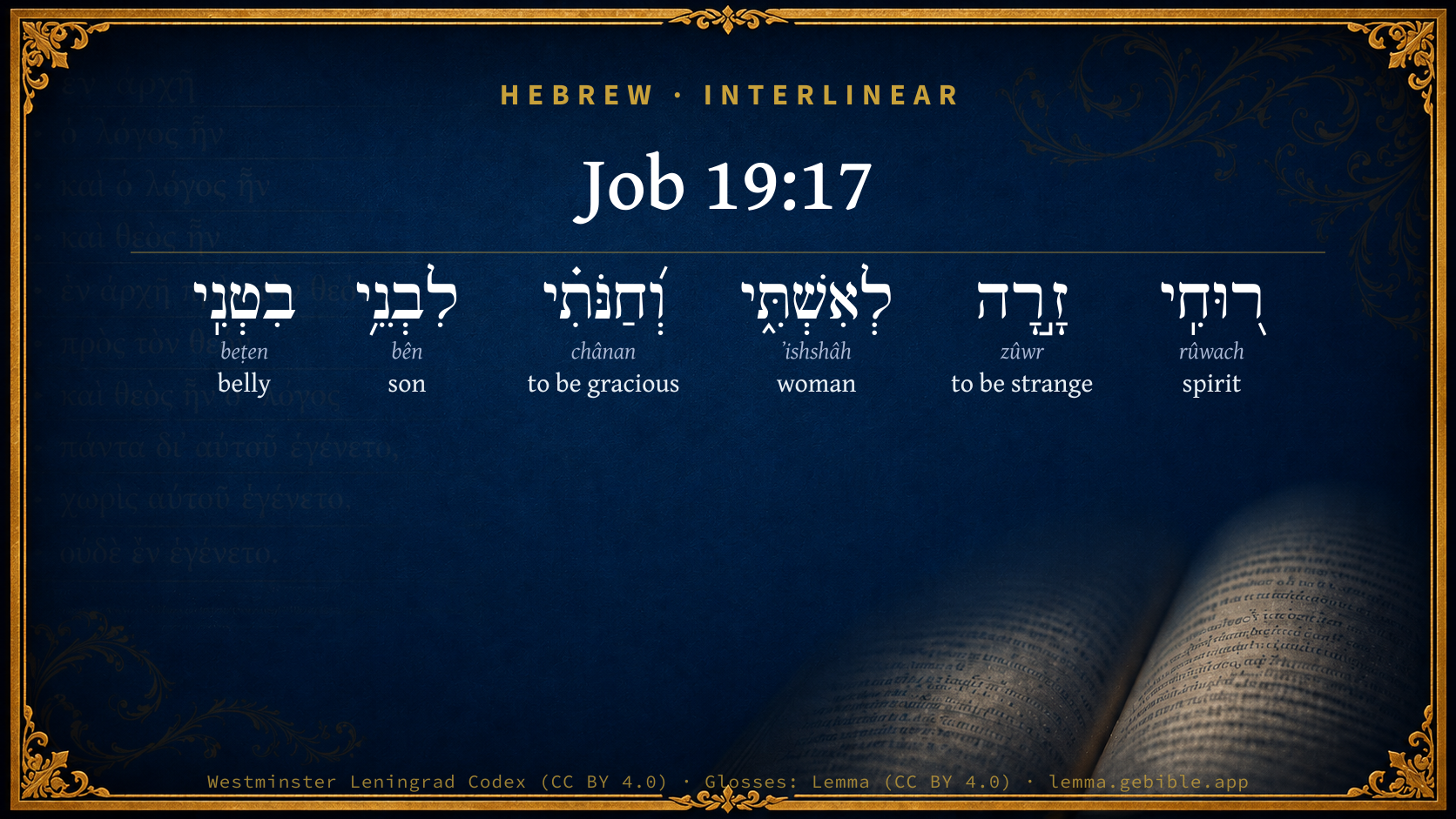
Job 19:17

Hebrew (Westminster Leningrad Codex) Job 19:17 appears in the Hebrew Old Testament. The text above is from the Westminster Leningrad Codex. Each word links to its Strong’s number, a concise gloss, and parsing drawn from the Open Scriptures Hebrew Bible morphology. Click any word for its full Brown-Driver-Briggs (BDB) entry.
Download image
Cite this verse

Job 19:17 (World English Bible). Public Domain. Lemma interlinear Bible study tool, https://lemma.gebible.app/v/job/19/17.

Show BibTeX & RIS
BibTeX
RIS
English Translation
My breath is offensive to my wife. I am loathsome to the children of my own mother.
World English Bible · Public Domain
Download a study sheet

One document with this verse’s original text, its word-by-word gloss line, the meaning frame, cross-references with their text, attributed commentary, and full source and license credits — printable, and it pastes into notes with its structure intact.

This verse Autodidact and up

Study sheet (.html) Plain text (.txt)

A passage Seminary Student

Up to 50 verses in one chapter. A passage sheet keeps up to 6 commentary sources and 12 cross-references per verse, in the order this page ranks them, and says so on the sheet whenever that leaves anything out. Ask for a single verse and you get the Autodidact verse sheet above.

Everything on this page stays free to read, with no account — the sheet is a download of what is already on screen, not access to it.

Want to remove ads? Support Godless Engineer
Compare translations 3

The same verse in 3 English versions, stacked beneath the original-language interlinear above. Click any original word for its lexicon entry.

Each is an independent rendering of the whole verse — the interlinear is not word-aligned to these translations.

Highlighted words mark where these versions differ — a whole-verse word diff, not a word-by-word alignment.

  • World English Bible Public Domain
    My breath is offensive to my wife. I am loathsome to the children of my own mother.
  • King James Version Public Domain
    My breath is strange to my wife, though I intreated for the children's sake of mine own body.
  • unfoldingWord Literal Text CC BY-SA 4.0
    My breath is strange to my wife, though I was gracious to the sons of my womb.

unfoldingWord Literal Text — © unfoldingWord, licensed CC BY-SA 4.0. Word-aligned USFM3 via Door43 (git.door43.org/unfoldingWord/en_ult).

Versions to compare (up to 4)

3 of 4 selected

Show all 18 translations

Every available English version of this verse, each an independent rendering of the whole verse.

  • World English Bible Public Domain
    My breath is offensive to my wife. I am loathsome to the children of my own mother.
  • Berean Standard Bible Public Domain
    My breath is repulsive to my wife, and I am loathsome to my own family.
  • Majority Standard Bible Public Domain
    My breath is repulsive to my wife, and I am loathsome to my own family.
  • King James Version Public Domain
    My breath is strange to my wife, though I intreated for the children's sake of mine own body.
  • American Standard Version (1901) Public Domain
    My breath is strange to my wife, And my supplication to the children of mine own mother.
  • Revised Version (1885) Public Domain
    My breath is strange to my wife, and my supplication to the children of my mother’s womb.
  • Geneva Bible (1599) Public Domain
    My breath was strange vnto my wife, though I prayed her for the childrens sake of mine owne body.
  • Douay-Rheims (1899) Public Domain
    My wife hath abhorred my breath, and I entreated the children of my womb.
  • Young's Literal Translation Public Domain
    My spirit is strange to my wife, And my favours to the sons of my `mother's' womb.
  • Literal Standard Version CC BY-SA 4.0
    My spirit is strange to my wife, || And my favors to the sons of my [mother’s] womb.
  • Unlocked Literal Bible CC BY-SA 4.0
    My breath is offensive to my wife; I am even disgusting to those who were born from my mother's womb.
  • unfoldingWord Literal Text CC BY-SA 4.0
    My breath is strange to my wife, though I was gracious to the sons of my womb.
  • Darby Bible Public Domain
    My breath is strange to my wife, and my entreaties to the children of my [mother's] womb.
  • World Messianic Bible Public Domain
    My breath is offensive to my wife. I am loathsome to the children of my own mother.
  • Webster's Bible Public Domain
    My breath is strange to my wife, though I entreated for the children's sake of my own body.
  • Free Bible Version CC BY-SA 4.0
    I am repulsive to my wife, and I am loathsome to my own brothers.
  • Bible in Basic English Public Domain
    My breath is strange to my wife, and I am disgusting to the offspring of my mother's body.
  • JPS Tanakh (1917) Public Domain
    My breath is abhorred of my wife, and I am loathsome to the children of my tribe.

Literal Standard Version (2020), Covenant Press — licensed CC BY-SA 4.0. Text via the HelloAO Bible API (eBible.org). Unlocked Literal Bible (unfoldingWord) — licensed CC BY-SA 4.0. Text via the HelloAO Bible API (eBible.org). unfoldingWord Literal Text — © unfoldingWord, licensed CC BY-SA 4.0. Word-aligned USFM3 via Door43 (git.door43.org/unfoldingWord/en_ult). Free Bible Version, Dr. Jonathan Gallagher — licensed CC BY-SA 4.0. Text via the HelloAO Bible API (eBible.org).

Word by word

More ways to search: Search by grammar → Find every occurrence → Compare this word →

Practice this passage: Drill this verse → Learn its vocabulary →

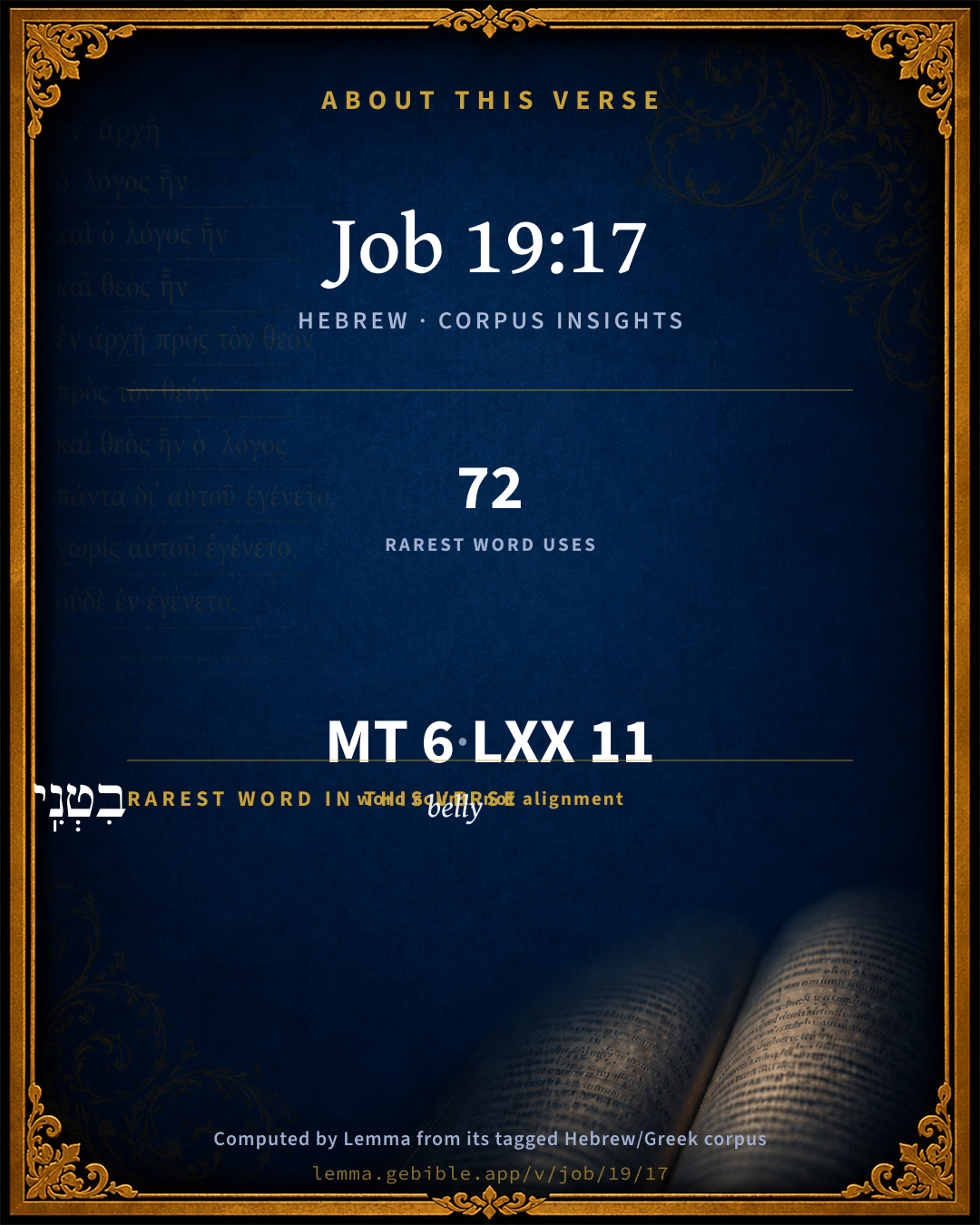
About this verse

These counts appear in no published source. They are computed here, from the morphology-tagged text and Lemma’s own curated glosses. What Lemma adds →

6
words
6
distinct lemmas
Wisdom
section

Grammatical profile

  • 2 verbs
  • 4 nouns

Verb forms

  • זָ֣רָה Qal · Perfect
  • וְ֝חַנֹּתִ֗י Qal · Perfect

Hebrew & Septuagint length

In English translation the verse runs 17 words from the Hebrew and 13 from the Septuagint (LXX English) — closely comparable.

A rough comparison of the two English renderings, which tokenize alike — not a word-level alignment.

Word counts can differ between the Hebrew and the Greek without any difference in meaning — e.g. the Hebrew direct-object marker אֵת has no separate Greek word, and Greek often adds the article ὁ.

In the original languages it is 6 Hebrew tokens and 11 Greek tokens — but the two are counted differently (Hebrew bundles its prefixes and suffixes into one token; the Greek is in lemma form), so that isn’t a like-for-like length.

Cross-references

2

Topical passages linked to Job 19:17 in the Treasury of Scripture Knowledge — connected by theme and wording, ordered by reader-vote popularity; previews shown in the World English Bible.

  • Job 2:9–10 Then his wife said to him, "Do you still maintain your integrity? Renounce God, and die."
  • Job 17:1 "My spirit is consumed, my days are extinct, And the grave is ready for me.

Cross-references courtesy of OpenBible.info (CC BY 4.0).

Hebrew and Greek witnesses Masoretic Hebrew ↔ Greek Septuagint

The same verse in the two great witnesses to the Old Testament, shown verse-for-verse.

These are two independent witnesses, not word-aligned to each other, and the Septuagint is shown in lemma (dictionary) form.

Hebrew Job 19:17 Masoretic · Westminster Leningrad Codex

ר֭וּחִֽי זָ֣רָה לְאִשְׁתִּ֑י וְ֝חַנֹּתִ֗י לִבְנֵ֥י בִטְנִֽי

My breath is offensive to my wife. I am loathsome to the children of my own mother.

World English Bible · Public Domain

Greek LXX Job 19:17 Septuagint · lemma form

καί ἱκετεύω ὁ γυνή ἐγώ προςκαλέω δέ κολακεύω υἱός παλλακίς ἐγώ

And I implored my wife, and earnestly entreated the sons of my concubines.

LXX2012 (modern English Septuagint) · Public Domain

On this verse, Joseph Benson's Commentary discusses the Septuagint’s reading. Read the note in Commentary ↓

Hebrew: Westminster Leningrad Codex (CC BY 4.0). Greek: Septuagint (public domain); English from LXX2012 (modern English Septuagint) (Public Domain). How the Septuagint differs from the Hebrew →

Commentary

Notes on Job 19:17 from classic Christian and Jewish commentators (each source and its license shown beneath its notes). The classic Christian expositions comment on the surrounding passage and are grouped to its opening verse, so a note may address several verses; the Jewish commentaries on the Tanakh (Rashi and others) are per-verse, so they appear only where the commentator wrote on this verse.

Lemma curates 59 commentaries, every one of them public domain or Creative Commons licensed, each selected and text-cleaned for this edition rather than reprinted as found. About our sources →

Trapp's Complete Commentary

John Trapp

Job 19:17 My breath is strange to my wife, though I intreated for the children’s [sake] of mine own body.

Ver. 17. My breath is strange to my wife] The corruption of his inwards (besides the noisomeness of his outward ulcers) made his breath strong and unwholesome. This his wife (as did that Roman lady, who said she thought all men’s breath as unsavoury as her husband’s was), should have borne with, in a time of sickness especially, when she should have shown herself a help, and not a heartbreak, to her husband. Famous in our chronicles is the Lady Eleanor, wife to Prince Edward (afterwards Edward I), who extracted the poison out of her husband’s wounds with her tongue, licking daily, while he slept, his rankling wounds, whereby they perfectly closed (Cambd. in Middlesex, Speed. 630). And no less famous is the wife of Valdaurus, celebrated by Ludov. Vires, lib. 2, de Christiana Femina, p. 360. A young and beautiful maid, saith he, was matched to a man stricken in years, whom after she found to have a very fulsome breath and a diseased body, yet (out of conscience, being by God’s providence become his wife) she most worthily digested, with incredible patience and contentment, the languishing and loathsomeness of a husband, continually visited with variety of most irksome and infectious diseases; and though friends and physicians advised her by no means to come near him, for fear of danger and infection, yet she, passing by with a loving disdain and contempt these unkind dissuasions, plied him night and day with extraordinary tenderness and care, and services of all sorts above her strength and ability; she was to him friends, physician, wife, nurse; yea, she was father, mother, brother, sister, daughter, everything, anything to do him good in any manner or way, &c.

Though I intreated for the children’s sake, &c.] i.e. By the holy right of wedlock, and the fruit thereof, those dear pledges of our matrimonial good affection; children, as they are dear to their parents (Charos, Plautus somewhere calleth them), so they are an endearing to their parents, whose seed they are called, as if there were nothing left to the parents but the husks. This therefore was a melting argument; but it moved not Job’s wife. Men may speak persuasively, but God only persuadeth.

John Trapp, A Commentary or Exposition upon All the Books of the Old and New Testament (1647–1656) — public domain. Text from a community e-Sword module.

Joseph Benson's Commentary

Job 19:17. My breath is strange to my wife, &c. — I am become so loathsome that my wife will not come near me, though I have conjured her to do it, by the dear memory of our children, those common pledges of our mutual love. Houbigant translates the verse, My wife abhors even my breath: the children of my body fly far from my offensive smell: and he observes, that “we are nowhere told that all the children of Job perished, but only such as were feasting in their eldest brother’s house.” It must be observed, however, that when the messenger informed Job of the destruction of his family, the answer which he gave, namely, Naked came I, &c., supposes that there were none who survived that calamity. Some are of opinion that those whom Job calls his children were grandchildren. The LXX. take them for the children of concubines. Sol. Jarchi supposes they were his domestics: but the Hebrew text here does not necessarily imply that there were any children of his then in existence. For there is nothing for the word sake; it is literally, I entreated for the children of my body, which may mean, as interpreted above, for, or by the memory of our children, namely, the children now dead. The general interpretation here supposes that Job’s breath, by reason of his sores and ulcers, was so offensive that his wife could not bear to come near him; but the words do not necessarily imply that: for, as he had just said before, I entreated my servant with my mouth; so, when he immediately adds, My breath is strange: &c., he might mean no more than that his breath or voice was strange also to his wife: that is, she had as little regard to what he said as the servant who gave him no answer when he was called. See Chappelow, who thus paraphrases the passage: “When my servant gave no attention, I called to my wife; but neither did she regard me, though I particularly mentioned to her (as an aggravation of my calamities, and to move her compassion) the loss of my children, whom I had begotten.”

Joseph Benson's Commentary on the Old and New Testaments (1811–1818) — public domain. Text from a community e-Sword module.

Tyndale Open Study Notes

Tyndale Open Resources

19:17 my own family: Job might have been referring to his tribal line, his parents, his own children, or his siblings.

Tyndale Open Study Notes — © Tyndale Open Resources, licensed CC BY-SA 4.0. Text via the HelloAO Bible API.

Geneva Bible (1599)

Geneva Bible translators

Which were hers and mine.

Geneva Bible (1599) marginal notes — public domain. Text via Bolls.life.

Jamieson, Fausset & Brown

Robert Jamieson, A. R. Fausset & David Brown

strange--His breath by elephantiasis had become so strongly altered and offensive, that his wife turned away as estranged from him (Job 19:13; Job 17:1).

children's . . . of mine own body--literally, "belly." But "loins" is what we should expect, not "belly" (womb), which applies to the woman. The "mine" forbids it being taken of his wife. Besides their children were dead. In Job 3:10 the same words "my womb" mean, my mother's womb: therefore translate, "and I must entreat (as a suppliant) the children of my mother's womb"; that is, my own brothers--a heightening of force, as compared with last clause of Job 19:16 [UMBREIT]. Not only must I entreat suppliantly my servant, but my own brothers (Psa 69:8). Here too, he unconsciously foreshadows Jesus Christ (Joh 7:5).

Jamieson, Fausset & Brown — Commentary Critical and Explanatory on the Whole Bible (1871) — public domain (CC PDM 1.0). Text via the HelloAO Bible API.

Adam Clarke's Commentary

Verse 17. Though I entreated for the children's sake of mine own body.] This may imply no more than adjuring her by the tenderest ties, by their affectionate intercourse, and consequently by the children which had been the seals of their mutual affection, though these children were no more.

But the mention of his children in this place may intimate that he had still some remaining; that there might have been young ones, who, not being of a proper age to attend the festival of their elder brothers and sisters, escaped that sad catastrophe. The Septuagint have, Προσεκαλουμην δε κολακευων υἰους παλλακιδων μου, "I affectionately entreated the children of my concubines." But there is no ground in the Hebrew text for such a strange exceptionable rendering. Coverdale has, I am fayne to speake fayre to the children of myne own body.

Adam Clarke's Commentary on the Bible (1810–1826) — public domain. Text from a community e-Sword/MySword module.

Ellicott's Commentary for English Readers

(17) Though I intreated for the children’s sake of mine own body.—Rather, and so is my affection or kindness (see Psa_77:10, where the same word occurs) to the children of my mother’s womb, i.e., my brethren. Others render, I am become offensive to, &c.

A Bible Commentary for English Readers, edited by Charles John Ellicott (1878–1897) — public domain. Text from a community e-Sword module.

The Cambridge Bible for Schools and Colleges

gen. ed. J. J. S. Perowne

17. Once more, if possible an acuter misery—he is become intolerable to those most dear to him.

though I intreated] Perhaps, and I am loathsome to the children of—. The word as known in Heb. means to be gracious to, to pity (Job_19:21), in the simple form (here), and to seek favour to oneself, or beseech, in the reflexive (Job_19:16), but the simple form has nowhere the meaning of “beseech” or entreat. The Arab. has a root of the same spelling, which means to smell badly, to stink,—a sense parallel to the meaning of the first clause, where “strange” means offensive.

The last words of the verse “children of mine own body” are difficult; they mean literally, children of my womb. The word usually rendered womb is used occasionally of the father, Psa_132:11; Mic_6:7. The Prologue narrates the death of Job’s children, and the same assumption is made in the Poem, ch. Job_8:4, Job_29:5, and it is not to be thought that another mode of representation appears here. In Job_19:15-16, however, Job has still maids and servants, though his servants are represented in the Prologue as having perished. As he has other servants he might have other children. These might be children of concubines, as Job lived in the patriarchal age, though no allusion is made to such connexions, and the references to his wife are of such a kind as to suggest that Job lived in a state of strict monogamy. Or the expression “children of my body” might be used somewhat loosely to mean grandchildren—children of his sons. The impression conveyed by the Prologue is that the seven sons were unmarried, though this is left uncertain. Others consider the phrase “children of my womb” to mean, children of my mother—children of the same womb with myself.

The Cambridge Bible for Schools and Colleges (gen. ed. J. J. S. Perowne; Cambridge University Press, 1878–1918) — public domain. Text from a community e-Sword module.

John Gill's Exposition

Yea, young children despised me,.... Having related what he met with within doors from those in his own house, the strangers and proselytes in it, his maidens and menservants, and even from his own wife, he proceeds to give an account of what befell him without; young children, who had learned of their parents, having observed them to treat him with contempt, mocked and scoffed at him, and said, there sits old Job, that nasty creature, with his boils and ulcers; or using some such contemptuous expression, as "wicked man"; so some translate the word (k); he was scorned and condemned by profane persons, who might tease him with his religion, and ask, where was his God? and bid him observe the effect and issue of his piety and strict course of living, and see what it was all come to, or what were the fruits of it: the Vulgate Latin version renders it "fools", that is, not idiots, but such as are so in a moral sense, and so signifies as before; and as these make mock at sin, and a jest of religion, it is no wonder that they despised good men: the word is rendered by a learned man (l), the "most needy clients", who were dependent on him, and were supported by him; but this coincides with Job 19:15;

I arose, and they spoke against me: he got up from his seat, either to go about his business, and do what he had to do; and they spoke against him as he went along, and followed him with their reproaches, as children will go after persons in a body they make sport of; or he rose up in a condescending manner to them, when they ought to have rose up to him, and reverenced and honoured him; and this he did to win upon them, and gain their good will and respect; or to admonish them, chastise and correct them, for their insolence and disrespect to him; but it signified nothing, they went on calling him names, and speaking evil against him, and loading him with scoffs and reproaches.

(k) "iniqui", Pagninus, Montanus; "homines nequam", Tigurine version; so Ben Gersom. (l) "Clientes egentissimi", Schultens.

John Gill's Exposition of the Whole Bible (1746–1763) — public domain (CC PDM 1.0). Text via the HelloAO Bible API.

Albert Barnes' Notes on the Bible

My breath is strange to my wife - Schultens renders this, “my breath is loathsome to my wife,” and so also Noyes. Wemyss translates it, “my own wife turns aside from my breath.” Dr Good, “my breath is scattered away by my wife.” The literal meaning is, “my breath is “strange” (זרה zârâh) to my wife;” and the idea is, that there had been such a change in him from his disease, that his breath was not that which she had been accustomed to breathe without offence, and that she now turned away from it as if it were the breath of a stranger. Jerome renders it, “Halitum meum exhorruit uxor mea - my wife abhors my breath.” It may be worthy of remark here, that but “one” wife of Job is mentioned - a remarkable fact, as he probably lived in an age when polygamy was common.

I entreated her - I appealed to her by all that was tender in the domestic relation, but in vain. From this it would seem that even his wife had regarded him as an object of divine displeasure and had also left him to suffer alone.

For the children’s sake of mine own body - Margin, “my belly.” There is consideralbe variety in the interpretation of this passage. The word rendered “my own body” (בטני beṭenı̂y) means literally, “my belly or womb;” and Noyes, Gesenius, and some others, suppose it means the children of his own mother! But assuredly this was scarcely an appeal that Job would be likely to make to his wife in such circumstances. There can be no impropriety in supposing that Job referred to himself, and that the word is used somewhat in the same sense as the word “loins” is in Gen 35:11; Gen 46:26; Exo 1:5; 1Ki 8:19. Thus, understood, it would refer to his own children, and the appeal to his wife was founded on the relation which they had sustainded to them. Though they were now dead, he referred to their former united attachment to them, to the common affliction which they had experienced in their loss; and in view of all their former love to them, and all the sorrow which they had experienced in their death, he made an appeal to his wife to show him kindness, but in vain. Jerome renders this, “Orabam filios uteri mei.” The Septuagint, not understanding it, and trying to “make” sense of it, introduced a statement which is undoubtedly false, though Rosenmuller accords with it. “I called affectionately (κολακεύων kolakeuōn) the sons of my concubines” - υἵους παλλακίδων μου huious pallakidōn mou. But the whole meaning is evidently that he made a solemn and tender appeal to his wife, in view of all the joys and sorrows which they had experience as the united head of a family of now no more. What would reach the heart of an estranged wife, if such an appeal would not?

Albert Barnes' Notes on the Bible (1834–1885) — public domain. Text from a community e-Sword/MySword module.

Haydock's Catholic Bible Commentary

Entreated. Protestants add, "for the children’s sake of mine own body." Septuagint, "I invited with flattering speeches the sons of my concubines. (18) But they cast me from them for ever. When I arise, they speak against me." (Haydock) --- Interpreters generally suppose that Job speaks of the children by his inferior wives: though he might have some at home by the first wife, who were not old enough to be invited to the feast, with those who were destroyed. (Calmet)

George Leo Haydock (1774–1849), Haydock's Catholic Family Bible and Commentary, 1859 edition — public domain. Excludes Psalms (Douay-Rheims chapter numbering differs from Protestant) and Deuterocanonical books (Catholic canon only).

Matthew Poole's English Annotations

To my wife; who by reason of the stink of my breath and sores denied me her company.

For the children’s sake of mine own body; by these pledges of our mutual and matrimonial tie and affection, the children which came out of my loins, and were begotten by me upon her body. But divers render the words thus, and I entreated the children of my own body, i.e. either some of Job’s younger children, who by reason of their tender years were kept at home with their father, when their elder brethren and sisters were gone abroad to the feast; or some of his grandchildren by those grown sons and daughters; for such also oft come under the name of children. But this sense seems not so proper, partly because according to that translation here is mention only of Job’s entreating them, but not a word of their denying his request; which is the only matter of his present complaint; and partly because according to the former translation it is a great and just aggravation of his wife’s unkindness, and exactly answers to the foregoing verse, where the servant’s perverseness is aggravated in the same manner, and by part of the same words.

Matthew Poole's English Annotations on the Holy Bible (1683–1685) — public domain. Text from a community e-Sword/MySword module.

Whedon's Commentary on the Bible

Daniel D. Whedon

17. Though I entreated, etc. — Now generally translated, I am offensive to the sons, etc. The Hebrew is equivocal in meaning. (See below.) Job’s disease was no less offensive to the sense of sight than to that of smell. It is to the latter sense he may now refer.

Children — Some suppose he refers to his grandchildren, as his own children were believed to be all dead. But as the word rendered body signifies also womb, others think that he speaks of his own full brothers, that is, brothers by the same mother. Tayler Lewis renders the passage thus: “My temper, רוחי, [in the sense of religious faith.] to my wife is strange — my yearning for the children that she bare,” and devotes a long note to its defence. This rendering of חנותי agrees with the Arabic version, “My longing is for, or, I yearn after, the children of my body.” Such a sense is justified by the Arabic hhanan, signifying “to be moved by affection, either maternal or paternal,” as in Schultens, (i, 474,) who illustrates by the exceeding fondness of the camel for her young. It establishes a satisfactory parallelism, and removes the difficulty connected with the subsequent words of the verse. It is observable that Job makes no mention of his children except here and in Job_29:5. Their tragical death rendered the subject too painful for speech. In one of the Arabic poems of the Moallakat we have, “The unkindness of relations gives keener anguish to every noble breast than the stroke of an Indian scimitar.” It is said of Job’s great antitype, “He came unto his own, and his own received him not.” Joh_1:11.

Daniel D. Whedon (gen. ed.), Commentary on the Old and New Testaments (1874–1909) — public domain. Text from a community e-Sword module.

The Pulpit Commentary

My breath is strange to my wife. The breath of a sufferer from elephantiasis has often a fetid odour which is extremely disagreeable. Job"s wife, it would seem, held aloof from him on this account, so that he lost the tender offices which a wife is the fittest person to render. Though I intreated for the children"s sake of mine own body. This translation is scarcely tenable, though no doubt it gives to the words used a most touching and pathetic sense. Translate, and I am loathsome to the children of my mother"s wench; i.e. to my brothers and sisters. (comp. Job_42:11) It would seem that they also avoided Job"s presence, or at any rate any near approach to him. Under the circumstances, this is perhaps not surprising; but Job, in his extreme isolation, felt it keenly.

The Pulpit Commentary (1880–1919), ed. H.D.M. Spence-Jones & Joseph S. Exell — public domain. Text from a community e-Sword module.

unfoldingWord translationNotes

Door43 World Missions Community

General Information:

Job continues to speak to his three friends.

My breath is offensive to my wife

Here "breath" represents the smell of his breath. If something is offensive to someone, it means that he hates it. AT: "My wife hates the smell of my breath" (See: Metonymy)

those who were born from my mother's womb

Job refers to his brothers and sisters this way to imply that they are people who should love him. The full meaning of this can be made clear. AT: "my own brothers who should love me" or "my brothers and sisters who should love me" (See: Assumed Knowledge and Implicit Information)

despise me

"hate me" or "detest me"

they speak against me

"they ridicule me" or "they make fun of me"

All my familiar friends

"All my closest friends" or "All of my friends with whom I shared my secrets." This refers to his closest friends.

abhor me

"think I am disgusting"

have turned against me

"have betrayed me"

translationWords

love

unfoldingWord translationNotes — © Distant Shores Media and the Door43 World Missions Community, licensed CC BY-SA 4.0. Source: git.door43.org/Door43/en_tn.

Rashi

Rabbi Shlomo Yitzchaki (Rashi)

to the children of my body To those who I raised in my house as though they were my own children.

Rashi on the Tanakh — English translations: “The Judaica Press complete Tanach with Rashi, translated by A. J. Rosenberg” (CC BY 4.0); “Pentateuch with Rashi's commentary by M. Rosenbaum and A.M. Silbermann, 1929-1934” (public domain); “The Metsudah Tanach series, Lakewood, N.J” (CC BY 4.0); and “The Book of Joshua, Metsudah Publications, 1997” (CC BY 4.0). Text via Sefaria.

Lesson kit

Teaching starters — assembled from the data on this page, not authored interpretation. Every prompt links to the verse data it draws on. Edit before teaching.

Job, in the Wisdom, opens this verse with 6 words (6 distinct Hebrew lemmas). Its most distinctive word is beṭen (“belly”). A historical commentator’s framing appears above. Read the whole chapter for the surrounding context.

Discussion questions

  1. What does “belly” (beṭen) contribute to the verse as a whole?
  2. How does Job 2:9–10, which shares this passage’s theme, read alongside this verse?
  3. These translations render this verse differently; the difference is in the English rendering, not the original. What questions does that raise?
  4. «זָ֣רָה» is a Qal Perfect verb. How does that grammatical form shape the action described?
  5. Compare how Trapp's Complete Commentary and Joseph Benson's Commentary read this verse. Where do they agree or differ?

Things to notice

Reading settings

Reading text

Shown beneath each verse's original-language words.

Old Testament
Old Testament edition

Read the OT as the Masoretic Hebrew (MT) or the Greek Septuagint (LXX).

English shown for the Greek Septuagint (in the Hebrew ↔ Greek comparison).

Comparing translations? Open the Compare panel on any verse page to stack up to four side by side.