
Haggai 1:14

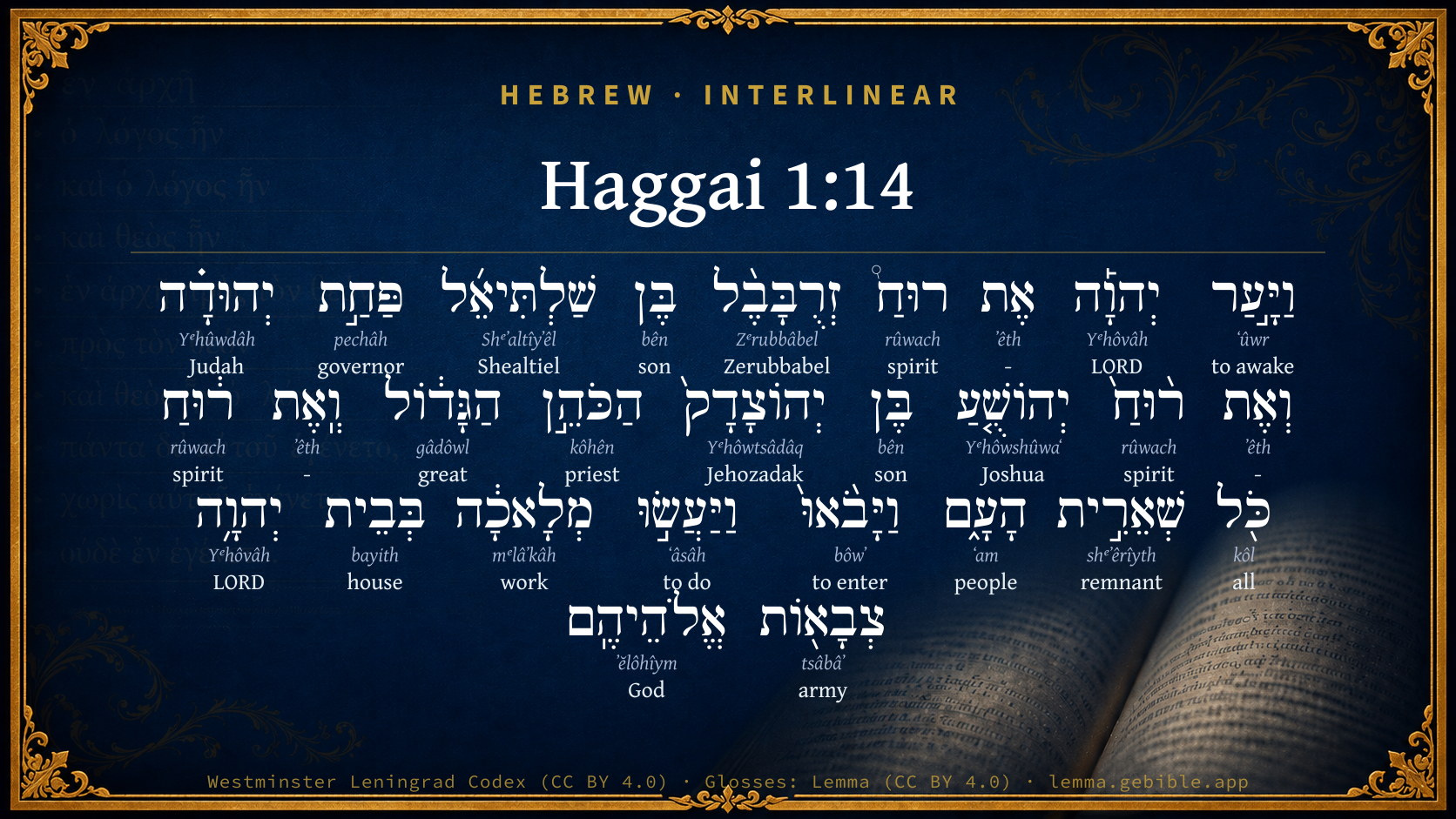
Hebrew (Westminster Leningrad Codex) Haggai 1:14 appears in the Hebrew Old Testament. The text above is from the Westminster Leningrad Codex. Each word links to its Strong’s number, a concise gloss, and parsing drawn from the Open Scriptures Hebrew Bible morphology. Click any word for its full Brown-Driver-Briggs (BDB) entry.
Download image
Cite this verse

Haggai 1:14 (World English Bible). Public Domain. Lemma interlinear Bible study tool, https://lemma.gebible.app/v/haggai/1/14.

Show BibTeX & RIS
BibTeX
RIS
English Translation
Yahweh stirred up the spirit of Zerubbabel, the son of Shealtiel, governor of Judah, and the spirit of Joshua, the son of Jehozadak, the high priest, and the spirit of all the remnant of the people; and they came and worked on the house of Yahweh of Hosts, their God,
World English Bible · Public Domain
Download a study sheet

One document with this verse’s original text, its word-by-word gloss line, the meaning frame, cross-references with their text, attributed commentary, and full source and license credits — printable, and it pastes into notes with its structure intact.

This verse Autodidact and up

Study sheet (.html) Plain text (.txt)

A passage Seminary Student

Up to 50 verses in one chapter. A passage sheet keeps up to 6 commentary sources and 12 cross-references per verse, in the order this page ranks them, and says so on the sheet whenever that leaves anything out. Ask for a single verse and you get the Autodidact verse sheet above.

Everything on this page stays free to read, with no account — the sheet is a download of what is already on screen, not access to it.

Want to remove ads? Support Godless Engineer
Compare translations 3

The same verse in 3 English versions, stacked beneath the original-language interlinear above. Click any original word for its lexicon entry.

Each is an independent rendering of the whole verse — the interlinear is not word-aligned to these translations.

Highlighted words mark where these versions differ — a whole-verse word diff, not a word-by-word alignment.

  • World English Bible Public Domain
    Yahweh stirred up the spirit of Zerubbabel, the son of Shealtiel, governor of Judah, and the spirit of Joshua, the son of Jehozadak, the high priest, and the spirit of all the remnant of the people; and they came and worked on the house of Yahweh of Hosts, their God,
  • King James Version Public Domain
    And the LORD stirred up the spirit of Zerubbabel the son of Shealtiel, governor of Judah, and the spirit of Joshua the son of Josedech, the high priest, and the spirit of all the remnant of the people; and they came and did work in the house of the LORD of hosts, their God,
  • unfoldingWord Literal Text CC BY-SA 4.0
    And Yahweh awakened the spirit of the governor of Judah, Zerubbabel son of Shealtiel, and the spirit of Joshua son of Jehozadak, the high priest, and the spirit of all of the remnant of the people, and they came and did the work on the house of Yahweh of Armies, their God,

unfoldingWord Literal Text — © unfoldingWord, licensed CC BY-SA 4.0. Word-aligned USFM3 via Door43 (git.door43.org/unfoldingWord/en_ult).

Versions to compare (up to 4)

3 of 4 selected

Show all 18 translations

Every available English version of this verse, each an independent rendering of the whole verse.

  • World English Bible Public Domain
    Yahweh stirred up the spirit of Zerubbabel, the son of Shealtiel, governor of Judah, and the spirit of Joshua, the son of Jehozadak, the high priest, and the spirit of all the remnant of the people; and they came and worked on the house of Yahweh of Hosts, their God,
  • Berean Standard Bible Public Domain
    So the LORD stirred the spirit of Zerubbabel son of Shealtiel, governor of Judah, and the spirit of Joshua son of Jehozadak, the high priest, as well as the spirit of all the remnant of the people. And they came and began the work on the house of the LORD of Hosts, their God,
  • Majority Standard Bible Public Domain
    So the LORD stirred the spirit of Zerubbabel son of Shealtiel, governor of Judah, and the spirit of Joshua son of Jehozadak, the high priest, as well as the spirit of all the remnant of the people. And they came and began the work on the house of the LORD of Hosts, their God,
  • King James Version Public Domain
    And the LORD stirred up the spirit of Zerubbabel the son of Shealtiel, governor of Judah, and the spirit of Joshua the son of Josedech, the high priest, and the spirit of all the remnant of the people; and they came and did work in the house of the LORD of hosts, their God,
  • American Standard Version (1901) Public Domain
    And Jehovah stirred up the spirit of Zerubbabel the son of Shealtiel, governor of Judah, and the spirit of Joshua the son of Jehozadak, the high priest, and the spirit of all the remnant of the people; and they came and did work on the house of Jehovah of hosts, their God,
  • Revised Version (1885) Public Domain
    And the LORD stirred up the spirit of Zerubbabel the son of Shealtiel, governor of Judah, and the spirit of Joshua the son of Jehozadak, the high priest, and the spirit of all the remnant of the people; and they came and did work in the house of the LORD of hosts, their God,
  • Geneva Bible (1599) Public Domain
    And the Lord stirred vp the spirite of Zerubbabel, the sonne of Shealtiel a prince of Iudah, and the spirit of Iehoshua the sonne of Iehozadak the hie Priest, and the spirit of all the remnant of the people, and they came, and did the worke in the House of the Lord of hostes their God.
  • Douay-Rheims (1899) Public Domain
    And the Lord stirred up the spirit of Zorobabel the son of Salathiel governor of Juda, and the spirit of Jesus the son of Josedec the high priest, and the spirit of all the rest of the people: and they went in, and did the work in the house of the Lord of hosts their God.
  • Young's Literal Translation Public Domain
    And Jehovah doth stir up the spirit of Zerubbabel son of Shealtiel, governor of Judah, and the spirit of Joshua son of Josedech, the high priest, and the spirit of all the remnant of the people, and they come in, and do work in the house of Jehovah of Hosts their God,
  • Literal Standard Version CC BY-SA 4.0
    And YHWH stirs up the spirit of Zerubbabel son of Shealtiel, governor of Judah, and the spirit of Joshua son of Josedech, the high priest, and the spirit of all the remnant of the people, and they come in, and work in the house of YHWH of Hosts their God,
  • Unlocked Literal Bible CC BY-SA 4.0
    So Yahweh stirred up the spirit of the governor of Judah, Zerubbabel son of Shealtiel, and the spirit of the high priest Joshua son of Jehozadak, and the spirit of all the remnant of the people, so that they went and worked on the house of Yahweh of hosts, their God
  • unfoldingWord Literal Text CC BY-SA 4.0
    And Yahweh awakened the spirit of the governor of Judah, Zerubbabel son of Shealtiel, and the spirit of Joshua son of Jehozadak, the high priest, and the spirit of all of the remnant of the people, and they came and did the work on the house of Yahweh of Armies, their God,
  • Darby Bible Public Domain
    And Jehovah stirred up the spirit of Zerubbabel the son of Shealtiel, governor of Judah, and the spirit of Joshua the son of Jehozadak, the high priest, and the spirit of all the remnant of the people; and they came and worked at the house of Jehovah of hosts, their God,
  • World Messianic Bible Public Domain
    The LORD stirred up the spirit of Zerubbabel the son of Shealtiel, governor of Judah, and the spirit of Joshua the son of Jehozadak, the high priest, and the spirit of all the remnant of the people; and they came and worked on the house of the LORD of Hosts, their God,
  • Webster's Bible Public Domain
    And the LORD stirred up the spirit of Zerubbabel the son of Shealtiel, governor of Judah, and the spirit of Joshua the son of Josedech, the high priest, and the spirit of all the remnant of the people; and they came and performed work in the house of the LORD of hosts, their God,
  • Free Bible Version CC BY-SA 4.0
    The Lord inspired Zerubbabel, son of Shealtiel, governor of Judah, and Joshua, son of Jehozadak, the high priest, and all the remaining people. They came and began work on the house of the Lord Almighty.
  • Bible in Basic English Public Domain
    And the spirit of Zerubbabel, the son of Shealtiel, ruler of Judah, was moved by the Lord, as was the spirit of Joshua, the son of Jehozadak, the high priest, and the spirit of all the rest of the people; and they came and did work in the house of the Lord of armies, their God.
  • JPS Tanakh (1917) Public Domain
    And the LORD stirred up the spirit of Zerubbabel the son of Shealtiel, governor of Judah, and the spirit of Joshua the son of Jehozadak, the high priest, and the spirit of all the remnant of the people; and they came and did work in the house of the LORD of hosts, their God,

Literal Standard Version (2020), Covenant Press — licensed CC BY-SA 4.0. Text via the HelloAO Bible API (eBible.org). Unlocked Literal Bible (unfoldingWord) — licensed CC BY-SA 4.0. Text via the HelloAO Bible API (eBible.org). unfoldingWord Literal Text — © unfoldingWord, licensed CC BY-SA 4.0. Word-aligned USFM3 via Door43 (git.door43.org/unfoldingWord/en_ult). Free Bible Version, Dr. Jonathan Gallagher — licensed CC BY-SA 4.0. Text via the HelloAO Bible API (eBible.org).

Word by word

More ways to search: Search by grammar → Find every occurrence → Compare this word →

Practice this passage: Drill this verse → Learn its vocabulary →

יְהוֹצָדָק֙
Yᵉhôwtsâdâq
H3087
“Jehozadak”
Noun, Proper
Part of Speech
Noun
Type
Proper
Full BDB Definition

Origin: from H3068 and H6663

TWOT: None

Jehozadak or Josedech = "Jehovah is righteous" - grandson of the high priest Hilkiah; son of the high priest Seraiah; and father of the high priest Joshua; he never attained the office of high priest himself because he was carried captive to Babylon by Nebuchadnezzar
  1. וַיָּ֣עַר ʻûwr H5782 “and · to awake” Conjunction + Verb, Hiphil, Sequential Imperfect, 3rd Person, Masculine, Singular
  2. יְהוָ֡ה Yᵉhôvâh H3068 “LORD” Noun, Proper
  3. אֶת ʼêth H853 “-” Particle, Direct Object
  4. רוּחַ֩ rûwach H7307 “spirit of” Noun, Common, Both, Singular, Construct
  5. זְרֻבָּבֶ֨ל Zᵉrubbâbel H2216 “Zerubbabel” Noun, Proper
  6. בֶּן bên H1121 “son of” Noun, Common, Masculine, Singular, Construct
  7. שַׁלְתִּיאֵ֜ל Shᵉʼaltîyʼêl H7597 “Shealtiel” Noun, Proper
  8. פַּחַ֣ת pechâh H6346 “governor of” Noun, Common, Masculine, Singular, Construct
  9. יְהוּדָ֗ה Yᵉhûwdâh H3063 “Judah” Noun, Proper
  10. וְאֶת ʼêth H853 “and · -” Conjunction + Particle, Direct Object
  11. ר֨וּחַ֙ rûwach H7307 “spirit of” Noun, Common, Both, Singular, Construct
  12. יְהוֹשֻׁ֤עַ Yᵉhôwshûwaʻ H3091 “Joshua” Noun, Proper
  13. בֶּן bên H1121 “son of” Noun, Common, Masculine, Singular, Construct
  14. הַכֹּהֵ֣ן kôhên H3548 “the · priest” Particle, Definite Article + Noun, Common, Masculine, Singular, Absolute
  15. הַגָּד֔וֹל gâdôwl H1419 “the · great” Particle, Definite Article + Adjective, Adjective, Masculine, Singular, Absolute
  16. וְֽאֶת ʼêth H853 “and · -” Conjunction + Particle, Direct Object
  17. ר֔וּחַ rûwach H7307 “spirit of” Noun, Common, Both, Singular, Construct
  18. כֹּ֖ל kôl H3605 “all of” Noun, Common, Masculine, Singular, Construct
  19. שְׁאֵרִ֣ית shᵉʼêrîyth H7611 “remnant of” Noun, Common, Feminine, Singular, Construct
  20. הָעָ֑ם ʻam H5971 “the · people” Particle, Definite Article + Noun, Common, Masculine, Singular, Absolute
  21. וַיָּבֹ֨אוּ֙ bôwʼ H935 “and · to enter” Conjunction + Verb, Qal, Sequential Imperfect, 3rd Person, Masculine, Plural
  22. וַיַּעֲשׂ֣וּ ʻâsâh H6213 “and · to do” Conjunction + Verb, Qal, Sequential Imperfect, 3rd Person, Masculine, Plural
  23. מְלָאכָ֔ה mᵉlâʼkâh H4399 “work” Noun, Common, Feminine, Singular, Absolute
  24. בְּבֵית bayith H1004 “in/at · house of” Preposition + Noun, Common, Masculine, Singular, Construct
  25. יְהוָ֥ה Yᵉhôvâh H3068 “LORD” Noun, Proper
  26. צְבָא֖וֹת tsâbâʼ H6635 “armies” Noun, Common, Both, Plural, Absolute
  27. אֱלֹהֵיהֶֽם ʼĕlôhîym H430 “God(s) · their” Noun, Common, Masculine, Plural, Construct + Suffix, Personal, 3rd Person, Masculine, Plural

About this verse

These counts appear in no published source. They are computed here, from the morphology-tagged text and Lemma’s own curated glosses. What Lemma adds →

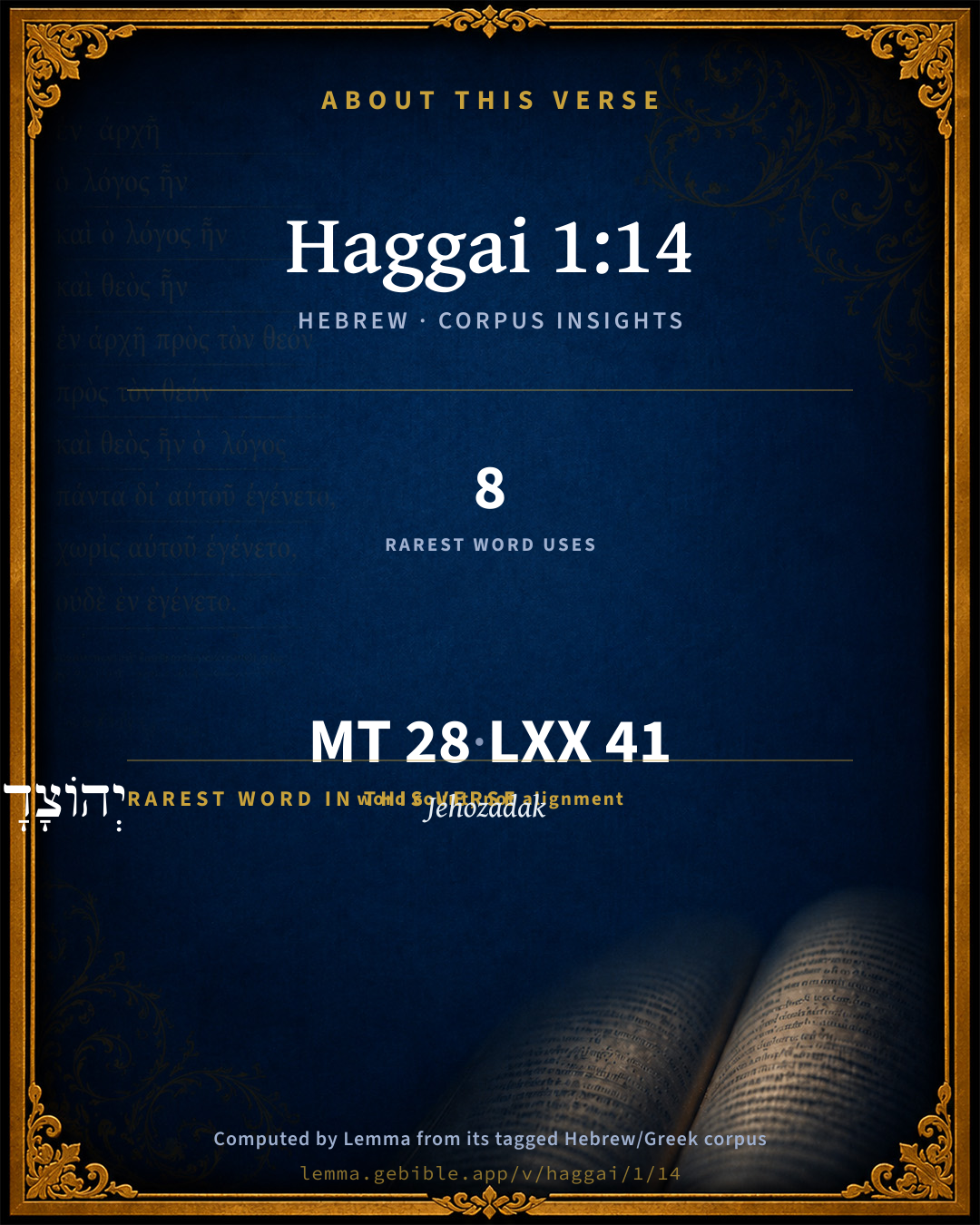
28
words
22
distinct lemmas
Prophets
section

Notable vocabulary

The rarest word here is יְהוֹצָדָק֙ Jehozadak H3087 — appearing just 8 times in the whole Hebrew Bible.

Shared distinctive vocabulary

יְהוֹצָדָק֙ Jehozadak H3087 occurs in 8 verses of the Hebrew Bible. Also found in:

Grammatical profile

  • 3 verbs
  • 21 nouns
  • 1 adjective
  • 3 particles

Verb forms

  • וַיָּ֣עַר Hiphil · Sequential Imperfect
  • וַיָּבֹ֨אוּ֙ Qal · Sequential Imperfect
  • וַיַּעֲשׂ֣וּ Qal · Sequential Imperfect

Repetition

Words recur within this verse — often emphatic in Hebrew:

  • רוּחַ֩ spirit H7307 ×3
  • יְהוָ֡ה LORD H3068 ×2
  • בֶּן son H1121 ×2

Hebrew & Septuagint length

In English translation the verse runs 50 words from the Hebrew and 55 from the Septuagint (LXX English) — closely comparable.

A rough comparison of the two English renderings, which tokenize alike — not a word-level alignment.

Word counts can differ between the Hebrew and the Greek without any difference in meaning — e.g. the Hebrew direct-object marker אֵת has no separate Greek word, and Greek often adds the article ὁ.

In the original languages it is 28 Hebrew tokens and 41 Greek tokens — but the two are counted differently (Hebrew bundles its prefixes and suffixes into one token; the Greek is in lemma form), so that isn’t a like-for-like length.

Cross-references

18

Topical passages linked to Haggai 1:14 in the Treasury of Scripture Knowledge — connected by theme and wording, ordered by reader-vote popularity; previews shown in the World English Bible.

  • 2 Chronicles 36:22 Now in the first year of Cyrus king of Persia, that the word of Yahweh by the mouth of Jeremiah might be accomplished, Yahweh stirred up the spirit of Cyrus king of Persia, so that he made a proclamation throughout all his kingdom, and [put it] also in writing, saying,
  • Hebrews 13:21 make you complete in every good work to do his will, working in you that which is well pleasing in his sight, through Jesus Christ, to whom be the glory forever and ever. Amen.
  • Ezra 1:1 Now in the first year of Cyrus king of Persia, that the word of Yahweh by the mouth of Jeremiah might be accomplished, Yahweh stirred up the spirit of Cyrus king of Persia, so that he made a proclamation throughout all his kingdom, and [put it] also in writing, saying,
  • Ezra 1:5 Then rose up the heads of fathers' [houses] of Judah and Benjamin, and the priests, and the Levites, even all whose spirit God had stirred to go up to build the house of Yahweh which is in Jerusalem.
  • Haggai 1:1 In the second year of Darius the king, in the sixth month, in the first day of the month, the Word of Yahweh came by Haggai, the prophet, to Zerubbabel, the son of Shealtiel, governor of Judah, and to Joshua, the son of Jehozadak, the high priest, saying,
  • Haggai 2:21 "Speak to Zerubbabel, governor of Judah, saying, 'I will shake the heavens and the earth.
  • 1 Chronicles 5:26 The God of Israel stirred up the spirit of Pul king of Assyria, and the spirit of Tilgath Pilneser king of Assyria, and he carried them away, even the Reubenites, and the Gadites, and the half-tribe of Manasseh, and brought them to Halah, and Habor, and Hara, and to the river of Gozan, to this day.
  • Ezra 5:2 Then rose up Zerubbabel the son of Shealtiel, and Jeshua the son of Jozadak, and began to build the house of God which is at Jerusalem; and with them were the prophets of God, helping them.
  • Ezra 5:8 Be it known to the king, that we went into the province of Judah, to the house of the great God, which is built with great stones, and timber is laid in the walls; and this work goes on with diligence and prospers in their hands.
  • Nehemiah 4:6 So we built the wall; and all the wall was joined together to half [the height] of it: for the people had a mind to work.
  • Haggai 2:2 "Speak now to Zerubbabel, the son of Shealtiel, governor of Judah, and to Joshua, the son of Jehozadak, the high priest, and to the remnant of the people, saying,
  • Philippians 2:12–13 So then, my beloved, even as you have always obeyed, not only in my presence, but now much more in my absence, work out your own salvation with fear and trembling.
  • Psalms 110:3 Your people offer themselves willingly in the day of your power, in holy array. Out of the womb of the morning, you have the dew of your youth.
  • Haggai 1:12 Then Zerubbabel, the son of Shealtiel, and Joshua, the son of Jehozadak, the high priest, with all the remnant of the people, obeyed the voice of Yahweh, their God, and the words of Haggai, the prophet, as Yahweh, their God, had sent him; and the people feared Yahweh.
  • 1 Corinthians 12:4–11 Now there are various kinds of gifts, but the same Spirit.
  • 1 Corinthians 15:58 Therefore, my beloved brothers, be steadfast, immovable, always abounding in the Lord's work, because you know that your labor is not in vain in the Lord.
  • 2 Corinthians 8:16 But thanks be to God, who puts the same earnest care for you into the heart of Titus.
  • Ezra 7:27–28 Blessed be Yahweh, the God of our fathers, who has put such a thing as this in the king's heart, to beautify the house of Yahweh which is in Jerusalem;

Cross-references courtesy of OpenBible.info (CC BY 4.0).

Hebrew and Greek witnesses Masoretic Hebrew ↔ Greek Septuagint

The same verse in the two great witnesses to the Old Testament, shown verse-for-verse.

These are two independent witnesses, not word-aligned to each other, and the Septuagint is shown in lemma (dictionary) form.

Hebrew Haggai 1:14 Masoretic · Westminster Leningrad Codex

וַיָּ֣עַר יְהוָ֡ה אֶת רוּחַ֩ זְרֻבָּבֶ֨ל בֶּן שַׁלְתִּיאֵ֜ל פַּחַ֣ת יְהוּדָ֗ה וְאֶת ר֨וּחַ֙ יְהוֹשֻׁ֤עַ בֶּן יְהוֹצָדָק֙ הַכֹּהֵ֣ן הַגָּד֔וֹל וְֽאֶת ר֔וּחַ כֹּ֖ל שְׁאֵרִ֣ית הָעָ֑ם וַיָּבֹ֨אוּ֙ וַיַּעֲשׂ֣וּ מְלָאכָ֔ה בְּבֵית יְהוָ֥ה צְבָא֖וֹת אֱלֹהֵיהֶֽם

Yahweh stirred up the spirit of Zerubbabel, the son of Shealtiel, governor of Judah, and the spirit of Joshua, the son of Jehozadak, the high priest, and the spirit of all the remnant of the people; and they came and worked on the house of Yahweh of Hosts, their God,

World English Bible · Public Domain

Greek LXX Haggai 1:14 Septuagint · lemma form

καί ἐκἀγείρω κύριος ὁ πνεῦμα ζοροβαβελ ὁ σαλαθιηλ ἐκ φυλή ιουδα καί ὁ πνεῦμα ἰησοῦς ὁ ιωσεδεκ ὁ ἱερεύς ὁ μέγας καί ὁ πνεῦμα ὁ κατάλοιπος πᾶς ὁ λαός καί εἰςἔρχομαι καί ποιέω ἔργον ἐν ὁ οἶκος κύριος παντοκράτωρ θεός αὐτός

And the Lord stirred up the spirit of Zorobabel the son of Salathiel, of the tribe of Juda, and the spirit of Jesus the son of Josedec, the high priest, and the spirit of the remnant of all the people; and they went in, and wrought in the house of the Lord Almighty their God,

LXX2012 (modern English Septuagint) · Public Domain

On this verse, Haydock's Catholic Bible Commentary discusses the Septuagint’s reading. Read the note in Commentary ↓

Hebrew: Westminster Leningrad Codex (CC BY 4.0). Greek: Septuagint (public domain); English from LXX2012 (modern English Septuagint) (Public Domain). How the Septuagint differs from the Hebrew →

Targum (Aramaic paraphrase)

1

The Targum is the ancient Jewish Aramaic paraphrase of the Hebrew Scriptures — an interpretive translation, not the Hebrew text itself. Onkelos (literal) and Pseudo-Jonathan (expansive) render the Torah, and Jonathan the Prophets. Coverage is partial: where no permissively-licensed English translation exists for a verse, only the Aramaic is shown. This is verse-level text, not a word-by-word alignment to the Hebrew.

  1. Targum Jonathan Prophets (Joshua–Malachi)
    וְאָעֵר יְיָ יַת רוּחַ זְרֻבָּבֶל בַּר שְׁאַלְתִּיאֵל רַבָּא דְבֵית יְהוּדָה וְיַת רוּחַ יְהוֹשֻׁעַ בַּר יְהוֹצָדָק כַּהֲנָא רַבָּא וְיַת רוּחַ כָּל שְׁאָרָא דְעַמָא וַאֲתוֹ וַעֲבְדוּ עֲבִידְתָּא בְּבֵית מַקְדְשָׁא דַייָ צְבָאוֹת אֱלָהָא:

    (no public-domain English translation for this verse)

    Targum Jonathan — Aramaic: “Mikraot Gedolot” (public domain). English: “Sefaria Community Translation” (CC0 1.0 (public-domain dedication)); “London "Chaldee Paraphrase," 1871” (public domain). Text via Sefaria.

Commentary

Notes on Haggai 1:14 from classic Christian and Jewish commentators (each source and its license shown beneath its notes). The classic Christian expositions comment on the surrounding passage and are grouped to its opening verse, so a note may address several verses; the Jewish commentaries on the Tanakh (Rashi and others) are per-verse, so they appear only where the commentator wrote on this verse.

Lemma curates 59 commentaries, every one of them public domain or Creative Commons licensed, each selected and text-cleaned for this edition rather than reprinted as found. About our sources →

Trapp's Complete Commentary

John Trapp

Hag 1:14 And the LORD stirred up the spirit of Zerubbabel the son of Shealtiel, governor of Judah, and the spirit of Joshua the son of Josedech, the high priest, and the spirit of all the remnant of the people; and they came and did work in the house of the LORD of hosts, their God,

Ver. 14. And the Lord stirred up the spirit of Zerubbabel, &c.] Here is the appendix of the foregoing sermon, whereof we have heard but the brief notes. That one word, I am with you, seconded and set on by God’s holy Spirit, set them all to work. "How forcible are right words!" Job 6:25. One seasonable truth falling on a prepared heart hath often a strong and sweet operation, sc. when God is pleased to work with it, and make it effectual; this man cannot do no more than the husbandman can make a harvest. "The weapons of our warfare are mighty, through God, to the pulling down of strongholds," 2Co 10:4. Luther, having heard Staupicius say, that that is kindly repentance which begins from the love of God, found from that time forward the practice of repentance far sweeter to him than before. Galeacius Caracciolus, an Italian marquis, was converted by an apt similitude used by Peter Martyr, reading on the First Epistle to the Corinthians. Dr Taylor, martyr, blessed God that ever he became fellow prisoner to that angel of God (as he called him), John Bradford. Senarclaeus (in his epistle to Bucer, prefixed before the history of the death of John Diarius, slain by his own brother, as Abel was, for religion’s sake), I remember, saith he, when he and I were together at Newburg, the day before his slaughter, he gave me a great deal of grave and gracious counsel: Ego vero illius oratione sic incendebar, ut cum eum disserentem audirem, Spiritus Sancti verba me audire existimarem, i.e. I was so stirred up with his discourse, as if I had heard the Holy Ghost himself speaking unto me; so fervent was he, and full of life; for he first felt what he spake, and then spake what he felt. So should all do that desire to speak to purpose; and then pray to God, as for a door of utterance, so for a door of entrance to be opened unto them; such as St Paul had to the heart of Lydia, and as Bishop Ridley had to the heart of good King Edward VI, whereof before.

And they came and did work] The governors also, by overseeing others, and ruling the business by their discretion. Where God’s glory and the common good is concerned all sorts must set to their helping hand.

John Trapp, A Commentary or Exposition upon All the Books of the Old and New Testament (1647–1656) — public domain. Text from a community e-Sword module.

The Biblical Illustrator

Joseph S. Exell

Hag_1:14

And the Lord stirred up the spirit of Zerubbabel.

Stirring up the Spirit

It is not right to restrict the influence of the Spirit to one thing only, as some do, who imagine that the Israelites were confirmed in their good resolution, as they say, having before spontaneously obeyed the Word of God. These separate, without reason, what ought to be read in the prophet as connected together. For God roused the spirit of Zerubbabel and of the whole people; and hence it was that they received the message of the prophet and were attentive to his words. Foolishly, then, do they imagine that the Israelites were led by their own free will to obey the Word of God, and then that some aid of the Holy Spirit followed, to make them firmly persevere in their course. But the prophet declared, in the first place, that his message was respectfully received by the ]people; and now he explains how it was, even because God had touched the hearts of the whole people. We ought to notice the expression, when it is said that the spirit of Zerubbabel and of all the people was stirred up. For much sloth, we Know, prevailed, especially among the multitude. But as to Zerubbabel and Joshua, they were already willing, but delayed until the coldness under which they laboured was reproved. But the prophet here simply means that they became thus obedient through the hidden impulse of God, and also that they were made firm in their purpose. God does not form new souls in us, when He draws us to His service, but changes what is wrong in us; for we should never be attentive to His Word, if He did not open our ears; and there would be no inclination to obey, were He not to turn our hearts; in a word, both will and effort would immediately fail in us, were He not to add His gift of perseverance. (John Calvin.)

The duty of rulers, ministers, and the community, to promote and increase the means of grace

However vast may be the indifference to the cause of Christ, and, therein, to the well-being of the human race, it is a source of encouragement to feel that there is not only pervading our land a holy seed, which is the substance of the Church, from whence its fruit-bearing branches spring; but that the number is increasing--slowly, perhaps, but certainly--of those who, professing to believe the Gospel, feel the obligation of applying its truths and its responsibilities to the guidance of their conscience, and the regulation of their practice.

1. Consider the necessity of enlarged means of grace for our countrymen. This necessity arises from the incalculable increase of our population. Of these people, the immense majority are congregated in masses in the metropolis, and in the trading and manufacturing districts. But what are the moral circumstances under which they have arisen, and are hourly arising? Is it with an expansion of the national Church, commensurate with the wants of the nation? Unhappily not. Where then is the basis on which social duty is to stand? How can we indulge such wild fanaticism as to expect the fruits of honesty, sobriety, and affection, respect for property or office, authority, regard to decorum, peace, and virtue, among multitudes who are growing up utterly unacquainted with the only tie by which moral obligation binds the conscience; ignorant of the only fountain from whence relative and social affection flow, and unhabituated to that softening influence which familiarity with the means of grace, and the kind sympathy of pastoral intercourse engender and maintain? Moreover, every agency of mischief is set on foot to corrupt men more and more, to enlist their innate passions, and to array their imagined happiness and interest in opposition to all that is holy, venerable, and good. Few of us, perhaps, are acquainted with the extent of that agency of Satan--an evil press--working amongst us. The necessity being admitted, upon whom does the duty of meeting it devolve? Upon all, upon every one, according to the ability which God has given.

1. The voice of heaven appeals to the civil ruler. On him devolves the obligation of providing for the moral well-being of those who are entrusted to his charge, since by this alone can the ends of government, peace, order, and security be attained.

2. The obligation especially devolves upon the ministers of religion. The Church of Christ is to be a witness for God, bearing testimony to man of the things of eternity; to be a light of truth, dispersing the dark and troubled desolation of falsehood, superstition, and impiety.

3. The duty devolves upon all the remnant of the people, the whole community of professing Christians. He who speaks of the Church as embracing the clergy alone, and not the whole congregation of faithful men, speaks unscripturally, untruly, and unwisely. If there is any class of persons upon whom this duty devolves with more responsibility than others, it is upon the land-owners, merchants, and manufacturers, who derive their wealth and their enjoyment by congregating multitudes to dwell upon their lands, or to labour for them. (John Garbett, M. A.)

The Biblical Illustrator, edited by Joseph S. Exell (c. 1880s–1900s) — public domain. Text from a community e-Sword module.

Tyndale Open Study Notes

Tyndale Open Resources

1:14 The Lord sparked the enthusiasm (literally stirred the spirit) of the people to accomplish his purposes (see Ezra 1:1; Isa 13:17; 41:25; Jer 51:1, 11). True worship of God prompts sacrificial service by God’s people.

Tyndale Open Study Notes — © Tyndale Open Resources, licensed CC BY-SA 4.0. Text via the HelloAO Bible API.

Geneva Bible (1599)

Geneva Bible translators

Which declareth that men are inept and dull to serve the Lord, neither can they obey his word or his messengers, before God reform their hearts, and give them new spirits, John 6:44.

Geneva Bible (1599) marginal notes — public domain. Text via Bolls.life.

Jamieson, Fausset & Brown

Robert Jamieson, A. R. Fausset & David Brown

Lord stirred up the spirit of, &c.--God gave them alacrity and perseverance in the good work, though slothful in themselves. Every good impulse and revival of religion is the direct work of God by His Spirit.

came and did work--collected the wood and stones and other materials (compare Hag 1:8) for the work. Not actually built or "laid the (secondary) foundations" of the temple, for this was not done till three months after, namely, the twenty-fourth day of the ninth month (Hag 2:18) [GROTIUS].

Jamieson, Fausset & Brown — Commentary Critical and Explanatory on the Whole Bible (1871) — public domain (CC PDM 1.0). Text via the HelloAO Bible API.

Adam Clarke's Commentary

Verse 14. And the Lord stirred up the spirit] It is not only necessary that the judgment should be enlightened, but the soul must be invigorated by the Spirit of God, before any good work can be effectually done.

Adam Clarke's Commentary on the Bible (1810–1826) — public domain. Text from a community e-Sword/MySword module.

The Cambridge Bible for Schools and Colleges

gen. ed. J. J. S. Perowne

14. the Lord stirred up, &c.] It would seem that the prevailing indifference and neglect by which they were surrounded had, in some measure at least, damped the ardour and quenched the spirit even of Zerubbabel and Joshua. It needed the same breath of heaven which had first kindled the fire of divine zeal in their hearts, to rouse the now smouldering embers into living flame again (ἀναζωπυρεῖν τὸ χάρισμα, 2Ti_1:6).

came and did work] The word “came,” may here be little more than pleonastic, but perhaps it refers to the coming of the people from the neighbouring towns and country to Jerusalem, as we know they did when the altar was first set up (Ezr_3:1). They “did,” or executed work (the word work is here a noun, not a verb) in the rebuilding of the Temple. Comp. Ezr_5:1-2.

The Cambridge Bible for Schools and Colleges (gen. ed. J. J. S. Perowne; Cambridge University Press, 1878–1918) — public domain. Text from a community e-Sword module.

John Gill's Exposition

And the Lord stirred up the spirit of Zerubbabel the son of Shealtiel, governor of Judah, and the spirit of Joshua the son of Josedech, the high priest, and the spirit of all the remnant of the people,.... He roused them up from that sleep and sloth in which they were before, both the governors and common people; he wrought in them both to will and do; or a willing mind to do his work in building his house; he gave them a spirit both of industry and courage; he enabled them to shake off that sluggish disposition they were attended with, and that fear of men which possessed them; he inspired them with zeal and resolution to enter upon the work at once, and pursue it with close application; the Lord only could do this:

and they came and did work in the house of the Lord of hosts, their God; the governor and high priest came to direct and oversee, encourage and animate the people by their presence and example; and the people to do the several parts of service that belonged to them, according to their genius and employment.

John Gill's Exposition of the Whole Bible (1746–1763) — public domain (CC PDM 1.0). Text via the HelloAO Bible API.

Albert Barnes' Notes on the Bible

And the Lord stirred up the spirit - The words are used of any strong impulse from God to fulfill His will, whether in those who execute His will unknowingly as Pul 1Ch 5:26, to carry off the trans-Jordanic tribes, or the Philistines and Arabians against Jehoram, 2Ch 21:16. or the Medes against Babylon Jer 51:11, or knowingly, as of Cyrus to restore God’s people and rebuild the temple Ezr 1:1, or of the people themselves to return Ezr 1:5 , “The spirit of Zerubbabel and the spirit of Joshua were stirred, that the government and priesthood may build the temple of God: the spirit of the people too, which before was asleep in them; not the body, not the soul, but the spirit. which knoweth best how to build the temple of God.” “The Holy Spirit is stirred up in us, that we should enter the house of the Lord, and do the works of the Lord.”

“Again, observe that they did not set themselves to choose to do what should please God, before He was with them and stirred up their spirit. We shall know hence also, that although one choose zealously to do good and be in earnest therein, yet he will accomplish nothing, unless God be with him, raising him up to dare, and sharpening him to endure, and removing all torpor. For so the wondrous Paul says of those entrusted with the divine preaching 1Co 15:11, I labored more abundantly than they all, yet added very wisely, yet not I, but the grace of God which was with me, and the Saviour Himself saith to the holy Apostles, Joh 15:5. Without Me ye can do nothing. For He is our desire, He, our courage to any good work; He our strength, and, if He is with us, we shall do well Eph 2:21-22, building ourselves to a holy temple, a habitation of God in the Spirit; if He depart and withdraws, how should any doubt, that we should fail, overcome by sluggishness and want of courage?”

Albert Barnes' Notes on the Bible (1834–1885) — public domain. Text from a community e-Sword/MySword module.

Haydock's Catholic Bible Commentary

Work. Septuagint, "works." (Haydock) --- They prepared materials, and began the temple on the 24th of the ninth month, chap. ii. 16, 19. (Menochius)

George Leo Haydock (1774–1849), Haydock's Catholic Family Bible and Commentary, 1859 edition — public domain. Excludes Psalms (Douay-Rheims chapter numbering differs from Protestant) and Deuterocanonical books (Catholic canon only).

Matthew Poole's English Annotations

The Lord stirred up: this is the first notable effect of God’s presence with them, a sensible performance of his promise. God inclined their minds, fixed their resolutions, and inspired them with courage for this work; whereas the stoutest of them before had no mind to set on this work, now the weakest are forward to it, and bold in it.

The spirit; the heart, mind, or inclination.

Shealtiel: see Hag 1:12.

Governor: see Hag 1:1,

Josedech: see Hag 1:1,12.

The remnant: see Hag 1:12.

They came, immediately, without delay, and unanimously, without any visible dissent.

Did work; every one set their hands to it in such manner as was fit for them; governors did oversee, direct, and encourage the workmen; artificers framed and prepared, and the people all laboured. In the house; which was now to be built upon the old foundations, laid some seventeen years before, when Cyrus gave the Jews leave to return and build their city and temple.

The Lord of hosts; by which name he delights to be known among the returned captives; and it was a name best suited to their present state, compassed on all hands with enemies, and in perpetual danger by them.

Their God: see Hab 1:12.

Matthew Poole's English Annotations on the Holy Bible (1683–1685) — public domain. Text from a community e-Sword/MySword module.

Whedon's Commentary on the Bible

Daniel D. Whedon

14, 15. The promise that Jehovah would co-operate filled the people with enthusiasm.

Stirred up the spirit — He imparted a spirit of willingness and determination (see on Joe_2:28), and enthusiastically they set to work on the twenty-fourth day of the sixth month, just twenty-three days after Haggai had first rebuked their indifference (compare Ezr_5:1-2). There is insufficient reason for doubting the originality of Hag_1:15.

Daniel D. Whedon (gen. ed.), Commentary on the Old and New Testaments (1874–1909) — public domain. Text from a community e-Sword module.

The Pulpit Commentary

The Lord stirred up, etc. The Lord excited the courage, animated the zeal, of the chiefs of the nation, who had themselves succumbed to the prevailing indifference, and had suffered their ardour to be quenched. (comp. 1Ch_5:26 2Ch_21:16; Ezr_1:1, Ezr_1:5) They came and did work. They went up to the temple and began to do the work which they had so long neglected.

The Pulpit Commentary (1880–1919), ed. H.D.M. Spence-Jones & Joseph S. Exell — public domain. Text from a community e-Sword module.

John Wesley's Explanatory Notes

The Lord of hosts - By which name he delights to be known among the returned captives; and it was a name best suited to their present state, compassed on all hands with enemies.

John Wesley, Explanatory Notes Upon the Whole Bible (1754–1765) — public domain. Text via the GEBible commentary corpus.

Scofield Reference Notes

C. I. Scofield

remnant

(See Scofield "Jer 15:21").

The Scofield Reference Bible (1917 edition), notes by C. I. Scofield — public domain. Text from a community e-Sword module.

unfoldingWord translationNotes

Door43 World Missions Community

Yahweh stirred up the spirit of the governor of Judah, Zerubbabel son of Shealtiel, and the spirit of the high priest Joshua son of Jehozadak, and the spirit of all the remnant of the people

Stirring the spirit is a metonym for making someone want to act. AT: "Yahweh made the governor of Judah, Zerubbabel son of Shealtiel, and the high priest Joshua son of Jehozadak, and all the remnant of the people want to act" (See: Metonymy)

remnant

people who were still alive after being captive in Babylon and had returned to Jerusalem

in the twenty-fourth day of the sixth month

This is just 23 days after he received the vision. This is the sixth month of the Hebrew calendar. The twenty-fourth day is near the middle of September on Western calendars. (See: Hebrew Months and Ordinal Numbers)

the second year of Darius the king

"second year of the reign of Darius the king" or "after Darius had been king for more than one year" (See: Ordinal Numbers)

translationWords

Yahweh

spirit

Judah

Joshua

Yahweh of hosts

God

day

year

Darius

king

unfoldingWord translationNotes — © Distant Shores Media and the Door43 World Missions Community, licensed CC BY-SA 4.0. Source: git.door43.org/Door43/en_tn.

Rashi

Rabbi Shlomo Yitzchaki (Rashi)

and they came and performed labor They commenced cutting stones and sawing trees in the sixth month, on the twenty fourth of the month; and in the seventh month, on the twenty-first day, the word of the Lord came to Haggai.

Rashi on the Tanakh — English translations: “The Judaica Press complete Tanach with Rashi, translated by A. J. Rosenberg” (CC BY 4.0); “Pentateuch with Rashi's commentary by M. Rosenbaum and A.M. Silbermann, 1929-1934” (public domain); “The Metsudah Tanach series, Lakewood, N.J” (CC BY 4.0); and “The Book of Joshua, Metsudah Publications, 1997” (CC BY 4.0). Text via Sefaria.

Lesson kit

Teaching starters — assembled from the data on this page, not authored interpretation. Every prompt links to the verse data it draws on. Edit before teaching.

Haggai, in the Prophets, opens this verse with 28 words (22 distinct Hebrew lemmas). Its most distinctive word is Yᵉhôwtsâdâq (“Jehozadak”). A historical commentator’s framing appears above. Read the whole chapter for the surrounding context.

Discussion questions

  1. How does “Jehozadak” (Yᵉhôwtsâdâq) shape what this verse is saying?
  2. How does 1 Chronicles 6:14, which shares the word «Jehozadak», read alongside this verse?
  3. What does the repetition of “spirit” (3× in this one verse) do in this verse?
  4. The translations on this page render this verse differently — a whole-verse word diff, not a word-by-word alignment. What might account for the different wordings?
  5. «וַיָּ֣עַר» is a Hiphil Sequential Imperfect verb. How does that grammatical form shape the action described?
  6. Compare how Trapp's Complete Commentary and The Biblical Illustrator read this verse. Where do they agree or differ?

Things to notice

Reading settings

Reading text

Shown beneath each verse's original-language words.

Old Testament
Old Testament edition

Read the OT as the Masoretic Hebrew (MT) or the Greek Septuagint (LXX).

English shown for the Greek Septuagint (in the Hebrew ↔ Greek comparison).

Comparing translations? Open the Compare panel on any verse page to stack up to four side by side.