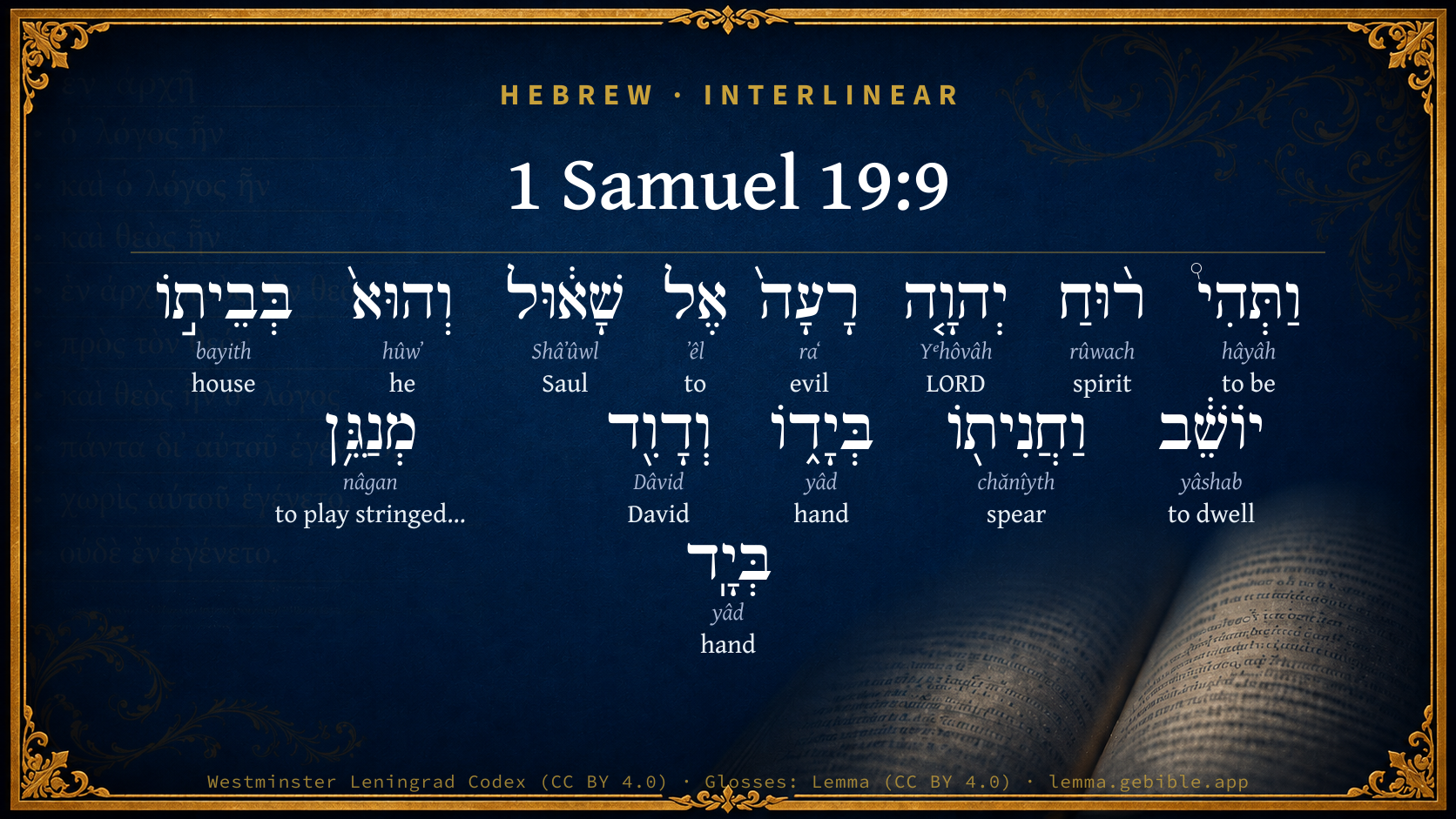
1 Samuel 19:9

Hebrew (Westminster Leningrad Codex) 1 Samuel 19:9 appears in the Hebrew Old Testament. The text above is from the Westminster Leningrad Codex. Each word links to its Strong’s number, a concise gloss, and parsing drawn from the Open Scriptures Hebrew Bible morphology. Click any word for its full Brown-Driver-Briggs (BDB) entry.
Download image
Cite this verse

1 Samuel 19:9 (World English Bible). Public Domain. Lemma interlinear Bible study tool, https://lemma.gebible.app/v/1-samuel/19/9.

Show BibTeX & RIS
BibTeX
RIS
English Translation
An evil spirit from Yahweh was on Saul, as he sat in his house with his spear in his hand; and David was playing with his hand.
World English Bible · Public Domain
Download a study sheet

One document with this verse’s original text, its word-by-word gloss line, the meaning frame, cross-references with their text, attributed commentary, and full source and license credits — printable, and it pastes into notes with its structure intact.

This verse Autodidact and up

Study sheet (.html) Plain text (.txt)

A passage Seminary Student

Up to 50 verses in one chapter. A passage sheet keeps up to 6 commentary sources and 12 cross-references per verse, in the order this page ranks them, and says so on the sheet whenever that leaves anything out. Ask for a single verse and you get the Autodidact verse sheet above.

Everything on this page stays free to read, with no account — the sheet is a download of what is already on screen, not access to it.

Want to remove ads? Support Godless Engineer
Compare translations 3

The same verse in 3 English versions, stacked beneath the original-language interlinear above. Click any original word for its lexicon entry.

Each is an independent rendering of the whole verse — the interlinear is not word-aligned to these translations.

Highlighted words mark where these versions differ — a whole-verse word diff, not a word-by-word alignment.

  • World English Bible Public Domain
    An evil spirit from Yahweh was on Saul, as he sat in his house with his spear in his hand; and David was playing with his hand.
  • King James Version Public Domain
    And the evil spirit from the LORD was upon Saul, as he sat in his house with his javelin in his hand: and David played with his hand.
  • unfoldingWord Literal Text CC BY-SA 4.0
    And a bad spirit from Yahweh came upon Saul, and he was sitting in his house, and his spear in his hand, and David was playing by hand.

unfoldingWord Literal Text — © unfoldingWord, licensed CC BY-SA 4.0. Word-aligned USFM3 via Door43 (git.door43.org/unfoldingWord/en_ult).

Versions to compare (up to 4)

3 of 4 selected

Show all 18 translations

Every available English version of this verse, each an independent rendering of the whole verse.

  • World English Bible Public Domain
    An evil spirit from Yahweh was on Saul, as he sat in his house with his spear in his hand; and David was playing with his hand.
  • Berean Standard Bible Public Domain
    But as Saul was sitting in his house with his spear in his hand, a spirit of distress from the LORD came upon him. While David was playing the harp,
  • Majority Standard Bible Public Domain
    But as Saul was sitting in his house with his spear in his hand, a spirit of distress from the LORD came upon him. While David was playing the harp,
  • King James Version Public Domain
    And the evil spirit from the LORD was upon Saul, as he sat in his house with his javelin in his hand: and David played with his hand.
  • American Standard Version (1901) Public Domain
    And an evil spirit from Jehovah was upon Saul, as he sat in his house with his spear in his hand; and David was playing with his hand.
  • Revised Version (1885) Public Domain
    And an evil spirit from the LORD was upon Saul as he sat in his house with his spear in his hand; and David played with his hand.
  • Geneva Bible (1599) Public Domain
    And the euill spirit of the Lord was vpon Saul, as hee sate in his house hauing his speare in his hand, and Dauid played with his hand.
  • Douay-Rheims (1899) Public Domain
    And the evil spirit from the Lord came upon Saul, and he sat in his house, and held a spear in his hand: and David played with his hand.
  • Young's Literal Translation Public Domain
    And a spirit of sadness `from' Jehovah is unto Saul, and he is sitting in his house, and his javelin in his hand, and David is playing with the hand,
  • Literal Standard Version CC BY-SA 4.0
    And a spirit of sadness [from] YHWH is to Saul, and he is sitting in his house, and his javelin [is] in his hand, and David is playing with the hand,
  • Unlocked Literal Bible CC BY-SA 4.0
    A harmful spirit from Yahweh came on Saul as he sat in his house with his spear in his hand, and as David was playing his instrument.
  • unfoldingWord Literal Text CC BY-SA 4.0
    And a bad spirit from Yahweh came upon Saul, and he was sitting in his house, and his spear in his hand, and David was playing by hand.
  • Darby Bible Public Domain
    And an evil spirit from Jehovah was upon Saul. And he sat in his house with his spear in his hand; and David played with his hand.
  • World Messianic Bible Public Domain
    An evil spirit from the LORD was on Saul as he sat in his house with his spear in his hand; and David was playing music with his hand.
  • Webster's Bible Public Domain
    And the evil spirit from the LORD was upon Saul, as he sat in his house with his javelin in his hand: and David played with his hand.
  • Free Bible Version CC BY-SA 4.0
    A while later an evil spirit from the Lord came on Saul while he was sitting in his house with his spear in his hand. As David played the lyre,
  • Bible in Basic English Public Domain
    And an evil spirit from the Lord came on Saul, when he was seated in his house with his spear in his hand; and David made music for him.
  • JPS Tanakh (1917) Public Domain
    And an evil spirit from the LORD was upon Saul, as he sat in his house with his spear in his hand; and David was playing with his hand.

Literal Standard Version (2020), Covenant Press — licensed CC BY-SA 4.0. Text via the HelloAO Bible API (eBible.org). Unlocked Literal Bible (unfoldingWord) — licensed CC BY-SA 4.0. Text via the HelloAO Bible API (eBible.org). unfoldingWord Literal Text — © unfoldingWord, licensed CC BY-SA 4.0. Word-aligned USFM3 via Door43 (git.door43.org/unfoldingWord/en_ult). Free Bible Version, Dr. Jonathan Gallagher — licensed CC BY-SA 4.0. Text via the HelloAO Bible API (eBible.org).

Word by word

More ways to search: Search by grammar → Find every occurrence → Compare this word →

Practice this passage: Drill this verse → Learn its vocabulary →

מְנַגֵּ֥ן
nâgan
H5059
“playing stringed instrument”
Verb, Piel, Participle Active, Masculine, Singular, Absolute
Part of Speech
Verb
Stem
Piel
Form
Participle Active
Gender
Masculine
Number
Singular
State
Absolute
Full BDB Definition

Origin: a primitive root

TWOT: 1292 . 1

to play or strike strings, play a stringed instrument - (Qal) - player (participle) - (Piel) - to play - player, minstrel (participle)
  1. וַתְּהִי֩ hâyâh H1961 “and · to be” Conjunction + Verb, Qal, Sequential Imperfect, 3rd Person, Feminine, Singular
  2. ר֨וּחַ rûwach H7307 “spirit of” Noun, Common, Both, Singular, Construct
  3. יְהוָ֤ה Yᵉhôvâh H3068 “LORD” Noun, Proper
  4. רָעָה֙ raʻ H7451 “evil” Adjective, Adjective, Feminine, Singular, Absolute
  5. אֶל ʼêl H413 “to” Preposition
  6. שָׁא֔וּל Shâʼûwl H7586 “Saul” Noun, Proper
  7. וְהוּא֙ hûwʼ H1931 “and · he” Conjunction + Pronoun, Personal, 3rd Person, Masculine, Singular
  8. בְּבֵית֣וֹ bayith H1004 “in/at · house · his” Preposition + Noun, Common, Masculine, Singular, Construct + Suffix, Personal, 3rd Person, Masculine, Singular
  9. יוֹשֵׁ֔ב yâshab H3427 “dwelling” Verb, Qal, Participle Active, Masculine, Singular, Absolute
  10. וַחֲנִית֖וֹ chănîyth H2595 “and · spear · his” Conjunction + Noun, Common, Feminine, Singular, Construct + Suffix, Personal, 3rd Person, Masculine, Singular
  11. בְּיָד֑וֹ yâd H3027 “in/at · hand · his” Preposition + Noun, Common, Both, Singular, Construct + Suffix, Personal, 3rd Person, Masculine, Singular
  12. וְדָוִ֖ד Dâvid H1732 “and · David” Conjunction + Noun, Proper
  13. בְּיָֽד yâd H3027 “in/at · hand” Preposition + Noun, Common, Both, Singular, Absolute

About this verse

These counts appear in no published source. They are computed here, from the morphology-tagged text and Lemma’s own curated glosses. What Lemma adds →

14
words
13
distinct lemmas
Historical
section

Notable vocabulary

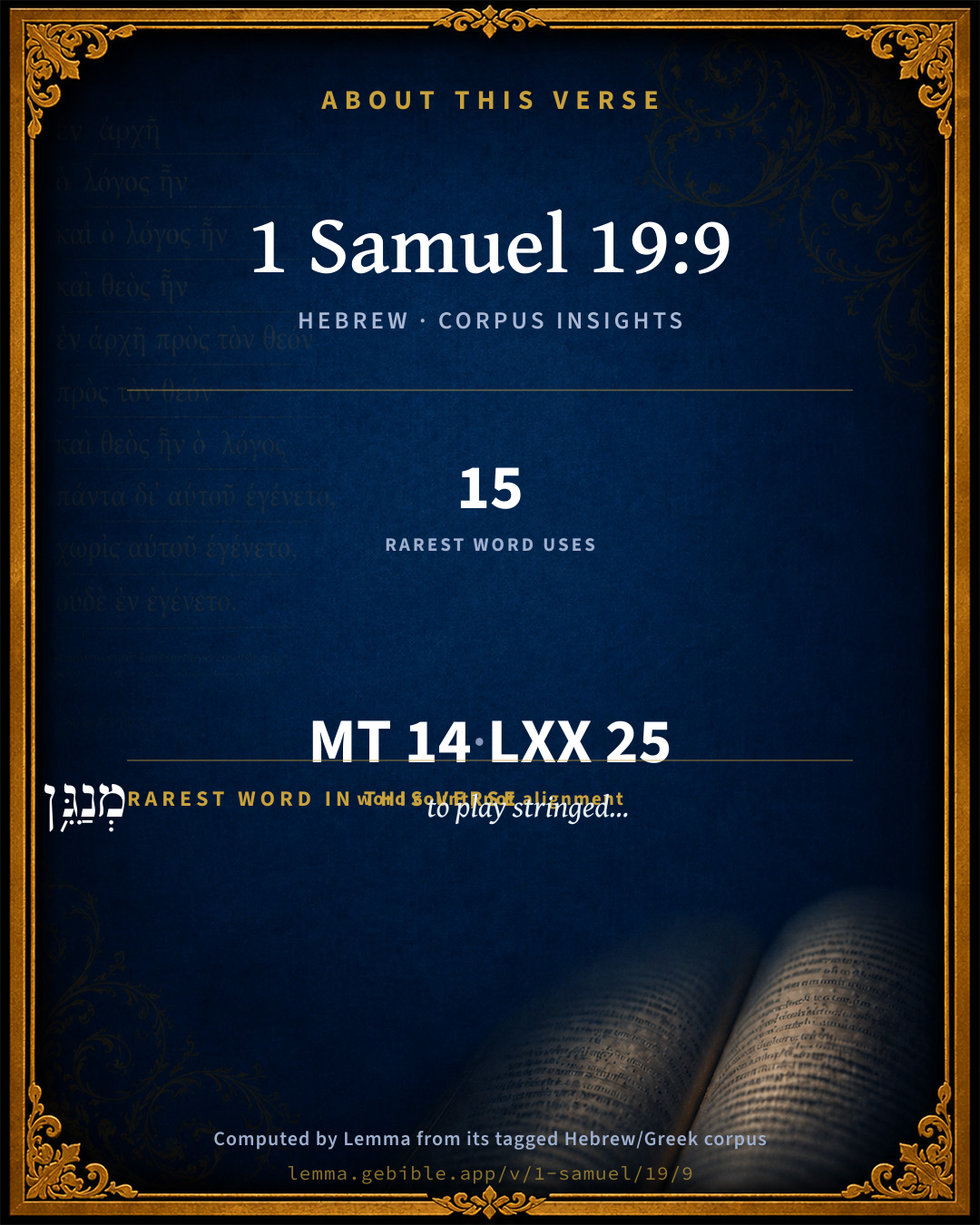
The rarest word here is מְנַגֵּ֥ן to play stringed instrument H5059 — appearing just 15 times in the whole Hebrew Bible.

Shared distinctive vocabulary

מְנַגֵּ֥ן to play stringed instrument H5059 occurs in 12 verses of the Hebrew Bible. Also found in:

Grammatical profile

  • 3 verbs
  • 8 nouns
  • 1 adjective
  • 1 pronoun
  • 1 preposition

Verb forms

  • וַתְּהִי֩ Qal · Sequential Imperfect
  • יוֹשֵׁ֔ב Qal · Participle Active
  • מְנַגֵּ֥ן Piel · Participle Active

Repetition

A word recurs within this verse — often emphatic in Hebrew:

  • בְּיָד֑וֹ hand H3027 ×2

Hebrew & Septuagint length

In English translation the verse runs 27 words from the Hebrew and 33 from the Septuagint (LXX English) — closely comparable.

A rough comparison of the two English renderings, which tokenize alike — not a word-level alignment.

Word counts can differ between the Hebrew and the Greek without any difference in meaning — e.g. the Hebrew direct-object marker אֵת has no separate Greek word, and Greek often adds the article ὁ.

In the original languages it is 14 Hebrew tokens and 25 Greek tokens — but the two are counted differently (Hebrew bundles its prefixes and suffixes into one token; the Greek is in lemma form), so that isn’t a like-for-like length.

Cross-references

3

Topical passages linked to 1 Samuel 19:9 in the Treasury of Scripture Knowledge — connected by theme and wording, ordered by reader-vote popularity; previews shown in the World English Bible.

  • 1 Samuel 16:14 Now the Spirit of Yahweh departed from Saul, and an evil spirit from Yahweh troubled him.
  • 1 Samuel 16:16 Let our lord now command your servants who are before you, to seek out a man who is a skillful player on the harp: and it shall happen, when the evil spirit from God is on you, that he shall play with his hand, and you shall be well.
  • 1 Samuel 18:10–11 It happened on the next day, that an evil spirit from God came mightily on Saul, and he prophesied in the midst of the house: and David played with his hand, as he did day by day. Saul had his spear in his hand;

Cross-references courtesy of OpenBible.info (CC BY 4.0).

Hebrew and Greek witnesses Masoretic Hebrew ↔ Greek Septuagint

The same verse in the two great witnesses to the Old Testament, shown verse-for-verse.

These are two independent witnesses, not word-aligned to each other, and the Septuagint is shown in lemma (dictionary) form.

Hebrew 1 Samuel 19:9 Masoretic · Westminster Leningrad Codex

וַתְּהִי֩ ר֨וּחַ יְהוָ֤ה רָעָה֙ אֶל שָׁא֔וּל וְהוּא֙ בְּבֵית֣וֹ יוֹשֵׁ֔ב וַחֲנִית֖וֹ בְּיָד֑וֹ וְדָוִ֖ד מְנַגֵּ֥ן בְּיָֽד

An evil spirit from Yahweh was on Saul, as he sat in his house with his spear in his hand; and David was playing with his hand.

World English Bible · Public Domain

Greek LXX 1 Samuel 19:9 Septuagint · lemma form

καί γίγνομαι πνεῦμα θεός πονηρός ἐπί σαούλ καί αὐτός ἐν οἶκος καταεὕδω καί δόρυ ἐν ὁ χείρ αὐτός καί δαυίδ ψάλλω ἐν ὁ χείρ αὐτός

And an evil spirit from God was upon Saul, and he was resting in his house, and a spear was in his hand, and David was playing on the harp with his hands.

LXX2012 (modern English Septuagint) · Public Domain

On this verse, Ellicott's Commentary for English Readers discusses the Septuagint’s reading. Read the note in Commentary ↓

Hebrew: Westminster Leningrad Codex (CC BY 4.0). Greek: Septuagint (public domain); English from LXX2012 (modern English Septuagint) (Public Domain). How the Septuagint differs from the Hebrew →

Targum (Aramaic paraphrase)

1

The Targum is the ancient Jewish Aramaic paraphrase of the Hebrew Scriptures — an interpretive translation, not the Hebrew text itself. Onkelos (literal) and Pseudo-Jonathan (expansive) render the Torah, and Jonathan the Prophets. Coverage is partial: where no permissively-licensed English translation exists for a verse, only the Aramaic is shown. This is verse-level text, not a word-by-word alignment to the Hebrew.

  1. Targum Jonathan Prophets (Joshua–Malachi)
    וּשְׁרַת רוּחַ בִּישָׁא מִן קֳדָם יְיָ לְוַת שָׁאוּל וְהוּא בְּבֵיתֵיהּ יָתִיב וּמוּרְנִיתָא בִּידֵיהּ וְדָוִד מְנַגֵן בְּיָד:

    (no public-domain English translation for this verse)

    Targum Jonathan — Aramaic: “Mikraot Gedolot” (public domain). English: “Sefaria Community Translation” (CC0 1.0 (public-domain dedication)); “London "Chaldee Paraphrase," 1871” (public domain). Text via Sefaria.

Commentary

Notes on 1 Samuel 19:9 from classic Christian and Jewish commentators (each source and its license shown beneath its notes). The classic Christian expositions comment on the surrounding passage and are grouped to its opening verse, so a note may address several verses; the Jewish commentaries on the Tanakh (Rashi and others) are per-verse, so they appear only where the commentator wrote on this verse.

Lemma curates 59 commentaries, every one of them public domain or Creative Commons licensed, each selected and text-cleaned for this edition rather than reprinted as found. About our sources →

Trapp's Complete Commentary

John Trapp

1Sa 19:9 And the evil spirit from the LORD was upon Saul, as he sat in his house with his javelin in his hand: and David played with [his] hand.

Ver. 9. With his javelin in his hand.] This he would not be without, as being ever in fear. The great Turk, that tyrant, hath always as he sitteth in his throne, lying at hand ready by him a target, a scimitar, an iron mace, with bow and arrows, for his defence. {a} Our Richard III had always his naked sword stuck by his bedside. {b}

{a} Turk. Hist.

{b} Daniel

John Trapp, A Commentary or Exposition upon All the Books of the Old and New Testament (1647–1656) — public domain. Text from a community e-Sword module.

Geneva Bible (1599)

Geneva Bible translators

He played on his harp to mitigate the rage of the evil spirit, as 1 Sam. 16:23.

Geneva Bible (1599) marginal notes — public domain. Text via Bolls.life.

Adam Clarke's Commentary

Verse 9. And the evil spirit from the Lord] His envy and jealousy again returned, producing distraction of mind, which was exacerbated by diabolic influence. See on 1Sa 16:14.

Adam Clarke's Commentary on the Bible (1810–1826) — public domain. Text from a community e-Sword/MySword module.

Ellicott's Commentary for English Readers

(9) And the evil spirit . . . was upon Saul.—Again the terrible malady was upon the king—not unlikely brought on by the wild storm of jealous fury which Saul allowed to sweep unchecked across his soul. Once more—

“Out of the black mid-tent’s silence, a space of three days,

Not a sound hath escaped to thy servants of prayer nor of

praise,

To betoken that Saul and the spirit have ended their strife,

And that, faint in his triumph, the monarch sinks back

upon life.”

BROWNING: Saul.

But the time when the skilled musician with his Divine strains had roused him into life again was passed (see 1Sa_16:21-23), not now as in old days, when, to use the words the great poet put into David’s mouth—

“—I looked up to know

If the best I could do had brought solace: he spoke not, but

slow

Lifted up the hand slack at his side, till he laid it with care,

Soft and grave, but in mild settled will, on my brow; through

my hair

The large fingers were pushed, and he bent back my head.

with kind power—

All my face back, intent to peruse it as men do a flower.

Thus held he me there, with his great eye that scrutinized

mine,

And oh, all my heart how it loved him! . . .”

BROWNING: Saul.

This time, seizing the tall spear which was ever by his side, he hurled it with deadly intent at the sorrow-stricken, loving face, and David fled in hot haste from the doomed presence for ever. The LXX. was offended at the statement “evil spirit of (or from) Jehovah,” and cuts the knot by leaving out “Jehovah.” It is, no doubt, a hard saying, and no human expositor has ever yet been able fully to explain it.

To the expression Ruach Jehovah, “Spirit of Jehovah” (for “of” is more accurate than “from”), and the equivalent phrase, Ruach Elohim, “Spirit of God” (1Sa_16:14-15), the epithet “evil” is added. We cannot attempt to fathom the mysteries of the spirit world—we have absolutely no data—we simply possess in the sacred book a few scattered notices, which indicate the existence of evil spirits. To suppose that these malignant or evil beings were part of the heavenly host employed by the Eternal is a supposition utterly at variance with our conception of the All-Father. We may, however, safely grant (1) the existence of evil spirits—probably beings fallen through sin and disobedience from their high estate; and (2) we may suppose that these evil spirits—all, of course, belonging to the Eternal, even in their deep degradation (so though “evil,” still “spirits of God, or Jehovah,”)—receive occasional permission, for some wise—though to us unknown—reasons, to tempt and plague for a season the souls of certain men.

The introduction to the Book of Job (Job_1:6; Job_2:1-7), and the circumstance which led to the death of King Ahab before Ramoth Gilead (1Ki_22:19-22), at least favour this hypothesis. The presence of those evil spirits, or “devils, who possessed those unhappy ones whom we meet so often in the Gospel story, points to the same conclusion. Why certain souls should have been exposed to this dread experience is, of course, beyond our ken. From the scanty information vouchsafed to us, it seems, however, that the power of the evil spirit was sometimes permitted to be exercised (a) as a trial of faith, as in the case of Job; or (b) as a punishment incurred by the soul’s desertion of God, as in the case of Saul.

A Bible Commentary for English Readers, edited by Charles John Ellicott (1878–1897) — public domain. Text from a community e-Sword module.

The Cambridge Bible for Schools and Colleges

gen. ed. J. J. S. Perowne

9. the evil spirit] See on 1Sa_16:14.

as he sat, &c.] Now he was sitting in his house with his spear in his hand, and David was playing with his hand. These words are a parenthesis picturing the circumstances under which Saul attempted to murder David. On Saul’s spear see at 1Sa_18:10.

The Cambridge Bible for Schools and Colleges (gen. ed. J. J. S. Perowne; Cambridge University Press, 1878–1918) — public domain. Text from a community e-Sword module.

John Gill's Exposition

And the evil spirit from the Lord was upon Saul,.... His melancholy and frantic disorder returned upon those victories of David, and he grew envious, jealous, spiteful, and malicious:

as he sat in his house with his javelin his hand; which either describes the posture he was in when the evil spirit came upon him; or the effects of it, he became dull and melancholy, did not care to go abroad, but kept at home, and was suspicious of everybody; and therefore kept a javelin in his hand to defend himself; or it may be rather to dispatch David with it, when an opportunity should offer, which quickly did:

and David played with his hand; on some instrument of music, particularly the harp, to drive away the evil spirit, the melancholy disorder, from Saul; which showed his humility, that though he was an officer in the army, had a considerable post in it, yet deigned to act the part of a musician to Saul, and his great kindness and affection for him his sovereign, willing to serve him what he could to promote his health and comfort, and the trust and confidence he put in his promise and oath, or rather in the providence of God for his protection in the way of his duty, though he knew how spiteful and injurious Saul had been to him.

John Gill's Exposition of the Whole Bible (1746–1763) — public domain (CC PDM 1.0). Text via the HelloAO Bible API.

Haydock's Catholic Bible Commentary

Saul. His jealousy was again enkindled by the success of David. (Calmet) --- Hand, on music, to assuage the paroxysms of the king’s fury. (Haydock)

George Leo Haydock (1774–1849), Haydock's Catholic Family Bible and Commentary, 1859 edition — public domain. Excludes Psalms (Douay-Rheims chapter numbering differs from Protestant) and Deuterocanonical books (Catholic canon only).

Matthew Poole's English Annotations

David’s successes against the Philistines, which should have cheered his heart, made him sad, and the devil watched the opportunity to improve his melancholy, as before he bad done.

Matthew Poole's English Annotations on the Holy Bible (1683–1685) — public domain. Text from a community e-Sword/MySword module.

John Wesley's Explanatory Notes

The evil spirit - David's successes against the Philistines revived his envy, and the devil watched the opportunity, as he had done before.

John Wesley, Explanatory Notes Upon the Whole Bible (1754–1765) — public domain. Text via the GEBible commentary corpus.

Lesson kit

Teaching starters — assembled from the data on this page, not authored interpretation. Every prompt links to the verse data it draws on. Edit before teaching.

1 Samuel, in the Historical, opens this verse with 14 words (13 distinct Hebrew lemmas). Its most distinctive word is nâgan (“to play stringed instrument”). A historical commentator’s framing appears above. Read the whole chapter for the surrounding context.

Discussion questions

  1. How does “to play stringed instrument” (nâgan) shape what this verse is saying?
  2. How does 1 Samuel 16:16, which shares the word «to play stringed instrument», read alongside this verse?
  3. What does the repetition of “hand” (2× in this one verse) do in this verse?
  4. These translations render this verse differently; the difference is in the English rendering, not the original. What questions does that raise?
  5. «וַתְּהִי֩» is a Qal Sequential Imperfect verb. How does that grammatical form shape the action described?
  6. Compare how Trapp's Complete Commentary and Geneva Bible (1599) read this verse. Where do they agree or differ?

Things to notice

Reading settings

Reading text

Shown beneath each verse's original-language words.

Old Testament
Old Testament edition

Read the OT as the Masoretic Hebrew (MT) or the Greek Septuagint (LXX).

English shown for the Greek Septuagint (in the Hebrew ↔ Greek comparison).

Comparing translations? Open the Compare panel on any verse page to stack up to four side by side.