Job 6:4

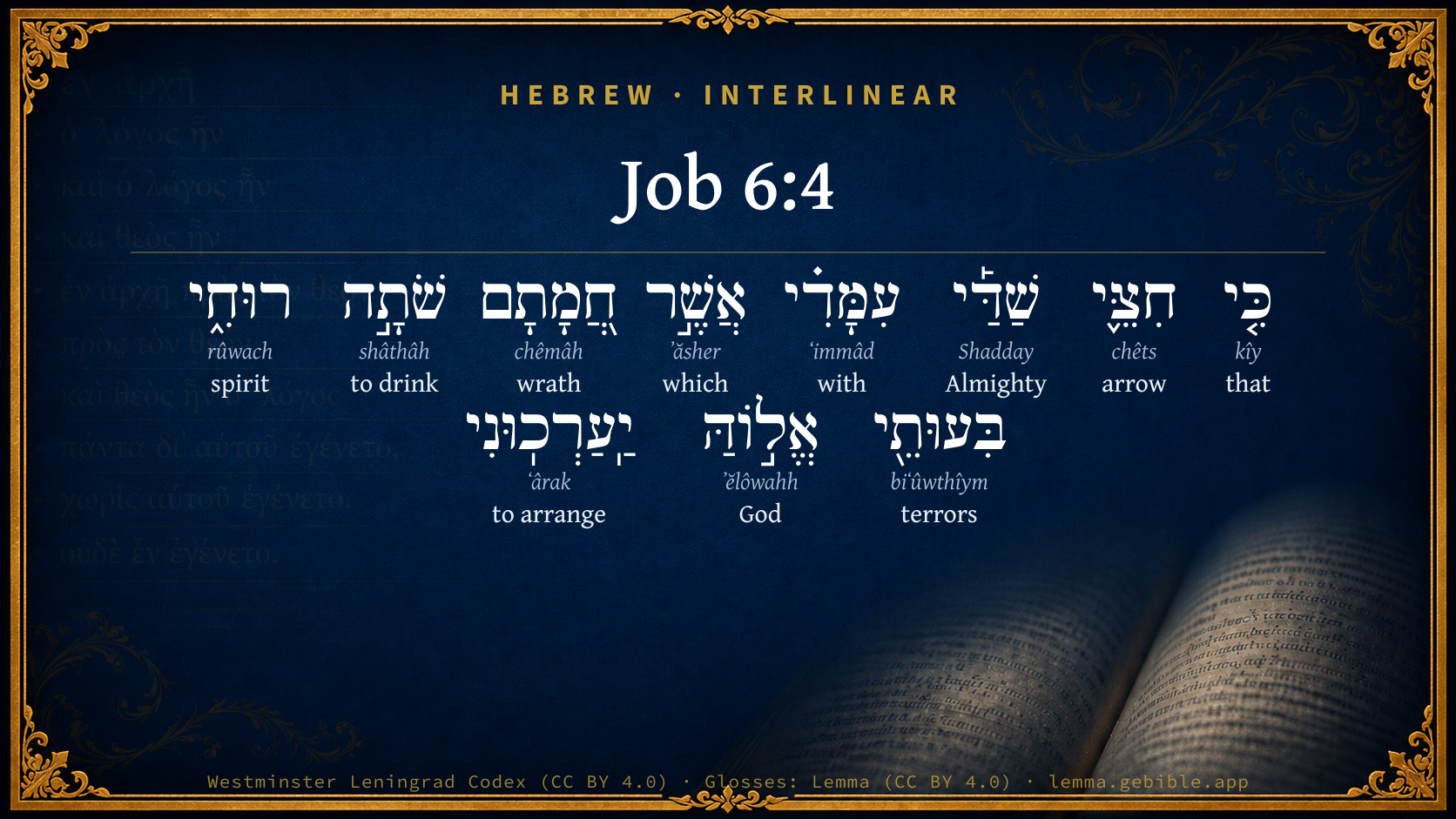
Hebrew (Westminster Leningrad Codex) Job 6:4 appears in the Hebrew Old Testament. The text above is from the Westminster Leningrad Codex. Each word links to its Strong’s number, a concise gloss, and parsing drawn from the Open Scriptures Hebrew Bible morphology. Click any word for its full Brown-Driver-Briggs (BDB) entry.
Download image
Cite this verse

Job 6:4 (World English Bible). Public Domain. Lemma interlinear Bible study tool, https://lemma.gebible.app/v/job/6/4.

Show BibTeX & RIS
BibTeX
RIS
English Translation
For the arrows of the Almighty are within me, My spirit drinks up their poison. The terrors of God set themselves in array against me.
World English Bible · Public Domain
Highlights
  • 1 first appearance in the Hebrew Bible
Full analysis ↓
Download a study sheet

One document with this verse’s original text, its word-by-word gloss line, the meaning frame, cross-references with their text, attributed commentary, and full source and license credits — printable, and it pastes into notes with its structure intact.

This verse Autodidact and up

Study sheet (.html) Plain text (.txt)

A passage Seminary Student

Up to 50 verses in one chapter. A passage sheet keeps up to 6 commentary sources and 12 cross-references per verse, in the order this page ranks them, and says so on the sheet whenever that leaves anything out. Ask for a single verse and you get the Autodidact verse sheet above.

Everything on this page stays free to read, with no account — the sheet is a download of what is already on screen, not access to it.

Want to remove ads? Support Godless Engineer
Compare translations 3

The same verse in 3 English versions, stacked beneath the original-language interlinear above. Click any original word for its lexicon entry.

Each is an independent rendering of the whole verse — the interlinear is not word-aligned to these translations.

Highlighted words mark where these versions differ — a whole-verse word diff, not a word-by-word alignment.

  • World English Bible Public Domain
    For the arrows of the Almighty are within me, My spirit drinks up their poison. The terrors of God set themselves in array against me.
  • King James Version Public Domain
    For the arrows of the Almighty are within me, the poison whereof drinketh up my spirit: the terrors of God do set themselves in array against me.
  • unfoldingWord Literal Text CC BY-SA 4.0
    For the arrows of the Almighty are in me, whose poison my spirit is drinking; the terrors of God array themselves against me.

unfoldingWord Literal Text — © unfoldingWord, licensed CC BY-SA 4.0. Word-aligned USFM3 via Door43 (git.door43.org/unfoldingWord/en_ult).

Versions to compare (up to 4)

3 of 4 selected

Show all 18 translations

Every available English version of this verse, each an independent rendering of the whole verse.

  • World English Bible Public Domain
    For the arrows of the Almighty are within me, My spirit drinks up their poison. The terrors of God set themselves in array against me.
  • Berean Standard Bible Public Domain
    For the arrows of the Almighty have pierced me; my spirit drinks in their poison; the terrors of God are arrayed against me.
  • Majority Standard Bible Public Domain
    For the arrows of the Almighty have pierced me; my spirit drinks in their poison; the terrors of God are arrayed against me.
  • King James Version Public Domain
    For the arrows of the Almighty are within me, the poison whereof drinketh up my spirit: the terrors of God do set themselves in array against me.
  • American Standard Version (1901) Public Domain
    For the arrows of the Almighty are within me, The poison whereof my spirit drinketh up: The terrors of God do set themselves in array against me.
  • Revised Version (1885) Public Domain
    For the arrows of the Almighty are within me, the poison whereof my spirit drinketh up: the terrors of God do set themselves in array against me.
  • Geneva Bible (1599) Public Domain
    For the arrowes of the Almightie are in me, the venime whereof doeth drinke vp my spirit, and the terrours of God fight against me.
  • Douay-Rheims (1899) Public Domain
    For the arrows of the Lord are in me, the rage whereof drinketh up my spirit, and the terrors of the Lord war against me.
  • Young's Literal Translation Public Domain
    For arrows of the Mighty `are' with me, Whose poison is drinking up my spirit. Terrors of God array themselves `for' me!
  • Literal Standard Version CC BY-SA 4.0
    For arrows of the Mighty [are] with me, || Whose poison is drinking up my spirit. Terrors of God array themselves [for] me!
  • Unlocked Literal Bible CC BY-SA 4.0
    For the arrows of the Almighty are in me, my spirit drinks up the poison; the terrors of God have arranged themselves in array against me.
  • unfoldingWord Literal Text CC BY-SA 4.0
    For the arrows of the Almighty are in me, whose poison my spirit is drinking; the terrors of God array themselves against me.
  • Darby Bible Public Domain
    For the arrows of the Almighty are within me, their poison drinketh up my spirit: the terrors of +God are arrayed against me.
  • World Messianic Bible Public Domain
    For the arrows of the Almighty are within me. My spirit drinks up their poison. The terrors of God set themselves in array against me.
  • Webster's Bible Public Domain
    For the arrows of the Almighty are within me, the poison of which drinketh up my spirit: the terrors of God set themselves in array against me.
  • Free Bible Version CC BY-SA 4.0
    For the arrows of the Almighty are in me; their poison saps my spirit. God's terrors are lined up against me.
  • Bible in Basic English Public Domain
    For the arrows of the Ruler of all are present with me, and their poison goes deep into my spirit: his army of fears is put in order against me.
  • JPS Tanakh (1917) Public Domain
    For the arrows of the Almighty are within me, the poison whereof my spirit drinketh up; the terrors of God do set themselves in array against me.

Literal Standard Version (2020), Covenant Press — licensed CC BY-SA 4.0. Text via the HelloAO Bible API (eBible.org). Unlocked Literal Bible (unfoldingWord) — licensed CC BY-SA 4.0. Text via the HelloAO Bible API (eBible.org). unfoldingWord Literal Text — © unfoldingWord, licensed CC BY-SA 4.0. Word-aligned USFM3 via Door43 (git.door43.org/unfoldingWord/en_ult). Free Bible Version, Dr. Jonathan Gallagher — licensed CC BY-SA 4.0. Text via the HelloAO Bible API (eBible.org).

Word by word

More ways to search: Search by grammar → Find every occurrence → Compare this word →

Practice this passage: Drill this verse → Learn its vocabulary →

בִּעוּתֵ֖י
biʻûwthîym
H1161
“terrors of”
Noun, Common, Masculine, Plural, Construct
Part of Speech
Noun
Type
Common
Gender
Masculine
Number
Plural
State
Construct
Full BDB Definition

Origin: from H1204

TWOT: 265b

terrors, alarms (occasioned by God)
  1. כִּ֤י kîy H3588 “that” Conjunction
  2. חִצֵּ֪י chêts H2671 “arrows of” Noun, Common, Masculine, Plural, Construct
  3. שַׁדַּ֡י Shadday H7706 “Almighty” Noun, Proper
  4. עִמָּדִ֗י ʻimmâd H5978 “with · me” Preposition + Suffix, Personal, 1st Person, Common, Singular
  5. אֲשֶׁ֣ר ʼăsher H834 “which” Particle, Relative
  6. חֲ֭מָתָם chêmâh H2534 “wrath · their” Noun, Common, Feminine, Singular, Construct + Suffix, Personal, 3rd Person, Masculine, Plural
  7. שֹׁתָ֣ה shâthâh H8354 “drinking” Verb, Qal, Participle Active, Feminine, Singular, Absolute
  8. רוּחִ֑י rûwach H7307 “spirit · my” Noun, Common, Both, Singular, Construct + Suffix, Personal, 1st Person, Common, Singular
  9. אֱל֣וֹהַּ ʼĕlôwahh H433 “God” Noun, Common, Masculine, Singular, Absolute
  10. יַֽעַרְכֽוּנִי ʻârak H6186 “to arrange · me” Verb, Qal, Imperfect, 3rd Person, Masculine, Plural + Suffix, Personal, 1st Person, Common, Singular

About this verse

These counts appear in no published source. They are computed here, from the morphology-tagged text and Lemma’s own curated glosses. What Lemma adds →

11
words
11
distinct lemmas
Wisdom
section

Notable vocabulary

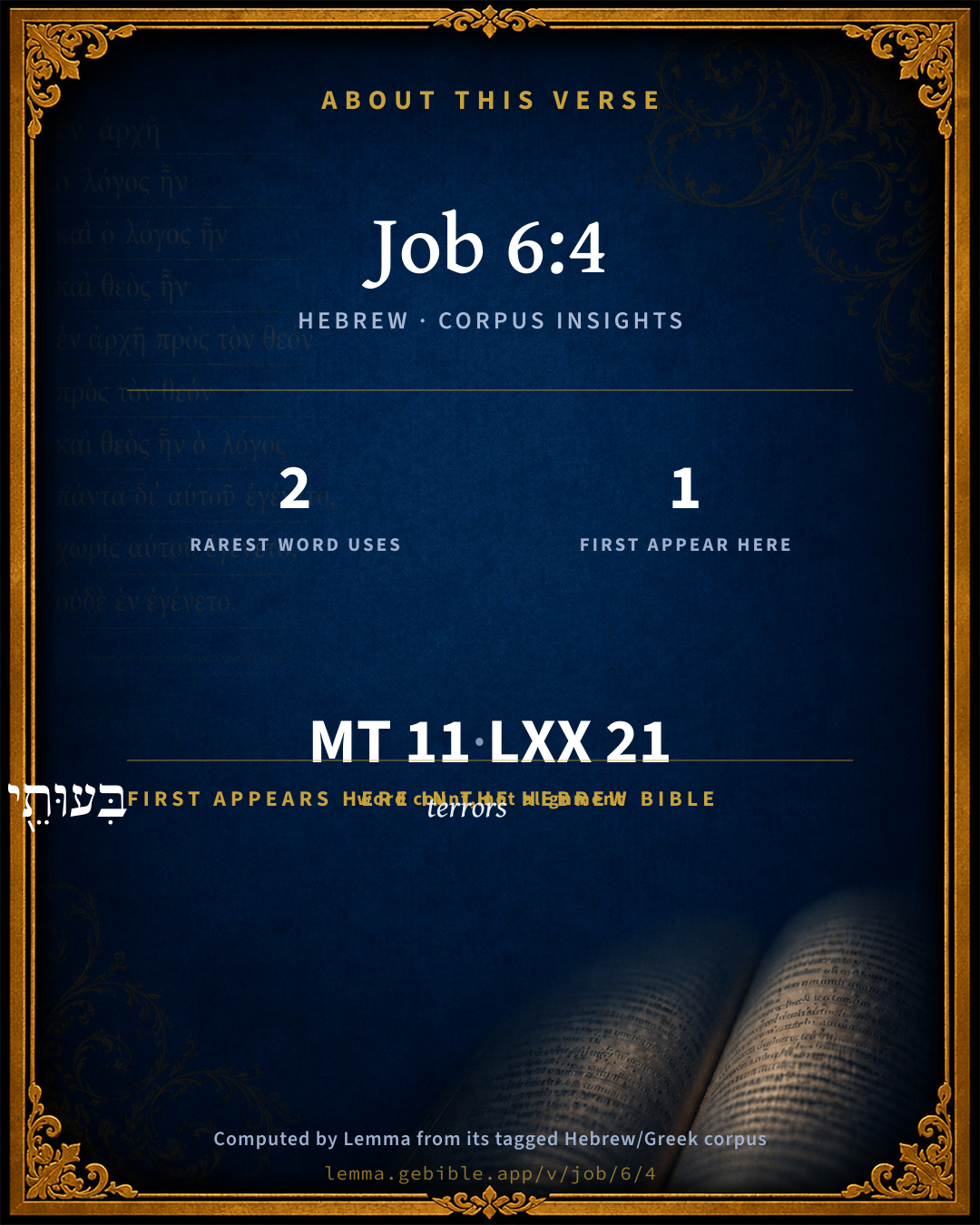
The rarest word here is בִּעוּתֵ֖י terrors H1161 — appearing just 2 times in the whole Hebrew Bible.

First appearance in Scripture

This word makes its first canonical appearance in the Hebrew Bible here:

  • בִּעוּתֵ֖י terrors H1161

Shared distinctive vocabulary

בִּעוּתֵ֖י terrors H1161 occurs in 2 verses of the Hebrew Bible. Also found in:

Grammatical profile

  • 2 verbs
  • 6 nouns
  • 1 preposition
  • 1 conjunction
  • 1 particle

Verb forms

  • שֹׁתָ֣ה Qal · Participle Active
  • יַֽעַרְכֽוּנִי Qal · Imperfect

Hebrew & Septuagint length

In English translation the verse runs 25 words from the Hebrew and 25 from the Septuagint (LXX English) — the same length.

A rough comparison of the two English renderings, which tokenize alike — not a word-level alignment.

Word counts can differ between the Hebrew and the Greek without any difference in meaning — e.g. the Hebrew direct-object marker אֵת has no separate Greek word, and Greek often adds the article ὁ.

In the original languages it is 11 Hebrew tokens and 21 Greek tokens — but the two are counted differently (Hebrew bundles its prefixes and suffixes into one token; the Greek is in lemma form), so that isn’t a like-for-like length.

Cross-references

19

Topical passages linked to Job 6:4 in the Treasury of Scripture Knowledge — connected by theme and wording, ordered by reader-vote popularity; previews shown in the World English Bible.

  • Psalms 38:2 For your arrows have pierced me, Your hand presses hard on me.
  • Job 30:15 Terrors are turned on me. They chase my honor as the wind. My welfare has passed away as a cloud.
  • Psalms 88:15–16 I am afflicted and ready to die from my youth up. While I suffer your terrors, I am distracted.
  • Proverbs 18:14 A man's spirit will sustain him in sickness, But a crushed spirit, who can bear?
  • Job 16:12–14 I was at ease, and he broke me apart. Yes, he has taken me by the neck, and dashed me to pieces. He has also set me up for his target.
  • Psalms 143:7 Hurry to answer me, Yahweh. My spirit fails. Don't hide your face from me, So that I don't become like those who go down into the pit.
  • Mark 15:34 At the ninth hour Jesus cried with a loud voice, saying, "Eloi, Eloi, lama sabachthani?" which is, being interpreted, "My God, my God, why have you forsaken me?"
  • Job 9:17 For he breaks me with a tempest, Multiplies my wounds without cause.
  • Lamentations 3:12–13 He has bent his bow, and set me as a mark for the arrow.
  • Deuteronomy 32:23–24 I will heap evils on them; I will spend my arrows on them:
  • Deuteronomy 32:42 I will make my arrows drunk with blood, My sword shall devour flesh; With the blood of the slain and the captives, From the head of the leaders of the enemy.
  • Job 21:20 Let his own eyes see his destruction. Let him drink of the wrath of the Almighty.
  • Job 31:23 For calamity from God is a terror to me, By reason of his majesty I can do nothing.
  • Psalms 7:13 He has also prepared for himself the instruments of death. He makes ready his flaming arrows.
  • Psalms 18:14 He sent out his arrows, and scattered them; Yes, great lightning bolts, and routed them.
  • Psalms 21:12 For you will make them turn their back, When you aim drawn bows at their face.
  • Psalms 45:5 Your arrows are sharp. The nations fall under you, with arrows in the heart of the king's enemies.
  • Mark 14:33–34 He took with him Peter, James, and John, and began to be greatly troubled and distressed.
  • 2 Corinthians 5:11 Knowing therefore the fear of the Lord, we persuade men, but we are revealed to God; and I hope that we are revealed also in your consciences.

Cross-references courtesy of OpenBible.info (CC BY 4.0).

Hebrew and Greek witnesses Masoretic Hebrew ↔ Greek Septuagint

The same verse in the two great witnesses to the Old Testament, shown verse-for-verse.

These are two independent witnesses, not word-aligned to each other, and the Septuagint is shown in lemma (dictionary) form.

Hebrew Job 6:4 Masoretic · Westminster Leningrad Codex

כִּ֤י חִצֵּ֪י שַׁדַּ֡י עִמָּדִ֗י אֲשֶׁ֣ר חֲ֭מָתָם שֹׁתָ֣ה רוּחִ֑י בִּעוּתֵ֖י אֱל֣וֹהַּ יַֽעַרְכֽוּנִי

For the arrows of the Almighty are within me, My spirit drinks up their poison. The terrors of God set themselves in array against me.

World English Bible · Public Domain

Greek LXX Job 6:4 Septuagint · lemma form

βέλος γάρ κύριος ἐν ὁ σῶμα ἐγώ εἰμί ὅς ὁ θυμός αὐτός ἐκπίνω ἐγώ ὁ αἷμα ὅταν ἄρχω λαλέω κεντέω ἐγώ

For the arrows of the Lord are in my body, whose violence drinks up my blood: whenever I am going to speak, they pierce me.

LXX2012 (modern English Septuagint) · Public Domain

On this verse, Haydock's Catholic Bible Commentary discusses the Septuagint’s reading. Read the note in Commentary ↓

Hebrew: Westminster Leningrad Codex (CC BY 4.0). Greek: Septuagint (public domain); English from LXX2012 (modern English Septuagint) (Public Domain). How the Septuagint differs from the Hebrew →

Commentary

Notes on Job 6:4 from classic Christian and Jewish commentators (each source and its license shown beneath its notes). The classic Christian expositions comment on the surrounding passage and are grouped to its opening verse, so a note may address several verses; the Jewish commentaries on the Tanakh (Rashi and others) are per-verse, so they appear only where the commentator wrote on this verse.

Lemma curates 59 commentaries, every one of them public domain or Creative Commons licensed, each selected and text-cleaned for this edition rather than reprinted as found. About our sources →

Trapp's Complete Commentary

John Trapp

Job 6:4 For the arrows of the Almighty [are] within me, the poison whereof drinketh up my spirit: the terrors of God do set themselves in array against me.

Ver. 4. For the arrows of the Almighty are within me] What marvel, then, though his flesh had no rest, but he was troubled on every side, since without were fightings, within were fears? 2Co 7:5. The arrows, not of a mighty man, as Psa 127:4, but of an Almighty God; troubles without and terrors within. David felt these arrows, and complaineth of them heavily, Psa 38:1-2. "He shall shoot at them with an arrow; suddenly shall they be wounded," saith he of his enemies who had bent their bow and shot their arrows at him, even bitter words, Psa 64:3; Psa 64:7. God will make his arrows drunk with the blood of such persons, Deu 32:42. But the arrows Job here complains of were poisoned or envenomed arrows.

The poison whereof drinketh up my spirits] Drieth them up, and corrupts the blood in which the spirits are, sprinkling in my veins a mortal poison, working greatest dolour and distemper. The Scythians and other nations used to dip their darts in the blood and gall of asps and vipers, the venomous heat of which, like a fire in their flesh, killed the wounded with torments, the likest hell of any other; and hereunto Job alludeth.

The terrors of God do set themselves in array against me] i.e. The terrible strokes of God, who seemeth to fight against me with his own hand, to rush upon me as the angel once did upon Balaam, with a drawn sword in his hand, threatening therewith to cut off my head, as David did Goliath’s, yea, to send me packing to hell, in the very suburbs whereof, methinks, I feel to be already; and shall not I be suffered to complain? A galled shoulder will shrink under a load, though it be but light; and a little water is heavy in a leaden vessel. But the word here used for terrors noteth the most terrible terrors, hellish terrors, and worse, for they are the terrors of God, surpassing great, 2Co 5:11, which made Jeremiah pray so hard, Be not thou a terror to me, O Lord, and then I care not greatly what befalleth me. "While I suffer thy terrors I am distracted," saith Heman, Psa 88:15. Add hereunto that these terrors of God had set themselves in array, they were in a military manner marshalled and imbattled against him, as Jer 50:9. God afflicted Job methodically and resolvedly; he led up his army, as a reverend man phraseth it, exactly formed to a pitched battle against him, and this was truly terrible; for who, saith Moses, knoweth the power of his wrath? since the apprehension and approach of it was so terrible to an upright-hearted Job, to a heroical Luther, upon whom God’s terrors were so heavy for a time, ut nec calor, nec sanguis, nec sensus, nec vox superesset (In epist. ad Melancth.), that neither heat, nor blood, nor sense, nor voice remained, but his body seemed dead, as Justus Jonas, an eye-witness, reporteth: agreeable whereunto is that memorable speech of Luther, Nihil est tentatio vel universi mundi, et totius inferni in unum conflata, &c., The temptation and terror of all the world, nay, of all hell put together, is nothing to that wherein God setteth himself in battle-array against a poor soul; in which case that in excellent counsel that one giveth in these words, When thy sins and God’s wrath meeting in thy conscience make thee deadly sick, as Isa 33:1-24, then pour forth thy soul in confession; and as it will ease thee (as vomiting useth to do), so also it will move God to pity, and to give thee cordials and comforts to restore thee.

John Trapp, A Commentary or Exposition upon All the Books of the Old and New Testament (1647–1656) — public domain. Text from a community e-Sword module.

The Biblical Illustrator

Joseph S. Exell

Job_6:4

For the arrows of the Almighty are within me.

Sharp arrows

Arrows are--

1. Swift.

2. Secret.

3. Sharp.

4. Killing. (J. Caryl.)

The poisoned arrows of the Almighty

By poisoned arrows we must understand, not only his boils, the heat and inflammation of which had dried up Jobs moisture, vigour, and strength, but all his other outward troubles also, which stuck fast in him; and his inward temptations, and sense of Gods wrath flowing therefrom, which, like the inward deep wound of the arrow, had, by the furious poison thereof, so exhausted him that he was ready to faint, and give it over. Learn--

1. Though to quarrel and complain of God, in any case, be a great fault, yet it pleads for much compassion to saints when they do not make a stir about their lot, except when their trouble is extreme.

2. It is the duty of those in trouble to turn their eyes off all instruments, that they may look to God.

3. As it is our duty always to entertain high and reverent thoughts of God, so trouble will cause men to know His almighty power.

4. It is a humbling sight of God Almightys power in trouble, when His strokes are like arrows, and do not only pierce deep, and come suddenly and swiftly upon men, as an arrow doth, but especially do speak God angry at them, in that He makes them His burr (target) at which He shoots.

5. In this case of Job, the number of troubles doth contribute much to afflict the child of God, every particular stroke adding to the weight.

6. Albeit sharp troubles, inflicted by the hand of God, be very sad to the people of God, yet all that is easy in comparison of the apprehension of Gods anger in the trouble and perplexities of spirit, and temptations arising upon those troubles.

7. Temptations, and sense of Divine displeasure under trouble, will soon exhaust created strength, and make the spirits of men succumb.

8. It is a great addition to the present troubles and temptations of saints, when terrors and fears for the future do assault and perplex them; especially when they apprehend that God is pursuing them by these terrors.

9. When once a broken mind is haunted with terrors add fears, their wit and fancy may multiply them beyond what they are, or will be, in reality. (George Hutcheson.)

Of religious melancholy

Jobs affliction was sent to him for the trial of an exemplary and unshaken virtue; and because it was sent for that reason only, and not as any mark of Divine displeasure, therefore how great soever the calamity was in another respect, yet was it by no means insupportable, because there still remained to him the great foundation of comfort, in the assurance of a good conscience, and the expectation of Gods final favour. He had in his own mind, even in the midst of his affliction, the satisfaction to reflect with pleasure on his past behaviour, and to strengthen his resolutions of continuing in the same course for the future. Though no calamity could well be heavier than that of Job, yet when the disposition of the person comes also to be taken into the act, there is a trouble far greater than his, namely, when the storm falls where there is no preparation to bear it; when the assault is made from without, and within there is nothing to resist it. In other cases, the spirit of a man will sustain his infirmity; but when the spirit itself is wounded, who can bear it? There is another state, most melancholy and truly pitiable, and that is of those who, neither by the immediate appointment of Providence, as in the case of Job, nor by the proper effect of their own wickedness, as in the case of an evil conscience, but by their own imagination and groundless fears, by indisposition of body and disorder of mind, by false notions of God and themselves, are made very miserable in their own minds. They fancy, though without sufficient reason, that the arrows of the Almighty are within them. Consider the chief occasions of such religious melancholy.

1. Indisposition or distemper of body. This is by no means to be neglected, slighted, or despised: for, as the mind operates continually upon the body, so the body likewise will of necessity influence and operate upon the mind. It is not unusual to see the good understanding even of a reasonable person, borne down and overburdened by bodily disorder. The principal sign by which we may judge when the indisposition is chiefly or wholly in the body is this, that the person accuses himself highly in general, without being able to give any instances in particular; that he is very apprehensive, of he does not well know what; and fearful, yet can give no reason why. The misery is very real, though without good foundation. In such cases all endeavours ought to be used to remove the bodily indisposition.

2. Want of improvement under the exercise of religious duties is complained of. Many piously and well-disposed persons, but of timorous and melancholy constitutions, are under continual apprehensions that they do not grow better, that they make little or no improvement in the ways of religion, and that they cannot find in themselves such a fervent zeal and love towards God, as they think is necessary to denominate them good Christians. If by want of improvement is only meant want of warmth and affection in the performance of their duty, then there is no just ground for trouble of mind upon that account. In the same person there are sure to be different degrees of affection at different times, according to the varying tempers of the body. No man can keep up at all times an equal vigour of mind. Vain suspicions that our obedience proceeds not from a right principle, from a true and unfeigned love of God, are by no means any just cause for uneasiness of mind, provided that we sincerely perform that obedience, by a life of virtue and true holiness.

3. An apprehension of exclusion from mercy by some positive decree and fore-appointment of God. From nature and reason, this apprehension cannot arise. Nor in Scripture is there any foundation for any such apprehension. There may be some obscure texts, which unstable persons may be apt to misinterpret to their own and others disquiet; but surely the whole tenour, design, and aim of Scripture should be the interpreter of particular passages. The plain texts should be the rule by which the obscurer ones are interpreted. It is quite evident that there is no ground in Scripture for any pious person to apprehend that possibly he may be excluded from mercy by any positive decree or fore-appointment of God.

4. The fear of having committed the sin against the Holy Ghost. But distinguish between sin against the Holy Ghost and blasphemy against the Holy Ghost. Such blasphemy was the sign of an incurably wicked and malicious disposition. It is quite impossible for any truly sincere and well-meaning person to be guilty of this malignity, or to have any reason of apprehending he can possibly have fallen into it.

5. A cause of much trouble to some is found in wicked and blasphemous thoughts. These are not so much sin as weakness of imagination arising from infirmity of body. They may he only signs of a tender conscience, and of a pious disposed mind.

6. Another cause is the conscience of past great sins, and of present remaining infirmities. Infirmities as weaknesses and omissions, are fully allowed for in the Gospel. Forgiveness of them is annexed to our daily prayers. And sins blotted out, ought to be forgotten by us, as God says they are by Him. (S. Clarke, D. D.)

The Biblical Illustrator, edited by Joseph S. Exell (c. 1880s–1900s) — public domain. Text from a community e-Sword module.

Joseph Benson's Commentary

Job 6:4. The arrows of the Almighty are within me, &c. — The sublimity of style, and beautiful vein of poetry, which run through this verse, are well deserving of the reader’s particular attention. He fitly terms his afflictions arrows, because, like arrows, they came upon him swiftly and suddenly, one after another, and that from on high, and wounded him deeply. And he calls them arrows of the Almighty, not only, generally speaking, because all afflictions come from him, but particularly, because God’s hand was in a singular manner visible and eminent in his sufferings, and especially because they were immediately shot by God into his spirit, so that they were within him, as it follows, not like the external evils mentioned chap. 1., which were passed, but fixed and constant in his very nature, producing sharp pains in his body, and dismal horrors in his mind. The poison whereof drinketh up my spirit — Or, as the Hebrew may be rendered, The poison whereof my spirit drinketh up: which is the construction of Pagninus and the Targum. But our translation is more poetical, and quite agreeable to Moses’s sublime expression, Deu 32:42, where he represents God as taking vengeance on his enemies, and saying, I will make mine arrows drunk with blood. The words imply, that these arrows were more keen and pernicious than ordinary, being dipped in God’s wrath, as the barbarous nations used to dip their arrows in poison, that they might not only pierce, but burn up and consume the vital parts. Thus did the poison of God’s arrows drink up his spirit, that is, exhaust and consume his life and soul. The terrors of God do set themselves in array — They are like a numerous army invading me on every side. Houbigant renders it, The terrors of the Lord confound me. This was the sorest part of his calamity, wherein he was an eminent type of Christ, who complained most of the sufferings of his soul. Indeed, trouble of mind is the sorest trouble. A wounded spirit, who can bear? “He had patience enough,” says Lord Clarendon, “for the oppression and rapine of his enemies, for the unkindness and reproach of his friends, and for the cunning and malice of the devil; but he was so transported with the sense of God’s anger against him, he could not bear that with temper: the apprehension that all those miseries, of so piercing and destroying a nature in themselves, fell upon him, not only by God’s permission, to try and humble him, but proceeded directly from his indignation and resolution to destroy him, almost confounded him. When they appeared no more the arrows of his enemies levelled and shot at his greatness and prosperity, the enterprises and designs of evil men, suborned by the devil against him; but the artillery which God himself discharged upon him in his greatest displeasure and fury, he was able to stand the shock no longer, and thought he had some reason to pour out his complaints and lamentations with a little more earnestness; and that the grief and trouble of his mind might excuse the want of that order, and method, and deliberation, which the ease, and calm condition, and disputing humour of his friends, who were only healthy spectators of what he suffered, reproachfully required from him.”

Joseph Benson's Commentary on the Old and New Testaments (1811–1818) — public domain. Text from a community e-Sword module.

Geneva Bible (1599)

Geneva Bible translators

Which declareth that he was not only afflicted in body, but wounded in conscience, which is the greatest battle that the faithful can have.

Geneva Bible (1599) marginal notes — public domain. Text via Bolls.life.

Jamieson, Fausset & Brown

Robert Jamieson, A. R. Fausset & David Brown

arrows . . . within me--have pierced me. A poetic image representing the avenging Almighty armed with bow and arrows (Psa 38:2-3). Here the arrows are poisoned. Peculiarly appropriate, in reference to the burning pains which penetrated, like poison, into the inmost parts--("spirit"; as contrasted with mere surface flesh wounds) of Job's body.

set themselves in array--a military image (Jdg 20:33). All the terrors which the divine wrath can muster are set in array against me (Isa 42:13).

Jamieson, Fausset & Brown — Commentary Critical and Explanatory on the Whole Bible (1871) — public domain (CC PDM 1.0). Text via the HelloAO Bible API.

Adam Clarke's Commentary

Verse 4. The arrows of the Almighty] There is an evident reference here to wounds inflicted by poisoned arrows; and to the burning fever occasioned by such wounds, producing such an intense parching thirst as to dry up all the moisture in the system, stop all the salivary ducts, thicken and inflame the blood, induce putrescency, and terminate in raging mania, producing the most terrifying images, from which the patient is relieved only by death. This is strongly expressed in the fine figure: The POISON DRINKETH UP my SPIRIT; the TERRORS of GOD SET THEMSELVES in ARRAY against me. That calamities are represented among the Eastern writers as the arrows of the Almighty, we have abundant proofs. In reference to this, I shall adduce that fine saying attributed to Aaly, the son-in-law of Mohammed in the Toozuki Teemour; which I have spoken of elsewhere. "It was once demanded of the fourth caliph (Aaly,) 'If the canopy of heaven were a bow; and if the earth were the cord thereof; and if calamities were the arrows; if mankind were the mark for those arrows; and if Almighty God, the tremendous and glorious, were the unerring Archer; to whom could the sons of Adam flee for protection?' The califf answered, 'The sons of Adam must flee unto the Lord.'" This fine image Job keeps in view in the eighth and ninth verses Job 6:8; Job 6:9, wishing that the unerring marksman may let fly these arrows, let loose his hand, to destroy and cut him off.

Adam Clarke's Commentary on the Bible (1810–1826) — public domain. Text from a community e-Sword/MySword module.

Ellicott's Commentary for English Readers

(4) The poison whereof drinketh up my spirit.—Rather, the poison whereof my spirit imbibeth, the rendering of the Authorised Version being ambiguous.

Do set themselves in array against me.—Like hosts marshalling themselves for battle. “If the ox or the ass will not low or bray so long as he is satisfied, so neither should I complain if I had no valid cause. My groaning is the evidence of a great burden, and consequently the disdainful way in which you treat it is insipid and distasteful to me—my soul refuseth to touch your proffered remedies; they are as loathsome meat to me.” According to some, the words rendered “the white of an egg” mean the juice of purslain.

A Bible Commentary for English Readers, edited by Charles John Ellicott (1878–1897) — public domain. Text from a community e-Sword module.

The Cambridge Bible for Schools and Colleges

gen. ed. J. J. S. Perowne

4. the arrows of the Almighty] This explains his bearing and excuses it. Everywhere Job says that it is not his afflictions in themselves that terrify him, it is that they come from God; it is the moral problem that lies under his calamities and that God has become his enemy that makes his heart “soft” (ch. Job_23:15 seq.). The “arrows” of God are the plagues, diseases and pains with which He assails men, ch. Job_16:12 seq.; cf. Psa_38:2 seq.; Deu_32:23. So Hamlet,

The slings and arrows of outrageous fortune.

the poison whereof drinketh] Rather, the poison of which my spirit drinketh in. God’s arrows are poisoned arrows, the poison of which the spirit sucks in and becomes enervated and paralysed. This is the idea, rather than maddened. The figure in the end of the verse is that of a beleaguering army; this host is composed of “terrors” from God. The reference is again not to Job’s mere physical pains, but to the perplexing thoughts and fears which they occasioned.

The Cambridge Bible for Schools and Colleges (gen. ed. J. J. S. Perowne; Cambridge University Press, 1878–1918) — public domain. Text from a community e-Sword module.

John Gill's Exposition

For the arrows of the Almighty are within me,.... Which are a reason proving the weight and heaviness of his affliction, and also of his hot and passionate expressions he broke out into; which designs not so much outward calamities, as famine, pestilence, thunder and lightning, which are called the arrows of God, Deu 32:23; all which had attended Job, and were his case; being reduced to extreme poverty, had malignant and pestilential ulcers upon him, and his sheep destroyed by thunder and lightning; and which were like arrows, that came upon him suddenly, secretly, and at unawares, and very swiftly; these arrows flew thick and first about, him, and stuck in him, and were sharp and painful, and wounded and slew him; for he was now under slaying circumstances of Providence; but rather these mean, together with his afflictions, the inward distresses, grief, and anguish of his mind arising from them, being attended with a keen sense of the divine displeasure, which was the case of David, and is expressed in much the same language, Psa 38:1; Job here considers his afflictions as coming from God, as arrows shot from his bow; and as coming from him, not as a father, in a way of paternal chastisement, and love, dealing with him as a child of his, but accounting him as an enemy, and setting him up as a mark or butt to shoot at, see Job 7:20; yea, not only as the arrows of a strong and mighty man, expert in archery, who shoots his arrows with great strength and skill, so that they miss not, and return not in vain, see Psa 120:4; but as being the arrows of the Almighty, which come with force irresistible, with the stretching and lighting down of his arm, and with the indignation of his anger intolerable:

the poison whereof drinketh up my spirit; alluding to the custom of some people, that used to dip their arrows in poison, or besmear them with it; so the Persians, as Jarchi observes, and Heliodorus (c) reports of the Ethiopians, that they dipped their arrows in the poison of dragons, and which made them inflammatory, and raised such an heat, and such burning pains, as were intolerable; and now, as such poison presently infected the blood, and penetrated into and seized the animal spirits, and inflamed and soon exhausted them; so the heat of divine wrath, and a sense of it, which attended the arrows of God, his afflictions on Job, so affected him, as not only to take away his breath, that he could not speak, as in Job 6:3, or rather, as to cause those warm and hot expressions to break out from him, but even to eat up his vital spirits, and leave him spiritless and lifeless; which was Heman's case, and similar to Job's, Psa 88:3,

the terrors of God do set themselves in array against me; the Lord is sometimes compared to a man of war in arms, stirring up his wrath and jealousy, Exo 15:3; and in this light he was viewed by Job, and so he apprehended him, as coming forth against him, and which was terrible; and his terrors were like an army of soldiers set in battle array, in rank and file, ready to discharge, or discharging their artillery upon him; and which sometimes design the inward terrors of mind, of a guilty conscience, the terrors of God's judgment here, or of a future judgment hereafter, of death and hell, and eternal damnation, through the menaces and curses of the law of God transgressed and broken; but here afflictive providences, or terrible things in righteousness, which surrounded him, attacked him in great numbers, and in a hostile military way, with great order and regularity, and which were frightful to behold; perhaps regard may be also had to those scaring dreams and terrifying visions he sometimes had, see Job 7:14.

(c) Ethiopic. l. 9. c. 19.

John Gill's Exposition of the Whole Bible (1746–1763) — public domain (CC PDM 1.0). Text via the HelloAO Bible API.

Albert Barnes' Notes on the Bible

For the arrows of the Almighty are within me - That is, it is not a light affliction that I endure. I am wounded in a manner which could not be caused by man - called to endure a severity of suffering which shows that it proceeds from the Almighty. Thus called to suffer what man could not cause, he maintains that it is right for him to complain, and that the words which he employed were not an improper expression of the extent of the grief.

The poison whereof drinketh up my spirit - Takes away my rigor, my comfort, my life. He here compares his afflictions with being wounded with poisoned arrows. Such arrows were not unfrequently used among the ancients. The object was to secure certain death, even where the wound caused by the arrow itself would not produce it. Poison was made so concentrated, that the smallest quantity conveyed by the point of an arrow would render death inevitable. This practice contributed much to the barbarity of savage war. Thus, Virgil speaks of poisoned arrows:

Ungere tela manu, ferrumque armare veneno.

Aeneid ix. 773

And again, Aen x. 140:

Vulnera dirigere, et calamos armare veneno.

So Ovid, Lib. 1. de Ponto, Eleg. ii. of the Scythians:

Qui mortis saevo geminent ut vulnere causas,

Omnia vipereo spicula felle linunt.

Compare Justin, Lib. ii. c. 10. section 2; Grotius, de Jure Belli et Pacis; and Virgil, En. xii. 857. In the Odyssey, i. 260ff we read of Ulysses that he went to Ephyra, a city of Thessaly, to obtain from Ilus, the son of Mermer, deadly poison, that he might smear it over the iron point of his arrows. The pestilence which produced so great a destruction in the Grecian camp is also said by Homer (Iliad i. 48) to have been caused by arrows shot from the bow of Apollo. The phrase “drinketh up the spirit” is very expressive. We speak now of the sword thirsting for blood; but this language is more expressive and striking. The figure is not uncommon in the poetry of the East and of the ancients. In the poem of Zohair, the third of the Moallakat, or those transcribed in golden letters, and suspended in the temple of Mecca, the same image occurs. It is thus rendered by Sir William Jones:

Their javelins had no share in drinking the blood of Naufel.

A similar expression occurs in Sophocles in Trachinn, verse 1061, as quoted by Schultens, when describing the pestilence in which Hercules suffered:

ἐκ δὲ χλωρὸν αἵμα μου Πέπωκεν ἤδη -

ek de chlōron haima mou Pepōken ēdē -

This has been imitated by Cicero in Tusculan. Disp. ii. 8:

Haec me irretivit veste furiali inscium,

Quae lateri inhaerens morsu lacerat viscera,

Urgensque graviter, pulmonum haurit spiritus,

Jam decolorem sanguinem omnem exsorbuit.

So Lucan, Pharsa. ix. 741ff gives a similar description:

Ecce subit virus taciturn, carpitque medullas

Ignis edax calidaque iacendit viscera tabe.

Ebibit humorem circa vitalia fusum

Pestis, et in sicco linguan torrere palato Coepit.

Far more beautiful, however, than the expressions of any of the ancient Classics - more tender, more delicate, more full of pathos - is the description which the Christian poet Cowper gives of the arrow that pierces the side of the sinner. It is the account of his own conversion:

I was a stricken deer that left the herd

Long since. With many an artery deep infix’d

My panting side was charged when I withdrew

To seek a tranquil death in distant shades.

There I was found by one, who had himself

Been hurt by the archers. In his side he bore,

And in his hands and feet, the cruel scars.

Task, b. iii.

Of such wounding he did not complain. The arrow was extracted by the tender hand of him who alone had power to do it. Had Job known of him; had he been fully acquainted with the plan of mercy through him, and the comfort which a wounded sinner may find there, we should not have heard the bitter complaints which he uttered in his trials. Let us not judge him with the severity which we may use of one who is afflicted and complains under the full light of the gospel.

The terrors of God do set themselves in array against me - Those things which God uses to excite terror. The word which is rendered “set in array” (ערך ‛ârak) properly denotes the drawing up of a line for battle; and the sense is here, that all these terrors seem to be drawn up in battle array, as if on purpose to destroy him. No expression could more strikingly describe the condition of an awakened sinner, though it is not certain that Job used it precisely in this sense. The idea as he used it is, that all that God commonly employed to produce alarm seemed to be drawn up as in a line of battle against him.

Albert Barnes' Notes on the Bible (1834–1885) — public domain. Text from a community e-Sword/MySword module.

Haydock's Catholic Bible Commentary

Rage. Hebrew, "poison," (Haydock) or "venom;" (Chaldean; Menochius) as it was customary to use poisoned arrows. (Calmet) --- Septuagint, "When I begin to speak, they pierce me. For what! Does the wild ass continually bray, except when he is in quest of food?" (Haydock) --- It is easy for those to be silent who suffer nothing. The wild asses were so common in those parts, (Calmet) that Herod sometimes slew 40 in a hunt. (Josephus, Jewish Wars i. 16.) --- Many fabulous account have been given of them. Some are still found in Ethiopia resembling a mule, except in the ears, and beautifully striped with grey, black, and reddish colours. (Bernier)

George Leo Haydock (1774–1849), Haydock's Catholic Family Bible and Commentary, 1859 edition — public domain. Excludes Psalms (Douay-Rheims chapter numbering differs from Protestant) and Deuterocanonical books (Catholic canon only).

Matthew Poole's English Annotations

Arrows; so he fitly calls his afflictions, because, like arrows, they came upon him swiftly and suddenly, one after another, and that from on high, and they wounded him deeply and deadly.

Of the Almighty; so he calls them, either generally, because all afflictions come from him; or particularly, because God’s hand was in a singular manner eminent and visible in his miseries, Job 1; or yet more especially, because they were immediately shot by God into his spirit, as it follows.

Are within me; besides those evils which are past, Job 1, there are other miseries that are constant and fixed in me, the sharp pains of my body, and dismal horrors of my mind.

The poison whereof; implying that these arrows were more keen and pernicious than ordinary, as being dipped in God’s wrath, as the barbarous nations then and since used to dip their arrows in poison, that they might not only pierce, but burn up and consume the vital parts.

Drinketh up my spirit, i.e. exhausteth and consumeth, either,

1. My vital spirits, together with my blood, the seat of them, and my heart, the spring of them, as poison useth to do. But I doubt the Hebrew word ruach is never used in that sense. Or,

2. My soul, which is commonly the spirit, my mind and conscience. So he tells them, that besides the miseries which they saw, he felt others, and far greater, though invisible, torments in his soul, which if they could see, they would have more pity for him. And in this sense this place is and may very well be otherwise rendered, whose poison my spirit

drinketh up, i.e. my soul sucks in the venom of those calamities, by apprehending and applying to itself the wrath of God manifested and conveyed by them.

The terrors of God; either,

1. Great terrors; or,

2. God’s terrible judgments; or rather,

3. These terrors which God immediately works in my soul, either from the sense of his wrath accompanying my outward troubles, or from the sad expectation of longer and greater torments.

Set themselves in array; they are like a numerous and well-ordered army, under the conduct of an irresistible general, who designs and directs them to invade me on every side.

Matthew Poole's English Annotations on the Holy Bible (1683–1685) — public domain. Text from a community e-Sword/MySword module.

Whedon's Commentary on the Bible

Daniel D. Whedon

4. The arrows of the Almighty — The various calamities, such as sickness, pain, bereavements, and sorrows, (Deu_32:23; Psa_38:2,) which the great Archer had sent. “The emphasis lies on Almighty — the awful nature of his Adversary” — this was enough to account for all his madness. Few are the hearts in which remain not such arrows deeply infixed, which He alone can extract —

Who has Himself Been hurt by th’ archers; in his side

He bears, And in his hands and feet, the cruel scars!

— Cowper.

The poison whereof. The ancients sometimes tipped their arrow-heads with the most deadly poison. If they but touched the blood they inflicted certain death. Ulysses is represented in Homer as making a voyage to a distant city, Ephyra, —

Seeking some poisonous drug

Wherewith to taint his brazen arrows keen.

— Odyssey, 1:260.

Man’s cruelty to man, in one age, invents poisoned arrows, in another, explosive bullets.

Drinketh up my spirit — Rather, my spirit drinketh up. The original justifies this change, which modern commentators generally adopt. The effects of the divine arrows upon him are similar, to the poisoned arrows of men. Maddened by the virus, it is no wonder he raves.

Set themselves in array — Used in a military sense, as in Jdg_20:33 and 1Sa_4:2, where the same Hebrew word is used.

Daniel D. Whedon (gen. ed.), Commentary on the Old and New Testaments (1874–1909) — public domain. Text from a community e-Sword module.

John Wesley's Explanatory Notes

Arrows - So he fitly calls his afflictions, because, like arrows, they came upon him swiftly and suddenly one after another, immediately shot by God into his spirit. Poison - Implying that these arrows were more keen than ordinary, being dipped in God's wrath, as the barbarous nations used to dip their arrows in poison, that they might not only pierce, but burn up and consume the vital parts. Drinketh - Exhausteth and consumeth my soul. In array - They are like a numerous army, who invade me on every side. This was the sorest part of his calamity, wherein he was an eminent type of Christ, who complained most of the sufferings of his soul. Now is my soul troubled. My soul is exceeding sorrowful. My God, my God, why hast thou forsaken me? Indeed trouble of mind is the sorest trouble. A wounded spirit who can bear.

John Wesley, Explanatory Notes Upon the Whole Bible (1754–1765) — public domain. Text via the GEBible commentary corpus.

unfoldingWord translationNotes

Door43 World Missions Community

General Information:

The writer continues to use parallelism in each of these verses, conveying a single idea using two different statements to emphasize Job's intense suffering as the grounds for his complaint. (See: Parallelism)

For the arrows of the Almighty are in me

This is a metaphor for Job's suffering. He compares his many troubles to arrows that that God has shot his body with. AT: "It is as though the Almighty has shot arrows into my body" (See: Metaphor)

my spirit drinks up the poison

"my spirit drinks up the arrows' poison." This continues the metaphor of the arrows, by implying that they had tips of poison and that Job feels the pain in his spirit. He speaks of feeling this pain as if his spirit drank the poison. AT: "I feel the pain of their poison in my inner being" (See: Metaphor)

the terrors of God have arranged themselves in array against me

Job speaks of the terrible things that have happened to him as if they were soldiers that God had lined up to attack him all at once. AT: "God has caused all the terrible things that could happen to happen to me all at once" (See: Personification)

the terrors of God have arranged themselves in array against me

God causing many things to terrify Job is spoken of as if God's terrors were soldiers lined up to attack Job. AT: "the terrors of God have arranged themselves like soldiers in an army" (See: Metaphor)

Does the wild donkey bray in despair when he has grass? Or does the ox low in hunger when it has fodder?

Job poses these rhetorical questions to emphasize that he has a reason to complain. These question can be written as statements. AT: "Just as the wild donkey does not bray in despair when he has grass and as the ox does not low in hunger when he has fodder, I would not complain if I did not have a reason" (See: Rhetorical Question)

bray

the sound a donkey makes

low

the sound an ox makes

fodder

animal food

Can that which has no taste be eaten without salt? Or is there any taste in the white of an egg?

Possible meanings are 1) Job is comparing his displeasure for his circumstances to people's dislike for bland food or 2) Job is comparing his displeasure for his friend's advice to people's dislike for bland food. (See: Metaphor)

Can that which has no taste be eaten without salt? Or is there any taste in the white of an egg?

Job uses these rhetorical questions to emphasize his own displeasure. These questions can be written as a statement. AT: "Tasteless food cannot be eaten without salt, just as there is no taste in the white of an egg." (See: Rhetorical Question)

Can that which has no taste be eaten

This can be stated in active form. AT: "Can you eat that which has no taste" (See: Active or Passive)

translationWords

bow and arrow

Almighty

spirit

terror

God

donkey

cow

unfoldingWord translationNotes — © Distant Shores Media and the Door43 World Missions Community, licensed CC BY-SA 4.0. Source: git.door43.org/Door43/en_tn.

Rashi

Rabbi Shlomo Yitzchaki (Rashi)

venom Heb. חמתם, their poison. It was the custom of the Persians to apply snake venom to their arrows.

Rashi on the Tanakh — English translations: “The Judaica Press complete Tanach with Rashi, translated by A. J. Rosenberg” (CC BY 4.0); “Pentateuch with Rashi's commentary by M. Rosenbaum and A.M. Silbermann, 1929-1934” (public domain); “The Metsudah Tanach series, Lakewood, N.J” (CC BY 4.0); and “The Book of Joshua, Metsudah Publications, 1997” (CC BY 4.0). Text via Sefaria.

Lesson kit

Teaching starters — assembled from the data on this page, not authored interpretation. Every prompt links to the verse data it draws on. Edit before teaching.

Job, in the Wisdom, opens this verse with 11 words (11 distinct Hebrew lemmas). Its most distinctive word is biʻûwthîym (“terrors”). A historical commentator’s framing appears above. Read the whole chapter for the surrounding context.

Discussion questions

  1. The word biʻûwthîym carries the sense “terrors.” How does it shape the verse?
  2. This is the first place “terrors” appears in Scripture (first appears here). What does its debut here establish?
  3. How does Psalms 88:16, which shares the word «terrors», read alongside this verse?
  4. These translations render this verse differently; the difference is in the English rendering, not the original. What questions does that raise?
  5. «שֹׁתָ֣ה» is a Qal Participle Active verb. How does that grammatical form shape the action described?
  6. Compare how Trapp's Complete Commentary and The Biblical Illustrator read this verse. Where do they agree or differ?

Things to notice

Reading settings

Reading text

Shown beneath each verse's original-language words.

Old Testament
Old Testament edition

Read the OT as the Masoretic Hebrew (MT) or the Greek Septuagint (LXX).

English shown for the Greek Septuagint (in the Hebrew ↔ Greek comparison).

Comparing translations? Open the Compare panel on any verse page to stack up to four side by side.