
Psalms 18:42

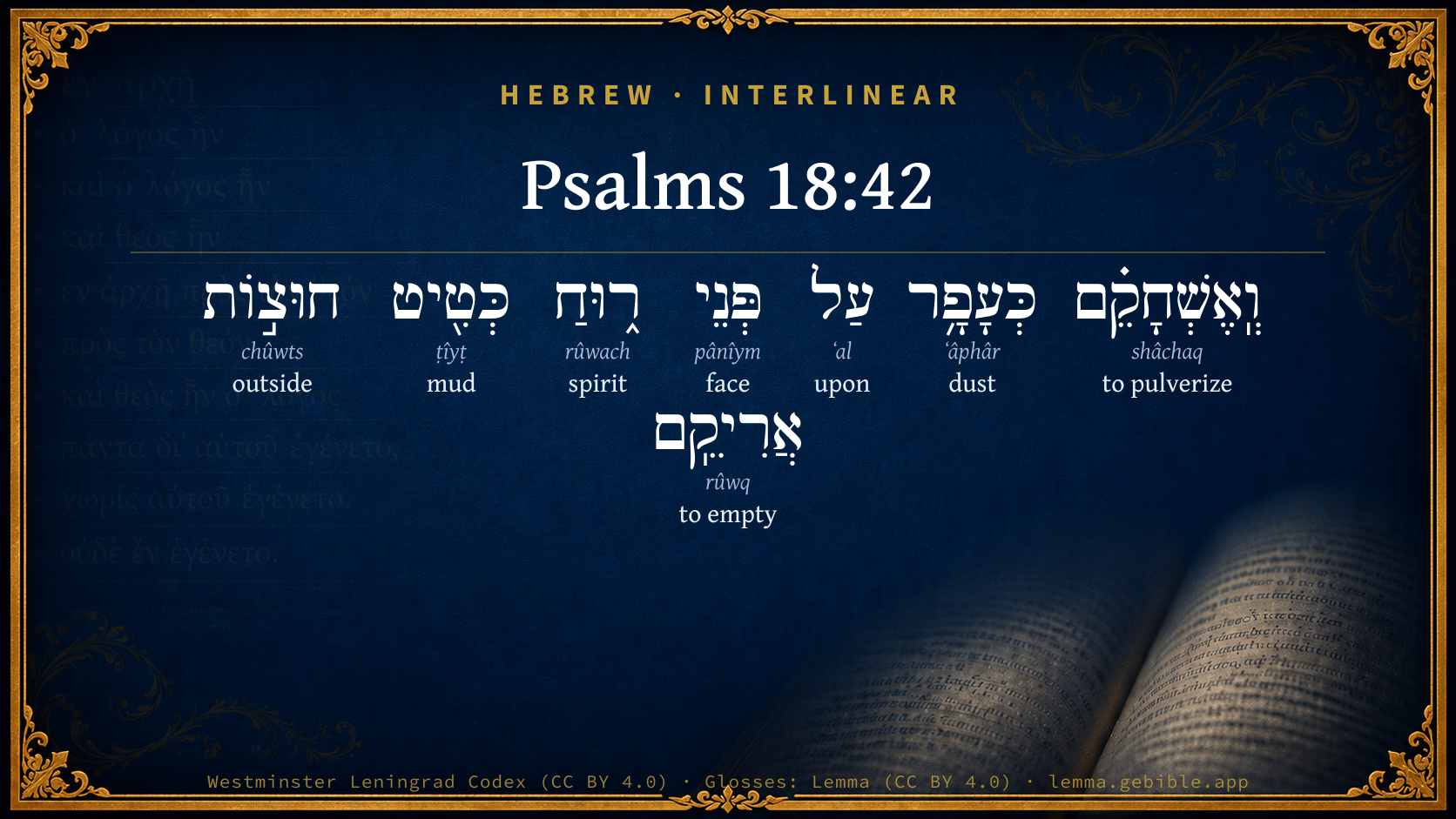
Hebrew (Westminster Leningrad Codex) Psalms 18:42 appears in the Hebrew Old Testament. The text above is from the Westminster Leningrad Codex. Each word links to its Strong’s number, a concise gloss, and parsing drawn from the Open Scriptures Hebrew Bible morphology. Click any word for its full Brown-Driver-Briggs (BDB) entry.
Download image
Cite this verse

Psalms 18:42 (World English Bible). Public Domain. Lemma interlinear Bible study tool, https://lemma.gebible.app/v/psalms/18/42.

Show BibTeX & RIS
BibTeX
RIS
English Translation
Then I beat them small as the dust before the wind. I cast them out as the mire of the streets.
World English Bible · Public Domain
Download a study sheet

One document with this verse’s original text, its word-by-word gloss line, the meaning frame, cross-references with their text, attributed commentary, and full source and license credits — printable, and it pastes into notes with its structure intact.

This verse Autodidact and up

Study sheet (.html) Plain text (.txt)

A passage Seminary Student

Up to 50 verses in one chapter. A passage sheet keeps up to 6 commentary sources and 12 cross-references per verse, in the order this page ranks them, and says so on the sheet whenever that leaves anything out. Ask for a single verse and you get the Autodidact verse sheet above.

Everything on this page stays free to read, with no account — the sheet is a download of what is already on screen, not access to it.

Want to remove ads? Support Godless Engineer
Compare translations 3

The same verse in 3 English versions, stacked beneath the original-language interlinear above. Click any original word for its lexicon entry.

Each is an independent rendering of the whole verse — the interlinear is not word-aligned to these translations.

Highlighted words mark where these versions differ — a whole-verse word diff, not a word-by-word alignment.

  • World English Bible Public Domain
    Then I beat them small as the dust before the wind. I cast them out as the mire of the streets.
  • King James Version Public Domain
    Then did I beat them small as the dust before the wind: I did cast them out as the dirt in the streets.
  • unfoldingWord Literal Text CC BY-SA 4.0
    And I beat them fine as dust upon the face of the wind; like the mud of the streets I cast them out.

unfoldingWord Literal Text — © unfoldingWord, licensed CC BY-SA 4.0. Word-aligned USFM3 via Door43 (git.door43.org/unfoldingWord/en_ult).

Versions to compare (up to 4)

3 of 4 selected

Show all 18 translations

Every available English version of this verse, each an independent rendering of the whole verse.

  • World English Bible Public Domain
    Then I beat them small as the dust before the wind. I cast them out as the mire of the streets.
  • Berean Standard Bible Public Domain
    I ground them as dust in the face of the wind; I trampled them like mud in the streets.
  • Majority Standard Bible Public Domain
    I ground them as dust in the face of the wind; I trampled them like mud in the streets.
  • King James Version Public Domain
    Then did I beat them small as the dust before the wind: I did cast them out as the dirt in the streets.
  • American Standard Version (1901) Public Domain
    Then did I beat them small as the dust before the wind; I did cast them out as the mire of the streets.
  • Revised Version (1885) Public Domain
    Then did I beat them small as the dust before the wind: I did cast them out as the mire of the streets.
  • Geneva Bible (1599) Public Domain
    Then I did beate them small as the dust before the winde: I did treade them flat as the clay in the streetes.
  • Douay-Rheims (1899) Public Domain
    They cried, but there was none to save them, to the Lord: but he heard them not.
  • Young's Literal Translation Public Domain
    And I beat them as dust before wind, As mire of the streets I empty them out.
  • Literal Standard Version CC BY-SA 4.0
    And I beat them as dust before wind, || I empty them out as mire of the streets.
  • Unlocked Literal Bible CC BY-SA 4.0
    I beat them into fine pieces like dust before the wind; I threw them out like mud in the streets.
  • unfoldingWord Literal Text CC BY-SA 4.0
    And I beat them fine as dust upon the face of the wind; like the mud of the streets I cast them out.
  • Darby Bible Public Domain
    And I did beat them small as dust before the wind; I did cast them out as the mire of the streets.
  • World Messianic Bible Public Domain
    Then I beat them small as the dust before the wind. I cast them out as the mire of the streets.
  • Webster's Bible Public Domain
    \\18:41\\They cried, but there was none to save them: even to the LORD, but he answered them not.
  • Free Bible Version CC BY-SA 4.0
    I ground them into dust, like dust in the wind. I threw them out like mud in the street.
  • Bible in Basic English Public Domain
    Then they were crushed as small as dust before the wind; they were drained out like the waste of the streets.
  • JPS Tanakh (1917) Public Domain
    (18-43) Then did I beat them small as the dust before the wind; I did cast them out as the mire of the streets.

Literal Standard Version (2020), Covenant Press — licensed CC BY-SA 4.0. Text via the HelloAO Bible API (eBible.org). Unlocked Literal Bible (unfoldingWord) — licensed CC BY-SA 4.0. Text via the HelloAO Bible API (eBible.org). unfoldingWord Literal Text — © unfoldingWord, licensed CC BY-SA 4.0. Word-aligned USFM3 via Door43 (git.door43.org/unfoldingWord/en_ult). Free Bible Version, Dr. Jonathan Gallagher — licensed CC BY-SA 4.0. Text via the HelloAO Bible API (eBible.org).

Word by word

More ways to search: Search by grammar → Find every occurrence → Compare this word →

Practice this passage: Drill this verse → Learn its vocabulary →

וְֽאֶשְׁחָקֵ֗ם
shâchaq
H7833
“and · to pulverize · them”
Conjunction + Verb, Qal, Imperfect, 1st Person, Common, Singular + Suffix, Personal, 3rd Person, Masculine, Plural
Part of Speech
Conjunction + Verb
Stem
Qal
Form
Imperfect
Person
1st Person
Gender
Common
Number
Singular
Full BDB Definition

Origin: a primitive root

TWOT: 2367

to rub away, beat fine, pulverise - (Qal) - to rub away - of incense, stones - of enemies (figuratively)
  1. כְּעָפָ֥ר ʻâphâr H6083 “like/as · dust” Preposition + Noun, Common, Masculine, Singular, Absolute
  2. עַל ʻal H5921 “upon” Preposition
  3. פְּנֵי pânîym H6440 “face(s) of” Noun, Common, Both, Plural, Construct
  4. ר֑וּחַ rûwach H7307 “spirit” Noun, Common, Both, Singular, Absolute
  5. כְּטִ֖יט ṭîyṭ H2916 “like/as · mud of” Preposition + Noun, Common, Masculine, Singular, Construct
  6. חוּצ֣וֹת chûwts H2351 “streets” Noun, Common, Masculine, Plural, Absolute
  7. אֲרִיקֵֽם rûwq H7324 “to empty · them” Verb, Hiphil, Imperfect, 1st Person, Common, Singular + Suffix, Personal, 3rd Person, Masculine, Plural

About this verse

These counts appear in no published source. They are computed here, from the morphology-tagged text and Lemma’s own curated glosses. What Lemma adds →

8
words
8
distinct lemmas
Wisdom
section

Notable vocabulary

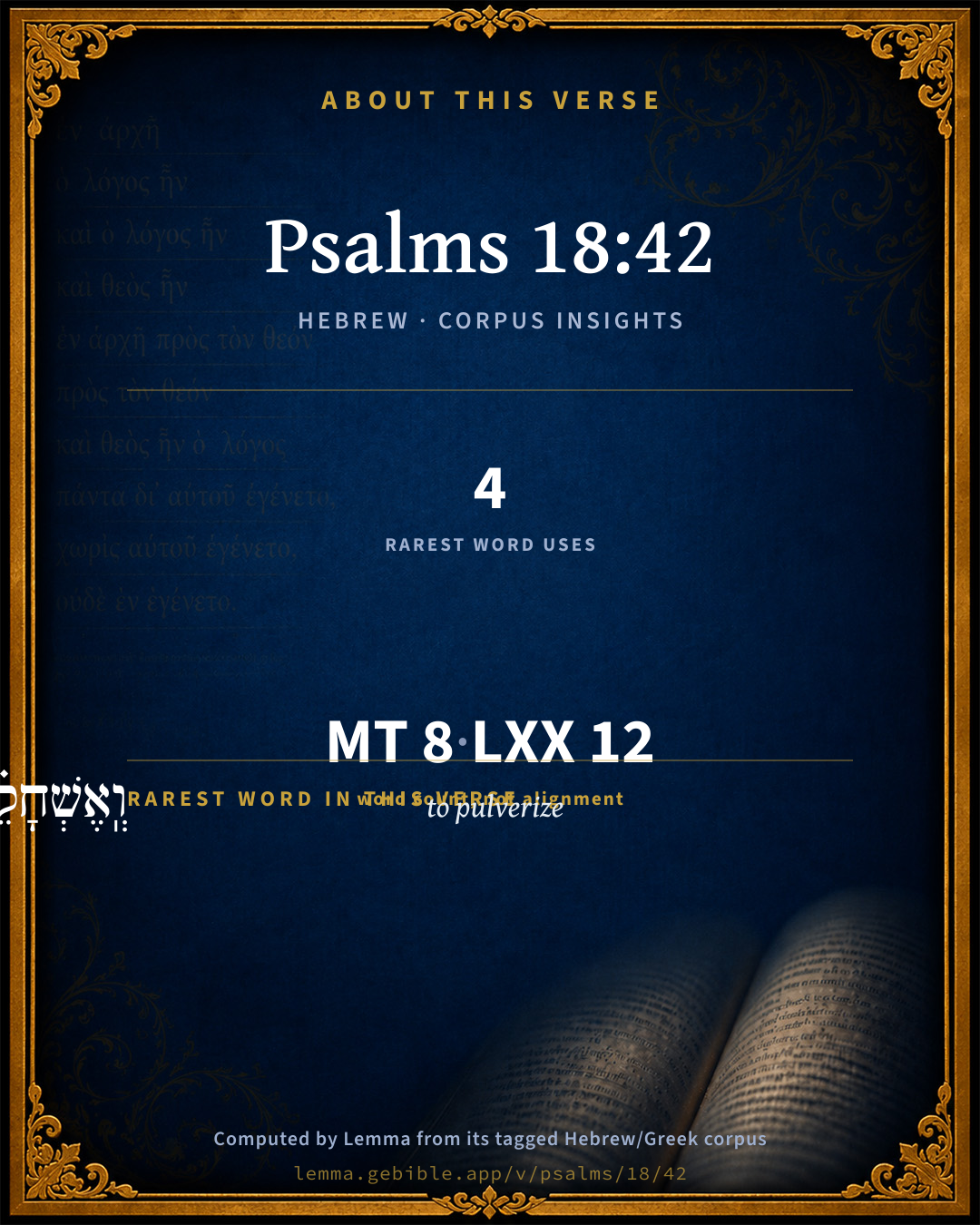
The rarest word here is וְֽאֶשְׁחָקֵ֗ם to pulverize H7833 — appearing just 4 times in the whole Hebrew Bible.

Shared distinctive vocabulary

וְֽאֶשְׁחָקֵ֗ם to pulverize H7833 occurs in 4 verses of the Hebrew Bible. Also found in:

Grammatical profile

  • 2 verbs
  • 5 nouns
  • 1 preposition

Verb forms

  • וְֽאֶשְׁחָקֵ֗ם Qal · Imperfect
  • אֲרִיקֵֽם Hiphil · Imperfect

Hebrew & Septuagint length

In English translation the verse runs 21 words from the Hebrew and 21 from the Septuagint (LXX English) — the same length.

A rough comparison of the two English renderings, which tokenize alike — not a word-level alignment.

Word counts can differ between the Hebrew and the Greek without any difference in meaning — e.g. the Hebrew direct-object marker אֵת has no separate Greek word, and Greek often adds the article ὁ.

In the original languages it is 8 Hebrew tokens and 12 Greek tokens — but the two are counted differently (Hebrew bundles its prefixes and suffixes into one token; the Greek is in lemma form), so that isn’t a like-for-like length.

Cross-references

8

Topical passages linked to Psalms 18:42 in the Treasury of Scripture Knowledge — connected by theme and wording, ordered by reader-vote popularity; previews shown in the World English Bible.

  • Isaiah 10:6 I will send him against a profane nation, and against the people of my wrath will I give him a charge, to take the spoil, and to take the prey, and to tread them down like the mire of the streets.
  • 2 Kings 13:7 For he didn't leave to Jehoahaz of the people save fifty horsemen, and ten chariots, and ten thousand footmen; for the king of Syria destroyed them, and made them like the dust in threshing.
  • Isaiah 41:15–16 Behold, I have made you [to be] a new sharp threshing instrument having teeth; you shall thresh the mountains, and beat them small, and shall make the hills as chaff.
  • Zechariah 10:5 They shall be as mighty men, Treading down muddy streets in the battle; And they shall fight, because Yahweh is with them; And the riders on horses will be confounded.
  • Psalms 50:22 "Now consider this, you who forget God, Lest I tear you into pieces, and there be none to deliver.
  • Isaiah 25:10 For in this mountain will the hand of Yahweh rest; and Moab shall be trodden down in his place, even as straw is trodden down in the water of the dung-hill.
  • Isaiah 41:2 Who has raised up one from the east, whom he calls in righteousness to his foot? he gives nations before him, and makes him rule over kings; he gives them as the dust to his sword, as the driven stubble to his bow.
  • Malachi 4:3 You shall tread down the wicked; for they will be ashes under the soles of your feet in the day that I make," says Yahweh of Hosts.

Cross-references courtesy of OpenBible.info (CC BY 4.0).

Hebrew and Greek witnesses Masoretic Hebrew ↔ Greek Septuagint

The same verse in the two great witnesses to the Old Testament, shown verse-for-verse.

You’re reading Greek Psalm 17 (Hebrew Psalm 18). The Septuagint counts the superscription, so verse numbers can differ from the Hebrew — chapter-level alignment, not verse-by-verse. Numbering follows Rahlfs.

These are two independent witnesses, not word-aligned to each other, and the Septuagint is shown in lemma (dictionary) form.

Hebrew Psalms 18:42 Masoretic · Westminster Leningrad Codex

וְֽאֶשְׁחָקֵ֗ם כְּעָפָ֥ר עַל פְּנֵי ר֑וּחַ כְּטִ֖יט חוּצ֣וֹת אֲרִיקֵֽם

Then I beat them small as the dust before the wind. I cast them out as the mire of the streets.

World English Bible · Public Domain

Greek LXX Greek Psalm 17:42 Septuagint · lemma form

κράζω καί οὐ εἰμί ὁ σώζω πρός κύριος καί οὐ εἰςἀκούω αὐτός

I will grind them as the mud of the streets: and I will beat them small as dust before the wind.

LXX2012 (modern English Septuagint) · Public Domain

On this verse, Ellicott's Commentary for English Readers discusses the Septuagint’s reading. Read the note in Commentary ↓

Hebrew: Westminster Leningrad Codex (CC BY 4.0). Greek: Septuagint (public domain); English from LXX2012 (modern English Septuagint) (Public Domain). How the Septuagint differs from the Hebrew →

Commentary

Notes on Psalms 18:42 from classic Christian and Jewish commentators (each source and its license shown beneath its notes). The classic Christian expositions comment on the surrounding passage and are grouped to its opening verse, so a note may address several verses; the Jewish commentaries on the Tanakh (Rashi and others) are per-verse, so they appear only where the commentator wrote on this verse.

Lemma curates 59 commentaries, every one of them public domain or Creative Commons licensed, each selected and text-cleaned for this edition rather than reprinted as found. About our sources →

Trapp's Complete Commentary

John Trapp

Psa 18:42 Then did I beat them small as the dust before the wind: I did cast them out as the dirt in the streets.

Ver. 42. Then did I beat them as small as the dust] When God once withdraws his protection and help from a people it is an easy matter to tread them down and beat them in pieces. Lay hold upon him, therefore, as the Church did, and hang on. Say, as Jer 14:21, Do not abhor us for thy name’s sake; for as Bodin said well of obtaining, so for retaining, religion and civil rights, Non disputationibus, sed rogationibus agendum, prayer is most prevalent. If once our shadow depart, &c., woe be unto them when I depart from them.

I did cast them out, &c.] Evacuabam eos, I dealt by them as men do by the sweepings of the house, or noisome excrements. God sometimes dungeth his vineyard with the dead bodies of his enemies.

John Trapp, A Commentary or Exposition upon All the Books of the Old and New Testament (1647–1656) — public domain. Text from a community e-Sword module.

J. A. Alexander on Psalms

Joseph Addison Alexander

43. (Psa 18:42). And I shall beat them small as dust before the wind, as dirt in the streets I will pour them out. The comparisons in this verse are intended to express the Psalmist's superiority to his enemies, his consequent contempt for them, and the facility with which he will destroy them. Similar images are not unfrequent in the Old Testament. See for example Isa 10:6, Zep 1:17. Zec 10:5.

Joseph Addison Alexander, The Psalms Translated and Explained (1850) — public domain. Text from a community e-Sword module.

Jamieson, Fausset & Brown

Robert Jamieson, A. R. Fausset & David Brown

This conquest was complete.

Jamieson, Fausset & Brown — Commentary Critical and Explanatory on the Whole Bible (1871) — public domain (CC PDM 1.0). Text via the HelloAO Bible API.

Adam Clarke's Commentary

Verse 42. Then did l beat them] God was with him, and they had only an arm of flesh. No wonder then that his enemies were destroyed.

Small as the dust before the wind] This well expresses the manner in which he treated the Moabites, Ammonites, and the people of Rabbah: "He put them under saws, and under harrows of iron, and under axes of iron; and made them pass through the brick-kiln," c. See 2Sa 12:31, and the notes there.

Adam Clarke's Commentary on the Bible (1810–1826) — public domain. Text from a community e-Sword/MySword module.

Ellicott's Commentary for English Readers

(42) Before the wind.—In Samuel, the weaker “of the earth.”

Cast them out—i.e., sweep them before me. In Samuel “stamp and tread them out.” So LXX. here “grind,” or “pound.”

A Bible Commentary for English Readers, edited by Charles John Ellicott (1878–1897) — public domain. Text from a community e-Sword module.

The Cambridge Bible for Schools and Colleges

gen. ed. J. J. S. Perowne

42. Two figures are combined to express the annihilation of David’s enemies. They were, as it were, pounded to dust (2Ki_13:7), and then scattered like that dust driven before the wind. Cp. Isa_29:5; Isa_41:2. 2 Sam. reads only “as the dust of the earth.”

I did cast them out &c.] Flung them away as worthless refuse (Zep_1:17). But the mire of the streets is usually spoken of as trampled under foot (Isa_10:6; Mic_7:10; Zec_10:5), and it suits the parallelism better to read with the LXX and 2 Sam., I did stamp them (Mic_4:13). The variation is again due to the confusion of similar letters (ארקם—אדקם). The addition at the end of the verse in 2 Sam., “and did spread them abroad,” is probably a gloss.

The Cambridge Bible for Schools and Colleges (gen. ed. J. J. S. Perowne; Cambridge University Press, 1878–1918) — public domain. Text from a community e-Sword module.

John Gill's Exposition

Thou hast delivered me from the strivings of the people,.... In Sa2 22:44, it is read "my people", meaning the people of Israel; either Saul and his men, who contended with David, and sought his life; or rather the tribes of Israel, who, after Saul's death, refused to acknowledge David as their king, but afterwards came and anointed him in Hebron. The words may very well be interpreted of the contentions of the Scribes and Pharisees with Christ, and of the opposition from sinners, which he for a while endured, but is now delivered from them all;

and thou hast made me the head of the Heathen; which, if understood of David, refers to the Philistines, Syrians, Moabites, and Edomites, being subdued by him, and becoming tributaries to him, Sa2 8:1. But it best agrees with Christ, who is the head of his chosen ones among the Gentiles; the political head, King, and Governor of them, the Heathen being given him for his inheritance and possession; and which appeared in the first ages of Christianity, when the Gospel was first preached to the Gentiles by the apostles; and still continues, and will be more clearly seen in the latter day, when the Lord shall be King over all the earth. Christ was made the head of the Heathen, by the appointment and designation of his Father; and, in fact, was so when multitudes from among the Gentiles were converted and brought to the obedience of him. In Sa2 22:44 it is, "thou hast kept me to be head of the Heathen"; which does not seem so much to intend the designation and constitution of him as such, but the continuation of him; and denotes the stability of his government in the Gentile world, of which there will be no end;

a people whom I have not known shall serve me; by whom are meant the Gentiles, who were not the people of God, were without Christ and without God, and without hope in the world: not that there are any people that can be unknown to Christ, as he is the omniscient God; nor were these unknown to him, in such sense as reprobates, nominal professors, and foolish virgins, are said not to be known by him, Mat 7:23. For these people among the Heathen, who are or shall be brought to serve the Lord, are such who were the objects of his love and delight from everlasting; were in his Father's choice and in his own, and in the gift of his Father to him, and in the covenant of his grace; and therefore must be known by him; moreover, they are the purchase of his blood; and the sheep he knows, for whom he has laid down his life, and of whom he has such an exact and particular knowledge, that he can and does call them by name. But the sense is, these seemed not to be taken notice of and cared for by Christ; they were not owned and acknowledged by him as his people; the Jews were distinguished from all others; they only had the law, the word of God, and his ordinances; the Gentiles were suffered to walk in their own ways; they were neglected, and the times of their ignorance were overlooked and disregarded; so that they were treated as a people that were not known for many hundreds of years: but here it is predicted, that when the Gospel should come among them, and they be called by it, they should "serve" the Lord in righteousness and true holiness, with reverence and godly fear, from a principle of love, in his name and strength, and to his glory; see Isa 55:4.

John Gill's Exposition of the Whole Bible (1746–1763) — public domain (CC PDM 1.0). Text via the HelloAO Bible API.

Albert Barnes' Notes on the Bible

Then did I beat them small as the dust before the wind - As the fine dust is driven by the wind, so they fled before me. There could be no more striking illustration of a defeated army flying before a conqueror. DeWette says correctly that the idea is, “I beat them small, and scattered them as dust before the wind.”

I did cast them out as the dirt in the streets - In the corresponding place in 2Sa 22:43, this is, “I did stamp them as the mire of the street, and did spread them abroad.” The idea in the place before us is, that he poured them out, for so the Hebrew word means, as the dirt or mire in the streets. As that is trodden on, or trampled down, so they, instead of being marshalled for battle, were wholly disorganized, scattered, and left to be trodden down, as the most worthless object is. A similar image occurs in Isa 10:6, where God is speaking of Sennacherib: “I will send him against an hypocritical nation ... to tread them down like the mire of the streets.”

Albert Barnes' Notes on the Bible (1834–1885) — public domain. Text from a community e-Sword/MySword module.

Matthew Poole's English Annotations

Or, rid them away, as dirt is usually swept or carried out of houses or streets. Or, tread them down, or bruise them, as men do dirt when they walk in the streets.

Matthew Poole's English Annotations on the Holy Bible (1683–1685) — public domain. Text from a community e-Sword/MySword module.

The Pulpit Commentary

Then did I beat them small as the dust before the wind. (comp. Psa_35:5) The enemy were beaten and dispersed so that they seemed driven as dust before the wind. I did cast them out as the dirt in the streets. They were made no account of, treated with as little ceremony as the clay in the streets. Language of utter contempt.

The Pulpit Commentary (1880–1919), ed. H.D.M. Spence-Jones & Joseph S. Exell — public domain. Text from a community e-Sword module.

Rashi

Rabbi Shlomo Yitzchaki (Rashi)

They pray to their idols.

but no one saves them Because it [their prayer] has no power, and they return and call upon the Lord, but He does not answer them.

Rashi on the Tanakh — English translations: “The Judaica Press complete Tanach with Rashi, translated by A. J. Rosenberg” (CC BY 4.0); “Pentateuch with Rashi's commentary by M. Rosenbaum and A.M. Silbermann, 1929-1934” (public domain); “The Metsudah Tanach series, Lakewood, N.J” (CC BY 4.0); and “The Book of Joshua, Metsudah Publications, 1997” (CC BY 4.0). Text via Sefaria.

Lesson kit

Teaching starters — assembled from the data on this page, not authored interpretation. Every prompt links to the verse data it draws on. Edit before teaching.

Psalms, in the Wisdom, opens this verse with 8 words (8 distinct Hebrew lemmas). Its most distinctive word is shâchaq (“to pulverize”). A historical commentator’s framing appears above. Read the whole chapter for the surrounding context.

Discussion questions

  1. How does “to pulverize” (shâchaq) shape what this verse is saying?
  2. How does Exodus 30:36, which shares the word «to pulverize», read alongside this verse?
  3. The translations on this page render this verse differently — a whole-verse word diff, not a word-by-word alignment. What might account for the different wordings?
  4. «וְֽאֶשְׁחָקֵ֗ם» is a Qal Imperfect verb. How does that grammatical form shape the action described?
  5. Compare how Trapp's Complete Commentary and J. A. Alexander on Psalms read this verse. Where do they agree or differ?

Things to notice

Reading settings

Reading text

Shown beneath each verse's original-language words.

Old Testament
Old Testament edition

Read the OT as the Masoretic Hebrew (MT) or the Greek Septuagint (LXX).

English shown for the Greek Septuagint (in the Hebrew ↔ Greek comparison).

Comparing translations? Open the Compare panel on any verse page to stack up to four side by side.