
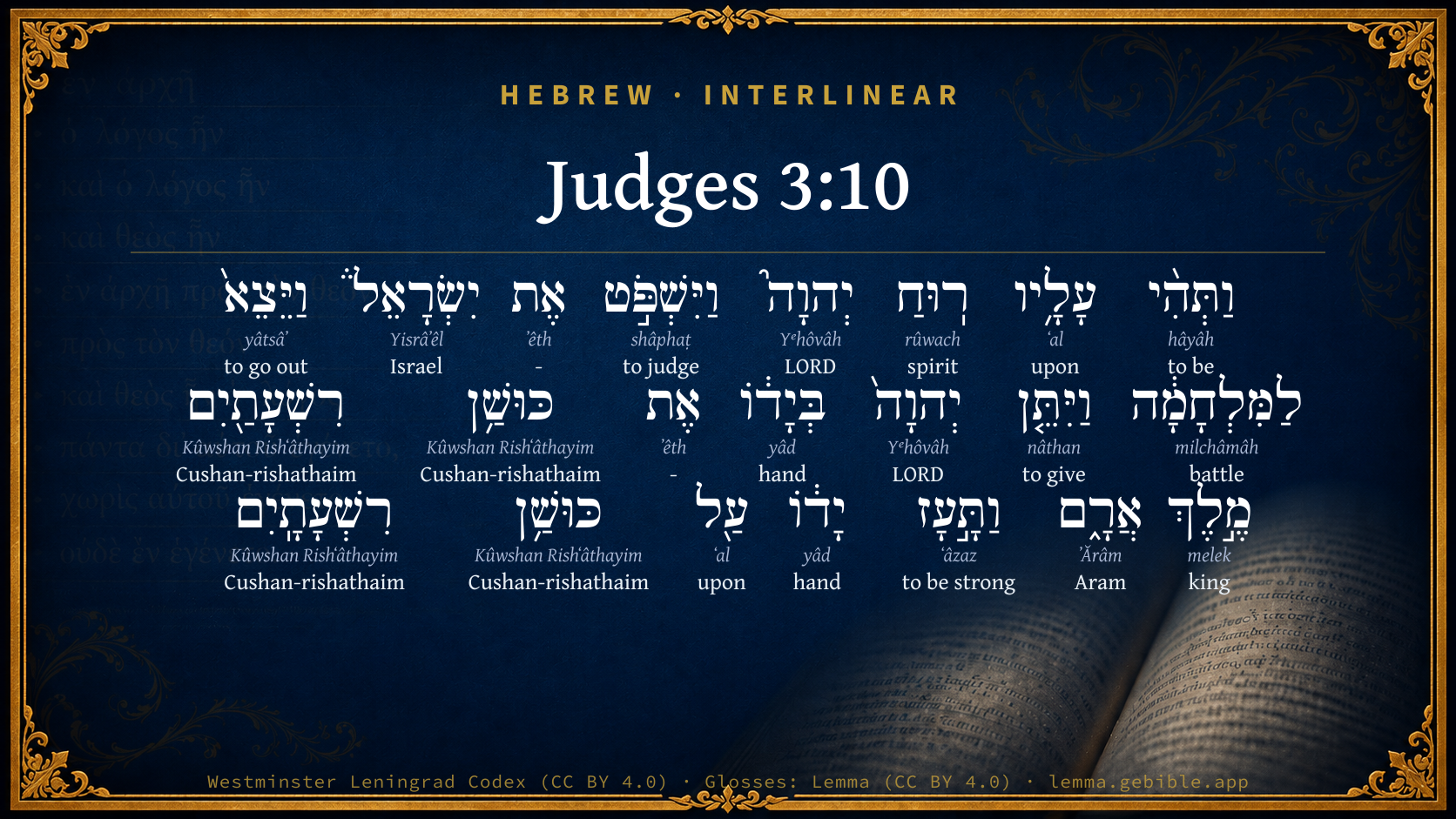
Judges 3:10

Hebrew (Westminster Leningrad Codex) Judges 3:10 appears in the Hebrew Old Testament. The text above is from the Westminster Leningrad Codex. Each word links to its Strong’s number, a concise gloss, and parsing drawn from the Open Scriptures Hebrew Bible morphology. Click any word for its full Brown-Driver-Briggs (BDB) entry.
Download image
Cite this verse

Judges 3:10 (World English Bible). Public Domain. Lemma interlinear Bible study tool, https://lemma.gebible.app/v/judges/3/10.

Show BibTeX & RIS
BibTeX
RIS
English Translation
The Spirit of Yahweh came on him, and he judged Israel; and he went out to war, and Yahweh delivered Cushan Rishathaim king of Mesopotamia into his hand: and his hand prevailed against Cushan Rishathaim.
World English Bible · Public Domain
Highlights
  • 1 first appearance in the Hebrew Bible
Full analysis ↓
Download a study sheet

One document with this verse’s original text, its word-by-word gloss line, the meaning frame, cross-references with their text, attributed commentary, and full source and license credits — printable, and it pastes into notes with its structure intact.

This verse Autodidact and up

Study sheet (.html) Plain text (.txt)

A passage Seminary Student

Up to 50 verses in one chapter. A passage sheet keeps up to 6 commentary sources and 12 cross-references per verse, in the order this page ranks them, and says so on the sheet whenever that leaves anything out. Ask for a single verse and you get the Autodidact verse sheet above.

Everything on this page stays free to read, with no account — the sheet is a download of what is already on screen, not access to it.

Want to remove ads? Support Godless Engineer
Compare translations 3

The same verse in 3 English versions, stacked beneath the original-language interlinear above. Click any original word for its lexicon entry.

Each is an independent rendering of the whole verse — the interlinear is not word-aligned to these translations.

Highlighted words mark where these versions differ — a whole-verse word diff, not a word-by-word alignment.

  • World English Bible Public Domain
    The Spirit of Yahweh came on him, and he judged Israel; and he went out to war, and Yahweh delivered Cushan Rishathaim king of Mesopotamia into his hand: and his hand prevailed against Cushan Rishathaim.
  • King James Version Public Domain
    And the Spirit of the LORD came upon him, and he judged Israel, and went out to war: and the LORD delivered Chushanrishathaim king of Mesopotamia into his hand; and his hand prevailed against Chushanrishathaim.
  • unfoldingWord Literal Text CC BY-SA 4.0
    And the Spirit of Yahweh was upon him, and he judged Israel. And he went out to war, and Yahweh gave Cushan-Rishathaim, the king of Aram, into his hand. So his hand was strong against Cushan-Rishathaim.

unfoldingWord Literal Text — © unfoldingWord, licensed CC BY-SA 4.0. Word-aligned USFM3 via Door43 (git.door43.org/unfoldingWord/en_ult).

Versions to compare (up to 4)

3 of 4 selected

Show all 18 translations

Every available English version of this verse, each an independent rendering of the whole verse.

  • World English Bible Public Domain
    The Spirit of Yahweh came on him, and he judged Israel; and he went out to war, and Yahweh delivered Cushan Rishathaim king of Mesopotamia into his hand: and his hand prevailed against Cushan Rishathaim.
  • Berean Standard Bible Public Domain
    The Spirit of the LORD came upon him, and he became Israel’s judge and went out to war. And the LORD delivered Cushan-rishathaim king of Aram into the hand of Othniel, who prevailed against him.
  • Majority Standard Bible Public Domain
    The Spirit of the LORD came upon him, and he became Israel’s judge and went out to war. And the LORD delivered Cushan-rishathaim king of Aram into the hand of Othniel, who prevailed against him.
  • King James Version Public Domain
    And the Spirit of the LORD came upon him, and he judged Israel, and went out to war: and the LORD delivered Chushanrishathaim king of Mesopotamia into his hand; and his hand prevailed against Chushanrishathaim.
  • American Standard Version (1901) Public Domain
    And the Spirit of Jehovah came upon him, and he judged Israel; and he went out to war, and Jehovah delivered Cushan-rishathaim king of Mesopotamia into his hand: and his hand prevailed against Cushan-rishathaim.
  • Revised Version (1885) Public Domain
    And the spirit of the LORD came upon him, and he judged Israel; and he went out to war, and the LORD delivered Cushan-rishathaim king of Mesopotamia into his hand: and his hand prevailed against Cushan-rishathaim.
  • Geneva Bible (1599) Public Domain
    And the spirite of the Lord came vpon him, and he iudged Israel, and went out to warre: and the Lord deliuered Chushan rishathaim king of Aram into his hand, and his hand preuailed against Chushan rishathaim.
  • Douay-Rheims (1899) Public Domain
    And the spirit of the Lord was in him, and he judged Israel. And he went out to fight, and the Lord delivered into his hands Chusan Rasathaim king of Syria, and he overthrew him.
  • Young's Literal Translation Public Domain
    and the Spirit of Jehovah is upon him, and he judgeth Israel, and goeth out to battle, and Jehovah giveth unto his hand Chushan-Rishathaim king of Aram, and strong is his hand against Chushan-Rishathaim;
  • Literal Standard Version CC BY-SA 4.0
    and the Spirit of YHWH is on him, and he judges Israel, and goes out to battle, and YHWH gives Chushan-Rishathaim king of Aram into his hand, and his hand is strong against Chushan-Rishathaim;
  • Unlocked Literal Bible CC BY-SA 4.0
    Yahweh's Spirit empowered him, and he judged Israel and he went out to war. Yahweh gave him victory over Cushan-Rishathaim king of Aram. The hand of Othniel defeated Cushan-Rishathaim.
  • unfoldingWord Literal Text CC BY-SA 4.0
    And the Spirit of Yahweh was upon him, and he judged Israel. And he went out to war, and Yahweh gave Cushan-Rishathaim, the king of Aram, into his hand. So his hand was strong against Cushan-Rishathaim.
  • Darby Bible Public Domain
    The Spirit of the LORD came upon him, and he judged Israel; he went out to war, and the LORD gave Cu'shan-rishatha'im king of Mesopota'mia into his hand; and his hand prevailed over Cu'shan-rishatha'im.
  • World Messianic Bible Public Domain
    The LORD’s Spirit came on him, and he judged Israel; and he went out to war, and the LORD delivered Cushan Rishathaim king of Mesopotamia into his hand. His hand prevailed against Cushan Rishathaim.
  • Webster's Bible Public Domain
    And the Spirit of the LORD came upon him, and he judged Israel, and went out to war: and the LORD delivered Chushan-rishathaim king of Mesopotamia into his hand; and his hand prevailed against Chushan-rishathaim.
  • Free Bible Version CC BY-SA 4.0
    The Spirit of the Lord came on him, and he became Israel's judge. He went to war with Cushan-Rishathaim, king of Aram, and the Lord handed the king over to Othniel, who was victorious.
  • Bible in Basic English Public Domain
    And the spirit of the Lord came on him and he became judge of Israel, and went out to war, and the Lord gave up Cushan-rishathaim, king of Mesopotamia, into his hands and he overcame him.
  • JPS Tanakh (1917) Public Domain
    And the spirit of the LORD came upon him, and he judged Israel; and he went out to war, and the LORD delivered Cushan-rishathaim king of Aram into his hand; and his hand prevailed against Cushan-rishathaim.

Literal Standard Version (2020), Covenant Press — licensed CC BY-SA 4.0. Text via the HelloAO Bible API (eBible.org). Unlocked Literal Bible (unfoldingWord) — licensed CC BY-SA 4.0. Text via the HelloAO Bible API (eBible.org). unfoldingWord Literal Text — © unfoldingWord, licensed CC BY-SA 4.0. Word-aligned USFM3 via Door43 (git.door43.org/unfoldingWord/en_ult). Free Bible Version, Dr. Jonathan Gallagher — licensed CC BY-SA 4.0. Text via the HelloAO Bible API (eBible.org).

Word by word

More ways to search: Search by grammar → Find every occurrence → Compare this word →

Practice this passage: Drill this verse → Learn its vocabulary →

כּוּשַׁ֥ן
Kûwshan Rishʻâthayim
H3573
“Cushan-rishathaim”
Noun, Proper
Part of Speech
Noun
Type
Proper
Full BDB Definition

Origin: apparently from H3572 and the dual of H7564

TWOT: None

Chushan-rishathaim = "twice-wicked Cushan" - a king of Mesopotamia defeated by the judge Othniel the son-in-law of Caleb
  1. וַתְּהִ֨י hâyâh H1961 “and · to be” Conjunction + Verb, Qal, Sequential Imperfect, 3rd Person, Feminine, Singular
  2. עָלָ֥יו ʻal H5921 “upon · him” Preposition + Suffix, Personal, 3rd Person, Masculine, Singular
  3. רֽוּחַ rûwach H7307 “spirit of” Noun, Common, Both, Singular, Construct
  4. יְהוָה֮ Yᵉhôvâh H3068 “LORD” Noun, Proper
  5. וַיִּשְׁפֹּ֣ט shâphaṭ H8199 “and · to judge” Conjunction + Verb, Qal, Sequential Imperfect, 3rd Person, Masculine, Singular
  6. אֶת ʼêth H853 “-” Particle, Direct Object
  7. יִשְׂרָאֵל֒ Yisrâʼêl H3478 “Israel” Noun, Proper
  8. וַיֵּצֵא֙ yâtsâʼ H3318 “and · to go out” Conjunction + Verb, Qal, Sequential Imperfect, 3rd Person, Masculine, Singular
  9. לַמִּלְחָמָ֔ה milchâmâh H4421 “to/for the · battle” Preposition, Determined + Noun, Common, Feminine, Singular, Absolute
  10. וַיִּתֵּ֤ן nâthan H5414 “and · to give” Conjunction + Verb, Qal, Sequential Imperfect, 3rd Person, Masculine, Singular
  11. יְהוָה֙ Yᵉhôvâh H3068 “LORD” Noun, Proper
  12. בְּיָד֔וֹ yâd H3027 “in/at · hand · his” Preposition + Noun, Common, Both, Singular, Construct + Suffix, Personal, 3rd Person, Masculine, Singular
  13. אֶת ʼêth H853 “-” Particle, Direct Object
  14. רִשְׁעָתַ֖יִם Kûwshan Rishʻâthayim H3573 “Cushan-rishathaim” Noun, Proper
  15. מֶ֣לֶךְ melek H4428 “king of” Noun, Common, Masculine, Singular, Construct
  16. אֲרָ֑ם ʼĂrâm H758 “Aram” Noun, Proper
  17. וַתָּ֣עָז ʻâzaz H5810 “and · to be strong” Conjunction + Verb, Qal, Sequential Imperfect, 3rd Person, Feminine, Singular
  18. יָד֔וֹ yâd H3027 “hand · his” Noun, Common, Both, Singular, Construct + Suffix, Personal, 3rd Person, Masculine, Singular
  19. עַ֖ל ʻal H5921 “upon” Preposition
  20. כּוּשַׁ֥ן Kûwshan Rishʻâthayim H3573 “Cushan-rishathaim” Noun, Proper
  21. רִשְׁעָתָֽיִם Kûwshan Rishʻâthayim H3573 “Cushan-rishathaim” Noun, Proper

About this verse

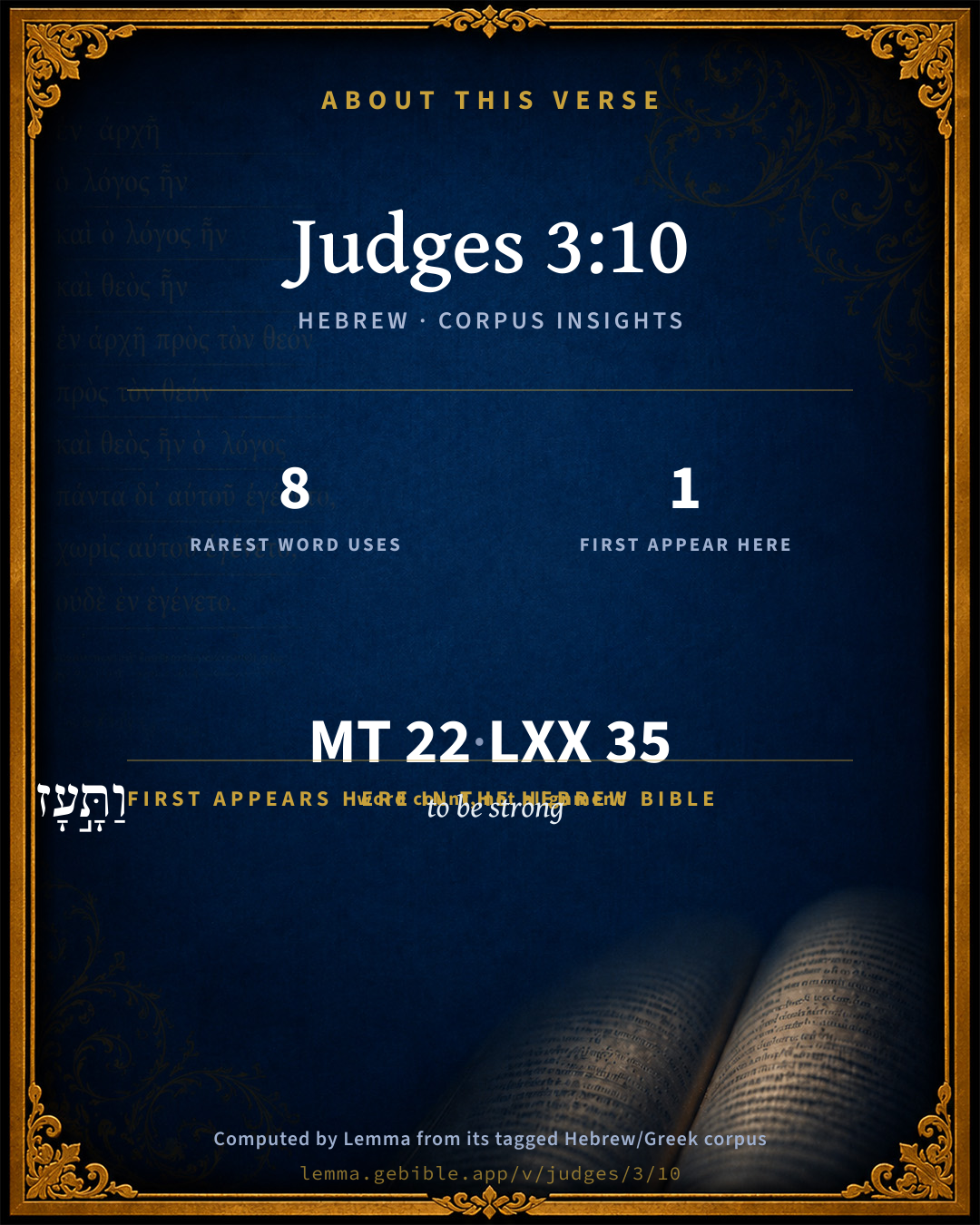
These counts appear in no published source. They are computed here, from the morphology-tagged text and Lemma’s own curated glosses. What Lemma adds →

22
words
15
distinct lemmas
Historical
section

Notable vocabulary

The rarest word here is כּוּשַׁ֥ן Cushan-rishathaim H3573 — appearing just 8 times in the whole Hebrew Bible.

First appearance in Scripture

This word makes its first canonical appearance in the Hebrew Bible here:

  • וַתָּ֣עָז to be strong H5810

Shared distinctive vocabulary

כּוּשַׁ֥ן Cushan-rishathaim H3573 occurs in 2 verses of the Hebrew Bible. Also found in:

Grammatical profile

  • 5 verbs
  • 13 nouns
  • 2 prepositions
  • 2 particles

Verb forms

  • וַתְּהִ֨י Qal · Sequential Imperfect
  • וַיִּשְׁפֹּ֣ט Qal · Sequential Imperfect
  • וַיֵּצֵא֙ Qal · Sequential Imperfect
  • וַיִּתֵּ֤ן Qal · Sequential Imperfect
  • וַתָּ֣עָז Qal · Sequential Imperfect

Repetition

Words recur within this verse — often emphatic in Hebrew:

  • כּוּשַׁ֥ן Cushan-rishathaim H3573 ×4
  • עָלָ֥יו upon H5921 ×2
  • יְהוָה֮ LORD H3068 ×2
  • בְּיָד֔וֹ hand H3027 ×2

Hebrew & Septuagint length

In English translation the verse runs 35 words from the Hebrew and 41 from the Septuagint (LXX English) — closely comparable.

A rough comparison of the two English renderings, which tokenize alike — not a word-level alignment.

Word counts can differ between the Hebrew and the Greek without any difference in meaning — e.g. the Hebrew direct-object marker אֵת has no separate Greek word, and Greek often adds the article ὁ.

In the original languages it is 22 Hebrew tokens and 35 Greek tokens — but the two are counted differently (Hebrew bundles its prefixes and suffixes into one token; the Greek is in lemma form), so that isn’t a like-for-like length.

Cross-references

18

Topical passages linked to Judges 3:10 in the Treasury of Scripture Knowledge — connected by theme and wording, ordered by reader-vote popularity; previews shown in the World English Bible.

  • Judges 11:29 Then the Spirit of Yahweh came on Jephthah, and he passed over Gilead and Manasseh, and passed over Mizpeh of Gilead, and from Mizpeh of Gilead he passed over to the children of Ammon.
  • Judges 13:25 The Spirit of Yahweh began to move him in Mahaneh-dan, between Zorah and Eshtaol.
  • Judges 14:6 The Spirit of Yahweh came mightily on him, and he tore him as he would have torn a kid; and he had nothing in his hand: but he didn't tell his father or his mother what he had done.
  • Judges 14:19 The Spirit of Yahweh came mightily on him, and he went down to Ashkelon, and struck thirty men of them, and took their spoil, and gave the changes [of clothing] to those who declared the riddle. His anger was kindled, and he went up to his father's house.
  • 1 Samuel 11:6 The Spirit of God came mightily on Saul when he heard those words, and his anger was kindled greatly.
  • 2 Chronicles 15:1 The Spirit of God came on Azariah the son of Oded:
  • Numbers 24:2 Balaam lifted up his eyes, and he saw Israel dwelling according to their tribes; and the Spirit of God came on him.
  • Judges 6:34 But the Spirit of Yahweh came on Gideon; and he blew a trumpet; and Abiezer was gathered together after him.
  • Numbers 11:17 I will come down and talk with you there: and I will take of the Spirit which is on you, and will put it on them; and they shall bear the burden of the people with you, that you not bear it yourself alone.
  • Numbers 11:25 Yahweh came down in the cloud, and spoke to him, and took of the Spirit that was on him, and put it on the seventy elders: and it happened that when the Spirit rested on them, they prophesied, but they did so no more.
  • Numbers 11:29 Moses said to him, Are you jealous for my sake? would that all Yahweh's people were prophets, that Yahweh would put his Spirit on them!
  • Numbers 27:18 Yahweh said to Moses, Take Joshua the son of Nun, a man in whom is the Spirit, and lay your hand on him;
  • 1 Samuel 10:6 and the Spirit of Yahweh will come mightily on you, and you shall prophesy with them, and shall be turned into another man.
  • 1 Samuel 16:13 Then Samuel took the horn of oil, and anointed him in the midst of his brothers: and the Spirit of Yahweh came mightily on David from that day forward. So Samuel rose up, and went to Ramah.
  • 2 Chronicles 20:14 Then on Jahaziel the son of Zechariah, the son of Benaiah, the son of Jeiel, the son of Mattaniah, the Levite, of the sons of Asaph, came the Spirit of Yahweh in the midst of the assembly;
  • Psalms 51:11 Don't throw me from your presence, And don't take your holy Spirit from me.
  • 1 Corinthians 12:4–11 Now there are various kinds of gifts, but the same Spirit.
  • Hebrews 6:4 For concerning those who were once enlightened and tasted of the heavenly gift, and were made partakers of the Holy Spirit,

Cross-references courtesy of OpenBible.info (CC BY 4.0).

Hebrew and Greek witnesses Masoretic Hebrew ↔ Greek Septuagint

The same verse in the two great witnesses to the Old Testament, shown verse-for-verse.

These are two independent witnesses, not word-aligned to each other, and the Septuagint is shown in lemma (dictionary) form.

Hebrew Judges 3:10 Masoretic · Westminster Leningrad Codex

וַתְּהִ֨י עָלָ֥יו רֽוּחַ יְהוָה֮ וַיִּשְׁפֹּ֣ט אֶת יִשְׂרָאֵל֒ וַיֵּצֵא֙ לַמִּלְחָמָ֔ה וַיִּתֵּ֤ן יְהוָה֙ בְּיָד֔וֹ אֶת כּוּשַׁ֥ן רִשְׁעָתַ֖יִם מֶ֣לֶךְ אֲרָ֑ם וַתָּ֣עָז יָד֔וֹ עַ֖ל כּוּשַׁ֥ן רִשְׁעָתָֽיִם

The Spirit of Yahweh came on him, and he judged Israel; and he went out to war, and Yahweh delivered Cushan Rishathaim king of Mesopotamia into his hand: and his hand prevailed against Cushan Rishathaim.

World English Bible · Public Domain

Greek LXX Judges 3:10 Septuagint · lemma form

καί γίγνομαι ἐπί αὐτός πνεῦμα κύριος καί κρίνω ὁ ἰσραήλ καί ἐκἔρχομαι εἰς πόλεμος πρός χουσαρσαθαιμ καί παραδίδωμι κύριος ἐν χείρ αὐτός ὁ χουσαρσαθαιμ βασιλεύς συρία ποταμός καί κραταιόω ὁ χείρ αὐτός ἐπί ὁ χουσαρσαθαιμ

And the Spirit of the Lord came upon him, and he judged Israel; and he went out to war against Chusarsathaim: and the Lord delivered into his hand Chusarsathaim king of Syria of the rivers, and his hand prevailed against Chusarsathaim.

LXX2012 (modern English Septuagint) · Public Domain

Hebrew: Westminster Leningrad Codex (CC BY 4.0). Greek: Septuagint (public domain); English from LXX2012 (modern English Septuagint) (Public Domain). How the Septuagint differs from the Hebrew →

Targum (Aramaic paraphrase)

1

The Targum is the ancient Jewish Aramaic paraphrase of the Hebrew Scriptures — an interpretive translation, not the Hebrew text itself. Onkelos (literal) and Pseudo-Jonathan (expansive) render the Torah, and Jonathan the Prophets. Coverage is partial: where no permissively-licensed English translation exists for a verse, only the Aramaic is shown. This is verse-level text, not a word-by-word alignment to the Hebrew.

  1. Targum Jonathan Prophets (Joshua–Malachi)
    וּשְׁרַת עֲלוֹהִי רוּחַ נְבוּאָה מִן קֳדָם יְיָ וְדָן יַת יִשְׂרָאֵל וּנְפַק לְאַגָחָא קְרָבָא וּמְסַר יְיָ בִּידוֹהִי יַת כּוּשַׁן חַיָבָא מַלְכָּא דַאֲרָם דִי עַל פְרָת וּתְקֵפַת יְדֵיהּ עַל כּוּשַׁן חַיָבָא:

    (no public-domain English translation for this verse)

    Targum Jonathan — Aramaic: “Mikraot Gedolot” (public domain). English: “Sefaria Community Translation” (CC0 1.0 (public-domain dedication)); “London "Chaldee Paraphrase," 1871” (public domain). Text via Sefaria.

Commentary

Notes on Judges 3:10 from classic Christian and Jewish commentators (each source and its license shown beneath its notes). The classic Christian expositions comment on the surrounding passage and are grouped to its opening verse, so a note may address several verses; the Jewish commentaries on the Tanakh (Rashi and others) are per-verse, so they appear only where the commentator wrote on this verse.

Lemma curates 59 commentaries, every one of them public domain or Creative Commons licensed, each selected and text-cleaned for this edition rather than reprinted as found. About our sources →

Trapp's Complete Commentary

John Trapp

Jdg 3:10 And the Spirit of the LORD came upon him, and he judged Israel, and went out to war: and the LORD delivered Chushanrishathaim king of Mesopotamia into his hand; and his hand prevailed against Chushanrishathaim.

Ver. 10. And the Spirit of the Lord came upon him.] Calling him to the work, and by heroic virtues fitting him for it, and then mightily working upon his spirit to undertake it.

John Trapp, A Commentary or Exposition upon All the Books of the Old and New Testament (1647–1656) — public domain. Text from a community e-Sword module.

Geneva Bible (1599)

Geneva Bible translators

Or, Syria.

He was stirred up by the Spirit of the Lord.

Geneva Bible (1599) marginal notes — public domain. Text via Bolls.life.

Jamieson, Fausset & Brown

Robert Jamieson, A. R. Fausset & David Brown

The Spirit of the Lord came upon him and he judged Israel, and went out to war--Impelled by a supernatural influence, he undertook the difficult task of government at this national crisis--addressing himself to promote a general reformation of manners, the abolition of idolatry, and the revival of pure religion. After these preliminary measures, he collected a body of choice warriors to expel the foreign oppressors.

the Lord delivered Chushan-rishathaim king of Mesopotamia into his hand; and his hand prevailed against Chushan-rishathaim--No details are given of this war, which, considering the resources of so potent a monarch, must have been a determined struggle. But the Israelitish arms were crowned through the blessing of God with victory, and Canaan regained its freedom and independence.

Jamieson, Fausset & Brown — Commentary Critical and Explanatory on the Whole Bible (1871) — public domain (CC PDM 1.0). Text via the HelloAO Bible API.

Adam Clarke's Commentary

Verse 10. His hand prevailed] We are not told or what nature this war was, but it was most decisive; and the consequence was an undisturbed peace of forty years, during the whole life of Othniel. By the Spirit of the Lord coming upon him, the Chaldee understands the spirit of prophecy; others understand the spirit of fortitude and extraordinary courage, as opposed to the spirit of fear or faintness of heart; but as Othniel was judge, and had many offices to fulfil besides that of a general, he had need of the Spirit of God, in the proper sense of the word, to enable him to guide and govern this most refractory and fickle people; and his receiving it for these purposes, shows that the political state of the Jews was still a theocracy. No man attempted to do any thing in that state without the immediate inspiration of God, the pretension to which was always justified by the event.

Adam Clarke's Commentary on the Bible (1810–1826) — public domain. Text from a community e-Sword/MySword module.

Ellicott's Commentary for English Readers

(10) The Spirit of the Lord came upon him.—Here the Targum has “the spirit of prophecy” (comp. Isa_61:1), perhaps with reference to Num_11:25. They render the same phrase in Jdg_6:34, “spirit of courage from Jehovah.” This expression constantly recurs in this book (Jdg_6:34; Jdg_11:29; Jdg_13:25). For “came upon him” (literally “was upon him”), a stronger phrase is “clothed him” (Jdg_6:34; 1Ch_12:18; 2Ch_24:20). The Jews, however, placed Othniel highest among the judges, and applied to him the words of Son_4:7, “Thou art all fair; there is no spot in thee,” because he alone of the judges is represented as irreproachable. Further than this, they followed some dim traditional data in identifying him with Jabez (1Ch_4:10), and regarding him as a learned teacher of the law. (See Jdg_1:13.)

He judged Israel.—Some of the Rabbis explain “judged” (yishhab) here to mean “avenged,” as in Psa_43:1, “Avenge me, O God” (Shapetêni),possibly from disliking the notion of a Kenizzite, however distinguished, holding the office of a suffes, or judge. There is a difficulty about Othniel’s age; Caleb was eighty-five at the conquest, and, if Othniel was his brother, he could not have been less than fifty or sixty at that time. But even supposing him to have been Caleb’s nephew, and aged forty at his marriage, then, since Joshua lived to be 110, and Cushan-Rishathaim’s oppression did not begin till after the death of the elders who outlived Joshua, and lasted eight years, if Othniel was judge for forty years, this would make him quite 143 years old at his death. It is only another sign that the chronological data of the Book of Judges are not sufficiently definite to enable us to construct a system out of them.

A Bible Commentary for English Readers, edited by Charles John Ellicott (1878–1897) — public domain. Text from a community e-Sword module.

The Cambridge Bible for Schools and Colleges

gen. ed. J. J. S. Perowne

10. the spirit of the Lord came upon him] So the spirit came upon Jephthah Jdg_11:29, and clothed itself with Gideon Jdg_6:34, and impelled (Jdg_13:25) or rushed upon Samson Jdg_14:6; Jdg_14:19, Jdg_15:14, and Saul 1Sa_11:6. These heroes seemed to be possessed; their extraordinary feats of strength and daring struck the beholder as due to the presence of a superhuman power—the spirit of the Lord, i.e. Jehovah directly acting in the physical, as elsewhere in the intellectual and spiritual, sphere. In the O.T. the spirit is not realized as a distinct personality; the spirit of Jehovah is Jehovah Himself in operation, and, as the divine name implies, in redemptive operation on behalf of Israel.

and he judged Israel] See on Jdg_2:16. The verb means both ‘to give judgement’ and ‘to do justice,’ ‘to give a person his rights’; in the latter sense it is used in parallelism with ‘save,’ and can even be followed by ‘out of the hand of,’ 1Sa_24:15, 2Sa_18:19; 2Sa_18:31. In the, age before the monarchy the ‘judges’ or ‘deliverers’ exercised in Israel an intermittent function, to which they were specially summoned by Jehovah; hence the Dtc. compiler uses the word almost as the title of an office. When the national sense was more fully developed, the Israelites demanded a king to fulfil the same function permanently instead of intermittently: see 1Sa_8:20.

The Cambridge Bible for Schools and Colleges (gen. ed. J. J. S. Perowne; Cambridge University Press, 1878–1918) — public domain. Text from a community e-Sword module.

John Gill's Exposition

And the Spirit of the Lord came upon him,.... Moved him to engage in this work of delivering Israel, inspired him with courage, and filled him with every needful gift, qualifying him for it; the Targum interprets it the spirit of prophecy; it seems father to be the spirit of counsel and courage, of strength and fortitude of body and mind:

and he judged Israel; took upon him the office of a judge over them, and executed it; very probably the first work he set about was to reprove them for their sins, and convince them of them, and reform them from their idolatry, and restore among them the pure worship of God; and this he did first before he took up arms for them:

and he went out to war; raised an army, and went out at the head of them, to fight with their oppressor:

and the Lord delivered Chushanrishathaim king of Mesopotamia into his hand; and his hand prevailed against Chushanrishathaim; gave him the victory over him and his army, so that he fell into his hands, became his captive, and perhaps was slain by him.

John Gill's Exposition of the Whole Bible (1746–1763) — public domain (CC PDM 1.0). Text via the HelloAO Bible API.

Albert Barnes' Notes on the Bible

And the Spirit of the Lord came upon him - The phrase occurs frequently in this book and in the books of Samuel and Kings. It marks the special office of the Judges. They were saviors (Jdg 3:9 margin; Neh 9:27) called and directed by the Holy Spirit, who endued them with extraordinary wisdom, courage, and strength for the work which lay before them (compare Jdg 6:34; Jdg 11:29; Jdg 13:25; Jdg 14:6, Jdg 14:19), and were in this respect types of Christ the “Judge of Israel” Mic 5:1, in whom “the Spirit of the Lord God” was “without measure” Isa 11:2; Isa 61:1; Mat 12:18-21; Job 1:32; Act 13:2.

Albert Barnes' Notes on the Bible (1834–1885) — public domain. Text from a community e-Sword/MySword module.

Haydock's Catholic Bible Commentary

In him, to instruct and enable him both to rout the enemy, and to govern the people with prudence. (Haydock) --- Chaldean, "the spirit of prophecy." The oracle excited him to attack Chusan. (Josephus, [Antiquities?] v. 3.) He was entrusted with an extraordinary authority, in a wonderful manner, and God gave him all those virtues which were requisite for his exalted station. (Calmet) --- Him. Hebrew, "his hand was strong upon Chusan Rasathaim." He gained a complete victory over him, (Haydock) the particulars of which are not mentioned, though they must have been very interesting and extraordinary, as the power of Chusan was so extensive. (Calmet)

George Leo Haydock (1774–1849), Haydock's Catholic Family Bible and Commentary, 1859 edition — public domain. Excludes Psalms (Douay-Rheims chapter numbering differs from Protestant) and Deuterocanonical books (Catholic canon only).

Matthew Poole's English Annotations

The Spirit of the Lord came upon him, with extraordinary influences, endowing him with singular wisdom, and courage, and resolution; and stirring him up to this great undertaking. Compare Jdg 6:34; 11:29.

He judged Israel, i.e. pleaded and avenged the cause of Israel against their oppressors; as that phrase is oft used, as Deu 32:36; Psa 10:18; 43:1.

Matthew Poole's English Annotations on the Holy Bible (1683–1685) — public domain. Text from a community e-Sword/MySword module.

Whedon's Commentary on the Bible

Daniel D. Whedon

10. The Spirit of the Lord came upon him — This expression occurs six times in this book, and is by no means equivalent to the New Testament “gift of the Holy Ghost;” nor can it be used as certain proof of great spiritual purity or eminent piety in him to whom it is referred. It designates the sudden divine impulse that quickened the heroes of this age to marvellous feats of valour, and was chiefly of a physical and psychical character. It denotes the supernatural influence that thrilled all the heroic passions of the soul, and always led to deeds of bravery and power. Thus it is used of the supernatural impulse that led Gideon to blow the trumpet and assemble the people for war, (Jdg_6:34;) that inspired Jephthah to lead his army against Ammon, (Jdg_11:29;) that moved Samson to his early feats of strength, (Jdg_13:25,) and to rend the young lion of Timnath, (Jdg_14:6,) and to slay the thirty men of Ashkelon, (Jdg_14:19.) In Othniel’s case it seems to denote the divine guidance by which he both judged and fought. His high natural qualities, love of justice, love of country, courage, and military skill, were crowned with an unwavering faith in God, breathed into his soul by the Holy Spirit. There can be no great warrior and national saviour without a large infusion of the religious element into his nature.

He judged Israel — He was born to command. His generation of Hebrews yielded him instinctive and unquestioning obedience. The spirit which he infused into them, and the trust which he reposed in God, together with the unanimity of the nation in rallying to his standard, were sufficient credenda of his divine vocation to the leadership of Israel. He judged not in the narrow, technical sense, but he administered the military and civil government of the theocracy.

Daniel D. Whedon (gen. ed.), Commentary on the Old and New Testaments (1874–1909) — public domain. Text from a community e-Sword module.

The Pulpit Commentary

And the Spirit, etc. This marks Othniel as one of the extraordinary Shophetim, or judges, Divinely commissioned to save Israel. (Jud_1:6:34 11:29 13:25 14:6, 19)

Vers. 10, 11. The secret of individual and national greatness.

It was as a judge of Israel that Othniel first attained influence. This necessitated a righteous life and a consistent character. In this way he obtained command over his people, and was able to transfer their attachment and respect to the battle-field. So it was, as Israel learned to obey the servant of Jehovah in civil affairs, and learned to respect the law of righteousness, that it was able to face its enemies with an irresistible front. It is righteousness that exalteth a nation and a man.

I TO MAINTAIN AND ADVANCE A RIGHTEOUS CAUSE WE MUST BEGIN AT HOME.

II THE VICTORY OVER OUR ENEMIES CONSISTS MORE THAN HALF IN THE VICTORY OVER OURSELVES.

III HABITUAL RECTITUDE AND A GOOD CONSCIENCE PREPARE FOR SUDDEN AND ABIDING SUCCESS. M.

The Pulpit Commentary (1880–1919), ed. H.D.M. Spence-Jones & Joseph S. Exell — public domain. Text from a community e-Sword module.

John Wesley's Explanatory Notes

Came upon him - With extraordinary influence, endowing him with singular wisdom and courage, and stirring him up to this great undertaking. Judged Israel - That is, pleaded and avenged the cause of Israel against their oppressors.

John Wesley, Explanatory Notes Upon the Whole Bible (1754–1765) — public domain. Text via the GEBible commentary corpus.

Rashi

Rabbi Shlomo Yitzchaki (Rashi)

The Divine spirit visited him. R' Tanchuma expounded: He studied the statement of the Holy One, blessed is He, to Moshe in Mitzrayim, "I have surely seen (lit. 'seeing, I have seen') the tribulation of my people." What are the two sights? He said to him, "I see that they are destined to err with the golden calf—nevertheless, 'I have seen the tribulation of my people.'" Asniel expounded upon this, saying, whether innocent or guilty, He is obliged to save them.

Rashi on the Tanakh — English translations: “The Judaica Press complete Tanach with Rashi, translated by A. J. Rosenberg” (CC BY 4.0); “Pentateuch with Rashi's commentary by M. Rosenbaum and A.M. Silbermann, 1929-1934” (public domain); “The Metsudah Tanach series, Lakewood, N.J” (CC BY 4.0); and “The Book of Joshua, Metsudah Publications, 1997” (CC BY 4.0). Text via Sefaria.

Lesson kit

Teaching starters — assembled from the data on this page, not authored interpretation. Every prompt links to the verse data it draws on. Edit before teaching.

Judges, in the Historical, opens this verse with 22 words (15 distinct Hebrew lemmas). Its most distinctive word is Kûwshan Rishʻâthayim (“Cushan-rishathaim”). A historical commentator’s framing appears above. Read the whole chapter for the surrounding context.

Discussion questions

  1. What does “Cushan-rishathaim” (Kûwshan Rishʻâthayim) contribute to the verse as a whole?
  2. The word “to be strong” first appears here in Scripture. What is being introduced at this debut?
  3. Judges 3:8 shares the word «Cushan-rishathaim» with this verse. How do the two illuminate each other?
  4. “Cushan-rishathaim” occurs 4× in this one verse. What is the effect of the repetition?
  5. The translations on this page render this verse differently — a whole-verse word diff, not a word-by-word alignment. What might account for the different wordings?
  6. The verb «וַתְּהִ֨י» is Qal Sequential Imperfect. How does its form color the action?
  7. Reading how Trapp's Complete Commentary and Geneva Bible (1599) read this verse, where do the two commentators agree and where do they part?

Things to notice

Reading settings

Reading text

Shown beneath each verse's original-language words.

Old Testament
Old Testament edition

Read the OT as the Masoretic Hebrew (MT) or the Greek Septuagint (LXX).

English shown for the Greek Septuagint (in the Hebrew ↔ Greek comparison).

Comparing translations? Open the Compare panel on any verse page to stack up to four side by side.