Exodus 6:9

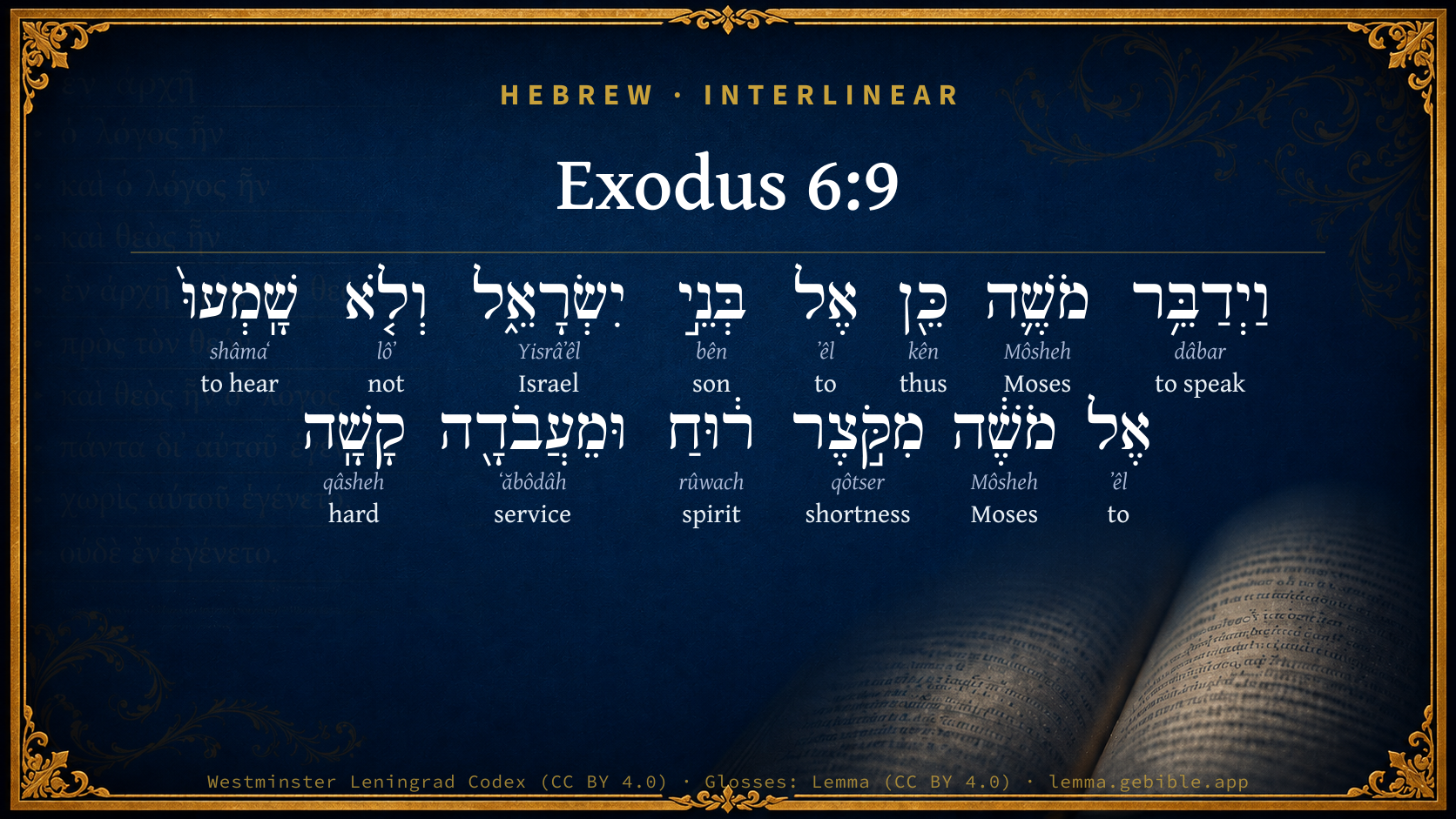
Hebrew (Westminster Leningrad Codex) Exodus 6:9 appears in the Hebrew Old Testament. The text above is from the Westminster Leningrad Codex. Each word links to its Strong’s number, a concise gloss, and parsing drawn from the Open Scriptures Hebrew Bible morphology. Click any word for its full Brown-Driver-Briggs (BDB) entry.
Download image
Cite this verse

Exodus 6:9 (World English Bible). Public Domain. Lemma interlinear Bible study tool, https://lemma.gebible.app/v/exodus/6/9.

Show BibTeX & RIS
BibTeX
RIS
English Translation
Moses spoke so to the children of Israel, but they didn't listen to Moses for anguish of spirit, and for cruel bondage.
World English Bible · Public Domain
Highlights
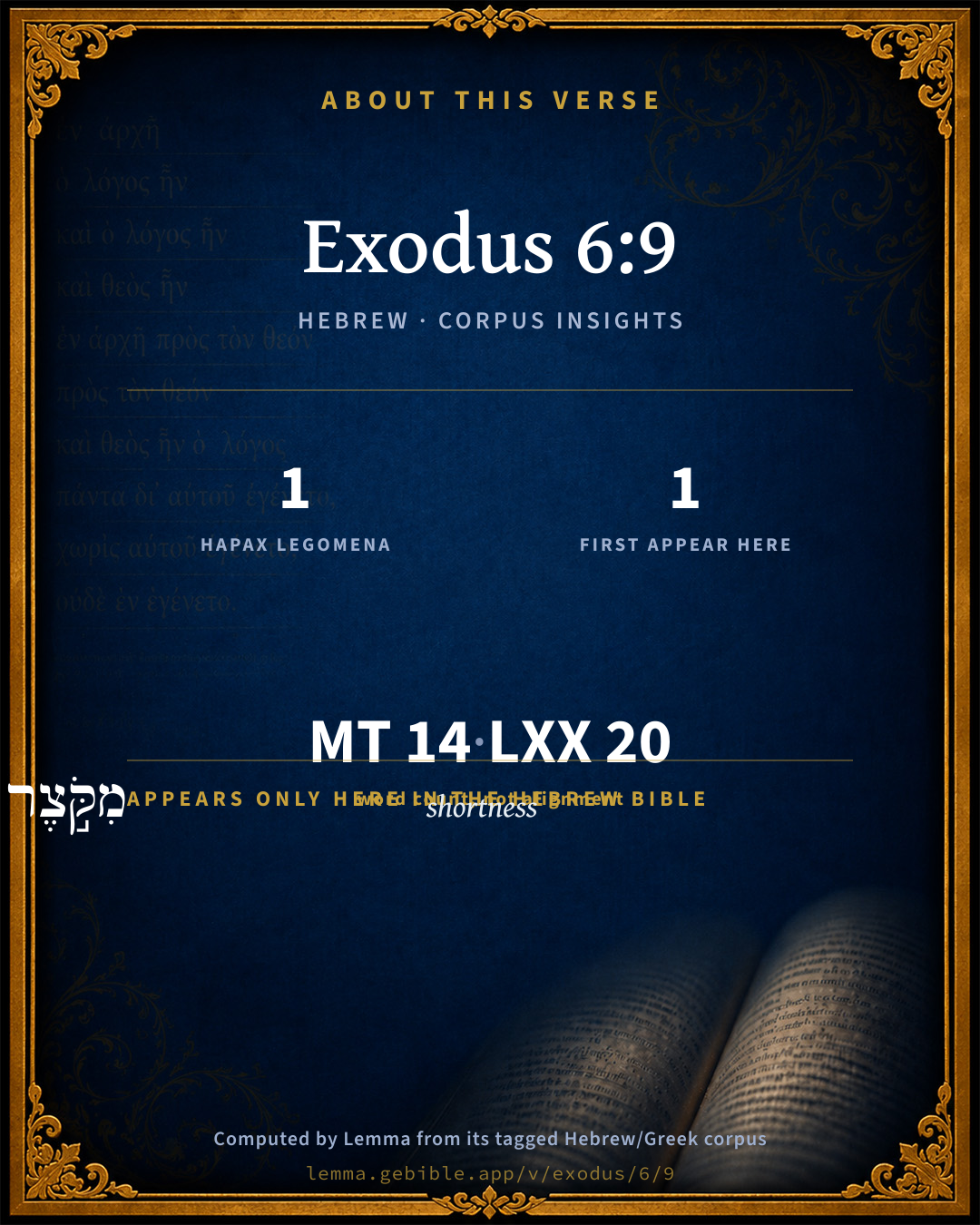
  • 1 hapax legomenon — only here in the Hebrew Bible
  • 1 first appearance in the Hebrew Bible
Full analysis ↓
Download a study sheet

One document with this verse’s original text, its word-by-word gloss line, the meaning frame, cross-references with their text, attributed commentary, and full source and license credits — printable, and it pastes into notes with its structure intact.

This verse Autodidact and up

Study sheet (.html) Plain text (.txt)

A passage Seminary Student

Up to 50 verses in one chapter. A passage sheet keeps up to 6 commentary sources and 12 cross-references per verse, in the order this page ranks them, and says so on the sheet whenever that leaves anything out. Ask for a single verse and you get the Autodidact verse sheet above.

Everything on this page stays free to read, with no account — the sheet is a download of what is already on screen, not access to it.

Want to remove ads? Support Godless Engineer
Compare translations 3

The same verse in 3 English versions, stacked beneath the original-language interlinear above. Click any original word for its lexicon entry.

Each is an independent rendering of the whole verse — the interlinear is not word-aligned to these translations.

Highlighted words mark where these versions differ — a whole-verse word diff, not a word-by-word alignment.

  • World English Bible Public Domain
    Moses spoke so to the children of Israel, but they didn't listen to Moses for anguish of spirit, and for cruel bondage.
  • King James Version Public Domain
    And Moses spake so unto the children of Israel: but they hearkened not unto Moses for anguish of spirit, and for cruel bondage.
  • unfoldingWord Literal Text CC BY-SA 4.0
    And Moses spoke in this way to the sons of Israel, but they did not listen to Moses, because of shortness of spirit and because of hard slavery.

unfoldingWord Literal Text — © unfoldingWord, licensed CC BY-SA 4.0. Word-aligned USFM3 via Door43 (git.door43.org/unfoldingWord/en_ult).

Versions to compare (up to 4)

3 of 4 selected

Show all 18 translations

Every available English version of this verse, each an independent rendering of the whole verse.

  • World English Bible Public Domain
    Moses spoke so to the children of Israel, but they didn't listen to Moses for anguish of spirit, and for cruel bondage.
  • Berean Standard Bible Public Domain
    Moses relayed this message to the Israelites, but on account of their broken spirit and cruel bondage, they did not listen to him.
  • Majority Standard Bible Public Domain
    Moses relayed this message to the Israelites, but on account of their broken spirit and cruel bondage, they did not listen to him.
  • King James Version Public Domain
    And Moses spake so unto the children of Israel: but they hearkened not unto Moses for anguish of spirit, and for cruel bondage.
  • American Standard Version (1901) Public Domain
    And Moses spake so unto the children of Israel: but they hearkened not unto Moses for anguish of spirit, and for cruel bondage.
  • Revised Version (1885) Public Domain
    And Moses spake so unto the children of Israel: but they hearkened not unto Moses for anguish of spirit, and for cruel bondage.
  • Geneva Bible (1599) Public Domain
    So Moses told the children of Israel thus: but they hearkened not vnto Moses, for anguish of spirit and for cruel bondage.
  • Douay-Rheims (1899) Public Domain
    And Moses told all this to the children of Israel: but they did not hearken to him, for anguish of spirit, and most painful work.
  • Young's Literal Translation Public Domain
    And Moses speaketh so unto the sons of Israel, and they hearkened not unto Moses, for anguish of spirit, and for harsh service.
  • Literal Standard Version CC BY-SA 4.0
    And Moses speaks so to the sons of Israel, and they did not listen to Moses, for anguish of spirit, and for harsh service.
  • Unlocked Literal Bible CC BY-SA 4.0
    When Moses told this to the Israelites, they would not listen to him because of their discouragement about their harsh slavery.
  • unfoldingWord Literal Text CC BY-SA 4.0
    And Moses spoke in this way to the sons of Israel, but they did not listen to Moses, because of shortness of spirit and because of hard slavery.
  • Darby Bible Public Domain
    And Moses spoke thus to the children of Israel; but they did not listen to Moses from anguish of spirit, and from hard service.
  • World Messianic Bible Public Domain
    Moses spoke so to the children of Israel, but they didn’t listen to Moses for anguish of spirit, and for cruel bondage.
  • Webster's Bible Public Domain
    And Moses spoke so to the children of Israel: but they hearkened not to Moses, by reason of anguish of spirit, and cruel bondage.
  • Free Bible Version CC BY-SA 4.0
    Moses explained this to the Israelites but they did not listen to him, because they were so discouraged and because of the hard labor they were forced to do.
  • Bible in Basic English Public Domain
    And Moses said these words to the children of Israel, but they gave no attention to him, because of the grief of their spirit and the cruel weight of their work.
  • JPS Tanakh (1917) Public Domain
    And Moses spoke so unto the children of Israel; but they hearkened not unto Moses for impatience of spirit, and for cruel bondage.

Literal Standard Version (2020), Covenant Press — licensed CC BY-SA 4.0. Text via the HelloAO Bible API (eBible.org). Unlocked Literal Bible (unfoldingWord) — licensed CC BY-SA 4.0. Text via the HelloAO Bible API (eBible.org). unfoldingWord Literal Text — © unfoldingWord, licensed CC BY-SA 4.0. Word-aligned USFM3 via Door43 (git.door43.org/unfoldingWord/en_ult). Free Bible Version, Dr. Jonathan Gallagher — licensed CC BY-SA 4.0. Text via the HelloAO Bible API (eBible.org).

Word by word

More ways to search: Search by grammar → Find every occurrence → Compare this word →

Practice this passage: Drill this verse → Learn its vocabulary →

מִקֹּ֣צֶר
qôtser
H7115
“from · shortness of”
Preposition + Noun, Common, Masculine, Singular, Construct
Part of Speech
Preposition + Noun
Type
Common
Gender
Masculine
Number
Singular
State
Construct
Full BDB Definition

Origin: from H7114

TWOT: 2061b

shortness, impatience, anguish
  1. וַיְדַבֵּ֥ר dâbar H1696 “and · to speak” Conjunction + Verb, Piel, Sequential Imperfect, 3rd Person, Masculine, Singular
  2. מֹשֶׁ֛ה Môsheh H4872 “Moses” Noun, Proper
  3. כֵּ֖ן kên H3651 “thus” Particle, Demonstrative
  4. אֶל ʼêl H413 “to” Preposition
  5. בְּנֵ֣י bên H1121 “sons of” Noun, Common, Masculine, Plural, Construct
  6. יִשְׂרָאֵ֑ל Yisrâʼêl H3478 “Israel” Noun, Proper
  7. וְלֹ֤א lôʼ H3808 “and · not” Conjunction + Particle, Negative
  8. שָֽׁמְעוּ֙ shâmaʻ H8085 “to hear” Verb, Qal, Perfect, 3rd Person, Common, Plural
  9. אֶל ʼêl H413 “to” Preposition
  10. מֹשֶׁ֔ה Môsheh H4872 “Moses” Noun, Proper
  11. ר֔וּחַ rûwach H7307 “spirit” Noun, Common, Both, Singular, Absolute
  12. וּמֵעֲבֹדָ֖ה ʻăbôdâh H5656 “and · from · service” Conjunction + Preposition + Noun, Common, Feminine, Singular, Absolute
  13. קָשָֽׁה qâsheh H7186 “hard” Adjective, Adjective, Feminine, Singular, Absolute

About this verse

These counts appear in no published source. They are computed here, from the morphology-tagged text and Lemma’s own curated glosses. What Lemma adds →

14
words
12
distinct lemmas
Pentateuch
section

Notable vocabulary

1 hapax legomenon — a word that appears only here in the entire Hebrew Bible:

  • מִקֹּ֣צֶר shortness H7115

First appearance in Scripture

This word makes its first canonical appearance in the Hebrew Bible here:

  • מִקֹּ֣צֶר shortness H7115

Shared distinctive vocabulary

קָשָֽׁה hard H7186 occurs in 36 verses of the Hebrew Bible. Also found in:

Grammatical profile

  • 2 verbs
  • 7 nouns
  • 1 adjective
  • 2 prepositions
  • 2 particles

Verb forms

  • וַיְדַבֵּ֥ר Piel · Sequential Imperfect
  • שָֽׁמְעוּ֙ Qal · Perfect

Repetition

Words recur within this verse — often emphatic in Hebrew:

  • מֹשֶׁ֛ה Moses H4872 ×2
  • אֶל to H413 ×2

Hebrew & Septuagint length

In English translation the verse runs 22 words from the Hebrew and 22 from the Septuagint (LXX English) — the same length.

A rough comparison of the two English renderings, which tokenize alike — not a word-level alignment.

Word counts can differ between the Hebrew and the Greek without any difference in meaning — e.g. the Hebrew direct-object marker אֵת has no separate Greek word, and Greek often adds the article ὁ.

In the original languages it is 14 Hebrew tokens and 20 Greek tokens — but the two are counted differently (Hebrew bundles its prefixes and suffixes into one token; the Greek is in lemma form), so that isn’t a like-for-like length.

Cross-references

5

Topical passages linked to Exodus 6:9 in the Treasury of Scripture Knowledge — connected by theme and wording, ordered by reader-vote popularity; previews shown in the World English Bible.

  • Exodus 5:21 and they said to them, "May Yahweh look at you, and judge, because you have made us a stench to be abhorred in the eyes of Pharaoh, and in the eyes of his servants, to put a sword in their hand to kill us."
  • Job 21:4 As for me, is my complaint to man? Why shouldn't I be impatient?
  • Exodus 14:12 Isn't this the word that we spoke to you in Egypt, saying, 'Leave us alone, that we may serve the Egyptians?' For it were better for us to serve the Egyptians, than that we should die in the wilderness."
  • Numbers 21:4 They traveled from Mount Hor by the way to the Red Sea, to compass the land of Edom: and the soul of the people was much discouraged because of the way.
  • Proverbs 14:19 The evil bow down before the good, And the wicked at the gates of the righteous.

Cross-references courtesy of OpenBible.info (CC BY 4.0).

Hebrew and Greek witnesses Masoretic Hebrew ↔ Greek Septuagint

The same verse in the two great witnesses to the Old Testament, shown verse-for-verse.

These are two independent witnesses, not word-aligned to each other, and the Septuagint is shown in lemma (dictionary) form.

Hebrew Exodus 6:9 Masoretic · Westminster Leningrad Codex

וַיְדַבֵּ֥ר מֹשֶׁ֛ה כֵּ֖ן אֶל בְּנֵ֣י יִשְׂרָאֵ֑ל וְלֹ֤א שָֽׁמְעוּ֙ אֶל מֹשֶׁ֔ה מִקֹּ֣צֶר ר֔וּחַ וּמֵעֲבֹדָ֖ה קָשָֽׁה

Moses spoke so to the children of Israel, but they didn't listen to Moses for anguish of spirit, and for cruel bondage.

World English Bible · Public Domain

Greek LXX Exodus 6:9 Septuagint · lemma form

λαλέω δέ μωυσῆς οὕτως ὁ υἱός ἰσραήλ καί οὐ εἰςἀκούω μωυσῆς ἀπό ὁ ὀλιγοψυχία καί ἀπό ὁ ἔργον ὁ σκληρός

And Moses spoke thus to the sons of Israel, and they listened not to Moses for faint-heartedness, and for their hard tasks.

LXX2012 (modern English Septuagint) · Public Domain

On this verse, Haydock's Catholic Bible Commentary discusses the Septuagint’s reading. Read the note in Commentary ↓

Hebrew: Westminster Leningrad Codex (CC BY 4.0). Greek: Septuagint (public domain); English from LXX2012 (modern English Septuagint) (Public Domain). How the Septuagint differs from the Hebrew →

Targum (Aramaic paraphrase)

2

The Targum is the ancient Jewish Aramaic paraphrase of the Hebrew Scriptures — an interpretive translation, not the Hebrew text itself. Onkelos (literal) and Pseudo-Jonathan (expansive) render the Torah, and Jonathan the Prophets. Coverage is partial: where no permissively-licensed English translation exists for a verse, only the Aramaic is shown. This is verse-level text, not a word-by-word alignment to the Hebrew.

  1. Targum Onkelos Torah (Genesis–Deuteronomy)
    וּמַלֵיל משֶׁה כֵּן לִבְנֵי יִשְׂרָאֵל וְלָא קַבִּילוּ מִן משֶׁה מִמַעְיַק רוּחָא וּמִפָּלְחָנָא דַהֲוָה קָשְׁיָא עֲלֵיהוֹן:

    (no public-domain English translation for this verse)

    Targum Onkelos — Aramaic: “Onkelos Genesis” (public domain); “Onkelos Exodus” (public domain); “Onkelos Leviticus” (public domain); “Onkelos Numbers” (public domain); “Onkelos Deuteronomy” (public domain). English: “Sefaria Community Translation” (CC0 1.0 (public-domain dedication)); “J.W. Etheridge. The Targums of Onkelos and Jonathan Ben Uzziel on the Pentateuch. London: Longmans, Green, 1862” (public domain). Text via Sefaria.

  2. Targum Pseudo-Jonathan Torah (Genesis–Deuteronomy)
    וּמַלֵיל משֶׁה כְּדֵין עִם בְּנֵי יִשְרָאֵל וְלָא קַבִּילוּ מִן משֶׁה מִקְפִּידוּת רוּחָא וּמִפּוּלְחָנָא נוּכְרָאָה קַשְׁיָא דִי בִּידֵיהוֹן

    And Mosheh spake according to this to the sons of Israel; but they received not from Mosheh, through anxiety of spirit, and from the strange and hard service which was upon their hands.

    Targum Pseudo-Jonathan — Aramaic: “Targum Jonathan on Genesis” (public domain); “Targum Jonathan on Exodus” (public domain); “Targum Jonathan on Leviticus” (public domain); “Targum Jonathan on Numbers” (public domain); “Targum Jonathan on Deuteronomy” (public domain). English: “The Targum of Jonathan ben Uzziel, trans. J. W. Etheridge, London, 1862” (public domain). Text via Sefaria.

Commentary

Notes on Exodus 6:9 from classic Christian and Jewish commentators (each source and its license shown beneath its notes). The classic Christian expositions comment on the surrounding passage and are grouped to its opening verse, so a note may address several verses; the Jewish commentaries on the Tanakh (Rashi and others) are per-verse, so they appear only where the commentator wrote on this verse.

Lemma curates 59 commentaries, every one of them public domain or Creative Commons licensed, each selected and text-cleaned for this edition rather than reprinted as found. About our sources →

Trapp's Complete Commentary

John Trapp

Exo 6:9 And Moses spake so unto the children of Israel: but they hearkened not unto Moses for anguish of spirit, and for cruel bondage.

Ver. 9. But they hearkened not.] The ear, which tastes words as the mouth doth meat, was so filled with choler, that they could relish no comfort. It is ill sowing in a storm, giving physic in a fever fit. The easiest medicines or waters are troublesome to sore eyes: so here. Quicquid recipitur, recipitur ad modum recipientis.

John Trapp, A Commentary or Exposition upon All the Books of the Old and New Testament (1647–1656) — public domain. Text from a community e-Sword module.

The Biblical Illustrator

Joseph S. Exell

Exo_6:9

They hearkened not unto Moses for anguish of spirit.

Physical destitution stifling spiritual life

A permanent principle of our nature, and a distinctive feature of the Divine government are here embodied in an example. We shall endeavour to explain the historic incident, and to apply the spiritual lesson.

I. The fact which embodies the principle. It consists of three parts--

1. The message addressed to Israel: Moses so spake unto the children of Israel. In that message, whether you regard its Author, its bearer, or its nature, everything tended to entice; nothing to repel them. Its Author was the God of Abraham, of Isaac, and of Jacob; its bearer was Moses, a man who for their sakes had sacrificed his position among the princes of Pharaoh, and taken refuge in a desert; its nature was hope to the desponding and freedom to the enslaved. The time, too, seemed fit: when the bondage had become unbearable, word is sent that the bondage is almost done.

2. Their neglect of the message: They hearkened not unto Moses. It was a spark of tire that fell, but it fell on wetted wood, and kindled therefore no flame. They saw nothing against it, but they let it alone.

3. Examine near the specific reason of their apathy. The cause of their indifference to liberty was the extreme severity of their bondage. They hearkened not for anguish of spirit and for cruel bondage. Here is a paradox: the slavery is excessively severe, and therefore the slave does not care for freedom. Broken hearts have lost their spring, and cannot bound from the bottom of the pit at the call of a deliverer. Great need does not, alone, produce great exertion. The hopeless, helpless captive steadily refuses to stir, lest the chain by the movement Should saw deeper into his flesh.

II. The principle embodied in the fact. These things happened to them in order that their history might be a type for us.

1. The message. To us, as to them, it is a message of mercy. Specifically, it proclaims deliverance to the captive. God recognizes all mankind as slaves, and sends an offer of freedom. Christ is the Messenger of the covenant. A greater than Moses is here, publishing a greater salvation. Through the lamb slain is the deliverance wrought. The death of Christ is the death of death.

2. Such is the proposal; but it is not heeded. Comparatively few disbelieve the message or revile the messenger. They simply pay no heed.

3. The reason of this neglect. A carnal mind, which is enmity against God. At one time prosperity, at another adversity, becomes the immediate occasion to an evil heart of departing from the living God. At present we are called to investigate only one class of these occasions or causes of neglect. Anguish of spirit and cruel bondage still make many captives hug their chains, and refuse to hear the voice which invites them to glorious liberty. The lesson here parts into two branches, one pointing to our neighbours neglect, and another to our own.

(1) The first lesson teaches the duty of Christs disciples to a careless neighbourhood. Abject poverty in these favoured lands exacts a heavier task than Pharaoh from a more numerous host than the Hebrews in Egypt. Self-sacrificing, laborious effort to improve the temporal condition of the poor is a species of revival much needed in the Church of Christ. Of course I do not counsel donations of money or food to the vicious, instead of reproof and instruction--I claim the union of the two.

(2) The second lesson applies more directly to ourselves. Anguish of spirit, whether it comes from Gods hand in the form of personal affliction, or from mans hand in the form of unjust oppression, may become the occasion of neglecting the salvation of Christ. Beware of neglecting your spiritual state and interests while you are well, in the expectation that distress when it comes will make you religious. There is no truth in nature more certain than this, that the time of health and happiness is the best time for cleaving to Christ and making our calling and election sure. Then it could be best done, if men would then do it. Beware lest you be letting the best time slip past, and the worst time draw on, while you are not saved! It is true that God in sovereign marcy often uses affliction to bring us to Christ; but He does so because we would not come to Christ at all earlier and better time. The mind may be heavenly without sore bondage, and earthly with it. If you beckon the Spirit off till affliction come, affliction may come without the Spirit. There is no anguish of spirit in the just made perfect, and yet they are like flames of fire in the keenness of their love to the Lord that bought them. They are happiest who give their bright days to Christ; for when the dark days come, the Light of Life continues to shine within their hearts. (W. Arnot, D. D.)

To the saddest of the sad

Little words often contain great meanings. It is often the ease with that monosyllable so. In the present instance we must lay stress upon it and read the text thus--Moses spake so unto the Children of Israel. That is, he said what God told him to say. He did not invent his message. He was simply a repeater of the Divine message. As he received it, so he spake it. Now, the message Moses brought was rejected, and he knew why it was rejected. He could see the reason. The people were in such bondage, they were so unhappy and hopeless, that what he spake seemed to them to be as idle words. There are hundreds of reasons why men reject the gospel. Amongst all the reasons, however, that I ever heard, that with which I have the most sympathy, is this one--that some cannot receive Christ because they are so full of anguish, that they cannot find strength enough of mind to entertain a hope that by any possibility salvation can come to them.

I. And first, will you notice that what Moses brought to these people was glad tidings. It was a free and full gospel message. To them it was the gospel of salvation from a cruel bondage, the gospel of hope, the gospel of glorious promise. It was a very admirable type and metaphorical description of what the gospel is to us. Moses word to them was singularly clear, cheering, and comforting; but they could not receive it.

II. We come now to note that it was received with unbelief caused by anguish of heart. We can quite understand what that meant. Let us look into the case.

1. They could not now receive this gospel because they had at first caught at it, and had been disappointed. They limited the great and infinite God to minutes and days; and so, as they found themselves at first getting into a worse case than before, they said to Moses, deliberately, Let us alone, that we may serve the Egyptians. They did as good as say--You have done us no good; indeed, you have increased our miseries; and we cannot believe in you or accept your message as really from God, seeing it has caused us a terrible increase of our sufferings. Grace may truly and effectually come to a heart, and for awhile cause no joy, no peace; but the reverse. Yet press on; be of good courage. Wait hopefully. The God who begins in darkness will end in light.

2. The inability of Israel to believe the message of Moses arose also from the fact that they were earthbound by heavy oppression: the mere struggle to exist exhausted all their energy, and destroyed all their hope. If you have such a struggle for existence here, you should seek that higher, nobler, better life, which would give you, even in penury and want, a joy and a comfort to which you are a stranger now.

3. But, worst of all, there are some who seem as if they could not lay hold on Christ because their sense of sin has become so intolerable, and the wretchedness which follows upon conviction has become so fearful, that they have grown almost to be contentedly despairing. A man who has begun to be numbed with cold, cries to his comrades, Leave me to sleep myself to death; and thus do despairing ones ask to be left in their misery. Dear soul, we cannot, we dare not, thus desert you.

III. The message was at first not received by Israel by reason of their anguish of soul, but it was true for all that, and the Lord made it so.

1. The first thing the Lord did to prove His persevering grace was to commission Moses again (Exo_6:1; Exo_7:2). So the Lord God, in everlasting mercy, says to His minister, You have to preach the gospel again to them. Again proclaim My grace.

2. But the Lord did more than that for Israel. As these people had not listened to Moses, He called Moses and Aaron to Him, and He renewed their charge. It is a grand point when the Lord lays the conversion of men on the hearts of His ministers, and makes them feel that they must win souls. Moses was bound to bring out Israel. But there is Pharaoh. Pharaoh is included in the Divine charge. They have to beat Pharaoh into submission. But these Children of Israel will not obey. The Lord put them in the charge: did you not observe the words, He gave them a charge unto the Children of Israel, and unto Pharaoh? Moses and Aaron, you have to bring Israel out, Pharaoh is to let them go, and Israel is to go willingly. God has issued His royal decree, and be you sure it will stand.

3. I cannot help admiring the next thing that God did when He told His servant what to do. The Lord began to count the heads of those whom He would redeem out of bondage. You see the rest of the chapter is occupied with the children of Reuben, and the children of Simeon, and the children of Levi. God seemed to say, Pharaoh, let My people go!. . . I will not, said the despot. Straightway the Lord goes right down into the brick-town where the poor slaves are at work, and He makes out a list of all of them, to show that He means to set free. So many there of Simeon. So many here of Reuben. So many here of Levi. The Lord is counting them. Moreover He numbers their cattle, for He declares, There shall not an hoof be left behind. Men say, It is of no use counting your chickens before they are hatched; but when it comes to Gods counting those whom He means to deliver, it is another matter; for He knows what will be done, because He determines to do it, and He is almighty. He knows what is to come of the gospel, and He knows whom He means to bless. ( C. H. Spurgeon.)

Men content to remain in bondage

When Moses came to the Hebrews to deliver them from bondage, they distrusted his commission, and begged to be let alone that they might serve the Egyptians. And so it happens when Christ, the Divine Emancipator, comes to men who have long worn the inherited chain of bondage to sin. They have become so habituated to the hopes, the desires, the pleasures and expectations of a worldly life, that they give no heed to Him who offers to break their chain and bring them forth into glorious and immortal liberty. I have seen the caged eagle beating vainly against the iron bars of his prison, his plumes soiled and torn, his strong wings drooping, the light of his glorious eye dimmed, the pulse of his proud heart panting in vain for conflict with the careering clouds and the mountain blast; and I thought it a pitiable sight Co see that kingly bird subjected to such bondage, just to be gazed at by the curious crowd. And I have seen the proud denizen of the air rejoicing in the freedom of his mountain home, basking in the noons broad light, balancing with motionless wings in the high vault of heaven, or rushing forth like the thunderbolt to meet the clouds on the pathway of the blast; and I thought that that wild and cloud-cleaving bird would choose death, could the choice be his, rather than give up his free and joyous life to drag out a weary bondage in a narrow and stifling cage. And yet I have seen a greater and sadder contrast than that. I have seen men, made in the image of the living God, endowed with the glorious and fearful gift of immortality, capable of becoming co-equal companions with archangels, consenting to be caged and fenced around and fettered down by customs and cares and pleasures and pursuits, that only bind them to earth, make them slaves of things they despise, and answer their noblest aspirations with disappointment. (D. Marsh, D. D.)

Ready for deliverance

Imagine some poor shipwrecked mariner cast ashore upon a lonely island in mid-ocean. The gallant vessel which had been his home upon the deep went down with all its precious freight before the fury of the storm. His fellow-voyagers all perished in the terrible conflict with the winds and the waves. He alone was cast alive on shore, to suffer more than the bitterness of death in sorrowing for his lost companions, and in longing for a return to his far-distant home. The climate of the island is perpetual summer. Everything needed to sustain life springs from the earth without cultivation, Flowers blossom and fruits ripen through all the year. The forests are full of singing birds. But to the lonely shipwrecked mariner this seeming paradise is a prison. He longs for his distant home beyond the melancholy main. The first thing in the morning and the last at evening he climbs the rocky height overlooking the sea, to search round the whole horizon for some friendly ship coming to deliver him from his watery prison. And when at last he sees a white sail hanging in the far horizon and growing larger as it approaches, it looks to him as if it were the white wing of an angel flying to his rescue. With eager and frantic joy he makes every possible signal to arrest the attention of the coming ship. And when his signals are answered, and a boat is lowered to take him on board, he is ready to rush into the waves and swim out to meet his deliverers before they reach the land. Yet all his joy is excited by the hope of return to an earthly home, where he must still be exposed to pain and sorrow and death. This earth is an island in the infinite ocean of space. It has abundance of riches, and pleasures, and occupations for a few--much toil, and work, and suffering for many--and it must be a temporary resting-place for all. But it has no home for the soul. The ship of salvation is sent to take us to the land of rest. Shall we not look often and eagerly for its coming? And when it appears shall we not be ready and willing to go? Shall we try so to accustom ourselves to the ways of living on this island waste of earth that we shall be unfitted to live in a land where there is no death? (D. Marsh, D. D.)

The Biblical Illustrator, edited by Joseph S. Exell (c. 1880s–1900s) — public domain. Text from a community e-Sword module.

The Pulpit Commentary

Hope deferred maketh the heart sick. The Israelites, who had expected a speedy deliverance, and found themselves only the more downtrodden for Moses" interference, were too much dispirited to be cheered even by the gracious promises and assurances which Moses was commissioned to give. They had no longer any trust in one who they thought had deceived them. He was a dreamer, a visionary, if no worse. They did not intend hearkening to him any more. "Anguish of spirit" possessed their souls, and "cruel bondage" claimed their bodies, day after day. They had not even the time, had they had the will, to hearken.

Anguish of spirit. Literally, "shortness." Compare Job_21:4. Their spirit was shortened they had lost all heart, as we say, socruel had been their disappointment. The contrast between their feelings now, and when Moses first addressed them, (Exo_4:31) is strong, but "fully accounted for by the change of circumstances". (Cook). Cruel bondage. Bondage, i.e., far more oppressive and continuous than. it had. (Exo_5:9-14) The Samaritan version adds: "And they said to him, Let us alone, and let us serve the Egyptians; for it is better for us to serve the Egyptians than die in a wilderness," an addition which receives some support from Exo_14:12.

Ver. 9. Spiritual deadness produced by extreme physical need.

It is the worst result of long-continued oppression that it brings its victims into a state of apathy. Servile insurrections are rare servile wars all but unknown. Slavery so crushes men, so brutalises, so deadens them, that they lose all heart, all spirit, all hope, almost all feeling. Defenders of slavery call the proper objects of the "institution" live machines; and "live machines" is exactly what it tends to make them. What is to stir a mass so sluggish and inert that it vegetates rather than lives? Not the name of God (ver. 3). It falls on closed ears it has no meaning to them, conveys no idea, arouses no thought. Not the mention of a covenant (vers. 4, 5). They cannot realise so complex a notion cannot understand what the word means. Not promises (vers. 6-8). A promise has no power unless embraced by faith; and the down-trodden have no faith, either in themselves or in others. So the most stirring appeals are made in vain the brightest hopes and prospects presented to no purpose. And as with oppression, so with all extreme depression and destitution. Hopeless poverty, constant battle with the wolf at the door, continual striving to keep off starvation from themselves, their wives, and children, reduces a population to a condition in which it becomes dead to spiritual things, and not only appears to be, but is, unimpressible. It is so occupied with the cares of this life that it has no thought for another. It has bid farewell to hope, and with hope to fear. It is reckless. The preacher can do nothing with it until he has changed the physical conditions of its existence. He must first address himself to the people"s physical wants. Let these be provided for, let the struggle for existence slacken, let hope dawn on the despairing souls, and all will at once be different. As the unbound earth opens to receive seed at the genial breath of spring, so these torpid souls may be brought to take in the seed of life, by having their bodies warmed and clothed and cared for.

HOMILIES BY D. YOUNG Ver. 9. The pains of the lower life shutting out the blessings of the higher one.

They hearkened not unto Moses for anguish of spirit, and for cruel bondage." Notice that this reason, and not some other, is stated for the indifference of Israel to the glorious words which Moses was commanded to repeat to them. We might fairly have expected some other reason to be stated; as, for instance, "We have been deceived once, and are not again to be put off with fair words;" or, "This array of promises is very grand and imposing, but there is nothing in them." But they are emphatically represented as not even attending to what Moses had to say. Their minds were effectually closed by preoccupation with something else. They were so much harassed in body and mind as to lack not only the inclination, but even the ability, to give Moses a proper hearing. And so Pharaoh"s policy had this effect at least, that it prevented the people, for a while, from considering things belonging to their highest welfare. Only we must bear in mind that as the liberating advance of God was not in the least hindered by the cruelty of Pharaoh, so neither was it hindered by the negligence of Israel. A Pharaoh could not hinder, so the people could neither help nor hinder. When they were yet without strength, utterly without strength, in due time God intervened to deliver them.

I There is thus suggested to us how we should keep in mind ONE GREAT CAUSE OF HINDRANCE TO THE GOSPEL. A message like that of the Gospel of Christ finds great difficulty in its way from preoccupation of any kind, seeing that the mind of man cannot properly entertain two great topics of thought at the same time. Some one thing must hold a first place in thought; and when the heart is occupied with the presence of worldly cares, whatever form they take, then it must be peculiarly hard for the Gospel to find a foothold. God, when he seeks love and service from us, looks to find his rivals in ambition, in pleasure, in fiches; and we are used to hear frequent warnings against these rivals. But what rival is more dangerous than (say) poverty, that cleaving, biting, pinching spirit, which, when once it gets hold of a man, never lets him forget that it is near. What chance is there then to bring out of the heart a deep conviction of sin and spiritual need? The difficulties of getting the natural man to attend to spiritual concerns are immensely increased by poverty as well as by riches. If, upon some considerations, it is seen to be hard for the rich to enter the kingdom of heaven, upon other considerations it is seen to be equally hard for the poor. The poor have the Gospel presented to them, but alas! it is often hard work to persuade them that it is a Gospel. Go to them, and how are you often met? It may be that your very exemption from a life-long struggle for daily bread blinds you to their peculiar difficulties. You are not able to see that grim wolf which is incessantly at the door, and never out of their thoughts. What wonder if at first and indeed habitually the poor should think that there is little or nothing in religion! Often they show their feeling very plainly by bitter and savage words. They want a gospel; but not your gospel. They do not care for a gospel which, while it makes large offers, makes also large demands. They do not care to be asked for self-denial, self-respect, contentment, and patient submission to hard conditions which cannot be easily or immediately altered. They want a gospel which will give, and give just what they choose to ask. The privations, the struggles, the agonies of the poor reduce them often nearer to the spirit of wild beasts than of human beings. Give them what indulges their appetites, and they will welcome you. Minister to the cravings of the flesh, and they will wait as long as you are disposed to supply. But proclaim unpalatable truths, and you might as well -speak in a wilderness. We might pursue a similar line of thought in considering the anguish of spirit and cruel bondage of heathendom . The missionary often has to speak to those whose minds are oppressed with terrible visions of deities who can only be propitiated by laborious and agonising penances. Read what is said concerning the life-long austerities of some Hindoo devotees, and then consider whether you have not in them a bondage of spirit which may only too effectually shut out even the most attractive truths of the Gospel. We might speak also of the cruel bondage of worldly conventions; the incessant and weary struggle to keep up social position a struggle which, however ridiculous it may be made to look, is, in the eyes of multitudes, a great necessity. And if a man feels a thing a necessity, then you must, at least in your first approaches to him, treat it as a necessity. And last, but not least, there is the anguish and bondage of disease, physical pain, perhaps approaching death. The sick send, or are supposed to send, for ministers of religion, but how plain it is in the great bulk of instances that such resorts are utterly ineffectual to bring the sick person to God! There may be an appearance of repentance, a pretence of understanding the way of salvation; but when we know that the actual motive is the fear of death, and not the bitter consciousness of sin, then we cannot but distrust all the action following upon the motive. When a human being, in youth, in health, and with the prospect. of a long life, professes to be smitten with convictions of sin, and begins to seek for a Saviour, we know where we are in considering his position. His apparent motive has everything in the circumstances to approve itself as a real one. But when the appearance of interest in Divine things only comes consequent on the alarms of a dangerous, perhaps a fatal illness, then we suspect that the cry for salvation is a selfish and ignorant one; and how can we be sure that it will be anything but a vain one? A courteous pretence of listening to the message of God when there is no real apprehension of it is practically the same thing as not listening at all.

II NOTE THE OBJECTION WHICH IS BROUGHT AGAINST THE GOSPEL FROM ITS INABILITY TO DEAL IMMEDIATELY WITH ALL THIS ANGUISH AND BONDAGE OF MEN. There is a plausible argument one very frequently urged, and alas! very easily deceiving that the Gospel of Christ does nothing immediately for the social improvement of the world. What is more common than the cry, when some hideous blot and ulcer of society is suddenly revealed, "Here we stand, having only got so far, after more than eighteen centuries of Christianity!" And in hearing talk of this kind, which is sometimes sincere, but oftener is mere cant, we have not so much to reply to others as to enlighten and reassure ourselves. How easily it might have been said with respect to these Israelites, "God is no deliverer, else he would at once take these people this living, suffering generation out of all their pains." What God might have done we cannot tell; we only know what he actually did. The light of the whole transaction shows that Jehovah was unquestionably a deliverer; that however a single generation might suffer, the whole nation was in due time, and at the best time, fully redeemed. And in like manner, by the consideration of ultimate results as well as present experiences, we gain the assurance that God is truly the deliverer of men from all spiritual bondage, all spiritual pain. Our frequent folly as defenders of the faith is in saying more than there is any need to say. Let us keep within safe, practical, provable assertions, and these will give an answer enough for the present need. The Gospel of Christ, we know, does something, immediately, for every one who, in response to its great invitation, believes in the Lord Jesus Christ as his Saviour. Real belief in him will at once irradiate the meanest hovel, the most squalid circumstances, with a light which may most truly be described as

The light that never was on sea or land.

No combination of favourable social surroundings will ever bring that light; nothing will bring it but the soul"s own free and intelligent admission of Jesus as Saviour and Lord. His presence thus obtained gives joy in the midst of the bitterest anguish, liberty in the midst of the most grinding bondage. The more that people believe in Christ, the more we shall have of his effectual presence in the world; and the more we have of his effectual presence, the nearer we shall come to that perpetual summer when the ice that now wraps so many human hearts will be utterly and lastingly melted away. Social reformers who are not also humble Christians, with all their pretensions and all their zeal, are" only touching secondary causes; relieving symptoms without cutting at the root of disease. No human being ever did or ever will get clear of anguish and bondage except by submitting to Christ. And no one ever submitted to Christ without having the certain assurance given, that in due time all sorrow and sighing would for ever flee away. Y.

HOMILIES BY J. ORR Vers. 9-14, 28-30. Shaken faith, and an unshaken purpose.

In these verses we have

I A PAINFUL RESULT OF AFFLICTIVE PROVIDENCE. The children of Israel, hard-driven by their taskmasters, and sunk in misery, were so stupefied with sorrow, as to have no longer any heart for their cheering tidings brought to them by Moses. Their despair had its ground in unbelief. They judged Moses a deceiver. They had trusted him before, and they reflected that the only outcome of it had been this unprecedented aggravation of their wretchedness. His fine promises must now go for what they were worth; they were past deriving comfort from them! Yet observe how in all this

1. They wronged God. God had not deserted them as they thought. He was on the very eve of fulfilling every promise he had made them. We see the error in their case; it would be well if we could always see it as clearly in our own.

2. Made their trials harder. For if trials are hard enough to bear even with faith in the goodness and help of God, how much harder are they to bear without it!

3. Shut themselves out from Divinely-sent consolation. Their despondency led them. to refuse the very message which would have given them relief. How often is the same thing witnessed under severe affliction! There is a kind of perversity in grief, which leads it to "refuse to be comforted." God is mistrusted. The heart abandons itself to its despair. It sinks in gloom and wretchedness. It turns the very truth of God into a lie, and refuses Scripture and Gospel consolations. Unhappy condition! And as foolish as unhappy for God is never nearer to the suffering spirit, never more ready to hear its cry, probably never nearer bringing it deliverance, than just when it is thus shutting out his consolations, and refusing him its confidence.

II TYPICAL DISCOURAGEMENTS IN SPIRITUAL SERVICE (vers. 9, 13, 30). Moses was sorely discouraged

1. At the unbelieving despair of the people. He could make no impression on them. They seemed hardened in their misery. So swallowed up were they in their grief, so crushed with sorrow, that their minds seemed to have lost all elasticity, all power of responding to the gladdest of tidings. This is a difficulty one has often to contend with in spiritual work the spiritless, despairing condition induced by long experience of misfortune. The city missionary, e.g. , has frequently to encounter it in going among the dwellings of the very poor. His heart sickens as he realises how little chance his Gospel has of finding acceptance in homes where all the surroundings are wretched, and where from year"s end to year"s end, there is being carried on the same heartless, monotonous "struggle for existence." But this insensibility to religion induced by suffering is not peculiar to the poor. Far from it. You will find it wherever men are sore beset with trouble, and have no firm, rooted faith in God to support them under it. Absorbed in "the sorrow of the world," they have no ear for spiritual comfort, and almost spurn it as a mockery.

2. At the prospect of having to go again before Pharaoh. Having failed with the people, how should he hope to prevail with Pharaoh, emboldened as that monarch would be with the success of a previous refusal? The element of discouragement here is the depressing sense of failure. Moses had failed in the part of the work which seemed easiest, and in which on the former occasion he had succeeded; how, then, should he look for success in the more difficult part of it, where previously he had sustained defeat? Observe carefully that on this point Moses" plea was not admitted.

(1) We are bad judges of what is failure. What Moses counted-defeats were not defeats at all, but at most delays. The history of missions furnishes striking illustrations of the danger of too hastily concluding that a work has failed because no immediate fruits are visible. Nothing has been more common in missionary experience (South Seas, Madagascar, Tinnivelly, the Kohls, etc.) than times of extraordinary fruitfulness following upon long periods of seeming failure ten, twenty, thirty years often passing without a single convert. These were seasons of trial of faith, and had the missions been abandoned, as timid counsellors advised, the whole blessing would have been lost.

(2) It is the doing of our duty we arc held responsible for, not the failure or success which may attend it. That remains with God. The lesson is that in spiritual work there must be no talk of abandonment; no putting of the hand to the plough and then looking back; no flinging away of our weapons because the outlook is discouraging. Our part is to labour on, believing that "in due season we shall reap if we faint not". (Gal_6:9)

3. By the revived sense of personal deficiencies. "How then shall Pharaoh hear me, who am of uncircumcised lips!" Moses had Aaron, it was true, to speak for him, but there was a certain clumsiness in this method of two men going in, the one to speak for the other, and Moses felt his deficiency only the more keenly on account of it. He seems to have despaired of having any influence with Pharaoh, who would look on him with contempt. Moses forgot that in work of this kind no man "goeth a warfare any time at his own charges", (1Co_9:7) and that, if God sent him, God would qualify and support him, would give him strength for every duty he had to perform. (cf. Exo_7:1-7)

III GOD"S UNSHAKEN PURPOSE ASSERTING ITSELF IN THE MIDST OF HUMAN UNBELIEF AND INFIRMITY (vers. 11, 13, 29). This is a most remarkable feature in the narrative how, high and clear above all notes of doubt and hesitancy on the side of man, and at the very time when things are wearing their most untoward aspect, God expresses himself with perfect decision as to the deliverance of the people. Hope in the hearts of the people seemed extinct; even the faith of a Moses was staggering at the obstacles to be encountered. These fears and tremblings, however, are all on the human side; he who names himself Jehovah is raised infinitely above them, and has clearly in his view not only the certainty of his purpose being fulfilled, but all the steps by which the fulfilment is to be brought about. How should this give us confidence when we are trembling for the cause of Truth! We cannot see the end from the beginning, but Jehovah can, and we can stay ourselves on his knowledge of what is dark to us. It is enough for us to know that no contingency can arise which he is not aware of and has not prepared himself to cope with; that no opposition can erect itself against his counsel, which it is not within his power to overthrow. The counsel of the Lord stands for ever the one stable fact in the midst of earthly vicissitude and change, of all ebb and flow of human hopes and fears. That surely is enough to lean upon, in the dark and troubled hours of our own and of the world"s existence.

IV FRESH EVIDENCE OF THE SUPERNATURAL CHARACTER OF THE DELIVERANCE, Allusion has already been made to the theory that the Exodus had its origin, not in a supernatural interposition of God, but in some gigantic spiritual movement springing up among the people themselves. The facts in this chapter, if anything of the character of history belongs to them, conclusively dispose of that theory. So far from the people of Israel being in a state of hopeful enthusiasm, ready to make great efforts for their own deliverance, they appear as utterly crushed and broken-spirited totally "without strength." There was doubtless a profound purpose in God"s permitting them to be brought into this condition.

1. It made more manifest the fact that their deliverance did not originate with themselves. And

2. It furnishes a striking image of Gospel truth. We too were "withoutstrength" when, "in due time, Christ died for the ungodly". (Rom_5:6) There was the want of will as well as of power to do anything of ourselves. God has interposed, and done all for us. J.O.

HOMILIES BY J. URQUHART Vers. 9-12. The contagion of despair.

I ISRAEL"S REJECTION OF THE PROFFERED CONSOLATION. They hearkened not "for anguish of spirit and for cruel bondage.

1. The sympathy of the Word of God. Their case stated not only fairly butwith infinite compassion.

2. Israel"s folly. Their anguish is permitted to stand between them and Godtheir only helper their sickness between them and the great Physician; multitudes will not hear because they have no sense of need, and multitudes again because their need is so very great. Israel in their folly typical:

1. The poor" the lapsed masses.

2. Those passing through heavy trial.

3. The bereaved.

4. Those battling despairingly with besetting sin.

How often have these no ear for the rich consolations of the promises of God!

II THE WEAKNESS OF MOSES.

1. Failure among.his own people crushes utterly hope of success amongstrangers and foes. If Israel will not hear, who have everything to gain, will Pharaoh, who has everything to lose?

2. The old sense of his insufficiency again overpowers him. Deaf ears,unmoved hearts, unconsecrated lives in the Church, paralyse the preacher in his appeals to those that are without. U

The Pulpit Commentary (1880–1919), ed. H.D.M. Spence-Jones & Joseph S. Exell — public domain. Text from a community e-Sword module.

The Preacher's Complete Homiletical Commentary

Joseph S. Exell (gen. ed.)

MAIN HOMILETICS OF THE PARAGRAPH.—Exo_6:9

PHYSICAL DESTITUTION STIFLING SPIRITUAL LIFE

This fact has long since passed away; but its lesson remains ever new. Its body is dead, and has returned to the dust; but its spirit survives immortal. God gave it a body in the actual history of the Hebrews that its meaning might become articulate to human ears. A permanent principle of our nature, and a distinctive feature of the Divine government are here embodied in an example.

I. The Fact which embodies the Principle.

1. The message addressed to Israel. “Moses so spake unto the Children of Israel” (Exo_6:1-8). This message, in its substance and in its circumstances, was fitted to arrest the people’s attention and win their love. In that message, whether you regard its author, its bearer, or its nature, everything tended to entice; nothing to repel them. The time was also fitting, when their burdens were unbearable. Before the slave a pospect of liberty is opened; before the weary a prospect of rest. Will the drooping spirits of the multitude revive at this intelligence?

2. The neglect of the message. No; the promise, although it was rich and precious, stirred not the sluggish mass. It was a spark of fire that fell, but it fell on wetted wood, and kindled therefore no flame. “They hearkened not unto Moses.” Why? No people could be in deeper affliction, no kind message could be better authenticated. They neither denied the truth of the message, nor injured the person who bore it. When God’s great salvation was provided, the people neglected it. This the head and front of their offending. They said nothing against it, but they let it alone.

3. Examine the specific reason of their apathy. The cause of their indifference to liberty was the extreme severity of their bondage. They hearkened not “for anguish of spirit and for cruel bondage.” Here is a paradox: the slavery excessively severe, and therefore the slave does not care for freedom. One would say, the force of the reason goes all the other way. We would rather expect that in proportion to the cruelty of the yoke would be the alacrity of the captives in rising at the Redeemer’s call. Had Pharaoh lavished kindness and luxury upon Joseph’s kindred, this might have been a reason why they treated with indifference the proffered method of escape. But because prosperity makes people callous to the voice of freedom, it does not follow that the extreme of adversity will put courage into their hearts. Extremes meet. Both great prosperity and great distress often crush every aspiration of freedom. Plenty extinguished the desire, and oppression the hope of freedom. Afterwards the same Hebrews shook off the iron yoke that had lain so long upon their bodies, and sunk so deeply into their souls. A door of hope was opened to them.

II. The principle embodied in the fact. The story of this ancient incident may seem to have no more affinity with modern character than the mummies which travellers dig from the tombs in Egypt have with the living men of to-day. Speaks to all.

1. The message. To us, as to them, it is a message of mercy. Specifically, it proclaims deliverance to the captive. God recognises all men as slaves, and sends an offer for freedom. Christ is the messenger of the covenant. A greater than Moses is here, publishing a greater salvation. We are redeemed from one master to serve another. “Let my people go that they may serve me.” He allures them into the wilderness, and abides with them there. The glory of the Lord goes before them during the journey, and settles on the mercy seat when they reach the promised land.

2. Such is the proposal, but it is not heeded. But few disbelieve or revile the messenger. They neglect him.

3. The reason of this neglect. Anguish and cruel bondage. Let us beware of mistake here. Both with them and us the true cause of the listlessness is the carnal mind. The evil is in the heart, but outward things become the occasions of specific disloyalties. Learn:—

(1.) The duty of Christ’s disciples to a careless neighbourhood. Abject poverty in these favoured exacts a heavy task from many. Bad dwellings. Hunger. Oppression. Their souls are soured to the bottom, and they care neither for God nor man. They are reckless. They are destitute of fear and of hope. They care not for the future. I am not palliating sin. A fact. What shall be done? Disciples of Christ should not give less attention to spiritual teaching, but more to the material well-being of fallen brothers.

(2.) The second lesson applies more directly to ourselves. Anguish of spirit, whether it comes from God’s hand in the form of personal affliction, or from man’s hand in the form of unjust oppression, may become the occasion of neglecting the salvation of Christ. We regard sorrow as a time of spiritual revival. Thanks to God, it often is. But the day of anguish is not the sinner’s best day for seeking the Saviour. Sorrow is not seed; it may conspire with other means to make the seed grow. Beware of neglecting your spiritual state while you are well. (Rev. W. Arnot.)

SUGGESTIVE COMMENTS ON THE VERSES

Exo_6:9. God’s faithful messengers do speak His will speedily and fully to whom God sends it.

Former discouragements from men must not hinder God’s ministers further to declare His will.

After all God’s promises and commands perverse spirits may refuse to hear or believe.

God’s message to people in such straits is to ease their pain and enlarge their spirits.

Sense of pain makes some souls unreasonable, even to reject their mercies.

ILLUSTRATIONS

BY

REV. WM. ADAMSON

Bondage Effects! Exo_6:9. Every man has a right to freedom. Of all earth’s hapless ones we pity him the most who languishes is hopeless bondage until he has lost all note of time, and looks through the rayless eyes of idiocy upon any change that gleams through the despairs of his dungeon. Very near to this had Israel sunk. They had a right to be free, but long oppression had sunk them into hugging the chains that fettered them. They were slow to seize the offered boon of freedom—so slow that Pharaoh was emboldened to resist the demand of Moses and Aaron to give liberty to the slaves.

“Yet while he deems thee bound,

The links are shivered, and the prison walls

Fall outward.”

—Bryant.

Vitality! Exo_6:9. The sunbeam shines upon the entombed seed, and lo! a flower all beautiful with rainbow brightness—all fragrant with spicy perfumes rises from the grave. The same light will shine upon a rock, and leave it still a rock after a thousand years. Why? There was no life. The Spirit of God plants the germ of life in the softened soul, and the sunlight of the Saviour’s beaming countenance energizes. The rock remains unaffected by all the radiance of the Gospel until affliction pulverizes its hardness, and the Spirit implants the germ of life.

“We welcome clouds that bring the former rain,

Though they the present prospect blacken round,

And shade the beauties of the opening year,

That, by their stores enriched, the earth may yield,

A faithful summer and a plenteous crop.”

—Swain.

The Preacher's Complete Homiletical Commentary (gen. ed. Joseph S. Exell; Funk & Wagnalls, c. 1892) — public domain (pre-1929). A full-Bible homiletical/sermon-outline anthology covering 65 of 66 books (2 John is absent from the source module). Text from a community e-Sword module.

Tyndale Open Study Notes

Tyndale Open Resources

6:9 The crisis deepened as the people refused to listen to the reaffirmation of the promises. They had not anticipated that their initial faith would produce greater problems for them.

Tyndale Open Study Notes — © Tyndale Open Resources, licensed CC BY-SA 4.0. Text via the HelloAO Bible API.

Geneva Bible (1599)

Geneva Bible translators

So hard a thing it is to show true obedience under the cross.

Geneva Bible (1599) marginal notes — public domain. Text via Bolls.life.

Jamieson, Fausset & Brown

Robert Jamieson, A. R. Fausset & David Brown

Moses spake so unto the children of Israel--The increased severities inflicted on the Israelites seem to have so entirely crushed their spirits, as well as irritated them, that they refused to listen to any more communications (Exo 14:12). Even the faith of Moses himself was faltering; and he would have abandoned the enterprise in despair had he not received a positive command from God to revisit the people without delay, and at the same time renew their demand on the king in a more decisive and peremptory tone.

Jamieson, Fausset & Brown — Commentary Critical and Explanatory on the Whole Bible (1871) — public domain (CC PDM 1.0). Text via the HelloAO Bible API.

Adam Clarke's Commentary

Verse 9. But they hearkened not] Their bondage was become so extremely oppressive that they had lost all hope of ever being redeemed from it. After this verse the Samaritan adds, Let us alone, that we may serve the Egyptians: for it is better for us to serve the Egyptians than that we should die in the wilderness. This appears to be borrowed from Ex 14:12.

Anguish of spirit] קצר רוח kotzer ruach, shortness of spirit or breath. The words signify that their labour was so continual, and their bondage so cruel and oppressive, that they had scarcely time to breathe.

Adam Clarke's Commentary on the Bible (1810–1826) — public domain. Text from a community e-Sword/MySword module.

Ellicott's Commentary for English Readers

(9) They hearkened not.—The second message was received in quite a different spirit from the first. Then “the people believed, and bowed their knees and worshipped” (Exo_4:31). Now they could not even be induced to listen. But there is nothing strange in this. The reason is obvious. The first announcement of coming deliverance elated them with a hope to which they had been long strangers. Their spirits sprang to the message, and readily accepted it. But now they had been chilled by disappointment. The only result of their leader’s interference hitherto had been to increase their misery (Exo_4:7-23). They had therefore lost heart, and could trust him no longer.

Anguish of spirit.—Heb., shortness of breath. (Comp. Job_21:4.) The expression points to extreme lassitude and depression.

A Bible Commentary for English Readers, edited by Charles John Ellicott (1878–1897) — public domain. Text from a community e-Sword module.

The Cambridge Bible for Schools and Colleges

gen. ed. J. J. S. Perowne

9. Moses communicates the Divine message to the Israelites; but they are too much disheartened and demoralized by their sufferings to pay heed to it, or credit it.

hearkened not] according to Exo_4:31 (J), the people listened to Moses gladly.

for impatience] the marg. is right; promises of deliverance had no meaning for them; they repelled them with impatience. See, with the corresponding verb or adj., Job_21:4 RV., Pro_14:29 b Heb., Mic_2:7 RVm.; and with ‘soul’ for ‘spirit,’ Num_21:4 RVm., Jdg_10:16 Heb. Jdg_16:16 Heb. The opposite is ‘long of spirit,’ i.e. patient, Job_6:11 RV. (lit. ‘make long my spirit’), Ecc_7:8.

cruel (lit. hard) bondage] The same expression which in Exo_1:14 (see the note) is rendered hard service (where slaves are referred to, ‘service’ and ‘bondage’ are naturally identical).

The Cambridge Bible for Schools and Colleges (gen. ed. J. J. S. Perowne; Cambridge University Press, 1878–1918) — public domain. Text from a community e-Sword module.

John Gill's Exposition

And the Lord spake unto Moses,.... At another time, and renewed his orders to him to go again to Pharaoh, and require their dismission:

saying; as follows:

John Gill's Exposition of the Whole Bible (1746–1763) — public domain (CC PDM 1.0). Text via the HelloAO Bible API.

Albert Barnes' Notes on the Bible

They hearkened not - The contrast between the reception of this communication and that recorded in Exo 4:31 is accounted for by the change of circumstances. On the former occasion the people were comparatively at ease, accustomed to their lot, sufficiently afflicted to long for deliverance, and sufficiently free in spirit to hope for it.

For anguish - See the margin; out of breath, as it were, after their cruel disappointment, they were quite absorbed by their misery, unable and unwilling to attend to any fresh communication.

Albert Barnes' Notes on the Bible (1834–1885) — public domain. Text from a community e-Sword/MySword module.

Haydock's Catholic Bible Commentary

Anguish: Septuagint, "pusillanimity." They would not even hope for a change. (Menochius) --- The Samaritan copy records the speech which they made to Moses. (Kennicott, p. 313.)

George Leo Haydock (1774–1849), Haydock's Catholic Family Bible and Commentary, 1859 edition — public domain. Excludes Psalms (Douay-Rheims chapter numbering differs from Protestant) and Deuterocanonical books (Catholic canon only).

Matthew Poole's English Annotations

Their minds were so oppressed with their present burdens and future expectations, that they could not believe nor hope for any deliverance, but deemed it impossible; and having been once deceived in their hopes, they now quite despaired, and thought their entertainment of new hopes, or use of further endeavours, would make their condition worse, as it had done.

Matthew Poole's English Annotations on the Holy Bible (1683–1685) — public domain. Text from a community e-Sword/MySword module.

John Wesley's Explanatory Notes

But they hearkened not to Moses for anguish of spirit - That is, They were so taken up with their troubles that they did not heed him.

John Wesley, Explanatory Notes Upon the Whole Bible (1754–1765) — public domain. Text via the GEBible commentary corpus.

Keil & Delitzsch

C. F. Keil & F. Delitzsch

When Moses communicated this solemn assurance of God to the people, they did not listen to him רוּה מּקּצר, lit., "for shortness of breath;" not "from impatience" (like קצר־רוּח, Pro 14:29, in contrast to אפּים ארך), but from anguish, inward pressure, which prevents a man from breathing properly. Thus the early belief of the Israelites was changed into the despondency of unbelief through the increase of their oppression. This result also produced despondency in Moses' mind, so that he once more declined the commission, which followed the promise, viz., to go to Pharaoh and demand that he would let Israel go out of his land (Exo 6:11). If the children of Israel would not listen to him, how should Pharaoh hear him, especially as he was uncircumcised in the lips (Exo 6:12)? שׁפתים ערל is one whose lips are, as it were, covered with a foreskin, so that he cannot easily bring out his words; in meaning the same as "heavy of mouth" in Exo 4:10. The reply of God to this objection is given in Exo 7:1-5. For, before the historian gives the decisive answer of Jehovah which removed all further hesitation on the part of Moses, and completed his mission and that of Aaron to Pharaoh, he considers it advisable to introduce the genealogy of the two men of God, for the purpose of showing clearly their genealogical relation to the people of Israel.

Keil & Delitzsch — Biblical Commentary on the Old Testament (1861–1891) — public domain (CC PDM 1.0). Text via the HelloAO Bible API. (Old Testament only.)

Kretzmann's Popular Commentary

Paul E. Kretzmann

God’s Charge to Moses and Aaron

v. 9. And Moses spake so unto the children of Israel; but they hearkened not unto Moses for anguish of spirit and for cruel bondage, literally, for shortness of breath and for hard slavery. It was not merely physical affliction with which they were suffering, but their spirit was almost broken with the unendurable harshness of the treatment which they received.

v. 10. And the Lord spake unto Moses, saying,

v. 11. Go in, speak unto Pharaoh, king of Egypt, that he let the children of Israel go out of his land. It was a direct command to lay aside all faint-heartedness and to undertake the task of delivering the people with all energy.

v. 12. And Moses spake before the Lord, saying, Behold, the children of Israel have not hearkened unto me; how, then, shall Pharaoh hear me, who am of uncircumcised lips? He argues that if the less difficult was impossible for him, the harder task would certainly be far above his ability. He assigns the reason for his failure to his uncircumcised, his unregenerate lips, which made it impossible for him to transmit the words of the Lord to Aaron with the proper ease and fluency and in all their stainless purity.

v. 13. And the Lord spake unto Moses and unto Aaron, and gave them a charge unto the children of Israel, and unto Pharaoh, king of Egypt, to bring the children of Israel out of the land of Egypt. It was a comprehensive command intended to beat down the last feeling of hesitation which Moses still felt. It is no small matter to proclaim the will of the Lord to defiant, obstinate men, but when the Lord commands, His will must be done.

Paul E. Kretzmann, Popular Commentary of the Bible (1921–1924) — public domain. Text from a community e-Sword module.

Rashi

Rabbi Shlomo Yitzchaki (Rashi)

ולא שמעו אל משה BUT THEY HEARKENED NOT TO MOSES — they did not accept his words of comfort.

מקצר רוח THROUGH ANGUISH (lit. shortness) OF SPIRIT — If one is in anguish his breath comes in short gasps and he cannot draw long breaths. In a somewhat similar manner to this I heard this section expounded by Rabbi Baruch the son of Rabbi Eliezer, and he cited the following verse to me in proof of his explanation: (Jeremiah 16:21) “This once will I cause them to know My hand and My might, and they shall know that My Name is the Lord”. Rabbi Baruch said: we may learn from this text that when the Holy One, blessed be He, fulfils His words, even when it is a matter of punishment, He makes it known that His Name is the Lord; and, of course, this is all the more so, when He fulfils His words in a matter of bestowing reward. — Our Rabbis explained it (this section) as having reference to what precedes it — that Moses said (5:22): “Wherefore hast thou done so evil [to this people]”. Whereupon God said to him, “Alas, for those that are gone (i. e. the patriarchs) and are no more to be found! I really have reason to deplore the death of the patriarchs. Many a time did I reveal Myself to them by the name ‘God Almighty’, and not once did they ask Me, What is Thy Name? (i. e. what is the name that describes Thy true essence); but thou hast at once said (Exodus 3:13) “[If they ask] ‘what is His name’, what shall I say unto them?!” (Exodus Rabbah 6:4; Sanhedrin 111a).

וגם הקמתי וגו׳ ALSO I SET UP [MY COVENANT WITH THEM TO GIVE THEM THE LAND OF CANAAN], and yet when Abraham wished to bury Sarah he could not obtain a grave until he purchased one at a high price. So, too, in the case of Isaac, people strove with him for possession of the wells which he had dug. Similarly, of Jacob it is stated, (Genesis 33:19) “He purchased a parcel of field,” in which to pitch his tent. Yet none of them criticised My dealings with them, whilst you say “Wherefore hast Thou done so evil [to this people!]” — But this Midrashic exposition does not fit in with the text for several reasons. Firstly, because Scripture does not state “And they did not ask of Me regarding my Name, the Lord”. And if you say in refutation of my objection that they did not mean that ושמי ה' לא נודעתי actually signifies that they did not ask what is My Name, but it means “He did not tell them that this was His Name and yet they did not ask Him what it was”, then I reply that these words cannot mean that He did not tell them His name, for at the very first when He revealed Himself to Abraham at the Covenant “between the pieces’’ it is said, (Genesis 15:7) “I am the Lord (אני ה׳) who brought thee out from Ur of the Chaldees”. Further (secondly), how does the context run on to the statements which Scripture places after the above verses, viz., “And I have also heard etc.” and “Wherefore say unto the children of Israel etc.”? Therefore I say: let Scripture be explained in its literal sense so that each statement fits into its proper setting, but the Midrashic exposition may also be given, if you like, as it is said (Jeremiah 23:29) “Is not my word like as fire, saith the Lord, and like a hammer which, by the force of its own blow, the rock at which it strikes shatters in pieces”.

Rashi on the Tanakh — English translations: “The Judaica Press complete Tanach with Rashi, translated by A. J. Rosenberg” (CC BY 4.0); “Pentateuch with Rashi's commentary by M. Rosenbaum and A.M. Silbermann, 1929-1934” (public domain); “The Metsudah Tanach series, Lakewood, N.J” (CC BY 4.0); and “The Book of Joshua, Metsudah Publications, 1997” (CC BY 4.0). Text via Sefaria.

Ramban (Nachmanides)

Rabbi Moshe ben Nachman (Ramban / Nachmanides)

BUT THEY HEARKENED NOT UNTO MOSES FOR IMPATIENCE OF SPIRIT, AND FOR CRUEL BONDAGE. It was not because they did not believe in G-d and in His prophet [that they hearkened not]. Rather, they paid no attention to his words because of impatience of spirit, as a person whose soul is grieved on account of his misery and who does not want to live another moment in his suffering even though he knows that he will be relieved later. The “impatience of spirit” was their fear that Pharaoh would put them to death, as their officers said to Moses, and the “cruel bondage” was the pressure, for the taskmasters pressed upon them and hurried them [in their daily task], Verse 13. which gave them no chance to hear anything and consider it.

Ramban (Nachmanides) on the Tanakh — English translation: “Commentary on the Torah by Ramban (Nachmanides). Translated and annotated by Charles B. Chavel. New York, Shilo Pub. House, 1971-1976” (CC BY 4.0). Text via Sefaria.

Lesson kit

Teaching starters — assembled from the data on this page, not authored interpretation. Every prompt links to the verse data it draws on. Edit before teaching.

Exodus, in the Pentateuch, opens this verse with 14 words (12 distinct Hebrew lemmas). Its most distinctive word is qôtser (“shortness”). A historical commentator’s framing appears above. Read the whole chapter for the surrounding context.

Discussion questions

  1. What does “shortness” (qôtser) contribute to the verse as a whole?
  2. 1 word here appears nowhere else in the Hebrew Bible. Why might the author reach for such rare wording?
  3. This is the first place “shortness” appears in Scripture (first appears here). What does its debut here establish?
  4. How does Genesis 42:7, which shares the word «hard», read alongside this verse?
  5. What does the repetition of “Moses” (2× in this one verse) do in this verse?
  6. These translations render this verse differently. What is at stake in choosing one wording over another?
  7. «וַיְדַבֵּ֥ר» is a Piel Sequential Imperfect verb. How does that grammatical form shape the action described?
  8. Compare how Trapp's Complete Commentary and The Biblical Illustrator read this verse. Where do they agree or differ?

Things to notice

  • 1 word in this verse appears nowhere else in the Hebrew Bible.
  • 1 word makes its first canonical appearance in Scripture here.
  • This verse counts 14 Hebrew ↔ 20 Greek words.
  • These translations choose different wording for 16 words in this verse.
  • “Moses” occurs 2× in this single verse.

Reading settings

Reading text

Shown beneath each verse's original-language words.

Old Testament
Old Testament edition

Read the OT as the Masoretic Hebrew (MT) or the Greek Septuagint (LXX).

English shown for the Greek Septuagint (in the Hebrew ↔ Greek comparison).

Comparing translations? Open the Compare panel on any verse page to stack up to four side by side.