
Numbers 27:16

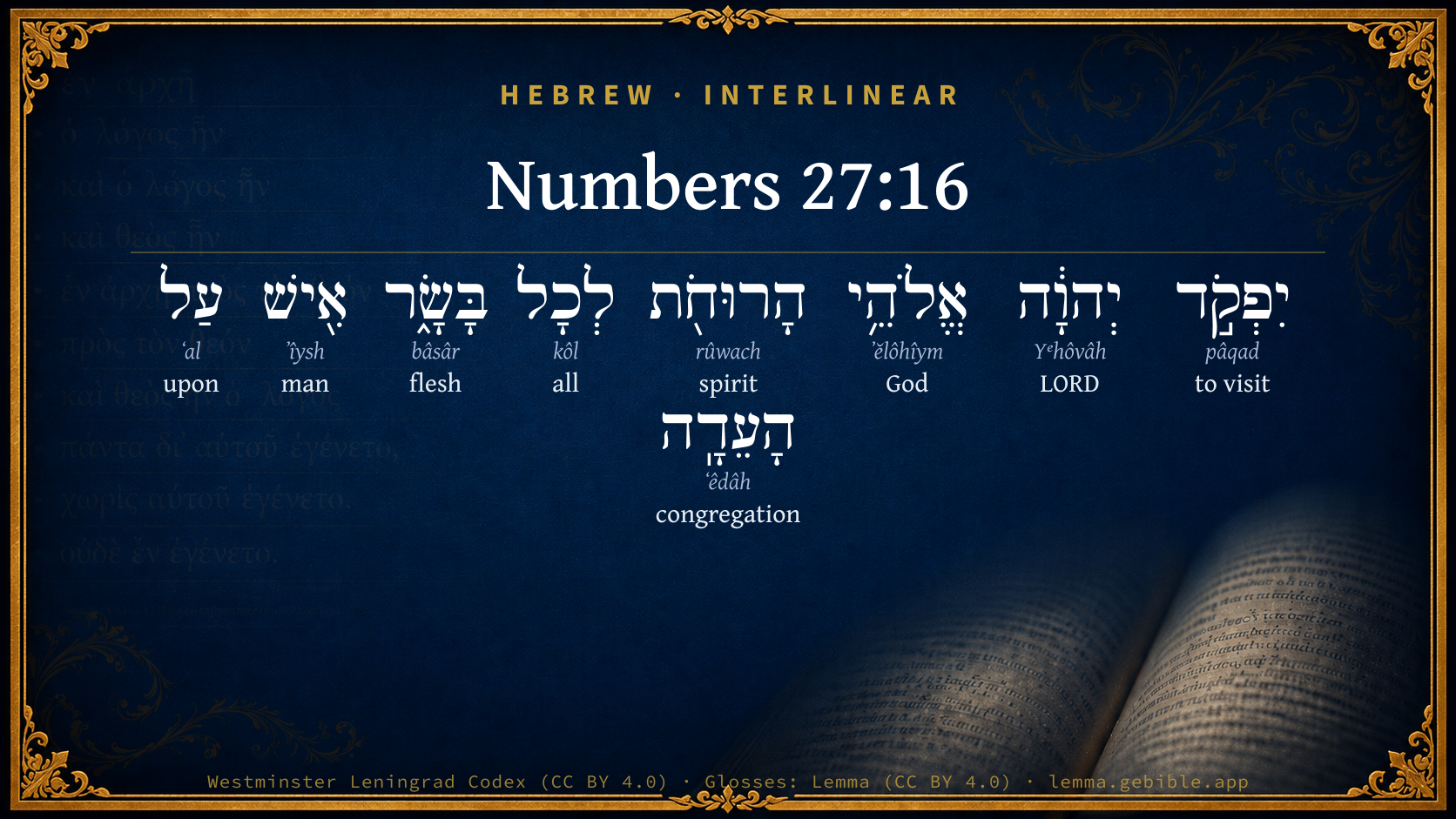
Hebrew (Westminster Leningrad Codex) Numbers 27:16 appears in the Hebrew Old Testament. The text above is from the Westminster Leningrad Codex. Each word links to its Strong’s number, a concise gloss, and parsing drawn from the Open Scriptures Hebrew Bible morphology. Click any word for its full Brown-Driver-Briggs (BDB) entry.
Download image
Cite this verse

Numbers 27:16 (World English Bible). Public Domain. Lemma interlinear Bible study tool, https://lemma.gebible.app/v/numbers/27/16.

Show BibTeX & RIS
BibTeX
RIS
English Translation
Let Yahweh, the God of the spirits of all flesh, appoint a man over the congregation,
World English Bible · Public Domain
Download a study sheet

One document with this verse’s original text, its word-by-word gloss line, the meaning frame, cross-references with their text, attributed commentary, and full source and license credits — printable, and it pastes into notes with its structure intact.

This verse Autodidact and up

Study sheet (.html) Plain text (.txt)

A passage Seminary Student

Up to 50 verses in one chapter. A passage sheet keeps up to 6 commentary sources and 12 cross-references per verse, in the order this page ranks them, and says so on the sheet whenever that leaves anything out. Ask for a single verse and you get the Autodidact verse sheet above.

Everything on this page stays free to read, with no account — the sheet is a download of what is already on screen, not access to it.

Want to remove ads? Support Godless Engineer
Compare translations 3

The same verse in 3 English versions, stacked beneath the original-language interlinear above. Click any original word for its lexicon entry.

Each is an independent rendering of the whole verse — the interlinear is not word-aligned to these translations.

Highlighted words mark where these versions differ — a whole-verse word diff, not a word-by-word alignment.

  • World English Bible Public Domain
    Let Yahweh, the God of the spirits of all flesh, appoint a man over the congregation,
  • King James Version Public Domain
    Let the LORD, the God of the spirits of all flesh, set a man over the congregation,
  • unfoldingWord Literal Text CC BY-SA 4.0
    “May Yahweh, the God of the spirits of all flesh, appoint a man over the congregation

unfoldingWord Literal Text — © unfoldingWord, licensed CC BY-SA 4.0. Word-aligned USFM3 via Door43 (git.door43.org/unfoldingWord/en_ult).

Versions to compare (up to 4)

3 of 4 selected

Show all 18 translations

Every available English version of this verse, each an independent rendering of the whole verse.

  • World English Bible Public Domain
    Let Yahweh, the God of the spirits of all flesh, appoint a man over the congregation,
  • Berean Standard Bible Public Domain
    “May the LORD, the God of the spirits of all flesh, appoint a man over the congregation
  • Majority Standard Bible Public Domain
    “May the LORD, the God of the spirits of all flesh, appoint a man over the congregation
  • King James Version Public Domain
    Let the LORD, the God of the spirits of all flesh, set a man over the congregation,
  • American Standard Version (1901) Public Domain
    Let Jehovah, the God of the spirits of all flesh, appoint a man over the congregation,
  • Revised Version (1885) Public Domain
    Let the LORD, the God of the spirits of all flesh, appoint a man over the congregation,
  • Geneva Bible (1599) Public Domain
    Let the Lord God of the spirits of all flesh appoint a man ouer the Congregation,
  • Douay-Rheims (1899) Public Domain
    May the Lord the God of the spirits of all flesh provide a man, that may be over this multitude:
  • Young's Literal Translation Public Domain
    `Jehovah -- God of the spirits of all flesh -- appoint a man over the company,
  • Literal Standard Version CC BY-SA 4.0
    “YHWH, God of the spirits of all flesh, appoint a man over the congregation,
  • Unlocked Literal Bible CC BY-SA 4.0
    “May you, Yahweh, the God of the spirits of all humanity, appoint a man over the community,
  • unfoldingWord Literal Text CC BY-SA 4.0
    “May Yahweh, the God of the spirits of all flesh, appoint a man over the congregation
  • Darby Bible Public Domain
    Let Jehovah, the God of the spirits of all flesh, set a man over the assembly,
  • World Messianic Bible Public Domain
    “Let the LORD, the God of the spirits of all flesh, appoint a man over the congregation,
  • Webster's Bible Public Domain
    Let the LORD, the God of the spirits of all flesh, set a man over the congregation.
  • Free Bible Version CC BY-SA 4.0
    “May the Lord, the God who gives life to all living beings, choose a man to lead the Israelites
  • Bible in Basic English Public Domain
    Let the Lord, the God of the spirits of all flesh, put a man at the head of this people,
  • JPS Tanakh (1917) Public Domain
    'Let the LORD, the God of the spirits of all flesh, set a man over the congregation,

Literal Standard Version (2020), Covenant Press — licensed CC BY-SA 4.0. Text via the HelloAO Bible API (eBible.org). Unlocked Literal Bible (unfoldingWord) — licensed CC BY-SA 4.0. Text via the HelloAO Bible API (eBible.org). unfoldingWord Literal Text — © unfoldingWord, licensed CC BY-SA 4.0. Word-aligned USFM3 via Door43 (git.door43.org/unfoldingWord/en_ult). Free Bible Version, Dr. Jonathan Gallagher — licensed CC BY-SA 4.0. Text via the HelloAO Bible API (eBible.org).

Word by word

More ways to search: Search by grammar → Find every occurrence → Compare this word →

Practice this passage: Drill this verse → Learn its vocabulary →

About this verse

These counts appear in no published source. They are computed here, from the morphology-tagged text and Lemma’s own curated glosses. What Lemma adds →

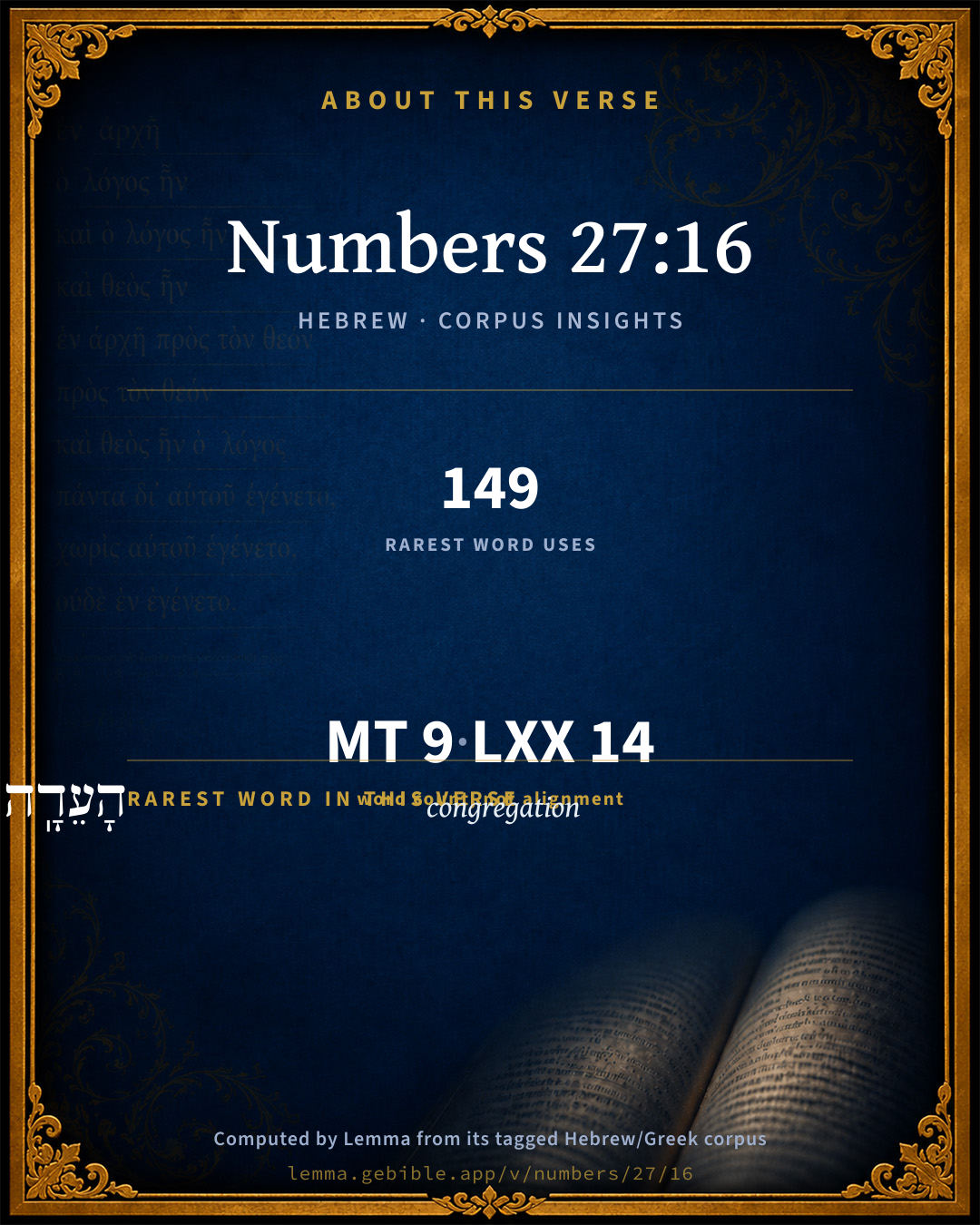
9
words
9
distinct lemmas
Pentateuch
section

Grammatical profile

  • 1 verb
  • 7 nouns
  • 1 preposition

Verb forms

  • יִפְקֹ֣ד Qal · Imperfect

Hebrew & Septuagint length

In English translation the verse runs 16 words from the Hebrew and 18 from the Septuagint (LXX English) — closely comparable.

A rough comparison of the two English renderings, which tokenize alike — not a word-level alignment.

Word counts can differ between the Hebrew and the Greek without any difference in meaning — e.g. the Hebrew direct-object marker אֵת has no separate Greek word, and Greek often adds the article ὁ.

In the original languages it is 9 Hebrew tokens and 14 Greek tokens — but the two are counted differently (Hebrew bundles its prefixes and suffixes into one token; the Greek is in lemma form), so that isn’t a like-for-like length.

Cross-references

14

Topical passages linked to Numbers 27:16 in the Treasury of Scripture Knowledge — connected by theme and wording, ordered by reader-vote popularity; previews shown in the World English Bible.

  • Numbers 16:22 They fell on their faces, and said, God, the God of the spirits of all flesh, shall one man sin, and will you be angry with all the congregation?
  • Jeremiah 3:15 and I will give you shepherds according to my heart, who shall feed you with knowledge and understanding.
  • Hebrews 12:9 Furthermore, we had the fathers of our flesh to chasten us, and we paid them respect. Shall we not much rather be in subjection to the Father of spirits, and live?
  • Deuteronomy 31:14 Yahweh said to Moses, Behold, your days approach that you must die: call Joshua, and present yourselves in the tent of meeting, that I may give him a charge. Moses and Joshua went, and presented themselves in the tent of meeting.
  • 1 Samuel 12:13 Now therefore see the king whom you have chosen, and whom you have asked for: and, behold, Yahweh has set a king over you.
  • Ezekiel 34:23 I will set up one shepherd over them, and he shall feed them, even my servant David; he shall feed them, and he shall be their shepherd.
  • Ezekiel 37:24 My servant David shall be king over them; and they all shall have one shepherd: they shall also walk in my ordinances, and observe my statutes, and do them.
  • Matthew 9:38 Pray therefore that the Lord of the harvest will send out laborers into his harvest."
  • John 10:11 I am the good shepherd. The good shepherd lays down his life for the sheep.
  • Acts 20:28 Take heed, therefore, to yourselves, and to all the flock, in which the Holy Spirit has made you overseers, to shepherd the assembly of the Lord and God which he purchased with his own blood.
  • 1 Peter 5:2–4 Shepherd the flock of God which is among you, exercising the oversight, not under compulsion, but voluntarily, not for dishonest gain, but willingly;
  • 1 Kings 5:5 Behold, I purpose to build a house for the name of Yahweh my God, as Yahweh spoke to David my father, saying, Your son, whom I will set on your throne in your room, he shall build the house for my name.
  • Jeremiah 23:4–5 I will set up shepherds over them, who shall feed them; and they shall fear no more, nor be dismayed, neither shall any be lacking, says Yahweh.
  • Ezekiel 34:11–16 For thus says the Lord Yahweh: Behold, I myself, even I, will search for my sheep, and will seek them out.

Cross-references courtesy of OpenBible.info (CC BY 4.0).

Hebrew and Greek witnesses Masoretic Hebrew ↔ Greek Septuagint

The same verse in the two great witnesses to the Old Testament, shown verse-for-verse.

These are two independent witnesses, not word-aligned to each other, and the Septuagint is shown in lemma (dictionary) form.

Hebrew Numbers 27:16 Masoretic · Westminster Leningrad Codex

יִפְקֹ֣ד יְהוָ֔ה אֱלֹהֵ֥י הָרוּחֹ֖ת לְכָל בָּשָׂ֑ר אִ֖ישׁ עַל הָעֵדָֽה

Let Yahweh, the God of the spirits of all flesh, appoint a man over the congregation,

World English Bible · Public Domain

Greek LXX Numbers 27:16 Septuagint · lemma form

ἐπισκέπτω κύριος ὁ θεός ὁ πνεῦμα καί πᾶς σάρξ ἄνθρωπος ἐπί ὁ συναγωγή οὗτος

Let the Lord God of spirits and of all flesh look out for a man over this congregation,

LXX2012 (modern English Septuagint) · Public Domain

Hebrew: Westminster Leningrad Codex (CC BY 4.0). Greek: Septuagint (public domain); English from LXX2012 (modern English Septuagint) (Public Domain). How the Septuagint differs from the Hebrew →

Targum (Aramaic paraphrase)

2

The Targum is the ancient Jewish Aramaic paraphrase of the Hebrew Scriptures — an interpretive translation, not the Hebrew text itself. Onkelos (literal) and Pseudo-Jonathan (expansive) render the Torah, and Jonathan the Prophets. Coverage is partial: where no permissively-licensed English translation exists for a verse, only the Aramaic is shown. This is verse-level text, not a word-by-word alignment to the Hebrew.

  1. Targum Onkelos Torah (Genesis–Deuteronomy)
    יְמַנֵי יְיָ אֱלָהָא רוּחַיָא לְכָל בִּשְׂרָא גְבַר עַל כְּנִשְׁתָּא

    (no public-domain English translation for this verse)

    Targum Onkelos — Aramaic: “Onkelos Genesis” (public domain); “Onkelos Exodus” (public domain); “Onkelos Leviticus” (public domain); “Onkelos Numbers” (public domain); “Onkelos Deuteronomy” (public domain). English: “Sefaria Community Translation” (CC0 1.0 (public-domain dedication)); “J.W. Etheridge. The Targums of Onkelos and Jonathan Ben Uzziel on the Pentateuch. London: Longmans, Green, 1862” (public domain). Text via Sefaria.

  2. Targum Pseudo-Jonathan Torah (Genesis–Deuteronomy)
    יְמַנֵי מֵימְרָא דַיְיָ דְשַׁלִיט בְּנִשְׁמַת בַּר נַשׁ וּמִנֵיהּ מִתְיְיהַב רוּחַ נִשְׁמָתָא לְכָל בִּישְרָא גְבַר מְהֵימָן עַל כְּנִשְׁתָּא

    May the Word of the Lord, who ruleth over the souls of men, and by whom hath been given the inspiration of the spirit of all flesh, appoint a faithful man over the congregation,

    Targum Pseudo-Jonathan — Aramaic: “Targum Jonathan on Genesis” (public domain); “Targum Jonathan on Exodus” (public domain); “Targum Jonathan on Leviticus” (public domain); “Targum Jonathan on Numbers” (public domain); “Targum Jonathan on Deuteronomy” (public domain). English: “The Targum of Jonathan ben Uzziel, trans. J. W. Etheridge, London, 1862” (public domain). Text via Sefaria.

Commentary

Notes on Numbers 27:16 from classic Christian and Jewish commentators (each source and its license shown beneath its notes). The classic Christian expositions comment on the surrounding passage and are grouped to its opening verse, so a note may address several verses; the Jewish commentaries on the Tanakh (Rashi and others) are per-verse, so they appear only where the commentator wrote on this verse.

Lemma curates 59 commentaries, every one of them public domain or Creative Commons licensed, each selected and text-cleaned for this edition rather than reprinted as found. About our sources →

Trapp's Complete Commentary

John Trapp

Num 27:16 Let the LORD, the God of the spirits of all flesh, set a man over the congregation,

Ver. 16. The God of the spirits of all flesh.] "Thou, Lord, that knowest the hearts of all men." {Act 1:24} {See Trapp on "Act 1:24"} Artificers know well the nature and properties of their own work. Deus intimior nobis intimo nostro.

John Trapp, A Commentary or Exposition upon All the Books of the Old and New Testament (1647–1656) — public domain. Text from a community e-Sword module.

The Biblical Illustrator

Joseph S. Exell

Num_27:16-23

Let the Lord, the God of the spirits of all flesh, set a man over the congregation.

The spiritual leaders of men

I. The worlds need of spiritual leaders.

1. The great majority of every generation are uninventive, unaspiring, cringing, servile, thoughtless, ignorant. They not only walk in moral darkness, but lack the desire, if not the capacity, to struggle into the light of moral principles.

2. Clearly, then, they require spiritual leaders, men who shall point out to them the way of honesty, truth, purity, and holiness, marching before them in all the stateliness of the Christly morality.

II. The genuine type of spiritual leaders.

1. The true spiritual leader must be a man. Not an idiot, not a charlatan, not a functionary. A man is a person who has right convictions of moral duty, and honestly embodies them in his daily life.

2. The true spiritual leader must be a man inspired by God. No man can be a true moral leader of the people who has not within him, as the all-animating and directing force, an unutterable abhorrence of wrong and an invincible attachment to the right, whose whole nature does not beat and beam with the soul of Divine morality.

III. The Divine succession of spiritual leaders. They are all in the hands of God.

1. He takes the greatest spiritual leaders away by death.

2. He raises others to supply their place. One enters into anothers labours. (Homilist.)

A model ordination service

I. That the person ordained should be chosen of God for his work. Moses asked the Lord to set a man over the congregation, &c. (Num_27:16-17). And the Lord said unto Moses, Take thee Joshua, &c. So now the Christian minister should be--

1. Called by God to His work.

2. Appointed by God to his sphere of work.

II. That the ordination is to the most important work.

III. That the ordination should be conducted by tried men.

IV. The ordination should be accompanied with the imposition of hands.

V. That the ordination should include a charge to the ordained, Give him a charge. The duties and responsibilities of the office should be laid before those who are being set apart to it; and the experience of godly and approved men should be made available for the direction of the inexperienced. What wise and inspiring things Moses would say to Joshua in this charge! What sage counsels drawn from his ripe experience! &c.

VI. That the ordination should be conducted in the presence of the people. Moreover, such an arrangement--

1. Is more impressive to the person being ordained. There present with him are the immortal souls for whom he has to live and labour.

2. Tends to influence the people beneficially. As they hear of the important duties and solemn responsibilities of their minister, they should be awakened to deeper solicitude and more earnest prayer on his behalf, and to heartier co-operation with him.

VII. The ordination should confer honour upon the person ordained.

VIII. That a person so chosen of God, should seek special direction from Him, and seeking, shall obtain it.

1. A warning against self-sufficiency.

2. A source of encouragement and strength. (W. Jones.)

The God of the spirits of all flesh

I. The affecting view here furnished of the agency and dominion of God in connection with the human mind.

1. God imparts the powers of the spirit. We have nothing self-derived.

2. He claims the affections of the spirit.

3. He heals the disorders and sympathises with the sorrows of the spirit.

4. He alone can constitute the happiness of the spirit.

5. He will decide upon the future destiny of the spirit.

II. The moral uses of these contemplations.

1. Let them teach you reverence for the human mind.

2. Let them impress you with thoughts of the vast importance of personal religion.

3. Let them inspire you with practical efforts to benefit and bless society. By education-by missions, &c.

4. Let them kindle hope for the prospects of the human race. (S. Thodey.)

.

The Biblical Illustrator, edited by Joseph S. Exell (c. 1880s–1900s) — public domain. Text from a community e-Sword module.

Joseph Benson's Commentary

Num 27:16. The God of the spirits of all flesh — God of all men; the Searcher of spirits, that knowest who is fit for this great employment; the Father, and Giver, and Governor of spirits, who canst raise and suit the spirits of men to the highest and hardest works.

Joseph Benson's Commentary on the Old and New Testaments (1811–1818) — public domain. Text from a community e-Sword module.

Geneva Bible (1599)

Geneva Bible translators

Who as he hath created, so he governeth the hearts of all men.

Geneva Bible (1599) marginal notes — public domain. Text via Bolls.life.

Jamieson, Fausset & Brown

Robert Jamieson, A. R. Fausset & David Brown

God of the spirits of all flesh, set a man over the congregation--The request was most suitably made to God in this character, as the Author of all the intellectual gifts and moral graces with which men are endowed, and who can raise up qualified persons for the most arduous duties and the most difficult situations.

Jamieson, Fausset & Brown — Commentary Critical and Explanatory on the Whole Bible (1871) — public domain (CC PDM 1.0). Text via the HelloAO Bible API.

Adam Clarke's Commentary

Verse 16. The Lord, the God of the spirits of all flesh] See Clarke on Nu 16:22.

Adam Clarke's Commentary on the Bible (1810–1826) — public domain. Text from a community e-Sword/MySword module.

Ellicott's Commentary for English Readers

(16) Let the Lord . . . —We have a remarkable instance here of the true greatness of Moses, as a type of Him whose words were, “Weep not for me, but weep for yourselves and for your children” (Luk_23:28). Instead of indulging in excessive grief, or in unavailing remorse, the mind of Moses was intently fixed upon the welfare of those for whose sake he had been willing that his own name should be blotted out of the Book (Exo_32:32); and instead of appointing one of his own family, or the man of his own choice, as his successor, he commits the matter to God, and prays that He will appoint one who would be a true shepherd to the flock.

A Bible Commentary for English Readers, edited by Charles John Ellicott (1878–1897) — public domain. Text from a community e-Sword module.

The Cambridge Bible for Schools and Colleges

gen. ed. J. J. S. Perowne

16. the God of the spirits of all flesh] See on Num_16:22.

The Cambridge Bible for Schools and Colleges (gen. ed. J. J. S. Perowne; Cambridge University Press, 1878–1918) — public domain. Text from a community e-Sword module.

John Gill's Exposition

Which may go out before them, and which may go in before them, and which may lead them out, and which may bring them in,.... Which may lead them out, and go before them in war, and command them in battle and bring them in peace, having conquered their enemies; or these phrases only mean the administration of civil government among them, and diligence and assiduity in it, see Ch2 1:10, unless it has any peculiar respect to the leading the people of Israel out of the wilderness, and introducing them into the land of Canaan:

that the congregation of the Lord be not as sheep which have no shepherd; and so wander about, having none to guide them into proper pastures, or to protect them from beasts of prey; which is to be in a most forlorn and distressed condition; see Mat 9:36.

John Gill's Exposition of the Whole Bible (1746–1763) — public domain (CC PDM 1.0). Text via the HelloAO Bible API.

Albert Barnes' Notes on the Bible

The God of the spirits of all flesh - An acknowledgment that man, who is but flesh (compare Gen 6:3), is of himself helpless; and “lives and moves and has his being” in God Act 17:28. The words are suitably employed here to introduce an entreaty that God would not leave the congregation without a guide and leader, and in Num 16:22 as a preface to an intercession that the whole people should not suffer for the sin of a, few.

Albert Barnes' Notes on the Bible (1834–1885) — public domain. Text from a community e-Sword/MySword module.

Haydock's Catholic Bible Commentary

Flesh, who gives life, and penetrates the secrets of hearts, chap. xvi. 22.

George Leo Haydock (1774–1849), Haydock's Catholic Family Bible and Commentary, 1859 edition — public domain. Excludes Psalms (Douay-Rheims chapter numbering differs from Protestant) and Deuterocanonical books (Catholic canon only).

Matthew Poole's English Annotations

All flesh, i.e. of all men; the Searcher of spirits, that knowest who is fit for this great employment; the Father, and Giver, and Governor of spirits, who canst raise and suit the spirits of men to the highest and hardest works, as thou didst those Num 11:16,17. See Num 16:22.

Matthew Poole's English Annotations on the Holy Bible (1683–1685) — public domain. Text from a community e-Sword/MySword module.

Whedon's Commentary on the Bible

Daniel D. Whedon

JOSHUA PUBLICLY CONSECRATED AS THE SUCCESSOR OF MOSES, Num_27:15-23.

16. The spirits of all flesh — The distinction between mind and matter is here clearly taught by Moses. In answer to the objection that the Hebrew word ruach signifies only breath, we quote the following from Sir W. Hamilton: “The term soul, (and what I say of the term soul is true of the term spirit,) though in this country less employed than the term mind, may be regarded as another synonyme for the unknown basis of the mental phenomena. Like nearly all words significant of the internal world, there is here a metaphor borrowed from the external; and this is the case not merely in one, but, as far as we can trace the analogy, in all languages. You are aware that ψυχη, the Greek term for soul, comes from ψυχω, I breathe or blow, as πνευμα, in Greek, and spiritus, in Latin, from verbs of the same signification. In like manner, anima and animus are words which, though in Latin they have lost their primary signification, and are only known in their secondary or metaphorical sense, yet in their original physical meaning are preserved in the Greek ανεμος, wind or air. The English soul, and the German seele, come from a Gothic root saivala, which signifies to storm. Ghost, the old English word for spirit in general, and so used in our English version of the Scriptures, is the same as the German geist, and is derived from gas or gescht, which signifies air. In like manner the two words in Hebrew for soul or spirit, nephesh and ruach, are derivatives of a root which means to breathe; and in Sanscrit the word atma (analogous to the Greek ατμος, vapor or air) signifies both mind and wind or air.” Jehovah is here styled the God of all human spirits, to intimate his perfect acquaintance with the mental, moral, and spiritual characteristics of all men, and hence his ability to select the man who should succeed to the leadership of Israel, soon to be made vacant by the death of Moses.

Daniel D. Whedon (gen. ed.), Commentary on the Old and New Testaments (1874–1909) — public domain. Text from a community e-Sword module.

John Wesley's Explanatory Notes

The Lord of the spirits of all flesh - God of all men: the searcher of spirits, that knowest who is fit for this great employment; the father and giver and governor of spirits, who canst raise and suit the spirits of men to the highest and hardest works.

John Wesley, Explanatory Notes Upon the Whole Bible (1754–1765) — public domain. Text via the GEBible commentary corpus.

Rashi

Rabbi Shlomo Yitzchaki (Rashi)

יפקד ה׳ LET THE LORD … SET [A MAN OVER THE CONGREGATION] — When Moses heard that the Omnipresent said to him, “Give the inheritance of Zelophehad to his daughters”, he said to himself, “The time has come that I should ask something that I want — that my sons should inherit my high position”. God replied to him, “Not thus has entered My mind; Joshua deserves to receive the reward of his ministrations, because “he has never departed from out the tent” (Exodus XXXIII 11). — This is what Solomon said, (Proverbs 27:18) ‘‘Whoso keepeth the fig-tree shall eat the fruit thereof, [and he that waiteth on his master shall be honoured]” (Midrash Tanchuma, Pinchas 11).

אלהי הרוחת GOD OF THE SPIRITS [OF ALL FLESH] — Why is this expression used? (i.e., why does it not state simply אלהי כל בשר?) He said to Him: “Lord of the Universe! the personality of each person is revealed to you, and no two are alike. Appoint over them a leader who will tolerate each person according to his individual character (Midrash Tanchuma, Pinchas 10; cf. Yalkut Shimoni on Torah 776).

Rashi on the Tanakh — English translations: “The Judaica Press complete Tanach with Rashi, translated by A. J. Rosenberg” (CC BY 4.0); “Pentateuch with Rashi's commentary by M. Rosenbaum and A.M. Silbermann, 1929-1934” (public domain); “The Metsudah Tanach series, Lakewood, N.J” (CC BY 4.0); and “The Book of Joshua, Metsudah Publications, 1997” (CC BY 4.0). Text via Sefaria.

Lesson kit

Teaching starters — assembled from the data on this page, not authored interpretation. Every prompt links to the verse data it draws on. Edit before teaching.

Numbers, in the Pentateuch, opens this verse with 9 words (9 distinct Hebrew lemmas). Its most distinctive word is ʻêdâh (“congregation”). A historical commentator’s framing appears above. Read the whole chapter for the surrounding context.

Discussion questions

  1. What does “congregation” (ʻêdâh) contribute to the verse as a whole?
  2. Numbers 16:22 shares this passage’s theme. How do the two illuminate each other?
  3. These translations render this verse differently. What is at stake in choosing one wording over another?
  4. The verb «יִפְקֹ֣ד» is Qal Imperfect. How does its form color the action?
  5. Reading how Trapp's Complete Commentary and The Biblical Illustrator read this verse, where do the two commentators agree and where do they part?

Things to notice

Reading settings

Reading text

Shown beneath each verse's original-language words.

Old Testament
Old Testament edition

Read the OT as the Masoretic Hebrew (MT) or the Greek Septuagint (LXX).

English shown for the Greek Septuagint (in the Hebrew ↔ Greek comparison).

Comparing translations? Open the Compare panel on any verse page to stack up to four side by side.