
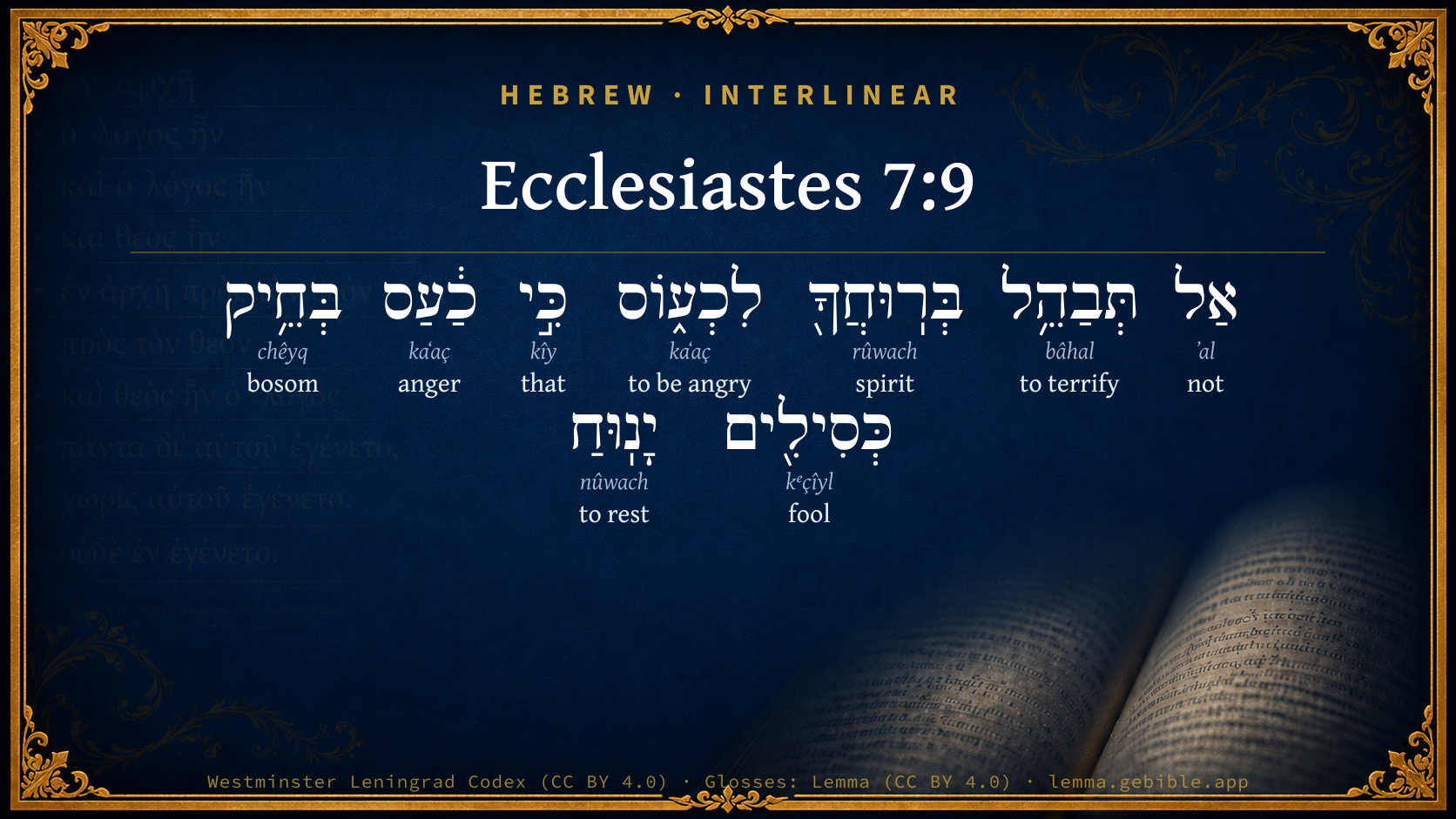
Ecclesiastes 7:9

Hebrew (Westminster Leningrad Codex) Ecclesiastes 7:9 appears in the Hebrew Old Testament. The text above is from the Westminster Leningrad Codex. Each word links to its Strong’s number, a concise gloss, and parsing drawn from the Open Scriptures Hebrew Bible morphology. Click any word for its full Brown-Driver-Briggs (BDB) entry.
Download image
Cite this verse

Ecclesiastes 7:9 (World English Bible). Public Domain. Lemma interlinear Bible study tool, https://lemma.gebible.app/v/ecclesiastes/7/9.

Show BibTeX & RIS
BibTeX
RIS
English Translation
Don't be hasty in your spirit to be angry, for anger rests in the bosom of fools.
World English Bible · Public Domain
Download a study sheet

One document with this verse’s original text, its word-by-word gloss line, the meaning frame, cross-references with their text, attributed commentary, and full source and license credits — printable, and it pastes into notes with its structure intact.

This verse Autodidact and up

Study sheet (.html) Plain text (.txt)

A passage Seminary Student

Up to 50 verses in one chapter. A passage sheet keeps up to 6 commentary sources and 12 cross-references per verse, in the order this page ranks them, and says so on the sheet whenever that leaves anything out. Ask for a single verse and you get the Autodidact verse sheet above.

Everything on this page stays free to read, with no account — the sheet is a download of what is already on screen, not access to it.

Want to remove ads? Support Godless Engineer
Compare translations 3

The same verse in 3 English versions, stacked beneath the original-language interlinear above. Click any original word for its lexicon entry.

Each is an independent rendering of the whole verse — the interlinear is not word-aligned to these translations.

Highlighted words mark where these versions differ — a whole-verse word diff, not a word-by-word alignment.

  • World English Bible Public Domain
    Don't be hasty in your spirit to be angry, for anger rests in the bosom of fools.
  • King James Version Public Domain
    Be not hasty in thy spirit to be angry: for anger resteth in the bosom of fools.
  • unfoldingWord Literal Text CC BY-SA 4.0
    Do not hasten in your spirit to become angry, for anger rests in lap of fools. q1

unfoldingWord Literal Text — © unfoldingWord, licensed CC BY-SA 4.0. Word-aligned USFM3 via Door43 (git.door43.org/unfoldingWord/en_ult).

Versions to compare (up to 4)

3 of 4 selected

Show all 18 translations

Every available English version of this verse, each an independent rendering of the whole verse.

  • World English Bible Public Domain
    Don't be hasty in your spirit to be angry, for anger rests in the bosom of fools.
  • Berean Standard Bible Public Domain
    Do not be quickly provoked in your spirit, for anger settles in the lap of a fool.
  • Majority Standard Bible Public Domain
    Do not be quickly provoked in your spirit, for anger settles in the lap of a fool.
  • King James Version Public Domain
    Be not hasty in thy spirit to be angry: for anger resteth in the bosom of fools.
  • American Standard Version (1901) Public Domain
    Be not hasty in thy spirit to be angry; for anger resteth in the bosom of fools.
  • Revised Version (1885) Public Domain
    Be not hasty in thy spirit to be angry: for anger resteth in the bosom of fools.
  • Geneva Bible (1599) Public Domain
    Surely oppression maketh a wise man mad: and the rewarde destroyeth the heart.
  • Douay-Rheims (1899) Public Domain
    Better is the end of a speech than the beginning. Better is the patient man than the presumptuous.
  • Young's Literal Translation Public Domain
    Be not hasty in thy spirit to be angry, For anger in the bosom of fools resteth.
  • Literal Standard Version CC BY-SA 4.0
    Do not be hasty in your spirit to be angry, || For anger in the bosom of fools rests.
  • Unlocked Literal Bible CC BY-SA 4.0
    Do not be quick to anger in your spirit, for anger resides in the hearts of fools.
  • unfoldingWord Literal Text CC BY-SA 4.0
    Do not hasten in your spirit to become angry, for anger rests in lap of fools. q1
  • Darby Bible Public Domain
    Be not hasty in thy spirit to be vexed; for vexation resteth in the bosom of fools.
  • World Messianic Bible Public Domain
    Don’t be hasty in your spirit to be angry, for anger rests in the bosom of fools.
  • Webster's Bible Public Domain
    Be not hasty in thy spirit to be angry: for anger resteth in the bosom of fools.
  • Free Bible Version CC BY-SA 4.0
    Don't be quick to get angry, for anger controls the minds of fools.
  • Bible in Basic English Public Domain
    Be not quick to let your spirit be angry; because wrath is in the heart of the foolish.
  • JPS Tanakh (1917) Public Domain
    Be not hasty in thy spirit to be angry; for anger resteth in the bosom of fools.

Literal Standard Version (2020), Covenant Press — licensed CC BY-SA 4.0. Text via the HelloAO Bible API (eBible.org). Unlocked Literal Bible (unfoldingWord) — licensed CC BY-SA 4.0. Text via the HelloAO Bible API (eBible.org). unfoldingWord Literal Text — © unfoldingWord, licensed CC BY-SA 4.0. Word-aligned USFM3 via Door43 (git.door43.org/unfoldingWord/en_ult). Free Bible Version, Dr. Jonathan Gallagher — licensed CC BY-SA 4.0. Text via the HelloAO Bible API (eBible.org).

Word by word

More ways to search: Search by grammar → Find every occurrence → Compare this word →

Practice this passage: Drill this verse → Learn its vocabulary →

About this verse

These counts appear in no published source. They are computed here, from the morphology-tagged text and Lemma’s own curated glosses. What Lemma adds →

9
words
9
distinct lemmas
Wisdom
section

Notable vocabulary

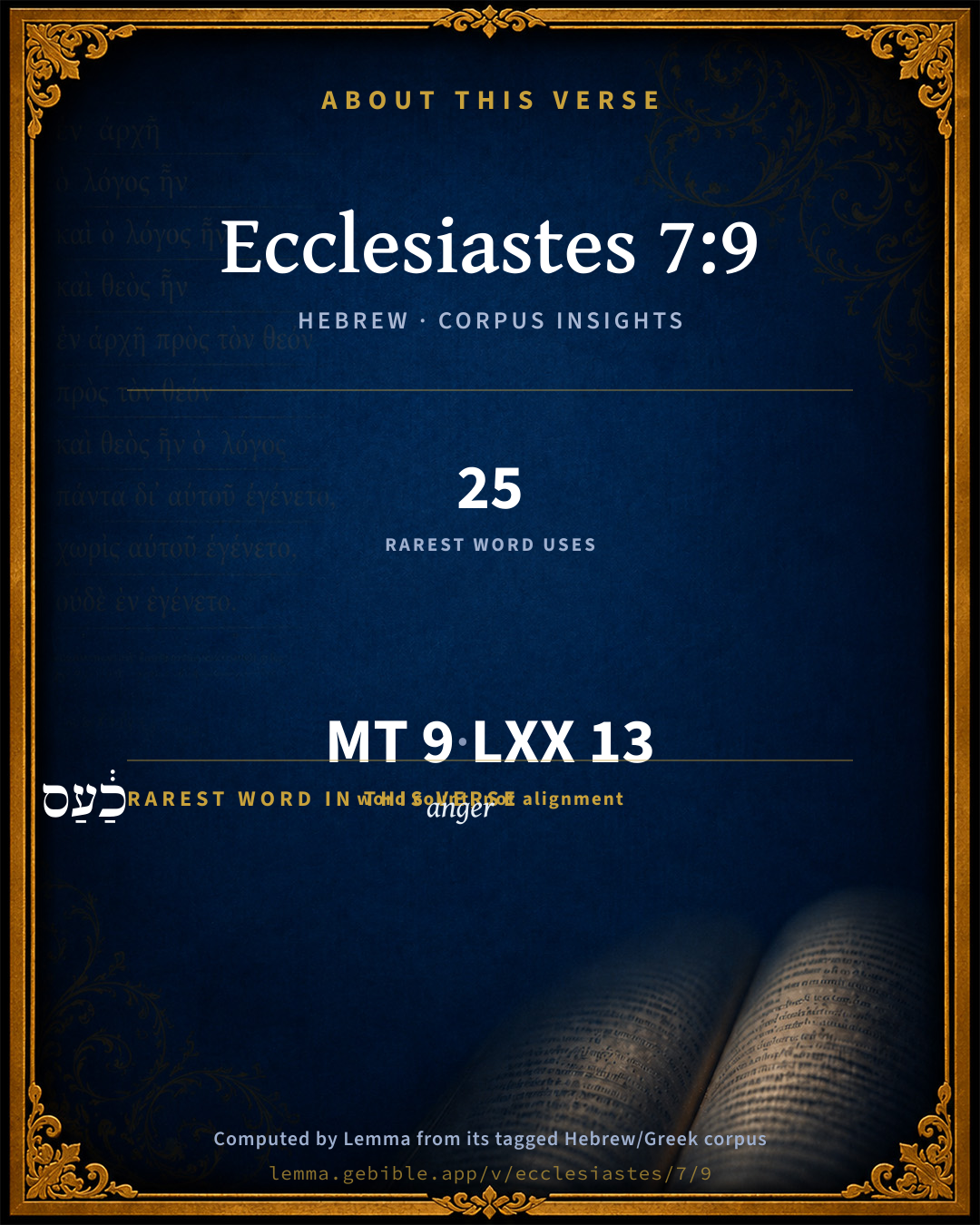
The rarest word here is כַ֔עַס anger H3708 — appearing just 25 times in the whole Hebrew Bible.

Shared distinctive vocabulary

כַ֔עַס anger H3708 occurs in 25 verses of the Hebrew Bible. Also found in:

Grammatical profile

  • 3 verbs
  • 3 nouns
  • 1 adjective
  • 1 conjunction
  • 1 particle

Verb forms

  • תְּבַהֵ֥ל Piel · Jussive
  • לִכְע֑וֹס Qal · Infinitive Construct
  • יָנֽוּחַ Qal · Imperfect

Hebrew & Septuagint length

In English translation the verse runs 17 words from the Hebrew and 18 from the Septuagint (LXX English) — closely comparable.

A rough comparison of the two English renderings, which tokenize alike — not a word-level alignment.

Word counts can differ between the Hebrew and the Greek without any difference in meaning — e.g. the Hebrew direct-object marker אֵת has no separate Greek word, and Greek often adds the article ὁ.

In the original languages it is 9 Hebrew tokens and 13 Greek tokens — but the two are counted differently (Hebrew bundles its prefixes and suffixes into one token; the Greek is in lemma form), so that isn’t a like-for-like length.

Cross-references

19

Topical passages linked to Ecclesiastes 7:9 in the Treasury of Scripture Knowledge — connected by theme and wording, ordered by reader-vote popularity; previews shown in the World English Bible.

  • James 1:19 So, then, my beloved brothers, let every man be swift to hear, slow to speak, and slow to anger;
  • Proverbs 14:17 He who is quick to become angry will commit folly, And a crafty man is hated.
  • Ephesians 4:26–27 "Be angry, and don't sin." Don't let the sun go down on your wrath,
  • Proverbs 16:32 One who is slow to anger is better than the mighty; One who rules his spirit, than he who takes a city.
  • Proverbs 26:23–26 Like silver dross on an earthen vessel Are the lips of a fervent one with an evil heart.
  • Genesis 34:7–8 The sons of Jacob came in from the field when they heard it. The men were grieved, and they were very angry, because he had done folly in Israel in lying with Jacob's daughter; which thing ought not to be done.
  • Genesis 34:30–31 Jacob said to Simeon and Levi, "You have troubled me, to make me odious to the inhabitants of the land, among the Canaanites and the Perizzites. I am few in number. They will gather themselves together against me and strike me, and I will be destroyed, I and my house."
  • 1 Samuel 25:21–22 Now David had said, Surely in vain have I kept all that this fellow has in the wilderness, so that nothing was missed of all that pertained to him: and he has returned me evil for good.
  • 2 Samuel 13:22 Absalom spoke to Amnon neither good nor bad; for Absalom hated Amnon, because he had forced his sister Tamar.
  • 2 Samuel 19:43 The men of Israel answered the men of Judah, and said, We have ten parts in the king, and we have also more [right] in David than you: why then did you despise us, that our advice should not be first had in bringing back our king? The words of the men of Judah were fiercer than the words of the men of Israel.
  • Esther 3:5–6 When Haman saw that Mordecai didn't bow down, nor did him reverence, then was Haman full of wrath.
  • Genesis 4:5–6 but he didn't respect Cain and his offering. Cain was very angry, and the expression on his face fell.
  • Genesis 34:25–26 It happened on the third day, when they were sore, that two of Jacob's sons, Simeon and Levi, Dinah's brothers, each took his sword, came upon the unsuspecting city, and killed all the males.
  • 2 Samuel 13:28 Absalom commanded his servants, saying, Mark you now, when Amnon's heart is merry with wine; and when I tell you, Smite Amnon, then kill him; don't be afraid; haven't I commanded you? be courageous, and be valiant.
  • Mark 6:19 Herodias set herself against him, and desired to kill him, but she couldn't,
  • Genesis 4:8 Cain said to Abel, his brother, "Let's go into the field." It happened, when they were in the field, that Cain rose up against Abel, his brother, and killed him.
  • Jonah 4:9 God said to Jonah, "Is it right for you to be angry about the vine?" He said, "I am right to be angry, even to death."
  • Mark 6:24 She went out, and said to her mother, "What shall I ask?" She said, "The head of John the Baptizer."
  • 2 Samuel 13:32 Jonadab, the son of Shimeah, David's brother, answered, Don't let my lord suppose that they have killed all the young men the king's sons; for Amnon only is dead; for by the appointment of Absalom this has been determined from the day that he forced his sister Tamar.

Cross-references courtesy of OpenBible.info (CC BY 4.0).

Hebrew and Greek witnesses Masoretic Hebrew ↔ Greek Septuagint

The same verse in the two great witnesses to the Old Testament, shown verse-for-verse.

These are two independent witnesses, not word-aligned to each other, and the Septuagint is shown in lemma (dictionary) form.

Hebrew Ecclesiastes 7:9 Masoretic · Westminster Leningrad Codex

אַל תְּבַהֵ֥ל בְּרֽוּחֲךָ֖ לִכְע֑וֹס כִּ֣י כַ֔עַס בְּחֵ֥יק כְּסִילִ֖ים יָנֽוּחַ

Don't be hasty in your spirit to be angry, for anger rests in the bosom of fools.

World English Bible · Public Domain

Greek LXX Ecclesiastes 7:9 Septuagint · lemma form

μή σπεύδω ἐν πνεῦμα σύ ὁ θυμόω ὅτι θυμός ἐν κόλπος ἄφρων ἀναπαύω

The end of a matter is better than the beginning thereof: the patient is better than the high-minded.

LXX2012 (modern English Septuagint) · Public Domain

Hebrew: Westminster Leningrad Codex (CC BY 4.0). Greek: Septuagint (public domain); English from LXX2012 (modern English Septuagint) (Public Domain). How the Septuagint differs from the Hebrew →

Commentary

Notes on Ecclesiastes 7:9 from classic Christian and Jewish commentators (each source and its license shown beneath its notes). The classic Christian expositions comment on the surrounding passage and are grouped to its opening verse, so a note may address several verses; the Jewish commentaries on the Tanakh (Rashi and others) are per-verse, so they appear only where the commentator wrote on this verse.

Lemma curates 59 commentaries, every one of them public domain or Creative Commons licensed, each selected and text-cleaned for this edition rather than reprinted as found. About our sources →

Trapp's Complete Commentary

John Trapp

Ecc 7:9 Be not hasty in thy spirit to be angry: for anger resteth in the bosom of fools.

Ver. 9. Be not hasty in thy spirit to be angry.] The hasty man, we say, never wants woe. For wrath is an evil counsellor, and enwrappeth a man in manifold troubles, mischiefs, and miseries. It makes man like the bee, that vindictive creature, which, to be revenged, loseth her sting, and becomes a drone; or, like Tamar, who, to be even with her father-in-law, defiled him and herself with incest. "Cease, therefore, from anger, and forsake wrath: fret not thyself in anywise to do evil." {Psa 37:8} Athenodorus counselled Augustus to determine nothing rashly, when he was angry, till he had repeated the Greek alphabet. Ambrose taught Theodosius, in that case, to repeat the Lord’s Prayer. What a shame it is to see a Christian act like Hercules furens, or like Solomon’s fool, that casts firebrands, or as that demoniac, {Mar 2:3} out of measure fierce! That demoniac was "among the tombs," but these are among the living, and molest those most that are nearest to them.

For anger resteth in the bosom of fools.] Rush it may into a wise man’s bosom, but not rest there, lodge there, dwell there; and only where it dwells it domineers, and that is only where a fool is master of the family. Thunder, hail, tempest, neither trouble nor hurt celestial bodies. See that the sun go not down upon this evil guest: see that the soul be not soured or impured with it, for anger corrupts the heart, as leaven doth the lump, or vinegar the vessel wherein it doth continue. {a}

{a} Aug., epist. 87.

John Trapp, A Commentary or Exposition upon All the Books of the Old and New Testament (1647–1656) — public domain. Text from a community e-Sword module.

Tyndale Open Study Notes

Tyndale Open Resources

7:9 anger labels you a fool: Cp. Prov 14:29; 29:11; see “Anger” Theme Note.

Tyndale Open Study Notes — © Tyndale Open Resources, licensed CC BY-SA 4.0. Text via the HelloAO Bible API.

Geneva Bible (1599)

Geneva Bible translators

A man that is esteemed wise, when he falleth to oppression, becometh like a beast.

Geneva Bible (1599) marginal notes — public domain. Text via Bolls.life.

Jamieson, Fausset & Brown

Robert Jamieson, A. R. Fausset & David Brown

angry--impatient at adversity befalling thee, as Job was (Ecc 5:2; Pro 12:16).

Jamieson, Fausset & Brown — Commentary Critical and Explanatory on the Whole Bible (1871) — public domain (CC PDM 1.0). Text via the HelloAO Bible API.

Adam Clarke's Commentary

Verse 9. Anger resteth in the bosom of fools.] A wise man, off his guard, may feel it for a moment: but in him it cannot rest: it is a fire which he immediately casts out of his breast. But the fool - the man who is under the dominion of his own tempers, harbours and fosters it, till it takes the form of malice, and then excites him to seek full revenge on those whom he deems enemies. Hence that class of dangerous and empty fools called duellists.

Adam Clarke's Commentary on the Bible (1810–1826) — public domain. Text from a community e-Sword/MySword module.

Ellicott's Commentary for English Readers

(9) Resteth.—Pro_14:33.

A Bible Commentary for English Readers, edited by Charles John Ellicott (1878–1897) — public domain. Text from a community e-Sword module.

The Cambridge Bible for Schools and Colleges

gen. ed. J. J. S. Perowne

9. Be not hasty in thy spirit to be angry] From sins of speech in general, the teacher passes on to that which is the source from which they most often flow. Anger, alike from the Stoic and Epicurean stand-point (and the writer, as we have seen, had points of contact with each of them), was the note of unwisdom. If it be right at all, it is when it is calm and deliberate, an indignation against moral evil. The hasty anger of wounded self-love is, as in the teaching of the Sermon on the Mount (Mat_5:22), destructive of the tranquillity of true wisdom, and, transient and impulsive as it seems at first, may harden “in the bosom of the fool” into a settled antipathy or malignant scorn.

The Cambridge Bible for Schools and Colleges (gen. ed. J. J. S. Perowne; Cambridge University Press, 1878–1918) — public domain. Text from a community e-Sword module.

John Gill's Exposition

Be not hasty in thy spirit to be angry,.... With men, for every word that is said, or action done, that is not agreeable; encourage not, but repress, sudden angry emotions of the mind; be not quick of resentment, and at once express anger and displeasure; but be slow to wrath, for such a man is better than the mighty, Jam 1:19, Pro 16:32; or with God, for his corrections and chastisements; so the Targum,

"in the time that correction from heaven comes upon thee, do not hasten in thy soul to be hot (or angry) to say words of rebellion (or stubbornness) against heaven;''

that advice is good,

"do nothing in anger (l);''

for anger resteth in the bosom of fools; where it riseth quick, and continues long; here it soon betrays itself, and finds easy admittance, and a resting dwelling place; it easily gets in, but it is difficult to get it out of the heart of a fool; both which are proofs of his folly, Pro 12:16; see Eph 4:26; the bosom, or breast, is commonly represented as the seat of anger by other writers (m).

(l) Isocrates ad Nicoclem, p. 36. (m) "In pectoribus ira considit", Petronius; "iram sanguinei regio sub pectore cordis", Claudian. de 4. Consul. Honor. Panegyr. v. 241.

John Gill's Exposition of the Whole Bible (1746–1763) — public domain (CC PDM 1.0). Text via the HelloAO Bible API.

Haydock's Catholic Bible Commentary

Speech. Hebrew, "thing." The best projects often are seen to fail. --- Beginning, as the auditor is on longer kept in suspense. --- Presumptuous. Rashness must not be confounded with courage. (Calmet) --- Hasty and immoderate anger is hurtful. (Worthington)

George Leo Haydock (1774–1849), Haydock's Catholic Family Bible and Commentary, 1859 edition — public domain. Excludes Psalms (Douay-Rheims chapter numbering differs from Protestant) and Deuterocanonical books (Catholic canon only).

Matthew Poole's English Annotations

Be not angry with any man without due consideration, and just and necessary cause; for otherwise anger is sometimes lawful, and sometimes a duty.

Resteth; hath its settled and quiet abode, is their constant companion, ever at hand upon all occasions, whereas wise men resist, and mortify, and banish it.

In the bosom; in the heart, the proper seat of the passions.

Matthew Poole's English Annotations on the Holy Bible (1683–1685) — public domain. Text from a community e-Sword/MySword module.

Whedon's Commentary on the Bible

Daniel D. Whedon

9. Be not hasty… angry — This exhortation comes as an inference from the foregoing remarks. Even an enemy may tell us some things good for us to know, much more, then, should we welcome the “faithful wounds” — the honest rebukes — of a friend. Only a fool would be angry at wholesome reproof. But how natural it is to be in this more or less foolish!

Daniel D. Whedon (gen. ed.), Commentary on the Old and New Testaments (1874–1909) — public domain. Text from a community e-Sword module.

The Pulpit Commentary

Be not hasty in thy spirit to be angry. A further warning against the arrogance which murmurs at Providence and revolts against the checks of the Divine arrangement. The injunction in Ecc_5:2 might be taken in this sense. It is not a general admonition against unrighteous anger, but is leveled at the haughty indignation which a proud man feels when things do not go as he wishes, and he deems that he could have managed matters more satisfactorily. For anger resteth in the bosom of fools. Such unreasonable displeasure is the mark of a foolish or skeptical mind, and if it rests, (Pro_14:33) is fostered and cherished there, may develop into misanthropy and atheism. If we adopt the rendering" word" in ver. 8, we may see in this injunction a warning against being quick to take offence at a rebuke, as it is only the fool who will not look to the object of the censure and see that it ought to be patiently submitted to. On the subject of anger St. Gregory writes, "As often as we restrain the turbulent motions of the mind under the virtue of mildness, we are essaying to return to the likeness of our Creator. For when the peace of mind is lashed with anger, torn and rent, as it were, it is thrown into confusion, so that it is not in harmony with itself, and loses the force of the inward likeness. By anger wisdom is parted with, so that we are left wholly in ignorance what to do; as it is written, "Anger resteth in the bosom of a fool," in this way, that it withdraws the light of understanding, while by agitating it troubles the mind" ("Moral.," 5:78).

The Pulpit Commentary (1880–1919), ed. H.D.M. Spence-Jones & Joseph S. Exell — public domain. Text from a community e-Sword module.

Keil & Delitzsch

C. F. Keil & F. Delitzsch

In this verse the author warns against this pride which, when everything does not go according to its mind, falls into passionate excitement, and thoughtlessly judges, or with a violent rude hand anticipates the end. אל־תּב: do not overturn, hasten not, rush not, as at Ecc 5:1. Why the word בּרוּחך, and not בנפשך or בלבך, is used, vid., Psychol. pp. 197-199: passionate excitements overcome a man according to the biblical representation of his spirit, Pro 25:28, and in the proving of the spirit that which is in the heart comes forth in the mood and disposition, Pro 15:13. כּעוס is an infin., like ישׁון, Ecc 5:11. The warning has its reason in this, that anger or (כעס, taken more potentially than actually) fretfulness rests in the bosom of fools, i.e., is cherished and nourished, and thus is at home, and, as it were (thought of personally, as if it were a wicked demon), feels itself at home (ינוּח, as at Pro 14:33). The haughty impetuous person, and one speaking out rashly, thus acts like a fool. In fact, it is folly to let oneself be impelled by contradictions to anger, which disturbs the brightness of the soul, takes away the considerateness of judgment, and undermines the health, instead of maintaining oneself with equanimity, i.e., without stormy excitement, and losing the equilibrium of the soul under every opposition to our wish.

From this point the proverb loses the form "better than," but tov still remains the catchword of the following proverbs. The proverb here first following is so far cogn., as it is directed against a particular kind of ka'as (anger), viz., discontentment with the present.

Keil & Delitzsch — Biblical Commentary on the Old Testament (1861–1891) — public domain (CC PDM 1.0). Text via the HelloAO Bible API. (Old Testament only.)

Rashi

Rabbi Shlomo Yitzchaki (Rashi)

Be not hasty Heb. אַל תְּבַהֵל. Do not hasten.

Rashi on the Tanakh — English translations: “The Judaica Press complete Tanach with Rashi, translated by A. J. Rosenberg” (CC BY 4.0); “Pentateuch with Rashi's commentary by M. Rosenbaum and A.M. Silbermann, 1929-1934” (public domain); “The Metsudah Tanach series, Lakewood, N.J” (CC BY 4.0); and “The Book of Joshua, Metsudah Publications, 1997” (CC BY 4.0). Text via Sefaria.

Lesson kit

Teaching starters — assembled from the data on this page, not authored interpretation. Every prompt links to the verse data it draws on. Edit before teaching.

Ecclesiastes, in the Wisdom, opens this verse with 9 words (9 distinct Hebrew lemmas). Its most distinctive word is kaʻaç (“anger”). A historical commentator’s framing appears above. Read the whole chapter for the surrounding context.

Discussion questions

  1. How does “anger” (kaʻaç) shape what this verse is saying?
  2. Deuteronomy 32:19 shares the word «anger» with this verse. How do the two illuminate each other?
  3. These translations render this verse differently; the difference is in the English rendering, not the original. What questions does that raise?
  4. The verb «תְּבַהֵ֥ל» is Piel Jussive. How does its form color the action?
  5. Reading how Trapp's Complete Commentary and Tyndale Open Study Notes read this verse, where do the two commentators agree and where do they part?

Things to notice

Reading settings

Reading text

Shown beneath each verse's original-language words.

Old Testament
Old Testament edition

Read the OT as the Masoretic Hebrew (MT) or the Greek Septuagint (LXX).

English shown for the Greek Septuagint (in the Hebrew ↔ Greek comparison).

Comparing translations? Open the Compare panel on any verse page to stack up to four side by side.