
Psalms 55:8

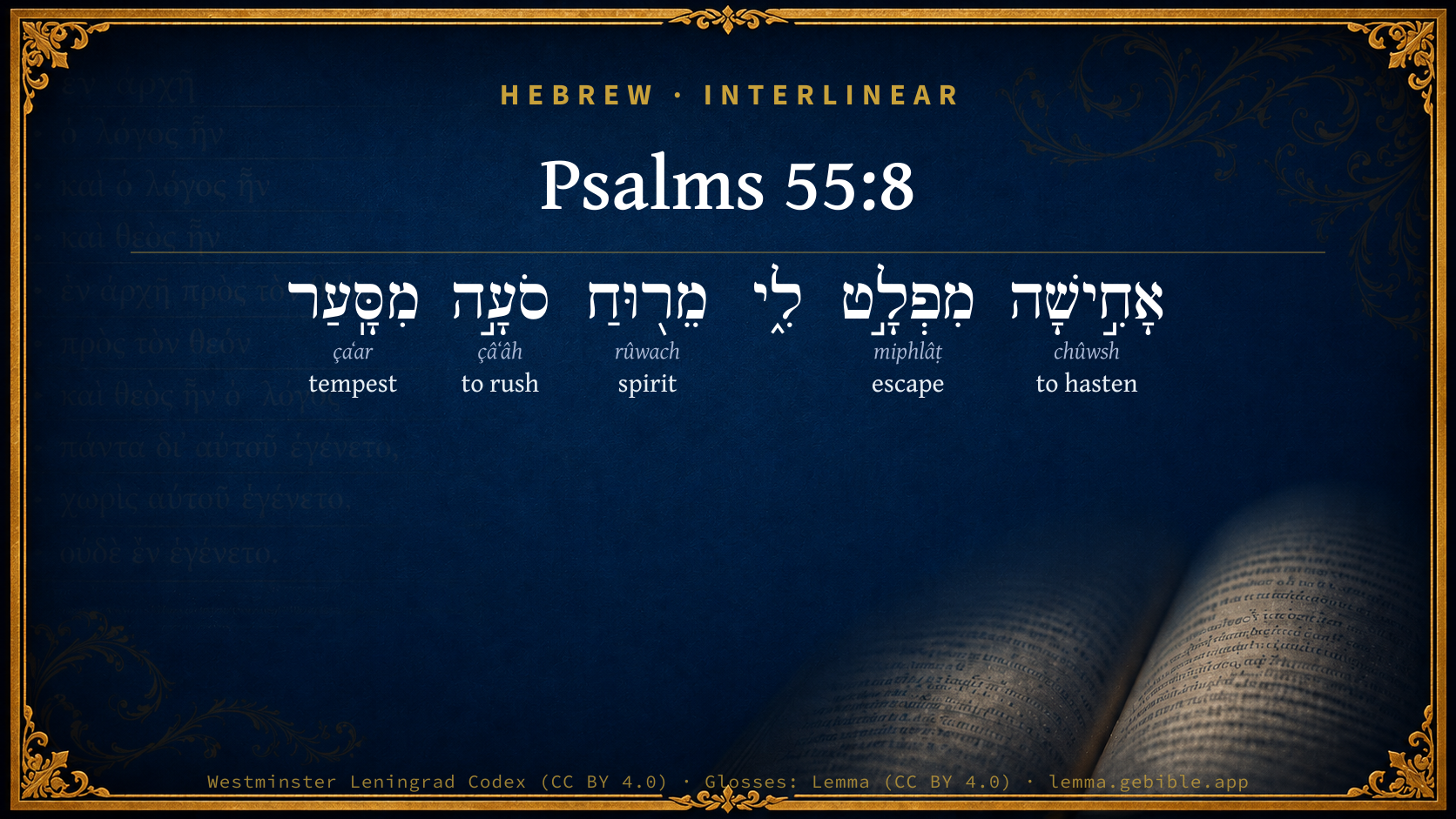
Hebrew (Westminster Leningrad Codex) Psalms 55:8 appears in the Hebrew Old Testament. The text above is from the Westminster Leningrad Codex. Each word links to its Strong’s number, a concise gloss, and parsing drawn from the Open Scriptures Hebrew Bible morphology. Click any word for its full Brown-Driver-Briggs (BDB) entry.
Download image
Cite this verse

Psalms 55:8 (World English Bible). Public Domain. Lemma interlinear Bible study tool, https://lemma.gebible.app/v/psalms/55/8.

Show BibTeX & RIS
BibTeX
RIS
English Translation
"I would hurry to a shelter from the stormy wind and tempest."
World English Bible · Public Domain
Highlights
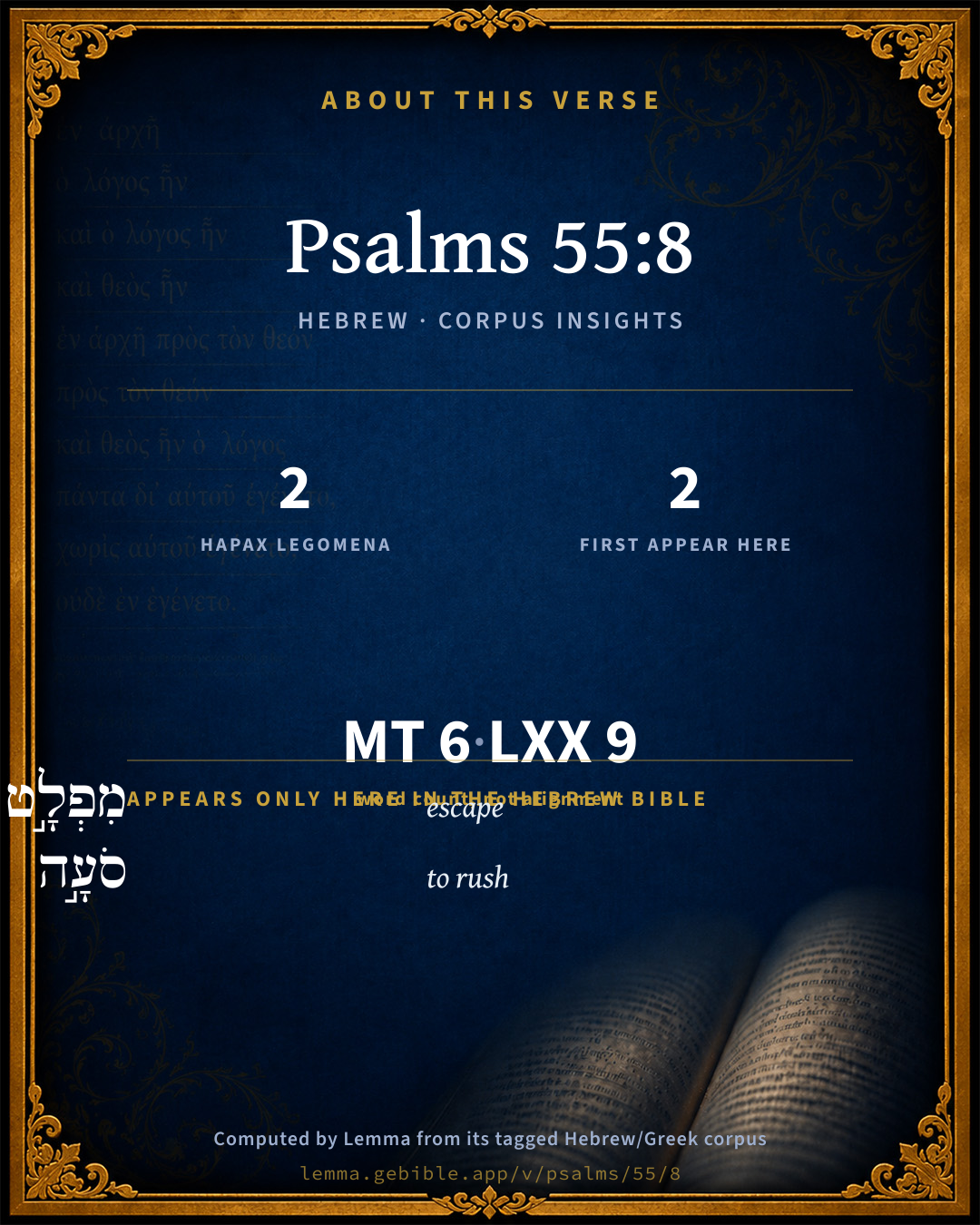
  • 2 hapax legomena — only here in the Hebrew Bible
  • 2 first appearances in the Hebrew Bible
Full analysis ↓
Download a study sheet

One document with this verse’s original text, its word-by-word gloss line, the meaning frame, cross-references with their text, attributed commentary, and full source and license credits — printable, and it pastes into notes with its structure intact.

This verse Autodidact and up

Study sheet (.html) Plain text (.txt)

A passage Seminary Student

Up to 50 verses in one chapter. A passage sheet keeps up to 6 commentary sources and 12 cross-references per verse, in the order this page ranks them, and says so on the sheet whenever that leaves anything out. Ask for a single verse and you get the Autodidact verse sheet above.

Everything on this page stays free to read, with no account — the sheet is a download of what is already on screen, not access to it.

Want to remove ads? Support Godless Engineer
Compare translations 3

The same verse in 3 English versions, stacked beneath the original-language interlinear above. Click any original word for its lexicon entry.

Each is an independent rendering of the whole verse — the interlinear is not word-aligned to these translations.

Highlighted words mark where these versions differ — a whole-verse word diff, not a word-by-word alignment.

  • World English Bible Public Domain
    "I would hurry to a shelter from the stormy wind and tempest."
  • King James Version Public Domain
    I would hasten my escape from the windy storm and tempest.
  • unfoldingWord Literal Text CC BY-SA 4.0
    Let me hasten for myself an escape from the storming wind, from the tempest.”

unfoldingWord Literal Text — © unfoldingWord, licensed CC BY-SA 4.0. Word-aligned USFM3 via Door43 (git.door43.org/unfoldingWord/en_ult).

Versions to compare (up to 4)

3 of 4 selected

Show all 18 translations

Every available English version of this verse, each an independent rendering of the whole verse.

  • World English Bible Public Domain
    "I would hurry to a shelter from the stormy wind and tempest."
  • Berean Standard Bible Public Domain
    I would hurry to my shelter, far from this raging tempest.”
  • Majority Standard Bible Public Domain
    I would hurry to my shelter, far from this raging tempest.”
  • King James Version Public Domain
    I would hasten my escape from the windy storm and tempest.
  • American Standard Version (1901) Public Domain
    I would haste me to a shelter From the stormy wind and tempest.
  • Revised Version (1885) Public Domain
    I would haste me to a shelter from the stormy wind and tempest.
  • Geneva Bible (1599) Public Domain
    Hee would make haste for my deliuerance from the stormie winde and tempest.
  • Douay-Rheims (1899) Public Domain
    Fear and trembling are come upon me: and darkness hath covered me.
  • Young's Literal Translation Public Domain
    I hasten escape for myself, From a rushing wind, from a whirlwind.
  • Literal Standard Version CC BY-SA 4.0
    I hurry escape for myself, || From a rushing wind, from a whirlwind.
  • Unlocked Literal Bible CC BY-SA 4.0
    I would hurry to a shelter from the stormy wind and tempest.”
  • unfoldingWord Literal Text CC BY-SA 4.0
    Let me hasten for myself an escape from the storming wind, from the tempest.”
  • Darby Bible Public Domain
    I would hasten my escape from the stormy wind, from the tempest.
  • World Messianic Bible Public Domain
    “I would hurry to a shelter from the stormy wind and storm.”
  • Webster's Bible Public Domain
    \\55:7\\Lo, then I would wander far off, and remain in the wilderness. Selah.
  • Free Bible Version CC BY-SA 4.0
    I would hurry to a place to hide, out of the wind, safe from the raging storm.
  • Bible in Basic English Public Domain
    I would quickly take cover from the driving storm and from the violent wind.
  • JPS Tanakh (1917) Public Domain
    (55-9) I would haste me to a shelter from the stormy wind and tempest.'

Literal Standard Version (2020), Covenant Press — licensed CC BY-SA 4.0. Text via the HelloAO Bible API (eBible.org). Unlocked Literal Bible (unfoldingWord) — licensed CC BY-SA 4.0. Text via the HelloAO Bible API (eBible.org). unfoldingWord Literal Text — © unfoldingWord, licensed CC BY-SA 4.0. Word-aligned USFM3 via Door43 (git.door43.org/unfoldingWord/en_ult). Free Bible Version, Dr. Jonathan Gallagher — licensed CC BY-SA 4.0. Text via the HelloAO Bible API (eBible.org).

Word by word

More ways to search: Search by grammar → Find every occurrence → Compare this word →

Practice this passage: Drill this verse → Learn its vocabulary →

About this verse

These counts appear in no published source. They are computed here, from the morphology-tagged text and Lemma’s own curated glosses. What Lemma adds →

6
words
5
distinct lemmas
Wisdom
section

Notable vocabulary

2 hapax legomena — words that appear only here in the entire Hebrew Bible:

  • מִפְלָ֣ט escape H4655
  • סֹעָ֣ה to rush H5584

First appearance in Scripture

These words make their first canonical appearance in the Hebrew Bible here:

  • מִפְלָ֣ט escape H4655
  • סֹעָ֣ה to rush H5584

Shared distinctive vocabulary

אָחִ֣ישָׁה to hasten H2363 occurs in 20 verses of the Hebrew Bible. Also found in:

Grammatical profile

  • 2 verbs
  • 3 nouns
  • 1 preposition

Verb forms

  • אָחִ֣ישָׁה Hiphil · Cohortative
  • סֹעָ֣ה Qal · Participle Active

Hebrew & Septuagint length

In English translation the verse runs 12 words from the Hebrew and 14 from the Septuagint (LXX English) — closely comparable.

A rough comparison of the two English renderings, which tokenize alike — not a word-level alignment.

Word counts can differ between the Hebrew and the Greek without any difference in meaning — e.g. the Hebrew direct-object marker אֵת has no separate Greek word, and Greek often adds the article ὁ.

In the original languages it is 6 Hebrew tokens and 9 Greek tokens — but the two are counted differently (Hebrew bundles its prefixes and suffixes into one token; the Greek is in lemma form), so that isn’t a like-for-like length.

Cross-references

4

Topical passages linked to Psalms 55:8 in the Treasury of Scripture Knowledge — connected by theme and wording, ordered by reader-vote popularity; previews shown in the World English Bible.

  • Isaiah 4:6 There will be a pavilion for a shade in the daytime from the heat, and for a refuge and for a shelter from storm and from rain.
  • Matthew 7:25–27 The rain came down, the floods came, and the winds blew, and beat on that house; and it didn't fall, for it was founded on the rock.
  • Psalms 18:4 The cords of death surrounded me. The floods of ungodliness made me afraid.
  • Isaiah 17:12–13 Ah, the uproar of many peoples, who roar like the roaring of the seas; and the rushing of nations, that rush like the rushing of mighty waters!

Cross-references courtesy of OpenBible.info (CC BY 4.0).

Hebrew and Greek witnesses Masoretic Hebrew ↔ Greek Septuagint

The same verse in the two great witnesses to the Old Testament, shown verse-for-verse.

You’re reading Greek Psalm 54 (Hebrew Psalm 55). The Septuagint counts the superscription, so verse numbers can differ from the Hebrew — chapter-level alignment, not verse-by-verse. Numbering follows Rahlfs.

These are two independent witnesses, not word-aligned to each other, and the Septuagint is shown in lemma (dictionary) form.

Hebrew Psalms 55:8 Masoretic · Westminster Leningrad Codex

אָחִ֣ישָׁה מִפְלָ֣ט לִ֑י מֵר֖וּחַ סֹעָ֣ה מִסָּֽעַר

"I would hurry to a shelter from the stormy wind and tempest."

World English Bible · Public Domain

Greek LXX Greek Psalm 54:8 Septuagint · lemma form

ἰδού μακρύνω φυγαδεύω καί αὐλίζω ἐν ὁ ἔρημος διάψαλμα

I waited for him that should deliver me from distress of spirit and tempest.

LXX2012 (modern English Septuagint) · Public Domain

Hebrew: Westminster Leningrad Codex (CC BY 4.0). Greek: Septuagint (public domain); English from LXX2012 (modern English Septuagint) (Public Domain). How the Septuagint differs from the Hebrew →

Commentary

Notes on Psalms 55:8 from classic Christian and Jewish commentators (each source and its license shown beneath its notes). The classic Christian expositions comment on the surrounding passage and are grouped to its opening verse, so a note may address several verses; the Jewish commentaries on the Tanakh (Rashi and others) are per-verse, so they appear only where the commentator wrote on this verse.

Lemma curates 59 commentaries, every one of them public domain or Creative Commons licensed, each selected and text-cleaned for this edition rather than reprinted as found. About our sources →

Trapp's Complete Commentary

John Trapp

Psa 55:8 I would hasten my escape from the windy storm [and] tempest.

Ver. 8. I would hasten my escape from the windy storm, &c.] I would thrust my ship into any creek in the whole world, go as far as my legs, nay, wings, could carry me. Of the swiftness of the dove’s flight, see Plin. l. 10, c. 37; and how David hastened his flight from Absalom, see 2Sa 15:14.

John Trapp, A Commentary or Exposition upon All the Books of the Old and New Testament (1647–1656) — public domain. Text from a community e-Sword module.

J. A. Alexander on Psalms

Joseph Addison Alexander

9. (Psa 55:8). I will hasten my escape from rushing wind, from tempest. Another construction of the first clause makes the verb intransitive and the noun a local one, as indicated by its form, I will hasten (to) my refuge. It is better, however, to give the hiphil verb its proper meaning, and nouns of the form here used denote not only the place of action bnt the act itself. My escape, literally an escape for me or for myself. The preposition in the last clause, though it properly means from, is constantly employed in Hebrew to denote or indicate comparison. If thus explained in this case, it would make the clause descriptive of the speed with which he wishes to escape, more than the rushing wind and tempest. This sense is preferred by some interpreters; but the other is more obvious and simple, and is also recommended by the frequent representation of calamity under the figure of a storm or tempest, which would hardly have been joined with that of wind, if the only idea meant to be conveyed had been that of great velocity.

Joseph Addison Alexander, The Psalms Translated and Explained (1850) — public domain. Text from a community e-Sword module.

Geneva Bible (1599)

Geneva Bible translators

From the cruel rage and tyranny of Saul.

Geneva Bible (1599) marginal notes — public domain. Text via Bolls.life.

Adam Clarke's Commentary

Verse 8. The windy storm] From the sweeping wind and tempest-Absalom and his party and the mutinous people in general.

Adam Clarke's Commentary on the Bible (1810–1826) — public domain. Text from a community e-Sword/MySword module.

The Cambridge Bible for Schools and Colleges

gen. ed. J. J. S. Perowne

8. Or as R.V.,

I would haste me to a shelter

From the stormy wind and tempest,

the storms of faction and party spirit raging in the city.

The Cambridge Bible for Schools and Colleges (gen. ed. J. J. S. Perowne; Cambridge University Press, 1878–1918) — public domain. Text from a community e-Sword module.

John Gill's Exposition

I would hasten my escape from the windy storm and tempest. Of an army of rebellious subjects, bearing down all before them, and threatening with utter ruin and destruction; so a powerful army of enemies invading a country is signified by a storm and tempest, Isa 28:2; and may be expressive of the storm and tempest of divine wrath and vengeance the sensible sinner hastens his escape from by fleeing to Christ; and of the blowing and furious winds of persecution, which the church, Christ's dove, flees from, by getting into the clefts of the rock, and the secret places of the stairs, Sol 2:14; and of the storms of divine wrath and justice that fell upon Christ as the surety of his people; from which the human nature, seized with fearfulness, trembling, and horror, desired an hasty escape.

; and of the storms of divine wrath and justice that fell upon Christ as the surety of his people; from which the human nature, seized with fearfulness, trembling, and horror, desired an hasty escape.

Psalms 55:9

psa 55:9

psa 55:9

psa 55:9Destroy, O Lord,.... Or "swallow up" (s), as Pharaoh and his host were swallowed up in the Red sea; or as Korah, Dathan, and Abiram, were swallowed up in the earth; so all the enemies of Christ and his church will be destroyed; and death, the last of them, will be swallowed up in victory, Isa 25:8. The Targum interprets it, "destroy", or "scatter their counsel": but this seems to be intended in the next clause;

and divide their tongues: as at the confusion of languages at Babel, to which the allusion is: this had its accomplishment in Absalom's counsellors according to David's wish, Sa2 15:31; and in the Jewish sanhedrim in Christ's time, and in the witnesses they produced against him, Luk 23:51; and of which there is an instance in the council of the Jews, held on account of the Apostle Paul, Act 23:7;

for I have seen violence and strife in the city: in the city of Jerusalem, now left by David, and possessed by Absalom, by whom "violence" was done to David's wives, through the advice of Ahithophel; and "strife", contention, and rebellion, were fomented among the people: this David saw, understood, and perceived, by the intelligence brought him from time to time: and in the times of Christ the kingdom of heaven suffered "violence" in this place, and he endured the "contradiction" of sinners against himself.

(s) "degluti", Montanus, Tigurine version; "absorbe", Piscator, Gejerus, Michaelis; so Ainsworth.

John Gill's Exposition of the Whole Bible (1746–1763) — public domain (CC PDM 1.0). Text via the HelloAO Bible API.

Albert Barnes' Notes on the Bible

I would hasten my escape - I would make haste to secure an escape. I would not delay, but I would flee at once.

From the windy storm and tempest - From the calamities which have come upon me, and which beat upon me like a violent tempest. If this psalm was composed on occasion of the rebellion of Absalom, it is easy to see with what propriety tiffs language is used. The troubles connected with that unnatural rebellion had burst upon him with the fury of a sudden storm, and threatened to sweep everything away.

Albert Barnes' Notes on the Bible (1834–1885) — public domain. Text from a community e-Sword/MySword module.

Matthew Poole's English Annotations

From the force and fury of mine enemies, which now highly threaten me.

Matthew Poole's English Annotations on the Holy Bible (1683–1685) — public domain. Text from a community e-Sword/MySword module.

The Treasury of David

Charles H. Spurgeon

Ver. 8. I would hasten my escape. He tried to pause but could not, like a horse which when pulled up slips on a little because of the speed at which he was going. David declares that he would not waste a moment, or stay to bid adieu to his friends, but up and away at once, for fear he should be too late, and because he could bear the clamour of his foes no longer.

From the windy storm and tempest. A storm was brewing, and, like a dove, he would outfly it and reach a calmer region. Swifter than the storm cloud would he fly, to avoid the deluge of rain, and the flash of the lightning. Alas! poor soul, no such wings are thine, as yet thou must tarry here and feel the tempest; but be of good cheer, thou shalt stretch thy wings ere long for a bolder flight, heaven shall receive thee, and there thy sorrows shall have a finis of felicity among the birds of paradise.

Ver. 8. I would hasten my escape from the windy storm and tempest. There was a windy storm and tempest without, and which is worse, a tumult and combustion within in his thoughts. A man may escape from external confusions, but how shall he fly from himself? If he be out of the reach of all the blood suckers on earth, and all the furies in hell, yet be dogged and haunted with his own turbulent, ungovernable cogitations, he needs no other tormentors. This holy man was thus doubly distressed, a storm abroad and an earthquake at home rendered his condition most dolorous; but for both he hath en mega he goes not about with the foxes of this world to relieve himself with subtle stratagems and wiles, by carnal shifts and policies, a vanity tosses to and from by them that seek death. No, his one great refuge is to get aloft, to ascend to God. Thomas Sharp.

Ver. 8. Too hasty a flight from trial.

1. Would show rebellion against God.

2. Would manifest cowardly want of faith.

3. Would involve loss of useful experience.

4. Would land us in other and worse trials.

5. Would prevent our glorifying God.

6. Would mar our conformity to Christ and fellowship with his people.

7. Would lessen the value of heaven.

Psalms 55:9*

Charles H. Spurgeon's The Treasury of David (1869–1885) — public domain. Psalms only. Text from a community e-Sword/MySword module.

Whedon's Commentary on the Bible

Daniel D. Whedon

8. Storm and tempest—The description is of one of those tropical winds which swept away every moveable thing in its course. From such a scene in society and government he would gladly hasten his escape; and the mountain gorge on his present route, so proverbial for its dangers, might well suggest Psa_55:7-8. From these sorrowful and plaintive longings a sudden transition is made to just imprecation and a review of public affairs.

Daniel D. Whedon (gen. ed.), Commentary on the Old and New Testaments (1874–1909) — public domain. Text from a community e-Sword module.

The Pulpit Commentary

I would hasten my escape from the windy storm and tempest. As doves fly from storm and tempest to their nests in the rocks, so the psalmist would fain haste away from the passions and perils of the city to some safe refuge in the wilds. What he here anticipates, he afterwards accomplished, when he fled from Absalom over Jordan. (2Sa_15:14)

The Pulpit Commentary (1880–1919), ed. H.D.M. Spence-Jones & Joseph S. Exell — public domain. Text from a community e-Sword module.

John Wesley's Explanatory Notes

Tempest - From the force and fury of mine enemies.

John Wesley, Explanatory Notes Upon the Whole Bible (1754–1765) — public domain. Text via the GEBible commentary corpus.

unfoldingWord translationNotes

Door43 World Missions Community

General Information:

The writer finishes telling about what he had said.

tempest

a strong storm

Devour them

Destroying something is spoken of as eating all of it. Possible meanings are "Destroy my enemies' plans" or "Destroy my enemies." (See: Metaphor)

confuse their language

"Language" here represents what the people were saying to each other, and probably refers specifically to them talking about plans to do evil. Confusing it represents making the people unable to understand each other. AT: "confuse them when they speak to each other" or "confuse their plans" (See: Metonymy)

translationWords

lord

strife

unfoldingWord translationNotes — © Distant Shores Media and the Door43 World Missions Community, licensed CC BY-SA 4.0. Source: git.door43.org/Door43/en_tn.

Rashi

Rabbi Shlomo Yitzchaki (Rashi)

Behold I would wander far away... and... I would quickly find myself a refuge If I had wings, I would wander far away and hasten to save my soul from their hands, for they are like a sweeping wind, a storm wind, which uproots trees, as (Job 19:10): “He has uprooted (ויסע) like a tree.” But Menachem (p. 127) associated it with (Exod.12: 37): “And the children of Israel traveled (ויסעו).

Rashi on the Tanakh — English translations: “The Judaica Press complete Tanach with Rashi, translated by A. J. Rosenberg” (CC BY 4.0); “Pentateuch with Rashi's commentary by M. Rosenbaum and A.M. Silbermann, 1929-1934” (public domain); “The Metsudah Tanach series, Lakewood, N.J” (CC BY 4.0); and “The Book of Joshua, Metsudah Publications, 1997” (CC BY 4.0). Text via Sefaria.

Lesson kit

Teaching starters — assembled from the data on this page, not authored interpretation. Every prompt links to the verse data it draws on. Edit before teaching.

Psalms, in the Wisdom, opens this verse with 6 words (5 distinct Hebrew lemmas). Its most distinctive word is miphlâṭ (“escape”). A historical commentator’s framing appears above. Read the whole chapter for the surrounding context.

Discussion questions

  1. How does “escape” (miphlâṭ) shape what this verse is saying?
  2. This verse holds 2 words here found nowhere else in the Hebrew Bible. What might the rare words draw attention to?
  3. 2 words here appear for the first time in Scripture. What is being introduced at this debut?
  4. Numbers 32:17 shares the word «to hasten» with this verse. How do the two illuminate each other?
  5. These translations render this verse differently. What is at stake in choosing one wording over another?
  6. The verb «אָחִ֣ישָׁה» is Hiphil Cohortative. How does its form color the action?
  7. Reading how Trapp's Complete Commentary and J. A. Alexander on Psalms read this verse, where do the two commentators agree and where do they part?

Things to notice

Reading settings

Reading text

Shown beneath each verse's original-language words.

Old Testament
Old Testament edition

Read the OT as the Masoretic Hebrew (MT) or the Greek Septuagint (LXX).

English shown for the Greek Septuagint (in the Hebrew ↔ Greek comparison).

Comparing translations? Open the Compare panel on any verse page to stack up to four side by side.