
Job 27:3

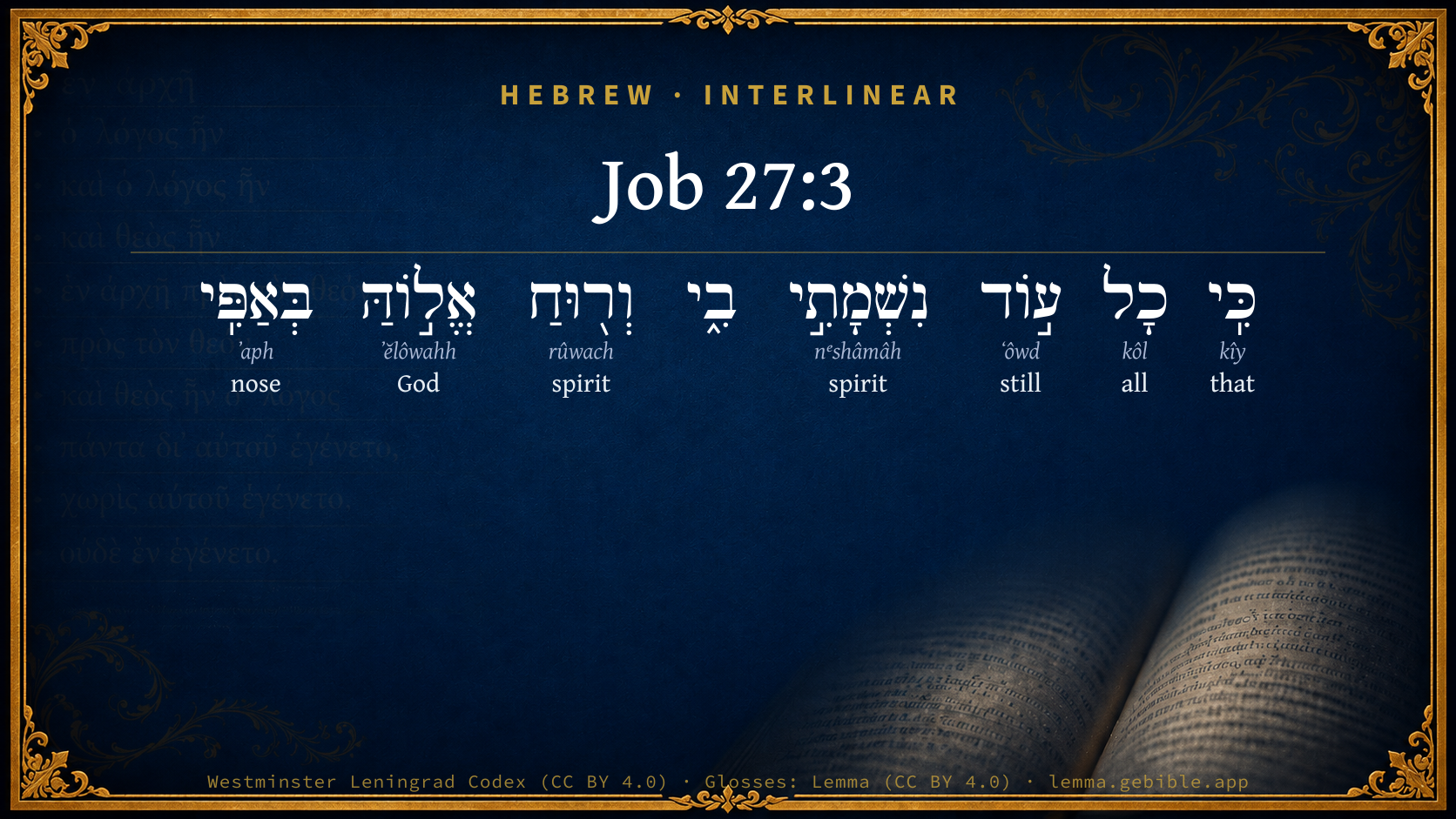
Hebrew (Westminster Leningrad Codex) Job 27:3 appears in the Hebrew Old Testament. The text above is from the Westminster Leningrad Codex. Each word links to its Strong’s number, a concise gloss, and parsing drawn from the Open Scriptures Hebrew Bible morphology. Click any word for its full Brown-Driver-Briggs (BDB) entry.
Download image
Cite this verse

Job 27:3 (World English Bible). Public Domain. Lemma interlinear Bible study tool, https://lemma.gebible.app/v/job/27/3.

Show BibTeX & RIS
BibTeX
RIS
English Translation
(For the length of my life is still in me, And the spirit of God is in my nostrils);
World English Bible · Public Domain
Download a study sheet

One document with this verse’s original text, its word-by-word gloss line, the meaning frame, cross-references with their text, attributed commentary, and full source and license credits — printable, and it pastes into notes with its structure intact.

This verse Autodidact and up

Study sheet (.html) Plain text (.txt)

A passage Seminary Student

Up to 50 verses in one chapter. A passage sheet keeps up to 6 commentary sources and 12 cross-references per verse, in the order this page ranks them, and says so on the sheet whenever that leaves anything out. Ask for a single verse and you get the Autodidact verse sheet above.

Everything on this page stays free to read, with no account — the sheet is a download of what is already on screen, not access to it.

Want to remove ads? Support Godless Engineer
Compare translations 3

The same verse in 3 English versions, stacked beneath the original-language interlinear above. Click any original word for its lexicon entry.

Each is an independent rendering of the whole verse — the interlinear is not word-aligned to these translations.

Highlighted words mark where these versions differ — a whole-verse word diff, not a word-by-word alignment.

  • World English Bible Public Domain
    (For the length of my life is still in me, And the spirit of God is in my nostrils);
  • King James Version Public Domain
    All the while my breath is in me, and the spirit of God is in my nostrils;
  • unfoldingWord Literal Text CC BY-SA 4.0
    that, any of my life still in me, and breath from God in my nose,

unfoldingWord Literal Text — © unfoldingWord, licensed CC BY-SA 4.0. Word-aligned USFM3 via Door43 (git.door43.org/unfoldingWord/en_ult).

Versions to compare (up to 4)

3 of 4 selected

Show all 18 translations

Every available English version of this verse, each an independent rendering of the whole verse.

  • World English Bible Public Domain
    (For the length of my life is still in me, And the spirit of God is in my nostrils);
  • Berean Standard Bible Public Domain
    as long as my breath is still within me and the breath of God remains in my nostrils,
  • Majority Standard Bible Public Domain
    as long as my breath is still within me and the breath of God remains in my nostrils,
  • King James Version Public Domain
    All the while my breath is in me, and the spirit of God is in my nostrils;
  • American Standard Version (1901) Public Domain
    (For my life is yet whole in me, And the spirit of God is in my nostrils);
  • Revised Version (1885) Public Domain
    (For my life is yet whole in me, and the spirit of God is in my nostrils;)
  • Geneva Bible (1599) Public Domain
    Yet so long as my breath is in me, and the Spirit of God in my nostrels,
  • Douay-Rheims (1899) Public Domain
    As long as breath remaineth in me, and the spirit of God in my nostrils,
  • Young's Literal Translation Public Domain
    For all the while my breath `is' in me, And the spirit of God in my nostrils.
  • Literal Standard Version CC BY-SA 4.0
    For all the while my breath [is] in me, || And the wind of God in my nostrils.
  • Unlocked Literal Bible CC BY-SA 4.0
    while my life is yet in me, and the breath from God is in my nostrils, this is what I will do.
  • unfoldingWord Literal Text CC BY-SA 4.0
    that, any of my life still in me, and breath from God in my nose,
  • Darby Bible Public Domain
    All the while my breath is in me, and the spirit of +God is in my nostrils,
  • World Messianic Bible Public Domain
    (for the length of my life is still in me, and the spirit of God is in my nostrils);
  • Webster's Bible Public Domain
    All the while my breath is in me, and the spirit of God is in my nostrils;
  • Free Bible Version CC BY-SA 4.0
    for as long as I have life, while the breath of God remains in my nostrils—
  • Bible in Basic English Public Domain
    (For all my breath is still in me, and the spirit of God is my life;)
  • JPS Tanakh (1917) Public Domain
    All the while my breath is in me, and the spirit of God is in my nostrils,

Literal Standard Version (2020), Covenant Press — licensed CC BY-SA 4.0. Text via the HelloAO Bible API (eBible.org). Unlocked Literal Bible (unfoldingWord) — licensed CC BY-SA 4.0. Text via the HelloAO Bible API (eBible.org). unfoldingWord Literal Text — © unfoldingWord, licensed CC BY-SA 4.0. Word-aligned USFM3 via Door43 (git.door43.org/unfoldingWord/en_ult). Free Bible Version, Dr. Jonathan Gallagher — licensed CC BY-SA 4.0. Text via the HelloAO Bible API (eBible.org).

Word by word

More ways to search: Search by grammar → Find every occurrence → Compare this word →

Practice this passage: Drill this verse → Learn its vocabulary →

About this verse

These counts appear in no published source. They are computed here, from the morphology-tagged text and Lemma’s own curated glosses. What Lemma adds →

8
words
7
distinct lemmas
Wisdom
section

Notable vocabulary

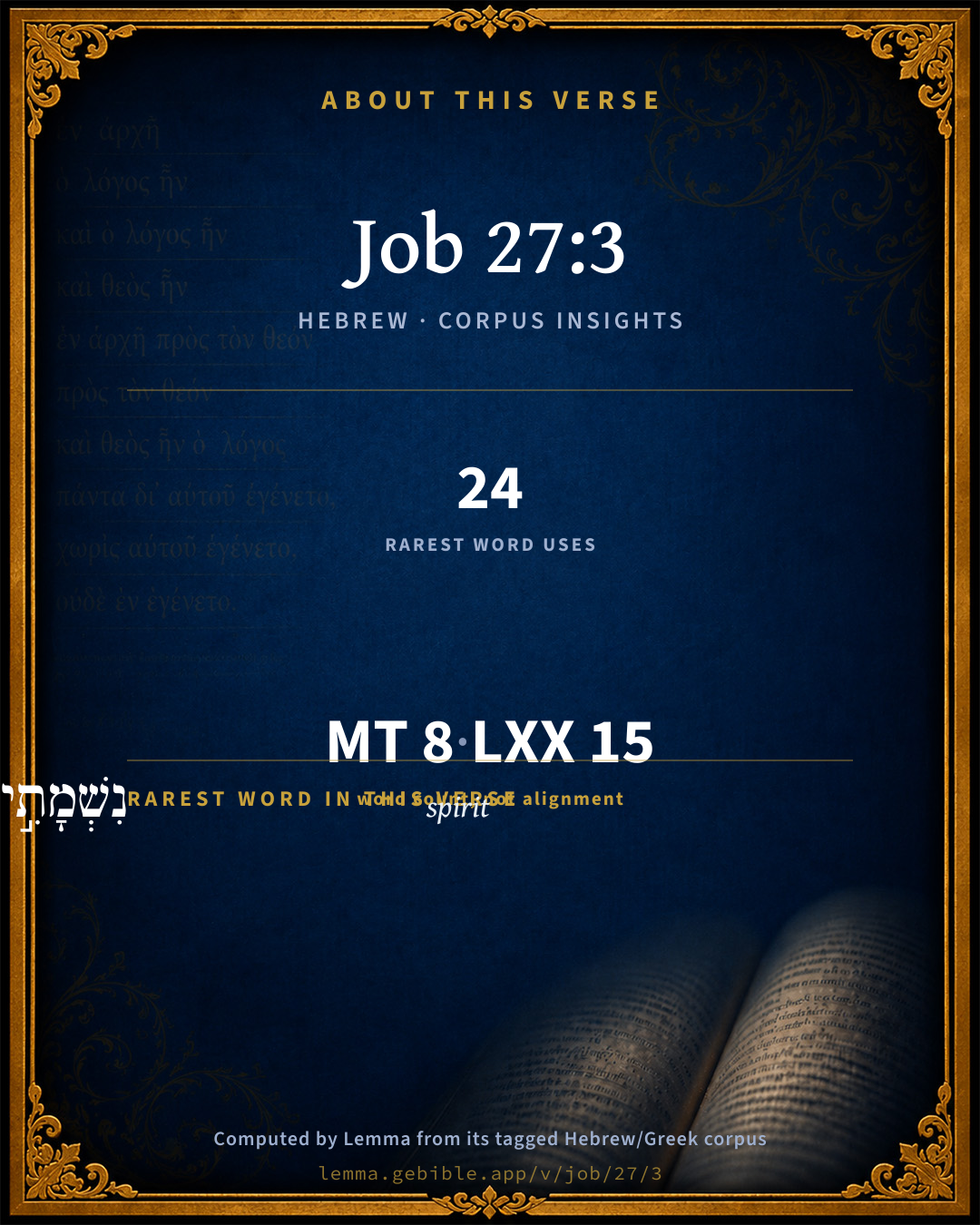
The rarest word here is נִשְׁמָתִ֣י spirit H5397 — appearing just 24 times in the whole Hebrew Bible.

Shared distinctive vocabulary

נִשְׁמָתִ֣י spirit H5397 occurs in 24 verses of the Hebrew Bible. Also found in:

Grammatical profile

  • 5 nouns
  • 1 preposition
  • 1 conjunction
  • 1 adverb

Hebrew & Septuagint length

In English translation the verse runs 19 words from the Hebrew and 21 from the Septuagint (LXX English) — closely comparable.

A rough comparison of the two English renderings, which tokenize alike — not a word-level alignment.

Word counts can differ between the Hebrew and the Greek without any difference in meaning — e.g. the Hebrew direct-object marker אֵת has no separate Greek word, and Greek often adds the article ὁ.

In the original languages it is 8 Hebrew tokens and 15 Greek tokens — but the two are counted differently (Hebrew bundles its prefixes and suffixes into one token; the Greek is in lemma form), so that isn’t a like-for-like length.

Cross-references

5

Topical passages linked to Job 27:3 in the Treasury of Scripture Knowledge — connected by theme and wording, ordered by reader-vote popularity; previews shown in the World English Bible.

  • Genesis 2:7 Yahweh God formed man from the dust of the ground, and breathed into his nostrils the breath of life; and man became a living soul.
  • Job 33:4 The Spirit of God has made me, And the breath of the Almighty gives me life.
  • Job 32:8 But there is a spirit in man, And the breath of the Almighty gives them understanding.
  • Isaiah 2:22 Stop trusting in man, whose breath is in his nostrils; For of what account is he?
  • Acts 17:25 neither is he served by men's hands, as though he needed anything, seeing he himself gives to all life and breath, and all things.

Cross-references courtesy of OpenBible.info (CC BY 4.0).

Hebrew and Greek witnesses Masoretic Hebrew ↔ Greek Septuagint

The same verse in the two great witnesses to the Old Testament, shown verse-for-verse.

These are two independent witnesses, not word-aligned to each other, and the Septuagint is shown in lemma (dictionary) form.

Hebrew Job 27:3 Masoretic · Westminster Leningrad Codex

כִּֽי כָל ע֣וֹד נִשְׁמָתִ֣י בִ֑י וְר֖וּחַ אֱל֣וֹהַּ בְּאַפִּֽי

(For the length of my life is still in me, And the spirit of God is in my nostrils);

World English Bible · Public Domain

Greek LXX Job 27:3 Septuagint · lemma form

ἦ μήν ἔτι ὁ πνοή ἐγώ ἐνεἰμί πνεῦμα δέ θεῖος ὁ περιεἰμί ἐγώ ἐν ῥίς

verily, while my breath is yet in me, and the breath of God which remains to me is in my nostrils,

LXX2012 (modern English Septuagint) · Public Domain

Hebrew: Westminster Leningrad Codex (CC BY 4.0). Greek: Septuagint (public domain); English from LXX2012 (modern English Septuagint) (Public Domain). How the Septuagint differs from the Hebrew →

Commentary

Notes on Job 27:3 from classic Christian and Jewish commentators (each source and its license shown beneath its notes). The classic Christian expositions comment on the surrounding passage and are grouped to its opening verse, so a note may address several verses; the Jewish commentaries on the Tanakh (Rashi and others) are per-verse, so they appear only where the commentator wrote on this verse.

Lemma curates 59 commentaries, every one of them public domain or Creative Commons licensed, each selected and text-cleaned for this edition rather than reprinted as found. About our sources →

Trapp's Complete Commentary

John Trapp

Job 27:3 All the while my breath [is] in me, and the spirit of God [is] in my nostrils;

Ver. 3. All the while my breath is in me] Periphrasis vitae, - Dum spiritus hos regat artas, While I have an hour to breathe, I will hold to this oath of mine; neither may you ever hope to dispute me out of mine integrity. Life is described by breath, which, when it faileth, the man dieth, 1Ki 17:17 Psa 146:4 Isa 2:22. Cease ye from man, whose breath is in his nostrils, every moment ready to puff out. What is man, saith Nazianzen, but soul and soil, breath and body, a puff of wind the one, a pile of dust the other, no solidity in either? Jovinian, the emperor, was choked with the smoke of charcoal (Eutrop. Oros.); Pope Adrian with a fly, getting into his throat as he gaped; the cardinal of Lorrain was lighted to his lodging and to his long home both at once by a poisoned torch. Defer not, saith one, since at the next puff of breath thou mayest blow away thy life.

And the Spirit of God is in my nostrils] He seems to allude to Gen 2:7, or some tradition of the fathers to like purpose; Act 17:25, God giveth to all life, and breath, and all things. And again, Act 17:28, "In him we live, and move, and have our being." Wherefore "let everything that hath breath praise the Lord," Psa 150:6; yea, let every breath (as some read it) praise the Lord. Let it be as the smoke of the tabernacle, as pillars of incense ascending up to heaven. Tam Dei meminisse opus est, quam respirare (Chrysost.).

John Trapp, A Commentary or Exposition upon All the Books of the Old and New Testament (1647–1656) — public domain. Text from a community e-Sword module.

The Biblical Illustrator

Joseph S. Exell

Job_27:3-6

Till I die I will not remove mine integrity from me.

Moral courage

It is the aim of all men to secure happiness. As to the course they think best adapted to secure this they differ most widely, and as to what constitutes real happiness the most different opinions are entertained, yet the desire for that which each considers to be happiness is universal. Physical courage is common enough all over the world, but moral courage is a rare phenomenon. Before the fear of being thought foolish, our moral courage relaxes and melts away as snow before the sun. If you make a stand for a principle, society regards you as some abnormal specimen of humanity. They are not the greatest martyrs who die a martyrs death, but they who have the moral courage to live a martyrs life for conscience and for duty. But the lack of moral courage is visible everywhere about us. It infests and poisons every trade and every profession; and moral cowardice abounds in the very last place where it should be met with--the Church. Whether deficiency in moral courage is with us a national failing or not, is difficult to determine. Undeniably there is a grievous want of it around us. Hardly anyone will go out of his way in the interest of abstract truth, or cry down and fight a wrong by which he does not suffer directly and personally. (D. P. Faure.)

Holding fast integrity

We cannot command the smiles of fortune or the friendship of men. But in defiance of every external event we may, with Job, hold fast our integrity, and not let it go so long as we live. To explain and recommend this excellent disposition I illustrate its influence upon taste, sentiments, and conduct, and the happy effects which result from it.

1. In opposition to prejudice and bigotry, it implies a prevailing love of truth. To rise entirely above the influence of prejudice is not allotted to human nature, in our present state of ignorance and imperfection. Integrity cannot secure the mind entirely from prejudices, but it will diminish their number and force, and dispose the man who is under its influence to renounce them when they are discovered. It redounds to the credit of a mans understanding to have made choice of sound principles upon first deliberation. But it is no less an evidence of a manly and independent mind to relinquish the opinions it has already espoused, when they stand in opposition to the unchangeable laws of truth and righteousness.

2. In opposition to show and affectation, integrity consists in adhering to nature and simplicity. The manners of every individual must, in some degree, be formed upon the examples and fashions of the surrounding multitude. But this may be truly asserted, a man of integrity will not be the first to invent or imitate any custom that departs from simplicity and nature, and consists only in ceremony and false refinement. Through his predilection for simplicity, his religion will have nothing of affectation, but will be sincere and substantial. He does not assume the profession of it with any selfish end. He is but little solicitous about the praise of men. His attention is principally directed to the culture of inward piety and goodness.

3. Integrity implies a love of justice in opposition to fraud and dishonest dealing. The character I am describing, is superior to the influence of mercenary, grovelling motives. The man of deep-rooted integrity, by the irresistible and pleasing impulse of his heart, is at all times preserved from the most distant approach to fraud and dishonesty.

4. In opposition to disguise and hypocrisy, the character under review is open, bold, and pleased to be seen in its true colours. The consciousness of personal guilt engenders a suspicion of others, and makes the men who are tainted with it study the natural accomplishments of concealment and dissimulation.

(1)

Integrity is the surest road to truth. A man of integrity not only looks up through a clear medium to the bright rays of the divinity, but also in his own nature and temper he perceives genuine, though faint and imperfect, lineaments of the image of God.

(2) The disposition of integrity has a powerful influence in nourishing and confirming all the graces of the Christian character. Sincerity and uprightness of conduct are the best security for the performance of every social duty.

(3) The virtue of integrity, from the intercourse which it establishes between God and the soul, and its moral influence extending to every branch of character, does, in a peculiar manner, inspire a man with a good conscience and an unshaken trust in the protection of heaven. (T. Somerville, D. D.)

Uprightness in life and death

Till I die. This thought pervades a large portion of this book. Sometimes as a welcome thought, I would not live always. At others, as a thing which is inevitable. When a few years are come, then I shall go the way whence I shall not return. To a Christian, death is a widely different thing from what it was to Job. Christ has abolished death. His disciples can say to death, Where is thy sting? Job resolves that his retrospect from his deathbed shall not reproach him with insincerity, unfaithfulness, falseness to his convictions.

I. All men will wish to die in love and charity with their neighbours.

1. When we are angry--perhaps vindictive--the reason is as much from the consideration of the future as out of resentment for the past.

2. Few men would speak words of anger--especially of resentful anger--if they thought they were last words.

3. It is a natural impulse, when bidding farewell to the world, to ask for pardon, and to grant it. All this is admirable and excellent. But--

II. It is equally desirable that men should be true and just and upright in both life and death.

1. Love without righteousness is no true love--does not really bless.

2. But difficulties in the way of strict fidelity.

(1)

Seems to be inconsistent with love and kindness. An error, but a very natural one. Hence we keep back words which honesty to our convictions would bid us speak.

(2) Is an apparent assumption of superiority from which we shrink.

(3) Is a kind of challenge to others to scrutinise our own conduct. For these and other reasons men are often silent when they ought to speak; sometimes say smooth things when they ought to be stern.

3. No one can doubt, however, that a real friend is one who is perfectly sincere.

(1) In dealing with our faults, as well as

(2) In acknowledging our good qualities.

III. An important caution. (W. R. Clarke, M. A.)

Peace of conscience

In these words we cannot but observe what a mighty satisfaction the good man takes in the peace of his conscience, and the performance of his duty, and the steadiness of his resolution, never to be frightened out of it by any temptation or discouragement whatsoever. In the want of all the good things he had formerly abounded with, it was Jobs comfort to remember that he had enjoyed them innocently, and employed them faithfully. It was not for any notorious provocation of his God, or injury to his neighbour, that they were come upon him. He had confidence in his integrity, and boldly durst look up to God Himself, and maintain his ways before Him. Show the wisdom of this resolution, of holding fast our integrity; and never letting it go upon any prospect or temptation whatsoever. The tracks and footsteps of our duty are all along as plain and as legible as we can wish; and if we will but follow them, will lead us on as strait and as direct a path as we can go. So that the very windings and turnings through which unfaithfulness wanders, are enough to convince us that it mistakes its course, and instead of carrying us, as it pretends, a shorter way, is losing sight apace of happiness, and insensibly making on to misery. The first step of these men proceeds upon mistake. They falsely divide their duty from their interest, the two things in the world of all others most strictly inseparable. Every man is so far happy as he is virtuous, and miserable as he is vicious. Upon this foundation it is that the happiness of God Himself is conceived to stand. Had the devil himself but held fast his integrity, he had been happy still; nor can he ever destroy the happiness of man, but by persuading him to that by which he lost his own. God has given us a more secure possession of our integrity than of any one thing in the world besides that we can call our own. The wisdom of holding it fast, and never letting it go, will appear from the following considerations.

1. In parting with our integrity, we let go that, without which prosperity itself can never make us happy. There is not a greater mistake than the common notion of the happiness of the wicked in this life. How many false exceptions against Providence, and discouragements from virtue, has it sometimes started in the best of men! Even in the seeming equality of His distributions to the wicked and the good, God has made a very sensible distinction, and done abundantly enough to justify the conduct of His providence and the wisdom of our integrity. God punishes the wicked with those very blessings He admits him to partake of. Envy not the glory of the sinner, for thou knowest not what shall be his end. Nay, thou knowest not so much as how it fares at present with him.

2. Because we let go that which being once gone, affliction needs must render us insupportably miserable. Nothing is more certain in the life of a man than a share in the troubles that inseparably accompany it. Yet how few make any provision for what nobody can avoid. So long as the world runs smoothly on their side, on they travel, thoughtless and secure, never considering that though it is fair and sunshine now, the weather soon may change, and a storm they little dream of may break suddenly upon them. The wise man, who builds upon the sure foundations of his own integrity, stands unshaken and secure. Afflictions may dash and spend themselves upon him, but his hope and confidence may not be removed, but standeth fast forever. The spirit of a man will go a long way towards sustaining his infirmities.

3. He that lets go his integrity, parts with that which alone can avail him in the day of judgment. Whatever hopes a man may have of carrying on an interest in this world, by acting contrary to his duty, no man was ever weak enough to imagine it could be of any service to him in another. How bold and fearless will they who have kept their integrity stand before the dread tribunal, secure of being justified in their trial, and clear when they are judged. (Pawlet St. John, A. M.)

Holding fast our righteousness

Job had lost almost everything else, but he still held fast his righteousness. His wealth and his honour, his flocks and his herds, his sons and his daughters, his health and his home, had all been lost, but still he retained his integrity.

I. Righteousness is a mans true treasure, and he should hold it fast at any cost, and never let it go. It is not the wealth which a man has, or the honour and greatness which he attains, or the success which he wins in business and professional life, which makes him truly rich, but the holy and Christlike character which he builds up. It is to the upright that there ariseth light in the darkness; it is those that have clean hands and a pure heart and that have not lifted up their soul unto vanity, that shall receive the blessing of the Lord. The promises of God and the blessings of His salvation are all attached to character, and not to the accident of birth or training, of position or wealth, so that character is the thing of value in the judgment of God. Nay, all other kinds of wealth will be left behind, and will find no place in the eternal world. For, as St. Paul reminds us, We brought nothing into the world, and it is certain we can carry nothing out. The gateway of death is so strait that before we can pass through we must be stripped of everything except our character.

II. But while righteousness is a mans true treasure, this treasure is often assailed and put in jeopardy.

1. The manifold trials of life make it difficult to hold fast ones righteousness.

2. Then, further, not only suffering but perplexity and doubt make it hard to hold fast our righteousness. These were the chief cause of difficulty in the case of Job. There are some who today find it hard to believe in God and freedom and immortality, and if these things be denied where is there any basis for righteousness of life?

3. Then, again, we must remember that there are manifold forms of temptation which assail men in their business and their pleasure, in their hours of leisure and their hours of toil, in the home and in the office, on Sundays and on weekdays.

III. But now let me remind you in closing that a man can hold fast his righteousness, however fiercely it may be assailed. We have heard so much in recent years of heredity and environment and solidarity that we are in danger of overlooking the power and prerogative of the individual will. We can abhor that which is evil and cleave to that which is good. We can resist the devil that he may flee from us; we can draw near to God that He may draw nigh unto us. (G. Hunsworth, M. A.)

My heart shall not reproach me so long as I live.

Of an unreproaching heart

I. The state of mind or heart which is necessary to prevent our being reproached by ourselves. As men are endowed with a sense of moral good and evil, of merit and demerit in their own affections and actions, they are by nature a law to themselves, and have the rule of right, and the standard of worth and excellence, engraved on their minds. They approve or condemn themselves according as they find their affections and actions to agree with the law of their nature. What are the worthy, amiable, and becoming affections, the prevalence of which constitutes that good state of heart which frees us from inward anguish and remorse, and all the pains of self-condemnation, and which gives us the delight, joy, and assurance which flow from the approbation of our consciences? They are such as these,--reverence, love, gratitude, dependence, submission, and resignation, with respect to the great Author and Governor of all things. Probity, truth, justice, meekness, and kindness toward men; a love of the public, and a regard to the common interest of the world; a moderation of our lower desires and passions; and a cultivation of the higher faculties. These dispositions have an intrinsic excellence and loveliness in them. As these virtues and dispositions prevail in very different degrees in the hearts of men, so the pleasure, satisfaction, and peace which they find in their reflections upon their inward frame, are likewise very different and unequal. Where the motions of the soul towards virtue are all free and lively, intense and vigorous, and withal uniform, permanent, and fixed, the man enjoys the most perfect satisfaction and peace.

II. The great importance of keeping our hearts always in this state. As the power of moral discernment, or our natural conscience of good and evil, is the principle of virtue, and the guide of life in us, so it is likewise the great cause and spring of our happiness. Integrity, or a sincerely and uniformly good frame of heart, must certainly be allowed to be the most felicitating, or the most replete with true happiness. This consciousness gives us a sense of our possessing an intrinsic solid dignity and merit, and being in a state the most becoming and honourable to rational agents. The pleasures derived from this source are permanent, and do not depend on any uncertain, external objects. A man who is calm and serene within, will be but little moved with those evils which are incident to everyone in the course of this frail, uncertain life. And these inward pleasures are also the life of all our other enjoyments.

III. Rules for attaining this state of heart.

1. Consider the several pursuits and actions in which we allow ourselves, whether they are really such as our consciences approve.

2. Frequently review and examine the state of our minds, that we may find out our defects, and know what progress we are making.

3. We should correct our errors, and make up our defects, as far as we can, by sincere repentance. And we should derive new strength to ourselves by the exercise of a serious and humble devotion.

Reflections--

1. See the inestimable value of integrity of heart, and the testimony of a good conscience.

2. See how groundless those fears and perplexities are, which so often disturb the minds of sincere persons.

3. See the presumption of those sinners who speak peace to themselves, when there is no foundation laid for peace to them, in the temper and disposition of their hearts. (J. Orr, D. D.)

The Biblical Illustrator, edited by Joseph S. Exell (c. 1880s–1900s) — public domain. Text from a community e-Sword module.

Jamieson, Fausset & Brown

Robert Jamieson, A. R. Fausset & David Brown

Implying Job's knowledge of the fact that the living soul was breathed into man by God (Gen 2:7). "All the while." But MAURER, "As yet all my breath is in me" (notwithstanding my trials): the reason why I can speak so boldly.

Jamieson, Fausset & Brown — Commentary Critical and Explanatory on the Whole Bible (1871) — public domain (CC PDM 1.0). Text via the HelloAO Bible API.

Adam Clarke's Commentary

Verse 3. All the while my breath is in me] As Job appears to allude to the creation of Adam, whom God made out of the dust of the earth, and breathed into his nostrils the breath of life, so that he became a living soul, the whole of Job's assertion may be no more than a periphrasis for As long as I live and have my understanding. Indeed נשמתי nishmathi may be rendered my mind or understanding, and רוח אלוה ruach Eloah, the breath of God, the principle of animal life, the same that he breathed into Adam; for it is there said, Ge 2:7, He breathed into his nostrils, נשמת חיים nismath chaiyim, the breath of lives, or that principle from which animal and spiritual life proceeds; in consequence of which he became לנפש חיה lenephesh chaiyah, an intelligent or rational animal.

Adam Clarke's Commentary on the Bible (1810–1826) — public domain. Text from a community e-Sword/MySword module.

The Cambridge Bible for Schools and Colleges

gen. ed. J. J. S. Perowne

3. all the while] The sense is rather as given above, according to the parallel passage, 2Sa_1:9. The phrase “my life” in the first clause is lit. my breath. The words are parenthetical, and are thrown in to add weight to the affirmation of his rectitude which Job is about to make (Job_27:4); they imply that, though reduced by disease, he is in possession of all his powers, and flings the whole force of his being into his affirmation.

The Cambridge Bible for Schools and Colleges (gen. ed. J. J. S. Perowne; Cambridge University Press, 1878–1918) — public domain. Text from a community e-Sword module.

John Gill's Exposition

All the while my breath is in me,.... So long the oath of God would be upon him, or he bound himself under it:

and the spirit of God is in my nostrils; which signifies the same thing. The breath of a man is his spirit, and this is of God, the Father of spirits; he first breathed into man the breath of life, and he became a living soul or spirit, Gen 2:7; it is he that gives life and breath to every man, Act 17:25, and continues it as long as he pleases, which is a very precarious thing; for it is in his nostrils, where it is drawn to and fro and soon and easily stopped; nor will it always continue, it will some time not be, it will go forth, and then man dies, and returns to the earth, Ecc 12:7; but as long as there is breath there is life; so that to say this is the same as to say, as long as I live, or have a being, Psa 104:33; and while that continued, Job looked upon himself under the oath he had taken by the living God.

John Gill's Exposition of the Whole Bible (1746–1763) — public domain (CC PDM 1.0). Text via the HelloAO Bible API.

Albert Barnes' Notes on the Bible

And the spirit of God is in my nostrils - As long as I live. The “spirit of God” here means the breath that God breathed into man when he created him, Gen 2:7. It would seem probable that there was an allusion to that fact by the language here, and that the knowledge of the way in which man was created was thus handed down by tradition.

Albert Barnes' Notes on the Bible (1834–1885) — public domain. Text from a community e-Sword/MySword module.

Haydock's Catholic Bible Commentary

Nostrils: while I live. (Haydock) --- Genesis ii. 7., and Ezechiel xxxvii. 14. (Calmet)

George Leo Haydock (1774–1849), Haydock's Catholic Family Bible and Commentary, 1859 edition — public domain. Excludes Psalms (Douay-Rheims chapter numbering differs from Protestant) and Deuterocanonical books (Catholic canon only).

Matthew Poole's English Annotations

My breath; which is the constant companion and certain sign of life, both coming in with it, Gen 2:7, and going out with it, 1Ki 17:17; Psa 144:4. Or, my soul, or life. The spirit of God; that spirit or soul which God breathed into me, Gen 2:7, and preserveth in me. Or rather, the breath of God, i.e. which God breathed into me, which eminently appears in a man’s nostrils.

Matthew Poole's English Annotations on the Holy Bible (1683–1685) — public domain. Text from a community e-Sword/MySword module.

Whedon's Commentary on the Bible

Daniel D. Whedon

3. All the while, etc. — Dillmann, Hitzig, and the Speaker’s Commentary, read, for whole even yet is my breath in me; that is, notwithstanding his weight of sorrow he feels himself “sound, capable of knowing and holding what is true and right;” in a condition not unlike that essential to the making of a will, “being in sound mind.” The Authorized Version, which is approved by Gesenius, Furst, and Hengstenberg, makes quite as good sense. As long as he lives he will adhere to what he is about to swear. Umbreit makes this verse a part of the oath.

Spirit (or breath) of God — An allusion to the Mosaical account of man’s creation. Gen_2:7.

Daniel D. Whedon (gen. ed.), Commentary on the Old and New Testaments (1874–1909) — public domain. Text from a community e-Sword module.

The Pulpit Commentary

All the while my breath is in me. This verse is parenthetic. Job claims in it to be in possession of all his faculties, notwithstanding his sufferings. The right translation would seem to be, "For my life is yet whole within me" (see the Revised Version). And the spirit of God is in my nostrils. The spirit of God, originally breathed into man"s nostrils, whereby he became a living soul, (Gen_2:7) is still, Job says, within him, and makes him capable of judging and declaring what is right.

The Pulpit Commentary (1880–1919), ed. H.D.M. Spence-Jones & Joseph S. Exell — public domain. Text from a community e-Sword module.

Lesson kit

Teaching starters — assembled from the data on this page, not authored interpretation. Every prompt links to the verse data it draws on. Edit before teaching.

Job, in the Wisdom, opens this verse with 8 words (7 distinct Hebrew lemmas). Its most distinctive word is nᵉshâmâh (“spirit”). A historical commentator’s framing appears above. Read the whole chapter for the surrounding context.

Discussion questions

  1. How does “spirit” (nᵉshâmâh) shape what this verse is saying?
  2. How does Genesis 2:7, which shares the word «spirit», read alongside this verse?
  3. These translations render this verse differently; the difference is in the English rendering, not the original. What questions does that raise?
  4. Compare how Trapp's Complete Commentary and The Biblical Illustrator read this verse. Where do they agree or differ?

Things to notice

Reading settings

Reading text

Shown beneath each verse's original-language words.

Old Testament
Old Testament edition

Read the OT as the Masoretic Hebrew (MT) or the Greek Septuagint (LXX).

English shown for the Greek Septuagint (in the Hebrew ↔ Greek comparison).

Comparing translations? Open the Compare panel on any verse page to stack up to four side by side.