
Job 32:18

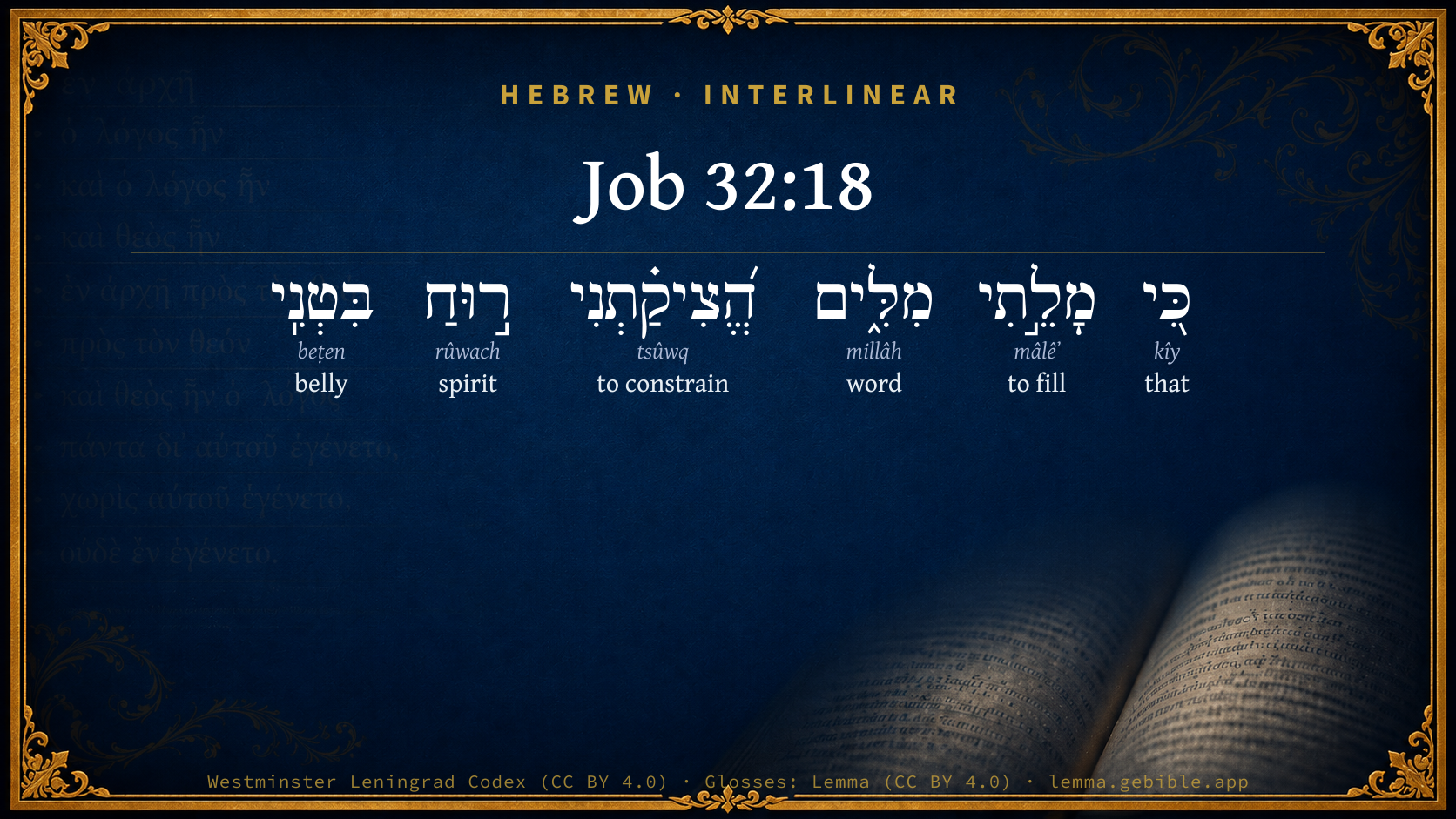
Hebrew (Westminster Leningrad Codex) Job 32:18 appears in the Hebrew Old Testament. The text above is from the Westminster Leningrad Codex. Each word links to its Strong’s number, a concise gloss, and parsing drawn from the Open Scriptures Hebrew Bible morphology. Click any word for its full Brown-Driver-Briggs (BDB) entry.
Download image
Cite this verse

Job 32:18 (World English Bible). Public Domain. Lemma interlinear Bible study tool, https://lemma.gebible.app/v/job/32/18.

Show BibTeX & RIS
BibTeX
RIS
English Translation
For I am full of words. The spirit within me constrains me.
World English Bible · Public Domain
Download a study sheet

One document with this verse’s original text, its word-by-word gloss line, the meaning frame, cross-references with their text, attributed commentary, and full source and license credits — printable, and it pastes into notes with its structure intact.

This verse Autodidact and up

Study sheet (.html) Plain text (.txt)

A passage Seminary Student

Up to 50 verses in one chapter. A passage sheet keeps up to 6 commentary sources and 12 cross-references per verse, in the order this page ranks them, and says so on the sheet whenever that leaves anything out. Ask for a single verse and you get the Autodidact verse sheet above.

Everything on this page stays free to read, with no account — the sheet is a download of what is already on screen, not access to it.

Want to remove ads? Support Godless Engineer
Compare translations 3

The same verse in 3 English versions, stacked beneath the original-language interlinear above. Click any original word for its lexicon entry.

Each is an independent rendering of the whole verse — the interlinear is not word-aligned to these translations.

Highlighted words mark where these versions differ — a whole-verse word diff, not a word-by-word alignment.

  • World English Bible Public Domain
    For I am full of words. The spirit within me constrains me.
  • King James Version Public Domain
    For I am full of matter, the spirit within me constraineth me.
  • unfoldingWord Literal Text CC BY-SA 4.0
    For I am full of words; the spirit in my belly compels me.

unfoldingWord Literal Text — © unfoldingWord, licensed CC BY-SA 4.0. Word-aligned USFM3 via Door43 (git.door43.org/unfoldingWord/en_ult).

Versions to compare (up to 4)

3 of 4 selected

Show all 18 translations

Every available English version of this verse, each an independent rendering of the whole verse.

  • World English Bible Public Domain
    For I am full of words. The spirit within me constrains me.
  • Berean Standard Bible Public Domain
    For I am full of words, and my spirit within me compels me.
  • Majority Standard Bible Public Domain
    For I am full of words, and my spirit within me compels me.
  • King James Version Public Domain
    For I am full of matter, the spirit within me constraineth me.
  • American Standard Version (1901) Public Domain
    For I am full of words; The spirit within me constraineth me.
  • Revised Version (1885) Public Domain
    For I am full of words; the spirit within me constraineth me.
  • Geneva Bible (1599) Public Domain
    For I am full of matter, and the spirite within me compelleth me.
  • Douay-Rheims (1899) Public Domain
    Behold, my belly is as new wine which wanteth vent, which bursteth the new vessels.
  • Young's Literal Translation Public Domain
    For I have been full of words, Distressed me hath the spirit of my breast,
  • Literal Standard Version CC BY-SA 4.0
    For I have been full of words, || The spirit of my breast has distressed me,
  • Unlocked Literal Bible CC BY-SA 4.0
    For I am full of words; the spirit in me compels me.
  • unfoldingWord Literal Text CC BY-SA 4.0
    For I am full of words; the spirit in my belly compels me.
  • Darby Bible Public Domain
    For I am full of matter, the spirit within me constraineth me.
  • World Messianic Bible Public Domain
    For I am full of words. The spirit within me constrains me.
  • Webster's Bible Public Domain
    For I am full of matter, the spirit within me constraineth me.
  • Free Bible Version CC BY-SA 4.0
    I have so much to say I can't hold the words back!
  • Bible in Basic English Public Domain
    For I am full of words, I am unable to keep in my breath any longer:
  • JPS Tanakh (1917) Public Domain
    For I am full of words; the spirit within me constraineth me.

Literal Standard Version (2020), Covenant Press — licensed CC BY-SA 4.0. Text via the HelloAO Bible API (eBible.org). Unlocked Literal Bible (unfoldingWord) — licensed CC BY-SA 4.0. Text via the HelloAO Bible API (eBible.org). unfoldingWord Literal Text — © unfoldingWord, licensed CC BY-SA 4.0. Word-aligned USFM3 via Door43 (git.door43.org/unfoldingWord/en_ult). Free Bible Version, Dr. Jonathan Gallagher — licensed CC BY-SA 4.0. Text via the HelloAO Bible API (eBible.org).

Word by word

More ways to search: Search by grammar → Find every occurrence → Compare this word →

Practice this passage: Drill this verse → Learn its vocabulary →

About this verse

These counts appear in no published source. They are computed here, from the morphology-tagged text and Lemma’s own curated glosses. What Lemma adds →

6
words
6
distinct lemmas
Wisdom
section

Notable vocabulary

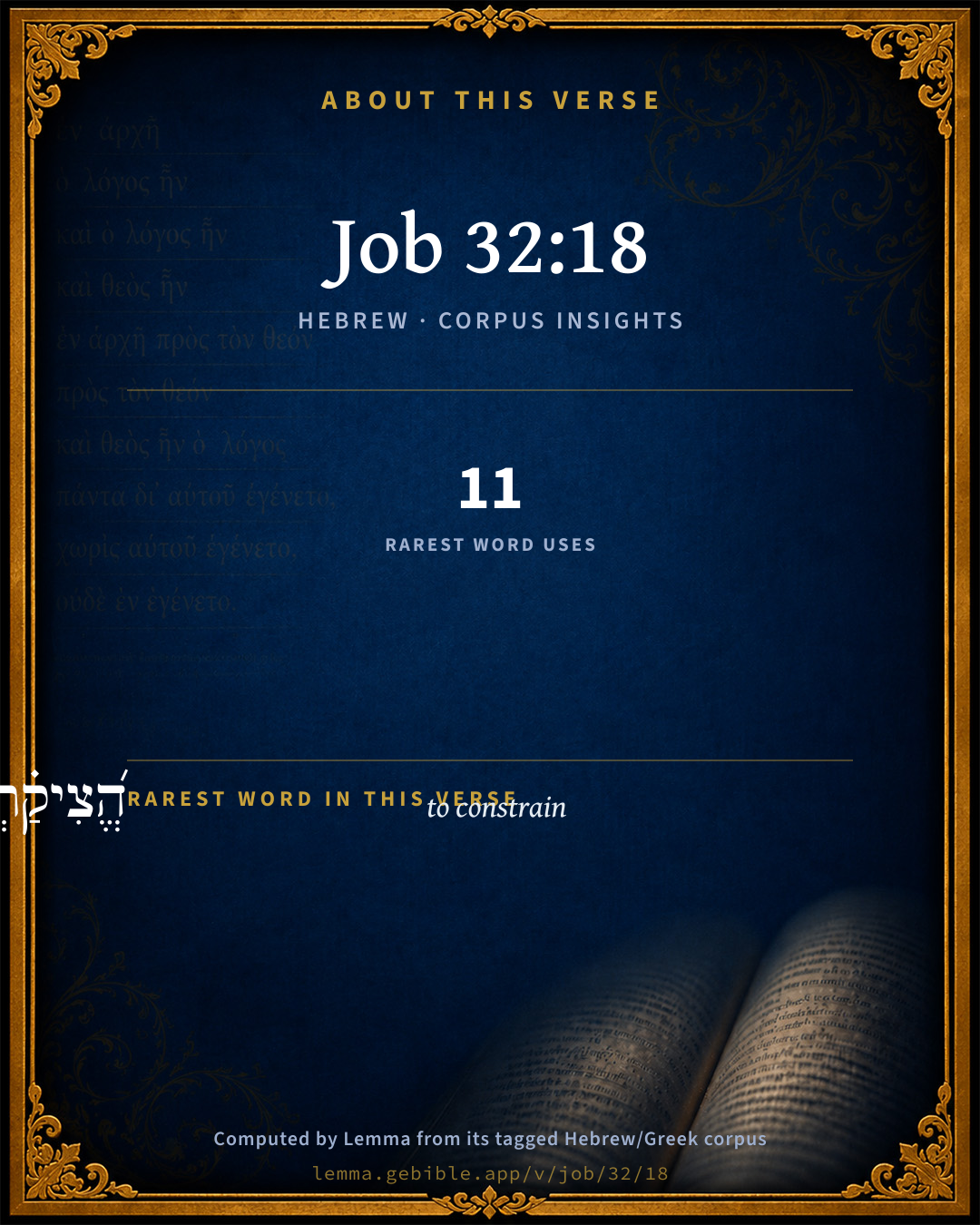
The rarest word here is הֱ֝צִיקַ֗תְנִי to constrain H6693 — appearing just 11 times in the whole Hebrew Bible.

Shared distinctive vocabulary

הֱ֝צִיקַ֗תְנִי to constrain H6693 occurs in 10 verses of the Hebrew Bible. Also found in:

Grammatical profile

  • 2 verbs
  • 3 nouns
  • 1 conjunction

Verb forms

  • מָלֵ֣תִי Qal · Perfect
  • הֱ֝צִיקַ֗תְנִי Hiphil · Perfect

Hebrew & Septuagint length

In English translation the verse runs 12 words from the Hebrew and 14 from the Septuagint (LXX English) — closely comparable.

A rough comparison of the two English renderings, which tokenize alike — not a word-level alignment.

Word counts can differ between the Hebrew and the Greek without any difference in meaning — e.g. the Hebrew direct-object marker אֵת has no separate Greek word, and Greek often adds the article ὁ.

Cross-references

5

Topical passages linked to Job 32:18 in the Treasury of Scripture Knowledge — connected by theme and wording, ordered by reader-vote popularity; previews shown in the World English Bible.

  • Psalms 39:3 My heart was hot within me. While I meditated, the fire burned: I spoke with my tongue:
  • Acts 4:20 for we can't help telling the things which we saw and heard."
  • Jeremiah 20:9 If I say, I will not make mention of him, nor speak any more in his name, then there is in my heart as it were a burning fire shut up in my bones, and I am weary with forbearing, and I can't [contain].
  • Ezekiel 3:14–27 So the Spirit lifted me up, and took me away; and I went in bitterness, in the heat of my spirit; and the hand of Yahweh was strong on me.
  • 2 Corinthians 5:13–14 For if we are beside ourselves, it is for God. Or if we are of sober mind, it is for you.

Cross-references courtesy of OpenBible.info (CC BY 4.0).

Hebrew and Greek witnesses Masoretic Hebrew ↔ Greek Septuagint

The same verse in the two great witnesses to the Old Testament, shown verse-for-verse.

These are two independent witnesses, not word-aligned to each other, and the Septuagint is shown in lemma (dictionary) form.

Hebrew Job 32:18 Masoretic · Westminster Leningrad Codex

כִּ֭י מָלֵ֣תִי מִלִּ֑ים הֱ֝צִיקַ֗תְנִי ר֣וּחַ בִּטְנִֽי

For I am full of words. The spirit within me constrains me.

World English Bible · Public Domain

Greek LXX Job 32:18 Septuagint · lemma form

πάλιν λαλέω πλήρης γάρ εἰμί ῥῆμα ὀλέκω γάρ ἐγώ ὁ πνεῦμα ὁ γαστήρ

for I am full of words, for the spirit of my belly destroys me.

LXX2012 (modern English Septuagint) · Public Domain

On this verse, Keil & Delitzsch discusses the Septuagint’s reading. Read the note in Commentary ↓

Hebrew: Westminster Leningrad Codex (CC BY 4.0). Greek: Septuagint (public domain); English from LXX2012 (modern English Septuagint) (Public Domain). How the Septuagint differs from the Hebrew →

Commentary

Notes on Job 32:18 from classic Christian and Jewish commentators (each source and its license shown beneath its notes). The classic Christian expositions comment on the surrounding passage and are grouped to its opening verse, so a note may address several verses; the Jewish commentaries on the Tanakh (Rashi and others) are per-verse, so they appear only where the commentator wrote on this verse.

Lemma curates 59 commentaries, every one of them public domain or Creative Commons licensed, each selected and text-cleaned for this edition rather than reprinted as found. About our sources →

Trapp's Complete Commentary

John Trapp

Job 32:18 For I am full of matter, the spirit within me constraineth me.

Ver. 18. For I am full of matter] Heb. Of words; such as are weighty and stuffy, steeped in mine understanding (as Plutarch saith Phocion’s words were), and very well digested. I am ειπειν δεινοτατος, in very good case to speak; as full of solid arguments as the moon is of light. Whether Elihu speaketh this arrogantly and from the flesh, or from the spirit, I determine not, saith Brentius here. But sure it is, that such words as these, howsoever they may seem arrogant and carnal, possunt tamen esse spiritualissima, yet they may be very spiritual, as Jer 4:1-31 Jer 20:1-18. And as sure it is, that we should be in company like full clouds or paps, that pain themselves with fulness till eased of their milk.

The spirit within me constraineth me] Heb. The spirit of my belly; that is, God’s Holy Spirit inhabiting mine heart, and exciting me to so good a work. "The love of Christ constraineth us," 2Co 5:14. It hath not only an impulsive, but a compulsive, faculty. Rumperer medius, si non erumperet sermo intra me conceptus, as Brentius here paraphraseth; I should even burst if I did not vent my conceptions, which, like a child in the womb at full time, or as wind in the bowels, want room, and press to come out, Psa 39:3 Jer 20:9. Sicut flatus in ventre conclusus magno impetu exitum quaerit: sic zelus mentis quaerit exitum per sermonem (Pisc.).

John Trapp, A Commentary or Exposition upon All the Books of the Old and New Testament (1647–1656) — public domain. Text from a community e-Sword module.

The Biblical Illustrator

Joseph S. Exell

Job_32:18

For I am full of matter.

Ideas and expression

Sainte-Beuve remarks that the great art in speech, as in military service, is to gather, maintain, and bring to bear at once the greatest number of forces. Some generals can manage but few men and some speakers can handle but one or two ideas. There are writers who resemble Marshal Soubise: when he had all his troops gathered at his disposal he knew not what to do with them, and he dispersed them again that he might fight to better advantage. So I know of writers who, before writing, dismiss half their ideas because they can express them only one by one: it is pitiful. It shows that one is embarrassed by his very resources..

The Biblical Illustrator, edited by Joseph S. Exell (c. 1880s–1900s) — public domain. Text from a community e-Sword module.

Tyndale Open Study Notes

Tyndale Open Resources

32:18-20 The length of Elihu’s speech (32:1–37:24) demonstrates that he truly was full of pent-up words. • Elihu probably thought the spirit (Hebrew ruakh) within him was prophetic urgency (32:8, 19-20; Ps 39:3), but the reader might find him full of wind (Hebrew ruakh; see study note on Job 15:2-3). • Like Zophar, Elihu must speak to find relief (cp. 20:2).

Tyndale Open Study Notes — © Tyndale Open Resources, licensed CC BY-SA 4.0. Text via the HelloAO Bible API.

Geneva Bible (1599)

Geneva Bible translators

I have conceived in my mind great store of reasons.

Geneva Bible (1599) marginal notes — public domain. Text via Bolls.life.

Jamieson, Fausset & Brown

Robert Jamieson, A. R. Fausset & David Brown

"I am full of words," whereas the friends have not a word more to say.

the spirit-- (Job 32:8; Job 33:4; Jer 20:9; Act 18:5).

Jamieson, Fausset & Brown — Commentary Critical and Explanatory on the Whole Bible (1871) — public domain (CC PDM 1.0). Text via the HelloAO Bible API.

Adam Clarke's Commentary

Verse 18. I am full of matter] מלים millim, "I am full of WORDS," or sayings; i.e., wise sentences, and ancient opinions.

The spirit within me constraineth me.] How similar to the words of St. Paul! The love of Christ constraineth us. Elihu considered himself under the influence of that Spirit of God which gives understanding, and felt anxiously concerned for the welfare both of Job and his friends.

Adam Clarke's Commentary on the Bible (1810–1826) — public domain. Text from a community e-Sword/MySword module.

The Cambridge Bible for Schools and Colleges

gen. ed. J. J. S. Perowne

18–19. Elihu feels a crowd of thoughts and arguments fermenting in his bosom and pressing for utterance with a force not to be resisted. The word “belly” corresponds to the English “breast” or bosom. What stirs the spirit of Elihu is not only his eagerness to express his convictions on the question, but also indignation at the retreat and silence of the three friends.

The Cambridge Bible for Schools and Colleges (gen. ed. J. J. S. Perowne; Cambridge University Press, 1878–1918) — public domain. Text from a community e-Sword module.

John Gill's Exposition

For I am full of matter,.... Or "full of words" (y); not of mere words, such that have nothing solid and substantial in them; this is the character of a fool, Ecc 10:14; nor was Elihu a loquacious talkative man, as Job is charged to be, a man full of talk, Job 11:2; but he was full of words, which had fulness of matter in them, which were to the purpose, and contained strong reasonings and solid arguments; his mind was full of them, and he could easily fill his mouth with them, and was not easy until he had uttered them: so an able minister of the word may be said to be full of words, of the wholesome words of our Lord Jesus, of useful doctrines, when the word of Christ dwells richly in him, and he has a rich treasure in an earthen vessel, is full of the blessing of the Gospel of Christ; has a large knowledge of Gospel truths, a real experience of them in the heart, great gifts to express them to others, and is full of power and of the Spirit of God to declare them, as this good man was:

the spirit within me constraineth me, or "the spirit of my belly" (z); alluding to wind pent up therein, which, unless expelled, gives great uneasiness and pain: he either means the Spirit of God within him, as in Job 32:8, by whom the prophets were inspired and spoke, by whom ordinary ministers of the word are qualified for their work, and by whom they are led into all truth, and who presses and obliges them to speak what they know; there is a necessity upon them to preach the Gospel wholly and faithfully, and a woe unto them if they do not: or else his own spirit, influenced and actuated by the Spirit of God; as the spirit of the Apostle Paul was stirred up in him to speak, when he saw the idolatry and superstition of the people of Athens, Act 17:16; so love to God and Christ, and the souls of men, the honour of God, and interest of religion, constrain the ministers of Christ to speak in his name, notwithstanding all the opposition made unto them, and reproach cast upon them.

(y) "plenus sum sermonibus", V. L. Pagninus, Montanus, Tigurine version, Beza, Junius & Tremellius, Piscator. (z) "spiritus ventris mei", Beza, Junius & Tremellius, Cocceius, Schultens.

John Gill's Exposition of the Whole Bible (1746–1763) — public domain (CC PDM 1.0). Text via the HelloAO Bible API.

Albert Barnes' Notes on the Bible

For I am full of matter - Margin, as in Hebrew words.” The three friends of Job had been silenced. They had not one word more to say. Elihu says that the reverse was true of him. He was full of words, and felt constrained to speak. It was not because he forced himself to do it, nor because he did it as a mere matter of duty, but he was so impressed with the subject that it would be a relief for him to give utterance to his views.

The spirit within me - Referring, probably, to the conviction that it was the divine Spirit which urged him to speak; see the notes at Job 32:8; compare Job 33:4. A similar constraint in regard to the necessity of speaking, when under the influence of the Holy Spirit, is expressed in Jer 20:9, “His word was in my heart as a burning fire shut up in my bones, and I was weary with forbearing, and I could not stay;” compare Introduction to Isaiah, Section 7. The phrase “within me” is in the margin, as in Hebrew my belly - where the belly is spoken of as the seat of the mind; see Job 15:2. We speak of the head as the seat of the intellect, and the heart as the seat of the affections. The Hebrews were much in the habit of representing the region of the heart as the seat of all mental operations.

Albert Barnes' Notes on the Bible (1834–1885) — public domain. Text from a community e-Sword/MySword module.

Haydock's Catholic Bible Commentary

Me. And forces me to speak, Jeremias v. 24., and xx. 9. Thus Juvenal describes a great talker. Tunc immensa cavi spirant mendacia folles.---Conspuiturque sinus. (Sat. vi.) (Calmet)

George Leo Haydock (1774–1849), Haydock's Catholic Family Bible and Commentary, 1859 edition — public domain. Excludes Psalms (Douay-Rheims chapter numbering differs from Protestant) and Deuterocanonical books (Catholic canon only).

Matthew Poole's English Annotations

I am full of matter, i.e. I have many things to say in this cause.

The spirit within me; either my own spirit or soul, which is wholly dissatisfied with what hath been hitherto spoken, and clearly apprehends what may silence Job, and end the dispute; or God’s Spirit, which he hath put in me; the Spirit of understanding, which hath discovered the truth of the matter to me; and the Spirit of zeal, which urgeth me to plead God’s cause against Job.

Constraineth me; forceth me to speak. It is a metaphor from a man or woman whose belly is full with wind, or with a child, and is never at rest till it be emptied and eased of its burden.

Matthew Poole's English Annotations on the Holy Bible (1683–1685) — public domain. Text from a community e-Sword/MySword module.

Whedon's Commentary on the Bible

Daniel D. Whedon

18. The spirit within me — Literally, The spirit of my inward part, בשׂני. The experience of the prophets was similar to that of Elihu. Jer_4:19; Amo_3:8.

Daniel D. Whedon (gen. ed.), Commentary on the Old and New Testaments (1874–1909) — public domain. Text from a community e-Sword module.

The Pulpit Commentary

For I am full of matter; literally, I am full of words; i.e. I have very much to say. The spirit within me constraineth me; literally, the spirit of my belly; i.e. "my inward feelings and emotions." Compare Zophar"s statements in Job_20:2:3; and Job"s own declarations in Job 13, that he must speak (vers. 13, 19). There is a state of internal excitement, when reticence becomes impossible.

The Pulpit Commentary (1880–1919), ed. H.D.M. Spence-Jones & Joseph S. Exell — public domain. Text from a community e-Sword module.

Keil & Delitzsch

C. F. Keil & F. Delitzsch

18 For I am full of words,

The spirit of my inner nature constraineth me.

19 Behold, my interior is like wine which is not opened,

Like new bottles it is ready to burst.

20 I will speak, that I may gain air,

I will open my lips and reply.

21 No, indeed, I will accept no man's person,

And I will flatter no man.

22 For I understand not how to flatter;

My Maker would easily snatch me away.

The young speaker continues still further his declaration, promising so much. He has a rich store of מלּים, words, i.e., for replying. מלתי defective for מלאתי, like יצתי for יצאתי, Job 1:21; whereas מלוּ, Eze 28:6, is not only written defectively, but is also conjugated after the manner of a Lamed He verb, Ges. 23, 3, 74, rem. 4, 75, 21, c. The spirit of his inner nature constrains him, since, on account of its intensity and the fulness of this interior, it struggles to break through as through a space that is too narrow for it. בּטן, as Job 15:2, Job 15:35, not from the curved appearance of the belly, but from the interior of the body with its organs, which serve the spirit life as the strings of a harp; comp. Arab. batn, the middle or interior; bâtin, inwardly (opposite of zâhir, outwardly). His interior is like wine לא יפּתח, which, or (as an adverbial dependent clause) when it is not opened, i.e., is kept closed, so that the accumulated gas has no vent, lxx δεδεμένος (bound up), Jer. absque spiraculo; it will burst like new bottles. יבּקע is not a relative clause referring distributively to each single one of these bottles (Hirz. and others), and not an adverbial subordinate clause (Hahn: when it will explode), but predicate to בטני: his interior is near bursting like new bottles (אבות masc. like נאדות, Jos 9:13), i.e., not such as are themselves new (ἀσκοὶ καινοὶ, Mat 9:17, for these do not burst so easily), but like bottles of new wine, which has to undergo the action of fermentation, lxx ὥσπερ φυσητὴρ (Cod. Sinait.1 φυσητής) χαλκέως, i.e., חרשׁים whence it is evident that a bottle and also a pair of bellows were called אוב). Since he will now yield to his irresistible impulse, in order that he may obtain air or free space, i.e., disburdening and ease (וירוח לּי), he intends to accept no man's person, i.e., to show partiality to no one (vid., on Job 13:8), and he will flatter no one. כּנּה signifies in all three dialects to call any one by an honourable name, to give a surname, here with אל, to speak fine words to any one, to flatter him. This Elihu is determined he will not do; for לא ידעתּי אכנּה, I know not how to flatter (French, je ne sais point flatter), for כנּות or לכנּות; comp. the similar constructions, Job 23:3 (as Est 8:6), Job 10:16, Sa1 2:3; Isa 42:21; Isa 51:1, Ges. 142, 3, c; also in Arabic similar verbs, as "to be able" and "to prepare one's self," are thus connected with the fut. without a particle between (e.g., anshaa jef‛alu, he began to act). Without partiality he will speak, flattery is not his force. If by flattery he should deny the truth, his Maker would quickly carry him off. כּמעט followed by subjunct. fut.: for a little (with disjunctive accent, because equivalent to haud multum abest quin), i.e., very soon indeed, or easily would or might ... ; ישּׂני (as Job 27:21) seems designedly to harmonize with עשׂני.

Keil & Delitzsch — Biblical Commentary on the Old Testament (1861–1891) — public domain (CC PDM 1.0). Text via the HelloAO Bible API. (Old Testament only.)

Lesson kit

Teaching starters — assembled from the data on this page, not authored interpretation. Every prompt links to the verse data it draws on. Edit before teaching.

Job, in the Wisdom, opens this verse with 6 words (6 distinct Hebrew lemmas). Its most distinctive word is tsûwq (“to constrain”). A historical commentator’s framing appears above. Read the whole chapter for the surrounding context.

Discussion questions

  1. How does “to constrain” (tsûwq) shape what this verse is saying?
  2. How does Deuteronomy 28:53, which shares the word «to constrain», read alongside this verse?
  3. These translations render this verse differently. What is at stake in choosing one wording over another?
  4. «מָלֵ֣תִי» is a Qal Perfect verb. How does that grammatical form shape the action described?
  5. Compare how Trapp's Complete Commentary and The Biblical Illustrator read this verse. Where do they agree or differ?

Things to notice

Reading settings

Reading text

Shown beneath each verse's original-language words.

Old Testament
Old Testament edition

Read the OT as the Masoretic Hebrew (MT) or the Greek Septuagint (LXX).

English shown for the Greek Septuagint (in the Hebrew ↔ Greek comparison).

Comparing translations? Open the Compare panel on any verse page to stack up to four side by side.