
Job 8:2

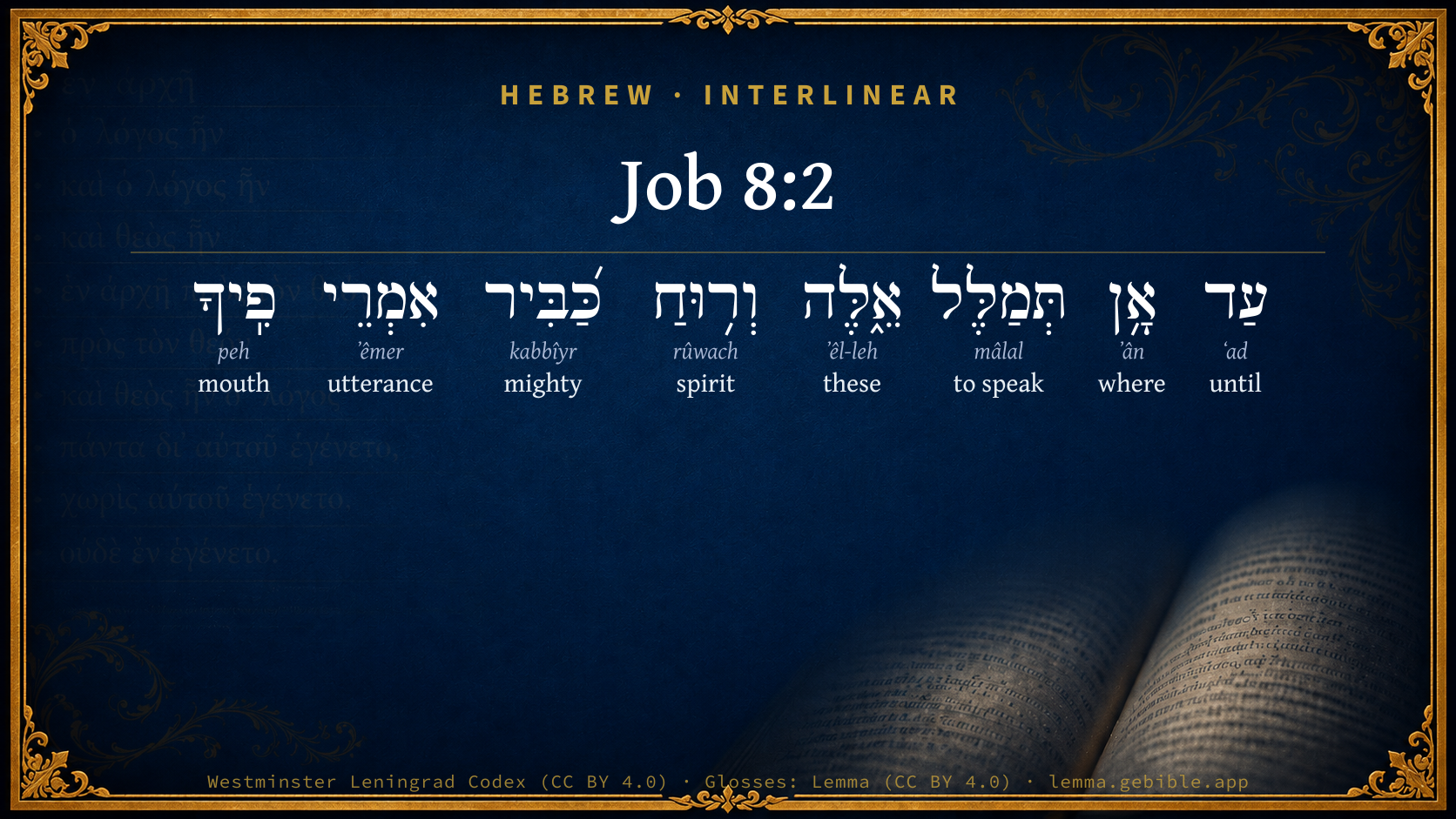
Hebrew (Westminster Leningrad Codex) Job 8:2 appears in the Hebrew Old Testament. The text above is from the Westminster Leningrad Codex. Each word links to its Strong’s number, a concise gloss, and parsing drawn from the Open Scriptures Hebrew Bible morphology. Click any word for its full Brown-Driver-Briggs (BDB) entry.
Download image
Cite this verse

Job 8:2 (World English Bible). Public Domain. Lemma interlinear Bible study tool, https://lemma.gebible.app/v/job/8/2.

Show BibTeX & RIS
BibTeX
RIS
English Translation
"How long will you speak these things? Shall the words of your mouth be a mighty wind?
World English Bible · Public Domain
Highlights
  • 1 first appearance in the Hebrew Bible
Full analysis ↓
Download a study sheet

One document with this verse’s original text, its word-by-word gloss line, the meaning frame, cross-references with their text, attributed commentary, and full source and license credits — printable, and it pastes into notes with its structure intact.

This verse Autodidact and up

Study sheet (.html) Plain text (.txt)

A passage Seminary Student

Up to 50 verses in one chapter. A passage sheet keeps up to 6 commentary sources and 12 cross-references per verse, in the order this page ranks them, and says so on the sheet whenever that leaves anything out. Ask for a single verse and you get the Autodidact verse sheet above.

Everything on this page stays free to read, with no account — the sheet is a download of what is already on screen, not access to it.

Want to remove ads? Support Godless Engineer
Compare translations 3

The same verse in 3 English versions, stacked beneath the original-language interlinear above. Click any original word for its lexicon entry.

Each is an independent rendering of the whole verse — the interlinear is not word-aligned to these translations.

Highlighted words mark where these versions differ — a whole-verse word diff, not a word-by-word alignment.

  • World English Bible Public Domain
    "How long will you speak these things? Shall the words of your mouth be a mighty wind?
  • King James Version Public Domain
    How long wilt thou speak these things? and how long shall the words of thy mouth be like a strong wind?
  • unfoldingWord Literal Text CC BY-SA 4.0
    “Until when will you say these things, and the words of your mouth a mighty wind?

unfoldingWord Literal Text — © unfoldingWord, licensed CC BY-SA 4.0. Word-aligned USFM3 via Door43 (git.door43.org/unfoldingWord/en_ult).

Versions to compare (up to 4)

3 of 4 selected

Show all 18 translations

Every available English version of this verse, each an independent rendering of the whole verse.

  • World English Bible Public Domain
    "How long will you speak these things? Shall the words of your mouth be a mighty wind?
  • Berean Standard Bible Public Domain
    “How long will you go on saying such things? The words of your mouth are a blustering wind.
  • Majority Standard Bible Public Domain
    “How long will you go on saying such things? The words of your mouth are a blustering wind.
  • King James Version Public Domain
    How long wilt thou speak these things? and how long shall the words of thy mouth be like a strong wind?
  • American Standard Version (1901) Public Domain
    How long wilt thou speak these things? And `how long' shall the words of thy mouth be `like' a mighty wind?
  • Revised Version (1885) Public Domain
    How long wilt thou speak these things? and how long shall the words of thy mouth be like a mighty wind?
  • Geneva Bible (1599) Public Domain
    Howe long wilt thou talke of these things? and howe long shall the wordes of thy mouth be as a mightie winde?
  • Douay-Rheims (1899) Public Domain
    How long wilt thou speak these things, and how long shall the words of thy mouth be like a strong wind?
  • Young's Literal Translation Public Domain
    Till when dost thou speak these things? And a strong wind -- sayings of thy mouth?
  • Literal Standard Version CC BY-SA 4.0
    “Until when do you speak these things? And a strong wind—sayings of your mouth?
  • Unlocked Literal Bible CC BY-SA 4.0
    “How long will you say these things? How long will the words of your mouth be a mighty wind?
  • unfoldingWord Literal Text CC BY-SA 4.0
    “Until when will you say these things, and the words of your mouth a mighty wind?
  • Darby Bible Public Domain
    How long wilt thou speak these things? and the words of thy mouth be a strong wind?
  • World Messianic Bible Public Domain
    “How long will you speak these things? Shall the words of your mouth be a mighty wind?
  • Webster's Bible Public Domain
    How long wilt thou speak these things? and how long shall the words of thy mouth be like a strong wind?
  • Free Bible Version CC BY-SA 4.0
    “How much longer will you go on talking like this? The words coming out of your mouth are a lot of hot air!
  • Bible in Basic English Public Domain
    How long will you say these things, and how long will the words of your mouth be like a strong wind?
  • JPS Tanakh (1917) Public Domain
    How long wilt thou speak these things, seeing that the words of thy mouth are as a mighty wind?

Literal Standard Version (2020), Covenant Press — licensed CC BY-SA 4.0. Text via the HelloAO Bible API (eBible.org). Unlocked Literal Bible (unfoldingWord) — licensed CC BY-SA 4.0. Text via the HelloAO Bible API (eBible.org). unfoldingWord Literal Text — © unfoldingWord, licensed CC BY-SA 4.0. Word-aligned USFM3 via Door43 (git.door43.org/unfoldingWord/en_ult). Free Bible Version, Dr. Jonathan Gallagher — licensed CC BY-SA 4.0. Text via the HelloAO Bible API (eBible.org).

Word by word

More ways to search: Search by grammar → Find every occurrence → Compare this word →

Practice this passage: Drill this verse → Learn its vocabulary →

About this verse

These counts appear in no published source. They are computed here, from the morphology-tagged text and Lemma’s own curated glosses. What Lemma adds →

8
words
8
distinct lemmas
Wisdom
section

Notable vocabulary

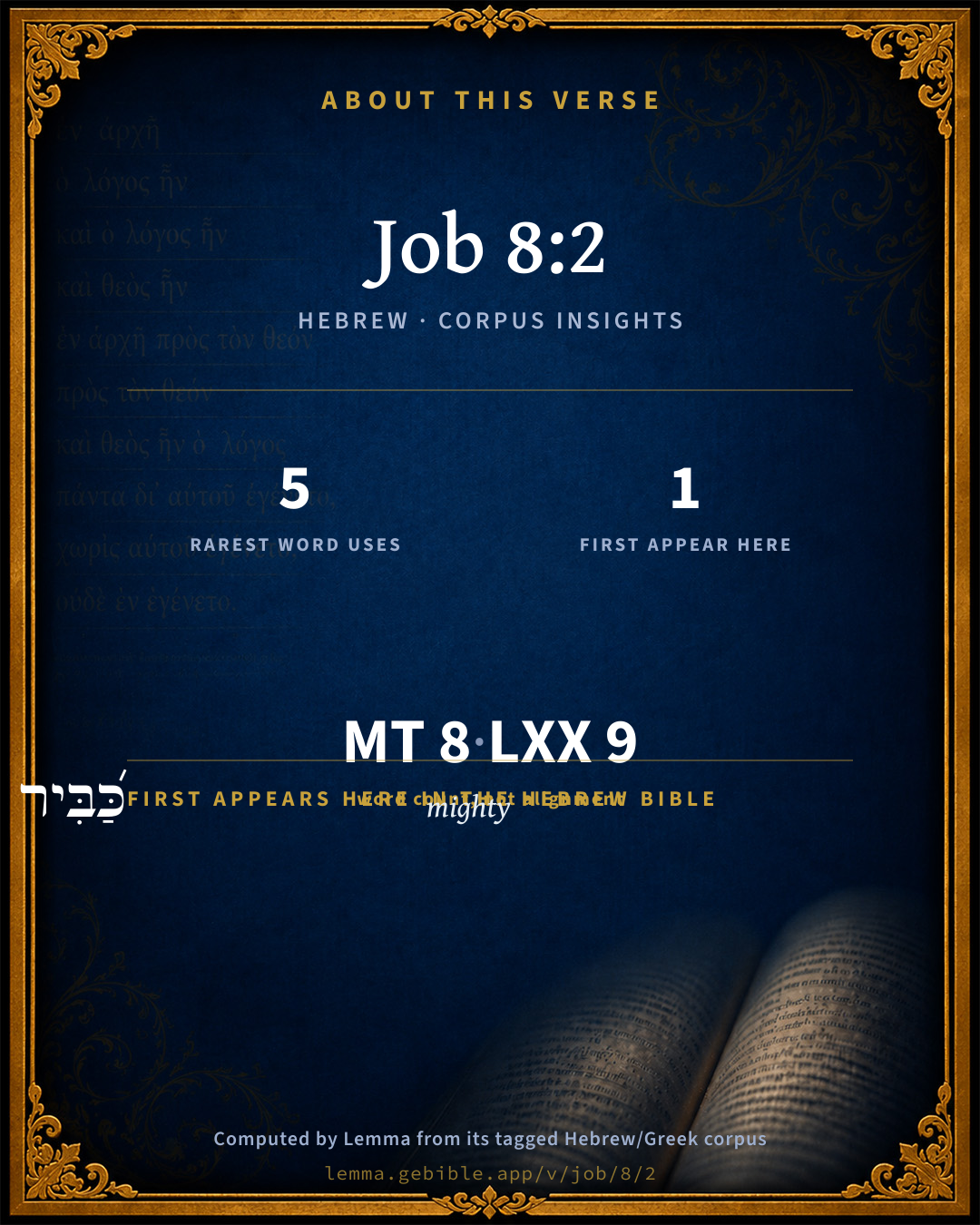
The rarest word here is תְּמַלֶּל to speak H4448 — appearing just 5 times in the whole Hebrew Bible.

First appearance in Scripture

This word makes its first canonical appearance in the Hebrew Bible here:

  • כַּ֝בִּיר mighty H3524

Shared distinctive vocabulary

תְּמַלֶּל to speak H4448 occurs in 5 verses of the Hebrew Bible. Also found in:

Grammatical profile

  • 1 verb
  • 3 nouns
  • 1 adjective
  • 1 pronoun
  • 1 preposition
  • 1 particle

Verb forms

  • תְּמַלֶּל Piel · Imperfect

Hebrew & Septuagint length

In English translation the verse runs 17 words from the Hebrew and 19 from the Septuagint (LXX English) — closely comparable.

A rough comparison of the two English renderings, which tokenize alike — not a word-level alignment.

Word counts can differ between the Hebrew and the Greek without any difference in meaning — e.g. the Hebrew direct-object marker אֵת has no separate Greek word, and Greek often adds the article ὁ.

In the original languages it is 8 Hebrew tokens and 9 Greek tokens — but the two are counted differently (Hebrew bundles its prefixes and suffixes into one token; the Greek is in lemma form), so that isn’t a like-for-like length.

Cross-references

12

Topical passages linked to Job 8:2 in the Treasury of Scripture Knowledge — connected by theme and wording, ordered by reader-vote popularity; previews shown in the World English Bible.

  • Job 6:26 Do you intend to reprove words, Seeing that the speeches of one who is desperate are as wind?
  • Job 15:2 "Should a wise man answer with vain knowledge, And fill himself with the east wind?
  • 1 Kings 19:11 He said, Go forth, and stand on the mountain before Yahweh. Behold, Yahweh passed by, and a great and strong wind tore the mountains, and broke in pieces the rocks before Yahweh; but Yahweh was not in the wind: and after the wind an earthquake; but Yahweh was not in the earthquake:
  • Exodus 10:3 Moses and Aaron went in to Pharaoh, and said to him, "This is what Yahweh, the God of the Hebrews, says: 'How long will you refuse to humble yourself before me? Let my people go, that they may serve me.
  • Exodus 10:7 Pharaoh's servants said to him, "How long will this man be a snare to us? Let the men go, that they may serve Yahweh, their God. Don't you yet know that Egypt is destroyed?"
  • Job 6:9 Even that it would please God to crush me; That he would let loose his hand, and cut me off!
  • Job 7:11 "Therefore I will not keep silent. I will speak in the anguish of my spirit. I will complain in the bitterness of my soul.
  • Job 11:2–3 "Shouldn't the multitude of words be answered? Should a man full of talk be justified?
  • Job 16:3 Shall vain words have an end? Or what provokes you that you answer?
  • Job 18:2 "How long will you hunt for words? Consider, and afterwards we will speak.
  • Proverbs 1:22 "How long, you simple ones, will you love simplicity? How long will mockers delight themselves in mockery, And fools hate knowledge?
  • Job 19:2–3 "How long will you torment me, And crush me with words?

Cross-references courtesy of OpenBible.info (CC BY 4.0).

Hebrew and Greek witnesses Masoretic Hebrew ↔ Greek Septuagint

The same verse in the two great witnesses to the Old Testament, shown verse-for-verse.

These are two independent witnesses, not word-aligned to each other, and the Septuagint is shown in lemma (dictionary) form.

Hebrew Job 8:2 Masoretic · Westminster Leningrad Codex

עַד אָ֥ן תְּמַלֶּל אֵ֑לֶּה וְר֥וּחַ כַּ֝בִּיר אִמְרֵי פִֽיךָ

"How long will you speak these things? Shall the words of your mouth be a mighty wind?

World English Bible · Public Domain

Greek LXX Job 8:2 Septuagint · lemma form

μέχρι τίς λαλέω οὗτος πνεῦμα πολυρρήμων ὁ στόμα σύ

How long will you speak these things, how long shall the breath of your mouth be abundant in words?

LXX2012 (modern English Septuagint) · Public Domain

On this verse, Albert Barnes' Notes on the Bible discusses the Septuagint’s reading. Read the note in Commentary ↓

Hebrew: Westminster Leningrad Codex (CC BY 4.0). Greek: Septuagint (public domain); English from LXX2012 (modern English Septuagint) (Public Domain). How the Septuagint differs from the Hebrew →

Commentary

Notes on Job 8:2 from classic Christian and Jewish commentators (each source and its license shown beneath its notes). The classic Christian expositions comment on the surrounding passage and are grouped to its opening verse, so a note may address several verses; the Jewish commentaries on the Tanakh (Rashi and others) are per-verse, so they appear only where the commentator wrote on this verse.

Lemma curates 59 commentaries, every one of them public domain or Creative Commons licensed, each selected and text-cleaned for this edition rather than reprinted as found. About our sources →

Trapp's Complete Commentary

John Trapp

Job 8:2 How long wilt thou speak these [things]? and [how long shall] the words of thy mouth [be like] a strong wind?

Ver. 2. How long wilt thou speak these things?] Quousque effaberis ista. q.d. Hast thou nothing better than this to utter? (Tremel.) Be silent for shame, or forbear at least to vent thy spleen against God, of whose proceedings with thee thou hast heavily complained; thy words have been stout against the Lord, and thou hast taken too much liberty of language in this tempest of talk.

And how long shall the words of thy mouth be like a strong wind?] Big and boisterous, rude and robustuous, as if thou wouldst Dominum impetere, evertere, et deiecere, blow down God and his proceedings at a breath (Mercer). The Tigurine translation is, Quandiu verba oris sui sonabunt pertinaciam? How long shall the words of thy mouth sound out thine obstinacy? If evil thoughts be maioris reatus, of greater guilt, as the schools speak; yet evil words and works are maioris infamiae, of greater scandal, and do more corrupt others. This Bildad was sensible of, and conceiving that Job complained of God as dealing hardly with him, and unjustly afflicting him, he addeth,

John Trapp, A Commentary or Exposition upon All the Books of the Old and New Testament (1647–1656) — public domain. Text from a community e-Sword module.

Joseph Benson's Commentary

Job 8:2. How long wilt thou speak these things? &c. — Why dost thou persist to talk in this manner? and why are thy words thus vehement? As a strong wind which overturns all things without any moderation, and suffers nothing else to be heard, so thy boisterous and violent words will not permit the voice of truth and wisdom to be heard.

Joseph Benson's Commentary on the Old and New Testaments (1811–1818) — public domain. Text from a community e-Sword module.

Whedon's Commentary on the Bible

Daniel D. Whedon

The first strophe — THE COURSE OF DIVINE PROVIDENCE DISPLAYS THE JUSTICE OF GOD, Job_8:2-7.

a. Since God cannot pervert the right, the death of Job’s children shows that they must have sinned, Job_8:2-4.

2. A strong wind — Omit like. A common figure with poets. The irony of Aristophanes furnishes a good comment: “A whirlwind of words is preparing to burst forth.” Job’s words are also boisterous, but none the less empty.

Daniel D. Whedon (gen. ed.), Commentary on the Old and New Testaments (1874–1909) — public domain. Text from a community e-Sword module.

Tyndale Open Study Notes

Tyndale Open Resources

8:2 How long? Bildad’s question might be an ironic parody of Job’s question in 7:19.

Tyndale Open Study Notes — © Tyndale Open Resources, licensed CC BY-SA 4.0. Text via the HelloAO Bible API.

Geneva Bible (1599)

Geneva Bible translators

He declareth that their words which would diminish anything from the justice of God, is but as a puff of wind that vanisheth away.

Geneva Bible (1599) marginal notes — public domain. Text via Bolls.life.

Adam Clarke's Commentary

Verse 2. How long wilt thou speak these things?] Wilt thou still go on to charge God foolishly? Thy heavy affliction proves that thou art under his wrath; and his wrath, thus manifested, proves that it is for thy sins that he punisheth thee.

Be like a strong wind?] The Arabic, with which the Syriac agrees, is [Syriac] rucholazomati, the spirit of pride. Wilt thou continue to breathe forth a tempest of words? This is more literal.

Adam Clarke's Commentary on the Bible (1810–1826) — public domain. Text from a community e-Sword/MySword module.

John Gill's Exposition

Doth God pervert judgment?.... In his dealings with men in the way of his providence; no, he does not; here Bildad opposes himself to Job, who he thought had charged God with injustice in dealing with him, and his children, in the manner he had done: the same thing is intended in the following question:

or doth the Almighty pervert justice? for judgment and justice are the same, and often go together in Scripture, as being done either by God or men, when righteousness is executed by them, and this is never perverted by the Lord; there is no unrighteousness in him, neither in his nature, nor in his ways and works, either of providence or of grace; he is the Judge of all the earth, that does and will do right; to subvert a man in his cause, he approves not of in others, and will never do it himself; to justify the wicked, and condemn the just, are both an abomination to him, and therefore neither of these can ever be thought to be done by him; for though he justifies the ungodly, he does not justify their ungodliness, nor them in it, but from it, and that by the perfect righteousness of his Son; whereby the law is fulfilled, and justice satisfied, and so he is just while he is the justifier of him that believes in Jesus; though he is gracious and merciful, he is also righteous, and will not clear the guilty, or pardon sin without satisfaction to his justice; and such as are truly just or righteous, he never condemns here or hereafter; he may afflict them, but he delivers them out of their afflictions, nor are they ever forsaken by him; and, on the contrary, he punishes wicked men in this world, and in that to come, as he has the angels that sinned, the old world, Sodom and Gomorrah, and many others, and all wicked men will be punished with everlasting destruction; yea, even so strict is his punitive justice, that the sins of his own people being laid and found on his Son as their surety, he has most severely punished him for them; he awoke the sword of justice against him, spared him not, but delivered him to death for us all; and though he forgives the iniquities of his children, he takes vengeance on their inventions, and chastises them for their sins, that they may not be condemned with the world; and, on the other hand, he is not unrighteous to forget their work and labour of love, which he rewards in a way of grace, as well as it is a righteous thing with him to render tribulation to them that trouble them: the righteousness of God is known by the judgments he executes on wicked men, and especially will be manifest in his judgments on antichrist; and though the justice of God in the course of his providence, in some instances, may not now be so clear, his judgments will be made manifest, and especially at the great day of judgment, when everything shall be brought to account, and God will judge the world in righteousness; all which, we may be assured of, is and will be executed by him, from the consideration of his nature and perfections, and particularly from the name he goes by in this passage, being El, the mighty God, who is able to save and to destroy, to save the righteous, and destroy the wicked; and is Shaddai, all sufficient, stands in need of nothing; nor can he receive anything that is not his own, and therefore incapable of being bribed to the perversion of justice and judgment.

John Gill's Exposition of the Whole Bible (1746–1763) — public domain (CC PDM 1.0). Text via the HelloAO Bible API.

Albert Barnes' Notes on the Bible

How long wilt thou speak these things? - The flyings of murmuring and complaint, such as he had uttered in the previous chapters.

The words of thy mouth be like a strong wind? - The Syriac and Arabic (according to Walton) render this, “the spirit of pride fill thy mouth.” The Septuagint renders it, “The spirit of thy mouth is profuse of words” - πολυῤῥῆμον polurrēmon. But the common rendering is undoubtedly correct, and the expression is a very strong and beautiful one. His language of complaint and murmuring was like a tempest. It swept over all barriers, and disregarded all restraint. The same figure is found in Aristophanes, Ran. 872, as quoted by Schultens, Τυφὼς ἐχβαίειν παρασκενάξεται Tuphōs ekbainein paraskeuacetai - a tempest of words is preparing to burst forth. And in Silius Italicus, xxi. 581:

- qui tanta superbo

Facta sonas ore, et spumanti turbine perflas

Ignorantum aures.

The Chaldee renders it correctly רבא זעפא - a great tempest.

Albert Barnes' Notes on the Bible (1834–1885) — public domain. Text from a community e-Sword/MySword module.

Haydock's Catholic Bible Commentary

How long. He seems tired with hearing, (Haydock) and accuses Job of want of moderation, representing him as a hypocrite, (Calmet) and an obstinate defender of his own opinion, against the better judgment of Eliphaz; (Menochius) though he was in reality only a constant asserter of truth. (Worthington)

George Leo Haydock (1774–1849), Haydock's Catholic Family Bible and Commentary, 1859 edition — public domain. Excludes Psalms (Douay-Rheims chapter numbering differs from Protestant) and Deuterocanonical books (Catholic canon only).

Matthew Poole's English Annotations

i.e. Boisterous and violent, swelling and furious, opposing all persons and things that stand in thy way, not sparing either God or men.

Matthew Poole's English Annotations on the Holy Bible (1683–1685) — public domain. Text from a community e-Sword/MySword module.

The Pulpit Commentary

How long wilt thou speak these things? An exclamation like that of Cicero, "Quousque tandem?" One or two outbreaks might be pardoned; but to persist was to abuse the patience of his hearers. And how long shall the words of thy mouth be like a strong wind? literally, be a strong wind; i.e. have all the bluster and vehemence of a tempest, which seeks to carry everything before it by sheer force and fury. The address is rude and unsympathetic.

The Pulpit Commentary (1880–1919), ed. H.D.M. Spence-Jones & Joseph S. Exell — public domain. Text from a community e-Sword module.

John Wesley's Explanatory Notes

Strong wind - Boisterous and violent.

John Wesley, Explanatory Notes Upon the Whole Bible (1754–1765) — public domain. Text via the GEBible commentary corpus.

Rashi

Rabbi Shlomo Yitzchaki (Rashi)

Bildad’s Addressa mighty wind Many words.

mighty Heb. כביר, an expression of multiplicity.

Rashi on the Tanakh — English translations: “The Judaica Press complete Tanach with Rashi, translated by A. J. Rosenberg” (CC BY 4.0); “Pentateuch with Rashi's commentary by M. Rosenbaum and A.M. Silbermann, 1929-1934” (public domain); “The Metsudah Tanach series, Lakewood, N.J” (CC BY 4.0); and “The Book of Joshua, Metsudah Publications, 1997” (CC BY 4.0). Text via Sefaria.

Lesson kit

Teaching starters — assembled from the data on this page, not authored interpretation. Every prompt links to the verse data it draws on. Edit before teaching.

Job, in the Wisdom, opens this verse with 8 words (8 distinct Hebrew lemmas). Its most distinctive word is mâlal (“to speak”). A historical commentator’s framing appears above. Read the whole chapter for the surrounding context.

Discussion questions

  1. The word mâlal carries the sense “to speak.” How does it shape the verse?
  2. This is the first place “mighty” appears in Scripture (first appears here). What does its debut here establish?
  3. How does Genesis 21:7, which shares the word «to speak», read alongside this verse?
  4. The translations on this page render this verse differently — a whole-verse word diff, not a word-by-word alignment. What might account for the different wordings?
  5. «תְּמַלֶּל» is a Piel Imperfect verb. How does that grammatical form shape the action described?
  6. Compare how Trapp's Complete Commentary and Joseph Benson's Commentary read this verse. Where do they agree or differ?

Things to notice

Reading settings

Reading text

Shown beneath each verse's original-language words.

Old Testament
Old Testament edition

Read the OT as the Masoretic Hebrew (MT) or the Greek Septuagint (LXX).

English shown for the Greek Septuagint (in the Hebrew ↔ Greek comparison).

Comparing translations? Open the Compare panel on any verse page to stack up to four side by side.