

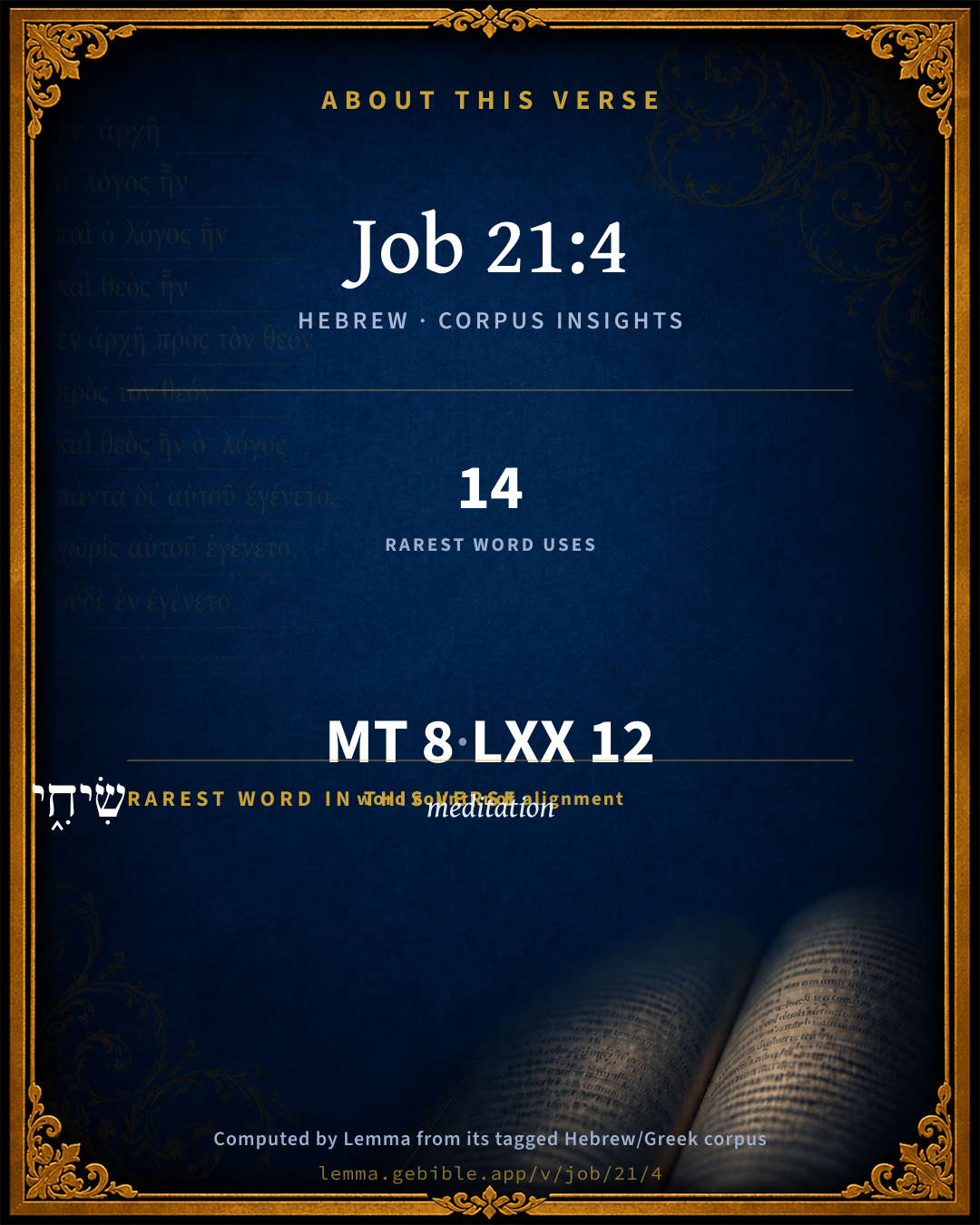
Job 21:4

Hebrew (Westminster Leningrad Codex) Job 21:4 appears in the Hebrew Old Testament. The text above is from the Westminster Leningrad Codex. Each word links to its Strong’s number, a concise gloss, and parsing drawn from the Open Scriptures Hebrew Bible morphology. Click any word for its full Brown-Driver-Briggs (BDB) entry.
Download image
Cite this verse

Job 21:4 (World English Bible). Public Domain. Lemma interlinear Bible study tool, https://lemma.gebible.app/v/job/21/4.

Show BibTeX & RIS
BibTeX
RIS
English Translation
As for me, is my complaint to man? Why shouldn't I be impatient?
World English Bible · Public Domain
Download a study sheet

One document with this verse’s original text, its word-by-word gloss line, the meaning frame, cross-references with their text, attributed commentary, and full source and license credits — printable, and it pastes into notes with its structure intact.

This verse Autodidact and up

Study sheet (.html) Plain text (.txt)

A passage Seminary Student

Up to 50 verses in one chapter. A passage sheet keeps up to 6 commentary sources and 12 cross-references per verse, in the order this page ranks them, and says so on the sheet whenever that leaves anything out. Ask for a single verse and you get the Autodidact verse sheet above.

Everything on this page stays free to read, with no account — the sheet is a download of what is already on screen, not access to it.

Want to remove ads? Support Godless Engineer
Compare translations 3

The same verse in 3 English versions, stacked beneath the original-language interlinear above. Click any original word for its lexicon entry.

Each is an independent rendering of the whole verse — the interlinear is not word-aligned to these translations.

Highlighted words mark where these versions differ — a whole-verse word diff, not a word-by-word alignment.

  • World English Bible Public Domain
    As for me, is my complaint to man? Why shouldn't I be impatient?
  • King James Version Public Domain
    As for me, is my complaint to man? and if it were so, why should not my spirit be troubled?
  • unfoldingWord Literal Text CC BY-SA 4.0
    As for me, my complaint to a man? And if, why may my breath not be short?

unfoldingWord Literal Text — © unfoldingWord, licensed CC BY-SA 4.0. Word-aligned USFM3 via Door43 (git.door43.org/unfoldingWord/en_ult).

Versions to compare (up to 4)

3 of 4 selected

Show all 18 translations

Every available English version of this verse, each an independent rendering of the whole verse.

  • World English Bible Public Domain
    As for me, is my complaint to man? Why shouldn't I be impatient?
  • Berean Standard Bible Public Domain
    Is my complaint against a man? Then why should I not be impatient?
  • Majority Standard Bible Public Domain
    Is my complaint against a man? Then why should I not be impatient?
  • King James Version Public Domain
    As for me, is my complaint to man? and if it were so, why should not my spirit be troubled?
  • American Standard Version (1901) Public Domain
    As for me, is my complaint to man? And why should I not be impatient?
  • Revised Version (1885) Public Domain
    As for me, is my complaint to man? and why should I not be impatient?
  • Geneva Bible (1599) Public Domain
    Doe I direct my talke to man? If it were so, how should not my spirit be troubled?
  • Douay-Rheims (1899) Public Domain
    Is my debate against man, that I should not have just reason to be troubled?
  • Young's Literal Translation Public Domain
    I -- to man `is' my complaint? and if `so', wherefore May not my temper become short?
  • Literal Standard Version CC BY-SA 4.0
    [Is] my complaint [against] man? And if [so], why may my temper not become short?
  • Unlocked Literal Bible CC BY-SA 4.0
    As for me, is my complaint to a person? Why should I not be impatient?
  • unfoldingWord Literal Text CC BY-SA 4.0
    As for me, my complaint to a man? And if, why may my breath not be short?
  • Darby Bible Public Domain
    As for me, is my complaint to a man? or wherefore should not my spirit be impatient?
  • World Messianic Bible Public Domain
    As for me, is my complaint to man? Why shouldn’t I be impatient?
  • Webster's Bible Public Domain
    As for me, is my complaint to man? and if it were so, why should not my spirit be troubled?
  • Free Bible Version CC BY-SA 4.0
    Am I complaining against people? Of course not. Why shouldn't I be impatient?
  • Bible in Basic English Public Domain
    As for me, is my outcry against man? is it then to be wondered at if my spirit is troubled?
  • JPS Tanakh (1917) Public Domain
    As for me, is my complaint to man? Or why should I not be impatient?

Literal Standard Version (2020), Covenant Press — licensed CC BY-SA 4.0. Text via the HelloAO Bible API (eBible.org). Unlocked Literal Bible (unfoldingWord) — licensed CC BY-SA 4.0. Text via the HelloAO Bible API (eBible.org). unfoldingWord Literal Text — © unfoldingWord, licensed CC BY-SA 4.0. Word-aligned USFM3 via Door43 (git.door43.org/unfoldingWord/en_ult). Free Bible Version, Dr. Jonathan Gallagher — licensed CC BY-SA 4.0. Text via the HelloAO Bible API (eBible.org).

Word by word

More ways to search: Search by grammar → Find every occurrence → Compare this word →

Practice this passage: Drill this verse → Learn its vocabulary →

About this verse

These counts appear in no published source. They are computed here, from the morphology-tagged text and Lemma’s own curated glosses. What Lemma adds →

8
words
8
distinct lemmas
Wisdom
section

Notable vocabulary

The rarest word here is שִׂיחִ֑י meditation H7879 — appearing just 14 times in the whole Hebrew Bible.

Shared distinctive vocabulary

שִׂיחִ֑י meditation H7879 occurs in 14 verses of the Hebrew Bible. Also found in:

Grammatical profile

  • 1 verb
  • 3 nouns
  • 1 pronoun
  • 1 conjunction
  • 2 particles

Verb forms

  • תִקְצַ֥ר Qal · Imperfect

Hebrew & Septuagint length

In English translation the verse runs 13 words from the Hebrew and 13 from the Septuagint (LXX English) — the same length.

A rough comparison of the two English renderings, which tokenize alike — not a word-level alignment.

Word counts can differ between the Hebrew and the Greek without any difference in meaning — e.g. the Hebrew direct-object marker אֵת has no separate Greek word, and Greek often adds the article ὁ.

In the original languages it is 8 Hebrew tokens and 12 Greek tokens — but the two are counted differently (Hebrew bundles its prefixes and suffixes into one token; the Greek is in lemma form), so that isn’t a like-for-like length.

Cross-references

12

Topical passages linked to Job 21:4 in the Treasury of Scripture Knowledge — connected by theme and wording, ordered by reader-vote popularity; previews shown in the World English Bible.

  • Psalms 42:11 Why are you in despair, my soul? Why are you disturbed within me? Hope in God! For I shall still praise him, The saving help of my countenance, and my God.
  • Psalms 102:1 Hear my prayer, Yahweh! Let my cry come to you.
  • Psalms 142:2–3 I pour out my complaint before him. I tell him my troubles.
  • Exodus 6:9 Moses spoke so to the children of Israel, but they didn't listen to Moses for anguish of spirit, and for cruel bondage.
  • 1 Samuel 1:16 Don't count your handmaid for a wicked woman; for out of the abundance of my complaint and my provocation have I spoken hitherto.
  • 2 Kings 6:26–27 As the king of Israel was passing by on the wall, there cried a woman to him, saying, Help, my lord, O king.
  • Job 6:11 What is my strength, that I should wait? What is my end, that I should be patient?
  • Job 7:11–21 "Therefore I will not keep silent. I will speak in the anguish of my spirit. I will complain in the bitterness of my soul.
  • Job 10:1–2 "My soul is weary of my life; I will give free course to my complaint. I will speak in the bitterness of my soul.
  • Psalms 22:1–3 My God, my God, why have you forsaken me? Why are you so far from helping me, and from the words of my groaning?
  • Psalms 77:3–9 I remember God, and I groan. I complain, and my spirit is overwhelmed. Selah.
  • Matthew 26:38 Then he said to them, "My soul is exceedingly sorrowful, even to death. Stay here, and watch with me."

Cross-references courtesy of OpenBible.info (CC BY 4.0).

Hebrew and Greek witnesses Masoretic Hebrew ↔ Greek Septuagint

The same verse in the two great witnesses to the Old Testament, shown verse-for-verse.

These are two independent witnesses, not word-aligned to each other, and the Septuagint is shown in lemma (dictionary) form.

Hebrew Job 21:4 Masoretic · Westminster Leningrad Codex

הֶ֭אָנֹכִי לְאָדָ֣ם שִׂיחִ֑י וְאִם מַ֝דּ֗וּעַ לֹא תִקְצַ֥ר רוּחִֽי

As for me, is my complaint to man? Why shouldn't I be impatient?

World English Bible · Public Domain

Greek LXX Job 21:4 Septuagint · lemma form

τίς γάρ μή ἄνθρωπος ἐγώ ὁ ἔλεγξις ἤ διά τίς οὐ θυμόω

What! is my reproof of man? and why should I not be angry?

LXX2012 (modern English Septuagint) · Public Domain

On this verse, Albert Barnes' Notes on the Bible discusses the Septuagint’s reading. Read the note in Commentary ↓

Hebrew: Westminster Leningrad Codex (CC BY 4.0). Greek: Septuagint (public domain); English from LXX2012 (modern English Septuagint) (Public Domain). How the Septuagint differs from the Hebrew →

Commentary

Notes on Job 21:4 from classic Christian and Jewish commentators (each source and its license shown beneath its notes). The classic Christian expositions comment on the surrounding passage and are grouped to its opening verse, so a note may address several verses; the Jewish commentaries on the Tanakh (Rashi and others) are per-verse, so they appear only where the commentator wrote on this verse.

Lemma curates 59 commentaries, every one of them public domain or Creative Commons licensed, each selected and text-cleaned for this edition rather than reprinted as found. About our sources →

Trapp's Complete Commentary

John Trapp

Job 21:4 As for me, [is] my complaint to man? and if [it were so], why should not my spirit be troubled?

Ver. 4. As for me, is my complaint to man?] Vult dicere, saith Lavater, Job’s meaning is, that he complained not to man, but to God himself, who well knew his heart and his innocence, though men misjudged him. And this being so, how could he be otherwise than anxious and solicitous, since if a man be but to speak to an earthly prince, he will be afraid? It is said of Charles V, emperor, that he spake more to God than to men. Job did so, it seemeth; and this he allegeth to the shame of his hard hearted friends, who put him to it in this way.

John Trapp, A Commentary or Exposition upon All the Books of the Old and New Testament (1647–1656) — public domain. Text from a community e-Sword module.

Matthew Poole's English Annotations

To man; or, of man; for the prefix lamed commonly signifieth both to and of. And this question implies a denial, or that his complaint is not to or of man, to wit, only, but to or of God; as is here sufficiently implied, and oft elsewhere expressed by Job in this book. So the sense seems to be either,

1. This, I do not make my moan or complaint unto, or expect relief from, you, or from any men, but from God only; and therefore you have reason patiently to hear me when I am pouring forth my complaints to God. Or rather,

2. This, Do I only complain, or have I reason to complain, only of you and your unmerciful carriage to me; or of men who have dealt barbarously with me? Job 1; Job 30:1,9, &c. Surely no; but, my complaint is of God, and of his hard and severe dealing with me. It is he who hath alienated my friends’ affections from me, and stirred up mine enemies against me. And though it hath been my chief care and business to please and serve him, yet he hath also set himself against me, and shot all his arrows into me. And therefore my expostulation with him (which here follows, Job 21:7) is the more reasonable; and if you will hear me calmly and patiently, you will find that I have cause of complaining. If it were so, i.e. if my complaint were only of man, I have cause to be troubled. Or, if it be so, i.e. if I do not complain of man, but of God, it is no wonder if my spirit be greatly oppressed; and you ought to allow me the liberty of easing my troubled mind, and modestly pleading my cause before God.

Be troubled, Heb. be shortened, or straitened, i.e. either grieved or vexed, as this word signifies, Exo 6:9; Num 21:4; Jdg 10:16; 16:16 The heart is enlarged by joy, and contracted by sorrow; as appears by philosophy and experience.

Matthew Poole's English Annotations on the Holy Bible (1683–1685) — public domain. Text from a community e-Sword/MySword module.

Joseph Benson's Commentary

Job 21:4. Is my complaint to man? — No: if it were, I see it would be to little purpose to complain. I do not make my complaint to, or expect relief from you, or from any men; but from God only. I am pouring forth my complaints to him; to him I appeal. Let him be judge between you and me. Before him we stand upon equal terms, and, therefore, I have the privilege of being heard as well as you. And if it were so — If my complaint were to man; why should not my spirit be troubled? — Would I not have cause to be troubled? For they would not regard, nor even rightly understand me; but my complaint is to God, who will suffer me to speak, though you will not.

Joseph Benson's Commentary on the Old and New Testaments (1811–1818) — public domain. Text from a community e-Sword module.

Geneva Bible (1599)

Geneva Bible translators

As though he would say, I do not talk with man but with God, who will not answer me, and therefore my mind must needs be troubled.

Geneva Bible (1599) marginal notes — public domain. Text via Bolls.life.

Jamieson, Fausset & Brown

Robert Jamieson, A. R. Fausset & David Brown

Job's difficulty was not as to man, but as to God, why He so afflicted him, as if he were the guilty hypocrite which the friends alleged him to be. Vulgate translates it, "my disputation."

if it were--rather, "since this is the case."

Jamieson, Fausset & Brown — Commentary Critical and Explanatory on the Whole Bible (1871) — public domain (CC PDM 1.0). Text via the HelloAO Bible API.

Adam Clarke's Commentary

Verse 4. As for me] האנכי heanochi, "Alas for me!" Is it not with a man that I speak? And, if this be the case, why should not my spirit be troubled? I do not reply against my Maker: I suffer much from God and man; why then may I not have the privilege of complaining to creatures like myself?

Adam Clarke's Commentary on the Bible (1810–1826) — public domain. Text from a community e-Sword/MySword module.

Ellicott's Commentary for English Readers

(4) Is my complaint to man?—“It is not to man that I complain. I do not ask for your sympathy, and, therefore, why should ye resent an offence that is not given? If, however, I did ask it, might not my spirit with good reason be impatient? But, on the contrary, my complaint is to God; and, concerning the ways of God, I venture to ask why it is that His justice is so tardy; and this is a problem which when I remember it I am troubled, and horror taketh hold on my flesh, so difficult and arduous is it.”

A Bible Commentary for English Readers, edited by Charles John Ellicott (1878–1897) — public domain. Text from a community e-Sword module.

The Cambridge Bible for Schools and Colleges

gen. ed. J. J. S. Perowne

4. is my complaint to man] Rather, of, or, concerning man. The whole first clause means, Is my complaint about man? my emphatic. The words may express a reason for their listening to him, it is not of them nor of men at all that he complains; it is of another, and of a moral riddle and evil that may well excuse his impatience.

And if it were so … troubled] Rather, or wherefore should I not be impatient? lit. should not my spirit be short?

The Cambridge Bible for Schools and Colleges (gen. ed. J. J. S. Perowne; Cambridge University Press, 1878–1918) — public domain. Text from a community e-Sword module.

John Gill's Exposition

Mark me,.... Or "look at me" (n); not at his person, which was no lovely sight to behold, being covered with boils from head to foot, his flesh clothed with worms and clods of dust, his skin broken, yea, scarce any left; however, he was become a mere skeleton, reduced to skin and bone; but at his sorrows, and sufferings, and consider and contemplate them in their minds, and see if there was any sorrow like his, or anyone that suffered as he did, and in such pitiful circumstances; or that they would have a regard to his words, and well weigh what he had said, or was about to say, concerning his own case, or concerning the providences of God with respect to good and bad men, and especially the latter:

and be astonished; at what had befallen him, at his afflictions, being an innocent man, and not chargeable with any crime for which it could be thought that these came upon him; and at the different methods of Providence towards good men and bad men, the one being afflicted, and the other in prosperous circumstances, see Job 17:8;

and lay your hand upon your mouth; and be silent, since such dispensations of Providence are unsearchable, and past finding out; and, as they are not to be accounted for, are not to be spoken against: and it would have been well if Job had taken the same advice himself, and had been still, and owned and acknowledged the sovereignty of God, and not opened his mouth in the manner he had done, and cursed the of his birth, and complained of hard treatment at the hand of God perhaps his sense may be, that he would have his friends be silent, and forbear drawing the characters of men from the outward dealings of God with them. This phrase is used of silence in Job 29:9; thus Harpocrates, the god of silence with the Heathens, is always pictured with his hand to his mouth.

(n) "respicite ad me", Pagninus, Montanus, Junius & Tremellius, Piscator, &c.

John Gill's Exposition of the Whole Bible (1746–1763) — public domain (CC PDM 1.0). Text via the HelloAO Bible API.

Albert Barnes' Notes on the Bible

As for me, is my complaint to man? - There is some difficulty in the interpretation of this verse, and considerable variety of explanation may be seen among expositors. The “object” of the verse is plain. It is to state a reason why they should hear him with patience and without interruption. The meaning of this part of the verse probably is, that his principal difficulty was not with his friends, but with God. It was not so much what they had said, that gave him trouble, as it was what God had done. Severe and cutting as were their rebukes, yet it was far more trying to him to be treated as he had been by God, “as if” he were a great sinner. That was what he could not understand. Perplexed and troubled, therefore, by the mysteriousness of the divine dealings, his friends ought to be willing to listen patiently to what he had to say; and in his anxiety to find out “why” God had treated him so, they ought not at once to infer that he was a wicked man, and to overwhelm him with increased anguish of spirit.

It will be recollected that Job repeatedly expressed the wish to be permitted to carry his cause at once up to God, and to have his adjudication on it. See Job 13:3, note; Job 13:18, notes. It is that to which he refers when he says here, that he wished to have the cause before God, and not before man. It was a matter which he wished to refer to the Almighty, and he ought to be allowed to express his sentiments with entire freedom. One of the difficulties in understanding this verse arises from the word “complaint.” We use it in the sense of “murmuring,” or “repining;” but this, I think, is not its meaning here. It is used rather in the sense of “cause, argument, reasoning, or reflections.” The Hebrew word שׂיח śı̂yı̂ch means, properly, that which is “brought out” - from שׂיח śı̂yach, “to bring out, to put forth, to produce” - as buds, leaves, flowers; and then it means “words” - as brought out, or spoken; and then, meditations, reflections, discourses, speeches; and then it “may” mean “complaint.” But there is no evidence that the word is used in that sense here. It means his reflections, or arguments. They were not to man. He wished to carry them at once before God, and he ought, therefore, to be allowed to speak freely. Jerome renders it, “disputatio mea.” The Septuagint, ἔλεγξις elengcis - used here, probably, in the sense of “an argument to produce conviction,” as it is often.

And if it were so, why should not my spirit be troubled? - Margin, “shortened,” meaning the same as troubled, afflicted, or impatient. A more literal translation will better express the idea which is now lost sight of, “And if so, why should not my spirit be distressed?” That is, since my cause is with God - since my difficulty is in understanding his dealings with me - since I have carried my cause up to him, and all now depends on him, why should I not be allowed to have solicitude in regard to the result? If I manifest anxiety, who can blame me? Who would not, when his all was at stake, and when the divine dealings toward him were so mysterious?

Albert Barnes' Notes on the Bible (1834–1885) — public domain. Text from a community e-Sword/MySword module.

Haydock's Catholic Bible Commentary

Troubled. Hebrew, "Why is not my spirit shortened" by death, if your assertion be true? (Haydock) or why may I not be "troubled," since I have to deal, not with an enlightened judge, but with men who are under the greatest prejudices? (Calmet) --- I seem to you to dispute against God. Have I not then reason to tremble? ver. 6. (Haydock) --- Though he disputed with men, it was concerning Providence and eternal things. (Worthington)

George Leo Haydock (1774–1849), Haydock's Catholic Family Bible and Commentary, 1859 edition — public domain. Excludes Psalms (Douay-Rheims chapter numbering differs from Protestant) and Deuterocanonical books (Catholic canon only).

Whedon's Commentary on the Bible

Daniel D. Whedon

4. To man — To in the sense of concerning. His complaint is not in regard to man, but God, the superhuman source of his woe.

Troubled — Literally, shortened — the Hebrew phrase for impatient.

Daniel D. Whedon (gen. ed.), Commentary on the Old and New Testaments (1874–1909) — public domain. Text from a community e-Sword module.

The Pulpit Commentary

As for me, is my complaint to man? Do I address myself to man, pour out my complaint to him, and expect him to redress my wrongs? No; far otherwise. I address myself to God, from whom alone I can look for effectual assistance. And if it were so; rather, and if so, if this is the case, if my appeal is to God, and he makes me no answer, then why should not my spirit be troubled? or, Why should I not be impatient? (Revised Version). Job thinks that he has a right to be impatient, if God does not vouchsafe him an answer.

The complaint that goes beyond man.

I THE COMPLAINT THAT IS OF MORE THAN MAN"S DOINGS. Job does not only complain of man"s injustice. That would be hard to bear; and yet a strong soul should be able to withstand it, trusting in a higher justice that will set all right at last. But the mystery, the horror, the agony, of Job"s complaint, spring from the persuasion that his troubles are to be attributed to a more than earthly origin. They are so huge and terrible that he cannot but ascribe them to a superhuman source. This fact intensifies the complaint in many respects.

1. The mystery of the supernatural. Man quails before it. The bravest hero who is not afraid of any human strength trembles at the thought of the unseen.

2. The power of the Divine. Job can resist man, but he cannot stand out against God. It is not mortal frailty, but immortal Omnipotence, that assails him. The contest is unequal.

3. The apparent injustice of the Just One. This is hardest of all. It would be possible to bear the lower injustice if assured of the impartiality and triumph of the higher justice. But when Job looks up for justice to its great central throne, even there he seems to see wrong, misapprehension, and unfair treatment. It is not that Job directly charges God with injustice; but there is in his heart an all-perplexing, baffling thought, discouraging confidence. Though we may not doubt God, it is hard to bear his hand when he seems to go against justice and love. Here is the great test of faith.

II THE COMPLAINT THAT GOES BEYOND MAN"S EARS. As Job complains of what is done by more than man, so he cries to a power above the human. The sublimity of the drama is seen in its relations with the unseen world. It assumes more than heroic proportions. It is concerned with God as well as man.

1. The complaining cry. Job continually lifts up his voice to God. We have to learn to look above the earth. It is foolish to complain of God, but it is natural to complain to God. If we even think hard thoughts of God, it is not necessary for us to bury them in the secrecy of our own breasts. There they will only burn as hidden fires, and consume all faith and hope. It is far better to be courageous, and confess them frankly to God himself. He can understand them, judge them fairly, and see the sorrow and perplexity from which they have sprung. And it is he who can dissipate them.

2. The merciful Heaven. God hears every cry of his children, and when faith is mixed with fear he accepts the faith and dispels the fear. Men judge their fellows harshly for their complaining utterances. God is like the patient mother who soothes her fretful child. Though the cry is wrung from the heart in an agony of dismay, so that no hope of relief is visible through the blinding veil of tears, God does not fling it back with angered dignity; he treats it with pitying mercy. If only the soul will give itself utterly up to him, even in its darkness and despair, he will hear and save. W.F.A.

The Pulpit Commentary (1880–1919), ed. H.D.M. Spence-Jones & Joseph S. Exell — public domain. Text from a community e-Sword module.

John Wesley's Explanatory Notes

Is - I do not make my complaint to, or expect relief from you, or from any men, hut from God only: I am pouring forth my complaints to God. If - If my complaint were to man, have I not cause?

John Wesley, Explanatory Notes Upon the Whole Bible (1754–1765) — public domain. Text via the GEBible commentary corpus.

unfoldingWord translationNotes

Door43 World Missions Community

Connecting Statement:

Job continues speaking to his friends.

As for me, is my complaint to a person? Why should I not be impatient?

Job uses questions to emphasize that he thinks it is fair for him to complain to God. AT: "I am not complaining to a person. I have the right to be impatient" (See: Rhetorical Question)

lay your hand upon your mouth

"cover your mouth with your hand." Possible meanings are that 1) this is a response to being astonished. AT: "cover your mouth with your hand" or 2) this is a symbol that the person will not speak. AT: "do not say anything" (See: Symbolic Action)

trembling seizes my body

"fear causes my body to tremble" or "I shake with fear"

translationWords

trouble

horror

flesh

unfoldingWord translationNotes — © Distant Shores Media and the Door43 World Missions Community, licensed CC BY-SA 4.0. Source: git.door43.org/Door43/en_tn.

Rashi

Rabbi Shlomo Yitzchaki (Rashi)

Am I speaking to man Why should you make an issue of my complaint? Am I complaining to a man like me that he should listen to me? Why then should I not be short of breath to cry out from my straits?

Rashi on the Tanakh — English translations: “The Judaica Press complete Tanach with Rashi, translated by A. J. Rosenberg” (CC BY 4.0); “Pentateuch with Rashi's commentary by M. Rosenbaum and A.M. Silbermann, 1929-1934” (public domain); “The Metsudah Tanach series, Lakewood, N.J” (CC BY 4.0); and “The Book of Joshua, Metsudah Publications, 1997” (CC BY 4.0). Text via Sefaria.

Lesson kit

Teaching starters — assembled from the data on this page, not authored interpretation. Every prompt links to the verse data it draws on. Edit before teaching.

Job, in the Wisdom, opens this verse with 8 words (8 distinct Hebrew lemmas). Its most distinctive word is sîyach (“meditation”). A historical commentator’s framing appears above. Read the whole chapter for the surrounding context.

Discussion questions

  1. What does “meditation” (sîyach) contribute to the verse as a whole?
  2. 1 Samuel 1:16 shares the word «meditation» with this verse. How do the two illuminate each other?
  3. The translations on this page render this verse differently — a whole-verse word diff, not a word-by-word alignment. What might account for the different wordings?
  4. The verb «תִקְצַ֥ר» is Qal Imperfect. How does its form color the action?
  5. Reading how Trapp's Complete Commentary and Matthew Poole's English Annotations read this verse, where do the two commentators agree and where do they part?

Things to notice

Reading settings

Reading text

Shown beneath each verse's original-language words.

Old Testament
Old Testament edition

Read the OT as the Masoretic Hebrew (MT) or the Greek Septuagint (LXX).

English shown for the Greek Septuagint (in the Hebrew ↔ Greek comparison).

Comparing translations? Open the Compare panel on any verse page to stack up to four side by side.