
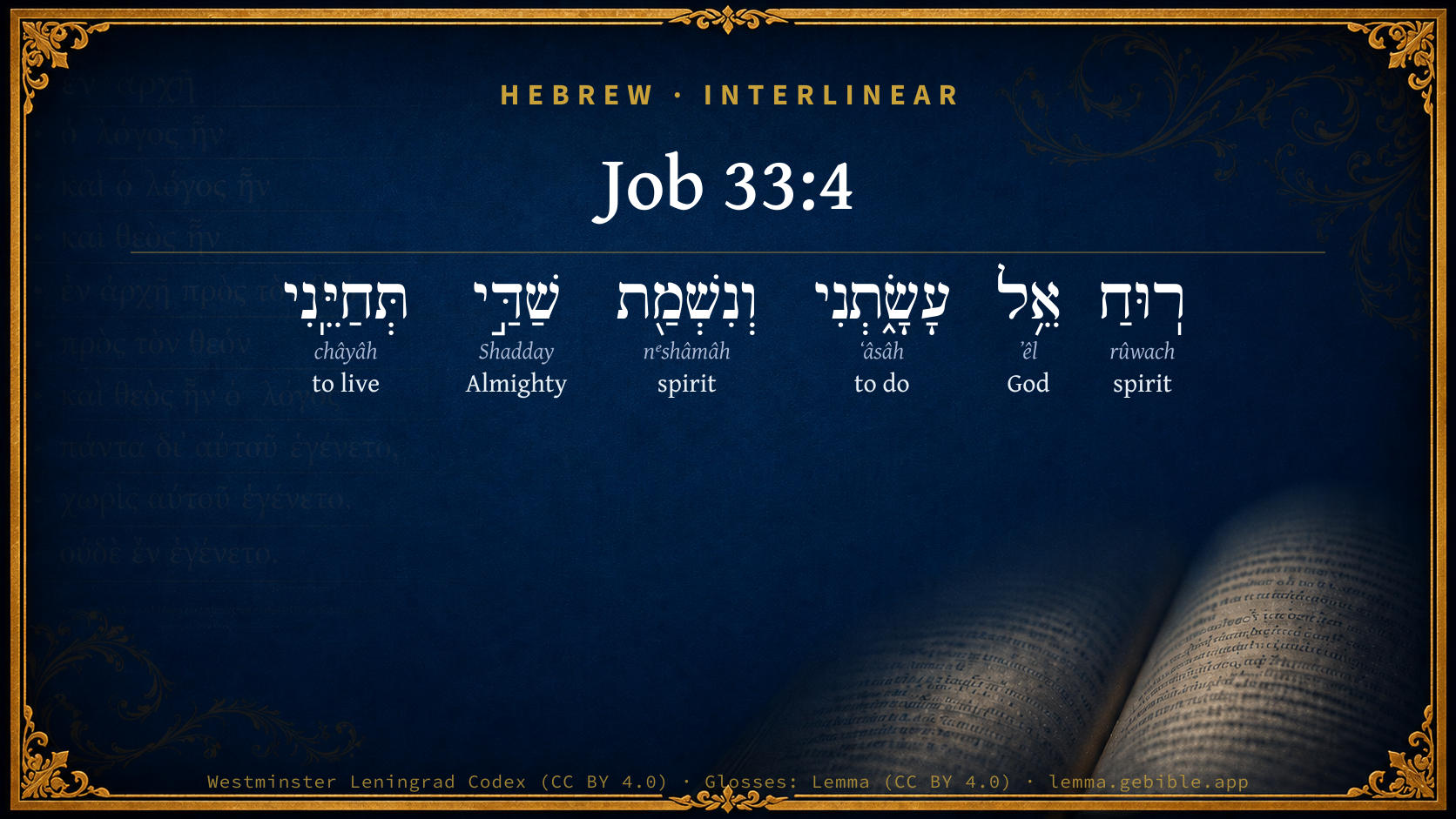
Job 33:4

Hebrew (Westminster Leningrad Codex) Job 33:4 appears in the Hebrew Old Testament. The text above is from the Westminster Leningrad Codex. Each word links to its Strong’s number, a concise gloss, and parsing drawn from the Open Scriptures Hebrew Bible morphology. Click any word for its full Brown-Driver-Briggs (BDB) entry.
Download image
Cite this verse

Job 33:4 (World English Bible). Public Domain. Lemma interlinear Bible study tool, https://lemma.gebible.app/v/job/33/4.

Show BibTeX & RIS
BibTeX
RIS
English Translation
The Spirit of God has made me, And the breath of the Almighty gives me life.
World English Bible · Public Domain
Download a study sheet

One document with this verse’s original text, its word-by-word gloss line, the meaning frame, cross-references with their text, attributed commentary, and full source and license credits — printable, and it pastes into notes with its structure intact.

This verse Autodidact and up

Study sheet (.html) Plain text (.txt)

A passage Seminary Student

Up to 50 verses in one chapter. A passage sheet keeps up to 6 commentary sources and 12 cross-references per verse, in the order this page ranks them, and says so on the sheet whenever that leaves anything out. Ask for a single verse and you get the Autodidact verse sheet above.

Everything on this page stays free to read, with no account — the sheet is a download of what is already on screen, not access to it.

Want to remove ads? Support Godless Engineer
Compare translations 3

The same verse in 3 English versions, stacked beneath the original-language interlinear above. Click any original word for its lexicon entry.

Each is an independent rendering of the whole verse — the interlinear is not word-aligned to these translations.

Highlighted words mark where these versions differ — a whole-verse word diff, not a word-by-word alignment.

  • World English Bible Public Domain
    The Spirit of God has made me, And the breath of the Almighty gives me life.
  • King James Version Public Domain
    The spirit of God hath made me, and the breath of the Almighty hath given me life.
  • unfoldingWord Literal Text CC BY-SA 4.0
    The Spirit of God made me; yes, the breath of the Almighty enlivened me.

unfoldingWord Literal Text — © unfoldingWord, licensed CC BY-SA 4.0. Word-aligned USFM3 via Door43 (git.door43.org/unfoldingWord/en_ult).

Versions to compare (up to 4)

3 of 4 selected

Show all 18 translations

Every available English version of this verse, each an independent rendering of the whole verse.

  • World English Bible Public Domain
    The Spirit of God has made me, And the breath of the Almighty gives me life.
  • Berean Standard Bible Public Domain
    The Spirit of God has made me, and the breath of the Almighty gives me life.
  • Majority Standard Bible Public Domain
    The Spirit of God has made me, and the breath of the Almighty gives me life.
  • King James Version Public Domain
    The spirit of God hath made me, and the breath of the Almighty hath given me life.
  • American Standard Version (1901) Public Domain
    The Spirit of God hath made me, And the breath of the Almighty giveth me life.
  • Revised Version (1885) Public Domain
    The spirit of God hath made me, and the breath of the Almighty giveth me life.
  • Geneva Bible (1599) Public Domain
    The Spirite of God hath made me, and the breath of the Almightie hath giuen me life.
  • Douay-Rheims (1899) Public Domain
    The spirit of God made me, and the breath of the Almighty gave me life.
  • Young's Literal Translation Public Domain
    The Spirit of God hath made me, And the breath of the Mighty doth quicken me.
  • Literal Standard Version CC BY-SA 4.0
    The Spirit of God has made me, || And the breath of the Mighty quickens me.
  • Unlocked Literal Bible CC BY-SA 4.0
    The Spirit of God has made me; the breath of the Almighty has given me life.
  • unfoldingWord Literal Text CC BY-SA 4.0
    The Spirit of God made me; yes, the breath of the Almighty enlivened me.
  • Darby Bible Public Domain
    The Spirit of ùGod hath made me, and the breath of the Almighty hath given me life.
  • World Messianic Bible Public Domain
    The Spirit of God has made me, and the breath of the Almighty gives me life.
  • Webster's Bible Public Domain
    The Spirit of God hath made me, and the breath of the Almighty hath given me life.
  • Free Bible Version CC BY-SA 4.0
    The spirit of God made me, and the breath of the Almighty gives me life.
  • Bible in Basic English Public Domain
    The spirit of God has made me, and the breath of the Ruler of all gives me life.
  • JPS Tanakh (1917) Public Domain
    The spirit of God hath made me, and the breath of the Almighty given me life.

Literal Standard Version (2020), Covenant Press — licensed CC BY-SA 4.0. Text via the HelloAO Bible API (eBible.org). Unlocked Literal Bible (unfoldingWord) — licensed CC BY-SA 4.0. Text via the HelloAO Bible API (eBible.org). unfoldingWord Literal Text — © unfoldingWord, licensed CC BY-SA 4.0. Word-aligned USFM3 via Door43 (git.door43.org/unfoldingWord/en_ult). Free Bible Version, Dr. Jonathan Gallagher — licensed CC BY-SA 4.0. Text via the HelloAO Bible API (eBible.org).

Word by word

More ways to search: Search by grammar → Find every occurrence → Compare this word →

Practice this passage: Drill this verse → Learn its vocabulary →

About this verse

These counts appear in no published source. They are computed here, from the morphology-tagged text and Lemma’s own curated glosses. What Lemma adds →

6
words
6
distinct lemmas
Wisdom
section

Notable vocabulary

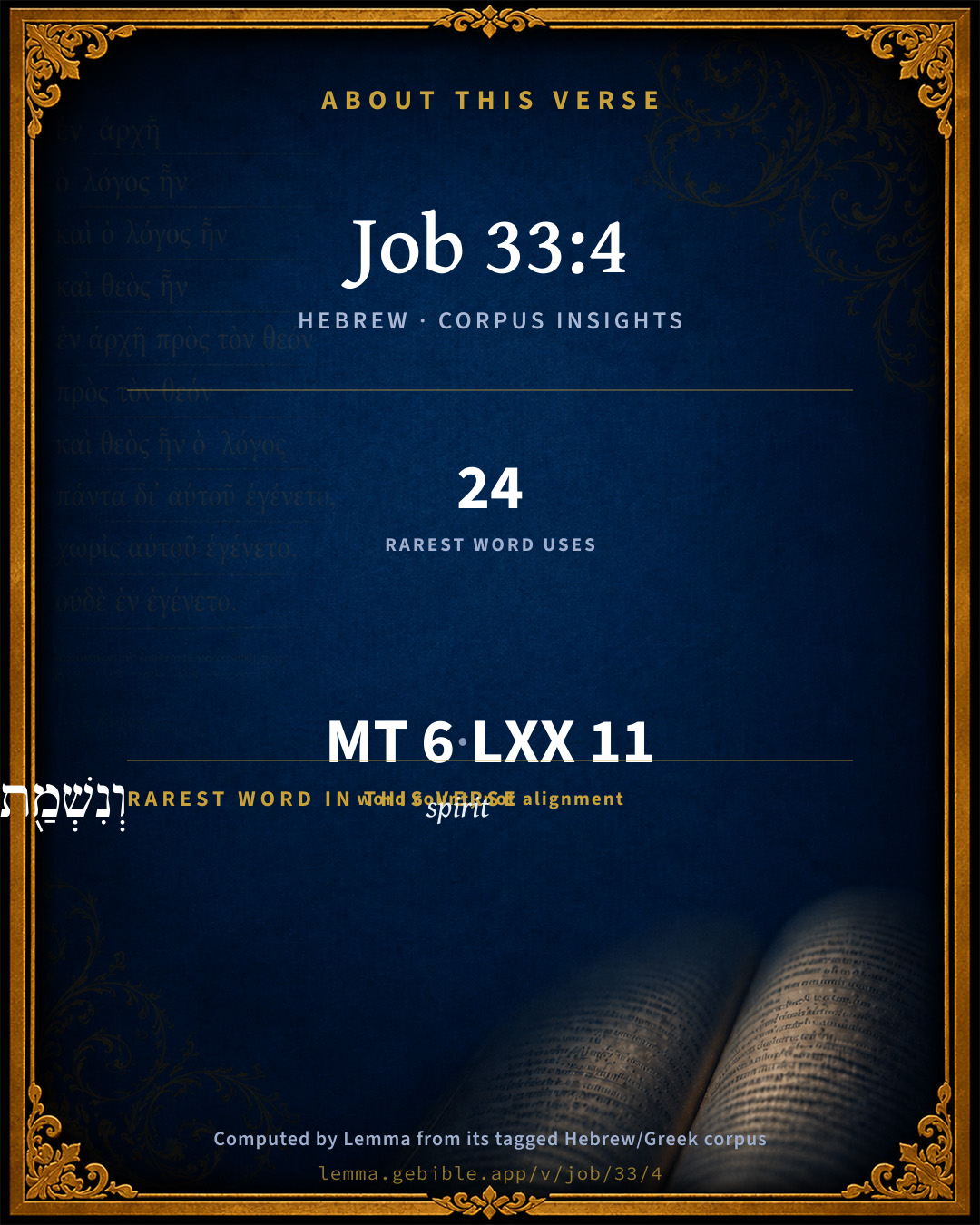
The rarest word here is וְנִשְׁמַ֖ת spirit H5397 — appearing just 24 times in the whole Hebrew Bible.

Shared distinctive vocabulary

וְנִשְׁמַ֖ת spirit H5397 occurs in 24 verses of the Hebrew Bible. Also found in:

Grammatical profile

  • 2 verbs
  • 4 nouns

Verb forms

  • עָשָׂ֑תְנִי Qal · Perfect
  • תְּחַיֵּֽנִי Piel · Imperfect

Hebrew & Septuagint length

In English translation the verse runs 16 words from the Hebrew and 18 from the Septuagint (LXX English) — closely comparable.

A rough comparison of the two English renderings, which tokenize alike — not a word-level alignment.

Word counts can differ between the Hebrew and the Greek without any difference in meaning — e.g. the Hebrew direct-object marker אֵת has no separate Greek word, and Greek often adds the article ὁ.

In the original languages it is 6 Hebrew tokens and 11 Greek tokens — but the two are counted differently (Hebrew bundles its prefixes and suffixes into one token; the Greek is in lemma form), so that isn’t a like-for-like length.

Cross-references

8

Topical passages linked to Job 33:4 in the Treasury of Scripture Knowledge — connected by theme and wording, ordered by reader-vote popularity; previews shown in the World English Bible.

  • Job 32:8 But there is a spirit in man, And the breath of the Almighty gives them understanding.
  • Genesis 2:7 Yahweh God formed man from the dust of the ground, and breathed into his nostrils the breath of life; and man became a living soul.
  • Job 27:3 (For the length of my life is still in me, And the spirit of God is in my nostrils);
  • Job 10:12 You have granted me life and loving kindness. Your visitation has preserved my spirit.
  • 1 Corinthians 15:45 So also it is written, "The first man, Adam, became a living soul." The last Adam became a life-giving spirit.
  • Psalms 33:6 By Yahweh's word the heavens were made; All their host by the breath of his mouth.
  • Romans 8:2 For the law of the Spirit of life in Christ Jesus made me free from the law of sin and of death.
  • Job 10:3 Is it good to you that you should oppress, That you should despise the work of your hands, And smile on the counsel of the wicked?

Cross-references courtesy of OpenBible.info (CC BY 4.0).

Hebrew and Greek witnesses Masoretic Hebrew ↔ Greek Septuagint

The same verse in the two great witnesses to the Old Testament, shown verse-for-verse.

These are two independent witnesses, not word-aligned to each other, and the Septuagint is shown in lemma (dictionary) form.

Hebrew Job 33:4 Masoretic · Westminster Leningrad Codex

רֽוּחַ אֵ֥ל עָשָׂ֑תְנִי וְנִשְׁמַ֖ת שַׁדַּ֣י תְּחַיֵּֽנִי

The Spirit of God has made me, And the breath of the Almighty gives me life.

World English Bible · Public Domain

Greek LXX Job 33:4 Septuagint · lemma form

πνεῦμα θεῖος ὁ ποιέω ἐγώ πνοή δέ παντοκράτωρ ὁ διδάσκω ἐγώ

The Divine Spirit is that which formed me, and the breath of the Almighty that which teaches me.

LXX2012 (modern English Septuagint) · Public Domain

On this verse, Keil & Delitzsch discusses the Septuagint’s reading. Read the note in Commentary ↓

Hebrew: Westminster Leningrad Codex (CC BY 4.0). Greek: Septuagint (public domain); English from LXX2012 (modern English Septuagint) (Public Domain). How the Septuagint differs from the Hebrew →

Commentary

Notes on Job 33:4 from classic Christian and Jewish commentators (each source and its license shown beneath its notes). The classic Christian expositions comment on the surrounding passage and are grouped to its opening verse, so a note may address several verses; the Jewish commentaries on the Tanakh (Rashi and others) are per-verse, so they appear only where the commentator wrote on this verse.

Lemma curates 59 commentaries, every one of them public domain or Creative Commons licensed, each selected and text-cleaned for this edition rather than reprinted as found. About our sources →

Trapp's Complete Commentary

John Trapp

Job 33:4 The Spirit of God hath made me, and the breath of the Almighty hath given me life.

Ver. 4. The Spirit of God hath made me] That is, I am God’s creature no less than thou art, made and maintained by the word of his power, by the breath of his mouth; why then may I not utter pure and holy doctrine? since I also am a rational creature; and if the Holy Spirit please to blow upon me, I can turn about like the mill; if to tune and touch me, I can move to make music; if to infuse good notions, I can utter them. Hear me therefore.

And the breath of the Almighty hath given me life] This some will have to be a metaphor taken from the blowing of glasses into this or that shape. It hath been before noted, that the Egyptians worshipped a god whom they knew not, under the shape of a man blowing an egg out of his mouth, to signify that he made the round world by his word (Plut. de Isid. et Osirid.). "By the word of the Lord were the heavens made; and all the host of them by the breath of his mouth," Psa 33:6. Where some well note the mystery of the Trinity; as others do, not so well, out of this text; by God, understanding the first person; by Almighty, the second; and by the breath of the Almighty, the third. Sed hoc subtilius, saith Mercer.

John Trapp, A Commentary or Exposition upon All the Books of the Old and New Testament (1647–1656) — public domain. Text from a community e-Sword module.

The Biblical Illustrator

Joseph S. Exell

Job_33:4

The Spirit of God hath made me.

On the general dispensation of the Holy Spirit with respect to the new creation

The Holy Spirit completed the work of creation in all its parts. With respect to the new creation, the work is threefold.

I. His rich and copious influences and operations. The dispensation of the Spirit with respect to the new creation may be considered as follows:--

1. The plentiful effusion of the Spirits influences.

2. The ministry of the Spirit, in the Gospel, is called the ministry of the Spirit by way of eminence.

3. In the Gospel the Spirit is promised to all ranks and degrees of men.

4. Our Lord teaches all His disciples to pray for the Spirit (Luk_11:13).

5. The chief comfort which our Lord left to His disciples at His departure was the Spirit.

II. The work of the Spirit with respect to the human nature of Christ, the head of the new creation.

1. Spirit miraculously formed our Lords human nature, soul and body, in the womb of the Virgin.

2. He filled the human nature of our Lord with holiness; He sanctifies the new nature of the believer.

3. He carried on the progressive work of grace in our Lords soul and body; He carries on the sanctification of the believer unto perfection.

4. He anointed our Lord with all extraordinary powers necessary for the discharge of His offices; He anoints the believer for the discharge of every duty

5. He enabled our Lord to work miracles. He enables the believer to conquer sin and Satan: and are not these great miracles?

6. He directed and comforted our Lord in all His troubles. He directs and comforts believers in all their troubles.

7. He enabled our Lord to offer Himself without spot to God. He enables the believer to meet death in peace and purity.

8. He preserved our Lords dead body that it saw no corruption. He will gather the remains of the believers body, wherever they are.

9. He raised our Lord from the dead. He will raise the believer at the last day.

10. He glorified our Lords human nature. He will glorify the believer, when raised from the tomb.

II. He has borne witness concerning our Lord ever since He raised Him from the dead. He will write the name of the believer in the Book of Life.

III. The work of the Spirit upon the members of Christs mystical body. (J. Kidd, D. D.)

The breath of the Almighty hath given me life.--

The value of life

There are two conflicting theories of the origin of man. One brings him upward from the brute, the other downward from God.

1. Life, in its origin, is infinitely important. The birth of a babe is a mighty event. The Scandinavians have a very impressive allegory of human life. They represent it as a tree, the Igdrasil, or tree of existence, whose roots grow deep down in the soil of mystery; the trunk reaches above the clouds; its branches spread out over the globe. At the foot of it sit the past, present, and future, watering the roots. Its boughs, with their unleafing, spread out through all lands and all time; every leaf of the tree is a biography, every fibre a word, a thought, or a deed; its boughs are the histories of nations; the rustle of it is the noise of human existence onwards from of old; it grows amid the howling of the hurricane--it is the great tree of humanity.

2. Human life is transcendently precious from the services it may render to God in the advancement of His glory. Man was not created as a piece of guess work, flung into existence as a waif. There is purpose in the creation of every human being. What is the purpose of life? Man was created to be happy, to be holy! That is the double aim of life--duty first, then happiness as the consequence. The highest style of manhood and womanhood is to be attained by consecration to the Son of God.

3. Life is infinitely valuable from the eternal consequences flowing from it. This world is a solemn vestibule of eternity.

Practical thoughts--

1. How careful we ought to be to husband life.

2. What a stupendous crime wanton war becomes!

3. How short life is, yet infinite in its reach and retribution! What sort of life are you living? (T. L. Cuyler, D. D.)

The Biblical Illustrator, edited by Joseph S. Exell (c. 1880s–1900s) — public domain. Text from a community e-Sword module.

Joseph Benson's Commentary

Job 33:4-5. The Spirit of God hath made me, &c. — First of all, consider that I am thy fellow-creature, made by God’s Spirit, (Gen 1:2,) and quickened by a soul of the same nature with that which God at first breathed into the body of man, and I am ready to discourse with thee upon even terms according to thy desire. If thou canst answer me — Thou needest not, therefore, decline the encounter, but if thou art able to answer, set thy words in order — I shall allow thee all freedom of discourse; I cannot terrify thee as God would, and I shall not reproach thee, or cavil at thee, as thy friends have done; stand up — To oppose and argue with me in this cause.

Joseph Benson's Commentary on the Old and New Testaments (1811–1818) — public domain. Text from a community e-Sword module.

Keil & Delitzsch

C. F. Keil & F. Delitzsch

4 The Spirit of God hath made me,

And the breath of the Almighty hath given me life.

5 If thou canst, answer me,

Prepare in my presence, take thy stand!

6 Behold, I am like thyself, of God,

Formed out of clay am I also.

7 Behold, my terror shall not affright thee,

And my pressure shall not be heavy upon thee.

He has both in common with Job: the spirituality as well as the earthliness of man's nature; but by virtue of the former he does not, indeed, feel himself exalted above Job's person, but above the present standpoint taken up by Job; and in consideration of this, Job need not fear any unequal contest, nor as before God, Job 9:34; Job 13:21, in order that he may be able to defend himself against Him, make it a stipulation that His majesty may not terrify him. It is man's twofold origin which Elihu, Job 33:4, Job 33:6, gives utterance to in harmony with Gen 2:7 : the mode of man's origin, which is exalted above that of all other earthly beings that have life; for the life of the animal is only the individualizing of the breath of the Divine Spirit already existing in matter. The spirit of man, on the contrary (for which the language has reserved the name נשׁמה), is an inspiration directly coming forth from God the personal being, transferred into the bodily frame, and therefore forming a person.

(Note: God took a small piece of His own life - says the tradition among the Karens, a scattered tribe of Eastern India - blew into the nostrils of His son and daughter, and they became living beings, and were really human.)

In the exalted consciousness of having been originated by the Spirit of God, and being endowed with life from the inbreathed breath of the Almighty, Elihu stands invincible before Job: if thou canst, refute me (השׁיב with acc. of the person, as Job 33:32); array thyself (ערכה for ערכה, according to Ges. 63, rem. 1) before me (here with the additional thought of מלחמה, as Job 23:4, in a forensic sense with משׁפּט), place thyself in position, or take thy post (imper. Hithpa. with the ah less frequent by longer forms, Ew. 228, a).

On the other side, he also, like Job, belongs to God, i.e., is dependent and conditioned. הן־אני is to be written with Segol (not Ssere); לאל is intended like לו, Job 12:16; and כּפיך signifies properly, according to thine utterance, i.e., standard, in accordance with, i.e., like thee, and is used even in the Pentateuch (e.g., Exo 16:21) in this sense pro ratione; כפי, Job 30:18, we took differently. He, Elihu, is also nipped from the clay, i.e., taken from the earth, as when the potter nips off a piece of his clay (comp. Aram. קרץ, a piece, Arab. qurs, a bread-cake, or a dung-cake, vid., supra, p. 449, from qarasa, to pinch off, take off, cogn. qarada, to gnaw off, cut off, p. 512). Thus, therefore, no terribleness in his appearing will disconcert Job, and his pressure will not be a burden upon him. By a comparison of Job 13:21, it might seem that אכפּי is equivalent to כּפּי (lxx ἡ χείρ μου), but כּבד is everywhere connected only with יד, never with כּף; and the ἁπ. γεγρ. is explained according to Pro 16:26, where אכף signifies to oppress, drive (Jer. compulit), and from the dialects differently, for in Syr. ecaf signifies to be anxious about anything (ecaf li, it causes me anxiety, curae mihi est), and in Arab. accafa, to saddle, ucâf, Talmud. אוּכּף, a saddle, so that consequently the Targ. translation of אכפּי by טוּני, my burden, and the Syr. by אוכפני, my pressing forward (Arabic version iqbâli, my touch), are supported, since אכף signifies pressure, heavy weight, load, and burden; according to which it is also translated by Saad. (my constraint), Gecat. (my might). It is therefore not an opponent who is not on an equality with him by nature, with whom Job has to do. If he is not able to answer him, he will have to be considered as beaten.

Keil & Delitzsch — Biblical Commentary on the Old Testament (1861–1891) — public domain (CC PDM 1.0). Text via the HelloAO Bible API. (Old Testament only.)

Geneva Bible (1599)

Geneva Bible translators

I confess the power of God, and am one of his, therefore thou oughtest to hear me.

Geneva Bible (1599) marginal notes — public domain. Text via Bolls.life.

Jamieson, Fausset & Brown

Robert Jamieson, A. R. Fausset & David Brown

The Spirit of God hath made me--as He did thee: latter clause of Job 33:6 (Gen 2:7). Therefore thou needest not fear me, as thou wouldest God (Job 33:7; Job 9:34). On the other hand, "the breath of the Almighty hath inspired me" (as Job 32:8); not as English Version, "given me life"; therefore "I am according to thy wish (Job 9:32-33) in God's stead" to thee; a "daysman," umpire, or mediator, between God and thee. So Elihu was designed by the Holy Ghost to be a type of Jesus Christ (Job 33:23-26).

Jamieson, Fausset & Brown — Commentary Critical and Explanatory on the Whole Bible (1871) — public domain (CC PDM 1.0). Text via the HelloAO Bible API.

Adam Clarke's Commentary

Verse 4. The Spirit of God hath made me] Another plain allusion to the account of the creation of man, Ge 2:7, as the words נשמת nishmath, the breath or breathing of God, and תחיני techaiyeni, hath given me life, prove: "He breathed into his nostrils the breath of lives, and he became a living soul."

Adam Clarke's Commentary on the Bible (1810–1826) — public domain. Text from a community e-Sword/MySword module.

The Cambridge Bible for Schools and Colleges

gen. ed. J. J. S. Perowne

4. On the language of this verse see ch. Job_32:8. The verse seems connected with Job_33:3. Elihu will utter his sincere conviction, and it is a conviction flowing from that spirit of God given him in his creation; this is a guarantee of its worth as well as its sincerity. The appeal is to common reason (ch. Job_34:2-3), which is a divine illumination (the lamp of the Lord, Pro_20:27), but in his animated zeal for God against the charges of Job Elihu feels that this spirit of God is within him in a powerful degree and gives him a higher wisdom than ordinary.

The Cambridge Bible for Schools and Colleges (gen. ed. J. J. S. Perowne; Cambridge University Press, 1878–1918) — public domain. Text from a community e-Sword module.

John Gill's Exposition

The Spirit of God hath made me,.... As a man; so every man is made by God, and not by himself; Father, Son, and Spirit, are his Makers or Creators, as we read of them in the plural number, Psa 149:2; and this is a proof of the deity of the Spirit, who was not only concerned in the creation of all things, garnishing the heavens, and moving upon the face of the waters on the earth; but in the formation of man:

and the breath of the mighty hath given me life; the same with the Spirit of God, the allusion is to the creation of man at first, when God breathed into him the breath of life, and he became a living soul: life natural is from God, he is the God of our life, he gives all the mercies of life, and by him is this life preserved; and the whole is the effect of almighty power: now this is observed by Elihu to Job, to encourage him to attend to him without fear, since he was a man, a creature of God, as he was: it may be understood of his spiritual formation, the Spirit of God remakes men, or makes them new men, new creatures; this is done in regeneration, which is the work of the Holy Spirit; hence regeneration, and renewing of the Holy Ghost, are put together; and being a work of almighty power, is proof of the deity of the Spirit of God; it is he that quickens men when dead in trespasses and sins, and makes them alive to God; which appears by their spiritual breathings after divine things, and by the exercise of their spiritual senses, and by their performance of spiritual actions; and now Elihu, being a man regenerated and quickened by the Spirit, might more justly claim the attention of Job, since what he should say was what he had heard, felt, and seen, as good man, one that had an experience of divine and spiritual things.

John Gill's Exposition of the Whole Bible (1746–1763) — public domain (CC PDM 1.0). Text via the HelloAO Bible API.

Albert Barnes' Notes on the Bible

The Spirit of God hath made me; - see the notes at Job 32:8. There is an evident allusion in this verse to the mode in which man was created, when God breathed into him the breath of life and he became a living being; Gen 2:7. But it is not quite clear why Elihu adverts here to the fact that God had made him, or what is the bearing of this fact on what he proposed to say. The most probable supposition is, that he means to state that he is, like Job, a man; that both were formed in the same way - from the same breathing of the Almighty, and from the same clay Job 33:6; and that although he bad undertaken to speak to Job in God’s stead Job 33:6, yet Job had no occasion to fear that he would be overawed and confounded by the Divine Majesty. He had dreaded that, if he should be permitted to bring his case before him (Notes, Job 33:7), but Elihu says that now he would have no such thing to apprehend. Though it would be in fact the same thing as carrying the matter before God - since he came in his name, and meant to state the true principles of his government, yet Job would be also really conducting the cause with a man like himself, and might, unawed, enter with the utmost freedom into the statement of his views.

Albert Barnes' Notes on the Bible (1834–1885) — public domain. Text from a community e-Sword/MySword module.

Haydock's Catholic Bible Commentary

Spirit. We are therefore equal. (Menochius) --- Thou canst not fear being overpowered with the divine majesty, in this dispute, chap. xiii. 21. (Calmet) --- Life. Septuagint, "instruction." (Haydock)

George Leo Haydock (1774–1849), Haydock's Catholic Family Bible and Commentary, 1859 edition — public domain. Excludes Psalms (Douay-Rheims chapter numbering differs from Protestant) and Deuterocanonical books (Catholic canon only).

Matthew Poole's English Annotations

I am thy fellow creature, made by God’s Spirit, Gen 1:2, and quickened by that soul which God breathed into man, Gen 2:7, and therefore fit and ready to discourse with thee upon even and equal terms, according to thy desire.

Matthew Poole's English Annotations on the Holy Bible (1683–1685) — public domain. Text from a community e-Sword/MySword module.

Whedon's Commentary on the Bible

Daniel D. Whedon

4. The Spirit of God hath made me — See note on Job_32:8. In the origination of every man is thus repeated, according to the view of Scripture, a work as divine as that of Adam’s creation. (Compare DELITZSCH. Psych., 249.) This passage is cited by Theodoret as a proof-text of the divinity of the Holy Spirit.

Hath given me life — Giveth me life, quickeneth me. The manifestations of divine power in upholding all things, “cannot be better explained than by calling it a continuous creation.” — Leibnitz.

Daniel D. Whedon (gen. ed.), Commentary on the Old and New Testaments (1874–1909) — public domain. Text from a community e-Sword module.

The Pulpit Commentary

The Spirit of God hath made me. This is assigned as the main reason why Job should give his best attention to Elihu"s words. Elihu claims to be quickened and informed by the Divine Spirit which was once breathed into man, (Gen_2:7) whereby man became a living soul. (comp. Job_32:8) And the breath of the Almighty hath given me life; or, quickened me originated and preserved my life. Elihu does not, however, claim that his words are actually inspired, or that he has a message to Job from the Almighty.

The Pulpit Commentary (1880–1919), ed. H.D.M. Spence-Jones & Joseph S. Exell — public domain. Text from a community e-Sword module.

John Wesley's Explanatory Notes

Life - I am thy fellow creature, and am ready to discourse with thee upon even terms, according to thy desire.

John Wesley, Explanatory Notes Upon the Whole Bible (1754–1765) — public domain. Text via the GEBible commentary corpus.

unfoldingWord translationNotes

Door43 World Missions Community

General Information:

Elihu continues speaking to Job.

The Spirit of God ... has given me life

These two lines mean the same thing. Elihu is emphasizing that God has made him and so gives authority to what he is saying. (See: Parallelism)

set your words in order before me and stand up

This speaks of Job preparing what he will say as if he were setting up and organizing physical objects. AT: "prepare what you will say, and stand up and answer me" (See: Metaphor)

translationWords

Holy Spirit

Almighty

life

unfoldingWord translationNotes — © Distant Shores Media and the Door43 World Missions Community, licensed CC BY-SA 4.0. Source: git.door43.org/Door43/en_tn.

Rashi

Rabbi Shlomo Yitzchaki (Rashi)

The spirit of God made me and I am no stronger than you.

Rashi on the Tanakh — English translations: “The Judaica Press complete Tanach with Rashi, translated by A. J. Rosenberg” (CC BY 4.0); “Pentateuch with Rashi's commentary by M. Rosenbaum and A.M. Silbermann, 1929-1934” (public domain); “The Metsudah Tanach series, Lakewood, N.J” (CC BY 4.0); and “The Book of Joshua, Metsudah Publications, 1997” (CC BY 4.0). Text via Sefaria.

Lesson kit

Teaching starters — assembled from the data on this page, not authored interpretation. Every prompt links to the verse data it draws on. Edit before teaching.

Job, in the Wisdom, opens this verse with 6 words (6 distinct Hebrew lemmas). Its most distinctive word is nᵉshâmâh (“spirit”). A historical commentator’s framing appears above. Read the whole chapter for the surrounding context.

Discussion questions

  1. The word nᵉshâmâh carries the sense “spirit.” How does it shape the verse?
  2. How does Genesis 2:7, which shares the word «spirit», read alongside this verse?
  3. These translations render this verse differently; the difference is in the English rendering, not the original. What questions does that raise?
  4. «עָשָׂ֑תְנִי» is a Qal Perfect verb. How does that grammatical form shape the action described?
  5. Compare how Trapp's Complete Commentary and The Biblical Illustrator read this verse. Where do they agree or differ?

Things to notice

Reading settings

Reading text

Shown beneath each verse's original-language words.

Old Testament
Old Testament edition

Read the OT as the Masoretic Hebrew (MT) or the Greek Septuagint (LXX).

English shown for the Greek Septuagint (in the Hebrew ↔ Greek comparison).

Comparing translations? Open the Compare panel on any verse page to stack up to four side by side.