
1 Kings 19:11

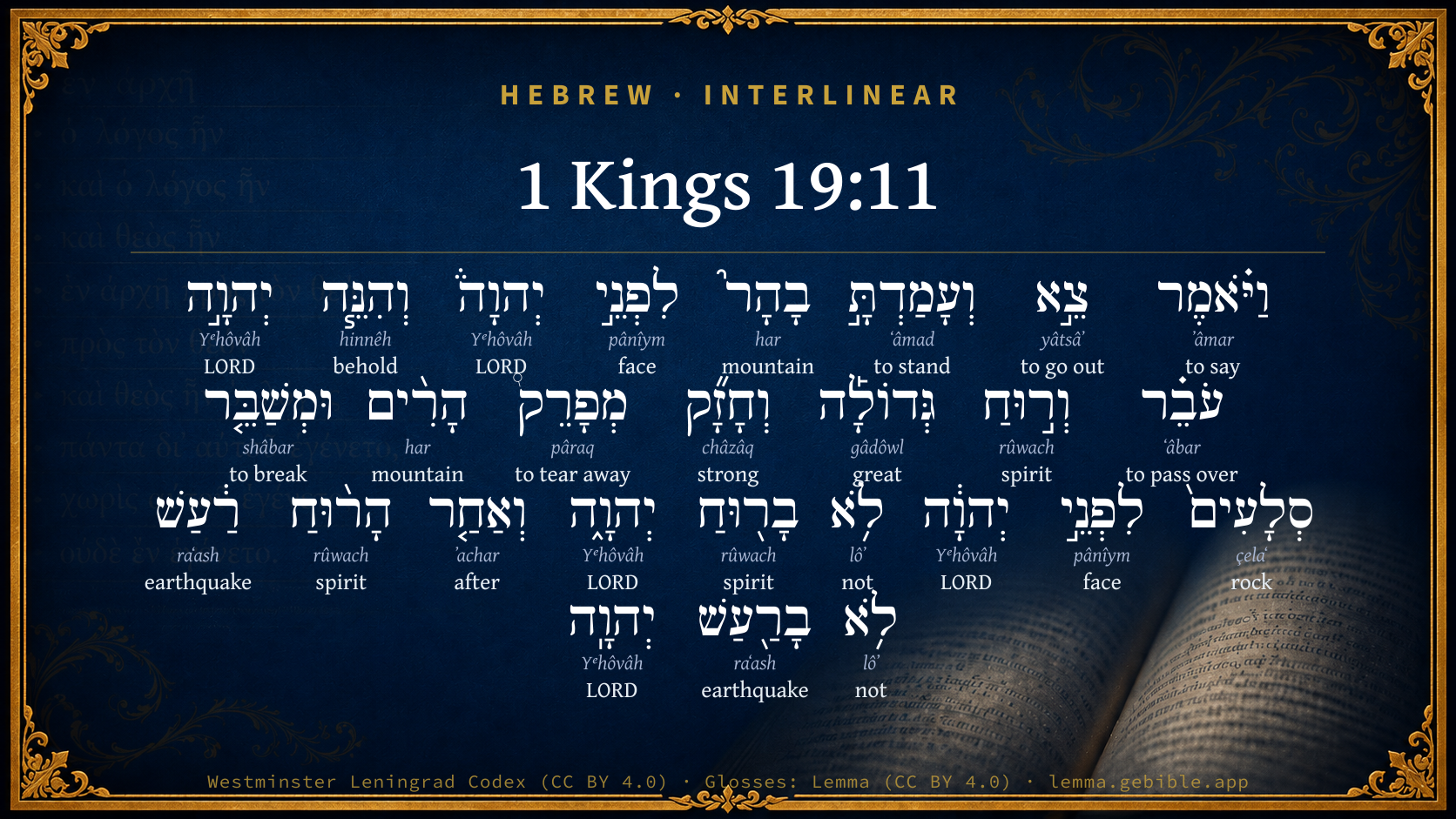
Hebrew (Westminster Leningrad Codex) 1 Kings 19:11 appears in the Hebrew Old Testament. The text above is from the Westminster Leningrad Codex. Each word links to its Strong’s number, a concise gloss, and parsing drawn from the Open Scriptures Hebrew Bible morphology. Click any word for its full Brown-Driver-Briggs (BDB) entry.
Download image
Cite this verse

1 Kings 19:11 (World English Bible). Public Domain. Lemma interlinear Bible study tool, https://lemma.gebible.app/v/1-kings/19/11.

Show BibTeX & RIS
BibTeX
RIS
English Translation
He said, Go forth, and stand on the mountain before Yahweh. Behold, Yahweh passed by, and a great and strong wind tore the mountains, and broke in pieces the rocks before Yahweh; but Yahweh was not in the wind: and after the wind an earthquake; but Yahweh was not in the earthquake:
World English Bible · Public Domain
Highlights
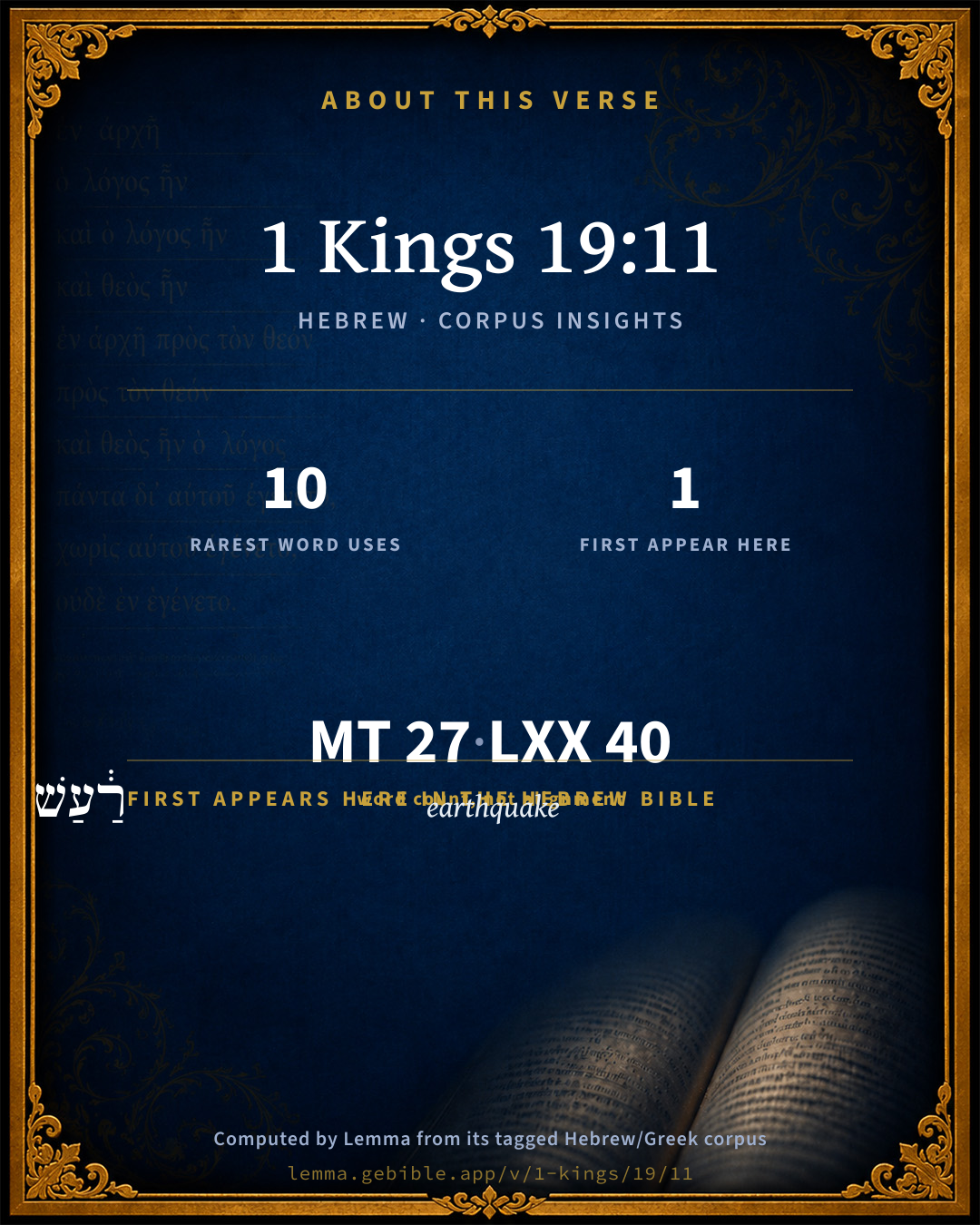
  • 1 first appearance in the Hebrew Bible
Full analysis ↓
Download a study sheet

One document with this verse’s original text, its word-by-word gloss line, the meaning frame, cross-references with their text, attributed commentary, and full source and license credits — printable, and it pastes into notes with its structure intact.

This verse Autodidact and up

Study sheet (.html) Plain text (.txt)

A passage Seminary Student

Up to 50 verses in one chapter. A passage sheet keeps up to 6 commentary sources and 12 cross-references per verse, in the order this page ranks them, and says so on the sheet whenever that leaves anything out. Ask for a single verse and you get the Autodidact verse sheet above.

Everything on this page stays free to read, with no account — the sheet is a download of what is already on screen, not access to it.

Want to remove ads? Support Godless Engineer
Compare translations 3

The same verse in 3 English versions, stacked beneath the original-language interlinear above. Click any original word for its lexicon entry.

Each is an independent rendering of the whole verse — the interlinear is not word-aligned to these translations.

Highlighted words mark where these versions differ — a whole-verse word diff, not a word-by-word alignment.

  • World English Bible Public Domain
    He said, Go forth, and stand on the mountain before Yahweh. Behold, Yahweh passed by, and a great and strong wind tore the mountains, and broke in pieces the rocks before Yahweh; but Yahweh was not in the wind: and after the wind an earthquake; but Yahweh was not in the earthquake:
  • King James Version Public Domain
    And he said, Go forth, and stand upon the mount before the LORD. And, behold, the LORD passed by, and a great and strong wind rent the mountains, and brake in pieces the rocks before the LORD; but the LORD was not in the wind: and after the wind an earthquake; but the LORD was not in the earthquake:
  • unfoldingWord Literal Text CC BY-SA 4.0
    And he said, “Go out, and you shall stand on the mountain to the face of Yahweh.” And behold, Yahweh was passing over, and a great and strong wind was tearing the mountains and breaking rocks to the face of Yahweh. Yahweh not in the wind. And after the wind, an earthquake. Yahweh not in the earthquake.

unfoldingWord Literal Text — © unfoldingWord, licensed CC BY-SA 4.0. Word-aligned USFM3 via Door43 (git.door43.org/unfoldingWord/en_ult).

Versions to compare (up to 4)

3 of 4 selected

Show all 18 translations

Every available English version of this verse, each an independent rendering of the whole verse.

  • World English Bible Public Domain
    He said, Go forth, and stand on the mountain before Yahweh. Behold, Yahweh passed by, and a great and strong wind tore the mountains, and broke in pieces the rocks before Yahweh; but Yahweh was not in the wind: and after the wind an earthquake; but Yahweh was not in the earthquake:
  • Berean Standard Bible Public Domain
    Then the LORD said, “Go out and stand on the mountain before the LORD. Behold, the LORD is about to pass by.” And a great and mighty wind tore into the mountains and shattered the rocks before the LORD, but the LORD was not in the wind. After the wind there was an earthquake, but the LORD was not in the earthquake.
  • Majority Standard Bible Public Domain
    Then the LORD said, “Go out and stand on the mountain before the LORD. Behold, the LORD is about to pass by.” And a great and mighty wind tore into the mountains and shattered the rocks before the LORD, but the LORD was not in the wind. After the wind there was an earthquake, but the LORD was not in the earthquake.
  • King James Version Public Domain
    And he said, Go forth, and stand upon the mount before the LORD. And, behold, the LORD passed by, and a great and strong wind rent the mountains, and brake in pieces the rocks before the LORD; but the LORD was not in the wind: and after the wind an earthquake; but the LORD was not in the earthquake:
  • American Standard Version (1901) Public Domain
    And he said, Go forth, and stand upon the mount before Jehovah. And, behold, Jehovah passed by, and a great and strong wind rent the mountains, and brake in pieces the rocks before Jehovah; but Jehovah was not in the wind: and after the wind an earthquake; but Jehovah was not in the earthquake:
  • Revised Version (1885) Public Domain
    And he said, Go forth, and stand upon the mount before the LORD. And, behold, the LORD passed by, and a great and strong wind rent the mountains, and brake in pieces the rocks before the LORD; but the LORD was not in the wind: and after the wind an earthquake; but the LORD was not in the earthquake:
  • Geneva Bible (1599) Public Domain
    And he saide, Come out, and stand vpon the mount before the Lord. And beholde, the Lord went by, and a mightie strong winde rent the mountaines, and brake the rockes before the Lord: but the Lord was not in the winde: and after the wind came an earthquake: but the Lord was not in the earthquake:
  • Douay-Rheims (1899) Public Domain
    And he said to him: Go forth, and stand upon the mount before the Lord: and behold the Lord passeth, and a great and strong wind before the Lord over throwing the mountains, and breaking the rocks in pieces: the Lord is not in the wind, and after the wind an earthquake: the Lord is not in the earthquake.
  • Young's Literal Translation Public Domain
    And He saith, `Go out, and thou hast stood in the mount before Jehovah.' And lo, Jehovah is passing by, and a wind -- great and strong -- is rending mountains, and shivering rocks before Jehovah: -- not in the wind `is' Jehovah; and after the wind a shaking: -- not in the shaking `is' Jehovah;
  • Literal Standard Version CC BY-SA 4.0
    And He says, “Go out, and you have stood on the mountain before YHWH.” And behold, YHWH is passing by, and a wind—great and strong—is tearing mountains, and shattering rocks before YHWH, [but] YHWH [is] not in the wind; and after the wind [is] a shaking, [but] YHWH [is] not in the shaking;
  • Unlocked Literal Bible CC BY-SA 4.0
    Yahweh replied, “Go out and stand on the mountain before me.” Then Yahweh passed by, and a very strong wind struck the mountains and broke rocks into pieces before Yahweh, but Yahweh was not in the wind. Then after the wind, an earthquake came, but Yahweh was not in the earthquake.
  • unfoldingWord Literal Text CC BY-SA 4.0
    And he said, “Go out, and you shall stand on the mountain to the face of Yahweh.” And behold, Yahweh was passing over, and a great and strong wind was tearing the mountains and breaking rocks to the face of Yahweh. Yahweh not in the wind. And after the wind, an earthquake. Yahweh not in the earthquake.
  • Darby Bible Public Domain
    And he said, Go forth, and stand upon the mount before Jehovah. And behold, Jehovah passed by, and a great and strong wind rent the mountains, and broke in pieces the rocks before Jehovah: Jehovah was not in the wind. And after the wind, an earthquake: Jehovah was not in the earthquake.
  • World Messianic Bible Public Domain
    He said, “Go out and stand on the mountain before the LORD.” Behold, the LORD passed by, and a great and strong wind tore the mountains and broke in pieces the rocks before the LORD; but the LORD was not in the wind. After the wind there was an earthquake; but the LORD was not in the earthquake.
  • Webster's Bible Public Domain
    And he said, Go forth, and stand upon the mount before the LORD. And behold, the LORD passed by, and a great and strong wind rent the mountains, and broke in pieces the rocks before the LORD; but the LORD was not in the wind: and after the wind an earthquake; but the LORD was not in the earthquake:
  • Free Bible Version CC BY-SA 4.0
    Then the Lord told him, “Go out and stand on the mountain before the Lord.” Right then the Lord passed by. A tremendously powerful wind ripped into the mountains and smashed rocks before the Lord, but the Lord wasn't in the wind. After the wind there came an earthquake, but the Lord wasn't in the earthquake.
  • Bible in Basic English Public Domain
    Then he said, Go out and take your place on the mountain before the Lord. Then the Lord went by, and mountains were parted by the force of a great wind, and rocks were broken before the Lord; but the Lord was not in the wind. And after the wind there was an earth-shock, but the Lord was not in the earth-shock.
  • JPS Tanakh (1917) Public Domain
    And He said: 'Go forth, and stand upon the mount before the LORD.' And, behold, the LORD passed by, and a great and strong wind rent the mountains, and broke in pieces the rocks before the LORD; but the LORD was not in the wind; and after the wind an earthquake; but the LORD was not in the earthquake;

Literal Standard Version (2020), Covenant Press — licensed CC BY-SA 4.0. Text via the HelloAO Bible API (eBible.org). Unlocked Literal Bible (unfoldingWord) — licensed CC BY-SA 4.0. Text via the HelloAO Bible API (eBible.org). unfoldingWord Literal Text — © unfoldingWord, licensed CC BY-SA 4.0. Word-aligned USFM3 via Door43 (git.door43.org/unfoldingWord/en_ult). Free Bible Version, Dr. Jonathan Gallagher — licensed CC BY-SA 4.0. Text via the HelloAO Bible API (eBible.org).

Word by word

More ways to search: Search by grammar → Find every occurrence → Compare this word →

Practice this passage: Drill this verse → Learn its vocabulary →

מְפָרֵק֩
pâraq
H6561
“tearing away”
Verb, Piel, Participle Active, Masculine, Singular, Absolute
Part of Speech
Verb
Stem
Piel
Form
Participle Active
Gender
Masculine
Number
Singular
State
Absolute
Full BDB Definition

Origin: a primitive root

TWOT: 1828

to tear apart or away, tear off, break away - (Qal) to tear away, snatch, rescue - (Piel) to tear off - (Hithpael) to tear off from oneself, be broken off, be broken in pieces
  1. וַיֹּ֗אמֶר ʼâmar H559 “and · to say” Conjunction + Verb, Qal, Sequential Imperfect, 3rd Person, Masculine, Singular
  2. צֵ֣א yâtsâʼ H3318 “go out” Verb, Qal, Imperative, 2nd Person, Masculine, Singular
  3. וְעָמַדְתָּ֣ ʻâmad H5975 “and · to stand” Conjunction + Verb, Qal, Sequential Perfect, 2nd Person, Masculine, Singular
  4. בָהָר֮ har H2022 “in/at the · mountain” Preposition, Determined + Noun, Common, Masculine, Singular, Absolute
  5. לִפְנֵ֣י pânîym H6440 “to/for · face(s) of” Preposition + Noun, Common, Both, Plural, Construct
  6. יְהוָה֒ Yᵉhôvâh H3068 “LORD” Noun, Proper
  7. וְהִנֵּ֧ה hinnêh H2009 “and · behold” Conjunction + Particle, Demonstrative
  8. יְהוָ֣ה Yᵉhôvâh H3068 “LORD” Noun, Proper
  9. עֹבֵ֗ר ʻâbar H5674 “passing over” Verb, Qal, Participle Active, Masculine, Singular, Absolute
  10. וְר֣וּחַ rûwach H7307 “and · spirit” Conjunction + Noun, Common, Both, Singular, Absolute
  11. גְּדוֹלָ֡ה gâdôwl H1419 “great” Adjective, Adjective, Feminine, Singular, Absolute
  12. וְחָזָ֞ק châzâq H2389 “and · strong” Conjunction + Adjective, Adjective, Masculine, Singular, Absolute
  13. הָרִ֨ים har H2022 “mountains” Noun, Common, Masculine, Plural, Absolute
  14. וּמְשַׁבֵּ֤ר shâbar H7665 “and · breaking” Conjunction + Verb, Piel, Participle Active, Masculine, Singular, Absolute
  15. סְלָעִים֙ çelaʻ H5553 “rocks” Noun, Common, Masculine, Plural, Absolute
  16. לִפְנֵ֣י pânîym H6440 “to/for · face(s) of” Preposition + Noun, Common, Both, Plural, Construct
  17. יְהוָ֔ה Yᵉhôvâh H3068 “LORD” Noun, Proper
  18. לֹ֥א lôʼ H3808 “not” Particle, Negative
  19. בָר֖וּחַ rûwach H7307 “in/at the · spirit” Preposition, Determined + Noun, Common, Both, Singular, Absolute
  20. יְהוָ֑ה Yᵉhôvâh H3068 “LORD” Noun, Proper
  21. וְאַחַ֤ר ʼachar H310 “and · after” Conjunction + Preposition
  22. הָר֨וּחַ rûwach H7307 “the · spirit” Particle, Definite Article + Noun, Common, Both, Singular, Absolute
  23. רַ֔עַשׁ raʻash H7494 “earthquake” Noun, Common, Masculine, Singular, Absolute
  24. לֹ֥א lôʼ H3808 “not” Particle, Negative
  25. בָרַ֖עַשׁ raʻash H7494 “in/at the · earthquake” Preposition, Determined + Noun, Common, Masculine, Singular, Absolute
  26. יְהוָֽה Yᵉhôvâh H3068 “LORD” Noun, Proper

About this verse

These counts appear in no published source. They are computed here, from the morphology-tagged text and Lemma’s own curated glosses. What Lemma adds →

27
words
17
distinct lemmas
Historical
section

Notable vocabulary

The rarest word here is מְפָרֵק֩ to tear away H6561 — appearing just 10 times in the whole Hebrew Bible.

First appearance in Scripture

This word makes its first canonical appearance in the Hebrew Bible here:

  • רַ֔עַשׁ earthquake H7494

Shared distinctive vocabulary

מְפָרֵק֩ to tear away H6561 occurs in 10 verses of the Hebrew Bible. Also found in:

Grammatical profile

  • 6 verbs
  • 15 nouns
  • 2 adjectives
  • 1 preposition
  • 3 particles

Verb forms

  • וַיֹּ֗אמֶר Qal · Sequential Imperfect
  • צֵ֣א Qal · Imperative
  • וְעָמַדְתָּ֣ Qal · Sequential Perfect
  • עֹבֵ֗ר Qal · Participle Active
  • מְפָרֵק֩ Piel · Participle Active
  • וּמְשַׁבֵּ֤ר Piel · Participle Active

Repetition

Words recur within this verse — often emphatic in Hebrew:

  • יְהוָה֒ LORD H3068 ×5
  • וְר֣וּחַ spirit H7307 ×3
  • בָהָר֮ mountain H2022 ×2
  • לִפְנֵ֣י face H6440 ×2
  • רַ֔עַשׁ earthquake H7494 ×2
  • לֹ֥א not H3808 ×2

Hebrew & Septuagint length

In English translation the verse runs 52 words from the Hebrew and 62 from the Septuagint (LXX English) — closely comparable.

A rough comparison of the two English renderings, which tokenize alike — not a word-level alignment.

Word counts can differ between the Hebrew and the Greek without any difference in meaning — e.g. the Hebrew direct-object marker אֵת has no separate Greek word, and Greek often adds the article ὁ.

In the original languages it is 27 Hebrew tokens and 40 Greek tokens — but the two are counted differently (Hebrew bundles its prefixes and suffixes into one token; the Greek is in lemma form), so that isn’t a like-for-like length.

Cross-references

30

Topical passages linked to 1 Kings 19:11 in the Treasury of Scripture Knowledge — connected by theme and wording, ordered by reader-vote popularity; previews shown in the World English Bible.

  • Ezekiel 1:4 I looked, and, behold, a stormy wind came out of the north, a great cloud, with flashing lightning, and a brightness round about it, and out of the midst of it as it were glowing metal, out of the midst of the fire.
  • Psalms 50:3 Our God comes, and does not keep silent. A fire devours before him. It is very tempestuous around him.
  • Job 38:1 Then Yahweh answered Job out of the whirlwind,
  • Isaiah 30:30 Yahweh will cause his glorious voice to be heard, and will show the lighting down of his arm, with the indignation of [his] anger, and the flame of a devouring fire, with a blast, and tempest, and hailstones.
  • Hebrews 12:26 whose voice shook the earth, then, but now he has promised, saying, "Yet once more I will shake not only the earth, but also the heavens."
  • Exodus 19:20 Yahweh came down on Mount Sinai, to the top of the mountain. Yahweh called Moses to the top of the mountain, and Moses went up.
  • Exodus 34:2 Be ready by the morning, and come up in the morning to Mount Sinai, and present yourself there to me on the top of the mountain.
  • Psalms 68:8 The earth trembled. The sky also poured down rain at the presence of the God of Sinai-- At the presence of God, the God of Israel.
  • Ezekiel 37:7 So I prophesied as I was commanded: and as I prophesied, there was a noise, and, behold, an earthquake; and the bones came together, bone to its bone.
  • Hebrews 12:18–21 For you have not come to a mountain that might be touched, and that burned with fire, and to blackness, darkness, tempest,
  • Revelation 11:19 God's temple that is in heaven was opened, and the ark of the Lord's covenant was seen in his temple. Lightnings, sounds, thunders, an earthquake, and great hail followed.
  • Exodus 24:12 Yahweh said to Moses, "Come up to me on the mountain, and stay here, and I will give you the tables of stone with the law and the commands that I have written, that you may teach them."
  • Exodus 24:18 Moses entered into the midst of the cloud, and went up on the mountain; and Moses was on the mountain forty days and forty nights.
  • Revelation 16:18 There were lightnings, sounds, and thunders; and there was a great earthquake, such as was not since there were men on the earth, so great an earthquake, so mighty.
  • Revelation 20:11 I saw a great white throne, and him who sat on it, from whose face the earth and the heaven fled away. There was found no place for them.
  • Matthew 27:51–54 Behold, the veil of the temple was torn in two from the top to the bottom. The earth quaked and the rocks were split.
  • Matthew 28:2 Behold, there was a great earthquake, for an angel of the Lord descended from the sky, and came and rolled away the stone from the door, and sat on it.
  • 2 Peter 1:17–18 For he received from God the Father honor and glory, when the voice came to him from the Majestic Glory, "This is my beloved Son, in whom I am well pleased."
  • Exodus 20:18 All the people perceived the thunderings, the lightnings, the sound of the trumpet, and the mountain smoking. When the people saw it, they trembled, and stayed at a distance.
  • Exodus 33:21–23 Yahweh also said, "Behold, there is a place by me, and you shall stand on the rock.
  • Exodus 34:6 Yahweh passed by before him, and proclaimed, "Yahweh! Yahweh, a merciful and gracious God, slow to anger, and abundant in loving kindness and truth,
  • Nahum 1:3 Yahweh is slow to anger, and great in power, and will by no means leave the guilty unpunished. Yahweh has his way in the whirlwind and in the storm, and the clouds are the dust of his feet.
  • Nahum 1:5–6 The mountains quake before him, and the hills melt away. The earth trembles at his presence, yes, the world, and all who dwell in it.
  • Habakkuk 3:3–5 God came from Teman, The Holy One from Mount Paran. Selah. His glory covered the heavens, And his praise filled the earth.
  • Zechariah 4:6 Then he answered and spoke to me, saying, "This is the word of Yahweh to Zerubbabel, saying, 'Not by might, nor by power, but by my Spirit,' says Yahweh of Hosts.
  • Matthew 17:1–3 After six days, Jesus took with him Peter, James, and John his brother, and brought them up into a high mountain by themselves.
  • Zechariah 14:5 You shall flee by the valley of my mountains; for the valley of the mountains shall reach to Azel; yes, you shall flee, just like you fled from before the earthquake in the days of Uzziah king of Judah. Yahweh my God will come, and all the holy ones with you.
  • Matthew 24:7 For nation will rise against nation, and kingdom against kingdom; and there will be famines, plagues, and earthquakes in various places.
  • Exodus 19:16 It happened on the third day, when it was morning, that there were thunders and lightnings, and a thick cloud on the mountain, and the sound of an exceedingly loud trumpet; and all the people who were in the camp trembled.
  • 1 Samuel 14:15 There was a trembling in the camp, in the field, and among all the people; the garrison, and the spoilers, they also trembled; and the earth quaked: so there was an exceeding great trembling.

Cross-references courtesy of OpenBible.info (CC BY 4.0).

Hebrew and Greek witnesses Masoretic Hebrew ↔ Greek Septuagint

The same verse in the two great witnesses to the Old Testament, shown verse-for-verse.

These are two independent witnesses, not word-aligned to each other, and the Septuagint is shown in lemma (dictionary) form.

Hebrew 1 Kings 19:11 Masoretic · Westminster Leningrad Codex

וַיֹּ֗אמֶר צֵ֣א וְעָמַדְתָּ֣ בָהָר֮ לִפְנֵ֣י יְהוָה֒ וְהִנֵּ֧ה יְהוָ֣ה עֹבֵ֗ר וְר֣וּחַ גְּדוֹלָ֡ה וְחָזָ֞ק מְפָרֵק֩ הָרִ֨ים וּמְשַׁבֵּ֤ר סְלָעִים֙ לִפְנֵ֣י יְהוָ֔ה לֹ֥א בָר֖וּחַ יְהוָ֑ה וְאַחַ֤ר הָר֨וּחַ רַ֔עַשׁ לֹ֥א בָרַ֖עַשׁ יְהוָֽה

He said, Go forth, and stand on the mountain before Yahweh. Behold, Yahweh passed by, and a great and strong wind tore the mountains, and broke in pieces the rocks before Yahweh; but Yahweh was not in the wind: and after the wind an earthquake; but Yahweh was not in the earthquake:

World English Bible · Public Domain

Greek LXX 1 Kings 19:11 Septuagint · lemma form

καί εἶπον ἐκἔρχομαι αὔριον καί ἵστημι ἐνώπιον κύριος ἐν ὁ ὄρος ἰδού παραἔρχομαι κύριος καί πνεῦμα μέγας κραταιός διαλύω ὄρος καί συντρίβω πέτρα ἐνώπιον κύριος οὐ ἐν ὁ πνεῦμα κύριος καί μετά ὁ πνεῦμα συσσεισμός οὐ ἐν ὁ συσσεισμός κύριος

And he said, You shall go forth to-morrow, and shall stand before the Lord in the mount; behold, the Lord will pass by. And, behold, a great and strong wind rending the mountains, and crushing the rocks before the Lord; but the Lord was not in the wind; and after the wind an earthquake; but the Lord was not in the earthquake:

LXX2012 (modern English Septuagint) · Public Domain

On this verse, Ellicott's Commentary for English Readers discusses the Septuagint’s reading. Read the note in Commentary ↓

Hebrew: Westminster Leningrad Codex (CC BY 4.0). Greek: Septuagint (public domain); English from LXX2012 (modern English Septuagint) (Public Domain). How the Septuagint differs from the Hebrew →

Targum (Aramaic paraphrase)

1

The Targum is the ancient Jewish Aramaic paraphrase of the Hebrew Scriptures — an interpretive translation, not the Hebrew text itself. Onkelos (literal) and Pseudo-Jonathan (expansive) render the Torah, and Jonathan the Prophets. Coverage is partial: where no permissively-licensed English translation exists for a verse, only the Aramaic is shown. This is verse-level text, not a word-by-word alignment to the Hebrew.

  1. Targum Jonathan Prophets (Joshua–Malachi)
    וַאֲמַר פּוּק וּתְקוּם בְּטוּרָא קֳדָם יְיָ וְהָא יְיָ מִתְגְלֵי וּקְדָמוֹהִי מַשִׁרְיַת מַלְאֲכֵי רוּחָא מְפַרְקִין טוּרַיָא וּמְתַבְּרִין כֵּיפַיָא קֳדָם יְיָ וְלָא בְמַשִׁרְיַת מַלְאֲכֵי רוּחָא שְׁכִנְתָּא דַייָ וּבָתַר מַשִׁרְיַת מַלְאֲכֵי רוּחָא מַשִׁרְיַת מַלְאֲכֵי זִיעָא וְלָא בְמַשִׁרְיַת מַלְאֲכֵי זִיעָא שְׁכִנְתָּא דַיְיָ:

    (no public-domain English translation for this verse)

    Targum Jonathan — Aramaic: “Mikraot Gedolot” (public domain). English: “Sefaria Community Translation” (CC0 1.0 (public-domain dedication)); “London "Chaldee Paraphrase," 1871” (public domain). Text via Sefaria.

Commentary

Notes on 1 Kings 19:11 from classic Christian and Jewish commentators (each source and its license shown beneath its notes). The classic Christian expositions comment on the surrounding passage and are grouped to its opening verse, so a note may address several verses; the Jewish commentaries on the Tanakh (Rashi and others) are per-verse, so they appear only where the commentator wrote on this verse.

Lemma curates 59 commentaries, every one of them public domain or Creative Commons licensed, each selected and text-cleaned for this edition rather than reprinted as found. About our sources →

Trapp's Complete Commentary

John Trapp

1Ki 19:11 And he said, Go forth, and stand upon the mount before the LORD. And, behold, the LORD passed by, and a great and strong wind rent the mountains, and brake in pieces the rocks before the LORD; [but] the LORD [was] not in the wind: and after the wind an earthquake; [but] the LORD [was] not in the earthquake:

Ver. 11. And a great and strong wind.] These first terrible apparitions might well be to humble the prophet, and to prepare him to hearken more heedfully to the still voice, and to whatsoever God should say unto him, who could have confounded him, but is content to deal more gently with him: accounting the execution of "judgment" - set forth here by these dreadful representations - "his work, his strange work." {Isa 28:21}

John Trapp, A Commentary or Exposition upon All the Books of the Old and New Testament (1647–1656) — public domain. Text from a community e-Sword module.

The Biblical Illustrator

Joseph S. Exell

1Ki_19:11-21

And He said, Go forth, and stand upon the mount before the Lord.

Elijahs vision

I. The man himself. A great craggy soul that towers above the men of his age--his head wreathed in the glories of heaven. But though standing out from the age in which he lives as one of Gods Elect--yet a man with a human heart capable of rejoicing and despondency even as others.

II. His dread mission. To be the agent of Divine judgments. He was filled with righteous indignation at seeing the old worship of his country--the trust in the one living God--superseded by a religion which was but a form of paganism. And the God of Israel, who was a jealous God--jealous of the affections of His people being turned aside to another--empowered the prophet to do the terrible work of destruction.

III. The vision of God. When Elijah had done the terrible deed of blood, the reaction of spirit was so great, the dejection so overwhelming, that he was glad to get away from all society into a desert place to pray that he might die. Elijahs anger had been the flaming forth of deep passionate love. The love of God sometimes flames forth in flashes of anger which make the very earth to reel and stagger. What is Gods justice but His love flashing out in angry retribution? Never argue, as so many do, that because God is love, therefore He will not punish sin. Learn--

1. That in terrible crises of life the faithful man may look for some special vision of God.

2. To distinguish between blind zeal which destroys, and intelligent zeal which edifies.

3. That while the might of Jehovah is used to crush wrong, the voice of love is needful to build up men in righteousness. (R. Thomas, M. A.)

Upon the mount

1. The Lord came to him there with a searching question. Every word went home to him with rebuke. What doest thou here, Elijah? This is a time for action, the work of reformation is only begun; the elders of Israel must be encouraged and led in their protest against the State idolatry. Thou art a man of action; what doest thou, the champion of Mount Carmel, the protagonist in this holy war, thou Elijah, whose name declares that the Lord is thy Strength? What doest thou here, hiding in this gloomy cave far away from the scattered flock who sorely need thy watchful care? Elijah shrinks from a direct reply. Self is still uppermost in his thoughts, lie almost boasts of his loyalty to God. He deeply laments the infidelity and apostasy of the nation, and he complains that his own life is in danger. His eyes are still on himself. But Elijah is concerned for himself, and thinks his valiant championship of Gods cause should have received different recognition. Child of God, never pity yourself; pity others. All heaven cares for thee; it is wrong to have any care for yourself.

2. After the searching question came a solemn command. God said, Go forth, and stand upon the mount before the Lord.

3. After the solemn command came a Divine manifestation, a marvellous display of the majesty and power of God. And in the pains God took with His moody servant, moving all creation, as it were, to teach him lessons, we learn how very dear to God Elijah was. The barrier of resentment and self-justification was swept away. Elijah wrapped his face in his mantle, and stood before the Lord. It was a parable, surely, of the variety of Divine operations. And just as hurricane and earthquake prepared the way, making the still small voice the more impressive and subduing, so Elijahs ministry had done its work. He had been sent with famine and fire and sword; and now all Israel was awakened, and the more ready to hearken to the still small voice.

4. But after the Divine manifestation came the Divine commission. God had more work for Elijah to do. He was not to be cast aside or superseded. He was to be strengthened and cheered by the companionship of Elisha; but Elijah was still to be Gods honoured servant, Gods chosen messenger. It would, indeed, have been a grievous thing if a sudden failure of faith should have disqualified him for future service. God still had confidence in Elijah. (F. S. Webster, M. A.)

Some mistakes regarding the earthquake

The earthquake has shaken the Queen City of the South, and given Charleston ashes for her beauty.

1. As a scientific fact, there is no more of God, His wisdom, power, or purpose, displayed in an earthquake than there is in the quiet growth of the grass in our door-yard; no more of God in the cyclone than in the perfumed breath of the flowers; no more of God in the conflagration kindled by the lightning or the volcano than in the glow of animal heat in our bodies. The steady, hardly audible, ticking of a watch reveals as much of the intelligence and purpose of its artificer as does the striking of the clock upon the steeple bell; and these alarming things in nature are but the louder striking of the mechanism of the universe. Great minds show their greatness by recognising the great in little things, recognising God in the commonplace things of daily observation. Sir David Brewster raised his hands and cried: Great God! how marvellous are Thy works! when he studied a tiny bit of animated matter. A distinguished naturalist wrote over his study door: Be reverent, for God is here. Jesus illustrated the Divine Providence, not by world-shaking events, but by the clothing of the lily and the floating wing of the sparrow.

2. It is a mistake to imagine that there are any deeper lessons of mans impotence and dependence to be learned from these astounding things than ought to be learned from everyday occurrences. Fifty men were killed by the earthquake; but as many die every night in this city without the slightest tremor being observed in the earths surface until their survivors dig their graves. Some millions of dollars worth of property was shaken down by the mysterious visitant; but the common law of decay is all the time shaking our habitations back again to original dust.

3. It is a mistake to imagine that men will lay these lessons more to heart, and seek more persistently the favour of God, because His more astounding judgments are abroad in the land. The inhabitants of Naples are not the less worldly and thoughtless because Vesuvius keeps its flag of smoke all the time flying over the city, and so frequently awakens them by the lava-burst flashing its glare through their windows. Though she sits on the quivering edge of destruction, and her children play on the mounds of buried Pompeii and Herculaneum, Naples is one of the most godless haunts on the face of the earth. The Eastern Mediterranean is on the great earthquake belt. Its islands and shores are torn by convulsions, many of them having occurred within historic times, and not a few of them within the memory of the present generation. Yet this has always been the belt of human corruption. Antioch and Cyprus, earthquake centres, were the seats of the most abominable paganism and immorality. There is an Eastern proverb: God comes to us without bell. The deepest Divine impressions are those which are made silently upon the heart, not by wind, nor earthquake, nor fire, but by the still small voice of His spirit. These startling events can do no more than arrest our attention momentarily. They are like a hand touching us to awaken, but whether we are bettered or not depends upon our laying the lesson to heart, hearing within the soul the spiritual voice. Do you remember how beautifully St. Augustine speaks of Gods talking with the human soul--an exquisite description of the still small voice? He and Monica were communing together about spiritual things--We were saying to ourselves then: If the tumult of the flesh were hushed, hushed the images of earth, and waters and air, hushed also the poles of heaven, yea, the very soul hushed to herself . . . hushed all dreams and imaginary revelations, every tongue and every sign . . . and He alone should speak . . . if we might hear His word, not through any tongue of flesh, nor angels voice, nor sound of thunder, nor in dark riddle of similitude . . . but might hear His very self . . . were not this to enter into the joy of the Lord? (Homiletic Review.)

The disclosure on the mount

We may learn from this incident:

I. That men are not brought to acknowledge God merely by outward manifestations of power or greatness. Elijah needed this lesson. He looked to the appearance on Carmel to bring the Israelites to renounce their idolatry, and to bow to the authority of Jehovah; and because they did not he was disappointed, and his heart failed him. By what he saw at Horeb he would be convinced that outward demonstrations of power or glory were not sufficient to lead men to repentance. Our Lord, in the days of His flesh, constantly met with those who sought signs and wonders as the only means of producing faith. And the same feeling is still shown by men in the importance they attach to some outward circumstances for producing repentance--calamity, bereavement, affliction.

II. That outward circumstances may be helpful in bringing men to acknowledge God. While some depend too much upon the outward and circumstantial, others go to the opposite extreme, and ignore them altogether in the work of God, whereas they have a place in that work. Calamity or affliction may not produce repentance, but they tend to subdue the spirit, and make it more susceptible to the work of God. They break up the fallow ground, and prepare it for the seed of truth.

III. That true repentance is produced by the voice of God. It was when Elijah heard the still small voice that he wrapped his face in his mantle, and went out, and stood at the entrance of the cave.

IV. That Christian work is needful to spiritual health. Elijah was commanded to return to the wilderness of Damascus, and to do the work assigned him. He obeyed, and we never read of him wandering away again. Many Christians get low-spirited, and wander into forbidden paths, because of inactivity. Earnest work for God would restore and preserve them. (The Study and the Pulpit.)

Elijah at Horeb

I. The truest revelation of God to man is a simple one. Whirlwind, earthquake, and fire did not seem to greatly move the prophet. The solitary voice, still and small, with nothing bewildering about it, invited attention to the speaker and the message. It is a mistake which men often make that they look more confidently for revelations of God in large things than in small. For illustrations of the workings of the Divine Providence, they take whole epochs of history. They use a system of numeration in which dynasties and nations are the digits. They trace the slow processes by which some monstrous wrong is at last brought to extinction, or some great truth is finally established in sovereignty, and they say, see how evidently God directs the affairs of the world. To our Lord, a dead sparrow by the roadside meant quite as milch, for He said: Are not two sparrows sold for a farthing? and not one of them falleth to the ground without your Father. It is not possible for all men to be profound students; but all men profoundly need that God should stand revealed to them, not after protracted investigation, and once or twice in a lifetime, but every day, and in each new emergency of experience; and just that is possible to them, because, to rightseeing men, God is discernible in items as well as aggregates.

II. The truest revelation of God to man is an intelligible one. The prophet on Horeb might have been in doubt as to the full significance of the wonders with which God prefaced His presence: the still small voice, speaking in intelligible phrase, could not be misunderstood. It was entirely reasonable that, when the revelation assumed that form, the prophet should bow in reverence and recognise the true presence of God. That there is a manifestation of God in the physical universe is true, but the revelation of Him is largely incidental. There is no evidence that God built this fine frame of nature simply or mostly to instruct men as to His character and will. It has other uses. A house incidentally expresses the tastes and wishes of its builder; but it was not built for that purpose, but to provide a family with a home. And therefore, and further, the teachings of nature in regard to God are vague and general. The truest revelation of God in regard to His character and will, is His purposed revelation--the intelligible Scriptures, given for the sole end of making men wise spiritually.

III. The truest revelation of God to man is often, if not always, a personal one. The whirlwind and earthquake and fire did not seem charged with any special message to the prophet; but the voice said, What doest thou here, Elijah? It was personality addressing personality, and the prophet recognised the words as proceeding out of the mouth of God.

IV. The truest revelation of God to man is a practical one. What doest thou here, Elijah? was the burden of the still small voice. It was a charge that the prophet was away from duty, and an urgency for him to resume his deserted place. There is something of instruction in the Gospel, but more of incitement. It comes to sinful men, and says, Repent; to doubting men, and says, Believe; to serving men, and says, Run, strive, fight. There are no bowers of ease for idle men in this book; no cradles of inaction where they may rock and dream; no empty chambers where they may spin their gossamer webs of speculation. To every man, this Scripture comes with its call to immediate and earnest action. (Monday Club.)

Gods manifestation to Elijah at Horeb

We learn here--

I. That the divine working in nature is intended by God to prepare men for a higher revelation. This was the intention of the miracles of Christ.

II. When men reverentially listen to the lower forms of teaching, God gives them the higher revelation. Nicodemus allowed the teaching of Christ in His miracles to bring conviction of His Divine mission to his heart (Joh_3:2); how willingly the Saviour led him into the deeper mysteries of His kingdom (1Ki_19:16).

III. That although the physical power of God is strong enough to terrify men into submission, He will have them brought to obedience by moral suasion. The prophet longed for the eternal overthrow of the forces of evil, by what we may call Gods physical omnipotence. (Outlines from Sermons by a London Minister.)

The Biblical Illustrator, edited by Joseph S. Exell (c. 1880s–1900s) — public domain. Text from a community e-Sword module.

Joseph Benson's Commentary

1Ki 19:11. Go forth, and stand upon the mount before the Lord — Elijah came hither to meet with God, and God graciously condescended to give him the meeting. And the manner of his manifesting himself seems evidently to refer to the discoveries God formerly made of himself at this place to Moses. Then there was a tempest, an earthquake, and fire, (Heb 12:18,) but when God would show Moses his glory, he proclaimed his name before him, The Lord God, merciful and gracious, &c. So here: Elijah heard a strong wind, and saw the terrible effects of it; for it rent the mountains, and tore the rocks: he felt the shock of an earthquake, and saw an eruption of fire. These effects, no doubt, were all produced by the ministration of angels, the harbingers of the divine Majesty, and were to usher in the intended manifestation of Jehovah’s glory. By these Elijah was prepared to receive this discovery of God with the greatest humility, reverence, and godly fear: and by these God signified his almighty and irresistible power, to break the hardest hearts of the Israelites, and to bear down all opposition that was or should be made against his prophet in the discharge of his office. The Lord was not in the wind, &c. — The Lord did not vouchsafe his special and gracious presence to Elijah in that wind, earthquake, or fire, which possibly was to teach him not to wonder, if God did not accompany his terrible administration at mount Carmel with the presence of his grace, to turn the hearts of the Israelites to himself, as he desired; but which, for wise reasons, God saw fit to deny. Hereby also it was intimated, that “miraculous judgments, and terrifying displays of the Lord’s power and indignation, though proper for the destruction or intimidation of his enemies, or to excite attention, were only preparatives for that real good intended for Israel;” which must be effected by the convincing and persuasive instructions of his word, accompanied by the influences of his Spirit.

Joseph Benson's Commentary on the Old and New Testaments (1811–1818) — public domain. Text from a community e-Sword module.

Tyndale Open Study Notes

Tyndale Open Resources

19:11-12 The powerful physical phenomena that sometimes signal God’s presence (Exod 3:2; 19:18; Pss 68:7-8; 114:4; Heb 3:6-7) did not herald God’s approach on this occasion. Instead, Elijah sensed God’s presence when he heard the sound of a gentle whisper.

Tyndale Open Study Notes — © Tyndale Open Resources, licensed CC BY-SA 4.0. Text via the HelloAO Bible API.

Geneva Bible (1599)

Geneva Bible translators

For the nature of man is not able to come near unto God, if he should appear in his strength and full majesty, and therefore of his mercy he submitteth himself to our capacity.

Geneva Bible (1599) marginal notes — public domain. Text via Bolls.life.

Adam Clarke's Commentary

Verse 11. Stand upon the mount before the Lord.] God was now treating Elijah nearly in the same way that he treated Moses; and it is not unlikely that Elijah was now standing on the same place where Moses stood, when God revealed himself to him in the giving of the law. See Ex 19:9; Ex 19:16.

The Lord passed by] It appears that the passing by of the Lord occasioned the strong wind, the earthquake, and the fire; but in none of these was God to make a discovery of himself unto the prophet; yet these, in some sort, prepared his way, and prepared Elijah to hear the still small voice. The apparatus, indicating the presence of the Divine Majesty, is nearly the same as that employed to minister the law to Moses; and many have supposed that God intended these things to be understood thus: that God intended to display himself to mankind not in judgment, but in mercy; and that as the wind, the earthquake, and the fire, were only the forerunners of the still small voice, which proclaimed the benignity of the Father of spirits; so the law, and all its terrors, were only intended to introduce that mild spirit of the Gospel of Jesus, proclaiming glory to God in the highest, and on earth peace, and good will unto men. Others think that all this was merely natural; and that a real earthquake, and its accompaniments, are described.

1. Previously to earthquakes the atmosphere becomes greatly disturbed, mighty winds and tempests taking place.

2. This is followed by the actual agitation of the earth.

3. In this agitation fire frequently escapes, or a burning lava is poured out, often accompanied with thunder and lightning.

4. After these the air becomes serene, the thunder ceases to roll, the forked lightnings no longer play, and nothing remains but a gentle breeze.

However correct all this may be, it seems most probably evident that what took place at this time was out of the ordinary course of nature; and although the things, as mentioned here, may often be the accompaniments of an earthquake that has nothing supernatural in it; yet here, though every thing is produced in its natural order, yet the exciting cause of the whole is supernatural. Thus the Chaldee understands the whole passage: "And behold the Lord was revealed; and before him was a host of the angels of the wind, tearing the mountains, and breaking the rocks before the Lord, but the Majesty (Shechinah) of the Lord was not in the host of the angels of the wind. And after the host of the angels of the wind, there was a host of the angels of commotion; but the Majesty of the Lord was not in the host of the angels of commotion. And after the host of the angels of commotion, a fire; but the Majesty of the Lord was not in the host of the angels of fire. And after the host of the angels of fire, a voice singing in silence," c. that is, a sound with which no other sound was mingled. Perhaps the whole of this is intended to give an emblematical representation of the various displays of Divine providence and grace.

Adam Clarke's Commentary on the Bible (1810–1826) — public domain. Text from a community e-Sword/MySword module.

Ellicott's Commentary for English Readers

(11) And, behold.—In the LXX., the whole of this verse, couched in the future, is made part of the “word of the Lord.” But our version is probably correct.

The whole of the vision, which is left to speak for itself, without any explanation or even allusion in the subsequent message to Elijah, is best understood by comparison with two former manifestations at Horeb, to the people and to Moses (Exo_19:16-18; Exo_34:5-8). To the people the Lord had then, been manifested in the signs of visible power, the whirlwind, the earthquake, and the fire—first, because these were the natural clothing of the terrors of the Law, which is the will of God visibly enforced; next, because for such visible manifestations of God, and perhaps for these alone, the hearts of Israel were then prepared. To Moses, in answer to his craving for the impossible vision of the glory of the Lord face to face, the manifestation granted was not of the Divine majesty, but of the “Name of the Lord,” “the Lord God, merciful and gracious, longsuffering and abundant in goodness and truth;” for this higher conception of the majesty of God, as shown in righteousness and mercy, Moses, as being the greatest of prophets, could well understand. The vision of Elijah stands out in contrast with the one and in harmony with the other. It disclaims the visible manifestation in power and vengeance, for which he had by implication craved; it implies in “the still small voice”—“the voice (as the LXX. has it) of a light breath”—a manifestation like that expressed plainly to Moses, of the higher power of the Spirit, penetrating to the inmost soul, which the terrors of external power cannot reach. The lesson is simply, “Not by might, nor by power, but by my Spirit saith the Lord of hosts” (Zec_4:6). The prophet so far reads it that he acknowledges, by veiled face of reverence, the presence of the Lord in “the still small voice,” yet, with singular truth to nature, he is recorded as repeating, perhaps mechanically, his old complaint.

A Bible Commentary for English Readers, edited by Charles John Ellicott (1878–1897) — public domain. Text from a community e-Sword module.

The Cambridge Bible for Schools and Colleges

gen. ed. J. J. S. Perowne

11. Go forth] The LXX. here adds αὓριον, to-morrow, and the narrative in Josephus (Ant. VIII. 13. 7) represents the prophet’s going forth as taking place on the day following the divine questioning. But these variations from the text may be, and probably are, due to a desire to assimilate the narrative to Exo_34:2, where Moses is told to ‘be ready in the morning.’

stand upon the mount before the Lord] Elijah does not go forth (see 1Ki_19:13) until he recognises the presence of the Lord in the still small voice. The violence of the wind and the earthquake and the devouring rage of the fire, he was made to feel, were not the proper manifestations of Jehovah, were not those tokens by which He would be known to His people, and consequently he abode still in the cave while they were raging. The Lord had not yet appeared.

And behold, the Lord passed by] The participial form of the verb עֹבֵר (literally is passing by) seems to require a modification of the translation. What appears to be meant is ‘the Lord is about to pass by and you shall be able at that time to recognise something of His true character, and to gain the instruction which you need from this revelation.’ The LXX. gives this sense, ἰδοὺ παρελεύσεται κύριος, ‘Behold the Lord will pass by.’ In that case these words belong to the preceding clause, and must be connected with the command to go forth, which the prophet obeyed when he found in which manifestation it pleased the Lord to be present. Thus the narrative of what occurred will commence at ‘And a great and strong wind, &c.’

The Cambridge Bible for Schools and Colleges (gen. ed. J. J. S. Perowne; Cambridge University Press, 1878–1918) — public domain. Text from a community e-Sword module.

John Gill's Exposition

And he said, go forth and stand upon the mount before the Lord,.... Who would appear there as he had to Moses formerly, though not in the same manner:

and, behold, the Lord passed by; or was about to pass, for as yet he had not; his messengers first went before him:

and a great and strong wind rent the mountains, and brake in pieces the rocks before the Lord; strong enough to do all this, and so it might:

but the Lord was not in the wind; as he sometimes is, Nah 1:3, he spake to Job out of a whirlwind, Job 38:1,

and after the wind an earthquake; that shook the earth all around, and the mountain also, as it did when the law was given on it, Psa 68:8.

but the Lord was not in the earthquake; as he was when it trembled in the times of Moses, Exo 19:18.

John Gill's Exposition of the Whole Bible (1746–1763) — public domain (CC PDM 1.0). Text via the HelloAO Bible API.

Albert Barnes' Notes on the Bible

And behold, the Lord passed by - The remainder of this verse and the whole of the next are placed by the Septuagint, and by the Arabic translator, in the mouth of the Angel. But it seems best to regard the vision as ending with the words “before the Lord” - and the writer as then assuming that this was done, and proceeding to describe what followed.

Albert Barnes' Notes on the Bible (1834–1885) — public domain. Text from a community e-Sword/MySword module.

Haydock's Catholic Bible Commentary

Lord; the angel, his representative. (Menochius) --- God had formerly granted the like favour to Moses, in the same place, Exodus xxxiii. 21.

George Leo Haydock (1774–1849), Haydock's Catholic Family Bible and Commentary, 1859 edition — public domain. Excludes Psalms (Douay-Rheims chapter numbering differs from Protestant) and Deuterocanonical books (Catholic canon only).

Matthew Poole's English Annotations

The Lord passed by; either, first, by his harbingers; for, as it follows, the Lord was not yet there; or, secondly, himself. And so this is a brief and general description of the thing, after which the manner of it is particularly explained.

Rent the mountains, and brake in pieces the rocks; whereby be both prepares Elijah to receive this discovery of God with greatest humility, reverence, and godly fear; and signifies his almighty and irresistible power to break the hardest hearts of the Israelites, and to bear down all opposition that was or should be made against him in the discharge of his office.

The Lord was not in the wind; the Lord did not vouchsafe his special and gracious presence to Elijah in that wind, where he confidently expected him; which possibly was, either, first, To qualify the excessive fervour and passion of Elijah, which mixed itself with his zeal for God, and to make him more mild in his censures, and more meek and patient in waiting for the conversion of Israel; wherein he might sooner expect God’s presence and blessed success, than in the storm of anger or impatience. Or, secondly, To teach him not to wonder if God did not accompany his terrible administration at Mount Carmel with the presence of his grace, to turn the hearts of the Israelites to himself, as he desired, but God for wise and just reasons saw fit to deny.

Matthew Poole's English Annotations on the Holy Bible (1683–1685) — public domain. Text from a community e-Sword/MySword module.

Whedon's Commentary on the Bible

Daniel D. Whedon

11. Go forth, and stand upon the mount — In order that, by impressive signs and symbols, I may teach thee a truer lesson of my nature and government, and send thee back to Israel a wiser man, a profounder prophet of my word, to finish the work I have for thee to do.

The Lord passed by — As he did by Moses in these same solitudes. Compare Exo_33:21-23; Exo_34:6. This whole scene that follows is largely a reproduction of what occurred to Moses, perhaps in the cleft of this same rocky cave, and the two ought to be compared together. When Moses saw the calf-worship his “anger waxed hot,” and he broke the tables of the law, and ground the golden calf to powder, and, as Elijah slew the Baal prophets, he slew three thousand men that day. Exo_32:19-28. Then in his anguish and discouragement he prayed, “Forgive their sin — ; and if not, blot me out of thy book,” (Exo_32:32,) and Jehovah condescended to make his glory and his goodness pass before him. He first awes Elijah by a fearful display of force.

A great and strong wind — A tremendous hurricane.

Rent the mountains, and brake in pieces the rocks — Literally, tearing up the mountains and shivering the rocks. This is sometimes partially done by an ordinary wind storm among the awful crags of the Sinaitic mountains, and even then the spectacle is fearfully sublime.

The Lord was not in the wind — He was neither in the wind, the earthquake, nor the fire, in the sense in which he was in the “still small voice.” There was a sense in which he was in them all. They came and shook the mountains at his command; they were symbols of his mighty power. But there was a revelation of the Divine nature which God would now give to Elijah which these symbols could not convey, and in this sense Jehovah was not in them.

Daniel D. Whedon (gen. ed.), Commentary on the Old and New Testaments (1874–1909) — public domain. Text from a community e-Sword module.

The Pulpit Commentary

And he said, Go forth The LXX inserts aurion, which, however, is destitute of authority, and was probably inserted from, Exo_34:2, to explain the difficulty which the prophet"s apparent disregard of this command creates and stand upon the mount before the Lord. And, behold, the Lord passed, by Heb. passeth by. Only used here and in Exo_33:22 Exo_34:6 of the Divine Being. The beatific vision must be transient. An abiding presence, a kevo, was more than man could bear. So Bahr. As Elijah does not seem to have gone forth from the cave until he heard the still small voice (ver. 13), some would take the participle rbe which is probably employed as more graphic, as a future, i.e. , "the Lord will pass by," and this is the interpretation of the LXX; ijdousitai kuriov kai ijdouga k.t.l. The effect of this rearrangement of the text would be that the words, "And behold the Lord passing by," must be taken as a part of the message, "Go forth," etc., and not as a statement of what happened. That statement would then begin with the next words, "And a great and strong wind," etc. But in that case we might have expected For behold," etc., or the "And behold" would have come before "a great and strong wind," etc. It is also to be considered and this seems to me decisive that the words "rent," "break," etc., are also participles, which it would be unnatural to divorce from the participle preceding, and a great and strong wind Such as was net uncommon in that region. The approach to Sinai from the west is known as Nukb-Hawy, "the pass of the winds." Elsewhere we find the Wady-el-Burk, or "valley of lightning." These phenomena the tempest, fire, etc. would be all the more awful and impressive because of the surrounding desolation and the utter solitude rent the mountains, and brake in pieces the rocks before the Lord; but the Lord was not in the wind Heb. not in the wind Jehovah: and after the wind an earthquake Once before (Exo_19:18) an earthquake accompanied the descent of God upon the same mountain. The desert of Sinai, with the exception of the Hammam Pharoun and other hot springs, affords no traces of volcanic action. "Everywhere there are signs of the action of water, nowhere of fire" (Stanley). But v"r" properly means (compare rauschen, rush) a crashing noise (Job_39:24; Isa_9:4) and the mysterious sounds of Jebel Musa have often been remarked (see Stanley, S. and P. pp. 13, 14); but the Lord was not in the earthquake:

Stand before the Lord." Only thus can we know ourselves, and self-knowledge must be our first aim. E caelo descendit, gnwqi seauton." "In thy light shall we see light." We compare ourselves with pigmies when we compare ourselves with others. (2Co_10:12) It is only in the presence of our Maker that we learn our nothingness and sinfulness. "Now mine eye seeth thee. Wherefore I abhor myself, and repent in dust and ashes". (Job_42:6, Job_42:6) "Beholding the glory of the Lord, we are changed into the same image". (2Co_3:18)

The Pulpit Commentary (1880–1919), ed. H.D.M. Spence-Jones & Joseph S. Exell — public domain. Text from a community e-Sword module.

John Wesley's Explanatory Notes

And behold - This is a general description of the thing, after which the manner of it is particularly explained. Strong wind - Whereby he both prepares Elijah to receive this discovery of God with greatest humility, reverence, and godly fear; and signifies his irresistible power, to break the hardest hearts of the Israelites, and to bear down all opposition that was or should be made against him in the discharge of his office. The Lord was not - The Lord did not vouchsafe his special and gracious presence to Elijah in that wind, which possibly was to teach him not to wonder if God did not accompany his terrible administration at mount Carmel with the presence of his grace, to turn the hearts of the Israelites to himself.

John Wesley, Explanatory Notes Upon the Whole Bible (1754–1765) — public domain. Text via the GEBible commentary corpus.

unfoldingWord translationNotes

Door43 World Missions Community

on the mountain before me

"Before me" here is an idiom for standing in front of someone. AT: "on the mountain in my presence" (See: Idiom)

translationWords

fire

voice

unfoldingWord translationNotes — © Distant Shores Media and the Door43 World Missions Community, licensed CC BY-SA 4.0. Source: git.door43.org/Door43/en_tn.

Rashi

Rabbi Shlomo Yitzchaki (Rashi)

And a great wind. [Targum Yonoson rendered,] “a camp of angels of the wind.”

In the earthquake. [Targum Yonoson rendered,] “a camp of angels of earthquake.

Rashi on the Tanakh — English translations: “The Judaica Press complete Tanach with Rashi, translated by A. J. Rosenberg” (CC BY 4.0); “Pentateuch with Rashi's commentary by M. Rosenbaum and A.M. Silbermann, 1929-1934” (public domain); “The Metsudah Tanach series, Lakewood, N.J” (CC BY 4.0); and “The Book of Joshua, Metsudah Publications, 1997” (CC BY 4.0). Text via Sefaria.

Lesson kit

Teaching starters — assembled from the data on this page, not authored interpretation. Every prompt links to the verse data it draws on. Edit before teaching.

1 Kings, in the Historical, opens this verse with 27 words (17 distinct Hebrew lemmas). Its most distinctive word is pâraq (“to tear away”). A historical commentator’s framing appears above. Read the whole chapter for the surrounding context.

Discussion questions

  1. The word pâraq carries the sense “to tear away.” How does it shape the verse?
  2. This is the first place “earthquake” appears in Scripture (first appears here). What does its debut here establish?
  3. How does Genesis 27:40, which shares the word «to tear away», read alongside this verse?
  4. What does the repetition of “LORD” (5× in this one verse) do in this verse?
  5. These translations render this verse differently. What is at stake in choosing one wording over another?
  6. «וַיֹּ֗אמֶר» is a Qal Sequential Imperfect verb. How does that grammatical form shape the action described?
  7. Compare how Trapp's Complete Commentary and The Biblical Illustrator read this verse. Where do they agree or differ?

Things to notice

Reading settings

Reading text

Shown beneath each verse's original-language words.

Old Testament
Old Testament edition

Read the OT as the Masoretic Hebrew (MT) or the Greek Septuagint (LXX).

English shown for the Greek Septuagint (in the Hebrew ↔ Greek comparison).

Comparing translations? Open the Compare panel on any verse page to stack up to four side by side.