Judges 6:34

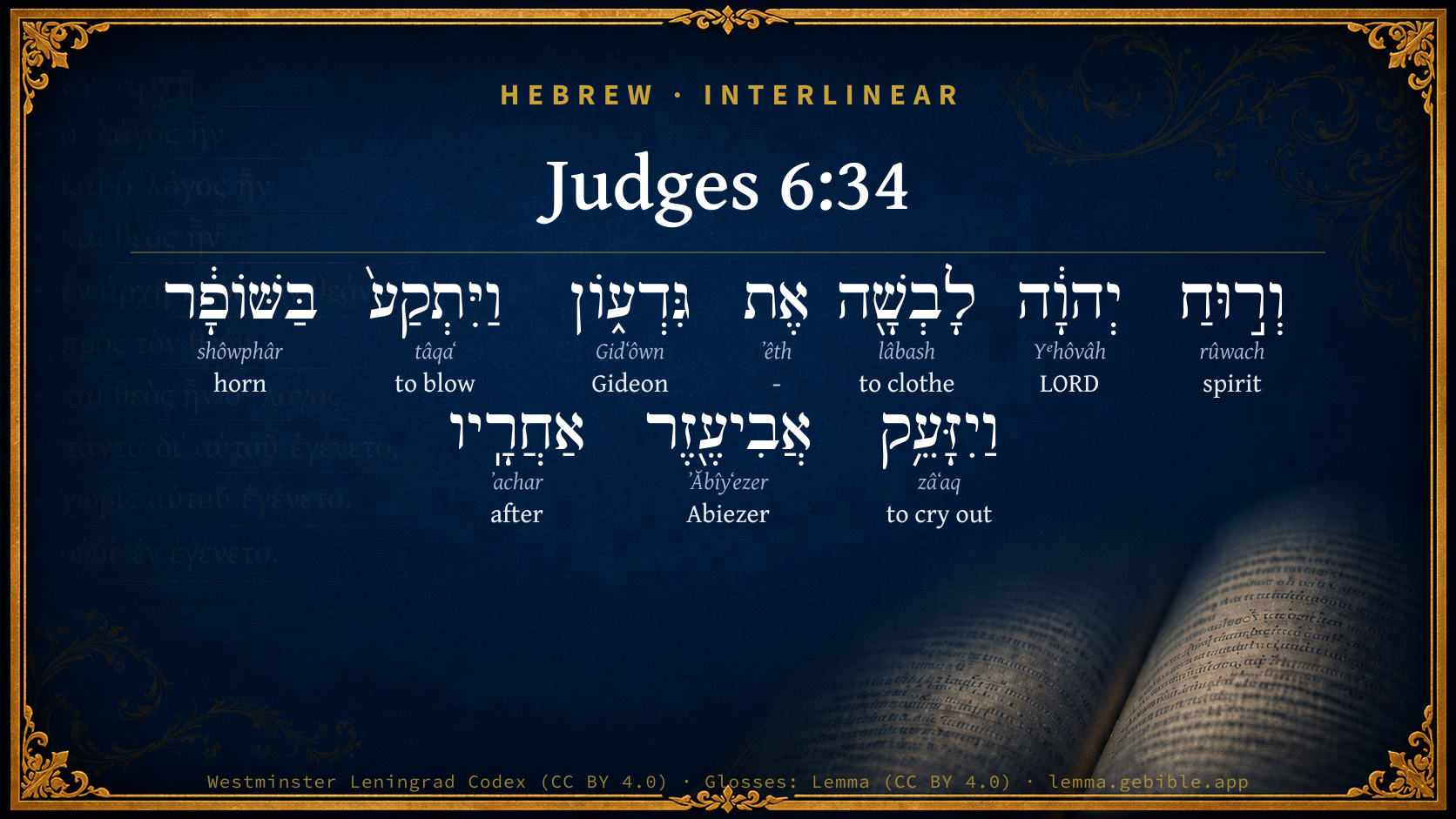
Hebrew (Westminster Leningrad Codex) Judges 6:34 appears in the Hebrew Old Testament. The text above is from the Westminster Leningrad Codex. Each word links to its Strong’s number, a concise gloss, and parsing drawn from the Open Scriptures Hebrew Bible morphology. Click any word for its full Brown-Driver-Briggs (BDB) entry.
Download image
Cite this verse

Judges 6:34 (World English Bible). Public Domain. Lemma interlinear Bible study tool, https://lemma.gebible.app/v/judges/6/34.

Show BibTeX & RIS
BibTeX
RIS
English Translation
But the Spirit of Yahweh came on Gideon; and he blew a trumpet; and Abiezer was gathered together after him.
World English Bible · Public Domain
Download a study sheet

One document with this verse’s original text, its word-by-word gloss line, the meaning frame, cross-references with their text, attributed commentary, and full source and license credits — printable, and it pastes into notes with its structure intact.

This verse Autodidact and up

Study sheet (.html) Plain text (.txt)

A passage Seminary Student

Up to 50 verses in one chapter. A passage sheet keeps up to 6 commentary sources and 12 cross-references per verse, in the order this page ranks them, and says so on the sheet whenever that leaves anything out. Ask for a single verse and you get the Autodidact verse sheet above.

Everything on this page stays free to read, with no account — the sheet is a download of what is already on screen, not access to it.

Want to remove ads? Support Godless Engineer
Compare translations 3

The same verse in 3 English versions, stacked beneath the original-language interlinear above. Click any original word for its lexicon entry.

Each is an independent rendering of the whole verse — the interlinear is not word-aligned to these translations.

Highlighted words mark where these versions differ — a whole-verse word diff, not a word-by-word alignment.

  • World English Bible Public Domain
    But the Spirit of Yahweh came on Gideon; and he blew a trumpet; and Abiezer was gathered together after him.
  • King James Version Public Domain
    But the Spirit of the LORD came upon Gideon, and he blew a trumpet; and Abiezer was gathered after him.
  • unfoldingWord Literal Text CC BY-SA 4.0
    Then the Spirit of Yahweh wore Gideon, and he blew on the shofar, and he summoned Abiezer after him.

unfoldingWord Literal Text — © unfoldingWord, licensed CC BY-SA 4.0. Word-aligned USFM3 via Door43 (git.door43.org/unfoldingWord/en_ult).

Versions to compare (up to 4)

3 of 4 selected

Show all 18 translations

Every available English version of this verse, each an independent rendering of the whole verse.

  • World English Bible Public Domain
    But the Spirit of Yahweh came on Gideon; and he blew a trumpet; and Abiezer was gathered together after him.
  • Berean Standard Bible Public Domain
    So the Spirit of the LORD came upon Gideon, who blew the ram’s horn and rallied the Abiezrites behind him.
  • Majority Standard Bible Public Domain
    So the Spirit of the LORD came upon Gideon, who blew the ram’s horn and rallied the Abiezrites behind him.
  • King James Version Public Domain
    But the Spirit of the LORD came upon Gideon, and he blew a trumpet; and Abiezer was gathered after him.
  • American Standard Version (1901) Public Domain
    But the Spirit of Jehovah came upon Gideon; and he blew a trumpet; and Abiezer was gathered together after him.
  • Revised Version (1885) Public Domain
    But the spirit of the LORD came upon Gideon; and he blew a trumpet; and Abiezer was gathered together after him.
  • Geneva Bible (1599) Public Domain
    But the Spirit of the Lord came vpon Gideon, and he blew a trumpet, and Abiezer was ioyned with him.
  • Douay-Rheims (1899) Public Domain
    Now all Madian, and Amalec, and the eastern people were gathered together, and passing over the Jordan, camped in the valley of Jezrael.
  • Young's Literal Translation Public Domain
    and the Spirit of Jehovah hath clothed Gideon, and he bloweth with a trumpet, and Abi-Ezer is called after him;
  • Literal Standard Version CC BY-SA 4.0
    and the Spirit of YHWH has clothed Gideon, and he blows with a horn, and Abi-Ezer is called after him;
  • Unlocked Literal Bible CC BY-SA 4.0
    But the Spirit of Yahweh came over Gideon. Gideon blew a trumpet, calling out the clan of Abiezer, so they might follow him.
  • unfoldingWord Literal Text CC BY-SA 4.0
    Then the Spirit of Yahweh wore Gideon, and he blew on the shofar, and he summoned Abiezer after him.
  • Darby Bible Public Domain
    But the Spirit of the LORD took possession of Gideon; and he sounded the trumpet, and the Abiez'rites were called out to follow him.
  • World Messianic Bible Public Domain
    But the LORD’s Spirit came on Gideon, and he blew a shofar; and Abiezer was gathered together to follow him.
  • Webster's Bible Public Domain
    But the Spirit of the LORD came upon Gideon, and he blew a trumpet; and Abiezer was called after him.
  • Free Bible Version CC BY-SA 4.0
    The Spirit of the Lord came on Gideon, and he blew the trumpet, calling the Abiezrites to join him.
  • Bible in Basic English Public Domain
    But the spirit of the Lord came on Gideon; and at the sound of his horn all Abiezer came together after him.
  • JPS Tanakh (1917) Public Domain
    But the spirit of the LORD clothed Gideon; and he blew a horn; and Abiezer was gathered together after him.

Literal Standard Version (2020), Covenant Press — licensed CC BY-SA 4.0. Text via the HelloAO Bible API (eBible.org). Unlocked Literal Bible (unfoldingWord) — licensed CC BY-SA 4.0. Text via the HelloAO Bible API (eBible.org). unfoldingWord Literal Text — © unfoldingWord, licensed CC BY-SA 4.0. Word-aligned USFM3 via Door43 (git.door43.org/unfoldingWord/en_ult). Free Bible Version, Dr. Jonathan Gallagher — licensed CC BY-SA 4.0. Text via the HelloAO Bible API (eBible.org).

Word by word

More ways to search: Search by grammar → Find every occurrence → Compare this word →

Practice this passage: Drill this verse → Learn its vocabulary →

About this verse

These counts appear in no published source. They are computed here, from the morphology-tagged text and Lemma’s own curated glosses. What Lemma adds →

10
words
10
distinct lemmas
Historical
section

Notable vocabulary

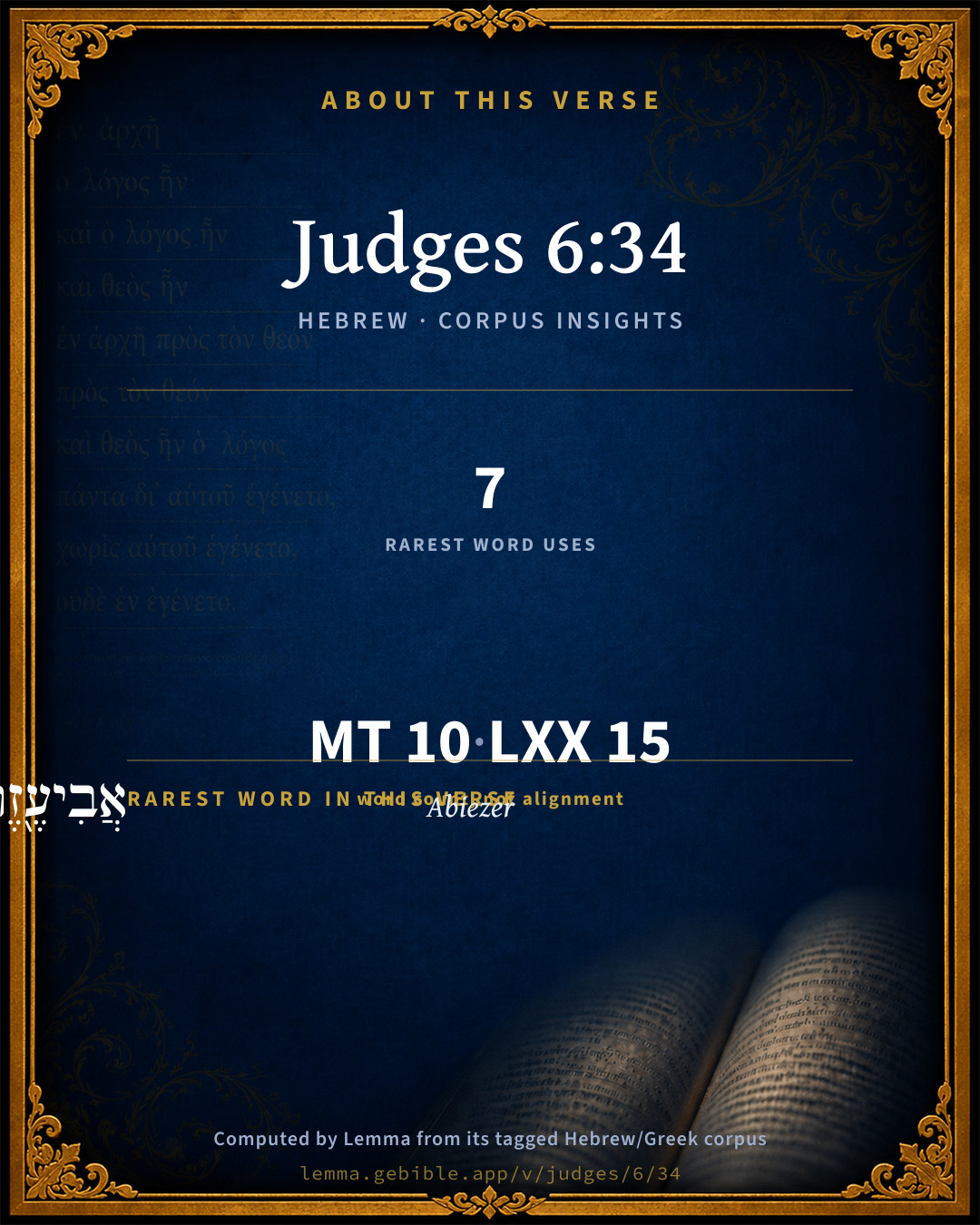
The rarest word here is אֲבִיעֶ֖זֶר Abiezer H44 — appearing just 7 times in the whole Hebrew Bible.

Shared distinctive vocabulary

אֲבִיעֶ֖זֶר Abiezer H44 occurs in 7 verses of the Hebrew Bible. Also found in:

Grammatical profile

  • 3 verbs
  • 5 nouns
  • 1 preposition
  • 1 particle

Verb forms

  • לָבְשָׁ֖ה Qal · Perfect
  • וַיִּתְקַע֙ Qal · Sequential Imperfect
  • וַיִזָּעֵ֥ק Niphal · Sequential Imperfect

Hebrew & Septuagint length

In English translation the verse runs 20 words from the Hebrew and 22 from the Septuagint (LXX English) — closely comparable.

A rough comparison of the two English renderings, which tokenize alike — not a word-level alignment.

Word counts can differ between the Hebrew and the Greek without any difference in meaning — e.g. the Hebrew direct-object marker אֵת has no separate Greek word, and Greek often adds the article ὁ.

In the original languages it is 10 Hebrew tokens and 15 Greek tokens — but the two are counted differently (Hebrew bundles its prefixes and suffixes into one token; the Greek is in lemma form), so that isn’t a like-for-like length.

Cross-references

18

Topical passages linked to Judges 6:34 in the Treasury of Scripture Knowledge — connected by theme and wording, ordered by reader-vote popularity; previews shown in the World English Bible.

  • 2 Chronicles 24:20 The Spirit of God came on Zechariah the son of Jehoiada the priest; and he stood above the people, and said to them, Thus says God, Why disobey you the commandments of Yahweh, so that you can't prosper? because you have forsaken Yahweh, he has also forsaken you.
  • Judges 3:10 The Spirit of Yahweh came on him, and he judged Israel; and he went out to war, and Yahweh delivered Cushan Rishathaim king of Mesopotamia into his hand: and his hand prevailed against Cushan Rishathaim.
  • Judges 3:27 It happened, when he had come, that he blew a trumpet in the hill-country of Ephraim; and the children of Israel went down with him from the hill-country, and he before them.
  • 1 Chronicles 12:18 Then the Spirit came on Amasai, who was chief of the thirty, [and he said], "We are yours, David, and on your side, you son of Jesse: peace, peace be to you, and peace be to your helpers; for your God helps you." Then David received them, and made them captains of the band.
  • Romans 13:14 But put on the Lord Jesus Christ, and make no provision for the flesh, for its lusts.
  • Psalms 51:11 Don't throw me from your presence, And don't take your holy Spirit from me.
  • 1 Samuel 11:6 The Spirit of God came mightily on Saul when he heard those words, and his anger was kindled greatly.
  • 1 Samuel 16:14 Now the Spirit of Yahweh departed from Saul, and an evil spirit from Yahweh troubled him.
  • 1 Corinthians 12:8–11 For to one is given through the Spirit the word of wisdom, and to another the word of knowledge, according to the same Spirit;
  • Galatians 3:27 For as many of you as were baptized into Christ have put on Christ.
  • Numbers 10:3 When they shall blow them, all the congregation shall gather themselves to you at the door of the tent of meeting.
  • Joshua 17:2 So [the lot] was for the rest of the children of Manasseh according to their families: for the children of Abiezer, and for the children of Helek, and for the children of Asriel, and for the children of Shechem, and for the children of Hepher, and for the children of Shemida: these were the male children of Manasseh the son of Joseph according to their families.
  • Judges 6:11 The angel of Yahweh came, and sat under the oak which was in Ophrah, that pertained to Joash the Abiezrite: and his son Gideon was beating out wheat in the winepress, to hide it from the Midianites.
  • Judges 8:2 He said to them, What have I now done in comparison with you? Isn't the gleaning of the grapes of Ephraim better than the vintage of Abiezer?
  • Judges 13:25 The Spirit of Yahweh began to move him in Mahaneh-dan, between Zorah and Eshtaol.
  • Judges 14:19 The Spirit of Yahweh came mightily on him, and he went down to Ashkelon, and struck thirty men of them, and took their spoil, and gave the changes [of clothing] to those who declared the riddle. His anger was kindled, and he went up to his father's house.
  • Judges 15:14 When he came to Lehi, the Philistines shouted as they met him: and the Spirit of Yahweh came mightily on him, and the ropes that were on his arms became as flax that was burnt with fire, and his bands dropped from off his hands.
  • 1 Samuel 10:6 and the Spirit of Yahweh will come mightily on you, and you shall prophesy with them, and shall be turned into another man.

Cross-references courtesy of OpenBible.info (CC BY 4.0).

Hebrew and Greek witnesses Masoretic Hebrew ↔ Greek Septuagint

The same verse in the two great witnesses to the Old Testament, shown verse-for-verse.

These are two independent witnesses, not word-aligned to each other, and the Septuagint is shown in lemma (dictionary) form.

Hebrew Judges 6:34 Masoretic · Westminster Leningrad Codex

וְר֣וּחַ יְהוָ֔ה לָבְשָׁ֖ה אֶת גִּדְע֑וֹן וַיִּתְקַע֙ בַּשּׁוֹפָ֔ר וַיִזָּעֵ֥ק אֲבִיעֶ֖זֶר אַחֲרָֽיו

But the Spirit of Yahweh came on Gideon; and he blew a trumpet; and Abiezer was gathered together after him.

World English Bible · Public Domain

Greek LXX Judges 6:34 Septuagint · lemma form

καί πνεῦμα κύριος ἐνδυναμόω ὁ γεδεων καί σαλπίζω ἐν κερατίνη καί φοβέω αβιεζερ ὀπίσω αὐτός

And the Spirit of the Lord came upon Gedeon, and he blew with the horn, and Abiezer came to help after him.

LXX2012 (modern English Septuagint) · Public Domain

On this verse, Ellicott's Commentary for English Readers discusses the Septuagint’s reading. Read the note in Commentary ↓

Hebrew: Westminster Leningrad Codex (CC BY 4.0). Greek: Septuagint (public domain); English from LXX2012 (modern English Septuagint) (Public Domain). How the Septuagint differs from the Hebrew →

Targum (Aramaic paraphrase)

1

The Targum is the ancient Jewish Aramaic paraphrase of the Hebrew Scriptures — an interpretive translation, not the Hebrew text itself. Onkelos (literal) and Pseudo-Jonathan (expansive) render the Torah, and Jonathan the Prophets. Coverage is partial: where no permissively-licensed English translation exists for a verse, only the Aramaic is shown. This is verse-level text, not a word-by-word alignment to the Hebrew.

  1. Targum Jonathan Prophets (Joshua–Malachi)
    וְרוּחַ גְבוּרָא מִן קֳדָם יְיָ לְבִישַׁת יַת גִדְעוֹן וּתְקַע בְּשׁוֹפָרָא וְאִתְכְּנִישׁוּ אֱנַשׁ אֲבִיעֶזֶר בַּתְרוֹהִי:

    (no public-domain English translation for this verse)

    Targum Jonathan — Aramaic: “Mikraot Gedolot” (public domain). English: “Sefaria Community Translation” (CC0 1.0 (public-domain dedication)); “London "Chaldee Paraphrase," 1871” (public domain). Text via Sefaria.

Commentary

Notes on Judges 6:34 from classic Christian and Jewish commentators (each source and its license shown beneath its notes). The classic Christian expositions comment on the surrounding passage and are grouped to its opening verse, so a note may address several verses; the Jewish commentaries on the Tanakh (Rashi and others) are per-verse, so they appear only where the commentator wrote on this verse.

Lemma curates 59 commentaries, every one of them public domain or Creative Commons licensed, each selected and text-cleaned for this edition rather than reprinted as found. About our sources →

Trapp's Complete Commentary

John Trapp

Jdg 6:34 But the Spirit of the LORD came upon Gideon, and he blew a trumpet; and Abiezer was gathered after him.

Ver. 34. But the Spirit of the Lord came upon Gideon.] Who had not his name for nought: for it signifieth a feller, or cutter down. He had manfully cut down Baal’s grove, and now God had brought him these barbarians that he might hew them down, and cut them in pieces: for which end also the Spirit of the Lord clothed him with wisdom, zeal, and fortitude.

John Trapp, A Commentary or Exposition upon All the Books of the Old and New Testament (1647–1656) — public domain. Text from a community e-Sword module.

The Biblical Illustrator

Joseph S. Exell

Jdg_6:34-35

He blew a trumpet, and Abi-ezer was gathered after him.

The muster

And what did he do? He seized a trumpet and blew a blast so loud that it startled the slumbering echoes of the hills, and stirred to the lowest depths the latent patriotism of the inhabitants of Abi-ezer. The martial notes of that shrill clarion as they pierced their ears operated like a charm on their minds, suffering as they were under the intolerable burden of suspense, not knowing how soon the enemy might be upon them, and might find them unprepared. Now their hearts beat strong with a new hope. Behold how suddenly and effectually the popular mind may undergo a thorough revolution! Where now were all their prejudices and fury and spite against Gideon? Before the startling peals of that trumpet blast they had vanished like a dream. Striking illustration of the expulsive power of a new affection or emotion of the mind! Yet a more striking illustration still of the truth to which we have already referred, namely, that God can make the very enemies of a godly man to be at peace with him, and even only too glad to come under his wing. See how they crowd around the man whom but yesterday they would have torn to pieces in expiation of his offence. Behold how readily they obey his summons, and how confidingly they look to him as the hero of the hour! So sure is real worth to rise to a premium in general esteem, when circumstances occur which call for more than ordinary wisdom, integrity, decision, fortitude, and nerve in the conduct of affairs. At such a time those who have contrived to suit themselves to the popular fancy during a season of ease and luxury are sure to be cast off, and men of sterner mould, men of high moral principle and integrity, men whose hearts are animated by the spirit of a hero, how ungainly soever the exterior beneath which they beat--men such as Havelock and Lawrence--are as sure to be in great demand, neglected though till then they may have been, and perhaps sneered at and despised by inferior souls. And in how many cases in the history of nations have such men as these--the Ezras, the Nehemiahs, the Jeroboams, the Gideons of our race--proved the right men in the right place, when elevated by a discerning country to that rank and authority and influence for which they were fitted above all others in virtue of their sterling worth. This is a lesson of too great importance to be lightly urged. How strikingly does the experience of Gideon, at this stage of his story, prove that no man who is conscious of being endowed with superior natural talents in combination with high moral principle should allow himself to be discouraged even though for a season he may fail to be duly appreciated by his fellow-men. Let him bide his time. Even in the piping times of peace, when there are no symptoms of coming convulsion, it is deemed the part of prudence to keep our arsenals well stored with the munitions of war, and standing army is maintained in continual readiness for whatever may occur. For who can tell how soon or how suddenly wild wars deadly blast may be blown, and its blood-hounds be let loose. And so it ought ever to be with body, soul, and spirit--the whole man. Reason, religion, experience, and common-sense, all combine to indicate that it is at once the duty and the interest of every one (leaving the future in the hands of God) to go straight forward in the improvement of all his talents and opportunities, and in the pursuit and practice of what is right, heedless of what men may say or do, satisfied that in due time God will secure for him the very place which it is fittest and best that he should occupy, in spite of all the opposition of earth or hell. (W. W. Duncan, M. A.)

The muster

What a strange, unwonted appearance must the market-place of Ophrah have presented at this juncture. The inhabitants had found something else to occupy them now than the martyrdom of Gideon. Rather than have injured a hair of his head, there was not one perhaps who would not have plucked out his eyes, and given them unto him, had the sacrifice been demanded, such and so general was the enthusiasm for him which now prevailed. As for ordinary business, it was in a great measure suspended, the grand business now in hand being to prepare for war. The sounds with which the ear must have been most familiar at that time were the ring of the anvil, the hiss of the grindstone, the shrill notes of the bugle and the clash of arms. And ever as a new arrival from distant parts took place, and ever as the colours of the different tribes that had received a summons were recognised, how would the air be rent with joyful acclamations. Here might be seen a band of stalwart shepherds and woodcutters from Lebanon, there a crew of sailors from the coasts of Asher. Yonder, streaming over the hills, eager to join their brethren, are a long line of fishermen from Zebulon and Naphtali, who have left their nets and boats on the shores of the sea of Galilee, accompanied by many of their own tribes of various grades and of various professions. All seem to be animated by one spirit--a spirit of patriotism, a desire to rid their beloved country at once and for ever of that hateful yoke under which for seven long years they had groaned, and thus to be restored once more to their ancestral liberties and rights. (W. W. Duncan, M. A.)

The Biblical Illustrator, edited by Joseph S. Exell (c. 1880s–1900s) — public domain. Text from a community e-Sword module.

Geneva Bible (1599)

Geneva Bible translators

Hebrew, clad Gideon.

The family of Abiezer, whereof he was.

Geneva Bible (1599) marginal notes — public domain. Text via Bolls.life.

Jamieson, Fausset & Brown

Robert Jamieson, A. R. Fausset & David Brown

the Spirit of the Lord came upon Gideon--Called in this sudden emergency into the public service of his country, he was supernaturally endowed with wisdom and energy commensurate with the magnitude of the danger and the difficulties of his position. His summons to war was enthusiastically obeyed by all the neighboring tribes. On the eve of a perilous enterprise, he sought to fortify his mind with a fresh assurance of a divine call to the responsible office. The miracle of the fleece was a very remarkable one--especially, considering the copious dews that fall in his country. The divine patience and condescension were wonderfully manifested in reversing the form of the miracle. Gideon himself seems to have been conscious of incurring the displeasure of God by his hesitancy and doubts; but He bears with the infirmities of His people.

Next: Judges Chapter 7

Jamieson, Fausset & Brown — Commentary Critical and Explanatory on the Whole Bible (1871) — public domain (CC PDM 1.0). Text via the HelloAO Bible API.

Adam Clarke's Commentary

Verse 34. The Spirit of the Lord came upon Gideon] He was endued with preternatural courage and wisdom.

Adam Clarke's Commentary on the Bible (1810–1826) — public domain. Text from a community e-Sword/MySword module.

Ellicott's Commentary for English Readers

(34) Came upon Gideon.—Literally, clothed Gideon. See Jdg_3:10 (Othniel); Jdg_11:29 (Jephthah); Jdg_13:25 (Samson). This forcible figure is found also in 1Ch_12:18 ( Amasai); 2Ch_24:20 (Zechariah); Psa_59:17; and in the New Testament, Luk_24:49 (endusçsthe); Gal_3:27 (enedusasthe Christon); 1Pe_5:5 (enkombôsasthe).

Blew a trumpet.—See Jdg_3:27. The trumpet is shophar, or ram’s horn (LXX., keratine). Gideon’s call was two-fold: the first he had already obeyed in destroying the Baal-worship at Ophrah; he now begins to obey the second, which was to deliver his country.

A Bible Commentary for English Readers, edited by Charles John Ellicott (1878–1897) — public domain. Text from a community e-Sword module.

The Cambridge Bible for Schools and Colleges

gen. ed. J. J. S. Perowne

34. the spirit of the Lord came upon] lit. ‘put on as a garment,’ i.e. took possession of Gideon; cf. 1Ch_12:18, 2Ch_24:20. The verb is used in Syriac with the same metaphorical sense; e.g. ‘Ignatius, God-clad and martyr,’ a frequent expression in the Syr. fragments of the Ignatian Epistles1[38]. Cf. also Rom_13:14. For the spirit of the Lord see on Jdg_3:10.

[38] Lightfoot, Apostolic Fathers i. 184–190, iii. 100, 111.

blew a trumpet] Cf. Jdg_3:27. Gideon’s own clansmen respond to the call; they seem to be the 300 who follow him in Jdg_8:4-21. This verse would form a suitable continuation of 11–24.

The Cambridge Bible for Schools and Colleges (gen. ed. J. J. S. Perowne; Cambridge University Press, 1878–1918) — public domain. Text from a community e-Sword module.

John Gill's Exposition

And he sent messengers through all Manasseh,.... Of which tribe he was; not only he called by the trumpet that part of the tribe, the Abiezrites, who were within the sound of it, but the rest of the tribe at a greater distance from him he sent messengers to, acquainting them with his design, and inviting them to his assistance. Some think this refers both to the half tribe of Manasseh within Jordan, and the other half tribe on the other side Jordan; but that is not very probable, only the half tribe within it is meant:

who also was gathered after him; obeying the summons and invitation he gave them by the messengers:

and he sent messengers unto Asher, and unto Zebulun, and unto Naphtali; which three tribes lay nearest to him on the north; but he sent not to the inhabitants of the tribe of Ephraim, which lay to the south, and which afterwards occasioned a quarrel, Jdg 8:1.

and they came up to meet them; that is, the inhabitants of the above three tribes, at least many of them, came up from the places of their habitations to meet Gideon, and those that were associated with him, at their place of rendezvous.

John Gill's Exposition of the Whole Bible (1746–1763) — public domain (CC PDM 1.0). Text via the HelloAO Bible API.

Albert Barnes' Notes on the Bible

The Spirit of the Lord came upon Gideon - See the margin. The word contains a striking thought. It is different from that used in the case of Othniel Jdg 3:10, Jephthah Jdg 11:29, and Samson Jdg 13:25; Jdg 14:6, Jdg 14:19.

Albert Barnes' Notes on the Bible (1834–1885) — public domain. Text from a community e-Sword/MySword module.

Haydock's Catholic Bible Commentary

Him. He first calls his relations, and then the neighbouring tribes, to march against the enemy. He had before declared God’s orders, and was recognized as judge and deliverer of Israel; so that no one objects to his exercising this act of sovereignty.

George Leo Haydock (1774–1849), Haydock's Catholic Family Bible and Commentary, 1859 edition — public domain. Excludes Psalms (Douay-Rheims chapter numbering differs from Protestant) and Deuterocanonical books (Catholic canon only).

Matthew Poole's English Annotations

Came upon Gideon, inspiring him with extraordinary wisdom, and courage, and zeal, to vindicate God’s honour and his country’s liberty. Compare 1Ch 12:18; 2Ch 24:20.

Abi-ezer, i.e. the Abi-ezrites, his kindred, And their servants, and others; who finding no harm coming to him for the destroying of Baal, but rather a blessing from God, in giving him strength and courage for so great and dangerous an attempt, changed their minds, and followed him as the person by whose hands God would deliver them.

Matthew Poole's English Annotations on the Holy Bible (1683–1685) — public domain. Text from a community e-Sword/MySword module.

Whedon's Commentary on the Bible

Daniel D. Whedon

34. The Spirit of the Lord came upon Gideon — Literally, clothed him; wrapped him round as with a garment, or a strong coat of mail, so as to make him secure against his foes. Compare the same expression in 1Ch_12:18; 2Ch_24:20; Luk_24:49.

Blew a trumpet — The customary signal for calling troops together, or collecting an army. Comp. Jdg_3:27.

Abi-ezer was gathered — That is the family or descendants of Abi-ezer, who dwelt in Ophrah. His own kindred were the first to rally around him; next his tribe, and then other tribes.

Daniel D. Whedon (gen. ed.), Commentary on the Old and New Testaments (1874–1909) — public domain. Text from a community e-Sword module.

The Pulpit Commentary

The Spirit of the Lord, etc. See Jud_1:3:10 11:29 13:25 14:6, 19; cf. Isa_11:2 Isa 61:1Jo Isa 20:22 Act_13:2 Act_20:28; and 1Co_12:4. Abi-ezer. His own family. (ver. 11; see Jos_17:2) In Num_26:30 the name appears as Jeezer, by a very defective transliterationAiezer represents the Hebrew letters. The b has probably fallen out by accident. Here we have the immediate fruit of Gideon s daring in the cause of God. The whole family of Abi-ezer, numbering probably thousands, sprang to his side.

The Pulpit Commentary (1880–1919), ed. H.D.M. Spence-Jones & Joseph S. Exell — public domain. Text from a community e-Sword module.

John Wesley's Explanatory Notes

The spirit came - Inspiring him with extraordinary wisdom, and courage, and zeal to vindicate God's honour, and his country's liberty. The Hebrew is, The Spirit of the Lord clothed Gideon; clothed him as a robe, to put honour upon him; clothed him as a coat of mail to put a defense upon him. Those are well clad that are thus clothed. Abiezer - That is, the Abiezrites, his kindred, and their servants, and others; who finding no harm coming to him for destroying Baal, but rather a blessing from God, in giving him strength and courage for so great an attempt, changed their minds, and followed him as the person by whose hands God would deliver them.

John Wesley, Explanatory Notes Upon the Whole Bible (1754–1765) — public domain. Text via the GEBible commentary corpus.

unfoldingWord translationNotes

Door43 World Missions Community

came over Gideon

This is an idiom. AT: "took control of Gideon" (See: Idiom)

clan of Abiezer

Translate the name of this people group as you did in Judges 6:11.

so they might follow him

The words "to battle" are understood. AT: "so they might follow him to battle" (See: Ellipsis)

and they too, were called out to follow him

This can be stated in active form. AT: "calling them out to follow him" (See: Active or Passive)

to Asher, Zebulun, and Naphtali

These all represent the people of each tribe. AT: "to the tribes of Asher, Zebulun, and Naphtali" (See: Metonymy)

translationWords

Holy Spirit

Yahweh

Gideon

trumpet

call

clan

send

messenger

Manasseh

Asher

Zebulun

Naphtali

unfoldingWord translationNotes — © Distant Shores Media and the Door43 World Missions Community, licensed CC BY-SA 4.0. Source: git.door43.org/Door43/en_tn.

Rashi

Rabbi Shlomo Yitzchaki (Rashi)

The Divine spirit. The spirit of valor.

Aviezer gathered. The entire clan.

Rashi on the Tanakh — English translations: “The Judaica Press complete Tanach with Rashi, translated by A. J. Rosenberg” (CC BY 4.0); “Pentateuch with Rashi's commentary by M. Rosenbaum and A.M. Silbermann, 1929-1934” (public domain); “The Metsudah Tanach series, Lakewood, N.J” (CC BY 4.0); and “The Book of Joshua, Metsudah Publications, 1997” (CC BY 4.0). Text via Sefaria.

Lesson kit

Teaching starters — assembled from the data on this page, not authored interpretation. Every prompt links to the verse data it draws on. Edit before teaching.

Judges, in the Historical, opens this verse with 10 words (10 distinct Hebrew lemmas). Its most distinctive word is ʼĂbîyʻezer (“Abiezer”). A historical commentator’s framing appears above. Read the whole chapter for the surrounding context.

Discussion questions

  1. What does “Abiezer” (ʼĂbîyʻezer) contribute to the verse as a whole?
  2. How does Joshua 17:2, which shares the word «Abiezer», read alongside this verse?
  3. These translations render this verse differently; the difference is in the English rendering, not the original. What questions does that raise?
  4. «לָבְשָׁ֖ה» is a Qal Perfect verb. How does that grammatical form shape the action described?
  5. Compare how Trapp's Complete Commentary and The Biblical Illustrator read this verse. Where do they agree or differ?

Things to notice

Reading settings

Reading text

Shown beneath each verse's original-language words.

Old Testament
Old Testament edition

Read the OT as the Masoretic Hebrew (MT) or the Greek Septuagint (LXX).

English shown for the Greek Septuagint (in the Hebrew ↔ Greek comparison).

Comparing translations? Open the Compare panel on any verse page to stack up to four side by side.