
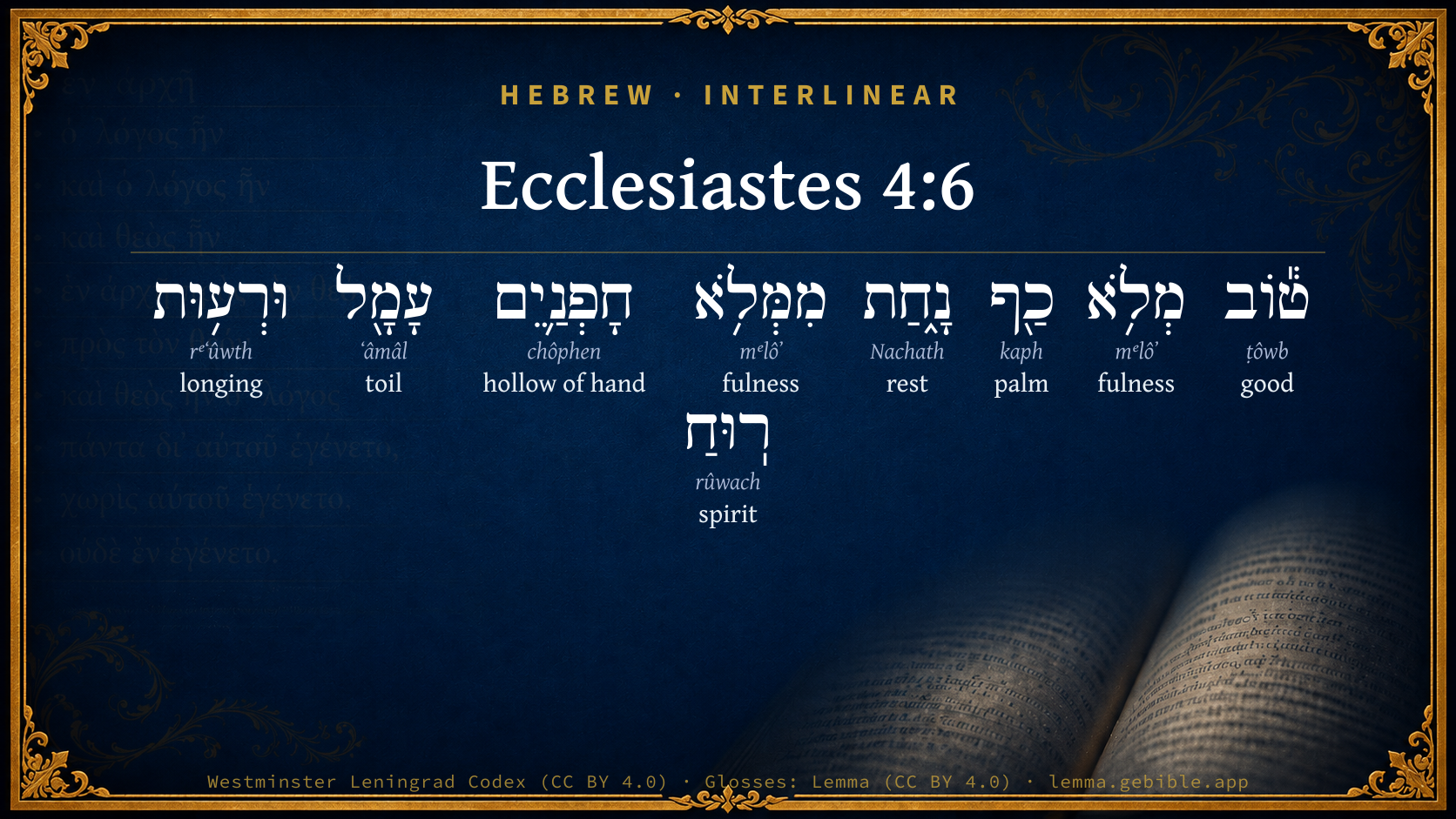
Ecclesiastes 4:6

Hebrew (Westminster Leningrad Codex) Ecclesiastes 4:6 appears in the Hebrew Old Testament. The text above is from the Westminster Leningrad Codex. Each word links to its Strong’s number, a concise gloss, and parsing drawn from the Open Scriptures Hebrew Bible morphology. Click any word for its full Brown-Driver-Briggs (BDB) entry.
Download image
Cite this verse

Ecclesiastes 4:6 (World English Bible). Public Domain. Lemma interlinear Bible study tool, https://lemma.gebible.app/v/ecclesiastes/4/6.

Show BibTeX & RIS
BibTeX
RIS
English Translation
Better is a handful, with quietness, than two handfuls with labor and chasing after wind.
World English Bible · Public Domain
Download a study sheet

One document with this verse’s original text, its word-by-word gloss line, the meaning frame, cross-references with their text, attributed commentary, and full source and license credits — printable, and it pastes into notes with its structure intact.

This verse Autodidact and up

Study sheet (.html) Plain text (.txt)

A passage Seminary Student

Up to 50 verses in one chapter. A passage sheet keeps up to 6 commentary sources and 12 cross-references per verse, in the order this page ranks them, and says so on the sheet whenever that leaves anything out. Ask for a single verse and you get the Autodidact verse sheet above.

Everything on this page stays free to read, with no account — the sheet is a download of what is already on screen, not access to it.

Want to remove ads? Support Godless Engineer
Compare translations 3

The same verse in 3 English versions, stacked beneath the original-language interlinear above. Click any original word for its lexicon entry.

Each is an independent rendering of the whole verse — the interlinear is not word-aligned to these translations.

Highlighted words mark where these versions differ — a whole-verse word diff, not a word-by-word alignment.

  • World English Bible Public Domain
    Better is a handful, with quietness, than two handfuls with labor and chasing after wind.
  • King James Version Public Domain
    Better is an handful with quietness, than both the hands full with travail and vexation of spirit.
  • unfoldingWord Literal Text CC BY-SA 4.0
    Better a fullness of a palm quiet than a fullness of handfuls toil and pursuit of wind.

unfoldingWord Literal Text — © unfoldingWord, licensed CC BY-SA 4.0. Word-aligned USFM3 via Door43 (git.door43.org/unfoldingWord/en_ult).

Versions to compare (up to 4)

3 of 4 selected

Show all 18 translations

Every available English version of this verse, each an independent rendering of the whole verse.

  • World English Bible Public Domain
    Better is a handful, with quietness, than two handfuls with labor and chasing after wind.
  • Berean Standard Bible Public Domain
    Better one handful with tranquility than two handfuls with toil and pursuit of the wind.
  • Majority Standard Bible Public Domain
    Better one handful with tranquility than two handfuls with toil and pursuit of the wind.
  • King James Version Public Domain
    Better is an handful with quietness, than both the hands full with travail and vexation of spirit.
  • American Standard Version (1901) Public Domain
    Better is a handful, with quietness, than two handfuls with labor and striving after wind.
  • Revised Version (1885) Public Domain
    Better is an handful with quietness, than two handfuls with labour and striving after wind.
  • Geneva Bible (1599) Public Domain
    Better is an handfull with quietnesse, then two handfuls with labour and vexation of spirit.
  • Douay-Rheims (1899) Public Domain
    Better is a handful with rest, than both hands full with labour, and vexation of mind.
  • Young's Literal Translation Public Domain
    `Better `is' a handful `with' quietness, than two handfuls `with' labour and vexation of spirit.'
  • Literal Standard Version CC BY-SA 4.0
    “Better [is] a handful [with] quietness, than two handfuls [with] labor and distress of spirit.”
  • Unlocked Literal Bible CC BY-SA 4.0
    But better is a handful of profit with quiet work than two handfuls with the work that tries to shepherd the wind.
  • unfoldingWord Literal Text CC BY-SA 4.0
    Better a fullness of a palm quiet than a fullness of handfuls toil and pursuit of wind.
  • Darby Bible Public Domain
    Better is a handful with quietness, than both hands full with labour and pursuit of the wind.
  • World Messianic Bible Public Domain
    Better is a handful, with quietness, than two handfuls with labor and chasing after wind.
  • Webster's Bible Public Domain
    Better is a handful with quietness, than both the hands full with toil and vexation of spirit.
  • Free Bible Version CC BY-SA 4.0
    It's better to earn a little without stress than a lot with too much stress and chasing after the wind.
  • Bible in Basic English Public Domain
    One hand full of rest is better than two hands full of trouble and desire for wind.
  • JPS Tanakh (1917) Public Domain
    Better is a handful of quietness, than both the hands full of labour and striving after wind.

Literal Standard Version (2020), Covenant Press — licensed CC BY-SA 4.0. Text via the HelloAO Bible API (eBible.org). Unlocked Literal Bible (unfoldingWord) — licensed CC BY-SA 4.0. Text via the HelloAO Bible API (eBible.org). unfoldingWord Literal Text — © unfoldingWord, licensed CC BY-SA 4.0. Word-aligned USFM3 via Door43 (git.door43.org/unfoldingWord/en_ult). Free Bible Version, Dr. Jonathan Gallagher — licensed CC BY-SA 4.0. Text via the HelloAO Bible API (eBible.org).

Word by word

More ways to search: Search by grammar → Find every occurrence → Compare this word →

Practice this passage: Drill this verse → Learn its vocabulary →

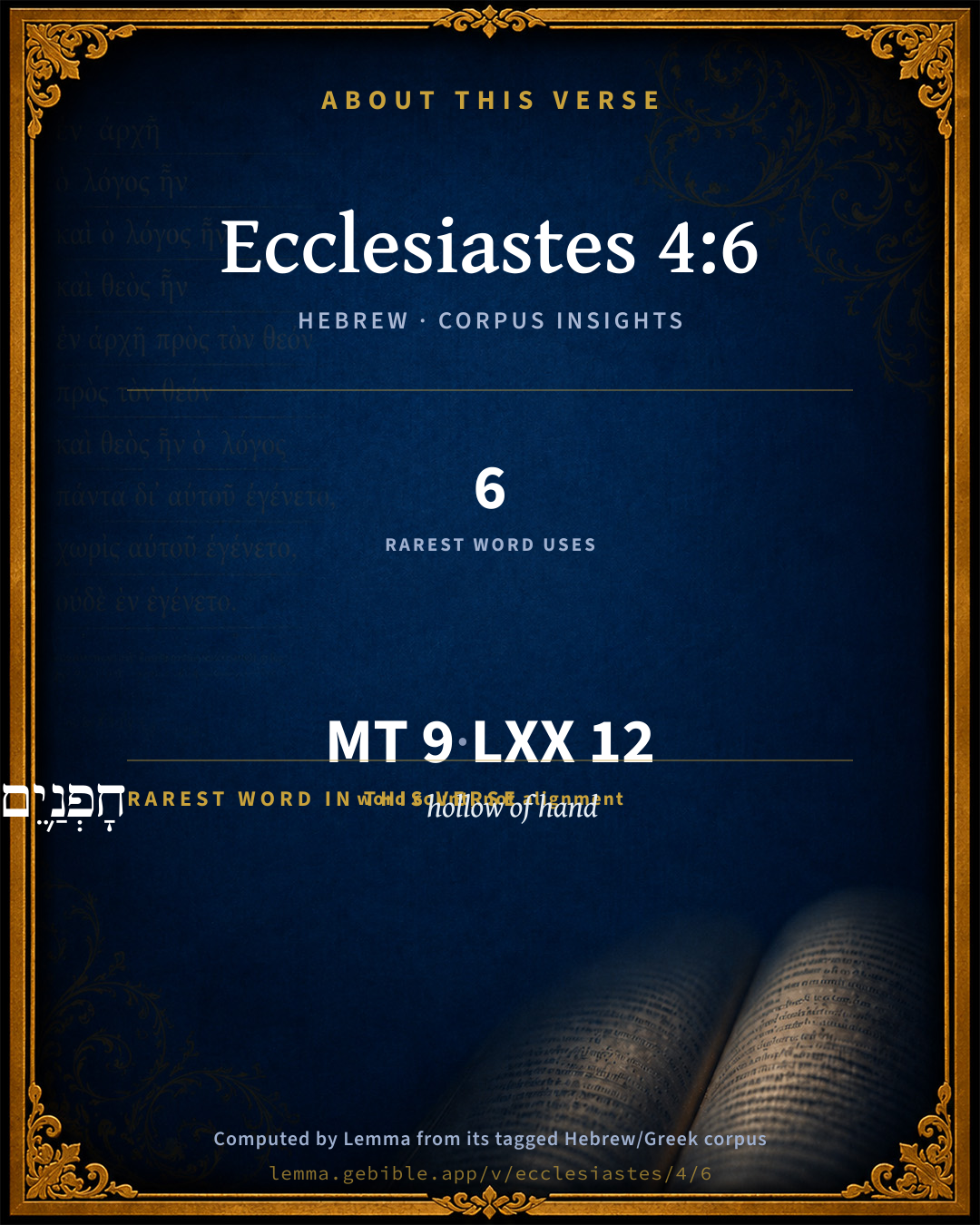
About this verse

These counts appear in no published source. They are computed here, from the morphology-tagged text and Lemma’s own curated glosses. What Lemma adds →

9
words
8
distinct lemmas
Wisdom
section

Notable vocabulary

The rarest word here is חָפְנַ֛יִם hollow of hand H2651 — appearing just 6 times in the whole Hebrew Bible.

Shared distinctive vocabulary

חָפְנַ֛יִם hollow of hand H2651 occurs in 6 verses of the Hebrew Bible. Also found in:

Grammatical profile

  • 8 nouns
  • 1 adjective

Repetition

A word recurs within this verse — often emphatic in Hebrew:

  • מְלֹ֥א fulness H4393 ×2

Hebrew & Septuagint length

In English translation the verse runs 15 words from the Hebrew and 15 from the Septuagint (LXX English) — the same length.

A rough comparison of the two English renderings, which tokenize alike — not a word-level alignment.

Word counts can differ between the Hebrew and the Greek without any difference in meaning — e.g. the Hebrew direct-object marker אֵת has no separate Greek word, and Greek often adds the article ὁ.

In the original languages it is 9 Hebrew tokens and 12 Greek tokens — but the two are counted differently (Hebrew bundles its prefixes and suffixes into one token; the Greek is in lemma form), so that isn’t a like-for-like length.

Cross-references

4

Topical passages linked to Ecclesiastes 4:6 in the Treasury of Scripture Knowledge — connected by theme and wording, ordered by reader-vote popularity; previews shown in the World English Bible.

  • Proverbs 15:16–17 Better is little, with the fear of Yahweh, Than great treasure with trouble.
  • Proverbs 16:8 Better is a little with righteousness, Than great revenues with injustice.
  • Psalms 37:16 Better is a little that the righteous has, Than the abundance of many wicked.
  • Proverbs 17:1 Better is a dry morsel with quietness, Than a house full of feasting with strife.

Cross-references courtesy of OpenBible.info (CC BY 4.0).

Hebrew and Greek witnesses Masoretic Hebrew ↔ Greek Septuagint

The same verse in the two great witnesses to the Old Testament, shown verse-for-verse.

These are two independent witnesses, not word-aligned to each other, and the Septuagint is shown in lemma (dictionary) form.

Hebrew Ecclesiastes 4:6 Masoretic · Westminster Leningrad Codex

ט֕וֹב מְלֹ֥א כַ֖ף נָ֑חַת מִמְּלֹ֥א חָפְנַ֛יִם עָמָ֖ל וּרְע֥וּת רֽוּחַ

Better is a handful, with quietness, than two handfuls with labor and chasing after wind.

World English Bible · Public Domain

Greek LXX Ecclesiastes 4:6 Septuagint · lemma form

ἀγαθός πλήρωμα δράξ ἀνάπαυσις ὑπέρ πλήρωμα δύο δράξ μόχθος καί προαίρεσις πνεῦμα

Better is a handful of rest than two handfuls of trouble and waywardness of spirit.

LXX2012 (modern English Septuagint) · Public Domain

Hebrew: Westminster Leningrad Codex (CC BY 4.0). Greek: Septuagint (public domain); English from LXX2012 (modern English Septuagint) (Public Domain). How the Septuagint differs from the Hebrew →

Commentary

Notes on Ecclesiastes 4:6 from classic Christian and Jewish commentators (each source and its license shown beneath its notes). The classic Christian expositions comment on the surrounding passage and are grouped to its opening verse, so a note may address several verses; the Jewish commentaries on the Tanakh (Rashi and others) are per-verse, so they appear only where the commentator wrote on this verse.

Lemma curates 59 commentaries, every one of them public domain or Creative Commons licensed, each selected and text-cleaned for this edition rather than reprinted as found. About our sources →

Trapp's Complete Commentary

John Trapp

Ecc 4:6 Better [is] an handful [with] quietness, than both the hands full [with] travail and vexation of spirit.

Ver. 6. Better is an handful with quietness.] This is the sluggard’s plea, whereby he bolstereth himself up in his wickedness, and would make you believe that he did, non sine ratione insanire, not play the madman without good reason. To what end, saith he, should a man toil and tire out himself with hard labour to compass commodity - making a drudge and a beast of himself for a little pelf, since he knows not who shall have the spending of it, and he is sure to be either squeezed by his superiors, {as Ecc 4:1} or else envied by his neighbours? {as Ecc 4:4} Is not a little with ease better? a penny by begging better than twopence by true labour? It is well observed by an interpreter, that this sentence uttered by the sluggard, is, in its true meaning, not much different from that of the wise man in Pro 17:1, but ill applied by him. Good words are not always to be trusted, from ill men especially.

John Trapp, A Commentary or Exposition upon All the Books of the Old and New Testament (1647–1656) — public domain. Text from a community e-Sword module.

The Biblical Illustrator

Joseph S. Exell

Ecc_4:6

Better is an handful with quietness, than both the hands full with travail and vexation of spirit.

Quality better than quantity

The quietness here spoken of is not the inactivity of sloth, but that restfulness of spirit which an industrious man may enjoy when his industry is pervaded by a cheerful contentment. Now, here is one of those maxims with which Ecclesiastes sought to comfort the hearts and to direct the conduct of his countrymen. Many of them might be disposed to murmur because the times were adverse to their acquisition of wealth. But he wishes them to remember that, even if the times had been more prosperous, they themselves would not necessarily have been more happy. He directs their attention away from quantity to quality of possession. One man may get more real satisfaction out of a little than another man gets out of much. Two handfuls are not necessarily better than one. It depends on what is in the hands. One handful of grain is better than two handfuls of chaff. It depends also on what kind of man has the handful or handfuls. Happiness, in its degree and quality, varies with the man who enjoys, as welt as with the means of enjoyment. Yea, and even the same man may possibly get more satisfaction out of one handful than out of two handfuls of the same thing. It depends on whether the additional handful does not bring with it something else as well. In human life it often happens that a plus involves a minus; a gain in one direction means a loss in another. This, indeed, is no argument for folding the hands in sloth or indifference; for there is no weariness like the weariness of idleness, and there is no more prolific source of cares than carelessness. But it is an argument against that spirit of envious rivalry and selfish, restless ambition, which lessens the capacity, in the very act of increasing the means, of enjoyment. This maxim of Ecclesiastes is well worth pondering. It is pitched in the same key as the maxim of the Apostle Paul: Godliness with contentment is great gain: and it reminds us of the still more inclusive maxim of our Lord Himself: A mans life consisteth not in the abundance of the things which he possesseth. (T. C. Finlayson.)

The Biblical Illustrator, edited by Joseph S. Exell (c. 1880s–1900s) — public domain. Text from a community e-Sword module.

Joseph Benson's Commentary

Ecc 4:6. Better is a handful with quietness, &c. — These are the words, either, 1st, Of the sluggard, making this apology for his idleness, that his little, with ease, is better than great riches got with much trouble; or, 2d, of Solomon, who elsewhere speaks to the same purpose, and here proposes this antidote against the vanity of immoderate cares and labours for worldly goods, against which he industriously directs his speech in divers places of this book, and particularly in the following passage.

Joseph Benson's Commentary on the Old and New Testaments (1811–1818) — public domain. Text from a community e-Sword module.

Keil & Delitzsch

C. F. Keil & F. Delitzsch

The fifth verse stands in a relation of contrast to this which follows: "Better is one hand full of quietness, than both fists full of labour and windy effort." Mendelssohn and others interpret Ecc 4:5 as the objection of the industrious, and Ecc 4:6 as the reply of the slothful. Zckler agrees with Hitz., and lapses into the hypothesis of a dialogue otherwise rejected by him. As everywhere, so also here it preserves the unity of the combination of thoughts. נחת signifies here, as little as it does anywhere else, the rest of sloth; but rest, in contrast to such activity in labour as robs a man of himself, to the hunting after gain and honour which never has enough, to the rivalry which places its goal always higher and higher, and seeks to be before others - it is rest connected with well-being (Ecc 6:5), gentle quietness (Ecc 9:17), resting from self-activity (Isa 30:15); cf. the post-bibl. רוּח נחת, satisfaction, contentment, comfort. In a word, nahath has not here the sense of being idle or lazy. The sequence of the thoughts is this: The fool in idleness consumes his own life-strength; but, on the other hand, a little of true rest is better than the labour of windy effort, urged on by rivalry yielding no rest. כּף is the open hollow hand, and חפן (Assyr. ḥupunnu) the hand closed like a ball, the first. "Rest" and "labour and windy effort" are the accusatives of that to which the designation of measure refers (Gesen. 118. 3); the accus. connection lay here so much the nearer, as מלא is connected with the accus. of that with which anything is full. In "and windy effort" lies the reason for the judgment pronounced. The striving of a man who laboriously seeks only himself and loses himself in restlessness, is truly a striving which has wind for its object, and has the property of wind.

Keil & Delitzsch — Biblical Commentary on the Old Testament (1861–1891) — public domain (CC PDM 1.0). Text via the HelloAO Bible API. (Old Testament only.)

Jamieson, Fausset & Brown

Robert Jamieson, A. R. Fausset & David Brown

Hebrew; "One open hand (palm) full of quietness, than both closed hands full of travail." "Quietness" (mental tranquillity flowing from honest labor), opposed to "eating one's own flesh" (Ecc 4:5), also opposed to anxious labor to gain (Ecc 4:8; Pro 15:16-17; Pro 16:8).

Jamieson, Fausset & Brown — Commentary Critical and Explanatory on the Whole Bible (1871) — public domain (CC PDM 1.0). Text via the HelloAO Bible API.

Adam Clarke's Commentary

Verse 6. Better is a handful with quietness] These may be the words of the slothful man, and spoken in vindication of his idleness; as if he had said, "Every man who labours and amasses property is the object of envy, and is marked by the oppressor as a subject for spoil; better, therefore, to act as I do; gain little, and have little, and enjoy my handful with quietness." Or the words may contain Solomon's reflection on the subject.

Adam Clarke's Commentary on the Bible (1810–1826) — public domain. Text from a community e-Sword/MySword module.

The Cambridge Bible for Schools and Colleges

gen. ed. J. J. S. Perowne

6. Better is a handful with quietness] The preposition is in both clauses an interpolation, and we should read “a handful of repose, … two handfuls of travail and feeding on wind.” In form the saying presents a parallel to Pro_15:17, “Better is a dinner of herbs where love is, than a stalled ox and hatred therewith;” but the thought is obviously of a less ethical character. The feeling expressed in Ecc_4:5-6 (the latter confirming the interpretation just given of the former) is such as we may think of as rising in the mind of an ambitious statesman or artist striving after fame, as he looks on the dolce far niente of a lazzarone at Naples, half-naked, basking in the sun, and revelling in the enjoyment of his water-melon. The one would at such a time, almost change places with the other, but that something after all forbids. The words have almost a verbal parallelism in our common English proverb “a bird in the hand is worth two in the bush.”

The Cambridge Bible for Schools and Colleges (gen. ed. J. J. S. Perowne; Cambridge University Press, 1878–1918) — public domain. Text from a community e-Sword module.

John Gill's Exposition

Better is a handful with quietness,.... These are the words of the fool, according to Aben Ezra; and which is the sense of other interpreters, particularly Mr. Broughton, who connects this verse with Ecc 4:5 by adding at the end of that the word "saying"; making an excuse or an apology for himself and conduct, from the use and profitableness of his sloth; that little had with ease, and without toil and labour, is much better

than both the hands full with travail and vexation of spirit; than large possessions gotten with a great deal of trouble, and enjoyed with much vexation and uneasiness; in which he mistakes slothful ease for true quietness; calls honest labour and industry travail and vexation; and supposes that true contentment lies in the enjoyment of little, and cannot be had where there is much; whereas it is to be found in a good man in every state: or else these words express the true sentiments of Solomon's mind, steering between the two extremes of slothfulness, and too toilsome labour to be rich; that it is much more eligible to have a competency, though it is but small, with a good conscience, with tranquillity of mind, with the love and fear of God, and a contented heart, than to have a large estate, with great trouble and fatigue in getting and keeping it, especially with discontent and uneasiness; and this agrees with what the wise man says elsewhere, Pro 15:16. The Targum is,

"better to a man is a handful of food with quietness of soul, and without robbery and rapine, than two handfuls of food with robbery and rapine;''

or with what is gotten in an ill way.

John Gill's Exposition of the Whole Bible (1746–1763) — public domain (CC PDM 1.0). Text via the HelloAO Bible API.

Albert Barnes' Notes on the Bible

Either the fool’s sarcasm on his successful but restless neighbor; or the comment of Solomon recommending contentment with a moderate competence. The former meaning seems preferable.

Albert Barnes' Notes on the Bible (1834–1885) — public domain. Text from a community e-Sword/MySword module.

Haydock's Catholic Bible Commentary

Mind. These are the words of the slothful, (Calmet) or of truth. (Haydock) (Proverbs xvii. 1.) --- The indolent will not observe moderation in the application of this sentence. (Menochius)

George Leo Haydock (1774–1849), Haydock's Catholic Family Bible and Commentary, 1859 edition — public domain. Excludes Psalms (Douay-Rheims chapter numbering differs from Protestant) and Deuterocanonical books (Catholic canon only).

Matthew Poole's English Annotations

These are the words, either,

1. Of the sluggard making this apology for his idleness, that his little with ease, is better than great riches got with much trouble. Or,

2. Of Solomon, who elsewhere speaks to the same purpose, as Pro 15:16,17; 17:1, and here proposeth it as a good antidote against the vanity of immoderate cares and labours for worldly goods, against which he industriously directs his speeches in divers places of this book; and particularly as a seasonable precaution against the sin of covetousness, of which he speaks in the following passage.

Matthew Poole's English Annotations on the Holy Bible (1683–1685) — public domain. Text from a community e-Sword/MySword module.

Whedon's Commentary on the Bible

Daniel D. Whedon

6. Better is a handful, etc. — This verse confirms what has been said to the credit of the lazy man, and really assigns a reason for the statement of Ecc_4:5. It would be better to use of in place of “with,” and Hebrew usage would demand it — “handful of quietness,” “both the hands full of travail.”

Daniel D. Whedon (gen. ed.), Commentary on the Old and New Testaments (1874–1909) — public domain. Text from a community e-Sword module.

The Pulpit Commentary

Better is a handful with quietness; literally, better a hand full of rest. Than both the hands full with travail and vexation of spirit; literally, than two hands full of travail, etc. This verse, which has been variously interpreted, is most simply regarded as the fool"s defense of his indolence, either expressed in his own words or fortified by a proverbial saying. One open hand full of quietness and rest is preferable to two closed hands full of toil and vain effort. The verse must not be taken as the writer"s warning against sloth, which would be out of place here, but as enunciating a maxim against discontent and that restless activity which is never satisfied with moderate returns.

The handful with quietness.

The lesson here imparted is proverbial. Every language has its own way of conveying and emphasizing this practical truth. Yet it is a belief more readily professed than actually made the basis of human conduct.

I ABUNDANT MATERIAL WEALTH ATTRACTS ATTENTION AND EXCITES DESIRE.

II THE DISPOSITION AND HABIT OF MIND WITH WHICH OUR POSSESSIONS ARE ENJOYED IS OF MORE IMPORTANCE THAN THEIR AMOUNT.

1. This appears from a consideration of human nature. "A man"s life consisteth not in the abundance of the things which he possesses.

2. And experience of human life enforces this lesson; for every observer of his fellow-men has remarked the unhappiness and pitiable moral state of some wealthy neighbors, and has known cases where narrow means have not hindered real well-being and felicity.

III IT IS HENCE INFERRED THAT A QUIET MIND WITH POVERTY IS TO BE PREFERRED TO WEALTH WITH VEXATION. So it seemed even to Solomon in all his glory, and similar testimony has been borne by not a few of the great of this world, Nor, on the other hand, is it uncommon to find the healthy, happy, and pious among the poor rejoicing in their lot, and cherishing gratitude to God for the station to which they were born, and for the work to which they are called.

APPLICATION.

1. The comparison made by the wise man in this passage is a rebuke to envy. Who can tell what, if his two hands were filled with earthly good, he might, in consequence of his wealth, be called upon to endure of sorrow and of care?

2. On the other hand, this comparison is an encouragement to contentment. A handful is sufficient; and a quiet heart, grateful to God and at peace with men, can make what others might deem poverty not only endurable but welcome. It is God"s blessing which maketh rich; and with it he addeth no sorrow. T.

The Pulpit Commentary (1880–1919), ed. H.D.M. Spence-Jones & Joseph S. Exell — public domain. Text from a community e-Sword module.

John Wesley's Explanatory Notes

Better - These are the words of the sluggard, making this apology for his idleness, That his little with ease, is better than great riches got with much trouble.

John Wesley, Explanatory Notes Upon the Whole Bible (1754–1765) — public domain. Text via the GEBible commentary corpus.

Rashi

Rabbi Shlomo Yitzchaki (Rashi)

Better is a handful of ease to acquire few possessions, but with his toil, so that his Creator should have satisfaction therefrom.

than two handfuls many possessions through sin, which is toil and grief to the Omnipresent.

Rashi on the Tanakh — English translations: “The Judaica Press complete Tanach with Rashi, translated by A. J. Rosenberg” (CC BY 4.0); “Pentateuch with Rashi's commentary by M. Rosenbaum and A.M. Silbermann, 1929-1934” (public domain); “The Metsudah Tanach series, Lakewood, N.J” (CC BY 4.0); and “The Book of Joshua, Metsudah Publications, 1997” (CC BY 4.0). Text via Sefaria.

Lesson kit

Teaching starters — assembled from the data on this page, not authored interpretation. Every prompt links to the verse data it draws on. Edit before teaching.

Ecclesiastes, in the Wisdom, opens this verse with 9 words (8 distinct Hebrew lemmas). Its most distinctive word is chôphen (“hollow of hand”). A historical commentator’s framing appears above. Read the whole chapter for the surrounding context.

Discussion questions

  1. The word chôphen carries the sense “hollow of hand.” How does it shape the verse?
  2. Exodus 9:8 shares the word «hollow of hand» with this verse. How do the two illuminate each other?
  3. “fulness” occurs 2× in this one verse. What is the effect of the repetition?
  4. These translations render this verse differently. What is at stake in choosing one wording over another?
  5. Reading how Trapp's Complete Commentary and The Biblical Illustrator read this verse, where do the two commentators agree and where do they part?

Things to notice

Reading settings

Reading text

Shown beneath each verse's original-language words.

Old Testament
Old Testament edition

Read the OT as the Masoretic Hebrew (MT) or the Greek Septuagint (LXX).

English shown for the Greek Septuagint (in the Hebrew ↔ Greek comparison).

Comparing translations? Open the Compare panel on any verse page to stack up to four side by side.