
Job 9:18

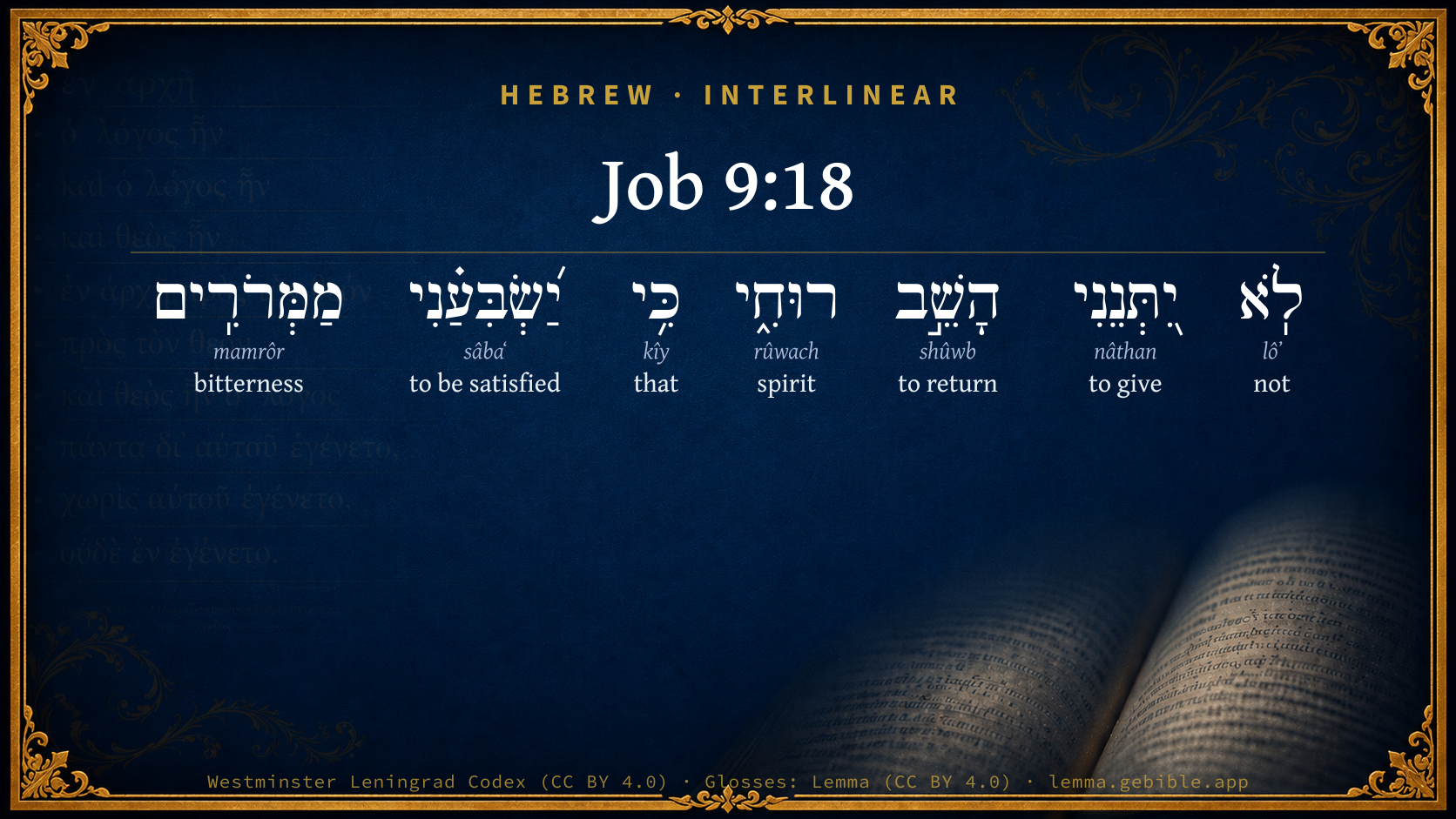
Hebrew (Westminster Leningrad Codex) Job 9:18 appears in the Hebrew Old Testament. The text above is from the Westminster Leningrad Codex. Each word links to its Strong’s number, a concise gloss, and parsing drawn from the Open Scriptures Hebrew Bible morphology. Click any word for its full Brown-Driver-Briggs (BDB) entry.
Download image
Cite this verse

Job 9:18 (World English Bible). Public Domain. Lemma interlinear Bible study tool, https://lemma.gebible.app/v/job/9/18.

Show BibTeX & RIS
BibTeX
RIS
English Translation
He will not allow me to take my breath, But fills me with bitterness.
World English Bible · Public Domain
Highlights
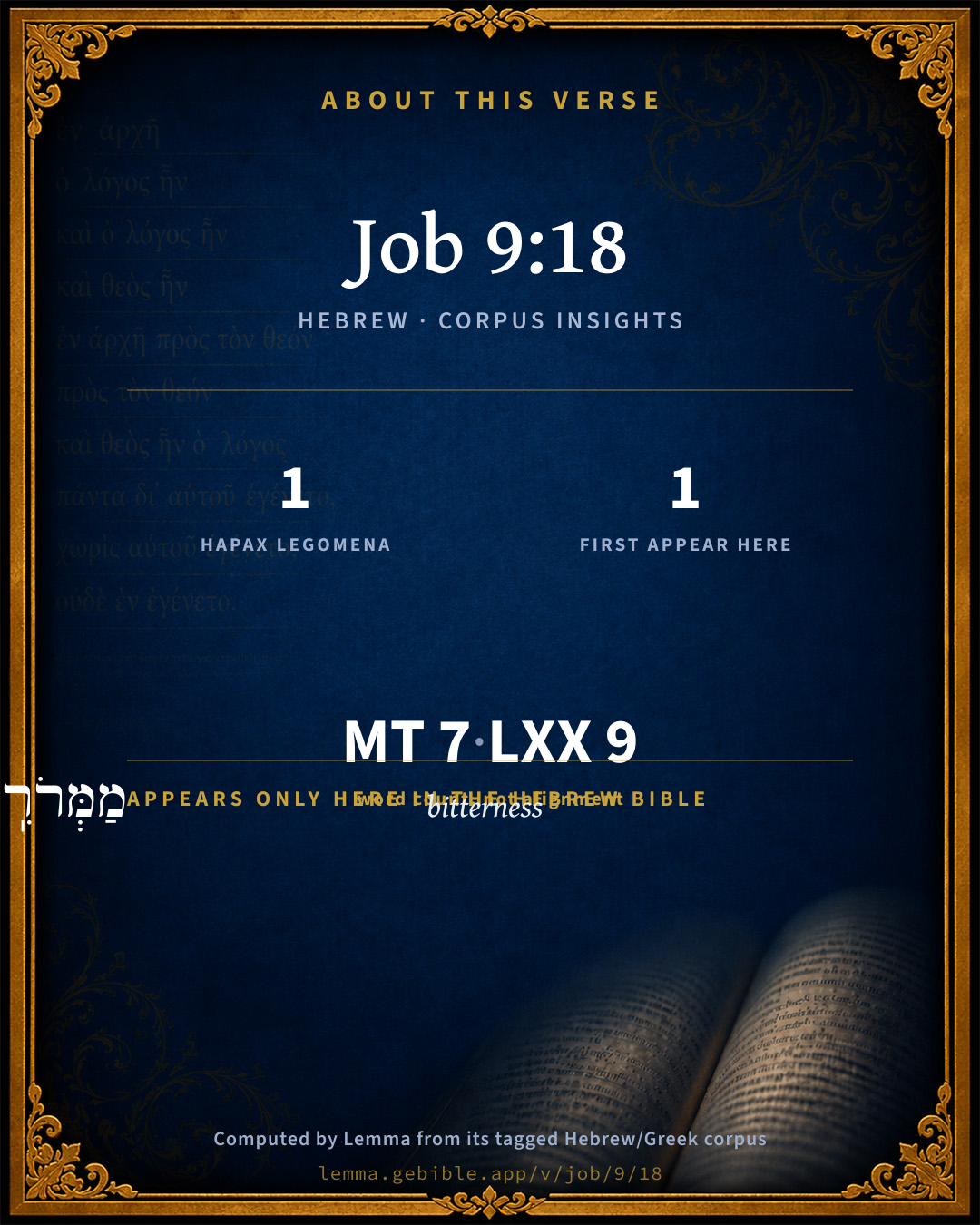
  • 1 hapax legomenon — only here in the Hebrew Bible
  • 1 first appearance in the Hebrew Bible
Full analysis ↓
Download a study sheet

One document with this verse’s original text, its word-by-word gloss line, the meaning frame, cross-references with their text, attributed commentary, and full source and license credits — printable, and it pastes into notes with its structure intact.

This verse Autodidact and up

Study sheet (.html) Plain text (.txt)

A passage Seminary Student

Up to 50 verses in one chapter. A passage sheet keeps up to 6 commentary sources and 12 cross-references per verse, in the order this page ranks them, and says so on the sheet whenever that leaves anything out. Ask for a single verse and you get the Autodidact verse sheet above.

Everything on this page stays free to read, with no account — the sheet is a download of what is already on screen, not access to it.

Want to remove ads? Support Godless Engineer
Compare translations 3

The same verse in 3 English versions, stacked beneath the original-language interlinear above. Click any original word for its lexicon entry.

Each is an independent rendering of the whole verse — the interlinear is not word-aligned to these translations.

Highlighted words mark where these versions differ — a whole-verse word diff, not a word-by-word alignment.

  • World English Bible Public Domain
    He will not allow me to take my breath, But fills me with bitterness.
  • King James Version Public Domain
    He will not suffer me to take my breath, but filleth me with bitterness.
  • unfoldingWord Literal Text CC BY-SA 4.0
    He does not allow me to cause my breath to return, for he fills me with bitterness.

unfoldingWord Literal Text — © unfoldingWord, licensed CC BY-SA 4.0. Word-aligned USFM3 via Door43 (git.door43.org/unfoldingWord/en_ult).

Versions to compare (up to 4)

3 of 4 selected

Show all 18 translations

Every available English version of this verse, each an independent rendering of the whole verse.

  • World English Bible Public Domain
    He will not allow me to take my breath, But fills me with bitterness.
  • Berean Standard Bible Public Domain
    He does not let me catch my breath, but overwhelms me with bitterness.
  • Majority Standard Bible Public Domain
    He does not let me catch my breath, but overwhelms me with bitterness.
  • King James Version Public Domain
    He will not suffer me to take my breath, but filleth me with bitterness.
  • American Standard Version (1901) Public Domain
    He will not suffer me to take my breath, But filleth me with bitterness.
  • Revised Version (1885) Public Domain
    He will not suffer me to take my breath, but filleth me with bitterness.
  • Geneva Bible (1599) Public Domain
    He wil not suffer me to take my breath, but filleth me with bitternesse.
  • Douay-Rheims (1899) Public Domain
    He alloweth not my spirit to rest, and he filleth me with bitterness.
  • Young's Literal Translation Public Domain
    He permitteth me not to refresh my spirit, But filleth me with bitter things.
  • Literal Standard Version CC BY-SA 4.0
    He does not permit me to refresh my spirit, || But fills me with bitter things.
  • Unlocked Literal Bible CC BY-SA 4.0
    He does not allow me to regain my breath; but he fills me with bitterness.
  • unfoldingWord Literal Text CC BY-SA 4.0
    He does not allow me to cause my breath to return, for he fills me with bitterness.
  • Darby Bible Public Domain
    He suffereth me not to take my breath, for he filleth me with bitternesses.
  • World Messianic Bible Public Domain
    He will not allow me to catch my breath, but fills me with bitterness.
  • Webster's Bible Public Domain
    He will not suffer me to take my breath, but filleth me with bitterness.
  • Free Bible Version CC BY-SA 4.0
    He doesn't give me a chance even to catch my breath; instead he fills my life with bitter suffering.
  • Bible in Basic English Public Domain
    He would not let me take my breath, but I would be full of bitter grief.
  • JPS Tanakh (1917) Public Domain
    That would not suffer me to take my breath, but fill me with bitterness.

Literal Standard Version (2020), Covenant Press — licensed CC BY-SA 4.0. Text via the HelloAO Bible API (eBible.org). Unlocked Literal Bible (unfoldingWord) — licensed CC BY-SA 4.0. Text via the HelloAO Bible API (eBible.org). unfoldingWord Literal Text — © unfoldingWord, licensed CC BY-SA 4.0. Word-aligned USFM3 via Door43 (git.door43.org/unfoldingWord/en_ult). Free Bible Version, Dr. Jonathan Gallagher — licensed CC BY-SA 4.0. Text via the HelloAO Bible API (eBible.org).

Word by word

More ways to search: Search by grammar → Find every occurrence → Compare this word →

Practice this passage: Drill this verse → Learn its vocabulary →

About this verse

These counts appear in no published source. They are computed here, from the morphology-tagged text and Lemma’s own curated glosses. What Lemma adds →

7
words
7
distinct lemmas
Wisdom
section

Notable vocabulary

1 hapax legomenon — a word that appears only here in the entire Hebrew Bible:

  • מַמְּרֹרִֽים bitterness H4472

First appearance in Scripture

This word makes its first canonical appearance in the Hebrew Bible here:

  • מַמְּרֹרִֽים bitterness H4472

Grammatical profile

  • 3 verbs
  • 2 nouns
  • 1 conjunction
  • 1 particle

Verb forms

  • יִ֭תְּנֵנִי Qal · Imperfect
  • הָשֵׁ֣ב Hiphil · Infinitive Absolute
  • יַ֝שְׂבִּעַ֗נִי Hiphil · Imperfect

Hebrew & Septuagint length

In English translation the verse runs 14 words from the Hebrew and 15 from the Septuagint (LXX English) — closely comparable.

A rough comparison of the two English renderings, which tokenize alike — not a word-level alignment.

Word counts can differ between the Hebrew and the Greek without any difference in meaning — e.g. the Hebrew direct-object marker אֵת has no separate Greek word, and Greek often adds the article ὁ.

In the original languages it is 7 Hebrew tokens and 9 Greek tokens — but the two are counted differently (Hebrew bundles its prefixes and suffixes into one token; the Greek is in lemma form), so that isn’t a like-for-like length.

Cross-references

10

Topical passages linked to Job 9:18 in the Treasury of Scripture Knowledge — connected by theme and wording, ordered by reader-vote popularity; previews shown in the World English Bible.

  • Job 7:19 How long will you not look away from me, Nor leave me alone until I swallow down my spittle?
  • Lamentations 3:15 He has filled me with bitterness, he has sated me with wormwood.
  • Job 3:20 "Why is light given to him who is in misery, Life to the bitter in soul,
  • Job 27:2 "As God lives, who has taken away my right, The Almighty, who has made my soul bitter.
  • Psalms 39:13 Oh spare me, that I may recover strength, Before I go away, and be no more."
  • Psalms 88:7 Your wrath lies heavily on me. You have afflicted me with all your waves. Selah.
  • Psalms 88:15–18 I am afflicted and ready to die from my youth up. While I suffer your terrors, I am distracted.
  • Lamentations 3:3 Surely against me he turns his hand again and again all the day.
  • Lamentations 3:18–19 I said, My strength is perished, and my expectation from Yahweh.
  • Hebrews 12:11 All chastening seems for the present to be not joyous but grievous; yet afterward it yields the peaceful fruit of righteousness to those who have been exercised thereby.

Cross-references courtesy of OpenBible.info (CC BY 4.0).

Hebrew and Greek witnesses Masoretic Hebrew ↔ Greek Septuagint

The same verse in the two great witnesses to the Old Testament, shown verse-for-verse.

These are two independent witnesses, not word-aligned to each other, and the Septuagint is shown in lemma (dictionary) form.

Hebrew Job 9:18 Masoretic · Westminster Leningrad Codex

לֹֽא יִ֭תְּנֵנִי הָשֵׁ֣ב רוּחִ֑י כִּ֥י יַ֝שְׂבִּעַ֗נִי מַמְּרֹרִֽים

He will not allow me to take my breath, But fills me with bitterness.

World English Bible · Public Domain

Greek LXX Job 9:18 Septuagint · lemma form

οὐ ἐάω γάρ ἐγώ ἀναπνέω ἐνπίμπλημι δέ ἐγώ πικρία

For he suffers me not to take breath, but he has filled me with bitterness.

LXX2012 (modern English Septuagint) · Public Domain

Hebrew: Westminster Leningrad Codex (CC BY 4.0). Greek: Septuagint (public domain); English from LXX2012 (modern English Septuagint) (Public Domain). How the Septuagint differs from the Hebrew →

Commentary

Notes on Job 9:18 from classic Christian and Jewish commentators (each source and its license shown beneath its notes). The classic Christian expositions comment on the surrounding passage and are grouped to its opening verse, so a note may address several verses; the Jewish commentaries on the Tanakh (Rashi and others) are per-verse, so they appear only where the commentator wrote on this verse.

Lemma curates 59 commentaries, every one of them public domain or Creative Commons licensed, each selected and text-cleaned for this edition rather than reprinted as found. About our sources →

Trapp's Complete Commentary

John Trapp

Job 9:18 He will not suffer me to take my breath, but filleth me with bitterness.

Ver. 18. He will not suffer me to take my breath] I am so far from a period, that I have no pause of my troubles. I cannot get any interspirias, or free breathing space. See Job 7:19. And in the former verse he had complained that God had stormed him. Interim per Pathos, saith Mercer; here he returns to his old practice of expostulating about the greatness of his grief, and spares not to hyperbolize. Beda and others understand this text to be a bodily distemper upon Job, which had made him short winded. And Lavater hath this good note here, Hoc cogitandum nobis est, &c. Let this text be thought upon when our spirits begin to sink; as also when by reason of the phthisic, {A wasting disease of the lungs; pulmonary consumption} or any other like disease, we feel a difficulty of breathing, and a straitening of our pectorals, or be otherwise compassed about with great sorrows.

But filleth me with bitterness] Heb. He satiateth me with bitternesses, i.e. with sore and sharp afflictions, which are in no way joyous, but grievous to the flesh, Heb 12:11. Job had his belly full of gall and wormwood; he had not only a draught or two, but a diet drink made for him of most bitter ingredients. Of this he complaineth heavily; what then will the wicked do, that must suck up the dregs of God’s cup, Psa 78:8, which hath eternity to the bottom?

John Trapp, A Commentary or Exposition upon All the Books of the Old and New Testament (1647–1656) — public domain. Text from a community e-Sword module.

Joseph Benson's Commentary

Job 9:18. He will not suffer me to take my breath — My pains and miseries are continual, and I have not so much as a breathing time free from them; but filleth me with bitterness — My afflictions are not only long and uninterrupted, but also exceeding sharp and violent, contrary to the common course of God’s providence. Houbigant’s version of this and the two preceding verses shows their connection admirably well, and, according to Bishop Lowth, gives us the true sense of the passage. “But, if I should call that he might answer me, I could not easily believe that he would hear my voice; since he hath broken me with a tempest, and inflicted many wounds upon me without cause; nor hath given me space to take my breath, so hath he filled me with bitterness.”

Joseph Benson's Commentary on the Old and New Testaments (1811–1818) — public domain. Text from a community e-Sword module.

Adam Clarke's Commentary

Verse 18. He will not suffer me to take my breath] I have no respite in my afflictions; I suffer continually in my body, and my mind is incessantly harassed.

Adam Clarke's Commentary on the Bible (1810–1826) — public domain. Text from a community e-Sword/MySword module.

Ellicott's Commentary for English Readers

(18) Take my breath.—The action being that of breathing again after complete exhaustion—recovering breath and the power to breathe, &c. “If I say I am perfect, it also shall prove me perverse by the very act of saying so; because for man to maintain his righteousness before God is at once to proclaim his iniquity. The finite cannot come into competition with the Infinite, nor measure itself therewith.”

A Bible Commentary for English Readers, edited by Charles John Ellicott (1878–1897) — public domain. Text from a community e-Sword module.

The Cambridge Bible for Schools and Colleges

gen. ed. J. J. S. Perowne

18. will not suffer] Rather, would not suffer. And so, but fill.

The Cambridge Bible for Schools and Colleges (gen. ed. J. J. S. Perowne; Cambridge University Press, 1878–1918) — public domain. Text from a community e-Sword module.

John Gill's Exposition

If I speak of strength, lo, he is strong,.... Or think of it, or betake myself to that, and propose to carry my point by mere force, as some men do by dint of power and authority they are possessed of; alas! there is nothing to be done this way; I am a poor, weak, feeble creature in body, mind, and estate; I am not able to contend with so powerful an antagonist on any account, in any way: God is strong, he is the "most strong" (w), as some render it; he is mighty, is the Almighty; the weakness of God is stronger than men; there is no disputing with God upon the foot of strength:

and if of judgment, who shall set me a time to plead? If I think and propose to put things upon the foot of justice, to have the cause between us issued in that way, I cannot expect to succeed by right, any more than by might; he is so strictly just and holy, that no righteousness and holiness of, mine can stand before him; he is God, and I a man, and therefore not fit to come together in judgment; and he a pure and holy Being, just and true, and without iniquity, and I a sinful polluted creature; and besides, there is none superior to him, that I can appeal unto, none that can appoint a place, or fix a time, for the hearing of the cause between us, or that can preside in judgment and determine the matter in controversy; nay, there is not one among the creatures that can be a daysman, an arbiter or umpire; yea not one that can be so much as employed as council, that can take the cause in hand, and plead it, and be a patron for me, and defender of me; so that, let me take what course I will, I am sure to be nonsuited and worsted, see Jer 49:19.

(w) "robustissimus est", V. L.

John Gill's Exposition of the Whole Bible (1746–1763) — public domain (CC PDM 1.0). Text via the HelloAO Bible API.

Albert Barnes' Notes on the Bible

He will not suffer me to take my breath; - see the notes at Job 7:19.

Albert Barnes' Notes on the Bible (1834–1885) — public domain. Text from a community e-Sword/MySword module.

Matthew Poole's English Annotations

My pains and miseries are continual, and I have not so much as a breathing time free from them. My afflictions are not only long and uninterrupted, but also exceeding sharp and violent, contrary to the common course of God’s providence.

Matthew Poole's English Annotations on the Holy Bible (1683–1685) — public domain. Text from a community e-Sword/MySword module.

Whedon's Commentary on the Bible

Daniel D. Whedon

18. Take my breath — So incessant is the sorrow with which God visits him. See Job_7:19.

Daniel D. Whedon (gen. ed.), Commentary on the Old and New Testaments (1874–1909) — public domain. Text from a community e-Sword module.

The Pulpit Commentary

He will not suffer me to take my breath. "He gives me no breathing-space," that is, "no time of relaxation or refreshment. My existence is one continual. misery.". (comp. Job_7:3-6, Job_7:13-19) But filleth me with bitterness; literally, with bitter things"or bitterness (Hebrew, rMm).

The Pulpit Commentary (1880–1919), ed. H.D.M. Spence-Jones & Joseph S. Exell — public domain. Text from a community e-Sword module.

John Wesley's Explanatory Notes

Breath - My pains are continual, and I have not so much as a breathing time free from them.

John Wesley, Explanatory Notes Upon the Whole Bible (1754–1765) — public domain. Text via the GEBible commentary corpus.

Rashi

Rabbi Shlomo Yitzchaki (Rashi)

He Who would not let me He does not let me bring back my breath to myself.

Rashi on the Tanakh — English translations: “The Judaica Press complete Tanach with Rashi, translated by A. J. Rosenberg” (CC BY 4.0); “Pentateuch with Rashi's commentary by M. Rosenbaum and A.M. Silbermann, 1929-1934” (public domain); “The Metsudah Tanach series, Lakewood, N.J” (CC BY 4.0); and “The Book of Joshua, Metsudah Publications, 1997” (CC BY 4.0). Text via Sefaria.

Lesson kit

Teaching starters — assembled from the data on this page, not authored interpretation. Every prompt links to the verse data it draws on. Edit before teaching.

Job, in the Wisdom, opens this verse with 7 words (7 distinct Hebrew lemmas). Its most distinctive word is mamrôr (“bitterness”). A historical commentator’s framing appears above. Read the whole chapter for the surrounding context.

Discussion questions

  1. How does “bitterness” (mamrôr) shape what this verse is saying?
  2. 1 word here appears nowhere else in the Hebrew Bible. Why might the author reach for such rare wording?
  3. This is the first place “bitterness” appears in Scripture (first appears here). What does its debut here establish?
  4. How does Job 7:19, which shares this passage’s theme, read alongside this verse?
  5. The translations on this page render this verse differently — a whole-verse word diff, not a word-by-word alignment. What might account for the different wordings?
  6. «יִ֭תְּנֵנִי» is a Qal Imperfect verb. How does that grammatical form shape the action described?
  7. Compare how Trapp's Complete Commentary and Joseph Benson's Commentary read this verse. Where do they agree or differ?

Things to notice

Reading settings

Reading text

Shown beneath each verse's original-language words.

Old Testament
Old Testament edition

Read the OT as the Masoretic Hebrew (MT) or the Greek Septuagint (LXX).

English shown for the Greek Septuagint (in the Hebrew ↔ Greek comparison).

Comparing translations? Open the Compare panel on any verse page to stack up to four side by side.