
Joshua 2:11

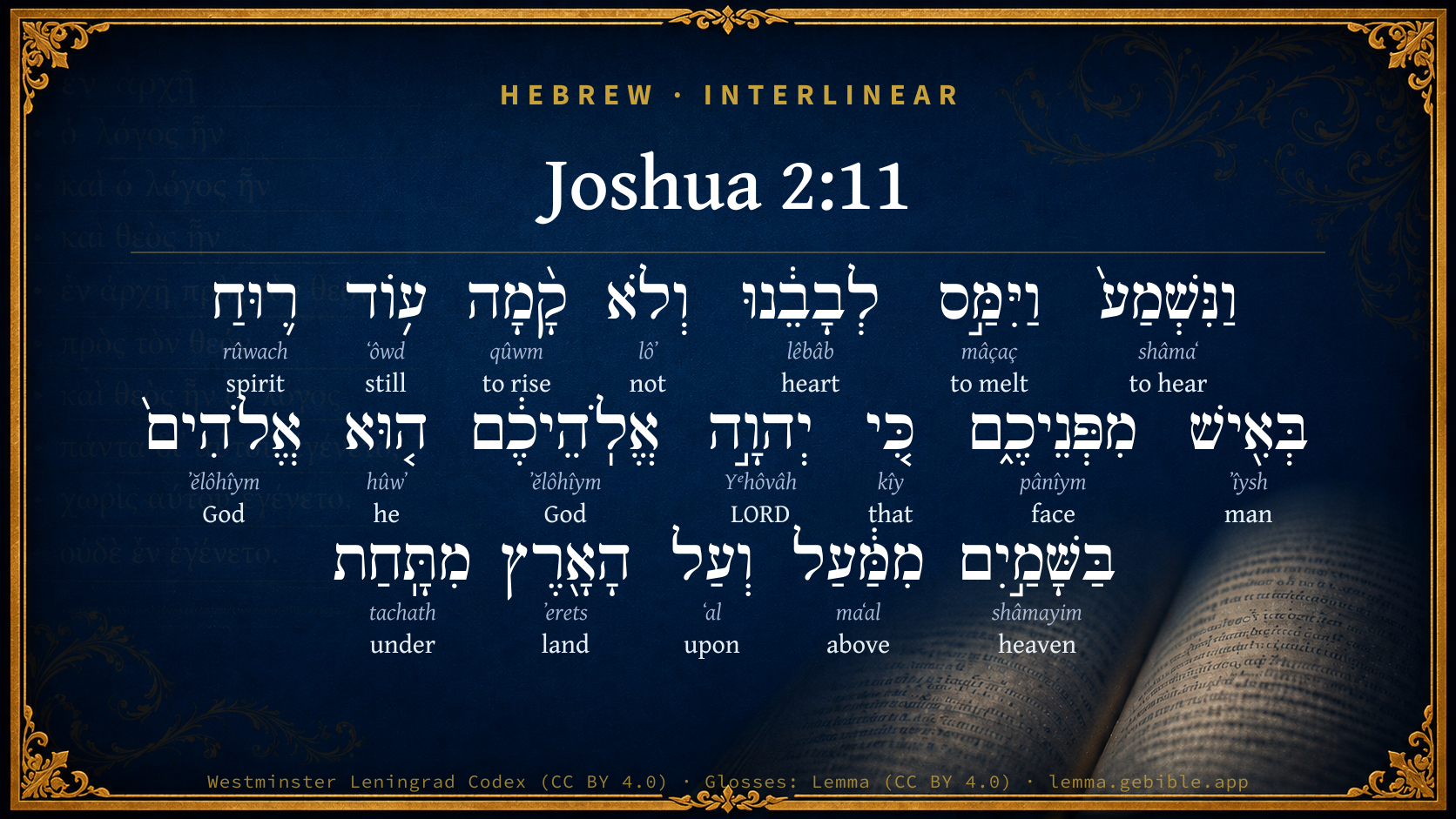
Hebrew (Westminster Leningrad Codex) Joshua 2:11 appears in the Hebrew Old Testament. The text above is from the Westminster Leningrad Codex. Each word links to its Strong’s number, a concise gloss, and parsing drawn from the Open Scriptures Hebrew Bible morphology. Click any word for its full Brown-Driver-Briggs (BDB) entry.
Download image
Cite this verse

Joshua 2:11 (World English Bible). Public Domain. Lemma interlinear Bible study tool, https://lemma.gebible.app/v/joshua/2/11.

Show BibTeX & RIS
BibTeX
RIS
English Translation
As soon as we had heard it, our hearts did melt, neither did there remain any more spirit in any man, because of you: for Yahweh your God, he is God in heaven above, and on earth beneath.
World English Bible · Public Domain
Download a study sheet

One document with this verse’s original text, its word-by-word gloss line, the meaning frame, cross-references with their text, attributed commentary, and full source and license credits — printable, and it pastes into notes with its structure intact.

This verse Autodidact and up

Study sheet (.html) Plain text (.txt)

A passage Seminary Student

Up to 50 verses in one chapter. A passage sheet keeps up to 6 commentary sources and 12 cross-references per verse, in the order this page ranks them, and says so on the sheet whenever that leaves anything out. Ask for a single verse and you get the Autodidact verse sheet above.

Everything on this page stays free to read, with no account — the sheet is a download of what is already on screen, not access to it.

Want to remove ads? Support Godless Engineer
Compare translations 3

The same verse in 3 English versions, stacked beneath the original-language interlinear above. Click any original word for its lexicon entry.

Each is an independent rendering of the whole verse — the interlinear is not word-aligned to these translations.

Highlighted words mark where these versions differ — a whole-verse word diff, not a word-by-word alignment.

  • World English Bible Public Domain
    As soon as we had heard it, our hearts did melt, neither did there remain any more spirit in any man, because of you: for Yahweh your God, he is God in heaven above, and on earth beneath.
  • King James Version Public Domain
    And as soon as we had heard these things, our hearts did melt, neither did there remain any more courage in any man, because of you: for the LORD your God, he is God in heaven above, and in earth beneath.
  • unfoldingWord Literal Text CC BY-SA 4.0
    And we have heard, and our heart has melted, and the spirit in a man no longer stands from your faces. For Yahweh your God, he God in the heavens above and on the earth below.

unfoldingWord Literal Text — © unfoldingWord, licensed CC BY-SA 4.0. Word-aligned USFM3 via Door43 (git.door43.org/unfoldingWord/en_ult).

Versions to compare (up to 4)

3 of 4 selected

Show all 18 translations

Every available English version of this verse, each an independent rendering of the whole verse.

  • World English Bible Public Domain
    As soon as we had heard it, our hearts did melt, neither did there remain any more spirit in any man, because of you: for Yahweh your God, he is God in heaven above, and on earth beneath.
  • Berean Standard Bible Public Domain
    When we heard this, our hearts melted and everyone’s courage failed because of you, for the LORD your God is God in the heavens above and on the earth below.
  • Majority Standard Bible Public Domain
    When we heard this, our hearts melted and everyone’s courage failed because of you, for the LORD your God is God in the heavens above and on the earth below.
  • King James Version Public Domain
    And as soon as we had heard these things, our hearts did melt, neither did there remain any more courage in any man, because of you: for the LORD your God, he is God in heaven above, and in earth beneath.
  • American Standard Version (1901) Public Domain
    And as soon as we had heard it, our hearts did melt, neither did there remain any more spirit in any man, because of you: for Jehovah your God, he is God in heaven above, and on earth beneath.
  • Revised Version (1885) Public Domain
    And as soon as we had heard it, our hearts did melt, neither did there remain any more spirit in any man, because of you: for the LORD your God, he is God in heaven above, and on earth beneath.
  • Geneva Bible (1599) Public Domain
    And when wee heard it, our heartes did faint, and there remained no more courage in any because of you: for the Lord your God, he is the God in heauen aboue, and in earth beneath.
  • Douay-Rheims (1899) Public Domain
    I know that the Lord hath given this land to you: for the dread of you is fallen upon us, and all the inhabitants of the land have lost all strength.
  • Young's Literal Translation Public Domain
    And we hear, and melt doth our heart, and there hath not stood any more spirit in `any' man, from your presence, for Jehovah your God, He `is' God in the heavens above, and on the earth beneath.
  • Literal Standard Version CC BY-SA 4.0
    And we hear, and our heart melts, and there has not stood anymore spirit in [any] man from your presence, for He, your God YHWH, [is] God in the heavens above and on the earth below.
  • Unlocked Literal Bible CC BY-SA 4.0
    As soon as we had heard it, our hearts melted and there was no courage left in anyone—for Yahweh your God, he is God in heaven above and on the earth below.
  • unfoldingWord Literal Text CC BY-SA 4.0
    And we have heard, and our heart has melted, and the spirit in a man no longer stands from your faces. For Yahweh your God, he God in the heavens above and on the earth below.
  • Darby Bible Public Domain
    We heard [of it], and our heart melted, and there remained no more spirit in any man because of you; for Jehovah your God, he is God in the heavens above and on the earth beneath.
  • World Messianic Bible Public Domain
    As soon as we had heard it, our hearts melted, and there wasn’t any more spirit in any man, because of you: for the LORD your God, he is God in heaven above, and on earth beneath.
  • Webster's Bible Public Domain
    And as soon as we had heard these things, our hearts did melt, neither did there remain any more courage in any man, because of you: for the LORD your God, he is God in heaven above, and in earth beneath.
  • Free Bible Version CC BY-SA 4.0
    When we heard all this, our courage melted away. Nobody had any fighting spirit left because of you. For the Lord your God is God of heaven above and the earth below.
  • Bible in Basic English Public Domain
    And because of this news, our hearts became like water, and there was no more spirit in any of us because of you; for the Lord your God is God in heaven on high and here on earth.
  • JPS Tanakh (1917) Public Domain
    And as soon as we had heard it, our hearts did melt, neither did there remain any more spirit in any man, because of you; for the LORD your God, He is God in heaven above, and on earth beneath.

Literal Standard Version (2020), Covenant Press — licensed CC BY-SA 4.0. Text via the HelloAO Bible API (eBible.org). Unlocked Literal Bible (unfoldingWord) — licensed CC BY-SA 4.0. Text via the HelloAO Bible API (eBible.org). unfoldingWord Literal Text — © unfoldingWord, licensed CC BY-SA 4.0. Word-aligned USFM3 via Door43 (git.door43.org/unfoldingWord/en_ult). Free Bible Version, Dr. Jonathan Gallagher — licensed CC BY-SA 4.0. Text via the HelloAO Bible API (eBible.org).

Word by word

More ways to search: Search by grammar → Find every occurrence → Compare this word →

Practice this passage: Drill this verse → Learn its vocabulary →

וַיִּמַּ֣ס
mâçaç
H4549
“and · to melt”
Conjunction + Verb, Niphal, Sequential Imperfect, 3rd Person, Masculine, Singular
Part of Speech
Conjunction + Verb
Stem
Niphal
Form
Sequential Imperfect
Person
3rd Person
Gender
Masculine
Number
Singular
Full BDB Definition

Origin: a primitive root

TWOT: 1223

to dissolve, melt - (Qal) to waste away - (Niphal) - to melt, vanish, drop off, melt away - to faint, grow fearful (figuratively) - wasted, worthless (participle) - (Hiphil) to cause to melt
  1. וַנִּשְׁמַע֙ shâmaʻ H8085 “and · to hear” Conjunction + Verb, Qal, Sequential Imperfect, 1st Person, Common, Plural
  2. לְבָבֵ֔נוּ lêbâb H3824 “heart · our” Noun, Common, Masculine, Singular, Construct + Suffix, Personal, 1st Person, Common, Plural
  3. וְלֹא lôʼ H3808 “and · not” Conjunction + Particle, Negative
  4. קָ֨מָה qûwm H6965 “to rise” Verb, Qal, Perfect, 3rd Person, Feminine, Singular
  5. ע֥וֹד ʻôwd H5750 “still” Adverb
  6. ר֛וּחַ rûwach H7307 “spirit” Noun, Common, Both, Singular, Absolute
  7. בְּאִ֖ישׁ ʼîysh H376 “in/at · man” Preposition + Noun, Common, Masculine, Singular, Absolute
  8. מִפְּנֵיכֶ֑ם pânîym H6440 “from · face(s) · your” Preposition + Noun, Common, Both, Plural, Construct + Suffix, Personal, 2nd Person, Masculine, Plural
  9. כִּ֚י kîy H3588 “that” Conjunction
  10. יְהוָ֣ה Yᵉhôvâh H3068 “LORD” Noun, Proper
  11. אֱלֹֽהֵיכֶ֔ם ʼĕlôhîym H430 “God(s) · your” Noun, Common, Masculine, Plural, Construct + Suffix, Personal, 2nd Person, Masculine, Plural
  12. ה֤וּא hûwʼ H1931 “he” Pronoun, Personal, 3rd Person, Masculine, Singular
  13. אֱלֹהִים֙ ʼĕlôhîym H430 “God(s)” Noun, Common, Masculine, Plural, Absolute
  14. בַּשָּׁמַ֣יִם shâmayim H8064 “in/at the · heaven(s)” Preposition, Determined + Noun, Common, Masculine, Plural, Absolute
  15. מִמַּ֔עַל maʻal H4605 “from · above” Preposition + Adverb
  16. וְעַל ʻal H5921 “and · upon” Conjunction + Preposition
  17. הָאָ֖רֶץ ʼerets H776 “the · land” Particle, Definite Article + Noun, Common, Both, Singular, Absolute
  18. מִתָּֽחַת tachath H8478 “from · under” Preposition + Preposition

About this verse

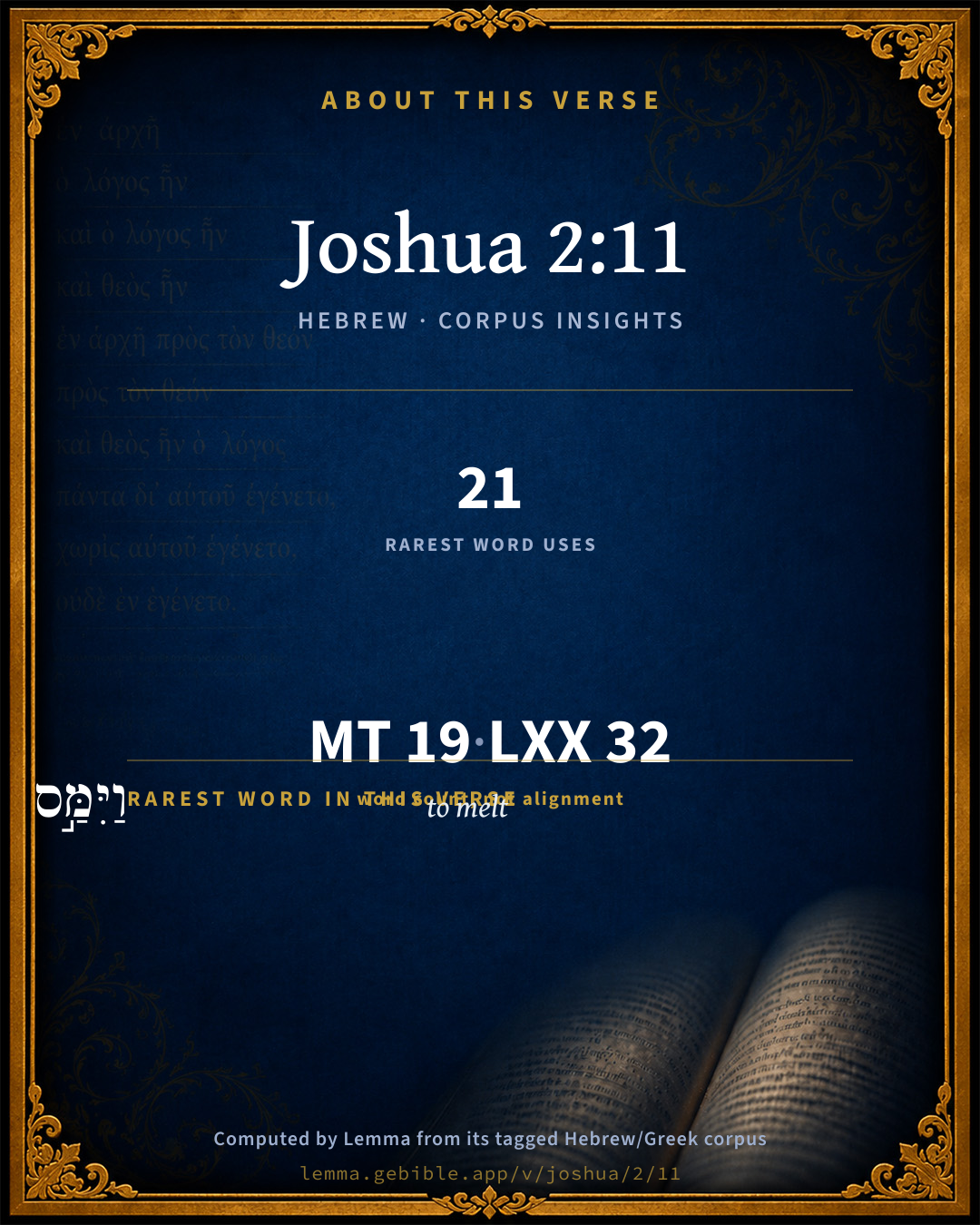
These counts appear in no published source. They are computed here, from the morphology-tagged text and Lemma’s own curated glosses. What Lemma adds →

19
words
18
distinct lemmas
Historical
section

Notable vocabulary

The rarest word here is וַיִּמַּ֣ס to melt H4549 — appearing just 21 times in the whole Hebrew Bible.

Shared distinctive vocabulary

וַיִּמַּ֣ס to melt H4549 occurs in 20 verses of the Hebrew Bible. Also found in:

Grammatical profile

  • 3 verbs
  • 9 nouns
  • 1 pronoun
  • 2 prepositions
  • 1 conjunction
  • 2 adverbs
  • 1 particle

Verb forms

  • וַנִּשְׁמַע֙ Qal · Sequential Imperfect
  • וַיִּמַּ֣ס Niphal · Sequential Imperfect
  • קָ֨מָה Qal · Perfect

Repetition

A word recurs within this verse — often emphatic in Hebrew:

  • אֱלֹֽהֵיכֶ֔ם God H430 ×2

Hebrew & Septuagint length

In English translation the verse runs 38 words from the Hebrew and 40 from the Septuagint (LXX English) — closely comparable.

A rough comparison of the two English renderings, which tokenize alike — not a word-level alignment.

Word counts can differ between the Hebrew and the Greek without any difference in meaning — e.g. the Hebrew direct-object marker אֵת has no separate Greek word, and Greek often adds the article ὁ.

In the original languages it is 19 Hebrew tokens and 32 Greek tokens — but the two are counted differently (Hebrew bundles its prefixes and suffixes into one token; the Greek is in lemma form), so that isn’t a like-for-like length.

Cross-references

18

Topical passages linked to Joshua 2:11 in the Treasury of Scripture Knowledge — connected by theme and wording, ordered by reader-vote popularity; previews shown in the World English Bible.

  • Deuteronomy 4:39 Know therefore this day, and lay it to your heart, that Yahweh he is God in heaven above and on the earth beneath; there is none else.
  • Joshua 5:1 It happened, when all the kings of the Amorites, who were beyond the Jordan westward, and all the kings of the Canaanites, who were by the sea, heard how that Yahweh had dried up the waters of the Jordan from before the children of Israel, until we were passed over, that their heart melted, neither was there spirit in them any more, because of the children of Israel.
  • Joshua 7:5 The men of Ai struck of them about thirty-six men; and they chased them [from] before the gate even to Shebarim, and struck them at the descent; and the hearts of the people melted, and became as water.
  • Isaiah 13:7 Therefore shall all hands be feeble, and every heart of man shall melt:
  • Jeremiah 16:19–21 Yahweh, my strength, and my stronghold, and my refuge in the day of affliction, to you shall the nations come from the ends of the earth, and shall say, Our fathers have inherited nothing but lies, [even] vanity and things in which there is no profit.
  • Daniel 4:34–35 At the end of the days I, Nebuchadnezzar, lifted up my eyes to heaven, and my understanding returned to me, and I blessed the Most High, and I praised and honored him who lives forever; for his dominion is an everlasting dominion, and his kingdom from generation to generation.
  • Daniel 6:25–27 Then king Darius wrote to all the peoples, nations, and languages, who dwell in all the earth: Peace be multiplied to you.
  • Zechariah 8:20–23 Thus says Yahweh of Hosts: "Many peoples, and the inhabitants of many cities will yet come;
  • 1 Kings 8:60 that all the peoples of the earth may know that Yahweh, he is God; there is none else.
  • Psalms 83:18 That they may know that you alone, whose name is Yahweh, Are the Most High over all the earth.
  • Psalms 102:15 So the nations will fear the name of Yahweh; All the kings of the earth your glory.
  • Nahum 2:10 She is empty, void, and waste. The heart melts, the knees knock together, their bodies and faces have grown pale.
  • Revelation 6:16 They told the mountains and the rocks, "Fall on us, and hide us from the face of him who sits on the throne, and from the wrath of the Lamb,
  • Exodus 15:14 The peoples have heard. They tremble. Pangs have taken hold on the inhabitants of Philistia.
  • Deuteronomy 1:28 Where are we going up? our brothers have made our heart to melt, saying, The people are greater and taller than we; the cities are great and fortified up to the sky; and moreover we have seen the sons of the Anakim there.
  • Deuteronomy 20:8 The officers shall speak further to the people, and they shall say, What man is there who is fearful and faint-hearted? let him go and return to his house, lest his brother's heart melt as his heart.
  • Joshua 14:8 Nevertheless my brothers who went up with me made the heart of the people melt; but I wholly followed Yahweh my God.
  • Psalms 22:14 I am poured out like water. All my bones are out of joint. My heart is like wax; It is melted within me.

Cross-references courtesy of OpenBible.info (CC BY 4.0).

Hebrew and Greek witnesses Masoretic Hebrew ↔ Greek Septuagint

The same verse in the two great witnesses to the Old Testament, shown verse-for-verse.

These are two independent witnesses, not word-aligned to each other, and the Septuagint is shown in lemma (dictionary) form.

Hebrew Joshua 2:11 Masoretic · Westminster Leningrad Codex

וַנִּשְׁמַע֙ וַיִּמַּ֣ס לְבָבֵ֔נוּ וְלֹא קָ֨מָה ע֥וֹד ר֛וּחַ בְּאִ֖ישׁ מִפְּנֵיכֶ֑ם כִּ֚י יְהוָ֣ה אֱלֹֽהֵיכֶ֔ם ה֤וּא אֱלֹהִים֙ בַּשָּׁמַ֣יִם מִמַּ֔עַל וְעַל הָאָ֖רֶץ מִתָּֽחַת

As soon as we had heard it, our hearts did melt, neither did there remain any more spirit in any man, because of you: for Yahweh your God, he is God in heaven above, and on earth beneath.

World English Bible · Public Domain

Greek LXX Joshua 2:11 Septuagint · lemma form

καί ἀκούω ἐγώ ἐκἵστημι ὁ καρδία ἐγώ καί οὐ ἵστημι ἔτι πνεῦμα ἐν οὐδείς ἐγώ ἀπό πρόσωπον σύ ὅτι κύριος ὁ θεός σύ θεός ἐν οὐρανός ἄνω καί ἐπί ὁ γῆ κάτω

And when we heard it we were amazed in our heart, and there was no longer any spirit in any of us because of you, for the Lord your god is God in heaven above, and on the earth beneath.

LXX2012 (modern English Septuagint) · Public Domain

Hebrew: Westminster Leningrad Codex (CC BY 4.0). Greek: Septuagint (public domain); English from LXX2012 (modern English Septuagint) (Public Domain). How the Septuagint differs from the Hebrew →

Targum (Aramaic paraphrase)

1

The Targum is the ancient Jewish Aramaic paraphrase of the Hebrew Scriptures — an interpretive translation, not the Hebrew text itself. Onkelos (literal) and Pseudo-Jonathan (expansive) render the Torah, and Jonathan the Prophets. Coverage is partial: where no permissively-licensed English translation exists for a verse, only the Aramaic is shown. This is verse-level text, not a word-by-word alignment to the Hebrew.

  1. Targum Jonathan Prophets (Joshua–Malachi)
    וּשְׁמַעְנָא וְאִתְמְסֵי לִבָּנָא וְלָא אִשְׁתְּאָרַת עוֹד רוּחָא בֶּאֱנַשׁ מִן קֳדָמֵיכוֹן אֲרֵי יְיָ אֱלָהָכוֹן הוּא אֱלָהָא דִשְׁכִינְתֵּיהּ בִּשְׁמַיָא מִלְעֵילָא וְשַׁלִיט עַל אַרְעָא מִלְרָע:

    (no public-domain English translation for this verse)

    Targum Jonathan — Aramaic: “Mikraot Gedolot” (public domain). English: “Sefaria Community Translation” (CC0 1.0 (public-domain dedication)); “London "Chaldee Paraphrase," 1871” (public domain). Text via Sefaria.

Commentary

Notes on Joshua 2:11 from classic Christian and Jewish commentators (each source and its license shown beneath its notes). The classic Christian expositions comment on the surrounding passage and are grouped to its opening verse, so a note may address several verses; the Jewish commentaries on the Tanakh (Rashi and others) are per-verse, so they appear only where the commentator wrote on this verse.

Lemma curates 59 commentaries, every one of them public domain or Creative Commons licensed, each selected and text-cleaned for this edition rather than reprinted as found. About our sources →

Trapp's Complete Commentary

John Trapp

Jos 2:11 And as soon as we had heard [these things], our hearts did melt, neither did there remain any more courage in any man, because of you: for the LORD your God, he [is] God in heaven above, and in earth beneath.

Ver. 11. For the Lord your God, he is God.] As for our idols, they are very vanities, and cannot deliver us. The Tyrians, afraid their Apollo should forsake them at that time when Alexander besieged their city, chained and nailed that idol to a post, that they might be sure of it; but all would not do.

John Trapp, A Commentary or Exposition upon All the Books of the Old and New Testament (1647–1656) — public domain. Text from a community e-Sword module.

Tyndale Open Study Notes

Tyndale Open Resources

2:11 Although the people of Canaan incurred God’s judgment, Rahab’s declaration of faith (proven genuine by her aid to the spies) brought her into the people of God (Heb 11:31).

Tyndale Open Study Notes — © Tyndale Open Resources, licensed CC BY-SA 4.0. Text via the HelloAO Bible API.

Geneva Bible (1599)

Geneva Bible translators

Or, spirit.

Herein appeareth the great mercy of God, that in this common destruction he would draw a most miserable sinner to repent, and confess his Name.

Or, melted.

Geneva Bible (1599) marginal notes — public domain. Text via Bolls.life.

Adam Clarke's Commentary

Verse 11. He is God in heaven above, and to earth beneath.] This confession of the true God is amazingly full, and argues considerable light and information. As if she had said, "I know your God to be omnipotent and omnipresent:" and in consequence of this faith she hid the spies, and risked her own life in doing it. But how had she this clear knowledge of the Divine nature?

1. Possibly the knowledge of the true God was general in the earth at this time, though connected with much superstition and idolatry; the people believing that there was a god for every district, and for every people; for the mountains and for the valleys; see 1Kg 20:23.

2. Or she received this instruction from the spies, with whom she appears to have had a good deal of conversation; or,

3. She had it from a supernatural influence of God upon her own soul. She probably made a better use of the light she had received than the rest of her countrymen, and God increased that light.

Adam Clarke's Commentary on the Bible (1810–1826) — public domain. Text from a community e-Sword/MySword module.

John Calvin's Commentaries

11. The Lord your God, he is God, etc. Here the image of Rahab’s faith appears, as if reflected in a mirror, when casting down all idols she ascribes the government of heaven and earth to the God of Israel alone. For it is perfectly clear that when heaven and earth are declared subject to the God of Israel, there is a repudiation of all the pagan fictions by which the majesty, and power, and glory of God are portioned out among different deities; and hence we see that it is not without cause that two Apostles have honored Rahab’s conduct with the title of faith This is sneered at by some proud and disdainful men, but I wish they would consider what it is to distinguish the one true God from all fictitious deities, and at the same time so to extol his power as to declare that the whole world is governed at his pleasure. Rahab does not speak hesitatingly, but declares, in absolute terms, that whatever power exists resides in the God of Israel alone, that he commands all the elements, that he orders all things above and below, and determines human affairs. Still I deny not that her faith was not fully developed, nay, I readily admit, that it was only a germ of piety which, as yet, would have been insufficient for her eternal salvation. We must hold, nevertheless, that however feeble and slender the knowledge of God which the woman possessed may have been, still in surrendering herself to his power, she gives a proof of her election, and that from that seed a faith was germinating which afterwards attained its full growth.

John Calvin's Commentaries (1540-1563) — public domain. Text from the Calvin Translation Society English edition (1840s-50s) via the Christian Classics Ethereal Library (ccel.org). Calvin's coverage is partial (roughly two-thirds of the Bible); uncommented books and verses are honest gaps, never fabricated. The 19th-century editor's footnotes and remarks are omitted so the notes are faithfully Calvin's own voice.

The Cambridge Bible for Schools and Colleges

gen. ed. J. J. S. Perowne

11. he is God in heaven above] Rahab expressly acknowledges God as Almighty, a knowledge which is possible to the heathen, for the “invisible things of God from the creation of the world are clearly seen, being understood by the things that are made, even His eternal power and Godhead” (Rom_1:20).

The Cambridge Bible for Schools and Colleges (gen. ed. J. J. S. Perowne; Cambridge University Press, 1878–1918) — public domain. Text from a community e-Sword module.

John Gill's Exposition

And as soon as we had heard these things, our hearts did melt,.... Particularly what were done to the two kings of the Amorites, who, and their people, were utterly destroyed, their goods made a prey of, and their countries seized upon and possessed:

neither did there remain any more courage in any man, because of you; they looked dejected in their countenances, had no heart to go about any business, trembled at the shaking of a leaf, or at the least rumour and report made that the Israelites were coming on and were at hand; they had no spirit to prepare to go out and meet them, or to defend themselves:

for the Lord your God, he is God in heaven above, and in earth beneath; the Maker and Possessor of both; is the Governor of the whole universe, and does what he pleases in it; and disposes of all countries, persons, and things, as he thinks fit: this is a proof of her knowledge of the true God, and faith in him, and shows her to be a believer, and hence she is reckoned in the catalogue of believers, Heb 11:31; and her faith is proved to be of the right kind by the works she did, Jam 2:25.

John Gill's Exposition of the Whole Bible (1746–1763) — public domain (CC PDM 1.0). Text via the HelloAO Bible API.

Albert Barnes' Notes on the Bible

The Lord your God, he is God - From the rumour of God’s miraculous interpositions Rahab believed, and makes the self-same confession to which Moses endeavors to bring Israel by rehearsing similar arguments Deu 4:39. Rahab had only heard of what Israel had experienced. Her faith then was ready. It is noteworthy, too, that the same reports which work faith and conversion in the harlot, cause only terror and astonishment among her countrymen. (Compare Luk 8:37-39.)

Albert Barnes' Notes on the Bible (1834–1885) — public domain. Text from a community e-Sword/MySword module.

Haydock's Catholic Bible Commentary

Beneath. This is the confession of a true convert, (Calmet) inspired by God. (Haydock) --- For St. Paul commends her faith. (Hebrews xi. 31.) (Menochius) --- The pagans confined the power of their idols to certain districts; the power of the true God is infinite. (Calmet)

George Leo Haydock (1774–1849), Haydock's Catholic Family Bible and Commentary, 1859 edition — public domain. Excludes Psalms (Douay-Rheims chapter numbering differs from Protestant) and Deuterocanonical books (Catholic canon only).

Matthew Poole's English Annotations

Did melt, i.e. were dissolved, lost all consistency and courage. This phrase is oft used, as Deu 1:28; 20:8; Jos 5:1; 7:5.

He is God in heaven above, and in earth beneath; he can do whatsoever he pleaseth in heaven and earth; whereas our gods are enclosed in heaven, and can do nothing to us upon earth.

Matthew Poole's English Annotations on the Holy Bible (1683–1685) — public domain. Text from a community e-Sword/MySword module.

Whedon's Commentary on the Bible

Daniel D. Whedon

11. For the Lord your God, he is God in heaven above, and in earth beneath — This is the full profession of Rahab’s faith in the God of Israel. It was a complete renunciation of her idolatry and harlotry. It was a change in belief, feeling, will, and action, which brought her to the worship of the true God, and to a maternity of the Messiah in David’s royal line. However alloyed by one imperfection, it was a true faith working out its true results. And the wide-spread terror of these nations, as described in the last verse, and Rahab’s faith, were in accordance with God’s purpose in raising up Pharaoh and diffusing his “name.” Note on Rom_9:17.

Daniel D. Whedon (gen. ed.), Commentary on the Old and New Testaments (1874–1909) — public domain. Text from a community e-Sword module.

The Pulpit Commentary

Melt. The word in the Hebrew is a different one to that used in ver. 9, but it has a precisely similar meaning. There seems no reason why the destruction of Sihon and Og should have inspired such terror into the hearts of the powerful Phoenician tribes. But the miracle of the drying up of the Red Sea was an event of quite another order, and eminently calculated to produce such feelings. Nothing but such an occurrence could have explained Rahab"s language, or the anxiety which the near approach of the armies of Israel inspired in those "cities, great and walled up to heaven," with their inhabitants of giant-like stature and strength. Courage. Literally, spirit. The word jWr seems to have been used in the Hebrew in just the same senses as our word spirit, and it signified wind also. (see 1Ki_10:5) For the Lord your God, he is God. Literally, for Jehovah your God. This declaration, bearing in mind the circumstances of the person who uttered it, is as remarkable as St. Peter"s, "Thou art the Christ, the Son of the living God." How Rahab attained to this knowledge of God"s name and attributes we do not know. It is certain, however, that under the circumstances her knowledge and spiritual insight are as surprising as any recorded in Scripture, and are sufficient to explain the honour in which her name has been held, both at the time and ever since. "I see here," says Bp. Hall, "not only a disciple of God, but a prophetesse." Keil argues that Rahab regards God only as one of the gods, and supposes that she had not entirely escaped from polytheism. But this view does not appear to be borne out by the form of her expressions. We should rather, in that case, have expected to find "he is among the gods," than He is God, which is the only possible rendering of the Hebrew.

The Pulpit Commentary (1880–1919), ed. H.D.M. Spence-Jones & Joseph S. Exell — public domain. Text from a community e-Sword module.

John Wesley's Explanatory Notes

Melted - That is, were dissolved, lost all courage.

John Wesley, Explanatory Notes Upon the Whole Bible (1754–1765) — public domain. Text via the GEBible commentary corpus.

Rashi

Rabbi Shlomo Yitzchaki (Rashi)

And there was no longer any spirit. [The men had no spirit (desire)] even to lie with a woman. It was said by the Sages: There was no prince or ruler who had not had [sexual] relationships with Rochav, the harlot. She was ten years old when the Bnei Yisroel went out of Egypt, and she engaged in harlotry for forty years.

Rashi on the Tanakh — English translations: “The Judaica Press complete Tanach with Rashi, translated by A. J. Rosenberg” (CC BY 4.0); “Pentateuch with Rashi's commentary by M. Rosenbaum and A.M. Silbermann, 1929-1934” (public domain); “The Metsudah Tanach series, Lakewood, N.J” (CC BY 4.0); and “The Book of Joshua, Metsudah Publications, 1997” (CC BY 4.0). Text via Sefaria.

Lesson kit

Teaching starters — assembled from the data on this page, not authored interpretation. Every prompt links to the verse data it draws on. Edit before teaching.

Joshua, in the Historical, opens this verse with 19 words (18 distinct Hebrew lemmas). Its most distinctive word is mâçaç (“to melt”). A historical commentator’s framing appears above. Read the whole chapter for the surrounding context.

Discussion questions

  1. What does “to melt” (mâçaç) contribute to the verse as a whole?
  2. Exodus 16:21 shares the word «to melt» with this verse. How do the two illuminate each other?
  3. “God” occurs 2× in this one verse. What is the effect of the repetition?
  4. The translations on this page render this verse differently — a whole-verse word diff, not a word-by-word alignment. What might account for the different wordings?
  5. The verb «וַנִּשְׁמַע֙» is Qal Sequential Imperfect. How does its form color the action?
  6. Reading how Trapp's Complete Commentary and Tyndale Open Study Notes read this verse, where do the two commentators agree and where do they part?

Things to notice

Reading settings

Reading text

Shown beneath each verse's original-language words.

Old Testament
Old Testament edition

Read the OT as the Masoretic Hebrew (MT) or the Greek Septuagint (LXX).

English shown for the Greek Septuagint (in the Hebrew ↔ Greek comparison).

Comparing translations? Open the Compare panel on any verse page to stack up to four side by side.