
Numbers 11:17

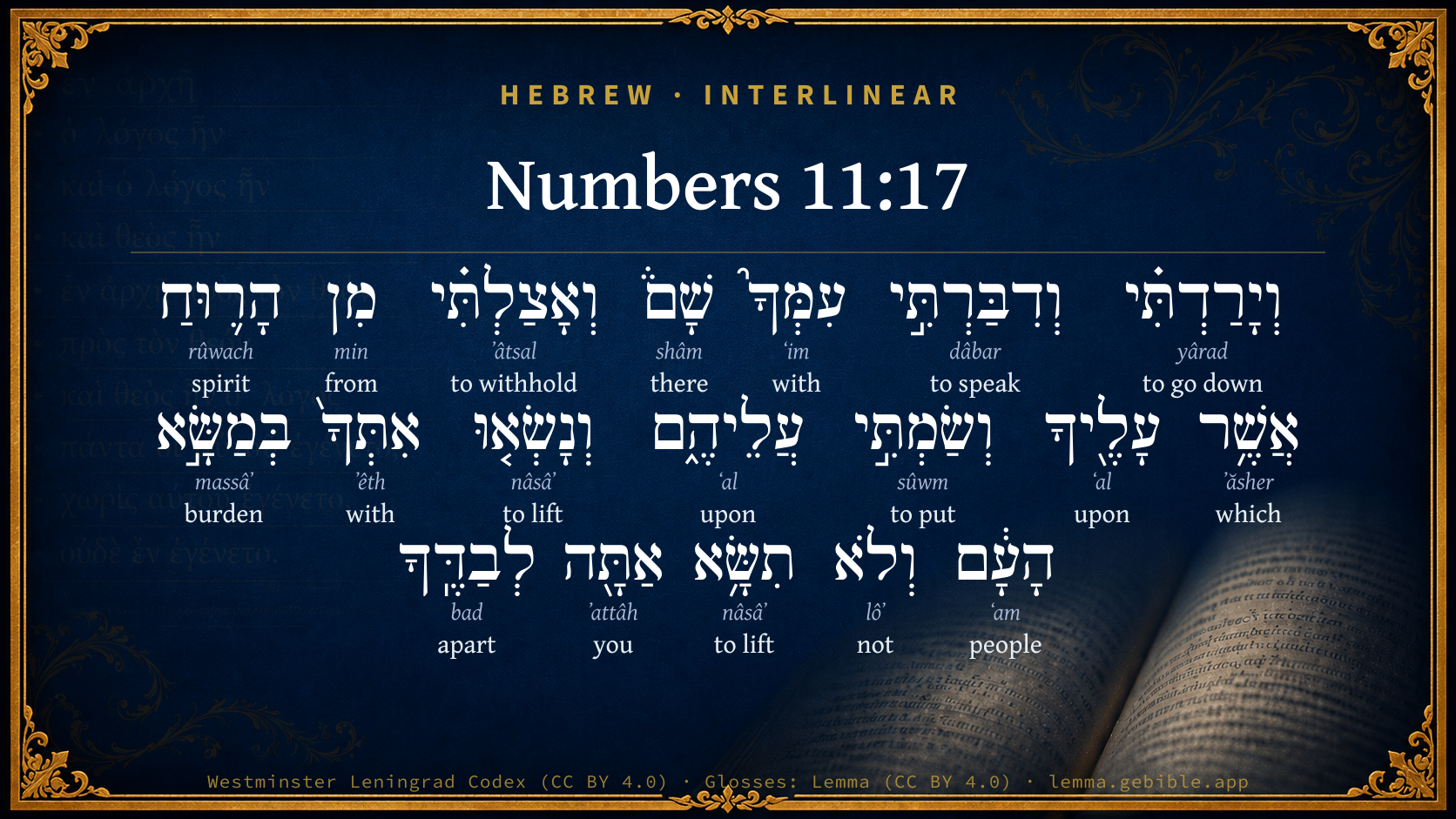
Hebrew (Westminster Leningrad Codex) Numbers 11:17 appears in the Hebrew Old Testament. The text above is from the Westminster Leningrad Codex. Each word links to its Strong’s number, a concise gloss, and parsing drawn from the Open Scriptures Hebrew Bible morphology. Click any word for its full Brown-Driver-Briggs (BDB) entry.
Download image
Cite this verse

Numbers 11:17 (World English Bible). Public Domain. Lemma interlinear Bible study tool, https://lemma.gebible.app/v/numbers/11/17.

Show BibTeX & RIS
BibTeX
RIS
English Translation
I will come down and talk with you there: and I will take of the Spirit which is on you, and will put it on them; and they shall bear the burden of the people with you, that you not bear it yourself alone.
World English Bible · Public Domain
Download a study sheet

One document with this verse’s original text, its word-by-word gloss line, the meaning frame, cross-references with their text, attributed commentary, and full source and license credits — printable, and it pastes into notes with its structure intact.

This verse Autodidact and up

Study sheet (.html) Plain text (.txt)

A passage Seminary Student

Up to 50 verses in one chapter. A passage sheet keeps up to 6 commentary sources and 12 cross-references per verse, in the order this page ranks them, and says so on the sheet whenever that leaves anything out. Ask for a single verse and you get the Autodidact verse sheet above.

Everything on this page stays free to read, with no account — the sheet is a download of what is already on screen, not access to it.

Want to remove ads? Support Godless Engineer
Compare translations 3

The same verse in 3 English versions, stacked beneath the original-language interlinear above. Click any original word for its lexicon entry.

Each is an independent rendering of the whole verse — the interlinear is not word-aligned to these translations.

Highlighted words mark where these versions differ — a whole-verse word diff, not a word-by-word alignment.

  • World English Bible Public Domain
    I will come down and talk with you there: and I will take of the Spirit which is on you, and will put it on them; and they shall bear the burden of the people with you, that you not bear it yourself alone.
  • King James Version Public Domain
    And I will come down and talk with thee there: and I will take of the spirit which is upon thee, and will put it upon them; and they shall bear the burden of the people with thee, that thou bear it not thyself alone.
  • unfoldingWord Literal Text CC BY-SA 4.0
    And I will come down and speak with you there, and I will take away from the Spirit that on you, and I will put on them, and they will carry the burden of the people with you, and you, you will not carry by yourself.

unfoldingWord Literal Text — © unfoldingWord, licensed CC BY-SA 4.0. Word-aligned USFM3 via Door43 (git.door43.org/unfoldingWord/en_ult).

Versions to compare (up to 4)

3 of 4 selected

Show all 18 translations

Every available English version of this verse, each an independent rendering of the whole verse.

  • World English Bible Public Domain
    I will come down and talk with you there: and I will take of the Spirit which is on you, and will put it on them; and they shall bear the burden of the people with you, that you not bear it yourself alone.
  • Berean Standard Bible Public Domain
    And I will come down and speak with you there, and I will take some of the Spirit that is on you and put that Spirit on them. They will help you bear the burden of the people, so that you do not have to bear it by yourself.
  • Majority Standard Bible Public Domain
    And I will come down and speak with you there, and I will take some of the Spirit that is on you and put that Spirit on them. They will help you bear the burden of the people, so that you do not have to bear it by yourself.
  • King James Version Public Domain
    And I will come down and talk with thee there: and I will take of the spirit which is upon thee, and will put it upon them; and they shall bear the burden of the people with thee, that thou bear it not thyself alone.
  • American Standard Version (1901) Public Domain
    And I will come down and talk with thee there: and I will take of the Spirit which is upon thee, and will put it upon them; and they shall bear the burden of the people with thee, that thou bear it not thyself alone.
  • Revised Version (1885) Public Domain
    And I will come down and talk with thee there: and I will take of the spirit which is upon thee, and will put it upon them; and they shall bear the burden of the people with thee, that thou bear it not thyself alone.
  • Geneva Bible (1599) Public Domain
    And I will come downe, and talke with thee there, and take of the Spirite, which is vpon thee, and put vpon them, and they shall beare the burthen of the people with thee: so thou shalt not beare it alone.
  • Douay-Rheims (1899) Public Domain
    That I may come down and speak with thee: and I will take of thy spirit, and will give to them, that they may bear with thee the burden of the people, and thou mayest not be burthened alone.
  • Young's Literal Translation Public Domain
    and I have come down and spoken with thee there, and have kept back of the Spirit which `is' upon thee, and have put on them, and they have borne with thee some of the burden of the people, and thou dost not bear `it' thyself alone.
  • Literal Standard Version CC BY-SA 4.0
    and I have come down and spoken with you there, and have kept back of the Spirit which [is] on you, and have put [that One] on them, and they have borne some of the burden of the people with you, and you do not bear [it] alone.
  • Unlocked Literal Bible CC BY-SA 4.0
    I will come down and talk with you there. I will take some of the Spirit that is on you and put it on them. They will bear the burden of the people with you. You will not have to bear it alone.
  • unfoldingWord Literal Text CC BY-SA 4.0
    And I will come down and speak with you there, and I will take away from the Spirit that on you, and I will put on them, and they will carry the burden of the people with you, and you, you will not carry by yourself.
  • Darby Bible Public Domain
    And I will come down and talk with thee there; and I will take of the Spirit which is upon thee, and will put it upon them; and they shall bear the burden of the people with thee, and thou shalt not bear it alone.
  • World Messianic Bible Public Domain
    I will come down and talk with you there. I will take of the Spirit which is on you, and will put it on them; and they shall bear the burden of the people with you, that you don’t bear it yourself alone.
  • Webster's Bible Public Domain
    And I will come down and talk with thee there: and I will take of the spirit which is upon thee, and will put it upon them; and they shall bear the burden of the people with thee, that thou mayest not bear it thyself alone.
  • Free Bible Version CC BY-SA 4.0
    I will come down and talk with you there. I will take some of the Spirit you have and give it to them. They will take some of the responsibility for the people so you won't have to bear it alone.
  • Bible in Basic English Public Domain
    And I will come down and have talk with you there: and I will take some of the spirit which is on you and put it on them, and they will take part of the weight of the people off you, so that you do not have to take it by yourself.
  • JPS Tanakh (1917) Public Domain
    And I will come down and speak with thee there; and I will take of the spirit which is upon thee, and will put it upon them; and they shall bear the burden of the people with thee, that thou bear it not thyself alone.

Literal Standard Version (2020), Covenant Press — licensed CC BY-SA 4.0. Text via the HelloAO Bible API (eBible.org). Unlocked Literal Bible (unfoldingWord) — licensed CC BY-SA 4.0. Text via the HelloAO Bible API (eBible.org). unfoldingWord Literal Text — © unfoldingWord, licensed CC BY-SA 4.0. Word-aligned USFM3 via Door43 (git.door43.org/unfoldingWord/en_ult). Free Bible Version, Dr. Jonathan Gallagher — licensed CC BY-SA 4.0. Text via the HelloAO Bible API (eBible.org).

Word by word

More ways to search: Search by grammar → Find every occurrence → Compare this word →

Practice this passage: Drill this verse → Learn its vocabulary →

וְאָצַלְתִּ֗י
ʼâtsal
H680
“and · to withhold”
Conjunction + Verb, Qal, Sequential Perfect, 1st Person, Common, Singular
Part of Speech
Conjunction + Verb
Stem
Qal
Form
Sequential Perfect
Person
1st Person
Gender
Common
Number
Singular
Full BDB Definition

Origin: a primitive root

TWOT: 153

to lay aside, reserve, withdraw, withhold - (Qal) to reserve, set apart, withhold - (Niphal) to be withdrawn - (Hiphil) to withdraw
  1. וְיָרַדְתִּ֗י yârad H3381 “and · to go down” Conjunction + Verb, Qal, Sequential Perfect, 1st Person, Common, Singular
  2. וְדִבַּרְתִּ֣י dâbar H1696 “and · to speak” Conjunction + Verb, Piel, Sequential Perfect, 1st Person, Common, Singular
  3. עִמְּךָ֮ ʻim H5973 “with · you” Preposition + Suffix, Personal, 2nd Person, Masculine, Singular
  4. שָׁם֒ shâm H8033 “there” Adverb
  5. מִן min H4480 “from” Preposition
  6. הָר֛וּחַ rûwach H7307 “the · spirit” Particle, Definite Article + Noun, Common, Both, Singular, Absolute
  7. אֲשֶׁ֥ר ʼăsher H834 “which” Particle, Relative
  8. עָלֶ֖יךָ ʻal H5921 “upon · you” Preposition + Suffix, Personal, 2nd Person, Masculine, Singular
  9. וְשַׂמְתִּ֣י sûwm H7760 “and · to put” Conjunction + Verb, Qal, Sequential Perfect, 1st Person, Common, Singular
  10. עֲלֵיהֶ֑ם ʻal H5921 “upon · them” Preposition + Suffix, Personal, 3rd Person, Masculine, Plural
  11. וְנָשְׂא֤וּ nâsâʼ H5375 “and · to lift” Conjunction + Verb, Qal, Sequential Perfect, 3rd Person, Common, Plural
  12. אִתְּךָ֙ ʼêth H854 “with · you” Preposition + Suffix, Personal, 2nd Person, Masculine, Singular
  13. בְּמַשָּׂ֣א massâʼ H4853 “in/at · burden of” Preposition + Noun, Common, Masculine, Singular, Construct
  14. הָעָ֔ם ʻam H5971 “the · people” Particle, Definite Article + Noun, Common, Masculine, Singular, Absolute
  15. וְלֹא lôʼ H3808 “and · not” Conjunction + Particle, Negative
  16. תִשָּׂ֥א nâsâʼ H5375 “to lift” Verb, Qal, Imperfect, 2nd Person, Masculine, Singular
  17. אַתָּ֖ה ʼattâh H859 “you” Pronoun, Personal, 2nd Person, Masculine, Singular
  18. לְבַדֶּֽךָ bad H905 “to/for · apart · your” Preposition + Noun, Common, Masculine, Singular, Construct + Suffix, Personal, 2nd Person, Masculine, Singular

About this verse

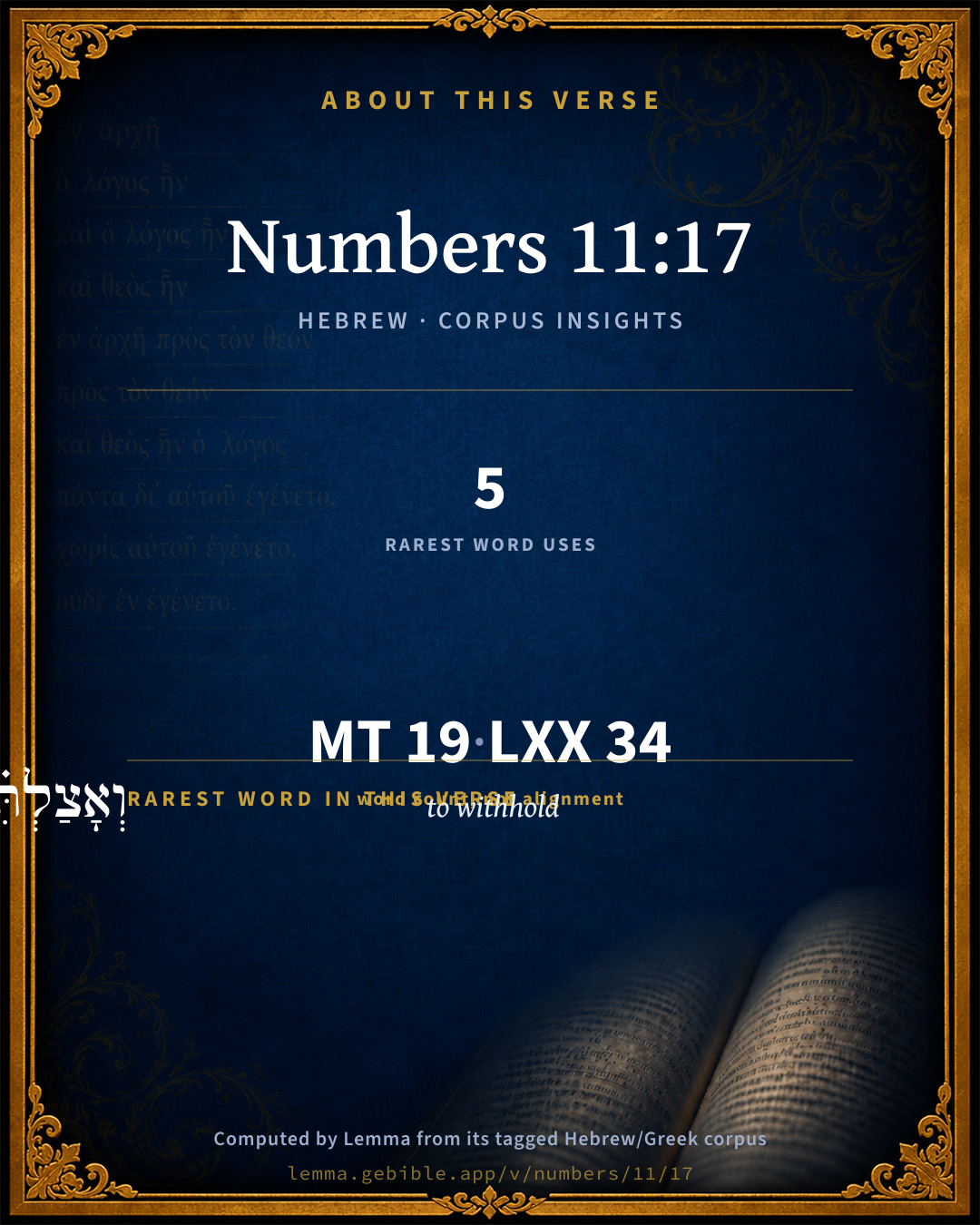
These counts appear in no published source. They are computed here, from the morphology-tagged text and Lemma’s own curated glosses. What Lemma adds →

19
words
17
distinct lemmas
Pentateuch
section

Notable vocabulary

The rarest word here is וְאָצַלְתִּ֗י to withhold H680 — appearing just 5 times in the whole Hebrew Bible.

Shared distinctive vocabulary

וְאָצַלְתִּ֗י to withhold H680 occurs in 5 verses of the Hebrew Bible. Also found in:

Grammatical profile

  • 6 verbs
  • 4 nouns
  • 1 pronoun
  • 5 prepositions
  • 1 adverb
  • 2 particles

Verb forms

  • וְיָרַדְתִּ֗י Qal · Sequential Perfect
  • וְדִבַּרְתִּ֣י Piel · Sequential Perfect
  • וְאָצַלְתִּ֗י Qal · Sequential Perfect
  • וְשַׂמְתִּ֣י Qal · Sequential Perfect
  • וְנָשְׂא֤וּ Qal · Sequential Perfect
  • תִשָּׂ֥א Qal · Imperfect

Repetition

Words recur within this verse — often emphatic in Hebrew:

  • עָלֶ֖יךָ upon H5921 ×2
  • וְנָשְׂא֤וּ to lift H5375 ×2

Hebrew & Septuagint length

In English translation the verse runs 44 words from the Hebrew and 46 from the Septuagint (LXX English) — closely comparable.

A rough comparison of the two English renderings, which tokenize alike — not a word-level alignment.

Word counts can differ between the Hebrew and the Greek without any difference in meaning — e.g. the Hebrew direct-object marker אֵת has no separate Greek word, and Greek often adds the article ὁ.

In the original languages it is 19 Hebrew tokens and 34 Greek tokens — but the two are counted differently (Hebrew bundles its prefixes and suffixes into one token; the Greek is in lemma form), so that isn’t a like-for-like length.

Cross-references

29

Topical passages linked to Numbers 11:17 in the Treasury of Scripture Knowledge — connected by theme and wording, ordered by reader-vote popularity; previews shown in the World English Bible.

  • Numbers 11:25 Yahweh came down in the cloud, and spoke to him, and took of the Spirit that was on him, and put it on the seventy elders: and it happened that when the Spirit rested on them, they prophesied, but they did so no more.
  • 1 Samuel 10:6 and the Spirit of Yahweh will come mightily on you, and you shall prophesy with them, and shall be turned into another man.
  • 2 Kings 2:9 It happened, when they had gone over, that Elijah said to Elisha, Ask what I shall do for you, before I am taken from you. Elisha said, please let a double portion of your spirit be on me.
  • 1 Corinthians 2:12 But we received, not the spirit of the world, but the Spirit which is from God, that we might know the things that were freely given to us by God.
  • 1 Corinthians 12:4–11 Now there are various kinds of gifts, but the same Spirit.
  • 2 Kings 2:15 When the sons of the prophets who were at Jericho over against him saw him, they said, The spirit of Elijah does rest on Elisha. They came to meet him, and bowed themselves to the ground before him.
  • Joel 2:28 "It will happen afterward, that I will pour out my Spirit on all flesh; And your sons and your daughters will prophesy. Your old men will dream dreams. Your young men will see visions.
  • Isaiah 59:20–21 A Redeemer will come to Zion, and to those who turn from disobedience in Jacob, says Yahweh.
  • Romans 8:9 But you are not in the flesh but in the Spirit, if it is so that the Spirit of God dwells in you. But if any man doesn't have the Spirit of Christ, he is not his.
  • Exodus 18:22 Let them judge the people at all times. It shall be that every great matter they shall bring to you, but every small matter they shall judge themselves. So shall it be easier for you, and they shall share the load with you.
  • Nehemiah 9:20 You gave also your good Spirit to instruct them, and didn't withhold your manna from their mouth, and gave them water for their thirst.
  • 1 Thessalonians 4:8 Therefore he who rejects doesn't reject man, but God, who has also given his Holy Spirit to you.
  • Genesis 11:5 Yahweh came down to see the city and the tower, which the children of men built.
  • Exodus 19:20 Yahweh came down on Mount Sinai, to the top of the mountain. Yahweh called Moses to the top of the mountain, and Moses went up.
  • Numbers 12:5 Yahweh came down in a pillar of cloud, and stood at the door of the Tent, and called Aaron and Miriam; and they both came forth.
  • 1 Peter 1:22 Seeing you have purified your souls in your obedience to the truth through the Spirit in sincere brotherly affection, love one another from the heart fervently:
  • Jude 1:19 These are they who cause divisions, and are sensual, not having the Spirit.
  • Genesis 17:3 Abram fell on his face. God talked with him, saying,
  • Genesis 17:22 When he finished talking with him, God went up from Abraham.
  • Genesis 18:20–22 Yahweh said, "Because the cry of Sodom and Gomorrah is great, and because their sin is very grievous,
  • Genesis 18:33 Yahweh went his way, as soon as he had finished communing with Abraham, and Abraham returned to his place.
  • Exodus 19:11 and be ready against the third day; for on the third day Yahweh will come down in the sight of all the people on Mount Sinai.
  • Exodus 34:5 Yahweh descended in the cloud, and stood with him there, and proclaimed the name of Yahweh.
  • Numbers 12:8 with him will I speak mouth to mouth, even manifestly, and not in dark speeches; and the form of Yahweh shall he see: why then were you not afraid to speak against my servant, against Moses?
  • Numbers 27:18 Yahweh said to Moses, Take Joshua the son of Nun, a man in whom is the Spirit, and lay your hand on him;
  • Isaiah 44:3 For I will pour water on him who is thirsty, and streams on the dry ground; I will pour my Spirit on your seed, and my blessing on your offspring:
  • John 3:13 No one has ascended into heaven, but he who descended out of heaven, the Son of Man, who is in heaven.
  • John 7:39 But he said this about the Spirit, which those believing in him were to receive. For the Holy Spirit was not yet given, because Jesus wasn't yet glorified.
  • Acts 6:3–4 Therefore select from among you, brothers, seven men of good report, full of the Holy Spirit and of wisdom, whom we may appoint over this business.

Cross-references courtesy of OpenBible.info (CC BY 4.0).

Hebrew and Greek witnesses Masoretic Hebrew ↔ Greek Septuagint

The same verse in the two great witnesses to the Old Testament, shown verse-for-verse.

These are two independent witnesses, not word-aligned to each other, and the Septuagint is shown in lemma (dictionary) form.

Hebrew Numbers 11:17 Masoretic · Westminster Leningrad Codex

וְיָרַדְתִּ֗י וְדִבַּרְתִּ֣י עִמְּךָ֮ שָׁם֒ וְאָצַלְתִּ֗י מִן הָר֛וּחַ אֲשֶׁ֥ר עָלֶ֖יךָ וְשַׂמְתִּ֣י עֲלֵיהֶ֑ם וְנָשְׂא֤וּ אִתְּךָ֙ בְּמַשָּׂ֣א הָעָ֔ם וְלֹא תִשָּׂ֥א אַתָּ֖ה לְבַדֶּֽךָ

I will come down and talk with you there: and I will take of the Spirit which is on you, and will put it on them; and they shall bear the burden of the people with you, that you not bear it yourself alone.

World English Bible · Public Domain

Greek LXX Numbers 11:17 Septuagint · lemma form

καί καταβαίνω καί λαλέω ἐκεῖ μετά σύ καί ἀποαἱρέω ἀπό ὁ πνεῦμα ὁ ἐπί σύ καί ἐπιτίθημι ἐπί αὐτός καί συν ἀντιλαμβάνω μετά σύ ὁ ὁρμή ὁ λαός καί οὐ φέρω αὐτός σύ μόνος

And I will go down, and speak there with you; and I will take of the spirit that is upon you, and will put it upon them; and they shall bear together with you the burden of the people, and you shall not bear them alone.

LXX2012 (modern English Septuagint) · Public Domain

On this verse, Haydock's Catholic Bible Commentary discusses the Septuagint’s reading. Read the note in Commentary ↓

Hebrew: Westminster Leningrad Codex (CC BY 4.0). Greek: Septuagint (public domain); English from LXX2012 (modern English Septuagint) (Public Domain). How the Septuagint differs from the Hebrew →

Targum (Aramaic paraphrase)

2

The Targum is the ancient Jewish Aramaic paraphrase of the Hebrew Scriptures — an interpretive translation, not the Hebrew text itself. Onkelos (literal) and Pseudo-Jonathan (expansive) render the Torah, and Jonathan the Prophets. Coverage is partial: where no permissively-licensed English translation exists for a verse, only the Aramaic is shown. This is verse-level text, not a word-by-word alignment to the Hebrew.

  1. Targum Onkelos Torah (Genesis–Deuteronomy)
    וְאִתְגְלֵי וַאֲמַלֵל עִמָךְ תַּמָן וַאֲרַבֵּי מִן רוּחָא דִי עֲלָךְ וֶאֱשַׁוֵּי עֲלֵיהוֹן וִיסוֹבְרוּן עִמָךְ בְּמַטוּל עַמָא וְלָא תְסוֹבַר אַתְּ בִּלְחוֹדָךְ

    (no public-domain English translation for this verse)

    Targum Onkelos — Aramaic: “Onkelos Genesis” (public domain); “Onkelos Exodus” (public domain); “Onkelos Leviticus” (public domain); “Onkelos Numbers” (public domain); “Onkelos Deuteronomy” (public domain). English: “Sefaria Community Translation” (CC0 1.0 (public-domain dedication)); “J.W. Etheridge. The Targums of Onkelos and Jonathan Ben Uzziel on the Pentateuch. London: Longmans, Green, 1862” (public domain). Text via Sefaria.

  2. Targum Pseudo-Jonathan Torah (Genesis–Deuteronomy)
    וְאִתְגְלִי בְּאִיקַר שְׁכִינְתִּי וַאֲמַלֵל עִמָךְ תַּמָן וַאֲרַבֵּי מִן רוּחַ נְבוּאָה דְעַלָךְ וְאֶשַׁוֵי עֲלֵיהוֹן וְיִטְעִינוּן עִמָךְ בְּטוּרְחָא דְעַמָא וְלָא תִטְעוֹן אַנְתְּ בִּלְחוֹדָךְ

    And I will be revealed in the glory of My Shekinah, and will speak with thee there, and will amplify the spirit of prophecy that is upon thee, and bestow it upon them; and they shall sustain with thee the burden of the people, that thou mayest not bear it alone.

    Targum Pseudo-Jonathan — Aramaic: “Targum Jonathan on Genesis” (public domain); “Targum Jonathan on Exodus” (public domain); “Targum Jonathan on Leviticus” (public domain); “Targum Jonathan on Numbers” (public domain); “Targum Jonathan on Deuteronomy” (public domain). English: “The Targum of Jonathan ben Uzziel, trans. J. W. Etheridge, London, 1862” (public domain). Text via Sefaria.

Commentary

Notes on Numbers 11:17 from classic Christian and Jewish commentators (each source and its license shown beneath its notes). The classic Christian expositions comment on the surrounding passage and are grouped to its opening verse, so a note may address several verses; the Jewish commentaries on the Tanakh (Rashi and others) are per-verse, so they appear only where the commentator wrote on this verse.

Lemma curates 59 commentaries, every one of them public domain or Creative Commons licensed, each selected and text-cleaned for this edition rather than reprinted as found. About our sources →

Trapp's Complete Commentary

John Trapp

Num 11:17 And I will come down and talk with thee there: and I will take of the spirit which [is] upon thee, and will put [it] upon them; and they shall bear the burden of the people with thee, that thou bear [it] not thyself alone.

Ver. 17. And I will take of the spirit,] i.e., I will bestow the same spirit upon them as upon thee; and this shall be nothing at all to thy loss or disadvantage. Habet Hispania montem ex sale magnum, de quo quantum demas, tantum accrescit.

Shall bear the burden of the people.] Who are in nothing more a burden than in this, that with them αει το παρον βαρυ, {a} Praesens imperium semper grave, They are ever grumbling at the present government, though never so gentle. Alleva iugum, Ease the yoke that thy father put upon us, said they to Rehoboam, forgetting the golden age they had lived in under his father Solomon. {1Ki 12:4}

{a} Thucyd.

John Trapp, A Commentary or Exposition upon All the Books of the Old and New Testament (1647–1656) — public domain. Text from a community e-Sword module.

Joseph Benson's Commentary

Num 11:17. I will come down — By my powerful presence and operation. I will put it on them — That is, I will give the same spirit to them which I have given to thee. The spirit is here put for the gifts of the Spirit, and particularly for the spirit of prophecy, whereby they were enabled, as Moses had been and still was, to discern hidden and future things, and resolve doubtful and difficult cases, which made them fit for government. It is observable that God would not, and therefore men should not, call any persons to any office for which they were not sufficiently qualified.

Joseph Benson's Commentary on the Old and New Testaments (1811–1818) — public domain. Text from a community e-Sword module.

Geneva Bible (1599)

Geneva Bible translators

I will distribute my spirit among them, as I have done to thee.

Geneva Bible (1599) marginal notes — public domain. Text via Bolls.life.

Jamieson, Fausset & Brown

Robert Jamieson, A. R. Fausset & David Brown

I will come down--that is, not in a visible manner or by local descent, but by the tokens of the divine presence and operations.

and I will take of the spirit which is upon thee--"The spirit" means the gifts and influences of the Spirit (Num 27:18; Joe 2:28; Joh 7:39; Co1 14:12), and by "taking the spirit of Moses, and putting it upon them," is not to be understood that the qualities of the great leader were to be in any degree impaired but that the elders would be endowed with a portion of the same gifts, especially of prophecy (Num 11:25) --that is, an extraordinary penetration in discovering hidden and settling difficult things.

Jamieson, Fausset & Brown — Commentary Critical and Explanatory on the Whole Bible (1871) — public domain (CC PDM 1.0). Text via the HelloAO Bible API.

Adam Clarke's Commentary

Verse 17. I will take of the spirit which is upon thee] From this place Origen and Theodoret take occasion to compare Moses to a lamp, at which seventy others were lighted, without losing any of its brightness. To convince Moses that God had sufficiently qualified him for the work which he had given him to do, he tells him that of the gifts and graces which he has given him he will qualify seventy persons to bear the charge with him. This was probably intended as a gracious reproof. Query. Did not Moses lose a measure of his gifts in this business? And is it not right that he whom God has called to and qualified for some particular office, should lose those gifts which he either undervalues or refuses to employ for God in the way appointed? Is there not much reason to believe that many cases have occurred where the spiritual endowments of particular persons have been taken away and given to others who made a better use of them? Hence the propriety of that exhortation, Re 3:11: Hold that fast which thou hast, that no man take thy crown.

The gracious God never called a man to perform a work without furnishing him with adequate strength; and to refuse to do it on the pretence of inability is little short of rebellion against God.

This institution of the seventy persons to help Moses the rabbins consider as the origin of their grand council called the Sanhedrin. But we find that a council of seventy men, elders of Israel, had existed among the people a year before this time. See Ex 24:9; see the advice given to Jethro to Moses, Ex 18:17, &c., and the notes there.

Adam Clarke's Commentary on the Bible (1810–1826) — public domain. Text from a community e-Sword/MySword module.

Ellicott's Commentary for English Readers

(17) And I will come down . . . —The cloud which hovered over the Tabernacle appears to have descended to the entrance of it (Num_11:25). (Comp. Exo_33:9; Num_12:5; Deu_31:15).

I will take of the spirit which is upon thee . . . —These words do not imply that there was any diminution of the gifts bestowed upon Moses, but that a portion of those spiritual gifts was bestowed upon the seventy. Rashi compares the mode of bestowal with the manner in which the other lamps of the Sanctuary were lighted at the golden candlestick without diminishing the light from which theirs was taken.

A Bible Commentary for English Readers, edited by Charles John Ellicott (1878–1897) — public domain. Text from a community e-Sword module.

John Gill's Exposition

And I will come down and talk with thee there,.... Descend from heaven, by some visible token of his power and presence, and in a friendly manner converse with him face to face; which was an instance of great condescension and grace, and especially when Moses had showed a very froward peevish spirit; yet all is overlooked, and the Lord vouchsafes the most intimate communion with him, and does him honour before the people:

and I will take of the spirit which is upon thee; the spirit of government, and the spirit of prophecy, the gifts of the spirit qualifying for these things, of which Moses had a large measure:

and will put it upon them; that is, gifts of the same kind with his; not that his gifts were diminished, or that properly speaking anything was taken from Moses and given to the seventy elders; but from the same fountain and fulness of the spirit Moses partook of, they were furnished with like gifts and qualifications, he having not at all the less for what was communicated to them; see Co1 12:4; several of the Jewish writers, and particularly Jarchi, illustrate it by the lamp in the golden candlestick in the sanctuary, which was always burning, and at which all the rest were lighted, without any diminution of its light at all:

and they shall bear the burden of the people with thee, that thou bear it not thyself alone: assist in the government of them, take part in all weighty and difficult matters, hear the complaints of the people, and bear a share of the blame and reproach they at any time should cast upon their rulers.

John Gill's Exposition of the Whole Bible (1746–1763) — public domain (CC PDM 1.0). Text via the HelloAO Bible API.

Haydock's Catholic Bible Commentary

Thy spirit. St. Augustine (q. 18) reads "of the spirit which is on thee;" (Septuagint) referring it to the indivisible spirit of God, so that these ancients received what was sufficient for them, while Moses suffered no diminution. Thus one lamp communicates light to another, without being impaired. (Origen, hom. 6.) Theodoret (q. 18,) also adds, that a person confers baptism on thousands, and yet loses no part of the grace himself. Selden (Syn. ii. 4,) shews that the Jews explain this spirit of a certain emanation of divine light, or inspiration, which causes the prophets to speak. They have not in general, a distinct belief of the blessed Trinity. "I will make an increase of the spirit, which is upon thee, and will place it upon them." (Chaldean; ver. 25.)

George Leo Haydock (1774–1849), Haydock's Catholic Family Bible and Commentary, 1859 edition — public domain. Excludes Psalms (Douay-Rheims chapter numbering differs from Protestant) and Deuterocanonical books (Catholic canon only).

Matthew Poole's English Annotations

I will come down, not by local motion, but by my powerful presence and operation. See Gen 11:5; Exo 34:5.

Will put it upon them, i.e. I will give the same Spirit to them which I have given to thee. But as the Spirit was not conveyed to them from or through Moses, but immediately from God, so the Spirit or its gifts were not by this means impaired in Moses. The Spirit is here put for the gifts of the Spirit, as it is Num 27:18; Joe 2:28; Joh 7:39; Act 19:2,6; 1Co 14:12,32; and particularly for the Spirit of prophecy, Num 11:25, whereby they were enabled, as Moses had been and still was, to discern hidden and future things, and resolve doubtful and difficult cases, which made them fit for government. It is observable, that God would not, and therefore men should not, call any persons to any office for which they were not sufficiently fit and qualified.

Matthew Poole's English Annotations on the Holy Bible (1683–1685) — public domain. Text from a community e-Sword/MySword module.

Whedon's Commentary on the Bible

Daniel D. Whedon

17. I will come down — Not figuratively, but by a literal descent in the pillar of cloud, as in Num_11:25. Chaldee, “I will manifest myself.” Targum of Palestine, “I will be revealed in the glory of my shekinah.” There is no record of the words of Jehovah to Moses on this occasion.

I will take of the spirit — The Hebrew for take is an unusual word here, signifying to divide into portions. The elders were to share, but probably in a less degree, the charismata, or special gifts of wisdom and administration which Moses possessed. There was to be no diminution of the endowment of Moses. The Targum of Palestine says: “I will amplify the spirit of prophecy that is upon thee, and bestow it upon them.” Hence Origen and Theodoret take occasion to compare Moses to a lamp at which seventy others were lighted without diminishing its lustre. Dr. Adam Clarke, however, queries whether Moses did not lose a measure of his gifts at this time because he had undervalued them, in accordance with the great law that a spiritual gift unused or slighted declines.

Daniel D. Whedon (gen. ed.), Commentary on the Old and New Testaments (1874–1909) — public domain. Text from a community e-Sword module.

The Pulpit Commentary

I will take of the spirit which is upon thee, and will put it upon them. The Holy Spirit is one and indivisible. But in the language of Scripture "the Spirit" often stands for the charismata, or gifts of the Spirit, and in this sense is freely spoken of as belonging to this or that man. So the "spirit of Elijah", (2Ki_2:9, 2Ki_2:15) which was transferred to Elisha, as it were, by bequest. It was not, therefore, the personal indwelling presence of the Holy Ghost in Moses which God caused him to share with the seventy elders, for that can in no ease be a matter of transfer or of arrangement, but simply those charismata or extraordinary gifts of the Spirit which Moses had hitherto enjoyed alone as the prophet of Israel. It is strange that in the face of the clear teaching of St. Paul in 1Co 12, 13, and in view of such cases as those of Saul (1Sa_10:10 1Sa 19:33) and David, (1Sa_16:13) any difficulty should have been felt about this passage. They shall bear the burden of the people with thee. It does not appear how they were to do this, nor is there any record of their work. Their gifts, however, were spiritual, and we may probably assume that their usefulness lay in producing and maintaining a proper religious tone among the people. The real difficulty which stood in the way of Moses was not one of outward organization or of government, for that had been amply provided for; it lay in the bad tone which prevailed among the people, and threatened to destroy at any moment the very foundations of their national hope and safety. We may see in these seventy not indeed a Sanhedrim to exercise authority and discipline, but the first commencement of that prophetic order which afterwards played so large a part in the religious history of Israel and of the early Christian Church an order designed kern the first to supplement by the freedom and originality of their ministry the more formal and unvarying offices of the priesthood. If this was the nature of their usefulness, it is not surprising that they are never mentioned again; and it is observable that a similar obscurity hangs over the activity of the prophets of the New Testament, who yet formed a most important part of the gospel regime. (cf. 1Co_14:29-32 Eph_2:20)

The communication of a spiritual endowment.

The endowment of the elders for official duties was

1. A Divine gift imparted by God himself. (1Co_12:4-6 Jam_1:17)

2. Yet mediate, through Moses, who was the first to enjoy it, but was thankful to share it with men in sympathy with himself. (cf. 1Co_3:21, 22 4:6, 7)

3. A means of relief to Moses and of blessing to the people. The communication did not impoverish Moses, but enriched him. He was like a lamp from which seventy other lamps were lit. The communication of the gift. like mercy, was twice blessed to him that gives and him that takes. It relieved Moses and enriched the elders, yet not for their own advantage, but as a means of discharging their new and solemn trust. All "gifts," however received, are to be looked on as talents and trusts. The law of the stewardship is found in Rom_12:3-8 1Pe_4:10, 1Pe_4:11.

Learn

1. The value of every spiritual gift. Men should not envy the possessor of it, but thank God for him, since the gift is communicable. If there had been no inspired Moses, there would have been no inspired elders. An Elisha is the heir of an Elijah; (2Ki_2:9, 2Ki_2:10) a Timothy is the son of a Paul. (2Ti_1:2, 2Ti_1:6)

2. The privilege of being the medium of communicating a spiritual gift. (Rom_1:11 Php_1:6)

3. The importance of "coveting the best gifts" which God can bestow, without human intervention, through his beloved Son. P.

The Pulpit Commentary (1880–1919), ed. H.D.M. Spence-Jones & Joseph S. Exell — public domain. Text from a community e-Sword module.

John Wesley's Explanatory Notes

I will come down - By my powerful presence and operation. I will put it on them - That is, I will give the same spirit to them which I have given to thee. But as the spirit was not conveyed to them from or through Moses, but immediately from God, so the spirit or its gifts were not by this means impaired in Moses. The spirit is here put for the gifts of the spirit, and particularly for the spirit of prophecy, whereby they were enabled, as Moses had been and still was, to discern hidden and future things, and resolve doubtful and difficult cases, which made them fit for government. It is observable, that God would not, and therefore men should not, call any persons to any office for which they were not sufficiently qualified.

John Wesley, Explanatory Notes Upon the Whole Bible (1754–1765) — public domain. Text via the GEBible commentary corpus.

Rashi

Rabbi Shlomo Yitzchaki (Rashi)

וירדתי AND I WILL COME DOWN [AND SPEAK WITH THEE THERE] This is one of the ten instances of the use of the term “coming down” written in the Torah to describe a Divine manifestation on earth (Sifrei Bamidbar 93).

ודברתי עמך AND I WILL SPEAK WITH THEE but not with them (Sifrei Bamidbar 93).

ואצלתי — Understand this as the Targum does: AND I SHALL MAKE GREAT. Similar is (Exodus 24:11) “And upon the great men of (אצילי) the children of Israel [He laid not his hands]”.

ושמתי עליהם AND I WILL PUT IT UPON THEM — What was Moses like to at that moment? He was like to a light that is placed in a candlestick at which everybody lights his lamps and yet its illuminating power is not the least diminished (Sifrei Bamidbar 93).

ונשאו אתך AND THEY SHALL BEAR [THE BURDEN OF THE PEOPLE] WITH THEE — stipulate with them that they shall join you on the understanding that they take upon themselves the burden of my children — because they are troublesome people and refractory (Sifrei Bamidbar 92).

ולא תשא אתה לבדך THAT THOU BEAR IT NOT THYSELF ALONE — Here you have the answer to what you have said, (Numbers 11:14) “I am not able [to bear all this people] alone” (cf. Sifrei Bamidbar 93; Rashi on Numbers 11:16).

Rashi on the Tanakh — English translations: “The Judaica Press complete Tanach with Rashi, translated by A. J. Rosenberg” (CC BY 4.0); “Pentateuch with Rashi's commentary by M. Rosenbaum and A.M. Silbermann, 1929-1934” (public domain); “The Metsudah Tanach series, Lakewood, N.J” (CC BY 4.0); and “The Book of Joshua, Metsudah Publications, 1997” (CC BY 4.0). Text via Sefaria.

Ramban (Nachmanides)

Rabbi Moshe ben Nachman (Ramban / Nachmanides)

AND I WILL COME DOWN AND SPEAK WITH THEE THERE, ‘V’ATZALTI’ (AND I WILL TAKE) OF THE SPIRIT WHICH IS UPON THEE, AND WILL PUT IT UPON THEM. The intention of the verse is to say that the transmission [of the spirit resting on Moses to the seventy elders] will take place at the time when G-d will speak to Moses; and it will be from that [Divine communication that the prophetic power will be transmitted to them], as is stated at the actual occurrance [of the events], And the Eternal came down in the cloud, and spoke unto him, [and took of the spirit that was upon him, and put it upon the seventy elders]. Now Scripture did not explain here what this communication was about, as is [usually] written in the whole Torah, where after [stating that G-d spoke to Moses] it explains what the Eternal said and what He spoke. [The reason for this is] that what happened here was that the elders, of whom Scripture states that they prophesied, did not hear any communication from the mouth of G-d, nor did He appear to them in a vision or in a dream, but G-d spoke to Moses, and from the atziluth [as is explained further on] of the spirit upon Moses, they understood that Divine communication. This is the sense of the expression, and they prophesied, but they did so no more, meaning that they did not continue receiving Divine communication on their own, for it was only the communication that G-d said to Moses in which they shared. This is also the meaning of v’atzalti [of the root eitzel — “near”], that “I will hold back with Me of the spirit which I put upon you, and I will put it upon them.” This is not the same idea as in the verse, and thou [Moses] shalt put of thy honor upon him [Joshua], 27:20. for the term atziluth always means “holding something back,” as in the expressions: And whatsoever mine eyes desired ‘lo atzalti’ (I did not keep) from them; ‘Halo atzalta’ (Hast thou not reserved) a blessing for me? Similarly, [Now the upper chambers were shorter, for the galleries took away from these, more than from the lower and the middlemost, in the building. For they were in three stories, and they had not pillars as the pillars of the courts;] therefore ‘ne’etzal’ (room was taken away) from the lowest and the middlemost, in comparison with the ground, meaning that more [room] was left by them [i.e., the upper chambers] relative to the ground, than by the chambers on the bottom and middle [stories], since their galleries did not take away from these upper chambers. used in the verse signifies “holding back.” Likewise, and to the ‘atzilei’ of the children of Israel means “those who were left and were separated from them, who were withdrawn to themselves from the rest of the ordinary people.” Or it may be that great men are so called [atzilim — from the root eitzel (near)] because everybody comes to them [for counsel and instruction]. And translators of languages (an Emanation from which emanated a second) etc. (Hirschfeld’s translation, I, 1, p. 36). use the term atziluth with reference to an emanation of any powers [coming forth] from the Creator and spreading to a created object. Thus they speak of the soul as atzulah (emanating) from Ruach Hakodesh (the Holy Spirit), since they understand atziluth as an expression of “drawing forth.” But it does not appear to me to be correct that atziluth should mean “drawing forth” or — “or placing upon”]: ela hanachah — “but placing upon.” That is to say, Ramban differs with the translators who understood atziluth as an act of both, coming forth from one subject and spreading to another, while Ramban holds it is primarily a concept of “placing upon” a subject, part of something which the bestower has set aside for it. — See further my Hebrew commentary p. 235. “placing upon” [the receiver], something which the bestower has set aside [for him]. Onkelos, however, explained that the term atziluth has two meanings. Thus he translated here [v’atzalti] — “and I shall make great” [thus indicating that the term atziluth is to be understood as a “drawing forth” by the giver for the benefit of the receiver, that he will be made great], and similarly and to the ‘atzilei’ [he translated], “and to the great men;” but he rendered ‘Halo atzalta’ a blessing for me — “Have you not ‘left’ for me a blessing?” Thus it appears that his opinion about the meaning of atziluth is that it [sometimes] refers to a drawing forth or bestowing by a giver on a receiver; thus [according to this interpretation] the verse here is saying: “I will draw forth from that which is upon you [Moses] of the spirit of prophecy, and I will put it upon them.” But we may [also use the term atziluth in speaking of] a “drawing forth” which a giver does to himself from that which is given, so that it remains with him, this being the meaning of the verse, ‘Halo atzalta’ a blessing for me — “Have you not kept to yourself for me one of the blessings with which to bless me?”The general principle about the elders is that their Divine communication came only from [G-d’s] spirit which spoke to Moses, and from him it came to them. Therefore the Rabbis have said in Bamidbar Sinai Rabbah:. “This can be compared to a master who gave an orchard to a guardian, and paid him a wage for his service. After a while the guardian said to him: ‘I cannot guard the whole orchard alone; bring in some more people to guard it with me.’ Thereupon the master said to him: ‘I gave you my orchard to guard, and all the fruits for guarding it I gave you [i.e., I gave you a reward for it], and now you tell me to bring in others to guard it with you! I will bring in others to help you guard it, but you should know that I will not give them wages for watching it out of my resources; rather it is from the wages that I have given you that they will take their payment.’ So did the Holy One, blessed be He, say to Moses: ‘I have given you spirit and knowledge to lead My children, and I did not want anyone else [to help you], in order that you alone should be singled out for this guardianship, and now you want someone else! Know then that from Me they will not take anything, but I will take of the spirit which is upon thee, and will put it upon them.’ Yet nonetheless Moses did not lose anything [of his spirit].” Thus far is in the Midrash.It appears likely to me that this [bestowing of the Divine spirit that was upon Moses] happened to the elders throughout their lives, so that they knew whatever G-d commanded Israel by the hand of Moses in connection with the temporary needs of the people and the events which happened to them in the wilderness. This is the meaning of the expression [in the verse before us] and they shall bear the burden of the people with thee, that whatever Moses told the people they knew, and each one would pass the Divine communication about it to the people of his tribe, and thus Moses no longer had to bear their complaints alone.

Ramban (Nachmanides) on the Tanakh — English translation: “Commentary on the Torah by Ramban (Nachmanides). Translated and annotated by Charles B. Chavel. New York, Shilo Pub. House, 1971-1976” (CC BY 4.0). Text via Sefaria.

Lesson kit

Teaching starters — assembled from the data on this page, not authored interpretation. Every prompt links to the verse data it draws on. Edit before teaching.

Numbers, in the Pentateuch, opens this verse with 19 words (17 distinct Hebrew lemmas). Its most distinctive word is ʼâtsal (“to withhold”). A historical commentator’s framing appears above. Read the whole chapter for the surrounding context.

Discussion questions

  1. The word ʼâtsal carries the sense “to withhold.” How does it shape the verse?
  2. Genesis 27:36 shares the word «to withhold» with this verse. How do the two illuminate each other?
  3. “upon” occurs 2× in this one verse. What is the effect of the repetition?
  4. The translations on this page render this verse differently — a whole-verse word diff, not a word-by-word alignment. What might account for the different wordings?
  5. The verb «וְיָרַדְתִּ֗י» is Qal Sequential Perfect. How does its form color the action?
  6. Reading how Trapp's Complete Commentary and Joseph Benson's Commentary read this verse, where do the two commentators agree and where do they part?

Things to notice

Reading settings

Reading text

Shown beneath each verse's original-language words.

Old Testament
Old Testament edition

Read the OT as the Masoretic Hebrew (MT) or the Greek Septuagint (LXX).

English shown for the Greek Septuagint (in the Hebrew ↔ Greek comparison).

Comparing translations? Open the Compare panel on any verse page to stack up to four side by side.