Job 15:30

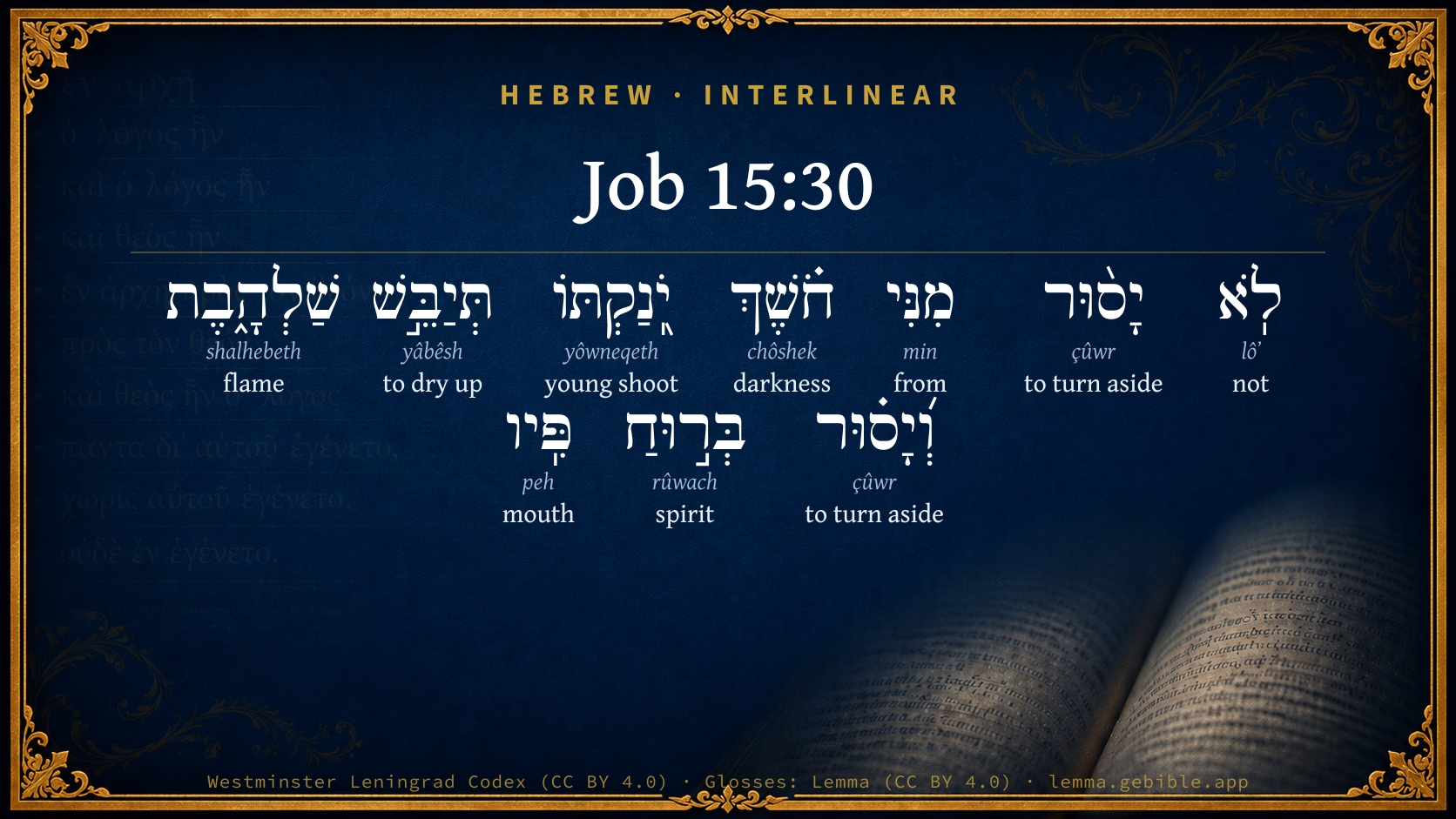
Hebrew (Westminster Leningrad Codex) Job 15:30 appears in the Hebrew Old Testament. The text above is from the Westminster Leningrad Codex. Each word links to its Strong’s number, a concise gloss, and parsing drawn from the Open Scriptures Hebrew Bible morphology. Click any word for its full Brown-Driver-Briggs (BDB) entry.
Download image
Cite this verse

Job 15:30 (World English Bible). Public Domain. Lemma interlinear Bible study tool, https://lemma.gebible.app/v/job/15/30.

Show BibTeX & RIS
BibTeX
RIS
English Translation
He shall not depart out of darkness; The flame shall dry up his branches, By the breath of God's mouth shall he go away.
World English Bible · Public Domain
Highlights
  • 1 first appearance in the Hebrew Bible
Full analysis ↓
Download a study sheet

One document with this verse’s original text, its word-by-word gloss line, the meaning frame, cross-references with their text, attributed commentary, and full source and license credits — printable, and it pastes into notes with its structure intact.

This verse Autodidact and up

Study sheet (.html) Plain text (.txt)

A passage Seminary Student

Up to 50 verses in one chapter. A passage sheet keeps up to 6 commentary sources and 12 cross-references per verse, in the order this page ranks them, and says so on the sheet whenever that leaves anything out. Ask for a single verse and you get the Autodidact verse sheet above.

Everything on this page stays free to read, with no account — the sheet is a download of what is already on screen, not access to it.

Want to remove ads? Support Godless Engineer
Compare translations 3

The same verse in 3 English versions, stacked beneath the original-language interlinear above. Click any original word for its lexicon entry.

Each is an independent rendering of the whole verse — the interlinear is not word-aligned to these translations.

Highlighted words mark where these versions differ — a whole-verse word diff, not a word-by-word alignment.

  • World English Bible Public Domain
    He shall not depart out of darkness; The flame shall dry up his branches, By the breath of God's mouth shall he go away.
  • King James Version Public Domain
    He shall not depart out of darkness; the flame shall dry up his branches, and by the breath of his mouth shall he go away.
  • unfoldingWord Literal Text CC BY-SA 4.0
    He will not depart from darkness; a flame will dry up his shoots, and he will depart at the breath of his mouth.

unfoldingWord Literal Text — © unfoldingWord, licensed CC BY-SA 4.0. Word-aligned USFM3 via Door43 (git.door43.org/unfoldingWord/en_ult).

Versions to compare (up to 4)

3 of 4 selected

Show all 18 translations

Every available English version of this verse, each an independent rendering of the whole verse.

  • World English Bible Public Domain
    He shall not depart out of darkness; The flame shall dry up his branches, By the breath of God's mouth shall he go away.
  • Berean Standard Bible Public Domain
    He will not escape from the darkness; the flame will wither his shoots, and the breath of God’s mouth will carry him away.
  • Majority Standard Bible Public Domain
    He will not escape from the darkness; the flame will wither his shoots, and the breath of God’s mouth will carry him away.
  • King James Version Public Domain
    He shall not depart out of darkness; the flame shall dry up his branches, and by the breath of his mouth shall he go away.
  • American Standard Version (1901) Public Domain
    He shall not depart out of darkness; The flame shall dry up his branches, And by the breath of `God's' mouth shall he go away.
  • Revised Version (1885) Public Domain
    He shall not depart out of darkness; the flame shall dry up his branches, and by the breath of his mouth shall he go away.
  • Geneva Bible (1599) Public Domain
    He shall neuer depart out of darkenesse: the flame shall drie vp his branches, and he shall goe away with the breath of his mouth.
  • Douay-Rheims (1899) Public Domain
    He shall not depart out of darkness: the flame shall dry up his branches, and he shall be taken away by the breath of his own month.
  • Young's Literal Translation Public Domain
    He turneth not aside from darkness, His tender branch doth a flame dry up, And he turneth aside at the breath of His mouth!
  • Literal Standard Version CC BY-SA 4.0
    He does not turn aside from darkness, || A flame dries up his tender branch, || And he turns aside at the breath of His mouth!
  • Unlocked Literal Bible CC BY-SA 4.0
    He will not depart out of darkness; a flame will dry up his stalks; at the breath of God's mouth he will go away.
  • unfoldingWord Literal Text CC BY-SA 4.0
    He will not depart from darkness; a flame will dry up his shoots, and he will depart at the breath of his mouth.
  • Darby Bible Public Domain
    He shall not depart out of darkness; the flame shall dry up his branches; and by the breath of his mouth shall he go away.
  • World Messianic Bible Public Domain
    He will not depart out of darkness. The flame will dry up his branches. He will go away by the breath of God’s mouth.
  • Webster's Bible Public Domain
    He shall not depart out of darkness; the flame shall dry up his branches, and by the breath of his mouth shall he go away.
  • Free Bible Version CC BY-SA 4.0
    They will not escape from the darkness. Like a tree whose shoots are burned up in a forest fire, the breath of God will blow him away.
  • Bible in Basic English Public Domain
    He does not come out of the dark; his branches are burned by the flame, and the wind takes away his bud.
  • JPS Tanakh (1917) Public Domain
    He shall not depart out of darkness; the flame shall dry up his branches, and by the breath of His mouth shall he go away.

Literal Standard Version (2020), Covenant Press — licensed CC BY-SA 4.0. Text via the HelloAO Bible API (eBible.org). Unlocked Literal Bible (unfoldingWord) — licensed CC BY-SA 4.0. Text via the HelloAO Bible API (eBible.org). unfoldingWord Literal Text — © unfoldingWord, licensed CC BY-SA 4.0. Word-aligned USFM3 via Door43 (git.door43.org/unfoldingWord/en_ult). Free Bible Version, Dr. Jonathan Gallagher — licensed CC BY-SA 4.0. Text via the HelloAO Bible API (eBible.org).

Word by word

More ways to search: Search by grammar → Find every occurrence → Compare this word →

Practice this passage: Drill this verse → Learn its vocabulary →

שַׁלְהָ֑בֶת
shalhebeth
H7957
“flame”
Noun, Common, Feminine, Singular, Absolute
Part of Speech
Noun
Type
Common
Gender
Feminine
Number
Singular
State
Absolute
Full BDB Definition

Origin: from the same as H3851 with sibilant prefix

TWOT: 1077c

flame
  1. לֹֽא lôʼ H3808 “not” Particle, Negative
  2. יָס֨וּר çûwr H5493 “to turn aside” Verb, Qal, Imperfect, 3rd Person, Masculine, Singular
  3. מִנִּי min H4480 “from” Preposition
  4. חֹ֗שֶׁךְ chôshek H2822 “darkness” Noun, Common, Masculine, Singular, Absolute
  5. יֹֽ֭נַקְתּוֹ yôwneqeth H3127 “young shoot · his” Noun, Common, Feminine, Singular, Construct + Suffix, Personal, 3rd Person, Masculine, Singular
  6. תְּיַבֵּ֣שׁ yâbêsh H3001 “to dry up” Verb, Piel, Imperfect, 3rd Person, Feminine, Singular
  7. וְ֝יָס֗וּר çûwr H5493 “and · to turn aside” Conjunction + Verb, Qal, Imperfect, 3rd Person, Masculine, Singular
  8. בְּר֣וּחַ rûwach H7307 “in/at · spirit of” Preposition + Noun, Common, Both, Singular, Construct
  9. פִּֽיו peh H6310 “mouth · his” Noun, Common, Masculine, Singular, Construct + Suffix, Personal, 3rd Person, Masculine, Singular

About this verse

These counts appear in no published source. They are computed here, from the morphology-tagged text and Lemma’s own curated glosses. What Lemma adds →

10
words
9
distinct lemmas
Wisdom
section

Notable vocabulary

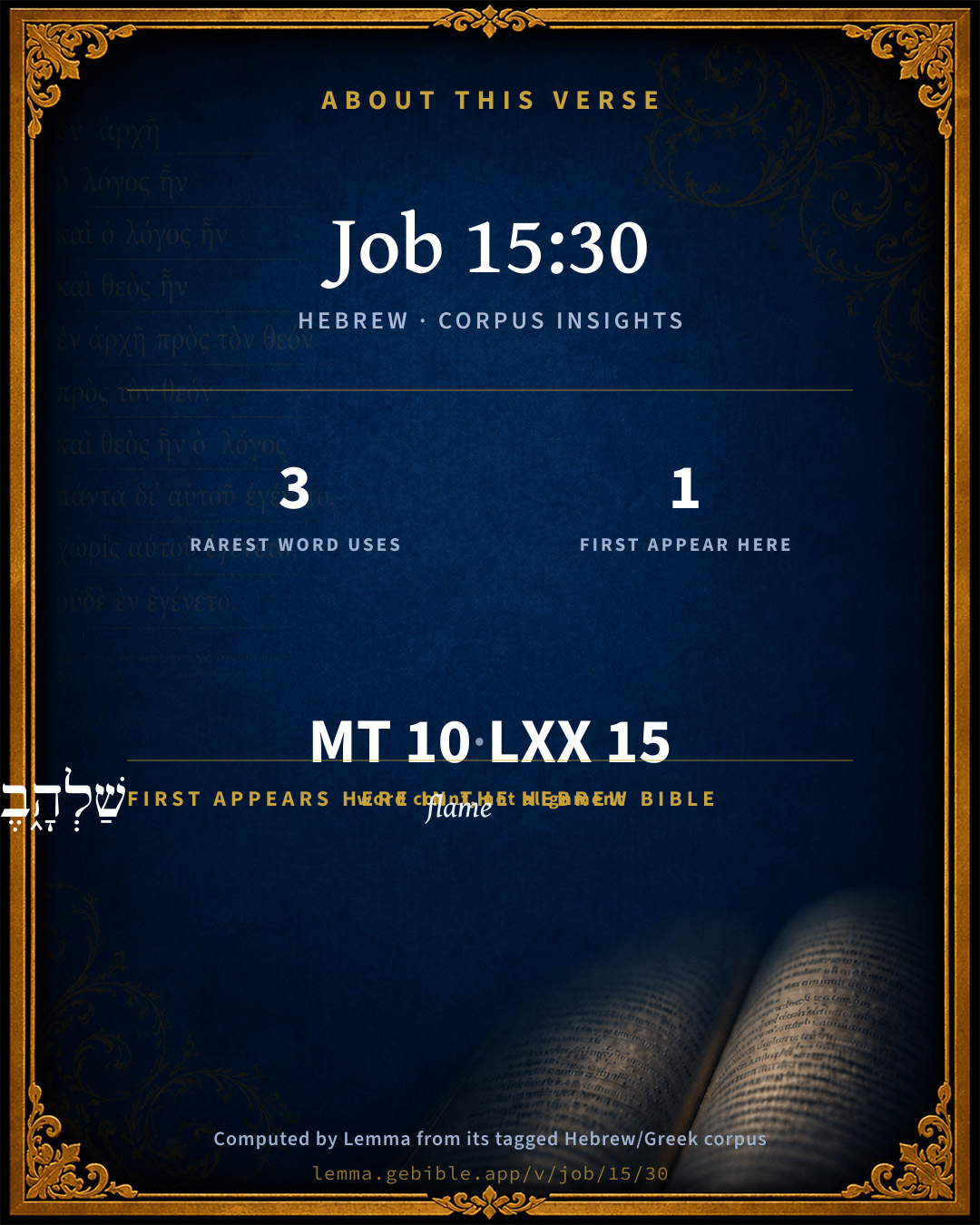
The rarest word here is שַׁלְהָ֑בֶת flame H7957 — appearing just 3 times in the whole Hebrew Bible.

First appearance in Scripture

This word makes its first canonical appearance in the Hebrew Bible here:

  • שַׁלְהָ֑בֶת flame H7957

Shared distinctive vocabulary

שַׁלְהָ֑בֶת flame H7957 occurs in 3 verses of the Hebrew Bible. Also found in:

Grammatical profile

  • 3 verbs
  • 5 nouns
  • 1 preposition
  • 1 particle

Verb forms

  • יָס֨וּר Qal · Imperfect
  • תְּיַבֵּ֣שׁ Piel · Imperfect
  • וְ֝יָס֗וּר Qal · Imperfect

Repetition

A word recurs within this verse — often emphatic in Hebrew:

  • יָס֨וּר to turn aside H5493 ×2

Hebrew & Septuagint length

In English translation the verse runs 24 words from the Hebrew and 21 from the Septuagint (LXX English) — closely comparable.

A rough comparison of the two English renderings, which tokenize alike — not a word-level alignment.

Word counts can differ between the Hebrew and the Greek without any difference in meaning — e.g. the Hebrew direct-object marker אֵת has no separate Greek word, and Greek often adds the article ὁ.

In the original languages it is 10 Hebrew tokens and 15 Greek tokens — but the two are counted differently (Hebrew bundles its prefixes and suffixes into one token; the Greek is in lemma form), so that isn’t a like-for-like length.

Cross-references

20

Topical passages linked to Job 15:30 in the Treasury of Scripture Knowledge — connected by theme and wording, ordered by reader-vote popularity; previews shown in the World English Bible.

  • Job 4:9 By the breath of God they perish, By the blast of his anger are they consumed.
  • Job 15:22 He doesn't believe that he shall return out of darkness, He is waited for by the sword.
  • Job 18:5–6 "Yes, the light of the wicked shall be put out, The spark of his fire shall not shine.
  • Job 20:26 All darkness is laid up for his treasures. An unfanned fire shall devour him. It shall consume that which is left in his tent.
  • Matthew 25:41 Then he will say also to those on the left hand, 'Depart from me, you cursed, into the eternal fire which is prepared for the devil and his angels;
  • Job 5:14 They meet with darkness in the day-time, And grope at noonday as in the night.
  • Job 10:21–22 Before I go where I shall not return from, To the land of darkness and of the shadow of death;
  • Job 18:18 He shall be driven from light into darkness, And chased out of the world.
  • Job 22:20 Saying, 'Surely those who rose up against us are cut off, The fire has consumed the remnant of them.'
  • Isaiah 11:4 but with righteousness shall he judge the poor, and decide with equity for the humble of the earth; and he shall strike the earth with the rod of his mouth; and with the breath of his lips shall he kill the wicked.
  • Isaiah 30:33 For a Topheth is prepared of old; yes, for the king it is made ready; he has made it deep and large; the pile of it is fire and much wood; the breath of Yahweh, like a stream of sulfur, does kindle it.
  • Ezekiel 15:4–7 Behold, it is cast into the fire for fuel; the fire has devoured both the ends of it, and the midst of it is burned: is it profitable for any work?
  • Ezekiel 20:47–48 and tell the forest of the South, Hear the word of Yahweh: Thus says the Lord Yahweh, Behold, I will kindle a fire in you, and it shall devour every green tree in you, and every dry tree: the flaming flame shall not be quenched, and all faces from the south to the north shall be burnt thereby.
  • Matthew 8:12 but the children of the Kingdom will be thrown out into the outer darkness. There will be weeping and the gnashing of teeth."
  • Matthew 22:13 Then the king said to the servants, 'Bind him hand and foot, take him away, and throw him into the outer darkness; there is where the weeping and grinding of teeth will be.'
  • Mark 9:43–49 If your hand causes you to stumble, cut it off. It is better for you to enter into life maimed, rather than having your two hands to go into Gehenna, into the unquenchable fire,
  • 2 Thessalonians 1:8–9 giving vengeance to those who don't know God, and to those who don't obey the Gospel of our Lord Jesus,
  • 2 Peter 2:17 These are wells without water, clouds driven by a storm; for whom the blackness of darkness has been reserved forever.
  • Jude 1:13 wild waves of the sea, foaming out their own shame; wandering stars, for whom the blackness of darkness has been reserved forever.
  • Revelation 19:15 Out of his mouth proceeds a sharp, double-edged sword, that with it he should strike the nations. He will rule them with a rod of iron. He treads the winepress of the fierceness of the wrath of God, the Almighty.

Cross-references courtesy of OpenBible.info (CC BY 4.0).

Hebrew and Greek witnesses Masoretic Hebrew ↔ Greek Septuagint

The same verse in the two great witnesses to the Old Testament, shown verse-for-verse.

These are two independent witnesses, not word-aligned to each other, and the Septuagint is shown in lemma (dictionary) form.

Hebrew Job 15:30 Masoretic · Westminster Leningrad Codex

לֹֽא יָס֨וּר מִנִּי חֹ֗שֶׁךְ יֹֽ֭נַקְתּוֹ תְּיַבֵּ֣שׁ שַׁלְהָ֑בֶת וְ֝יָס֗וּר בְּר֣וּחַ פִּֽיו

He shall not depart out of darkness; The flame shall dry up his branches, By the breath of God's mouth shall he go away.

World English Bible · Public Domain

Greek LXX Job 15:30 Septuagint · lemma form

οὐδέ μή ἐκφεύγω ὁ σκότος ὁ βλαστός αὐτός μαραίνω ἄνεμος ἐκπίπτω δέ αὐτός ὁ ἄνθος

Neither shall he in any wise escape the darkness: let the wind blast his blossom, and let his flower fall off.

LXX2012 (modern English Septuagint) · Public Domain

Hebrew: Westminster Leningrad Codex (CC BY 4.0). Greek: Septuagint (public domain); English from LXX2012 (modern English Septuagint) (Public Domain). How the Septuagint differs from the Hebrew →

Commentary

Notes on Job 15:30 from classic Christian and Jewish commentators (each source and its license shown beneath its notes). The classic Christian expositions comment on the surrounding passage and are grouped to its opening verse, so a note may address several verses; the Jewish commentaries on the Tanakh (Rashi and others) are per-verse, so they appear only where the commentator wrote on this verse.

Lemma curates 59 commentaries, every one of them public domain or Creative Commons licensed, each selected and text-cleaned for this edition rather than reprinted as found. About our sources →

Trapp's Complete Commentary

John Trapp

Job 15:30 He shall not depart out of darkness; the flame shall dry up his branches, and by the breath of his mouth shall he go away.

Ver. 30. He shall not depart out of darkness] But be held under remediless misery, being ever blasted and benighted, till God at last breathe forth upon him his final displeasure. When God hath brought wicked men into straits, there he holdeth them; not so the godly, Psa 34:19, they are sure of deliverance in due season. And as before the morning light is the thickest darkness, so before help hardest trials. Post tenebras lux, After the darkness, light, is the Christian’s motto; not so the ungodly, they are ex tenebris in tenebras, infelieiter exclusi, infelicius excludendi, as Austin hath it, to pass out of one darkness into another, till they be cast into utter darkness (Hom. 16).

The flame shall dry up his branches] That ventus urens et exsiccans of God’s wrath shall blast and consume, not his offspring only, but all his beauty and bravery; he shall be as a tree that is thunder struck, Zec 11:16.

And by the breath of his mouth shall he go away] God will blow him to destruction, his very breath shall leave him breathless, Isa 11:4 Psa 18:15 Job 4:9; {See Trapp on "Isa 11:4"} {See Trapp on "Psa 18:15"} {See Trapp on "Job 4:9"} Others understand it to be the wicked man’s mouth, and take this to be the sense, He shall be so choleric and impatient in his trouble, that he shall send out his last breath suddenly in a passionate fit. So did Nerva, the emperor, likewise Valentinian, Wenceslaus, king of Bohemia, and our Henry II.

John Trapp, A Commentary or Exposition upon All the Books of the Old and New Testament (1647–1656) — public domain. Text from a community e-Sword module.

Joseph Benson's Commentary

Job 15:30. He shall not depart out of darkness — His misery shall have no end. The flame — God’s anger and judgment upon him. Shall dry up his branches — His wealth, and power, and glory, wherewith he was encompassed, as trees are with their branches. By the breath of his mouth, &c. — This expression intimates, with how much ease God subdueth his enemies: his word, his blast, one act of his will, is sufficient. Shall he go away — Hebrew, go back: that is, run away from God faster than he ran upon him, Job 15:26. So it is a continuation of the former metaphor of a conflict between two persons.

Joseph Benson's Commentary on the Old and New Testaments (1811–1818) — public domain. Text from a community e-Sword module.

Tyndale Open Study Notes

Tyndale Open Resources

15:30 The burning sun (literally The flame) might be the scorching sun or a flame of judgment from God (15:34, see Num 16:31-35; Ps 106:17-18; Ezek 20:47). • The breath of God might be a desert wind or a more direct theophany (a manifestation of God’s presence) that caused the burning of Job 15:34.

Tyndale Open Study Notes — © Tyndale Open Resources, licensed CC BY-SA 4.0. Text via the HelloAO Bible API.

Jamieson, Fausset & Brown

Robert Jamieson, A. R. Fausset & David Brown

depart--that is, escape (Job 15:22-23).

branches--namely, his offspring (Job 1:18-19; Psa 37:35).

dry up--The "flame" is the sultry wind in the East by which plants most full of sap are suddenly shrivelled.

his mouth--that is, God's wrath (Isa 11:4).

Jamieson, Fausset & Brown — Commentary Critical and Explanatory on the Whole Bible (1871) — public domain (CC PDM 1.0). Text via the HelloAO Bible API.

Adam Clarke's Commentary

Verse 30. He shall not depart out of darkness]

4. He shall be in continual afflictions and distress.

5. The flame shall dry up his branches - his children shall be cut off by sudden judgments.

6. He shall pass away by the breath of his mouth; for by the breath of his mouth doth God slay the wicked.

Adam Clarke's Commentary on the Bible (1810–1826) — public domain. Text from a community e-Sword/MySword module.

Ellicott's Commentary for English Readers

(30) He shall not depart out of darkness.—See Job_15:22. “By the breath of his mouth shall he go away.” What this means is not very clear: probably as in Job_11:20; or, “When he expires it shall be the end of him; he shall leave nothing permanent that is destined to last;” or, “He shall pass away suddenly and completely, like his own breath.”

A Bible Commentary for English Readers, edited by Charles John Ellicott (1878–1897) — public domain. Text from a community e-Sword module.

The Cambridge Bible for Schools and Colleges

gen. ed. J. J. S. Perowne

30. Advance on Job_15:29, describing the sinner’s actual destruction. The figures are common; on darkness, cf. Job_15:22-23; the flame is the scorching sun or glowing wind; breath of his mouth, i. e., God’s mouth, cf. ch. Job_4:9.

The Cambridge Bible for Schools and Colleges (gen. ed. J. J. S. Perowne; Cambridge University Press, 1878–1918) — public domain. Text from a community e-Sword module.

John Gill's Exposition

Let not him that is deceived trust in vanity,.... Every wicked man is deceived, either by Satan, who deceives the whole world, deceived our first parents, and deceives all their posterity, not only profane sinners, but many professors of religion also; or by their own hearts, which are deceitful and desperately wicked; or through the deceitfulness of sin, which promises profit, pleasure, and liberty, and issues in ruin, pain, and bondage; and through the deceitfulness of riches, which promise that satisfaction they do not give: and such as are deceived in this manner are prone to trust in vanity; in men, who in every state, high or low, are altogether vanity; and in creature enjoyments, in outward riches and wealth, which are all vanity and vexation of spirit; and in their own hearts, and the vanity of their minds, which to do is extreme folly; and in their righteousness and external privileges, which will be of no service to them, as to their acceptance with God, and eternal happiness; and therefore trust in whatsoever is vain and empty, and affords no solid satisfaction, real pleasure, and advantage, is here dehorted from; unless the words will be allowed to be justly rendered, as I think they may, "trust not in him that is deceived by vanity" (e); by any of the above vain things, since he must himself be a vain man, and therefore not to be confided in; to which sense the Targum inclines;

"he will not (or should not) believe in a son of man (or in a man), who errs through falsehood;''

the reason dissuading from it follows:

for vanity shall be his recompence; all that a man gets by trusting in vanity, or by trusting in a man deceived, is nothing but emptiness and vanity; he gets nothing solid and substantial, that will be of any advantage to him here or hereafter; and yet this he will not easily believe; and so Beza reads the words, "he that is deceived by vanity will not believe that vanity shall be his recompence".

(e) "per vanitatem deceptus", Beza; so Tigurine version.

John Gill's Exposition of the Whole Bible (1746–1763) — public domain (CC PDM 1.0). Text via the HelloAO Bible API.

Albert Barnes' Notes on the Bible

He shall not depart out of darkness - He shall not escape from calamity; see Job 15:22. He shall not be able to rise again, but shall be continually poor.

The flame shall dry up his branches - As the fire consumes the green branches of a tree, so shall punishment do to him. This comparison is very forcible, and the idea is, that the man who has been prospered as a tree shall be consumed - as the fire consumes a tree when it passes through the branches. The comparison of a prosperous man with a tree is very common, and very beautiful. Thus, the Psalmist says,

I have seen the wicked in great power,

And spreading himself like a green bay tree. Psa 37:35.

Compare Psa 92:12-13. The aged Skenandoah - a chief of the Oneida tribe of Indians, said,” I am an aged hemlock. The winds of an hundred winters have whistled through my branches. I am dead at the top. My branches are falling,” etc.

And by the breath of his mouth shall he go away - That is, by the breath of the mouth of God. God is not indeed specified, but it is not unusual to speak of him in this manner. The image here seems to be that of the destruction of a man by a burning wind or by lightning. As a tree is dried up, or is rent by lightning, or is torn up from the roots by a tempest sent by the Deity, so the wicked will be destroyed.

Albert Barnes' Notes on the Bible (1834–1885) — public domain. Text from a community e-Sword/MySword module.

Matthew Poole's English Annotations

He shall not depart out of darkness; his misery shall have no end.

The flame; God’s anger and judgment upon him.

His branches; either,

1. His children; or,

2. Wealth, and power, and glory, wherewith he was encompassed, and adorned, and secured, as trees are with their branches.

Of his mouth, i.e. of God’s mouth, as appears both by comparing this with Job 15:25, where God is expressed as the adversary with whom this wicked wretch contendeth; and by the nature of the thing, and the whole context, all this man’s calamities being manifestly the effects of God’s anger; and by other places of Scripture, where the breath of God’s mouth or lips are mentioned as that whereby he destroyeth wicked men; as Job 4:9; Isa 11:4; 2Th 2:8. And this expression intimates to us with how much facility God subdueth his enemies; he needs no arms or instruments; his word, his blast, one act of his will, is more than sufficient to do it.

Shall he go away, Heb. go back, i.e. retreat and run away from God faster than he did run towards and upon him, Job 15:26. So it is a continuation of the former metaphor of a battle or conflict between two persons.

Matthew Poole's English Annotations on the Holy Bible (1683–1685) — public domain. Text from a community e-Sword/MySword module.

Whedon's Commentary on the Bible

Daniel D. Whedon

30. Dry up his branches — The figure is of a lofty tree which has been scathed by fire.

By the breath of his mouth — The breath of God’s mouth gave him life. God breathes in his wrath and it gives him death — he goes away. Where?

Daniel D. Whedon (gen. ed.), Commentary on the Old and New Testaments (1874–1909) — public domain. Text from a community e-Sword module.

The Pulpit Commentary

He shall not depart out of darkness (comp. ver. 23, where the wicked man is threatened with "a day of darkness"). When the darkness once falls, it shall continue; there shall be no escaping out of it The flame shall dry up his branches; rather, a flame. The "flame" intended seems to be the wrath of God. And by the breath of his mouth; i.e. "of God"s mouth". (comp. Job_4:9) Shall he go away; or, pass away; i.e. disappear, be consumed, perish.

The Pulpit Commentary (1880–1919), ed. H.D.M. Spence-Jones & Joseph S. Exell — public domain. Text from a community e-Sword module.

John Wesley's Explanatory Notes

Depart - His misery shall have no end. Flame - God's anger and judgment upon him. Branches - His wealth, and power, and glory, wherewith he was encompassed, as trees are with their branches. His mouth - And this expression intimates, with how much ease God subdueth his enemies: his word, his blast; one act of his will is sufficient. Go - Hebrew. go back: that is, run away from God faster than he ran upon him, ver. 26. So it is a continuation of the former metaphor of a conflict between two persons.

John Wesley, Explanatory Notes Upon the Whole Bible (1754–1765) — public domain. Text via the GEBible commentary corpus.

Rashi

Rabbi Shlomo Yitzchaki (Rashi)

and he will turn away from the world.

by the breath of His mouth Of the Ruler of the world. This is an ellipsis, Others interpret this to mean: because of the breath of his mouth that was guilty of speaking lies.

Rashi on the Tanakh — English translations: “The Judaica Press complete Tanach with Rashi, translated by A. J. Rosenberg” (CC BY 4.0); “Pentateuch with Rashi's commentary by M. Rosenbaum and A.M. Silbermann, 1929-1934” (public domain); “The Metsudah Tanach series, Lakewood, N.J” (CC BY 4.0); and “The Book of Joshua, Metsudah Publications, 1997” (CC BY 4.0). Text via Sefaria.

Lesson kit

Teaching starters — assembled from the data on this page, not authored interpretation. Every prompt links to the verse data it draws on. Edit before teaching.

Job, in the Wisdom, opens this verse with 10 words (9 distinct Hebrew lemmas). Its most distinctive word is shalhebeth (“flame”). A historical commentator’s framing appears above. Read the whole chapter for the surrounding context.

Discussion questions

  1. What does “flame” (shalhebeth) contribute to the verse as a whole?
  2. The word “flame” first appears here in Scripture. What is being introduced at this debut?
  3. Song of Solomon 8:6 shares the word «flame» with this verse. How do the two illuminate each other?
  4. “to turn aside” occurs 2× in this one verse. What is the effect of the repetition?
  5. These translations render this verse differently; the difference is in the English rendering, not the original. What questions does that raise?
  6. The verb «יָס֨וּר» is Qal Imperfect. How does its form color the action?
  7. Reading how Trapp's Complete Commentary and Joseph Benson's Commentary read this verse, where do the two commentators agree and where do they part?

Things to notice

Reading settings

Reading text

Shown beneath each verse's original-language words.

Old Testament
Old Testament edition

Read the OT as the Masoretic Hebrew (MT) or the Greek Septuagint (LXX).

English shown for the Greek Septuagint (in the Hebrew ↔ Greek comparison).

Comparing translations? Open the Compare panel on any verse page to stack up to four side by side.