
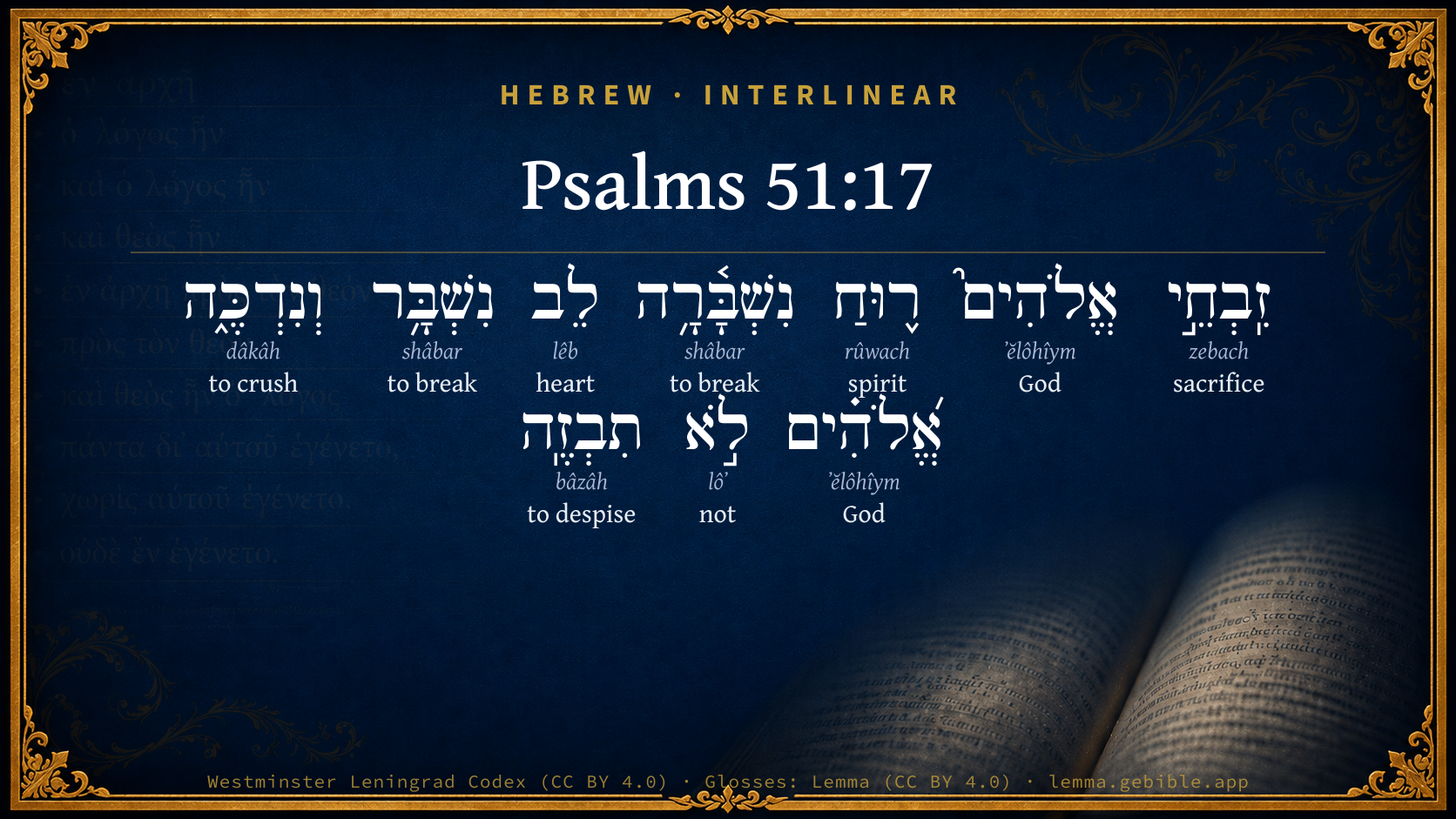
Psalms 51:17

Hebrew (Westminster Leningrad Codex) Psalms 51:17 appears in the Hebrew Old Testament. The text above is from the Westminster Leningrad Codex. Each word links to its Strong’s number, a concise gloss, and parsing drawn from the Open Scriptures Hebrew Bible morphology. Click any word for its full Brown-Driver-Briggs (BDB) entry.
Download image
Cite this verse

Psalms 51:17 (World English Bible). Public Domain. Lemma interlinear Bible study tool, https://lemma.gebible.app/v/psalms/51/17.

Show BibTeX & RIS
BibTeX
RIS
English Translation
The sacrifices of God are a broken spirit. A broken and contrite heart, O God, you will not despise.
World English Bible · Public Domain
Download a study sheet

One document with this verse’s original text, its word-by-word gloss line, the meaning frame, cross-references with their text, attributed commentary, and full source and license credits — printable, and it pastes into notes with its structure intact.

This verse Autodidact and up

Study sheet (.html) Plain text (.txt)

A passage Seminary Student

Up to 50 verses in one chapter. A passage sheet keeps up to 6 commentary sources and 12 cross-references per verse, in the order this page ranks them, and says so on the sheet whenever that leaves anything out. Ask for a single verse and you get the Autodidact verse sheet above.

Everything on this page stays free to read, with no account — the sheet is a download of what is already on screen, not access to it.

Want to remove ads? Support Godless Engineer
Compare translations 3

The same verse in 3 English versions, stacked beneath the original-language interlinear above. Click any original word for its lexicon entry.

Each is an independent rendering of the whole verse — the interlinear is not word-aligned to these translations.

Highlighted words mark where these versions differ — a whole-verse word diff, not a word-by-word alignment.

  • World English Bible Public Domain
    The sacrifices of God are a broken spirit. A broken and contrite heart, O God, you will not despise.
  • King James Version Public Domain
    The sacrifices of God are a broken spirit: a broken and a contrite heart, O God, thou wilt not despise.
  • unfoldingWord Literal Text CC BY-SA 4.0
    The sacrifices of God a broken spirit. A broken and crushed heart, God, you will not despise.

unfoldingWord Literal Text — © unfoldingWord, licensed CC BY-SA 4.0. Word-aligned USFM3 via Door43 (git.door43.org/unfoldingWord/en_ult).

Versions to compare (up to 4)

3 of 4 selected

Show all 18 translations

Every available English version of this verse, each an independent rendering of the whole verse.

  • World English Bible Public Domain
    The sacrifices of God are a broken spirit. A broken and contrite heart, O God, you will not despise.
  • Berean Standard Bible Public Domain
    The sacrifices of God are a broken spirit; a broken and a contrite heart, O God, You will not despise.
  • Majority Standard Bible Public Domain
    The sacrifices of God are a broken spirit; a broken and a contrite heart, O God, You will not despise.
  • King James Version Public Domain
    The sacrifices of God are a broken spirit: a broken and a contrite heart, O God, thou wilt not despise.
  • American Standard Version (1901) Public Domain
    The sacrifices of God are a broken spirit: A broken and contrite heart, O God, thou wilt not despise.
  • Revised Version (1885) Public Domain
    The sacrifices of God are a broken spirit: a broken and a contrite heart, O God, thou wilt not despise.
  • Geneva Bible (1599) Public Domain
    The sacrifices of God are a contrite spirit: a contrite and a broken heart, O God, thou wilt not despise.
  • Douay-Rheims (1899) Public Domain
    O Lord, thou wilt open my lips: and my mouth shall declare thy praise.
  • Young's Literal Translation Public Domain
    The sacrifices of God `are' a broken spirit, A heart broken and bruised, O God, Thou dost not despise.
  • Literal Standard Version CC BY-SA 4.0
    The sacrifices of God [are] a broken spirit, || A heart broken and bruised, O God, || You do not despise.
  • Unlocked Literal Bible CC BY-SA 4.0
    The sacrifices of God are a broken spirit. You, God, will not despise a broken and a contrite heart.
  • unfoldingWord Literal Text CC BY-SA 4.0
    The sacrifices of God a broken spirit. A broken and crushed heart, God, you will not despise.
  • Darby Bible Public Domain
    The sacrifices of God are a broken spirit: a broken and a contrite heart, O God, thou wilt not despise.
  • World Messianic Bible Public Domain
    The sacrifices of God are a broken spirit. O God, you will not despise a broken and contrite heart.
  • Webster's Bible Public Domain
    \\51:15\\O Lord, open thou my lips; and my mouth shall show forth thy praise.
  • Free Bible Version CC BY-SA 4.0
    The “sacrifices” that God wants are on the inside—the brokenness of repentance. God won't reject a broken and sorrowful heart.
  • Bible in Basic English Public Domain
    The offerings of God are a broken spirit; a broken and sorrowing heart, O God, you will not put from you.
  • JPS Tanakh (1917) Public Domain
    (51-19) The sacrifices of God are a broken spirit; a broken and a contrite heart, O God, Thou wilt not despise.

Literal Standard Version (2020), Covenant Press — licensed CC BY-SA 4.0. Text via the HelloAO Bible API (eBible.org). Unlocked Literal Bible (unfoldingWord) — licensed CC BY-SA 4.0. Text via the HelloAO Bible API (eBible.org). unfoldingWord Literal Text — © unfoldingWord, licensed CC BY-SA 4.0. Word-aligned USFM3 via Door43 (git.door43.org/unfoldingWord/en_ult). Free Bible Version, Dr. Jonathan Gallagher — licensed CC BY-SA 4.0. Text via the HelloAO Bible API (eBible.org).

Word by word

More ways to search: Search by grammar → Find every occurrence → Compare this word →

Practice this passage: Drill this verse → Learn its vocabulary →

וְנִדְכֶּ֑ה
dâkâh
H1794
“and · crushing”
Conjunction + Verb, Niphal, Participle Active, Masculine, Singular, Absolute
Part of Speech
Conjunction + Verb
Stem
Niphal
Form
Participle Active
Gender
Masculine
Number
Singular
State
Absolute
Full BDB Definition

Origin: a primitive root (compare H1790 , H1792 )

TWOT: 428

to crush, be crushed, be contrite, be broken - (Qal) to be crushed, collapse - (Niphal) to be crushed, be contrite, be broken - (Piel) - to crush down - to crush to pieces
  1. זִֽבְחֵ֣י zebach H2077 “sacrifices of” Noun, Common, Masculine, Plural, Construct
  2. אֱלֹהִים֮ ʼĕlôhîym H430 “God(s)” Noun, Common, Masculine, Plural, Absolute
  3. ר֪וּחַ rûwach H7307 “spirit of” Noun, Common, Both, Singular, Construct
  4. נִשְׁבָּ֫רָ֥ה shâbar H7665 “breaking” Verb, Niphal, Participle Active, Feminine, Singular, Absolute
  5. לֵב lêb H3820 “heart” Noun, Common, Masculine, Singular, Absolute
  6. נִשְׁבָּ֥ר shâbar H7665 “breaking” Verb, Niphal, Participle Active, Masculine, Singular, Absolute
  7. אֱ֝לֹהִ֗ים ʼĕlôhîym H430 “God(s)” Noun, Common, Masculine, Plural, Absolute
  8. לֹ֣א lôʼ H3808 “not” Particle, Negative
  9. תִבְזֶֽה bâzâh H959 “to despise” Verb, Qal, Imperfect, 2nd Person, Masculine, Singular

About this verse

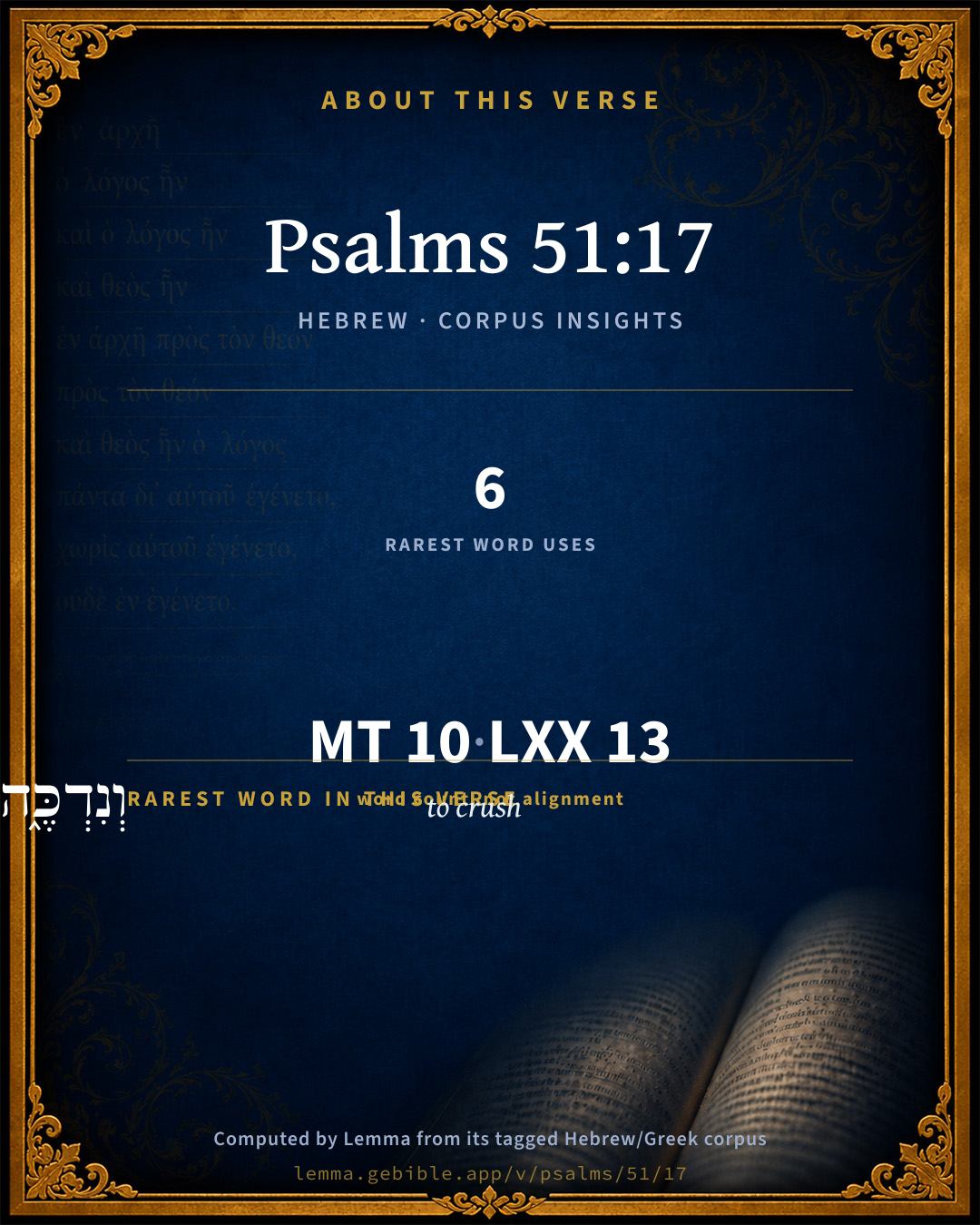
These counts appear in no published source. They are computed here, from the morphology-tagged text and Lemma’s own curated glosses. What Lemma adds →

10
words
8
distinct lemmas
Wisdom
section

Notable vocabulary

The rarest word here is וְנִדְכֶּ֑ה to crush H1794 — appearing just 6 times in the whole Hebrew Bible.

Shared distinctive vocabulary

וְנִדְכֶּ֑ה to crush H1794 occurs in 5 verses of the Hebrew Bible. Also found in:

Grammatical profile

  • 4 verbs
  • 5 nouns
  • 1 particle

Verb forms

  • נִשְׁבָּ֫רָ֥ה Niphal · Participle Active
  • נִשְׁבָּ֥ר Niphal · Participle Active
  • וְנִדְכֶּ֑ה Niphal · Participle Active
  • תִבְזֶֽה Qal · Imperfect

Repetition

Words recur within this verse — often emphatic in Hebrew:

  • אֱלֹהִים֮ God H430 ×2
  • נִשְׁבָּ֫רָ֥ה to break H7665 ×2

Hebrew & Septuagint length

In English translation the verse runs 19 words from the Hebrew and 16 from the Septuagint (LXX English) — closely comparable.

A rough comparison of the two English renderings, which tokenize alike — not a word-level alignment.

Word counts can differ between the Hebrew and the Greek without any difference in meaning — e.g. the Hebrew direct-object marker אֵת has no separate Greek word, and Greek often adds the article ὁ.

In the original languages it is 10 Hebrew tokens and 13 Greek tokens — but the two are counted differently (Hebrew bundles its prefixes and suffixes into one token; the Greek is in lemma form), so that isn’t a like-for-like length.

Cross-references

24

Topical passages linked to Psalms 51:17 in the Treasury of Scripture Knowledge — connected by theme and wording, ordered by reader-vote popularity; previews shown in the World English Bible.

  • Psalms 34:18 Yahweh is near to those who have a broken heart, And saves those who have a crushed spirit.
  • Isaiah 66:2 For all these things has my hand made, and [so] all these things came to be, says Yahweh: but to this man will I look, even to him who is poor and of a contrite spirit, and who trembles at my word.
  • Psalms 147:3 He heals the broken in heart, And binds up their wounds.
  • Luke 15:10 Even so, I tell you, there is joy in the presence of the angels of God over one sinner repenting."
  • Mark 12:33 and to love him with all the heart, and with all the understanding, with all the soul, and with all the strength, and to love his neighbor as himself, is more important than all whole burnt offerings and sacrifices."
  • Matthew 5:3 "Blessed are the poor in spirit, For theirs is the Kingdom of Heaven.
  • 2 Chronicles 33:12–13 When he was in distress, he begged Yahweh his God, and humbled himself greatly before the God of his fathers.
  • Psalms 102:17 He has responded to the prayer of the destitute, And has not despised their prayer.
  • Isaiah 57:15 For thus says the high and lofty One who inhabits eternity, whose name is Holy: I dwell in the high and holy place, with him also who is of a contrite and humble spirit, to revive the spirit of the humble, and to revive the heart of the contrite.
  • Hebrews 13:16 But don't forget to be doing good and sharing, for with such sacrifices God is well pleased.
  • 1 Peter 2:5 You also, as living stones, are built up as a spiritual house, to be a holy priesthood, to offer up spiritual sacrifices, acceptable to God through Jesus Christ.
  • 2 Kings 22:19 because your heart was tender, and you did humble yourself before Yahweh, when you heard what I spoke against this place, and against the inhabitants of it, that they should become a desolation and a curse, and have torn your clothes, and wept before me; I also have heard you, says Yahweh.
  • Psalms 107:22 Let them offer the sacrifices of thanksgiving, And declare his works with singing.
  • Amos 5:21 I hate, I despise your feasts, And I can't stand your solemn assemblies.
  • Romans 12:1 Therefore I urge you, brothers, by the mercies of God, to present your bodies a living sacrifice, holy, acceptable to God, which is your spiritual service.
  • Psalms 22:24 For he has not despised nor abhorred the affliction of the afflicted, Neither has he hidden his face from him; But when he cried to him, he heard.
  • Isaiah 61:1–3 The Spirit of the Lord Yahweh is on me; because Yahweh has anointed me to preach good news to the humble; he has sent me to bind up the broken-hearted, to proclaim liberty to the captives, and the opening [of the prison] to those who are bound;
  • Philippians 4:18 But I have all things, and abound. I am filled, having received from Epaphroditus the things that came from you, a sweet-smelling fragrance, an acceptable and well-pleasing sacrifice to God.
  • Luke 7:39–50 Now when the Pharisee who had invited him saw it, he said to himself, "This man, if he were a prophet, would have perceived who and what kind of woman this is who touches him, that she is a sinner."
  • Luke 15:21–32 The son said to him, 'Father, I have sinned against heaven, and in your sight. I am no longer worthy to be called your son.'
  • Luke 18:11–14 The Pharisee stood and prayed to himself like this: 'God, I thank you, that I am not like the rest of men, extortioners, unrighteous, adulterers, or even like this tax collector.
  • Ezekiel 9:3–4 The glory of the God of Israel was gone up from the cherub, whereupon it was, to the threshold of the house: and he called to the man clothed in linen, who had the writer's inkhorn by his side.
  • Luke 15:2–7 The Pharisees and the scribes murmured, saying, "This man welcomes sinners, and eats with them."
  • Ezekiel 9:6 kill utterly the old man, the young man and the virgin, and little children and women; but don't come near any man on whom is the mark: and begin at my sanctuary. Then they began at the old men that were before the house.

Cross-references courtesy of OpenBible.info (CC BY 4.0).

Hebrew and Greek witnesses Masoretic Hebrew ↔ Greek Septuagint

The same verse in the two great witnesses to the Old Testament, shown verse-for-verse.

You’re reading Greek Psalm 50 (Hebrew Psalm 51). The Septuagint counts the superscription, so verse numbers can differ from the Hebrew — chapter-level alignment, not verse-by-verse. Numbering follows Rahlfs.

These are two independent witnesses, not word-aligned to each other, and the Septuagint is shown in lemma (dictionary) form.

Hebrew Psalms 51:17 Masoretic · Westminster Leningrad Codex

זִֽבְחֵ֣י אֱלֹהִים֮ ר֪וּחַ נִשְׁבָּ֫רָ֥ה לֵב נִשְׁבָּ֥ר וְנִדְכֶּ֑ה אֱ֝לֹהִ֗ים לֹ֣א תִבְזֶֽה

The sacrifices of God are a broken spirit. A broken and contrite heart, O God, you will not despise.

World English Bible · Public Domain

Greek LXX Greek Psalm 50:17 Septuagint · lemma form

κύριος ὁ χεῖλος ἐγώ ἀναοἴγω καί ὁ στόμα ἐγώ ἀναἀγγέλλω ὁ αἴνεσις σύ

Sacrifice to God is a broken spirit: a broken and humbled heart God will not despise.

LXX2012 (modern English Septuagint) · Public Domain

Hebrew: Westminster Leningrad Codex (CC BY 4.0). Greek: Septuagint (public domain); English from LXX2012 (modern English Septuagint) (Public Domain). How the Septuagint differs from the Hebrew →

Commentary

Notes on Psalms 51:17 from classic Christian and Jewish commentators (each source and its license shown beneath its notes). The classic Christian expositions comment on the surrounding passage and are grouped to its opening verse, so a note may address several verses; the Jewish commentaries on the Tanakh (Rashi and others) are per-verse, so they appear only where the commentator wrote on this verse.

Lemma curates 59 commentaries, every one of them public domain or Creative Commons licensed, each selected and text-cleaned for this edition rather than reprinted as found. About our sources →

Trapp's Complete Commentary

John Trapp

Psa 51:17 The sacrifices of God [are] a broken spirit: a broken and a contrite heart, O God, thou wilt not despise.

Ver. 17. The sacrifices of God are a broken spirit] i.e. Such a heart as lieth low, and heareth all that God saith; such a sacrifice or service as is laid on the low altar of a contrite heart, which sanctifieth the sacrifice (Mr Abbot); such a person as with a self-condemning, self-crucifying, and sin-mortifying heart, humbly and yet believingly maketh out for mercy and pardon in the blood of Christ, this, this is the man that God expects, accepts, and makes great account of.

A broken and a contrite heart, O God, thou wilt not despise] This is great comfort to those that droop under a sense of sin and fear of wrath, being at next door to despair. Bring but a broken heart, and God will receive you graciously, pouring the oil of his grace into your broken vessels, This comforted Bernard on his deathbed, he died with this sentence in his mouth. Austin caused it to be written on the wall over against his bed where he lay sick and died. Many poor souls even in times of Popery had heaven opened unto them by meditating on this psalm; and especially on this verse Psa 51:17. (Jo. Manl. loc. com. 73)

John Trapp, A Commentary or Exposition upon All the Books of the Old and New Testament (1647–1656) — public domain. Text from a community e-Sword module.

The Biblical Illustrator

Joseph S. Exell

Psa_51:17

The sacrifices of God are a broken spirit; a broken and a contrite heart, O God, Thou wilt not despise.

A broken and a contrite heart

What is a broken heart? We use the expression to set forth the effects of heavy affliction and sorrow. And so here, the broken heart tells of deep sorrow on account of our Sin. Before, it had hope for itself; now it has none, and, thus broken, it is offered with shame and grief. Before, it could listen to the truths of the Gospel unmoved, but now it quivers with emotion. The same wind which moves violently the waters of the lake of Gennesaret is said to leave unruffled those of the Dead Sea. So the man may have been at one time insensible, but he is far from that now.

I. Such broken and contrite heart is a sacrifice of God. Men think it is the price which they pay for forgiveness, and they do not see why it is necessary that Christ should die. But debts cannot be cancelled by mere regret, and the sacrifice of the broken heart always follows, never precedes, the application to the heart of the sacrifice of Christs blood. Whenever Christ saves a sinner He invariably breaks his heart. The same cross which sets him free from the penalty of the law, sets him free also from the obduracy of his own nature; and these two deliverances always go together, and we can never be sure that we have the one unless we have the other.

II. It is an offering which God does not despise. He might have done so, and it is a wonder that He does not. Text implies this, and thankfulness and confidence.

III. But ungodly men despise it. Let them not think they will always feel as they do now. They would rather be detected in crime than in sorrow for it. But God can break their heart. At times He does so, by His word, mightily applied, or by terrible sorrow; and certainly by death. The only gift of God to a lost sinner is the gift of an insensibility unknown before. (J. A. Alexander, D. D.)

Wherein the real sacrifice and service of God consists

David and other Old Testament saints knew well that it was not in ceremonial observances, but in spiritual service.

I. Gods desire and search is after the heart, the soul of man. Our human parental heart teaches us this. Do we not desire our childrens hearts? And so with God; He wants His children back, and hence He so values the first returning relenting thought.

II. Wherefore this is so. All men are sinners, not in the same form, but in the possession of the heart of evil. But see the great change which is wrought when the soul is turned to God. God is revealed to the soul. Conviction of sin follows. We see our sin in the light of Gods goodness, and the vision of that goodness now waiting to be gracious, still further subdues the heart.

III. This new state of heart will be permanent, and will be seen in trust, in humility, in thankfulness, in consecration. (Watson Smith.)

Brokenness of heart

I. What it means.

1. It consists in a quickness of sense and apprehensiveness. A broken spirit is a sensible spirit; it presently discerns what is amiss, either in it, or towards it. As a broken bone or joint, it presently feels the least annoyance that is; even so likewise does a broken heart. That heart which is truly contrite and broken, it is sensible of the least grievance that may be; and this whether in regard of sin, or in regard of punishment,

(1) In regard of sin first, it is very quick and sensible here; those whose hearts are hardened and obdurate, they can commit one sin upon another, and yet never be affected with it, or lay it to heart; but those which are broken, and Be tender-spirited, the least miscarriage that troubles them, and goes to their souls, they are humbled, not only for greaser sins, but also for smaller infirmities; and not only for more notorious practices, but likewise for failings in duties themselves; and not only for outward and notorious miscarriages, which come into all mens view, but even also for the secretest obliquities and deflections of the inward man.

(2) So in regard of punishment also. Broken hearts and contrite spirits tremble at the very shak-ings of the rod. A wise man, that is, one spiritually wise, which has true grace and godliness in him, and has a principle of spiritual life, such an one is very sensible of judgment.

2. It consists in a pliableness and fashionableness of heart and spirit; a hard heart is capable of no impression; ye cannot work it, or frame it to anything; but a broken heart ye may mould it in any way, and turn it whithersoever ye please. And this is another thing which is considerable in it: it is such a heart as yields to all Gods dealings and workings with it, to His Word, and to His Providence, and that in the several dispensations of it, it is pliable to everything.

II. The reason why the scripture does so much press this upon us as that sacrifice which is most acceptable to God.

1. It signifies the person in whom it is to be subjected to God, and brought in obedience to Him. A man may offer bodily sacrifice, and perform outward duties to God, and yet stand aloof from Him, and have his heart still reserved to himself; but now, when it is once broken and contrite, it then stoops and gives itself up to Gods disposing; and this is that which God does mainly look after in those that come to Him, He desires still to have the better of them, and to have their spirits brought in order to Him, which is all in all in them; this is that which God calls for (Providence 23:16). Now, this is never done by us till it be in some manner broken and bruised in us; because till then, we shall be apt to rest upon our own bottom, and to subsist wholly in ourselves, and some worth of our own.

2. It is that which makes the best amends for all the sins which are committed by us. The breaking of our hearts, it best satisfies for the breaking of Gods laws; not as if thereby we did indeed make satisfaction to Gods justice (which is only done by the blood of Christ), but it is that which does carry the best shadow of compensation with it.

3. A broken heart is most desired, as that which makes the best improvement of all Gods providences and dispensations, etc. This makes us more thankful for mercies, and this makes us more corrigible under afflictions. (Thomas Horton, D. D.)

What does God require?--Consider the text

I. As setting before us most important truth--that God delights not in sacrifice or burnt-offering, but in the principles and feelings of sincere and heartfelt piety.

1. It is established by every correct view of the Divine character.

(1) God is a Spirit. Nothing can be acceptable to Him, as such, but spiritual service, the worship of the soul.

(2) God is Lord of all. He made, preserves, and governs all; and whatever we present is first His own.

(3) He is a God of love. He delighteth not to impoverish but to enrich His creatures.

2. It is illustrated by the great facts of revelation, and reflects on them, in return, a correspondent illustration and beauty.

(1) Sacrifices were designed not to relieve the offender from the compunction and penitence naturally arising from the remembrance of his faults, by the easy substitution of a trifling mulet instead of a deep and heartfelt contrition, but to render that compunction and penitence more solemn and more lively; to impress those feelings of contrition more awfully upon the soul by a most vivid and affecting exhibition of the just desert of sin. When he beheld the dying victim whom he had made his substitute, he was there to discern the fearful extent of that condemnation he had merited, and thus, humbled and sorrowful, was to acknowledge and bewail his misery, as exposed to the righteous indignation of a just and holy God.

(2) If in the sacrifices under the law it was not the mere pangs or death of the victim, but the moral dispositions with which it was presented, that God delighted in; if it was not in the mere punishment of sin, but its effect upon the conscience and the heart, that God took pleasure; then, in the sacrifice of Christ, we conceive this grand principle more abundantly established. And, oh, how full of a humbling and holy joy is the doctrine we have now endeavoured to explain, when we behold the necessity of our punishment for sin thus awfully manifested, and yet the fear of its endurance done away for ever by the offering of the Lamb of God!

II. As exhibiting the proper influence of this great truth upon the feelings of a humble and penitent mind.

1. How forcibly does this language express that exalted estimate of the worth of pardon, which will ever be cherished by those who sincerely repent!

2. How strikingly it exhibits the penitents humble sense of utter helplessness and incapacity for any service or offering of his own to procure the invaluable blessing!

3. How beautifully does the text describe a simple and grateful reliance upon the freeness of Divine mercy! Where is the man that weeps when no eye sees him, for the defilement of his degenerate nature? Let him not despair. Let him return unto the Lord. Let him lay his hand upon the great propitiation, and believe, and live for ever! (R. S. McAll, LL. D.)

Repentance after conversion

I. Let us consider what this sacrifice is. It is a broken spirit, a broken and a contrite heart.

1. If you and I have a broken spirit, all idea of our own importance is gone. What is the use of a broken heart? Why, much the same as the use of a broken pot, or a broken jug, or a broken bottle! Men throw it on the dunghill. Hence David says, A broken and a contrite heart, O God, Thou wilt not despise, as if he felt that everybody else would despise it. Now, do you feel that you are of no importance? Admire the grace of God to you, and marvel at it in deep humiliation of spirit. That is a part of the sacrifice that God will not despise.

2. Next, if you and I have a broken and a contrite heart, it means that frivolity and trifling have gone from us. A broken spirit is serious, and solemn, and in earnest.

3. A broken spirit is one out of which hypocrisy has gone. Reveal yourselves unto yourselves, and so reveal yourselves unto your God.

4. A broken spirit signifies that now all the secrets and essences of the spirit have flowed out. There is much of religion, now-a-days, that is very superficial, it is all on the surface; a very small quantity of gospel paint, with just a little varnish of profession, will go a very long way, and look very bright. But broken hearts are not like that; with broken hearts the hymn is a real hymn, the prayer is a real prayer, the hearing of sermons is earnest work, and the preaching of them is the hardest work of all. Oh, what a mercy it would be if some of you were broken all to pieces! There are many flowers that will never yield their perfume till they are bruised. Even the generous grape lets not its juice flow forth till it is trodden under foot of men.

II. Let us offer the sacrifice. Come, let us mourn a while on account of our past sin; we will do so from several points of view.

1. First, let us deeply regret that we have sinned against so good a God. Shall we not feel within our hearts a burning indignation against sin, because it is committed against so holy, so good, so glorious a being as the infinitely-blessed God?

2. Let us mourn to think that we have offended against so excellent and admirable a law.

3. Let us grieve that we have sinned against a Saviours love. Those hands, those feet, have saved me, yet I nailed them there. That opened side is the refuge of my guilty spirit, yet I made that fearful gash by my sin.

4. Think of our sins against the Holy Spirit. O my soul, how could]st thou ever grieve Him? How couldst thou ever have resisted that best and tenderest Friend? I do not ask you to torture yourselves, but I do invite you now to indulge the joyful grief of sweet heavenly penitence as you remember the love of the Spirit.

5. Let us set our sin in the light of Gods countenance.

6. I want you to set sin in the light of your marvellous experiences. Wonders of grace have been ours!

7. Think of the injury you have done to others by your example. Whatever any of us do, we are sure to have some who will copy us; it cannot be avoided. This thought has a sharp sting in it for any who, by word or by example, have taught others to do that which is evil in the sight of the Lord.

8. Think of all the opportunities that we lose whenever we fall into sin. I do repent of sin unfeignedly because it has hindered my progress. What a preacher I might have been! Oh, what winners of souls you might have become by this time! (C. H. Spurgeon.)

To the broken-hearted

I. The broken heart.

1. Renounces all idea of merit, and seeks alone for mercy (Psa_51:1).

2. Will always feel its sins to be peculiarly its own (Psa_51:2).

3. Will make full confession of sin (Psa_51:3).

(1) Without excuse.

(2) In the plainest language possible.

4. Mourns most over the Godward aspect of sin (Psa_51:4).

5. Will never cavil with God about the deserved punishment (Psa_51:4).

6. Will mourn its general depravity (Psa_51:5).

7. Will always be as anxious for purity as for pardon (Psa_51:7).

8. Is not a despairing heart (Psa_51:9).

9. Is an agonized heart (Psa_51:8).

II. A broken heart is not despised by God. We have His royal word for it (Isa_66:2). I know that Christ will never despise it, and that for a very good reason. He has suffered from it Himself. You say, Ah, but mine is broken on account of sin: His was not. Was it not? It was broken by the unutterable horror of having sin imputed to Him, and occupying the sinners place. Thy pangs, thy sorrows, thy griefs, thine unutterable longings for the light of the Fathers face--all these are known unto thy Saviour. He will not despise thee. I am sure He will not, because it was He who broke thy heart. It would be despising His own handiwork were He to reject a contrite spirit. It would be casting on one side that which He hath Himself made. (A. G. Brown.)

The broken heart

I. In what a broken heart consists. It is in itself a state where the mind is rendered susceptible of deep spiritual feeling--that feeling being mainly grief and sorrow.

II. How a broken heart is produced.

1. The Agent. You must remember that the state we are describing never can be supposed to originate in any human or finite power whatever. It is not, for example, produced by the force of instruction, whether administered in juvenile or in riper years. It is not produced by processes of personal reflection; and it is not produced by movements of the natural conscience. We do not deny that they do sometimes appear to possess influences very similar to the influences of religion; and we are aware how conscience, especially under particular circumstances, occasionally becomes lashed and roused into such a state of alarm and accusing energy, that its awakenings are not at all distinguishable from the impulses of veritable and substantial piety. But yet, after all, the appearances are deceitful, and the results are impotent. The heart of stone, if we may use such a figure, is, as it were, only shifted in its position--that change of position rendering the moral frame uneasy and disturbed. The substance of the heart itself yet remains unpenetrated and untransmuted, and the truth remains, that were man left to himself, and to beings like himself, never would he know and feel what real contrition is. After this limitation of human agency, we are prepared to determine that the production of this state is to be ascribed exclusively to the supreme power of the Divine Spirit.

2. This, then, is the Agent in the production of the state we have noticed. We must also observe the instrumentality which the Agent employs. And the Divine Spirit always operates upon the mind of man by an instrumentality which is precisely adapted to its nature; we mean the Word of truth, as it reveals the character, the claims, and the procedure of God, along with the character, the duties, and the prospects and destinies of man. And especially as it sets forth the love of the Lord Jesus Christ on behalf of sinners. This prominency will be found distinctly ascribed to it by the manner in which it constituted the one grand topic of inspired and apostolic ministry in primitive times.

III. Why a broken heart is commended. We are to commend as precious and valuable the broken heart.

1. Because it is the state by which alone man can be saved from everlasting ruin.

2. It introduces to the enjoyment of all spiritual blessings. (James Parsons.)

The true oblation

In the temple of Israel there were two altars: the first, the great altars of burnt-offering. It was the altar of atonement, the only one in all the world on which God looked down with approval. At its base flowed the blood of every victim that was slain. On its broad bosom it received, and with its fiery breath it consumed, the holocausts and hecatombs of the thousands of Judah. But within the holy place was another altar; it was the altar of incense, fit representative of an order of sacrifices that were not expiatory, but oblations. They were not for the purpose of making atonement and seeking reconcilation, but for expressing the consecration to God of the redeemed soul. And the acceptableness of such oblation was expressed by the offering of the fragrant incense that was burnt upon that altar. Now, it is of this second class of sacrifices that the psalmist is speaking in our text. He is referring not to the sacrifices of expiation, but of oblation. The sinner is already pardoned, the atoning sacrifice has already been accepted, and he approaches the golden altar, not to deprecate worth or to plead for pardon, but as a forgiven sinner to offer on this altar the oblation of his gratitude and devotion, the love which wells up with overflowing fulness in a heart redeemed from sin. Now, looking at this sacrifice, we note--

I. The spirituality of the service which God requires. That which is to be laid upon His altar is not some material gift, however costly, but an offering of the spirit.

II. In the sacrifices of God the heart constitutes its very essence. Gods religion is pre-eminently one of love. Hence, the true oblation can only be of love, the only true sacrifice that of the heart. Contrast the sacrifices on the great brazen altar and those on the altar of incense. That holy place was the sanctuary of forgiven hearts, the retreat of those whose sins had been put away by the expiation offered on the altar without. Then are we taught that it is the heart which God demands as an oblation upon His altar. Only love will satisfy love.

III. But the heart must be broken and contrite. This is one reason why the way to the altar of incense is by that of expiation, that men may learn the exceeding sinfulness of sin, and look upon Him whom they have pierced, and mourn for their sin. This it is which makes it so hard for man to lay upon this altar the acceptable sacrifice. If there were no demand for repentance and confession, no need for such self-humbling as in the dust, man would readily come. But only the broken and contrite heart will God accept, or ought He to accept. For such should be our posture before God. Not that of pride, but of deep humility. (T. D. Witherspoon, D. D.)

The Biblical Illustrator, edited by Joseph S. Exell (c. 1880s–1900s) — public domain. Text from a community e-Sword module.

J. A. Alexander on Psalms

Joseph Addison Alexander

19. (Psa 51:17). The sacrifices of God (are) a broken spirit; a heart broken and crushed, (O) God, thou wilt not despise. These are natural and perfectly intelligible figures for profound and submissive sorrow on account of sin. There is great significance and beauty in what seems at first to be a sole-cism in the language of the first clause. The sacrifice of God is a broken spirit might seem to be a more correct expression; but it would have failed to suggest the striking and important thought, that one such heart or spirit is equivalent to all the various and complicated sacrifices of the ritual. The sacrifices of God are those which he requires and is willing to accept. The use of the word contrite in the English versions mars the beauty of the metaphor, because that term is confined to the dialect of theology, whereas the Latin contritum, from which it was borrowed, as well as the original expression, exactly corresponds to broken, both in its literal and figurative usage. Thou wilt not despise, when it is offered, and especially when I present it, as the solemn expression of my thanks for this deliverance. The substitution of the present for the future would both weaken and obscure the sentence, and the same consideration might be urged in favour of a strict translation in the verse preceding. So far is a habitual sorrow for sin from being inconsistent with the joy of God's salvation, that David here engages to present it as a perpetual thank-offering. Compare the language of Hezekiah, Isa 38:15.

Joseph Addison Alexander, The Psalms Translated and Explained (1850) — public domain. Text from a community e-Sword module.

Geneva Bible (1599)

Geneva Bible translators

Which is a wounding of the heart, proceeding of faith, which seeketh unto God for mercy.

Geneva Bible (1599) marginal notes — public domain. Text via Bolls.life.

Adam Clarke's Commentary

Verse 17. The sacrifices of God are a broken spirit] As my crimes are such as admit of no legal atonement, so thou hast reserved them to be punished by exemplary acts of justice, or to be pardoned by a sovereign act of mercy: but in order to find this mercy, thou requirest that the heart and soul should deeply feel the transgression, and turn to thee with the fullest compunction and remorse. This thou hast enabled me to do. I have the broken spirit, רוח נשברה ruach nishbarah; and the broken and contrite heart, לב נשבר ונדכה leb nishbar venidkeh. These words are very expressive. שבר shabar signifies exactly the same as our word shiver, to break into pieces, to reduce into splinters; and דכה dakah, signifies to beat out thin, - to beat out masses of metal, c., into laminae or thin plates. The spirit broken all to pieces, and the heart broken all to pieces, stamped and beaten out, are the sacrifices which, in such cases, thou requirest and these "thou wilt not despise." We may now suppose that God had shone upon his soul, healed his broken spirit, and renewed and removed his broken and distracted heart; and that he had now received the answer to the preceding prayers. And here the Psalm properly ends; as, in the two following verses, there is nothing similar to what we find in the rest of this very nervous and most important composition.

Adam Clarke's Commentary on the Bible (1810–1826) — public domain. Text from a community e-Sword/MySword module.

John Calvin's Commentaries

17 The sacrifices of God are a broken spirit. He had shown that sacrifices have no such efficacy in procuring the Divine favor as the Jews imagined; and now he declares that he needed to bring nothing whatever to God but a contrite and humbled heart. Nothing more is necessary, on the part of the sinner, than to prostrate himself in supplication for Divine mercy. The plural number is used in the verse to express more forcibly the truth, that the sacrifice of repentance is enough in itself without any other. Had he said no more than that this kind of sacrifice was peculiarly acceptable to God, the Jews might easily have evaded his argument by alleging that this might be true, and yet other sacrifices be equally agreeable in his sight; just as the Papists in our own day mix up the grace of God with their own works, rather than submit to receive a gratuitous pardon for their sins. In order to exclude every idea of a pretended satisfaction, David represents contrition of heart as comprehending in itself the whole sum of acceptable sacrifices. And in using the term sacrifices of God, he conveys a tacit reproof to the proud hypocrite, who sets a high value upon such sacrifices as are of his own unauthorised fancy, when he imagines that by means of them he can propitiate God. But here a difficulty may be started. “If the contrite heart,” it may be said, “hold a higher place in the estimation of God than all sacrifices, does it not follow that we acquire pardon by our penitence, and that thus it ceases to be gratuitous?” In reply to this, I might observe, that David is not speaking at this time of the meritorious condition by which pardon is procured, but, on the contrary, asserting our absolute destitution of merit by enjoining humiliation and contrition of spirit, in opposition to everything like an attempt to render a compensation to God. The man of broken spirit is one who has been emptied of all vain-glorious confidence, and brought to acknowledge that he is nothing. The contrite heart abjures the idea of merit, and has no dealings with God upon the principle of exchange. Is it objected, that faith is a more excellent sacrifice that that which is here commended by the Psalmist, and of greater efficacy in procuring the Divine favor, as it presents to the view of God that Savior who is the true and only propitiation? I would observe, that faith cannot be separated from the humility of which David speaks. This is such a humility as is altogether unknown to the wicked. They may tremble in the presence of God, and the obstinacy and rebellion of their hearts may be partially restrained, but they still retain some remainders of inward pride. Where the spirit has been broken, on the other hand, and the heart has become contrite, through a felt sense of the anger of the Lord, a man is brought to genuine fear and self-loathing, with a deep conviction that of himself he can do or deserve nothing, and must be indebted unconditionally for salvation to Divine mercy. That this should be represented by David as constituting all which God desires in the shape of sacrifice, need not excite our surprise. He does not exclude faith, he does not condescend upon any nice division of true penitence into its several parts, but asserts in general, that the only way of obtaining the favor of God is by prostrating ourselves with a wounded heart at the feet of his Divine mercy, and supplicating his grace with ingenuous confessions of our own helplessness.

John Calvin's Commentaries (1540-1563) — public domain. Text from the Calvin Translation Society English edition (1840s-50s) via the Christian Classics Ethereal Library (ccel.org). Calvin's coverage is partial (roughly two-thirds of the Bible); uncommented books and verses are honest gaps, never fabricated. The 19th-century editor's footnotes and remarks are omitted so the notes are faithfully Calvin's own voice.

The Cambridge Bible for Schools and Colleges

gen. ed. J. J. S. Perowne

17. The sacrifices of God] Such as He desires and approves.

A broken spirit and a contrite heart are those in which sorrow and affliction (Psa_51:8) have done their work, and the obstinacy of pride has been replaced by the humility of penitence. Cp. Psa_34:18; Isa_57:15.

The P.B.V. a troubled spirit follows the Vulg. spiritus contribulatus, but introduced a distinction which does not exist in the Heb.

thou wilt not despise] Though David had despised the word of the Lord (2Sa_12:9), he is confident that God will not despise him. Cp. Psa_102:17; Joh_6:37.

The Cambridge Bible for Schools and Colleges (gen. ed. J. J. S. Perowne; Cambridge University Press, 1878–1918) — public domain. Text from a community e-Sword module.

John Gill's Exposition

The sacrifices of God are a broken spirit,.... That is humbled under a sense of sin; has true repentance for it; is smitten, wounded, and broken with it, by the word of God in the hand of the Spirit, which is a hammer to break the rock in pieces; and that not merely in a legal, but in an evangelical way; grieving for sin as committed against a God of love; broken and melted down under a sense of it, in a view of pardoning grace; and mourning for it, while beholding a pierced and wounded Saviour: the sacrifices of such a broken heart and contrite spirit are the sacrifices God desires, approves, accepts of, and delights in;

a broken and a contrite heart, O God, thou wilt not despise; but regard, and receive with pleasure; see Psa 102:17; the Lord binds up and heals such broken hearts and spirits, Psa 147:3; he is nigh to such persons, looks upon them, has respect unto them, and comes and dwells among them, Psa 34:18.

John Gill's Exposition of the Whole Bible (1746–1763) — public domain (CC PDM 1.0). Text via the HelloAO Bible API.

Albert Barnes' Notes on the Bible

The sacrifices of God - The sacrifices which God desires and approves; the sacrifices without which no other offering would be acceptable. David felt that that which he here specified was what was demanded in his case. He had grievously sinned; and the blood of animals offered in sacrifice could not put away his sin, nor could anything remove it unless the heart were itself penitent and contrite. The same thing is true now. Though a most perfect sacrifice, every way acceptable to God, has been made for human guilt by the Redeemer, yet it is as true as it was under the old dispensation in regard to the sacrifices there required, that even that will not avail for us unless we are truly penitent; unless we come before God with a contrite and humble heart.

Are a broken spirit - A mind broken or crushed under the weight of conscious guilt. The idea is that of a burden laid on the Soul until it is crushed and subdued.

A broken and a contrite heart - The word rendered contrite means to be broken or crushed, as when the bones are broken, Psa 44:19; Psa 51:8; and then it is applied to the mind or heart as that which is crushed or broken by the weight of guilt. The word does not differ materially from the term “broken.” The two together constitute intensity of expression.

Thou wilt not despise - Thou wilt not treat with contempt or disregard. That is, God would look upon them with favor, and to such a heart he would grant his blessing. See the notes at Isa 57:15; notes at Isa 66:2.

Albert Barnes' Notes on the Bible (1834–1885) — public domain. Text from a community e-Sword/MySword module.

Matthew Poole's English Annotations

The sacrifices: this is instead of or of more value than many sacrifices.

Of God; which God in such cases as mine requires, and will accept; in which sense we read of the work of God, Joh 6:28.

A broken and a contrite heart, i.e. a heart deeply afflicted and grieved for sin, humbled under the sense of God’s displeasure, and earnestly seeking and willing to accept of reconciliation with God upon any terms. See Isa 57:15; 61:1; 66:2; Mat 11:28. This is opposed to that hard or stony heart, of which we read so oft, which signifies a heart insensible of the burden of sin, stubborn and rebellious against God, imminent and incorrigible.

Thou wilt not despise, i.e. thou dost highly approve; as such negative phrases oft signify, as hath been formerly proved.

Matthew Poole's English Annotations on the Holy Bible (1683–1685) — public domain. Text from a community e-Sword/MySword module.

The Treasury of David

Charles H. Spurgeon

Ver. 17. The sacrifices of God are a broken spirit. All sacrifices are presented to thee in one, by the man whose broken heart presents the Saviour's merit to thee. When the heart mourns for sin, thou art better pleased than when the bullock bleeds beneath the axe. "A broken heart" is an expression implying deep sorrow, embittering the very life; it carries in it the idea of all but killing anguish in that region which is so vital as to be the very source of life. So excellent is a spirit humbled and mourning for sin, that it is not only a sacrifice, but it has a plurality of excellences, and is preeminently God's sacrifices. A broken and a contrite heart, O God, thou wilt not despise. A heart crushed is a fragrant heart. Men contemn those who are contemptible in their own eyes, but the Lord seeth not as man seeth. He despises what men esteem, and values that which they despise. Never yet has God spurned a lowly, weeping penitent, and never will he while God is love, and while Jesus is called the man who receiveth sinners. Bullocks and rams he desires not, but contrite hearts he seeks after; yea, but one of them is better to him than all the varied offerings of the old Jewish sanctuary.

Ver. 17. The sacrifices of God are a broken spirit: a broken and a contrite heart, etc. When speaking of thankfulness, we might have expected him to say, "a joyful heart, or a thankful heart, " but instead of that he says, "a contrite heart." For the joy of forgiveness does not banish sorrow and contrition for sin: this will still continue. And the deeper the sense of sin, and the truer the sorrow for it, the more heartfelt also will be the thankfulness for pardon and reconciliation. The tender, humble, broken heart, is therefore the best thank offering. J. J. Stewart Perowne.

Ver. 17. It may be observed that the second word, (xkbn) which we render contrite, denotes the being bruised and broken to pieces, as a thing is bruised in a mortar (See Nu 11:8), and therefore, in a moral sense, signifies such a weight of sorrow as must wholly crush the mind without some powerful and seasonable relief. Samuel Chandler.

Charles H. Spurgeon's The Treasury of David (1869–1885) — public domain. Psalms only. Text from a community e-Sword/MySword module.

The Pulpit Commentary

The sacrifices of God; i.e. the sacrifices which God really values and desires. Are a broken spirit: a broken and a contrite heart, O God, thou wilt not despise. "The contrite heart," says Hengstenberg, "denotes deep but soft and mild distress." It sets up no wild shriekings, no howls, like those of Oriental fanatics. But it nourishes a sorrow that is deep and persistent. The joy on account of forgiveness and restoration to favour does not exclude continued pain on account of past sin.

"The sacrifices of God," etc.

We may call this psalm "the penitents prayer-book." The spectacle of a good man falling into open sin is a sight to make angels weep, especially a man so distinguished as David falling into sins so gross and flagrant. We are ready to ask why a veil of silence was not allowed to hide this shameful example. This psalm supplies a twofold answer: the record of David"s profound humiliation and bitter repentance is a warning to those who "think they stand;" his humble but assured faith in God"s pardoning mercy is an encouragement to those who know they have fallen. We could none of us afford to lose this page out of the Bible. No part of Old Testament Scripture enters more deeply into the spiritual life. These words set before us

I WHAT THE SINNER CANNOT OFFER TO GOD. He can make no atonement for his sin, fulfil no duty that can be accepted as a counterpoise to his transgression. He has no hope but in the simple undeserved mercy of God (ver. 16). The word here for "sacrifice" is general, including sin offerings, Passover lambs, thank offerings any sacrifice in which the victim was slain. (so 1Sa_3:14 Exo_12:27; this is overlooked by some good writers) The sin offerings appointed by the Law provided for sins of ignorance, infirmity, and error, not for wilful transgressions of known law ("with a high hand"). (Lev_4:2 Num_15:27, Num_15:30) They were not designed to interfere with the course of civil justice; otherwise religion and law would have been in open conflict. (Heb_10:28) Therefore crimes like David"s adultery and murder, for either of which the Law sentenced him to death could not be purged by sacrifice. He deserved to die, and he knew it. He casts himself on the sovereign mercy of God: "Deliver me from bloodguiltness!" (ver. 14).

II WHAT THE SINNER CAN OFFER TO GOD, AND GOD WILL ACCEPT. "A broken spirit; a broken and a contrite heart" Why is this called a "sacrifice a consecrated gift to God?

1. Because we glorify God by frank, full acknowledgment that his Law is holy, his authority supreme, and that he may justly condemn and punish (see ver. 4). David had deeply sinned against men; but he seems to lose sight of this in the awful overwhelming view of his guilt against God. (cf. Jos_7:19)

2. Because this "broken and contrite heart" implies the full giving up of ourselves to God, not only that he may forgive our sin, set us free from the burden of guilt, but that he may "renew a right spirit within" us (vers. 9-12), that he may make us wholly his own. (cf. Rom_12:1) Note that this word "sacrifice" does not of itself mean atonement. That meaning was given to sacrifice by express Divine teaching. (Lev_17:11)

III THE DEEPEST PENITENCE the truest sense of guilt and shame and grief for sin IS CONSISTENT WITH BOUNDLESS FAITH IN GOD"S FORGIVING MERCY. If ever there was the utterance of a broken, contrite heart, it is this psalm. No hypocrite, no ungodly man, could possibly have written it. No, nor yet a sincere godly penitent, without a mighty inspiration of God"s Spirit. And the Holy Ghost, the Comforter, breathes into the broken heart the healing balm of hope, trust, joy, and thankfulness. David, who dares not offer a sacrifice until he knows that he is forgiven, looks forward to the time when he shall offer sacrifices of thanksgiving, peace offerings, and whole burnt offerings; when God will bless him in his work of building the holy city, and will himself bless and guard Jerusalem (vers. 18, 19), without which verses the psalm would be maimed and incomplete.

IV THE WARRANT OF THIS ASSURED FAITH is found, not in the sinner"s repentance, hut in God"s mercy and promise (ver. 1). Nathan had been commissioned to assure David of pardon as well as to charge him with his sin. (2Sa_12:13) If David had asked how it could be right and just for God thus to pardon crimes which, as king, David himself would have been bound to punish in another man, we know not what answer he could have found, except to say, "God is Sovereign!" The gospel alone reveals how God is "just, and the Justifier of him who believeth in Jesus". (Rom_3:23-26) It was a wonderful new doctrine which the apostles proclaimed, that sins for which the Law of Moses provided no sin offerings are atoned for by him. (Act_13:38, Act_13:39) "All sin". (1Jn_1:7) God has himself provided the Sacrifice which all the sacrifices of the Law faintly foreshadowed. (Joh_1:29) Therefore the sacrifice of one contrite heart and of one joyful tongue, blemished, blind, lame, though it too often is, is acceptable to God, because our High Priest ever lives to intercede.

The Pulpit Commentary (1880–1919), ed. H.D.M. Spence-Jones & Joseph S. Exell — public domain. Text from a community e-Sword module.

John Wesley's Explanatory Notes

A broken spirit - This is of more value than many sacrifices.

John Wesley, Explanatory Notes Upon the Whole Bible (1754–1765) — public domain. Text via the GEBible commentary corpus.

unfoldingWord translationNotes

Door43 World Missions Community

The sacrifices of God

"The sacrifices that please God"

a broken spirit

A broken spirit represents a humble attitude. AT: "humility" or "a person who becomes humble" (See: Metaphor and Metonymy)

a broken and a contrite heart

Being humble and sorry for one's sin is spoken of as having a broken and contrite heart. The heart represents the emotions and will. AT: "sorrow and humility" or "a person who is sorry for his sin and humble" (See: Metonymy)

rebuild the walls of Jerusalem

The walls of a city protect the city and the people in it. Possible meanings are 1) "enable us to rebuild the walls of Jerusalem" or 2) "protect Jerusalem and make it strong" (See: Metaphor)

our people will offer bulls on your altar

A bull is an adult male cow. Bulls were often used as sacrificial animals, according to God's instruction.

translationWords

God

spirit

heart

Zion

Jerusalem

delight

righteous

burnt offering

people group

cow

altar

unfoldingWord translationNotes — © Distant Shores Media and the Door43 World Missions Community, licensed CC BY-SA 4.0. Source: git.door43.org/Door43/en_tn.

Rashi

Rabbi Shlomo Yitzchaki (Rashi)

O Lord, You shall open my lips Forgive me so that I will be able to open my lips to recite Your praise.

Rashi on the Tanakh — English translations: “The Judaica Press complete Tanach with Rashi, translated by A. J. Rosenberg” (CC BY 4.0); “Pentateuch with Rashi's commentary by M. Rosenbaum and A.M. Silbermann, 1929-1934” (public domain); “The Metsudah Tanach series, Lakewood, N.J” (CC BY 4.0); and “The Book of Joshua, Metsudah Publications, 1997” (CC BY 4.0). Text via Sefaria.

Lesson kit

Teaching starters — assembled from the data on this page, not authored interpretation. Every prompt links to the verse data it draws on. Edit before teaching.

Psalms, in the Wisdom, opens this verse with 10 words (8 distinct Hebrew lemmas). Its most distinctive word is dâkâh (“to crush”). A historical commentator’s framing appears above. Read the whole chapter for the surrounding context.

Discussion questions

  1. What does “to crush” (dâkâh) contribute to the verse as a whole?
  2. Psalms 10:10 shares the word «to crush» with this verse. How do the two illuminate each other?
  3. “God” occurs 2× in this one verse. What is the effect of the repetition?
  4. These translations render this verse differently. What is at stake in choosing one wording over another?
  5. The verb «נִשְׁבָּ֫רָ֥ה» is Niphal Participle Active. How does its form color the action?
  6. Reading how Trapp's Complete Commentary and The Biblical Illustrator read this verse, where do the two commentators agree and where do they part?

Things to notice

Reading settings

Reading text

Shown beneath each verse's original-language words.

Old Testament
Old Testament edition

Read the OT as the Masoretic Hebrew (MT) or the Greek Septuagint (LXX).

English shown for the Greek Septuagint (in the Hebrew ↔ Greek comparison).

Comparing translations? Open the Compare panel on any verse page to stack up to four side by side.