
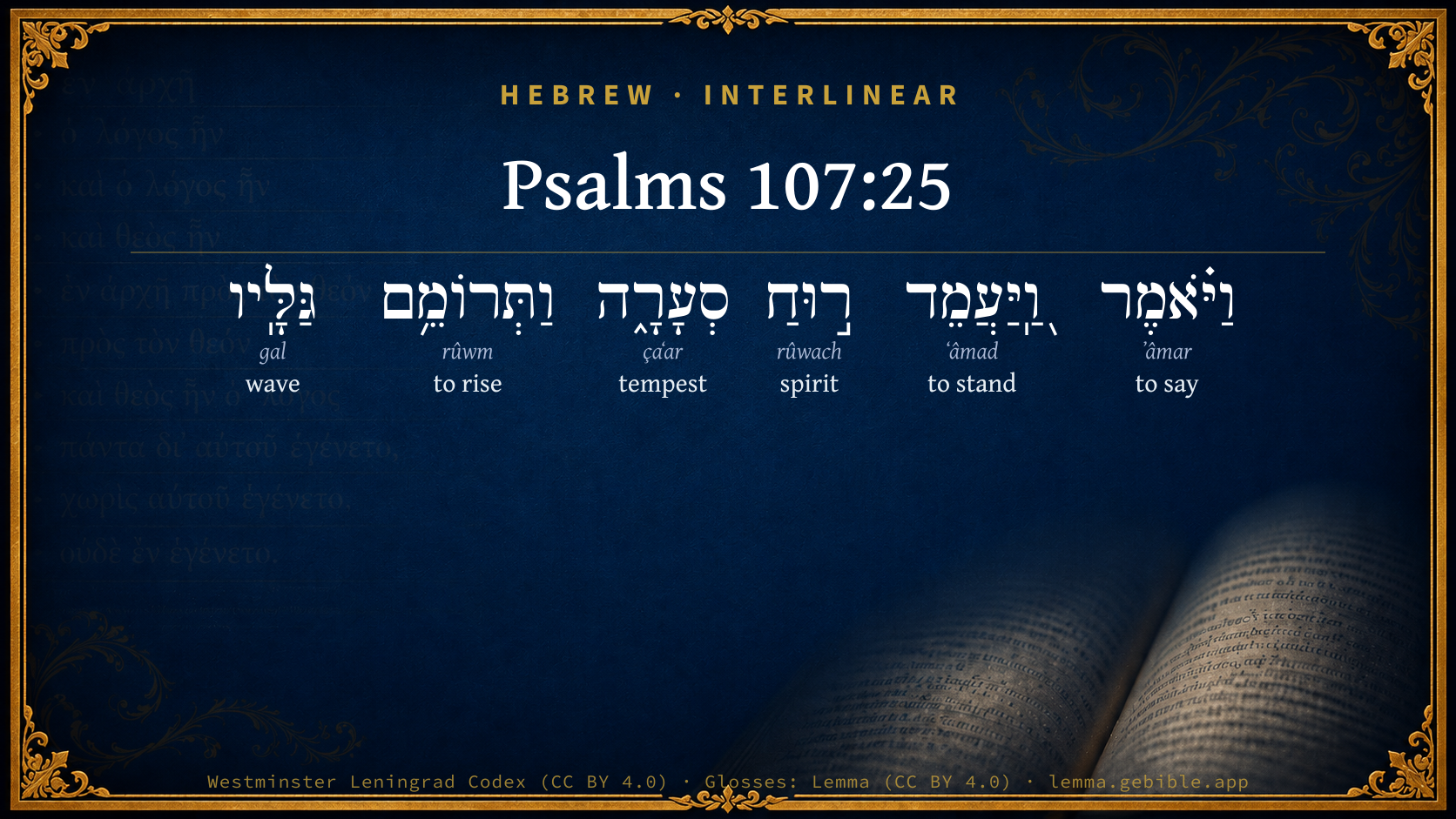
Psalms 107:25

Hebrew (Westminster Leningrad Codex) Psalms 107:25 appears in the Hebrew Old Testament. The text above is from the Westminster Leningrad Codex. Each word links to its Strong’s number, a concise gloss, and parsing drawn from the Open Scriptures Hebrew Bible morphology. Click any word for its full Brown-Driver-Briggs (BDB) entry.
Download image
Cite this verse

Psalms 107:25 (World English Bible). Public Domain. Lemma interlinear Bible study tool, https://lemma.gebible.app/v/psalms/107/25.

Show BibTeX & RIS
BibTeX
RIS
English Translation
For he commands, and raises the stormy wind, Which lifts up its waves.
World English Bible · Public Domain
Download a study sheet

One document with this verse’s original text, its word-by-word gloss line, the meaning frame, cross-references with their text, attributed commentary, and full source and license credits — printable, and it pastes into notes with its structure intact.

This verse Autodidact and up

Study sheet (.html) Plain text (.txt)

A passage Seminary Student

Up to 50 verses in one chapter. A passage sheet keeps up to 6 commentary sources and 12 cross-references per verse, in the order this page ranks them, and says so on the sheet whenever that leaves anything out. Ask for a single verse and you get the Autodidact verse sheet above.

Everything on this page stays free to read, with no account — the sheet is a download of what is already on screen, not access to it.

Want to remove ads? Support Godless Engineer
Compare translations 3

The same verse in 3 English versions, stacked beneath the original-language interlinear above. Click any original word for its lexicon entry.

Each is an independent rendering of the whole verse — the interlinear is not word-aligned to these translations.

Highlighted words mark where these versions differ — a whole-verse word diff, not a word-by-word alignment.

  • World English Bible Public Domain
    For he commands, and raises the stormy wind, Which lifts up its waves.
  • King James Version Public Domain
    For he commandeth, and raiseth the stormy wind, which lifteth up the waves thereof.
  • unfoldingWord Literal Text CC BY-SA 4.0
    Then he spoke and aroused the wind of a hurricane and raised up his waves.

unfoldingWord Literal Text — © unfoldingWord, licensed CC BY-SA 4.0. Word-aligned USFM3 via Door43 (git.door43.org/unfoldingWord/en_ult).

Versions to compare (up to 4)

3 of 4 selected

Show all 18 translations

Every available English version of this verse, each an independent rendering of the whole verse.

  • World English Bible Public Domain
    For he commands, and raises the stormy wind, Which lifts up its waves.
  • Berean Standard Bible Public Domain
    For He spoke and raised a tempest that lifted the waves of the sea.
  • Majority Standard Bible Public Domain
    For He spoke and raised a tempest that lifted the waves of the sea.
  • King James Version Public Domain
    For he commandeth, and raiseth the stormy wind, which lifteth up the waves thereof.
  • American Standard Version (1901) Public Domain
    For he commandeth, and raiseth the stormy wind, Which lifteth up the waves thereof.
  • Revised Version (1885) Public Domain
    For he commandeth, and raiseth the stormy wind, which lifteth up the waves thereof.
  • Geneva Bible (1599) Public Domain
    For he commaundeth and raiseth the stormie winde, and it lifteth vp the waues thereof.
  • Douay-Rheims (1899) Public Domain
    He said the word, and there arose a storm of wind: and the waves thereof were lifted up.
  • Young's Literal Translation Public Domain
    And He saith, and appointeth a tempest, And it lifteth up its billows,
  • Literal Standard Version CC BY-SA 4.0
    And He commands, and appoints a storm, || And it lifts up its billows,
  • Unlocked Literal Bible CC BY-SA 4.0
    For he commanded and aroused the windstorm that stirs up the seas.
  • unfoldingWord Literal Text CC BY-SA 4.0
    Then he spoke and aroused the wind of a hurricane and raised up his waves.
  • Darby Bible Public Domain
    For he speaketh, and raiseth the stormy wind, which lifteth up the waves thereof:
  • World Messianic Bible Public Domain
    For he commands, and raises the stormy wind, which lifts up its waves.
  • Webster's Bible Public Domain
    For he commandeth, and raiseth the stormy wind, which lifteth up its waves.
  • Free Bible Version CC BY-SA 4.0
    He only had to speak to cause a stormy wind that stirred up towering waves,
  • Bible in Basic English Public Domain
    For at his word comes up the storm-wind, lifting high the waves.
  • JPS Tanakh (1917) Public Domain
    For He commanded, and raised the stormy wind, which lifted up the waves thereof;

Literal Standard Version (2020), Covenant Press — licensed CC BY-SA 4.0. Text via the HelloAO Bible API (eBible.org). Unlocked Literal Bible (unfoldingWord) — licensed CC BY-SA 4.0. Text via the HelloAO Bible API (eBible.org). unfoldingWord Literal Text — © unfoldingWord, licensed CC BY-SA 4.0. Word-aligned USFM3 via Door43 (git.door43.org/unfoldingWord/en_ult). Free Bible Version, Dr. Jonathan Gallagher — licensed CC BY-SA 4.0. Text via the HelloAO Bible API (eBible.org).

Word by word

More ways to search: Search by grammar → Find every occurrence → Compare this word →

Practice this passage: Drill this verse → Learn its vocabulary →

About this verse

These counts appear in no published source. They are computed here, from the morphology-tagged text and Lemma’s own curated glosses. What Lemma adds →

6
words
6
distinct lemmas
Wisdom
section

Shared distinctive vocabulary

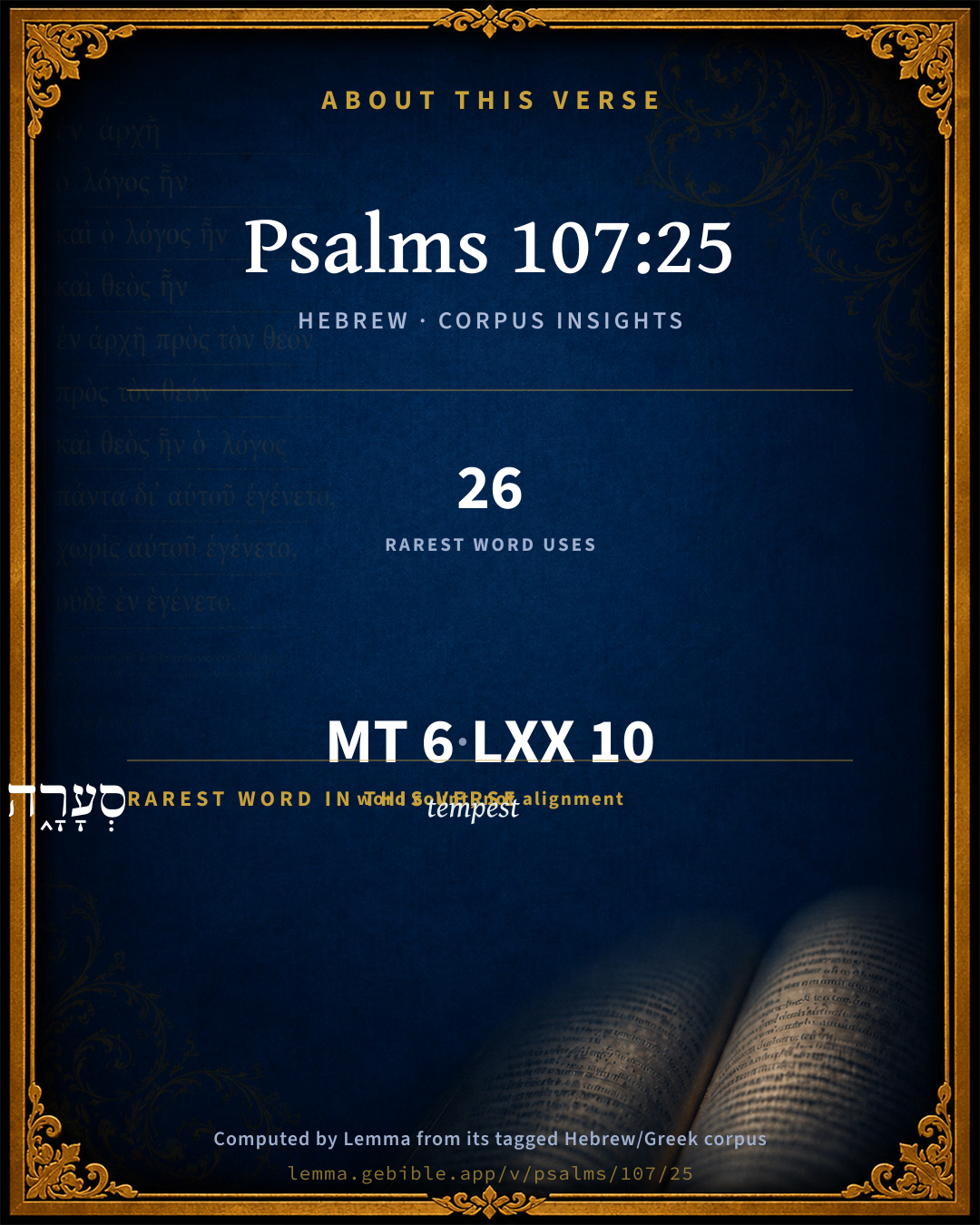
סְעָרָ֑ה tempest H5591 occurs in 22 verses of the Hebrew Bible. Also found in:

Grammatical profile

  • 3 verbs
  • 3 nouns

Verb forms

  • וַיֹּ֗אמֶר Qal · Sequential Imperfect
  • וַֽ֭יַּעֲמֵד Hiphil · Sequential Imperfect
  • וַתְּרוֹמֵ֥ם Polel · Sequential Imperfect

Hebrew & Septuagint length

In English translation the verse runs 13 words from the Hebrew and 13 from the Septuagint (LXX English) — the same length.

A rough comparison of the two English renderings, which tokenize alike — not a word-level alignment.

Word counts can differ between the Hebrew and the Greek without any difference in meaning — e.g. the Hebrew direct-object marker אֵת has no separate Greek word, and Greek often adds the article ὁ.

In the original languages it is 6 Hebrew tokens and 10 Greek tokens — but the two are counted differently (Hebrew bundles its prefixes and suffixes into one token; the Greek is in lemma form), so that isn’t a like-for-like length.

Cross-references

8

Topical passages linked to Psalms 107:25 in the Treasury of Scripture Knowledge — connected by theme and wording, ordered by reader-vote popularity; previews shown in the World English Bible.

  • Jonah 1:4 But Yahweh sent out a great wind on the sea, and there was a mighty tempest on the sea, so that the ship was likely to break up.
  • Matthew 8:24 Behold, a great tempest arose in the sea, so much that the boat was covered with the waves, but he was asleep.
  • Psalms 148:8 Lightning and hail, snow and clouds; Stormy wind, fulfilling his word;
  • Psalms 93:3 The floods have lifted up, Yahweh, The floods have lifted up their voice. The floods lift up their waves.
  • Psalms 105:34 He spoke, and the locusts came, And the grasshoppers, without number,
  • Psalms 105:31 He spoke, and swarms of flies came, And lice in all their borders.
  • Psalms 135:7 Who causes the clouds to rise from the ends of the earth; Who makes lightnings with the rain; Who brings forth the wind out of his treasuries;
  • John 6:18 The sea was tossed by a great wind blowing.

Cross-references courtesy of OpenBible.info (CC BY 4.0).

Hebrew and Greek witnesses Masoretic Hebrew ↔ Greek Septuagint

The same verse in the two great witnesses to the Old Testament, shown verse-for-verse.

You’re reading Greek Psalm 106 (Hebrew Psalm 107). The Septuagint counts the superscription, so verse numbers can differ from the Hebrew — chapter-level alignment, not verse-by-verse. Numbering follows Rahlfs.

These are two independent witnesses, not word-aligned to each other, and the Septuagint is shown in lemma (dictionary) form.

Hebrew Psalms 107:25 Masoretic · Westminster Leningrad Codex

וַיֹּ֗אמֶר וַֽ֭יַּעֲמֵד ר֣וּחַ סְעָרָ֑ה וַתְּרוֹמֵ֥ם גַּלָּֽיו

For he commands, and raises the stormy wind, Which lifts up its waves.

World English Bible · Public Domain

Greek LXX Greek Psalm 106:25 Septuagint · lemma form

εἶπον καί ἵστημι πνεῦμα καταιγίς καί ὑψόω ὁ κῦμα αὐτός

He speaks, and the stormy wind arises, and its waves are lifted up.

LXX2012 (modern English Septuagint) · Public Domain

On this verse, The Cambridge Bible for Schools and Colleges discusses the Septuagint’s reading. Read the note in Commentary ↓

Hebrew: Westminster Leningrad Codex (CC BY 4.0). Greek: Septuagint (public domain); English from LXX2012 (modern English Septuagint) (Public Domain). How the Septuagint differs from the Hebrew →

Commentary

Notes on Psalms 107:25 from classic Christian and Jewish commentators (each source and its license shown beneath its notes). The classic Christian expositions comment on the surrounding passage and are grouped to its opening verse, so a note may address several verses; the Jewish commentaries on the Tanakh (Rashi and others) are per-verse, so they appear only where the commentator wrote on this verse.

Lemma curates 59 commentaries, every one of them public domain or Creative Commons licensed, each selected and text-cleaned for this edition rather than reprinted as found. About our sources →

Trapp's Complete Commentary

John Trapp

Psa 107:25 For he commandeth, and raiseth the stormy wind, which lifteth up the waves thereof.

Ver. 25. For he commandeth, and raiseth the stormy wind, &c.] Of this Seneca, though a heathen, could say, Inter caetera providentiae divinae opera hoc quoque dignum est admiratione, &c., Among other works of the Divine providence this is admirable, that the winds lie upon the sea for the furtherance of navigation, &c.

John Trapp, A Commentary or Exposition upon All the Books of the Old and New Testament (1647–1656) — public domain. Text from a community e-Sword module.

J. A. Alexander on Psalms

Joseph Addison Alexander

25. (Psa 107:25) And he said—and there arose a stormy wind, and it lifted up his waves. He now parenthetically specifies some of the divine works which he had just mentioned in the general. The form of expression at the beginning, as in all like cases, involves an allusion to the history of the creation, where each creative act is preceded by God's saying, let it be. So here the full sense is, and God said (let a stormy wind arise) and a stormy wind arose. See above, on Psa 33:9. Arose, literally stood, stood up, as in Psa 106:30. A stormy wind, literally a wind of storm or tempest. Instead of his waves we may read its waves, and refer the pronoun to the remoter antecedent (sea) in Psa 107:23. Deep, in Psa 107:24, is of a different gender. It is equally correct, however, and more natural, to refer it to Jehovah, as the maker of the sea and the ruler of its waves. Compare the expression thy waves and thy billows in Psa 42:8. See also Isa 51:15, Jer 31:35.

Joseph Addison Alexander, The Psalms Translated and Explained (1850) — public domain. Text from a community e-Sword module.

Tyndale Open Study Notes

Tyndale Open Resources

107:25-29 The same God who speaks and brings about the sailors’ distress can also calm the storm with just a word (cp. Jon 1:4; Matt 8:26).

Tyndale Open Study Notes — © Tyndale Open Resources, licensed CC BY-SA 4.0. Text via the HelloAO Bible API.

Adam Clarke's Commentary

Verse 25. For he commandeth] And what less than the command of God can raise up such winds as seem to heave old Ocean from his bed?

Adam Clarke's Commentary on the Bible (1810–1826) — public domain. Text from a community e-Sword/MySword module.

Ellicott's Commentary for English Readers

(25) He commandeth.—Literally, He speaks. The Almighty fiat, as in Genesis 1.

A Bible Commentary for English Readers, edited by Charles John Ellicott (1878–1897) — public domain. Text from a community e-Sword module.

The Cambridge Bible for Schools and Colleges

gen. ed. J. J. S. Perowne

25. For he commandeth &c.] For he spake, and raised &c. Cp. Psa_105:31; Psa_105:34; Gen_1:3 &c. The P.B.V., For at his word the stormy wind ariseth follows the LXX (Vulg.) and Jer. in presuming a different vocalisation of the Heb. consonants, which may possibly be right.

The Cambridge Bible for Schools and Colleges (gen. ed. J. J. S. Perowne; Cambridge University Press, 1878–1918) — public domain. Text from a community e-Sword module.

John Gill's Exposition

Then they cry unto the Lord in their trouble,.... As in a storm seafaring persons are used to do; so did Jonah's mariners, though Heathens, everyone cried to his god. With the Romans (o) tempests were reckoned deities, and had temples erected, and sacrifices offered to them; but these persons were such as knew and owned the true Jehovah, and called upon him in their distress: so did the apostles of Christ.

And he bringeth them out of their distresses; by stilling the winds and the waves, causing them to proceed on their voyage with pleasure, and landing them safe on shore, as follows.

(o) Cicero, de Nat. Deor. l. 3. c. 20. Virgil. Aeneid. l. 5. v. 772. Horat. Epod. Ode 10. v. 23, 24. Ovid. Fast. 6. v. 193.

John Gill's Exposition of the Whole Bible (1746–1763) — public domain (CC PDM 1.0). Text via the HelloAO Bible API.

Albert Barnes' Notes on the Bible

For he commandeth - Hebrew, “he says;” that is, He speaks the word, and it is done. The mere expression of his will raises up the storm, and throws the sea into commotion.

And raiseth the stormy wind - Margin, as in Hebrew, “Maketh to stand.” The “stormy wind” is literally, the wind of the tempest.

Which lifteth up the waves thereof - The waves of the ocean. The wind seems to take them up, and lift them on high.

Albert Barnes' Notes on the Bible (1834–1885) — public domain. Text from a community e-Sword/MySword module.

Matthew Poole's English Annotations

The winds and storms come not by chance, but by the disposition of Divine Providence.

Matthew Poole's English Annotations on the Holy Bible (1683–1685) — public domain. Text from a community e-Sword/MySword module.

The Treasury of David

Charles H. Spurgeon

Ver. 25. For he commandeth: his word is enough for anything, he has but to will it and the tempest rages.

And raiseth the stormy wiled. It seemed to he asleep before, but it knows its Master's bidding, and is up at once in all its fury.

Which lifteth up the waves thereof. The glassy surface of the sea is broken, and myriads of white heads appear and rage and toss themselves to and fro as the wind blows upon them. Whereas they were lying down in quiet before, the waves rise in their might and leap towards the sky as soon as the howling of the wind awakens them.

Thus it needs but a word from God and the soul is in troubled waters, tossed to and fro with a thousand afflictions. Doubts, fears, terrors, anxieties lift their heads like so many angry waves, when once the Lord allows the storm winds to beat upon us.

Ver. 25-31.

Think, O my soul, devoutly think,

How, with affrighted eyes

Thou saw'st the wide extended deep

In all its horrors rise!

Confusion dwelt in every face,

And fear in every heart;

When waves on waves, and gulfs on gulfs,

Overcame the pilot's art.

Yet then from all my griefs, O Lord,

Thy mercy set me free,

Whilst in the confidence of prayer

My soul took hold on thee.

For though in dreadful whirls we hung

High on the broken wave,

I knew thou wert not slow to hear,

Nor impotent to save.

The storm was laid, the winds retired,

Obedient to thy will;

The sea that roared at thy command,

At thy command was still.

In midst of dangers, fears, and death,

Thy goodness I will adore,

And praise thee for thy mercies past;

And humbly hope for more.

My life, if thou preservest my life,

Thy sacrifice shall be;

And death, if death must be my doom,

Shall join my soul to thee. Joseph Addison.

Psalms 107:26*

Charles H. Spurgeon's The Treasury of David (1869–1885) — public domain. Psalms only. Text from a community e-Sword/MySword module.

Whedon's Commentary on the Bible

Daniel D. Whedon

25. He commandeth—No allusion to second causes, laws, or forces of nature, but all phenomena are referred directly to God, who saves by sea as well as by land. Psa_65:5. The descriptions which follow to Psa_107:30 require no comment. The object of these various citations of human distress and divine deliverance is, to show that Israel’s redemption from bondage stands out as a wonder of divine grace, equal to the greatest known to human experience; and that no exigence of human affairs is beyond the reach of divine help if men will seek God, obey his directions, and render him due praise.

Daniel D. Whedon (gen. ed.), Commentary on the Old and New Testaments (1874–1909) — public domain. Text from a community e-Sword module.

The Pulpit Commentary

For he commandeth, and raiseth the stormy wind. (comp. Psa_147:15, 18 Jon_1:4) The operations of nature are constantly spoken of in Scripture as God"s direct doing. Which lifteth up the waves thereof ; or, "the waves that are his". (compare, in Psa_147:17, Psa_147:18, "his ice, his cold, his wind

The Pulpit Commentary (1880–1919), ed. H.D.M. Spence-Jones & Joseph S. Exell — public domain. Text from a community e-Sword module.

unfoldingWord translationNotes

Door43 World Missions Community

he commanded and aroused the windstorm that stirs up the seas

"he commanded the wind and caused it become a great windstorm that stirred up the sea"

windstorm

a strong wind, like the wind that accompanies a strong rain storm

that stirs up the seas

Here David describes the winds causing the waves to become high as if the wind was an object fiercely stirring something. AT: "that caused the waves of the sea to become very high" (See: Metaphor)

They reached up to the sky; they went down to the depths

This describes the ships rising and falling with the waves. The extremes of rising to the sky and falling to the depths are an exaggeration to express how horrible the windstorm was and how large the waves were. AT: "their ships would rise very high on the waves and then they would fall very low between the waves" (See: Hyperbole and Generalization)

Their lives melted away in distress

This idiom describes the sailors' great fear. AT: "The men were terrified and greatly distressed" (See: Idiom)

were at their wits' end

The phrase "at their wit's end" means that they did not know what to do. AT: "and they did not know what to do" or "they had no idea what to do" (See: Idiom)

translationWords

command

heaven

drunk

unfoldingWord translationNotes — © Distant Shores Media and the Door43 World Missions Community, licensed CC BY-SA 4.0. Source: git.door43.org/Door43/en_tn.

Lesson kit

Teaching starters — assembled from the data on this page, not authored interpretation. Every prompt links to the verse data it draws on. Edit before teaching.

Psalms, in the Wisdom, opens this verse with 6 words (6 distinct Hebrew lemmas). Its most distinctive word is çaʻar (“tempest”). A historical commentator’s framing appears above. Read the whole chapter for the surrounding context.

Discussion questions

  1. What does “tempest” (çaʻar) contribute to the verse as a whole?
  2. How does 2 Kings 2:1, which shares the word «tempest», read alongside this verse?
  3. These translations render this verse differently. What is at stake in choosing one wording over another?
  4. «וַיֹּ֗אמֶר» is a Qal Sequential Imperfect verb. How does that grammatical form shape the action described?
  5. Compare how Trapp's Complete Commentary and J. A. Alexander on Psalms read this verse. Where do they agree or differ?

Things to notice

Reading settings

Reading text

Shown beneath each verse's original-language words.

Old Testament
Old Testament edition

Read the OT as the Masoretic Hebrew (MT) or the Greek Septuagint (LXX).

English shown for the Greek Septuagint (in the Hebrew ↔ Greek comparison).

Comparing translations? Open the Compare panel on any verse page to stack up to four side by side.